


Community hub
Recent from talks
Contribute something
Nothing was collected or created yet.
Redshift
View on Wikipedia

| General relativity |
|---|
 |



| Part of a series on |
| Physical cosmology |
|---|
 |

| Special relativity |
|---|
 |
In physics, a redshift is an increase in the wavelength, or equivalently, a decrease in the frequency, of electromagnetic radiation (such as light). The opposite change, a decrease in wavelength and increase in frequency and energy, is known as a blueshift.
Three forms of redshift occur in astronomy and cosmology: Doppler redshifts due to the relative motions of radiation sources, gravitational redshift as radiation escapes from gravitational potentials, and cosmological redshifts caused by the universe expanding. In astronomy, the value of a redshift is often denoted by the letter z, corresponding to the fractional change in wavelength (positive for redshifts, negative for blueshifts), and by the wavelength ratio 1 + z (which is greater than 1 for redshifts and less than 1 for blueshifts). Automated astronomical redshift surveys are an important tool for learning about the large-scale structure of the universe. Redshift and blueshift can also be related to photon energy and, via Planck's law, to a corresponding blackbody temperature.
Examples of strong redshifting are a gamma ray perceived as an X-ray, or initially visible light perceived as radio waves. The initial 3000 kelvin (K) radiation from the Big Bang has redshifted far down to become the 3 K cosmic microwave background. Subtler redshifts are seen in the spectroscopic observations of astronomical objects, and are used in terrestrial technologies such as Doppler radar and radar guns. Gravitational waves, which also travel at the speed of light, are subject to the same redshift phenomena.[1]
Other physical processes exist that can lead to a shift in the frequency of electromagnetic radiation, including scattering and optical effects; however, the resulting changes are distinguishable from (astronomical) redshift and are not generally referred to as such.
Concept
[edit]
Using a telescope and a spectrometer, the variation in intensity of star light with frequency can be measured. The resulting spectrum can be compared to the spectrum from hot gases expected in stars, such as hydrogen, in a laboratory on Earth. As illustrated with the idealised spectrum in the top-right, to determine the redshift, features in the two spectra such as absorption lines, emission lines, or other variations in light intensity may be shifted.
Redshift (and blueshift) may be characterised by the relative difference between the observed and emitted wavelengths (or frequency) of an object. In astronomy, it is customary to refer to this change using a dimensionless quantity called z. If λ represents wavelength and f represents frequency (note, λf = c where c is the speed of light), then z is defined by the equations:[3]
| Based on wavelength | Based on frequency |
|---|---|

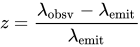
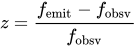
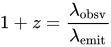
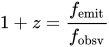
Doppler effect blueshifts (z < 0) are associated with objects approaching (moving closer to) the observer with the light shifting to greater energies. Conversely, Doppler effect redshifts (z > 0) are associated with objects receding (moving away) from the observer with the light shifting to lower energies. Likewise, gravitational blueshifts are associated with light emitted from a source residing within a weaker gravitational field as observed from within a stronger gravitational field, while gravitational redshifting implies the opposite conditions.
History
[edit]The history of the subject began in the 19th century, with the development of classical wave mechanics and the exploration of phenomena which are associated with the Doppler effect. The effect is named after the Austrian mathematician Christian Doppler, who offered the first known physical explanation for the phenomenon in 1842.[4][5]: 107 In 1845, the hypothesis was tested and confirmed for sound waves by the Dutch scientist Christophorus Buys Ballot.[6] Doppler correctly predicted that the phenomenon would apply to all waves and, in particular, suggested that the varying colors of stars could be attributed to their motion with respect to the Earth.[7]
Unaware of Doppler's work, French physicist Hippolyte Fizeau suggested in 1848 that a shift in spectral lines from stars might be used to measure their motion relative to Earth.[5]: 109 In 1850, François-Napoléon-Marie Moigno analysed both Doppler's and Fizeau's ideas in a publication read by both James Clerk Maxwell and William Huggins, who initially stuck to the idea that the color of stars related to their chemistry, however by 1868, Huggins was the first to determine the velocity of a star moving away from the Earth by the analysis of spectral shifts.[8][5]: 111
In 1871, optical redshift was confirmed when the phenomenon was observed in Fraunhofer lines, using solar rotation, about 0.1 Å in the red.[9] In 1887, Hermann Carl Vogel and Julius Scheiner discovered the "annual Doppler effect", the yearly change in the Doppler shift of stars located near the ecliptic, due to the orbital velocity of the Earth.[10] In 1901, Aristarkh Belopolsky verified optical redshift in the laboratory using a system of rotating mirrors.[11][9]
Beginning with observations in 1912, Vesto Slipher discovered that the Andromeda Galaxy had a blue shift, indicating that it was moving towards the Earth.[12] Slipher first reported his measurement in the inaugural volume of the Lowell Observatory Bulletin.[13] Three years later, he wrote a review in the journal Popular Astronomy.[14] In it he stated that "the early discovery that the great Andromeda spiral had the quite exceptional velocity of –300 km[/s] showed the means then available, capable of investigating not only the spectra of the spirals but their velocities as well."[14] Slipher reported the velocities for 15 spiral nebulae spread across the entire celestial sphere, all but three having observable "positive" (that is recessional) velocities.[12]
Until 1923 the nature of the nebulae was unclear. By that year Edwin Hubble had established that these were galaxies and worked out a procedure to measure distance based on the period-luminosity relation of variable Cepheids stars. This made it possible to test a prediction by Willem de Sitter in 1917 that redshift would be correlated with distance. In 1929 Hubble combined his distance estimates with redshift data from Slipher's reports and measurements by Milton Humason to report an approximate relationship between the redshift and distance, a result now called Hubble's law.[12]: 64 [15][16]
Theories relating to the redshift-distance relation also evolved during the 1920s. The solution to the equations of general relativity described by de Sitter contained no matter, but in 1922 Alexander Friedmann derived dynamic solutions, now called the Friedmann equations, based on frictionless fluid models.[17] Independently Georges Lemaître derived similar equations in 1927 and his analysis became widely known around the time of Hubble's key publication.[12]: 77
By early 1930 the combination of the redshift measurements and theoretical models established a major breakthrough in the new science of cosmology: the universe had a history and its expansion could be investigated with physical models backed up with observational astronomy.[12]: 99
When cosmological redshifts were first discovered, Fritz Zwicky proposed an effect known as tired light. However this model has largely been ruled out by timescale stretch observations in type Ia supernovae.[18]
Arthur Eddington used the term "red shift" as early as 1923, which is the oldest example of the term reported by the Oxford English Dictionary.[19][20] Willem de Sitter used the single-word version redshift in 1934.[21]
In the 1960s the discovery of quasars, which appear as very blue point sources and thus were initially thought to be unusual stars, led to the idea that they were as bright as they were because they were closer than their redshift data indicated. A flurry of theoretical and observational work concluded that these objects were very powerful but distant astronomical objects.[12]: 261
Physical origins
[edit]Redshifts are differences between two wavelength measurements and wavelengths are a property of both the photons and the measuring equipment. Thus redshifts characterise differences between two measurement locations. These differences are commonly organised in three groups, attributed to relative motion between the source and the observer, to the expansion of the universe, and to gravity.[22] The following sections explain these groups.
Doppler effect
[edit]

If a source of the light is moving away from an observer, then redshift (z > 0) occurs; if the source moves towards the observer, then blueshift (z < 0) occurs. This is true for all electromagnetic waves and is explained by the Doppler effect. Consequently, this type of redshift is called the Doppler redshift. If the source moves away from the observer with velocity v, which is much less than the speed of light (v ≪ c), the redshift is given by

where c is the speed of light (since ). In the classical Doppler effect, the frequency of the source is not modified, but the recessional motion causes the illusion of a lower frequency.

A more complete treatment of the Doppler redshift requires considering relativistic effects associated with motion of sources close to the speed of light. A complete derivation of the effect can be found in the article on the relativistic Doppler effect. In brief, objects moving close to the speed of light will experience deviations from the above formula due to the time dilation of special relativity which can be corrected for by introducing the Lorentz factor γ into the classical Doppler formula as follows (for motion solely in the line of sight):
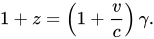
This phenomenon was first observed in a 1938 experiment performed by Herbert E. Ives and G. R. Stilwell, called the Ives–Stilwell experiment.[23]
Since the Lorentz factor is dependent only on the magnitude of the velocity, this causes the redshift associated with the relativistic correction to be independent of the orientation of the source movement. In contrast, the classical part of the formula is dependent on the projection of the movement of the source into the line-of-sight which yields different results for different orientations. If θ is the angle between the direction of relative motion and the direction of emission in the observer's frame[24] (zero angle is directly away from the observer), the full form for the relativistic Doppler effect becomes:
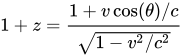
and for motion solely in the line of sight (θ = 0°), this equation reduces to:
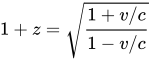
For the special case that the light is moving at right angle (θ = 90°) to the direction of relative motion in the observer's frame,[25] the relativistic redshift is known as the transverse redshift, and a redshift:
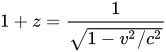
is measured, even though the object is not moving away from the observer. Even when the source is moving towards the observer, if there is a transverse component to the motion then there is some speed at which the dilation just cancels the expected blueshift and at higher speed the approaching source will be redshifted.[26]
Cosmological
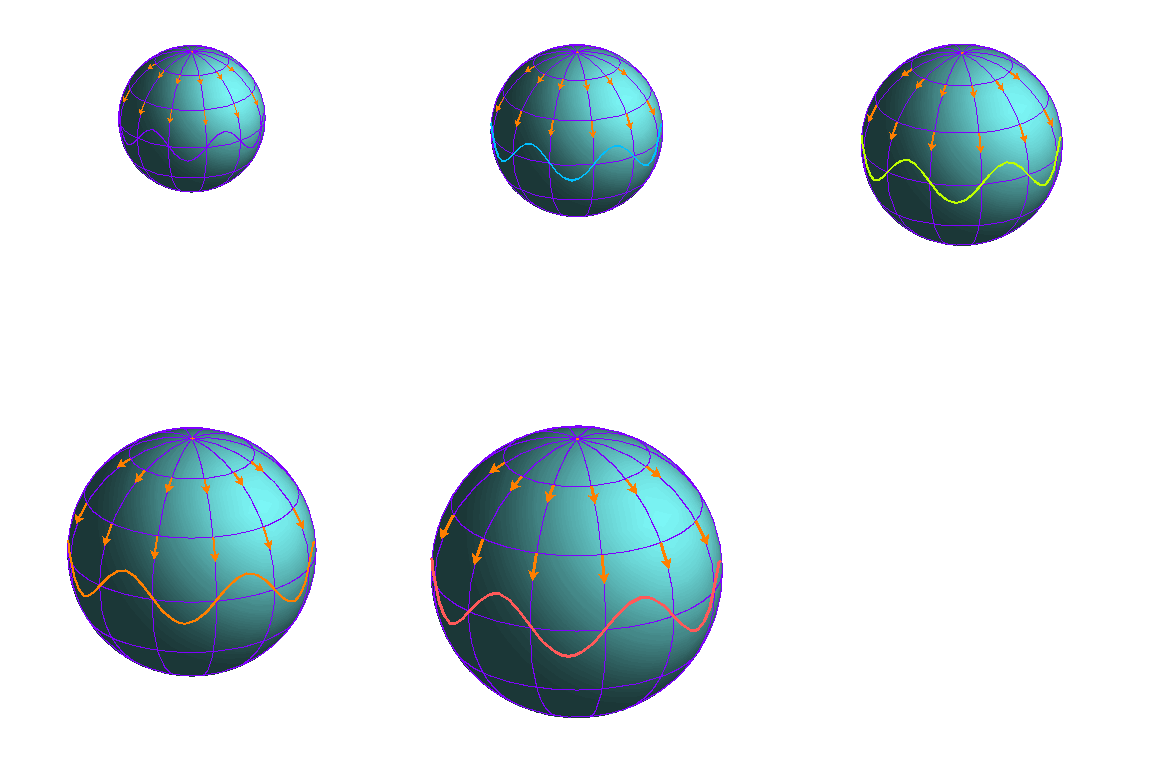
[edit]The observations of increasing redshifts from more and more distant galaxies can be modelled assuming a homogeneous and isotropic universe combined with general relativity. This cosmological redshift can be written as a function of a, the time-dependent cosmic scale factor:[27]: 72

The scale factor is monotonically increasing as time passes. Thus z is positive, close to zero for local stars, and increasing for distant galaxies that appear redshifted.
Using a Friedmann–Robertson–Walker model of the expansion of the universe, redshift can be related to the age of an observed object, the so-called cosmic time–redshift relation. Denote a density ratio as Ω0:

with ρcrit the critical density demarcating a universe that eventually crunches from one that simply expands. This density is about three hydrogen atoms per cubic meter of space.[28] At large redshifts, 1 + z > Ω0−1, one finds:
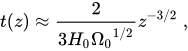
where H0 is the present-day Hubble constant, and z is the redshift.[29][30]
The cosmological redshift is commonly attributed to stretching of the wavelengths of photons due to the stretching of space. This interpretation can be misleading. As required by general relativity, the cosmological expansion of space has no effect on local physics. There is no term related to expansion in Maxwell's equations that govern light propagation. The cosmological redshift can be interpreted as an accumulation of infinitesimal Doppler shifts along the trajectory of the light.[31]
There are several websites for calculating various times and distances from redshift, as the precise calculations require numerical integrals for most values of the parameters.[32][33]
Distinguishing between cosmological and local effects
[edit]The redshift of a galaxy includes both a component related to recessional velocity from expansion of the universe, and a component related to the peculiar motion of the galaxy with respect to its local universe.[34] The redshift due to expansion of the universe depends upon the recessional velocity in a fashion determined by the cosmological model chosen to describe the expansion of the universe, which is very different from how Doppler redshift depends upon local velocity.[35] Describing the cosmological expansion origin of redshift, cosmologist Edward Robert Harrison said, "Light leaves a galaxy, which is stationary in its local region of space, and is eventually received by observers who are stationary in their own local region of space. Between the galaxy and the observer, light travels through vast regions of expanding space. As a result, all wavelengths of the light are stretched by the expansion of space. It is as simple as that..."[36] Steven Weinberg clarified, "The increase of wavelength from emission to absorption of light does not depend on the rate of change of a(t) [the scale factor] at the times of emission or absorption, but on the increase of a(t) in the whole period from emission to absorption."[37]
Gravitational redshift
[edit]In the theory of general relativity, there is time dilation within a gravitational well. Light emitted within the well will appear to have fewer cycles per second when measured outside of the well, due to differences in the two clocks.[38]: 284 This is known as the gravitational redshift or Einstein shift.[39] The theoretical derivation of this effect follows from the Schwarzschild solution of the Einstein equations which yields the following formula for redshift associated with a photon travelling in the gravitational field of an uncharged, nonrotating, spherically symmetric mass:
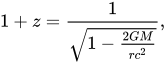
where
- G is the gravitational constant,
- M is the mass of the object creating the gravitational field,
- r is the radial coordinate of the source (which is analogous to the classical distance from the center of the object, but is actually a Schwarzschild coordinate), and
- c is the speed of light.
This gravitational redshift result can be derived from the assumptions of special relativity and the equivalence principle; the full theory of general relativity is not required.[40]
The effect is very small but measurable on Earth using the Mössbauer effect and was first observed in the Pound–Rebka experiment.[41] However, it is significant near a black hole, and as an object approaches the event horizon the red shift becomes infinite. It is also the dominant cause of large angular-scale temperature fluctuations in the cosmic microwave background radiation (see Sachs–Wolfe effect).[42]
Summary table
[edit]Several important special-case formulae for redshift in certain special spacetime geometries are summarised in the following table. In all cases the magnitude of the shift (the value of z) is independent of the wavelength.[43]
| Redshift type | Geometry | Formulae[a] |
|---|---|---|
| Relativistic Doppler | Minkowski space (flat spacetime) |
For motion completely in the radial or
for small For motion completely in the transverse direction:
for small |
| Cosmological redshift | FLRW spacetime (expanding Big Bang universe) |
for |
| Gravitational redshift | Any stationary spacetime |
For the Schwarzschild geometry:
for In terms of escape velocity: for |
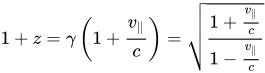


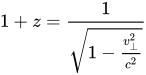
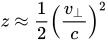

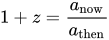


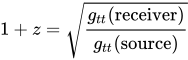
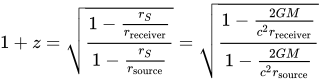
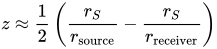



- ^ Where z = redshift; v|| = velocity parallel to line-of-sight (positive if moving away from receiver); c = speed of light; γ = Lorentz factor; a = scale factor; G = gravitational constant; M = object mass; r = radial Schwarzschild coordinate, gtt = t,t component of the metric tensor
Observations in astronomy
[edit]
The redshift observed in astronomy can be measured because the emission and absorption spectra for atoms are distinctive and well known, calibrated from spectroscopic experiments in laboratories on Earth. When the redshifts of various absorption and emission lines from a single astronomical object are measured, z is found to be remarkably constant. Although distant objects may be slightly blurred and lines broadened, it is by no more than can be explained by thermal or mechanical motion of the source. For these reasons and others, the consensus among astronomers is that the redshifts they observe are due to some combination of the three established forms of Doppler-like redshifts.
Spectroscopy, as a measurement, is considerably more difficult than simple photometry, which measures the brightness of astronomical objects through certain filters. When photometric data is all that is available (for example, the Hubble Deep Field and the Hubble Ultra Deep Field), astronomers rely on a technique for measuring photometric redshifts.[45] Due to the broad wavelength ranges in photometric filters and the necessary assumptions about the nature of the spectrum at the light-source, errors for these sorts of measurements can range up to δz = 0.5, and are much less reliable than spectroscopic determinations.[46]
However, photometry does at least allow a qualitative characterisation of a redshift. For example, if a Sun-like spectrum had a redshift of z = 1, it would be brightest in the infrared (1000 nm) rather than at the blue-green (500 nm) color associated with the peak of its blackbody spectrum, and the light intensity will be reduced in the filter by a factor of four, (1 + z)2. Both the photon count rate and the photon energy are redshifted. (See K correction for more details on the photometric consequences of redshift.)
Determining the redshift of an object with spectroscopy requires the wavelength of the emitted light in the rest frame of the source. Astronomical applications rely on distinct spectral lines. Redshifts cannot be calculated by looking at unidentified features whose rest-frame frequency is unknown, or with a spectrum that is featureless or white noise (random fluctuations in a spectrum). Thus gamma-ray bursts themselves cannot be used for reliable redshift measurements, but optical afterglow associated with the burst can be analysed for redshifts.[47]
Local observations
[edit]In nearby objects (within our Milky Way galaxy) observed redshifts are almost always related to the line-of-sight velocities associated with the objects being observed. Observations of such redshifts and blueshifts enable astronomers to measure velocities and parametrise the masses of the orbiting stars in spectroscopic binaries. Similarly, small redshifts and blueshifts detected in the spectroscopic measurements of individual stars are one way astronomers have been able to diagnose and measure the presence and characteristics of planetary systems around other stars and have even made very detailed differential measurements of redshifts during planetary transits to determine precise orbital parameters. Some approaches are able to track the redshift variations in multiple objects at once.[48]
Finely detailed measurements of redshifts are used in helioseismology to determine the precise movements of the photosphere of the Sun.[49] Redshifts have also been used to make the first measurements of the rotation rates of planets,[50] velocities of interstellar clouds,[51] the rotation of galaxies,[43] and the dynamics of accretion onto neutron stars and black holes which exhibit both Doppler and gravitational redshifts.[52] The temperatures of various emitting and absorbing objects can be obtained by measuring Doppler broadening—effectively redshifts and blueshifts over a single emission or absorption line.[53] By measuring the broadening and shifts of the 21-centimeter hydrogen line in different directions, astronomers have been able to measure the recessional velocities of interstellar gas, which in turn reveals the rotation curve of our Milky Way.[43] Similar measurements have been performed on other galaxies, such as Andromeda.[43]
Extragalactic observations
[edit]The most distant objects exhibit larger redshifts corresponding to the Hubble flow of the universe. The largest-observed redshift, corresponding to the greatest distance and furthest back in time, is that of the cosmic microwave background radiation; the numerical value of its redshift is about z = 1089 (z = 0 corresponds to present time), and it shows the state of the universe about 13.8 billion years ago,[54] and 379,000 years after the initial moments of the Big Bang.
The luminous point-like cores of quasars were the first "high-redshift" (z > 0.1) objects discovered before the improvement of telescopes allowed for the discovery of other high-redshift galaxies.[55]
For galaxies more distant than the Local Group and the nearby Virgo Cluster, but within a thousand megaparsecs or so, the redshift is approximately proportional to the galaxy's distance. This correlation was first observed by Edwin Hubble and has come to be known as Hubble's law. Vesto Slipher was the first to discover galactic redshifts, in about 1912, while Hubble correlated Slipher's measurements with distances he measured by other means to formulate his law.[56] Because it is usually not known how luminous objects are, measuring the redshift is easier than more direct distance measurements, so redshift is sometimes in practice converted to a crude distance measurement using Hubble's law.[57]
Gravitational interactions of galaxies with each other and clusters cause a significant scatter in the normal plot of the Hubble diagram. The peculiar velocities associated with galaxies superimpose a rough trace of the mass of virialised objects in the universe. This effect leads to such phenomena as nearby galaxies (such as the Andromeda Galaxy) exhibiting blueshifts as we fall towards a common barycenter, and redshift maps of clusters showing a fingers of god effect due to the scatter of peculiar velocities in a roughly spherical distribution.[58] These "redshift-space distortions" can be used as a cosmological probe in their own right, providing information on how structure formed in the universe,[59] and how gravity behaves on large scales.[60]
The Hubble law's linear relationship between distance and redshift assumes that the rate of expansion of the universe is constant. However, when the universe was much younger, the expansion rate, and thus the Hubble "constant", was larger than it is today. For more distant galaxies, then, whose light has been travelling to us for much longer times, the approximation of constant expansion rate fails, and the Hubble law becomes a non-linear integral relationship and dependent on the history of the expansion rate since the emission of the light from the galaxy in question. Observations of the redshift-distance relationship can be used, then, to determine the expansion history of the universe and thus the matter and energy content.[61]
It was long believed that the expansion rate has been continuously decreasing since the Big Bang, but observations beginning in 1988 of the redshift-distance relationship using Type Ia supernovae have suggested that in comparatively recent times the expansion rate of the universe has begun to accelerate.[62]
Highest redshifts
[edit].png)
The most reliable redshifts are from spectroscopic data,[63] and the highest-confirmed spectroscopic redshift of a galaxy is that of JADES-GS-z14-0 with a redshift of z = 14.32, corresponding to 290 million years after the Big Bang.[64] The previous record was held by GN-z11,[65] with a redshift of z = 11.1, corresponding to 400 million years after the Big Bang.
Slightly less reliable are Lyman-break redshifts, the highest of which is the lensed galaxy A1689-zD1 at a redshift z = 7.5[66][67] and the next highest being z = 7.0.[68] The most distant-observed gamma-ray burst with a spectroscopic redshift measurement was GRB 090423, which had a redshift of z = 8.2.[69] The most distant-known quasar, ULAS J1342+0928, is at z = 7.54.[70][71] The highest-known redshift radio galaxy (TGSS1530) is at a redshift z = 5.72[72] and the highest-known redshift molecular material is the detection of emission from the CO molecule from the quasar SDSS J1148+5251 at z = 6.42.[73]
Extremely red objects (EROs) are astronomical sources of radiation that radiate energy in the red and near infrared part of the electromagnetic spectrum. These may be starburst galaxies that have a high redshift accompanied by reddening from intervening dust, or they could be highly redshifted elliptical galaxies with an older (and therefore redder) stellar population.[74] Objects that are even redder than EROs are termed hyper extremely red objects (HEROs).[75]
The cosmic microwave background has a redshift of z = 1089, corresponding to an age of approximately 379,000 years after the Big Bang and a proper distance of more than 46 billion light-years.[76] This redshift corresponds to a shift in average temperature from 3000 K down to 3 K.[77] The yet-to-be-observed first light from the oldest Population III stars, not long after atoms first formed and the CMB ceased to be absorbed almost completely, may have redshifts in the range of 20 < z < 100.[78] Other high-redshift events predicted by physics but not presently observable are the cosmic neutrino background from about two seconds after the Big Bang (and a redshift in excess of z > 1010)[79] and the cosmic gravitational wave background emitted directly from inflation at a redshift in excess of z > 1025.[80]
In June 2015, astronomers reported evidence for Population III stars in the Cosmos Redshift 7 galaxy at z = 6.60. Such stars are likely to have existed in the very early universe (i.e., at high redshift), and may have started the production of chemical elements heavier than hydrogen that are needed for the later formation of planets and life as we know it.[81][82]
Redshift surveys
[edit]
With advent of automated telescopes and improvements in spectroscopes, a number of collaborations have been made to map the universe in redshift space. By combining redshift with angular position data, a redshift survey maps the 3D distribution of matter within a field of the sky. These observations are used to measure properties of the large-scale structure of the universe. The Great Wall, a vast supercluster of galaxies over 500 million light-years wide, provides a dramatic example of a large-scale structure that redshift surveys can detect.[83]
The first redshift survey was the CfA Redshift Survey, started in 1977 with the initial data collection completed in 1982.[84] More recently, the 2dF Galaxy Redshift Survey determined the large-scale structure of one section of the universe, measuring redshifts for over 220,000 galaxies; data collection was completed in 2002, and the final data set was released 30 June 2003.[85][86] The Sloan Digital Sky Survey (SDSS) began collecting data in 1998[87] and published its eighteenth data release in 2023.[88] SSDS has measured redshifts for galaxies as high as 0.8, and has recorded over 100,000 quasars at z = 3 and beyond.[89] The DEEP2 Redshift Survey used the Keck telescopes with the "DEIMOS" spectrograph; a follow-up to the pilot program DEEP1, DEEP2 was designed to measure faint galaxies with redshifts 0.7 and above, and it recorded redshifts of over 38,000 objects by its conclusion in 2013.[90][91]
Effects from physical optics or radiative transfer
[edit]The interactions and phenomena summarised in the subjects of radiative transfer and physical optics can result in shifts in the wavelength and frequency of electromagnetic radiation. In such cases, the shifts correspond to a physical energy transfer to matter or other photons rather than being by a transformation between reference frames. Such shifts can be from such physical phenomena as coherence effects or the scattering of electromagnetic radiation whether from charged elementary particles, from particulates, or from fluctuations of the index of refraction in a dielectric medium as occurs in the radio phenomenon of radio whistlers.[43] While such phenomena are sometimes referred to as "redshifts" and "blueshifts", in astrophysics light-matter interactions that result in energy shifts in the radiation field are generally referred to as "reddening" rather than "redshifting" which, as a term, is normally reserved for the effects discussed above.[43]
In many circumstances scattering causes radiation to redden because entropy results in the predominance of many low-energy photons over few high-energy ones (while conserving total energy).[43] Except possibly under carefully controlled conditions, scattering does not produce the same relative change in wavelength across the whole spectrum; that is, any calculated z is generally a function of wavelength. Furthermore, scattering from random media generally occurs at many angles, and z is a function of the scattering angle. If multiple scattering occurs, or the scattering particles have relative motion, then there is generally distortion of spectral lines as well.[43]
In interstellar astronomy, visible spectra can appear redder due to scattering processes in a phenomenon referred to as interstellar reddening[43]—similarly Rayleigh scattering causes the atmospheric reddening of the Sun seen in the sunrise or sunset and causes the rest of the sky to have a blue colour. This phenomenon is distinct from redshifting because the spectroscopic lines are not shifted to other wavelengths in reddened objects and there is an additional dimming and distortion associated with the phenomenon due to photons being scattered in and out of the line of sight.[92]
Blueshift
[edit]The opposite of a redshift is a blueshift. A blueshift is any decrease in wavelength (increase in energy), with a corresponding increase in frequency, of an electromagnetic wave. In visible light, this shifts a color towards the blue end of the spectrum.
Doppler blueshift
[edit]Doppler blueshift is caused by movement of a source towards the observer. The term applies to any decrease in wavelength and increase in frequency caused by relative motion, even outside the visible spectrum. Only objects moving at near-relativistic speeds toward the observer are noticeably bluer to the naked eye, but the wavelength of any reflected or emitted photon or other particle is shortened in the direction of travel.[93]
Doppler blueshift is used in astronomy to determine relative motion:
- The Andromeda Galaxy is moving toward our own Milky Way galaxy within the Local Group; thus, when observed from Earth, its light is undergoing a blueshift.[94]
- Components of a binary star system will be blueshifted when moving towards Earth
- When observing spiral galaxies, the side spinning toward us will have a slight blueshift relative to the side spinning away from us (see Tully–Fisher relation).
- Blazars are known to propel relativistic jets toward us, emitting synchrotron radiation and bremsstrahlung that appears blueshifted.[95]
- Nearby stars such as Barnard's Star are moving toward us, resulting in a very small blueshift.
- Doppler blueshift of distant objects with a high z can be subtracted from the much larger cosmological redshift to determine relative motion in the expanding universe.[96]
Gravitational blueshift
[edit]
Unlike the relative Doppler blueshift, caused by movement of a source towards the observer and thus dependent on the received angle of the photon, gravitational blueshift is absolute and does not depend on the received angle of the photon:
Photons climbing out of a gravitating object become less energetic. This loss of energy is known as a "redshifting", as photons in the visible spectrum would appear more red. Similarly, photons falling into a gravitational field become more energetic and exhibit a blueshifting. ... Note that the magnitude of the redshifting (blueshifting) effect is not a function of the emitted angle or the received angle of the photon—it depends only on how far radially the photon had to climb out of (fall into) the potential well.[97][98]
It is a natural consequence of conservation of energy and mass–energy equivalence, and was confirmed experimentally in 1959 with the Pound–Rebka experiment. Gravitational blueshift contributes to cosmic microwave background (CMB) anisotropy via the Sachs–Wolfe effect: when a gravitational well evolves while a photon is passing, the amount of blueshift on approach will differ from the amount of gravitational redshift as it leaves the region.[99]
Blue outliers
[edit]There are far-away active galaxies that show a blueshift in their [O III] emission lines. One of the largest blueshifts is found in the narrow-line quasar, PG 1543+489, which has a relative velocity of −1150 km/s.[96] These types of galaxies are called "blue outliers".[96]
Cosmological blueshift
[edit]In a hypothetical universe undergoing a runaway Big Crunch contraction, a cosmological blueshift would be observed, with galaxies further away being increasingly blueshifted—the exact opposite of the actually observed cosmological redshift in the present expanding universe.[100]
See also
[edit]References
[edit]- ^ Ding, Qianhang (August 2021). "Detectability of primordial black hole binaries at high redshift". Physical Review D. 104 (4) 043527. id. 043527. arXiv:2011.13643. Bibcode:2021PhRvD.104d3527D. doi:10.1103/PhysRevD.104.043527.
- ^ "Hubble census finds galaxies at redshifts 9 to 12". ESA/Hubble Press Release. Retrieved 13 December 2012.
- ^ Huchra, John. "Extragalactic Redshifts". NASA/IPAC Extragalactic Database. Harvard-Smithsonian Center for Astrophysics. Archived from the original on 2013-12-22. Retrieved 2023-03-16.
- ^ Doppler, Christian (1846). Beiträge zur Fixsternenkunde [Contributions to fixed-star science] (in German). Vol. 69. Prague: G. Haase Söhne. Bibcode:1846befi.book.....D.
- ^ a b c Becker, Barbara J. (2011-02-17). Unravelling Starlight: William and Margaret Huggins and the Rise of the New Astronomy (1 ed.). Cambridge University Press. doi:10.1017/cbo9780511751417. ISBN 978-1-107-00229-6.
- ^ Maulik, Dev (2005). "Doppler Sonography: A Brief History". In Maulik, Dev; Zalud, Ivica (eds.). Doppler Ultrasound in Obstetrics And Gynecology. Springer. ISBN 978-3-540-23088-5.
- ^ O'Connor, John J.; Robertson, Edmund F. (1998). "Christian Andreas Doppler". MacTutor History of Mathematics archive. University of St Andrews.
- ^ Huggins, William (1868). "Further Observations on the Spectra of Some of the Stars and Nebulae, with an Attempt to Determine Therefrom Whether These Bodies are Moving towards or from the Earth, Also Observations on the Spectra of the Sun and of Comet II". Philosophical Transactions of the Royal Society of London. 158: 529–564. Bibcode:1868RSPT..158..529H. doi:10.1098/rstl.1868.0022.
- ^ a b Nolte, David D. (1 March 2020). "The fall and rise of the Doppler effect". Physics Today. 73 (3): 30–35. Bibcode:2020PhT....73c..30N. doi:10.1063/PT.3.4429.
- ^ Pannekoek, A. (1961). A History of Astronomy. Interscience. p. 451.
- ^ Bélopolsky, A. (1901). "On an Apparatus for the Laboratory Demonstration of the Doppler-Fizeau Principle". Astrophysical Journal. 13: 15. Bibcode:1901ApJ....13...15B. doi:10.1086/140786.
- ^ a b c d e f Robert, Smith (2019). "Observations and the universe". In Kragh, Helge; Longair, Malcolm S. (eds.). The Oxford handbook of the history of modern cosmology. Oxford University Press. ISBN 978-0-19-881766-6. OCLC 1052868704.
- ^
Slipher, Vesto (1912). "The radial velocity of the Andromeda Nebula". Lowell Observatory Bulletin. 1 (8): 2.56 – 2.57. Bibcode:1913LowOB...2...56S.
The magnitude of this velocity, which is the greatest hitherto observed, raises the question whether the velocity-like displacement might not be due to some other cause, but I believe we have at present no other interpretation for it
- ^ a b Slipher, Vesto (1915). "Spectrographic Observations of Nebulae". Popular Astronomy. 23: 21–24. Bibcode:1915PA.....23...21S.
- ^ Hubble, Edwin (1929). "A Relation between Distance and Radial Velocity among Extra-Galactic Nebulae". Proceedings of the National Academy of Sciences of the United States of America. 15 (3): 168–173. Bibcode:1929PNAS...15..168H. doi:10.1073/pnas.15.3.168. PMC 522427. PMID 16577160.
- ^ "Universe is Expanding". Goddard Space Flight Center. 2017-12-08. Retrieved 2023-09-06.
- ^ Friedman, A. A. (1922). "Über die Krümmung des Raumes". Zeitschrift für Physik. 10 (1): 377–386. Bibcode:1922ZPhy...10..377F. doi:10.1007/BF01332580. S2CID 125190902. English translation in Friedman, A. (1999). "On the Curvature of Space". General Relativity and Gravitation. 31 (12): 1991–2000. Bibcode:1999GReGr..31.1991F. doi:10.1023/A:1026751225741. S2CID 122950995.)
- ^ Goldhaber, G.; Groom, D. E.; Kim, A.; Aldering, G.; Astier, P.; Conley, A.; et al. (2001). "Timescale Stretch Parameterization of Type Ia Supernova B-Band Lightcurves". Astrophysical Journal. 558 (1): 359–386. arXiv:astro-ph/0104382. Bibcode:2001ApJ...558..359G. doi:10.1086/322460. S2CID 17237531.
- ^ Eddington, Arthur Stanley (1923). The Mathematical Theory of Relativity. The University Press. p. 164.
- ^ "redshift". Oxford English Dictionary (Online ed.). Oxford University Press. Retrieved 2023-03-17. (Subscription or participating institution membership required.)
- ^
de Sitter, W. (1934). "On distance, magnitude, and related quantities in an expanding universe". Bulletin of the Astronomical Institutes of the Netherlands. 7: 205. Bibcode:1934BAN.....7..205D.
It thus becomes urgent to investigate the effect of the redshift and of the metric of the universe on the apparent magnitude and observed numbers of nebulae of given magnitude
- ^ Lewis, Geraint F. (2016). "On The Relativity of Redshifts: Does Space Really 'Expand'?". Australian Physics. 53: 95. arXiv:1605.08634.
- ^ Ives, H.; Stilwell, G. (1938). "An Experimental study of the rate of a moving atomic clock". Journal of the Optical Society of America. 28 (7): 215–226. Bibcode:1938JOSA...28..215I. doi:10.1364/josa.28.000215.
- ^ Freund, Jurgen (2008). Special Relativity for Beginners. World Scientific. p. 120. ISBN 978-981-277-160-5.
- ^ Ditchburn, R. (1991). Light. Dover. p. 329. ISBN 978-0-12-218101-6.
- ^ "Photons, Relativity, Doppler shift". Archived 2006-08-27 at the Wayback Machine. University of Queensland.
- ^ Peacock, J. A. (1998-12-28). Cosmological Physics (1 ed.). Cambridge University Press. doi:10.1017/cbo9780511804533. ISBN 978-0-521-41072-4.
- ^ Weinberg, Steven (1993). The First Three Minutes: A Modern View of the Origin of the Universe (2nd ed.). Basic Books. p. 34. ISBN 9780-465-02437-7.
- ^ Bergström, Lars; Goobar, Ariel (2006). Cosmology and Particle Astrophysics (2nd ed.). Springer. p. 77, Eq. 4.79. ISBN 978-3-540-32924-4.
- ^ Longair, M. S. (1998). Galaxy Formation. Springer. p. 161. ISBN 978-3-540-63785-1.
- ^ Bunn, E. F.; Hogg, D. W. (2009). "The kinematic origin of the cosmological redshift". American Journal of Physics. 77 (8): 688–694. arXiv:0808.1081. Bibcode:2009AmJPh..77..688B. doi:10.1119/1.3129103. S2CID 1365918.
- ^ a b Wright, Edward L. (2018). "UCLA Cosmological Calculator". UCLA. Retrieved 6 August 2022. For parameter values as of 2018, H0=67.4 and OmegaM=0.315; see the table at Lambda-CDM model § Parameters.
- ^ a b "ICRAR Cosmology Calculator". International Centre for Radio Astronomy Research. 2022. Retrieved 6 August 2022.
- ^ Bedran, M. L. (2002). "A comparison between the Doppler and cosmological redshifts" (PDF). American Journal of Physics. 70 (4): 406–408. Bibcode:2002AmJPh..70..406B. doi:10.1119/1.1446856. Retrieved 2023-03-16.
- ^ Harrison, Edward (1992). "The redshift-distance and velocity-distance laws". Astrophysical Journal. 403: 28–31. Bibcode:1993ApJ...403...28H. doi:10.1086/172179.
- ^ Harrison 2000, p. 302.
- ^ Weinberg, Steven (2008). Cosmology. Oxford University Press. p. 11. ISBN 978-0-19-852682-7.
- ^ Zee, Anthony (2013). Einstein Gravity in a Nutshell. In a Nutshell Series (1st ed.). Princeton: Princeton University Press. ISBN 978-0-691-14558-7.
- ^ Chant, C. A. (1930). "Notes and Queries (Telescopes and Observatory Equipment – The Einstein Shift of Solar Lines)". Journal of the Royal Astronomical Society of Canada. 24: 390. Bibcode:1930JRASC..24..390C.
- ^ Einstein, A. (1907). "Über das Relativitätsprinzip und die aus demselben gezogenen Folgerungen" [On the relativity principle and the consequences drawn from it]. Jahrbuch der Radioaktivität und Elektronik (in German). 4: 458. Bibcode:1908JRE.....4..411E.
- ^ Pound, R.; Rebka, G. (1960). "Apparent Weight of Photons". Physical Review Letters. 4 (7): 337–341. Bibcode:1960PhRvL...4..337P. doi:10.1103/PhysRevLett.4.337. This paper was the first measurement.
- ^ Sachs, R. K.; Wolfe, A. M. (1967). "Perturbations of a cosmological model and angular variations of the cosmic microwave background". Astrophysical Journal. 147 (73): 73. Bibcode:1967ApJ...147...73S. doi:10.1086/148982.
- ^ a b c d e f g h i See Binney & Merrifeld 1998, Carroll & Ostlie 1996, Kutner 2003 for applications in astronomy.
- ^ Pilipenko, Sergey V. (2013). "Paper-and-pencil cosmological calculator". arXiv:1303.5961 [astro-ph.CO]. Includes algorithm used to draw the graph.
- ^ The technique was first described by: Baum, W. A. (1962). McVittie, G. C. (ed.). Problems of extra-galactic research. IAU Symposium No. 15. p. 390.
- ^ Bolzonella, M.; Miralles, J.-M.; Pelló, R. (2000). "Photometric redshifts based on standard SED fitting procedures". Astronomy and Astrophysics. 363: 476–492. arXiv:astro-ph/0003380. Bibcode:2000A&A...363..476B.
- ^ "Swift: About Swift". swift.gsfc.nasa.gov. Retrieved 2025-04-07.
- ^ Ge, Jian; Van Eyken, Julian; Mahadevan, Suvrath; Dewitt, Curtis; et al. (2006). "The First Extrasolar Planet Discovered with a New-Generation High-Throughput Doppler Instrument". The Astrophysical Journal. 648 (1): 683–695. arXiv:astro-ph/0605247. Bibcode:2006ApJ...648..683G. doi:10.1086/505699. S2CID 13879217.
- ^ Libbrecht, Keng (1988). "Solar and stellar seismology" (PDF). Space Science Reviews. 47 (3–4): 275–301. Bibcode:1988SSRv...47..275L. doi:10.1007/BF00243557. S2CID 120897051.
- ^ Gaulme, Patrick; Schmider, François-Xavier; Gonçalves, Ivan (2018-09-01). "Measuring planetary atmospheric dynamics with Doppler spectroscopy". Astronomy & Astrophysics. 617: A41. arXiv:1804.09445. Bibcode:2018A&A...617A..41G. doi:10.1051/0004-6361/201832868. ISSN 0004-6361.
- ^ An early review on the subject: Oort, J. H. (1970). "The formation of galaxies and the origin of the high-velocity hydrogen". Astronomy and Astrophysics. 7: 381. Bibcode:1970A&A.....7..381O.
- ^ Asaoka, Ikuko (1989). "X-ray spectra at infinity from a relativistic accretion disk around a Kerr black hole". Publications of the Astronomical Society of Japan. 41 (4): 763–778. Bibcode:1989PASJ...41..763A. doi:10.1093/pasj/41.4.763.
- ^ Rybicki, G. B.; Lightman, A. R. (1979). Radiative Processes in Astrophysics. John Wiley & Sons. p. 288. ISBN 0-471-82759-2.
- ^ "Cosmic Detectives". The European Space Agency (ESA). 2013-04-02. Retrieved 2013-04-25.
- ^ Kellermann, K. I. (2014). "The Discovery of Quasars and its Aftermath". Journal of Astronomical History and Heritage. 17 (3): 267–282. arXiv:1304.3627. doi:10.3724/SP.J.1440-2807.2014.03.03.
- ^ Peebles 1993, pp. 78–79.
- ^ Halstead, Evan (2021-08-16). "Introduction to General Relativity: 7.3: Redshift". Physics LibreTexts. Retrieved 2025-03-06.
- ^ Peebles 1993, p. 34.
- ^ Percival, Will J.; White, Martin (11 February 2009). "Testing cosmological structure formation using redshift-space distortions". Monthly Notices of the Royal Astronomical Society. 393 (1): 297–308. arXiv:0808.0003. Bibcode:2009MNRAS.393..297P. doi:10.1111/j.1365-2966.2008.14211.x.
- ^ Raccanelli, A.; Bertacca, D.; Pietrobon, D.; Schmidt, F.; Samushia, L.; Bartolo, N.; Dore, O.; Matarrese, S.; Percival, W. J. (25 September 2013). "Testing gravity using large-scale redshift-space distortions". Monthly Notices of the Royal Astronomical Society. 436 (1): 89–100. arXiv:1207.0500. Bibcode:2013MNRAS.436...89R. doi:10.1093/mnras/stt1517.
- ^ Knox, Lloyd (2016-12-22). "Physics 156: A Cosmology Workbook: 1.7: The Distance-Redshift Relation". Physics LibreTexts. Retrieved 2025-03-06.
- ^ "The Nobel Prize in Physics 2011: Information for the Public" (PDF). Nobel Foundation. Retrieved 2023-06-13.
- ^ "Redshift". Las Cumbres Observatory. Retrieved 2025-03-06.
- ^ Carniani, Stefano; Hainline, Kevin; D'Eugenio, Francesco; Eisenstein, Daniel J.; Jakobsen, Peter; Witstok, Joris; et al. (2024-07-29). "Spectroscopic confirmation of two luminous galaxies at a redshift of 14". Nature. 633 (8029): 318–322. arXiv:2405.18485. Bibcode:2024Natur.633..318C. doi:10.1038/s41586-024-07860-9. ISSN 1476-4687. PMC 11390484. PMID 39074505.
- ^ Oesch, P. A.; Brammer, G.; van Dokkum, P. G.; Illingworth, G. D.; Bouwens, R. J.; Labbé, I.; et al. (March 1, 2016). "A Remarkably Luminous Galaxy at z=11.1 Measured with Hubble Space Telescope Grism Spectroscopy". The Astrophysical Journal. 819 (2): 129. arXiv:1603.00461. Bibcode:2016ApJ...819..129O. doi:10.3847/0004-637X/819/2/129. S2CID 119262750.
- ^ Watson, Darach; Christensen, Lise; Knudsen, Kirsten Kraiberg; Richard, Johan; Gallazzi, Anna; Michałowski, Michał Jerzy (2015). "A dusty, normal galaxy in the epoch of reionization". Nature. 519 (7543): 327–330. arXiv:1503.00002. Bibcode:2015Natur.519..327W. doi:10.1038/nature14164. PMID 25731171. S2CID 2514879.
- ^ Bradley, L. D.; Bouwens, R. J.; Ford, H. C.; Illingworth, G. D.; Jee, M. J.; Benítez, N.; et al. (2008). "Discovery of a Very Bright Strongly Lensed Galaxy Candidate at z ~ 7.6". The Astrophysical Journal. 678 (2): 647–654. arXiv:0802.2506. Bibcode:2008ApJ...678..647B. doi:10.1086/533519. S2CID 15574239.
- ^ Egami, E.; Kneib, J.-P.; Rieke, G. H.; Ellis, R. S.; Richard, J.; Rigby, J.; et al. (2005). "Spitzer and Hubble Space Telescope Constraints on the Physical Properties of the z~7 Galaxy Strongly Lensed by A2218". The Astrophysical Journal. 618 (1): L5 – L8. arXiv:astro-ph/0411117. Bibcode:2005ApJ...618L...5E. doi:10.1086/427550. S2CID 15920310.
- ^ Salvaterra, R.; Valle, M. Della; Campana, S.; Chincarini, G.; et al. (2009). "GRB 090423 reveals an exploding star at the epoch of re-ionization". Nature. 461 (7268): 1258–60. arXiv:0906.1578. Bibcode:2009Natur.461.1258S. doi:10.1038/nature08445. PMID 19865166. S2CID 205218263.
- ^ Chu, Jennifer (2017-12-06). "Scientists observe supermassive black hole in infant universe". MIT News. Massachusetts Institute of Technology.
- ^ Bañados, Eduardo; Venemans, Bram P.; Mazzucchelli, Chiara; Farina, Emanuele P.; Walter, Fabian; Wang, Feige; et al. (January 2018). "An 800-million-solar-mass black hole in a significantly neutral Universe at a redshift of 7.5". Nature. 553 (7689): 473–476. arXiv:1712.01860. Bibcode:2018Natur.553..473B. doi:10.1038/nature25180. PMID 29211709. S2CID 205263326.
- ^ Saxena, A. (2018). "Discovery of a radio galaxy at z = 5.72". Monthly Notices of the Royal Astronomical Society. 480 (2): 2733–2742. arXiv:1806.01191. Bibcode:2018MNRAS.480.2733S. doi:10.1093/mnras/sty1996. S2CID 118830412.
- ^ Walter, Fabian; Bertoldi, Frank; Carilli, Chris; Cox, Pierre; Lo, K. Y.; Neri, Roberto; et al. (2003). "Molecular gas in the host galaxy of a quasar at redshift z = 6.42". Nature. 424 (6947): 406–408. arXiv:astro-ph/0307410. Bibcode:2003Natur.424..406W. doi:10.1038/nature01821. PMID 12879063. S2CID 4419009.
- ^ Smail, Ian; Owen, F. N.; Morrison, G. E.; Keel, W. C.; et al. (2002). "The Diversity of Extremely Red Objects". The Astrophysical Journal. 581 (2): 844–864. arXiv:astro-ph/0208434. Bibcode:2002ApJ...581..844S. doi:10.1086/344440. S2CID 51737034.
- ^ Totani, Tomonori; Yoshii, Yuzuru; Iwamuro, Fumihide; Maihara, Toshinori; Motohara, Kentaro (2001). "Hyper Extremely Red Objects in the Subaru Deep Field: Evidence for Primordial Elliptical Galaxies in the Dusty Starburst Phase". The Astrophysical Journal. 558 (2): L87 – L91. arXiv:astro-ph/0108145. Bibcode:2001ApJ...558L..87T. doi:10.1086/323619. S2CID 119511017.
- ^ Lineweaver, Charles; Davis, Tamara M. (2005). "Misconceptions about the Big Bang". Scientific American. 292 (3): 36–45. Bibcode:2005SciAm.292c..36L. doi:10.1038/scientificamerican0305-36.
- ^ Gawiser, E.; Silk, J. (2000). "The cosmic microwave background radiation". Physics Reports. 333–334 (2000): 245–267. arXiv:astro-ph/0002044. Bibcode:2000PhR...333..245G. CiteSeerX 10.1.1.588.3349. doi:10.1016/S0370-1573(00)00025-9. S2CID 15398837.
- ^ Naoz, S.; Noter, S.; Barkana, R. (2006). "The first stars in the Universe". Monthly Notices of the Royal Astronomical Society: Letters. 373 (1): L98 – L102. arXiv:astro-ph/0604050. Bibcode:2006MNRAS.373L..98N. doi:10.1111/j.1745-3933.2006.00251.x. S2CID 14454275.
- ^ Lesgourgues, J.; Pastor, S. (2006). "Massive neutrinos and cosmology". Physics Reports. 429 (6): 307–379. arXiv:astro-ph/0603494. Bibcode:2006PhR...429..307L. doi:10.1016/j.physrep.2006.04.001. S2CID 5955312.
- ^ Grishchuk, Leonid P. (2005). "Relic gravitational waves and cosmology". Physics-Uspekhi. 48 (12): 1235–1247. arXiv:gr-qc/0504018. Bibcode:2005PhyU...48.1235G. doi:10.1070/PU2005v048n12ABEH005795. S2CID 11957123.
- ^ Sobral, David; Matthee, Jorryt; Darvish, Behnam; Schaerer, Daniel; Mobasher, Bahram; Röttgering, Huub J. A.; Santos, Sérgio; Hemmati, Shoubaneh (4 June 2015). "Evidence For POPIII-Like Stellar Populations In The Most Luminous LYMAN-α Emitters At The Epoch Of Re-Ionisation: Spectroscopic Confirmation". The Astrophysical Journal. 808 (2): 139. arXiv:1504.01734. Bibcode:2015ApJ...808..139S. doi:10.1088/0004-637x/808/2/139. S2CID 18471887.
- ^ Overbye, Dennis (17 June 2015). "Astronomers Report Finding Earliest Stars That Enriched Cosmos". The New York Times. Retrieved 17 June 2015.
- ^ Geller, M. J.; Huchra, J. P. (1989). "Mapping the Universe". Science. 246 (4932): 897–903. Bibcode:1989Sci...246..897G. doi:10.1126/science.246.4932.897. PMID 17812575. S2CID 31328798.
- ^ Huchra, John P. "The CfA Redshift Survey". Harvard & Smithsonian Center for Astrophysics. Retrieved 2023-03-20.
- ^ Cole, Shaun; Percival, Will J.; Peacock, John A.; Norberg, Peder; Baugh, Carlton M.; Frenk, Carlos S.; et al. (2005). "The 2dF galaxy redshift survey: Power-spectrum analysis of the final dataset and cosmological implications". Monthly Notices of the Royal Astronomical Society. 362 (2): 505–34. arXiv:astro-ph/0501174. Bibcode:2005MNRAS.362..505C. doi:10.1111/j.1365-2966.2005.09318.x. S2CID 6906627.
- ^ "2dF Galaxy Redshift Survey homepage". msowww.anu.edu.au. Archived from the original on 2012-03-22. Retrieved 2025-10-21.
- ^ Gunn, James E.; Siegmund, Walter A.; Mannery, Edward J.; Owen, Russell E.; Hull, Charles L.; Leger, R. French; et al. (April 2006). "The 2.5 m Telescope of the Sloan Digital Sky Survey". The Astronomical Journal. 131 (4): 2332–2359. arXiv:astro-ph/0602326. Bibcode:2006AJ....131.2332G. doi:10.1086/500975.
- ^ Almeida, Andrés; et al. (2023). "The Eighteenth Data Release of the Sloan Digital Sky Surveys: Targeting and First Spectra from SDSS-V". The Astrophysical Journal Supplement Series. 267 (2): 44. arXiv:2301.07688. Bibcode:2023ApJS..267...44A. doi:10.3847/1538-4365/acda98.
- ^ "Science Results". SSDS. Retrieved 2025-05-20.
- ^ Davis, Marc; et al. (DEEP2 collaboration) (2002). Science objectives and early results of the DEEP2 redshift survey. Conference on Astronomical Telescopes and Instrumentation, Waikoloa, Hawaii, 22–28 August 2002. arXiv:astro-ph/0209419. Bibcode:2003SPIE.4834..161D. doi:10.1117/12.457897.
- ^ Newman, Jeffrey A.; et al. (2013). "The DEEP2 Galaxy Redshift Survey: Design, Observations, Data Reduction, and Redshifts". The Astrophysical Journal Supplement Series. 208 (1): 5. arXiv:1203.3192. Bibcode:2013ApJS..208....5N. doi:10.1088/0067-0049/208/1/5.
- ^ Impey, Chris. Gay, Pamela (ed.). "Dust Extinction and Reddening". Dust Extinction and Reddening. Teach Astronomy. Retrieved 2025-03-06.
- ^ Kuhn, Karl F.; Koupelis, Theo (2004). In Quest of the Universe. Jones & Bartlett Publishers. pp. 122–3. ISBN 978-0-7637-0810-8.
- ^ Woodhouse, Chris (2017-12-04). "M31 (Andromeda Galaxy)". The Astrophotography Manual (2nd ed.). Routledge. pp. 308–313. doi:10.4324/9781315159225-42. ISBN 978-1-315-15922-5.
- ^ Maria Raiteri, Claudia (2024). "Monitoring Blazar Variability to Understand Extragalactic Jets". Publications of the Astronomical Observatory of Belgrade. Vol. 104. pp. 29–38. arXiv:2412.11565. doi:10.69646/aob104p029. ISBN 978-86-82296-11-9.
- ^ a b c Aoki, Kentaro; Kawaguchi, Toshihiro; Ohta, Kouji (January 2005). "The Largest Blueshifts of the [O III] Emission Line in Two Narrow-Line Quasars". Astrophysical Journal. 618 (2): 601–608. arXiv:astro-ph/0409546. Bibcode:2005ApJ...618..601A. doi:10.1086/426075. S2CID 17680991.
- ^ Nemiroff, R. J. (1993). "Gravitational Principles and Mathematics". NASA.
- ^ Nemiroff, R. J. (1993). "Visual distortions near a neutron star and black hole". American Journal of Physics. 61 (7): 619–632. arXiv:astro-ph/9312003v1. Bibcode:1993AmJPh..61..619N. doi:10.1119/1.17224. S2CID 16640860.
- ^ Bonometto, Silvio; Gorini, Vittorio; Moschella, Ugo (2002). Modern Cosmology. CRC Press. ISBN 978-0-7503-0810-6.
- ^ Miller, Cole. "Cosmology". www.astro.umd.edu. Retrieved 2025-03-06.
Sources
[edit]Articles
[edit]- Odenwald, S. & Fienberg, RT. 1993; "Galaxy Redshifts Reconsidered" in Sky & Telescope Feb. 2003; pp31–35 (This article is useful further reading in distinguishing between the 3 types of redshift and their causes.)
- Lineweaver, Charles H. and Tamara M. Davis, "Misconceptions about the Big Bang", Scientific American, March 2005. (This article is useful for explaining the cosmological redshift mechanism as well as clearing up misconceptions regarding the physics of the expansion of space.)
Books
[edit]- Nussbaumer, Harry; Lydia Bieri (2009). Discovering the Expanding Universe. Cambridge University Press. ISBN 978-0-521-51484-2.
- Binney, James; Merrifeld, Michael (1998). Galactic Astronomy. Princeton University Press. ISBN 978-0-691-02565-0.
- Carroll, Bradley W. & Ostlie, Dale A. (1996). An Introduction to Modern Astrophysics. Addison-Wesley. ISBN 978-0-201-54730-6.
- Feynman, Richard; Leighton, Robert; Sands, Matthew (1989). Feynman Lectures on Physics. Vol. 1. Addison-Wesley. ISBN 978-0-201-51003-4.
- Grøn, Øyvind; Hervik, Sigbjørn (2007). Einstein's General Theory of Relativity. New York: Springer. ISBN 978-0-387-69199-2.
- Harrison, Edward (2000). Cosmology: The Science of the Universe (2nd ed.). Cambridge University Press. ISBN 978-0-521-66148-5.
- Kutner, Marc (2003). Astronomy: A Physical Perspective. Cambridge University Press. ISBN 978-0-521-52927-3.
- Misner, Charles; Thorne, Kip S.; Wheeler, John Archibald (1973). Gravitation. San Francisco: W. H. Freeman. ISBN 978-0-7167-0344-0.
- Peebles, P. J. E. (1993). Principles of Physical Cosmology. Princeton University Press. ISBN 978-0-691-01933-8.
- Taylor, Edwin F.; Wheeler, John Archibald (1992). Spacetime Physics: Introduction to Special Relativity (2nd ed.). W. H. Freeman. ISBN 978-0-7167-2327-1.
- Weinberg, Steven (1971). Gravitation and Cosmology. John Wiley. ISBN 978-0-471-92567-5.
- See also Physical cosmology § Textbooks for applications of the cosmological and gravitational redshifts.
External links
[edit]

- Ned Wright's Cosmology tutorial
- Cosmic reference guide entry on redshift
- Mike Luciuk's Astronomical Redshift tutorial
- Animated GIF of Cosmological Redshift by Wayne Hu
- Merrifield, Michael; Hill, Richard (2009). "Z Redshift". SIXTψ SYMBΦLS. Brady Haran for the University of Nottingham.
| Background | |
|---|---|
| History of cosmological theories | |
| Past universe | |
| Present universe | |
| Future universe | |
| Components | |
| Structure formation | |
| Experiments | |


| International | |
|---|---|
| National | |
| Other | |

Redshift
View on GrokipediaDefinition and Fundamentals
Conceptual Overview
Redshift refers to the increase in the observed wavelength of electromagnetic radiation emitted by a source, causing spectral features to shift toward longer wavelengths, which correspond to the red end of the visible spectrum. This phenomenon is quantified by the dimensionless parameter , where is the measured wavelength and is the wavelength at emission; values of indicate a wavelength elongation, typically signifying recession of the source relative to the observer.[10] Intuitively, redshift can be visualized as the stretching of light waves, akin to marks on a rubber band being pulled apart: as space expands between the emitter and observer, the wavelengths lengthen proportionally, transforming shorter (bluer) light into longer (redder) light. For example, prominent spectral lines like those in the hydrogen Balmer series—such as the Hα line at 656 nm (red) or Hβ at 486 nm (blue-green) in the rest frame—appear displaced to even longer wavelengths in distant objects, moving progressively toward the infrared as increases.[11][12] Although redshift often manifests as an apparent reddening of an object's overall color, it is distinctly a precise relocation of discrete spectral lines, detectable and quantifiable only through detailed spectroscopic analysis rather than simple visual or photometric observation. The first recorded detection of redshift occurred in 1912 when Vesto Slipher measured the spectrum of the Sombrero Galaxy (NGC 4594), revealing a substantial line shift equivalent to a recession velocity of approximately 1100 km/s. This shift arises from mechanisms such as the Doppler effect due to relative motion or cosmological expansion, though the underlying causes are explored in greater detail elsewhere.Measurement and Quantification
Spectroscopic methods provide the most precise measurements of redshift by directly resolving spectral lines shifted from their rest-frame wavelengths. These techniques typically employ diffraction gratings or Fabry-Pérot interferometers to disperse and analyze light from astronomical sources. Diffraction gratings, often volume-phase holographic (VPH) types, are optimized for high spectral resolution (R = λ/Δλ typically 3000–5000) and throughput up to 90%, enabling the separation of closely spaced emission or absorption lines essential for accurate redshift determination. For instance, VPH gratings in integral-field spectrographs couple spatial and spectral information via fibers, lenslets, or slicers, facilitating redshift surveys of galaxies by measuring line shifts with minimal loss in signal-to-noise ratio (S/N). Fabry-Pérot interferometers, alternatively, achieve ultra-high resolution (R up to 10^5) through interference patterns formed by multiple etalons, ideal for detecting narrow lines in high-redshift objects or resolving velocity dispersions that contribute to redshift precision. These instruments excel in low-to-moderate redshift regimes but require high S/N to avoid blending of lines. Photometric redshift estimation offers a complementary approach for faint or numerous objects where spectroscopy is impractical, relying on broadband photometry rather than resolved spectra. This method involves template fitting, where observed colors in multiple filters are matched to synthetic spectral energy distribution (SED) templates of galaxies or quasars, inferring redshift from the best-fit shift.[13] Template fitting is physically motivated and can provide full probability distributions but is sensitive to incomplete template libraries and degeneracies between redshift and intrinsic properties like dust extinction.[13] Machine learning techniques, such as neural networks or random forests trained on spectroscopic samples, have emerged as powerful alternatives, achieving higher accuracy within the training redshift range by learning complex color-redshift relations from large datasets in surveys like LSST or DESI.[13] Hybrid approaches combining both methods reduce errors by over 10% in some cases, particularly for extragalactic populations.[13] Redshift measurements are subject to several error sources that can bias results or increase uncertainties. Instrumental resolution limits the ability to resolve fine spectral features, with low-resolution spectrographs (R < 1000) leading to line blending and redshift uncertainties up to Δz ~ 0.001. Signal-to-noise ratio (S/N) is a primary factor, as low S/N in faint objects amplifies noise in line centroiding, contributing Gaussian-distributed errors of Δz ~ 10^{-4} from thermal motions or turbulence. In photometric methods, template mismatches—arising from unrepresentative SED models—introduce systematic biases, particularly at high redshifts where unobserved emission lines skew fits, resulting in catastrophic outliers up to 5% of cases. These errors are mitigated through cross-correlation with empirical templates and Monte Carlo simulations to quantify velocity dispersions (e.g., 85–300 km/s for luminous red galaxies). Redshift z is a dimensionless quantity defined as z = (λ_observed - λ_rest)/λ_rest, with spectroscopic methods achieving typical precisions of Δz ≈ 0.001 for bright sources, sufficient to resolve velocity differences of ~200 km/s.[14] Photometric estimates are coarser, with standard deviations σ_z ≈ 0.05 (or normalized median absolute deviation σ_NMAD ~ 0.02–0.03), enabling statistical studies but not individual velocity measurements. For example, nearby galaxies at z ≈ 0.1, such as those in the Virgo Cluster, yield spectroscopic redshifts precise to 0.0005, while photometric values for similar objects scatter by ~0.01 due to color uncertainties. Key telescopes and their spectrographs play crucial roles in redshift quantification across cosmic scales. The Hubble Space Telescope's Space Telescope Imaging Spectrograph (STIS) provides ultraviolet-to-optical spectra for resolving lines in nearby and intermediate-redshift galaxies, achieving resolutions up to R = 30,000 for precise z measurements.[15] At the Very Large Telescope (VLT), instruments like FORS2 and VIMOS deliver multi-object spectroscopy with Δz ~ 0.001 for surveys of thousands of objects, while the integral-field unit MUSE offers spatially resolved redshifts at R = 3000 for galaxy kinematics.[14][16] The James Webb Space Telescope's Near-Infrared Spectrograph (NIRSpec) extends capabilities to high redshifts (z > 10) in the 0.6–5.3 μm range, using microshutters for simultaneous spectroscopy of up to 100 faint sources, enabling high redshift success rates, such as approximately 74% in recent deep-field surveys of early universe galaxies.[17][18]Historical Development
Early Observations
Vesto Slipher, working at the Lowell Observatory, pioneered the measurement of radial velocities for spiral nebulae using high-resolution spectroscopy starting in 1912. His initial observation of the Andromeda Nebula (M31, NGC 224) revealed a blueshift of approximately −300 km/s, indicating it was approaching the Milky Way. Subsequent observations of other spirals showed predominantly large redshifts. By 1917, Slipher had measured velocities for 25 spiral nebulae, with values ranging from −300 km/s to +1100 km/s and a mean recession velocity of about +400 km/s; 21 were receding while 4 were approaching. These unexpectedly high velocities—far exceeding typical stellar motions of around 20 km/s—were initially interpreted as peculiar motions, but they provided crucial data that later supported the concept of cosmic expansion.[19][20]Theoretical Milestones
In 1922, Alexander Friedmann derived solutions to Einstein's field equations of general relativity that permitted a dynamic, expanding universe, challenging the prevailing static model and laying the foundation for the Friedmann-Lemaître-Robertson-Walker (FLRW) metric.[21] These solutions described a homogeneous and isotropic universe with a scale factor that evolves over time, incorporating positive, zero, or negative spatial curvature depending on the density parameter.[22] Friedmann's work was initially overlooked but later recognized as seminal when Howard Robertson and Arthur Walker independently developed similar frameworks in the early 1930s, formalizing the FLRW models that became central to relativistic cosmology.[23] Building on Friedmann's ideas, Georges Lemaître proposed in 1927 an expanding universe model that interpreted the observed redshifts of distant galaxies as evidence of cosmic expansion rather than peculiar velocities alone.[24] Lemaître's "primeval atom" hypothesis, elaborated in subsequent works, posited that the universe originated from a hot, dense state and expanded, with redshifts arising from the cumulative Doppler-like effect of this recession. This framework integrated general relativity with emerging astronomical data, estimating a Hubble-like constant and predicting that redshift-distance relations would reveal the universe's finite age.[25] During the 1930s and 1940s, Richard Tolman and Hermann Bondi developed theoretical tests to distinguish between kinematic interpretations of expansion (pure velocity recession) and dynamic ones governed by general relativity. Tolman's surface brightness test predicted that in an expanding universe, the observed surface brightness of galaxies should dim with redshift as (1 + z)^{-4} due to cosmological effects on flux and angular size. Bondi extended this with spherically symmetric dust models in 1947, analyzing how inhomogeneities could mimic or challenge uniform expansion, providing tools to probe whether redshifts reflected true relativistic dynamics. The steady-state theory, introduced by Hermann Bondi, Thomas Gold, and Fred Hoyle in 1948, offered an alternative explanation for redshifts without invoking a Big Bang origin.[26] This model assumed continuous matter creation to maintain constant density amid expansion, satisfying the perfect cosmological principle and attributing redshifts solely to recession in an eternal, unchanging universe. Though mathematically consistent with general relativity, it was later falsified by the 1965 discovery of the cosmic microwave background, which supported a hot early universe over steady-state predictions.[27] The discovery of quasars in the 1960s, particularly Maarten Schmidt's 1963 identification of 3C 273's redshift of z = 0.158, revealed objects with enormous luminosities at high redshifts, necessitating refinements to relativistic cosmology.[28] These findings implied quasars as active galactic nuclei powered by supermassive black holes, with high-z examples (up to z ≈ 2 by mid-decade) probing the early universe and confirming FLRW predictions of accelerated expansion rates at greater distances.[29] This spurred developments in understanding redshift evolution and the role of dark matter in structure formation within expanding models.[30]Physical Mechanisms
Doppler Redshift
The Doppler redshift arises from the relative motion between a light source and an observer, where the source recedes along the line of sight, causing the observed wavelength of emitted light to increase compared to its rest-frame value.[31] This effect is a direct consequence of the Doppler principle applied to electromagnetic waves, distinct from expansions of space or gravitational fields. In astronomical contexts, it manifests as a shift in spectral lines toward longer wavelengths, enabling measurements of radial velocities.[32] For non-relativistic speeds where the radial velocity is much less than the speed of light (i.e., ), the redshift parameter , defined as , approximates .[33] This classical formula derives from the wave nature of light, where the receding source stretches the wavefronts, increasing the observed wavelength proportionally to the velocity component away from the observer. In special relativity, the full Doppler redshift accounts for the constancy of light speed and Lorentz invariance, derived by applying the Lorentz transformation to the events of photon emission and reception. Consider a source emitting light at proper frequency (wavelength ) while moving radially away from a stationary observer at velocity , with . The Lorentz transformation for the time interval between two wavefront emissions in the observer's frame yields the observed frequency , leading to the redshift formula: This longitudinal case applies to direct line-of-sight recession. For transverse motion, where the source velocity is perpendicular to the line of sight at the moment of emission, the effect stems purely from time dilation, giving , where .[34][35] These formulas find key applications in measuring motions within stellar and galactic systems. In binary star systems, periodic Doppler shifts in spectral lines reveal orbital velocities, allowing determination of stellar masses and inclinations.[36] For exoplanet detection via the radial velocity method, the star's wobble induced by an orbiting planet produces subtle redshifts and blueshifts, with amplitudes as small as meters per second.[32] Galactic rotation curves, such as that of the Milky Way, use Doppler shifts from neutral hydrogen emission lines to map velocities, typically around 220 km/s at the solar radius, indicating flat rotation profiles out to several kiloparsecs.[37] Doppler redshift primarily probes local peculiar velocities—random motions superimposed on larger-scale flows—typically below 1,000 km/s for galaxies in clusters, in contrast to the systematic Hubble flow dominating at greater distances.[38] This distinction aids in separating motion-induced effects from cosmological expansion in nearby universe studies.[39]Cosmological Redshift
Cosmological redshift arises from the expansion of the universe, as described by the Friedmann–Lemaître–Robertson–Walker (FLRW) metric, which models a homogeneous and isotropic expanding spacetime. The FLRW metric is given by where is the scale factor that describes the relative expansion of space as a function of cosmic time , is the comoving radial coordinate, is the curvature parameter ( for a flat universe, for closed, and for open), and accounts for angular coordinates.[40] For light propagating along null geodesics (), the radial path satisfies . The redshift for a photon emitted at cosmic time and observed at (present time) emerges from the stretching of the photon's wavelength proportional to the scale factor: . This relation indicates that the observed wavelength is stretched by the factor by which the universe has expanded between emission and observation.[41] This redshift represents a cumulative effect integrated over the photon's path through the evolving expansion history of the universe, rather than a local velocity shift. Light emitted at an earlier epoch, when the scale factor was smaller, experiences progressive stretching as space expands during transit, leading to a longer observed wavelength compared to the emitted one. Unlike the Doppler redshift, which stems from relative motion through space, cosmological redshift involves no bulk peculiar motion of the source; instead, it is a global metric effect where comoving observers and sources remain at fixed coordinates while distances between them increase. This distinction is tested observationally: if cosmological redshift were purely Doppler-like, distant galaxies would exhibit enormous transverse proper motions (superluminal in many cases) to account for the radial velocity interpretation, but astrometric measurements reveal only modest proper motions consistent with local dynamics, not recession speeds. Additionally, supernova light curves at high redshift are observed to be dilated in time by a factor of , matching the expected expansion effect rather than a static Doppler broadening.[42] At low redshifts (), cosmological redshift integrates with Hubble's law, where the recession speed relates linearly to distance as , with the present-day Hubble constant. This empirical relation, first established from observations of extra-galactic nebulae, provides a direct measure of cosmic expansion for nearby objects. For higher redshifts, deviations from linearity arise due to the universe's deceleration or acceleration history, incorporating the deceleration parameter (measuring slowdown from gravity) and the cosmological constant (driving late-time acceleration). The redshift-distance relation expands as a series: , with further terms involving and higher-order parameters, enabling distance estimates that probe the universe's composition and evolution. In the local universe, small Doppler contributions from peculiar velocities can slightly contaminate this relation, but they become negligible at larger distances where cosmological effects dominate.[43][40]Gravitational Redshift
Gravitational redshift arises in general relativity as a consequence of the warping of spacetime by mass, causing light emitted from a region of deeper gravitational potential to appear shifted toward longer wavelengths when observed from a region of shallower potential. This effect stems from the time dilation experienced by clocks in stronger gravitational fields, as photons climbing out of a potential well lose energy, reducing their frequency. In the weak-field limit, the redshift parameter is given by , where is the difference in gravitational potential between emission and observation points, and is the speed of light. This formula can be derived from the equivalence principle, equating a uniform gravitational field to an accelerating frame, where the frequency shift matches the Doppler effect from relative motion.[44] The Pound-Rebka experiment in 1959 provided the first laboratory confirmation of this effect, measuring the redshift of gamma rays traveling upward 22.5 meters against Earth's gravity using the Mössbauer effect at Harvard's Jefferson Laboratory. By comparing absorption resonances between source and detector, they detected a fractional frequency shift of , aligning with the predicted (where is gravitational acceleration and is height) to within 10% accuracy, later refined to 1%. This verified the equivalence principle's prediction for gravitational redshift in a terrestrial setting. In the Schwarzschild metric, describing spacetime around a spherically symmetric, non-rotating mass , the full relativistic treatment emerges from solving the null geodesic equations for photons. The metric is , where is the gravitational constant. For radial light rays, the conserved energy-like quantity from the geodesic equation yields the frequency shift: , with the radial coordinate of emission. In the weak-field approximation (), this reduces to , matching the Newtonian potential form. This derivation highlights how curvature alters photon paths and energies along geodesics. Astrophysical tests include solar observations, where Einstein predicted a redshift corresponding to from the Sun's surface potential. This has been verified through high-precision spectroscopy of solar spectral lines, such as iron transitions, with a 2020 analysis of HARPS data yielding z ≈ (2.13 ± 0.02) × 10^{-6}, consistent with general relativity after accounting for Doppler broadening and solar rotation. Such measurements, often using eclipse data to isolate limb effects, confirm the prediction originally tied to 1919 eclipse expeditions testing broader relativistic effects.[45] In compact objects, the effect scales dramatically with mass-to-radius ratio. For white dwarf atmospheres, like Sirius B (mass , radius ), spectra show (e.g., 80.65 km/s equivalent shift), measured via Hubble Space Telescope observations of Balmer lines, enabling mass-radius constraints. Neutron stars exhibit stronger shifts, up to for typical 1.4 objects with 10-15 km radii, inferred from X-ray burst spectroscopy and pulsar timing, where line broadening encodes the potential depth. At a black hole's event horizon (), the redshift diverges to infinity, as the metric factor vanishes, rendering emitted light unobservable from afar due to infinite energy loss along outgoing geodesics.[46][47]Astronomical Observations
Local Universe Studies
Studies of the local universe, typically encompassing objects at redshifts z < 0.1, leverage redshift measurements to map peculiar velocities—deviations from the uniform Hubble expansion—revealing the gravitational dynamics shaping nearby structures. Redshift distortions arise primarily from the Doppler effect due to these peculiar motions, which elongate galaxy clustering patterns along the line of sight, as predicted by linear theory in the Kaiser effect. This effect, where coherent infall toward overdensities boosts the apparent power on large scales in redshift space, enables reconstruction of velocity fields from galaxy surveys. For instance, maps of peculiar velocities around the Virgo Cluster (at approximately 16 Mpc) show infall velocities of about 200-300 km/s, highlighting its role as a dominant gravitational attractor in the local volume.[48][49] The Tully-Fisher relation provides a key tool for calibrating distances to spiral galaxies in this regime, correlating infrared luminosity (from 2MASS photometry) with neutral hydrogen line widths as a proxy for rotational velocity, enabling redshift-independent distance estimates accurate to within 20% out to 100 Mpc. By comparing these distances to observed redshifts, peculiar velocities are derived as v_pec = cz - H_0 d, isolating local motions from the Hubble flow. This method has been instrumental in mapping velocity fields for thousands of galaxies, confirming anisotropic structures like the "Great Attractor" influencing motions over scales of 50-100 Mpc.[50] Within the Local Group, redshift studies highlight contrasting dynamics: while most members recede due to the cosmological expansion, the Andromeda Galaxy (M31) exhibits a blueshift of z ≈ -0.001, corresponding to a radial approach velocity of about -300 km/s relative to the Milky Way, driven by mutual gravitational attraction. This peculiar motion exemplifies how local group-scale interactions override the general recession in the nearby universe (z < 0.01). Surveys like the 6dF Galaxy Survey (6dFGS), covering over 88,000 galaxies to z ≈ 0.05, and the 2MASS Redshift Survey (2MRS) extended to the Two-Micron All-Sky Redshift Survey (2MASS), have detected velocity anomalies such as bulk flows exceeding 400 km/s toward the Shapley Supercluster, using fundamental plane distances for early-type galaxies in 6dFGS and Tully-Fisher for spirals in 2MASS.[51] To isolate peculiar velocities, observed redshifts are corrected by subtracting the expected Hubble flow contribution, cz_H = H_0 d, where d is obtained from independent indicators like Cepheid variables or surface brightness fluctuations for calibration. This correction is crucial at low z, where peculiar velocities can contribute up to 10-20% of the total redshift signal, and is applied iteratively in velocity field reconstructions to account for non-linear effects near clusters. Such analyses from local surveys confirm a growth rate of structure fσ_8 ≈ 0.4-0.5 at z ≈ 0, consistent with ΛCDM predictions.[52][53]Extragalactic Detections
Extragalactic redshift detections have provided crucial insights into the large-scale structure and evolution of the universe beyond the Local Group, revealing patterns of galaxy assembly and intergalactic medium (IGM) properties at moderate redshifts. Observations of quasars, which exhibit prominent broad emission lines in their spectra due to high-velocity gas in accretion disks around supermassive black holes, span a wide redshift range from approximately z=0.1 to z=7, allowing probes of cosmic history over billions of years. A seminal example is the quasar 3C 273, the first identified with a spectroscopic redshift of z=0.158, discovered through analysis of its optical spectrum showing redshifted hydrogen emission lines.[28] These broad lines, typically with full widths at half maximum exceeding 1000 km/s, enable precise redshift measurements and highlight the role of quasars as beacons for tracing the growth of cosmic structures. Galaxy clusters, as cataloged in the Abell survey, offer another key avenue for extragalactic redshift studies, with the original compilation identifying 4073 rich clusters at redshifts up to z=0.2 and a typical mean redshift around z≈0.18.[54] Redshift surveys of these clusters reveal infall patterns, where galaxies approach cluster centers at velocities up to several hundred km/s, indicative of gravitational collapse and the formation of massive structures in the cosmic web. Such observations link redshift data to the dynamics of cluster environments, providing evidence for the hierarchical buildup of dark matter halos at these distances. The Lyman-alpha forest, consisting of numerous narrow absorption lines in quasar spectra from neutral hydrogen in the diffuse IGM, traces the filamentary structure of the universe at intermediate redshifts of z=1–3. These redshifted absorption features, appearing as a "forest" blueward of the quasar's Lyman-alpha emission line, reveal density fluctuations in the IGM that correlate with the underlying dark matter distribution, offering a window into the epoch of structure formation when the universe was about half its current age. Recent advances from the James Webb Space Telescope (JWST), leveraging its near-infrared capabilities up to 2025, have enhanced redshift detections of galaxies at z=2–5 by resolving their rest-frame optical morphologies through deep imaging surveys.[55] For instance, NIRCam observations in programs like MIDIS have uncovered disk-like and clumpy structures in these high-redshift galaxies, indicating rapid morphological evolution driven by mergers and star formation during cosmic noon.[55] These detections connect redshift measurements to the assembly of stellar populations, illuminating galaxy evolution in the early universe. In interpreting these extragalactic redshifts, the luminosity distance-redshift relation is fundamental for estimating distances in a flat universe, given bywhere is the proper distance and the factor accounts for photon dilution and time dilation effects. This relation underpins the conversion of observed fluxes to intrinsic luminosities, enabling the mapping of redshift to cosmic expansion and the inference of evolutionary timelines for distant structures.