


Community hub
Recent from talks
Contribute something
Nothing was collected or created yet.
Centum and satem languages
View on Wikipedia
| Part of a series on |
| Indo-European topics |
|---|
 |
 Category Category |

Languages of the Indo-European family are classified as either centum languages or satem languages according to how the dorsal consonants (sounds of "K", "G" and "Y" type) of the reconstructed Proto-Indo-European language (PIE) developed. An example of the different developments is provided by the words for "hundred" found in the early attested Indo-European languages (which is where the two branches get their names). In centum languages, they typically began with a /k/ sound (Latin centum was pronounced with initial /k/), but in satem languages, they often began with /s/ (the example satem comes from the Avestan language of Zoroastrian scripture).
The table below shows the traditional reconstruction of the PIE dorsal consonants, with three series, but according to some more recent theories there may actually have been only two series or three series with different pronunciations from those traditionally ascribed. In centum languages, the palatovelars, which included the initial consonant of the "hundred" root, merged with the plain velars. In satem languages, they remained distinct, and the labiovelars merged with the plain velars.[1]
| *kʷ | *gʷ | *gʷʰ | labiovelars | Merged in satem languages | |
| Merged in centum languages | *k | *g | *gʰ | plain velars | |
| *ḱ | *ǵ | *ǵʰ | palatovelars | Assibilated in satem languages |
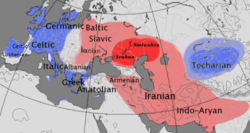
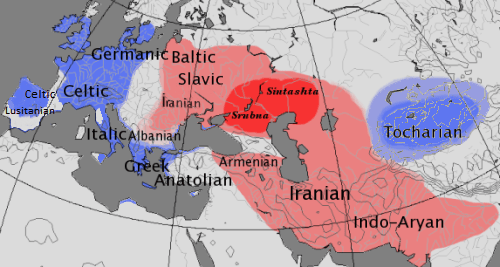
The centum–satem division forms an isogloss in synchronic descriptions of Indo-European languages. It is no longer thought that the PIE language split first into centum and satem branches from which all the centum and all the satem languages, respectively, would have derived. Such a division is made particularly unlikely by the discovery that while the satem group lies generally to the east and the centum group to the west, the most eastward of the known IE language branches, Tocharian, is centum.[2]
Centum languages
[edit]The centum languages of the Indo-European family are the "western" branches: Hellenic, Celtic, Italic and Germanic. They merged PIE palatovelars and plain velars, yielding plain velars (k, g, gh) only ("centumisation"), but retained the labiovelars as a distinct set.[1]
The Anatolian branch probably falls outside the centum–satem division; for instance, the Luwian language indicates that all three dorsal consonant rows survived separately in Proto-Anatolian.[3] The centumisation observed in Hittite is therefore assumed to have occurred only after the breakup of Proto-Anatolian into separate languages.[4] However, Craig Melchert proposes that proto-Anatolian is indeed a centum language.
While Tocharian is generally regarded as a centum language,[5] it is a special case, as it has merged all three of the PIE dorsal series (originally nine separate consonants) into a single phoneme, *k. According to some scholars, that complicates the classification of Tocharian within the centum–satem model.[6] However, as Tocharian has replaced some PIE labiovelars with the labiovelar-like, non-original sequence *ku, it has been proposed that labiovelars remained distinct in Proto-Tocharian, which would place Tocharian in the centum group (assuming that Proto-Tocharian lost palatovelars while labiovelars were still phonemically distinct).[5]
In the centum languages, PIE roots reconstructed with palatovelars developed into forms with plain velars. For example, in the PIE numeral *ḱm̥tóm 'hundred', the initial palatovelar *ḱ became a plain velar /k/, as in Latin centum (originally pronounced with /k/, although most modern descendants of Latin have a sibilant there), Greek (he)katon, Welsh cant, Tocharian B kante. In the Germanic languages, the /k/ developed regularly by Grimm's law to become /h/, as in Old English hund(red).
Centum languages also retained the distinction between the PIE labiovelar row (*kʷ, *gʷ, *gʷʰ) and the plain velars. Historically, it was unclear whether the labiovelar row represented an innovation by a process of labialisation, or whether it was inherited from the parent language (but lost in the satem branches); current mainstream opinion favours the latter possibility. Labiovelars as single phonemes (for example, /kʷ/) as opposed to biphonemes (for example, /kw/) are attested in Greek (the Linear B q- series), Italic (Latin ⟨qu⟩), Germanic (Gothic hwair ⟨ƕ⟩ and qairþra ⟨q⟩) and Celtic (Ogham ceirt ⟨Q⟩) (in the so-called P-Celtic languages /kʷ/ developed into /p/; a similar development took place in the Osco-Umbrian branch of Italic and sometimes in Greek and Germanic). The boukólos rule, however, states that a labiovelar reduces to a plain velar when it occurs next to *u or *w.
The centum–satem division refers to the development of the dorsal series of sounds only at the time of the earliest separation of PIE into the proto-languages of its individual daughter branches; it does not apply to any later analogous developments within any branch. For example, the palatalization of Latin /k/ to /t͡ʃ/ or /t͡s/ (often later /s/) in some Romance languages (which means that modern French and Spanish cent and cien are pronounced with initial /s/ and /θ/ respectively) is satem-like, as is the merger of *kʷ with *k in the Gaelic languages; such later changes do not affect the classification of the languages as centum.
Linguist Wolfgang P. Schmid argued that some proto-languages like Proto-Baltic were initially centum, but gradually became satem due to their exposure to the latter.[7]
Satem languages
[edit]The satem languages belong to the Eastern sub-families, especially Indo-Iranian and Balto-Slavic (but not Tocharian), with Indo-Iranian being the major Asian branch and Balto-Slavic the major Eurasian branch of the satem group. It lost the labial element of PIE labiovelars and merged them with plain velars, but the palatovelars remained distinct and typically came to be realised as sibilants.[8] That set of developments, particularly the assibilation of palatovelars, is referred to as satemisation.
In the satem languages, the reflexes of the presumed PIE palatovelars are typically fricative or affricate consonants, articulated further forward in the mouth. For example, the PIE root *ḱm̥tóm, "hundred", the initial palatovelar normally became a sibilant [s] or [ʃ], as in Avestan satem, Persian sad, Sanskrit śatam, sto in all modern Slavic languages, Old Church Slavonic sъto, Latvian simts, Lithuanian šimtas (Lithuanian is between Centum and Satem languages). Another example is the Slavic prefix sъ(n)- ("with"), which appears in Latin, a centum language, as co(n)-; conjoin is cognate with Russian soyuz ("union")[citation needed]. An [s] is found for PIE *ḱ in such languages as Latvian, Avestan, Russian and Armenian, but Lithuanian and Sanskrit have [ʃ] (š in Lithuanian, ś in Sanskrit transcriptions). For more reflexes, see the phonetic correspondences section below; note also the effect of the ruki sound law.
"Incomplete satemisation" may also be evidenced by remnants of labial elements from labiovelars in Balto-Slavic, including Lithuanian ungurys "eel" < *angʷi- and dygus "pointy" < *dʰeigʷ-. A few examples are also claimed in Indo-Iranian, such as Sanskrit guru "heavy" < *gʷer-, kulam "herd" < *kʷel-, but they may instead be secondary developments, as in the case of kuru "make" < *kʷer- in which it is clear that the ku- group arose in post-Rigvedic language. It is also asserted that in Sanskrit and Balto-Slavic, in some environments, resonant consonants (denoted by /R/) become /iR/ after plain velars but /uR/ after labiovelars.[citation needed]
Some linguists argue that the Albanian[9] and Armenian[citation needed] branches are also to be classified as satem,[10] whereas other linguists argue that they show evidence of separate treatment of all three dorsal consonant rows and so may not have merged the labiovelars with the plain velars, unlike the canonical satem branches.
Assibilation of velars in certain phonetic environments is a common phenomenon in language development. Consequently, it is sometimes hard to establish firmly the languages that were part of the original satem diffusion and the ones affected by secondary assibilation later. While extensive documentation of Latin and Old Swedish, for example, shows that the assibilation found in French and Swedish were later developments, there are not enough records of the extinct Dacian and Thracian languages to settle conclusively when their satem-like features originated.
In Armenian, some assert that /kʷ/ is distinguishable from /k/ before front vowels.[11] Martin Macak (2018) asserts that the merger of *kʷ and *k occurred "within the history of Proto-Armenian itself".[12]
In Albanian, the three original dorsal rows have remained distinguishable when before historic front vowels.[13][14][15] Labiovelars are for the most part differentiated from all other Indo-European velar series before front vowels (where they developed into s and z ultimately), but they merge with the "pure" (back) velars elsewhere.[13] The palatal velar series, consisting of PIE *ḱ and the merged *ģ and ģʰ, usually developed into th and dh, but were depalatalized to merge with the back velars when in contact with sonorants.[13] Because the original PIE tripartite distinction between dorsals is preserved in such reflexes, Demiraj argues Albanian is therefore to be considered, like Luwian, neither centum nor satem but at the same time it has a "satem-like" realization of the palatal dorsals in most cases.[14] Thus PIE *ḱ, *kʷ and *k become th (Alb. thom "I say" < PIE *ḱeHsmi), s (Alb. si "how" < PIE. *kʷih1, cf. Latin quī), and q (/c/: pleq "elderly" < *plak-i < PIE *plh2-ko-), respectively.[16]
History of the concept
[edit]Schleicher's single guttural series
[edit]August Schleicher, an early Indo-Europeanist, in Part I, "Phonology", of his major work, the 1871 Compendium of Comparative Grammar of the Indogermanic Language, published a table of original momentane Laute, or "stops", which has only a single velar series (Reihe), *k, *g, *gʰ, under the name of Gutturalen.[17][18] He identifies four palatals (*ḱ, *ǵ, *ḱʰ, *ǵʰ) but hypothesises that they came from the gutturals along with the nasal *ń and the spirant *ç.[19]
Brugmann's labialized and unlabialized language groups
[edit]Karl Brugmann, in his 1886 work Grundriß_der_vergleichenden_Grammatik_der_indogermanischen_Sprachen (abbreviated Grundriss), promotes the palatals to the original language, recognising two stores of Explosivae, or "stops", the palatal (*ḱ, *ǵ, *ḱʰ, *ǵʰ) and the velar (*k, *g, *kʰ, *gʰ),[20] each of which was simplified to three articulations even in the same work.[21] In the same work, Brugmann notices among die velaren Verschlusslaute, "the velar stops", a major contrast between reflexes of the same words in different daughter languages. In some, the velar is marked with a "u-articulation", which he terms a "labialization", in accordance with the prevailing theory that the labiovelars were velars labialised by combination with a u at some later time and were not among the original consonants. He thus divides languages into "the language group with labialization" and "the language group without labialization",[22] which basically correspond to what would later be termed the centum and satem groups:[23]
For words and groups of words, which do not appear in any language with labialized velar-sound [the "pure velars"], it must for the present be left undecided whether they ever had the u-afterclap.
The doubt introduced in that passage suggests he already suspected the "afterclap" u was not that but was part of an original sound.
Von Bradke's centum and satem groups
[edit]In 1890, Peter von Bradke published Concerning Method and Conclusions of Aryan (Indogermanic) Studies, in which he identified the same division, as did Brugmann, but he defined it in a different way. He said that the original Indo-Europeans had two kinds of "guttural sounds", the "guttural or velar, and palatal series", each of which were aspirated and unaspirated. The velars were to be viewed as gutturals in a "narrow sense". They were a "pure K-sound". Palatals were "frequently with subsequent labialization". The latter distinction led him to divide the "palatal series" into a "group as fricative" (Spirant) and a "pure K-sound", typified by the words satem and centum respectively.[24] Later in the book[25] he speaks of an original "centum group", from which on the north of the Black and Caspian Seas the "satem tribes" dissimilated among the "nomadic peoples" or "steppe peoples", distinguished by further palatalization of the palatal gutturals.
Brugmann's identification of labialized and centum
[edit]By the 1897 edition of Grundriss, Brugmann (and Delbrück) had adopted Von Bradke's view: "The Proto-Indo-European palatals ... appear in Greek, Italic, Celtic and Germanic as a rule as K-sounds, as opposed to in Aryan, Armenian, Albanian, Balto-Slavic, Phrygian and Thracian ... for the most part sibilants."[26]
There was no more mention of labialized and non-labialized language groups after Brugmann changed his mind regarding the labialized velars. The labio-velars now appeared under that name as one of the five series of stop consonants (Explosivae), comprising the "labial stops", the dental stops", the "palatal stops", the "purely velar stops", and the "labiovelar stops". It was Brugmann who pointed out that labiovelars had merged into the velars in the satem group,[27] accounting for the coincidence of the discarded non-labialized group with the satem group.
Discovery of Anatolian and Tocharian
[edit]When von Bradke first published his definition of the centum and satem sound changes, he viewed his classification as "the oldest perceivable division" in Indo-European, which he elucidated as "a division between eastern and western cultural provinces" (Kulturkreise).[28] The proposed split was undermined by the decipherment of Hittite and Tocharian in the early 20th century. Both languages show no satem-like assibilation in spite of being located in the satem area.[29]
The proposed phylogenetic division of Indo-European into satem and centum "sub-families" was further weakened by the identification of other Indo-European isoglosses running across the centum–satem boundary, some of which seemed of equal or greater importance in the development of daughter languages.[30] Consequently, since the early 20th century at least, the centum–satem isogloss has been considered an early areal phenomenon rather than a true phylogenetic division of daughter languages.
Alternative interpretations
[edit]Different realizations
[edit]The actual pronunciation of the velar series in PIE is not certain. One current idea is that the "palatovelars" were in fact simple velars *[k], *[ɡ], *[ɡʰ], and the "plain velars" were pronounced farther back, perhaps as uvular consonants: *[q], *[ɢ], *[ɢʰ].[31] If labiovelars were just labialized forms of the "plain velars", they would have been pronounced *[qʷ], *[ɢʷ], *[ɢʷʰ] but the pronunciation of the labiovelars as *[kʷ], *[gʷ], *[gʷʰ] would still be possible in uvular theory, if the satem languages first shifted the "palatovelars" then later merged the "plain velars" and "labiovelars". The uvular theory is supported by the following evidence.
- The "palatovelar" series was the most common, and the "plain velar" was by far the least common and never occurred in any affixes. In known languages with multiple velar series, the normal velar series is usually the most common, which would imply that what have been interpreted as "palatovelars" were more probably simply velars but the labiovelars were most likely still just *[kʷ], *[gʷ], *[gʷʰ] due to them being the second most common.
- There is no evidence of any palatalisation in the early history of the velars in the centum branches, but see above for the case of Anatolian. If the "palatovelars" were in fact palatalised in PIE, there would have had to be a single, very early, uniform depalatalisation in all (and only) the centum branches. Depalatalisation is cross-linguistically far less common than is palatalisation and so is unlikely to have occurred separately in each centum branch. In any case it would almost certainly have left evidence of prior palatalization in some of the branches. (As noted above, it is not thought that the centum branches had a separate common ancestor in which the depalatalization could have occurred just once and then have been inherited.)
- Most instances of the rare to non-existent /a/ phoneme without the /h₂/ laryngeal appear before or after *k, which could be the result of that phoneme being a-coloring, particularly likely if it was uvular /q/, similar to the /h₂/ laryngeal which may have been uvular /χ/. Uvulars coloring and lowering vowels is common cross-linguistically as in languages such as Quechuan or Greenlandic where /i/ and /u/ lower to [e] and [o] when next to uvulars, meaning the lowering of /e/ and /o/ to [a] or [ɑ] would be possible, and also occurs in Arabic.
On the above interpretation, the split between the centum and satem groups would not have been a straightforward loss of an articulatory feature (palatalization or labialization). Instead, the uvulars *q, *ɢ, *ɢʰ (the "plain velars" of the traditional reconstruction) would have been fronted to velars across all branches. In the satem languages, it caused a chain shift, and the existing velars (traditionally "palatovelars") were shifted further forward to avoid a merger, becoming palatal: /k/ > /c/; /q/ > /k/. In the centum languages, no chain shift occurred, and the uvulars merged into the velars. The delabialisation in the satem languages would have occurred later, in a separate stage (or not at all in the case of Albanian).
Related to the uvular theory is the glottalic theory. Both these theories have some support if PIE was spoken near the Caucasus, where both uvular and glottal consonants are common and many languages have a paucity of distinctive vowels.
Only two velar series
[edit]The presence of three dorsal rows in the proto-language has been the mainstream hypothesis since at least the mid-20th century. There remain, however, several alternative proposals with just two rows in the parent language, which describe either "satemisation" or "centumisation", as the emergence of a new phonematic category rather than the disappearance of an inherited one.
Antoine Meillet (1937) proposed that the original rows were the labiovelars and palatovelars, with the plain velars being allophones of the palatovelars in some cases, such as depalatalisation before a resonant.[32] The etymologies establishing the presence of velars in the parent language are explained as artefacts of either borrowing between daughter languages or of false etymologies. Having only labiovelars and palatovelars would also parallel languages such as Russian or Irish, where consonants can be either broad and unpalatalized, or slender and palatalized, and is also seen in some Northwest Caucasian languages.
Other scholars who assume two dorsal rows in PIE include Kuryłowicz (1935) and Lehmann (1952), as well as Frederik Kortlandt and others.[33] The argument is that PIE had only two series, a simple velar and a labiovelar. The satem languages palatalized the plain velar series in most positions, but the plain velars remained in some environments: typically reconstructed as before or after /u/, after /s/, and before /r/ or /a/ and also before /m/ and /n/ in some Baltic dialects. The original allophonic distinction was disturbed when the labiovelars were merged with the plain velars. That produced a new phonemic distinction between palatal and plain velars, with an unpredictable alternation between palatal and plain in related forms of some roots (those from original plain velars) but not others (those from original labiovelars). Subsequent analogical processes generalised either the plain or palatal consonant in all forms of a particular root. The roots in which the plain consonant was generalized are those traditionally reconstructed as having "plain velars" in the parent language in contrast to "palatovelars".
Oswald Szemerényi (1990) considers the palatovelars as an innovation, proposing that the "preconsonantal palatals probably owe their origin, at least in part, to a lost palatal vowel" and a velar was palatalised by a following vowel subsequently lost.[34] The palatal row would therefore postdate the original velar and labiovelar rows, but Szemerényi is not clear whether that would have happened before or after the breakup of the parent-language (in a table showing the system of stops "shortly before the break-up", he includes palatovelars with a question mark after them).
Woodhouse (1998; 2005) introduced a "bitectal" notation, labelling the two rows of dorsals as k1, g1, g1h and k2, g2, g2h. The first row represents "prevelars", which developed into either palatovelars or plain velars in the satem group but just into plain velars into the centum group; the second row represents "backvelars", which developed into either labiovelars or plain velars in the centum group but just plain velars in the satem group.[35]
The following are arguments that have been listed in support of a two-series hypothesis:[citation needed]
- The plain velar series is statistically rarer than the other two, is almost entirely absent from affixes and appears most often in certain phonological environments (described in the next point).
- The reconstructed velars and palatovelars occur mostly in complementary distribution (velars before *a, *r and after *s, *u; palatovelars before *e, *i, *j, liquid/nasal/*w+*e/*i and before o in o-grade forms by generalization from e-grade).
- It is unusual in general for palatovelars to move backwards rather than the reverse
- In most languages in which the "palatovelars" produced fricatives, other palatalisation also occurred, implying that it was part of a general trend;
- The centum languages are not contiguous, and there is no evidence of differences between dialects in the implementation of centumization (but there are differences in the process of satemisation: there can be pairs of satemized and non-satemized velars within the same language, there is evidence of a former labiovelar series in some satem languages and different branches have different numbers and timings of satemization stages). This makes a "centumisation" process less likely, implying that the position found in the centum languages was the original one.
- Alternations between plain velars and palatals are common in a number of roots across different satem languages, but the same root appears with a palatal in some languages but a plain velar in others (most commonly Baltic or Slavic, occasionally Armenian but rarely or never the Indo-Iranian languages). That is consistent with the analogical generalisation of one or another consonant in an originally-alternating paradigm but difficult to explain otherwise.
- The claim that in late PIE times, the satem languages (unlike the centum languages) were in close contact with each other is confirmed by independent evidence: the geographical closeness of current satem languages and certain other shared innovations (the ruki sound law and early palatalization of velars before front vowels).
Arguments in support of three series:
- Many instances of plain velars occur in roots that have no evidence of any of the putative environments that trigger plain velars and no obvious mechanism for the plain velar to have come in contact with any such environment; as a result, the comparative method requires three series to be reconstructed.
- Albanian[36] and Armenian[citation needed] are said to show evidence of different reflexes for the three different series. Evidence from the Anatolian language Luwian attests a three-way velar distinction *ḱ > z (probably [ts]); *k > k; *kʷ > ku (probably [kʷ]).[37] There is no evidence of any connection between Luwian and any satem language (labiovelars are still preserved, the ruki sound law is absent) and the Anatolian branch split off very early from PIE. The three-way distinction must be reconstructed for the parent language. (That is a strong argument in favor of the traditional three-way system; in response, proponents of the two-way system have attacked the underlying evidence by claiming that it "hinges upon especially difficult or vague or otherwise dubious etymologies" (such as Sihler 1995).) Melchert originally claimed that the change *ḱ > z was unconditional and subsequently revised the assertion to a conditional change occurring only before front vowels, /j/, or /w/; however, that does not fundamentally alter the situation, as plain-velar *k apparently remains as such in the same context. Melchert also asserts, contrary to Sihler, the etymological distinction between *ḱ and *k in the relevant positions is well-established.[38]
- According to Ringe (2006), there are root constraints that prevent the occurrence of a "palatovelar" and labiovelar or two "plain velars", in the same root, but they do not apply to roots containing, for example, a palatovelar and a plain velar.
- The centum change could have occurred independently in multiple centum subgroups (at the very least, Tocharian, Anatolian and Western IE), as it was a phonologically natural change, given the possible interpretation of the "palatovelar" series as plain-velar and the "plain velar" series as back-velar or uvular (see above). Given the minimal functional load of the plain-velar/palatovelar distinction, if there was never any palatalisation in the IE dialects leading to the centum languages, there is no reason to expect any palatal residues. Furthermore, it is phonologically entirely natural for a former plain-velar vs. back-velar/uvular distinction to have left no distinctive residues on adjacent segments.
Phonetic correspondences in daughter languages
[edit]The following table summarizes the outcomes of the reconstructed PIE palatals and labiovelars in the various daughter branches, both centum and satem. (The outcomes of the "plain velars" can be assumed to be the same as those of the palatals in the centum branches and those of the labiovelars in the satem branches.)
| PIE | *ḱ | *ǵ | *ǵʰ | *kʷ | *gʷ | *gʷʰ |
|---|---|---|---|---|---|---|
| Celtic | k | g | kw, p[* 1] | b | gw | |
| Italic | g | g, h[* 2] | kw, p[* 3] | gw, v, b[* 3] | f, v | |
| Venetic | h | kw | ? | |||
| Hellenic | kh | p, t, k[* 4] | b, d, g[* 4] | ph, kh, th[* 4] | ||
| Germanic | h | k | g ~ ɣ[* 5] | hw | kw | gw[* 6] ~ w[* 5] |
| Albanian[39] | θ, c, k[* 7] | ð, d[* 7] | k, c, s | g, ɟ, z | ||
| Anatolian | k,[* 8] kk[* 9] | g,[* 10] k[* 11] | kw, kkw[* 9] | gw,[* 12] kw[* 11] | ||
| Tocharian | k | k, kw | ||||
| Phrygian | k[* 13] | g | k | g | ||
| Armenian | s | c | dz | kh | k | g |
| Baltic | ś | ź | k | g | ||
| Thracian | s | z | k, kh | g, k | g | |
| Dacian | k, č | g, j ~ z | ||||
| Slavic | g, j ~ ž/z | |||||
| Iranian | s | z | k, č[* 14] | g, j[* 14] | ||
| Indic | ś | j | h[* 15] | k, c[* 14] | g, j[* 14] | gh, h[* 14] |
| Nuristani | ć,[* 16] s[* 17] | ź,[* 18] z | k, č[* 14] | g, j[* 14] | ||
See also
[edit]Notes
[edit]- ^ Within Celtic, the "p-Celtic" and "q-Celtic" branches have different reflexes of PIE *kʷ: *ekwos → epos, ekwos respectively. The Brythonic and Lepontic languages are P-Celtic, Goidelic and Celtiberian are Q-Celtic and different dialects of Gaulish had different realisations.
- ^ PIE *ǵʰ → Latin /h/ or /ɡ/, depending on its position in the word, and → Osco-Umbrian *kh → /h/.
- ^ a b PIE *kʷ and *gʷ developed differently in the two Italic subgroups: /kw/, /w/ in Latin (*kwis → quis), and /p/, /b/ in Osco-Umbrian (*kwis → pis).
- ^ a b c PIE *kʷ, *gʷ, *gʷʰ have three reflexes in Greek dialects such as Attic and Doric:
- /t, d, th/ before /e, i/ (IE *kʷis → Greek tis)
- /k, ɡ, kh/ before /u/ (IE *wl̥kʷos → Greek lukos)
- /p, b, ph/ before /a, o/ (IE *sekʷ- → Greek hep-)
- ^ a b Proto-Germanic reflexes of Indo-European aspirated stops had spirant allophones, retained in intervocalic position in Gothic.
- ^ This is the reflex after nasals. The outcome in other positions is disputed and may vary according to phonetic environment. See the note in Grimm's law § In detail.
- ^ a b PIE *ḱ, *ǵ, *ǵʰ mostly became affricates in Early Albanian /ts/ and /dz/ and then were fronted further to /θ/ and /ð/. However in specific contexts, one or both processes didn't occur so some instances were preserved as velar (Alb. krah, for example) while others ended up as /s/ and /z/, /ts/ and /dz/ or /c/ and /ɟ/ according to context. Furthermore the fricative /ð/ has become a stop /d/ in specific contexts in the modern language
- ^ In Luvic languages, yielding ts, at least under most circumstances.
- ^ a b Non-initial (Anatolian fortis)
- ^ In Luvic languages, usually becoming *y initially, lost intervocalically.
- ^ a b Non-initial (Anatolian lenis)
- ^ In Luvic languages, yielding simple w.
- ^ The Phrygian evidence is limited and often ambiguous so the issue of centum vs. satem reflexes is not completely settled, but the prevailing opinion is that Phrygian shows centum reflexes along with secondary palatalisation of /k/ to /ts/ and /ɡ/ to /dz/ before front vowels, as in most Romance languages, see Phrygian language § Phonology.
- ^ a b c d e f g before front vowels
- ^ pIE *ǵʰ → proto-Indo-Iranian *ȷ́ʰ → Indic /h/, Iranian /z/.
- ^ Phonetically /ts/.
- ^ Occurs in Ashkun only.
- ^ Phonetically /dz/. Occurs in Kamviri and Tregami only.
References
[edit]- ^ a b J.P. Mallory and D.Q. Adams (eds.), The Encyclopedia of Indo-European Culture (1997), p. 461.
- ^ Fortson 2010, chpt. 3.2–3.25
- ^ Fortson 2010, p. 59, originally proposed in Melchert 1987
- ^ Fortson 2010, p. 178
- ^ a b Fortson 2010, p. 59
- ^ Lyovin 1997, p. 53
- ^ Zinkevičius, Z. (1984). Lietuvių kalbos istorija. I. Vilnius: „Mokslas“. p. 116. ISBN 5-420-00102-0.
- ^ Mallory 1997, p. 461.
- ^ Matasović, Ranko (2012). "A Grammatical Sketch of Albanian for students of Indo-European". Page 13:"It has been claimed that the difference between the three PIE series of gutturals is preserved in Albanian before front vowels. This thesis, sometimes referred to as Pedersen’s law, is often contested, but still supported by the majority of Albanologists (e. g. Hamp, Huld, and Ölberg). In examining this view, one should bear in mind that it seems certain that there were at least two palatalizations in Albanian: the first palatalization, whereby labiovelars were palatalized to s and z before front vowels and *y, and the second palatalization, whereby all the remaining velars (*k and *g) were palatalized to q and gj, in the same environment. PIE palatalized velars are affected by neither palatalization (they yield Alb. th, d, dh, cf. Alb. thom ‘I say’ < *k’ensmi, cf. OInd. śa m s- ‘praise’, L c e nse o ‘reckon’). It may be that th yielded f before a consonant, if Alb. ënfle 'sleep' is from *nthle < *n-k’loye- (cf. G klínō ‘recline’). "
- ^ Andrew Miles Byrd (2018). "121. The phonology of Proto-Indo-European". In Fritz, Matthias; Joseph, Brian; Klein, Jared (eds.). Handbook of Comparative and Historical Indo-European Linguistics. De Gruyter Mouton. p. 2061. ISBN 978-3-11-054036-9.
- ^ Holger Pedersen, KZ 36 (1900) 277–340; Norbert Jokl, in: Mélanges linguistiques offerts à M. Holger Pedersen (1937) 127–161.
- ^ Martin Macak (2017). "61. The phonology of Classical Armenian". In Klein, Jared; Joseph, Brian; Fritz, Matthias (eds.). Handbook of Comparative and Historical Indo-European Linguistics. de Gruyter Mouton. p. 1048. ISBN 978-3-11-052161-0.
A characteristic feature of satem languages, the merger of *K and *K u̯ , seems to have taken place within the history of PA itself... After the merger of *K and *K u̯ , a preceding labial segment "satemizes" the velar so that the latter shows reflex- es identical to those of the original PIE palatovelar *K̑...
- ^ a b c Orel, Vladimir (2000). A CONCISE HISTORICAL GRAMMAR OF THE ALBANIAN LANGUAGE: Reconstruction of Proto-Albanian. Leiden: Brill. p. 66, 70-71. ISBN 90-04-11647-8.
- ^ a b Bardhyl Demiraj (2018). "100. The evolution of Albanian". In Fritz, Matthias; Joseph, Brian; Klein, Jared (eds.). Handbook of Comparative and Historical Indo-European Linguistics. De Gruyter Mouton. p. 1812. ISBN 978-3-11-054036-9.
and the outcomes of the three dorsal series suggest that Albanian, like Luwian, may have originally retained this three-way opposition intact and therefore is neither centum nor satem, despite the clear satem-like outcome of its palatal dorsals in most instances
- ^ Don Ringe (2018). "1. General and methodological issues". In Fritz, Matthias; Joseph, Brian; Klein, Jared (eds.). Handbook of Comparative and Historical Indo-European Linguistics. De Gruyter Mouton. p. 65. ISBN 978-3-11-054036-9.
- ^ Matthew C. Curtis (2018). "99. The dialectology of Albanian". In Fritz, Matthias; Joseph, Brian; Klein, Jared (eds.). Handbook of Comparative and Historical Indo-European Linguistics. de Gruyter Mouton. pp. 1807–1808. ISBN 978-3-11-054036-9.
- ^ Schleicher 1871, p. 10
- ^ Bynon, Theodora. "The Synthesis of Comparative and Historical Indo-European Studies: August Schleicher". In Auroux, Sylvain (ed.). History of the language sciences: an international handbook on. Vol. 2. pp. 1223–1239.
- ^ Schleicher 1871, p. 163
- ^ Brugmann 1886, p. 20
- ^ Brugmann 1886, pp. 308–309
- ^ Brugmann 1886, p. 312
- ^ Brugmann 1886, p. 313. The quotation given here is a translation by Joseph Wright, 1888.
- ^ von Bradke 1890, p. 63
- ^ von Bradke 1890, p. 107
- ^ "Die Palatallaute der idg. Urzeit ... erscheinen in Griech, Ital., Kelt., Germ. in der Regel als K-Laute, dagegen im Ar., Arm., Alb., Balt-Slav., denen sich Phrygisch und Thrakisch ... meistens als Zischlaute." Brugmann & Delbrück 1897 p. 542.
- ^ Brugmann & Delbrück 1897 p. 616. "... die Vertretung der qʷ-Laute ... ist wie die der q-Laute, ..."
- ^ von Bradke 1890, p. 108
- ^ K. Shields, "A New Look at the Centum/Satem Isogloss", Zeitschrift für vergleichende Sprachforschung (1981).
- ^ "... an early dialect split of the type indicated by the centum–satem contrast should be expected to be reflected in other high-order dialect distinctions as well, a pattern which is not evident from an analysis of shared features among eastern and western languages."Baldi, Philip (1999). The Foundations of Latin. Trends in Linguistics: Studies and Monographs 117. Berlin: Walter de Gruyter & Co. p. 39. ISBN 978-3-11-016294-3.
- ^ Kümmel, M.J. (2007), Konsonantenwandel. Bausteine zu einer Typologie des Lautwandels und ihre Konsequenzen für die vergleichende Rekonstruktion. Wiesbaden: Reichert. Cited in Prescott, C., Pharyngealization and the three dorsal stop series of Proto-Indo-European.
- ^ Lehmann 1993, p. 100
- ^ Such as Szemerényi (1995), Sihler (1995)
- ^ Szemerényi 1990, p. 148
- ^ R. Woodhouse, Indogermanische Forschungen (2010), 127–134.
- ^ Matthew C. Curtis (2018). "99. The dialectology of Albanian". In Fritz, Matthias; Joseph, Brian; Klein, Jared (eds.). Handbook of Comparative and Historical Indo-European Linguistics. de Gruyter Mouton. p. 1808. ISBN 978-3-11-054036-9.
the evidence of Albanian's support for the three-way distinction of gutturals in IE
- ^ Craig Melchert (1987). "PIE velars in Luvian" (PDF). Studies in Memory of Warren Cowgill. pp. 182–204. Retrieved 2008-10-27.
- ^ Craig Melchert (2013). "The Position of Anatolian" (PDF). Handbook of Indo-European Studies. pp. 18–22. Archived from the original (PDF) on 2010-07-09. Retrieved 2010-06-29.
- ^ Orel, Vladimir (2000). A CONCISE HISTORICAL GRAMMAR OF THE ALBANIAN LANGUAGE: Reconstruction of Proto-Albanian. Pages 66–72. Historic palatalizations further discussed on pages 72–77, palatalization of former velar sounds specifically 72–74.
Sources
[edit]- Brugmann, Karl (1886). Grundriss der Vergleichenden Grammatik der indogermanischen Sprachen (in German). Vol. Erster Band. Strassburg: Karl J. Trübner.
- Brugmann, Karl; Delbrück, Berthold (1897–1916). Grundriss der vergleichenden grammatik der indogermanischen sprachen. Vol. I Part 1 (2nd ed.). Strassburg: K.J. Trübner.
- Fortson, Benjamin W. (2010). Indo-European Language and Culture: An Introduction. Blackwell Textbooks in Linguistics (2nd ed.). Chichester, U.K.; Malden, MA: Wiley-Blackwell.
- Kortlandt, Frederik (1993). "General Linguistics & Indo-European Reconstruction" (PDF). Frederik Kortlandt. Retrieved 30 November 2009.
- Lehmann, Winfred Philipp (1993). Theoretical Bases of Indo-European Linguistics. Taylor & Francis Group.
- Lyovin, Anatole (1997). An introduction to the languages of the world. New York: Oxford University Press.
- Mallory, J.P.; Adams, D.Q., eds. (1997). "Proto-Indo-European". Encyclopedia of Indo-European Culture. London, Chicago: Fitzroy Dearborn Publishers. ISBN 1-884964-98-2.
- Melchert, Craig (1987), "PIE velars in Luvian" (PDF), Studies in Memory of Warren Cowgill, pp. 182–204, retrieved 28 November 2009.
- Remys, Edmund (2007). "General distinguishing features of various Indo-European languages and their relationship to Lithuanian". Indogermanische Forschungen. 112 (2007): 244–276. doi:10.1515/9783110192858.1.244. S2CID 169996117.
- Schleicher, August (1871). Compendium der vergleichenden grammatik der indogermanischen sprachen (in German). Weimar: Hermann Böhlau. ISBN 9783487053820.
{{cite book}}: ISBN / Date incompatibility (help) - Solta, G.R. (1965). "Palatalisierung und Labialisierung". Indogermanische Forschungen (in German). 70: 276–315.
- Szemerényi, Oswald J. L. (1990). Introduction to Indo-European Linguistics. Oxford [u.a.]: Oxford University Press.
- von Bradke, Peter (1890). Über Methode und Ergebnisse der arischen (indogermanischen) Alterthumswissenshaft (in German). Giessen: J. Ricker'che Buchhandlung.
Further reading
[edit]- Kortlandt, Frederik. "Balto-Slavic and Indo-Iranian". In: Baltistica 2016, t. 51, Nr. 2, p. 355–364. DOI: https://doi.org/10.15388/Baltistica.51.2.2284
- Mayer, Harvey E. (1980). "Baltic membership in the West Satem subgroup". In: Journal of Baltic Studies, 11:4, pp. 356–366. DOI: 10.1080/01629778000000351
- Mottausch, Karl-Heinz. "Eine Neue Lösung Für Ein Altes Problem: Kentum Und Satəm". In: Historische Sprachforschung [Historical Linguistics] 119 (2006): 35–76. www.jstor.org/stable/40849375.
External links
[edit]- Anderson, Deborah. "Centum and satem Languages". EurAsia '98. Archived from the original on 16 February 2009. Retrieved 5 December 2009.
- Baldia, Maximilian O. (2006). "Tombs and the Indo-European Homeland". The Comparative Archaeology Web. Archived from the original on 2009-08-18. Retrieved 27 November 2009.
- Wheeler, L. Kip. "The Indo-European Family of Languages". L. Kip Wheeler. Retrieved 5 December 2009.
Centum and satem languages
View on GrokipediaOverview and Phonological Basis
Defining the Centum-Satem Distinction
The terms "centum" and "satem" designate the two principal phonological groupings of Indo-European languages, based on their divergent evolution of the Proto-Indo-European (PIE) palatovelar consonants. "Centum" is derived from the Latin word centum meaning "hundred," which reflects the preservation of an initial velar stop /k/ from the PIE root ḱm̥tóm. In contrast, "satem" originates from the Avestan form satəm, also meaning "hundred," where the initial consonant has shifted to /s/ from the same PIE root, as seen similarly in Sanskrit śatám. This centum-satem divide constitutes a key isogloss—an areal linguistic feature—rather than a rigid genetic bifurcation of the Indo-European family tree, arising from regional dialectal variations in PIE. In centum languages, the palatovelars (*ḱ, *ǵ, *ǵʰ) merge with or are fronted to align with the plain velars (*k, *g, gʰ), effectively reducing the dorsal consonant series while often maintaining a distinction for labiovelars (*kʷ, *gʷ, gʷʰ). Satem languages, however, exhibit assibilation of the palatovelars, transforming them into fricatives or affricates (typically /s/, /z/, /ʃ/, or equivalents), separate from the plain velars that remain as back consonants; this process is viewed as an innovative areal development, likely in eastern IE dialects, with the centum pattern representing a more archaic retention. Illustrative etymologies highlight this split: the PIE *ḱm̥tóm "hundred" yields centum in Latin (centum) and hekatón in Greek (hekatón), exemplifying centum preservation, whereas it becomes satəm in Avestan and śatám in Sanskrit for satem languages. Similarly, PIE *pḱ- "to herd" or related forms develop into Latin pecus (centum, with /k/) but Avestan pasu- (satem, with /s/). The recognition of this phonological isogloss arose within 19th-century comparative linguistics, as scholars systematically reconstructed PIE through cognate comparisons and identified consistent sound correspondences in the dorsal series across attested languages, enabling the broader classification of IE branches according to velar reflexes and underscoring the role of dialect geography in language evolution.Proto-Indo-European Dorsal Consonants
The reconstructed phonological inventory of Proto-Indo-European (PIE) features three distinct series of dorsal consonants, which form the basis for understanding later developments in the Indo-European family. These series consist of plain velars (*k, *g, *gʰ), palatovelars (*ḱ, *ǵ, *ǵʰ), and labiovelars (*kʷ, *gʷ, *gʷʰ), each comprising voiceless, voiced, and breathy-voiced stops.[3] This tripartite distinction among dorsals is a cornerstone of the standard PIE reconstruction, posited to account for systematic patterns observed in descendant languages through the comparative method.[4] The evidence for this system derives primarily from the comparative method, which reconstructs ancestral sounds by aligning cognates across branches and identifying regular correspondences. For instance, the method reveals that the three series behave differently in phonological environments, such as before front vowels or labial sounds, supporting their separation in the PIE inventory.[5] Indirect corroboration comes from the Germanic branch, where Grimm's Law systematically shifted PIE voiceless stops—including the dorsals *k, *ḱ, and *kʷ—to fricatives (e.g., *k > *h), while Verner's Law further refined this by voicing those fricatives in post-accentual positions, thus validating the integrity of the original dorsal distinctions against later innovations.[6] Typologically, a three-way dorsal contrast is uncommon in the world's languages but not implausible, as it aligns with articulatory possibilities in the dorsal region of the vocal tract.[7] This typological fit bolsters the reconstruction's viability, suggesting PIE could have employed a rich dorsal system adapted to its phonetic needs. Notation for these consonants follows established conventions in Indo-European linguistics, often using diacritics for clarity: plain velars as *k, *g, *gʰ; palatovelars with an acute accent (*ḱ, *ǵ, *ǵʰ) or a caron (*k̑, *g̑, *g̑ʰ); and labiovelars with a superscript *w (*kʷ, *gʷ, *gʷʰ). In International Phonetic Alphabet (IPA) terms, they approximate /k, ɡ, ɡʰ/, /c, ɟ, ɟʰ/ (or /kʲ, ɡʲ, ɡʲʰ/ for palatals), and /kʷ, ɡʷ, ɡʷʰ/, reflecting their velar base with palatal or labial secondary articulations.[8] These symbols facilitate precise representation in scholarly analysis without implying exact phonetic realization, which remains a subject of ongoing debate.Language Classifications
Centum Branches
The centum branches of the Indo-European language family comprise the core Western groups, including Hellenic (exemplified by Ancient Greek), Italic (such as Latin and Oscan), Celtic (including Irish and Welsh), and Germanic (such as English and German). These branches are characterized by their phonological developments, which distinguish them from the Eastern satem languages through the treatment of Proto-Indo-European (PIE) dorsal consonants.[9][1] A defining phonological trait of the centum branches is the merger of PIE palatovelars (*ḱ, *ǵ, *ǵʰ) with plain velars (*k, *g, *gʰ), resulting in velar sounds such as /k/ without palatalization to sibilants; labiovelars (*kʷ, *gʷ, *gʷʰ) are typically retained as /kʷ/ or undergo limited mergers in specific contexts, like /p/ before front vowels in Greek. This retention preserves a three-way distinction in dorsal stops at an early stage, contrasting briefly with the satem assibilation seen in Eastern branches. For instance, in Greek, PIE *ḱm̥tóm 'hundred' yields ἑκατόν (hekatón) with /k/, while Latin reflects it as centum, both showing the velar preservation. Similar patterns appear in Celtic (e.g., Old Irish cét) and Germanic (e.g., Gothic hund).[9][1][10] Geographically, the centum branches are primarily distributed across Western and Southern Europe, with Hellenic centered in the Mediterranean, Italic in the Italian peninsula, Celtic in the British Isles and parts of continental Europe, and Germanic spreading from Scandinavia to Central Europe. This distribution aligns with archaeological evidence of early Indo-European expansions into these regions.[10][1]Satem Branches
The satem branches of the Indo-European language family encompass the Indo-Iranian, Balto-Slavic, and Armenian groups, which are defined by shared innovations in the treatment of Proto-Indo-European (PIE) dorsal consonants.[11][12] The Indo-Iranian branch includes languages such as Sanskrit and Avestan in its Indo-Aryan and Iranian subgroups, respectively, while Balto-Slavic comprises Baltic languages like Lithuanian and Slavic ones like Old Church Slavonic and Russian.[11][13] Armenian forms a separate branch, often classified provisionally with the satem group due to similar developments despite some unique features.[12] A hallmark phonological trait of these branches is the assibilation of PIE palatovelars, where sounds like *ḱ, *ǵ, and *ǵʰ evolve into sibilants such as /s/, /ʃ/, /z/, or /ʒ/, particularly before front vowels.[11][13] Additionally, labiovelars (*kʷ, *gʷ, *gʷʰ) undergo delabialization, merging with plain velars (*k, *g, *gʰ) rather than retaining their labial component.[12] These changes distinguish satem branches from centum ones, where palatovelars typically merge with plain velars without sibilant formation.[11] Representative examples illustrate these innovations, such as the PIE word for "hundred," *ḱm̥tóm, which yields Sanskrit śatám (pronounced with /ɕ/ or /s/), Lithuanian šimtas (/ʃ/), and Old Church Slavonic sъto (/s/). In Armenian, a satem-like sibilant reflex is seen in sun "dog" from PIE *ḱwón-, where *ḱ > s.[11][12][14] Geographically, satem branches are distributed across Eastern Europe for Balto-Slavic languages, Central and South Asia for Indo-Iranian, and the Near East and Caucasus for Armenian, reflecting an eastern orientation within the Indo-European dispersal.[11][12]Peripheral Languages and Exceptions
The Anatolian languages, including Hittite and Luwian, constitute an early-branching peripheral group that predates the centum-satem split and thus exhibits an archaic dorsal system outside the standard dichotomy. They retain plain velars (*k, *g, *gʰ) without palatalization, while palatovelars (*ḱ, *ǵ, *ǵʰ) merge with velars in a centum-like manner, though Luvic dialects show conditioned affrication of voiceless palatovelars to /ts/ or /s/ in fronting environments before eventual merger.[15] This independent development, such as Hittite *kuit- "what" from PIE *ḱwod, reflects retention of the PIE contrast rather than innovation toward sibilants.[13] Tocharian A and B, attested in the Tarim Basin from the 6th to 8th centuries CE, are classified as centum despite their eastern geographic position amid satem languages, challenging the traditional west-east isogloss. They merge all three PIE dorsal series (plain velars, palatovelars, and labiovelars) into a single velar phoneme /k/, with palatovelars shifting to velars but undergoing secondary palatalization to affricates like /t͡s/ and /t͡ʃ/ in certain contexts, possibly under eastern areal influences from Uralic or Turkic languages.[16][13] For instance, PIE *ḱ becomes Tocharian /ts/ in words like *tsaṃ "earth" from *dʰéǵʰōm.[16] Albanian, the sole survivor of the Paleo-Balkan branch, is typically affiliated with satem languages due to the assibilation of palatovelars to sibilants or affricates (e.g., PIE *ḱ > Albanian /θ/ or /s/, as in tho-të "says" from *ḱeh₁-ti), but it retains centum-like rounding in labiovelars (e.g., *kʷ > /k/, as in pjek "cooks" from *pekʷ-).[17] This mixed profile, including mergers of *k and *kʷ in some environments, has sparked debate over whether Albanian represents a primary satem branch or a centum language with secondary Balkan assibilation influenced by neighboring Greek and Thracian.[17][13] Armenian, an independent Indo-European branch, is conventionally grouped as satem for its palatovelar-to-sibilant shifts (e.g., PIE *ḱ > Armenian /s/, as in sirt "heart" from *ḱḗr(d)-), aligning it with Indo-Iranian and Balto-Slavic.[13][14] However, its satem status is questioned due to potential uvular developments from velars (e.g., *k > /χ/ or /q/ in some dialects) and secondary assibilations possibly arising from areal contacts with Iranian and Caucasian languages, rather than direct inheritance.[13][18] These peripheral languages—Anatolian, Tocharian, Albanian, and Armenian—undermine the strict binary centum-satem division by evidencing early divergences, conditioned mergers, and areal diffusions that blur the isogloss, implying a more complex Proto-Indo-European family tree with multiple innovation centers rather than a simple dialect continuum.[13][17]Historical Development of the Concept
Early Guttural Theories
The early development of Indo-European linguistics in the 19th century relied heavily on comparative studies of consonant correspondences, with initial attention to Germanic velars laying groundwork for broader dorsal reconstructions. Rasmus Rask, in his 1818 Undersøgelse om det gamle Nordiske eller Islandske Sprogs Oprindelse, systematically identified regular shifts between Germanic and other Indo-European languages, including velars such as Latin cornu corresponding to Icelandic horn, where an ancestral *k became *h in Germanic contexts.[19] This work highlighted phonetic patterns in stops, including dorsals, without positing a full proto-system but establishing the regularity of changes that influenced later reconstructions.[19] Jacob Grimm built on Rask's observations in his 1822 Deutsche Grammatik, formalizing what became known as Grimm's Law—a set of sound shifts affecting Proto-Indo-European stops, including velars, such as *k > h (e.g., Latin canis to Old High German hund).[20] Grimm's analysis treated these as uniform transformations from a shared ancestral inventory, indirectly shaping early views of dorsal consonants by demonstrating their systematic behavior across Germanic and classical languages like Latin and Greek.[20] By the 1860s, August Schleicher advanced these ideas into a more comprehensive reconstruction in his Compendium der vergleichenden Grammatik der indogermanischen Sprachen (1861–1862), positing a single series of gutturals in Proto-Indo-European: the unaspirated mute *k, sonant *g, and aspirated sonant *gh, alongside a labiovelar series.[21] Schleicher classified these dorsals physiologically as momentary sounds produced at the back of the mouth, with uniform evolutions across daughter languages—for instance, *k remaining as Sanskrit *k (in *kar- 'make'), Greek *κ (in *kaúō 'burn'), and Latin *c (in *canis 'dog')—explained through consistent sound laws without invoking palatal variants. His model assumed this single series accounted for all observed similarities in velar reflexes, integrating it into a 15-consonant proto-system that prioritized phonetic parallelism over dialectal divergence. However, Schleicher's single guttural series and the preceding work by Rask and Grimm faced significant limitations in explaining discrepancies among Indo-European branches, particularly where velars showed divergent outcomes. For example, cognates like Latin centum (with *c from an ancestral dorsal) contrasted with Sanskrit śatám (with *ś), which a uniform series could not adequately derive without ad hoc adjustments, as the model lacked mechanisms for palatalization or sibilant shifts in eastern branches.[22] These shortcomings, evident in irregular correspondences for words involving dorsals before front vowels, underscored the need for more nuanced reconstructions beyond a solitary series.[22]Formulation of Centum and Satem Groups
In the late 19th century, the Neogrammarian school advanced the classification of Indo-European languages by focusing on systematic phonological changes, leading to the establishment of the centum and satem groups as a key isogloss. Karl Brugmann, in his early work, proposed a division between labialized and unlabialized language groups in 1886, positing two distinct velar series in Proto-Indo-European: plain velars (*k, *g, *gh) and labiovelars (*kʷ, *gʷ, *ghʷ). This framework highlighted how labiovelars were preserved as rounded in certain branches while plain velars underwent varying developments, providing a basis for grouping Western Indo-European languages together based on their retention of labialization. Building on this, Peter von Bradke formalized the centum-satem distinction in 1890, coining the terms from the reflexes of the Proto-Indo-European word *ḱm̥tóm ('hundred'). In centum languages, such as Latin centum, the palatal velar *ḱ preserved a velar-like sound, while in satem languages, like Avestan satəm, it shifted to a sibilant /s/. Von Bradke linked this split to a three-series dorsal consonant system in PIE—palatovelars (*ḱ, *ǵ, *ǵh), plain velars (*k, *g, *gh), and labiovelars (*kʷ, *gʷ, *ghʷ)—with satem branches showing palatalization of the palatovelar series before front vowels. His key publication, Über Methode und Ergebnisse der arischen (indogermanischen) Alterthumswissenschaft, argued that this phonological divergence reflected early dialectal separations, grouping Indo-Iranian, Baltic, and Slavic as satem, and Greek, Italic, Germanic, and Celtic as centum.[23] Brugmann later refined his alignment in the 1880s through subsequent editions of his comparative grammar, equating the labialized group with the centum languages due to their shared retention of distinct /kʷ/ sounds, as seen in correspondences like Latin quattuor and Greek tettares for 'four'. This recognition solidified the centum-satem framework as a tool for understanding areal phonological innovations, though it emphasized innovation in satem branches rather than archaism in centum ones. These developments marked a shift from earlier single-series theories to a more nuanced three-series model, influencing subsequent Indo-European subgrouping.Influence of Anatolian and Tocharian Discoveries
The decipherment of Hittite by Czech scholar Bedřich Hrozný in 1915 marked a pivotal moment in Indo-European linguistics, revealing the Anatolian languages as an early branch that retained Proto-Indo-European velar consonants without the development of a distinct palatal series. Hrozný's analysis of cuneiform tablets from Boğazköy demonstrated Hittite's Indo-European affiliations through cognates like *watar 'water' and *ekuzi 'he drinks', positioning Anatolian as diverging before the innovations defining later centum and satem groups. This retention of plain velars (*k, *kʷ) alongside evidence of lost laryngeals suggested a centum-like phonology, but independent of the Western Indo-European developments, thereby challenging the binary classification proposed in the 19th century. The discovery of Tocharian manuscripts in the early 1900s, unearthed by explorer Aurel Stein during expeditions to Central Asia and formally identified as Indo-European by Emil Sieg and Wilhelm Siegling in 1908, introduced an eastern centum language that disrupted the geographical assumptions underlying the centum-satem divide. These texts from the Tarim Basin, dating to the 5th–8th centuries CE, showed Tocharian as a centum language where palatovelars merged with plain velars to produce stops such as /k/, as in Tocharian A känt or B kante 'hundred' from PIE *ḱm̥tóm, while plain velars remained distinct; secondary palatalization before front vowels could yield affricates like /ts/ in other contexts. This eastern placement of a centum branch amid predominantly satem territories like Indo-Iranian complicated the west-east areal model, indicating that the distinction did not strictly correlate with migration patterns.[24] These 20th-century findings prompted a reevaluation of the centum-satem hypothesis, shifting emphasis from a genetic subgrouping to an isogloss reflecting post-Proto-Indo-European sound changes. Antoine Meillet's 1908 analysis of Indo-European dialects argued that the palatalization in satem languages and merger in centum ones represented areal innovations spreading as waves across dialect continua, rather than an original bifurcation. The Anatolian and Tocharian evidence supported this view by illustrating early divergences where neither full satem fronting nor centum simplification had occurred, reinforcing the idea of the distinction as a secondary development after the Anatolian split around 4000–3500 BCE and Tocharian migration eastward.Alternative Interpretations
Two Velar Series Models
The two velar series models propose that Proto-Indo-European (PIE) possessed only plain velars (*k, *g, *gʰ) and labiovelars (*kʷ, *gʷ, *gʷʰ), rejecting the existence of a distinct palatovelar series (*ḱ, *ǵ, *ǵʰ) as a separate phonemic category. Instead, palatal-like sounds in satem languages are attributed to conditioned phonetic developments, such as palatalization of plain velars before front vowels, leading to the characteristic sibilant reflexes (e.g., *k > s/ś/š). This approach simplifies the PIE consonant inventory and aligns with typological patterns observed in natural languages. Antoine Meillet advanced a seminal version of this model in his 1908 work, positing that PIE had just two dorsal series—plain velars and labiovelars—with the satem sibilants arising from environmentally conditioned palatalization of plain velars rather than from an independent palatovelar series. Meillet argued that this conditioning explained the distribution of velar reflexes without invoking a third series, emphasizing the rarity of plain velars in certain positions and their merger patterns in daughter languages. His proposal influenced subsequent debates by highlighting the need for phonological economy in reconstruction. In the 1930s, Jerzy Kuryłowicz further developed the idea, viewing palatals primarily as allophones of plain velars realized before front vowels (e.g., *i, *e, *j), which later phonemicized in satem branches due to sound changes like assibilation. Kuryłowicz's framework, detailed in his 1935 Études indo-européennes, integrated this with broader structural considerations, suggesting that labiovelars remained distinct while plain velars underwent positional variation to account for centum-satem divergences without assuming an original three-series system. This allophonic interpretation reinforced the model's appeal by treating apparent palatovelars as derived rather than primitive.[25] Key evidence supporting these models includes the absence of unambiguous minimal pairs distinguishing three dorsal series across Indo-European branches, as reconstructions relying on such pairs often rely on indirect morphological evidence rather than clear phonological contrasts. Additionally, the typological rarity of three-way dorsal contrasts in proto-languages—most natural systems feature at most two dorsal series—lends plausibility to the reductionist view, as noted in comparative phonological studies. These factors suggest that the traditional three-series reconstruction may overcomplicate the system unnecessarily.[26] Despite their elegance, two-series models face criticisms for struggling to explain the consistent and widespread assibilation in satem languages (e.g., Indo-Iranian, Balto-Slavic, Albanian), which affects velars in non-adjacent environments and implies a more robust original distinction than mere allophony or conditioning could produce. Proponents of the three-series consensus argue that such regularity points to inherited palatovelars undergoing uniform innovation, rather than sporadic palatalization of plain velars. This limitation has contributed to the models' minority status in modern Indo-European linguistics.[26]Uvular and Areal Diffusion Theories
The uvular theory, advanced by Thomas V. Gamkrelidze and Vjačeslav V. Ivanov in their 1984 reconstruction of Proto-Indo-European (PIE) phonology (English translation 1995), posits that PIE possessed a distinct series of uvular consonants, including *q (a voiceless uvular stop) and potentially *ɢ (voiced counterpart), alongside palatal and velar series.[27] This system extends their glottalic theory, which reinterprets PIE stops as ejective and implosive, by incorporating a three-way dorsal contrast to account for irregularities in the traditional palatovelar hypothesis.[27] In this framework, the satem languages' characteristic merger of palatovelars into sibilants (e.g., *ḱ > s, *ǵ > z) arises from a phonetic shift of uvulars toward fricatives, influenced by prolonged contacts with Caucasian languages like Proto-Kartvelian during the PIE homeland period in the Transcaucasus region around the 5th–4th millennia BCE.[28] Centum languages, by contrast, preserved or merged uvulars into plain velars without sibilantization, reflecting divergent areal pressures.[28] The areal diffusion hypothesis offers an alternative explanation, viewing the centum-satem divide not as a deep genetic schism but as a Sprachbund effect resulting from substrate or adstratum influences from neighboring non-Indo-European languages.[29] This perspective aligns with broader typological patterns where dorsal mergers occur in multilingual contact zones, as seen in the Balkans or Central Asia, rather than through uniform internal evolution.[29] Recent phonetic research has provided partial support for these theories by examining dorsal consonant articulations and mergers. For instance, acoustic and articulatory studies post-2010 highlight how pharyngealization or uvularization can lead to sibilant-like realizations in satem-like environments, drawing on MRI and ultrasound data from modern Caucasian and Uralic languages to model PIE dorsals.[7] A 2015 study by Charles Prescott proposes that PIE labio-velars may have been pharyngealized allophones, facilitating mergers into sibilants under areal influence, consistent with typological evidence from Semitic-Caucasian contacts.[7] Similarly, Jan Bičovský's 2021 typological analysis of PIE voiced dental *d offers insights into phonetic variations that could influence broader sound changes in IE languages.[30] Debates surrounding these theories center on the balance between external diffusion and internal phonetic drift. Proponents of the uvular model emphasize Caucasian substrates as key to satem innovations, but critics argue it overcomplicates PIE phonology without sufficient reflexes in centum branches like Italic or Celtic. Areal diffusion advocates face challenges in pinpointing precise contact timelines, with some scholars favoring a hybrid view where diffusion amplified pre-existing genetic tendencies.[31] Overall, these interpretations underscore the role of multilingual ecologies in shaping Indo-European divergence, though they remain minority positions against the dominant palatovelar consensus.[29]Phonetic Correspondences and Implications
Correspondences Across Branches
The centum-satem isogloss primarily manifests in the divergent reflexes of Proto-Indo-European (PIE) dorsal consonants, particularly the palatovelars (*ḱ, *ǵ, *ǵʰ) and labiovelars (*kʷ, *gʷ, *gʷʰ), across Indo-European branches. In centum languages, such as those of the Italic, Celtic, Germanic, Hellenic, and Anatolian groups, palatovelars merge with plain velars (*k, *g, *gʰ), yielding velar stops, while labiovelars often retain their labialization as /kw/, /gw/, or simplify contextually. In satem languages, including Indo-Iranian, Balto-Slavic, and to varying degrees Albanian and Armenian, palatovelars front to sibilants or affricates (/s/, /ʃ/, /ɕ/, /ts/, /θ/), and labiovelars merge with plain velars, losing distinct labialization. These patterns are reconstructed from comparative evidence across attested forms, with Tocharian (a centum outlier) merging all dorsals into a single velar series.[13] The following table summarizes representative reflexes of voiceless PIE dorsals in major branches, based on systematic correspondences; voiced and aspirated series follow analogous patterns (e.g., *ǵ > g in centum, z/dʒ in satem).| PIE Dorsal | Italic (Latin) | Hellenic (Greek) | Germanic (Proto) | Indo-Iranian (Sanskrit/Avestan) | Balto-Slavic (Lithuanian/Old Church Slavonic) | Albanian | Armenian |
|---|---|---|---|---|---|---|---|
| *k | k | k | k (> x) | k | k | k, q | k |
| *ḱ | k (c) | k | k (> x) | ɕ (ś)/θ | s | θ, ts | s, c |
| *kʷ | kw (qu) | kʷ (p/t before e/i) | kʷ (> hw/xʷ) | k | k | p, k, gj | k, p |