Hubbry Logo
Session musicianSession musicianMain
Open search
Session musician
Community hub
Session musician
logo
8 pages, 0 posts
0 subscribers
Be the first to start a discussion here.
Session musician
Session musician
from Wikipedia
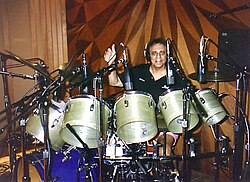
Session musician Hal Blaine (pictured in 1995) is widely regarded as one of the most prolific drummers in rock and roll history, having "certainly played on more hit records than any drummer in the rock era".[1]

A session musician (also known as studio musician or backing musician) is a musician hired to perform in a recording session or a live performance. The term sideman is also used in the case of live performances, such as accompanying a recording artist on a tour. Session musicians are usually not permanent or official members of a musical ensemble or band.

Many session musicians specialize in playing common rhythm section instruments such as guitar, piano, bass, or drums. Others are specialists, and play brass, woodwinds, and strings. Many session musicians play multiple instruments, which lets them play in a wider range of musical situations, genres, and styles. Examples of "doubling" include double bass and electric bass, acoustic guitar and mandolin, piano and accordion, and saxophone and other woodwind instruments.

Session musicians are used when musical skills are needed on a short-term basis. Typically, session musicians are used by recording studios to provide backing tracks for other musicians for recording sessions and live performances, recording music for advertising, film, television, and theatre.

In the 2000s, the terms "session musician" and "studio musician" were synonymous, though in past decades, "studio musician" meant a musician associated with a single record company, recording studio or entertainment agency.[2]

Session musicians rarely achieve mainstream fame in their own right as soloists or bandleaders. However, top session musicians are well-known within the music industry. Some have become publicly recognized, such as the Wrecking Crew, the Muscle Shoals Rhythm Section[3] and The Funk Brothers who worked with Motown Records.

Approaches

[edit]

Session musicians may play in a wide range of genres or specialize in a specific genre (e.g., country music or jazz). Some session musicians with a classical music background may focus on film score recordings. Even within a specific genre specialization, there may be even more focused sub-specializations. For example, a sub-specialization within trumpet session players is "high note specialist."

The working schedule for session musicians often depends on the terms set out by musicians' unions or associations, as these organizations typically set out rules on performance schedules (e.g., regarding the length of sessions and breaks). The length of employment may be as short as a single day, in the case of recording a brief demo song, or as long as several weeks if an album or film score is being recorded.

Musicians' associations and unions often set out the remuneration terms. Some musicians may get the minimum scale rate set out by the union. Heavily in-demand session musicians may earn much more. The union rates may vary based on whether it is a music recording versus a film/television recording. While the film/television rates may be lower, there may also be residual payments to compensate them for reruns, DVD sales, streaming usage, and so on.

Session musicians often have to bring their own instruments, such as in the case of guitar, bass, woodwinds, and brass. It is expected that studio musicians will have well-maintained professional-tier instruments. In some cases, larger or heavier instruments may be provided by the recording studio, such as a grand piano or Hammond organ and Leslie speaker. In certain cases, a session musicians may bring some instruments or musical gear and use them with larger instruments that are provided by the studio, such as a synthesizer player, who might bring rack-mounted synth modules and connect them to the studio's MIDI controller stage piano. Similarly, if the studio has a selection of well-known bass amplifiers, and speaker cabinets, a bass player may only have to bring bass guitars and effect units.

The requirement to read different types of music notation, improvise and/or "play by ear" varies according to the type of recording session and the genres of music being performed. Classical musicians and many jazz and popular music musicians are expected to read music notation and do sight-reading. In jazz, rock, and many popular music genres, performers may be expected to read chord charts and improvise accompaniment and solos. In country music, performers may be expected to read Nashville Number System charts and improvise accompaniment and solos. In many traditional and folk music styles, performers are expected to be able to play by ear.

Session musicians need a nuanced sense of the playing styles and idioms used in different genres. For example, a sax player who mainly plays jazz needs to know the R&B style, if they are asked to improvise a solo in an R&B song. Similarly, a bass player asked to improvise a walking bassline in a rockabilly song needs to know the stock lines and clichés used in this genre.

Regardless of the styles of music session musicians play, some qualities are universal: punctuality in arriving at the session; rhythmic and intonation precision; ability to play with good ensemble and excellent blending with the other performers; willingness to take direction from bandleaders, music directors, and music producers; and having good musical taste in regards to choices with musical ornaments and musical phrasing.[4]

History

[edit]

1950s–1960s

[edit]

During the 1950s and 1960s, session players were usually active in local recording scenes concentrated in places such as Los Angeles, New York City, Nashville, Memphis, Detroit, and Muscle Shoals.[5][6][7] Each local scene had its circle of "A-list" session musicians, such as The Nashville A-Team that played on numerous country and rock hits of the era, the two groups of musicians in Memphis, both the Memphis Boys and the musicians who backed Stax/Volt recordings, and the Funk Brothers in Detroit, who played on many Motown recordings.[6]

At the time, multi-tracking equipment, though common, was less elaborate, and instrumental backing tracks were often recorded "hot" with an ensemble playing live in the studio.[8] Musicians had to be available "on call" when producers needed a part to fill a last-minute time slot.[9] In the 1960s, Los Angeles was considered the top recording destination in the United States — consequently studios were constantly booked around the clock, and session time was highly sought after and expensive.[10] Songs had to be recorded quickly in the fewest possible takes.[11] In this environment, Los Angeles producers and record executives had little patience for needless expense or wasted time and depended on the service of reliable standby musicians who could be counted on to record in a variety of styles with minimal practice or takes, and deliver hits on short order.[9][12]

Studio band

[edit]

A studio band is a musical ensemble that is in the employ of a recording studio for the purpose of accompanying recording artists who are customers of the studio. The use of studio bands was more common during the 1960s with groups such Booker T. & the M.G.'s. The benefit of having a regular group, an approach which typified Southern soul, is that the group has much more experience playing together, which enables them to get a better sense of ensemble.

Notable groups

[edit]
Studio musicians who recorded during the Nashville sound era. Their contributions began in the 1950s with artists such as Elvis Presley. The original A-Team includes bassist Bob Moore; guitarists Grady Martin, Hank Garland, Ray Edenton, and Harold Bradley; drummer Buddy Harman; pianists Floyd Cramer and Hargus "Pig" Robbins; fiddler Tommy Jackson; steel guitarist Pete Drake; harmonicist Charlie McCoy; saxophonist Boots Randolph; and vocal groups The Jordanaires and The Anita Kerr Singers. Cramer, McCoy, and Randolph, along with later A-Teamer and producer Chet Atkins, would later emerge as part of Hee Haw's Million Dollar Band in the 1980s.
A collection of musicians based at the Brill Building at 1619 Broadway and the Aldon Music Allegro Studios at 1650 Broadway. The two locations were already producing popular music in the 1940s as Tin Pan Alley had been waning; it was in the late 1950s and early 1960s that a distinct Brill Building sound began to coalesce, which backed musicians such as The Four Seasons, Neil Sedaka, Bobby Darin,[13] and the early girl groups associated with Phil Spector, who later built upon his work at the Brill Building into his more famous Wall of Sound.[14] Many of the Brill Building studio musicians were themselves recording artists and songwriters.
The house band at Stax records in Memphis during the 1960s and 1970s, playing behind Otis Redding, Eddie Floyd, Sam and Dave, Isaac Hayes, The Staple Singers, and others. M.G.'s guitarist Steve Cropper co-wrote many of Redding's hits, and the M.G.'s produced albums and hit singles such as "Green Onions" in their own right while being the house band at Stax.
Prolific, established studio musicians based in Los Angeles, among which bassist Carol Kaye stands out as one of the rare female instrumentalists. They have recorded many songs and albums since the 1960s.
A vocal session group closely associated with the Wrecking Crew and appeared as backing vocalists on many of the Crew's recordings, including T.V. and movie themes and radio and television commercials.
An all-female vocal group featuring Darlene Love, which was closely associated with the Wrecking Crew and with Phil Spector, appeared as backing vocalists on many of their recordings. From 1964 to 1966, they were featured vocalists on the weekly rock' n' roll television program Shindig!
Session musicians who backed many Motown Records recordings from the late 1950s to the early 1970s as well as a few non-Motown recordings, notably on Jackie Wilson's "(Your Love Keeps Lifting Me) Higher and Higher".
An all-female trio of backing vocalists who backed many Motown Records artists from the late 1950s to the early 1970s as well as a few non-Motown artists, including Jackie Wilson, Betty Everett, and John Lee Hooker. Closely associated with the Funk Brothers.
Session musicians who served as American Sound Studio's house band. They backed such artists as Aretha Franklin, Elvis Presley, Wilson Pickett, Joe Tex, Neil Diamond, and Dusty Springfield, among others.
A Los Angeles singer/songwriter scene associated with the Troubadour nightclub and Laurel Canyon in the late 1960s to mid-1970s was supported by musicians Russ Kunkel, Danny Kortchmar, Leland Sklar and Craig Doerge. This session combo, nicknamed "the Section" or "the Mafia," backed many musicians, among others: Carole King, James Taylor, Jackson Browne, Warren Zevon, Kris Kristofferson and David Crosby.
A group comprising Barry Beckett, Roger Hawkins, David Hood, and Jimmy Johnson, also known as the Swampers, became known for the "Muscle Shoals Sound." Many of the recordings done in the Memphis area, which included Muscle Shoals, Alabama, used The Memphis Horns in their arrangements.
  • MFSB (Philadelphia, 1970s)
MFSB ("Mother Father Sister Brother") was a group of soul music studio musicians based in Philadelphia at the Sigma Sound Studios; they later went on to become a name-brand instrumental group, and their best-known hit was "TSOP (The Sound of Philadelphia)," better known as the theme from Soul Train.
A vocal group commissioned to provide vocals for Mayoham Music, formed by husband and wife Al Ham and Mary Mayo (the latter of whom was also a member of the group). The group is best known for their jingles and television news themes. "I'd Like to Teach the World to Sing (In Perfect Harmony)," originally composed as a jingle for Coca-Cola, became a surprise hit and the source of the group's recording name, as the Coca-Cola commercial featured singers on a hillside. The New Seekers would have an even larger hit with the same song. Their best-known news theme was "Move Closer to Your World," associated with Capital Cities Communications' Action News local news format.
Session musicians who backed many Salsoul Records recordings from 1974 to 1982. Under their own name, they recorded and released several hit singles and albums between 1975 and 1982.
Session musicians who served as the house band at Compass Point Studios.

See also

[edit]

References

[edit]
Revisions and contributorsEdit on WikipediaRead on Wikipedia
from Grokipedia
A session musician, also known as a studio musician or backing musician, is a highly skilled instrumentalist or vocalist hired on a short-term, freelance basis to perform during recording sessions, live performances, or other musical projects, providing essential support to lead artists or bands without being a permanent member. These musicians are renowned for their technical proficiency, versatility across genres, and ability to quickly learn and execute parts under tight deadlines, often complex scores or improvising to meet producers' visions. Typically working as independent contractors in studios, they contribute to albums, film scores, commercials, and tours, earning income through session fees, royalties, or union scale rates while navigating a competitive industry that demands reliability and adaptability. The role of session musicians has been pivotal in shaping modern popular music since the mid-20th century, evolving from in-house studio ensembles to predominantly freelance operations amid technological advancements like and digital production. In the 1950s and 1960s, record labels relied on dedicated groups of session players to achieve polished, efficient recordings; for instance, ' Wrecking Crew backed hits by artists like on albums such as (1966), while Detroit's Funk Brothers powered Motown's signature sound for acts including and . Similarly, the in contributed to soul classics by and in the late 1960s and 1970s, highlighting how these anonymous experts often replaced or augmented touring bands to deliver superior studio performances. By the , as and synthesizers proliferated, the demand shifted toward versatile freelancers who could add distinctive "feel" or grooves, exemplified by drummer Steve Gadd's iconic beat on Paul Simon's "50 Ways to Leave Your Lover" (1975). Notable session musicians have left indelible marks on music history through their innovative contributions, often remaining behind-the-scenes despite their influence. Bassist , a Wrecking Crew stalwart, played on over 10,000 sessions, including ' "You've Lost That Lovin' Feelin'" (1964) and Sonny & Cher's "The Beat Goes On" (1967), pioneering electric bass techniques in pop and rock. Bassist , from , crafted the unforgettable bass line for ' "" (1966), influencing funk and Motown's rhythmic foundation. Other luminaries include bassist , who supported artists from to Toto, and vocalist , whose improvised performance on Pink Floyd's "The Great Gig in the Sky" (1973) became a landmark. Today, session work continues to thrive in diverse formats, from streaming-era tracks to film scoring, underscoring the enduring value of these adaptable experts in an industry increasingly driven by collaboration and precision.

Definition and Role

Overview

A session musician is a freelance professional hired on a per-project basis to perform in recording sessions or live performances, typically providing or vocal support without being credited as a permanent band member. Unlike touring or ensemble members with ongoing commitments, session musicians operate independently, often through contracts or unions, to contribute to a wide array of music projects. Key characteristics of session musicians include exceptional versatility across multiple genres, the ability to quickly adapt to an artist's style and direction, and a primary focus on enhancing the lead performer's vision rather than taking a starring role. This adaptability allows them to sight-read complex arrangements on short notice and deliver polished performances under tight deadlines, making them indispensable in fast-paced production environments. The role emerged prominently in the mid-20th century alongside the expansion of commercial recording studios, though its roots trace back to earlier freelance orchestral work where musicians were hired for specific performances or recordings. Economically, session musicians are often compensated with flat fees per session, which enables record labels to assemble expert ensembles cost-effectively without the overhead of full-time staff or royalties in many cases. For instance, groups like the Wrecking Crew exemplified this model by powering numerous hit recordings in the 1960s.

Responsibilities

Session musicians undertake a range of core duties during recording and performance projects, primarily focused on delivering high-quality, supportive contributions under tight timelines. These include accurately to perform parts as scripted, synchronizing precisely with pre-recorded tracks or other musicians using a strong or charts, and providing backing vocals or as directed by the or . For instance, they must often execute complex arrangements in a single take, adjusting to stylistic nuances across genres like pop, , or rock to blend seamlessly into the overall sound. Preparation is essential for session work, requiring musicians to arrive fully equipped with their instruments, tuned and in optimal condition, ready to engage immediately upon call time. They are expected to learn and internalize new material rapidly—sometimes within hours or even minutes—through provided charts, mock-ups, or verbal cues, demonstrating versatility to accommodate last-minute changes. Collaboration with producers, engineers, and artists forms a key part of this phase, involving to feedback and iterating performances to meet creative visions efficiently. Following the initial recording, session musicians may handle post-session tasks such as additional layers to enhance tracks, their contributions for timing or tone, and verifying compatibility with the final mix to ensure professional integration. These steps help maintain the project's momentum while upholding audio quality standards. Legal and contractual obligations underpin session engagements, often governed by union regulations like those from the (AFM). Musicians typically adhere to standardized agreements such as the Sound Recording Labor Agreement (SRLA), which outline working conditions, including session lengths (e.g., up to three hours at scale wages starting at $488.29 for master recordings as of February 2025), pension contributions (14.09%), and health & welfare benefits ($30 for the first session). Non-disclosure agreements (NDAs) are commonly included in contracts to protect unreleased material, preventing musicians from discussing project details publicly. provisions under AFM guidelines require inclusion of the union acknowledgment in packaging or digital formats where applicable, though individual credits may be limited to or omitted in work-for-hire arrangements to prioritize the lead artist's visibility.

Approaches

Recording Sessions

Session musicians typically engage in structured recording sessions that begin with pre-production briefs to align on song arrangements, tempos, and keys, often using demos and rehearsals to ensure efficiency. These briefs help establish a clear , allowing musicians to familiarize themselves with the material before entering the studio. The core tracking phase follows, where instruments are recorded layer by layer onto multi-track systems, starting with foundational elements like and bass. Sessions integrate with mixdown by capturing flexible performances that can be edited later, emphasizing precision over live cohesion. According to the (AFM), a standard basic regular session lasts three hours and yields up to 15 minutes of final product, though extensions or multiple sessions are common for complex projects. Key techniques in these sessions include layering tracks through overdubs, where additional instruments or parts are added sequentially to build depth, and punch-ins to correct specific errors without re-recording entire takes. Musicians must adapt to click tracks or metronomes to maintain tight timing, enabling seamless editing and synchronization in . This approach contrasts with live recording by prioritizing isolated, editable performances that can be comped from multiple takes for optimal results. Sound on Sound highlights how click tracks are often employed during tracking to support consistent grooves, particularly when layering elements like guitars or keyboards. Session work demands familiarity with diverse studio equipment, including multi-track recorders for capturing individual stems, guitar and bass amps for tone shaping, and effects pedals or for real-time processing like reverb and delay. Musicians often interact with console preamps, microphones, and direct injection boxes to achieve producer-specified sounds quickly. For instance, renowned session players like utilized Fender Precision Basses with Fender amps across countless tracks, demonstrating the need for versatile gear handling. Adaptations across genres are essential, as session musicians adjust their style to fit the project's needs; in rock, they provide solid rhythm sections with locked-in grooves, while in pop sessions, jazz-trained players might incorporate subtle improvisational fills without disrupting the structured . The Wrecking Crew exemplified this versatility, blending phrasing into 1960s pop and hits for artists like . An analysis in the Art of Record Production Journal notes how session musicians like the Wrecking Crew added an extra feel and groove to recordings, tailoring their contributions to studio constraints.

Live Performances

Session musicians often participate in live s as part of temporary ensembles supporting headlining artists on tours, one-off shows, or special events, requiring them to integrate quickly into existing band dynamics. Setup and rehearsals for these engagements typically involve minimal preparation time, with soundchecks limited to a one-hour minimum call to ensure equipment functionality and balance with the headliner's setup. Rehearsals are structured around two-hour minimum sessions, often covered under a performance day rate that includes arrival, tuning, and blending instrument sounds to complement the main act without extensive prior collaboration. This rapid integration demands high adaptability, as session musicians must adjust to varying stage configurations and the headliner's stylistic preferences on the spot. During live performances, session musicians face unique demands such as managing dynamics, including changes, monitor mixes, and interactions that can alter levels unpredictably. They must maintain precision amid potential equipment malfunctions or technical issues, all while lacking the full cohesion of a permanent band, which heightens the need for real-time and reliability. Contracts often limit performances to a maximum of eight per week across six days to prevent , with additional shows compensated at a fraction of the weekly salary to account for the physical and mental toll. Representative examples of session musicians in live settings include providing backup instrumentation for artists at award shows like the Grammys, where they support musical guests in high-stakes, televised segments. Festival fill-ins occur when headliners require additional players for large outdoor events, such as Coachella or Glastonbury, to augment their sound for diverse crowds. TV appearances, like musical guest spots on Saturday Night Live, frequently feature session musicians as the touring band, delivering polished yet spontaneous renditions in a controlled studio environment. In recent years, session musicians have also adapted to virtual live performances and streaming events, providing remote backing for artists on platforms like and Twitch. Compensation for live performances differs from recording sessions, typically structured as per-gig or daily fees rather than royalties, with rates ranging from £250 for smaller venues to £500 for arenas (as of 2025), inclusive of soundcheck and rehearsal. For extended tours, weekly salaries apply, such as approximately $1,800 for sidemusicians (as of 2025), often supplemented by travel stipends and per diems of around $100 per day in major cities, contrasting with the one-time session payments in studios that may include residual royalties for broadcasts.

History

Early Development

The roots of session musicianship trace back to the late 19th and early 20th centuries, when professional musicians primarily worked in live performance settings such as theater pit orchestras and accompaniments. In houses, ensembles provided underscoring for acts, drawing from popular songs and improvisational skills, with orchestras typically comprising 20 to 80 players including strings, woodwinds, brass, and percussion to support variety shows. By the 1910s and 1920s, this evolved into theaters, where live musicians—ranging from solo pianists or organists in smaller venues to full symphonic groups of up to 100 players in major cities—synchronized music to on-screen action, enhancing emotional depth; for instance, New York's and Rivoli theaters each employed 45-piece orchestras plus multiple organists and conductors to perform daily for audiences. These roles demanded versatile, quick-adapting performers who could read cues and improvise, laying the groundwork for the precision required in later studio environments. The transition to recorded and broadcast media in the marked a pivotal shift, as and film musicians increasingly moved into radio studio ensembles and recording sessions, fueled by technological advancements. Radio stations, proliferating after , initially relied on live performances in studios, hiring ensembles similar to theater pits to broadcast and , which legitimized session work as a steady in urban centers like New York. A key enabler was the introduction of electrical recording on February 25, 1925, when Western Electric's and amplifier system replaced acoustic horns, allowing for the capture of larger, multi-instrument groups with greater fidelity and —such as an 850-voice in a single session—thus enabling complex backing tracks that expanded opportunities for session players beyond solo or small-group limitations. This innovation revitalized the industry, boosting demand for skilled musicians to support emerging genres like in controlled studio settings. Institutional milestones further shaped early session musicianship, particularly through the (AFM), formed in 1896 to unify professionals and establish wage scales for live and emerging recorded work. By the , the AFM had grown to represent over members across more than 400 locals, negotiating higher rates for recording sessions compared to live gigs and securing industry-wide agreements by the 1930s to protect against technological displacement. The 1942–1944 recording ban, initiated by AFM president James Petrillo, prohibited union musicians from making commercial records to demand royalties from labels and broadcasters, halting new releases for nearly two years and forcing radio to emphasize live sessions while highlighting session players' economic vulnerabilities. During the 1930s and early 1940s, pioneers in New York studios exemplified this era's growth; for example, versatile ensembles at RCA Victor's 24th Street facility provided backing for big band hits, with trombonist Miff Mole and trumpeter contributing to precise, multi-take recordings that supported leaders like , while utilized similar studio groups to underpin swing-era tracks by artists such as .

1950s–1960s

The 1950s and 1960s marked a pivotal era for session musicians, as the music industry shifted toward independent labels and specialized "hit factories" that prioritized rapid production of commercial recordings. Independent labels like Sun, Chess, and Atlantic pioneered innovative techniques to capture emerging rock 'n' roll and rhythm and blues sounds, often hiring skilled session professionals to provide polished, efficient instrumentation rather than relying on touring bands, which allowed for quicker turnaround times and cost savings in the competitive post-war market. This approach expanded the use of session musicians across major and smaller labels, enabling producers like Phil Spector to craft dense, orchestral pop arrangements with groups such as the Wrecking Crew in Los Angeles. In Hollywood, the Wrecking Crew—a loose collective of top studio players including drummer , bassist , and guitarist —became central to the West Coast sound, contributing to landmark tracks for , such as the innovative arrangements on the 1966 album , and nearly all of ' early hits, including their self-titled 1966 debut. Meanwhile, in , the (also known as the Swampers), comprising musicians like bassist , drummer Roger Hawkins, guitarist Jimmy Johnson, and keyboardist , formed the backbone of ' house band, delivering the gritty, emotive grooves behind soul classics such as Wilson Pickett's "Mustang Sally" (1966) and Aretha Franklin's "" (1967). These regional hubs exemplified how session musicians drove the era's output, blending rock, pop, and soul with professional precision. Session work also underpinned the British Invasion's transatlantic success, with London-based players like drummer and guitarist providing reliable backing on numerous chart-toppers, including hits by ("Telstar," 1962) and early recordings for acts like and the Who, ensuring high-quality results amid the rush to capitalize on . At Motown in Detroit, —session stalwarts including bassist , drummer , and keyboardist —operated like an assembly line under founder , powering the label's signature sound on over 100 top-ten singles from 1961 to 1969, such as ' "" (1966), through tightly scheduled three-hour sessions that mirrored automotive efficiency. Economically, union scale under the (AFM) provided stability, with typical rates for non-lead session players at $41.25 for a three-hour call or completed track in the mid-1960s, allowing versatile musicians to contribute to hundreds of uncredited hits annually while sustaining a freelance amid the boom. This period's reliance on such pros not only fueled the rock and pop explosion but also shaped a blueprint for studio-centric production that prioritized hits over band cohesion.

1970s–Present

The emergence of in the mid-1970s introduced a do-it-yourself (DIY) ethos that emphasized self-reliance among musicians, significantly reducing the demand for professional session players in rock and related genres as bands handled their own recordings with minimal external support. This shift contrasted with the polished studio productions of prior decades, leading to a contraction in traditional session work, particularly in freelance scenes centered in New York and , where punk's raw aesthetic prioritized authenticity over expert musicianship. However, the late 1970s and 1980s saw a partial revival through and emerging , where session musicians contributed to layered pop arrangements in major studios like those in New York (e.g., Electric Lady) and (e.g., ), supporting international hits by artists blending electronic elements with live instrumentation. In the and , the rise of hip-hop and further limited the role of live session musicians, as these genres favored sampling, machines, and digital production techniques that incorporated organic sounds sparingly, often through pre-recorded loops rather than on-site performances. Concurrently, the proliferation of file-sharing platforms like in the late drastically altered royalty structures, contributing to a 7.6% decline in global recorded music sales in and diminishing income streams for session contributors who relied on mechanical and royalties from album sales. This economic pressure compounded the sparse integration of session work in electronic-heavy productions, pushing many freelancers toward teaching or live touring for stability. From the onward, the streaming era has driven demand for rapid, cost-effective session contributions to fuel high-volume releases on platforms like , where quick-turnaround recordings align with algorithms favoring frequent output over elaborate studio sessions. Remote collaboration tools have facilitated this shift, enabling session musicians to record and share tracks globally without , as exemplified by platforms like SoundBetter, launched in , which connect freelancers with artists for virtual sessions across genres. This model has supported the globalization of session work, with Bollywood's studios employing versatile players for soundtracks mirroring Western pop production techniques, K-pop's Seoul-based teams integrating live elements into idol tracks for international appeal, and African hubs in and adopting similar freelance systems for exports. The , starting in 2020, further disrupted session musicianship by halting in-person studio sessions and live performances, leading to significant income losses, but it accelerated the adoption of remote recording technologies; by 2025, the industry had largely recovered with hybrid in-person and virtual models becoming standard.

Studio Bands

Formation and Function

Studio bands, also known as s, are typically assembled by record producers or label executives who select a core group of musicians based on their technical proficiency, stylistic versatility, and interpersonal compatibility to serve as a reliable backing unit for multiple recording projects. This selection process often draws from local talent pools, agency rosters, or personal referrals, prioritizing players who can quickly adapt to various artists while maintaining a cohesive ensemble sound. For instance, at , the house band formed in 1962 through an impromptu involving on organ, on guitar, on drums, and on bass, with Donald "Duck" Dunn later replacing Steinberg; the group emerged organically from musicians connected to the label's operations in Memphis. In operation, these bands function as semi-permanent units with a fixed —usually comprising drums, bass, and guitar—to provide structural consistency across sessions, while allowing for rotating additional players like horn sections or keyboardists depending on the project's or needs. This model enables efficient in the studio, where the core group rehearses minimally and records backing tracks that support lead vocalists or soloists, often in a single take to capture a live, integrated feel. At Stax, Booker T. & the M.G.'s exemplified this by backing nearly all early label sessions under founders Jim Stewart and , contributing to the raw, groove-oriented "Memphis Sound" that defined the label's output. The use of such bands offers several advantages, including accelerated group cohesion compared to ad-hoc assemblies, which reduces setup time and rehearsal costs for record labels, and the development of a specialized, signature sound that becomes synonymous with the studio or label. This operational efficiency allowed Stax to produce hits more economically during its peak years, as the familiar rhythm section minimized trial-and-error in tracking. Furthermore, the fixed lineup fostered innovation in grooves and arrangements tailored to soul and R&B, enhancing the commercial viability of releases. A prime example is the band's role in crafting the driving, horn-accented grooves behind Otis Redding's tracks, such as those on his 1965 album Otis Blue/Otis Redding Sings Soul, which helped propel Stax's soul catalog to national prominence.

Notable Groups

The Wrecking Crew emerged as a pivotal collective of session musicians in during the and , contributing to hundreds of hit recordings, including approximately 40 number-one hits and over 150 top 10 hits across genres like , and R&B. This loose group, often numbering around 20 core members, provided the instrumental foundation for recordings by artists including , , and , with their versatility enabling rapid adaptation to diverse styles. Notably, they were the go-to ensemble for producer , helping craft his signature "Wall of Sound" technique—a dense, reverberant production method achieved by overdubbing multiple instruments at —which defined tracks like ' "" (1963) and the ' "You've Lost That Lovin' Feelin'" (1964), both reaching number one on the Hot 100. In , formed the instrumental core of Records throughout the 1960s, backing virtually every major hit from the label's golden era and shaping the "Motown Sound" through their precise, groove-oriented playing. Comprising about 13 key musicians, they supported stars like on albums such as (1971), on smashes like "" (1964), and on "My Girl" (1964), collectively contributing to over 50 number-one singles and hundreds of top-ten hits. Their innovative bass lines, led by , and rhythmic interplay infused with infectious energy, influencing global pop for decades. The , affectionately nicknamed the Swampers, operated out of studios in and , from the mid-1960s into the 1970s, delivering a gritty, emotive sound that bridged and rock. This tight-knit group of four to six musicians recorded seminal tracks for , including her transformative covers "" (1967) and "" (1967) at , which revitalized her career and earned multiple Grammys. They also collaborated with during the 1969 sessions for , providing the backing for "" and "Wild Horses," blending R&B authenticity with rock edge to create enduring classics. Their work at , founded in 1969, extended to artists like and , solidifying the region's reputation as a recording hub. Beyond the , session musician collectives have played key roles in international scenes, such as those in supporting productions since the 1980s. These groups, often assembled at major studios like Sound City , provide versatile backing for idols and ensembles, contributing to high-energy tracks by artists like and contributing to the genre's polished, synth-driven sound without the formal naming seen in Western counterparts.

Skills and Career

Required Skills

Session musicians require a robust set of musical proficiencies to perform effectively in high-pressure environments. Sight-reading is essential, enabling performers to interpret and execute complex notation quickly without prior rehearsal, often from simple charts or lead sheets. Ear training complements this by allowing musicians to transcribe parts by hearing alone, facilitating improvisation and adaptation during sessions. Proficiency in multiple instruments is also common; for instance, guitarists may double on bass to provide versatility across tracks, expanding employability in diverse recording scenarios. Technical knowledge of recording processes underpins successful contributions in the studio. Musicians must grasp basics such as placement to optimize instrument capture, signal flow to understand how sounds integrate in a mix, and adaptation to click tracks for precise timing. Familiarity with workstations and sound-check procedures ensures seamless integration with engineering teams, minimizing downtime during sessions. Interpersonal and professional are equally critical for collaborative dynamics. and reliability ensure sessions run on schedule, respecting tight deadlines in professional environments. Ego management involves subordinating personal preferences to the project's needs, fostering and a positive atmosphere amid directives. Quick learning enables rapid mastery of complex arrangements, often requiring spontaneity under pressure. Genre fluency demands the ability to fluidly transition between styles, such as shifting from scales to structures without preparation. This versatility stems from broad stylistic knowledge, prioritizing "feel" and adaptability over virtuosic display, allowing musicians to meet producer expectations across , and other idioms.

Career Path

Aspiring session musicians typically enter the industry by gaining initial experience in local music scenes, performing with bands and at venues to develop versatility and connections. Many also obtain formal through music schools or conservatories, which emphasize and genre adaptability essential for studio work. To secure initial gigs, musicians often create and submit demo reels showcasing their playing across styles to producers, studios, or online platforms that facilitate freelance opportunities. Advancement relies on establishing a reputation through repeated engagements, including uncredited contributions to recordings that build a portfolio of credits for future hires. Networking directly at recording studios and with producers, engineers, and fellow musicians is vital for generating referrals and steady work. Over time, some session musicians transition into complementary roles like audio production or composing, leveraging their studio expertise to broaden their professional scope. The freelance nature of the work presents challenges, such as irregular streams that fluctuate with availability. Most operate under work-for-hire clauses, forgoing ongoing royalties in exchange for upfront session fees. In the 2020s, average earnings range from $200 to $500 per session, depending on location, union status, and session length, with hourly rates around $42 for musicians overall. For longevity, many diversify into teaching private lessons or composing stock music to stabilize finances and extend careers beyond peak performing years, often in the 30-50 age range when accumulated experience maximizes opportunities.

Modern Developments

Technological Impacts

The advent of digital audio workstations (DAWs) such as has fundamentally reshaped session musicians' workflows since the early 2000s by enabling seamless remote recording sessions and integrating virtual instruments that diminish the necessity for live performances. These tools allow producers to record, edit, and mix audio tracks digitally, facilitating collaboration without physical presence in a studio, which has expanded opportunities for session work across global locations. Virtual instruments and sample libraries, accessible within DAWs, provide high-fidelity emulations of real instruments, reducing the demand for on-site musicians for routine parts like drums or strings, thereby streamlining production timelines and costs. Pitch correction plugins like , developed in the late and widely adopted in the , have altered the technical demands on session musicians by automating pitch adjustments, which permits performers with less precise intonation to contribute effectively while shifting emphasis to elements such as rhythmic feel and emotional delivery. This technology uses algorithms to analyze and correct audio frequencies in real-time, allowing for natural-sounding corrections through adjustable retune speeds or more stylized effects in genres like pop and hip-hop. As a result, session players can focus on creative interpretation rather than flawless execution, though it underscores the importance of overall musicality in an era of fixes. Remote collaboration platforms have further transformed session musicians' roles by the 2010s, with tools like Splice and Zoom enabling global hires and file exchanges that eliminate travel requirements but necessitate proficiency in digital file management. Splice Studio, for instance, supports cloud-based sharing of stems, vocals, and project files, allowing musicians to iterate on tracks asynchronously via DAWs like , which fosters efficient division of labor in remote sessions. Video conferencing integrates with these systems for real-time feedback, broadening access to international projects while demanding skills in organizing and versioning audio files to maintain coherence. By 2025, (AI) tools are emerging as influencers in music production, with generative platforms automating basic session components such as patterns and bass lines, potentially reducing demand for entry-level live contributions. AI systems like virtual drummers adapt to user inputs in real-time, generating tracks that follow specified tempos and styles, which aids in rapid prototyping but challenges traditional session roles by offering synthetic alternatives for foundational elements. Tools such as BandLab Starter and Producer Suite further enable track generation from simple prompts, creating melodies and arrangements that session musicians might otherwise provide, though human oversight remains essential for nuanced artistry.

Industry Challenges

Session musicians in the contemporary music industry grapple with significant economic pressures, primarily driven by the dominance of streaming platforms that offer minimal royalties. Average payouts range from $0.003 to $0.005 per stream, severely limiting revenue for recordings involving session work and contributing to stagnant or declining session rates as labels prioritize cost-cutting. This financial strain has been exacerbated by the lingering effects of the , which led to widespread cancellation of live and studio gigs; a 2021 survey found 71% of musicians reported a loss of at least three-quarters of their income, and while the industry has seen recovery by 2025, reduced production budgets continue to limit some session opportunities. Legal challenges further complicate the landscape for session musicians, particularly around and labor protections. Disputes over uncredited samples frequently arise when session recordings are repurposed without compensation or attribution, as sampling a portion of a copyrighted work can trigger infringement lawsuits unless cleared with all rights holders, leaving session contributors vulnerable to exploitation. The weakening of unions like the (AFM) has intensified these issues, with non-union "dark dates"—recordings that bypass union contracts—eroding fair wage standards and benefits for session players. Additionally, ongoing debates over classification classify many session roles as independent contractor work, denying musicians access to employee protections such as health benefits and overtime pay, as highlighted in analyses of precarious labor in the sector. Cultural shifts toward valuing artist authenticity have diminished demand for session musicians, as contemporary artists increasingly seek to embody a "DIY" by performing and producing their own material to align with audience expectations of genuineness. This trend is amplified by the rise of bedroom producers, who use affordable digital tools to create full tracks independently, reducing the need for hired session expertise and sidelining traditional studio collaborations. Diversity gaps persist as a critical challenge, with women and minorities severely underrepresented in session and production roles; for instance, women comprise only 18.9% of songwriter credits and 5.9% of producers on major charts (2024 data), while 40.8% of female artists on major charts are from underrepresented racial/ethnic groups. Over 51% of women musicians report experiencing gender discrimination, including barriers to session opportunities, compared to 6% of men. Initiatives like the She Rocks Awards, founded in 2012 by the Women's International Music Network, aim to address these inequities by honoring trailblazing women across music roles, including performers and industry professionals, to promote visibility and inclusion.

References

Add your contribution
Related Hubs
User Avatar
No comments yet.