Smenkhkare
Smenkhkare
Main page
2232284

Smenkhkare

logo
Community Hub0 subscribers
Read side by side
from Wikipedia

Smenkhkare (alternatively romanized Smenkhare, Smenkare, or Smenkhkara; meaning "Vigorous is the soul of Re") was an ancient Egyptian pharaoh of unknown background who lived and ruled during the Amarna Period of the 18th Dynasty. Smenkhkare was husband to Meritaten, the daughter of his likely co-regent, Akhenaten. Since the Amarna period was subject to a large-scale condemnation of memory by later pharaohs, very little can be said of Smenkhkare with certainty, and he has hence been subject to immense speculation.[2]

Key Information

Origin and family

[edit]

Smenkhkare's origins are unknown. It is assumed he was a member of the royal family, likely either a brother or son of the pharaoh Akhenaten. If he is Akhenaten's brother, his mother was likely either Tiye or Sitamun.[3] If a son of Akhenaten, he was presumably an older brother of Tutankhamun, as he succeeded the throne ahead of him;[4] his mother was likely an unknown, lesser wife.[5] An alternative suggestion, based on objects from the tomb of Tutankhamun, is that Smenkhkare was the son of Akhenaten's older brother, Thutmose and an unknown woman, possibly one of his sisters.[6]

Smenkhkare is known to have married Akhenaten's eldest daughter, Meritaten, who was his Great Royal Wife.[7] Inscriptions mention a King's Daughter named Meritaten Tasherit, who may be the daughter of Meritaten and Smenkhkare.[8][9] Furthermore, Smenkhkare has been put forth as a candidate for the mummy in KV55. If so, he would be the father of Tutankhamun.

Reign as pharaoh

[edit]

Length of reign

[edit]

Clear evidence for a sole reign for Smenkhkare has not yet been found. There are few artifacts that attest to his existence at all, and so it is assumed his reign was short. A wine docket from "the house of Smenkhkare" attests to Regnal Year 1.[10] A second wine docket dated to Year 1 refers to him as "Smenkhkare, (deceased)" and may indicate that he died during his first regnal year.[11][12]

Some Egyptologists have speculated about the possibility of a two- or three-year reign for Smenkhkare based on a number of wine dockets from Amarna that lack a king's name but bear dates for regnal years 2 and 3.[13] However, they could belong to any of the Amarna kings such as Neferneferuaten and are not definitive proof either way.[14]

Smenkhkare Hall

[edit]

While there are few monuments or artifacts that attest to Smenkhkare's existence, there is a major addition to the Amarna palace complex that bears his name. It was built in approximately Year 15 and was likely built for a significant event related to him.

Theories of timing of Smenkhkare's reign

[edit]

Academic consensus has yet to be reached about when exactly Smenkhkare ruled as pharaoh and where he falls in the timeline of Amarna. In particular, the confusion of his identity compared to that of Pharaoh Neferneferuaten has led to considerable academic debate about the order of kings in the late Amarna Period. Aidan Dodson suggests that Smenkhkare did not have a sole reign and only served as Akhenaten's co-regent for about a year around Regnal Year 13.[15] However, James Peter Allen depicts Smenkhkare as successor to Neferneferuaten[16] and Marc Gabolde has suggested that after Smenkhkare's reign, Meritaten succeeded him as Neferneferuaten.

Co-regency with Akhenaten

[edit]

Per Dodson's theory, Smenkhkare served only as co-regent with Akhenaten and never had an individual rule and Nefertiti became co-regent and eventual successor to Akhenaten.[17] Smenkhkare and Meritaten appear together in the tomb of Meryre II at Amarna, rewarding Meryre. There, Smenkhkare wears the khepresh crown, however he is called the son-in-law of Akhenaten. Further, his name appears only during Akhenaten's reign without certain evidence to attest to a sole reign.[18] The names of the king have since been cut out but were recorded around 1850 by Karl Lepsius.[19] Additionally, a calcite "globular vase" from Tutankhamun's tomb displays the full double cartouches of both pharaohs. However, this is the only object known to carry both names side-by-side.[20] This evidence has been taken by some Egyptologists to indicate that Akhenaten and Smenkhkare were co-regents. However, the scene in Meryre's tomb is undated and Akhenaten is neither depicted nor mentioned in the tomb. The jar may simply be a case of one king associating himself with a predecessor. The simple association of names, particularly on everyday objects, is not conclusive of a co-regency.[21][22]

Smenkhkare as successor to Neferneferuaten

[edit]

Arguing against the co-regency theory, Allen suggests that Neferneferuaten followed Akhenaten and that upon her death, Smenkhkare ascended as pharaoh. Allen proposes that following Nefertiti's death in Year 13 or 14, her daughter Neferneferuaten-tasherit became Pharaoh Neferneferuaten.[16] After Neferneferuaten's short rule of two or three years, according to Allen, Smenkhkare became pharaoh.[16] Under this theory, both pharaohs succeeded Akhenaten: Neferneferuaten as the chosen successor and Smenkhkare as a rival with the same prenomen, perhaps to challenge Akhenaten's unacceptable choice.[23] However, a hieratic inscription discovered at the limestone quarry at Deir Abu Hinnis suggests that Nefertiti was alive in Akhenaten's Year 16, undermining this theory.[24] There, Nefertiti is referred to as the pharaoh's Great Royal Wife.[25][26]

Furthermore, work is believed to have halted on the Amarna tombs shortly after Year 13.[27][28] Therefore, the depiction of Smenkhkare in Meryre's tomb must date to no later than Year 13. For him to have succeeded Neferneferuaten means that aside from a lone wine docket, he left not a single trace over the course of five to six years.

Meritaten as successor to Smenkhkare

[edit]

In comparison to the theories mentioned above, Marc Gabolde has advocated that Smenkhkare's Great Royal Wife, Meritaten, became Pharaoh Neferneferuaten after her husband's death. The main argument against this is a box (Carter 001k) from Tutankhamun's tomb that lists Akhenaten, Neferneferuaten, and Meritaten as three separate individuals. There, Meritaten is explicitly listed as Great Royal Wife.[29] Further, various private stelae depict the female pharaoh with Akhenaten. However under this theory, Akhenaten would be dead by the time Meritaten became pharaoh as Neferneferuaten. Gabolde suggest that these depictions are retrospective. Yet since these are private cult stelae it would require a number of people to get the same idea to commission a retrospective, commemorative stela at the same time. Allen notes that the everyday interaction portrayed in them more likely indicates two living people.[22]

Identity and confusion over regnal name

[edit]
Line drawing from the tomb of Meryre II - the lost names had been recorded previously (inset) as Smenkhkare and Meritaten

There has been much confusion in identifying artifacts related to Smenkhkare because another pharaoh from the Amarna Period bears the same or similar royal titulary. In 1978, it was proposed that there were two individuals using the same name: a male king Smenkhkare and a female Neferneferuaten.[30] Neferneferuaten has since been identified as a female pharaoh who ruled during the Amarna Period and is generally accepted as a separate person from Smenkhkare.[31][32] Neferneferuaten is theorized to be either Nefertiti or Meritaten. The previous hypothesis that she was Neferneferuaten Tasherit by the Egyptologist James Peter Allen in a 2009 paper was later rejected by the same scholar in a later 2016 paper in favour of Nefertiti with the publication of the Year 16 date showing that Nefertiti was still alive in Akhenaten's second last year of rule.[33]

After their initial rediscovery, Smenkhkare and Neferneferuaten were assumed to be the same person because of their similar prenomen (throne name).[34] Typically, throne names in Ancient Egypt were unique. Thus, the use of similar titulary led to a great deal of confusion among Egyptologists.[35] For the better part of a century, the repetition of throne names was taken to mean that Smenkhare changed his name to Neferneferuaten at some point, probably upon the start of his sole reign. Indeed, Petrie makes exactly that distinction in his 1894 excavation notes. Later, a different set of names emerged using the same: "Ankhkheperure mery Neferkheperure [Akhenaten] Neferneferuaten mery Wa en Re [Akhenaten]".[35]

Smenkhkare can be differentiated from Neferneferutaten by the lack of an epithet associated with his throne name.[36][37] James Peter Allen pointed out the name 'Ankhkheperure' nearly always included the epithet 'desired of Wa en Re' (referring to Akhenaten) when coupled with the nomen 'Neferneferuaten'. There were no occasions where 'Ankhkheprure plus epithet' occurred alongside 'Smenkhkare;' nor was plain 'Ankhkheperure' ever found associated with the nomen Neferneferuaten.[38] However, differentiating between the two individuals when 'Ankhkheperure' occurs alone is complicated by the Pawah graffito from TT139. Here, Ankhkheperure is used alone twice when referring to Neferneferutaten.[39] In some instances, a female version 'Ankhetkheperure' occurs; in this case the individual is Neferneferuaten.[36][37]

The issue of a female Neferneferuaten was finally settled for the remaining holdouts when Allen confirmed Marc Gabolde's findings that objects from Tutankhamun's tomb originally inscribed for Neferneferuaten which had been read using the epithet "...desired of Akhenaten" were originally inscribed as Akhet-en-hyes or "effective for her husband."[40][41]

Theories

[edit]

Akhenaten and Smenkhkare as homosexual couple

[edit]

Theories arose when the two pharaohs Smenkhkare and Neferneferutaten were still considered the same, male person, that he and Akhenaten could have been homosexual lovers or even married. This is because of artwork clearly showing Akhenaten in familiar, intimate poses with another pharaoh. For example, stele in Berlin depicts a pair of royal figures, one in the double crown and the other, who appears to be a woman, in the khepresh crown. However, the set of three empty cartouches can only account for the names of a king and queen. This has been interpreted to mean that at one point Nefertiti may have been a coregent, as indicated by the crown, but not entitled to full pharaonic honors such as the double cartouche.[42] Furthermore, it is now accepted that other artifacts similar to this one are depictions of Akhenaten and Neferneferuaten.
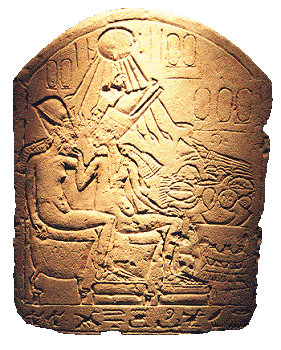
Nefertiti as Smenkhkare

[edit]

Alternatively, once the feminine traces were discovered in some versions of the throne names, it was proposed[by whom?] that Nefertiti was masquerading as Smenkhkare and later changed her name back to Neferneferuaten. There would be precedent for presenting a female pharaoh as a male, such as Hatshepsut had done generations prior.

Evidence

[edit]
This image is commonly taken to be Smenkhkare and Meritaten, although it may be Tutankhamun and Ankhesenamun
  • The Coregency Stela U.C. 410, now in the Petrie Museum. Although badly damaged, partial inscriptions survive. It shows the double cartouche of Akhenaten alongside that of Ankhkheperure mery-Waenre Neferneferuaten Akhet-en-hyes ('effective for her husband'). The inscription originally bore the single cartouche of Nefertiti, which was erased along with a reference to Meritaten to make room for the double cartouche of King Neferneferuaten.[43]
  • Line drawings of a block depicting the nearly complete names of King Smenkhkare and Meritaten as Great Royal Wife were recorded before the block was lost.
  • A cartouche which was stamped on a jar handle before firing, from Tell Jerishe (Tel Gerisa) in Israel. It bears the throne name of Smenkhkare.[44]
  • Flinders Petrie documented six rings bearing only the Throne Name 'Ankhkheperure' (the other six with the same Throne Name show an epithet: or Mery Neferkheperure, no. 92 and no. 93; or Mery Waenre, no. 94, 95, and 96) and two more bearing 'Smenkhkare' (with another one bearing the epithet Djeserkheperu, which belonged to Smenkhkare)[45] in excavations of the palace.[46] One example is Item UC23800 in the Petrie Museum which clearly shows the "djeser" and "kheperu" elements and a portion of the 'ka' glyph. Pendlebury found more when the town was cleared.[47]
  • A ring bearing his name is found at Malqata in Thebes.
  • Perhaps the most magnificent was a vast hall more than 125 metres square and including over 500 pillars. This late addition to the central palace has been known as the Hall of Rejoicing, Coronation Hall, or simply Smenkhkare Hall because a number of bricks stamped Ankhkheperure in the House of Rejoicing in the Aten were found at the site.[48]
  • Indisputable images for Smenkhkare are rare. Aside from the tomb of Meryre II, a carved and painted relief showing an Amarna king and queen in a garden is often attributed to him. It is completely without inscription, but since they do not look like Tutankhamun or his queen, they are often assumed to be Smenkhkare and Meritaten, but Akhenaten and Nefertiti are sometimes put forth as well.
  • An inscription in the tomb of Pairi, TT139, by the other Ankhkheperure (Neferneferuaten), mentions a functioning Amen 'temple of Ankhkheperure'.[49]

Several items from the tomb of Tutankhamun bear the name of Smenkhkare:

  • A linen garment decorated with 39 gold daisies along with 47 other sequins bearing the prenomen of Smenkhkare alongside Meritaten's name.
  • Carter number 101s is a linen shawl with the name Ankhkheperure
  • A compound bow (Carter 48h) and the mummy bands (Carter 256b) were both reworked for Tutankhamun.[50]
  • Less certain, but much more impressive is the second anthropoid coffin containing the mummy of Tutankhamun. The face depicted is much more square than that of the other coffins and quite unlike the gold mask or other depictions of Tutankhamun. The coffin is rishi style and inlaid with coloured glass, a feature only found on this coffin and one from KV55, the speculated resting place for the mummy of Smenkhkare. Since both cartouches show signs of being reworked, Dodson and Harrison conclude this was most likely originally made for Smenkhkare and reinscribed for Tutankhamun.[50][51]

As the evidence came to light in bits and pieces at a time when Smenkhkare was assumed to have also used the name Neferneferuaten, perhaps at the start of his sole reign, it sometimes defied logic. For instance, when the mortuary wine docket surfaced from the 'House of Smenkhkare (deceased)', it seemed to appear that he changed his name back before he died.

Since his reign was brief, and he may never have been more than co-regent, the evidence for Smenkhkare is not plentiful, but nor is it quite as insubstantial as it is sometimes made out to be. It certainly amounts to more than just 'a few rings and a wine docket' or that he 'appears only at the very end of Ahkenaton's reign in a few monuments'[52] as is too often portrayed.

Death and burial

[edit]
The desecrated royal coffin found in tomb KV55

The location of Smenkhkare's burial is unconfirmed. He has been put forward as a candidate for the mummy discovered in KV55, which rested in a desecrated rishi coffin with the owner's name removed. It is generally accepted that the coffin was originally intended for a female and later reworked to accommodate a male.[53] Over the past century, the chief candidates for this individual have been either Akhenaten or Smenkhkare.[54][55][56] The case for Smenkhkare comes mostly from the presumed age of the mummy (see below) which, between ages 18 and 26 would not fit Akhenaten who reigned for 17 years and had fathered a child near by his first regnal year. There is nothing in the tomb positively identified as belonging to Smenkhkare, nor is his name found there. The tomb is certainly not befitting any king, but even less so for Akhenaten.

The skull of the mummy in KV55, believed to be Smenkhkare

In 1980, James Harris and Edward F. Wente conducted X-ray examinations of New Kingdom Pharaoh's crania and skeletal remains, which included the supposed mummified remains of Smenkhkare. The authors determined that the royal mummies of the 18th Dynasty bore strong similarities to contemporary Nubians with slight differences.[57]

Initial studies conducted on the KV55 mummy indicated that the individual was a young man with no apparent abnormalities in his mid-twenties or younger.[58][59] Another study used craniofacial analysis and examined past x-rays on several 18th Dynasty mummies. That study found close cranial similarities between the mummies of Tutankhamun, KV55 and Thutmose IV.[60] In addition, seriological tests published in Nature in 1974 indicated that the KV55 mummy and Tutankhamun shared the same rare blood type.[61] This information led Egyptologists to conclude that the KV55 mummy was either the father or brother of Tutankhamun. A brother seemed more likely since the age would only be old enough to plausibly father a child at the upper extremes.

However, the academic debate was believed concluded following a 2010 genetic study performed by Zahi Hawass that determined that the parents of Tutankhamun were likely the KV55 mummy and "The Younger Lady" mummy from KV35.[62] Chief among the genetic results was, "The statistical analysis revealed that the mummy KV55 is most probably the father of Tutankhamun (probability of 99.99999981%), and KV35 Younger Lady could be identified as his mother (99.99999997%)."[63] The study further identified the two mummies as children of Amenhotep III and Queen Tiye.[64] CT scans also performed on the KV55 mummy indicated that his age at the time of death was likely higher than previous estimates, based on the reveal of age-related degeneration in the spine and osteoarthritis in the knees and spine.[65] These estimates placed the mummy's age at death closer to 40 years than 25.[65] This led to further belief that the mummy was in fact Akhenaten.

However, evidence to support the much older claim was not provided beyond the single point of spinal degeneration. Other scholars still dispute Hawass's assessment of the mummy's age and the identification of KV55 as Akhenaten.[59][66][67][68][69][70][71][72] Where Filer and Strouhal relied on multiple indicators to determine the younger age, the new study cited one point to indicate a much older age. One letter to the JAMA editors came from Arizona State University bioarchaeologist Brenda J. Baker. The content was retold on the Archaeology News Network website and is representative of a portion of the dissent:

A specialist in human osteology and paleopathology, Baker takes issue with the identification of the skeletonized mummy KV55 as Tutankhamun's father, Akhenaten. The authors [Hawass et al in JAMA] place this individual’s age at the time of death at 35–45, despite producing no evidence that repudiates well-known prior examinations citing the age in the 18–26 range. These earlier analyses – documented with written descriptions, photographs and radiographs – show a pattern of fused and unfused epiphyses (caps on ends of growing bones) throughout the skeleton, indicating a man much younger than Akhenaten is believed to have been at the time of his death. Baker also uses a photograph of the pubic symphysis of the pelvis to narrow the age of KV55 to 18–23 based on recent techniques used in osteology and forensic anthropology.[73]

An examination of the KV55 mummy was conducted in 1998 by Czech anthropologist Eugene Strouhal. He published his conclusions in 2010 where he 'utterly excluded the possibility of Akhenaten':

[T]he unambiguous male skeleton from Tomb 55 proved decisively by a long list of biological developmental features his age at death to be in the range of 19–22 years which fully agrees with the results of the previous determination by Harrison (1966)... He did not possess the slightest dental pathology and not even the onset of degenerative changes in the spine and joints.[74]

References

[edit]

Bibliography

[edit]
Revisions and contributorsEdit on WikipediaRead on Wikipedia
from Grokipedia
Smenkhkare (nomen meaning "Vigorous is the Soul of Re"), whose prenomen (throne name) is Ankhkheperure ("Living are the Manifestations of Re"), was a short-lived pharaoh of ancient Egypt's Eighteenth Dynasty during the late Amarna Period, reigning approximately from 1336 to 1334 BCE as the successor to Akhenaten and predecessor to Tutankhamun.[1] Ankhkheperure appears on scarce artifacts attesting to a brief rule, possibly as a co-regent with Akhenaten for part of that time.[2] Evidence of his kingship includes wine jar dockets dated to Year 1 of his reign, a stele from Thebes mentioning a "House of Ankhkheperure," and funerary items such as a calcite vessel and a canopic box originally inscribed for him but later reused.[3] The mummy discovered in tomb KV55 in the Valley of the Kings is commonly hypothesized to belong to Smenkhkare, estimated at death to be a young adult male with age debated between approximately 20–25 and 35–45 years, though its identification remains highly contested, particularly in light of 2010 DNA analyses of Amarna royal mummies.[4][5] Smenkhkare's identity and gender are subjects of ongoing scholarly debate, with evidence pointing to either a male figure—potentially Akhenaten's son or brother—or Nefertiti adopting a male pharaonic role toward the end of Akhenaten's reign.[2] Inscriptions depict him married to Meritaten, Akhenaten's eldest daughter, including scenes in the tomb of Meryre II at Amarna and a relief from Memphis.[1] Early serological studies of the KV55 mummy and Tutankhamun's remains suggested a close kinship based on shared blood types, assuming KV55 belongs to Smenkhkare and implying he was likely Tutankhamun's older brother, though this interpretation is debated given later DNA evidence indicating different familial relations.[6][5] His rule occurred amid the religious and political upheavals of the Amarna era, with limited surviving records due to later damnation of Amarna Period monuments under subsequent pharaohs like Horemheb.[3]

Historical Context

Amarna Period Overview

The Amarna Period, spanning approximately 1353–1336 BCE during the late 18th Dynasty of ancient Egypt's New Kingdom, represents a brief but transformative interlude marked by radical religious and political reforms under Pharaoh Akhenaten (originally Amenhotep IV).[7] This era is named after Akhetaten (modern Tell el-Amarna), the newly founded capital to which Akhenaten relocated the royal court around his fifth regnal year, selecting the site for its symbolic alignment with the sun god Aten's rising horizon and to escape the entrenched priesthoods of traditional deities in established cities like Thebes.[8] Aten worship was elevated to the exclusive state religion, depicted as a solar disk with rays ending in hands offering life (ankh symbols), emphasizing a near-monotheistic focus that redefined the pharaoh's role as the sole intermediary between the divine Aten and humanity.[7] Key societal transformations included the systematic suppression of traditional gods, particularly Amun and his Theban triad (Mut and Khonsu), beginning in Akhenaten's fifth year through the erasure of their names from monuments, redirection of temple revenues, and persecution of their priesthoods.[8] This religious revolution spurred an artistic revolution known as the Amarna style, characterized by naturalistic yet exaggerated depictions of the royal family—such as elongated skulls, slender necks, protruding bellies, and androgynous features—to convey intimacy with the Aten and a departure from rigid Old Kingdom conventions.[7] Politically, the inward focus on these reforms contributed to diplomatic isolation, as evidenced by the Amarna Letters, a cache of over 350 clay tablets revealing neglected alliances with powers like Mitanni and strained relations with vassal states, ultimately weakening Egypt's imperial hold in the Levant.[8] Under Akhenaten, the royal family dynamics featured prominent consorts like Nefertiti, who shared equal prominence in art and inscriptions, alongside secondary wives such as Kiya, and a lineage of at least six daughters (Meritaten, Meketaten, and others) and sons including the future Tutankhamun, reflecting a complex hierarchy of heirs amid the era's upheavals.[7] The period's perceived heresy profoundly impacted historiography, as successors like Horemheb and Ramesses II enacted damnatio memoriae by systematically defacing Akhenaten's monuments, reusing his talatat blocks in foundations, and omitting the Amarna rulers from king lists, resulting in significant gaps in the historical record and ongoing scholarly debates over the era's artifacts and chronology.[8]

Akhenaten's Reign and Succession Challenges

Akhenaten's reign spanned approximately from 1353 to 1336 BCE, following a debated coregency with his father, Amenhotep III, that evidence from wine dockets and scarabs suggests lasted around twelve years.[9] During this period, he aggressively consolidated the worship of the Aten as Egypt's sole deity, enacting policies that suppressed traditional cults, dismantled temples of gods like Amun, and relocated the capital to the newly founded city of Akhetaten to symbolize this monotheistic revolution.[7][10] These reforms, enforced through royal edicts and extensive building campaigns, represented a profound theological shift, elevating the Aten's solar disk as the universal creator while marginalizing polytheistic practices that had defined Egyptian religion for centuries.[11] Central to Akhenaten's court was his family structure, which underscored the succession vulnerabilities inherent in his dynasty. His primary wife, Nefertiti, bore six daughters—Meritaten, Meketaten, Ankhesenpaaten, Neferneferuaten tasherit, Neferneferure, and Setepenre—depicted prominently in Amarna art as extensions of the royal Aten cult.[12] A secondary consort, Kiya, also featured in early reign monuments and likely produced at least one daughter. Genetic evidence from a 2010 DNA study indicates that Tutankhamun's mother was an unidentified sister of Akhenaten, known as the "Younger Lady" mummy from KV35; the KV55 mummy is identified as Tutankhamun's father (debated as Akhenaten or a close relative).[5] Tutankhamun was Akhenaten's only surviving son to reach maturity. The family tree revealed acute heir apparent issues: no adult male successor emerged, as the daughters could not inherit under patriarchal norms, and any other sons appear to have died in infancy, leaving the throne's continuity precarious amid the regime's isolationist religious focus. These challenges contributed to the emergence of enigmatic successor figures such as Neferneferuaten and Smenkhkare, addressed in subsequent sections.[2] As Akhenaten's reign drew to a close, a series of family tragedies compounded these challenges, including the death of his second daughter, Meketaten, depicted in a mourning scene in the royal tomb, and the abrupt erasure of Kiya from official records around year 12. In response to the evident succession crisis, Akhenaten appointed Neferneferuaten as co-regent, a figure who assumed the epithet "Effective for her husband" and appeared on monuments alongside him in his final years.[13] These events unfolded against a backdrop of political instability fueled by the religious upheavals, which provoked backlash from displaced priesthoods and diverted resources to Akhetaten's construction, straining the economy and administration. The boundary stelae, inscribed in regnal years 5, 6, and 8, demarcated the sacred precincts of the new capital and proclaimed its divine foundation, reflecting this inward prioritization.[14] Meanwhile, the Amarna letters, a cache of over 350 diplomatic correspondences, expose administrative strains through reports of vassal rebellions, delayed military aid, and neglected alliances, illustrating how the reforms undermined Egypt's international standing.[15]

Name and Titles

Prenomen and Nomen

The nomen of Smenkhkare, transliterated as smnḫ-kꜣ-rʿ and often extended as Smenkhkare Djeser Kheperu, translates to "Vigorous is the Ka of Re," referring to the pharaoh's vital soul empowered by the sun god Re.[16][17] The prenomen, Ankhkheperure (Ꜥnḫ-ḫprw-rꜤ), means "Living are the Manifestations of Re," invoking the enduring life force of Re's transformative forms to affirm the ruler's divine vitality.[16][17] These names were invariably enclosed in cartouches—elongated ovals symbolizing the eternal horizon encircling the sun— a New Kingdom convention that protected the royal identity and underscored the pharaoh's immortality and solar divinity.[18] The hieroglyphic rendering of the nomen typically features signs for a quail chick (smn), loaf (), arm and basket (kꜣ), mouth (r), and sun disk (rʿ), while the prenomen includes an ankh (Ꜥnḫ), scarab (ḫpr), multiple plural strokes (w), and the sun disk, often with epithets appended within the cartouche for added specificity.[16] Both names share structural elements, such as the recurring kheperu (forms/manifestations) and solar Re, with Akhenaten's titulary (Neferkheperure Waenre), reflecting Amarna Period adaptations of traditional royal nomenclature.[17] Smenkhkare's core names lack additional epithets, distinguishing them from variants of the prenomen Ankhkheperure used by another ruler, Neferneferuaten (e.g., Ankhkheperure mery-Neferkheperure or Ankhkheperure Neferneferuaten), whose identity with Smenkhkare remains debated (see Identity Theories). Such additions, common in New Kingdom practice, personalized the core names while maintaining their sacred integrity.[18] In ancient Egyptian conventions, the prenomen—adopted at coronation—and nomen—retained from birth—formed the core of the royal titulary, their cartouche enclosure signifying supreme authority and protection from chaos, while similarities in naming could signal co-regency or dynastic alliances within the ruling house.[18][19] This dual structure not only legitimized the pharaoh's rule but also integrated personal identity with cosmic order, emphasizing eternal harmony with Re.[17]

Associated Epithets and Throne Names

Smenkhkare's throne name, Ankhkheperure, meaning "Living are the Manifestations of Re," frequently appears with supplementary epithets that emphasize devotion to the Aten cult, such as "Beloved of the Aten" (mry-Itn), reflecting the Amarna period's monotheistic ideology centered on the solar disk.[17] This phrasing mirrors Akhenaten's own titles, like "Beloved of Aten," which underscored the pharaoh's intimate connection to the divine Aten, thereby maintaining stylistic continuity in royal nomenclature during the late 18th Dynasty.[17] The use of such epithets served a propagandistic function, reinforcing Smenkhkare's authority amid the Amarna succession's uncertainties by aligning the ruler with Aten's supremacy and the preceding pharaohs' legacy, as seen in co-regal attestations where titles blend personal devotion with state stability.[17] Compared to Neferneferuaten's more elaborate forms, like "Beloved of Akhenaten," Smenkhkare's epithets exhibit a streamlined Aten focus, aiding the transitional reinforcement of royal ideology without overt deviation from Amarna theology.[20]

Identity Theories

Nefertiti as Smenkhkare

The hypothesis that Nefertiti assumed the throne as Smenkhkare following Akhenaten's death originated in early 20th-century scholarship, with Percy Newberry proposing in 1928 that Smenkhkare represented a male co-ruler, a view later reinterpreted by Nicholas Reeves in 2002 to suggest Nefertiti adopting a male pharaonic persona to maintain continuity in the Amarna dynasty.[2] Central to this theory is the shared prenomen Ankhkheperure Neferneferuaten, attested in late depictions of Nefertiti as co-regent alongside Akhenaten and in inscriptions associated with Smenkhkare, such as those on a calcite vessel (JE 62172) and a canopic box (JE 60687) from the Amarna royal tomb, indicating a possible name adoption or overlap in royal titulary.[2][21] Proponents argue that Nefertiti's documented elevation to co-regent around Akhenaten's regnal year 12, evidenced by her adoption of kingly epithets and iconography like the blue crown, positioned her to succeed directly, especially given the apparent absence of a suitable male heir and her sudden disappearance from records shortly after Akhenaten's death around year 17.[21] This scenario aligns with the political necessity for a stabilizing female ruler in the heirless Amarna court, potentially allowing Nefertiti to rule briefly as Smenkhkare before Tutankhamun's ascension, supported by intimate depictions of her with Akhenaten that suggest her increasing prominence.[2] A 2012-discovered graffito from year 16 further bolsters this by confirming Nefertiti's active role as "King’s Great Wife" late in Akhenaten's reign, implying her readiness for sole rule.[21] However, the theory faces significant counterpoints, including the lack of direct epigraphic or artistic evidence explicitly linking Nefertiti to Smenkhkare's nomen, as well as challenges posed by pharaonic iconography that typically depicts rulers with male attributes, raising questions about a woman's ability to fully embody the role without clear precedents.[2] Timeline mismatches also undermine the identification, such as the year 16 graffito attesting Nefertiti still as queen, which conflicts with Smenkhkare's co-regency appearing in years 13–14, and the KV 55 mummy—potentially Smenkhkare—identified through forensic analysis as male, contradicting a female ruler.[21][2] Recent scholarship has refined the hypothesis through new epigraphic readings and forensic data; for instance, Marc Gabolde's 2022 updated analysis of Amarna artifacts emphasizes a prolonged co-regency and shared titulary elements, while a 2024 study incorporates the year 16 graffito to propose Nefertiti as Neferneferuaten in a transitional regency role, potentially bridging to Smenkhkare without full equivalence.[2][21] These updates highlight ongoing debates over gender fluidity in Amarna rulership but stress the need for further archaeological confirmation.[2]

Meritaten or Other Royal Females

One prominent theory posits that Smenkhkare was Akhenaten's eldest daughter, Meritaten, who ascended to the throne and adopted "Smenkhkare" as her prenomen to legitimize her rule amid the Amarna dynasty's succession challenges. This hypothesis draws on the close association between the names Smenkhkare and Meritaten in contemporary inscriptions, interpreting their "marriage" as a strategic alliance—possibly symbolic—to secure her position as pharaoh, given the scarcity of male heirs and the need for dynastic continuity.[22][23] Supporting evidence includes depictions in the tomb of Meryre II at Amarna, where Smenkhkare and Meritaten appear together at the Window of Appearance, distributing rewards, with Meritaten titled as Great Royal Wife. Graffiti at Amarna and cylinder seals further attest to this pairing, such as a seal impression naming "Smenkhkare" alongside Meritaten's titles, suggesting her pivotal role in the brief administration. These artifacts imply that Meritaten's elevation from princess to consort (and potentially ruler) served diplomatic and propagandistic purposes during a period of instability.[24][3][2] Alternative proposals identify Smenkhkare with other royal females, such as the younger Ankhesenpaaten or one of Kiya's unnamed daughters, emphasizing the limited pool of eligible successors and the Amarna court's reliance on marriage alliances for political stability. These ideas stem from the era's emphasis on internal consolidation and foreign diplomacy, where elevating a female relative could bridge generational gaps without external threats. However, such identifications remain speculative due to scant direct attestations beyond general family inscriptions.[23] Critics of the Meritaten hypothesis highlight the incompatibility of Smenkhkare's short reign—evidenced by Year 1 wine dockets—with established pharaonic marriage customs, which typically involved longer consolidations of power. Moreover, the absence of clear precedents for female rulers immediately after Hatshepsut raises doubts, as Amarna iconography shows no explicit feminine attributes for Smenkhkare. Discussions in a 2021 e-book on Amarna phantom rulers underscore these issues, portraying the female theories as intriguing but undermined by ambiguous artifacts and the era's deliberate historical erasures. Nefertiti's own brief regency may have served as a model for such female involvement, yet it does not resolve the evidentiary gaps.[23][3][25]

Distinct Male Coregent Hypotheses

One prominent hypothesis posits Smenkhkare as a distinct male figure who served as Akhenaten's coregent toward the end of the latter's reign, likely in his Year 12 or later, before assuming sole rule for a brief period of approximately one to two years.[26] Scholars supporting this view argue that Smenkhkare was a member of the royal family, possibly Akhenaten's younger brother, born to Amenhotep III and Queen Tiye, which would explain his elevation to coregency amid succession uncertainties during the Amarna Period.[27] This theory draws on limited artifactual evidence, such as scarab seals and wine dockets from Amarna bearing both rulers' names in adjacent cartouches, interpreted as indicative of overlapping authority rather than shared identity.[28] An alternative within this framework identifies Smenkhkare as Akhenaten's eldest surviving son, potentially from his secondary wife Kiya, positioning him as a direct male heir who briefly succeeded before the ascension of Tutankhamun.[26] Proponents note that Kiya's attested children include young royals depicted in Amarna reliefs, and Smenkhkare's short reign aligns with the timeline of a youthful prince elevated for dynastic continuity, supported by serological analyses from the 1960s linking remains in KV55 (possibly Smenkhkare's) to Tutankhamun as siblings.[29] However, DNA studies from 2010 suggesting KV55 is likely Akhenaten (the father of Tutankhamun) have complicated this, though the identification remains debated due to issues with degraded DNA and age estimates, shifting focus to indirect familial ties without definitive proof.[26][5] A 2021 forensic facial reconstruction of the KV55 mummy produced features resembling Akhenaten, further fueling the debate over its identity.[30] A more speculative strand of the distinct male hypothesis suggests a homosexual relationship between Akhenaten and Smenkhkare, originating in early 20th-century interpretations of a Berlin stela (No. 17813) depicting the two pharaohs in close, affectionate poses reminiscent of Roman imperial iconography.[31] Proposed by Percy Newberry in 1928, this theory drew on the stela's imagery of Akhenaten embracing a smaller figure labeled with Smenkhkare's names, implying intimacy beyond standard royal protocol.[31] It echoed 19th-century sensationalism about Amarna rulers' unconventional depictions but has been largely discredited by modern scholarship, with J.R. Harris's 1973 reanalysis reidentifying the second figure as Nefertiti and attributing the poses to Atenist artistic conventions emphasizing familial unity rather than eroticism.[32] Less conventional proposals include Smenkhkare as a foreign ally, such as a Mitanni prince installed for diplomatic stability amid Amarna's isolationist policies, or an unrelated Egyptian noble elevated to avert crisis after Akhenaten's daughters proved unsuitable heirs.[33] These ideas stem from Hittite diplomatic letters referencing Egyptian requests for a royal consort post-Akhenaten, though they conflate Smenkhkare with later succession events involving Zannanza and lack direct epigraphic support.[33] Post-2020 scholarly assessments, including Chris Naunton's analyses of Amarna tomb iconography and artifacts, emphasize the minimal direct evidence for a distinct male Smenkhkare—primarily scarabs and a single graffito—while acknowledging persistent debate over his separation from Neferneferuaten.[34] Naunton's 2022 review highlights how evolving interpretations of dual "Ankhkheperure" throne names favor two individuals but caution against overreliance on fragmentary data, underscoring the hypothesis's viability yet unresolved status.[34]

Reign Chronology

Estimated Length and Dating

The estimated length of Smenkhkare's reign is generally considered to be a maximum of 1 to 2 years, with most evidence pointing to a brief sole rule attested only in regnal year 1 or possibly year 2. This assessment derives primarily from wine dockets discovered at Amarna, including a jar label inscribed with "Year 1" from the "house of Smenkhkare," which represents the sole direct regnal date for the ruler. Additional support comes from unfinished monuments and artifacts, such as a calcite jar from Tutankhamun's tomb bearing Smenkhkare's cartouches alongside those of Akhenaten, suggesting limited time for completion and implying a short independent phase. A 2024 proposal suggests a 3-year reign (1353–1351 BCE) based on lunar dating and attribution of a Year 3 graffito to Smenkhkare, though this remains a minority view.[15][35][36] In terms of absolute chronology, Smenkhkare's rule is placed circa 1336–1334 BCE, immediately following Akhenaten's death around 1336 BCE and preceding Tutankhamun's accession. This dating aligns with broader Eighteenth Dynasty frameworks established through the Sothic cycle—based on the heliacal rising of Sirius observed in earlier reigns—and lunar data, including proposed alignments for Amarna's foundation in Akhenaten's year 5 (IV Peret 14, circa 1348 BCE). These astronomical markers, combined with dead reckoning from attested regnal years, anchor the Amarna succession within a low chronology variant, though variations of up to a decade exist across scholarly reconstructions.[35] Methodologies for determining the reign's duration rely on regnal year counts from Amarna excavations, where wine jar dockets and sealings provide the primary sequence of dated artifacts. These are cross-referenced with Tutankhamun's early regnal years (up to year 10), which overlap in style and context with late Amarna material, helping to delineate a narrow window of 1–3 years between Akhenaten's year 17 and Tutankhamun's year 1. Excavations at sites like the Amarna Workmen's Village and royal tomb yielded these inscriptions, with vintages attributed to Smenkhkare numbering only two at most.[35] Significant uncertainties persist due to the systematic erasure of Amarna-period records during the post-Amarna restoration under Horemheb and later rulers, which obliterated many inscriptions and led to gaps in the evidentiary chain. This damnatio memoriae obscured potential higher regnal years or additional attestations, making precise boundaries reliant on fragmentary survivals and indirect synchronisms.[35]

Co-Regency with Akhenaten

The evidence for a co-regency between Smenkhkare and Akhenaten primarily derives from artifacts bearing double cartouches of both rulers, suggesting overlapping authority during the later years of Akhenaten's reign. A notable example is a calcite jar (Carter no. 405) discovered in Tutankhamun's tomb, which originally featured the full double cartouches of Akhenaten alongside those of Smenkhkare, though partially erased, indicating possible later damnation or reuse.[15] Similarly, a jar sealing from Amarna (Berlin ÄM 21331) juxtaposes the names of Akhenaten and Smenkhkare, interpreted by some as evidence of joint rule.[24] Talatat blocks from Amarna and Karnak temples, while predominantly associated with Akhenaten's constructions, include fragmentary scenes that may depict multiple royal figures in parallel, potentially alluding to a co-regent, though identifications remain tentative due to the blocks' reuse and damage.[2] Inscriptions from Year 12 of Akhenaten's reign, such as those on boundary stelae extensions or related Amarna dockets, further hint at transitional governance, with the Amarna Letter EA 27 dated to that year referencing festivals that could align with a grooming phase for a successor.[24] Scholars argue that such a co-regency served to groom Smenkhkare as heir amid Akhenaten's apparent health decline in his later years, evidenced by artistic depictions of the pharaoh's frail physique and possible endocrine disorders like aromatose excess syndrome, which may have prompted early succession planning to ensure continuity of the Aten cult.[37] This aligns with established 18th Dynasty practices, where coregencies—such as the debated overlap between Amenhotep III and Akhenaten—were used to legitimize heirs and stabilize the throne during periods of royal infirmity or dynastic uncertainty.[24] Proponents like Aldred posit a potentially extended joint rule, up to several years, based on these name associations and tomb scenes, such as those in Meryre II's Amarna tomb showing Smenkhkare in royal contexts alongside Akhenaten's family.[24] Counterarguments highlight significant dating ambiguities and the potential for retroactive alterations to inscriptions, weakening claims of a substantive co-regency. For instance, the short attested reign of Smenkhkare—likely less than one year—leaves little room for prolonged overlap, with many artifacts possibly commemorative rather than contemporary.[15] Erased or overwritten cartouches on items like the calcite jar suggest post-mortem adjustments to align with later rulers, rather than live joint rule.[15] Recent epigraphic analyses, including a 2023 study rethinking New Kingdom coregencies, question the existence of double dates or synchronized regnal years for Smenkhkare and Akhenaten, attributing much evidence to misinterpretations of Amarna chronology and the absence of clear textual overlaps in sources like the Amarna Letters.[38] Critics like Redford emphasize the scarcity of unambiguous joint attestations, proposing instead that Smenkhkare's appearances reflect a brief sole rule following Akhenaten's death.[24] The proposed co-regency, if historical, would imply a deliberate strategy for dynastic stability during the Amarna Period's turbulent end, facilitating a smoother transition to Tutankhamun by embedding Smenkhkare in administrative and cultic roles under Akhenaten.[2] However, the limited independent acts attributed to Smenkhkare—such as sparse dated inscriptions—suggest any joint rule was nominal, potentially masking underlying succession crises rather than resolving them, as evidenced by the rapid abandonment of Amarna shortly thereafter.[24] This arrangement parallels earlier 18th Dynasty efforts to avert power vacuums but underscores the fragility of Akhenaten's reforms in the face of royal mortality.[38]

Position Relative to Neferneferuaten

Neferneferuaten, often identified as a female pharaoh and possibly Akhenaten's daughter or Nefertiti in a later phase, ruled briefly as Akhenaten's immediate successor or co-regent, with her reign dated approximately to 1336–1335 BCE. Her attested rule lasted up to three years, supported by a Year 3 graffito in the tomb of Pairi (TT 139) and various wine dockets from Amarna, indicating administrative continuity in the early post-Akhenaten period. A 2024 lunar-based chronology alternatively attributes this Year 3 to Smenkhkare, proposing a longer 3-year reign for him, but this is not the prevailing view.[39][36] Scholars propose several theories regarding Smenkhkare's position relative to Neferneferuaten, including as her direct successor, an alter ego representing the same individual adopting a male persona, or even a usurper interrupting her rule. Evidence from sequential wine labels at Amarna plays a central role in these debates; for instance, dockets dated to Neferneferuaten's Year 3 precede a Year 1 label associated with Smenkhkare (Cairo JE 72455), suggesting a transition where Smenkhkare assumed the throne shortly after her, potentially within less than a year. James P. Allen's analysis in "The Amarna Succession" supports Smenkhkare as a male ruler succeeding the female Neferneferuaten, distinguishing their prenomen forms of Ankhkheperure and emphasizing minimal overlap based on inscriptional differences.[39] Debates persist over whether Smenkhkare followed Neferneferuaten as a distinct figure or if the two represent a single entity, with some earlier views conflating them due to shared epithets. However, recent scholarship, including Aidan Dodson's revised chronology, favors distinct but exceedingly short phases for both, with Neferneferuaten's rule ending abruptly and Smenkhkare's lasting under a year before the ascension of Tutankhamun around 1334 BCE.[40] This sequence aligns with limited artifactual evidence, such as seals and a calcite vessel (Cairo JE 62172) bearing Smenkhkare's names, which postdate Neferneferuaten's attestations without signs of prolonged co-rule.[21] Smenkhkare's brief interlude served as a transitional bridge to Tutankhamun's reign, occurring amid growing backlash against the Amarna religious reforms, as evidenced by the rapid shift toward traditional cults under the young king.[17] This positioning underscores the instability of the late Amarna succession, where short reigns facilitated a pivot away from Atenism without extended disruption.[40]

Attestations and Evidence

Key Artifacts and Inscriptions

One of the primary sources of evidence for Smenkhkare's existence comes from a small corpus of portable artifacts and inscriptions, predominantly discovered at Amarna (ancient Akhetaten) and in later royal tombs such as KV62. These items, including seals, rings, vessel fragments, and jar labels, bear his prenomen Ankhkheperure and nomen Smenkhkare, often alongside epithets like Djeserkheperu or references to the Aten cult. A comprehensive 2023 catalog identifies 18 such finds, ranging from jewelry and administrative dockets to altered vessels, most dating to a single regnal year and emphasizing his brief tenure.[41] These objects provide essential primary material for dating his rule but offer limited iconographic detail beyond standard royal cartouches and Aten motifs, such as the sun disk with rays ending in hands. Among the most significant are two wine jar dockets from Amarna, both inscribed with hieratic script dated to Year 1 of Smenkhkare's reign. One originates from "the house of Smenkhkare," recording the delivery or storage of wine in a royal estate, while the second explicitly labels him as "Smenkhkare (deceased)," implying his death occurred shortly after accession and possibly within the year. These fragments, excavated during the Egypt Exploration Society's campaigns in the 1920s, measure approximately 10-15 cm in length and include standard administrative notations for vintage and origin; they are housed in the Petrie Museum of Egyptian Archaeology, London.[42] Similar dockets, including one overwritten from Akhenaten's Year 17 to Smenkhkare's Year 1, further suggest a seamless transition in regnal counting at Amarna.[3] A notable artifact is a signet ring unearthed at Amarna, inscribed with Smenkhkare's prenomen Ankhkheperure in a single cartouche flanked by Aten rays. Diam. 2.8 cm (1 1/8 in.); bezel L. 2.3 cm (7/8 in.), it exemplifies Amarna-period jewelry production, with shallow engraving typical of mass-produced royal seals used for administrative stamping. This piece, now in the Metropolitan Museum of Art (26.7.779), was reportedly acquired from the Egyptian antiquities market but aligns stylistically with Amarna workshop output.[43] Ostraca and graffiti provide additional textual evidence. At Amarna, hasty graffiti in the tomb of high priest Meryre II (TA2) includes Smenkhkare's nomen in hieroglyphs, executed in red ochre and dated to around 1846 by explorer Robert Hay; it depicts the king in standard pose offering to the Aten and is documented in situ.[41] Further, a calcite vessel from Tutankhamun's tomb (KV62, Cairo JE 62172) bears partially erased inscriptions with Smenkhkare's names alongside Akhenaten's, suggesting reuse and possible co-regency implications; its rounded form and incised cartouches reflect Amarna alabaster work.[2] Ring bezels and clay molds form a substantial subset, with over a dozen examples from Amarna workshops inscribed with Smenkhkare's throne name and epithets like "Beloved of Waenre" (referring to Akhenaten). These small items, often 1-2 cm in diameter and made of faience or steatite, were used for sealing documents and show uniform Aten iconography; representative pieces are in the Toledo Museum of Art (1941.82) and Petrie Museum (UC 28679).[44] In the Valley of the Kings, KV55 yielded altered artifacts like a gilded shrine panel with fragmented cartouches possibly including Smenkhkare-Meritaten pairings, though direct mentions of their union appear in associated inscriptions rather than graffiti; these items, now in the Egyptian Museum (CG 61075 components), originated from Amarna-period royal reuse.[2] Overall, these finds cluster around Amarna and Theban caches, underscoring Smenkhkare's limited material legacy compared to contemporaries.

Architectural and Artistic Remains

The Smenkhkare Hall, also referred to as the Coronation Hall or Hall of Rejoicing, represents the primary architectural monument attributed to Smenkhkare at Amarna. Located at the southern extension of the Great Palace in the Central City, this large mud-brick pillared audience hall was constructed late in the Amarna period as an addition to the existing palace complex. Its identification stems from numerous bricks stamped with the throne name Ankhkheperure, linking it directly to Smenkhkare's brief rule. The structure features a spacious open court flanked by deep halls supported by brick piers, intended for ceremonial purposes, but it remains largely unfinished, with walls unplastered and floors unpaved, suggesting construction halted abruptly. Colossal statues were likely planned for the hall's niches, following Amarna conventions, though only fragmentary bases and preparatory cuts survive; reliefs depicting Smenkhkare alongside Akhenaten or possibly Meritaten were intended for the walls but were never fully carved or painted.[45][46] Excavations of the Smenkhkare Hall began with Flinders Petrie's 1894 season at Amarna, where he uncovered the stamped bricks and initial outlines of the hall amid the palace ruins, interpreting it as a site of royal coronation. Subsequent work by the Egypt Exploration Society in the 1920s and 1930s, detailed in Pendlebury's reports, mapped the hall's layout and confirmed its late addition to the palace, with evidence of hasty construction using recycled materials. Post-2020 reassessments by the Amarna Project, incorporating geophysical surveys and 3D modeling, have emphasized the hall's incomplete state—lacking roofing and decorative programs—as evidence of an interrupted building campaign tied to Smenkhkare's short reign of perhaps one to two years. These studies highlight how the hall's design echoed earlier Amarna audience spaces but incorporated subtle shifts toward more intimate royal pairings in planned iconography.[47] In the Royal Wadi east of the city, preparatory work on rock-cut tomb chambers (TA 26 extension) shows unfinished corridors and chambers adorned with partial Aten worship reliefs, likely intended for Smenkhkare, with chisel marks indicating work ceased midway.[48] Artistically, Smenkhkare's remains perpetuate the Amarna style's naturalism, featuring fluid poses, intimate family groupings, and androgynous physiognomy—slender waists, full lips, and subtle cranial elongations—that blur gender distinctions and have intensified scholarly debates on the ruler's identity. These traits appear in the planned hall decorations, emphasizing devotion to the Aten through dynamic, light-filled compositions rather than rigid traditionalism. The overall scarcity and unfinished nature of these works underscores the transitional instability of the late Amarna era.[2]

Family and Succession

Possible Consorts and Relations

The primary consort of Smenkhkare was Meritaten, the eldest daughter of Akhenaten and Nefertiti, who held the title of Great Royal Wife during his reign.[49] This relationship is evidenced by depictions in the tomb of the high priest Meryre II at Amarna (Tomb EA2), where Smenkhkare and Meritaten are shown together at the Window of Appearance, rewarding officials and affirming her status as queen. Further attestation comes from a linen garment discovered in Tutankhamun's tomb (KV62), adorned with gold sequins bearing Smenkhkare's prenomen alongside Meritaten's name and titles, indicating her role as his chief wife. A wooden box from the same tomb also lists Meritaten in association with Smenkhkare's throne name, reinforcing this marital link.[49] Additionally, a limestone talatat block originally depicting Kiya was usurped to show Meritaten, suggesting her elevation to prominence in the royal household around the time of Smenkhkare's rule.[49] Smenkhkare's familial ties remain hypothetical due to limited evidence, but he is posited as a potential sibling to Tutankhamun, sharing Akhenaten as father (assuming the KV55 mummy is Smenkhkare, though its identification as Akhenaten is also proposed), or as a son of Akhenaten's secondary wife Kiya, who bore other royal offspring. These connections align with patterns of close-kin unions in the Amarna court, where marriages within the family preserved the perceived divine purity of the Atenist royal line and prevented dilution of Aten-worshipping legitimacy.[5] DNA analysis of royal mummies confirms extensive consanguinity, including sibling unions like that of Akhenaten and his full sister (Tutankhamun's mother), underscoring how such practices reinforced ideological and genetic exclusivity during the Atenist experiment.[5] Recent scholarly assessments, including a 2022 analysis of Amarna iconography, affirm Meritaten's position as Smenkhkare's consort without equating her to the pharaoh himself, emphasizing her transitional role in stabilizing the dynasty before the succession to Tutankhamun.[25]

Transition to Tutankhamun

The death of Smenkhkare around 1334 BCE marked the end of his brief reign and facilitated the ascension of the young Tutankhamun, who was likely elevated through the influence of key court officials such as Ay and Horemheb. Ay, serving as a prominent civil advisor, and Horemheb, as the military commander, provided continuity in governance during the transition, with Ay later performing Tutankhamun's burial rites and Horemheb consolidating administrative control.[23] Evidence of administrative and religious continuity appears in Tutankhamun's early reign, where shared advisors like Ay maintained influence from the Amarna court, and artifacts such as initial royal seals and inscriptions retained references to the Aten alongside emerging traditional deities. This syncretic phase, evident in objects from the early years of Tutankhamun's rule (c. 1332–1323 BCE), suggests a gradual shift rather than an abrupt break from Smenkhkare's Aten-focused policies.[23][50] Under Tutankhamun, the political landscape began to reverse the Amarna Period's religious exclusivity, restoring traditional cults while Smenkhkare's name and monuments faced systematic erasure in later records, particularly after Tutankhamun's death. This damnatio memoriae aligned with the broader restorationist agenda, positioning Smenkhkare as the final pharaoh associated primarily with Atenism.[23]

Death and Burial

Evidence of Demise

The absence of administrative records or inscriptions dated to a third regnal year for Smenkhkare, combined with the scarcity of artifacts beyond his first two years, indicates an abrupt termination to his rule, likely due to his untimely death shortly after assuming sole authority following Akhenaten's demise.[24] This short reign, estimated at one to two years of independent rule after a possible brief coregency, aligns with the unfinished state of Amarna-period monuments, such as the royal tombs in the Wadi Abu Madina, which were hastily abandoned as the capital's population dispersed.[24] Scholars attribute this sudden halt not to political upheaval but to natural causes, paralleling the health decline observed in Akhenaten, whose own death is placed in Smenkhkare's second year.[24] Depictions of Smenkhkare, such as those on the calcite box from the tomb of Meryre II at Amarna, portray him as a young adult in his mid-20s, consistent with the physical maturity expected for a pharaoh who ascended young and ruled briefly before succumbing to illness.[51] This estimated age at death, around 1334 BCE, supports inferences of natural mortality rather than assassination, as no inscriptions or skeletal evidence suggest trauma or violence.[51] Scholarly consensus dismisses murder theories as speculative, emphasizing instead the lack of indicators for foul play in the transition to Tutankhamun. Contextual factors in the Amarna royal family point to potential health vulnerabilities, including inherited conditions from consanguineous marriages, as evidenced by genetic analysis of related mummies showing brother-sister unions that produced debilitating disorders like those in Tutankhamun.[5] The KV55 skeleton, identified as Akhenaten and exhibiting age-related degeneration without violent trauma, provides parallels for familial ailments such as temporal lobe epilepsy, a proposed hereditary syndrome affecting multiple 18th Dynasty rulers and contributing to their early deaths.[5][51] Although hypotheses of Amarna plagues have circulated, bioarchaeological surveys of over 800 burials reveal no epidemic markers, suggesting instead endemic diseases or individual illnesses as more likely causes for the cluster of royal fatalities, including Smenkhkare's.[52]

Proposed Tombs and Post-Mortem Treatment

The primary proposed burial site for Smenkhkare is Tomb KV55 in the Valley of the Kings, discovered in 1907 by Edward R. Ayrton under the sponsorship of Theodore M. Davis.[53] This small, unfinished tomb contained a mix of Amarna-period artifacts, including a wooden coffin originally made for a female royal—likely Kiya, one of Akhenaten's consorts—that was later altered by changing feminine titles to masculine and hacking out cartouches, suggesting reuse for a male burial.[53] Other items included a small golden shrine inscribed for Queen Tiye, canopic jars with erased names, and fragments bearing Atenist iconography, leading some scholars to associate the tomb with Smenkhkare due to the presence of late Amarna-style elements and the young estimated age of the male skeleton (initially around 20–26 years based on dental analysis).[53] However, the attribution remains disputed, as the artifacts show overlaps with Akhenaten's possessions, indicating possible confusion or reburial of multiple royals from Amarna during the transition back to Thebes. Genetic analysis confirms the KV55 remains as the father of Tutankhamun, aligning with Akhenaten, though age estimates remain contentious, ranging from 19–22 to 35–45 years as of 2025, complicating the identification.[5][54] An alternative candidate is the unfinished Royal Tomb (TA26) in the Royal Wadi at Amarna, designed during Akhenaten's reign as a multi-chambered necropolis for the royal family, including provisions for additional burials beyond Akhenaten himself.[48] The tomb's poor rock quality left it largely incomplete, with only partial decoration in gypsum plaster featuring Atenist scenes, and it was anciently plundered shortly after Akhenaten's death in his Year 17.[48] Scholars propose that Smenkhkare, as a short-reigning successor or co-regent, may have intended burial there alongside family members like Meritaten, based on contemporary depictions of the pair in nearby non-royal tombs such as that of Meryre II, though no direct epigraphic evidence links Smenkhkare to TA26.[48] Theoretical suggestions of a joint burial with Meritaten stem from their attested marital relationship in Amarna inscriptions, but lack archaeological support from early 20th-century excavations at the site.[27] Following Smenkhkare's death, the remains were likely mummified according to Amarna-period rites, emphasizing the Aten cult with specialized embalming and canopic equipment, as seen in surviving royal funerary objects from the era.[53] However, during Horemheb's reign (ca. 1319–1292 BC), Smenkhkare's name and images were systematically erased from monuments as part of a broader damnatio memoriae against Amarna rulers, including the defacement of cartouches and the looting or repurposing of tombs to suppress their legacy.[55] This post-mortem treatment extended to the probable disturbance of any original burial, with remains potentially relocated to KV55 as a hasty cache amid the counter-reformation, though the tomb itself was looted in antiquity, leaving the coffin and artifacts in disarray.[53] No mummy conclusively identified as Smenkhkare has been found, with KV55's skeleton—described as badly decomposed and skeletonized—serving as the main contender but ultimately excluded by modern analysis.[5] In 2010, DNA extraction and CT scans by Zahi Hawass and colleagues confirmed the KV55 remains as a male closely related to Tutankhamun (as his father) and Amenhotep III, aligning with Akhenaten's profile rather than Smenkhkare's, while noting shared familial traits like scoliosis across Amarna mummies.[5] Subsequent re-evaluations, including biological age assessments estimating 35–45 years at death via CT data, further support the Akhenaten identification and highlight the absence of direct links to Smenkhkare, though the debate persists without resolution from new analyses as of 2025.[56]

References

User Avatar
No comments yet.