


Community hub
Recent from talks
Contribute something
Nothing was collected or created yet.
Saint-Brieuc
View on Wikipedia
Saint-Brieuc (French: [sɛ̃ bʁijø] ⓘ; Breton: Sant-Brieg [sãnt ˈbriːɛk]; Gallo: Saint-Berieu) is a city in the Côtes-d'Armor department in Brittany in northwestern France.
Key Information


History
[edit]

Saint-Brieuc is named after a Welsh monk, Brioc, who Christianised the region in the 5th century and established an oratory there.[3] Bro Sant-Brieg/Pays de Saint-Brieuc, one of the nine traditional bishoprics of Brittany, which were used as administrative areas before the French Revolution, was named after Saint-Brieuc. It also dates from the Middle Ages, when the Pays de Saint Brieuc, or Penteur, was established by Duke Arthur II of Brittany as one of his eight "battles" or administrative regions.
The Hôtel de Ville was completed in 1873.[4]
Geography
[edit]The town is located by the English Channel, on the Bay of Saint-Brieuc. Two rivers flow through Saint-Brieuc: the Goued/Gouët and the Gouedig/Gouédic.
Other towns of notable size in the département of Côtes d'Armor are Gwengamp/Guingamp, Dinan, and Lannuon/Lannion all sous-préfectures.
In 2009, large amounts of sea lettuce, a type of alga, washed up on many beaches of Brittany, and when it rotted it emitted dangerous levels of hydrogen sulphide.[5] A horse and some dogs died and a council worker driving a truckload of it fell unconscious at the wheel and died.[5]
Neighbouring communes
[edit]Langueux, La Méaugon, Plérin, Ploufragan, Trégueux and Trémuson.
Climate
[edit]Saint-Brieuc experiences an oceanic climate.
| Town | Sunshine (hours/yr) |
Rain (mm/yr) |
Snow (days/yr) |
Storm (days/yr) |
Fog (days/yr) |
|---|---|---|---|---|---|
| National average | 1,973 | 770 | 14 | 22 | 40 |
| Saint-Brieuc | 1,565 | 774.7 | 7.4 | 8.4 | 44.8[7] |
| Paris | 1,661 | 637 | 12 | 18 | 10 |
| Nice | 2,724 | 767 | 1 | 29 | 1 |
| Strasbourg | 1,693 | 665 | 29 | 29 | 56 |
| Brest | 1,605 | 1,211 | 7 | 12 | 75 |
| Climate data for Saint-Brieuc (1991–2020 normals, extremes 1985–present) | |||||||||||||
|---|---|---|---|---|---|---|---|---|---|---|---|---|---|
| Month | Jan | Feb | Mar | Apr | May | Jun | Jul | Aug | Sep | Oct | Nov | Dec | Year |
| Record high °C (°F) | 15.9 (60.6) |
21.8 (71.2) |
23.9 (75.0) |
26.6 (79.9) |
29.0 (84.2) |
34.9 (94.8) |
39.7 (103.5) |
38.1 (100.6) |
31.5 (88.7) |
29.5 (85.1) |
20.7 (69.3) |
16.8 (62.2) |
39.7 (103.5) |
| Mean daily maximum °C (°F) | 8.9 (48.0) |
9.4 (48.9) |
11.4 (52.5) |
13.6 (56.5) |
16.4 (61.5) |
19.3 (66.7) |
21.4 (70.5) |
21.6 (70.9) |
19.5 (67.1) |
15.8 (60.4) |
12.0 (53.6) |
9.5 (49.1) |
14.9 (58.8) |
| Daily mean °C (°F) | 6.3 (43.3) |
6.5 (43.7) |
8.0 (46.4) |
9.8 (49.6) |
12.5 (54.5) |
15.3 (59.5) |
17.2 (63.0) |
17.4 (63.3) |
15.5 (59.9) |
12.6 (54.7) |
9.2 (48.6) |
6.9 (44.4) |
11.4 (52.5) |
| Mean daily minimum °C (°F) | 3.8 (38.8) |
3.6 (38.5) |
4.7 (40.5) |
6.0 (42.8) |
8.6 (47.5) |
11.2 (52.2) |
13.0 (55.4) |
13.2 (55.8) |
11.5 (52.7) |
9.4 (48.9) |
6.5 (43.7) |
4.3 (39.7) |
8.0 (46.4) |
| Record low °C (°F) | −11.3 (11.7) |
−9.4 (15.1) |
−3.9 (25.0) |
−1.8 (28.8) |
1.1 (34.0) |
3.6 (38.5) |
7.1 (44.8) |
6.6 (43.9) |
4.5 (40.1) |
−3.9 (25.0) |
−4.8 (23.4) |
−7.2 (19.0) |
−11.3 (11.7) |
| Average precipitation mm (inches) | 74.2 (2.92) |
64.5 (2.54) |
53.3 (2.10) |
59.7 (2.35) |
56.2 (2.21) |
50.7 (2.00) |
41.9 (1.65) |
44.5 (1.75) |
52.4 (2.06) |
81.6 (3.21) |
87.7 (3.45) |
90.6 (3.57) |
757.3 (29.81) |
| Average precipitation days (≥ 1.0 mm) | 13.5 | 12.4 | 10.6 | 10.9 | 9.2 | 7.8 | 7.3 | 7.6 | 8.4 | 12.8 | 14.2 | 14.8 | 129.6 |
| Mean monthly sunshine hours | 65.2 | 82.9 | 121.6 | 163.2 | 188.1 | 196.2 | 198.1 | 181.8 | 164.0 | 109.6 | 79.3 | 65.9 | 1,615.9 |
| Source: Meteociel [8] | |||||||||||||
Culture
[edit] |
Saint-Brieuc is one of the towns in Europe that host the IU Honors Program.
The Cemetery of Saint Michel contains graves of several notable Bretons, and sculptures by Paul le Goff and Jean Boucher. Outside the wall is Armel Beaufils's statue of Anatole Le Braz. Le Goff, who was killed with his two brothers in World War I, is also commemorated in a street and with his major sculptural work La forme se dégageant de la matière in the central gardens, which also includes a memorial to him by Jules-Charles Le Bozec and work by Francis Renaud.
The town of St. Brieux in Saskatchewan, Canada is named after Saint-Brieuc of Brittany. It was founded by immigrants from this region in Brittany. It was settled in the early 1900s.
Demographics
[edit]Inhabitants of Saint-Brieuc are called Briochins in French.[9]
|
| ||||||||||||||||||||||||||||||||||||||||||||||||||||||||||||||||||||||||||||||||||||||||||||||||||||||||||||||||||
| Source: EHESS[10] and INSEE (1968-2017)[11] | |||||||||||||||||||||||||||||||||||||||||||||||||||||||||||||||||||||||||||||||||||||||||||||||||||||||||||||||||||
Breton language
[edit]In 2008, 3.98% of primary school children attended bilingual schools.[12]
Transport
[edit]

The Saint-Brieuc railway station, situated on the Paris–Brest railway, is connected by TGV Atlantique to Paris Montparnasse station, with a journey time of about 3 hours.
There are no scheduled air services from Saint-Brieuc – Armor Airport.
Notable people
[edit]Saint-Brieuc has been the place of residence for many notable people.
- Yann Fouéré (1910–2011), Breton nationalist, journalist and author
- Patrice Carteron (born 1970), footballer
- Octave-Louis Aubert (1870–1950), editor
- Maryvonne Dupureur (1937–2008), athlete, Olympic 800m silver medallist
- Émile Durand (1830–1903), music theorist and teacher
- Léonard Charner (1797–1869), senator and Admiral of France
- Auguste Villiers de l'Isle-Adam (1838–1889), symbolist writer
- Célestin Bouglé (1870–1940), philosopher
- Louis Guilloux (1899–1980), writer
- Patrick Dewaere (1947–1982), actor
- Kévin Théophile-Catherine (born 1989), footballer
- Louis Rossel (1844–1871), Army officer and Communard
- Florent Du Bois de Villerabel (1877–1951), archbishop forced to resign after the Liberation of France in World War II
- Mamadou Wagué (born 1990), footballer
- Raymond Hains (1926–2005), artist
- Anaclet Wamba (born 1960), boxer
- Yelle (Julie Budet) (born 1983), musician
- Roland Fichet (born 1950), author, philosopher
- Jean-Christophe Boullion (born 1969), racing driver
- Alexandre Marsoin (born 1989), racing driver
Twin towns
[edit]Saint-Brieuc préfecture of the Côtes-d'Armor is twinned with:
 Aberystwyth, Wales[13]
 Agia Paraskevi, Greece
 Alsdorf, Germany
 Goražde, Bosnia and Herzegovina


See also
[edit]- Diocese of Saint-Brieuc
- Communes of the Côtes-d'Armor department
- Élie Le Goff Entry for Élie Le Goff a Saint-Brieuc born sculptor
- The Saint-Michel cemetery in Saint-Brieuc
References
[edit]- ^ "Répertoire national des élus: les maires" (in French). data.gouv.fr, Plateforme ouverte des données publiques françaises. 13 September 2022.
- ^ "Populations de référence 2022" (in French). National Institute of Statistics and Economic Studies. 19 December 2024.
- ^ Anonymous (5 May 2012). "Saint-Brieuc - Sant Breig". Transceltic - Home of the Celtic nations. Retrieved 2 February 2025.
- ^ "Saint-Brieuc. La mairie, un édifice qui a 150 ans". Ma Ville. 2 October 2023. Retrieved 12 July 2025.
- ^ a b "Seaweed suspected in French death". BBC News. 7 September 2009. Retrieved 5 January 2014.
- ^ Paris, Nice, Strasbourg, Brest
- ^ "Normales climatiques 1981-2010 : Saint-Brieuc". www.lameteo.org. Retrieved 18 June 2022.
- ^ "Normales et records pour St Brieuc (22)". Meteociel. Retrieved 14 September 2020.
- ^ Côtes-d'Armor, habitants.fr
- ^ Des villages de Cassini aux communes d'aujourd'hui: Commune data sheet Saint-Brieuc, EHESS (in French).
- ^ Population en historique depuis 1968, INSEE
- ^ (in French) Ofis ar Brezhoneg: Enseignement bilingue
- ^ "British towns twinned with French towns". Archant Community Media Ltd. Retrieved 11 July 2013.
External links
[edit]
- City council website Archived 23 January 2011 at the Wayback Machine (in French)
- saint-brieuc.maville (in French)
- Saint-Brieuc Tourism Archived 23 September 2015 at the Wayback Machine (in English)
- Base Mérimée: Search for heritage in the commune, Ministère français de la Culture. (in French)

| |
|
| International | |
|---|---|
| National | |
| Geographic | |
| Other | |

Saint-Brieuc
View on GrokipediaHistory
Founding and Medieval Development
Saint Brieuc, a Welsh holy man born around 420 AD in Ceredigion, migrated to Armorica (modern Brittany) circa 480 AD amid the Brittonic migrations driven by Anglo-Saxon pressures in Britain.[8] [9] There, he established a monastery near the site of present-day Saint-Brieuc, converting local chieftain Conan Meriadec and founding the religious community that formed the settlement's core.[10] This monastic foundation introduced Celtic Christian practices, aligning with the efforts of other migrant saints who Christianized the region during the 5th and 6th centuries.[11] The monastery evolved into an episcopal see by the 6th century, with Saint Brieuc serving as its first abbot-bishop, establishing Saint-Brieuc as one of Brittany's foundational bishoprics amid the consolidation of Brittonic principalities in Armorica.[12] Early wooden structures preceded stone fortifications developed in response to 9th- and 10th-century Viking incursions, which devastated coastal areas including northern Brittany and prompted defensive mottes and enclosures. [13] Medieval growth integrated Saint-Brieuc into the feudal framework of the Duchy of Brittany, under counts of Penthièvre and ducal oversight, with the bishopric wielding temporal influence through synods regulating Breton church discipline from the 12th century onward.[12] Cathedral construction commenced around 1180 in Romanesque style, transitioning to Gothic by the 13th century, symbolizing resilience against repeated reconstructions from sieges and fires while anchoring the town's role as a religious and administrative hub.[14]Early Modern Period
Following the Edict of Union ratified on August 13, 1532, by Francis I at Vannes, the Duchy of Brittany, including Saint-Brieuc, was incorporated into the Kingdom of France as a pays d'union, preserving Breton customs, laws, and fiscal privileges while subordinating the duchy to the crown.[15] This arrangement maintained the Estates of Brittany as a consultative body and allowed local Breton nobility significant influence, but it engendered persistent frictions as successive monarchs pursued greater centralization, including through royal governors and intendants who challenged traditional autonomies.[16] In Saint-Brieuc, these tensions manifested in episodes of local disorder, such as the 1636 upheavals documented in correspondence from Bishop Étienne de Villazel to Chancellor Pierre Séguier, reflecting resistance to perceived encroachments on diocesan and municipal authority amid broader Breton discontent with royal fiscal demands.[17] The French Wars of Religion (1562–1598) had limited direct impact on Saint-Brieuc, where Protestantism gained negligible foothold due to the region's entrenched Catholicism and rural insularity.[18] Brittany's primary entanglement came late, via the Catholic League's resistance to Henri IV under Governor Philippe Emmanuel de Lorraine, Duke de Mercœur, culminating in the 1598 Edict of Nantes, which reinforced Catholic dominance without significant Huguenot communities emerging locally.[19] The diocese of Saint-Brieuc, centered on its fortress cathedral, supported Counter-Reformation efforts through episcopal oversight, though revenues remained modest at around 18,000 livres by the late Ancien Régime, constraining ambitious reforms.[20] By the 18th century, Saint-Brieuc had solidified as a secondary market town and administrative seat in northern Brittany, handling trade in linen cloth (toiles de Bretagne), agricultural staples, and minor exports via the nearby Gouët River outlets, though overshadowed by ports like Saint-Malo.[21] Local industries included weaving workshops, serge production, paper mills, breweries, and tanneries, sustaining a bourgeoisie of merchants and ecclesiastics, with the town's population and commerce reflecting steady but unremarkable growth until the Revolution.[22] The Port du Légué, while active in coastal traffic, prioritized fishing and small-scale commerce over large-scale shipping, aligning with Brittany's emphasis on linen exports organized around inland market fairs.[23]19th and 20th Centuries
In the 19th century, Saint-Brieuc solidified its role as an administrative hub as the prefecture of Côtes-du-Nord (later Côtes-d'Armor), with population growth driven by trade and emerging infrastructure. The Paris-Brest railway line reached the city in 1863, enhancing connectivity to Paris and boosting commerce in linens, agricultural products, and Newfoundland fisheries, though this accentuated divides between the urban center and rural Breton hinterlands dominated by subsistence farming. Industrialization took tentative steps, particularly in metallurgy; the Forges et Laminoirs de Saint-Brieuc were established in the second half of the century, symbolizing the onset of heavy industry amid national revolutionary changes.[24] By the late 19th century, the Fonderie Sébert at Port du Légué employed 30 to 50 workers, focusing on castings, while paper mills along the Gouët River exemplified early water-powered manufacturing.[25] These developments occurred against Brittany's broader lag in full-scale industrialization, prioritizing proto-industrial crafts like linen over mechanized production.[26] The 20th century brought profound disruptions from global conflicts. World War I imposed economic strains but minimal direct destruction on Saint-Brieuc, while World War II saw German occupation beginning June 19, 1940, with the Wehrmacht entering the city unopposed. Local resistance networks, rooted in Breton cultural distinctiveness and anti-occupation sentiment, engaged in sabotage and intelligence; in Côtes-d'Armor, groups like the FFI and FTP coordinated with Allied advances. Liberation unfolded rapidly in August 1944: resistance forces seized control on August 5, incurring casualties—one FTP, nine FFI, and two civilians between August 3 and 5—before U.S. troops arrived via Rue de Gouédic on August 6, marking formal liberation amid popular acclaim. Wartime actions caused targeted damage to infrastructure and historic structures, including the port area, though comprehensive records emphasize resilience over total devastation.[27][28][29] Postwar reconstruction emphasized infrastructure repair and economic diversification, with agriculture, commerce, and nascent industries advancing amid national recovery plans. Food processing emerged as a key sector, capitalizing on regional dairy and seafood outputs, while heritage crafts like paintbrush manufacturing—dating to the 18th century but persisting—underlined continuity in skilled labor. Tourism gained traction from the mid-20th century, leveraging coastal assets and medieval sites, yet persistent disparities marked Brittany's trajectory: slower per capita industrial growth compared to mainland France highlighted causal factors like geographic isolation and delayed mechanization, countering uniform narratives of postwar prosperity.[30][31]Recent Developments
In the 2010s, Saint-Brieuc launched urban renewal initiatives aligned with France's regional development frameworks, including the TEO bus rapid transit project, which involved redeveloping Place du Guesclin in the city center to enhance public mobility and urban connectivity, with works advancing through 2021.[32] [33] Complementary efforts have transformed peripheral vacant commercial spaces into residential units to combat urban vacancy and support housing needs.[34] The Baie de Saint-Brieuc scallop fishery, which experienced stock declines from overexploitation in the late 20th century, has stabilized through evidence-based interventions by Ifremer, including annual biomass surveys and regulated quotas rather than broad ecological restrictions.[35] As of September 2025, Ifremer estimated the biomass at 70,960 tonnes—a 7% decrease from 2024 but remaining at elevated levels supportive of sustainable harvests into the near term, with projections for moderated yields by 2027-2028 due to fewer juveniles from the 2024 cohort.[36] [37] [38] Population growth has stagnated amid these changes, with Saint-Brieuc's estimated residents falling to 42,514 by 2025 from 45,331 in 2013, reflecting aging demographics and net outflows in the broader agglomeration.[39] INSEE data for 2022 confirm a municipal population of around 44,607, while projections indicate a contraction in the active workforce to 61,200 by 2050—a loss of 5,300 from 2020 levels—driven by low fertility and migration patterns favoring larger urban centers.[3] [40] These trends underscore tensions between preserving Breton linguistic and cultural elements, such as through local festivals and education initiatives, and pressures for national economic integration, as traditional sectors face contraction without offsetting growth in services or renewables.[41] Harbor enhancements at Le Légué have progressed to bolster tourism and marine activities, with waterfront redevelopment of legacy structures supporting yachting events and complementary economic uses as of 2025.[42] The 2024 inauguration of the 496 MW Saint-Brieuc offshore wind farm, located 16 km offshore, represents a major infrastructure shift toward renewables, though it has sparked disputes with small-scale fishers over access to traditional grounds.[43] [44]Geography
Location and Physical Features
Saint-Brieuc is situated in the northern part of Brittany, within the Côtes-d'Armor department of northwestern France, at coordinates 48°30′49″N 2°45′55″W.[45] The commune occupies a position on the right bank of the Gouët River estuary, which flows into the Bay of Saint-Brieuc along the English Channel coast.[46] Elevations in the area range from sea level at the coast to a maximum of approximately 134 meters, with average terrain heights around 91 meters, featuring a promontory between the Gouët and its tributary the Gouëdic, flanked by low hills and ravines.[47] The Bay of Saint-Brieuc, a semi-enclosed coastal inlet, is characterized by significant tidal amplitudes, ranking fifth globally, which drives dynamic marine environments including strong currents and extensive intertidal zones.[48] This bay supports substantial fisheries, particularly for king scallops (Pecten maximus), with regulated seasonal harvests involving hundreds of vessels targeting dense populations in the subtidal areas.[49] The urban layout centers on the elevated historic core overlooking the estuary, integrating coastal, urban, and adjacent agricultural lands that shape local hydrology and elevation-based flood vulnerabilities in lower zones.[50] Land use in the commune reflects its estuarine setting, with approximately 40% urban development, significant coastal wetlands and mudflats in the bay influencing biodiversity through habitat for shellfish and migratory birds, and surrounding arable fields for mixed farming, contributing to erosion control but also posing risks from tidal surges and river overflow.[51]Climate and Environment
Saint-Brieuc features an oceanic climate classified as Köppen Cfb, marked by temperate conditions with limited temperature extremes and persistent moisture. Winter months see average lows of 3–5°C (37–41°F), while summer highs typically reach 19–22°C (66–72°F), with annual means hovering around 11–12°C based on records from the late 20th and early 21st centuries.[52] Precipitation averages 781 mm annually, spread across roughly 175 rainy days, with peaks in autumn and winter but no pronounced dry season; December often records the highest monthly totals, around 80–100 mm. [53] Winds from the Atlantic contribute to frequent overcast skies and occasional fog, reflecting the region's exposure to maritime influences that moderate extremes compared to inland France.[52] The local environment centers on the Baie de Saint-Brieuc, a shallow coastal embayment supporting diverse marine ecosystems, including commercially vital great scallop (Pecten maximus) fisheries. Scallop populations display pronounced interannual variability, driven by natural factors such as predation by starfish and crabs, disease, and fluctuating environmental conditions like water temperature and oxygen levels, alongside anthropogenic pressures from dredging.[54] [55] Historical fluctuations, including periodic declines, stem primarily from overexploitation and inherent ecological dynamics rather than isolated pollution events, as evidenced by Ifremer monitoring that emphasizes recruitment variability over singular contaminants.[54] [55] Long-term patterns indicate resilience in sandy substrates subject to natural disturbances, though sustained high fishing effort has necessitated quotas to prevent collapses akin to those observed in less regulated areas.[56] Brittany's regional sustainability initiatives, including biodiversity strategies under the Schéma Régional du Patrimoine Naturel et de la Biodiversité, promote habitat restoration and reduced resource extraction to address coastal erosion and marine depletion.[57] These efforts align with France's broader environmental goals, such as curbing natural resource overuse amid ongoing biodiversity losses documented in national reports.[58] Empirical assessments reveal mixed outcomes, with persistent declines in certain species and habitats despite interventions, underscoring limits in countering underlying causal drivers like climatic variability and historical land-use intensification rather than fully attributable to recent policy shortcomings.[58] [59]Surrounding Areas
Saint-Brieuc borders the communes of Plérin to the north, Langueux to the east, Ploufragan to the south, and Trégueux to the southeast, among others such as Hillion and Trémuson.[60] These adjacent areas contribute to the cohesive urban fabric of the region, with shared boundaries facilitating continuous development along valleys and coastal approaches.[61] The city anchors the Saint-Brieuc Armor Agglomération, a community of 32 communes that promotes interdependencies through joint infrastructure projects, including transportation networks and environmental management.[62] This structure underscores Saint-Brieuc's role as a regional hub, where commuter flows from surrounding locales like Plérin and Langueux bolster economic and logistical ties, extending the functional urban area beyond administrative limits.[63] Geographically, expansion northward toward the Bay of Saint-Brieuc via communes such as Plérin and Hillion enables coastal integration, contrasting with more constrained inland growth southward through Ploufragan due to topographic features like river valleys and elevation changes.[60] This spatial dynamic shapes suburban sprawl, prioritizing maritime access while limiting unchecked inland proliferation.[63]Demographics
Population Dynamics
The population of Saint-Brieuc peaked at 52,559 inhabitants in 1975, following post-war growth, before entering a period of sustained decline driven by demographic aging and suburban outflows.[64] By 2022, the municipal population had fallen to 44,607, reflecting an average annual variation rate of -0.1% from 2016 onward, amid a density of 2,038.7 inhabitants per km².[64] This trajectory contrasts with modest national French population increases of around 0.3-0.5% annually in the same period, underscoring regional challenges in retaining urban core residents despite Saint-Brieuc's role as departmental prefecture.[64]| Year | Population | Annual Variation Rate (%) |
|---|---|---|
| 1968 | 50,281 | - |
| 1975 | 52,559 | +0.6 |
| 1982 | 48,563 | -1.1 |
| 1990 | 44,752 | -1.0 |
| 1999 | 46,087 | +0.3 |
| 2006 | 46,437 | +0.1 |
| 2011 | 46,173 | -0.1 |
| 2016 | 44,999 | -0.5 |
| 2022 | 44,607 | -0.1 |
Linguistic and Cultural Composition
Saint-Brieuc's population is overwhelmingly French-speaking, with Breton language use having declined sharply due to state-driven assimilation policies emphasizing linguistic standardization through education and administration from the late 19th century onward. Recent surveys indicate that fewer than 5% of residents in the surrounding Brittany region speak Breton regularly, a figure reflecting broader trends where total speakers fell from 214,000 in 2018 to 107,000 by 2024 amid aging native speakers and limited intergenerational transmission.[65] In urban centers like Saint-Brieuc, bilingual education enrollment hovered around 4% as of 2008, but active proficiency remains marginal, underscoring the effectiveness of French monolingualism in eroding minority language vitality despite revival efforts. Immigration since the 1960s, primarily from North Africa and other former French colonies, has introduced linguistic diversity including Arabic and Berber dialects, though integration into French-dominant public life prevails. Brittany, including Saint-Brieuc, has seen notable inflows of foreign nationals, with newcomers often facing elevated inactivity rates—up to 40.7% unemployment among working-age arrivals—exacerbating socioeconomic divides compared to native populations.[66] National data from INSEE show immigrants generally experience 22% lower living standards than non-immigrants, a gap persisting regionally due to barriers in employment and housing.[67] Culturally, residents exhibit strong Breton regionalism alongside French national allegiance, with surveys revealing dual identities rather than separatist dominance. A 2013 IFOP poll found 37% prioritizing Breton over French identity, while 46% favored the latter, and 75% in a 2009 study affirmed both affiliations equally, indicating pragmatic convergence over ethnic nationalism.[68][69] Nationalist sentiments persist in fringe movements advocating autonomy, but empirical attachment to regional symbols coexists with loyalty to centralized French institutions, tempering revivalist claims against assimilation's causal outcomes.[70]Economy
Primary Sectors and Industries
The economy of Saint-Brieuc is anchored in food processing industries, particularly those tied to seafood from the Bay of Saint-Brieuc, where scallop fishing represents a major activity in the Côtes-d'Armor department, supporting local production and export chains.[54] Aquaculture and fisheries in the broader Brittany region generate €2.2 billion in annual turnover and employ 13,000 workers, with Saint-Brieuc's coastal position facilitating processing of catches like scallops and shellfish into value-added products.[71] Agriculture-related industries, including dairy and vegetable processing, further bolster this sector, aligning with Brittany's export leadership in agri-food goods totaling €4.075 billion regionally.[72] Tourism has emerged as a key growth area, capitalizing on the bay's coastal landscapes and drawing visitors for its natural and recreational appeal, though it remains seasonal and sensitive to fluctuations in domestic and international travel demand.[73] In 2021, the Baie de Saint-Brieuc recorded 21.7 million tourist nights, reflecting a 20% increase from 2020 and underscoring its role in local revenue generation.[73] The Saint-Brieuc Armor Agglomération holds 6.8% of the department's salaried tourism jobs, contributing to economic diversification amid the region's peripheral status relative to France's industrial core.[74] Historically, the Port of Le Légué supported trade through exports of food products, kaolin, sand, scrap, and wood, but activity has transitioned toward niche bulks and services, diminishing its dominance as larger Breton ports handle broader volumes.[75] This shift highlights Brittany's challenges in competing with centralized French economic hubs, with blue economy sectors like fishing contributing modestly—around 0.92%—to the local GDP equivalent in the Pays de Saint-Brieuc area.[76]Labor Market Trends
In Saint-Brieuc, the activity rate for the 15-64 age group was 71.7% in 2022, slightly below the national average of around 73%, reflecting a moderately engaged workforce amid structural economic transitions.[77] The unemployment rate under the INSEE census definition reached 14.8% for the same demographic, higher than the national figure of approximately 7.5%, incorporating broader measures of labor market detachment including discouraged workers.[77] More recent estimates from the DARES model-based series indicate a decline to 6.6% in the fourth quarter of 2024, aligning closer to the Brittany regional average of 6.1% but still evidencing persistent local frictions from past deindustrialization, such as factory closures in the 1980s that pushed unemployment to 11.8%.[78] [79] [80] Sectoral dynamics underscore uneven recovery, with a pivot toward public administration and services bolstered by the city's prefecture status, which sustains employment in state functions including human resources and administrative roles at the prefecture and related bodies.[81] [82] In contrast, the scallop fishing sector in the Bay of Saint-Brieuc, despite ongoing environmental controversies over bycatch and habitat disruption from dredging, has not declined but expanded, supporting around 500 direct jobs amid record biomasses exceeding 64,000 tonnes in recent seasons and MSC sustainable certification.[83] [84] [85] Regional development aids have yielded limited success in curbing out-migration, particularly among youth seeking opportunities elsewhere, as evidenced by longstanding concerns in local planning documents over the exodus of 16-25-year-olds despite targeted retention efforts.[86] [87] This trend persists amid broader rural depopulation patterns in Côtes-d'Armor, where structural unemployment vulnerabilities exacerbate the appeal of urban centers like Rennes, undermining narratives of uniform regional prosperity.[88]Culture and Identity
Breton Traditions and Heritage
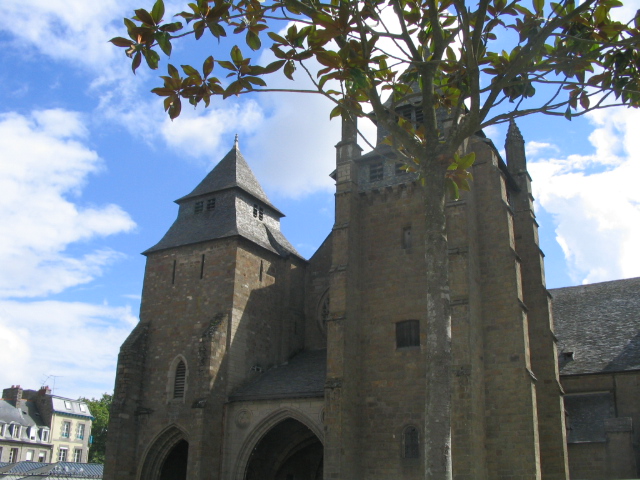
Saint-Brieuc's architectural heritage reflects Breton medieval traditions, prominently featuring the Gothic Cathedral of Saint-Étienne, constructed from the 13th to 18th centuries on a marshy site originally occupied by a 6th-century wooden church. This cathedral serves as a key stop on the Tro-Breizh, a historic pilgrimage circuit honoring seven founding Breton saints, underscoring its role in preserving Celtic-Christian legacies amid evolving urban landscapes.[89] Despite pressures from modernization and population growth, which have strained historical preservation efforts in the compact city center, the structure's fortified design—combining ecclesiastical and defensive elements—endures as a testament to adaptive resilience against central French influences.[89] Complementing the cathedral, clusters of half-timbered houses dating to the 16th through 18th centuries line narrow streets in the old town, such as Rue Fardet, where restorations have maintained their characteristic exposed wooden frameworks despite encroachment by contemporary infrastructure. These edifices, often repainted to highlight original features, embody vernacular Breton building techniques influenced by regional timber availability and Celtic settlement patterns, though ongoing urban density challenges their integrity without comprehensive policy enforcement.[89] [90] Breton folklore in Saint-Brieuc draws from Celtic roots, manifesting in tales of saints like Brieuc— a 5th-century Welsh missionary who evangelized the region—and supernatural entities such as korrigans, nature spirits tied to ancient megalithic sites nearby, which parallel broader Gallo-Celtic mythologies resistant to Roman and later Frankish assimilation. Traditional music, featuring instruments like the biniou bagpipe and bombard oboe, sustains communal dances and chants that echo pre-Christian rituals, fostering cultural continuity even as globalization dilutes participatory authenticity in favor of performative spectacles.[91] [92] The city's Breton identity has historically fueled resistance to Parisian centralism, evident in autonomist stirrings from the 19th century onward, including petitions for regional recognition in 1936 and militant actions by groups like the Breton Liberation Front in the 1960s, which targeted symbols of French unification to assert distinct Celtic governance. Such movements, rooted in Brittany's independent duchies until 1532 annexation, highlight causal tensions between local heritage preservation and national homogenization policies that systematically marginalized peripheral identities.[93] [94]Language Use and Preservation
Breton, a Brythonic Celtic language historically dominant in Lower Brittany, has approximately 107,000 active speakers across the region as of 2024, a sharp decline from 214,000 in 2018, primarily due to the passing of elderly speakers without sufficient replacement through family transmission.[65][95] In urban centers like Saint-Brieuc, usage remains marginal, with only 3.98% of primary school children enrolled in bilingual education programs as of 2008, reflecting broader patterns of French linguistic hegemony in administrative and economic hubs.[96] French state policies, rooted in revolutionary centralization and reinforced through mandatory monolingual education from the late 19th century onward, accelerated Breton's erosion by prohibiting its use in schools and public life, framing it as incompatible with national unity and modernization.[97] This shift intensified post-1950, when over one million speakers dwindled amid urbanization and media dominance of French, with empirical surveys indicating that by the late 20th century, Breton was largely confined to rural, older demographics in western departments like Finistère rather than Côtes-d'Armor prefectures such as Saint-Brieuc.[65] Contemporary preservation initiatives, including subsidized immersion schools (e.g., Diwan) and bilingual signage in Brittany, have enrolled under 20,000 students region-wide as of 2023, yet fail to reverse decline, as only 16% of current speakers acquired the language at home and intergenerational transmission hovers below 10% among those under 25.[98][99] These efforts, often funded through regional bodies, yield limited fluency outcomes, with sociolinguistic data underscoring that urban professional incentives favor French proficiency, rendering Breton's rural-conservative associations insufficient for broad revival amid ongoing speaker attrition.[65][100]Festivals and Cultural Events
The Art Rock festival, founded in 1983, is Saint-Brieuc's flagship cultural event, encompassing music concerts on two main city-center stages, alongside dance, theatre, visual arts exhibitions, and street performances. Typically occurring in late May or early June, the 2025 edition spanned June 6 to 8 and attracted 80,000 attendees, resulting in sold-out capacities across venues. The event generates substantial economic activity, with the festival advancing approximately 6 million euros in local cash flows through accommodations, dining, and services in 2022.[101][102] Complementing this, the Fête de la Bretagne features Saint-Brieuc-specific programming as part of the annual regional observance of Breton heritage, emphasizing Celtic traditions through communal gatherings. On May 24, 2025, activities included a central parade of traditional costumes led by twelve dance associations, bagadou (Breton pipe bands), and Celtic circles, culminating in a fest-noz evening of traditional dancing and music at Parc des Promenades, alongside an artisan market on May 25. These events promote cultural continuity and local identity, drawing participants from Breton cultural groups and correlating with spring tourism upticks via heightened visibility of regional customs.[103][104] Associated gastronomic festivals, such as Rock'n Toques during Art Rock, pair local chefs with musical acts to showcase Breton seafood specialties like scallops and mussels, further amplifying seasonal visitor numbers and economic benefits from integrated culinary tourism. While large-scale events like Art Rock prioritize broad appeal and international acts, potentially broadening exposure to Breton locales, traditional observances like the Fête de la Bretagne sustain grassroots participation, balancing mass commodification with authentic community reinforcement.[105][106]Infrastructure and Transport
Transportation Networks
Saint-Brieuc functions as a regional rail hub through Gare de Saint-Brieuc, offering TGV high-speed services to Paris Montparnasse with shortest journey times of 2 hours 21 minutes and averages around 2 hours 42 minutes.[107] Regional TER Bretagne trains connect to Rennes in as little as 48 minutes, supporting daily commuter and intercity travel.[108] These links handle substantial passenger volumes, though peak-hour capacity constraints occasionally lead to delays.[107] Road connectivity relies on the N12 (part of E50), a primary artery linking Saint-Brieuc eastward to Rennes and westward toward Brest, facilitating freight and personal vehicle flows.[109] However, the route suffers from recurrent congestion near the city, exacerbated by urban growth and limited bypass infrastructure, as noted in prefectural assessments calling for enhanced mobility planning.[110] Public bus services are managed by the TUB network under Saint-Brieuc Armor Agglomération, comprising 21 regular lines, 19 express routes, and additional school and evening services covering the urban area from 5:30 a.m. to 8:00 p.m. This system addresses intra-agglomeration mobility but faces challenges from rising demand and integration with rail transfers.[111] The Port of Légué, situated at the Gouët river mouth, processes around 320,000 tons of freight yearly via 220 vessels, specializing in imports like timber from Northern Europe and fertilizers, while lacking passenger ferry operations.[112] Originally centered on fishing, its role has diminished in volume relative to service-sector dominance in the local economy, with bottlenecks in berth availability for larger coasters up to 5,000 tons.[113][114]
Ports and Connectivity
The Port of Le Légué serves as Saint-Brieuc's principal maritime gateway, primarily accommodating coastal cabotage and bulk cargo shipments rather than large-scale international trade. In 2022, it handled 324,599 tonnes of goods, with 140 vessel calls, including 117 dedicated to short-sea shipping routes linking Brittany's regional network.[115] While historically a base for professional fishing—recording 460 tonnes of landings in 1992—commercial fishing activities have since largely shifted to the adjacent Port du Roselier, leaving Le Légué focused on residual small-scale operations and emerging roles in logistics support.[116] Post-2000 infrastructure upgrades, including a 450-meter protective dyke, two dedicated unloading berths, and dredging of 200,000 cubic meters to deepen access channels by 2 meters, have enhanced its capacity for smaller vessels and diversified uses such as yacht moorings, fostering limited tourism-related traffic amid Brittany's coastal economy.[117] These maritime facilities contribute to regional economic cohesion by enabling efficient bulk transfers within Brittany, mitigating geographic isolation through reliable sea links to ports like Saint-Malo and Brest, though volumes remain modest compared to larger hubs. Ongoing reconfiguration efforts target a 2038 horizon, aiming to integrate Le Légué into broader supply chains, including proximity support for the Saint-Brieuc offshore wind farm commissioned in 2023, which underscores the port's auxiliary function in renewable energy logistics without serving as a primary maintenance base.[118] [119] Air connectivity relies on Saint-Brieuc Armor Airport, a small facility opened in 1985 with a 2,200-meter runway supporting general aviation, private charters, and sporadic commercial flights, though the latter accounted for fewer than 300 movements in 2024 against over 11,300 by the local flying club.[120] [121] Regional underinvestment has led to the cessation of regular passenger services and departmental funding withdrawal, prompting discussions of potential closure within three years and alternative uses like photovoltaics, despite its strategic coastal position that could otherwise bolster tourism and business links.[122] [123] Residents often turn to Dinard-Pleurtuit-Saint-Malo Airport, approximately 52 kilometers southeast, for international options including low-cost carriers to the UK and Channel Islands, providing essential supplementation to local air access amid persistent infrastructure gaps.[124]Governance
Administrative Functions
Saint-Brieuc functions as the prefecture of the Côtes-d'Armor department, serving as the administrative center where the departmental prefect oversees the implementation of national government policies, coordination of public services, and enforcement of state regulations across the department's 365 communes.[2] The prefecture, established following the Napoleonic reorganization in 1800, centralizes authority to ensure uniform application of laws, including civil registration, emergency management, and security coordination.[125] As the seat of Saint-Brieuc Armor Agglomération, formed in 2017 from 32 municipalities, the city coordinates services for approximately 152,000 residents, encompassing waste collection, water supply, public transport, and economic promotion initiatives.[126] This intercommunal structure facilitates shared resource allocation, with the 2024 budget allocating significant portions to operational expenditures, including administrative personnel costs exceeding 184 full-time equivalents in core functions.[127] The post-Revolutionary creation of departments in 1790 and prefectural system imposed a centralized framework on former Breton provinces, enhancing administrative efficiency through standardized procedures but curtailing traditional local governance structures, which has perpetuated regional grievances over diminished autonomy in Brittany.[128] This model prioritizes hierarchical control from Paris, often directing local budgets toward compliance and staffing rather than localized development projects, as evidenced by persistent debates on resource distribution in peripheral departments.[129]Political Landscape
In the 2020 municipal elections, the left-wing list led by Hervé Guihard, "Saint-Brieuc, Réinventons l'espoir 2020" (divers gauche), secured victory with 59.89% of the votes in the second round on June 28, ending prior center-right dominance and shifting local governance toward progressive priorities.[130][131] This outcome reflected urban support for policies emphasizing social equity and environmental concerns, with Guihard's administration forming alliances including Europe Écologie Les Verts (EELV) and the Union Démocratique Bretonne (UDB) in the Saint-Brieuc Armor Agglomération council, where such coalitions hold majority influence.[132] Breton regionalism persists as an undercurrent, primarily through the UDB, a left-leaning nationalist party founded in 1964 that advocates devolution, promotion of Breton and Gallo languages, and cultural preservation while critiquing French centralization.[133] In Saint-Brieuc, UDB fields candidates and integrates into left coalitions, as seen in its 2022 legislative bids and hosting of the party's 2021 congress focused on Breton resident status and historical reunification of the five departments.[134][135] Broader departmental voting patterns underscore mixed dynamics: the 2022 presidential election in Côtes-d'Armor favored Emmanuel Macron with 62.90% against Marine Le Pen's 37.10%, signaling centrist-left urban strength but revealing rural conservative pockets where National Rally support exceeds national averages, often tied to agricultural grievances and skepticism toward EU directives.[136] Key debates revolve around autonomy versus fiscal reliance on Paris and Brussels, with UDB arguing that centralized policies stifle local innovation and exacerbate economic dependencies, favoring devolved powers to leverage Brittany's assets like fisheries and tourism without uniform national mandates.[133] Empirical critiques highlight how top-down regulations, such as agricultural reforms, have correlated with depopulation in rural Côtes-d'Armor cantons—evident in stagnant GDP growth rates lagging behind metropolitan France—prompting calls for decentralized models that prioritize regional data over ideological uniformity.[137] These tensions surface in local forums, where regionalists contrast subsidy-driven stasis with potential self-governance gains, though mainstream parties emphasize integration for funding stability.[138]Notable Figures
Historical Personalities
Saint Brieuc (also known as Brioc or Brieuc), a Celtic monk born in Ceredigion, Wales, in the 5th century, is credited with founding the religious community that developed into the city. Educated in Ireland and under Saint Germanus of Auxerre, he arrived in Armorica around 485 AD, establishing an oratory near the Gouët River after converting local chieftain Conan and reportedly curing Count Riguel, who donated land including the palace of Champ-du-Rouvre. Consecrated as the first bishop of the region, Brieuc organized monastic life and evangelism, dying circa 502–510 AD; his relics were later enshrined in the cathedral bearing his name, underscoring his role in early Christian consolidation amid post-Roman fragmentation.[11][12] Among medieval bishops shaping the diocese's administrative structure, Guillaume Pinchon (c. 1175–1234), appointed in 1220, stands out for defending ecclesiastical autonomy against Duke Peter I of Brittany (Mauclerc), who sought to encroach on church lands and revenues. A native of Saint-Alban in Brittany, Pinchon prioritized almsgiving and clerical reform, earning canonization for his resistance to secular interference, which preserved the bishopric's feudal privileges and jurisdictional independence during the 13th-century Angevin-Breton conflicts. His tenure reinforced the diocese's role as a spiritual and temporal power center, established formally by 848 AD.[139][140] Local counts of Penthièvre, such as Odo I (d. 1079), son of Duke Geoffrey I of Brittany, exerted influence over the diocese through territorial lordship, funding fortifications and ecclesiastical appointments to align religious authority with comital governance in northern Brittany. Odo's control facilitated the integration of Saint-Brieuc into broader Breton ducal networks, enabling administrative stability via manorial grants and dispute resolutions that bolstered the bishopric's endowments amid 11th-century Norman incursions.[140]Contemporary Individuals
Patrice Carteron (born July 30, 1970), a former professional defender who played for French clubs including AS Saint-Étienne and Olympique Lyonnais, later managed teams in Qatar, Egypt, and the Democratic Republic of Congo, such as TP Mazembe, where he won the CAF Champions League in 2015.[141][142] Julie Budet, professionally known as Yelle (born January 17, 1983), fronts an electropop band formed in Saint-Brieuc that achieved international success with albums like Pop 2000 (2007) and singles such as "Je veux te voir," blending rap and electronic music.[143] Jean-Christophe Boullion (born December 27, 1969), a racing driver who competed in Formula One for Sauber in 1995 and won the FIA GT Championship in 2005, exemplifies local talent pursuing high-level motorsport careers abroad.[144] Sylvie Josset (born August 14, 1963), a pioneering women's international goalkeeper, represented France at the 1991 European Championship and contributed to the growth of female football in the region during the late 20th century.[145] These figures highlight achievements in competitive fields requiring relocation, amid patterns of educated youth emigration from Brittany—driven by limited local opportunities in specialized sectors—to urban centers like Paris or international markets, though the region records net population inflows from higher-educated EU migrants, mitigating overall talent loss.[146][66]International Ties
Twin Towns and Partnerships
Saint-Brieuc has established formal twinning agreements with three European cities to promote intercultural exchanges, reconciliation, and educational programs. The earliest partnership, with Alsdorf in Germany, was signed on 15 September 1970, reflecting post-World War II efforts to strengthen Franco-German ties through youth and cultural initiatives.[147] This relationship has involved regular delegations, language cafes, and commemorative events, including 50th anniversary celebrations deferred to 2021 due to the COVID-19 pandemic.[148] In 1973, Saint-Brieuc twinned with Aberystwyth in Wales, United Kingdom, on 21 April, emphasizing shared Celtic heritage between Breton and Welsh communities through school exchanges, music collaborations, and local group visits.[149] [150] These activities have included band performances and town council delegations, with recent joint events in July 2025 reinforcing educational and cultural links despite challenges from declining regional language use.[151] The city signed a twinning charter with Aghia Paraskevi in Greece on 21 September 1991, supporting mutual visits and community projects focused on European integration and youth mobility.[152] Beyond twinnings, Saint-Brieuc maintains a decentralized cooperation agreement with Goražde in Bosnia and Herzegovina since approximately 2010, providing solidarity aid including support for an annual international friendship festival and post-conflict reconstruction efforts. [153] A separate friendship charter with Gabès in Tunisia, initiated in 2003 and formalized as a cooperation accord in 2006, targets development in areas like vocational training and environmental management, though activities have varied with funding availability.[153] These ties primarily yield cultural and educational outcomes, such as student programs and reciprocal hospitality, with documented exchanges numbering in the dozens annually through the local twinning committee, rather than measurable economic gains.[150]References
- https://coastalwiki.org/wiki/Case_study_Saint_Brieuc
- https://www.coastalwiki.org/wiki/Case_study_Saint_Brieuc