Hubbry Logo
ColumbanusColumbanusMain
Open search
Columbanus
Community hub
Columbanus
logo
8 pages, 0 posts
0 subscribers
Be the first to start a discussion here.
Contribute something
Columbanus
Columbanus
from Wikipedia

Saint Columbanus (Irish: Columbán; 543 – 21 November 615)[1] was an Irish missionary notable for founding a number of monasteries after 590 in the Frankish and Lombard kingdoms, most notably Luxeuil Abbey in present-day France and Bobbio Abbey in present-day Italy.

Key Information

Columbanus taught an Irish monastic rule and penitential practices for those repenting of sins, which emphasised private confession to a priest, followed by penances imposed by the priest in reparation for the sins. Columbanus is one of the earliest identifiable Hiberno-Latin writers.[1]

Sources

[edit]

Most of what we know about Columbanus is based on Columbanus' own works (as far as they have been preserved)[2][3] and Jonas of Susa's Vita Columbani (Life of Columbanus), which was written between 639 and 641.[Note 1]

Jonas entered Bobbio after Columbanus' death but relied on reports of monks who still knew Columbanus.[4] A description of miracles of Columbanus written by an anonymous monk of Bobbio is of much later date.[5] In the second volume of his Acta Sanctorum O.S.B., Mabillon gives the life in full, together with an appendix on the miracles of Columbanus, written by an anonymous member of the Bobbio community.[1]

Biography and early life

[edit]

Columbanus (the Latinised form of Colmán, meaning little dove) was born in Leinster, Ireland in 543.[4] After his conception, his mother was said to have had a vision of her child's "remarkable genius".[4]

He was first educated under Abbot Sinell of Cluaninis, whose monastery was on an island of the River Erne, in modern County Fermanagh.[6] Under Sinell's instruction, Columbanus composed a commentary on the Psalms.

Columbanus then moved to Bangor Abbey where he studied to become a teacher of the Bible.[4] He was well-educated in the areas of grammar, rhetoric, geometry, and the Holy Scriptures.[4] Abbot Comgall taught him Greek and Latin.[6] He stayed at Bangor until c. 590,[7] when Comgall reluctantly gave him permission to travel to the continent.[8][4]

Frankish Gaul (c. 590 – 610)

[edit]

Columbanus set sail with twelve companions: Attala, Columbanus the Younger, Gallus,[7] Domgal,[6] Cummain, Eogain, Eunan, Gurgano,[4] Libran, Lua, Sigisbert and Waldoleno.[1] They crossed the channel via Cornwall[9] and landed in Saint-Malo, Brittany.[6]

Columbanus then entered Burgundian France. Jonas writes that:

At that time, either because of the numerous enemies from without, or on account of the carelessness of the bishops, the Christian faith had almost departed from that country. The creed alone remained. But the saving grace of penance and the longing to root out the lusts of the flesh were to be found only in a few. Everywhere that he went the noble man [Columbanus] preached the Gospel. And it pleased the people because his teaching was adorned by eloquence and enforced by examples of virtue.[4]

Columbanus and his companions were welcomed by King Guntram of Burgundy,[6] who granted them land at Anegray, where they converted a ruined Roman fortress into a school.[4] Despite its remote location in the Vosges Mountains, the school rapidly attracted so many students that they moved to a new site at Luxeuil and then established a second school at Fontaines.[4] These schools remained under Columbanus' authority, and their rules of life reflected the Celtic tradition in which he had been educated.

As these communities expanded and drew more pilgrims, Columbanus sought greater solitude. Often he would withdraw to a cave seven miles away, with a single companion who acted as messenger between himself and his companions.[4]

Conflict with Frankish Bishops

[edit]

Tensions arose in 603 CE when St. Columbanus and his followers argued with Frankish bishops over the exact date of Easter. (St. Columbanus celebrated Easter according to Celtic rites and the Celtic Christian calendar.)[6]

The Frankish bishops may have feared his growing influence. During the first half of the sixth century, the councils of Gaul had given to bishops absolute authority over religious communities. Celtic Christians, Columbanus and his monks used the Irish Easter calculation, a version of Bishop Augustalis's 84-year computus for determining the date of Easter (quartodecimanism), whereas the Franks had adopted the Victorian cycle of 532 years. The bishops objected to the newcomers' continued observance of their own dating, which – among other issues – caused the end of Lent to differ. They also complained about the distinct Irish tonsure.

In 602,[10] the bishops assembled to judge Columbanus, but he did not appear before them as requested. Instead, he sent a letter to the prelates – a strange mixture of freedom, reverence, and charity – admonishing them to hold synods more frequently, and advising them to pay more attention to matters of equal importance to that of the date of Easter. In defence of his following his traditional paschal cycle, he wrote:

I am not the author of this divergence. I came as a poor stranger into these parts for the cause of Christ, Our Saviour. One thing alone I ask of you, holy Fathers, permit me to live in silence in these forests, near the bones of seventeen of my brethren now dead.[11]

When the bishops refused to abandon the matter, Columbanus appealed directly to Pope Gregory I. In the third and only surviving letter, he asks "the holy Pope, his Father" to provide "the strong support of his authority" and to render a "verdict of his favour", apologising for "presuming to argue as it were, with him who sits in the chair of Peter, Apostle and Bearer of the Keys". None of the letters were answered, most likely due to the pope's death in 604.[1]

Columbanus then sent a letter to Gregory's successor, Pope Boniface IV, asking him to confirm the tradition of his elders – if it was not contrary to the Faith – so that he and his monks could follow the rites of their ancestors. Before Boniface responded, Columbanus moved outside the jurisdiction of the Frankish bishops. As the Easter issue appears to end around that time, Columbanus may have stopped celebrating the Irish date of Easter after moving to Italy.[1]

Conflict with Brunhilda of Austrasia

[edit]

Columbanus was also involved in a dispute with members of the Burgundian dynasty. Upon the death of King Guntram of Burgundy, the succession passed to his nephew, Childebert II, the son of his brother Sigebert and Sigebert's wife Brunhilda of Austrasia. When Childebert II died, his territories were divided between his two sons: Theuderic II inherited the Kingdom of Burgundy and Theudebert II inherited the Kingdom of Austrasia. Both were minors and Brunhilda, their grandmother, ruled as their regents.[4]

Theuderic II "very often visited" Columbanus, but when Columbanus rebuked him for having a concubine,[4] Brunhilda became his bitterest foe because she feared the loss of her influence if Theuderic II married.[12] Brunhilda incited the court and Catholic bishops against Columbanus and Theuderic II confronted Columbanus at Luxeuil, accusing him of violating the "common customs" and "not allowing all Christians" in the monastery. Columbanus asserted his independence to run the monastery without interference and was imprisoned at Besançon for execution.[4]

Columbanus escaped and returned to Luxeuil. When the king and his grandmother found out, they sent soldiers to drive him back to Ireland by force,[4] separating him from his monks by insisting that only those from Ireland could accompany him into exile.[1]

Columbanus was taken to Nevers, then travelled by boat down the Loire river to the coast. At Tours he visited the tomb of Martin of Tours, and sent a message to Theuderic II indicating that within three years he and his children would perish.[4] When he arrived at Nantes, he wrote a letter before embarkation to his fellow monks at Luxeuil monastery. The letter urged his brethren to obey Attala, who stayed behind as abbot of the monastic community.[1]

The letter concludes:

They come to tell me the ship is ready. The end of my parchment compels me to finish my letter. Love is not orderly; it is this which has made it confused. Farewell, dear hearts of mine; pray for me that I may live in God.[1]

Soon after the ship set sail from Nantes, a severe storm drove the vessel back ashore. Convinced that his holy passenger caused the tempest, the captain refused further attempts to transport the monk.[1] Columbanus found sanctuary with Chlothar II of Neustria at Soissons, who gave him an escort to the court of King Theudebert II of Austrasia.[4]

The Alps (611–612)

[edit]

Columbanus arrived at Theudebert II's court in Metz in 611, where members of the Luxeuil school met him and Theudebert II granted them land at Bregenz.[4] They travelled up the Rhine via Mainz to the lands of the Suebi and Alemanni in the northern Alps, intending to preach the Gospel to these people. He followed the Rhine river and its tributaries, the Aar and the Limmat, and then on to Lake Zurich. Columbanus chose the village of Tuggen as his initial community, but the work was not successful.[1] He continued north-east by way of Arbon to Bregenz on Lake Constance. Here he found an oratory dedicated to Aurelia of Strasbourg containing three brass images of their tutelary deities. Columbanus commanded Gallus, who knew the local language, to preach to the inhabitants, and many were converted. The three brass images were destroyed, and Columbanus blessed the little church, placing the relics of Aurelia beneath the altar. A monastery was erected, Mehrerau Abbey, and the brethren observed their regular life. Columbanus stayed in Bregenz for about one year.[1]

In the spring of 612, war broke out between Austrasia and Burgundy and Theudebert II was resoundingly beaten by Theuderic II. Austrasia was subsumed under the kingdom of Burgundy and Columbanus was again vulnerable to Theuderic II's opprobrium.[6] When Columbanus' students began to be murdered in the woods, Columbanus decided to cross the Alps into Lombardy.[13]

Gallus remained in this area until his death in 646. About seventy years later at the place of Gallus' cell the Abbey of Saint Gall was founded. The city of St. Gallen originated as an adjoining settlement of the abbey.

Lombardy (612–615)

[edit]
Columbanus in the Alps and Italy

Columbanus arrived in Milan in 612 and was welcomed by King Agilulf and Queen Theodelinda of the Lombards. He immediately began refuting the teachings of Arianism, which had enjoyed a degree of acceptance in Italy. He wrote a treatise against Arianism,[4] which has since been lost. In 614, Agilulf granted Columbanus land for a school at the site of a ruined church at Bobbio.[4][6]

At the king's request, Columbanus wrote a letter to Pope Boniface IV on the controversy over the Three Chapters – writings by Syrian bishops suspected of Nestorianism, which had been condemned in the fifth century as heresy.[14][full citation needed] Pope Gregory I had tolerated in Lombardy those persons who defended the Three Letters, among them King Agilulf. Columbanus agreed to take up the issue on behalf of the king. The letter has a diplomatic tone and begins with an apology that a "foolish Scot" (Scottus, Irishman) would be writing for a Lombard king. After acquainting the pope with the imputations brought against him, he entreats the pontiff to prove his orthodoxy and assemble a council. When critiquing Boniface, he writes that his freedom of speech is consistent with the custom of his country.[1] Some of the language used in the letter might now be regarded as disrespectful, but in that time, faith and austerity could be more indulgent.[15] Columbanus was tactful when making critiques, as he begins the letter he expresses with the most affectionate and impassioned devotion to the Holy See.

We Irish, though dwelling at the far ends of the earth, are all disciples of Saint Peter and Saint Paul ... we are bound to the Chair of Peter, and although Rome is great and renowned, through that Chair alone is she looked on as great and illustrious among us ... On account of the two Apostles of Christ, you are almost celestial, and Rome is the head of the whole world, and of the Churches.

Later, he reveals charges against the Papacy so as to encourage Boniface to make concessions:

For, as I hear, you are alleged to favour heretics—God forbid men should believe that this has been, is, or shall be true. For they say that Eutyches, Nestorius, and Dioscorus, old heretics as we know, were favoured at some Council, at the fifth, by Vigilius. Here, as they say, is the cause of the whole calumny; if, as is reported, you also favour thus, or if you know that even (Pope) Vigilius himself died under such a taint, why do you repeat his name against your conscience? Already it is your fault if you have erred from the true belief and made your first faith void; justly do your subordinates oppose you, and justly do they hold no communion with you.[16]

Columbanus' deference towards Rome is sufficiently clear, calling the pope "his Lord and Father in Christ", the "Chosen Watchman", and the "First Pastor, set higher than all mortals",[17] also asserting that "we Irish, inhabitants of the world’s edge, are disciples of Saints Peter and Paul and of all the disciples"[18] and that "the unity of faith has produced in the whole world a unity of power and privilege."[19]

Facade of the Abbey in Bobbio

King Agilulf gave Columbanus a tract of land called Bobbio between Milan and Genoa near the Trebbia river, situated in a defile of the Apennine Mountains, to be used as a base for the conversion of the Lombard people. The area contained a ruined church and wastelands known as Ebovium, which had formed part of the lands of the papacy prior to the Lombard invasion. Columbanus wanted this secluded place, for while enthusiastic in the instruction of the Lombards he preferred solitude for his monks and himself. Next to the little church, which was dedicated to Peter the Apostle, Columbanus erected a monastery in 614. Bobbio Abbey at its foundation followed the Rule of Saint Columbanus, based on the monastic practices of Celtic Christianity. For centuries it remained the stronghold of orthodoxy in northern Italy.[1][Note 2]

Death

[edit]
Stone bridge over the Trebbia river leading to Bobbio Abbey in northern Italy

During the last year of his life, Columbanus received messages from King Chlothar II, inviting him to return to Burgundy, now that his enemies were dead. Columbanus did not return, but requested that the king should always protect his monks at Luxeuil Abbey.[4] He prepared for death by retiring to his cave on the mountainside overlooking the Trebbia river, where, according to a tradition, he had dedicated an oratory to Our Lady.[20] Columbanus died at Bobbio on 21 November 615 and is buried there.[4]

Rule of Saint Columbanus

[edit]

The Rule of Saint Columbanus embodied the customs of Bangor Abbey and other Irish monasteries. Much shorter than the Rule of Saint Benedict, the Rule of Saint Columbanus consists of ten chapters, on the subjects of obedience, silence, food, poverty, humility, chastity, choir offices, discretion, mortification, and perfection.[21]

In the first chapter, Columbanus introduces the great principle of his Rule: obedience, absolute and unreserved. The words of seniors should always be obeyed, just as "Christ obeyed the Father up to death for us".[21] One manifestation of this obedience was constant hard labour designed to subdue the flesh, exercise the will in daily self-denial, and set an example of industry in cultivation of the soil. The least deviation from the Rule entailed corporal punishment, or a severe form of fasting.[11] In the second chapter, Columbanus instructs that the rule of silence be "carefully observed", since it is written: "But the nurture of righteousness is silence and peace". He also warns, "Justly will they be damned who would not say just things when they could, but preferred to say with garrulous loquacity what is evil".[21] In the third chapter, Columbanus instructs, "Let the monks' food be poor and taken in the evening, such as to avoid repletion, and their drink such as to avoid intoxication, so that it may both maintain life and not harm".[21] Columbanus continues:

For indeed those who desire eternal rewards must only consider usefulness and use. Use of life must be moderated just as toil must be moderated, since this is true discretion, that the possibility of spiritual progress may be kept with a temperance that punishes the flesh. For if temperance exceeds measure, it will be a vice and not a virtue; for virtue maintains and retains many goods. Therefore we must fast daily, just as we must feed daily; and while we must eat daily, we must gratify the body more poorly and sparingly ...[21]

Fresco of Saint Columbanus in Brugnato Cathedral

In the fourth chapter, Columbanus presents the virtue of poverty and of overcoming greed, and that monks should be satisfied with "small possessions of utter need, knowing that greed is a leprosy for monks". Columbanus also instructs that "nakedness and disdain of riches are the first perfection of monks, but the second is the purging of vices, the third the most perfect and perpetual love of God and unceasing affection for things divine, which follows on the forgetfulness of earthly things. Since this is so, we have need of few things, according to the word of the Lord, or even of one."[21] In the fifth chapter, Columbanus warns against vanity, reminding the monks of Jesus' warning in Luke 16:15: "You are the ones who justify yourselves in the eyes of others, but God knows your hearts. What people value highly is detestable in God's sight."[21] In the sixth chapter, Columbanus instructs that "a monk's chastity is indeed judged in his thoughts" and warns, "What profit is it if he be virgin in body, if he be not virgin in mind? For God, being Spirit."[21]

In the seventh chapter, Columbanus instituted a service of perpetual prayer, known as laus perennis, by which choir succeeded choir, both day and night.[22] In the eighth chapter, Columbanus stresses the importance of discretion in the lives of monks to avoid "the downfall of some, who beginning without discretion and passing their time without a sobering knowledge, have been unable to complete a praiseworthy life". Monks are instructed to pray to God to "illumine this way, surrounded on every side by the world's thickest darkness".[21] Columbanus continues:

So discretion has got its name from discerning, for the reason that it discerns in us between good and evil, and also between the moderate and the complete. For from the beginning either class has been divided like light and darkness, that is, good and evil, after evil began through the devil's agency to exist by the corruption of good, but through God's agency Who first illumines and then divides. Thus righteous Abel chose the good, but unrighteous Cain fell upon evil.[21]

In the ninth chapter, Columbanus presents mortification as an essential element in the lives of monks, who are instructed, "Do nothing without counsel." Monks are warned to "beware of a proud independence, and learn true lowliness as they obey without murmuring and hesitation".[21] According to the Rule, there are three components to mortification: "not to disagree in mind, not to speak as one pleases with the tongue, not to go anywhere with complete freedom". This mirrors the words of Jesus, "For I have come down from heaven not to do my will but to do the will of him who sent me." (John 6:38) In the tenth and final chapter, Columbanus regulates forms of penance (often corporal) for offences, and it is here that the Rule of Saint Columbanus differs significantly from that of Saint Benedict.[1]

The Communal Rule of Columbanus required monks to fast every day until None or 3 p.m.; this was later relaxed and observed on designated days.[23] Columbanus' Rule regarding diet was very strict. Monks were to eat a limited diet of beans, vegetables, flour mixed with water and a small bread of a loaf, taken in the evenings.[23][24]

The habit of the monks consisted of a tunic of undyed wool, over which was worn the cuculla, or cowl, of the same material. A great deal of time was devoted to various kinds of manual labour, not unlike the life in monasteries of other rules. The Rule of Saint Columbanus was approved of by the Fourth Council of Mâcon in 627, but it was superseded at the close of the century by the Rule of Saint Benedict. For several centuries in some of the greater monasteries the two rules were observed conjointly.[1]

Character

[edit]

Columbanus did not lead a perfect life. According to Jonas and other sources, he could be impetuous and even headstrong, for by nature he was eager, passionate, and dauntless. These qualities were both the source of his power and the cause of his mistakes.[1] His virtues, however, were quite remarkable. Like many saints, he had a great love for God's creatures. Stories claim that as he walked in the woods, it was not uncommon for birds to land on his shoulders to be caressed, or for squirrels to run down from the trees and nestle in the folds of his cowl.[1] Although a strong defender of Irish traditions, he never wavered in showing deep respect for the Holy See as the supreme authority. His influence in Europe was due to the conversions he effected and to the rule that he composed. It may be that the example and success of Columba in Caledonia inspired him to similar exertions.[1] The life of Columbanus stands as the prototype of missionary activity in Europe, followed by such men as Kilian, Vergilius of Salzburg, Donatus of Fiesole, Wilfrid, Willibrord, Suitbert of Kaiserwerdt, Boniface, and Ursicinus of Saint-Ursanne.[1]

Miracles

[edit]

The following are the principal miracles attributed to his intercession:[1]

  1. Procuring food for a sick monk and curing the wife of his benefactor
  2. Escaping injury while surrounded by wolves
  3. Causing a bear to evacuate a cave at his bidding
  4. Producing a spring of water near his cave
  5. Replenishing the Luxeuil granary
  6. Multiplying bread and beer for his community
  7. Curing sick monks, who rose from their beds at his request to reap the harvest
  8. Giving sight to a blind man at Orleans
  9. Destroying with his breath a cauldron of beer prepared for a pagan festival
  10. Taming a bear and yoking it to a plough

Jonas relates the occurrence of a miracle during Columbanus' time in Bregenz, when that region was experiencing a period of severe famine.

Although they were without food, they were bold and unterrified in their faith, so that they obtained food from the Lord. After their bodies had been exhausted by three days of fasting, they found so great an abundance of birds, just as the quails formerly covered the camp of the children of Israel, that the whole country near there was filled with birds. The man of God knew that this food had been scattered on the ground for his own safety and that of his brethren, and that the birds had come only because he was there. He ordered his followers first to render grateful praises to the Creator, and then to take the birds as food. And it was a wonderful and stupendous miracle; for the birds were seized according to the father's commands and did not attempt to fly away. The manna of birds remained for three days. On the fourth day, a priest from an adjacent city, warned by divine inspiration, sent a supply of grain to Saint Columban. When the supply of grain arrived, the Omnipotent, who had furnished the winged food to those in want, immediately commanded the phalanxes of birds to depart. We learned this from Eustasius, who was present with the others, under the command of the servant of God. He said that no one of them remembered ever having seen birds of such a kind before; and the food was of so pleasant savor that it surpassed royal viands. Oh, wonderful gift of divine mercy![25]

Legacy

[edit]
Monastery ruins at Annegray

Historian Alexander O'Hara states that Columbanus had a "very strong sense of Irish identity ... He's the first person to write about Irish identity, he's the first Irish person that we have a body of literary work from, so even on that point of view he’s very important in terms of Irish identity."[26] In 1950 a congress celebrating the 1,400th anniversary of his birth took place in Luxeuil, France. It was attended by Robert Schuman, Seán MacBride, the future Pope John XXIII, and John A. Costello who said "All statesmen of today might well turn their thoughts to St Columban and his teaching. History records that it was by men like him that civilisation was saved in the 6th century."[27][28]

Columbanus is also remembered as the first Irish person to be the subject of a biography. An Italian monk named Jonas of Bobbio wrote a biography of him some twenty years after Columbanus' death.[27][28] His use of the phrase in 600 AD totius Europae (all of Europe) in a letter to Pope Gregory the Great is the first known use of the expression.[29]

At Saint-Malo in Brittany, there is a granite cross bearing Columbanus's name to which people once came to pray for rain in times of drought. The nearby village of Saint-Coulomb commemorates him in name.[30]

In France, the ruins of Columbanus' first monastery at Annegray are legally protected through the efforts of the Association Internationale des Amis de St Columban, which purchased the site in 1959. The association also owns and protects the site containing the cave, which served as Columbanus' cell, and the holy well that he created nearby.[30] At Luxeuil-les-Bains, the Basilica of Saint Peter stands on the site of Columbanus' first church. A statue near the entrance, unveiled in 1947, shows him denouncing the immoral life of King Theuderic II. Formally an abbey church, the basilica contains old monastic buildings, which have been used as a minor seminary since the nineteenth century. It is dedicated to Columbanus and houses a bronze statue of him in its courtyard.[30]

Luxeuil Abbey, described in the Catholic Encyclopedia as "the nursery of saints and apostles", produced sixty-three apostles who carried his rule, together with the Gospel, into France, Germany, Switzerland, and Italy.[31] These disciples of Columbanus are credited with founding more than a hundred different monasteries.[32] The canton and town still bearing the name of St. Gallen testify to how well one of his disciples succeeded.

Bobbio Abbey became a renowned center of learning in the Early Middle Ages, so famous that it rivaled the monastic community at Monte Cassino in wealth and prestige. St. Attala continued St. Columbanus' work at Bobbio, proselytizing and collecting religious texts for the abbey's library.[6] In Lombardy, San Colombano al Lambro in Milan, San Colombano Belmonte in Turin, and San Colombano Certénoli in Genoa all take their names from the saint.[33]

In 2024, the XXV International Meeting of Columban Associations for the "Columban's Day 2024" took place in Piacenza, Italy. Pope Francis said Columbanus enhanced the Catholic Church and that the life and labours of the Columban monks proved decisive for the preservation and renewal of European culture.[34]

The Missionary Society of Saint Columban, founded in 1916, and the Missionary Sisters of St. Columban, founded in 1924, are both dedicated to Columbanus.

Veneration

[edit]
Remains of Columbanus, Bobbio Abbey crypt

The remains of Columbanus are preserved in the crypt at Bobbio Abbey. Many miracles have been credited to his intercession. In 1482, the relics were placed in a new shrine and laid beneath the altar of the crypt. The sacristy at Bobbio possesses a portion of the skull of Columbanus, his knife, wooden cup, bell, and an ancient water vessel, formerly containing sacred relics and said to have been given to him by Pope Gregory I. According to some authorities, twelve teeth of Columbanus were taken from the tomb in the fifteenth century and kept in the treasury, but these have since disappeared.[35]

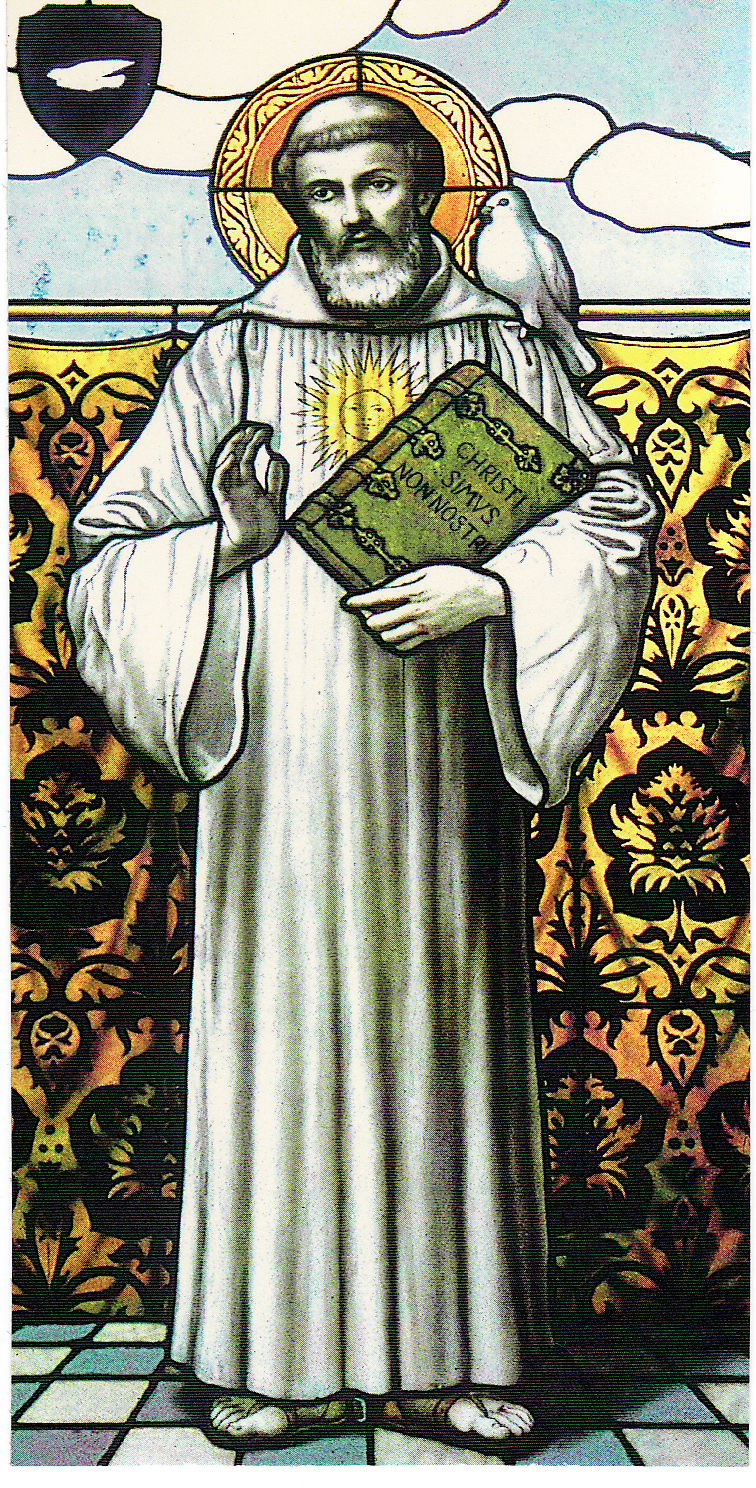
Columbanus is named in the Roman Martyrology on 23 November, which is his feast day in Ireland. His feast is observed by the Benedictines on 21 November. In art, Columbanus is represented bearded, bearing the monastic cowl, holding in his hand a book with an Irish satchel, and standing in the midst of wolves. Sometimes he is depicted in the attitude of taming a bear, or with sun-beams over his head.[36]

The Bishop of Hereford, John Oliver, suggested Columbanus as a patron of motorcyclists because of his extensive travels through Europe during his lifetime. His patronage was declared by the Vatican in 2002.[37]

References

[edit]
[edit]
Revisions and contributorsEdit on WikipediaRead on Wikipedia
from Grokipedia
Columbanus (c. 543 – 21 November 615) was an Irish abbot and renowned for establishing monastic communities across that propagated Celtic Christian practices and ascetic discipline. Born in , , he received monastic formation at under Abbot Comgall before departing around 590 with twelve companions to evangelize abroad, initially settling in the region of . There, he founded the monasteries of Annegray, Luxeuil, and Fontaine, where his rigorous rule—emphasizing manual labor, scriptural study, and private —drew numerous followers but sparked tensions with local Frankish over issues like the computation of and episcopal authority. Expelled from Luxeuil circa 610 amid these disputes, Columbanus journeyed through the , briefly establishing sites in and Tuggen, before founding in under the patronage of King Agilulf, which became a major center of learning and manuscript preservation until its decline. His writings, including sermons, letters critiquing secular rulers, and a penitential codifying tariffed confessions, influenced early medieval , though his hagiographic biography by Jonas of blends historical events with pious embellishments reflective of seventh-century monastic agendas.

Sources and Historiography

Primary Sources

The principal primary source for Columbanus's life is the Vita Sancti Columbani (Life of Saint Columbanus), composed around 640 by Jonas of , a and later at the Columbanus founded in , . Jonas, active in the mid-seventh century, relied on oral testimonies from Columbanus's surviving disciples, such as Attala and Bertulf, as well as written records and letters preserved at ; the work was commissioned by the Bobbio community to promote Columbanus's cult and monastic legacy shortly after his death in 615. Divided into two books, it narrates Columbanus's Irish origins, continental missions in and , conflicts with Frankish authorities, miracles attributed to him, and foundations like Luxeuil and , blending hagiographic elements with historical details verifiable against other records, such as synodal acts from 602–603. Columbanus's own writings, preserved in Latin manuscripts from the early medieval period, form the core autobiographical and doctrinal primary materials, totaling nine letters, seventeen instructional sermons (Instructiones), a monastic rule, a penitential, and fragmentary poems. The letters, dated between approximately 600 and 613, include appeals to (c. 600) defending Irish Easter computus practices and criticizing clerical laxity in , as well as to (613) seeking support for ; they reveal Columbanus's rhetorical style, peregrinatio motivations, and critiques of Merovingian church corruption. The Regula Monachorum (c. 590–600), Columbanus's primary monastic rule, emphasizes strict asceticism, obedience, silence, poverty, and communal prayer, influencing later Continental reforms while differing from Benedict's by prioritizing Irish penitential rigor over stability; a companion Regula Coenobialis outlines daily liturgical hours. His Paenitentiale prescribes graduated penances for sins, reflecting Celtic tariff traditions, while the sermons expound scriptural exegesis on themes like divine judgment and monastic virtue, intended for his communities. These texts survive in Carolingian-era copies but originate from Columbanus's hand, authenticated by stylistic consistency and contemporary references in Jonas.

Modern Scholarship and Historical Debates

The principal source for Columbanus's life remains the Vita Columbani by Jonas of , composed around 640, approximately 25 years after Columbanus's death in 615, drawing on eyewitness testimonies from surviving disciples and Columbanus's own letters and sermons. This proximity to events lends the text a degree of historical reliability for core biographical details, such as his Irish origins, travels through and the , and monastic foundations at Annegray, Luxeuil, and , though Jonas incorporates hagiographic miracles and idealizations to elevate Columbanus as a model ascetic. Scholars cross-reference it with independent evidence, like royal charters and contemporary letters, confirming key chronology, such as his arrival in circa 590–591 and exile in 610, while distinguishing factual elements from rhetorical flourishes. Jonas's narrative reflects a deliberate agenda to defend Columbanus's sanctity against Frankish critiques, particularly from and , by omitting divisive episodes like the Agrestius —where Columbanus opposed a disciple's semi-Pelagian leanings—and the rapid decline of his penitential regime at Luxeuil, which successors supplanted with milder regula mixta incorporating Benedict's rule by the mid-seventh century. This selective portrayal served Bobbio's interests in asserting independence and legitimacy amid Lombard-Frankish tensions, positioning Columbanus as a unifying holy wanderer rather than a rigid reformer prone to conflict. Modern analyses, such as those in O'Hara's studies, emphasize Jonas's conservative strategy to reconcile Irish peregrinatio traditions with continental norms, revealing how the Vita functioned as both history and for monastic continuity. Debates in contemporary scholarship question the traditional narrative of Columbanus as a pivotal "civilizer" injecting Irish rigor into a decadent post-Roman monastic landscape, with recent reassessments highlighting his limited long-term doctrinal innovation and the quick hybridization of his communities into local Frankish and Italian frameworks. For instance, while his advocacy for the "latercus" reckoning sparked real conflicts with bishops circa 602–613, evidenced in his epistles to and Queen , scholars now view these as symptomatic of broader Insular-continental divergences rather than uniquely transformative clashes. Critiques of nineteenth-century , which amplified Columbanus's role amid French Catholic revivalism and Irish nationalist historiography, have yielded more measured interpretations: his influence persisted through disciples like and Waldebert but waned without supplanting Benedictine dominance, underscoring over in shaping early medieval Europe's identity.

Early Life and Formation

Birth, Family, and Education in Ireland

Columbanus was born circa 543 in , , to parents of noble descent, though specific names are not recorded in contemporary accounts. His mother experienced a prophetic vision during , beholding the sun emerging from her womb, which was interpreted as a sign that she would bear a figure of great significance. In his youth, Columbanus pursued secular studies, excelling in , , metrics, and other liberal arts, which earned him admiration for his intellect and physical nobility. He faced strong temptations toward worldly pleasures, particularly from women, but sought counsel from a devout religious woman who urged him to renounce such pursuits and embrace monastic discipline to safeguard his . This led to his entry into monastic life under the guidance of Sinell at Cluaninis, an island monastery in , where he immersed himself in the Holy Scriptures and composed a commentary on the as a young man. Under Sinell's tutelage, Columbanus demonstrated profound scriptural mastery and ascetic commitment, laying the foundation for his later missionary endeavors.

Monastic Training and Decision to Evangelize

Columbanus, born around 543 in the kingdom of , , initially received a in , , and the liberal arts, but experienced a profound spiritual conversion in his youth, leading him to renounce secular pursuits amid concerns over worldly temptations, particularly the allure of women. He sought monastic guidance from an aged who directed him to enter the of Abbot Sinell at Cluaninis (modern Cleenish on , ), where he underwent preliminary ascetic formation emphasizing , scripture study, and detachment from worldly ties. This initial training, lasting several years, instilled in him the foundational disciplines of Irish monasticism, including strict fasting, manual labor, and communal liturgy. Seeking deeper rigor, Columbanus transferred to in , founded by Abbot Comgall (c. 520–602) around 558, a major center of learning and that housed hundreds of monks and attracted scholars across . Under Comgall's direction, he spent approximately 20 to 30 years in intensive training, engaging in perpetual psalmody, rigorous penances, and scholarly pursuits that included biblical and possibly early patristic texts available in Irish scriptoria. Bangor's rule, attributed to Comgall, stressed communal stability, hierarchical obedience, and evangelistic zeal, preparing Columbanus for through roles involving and administration. This period honed his commitment to a life of peregrinatio—voluntary exile for Christ—rooted in 's post-Patrician tradition of missionary , where monks viewed homeland departure as a radical imitation of Abraham's faith journey. By circa 590–591, at about age 48, Columbanus felt an urgent calling to evangelize pagan and lapsed Christian regions beyond , as the island itself had been thoroughly Christianized since the fifth century, limiting opportunities for conversion at home. Consulting Comgall, who initially hesitated but ultimately granted permission upon divine signs, Columbanus assembled a small band of 12 companions, embodying the apostolic model of itinerant mission. This decision reflected not mere but a deliberate to combat , pagan survivals, and moral laxity in Frankish and beyond, driven by first-hand awareness of continental spiritual needs via trade and pilgrim reports. Jonas of , in his Vita Columbani (composed c. 640s from eyewitness accounts and Columbanus's letters), portrays this departure as a divinely inspired exodus, underscoring Columbanus's resolve to transplant Irish monastic rigor to revive faith in , though modern scholars note Jonas's hagiographic embellishments may idealize the motivations.

Mission to Continental Europe

Arrival and Initial Foundations in Gaul (c. 590–600)

In approximately 590, Columbanus departed from Bangor Abbey in Ireland with twelve companions, embarking on a missionary journey to the European continent. The group sailed across the Irish Sea, briefly touching Britain before crossing to Gaul, landing in Brittany near Saint-Malo. From there, they traveled inland through Frankish territories, preaching repentance and asceticism to local populations amid the decaying remnants of Roman infrastructure and Merovingian instability. Seeking a remote site for monastic foundation, Columbanus and his followers reached the Mountains in around 591, discovering the ruins of an ancient at Annegray. Despite initial hardships including scarce provisions and harsh winters, they established a community there, attracting converts through demonstrations of rigorous discipline and miracles attributed to their intercessions, as recorded by Jonas of . The settlement at Annegray served as the initial base, emphasizing solitude, manual labor, and strict observance of Irish monastic customs. By 592, the growing number of disciples necessitated expansion; King Gontran of granted Columbanus the dilapidated Gallo-Roman fortress at Luxeuil, approximately eight miles from Annegray. Luxeuil quickly developed into a major monastic center, with Columbanus implementing his rule that combined elements of severe , perpetual , and communal prayer, drawing nobles and clergy from across the region. A third foundation at Fontaines soon followed to accommodate overflow monks, solidifying the triad of monasteries as hubs for Irish-influenced reform in Frankish by 600. These establishments emphasized evangelization among rural populations and clerical renewal, though tensions with local bishops over liturgical practices began to emerge.

Expansion and Integration in Frankish Territories (c. 600–610)

Following the initial establishments at Annegray and Fontaines, Columbanus transferred the bulk of his community to Luxeuil in the Mountains circa 600, founding a on the ruins of the ancient Gallo-Roman settlement of Luxovium. This site, strategically located in the Kingdom of under Merovingian rule, became the operational center for his expanding mission, with the community growing to include over 100 monks by the early 610s. Luxeuil's foundation capitalized on prior royal favor, initially secured under King (r. 575–596), and continued under his son (r. 596–613), whose regent, Queen , granted lands and protections to sustain the enterprise. Integration into Frankish society proceeded through patronage networks and ecclesiastical influence, as Luxeuil attracted Frankish nobles and seeking the rigor of Irish monasticism. According to Jonas of Bobbio's Vita Columbani, composed circa 640 based on eyewitness accounts, Columbanus served as a spiritual advisor to , advising on moral reforms while the king provided endowments that embedded the in the Merovingian fiscal system. This period saw the of Columbanus's disciples by local bishops, facilitating the dissemination of his Rule—emphasizing perpetual fasts, silence, and communal labor—into Frankish parishes and noble households. Brunhild's support, evidenced by her visits and charters, underscored the role in countering perceived laxity in Gallo-Roman , though Jonas portrays her favor as instrumental in shielding the community from early rivalries. Luxeuil's and library furthered cultural integration by preserving and adapting Irish texts, with manuscripts transported from forming a core collection that influenced Frankish scholarship. The monastery's output included liturgical innovations and penitentials, which gained traction among Merovingian elites, as monks from Luxeuil established satellite communities and reformed existing ones in the region. By , the site's annual assemblies drew pilgrims and recruits, solidifying Columbanus's network amid Frankish political fragmentation, though underlying tensions over Irish customs presaged later expulsions. This expansion phase thus bridged insular traditions with continental power structures, evidenced by the monastery's exemption from certain episcopal oversight through royal privilege.

Conflicts with Secular and Ecclesiastical Authorities

Columbanus's strict monastic discipline and adherence to Irish liturgical customs, including the Celtic computation of and the distinctive , provoked opposition from Frankish bishops, who favored Roman practices and viewed his growing influence as a threat to their . In 603, a of bishops summoned him to justify these divergences, particularly the timing of and Lenten observances, which differed from the Victorian table used in ; Columbanus refused to attend in person but sent a letter defending the antiquity of Irish traditions and accusing the bishops of laxity in enforcing moral standards. This correspondence highlighted his critique of the Frankish clergy's tolerance for secular vices, such as clerical involvement in worldly affairs, contrasting sharply with his emphasis on ascetic rigor. Seeking papal endorsement for his practices, Columbanus wrote to Pope Gregory the Great around 600, requesting condemnation of the Victorian Easter table and affirming fidelity to Roman primacy while pleading for tolerance of Celtic customs rooted in patristic sources like Jerome. Gregory's response urged unity under Roman authority but did not fully resolve the tensions, as local bishops continued to resent Columbanus's independent monastic foundations, which operated under abbatial rather than episcopal oversight and attracted nobles, diminishing diocesan control. These ecclesiastical frictions culminated in broader resistance to his penitential system, which imposed severe penances unfamiliar to the more lenient Gallic church. Secular conflicts arose from Columbanus's outspoken rebukes of Merovingian rulers' immorality, particularly King of (r. 595–613), whose court he condemned for and illegitimate offspring. In a direct confrontation, Columbanus refused to bless Theuderic's bastards and prophesied divine judgment on the king's licentiousness, enraging the monarch and his regent, Queen Brunhilda, who wielded significant influence and bore personal grudges against the Irish for his uncompromising stance. This moral challenge, combined with the monasteries' economic independence, fueled royal suspicions of disloyalty, leading to edicts restricting Irish monks' privileges. The cumulative pressures—ecclesiastical jealousy and secular retaliation—resulted in Columbanus's expulsion from Luxeuil in 610, ordered by at Brunhilda's instigation; he was commanded to leave with his Irish followers, though permitted to retain Gallic disciples, effectively banishing him eastward. Despite this, his foundations like Luxeuil persisted under successors, underscoring the tensions between his reformist zeal and the entrenched Frankish power structures.

Exile, Alpine Transit, and Italian Foundations (c. 610–615)

In 610, Columbanus faced expulsion from Luxeuil Abbey due to escalating conflicts with Merovingian authorities, particularly Queen Brunhilda, who influenced King of to banish him after Columbanus refused to bless the king's illegitimate sons and challenged lax monastic admissions. This expulsion, detailed in Jonas of 's Vita Columbani—a near-contemporary composed by a around 640—stemmed from broader tensions over Columbanus' strict Irish disciplinary practices and paschal computations diverging from Gallo-Roman norms. Accompanied by approximately twelve disciples, including Attala (whom he initially appointed interim before departing), Columbanus left behind a thriving community but carried his penitential code and rule eastward. Initially directing southward toward or for potential royal patronage, the group encountered obstacles from civil strife between and under and , prompting a pivot to cross the into Alamannic territories around 610–611. Traversing rugged passes amid harsh conditions, they established a transient base near , associating with sites at Tuggen and , where Columbanus engaged in evangelization among semi-pagan Alamanni, reportedly confronting Duke Willibad and effecting conversions through preaching and purported miracles like reclaiming stolen goods via divine intervention. This Alamannic sojourn, lasting roughly a year, saw the separation of disciple , who remained to found his own foundations, while highlighting Jonas' portrayal of Columbanus as a peregrinus enduring voluntary for apostolic zeal. By spring 612, renewed Frankish wars disrupted the settlement, impelling Columbanus southward into Lombard Italy; arriving in , he secured favor from King and Queen Theudelinda, who valued his ascetic rigor amid Arian-influenced court dynamics. granted a forested estate in the Trebbia Valley at , including a ruined , where Columbanus founded his final in 613–614, implementing his rule alongside Roman elements to foster a and outpost bridging Irish and continental traditions. This establishment, verified by early charters and Jonas' account, rapidly grew into a cultural hub, underscoring Columbanus' adaptability despite prior exilic hardships.

Monastic Rule and Reforms

Core Elements of the Rule

The Regula Monachorum (Rule for Monks), composed by Columbanus around 590–600 CE during his time in Gaul, consists of ten concise chapters emphasizing ascetic rigor and spiritual discipline for cenobitic communities blending communal and eremitic elements. Unlike the longer, more moderate Regula Benedicti, Columbanus's rule prioritizes mortification as its foundational principle, requiring monks to subdue bodily desires through fasting, solitude, and self-denial to pursue holiness and overcome sin. This penitential focus draws from Irish traditions and influences like John Cassian, mandating practices such as a single daily meal of vegetables like cabbage on most days, with stricter fasting on Wednesdays and Fridays, and prohibiting monks from acting, speaking, or thinking independently without superior's counsel. Obedience forms the , demanding immediate, cheerful submission to the and superiors as to Christ himself, with no allowance for delay, murmuring, or excuses, modeled on scriptural imperatives like Luke 10:16 ("Whoever listens to you, listens to me"). is enforced rigorously outside necessary communal or instructional speech, guarding against through idle talk (Proverbs 10:19), while requires rejecting and worldly attachments, embracing voluntary "nakedness" and contentment with basics to crucify the flesh. Humility and chastity counter vanity and lust, with the former demanding conquest of self-exaltation (Luke 16:15) and the latter vigilance over thoughts to maintain purity. The Divine Office adapts psalmody to seasonal night lengths, from 12 psalms in summer to 75 in winter, fostering perpetual prayer. Discretion balances excesses, ensuring virtues endure without collapse into vice, culminating in the monk's perfection through unyielding discipline under authority. These elements, shorter and more severe than Benedict's provisions for moderation and stability, supported Columbanus's missionary foundations by integrating manual labor, penance, and evangelization.

Penitential Code and Disciplinary Practices

The Paenitentiale Columbani, attributed to Columbanus and likely composed under his direction at Bobbio before his death in 615, represents one of the earliest systematic Irish penitentials introduced to continental Europe. This text established a tariff-based system of private penance, allowing for repeatable confession to a priest rather than the irreversible public penance dominant in Roman traditions. It categorized sins according to the offender's ecclesiastical rank—monks, clergy, or laity—with tailored durations of fasting, often on bread and water, exile, or prostration; for instance, homicide required seven to fourteen years of penance, while fornication by a layman mandated one to seven years depending on circumstances. This approach, rooted in Irish monastic customs, emphasized measured atonement proportional to sin's gravity and the sinner's status, influencing subsequent Frankish penitential literature by reinforcing distinctions in Christian hierarchies. Columbanus's monastic rule complemented this penitential framework with rigorous disciplinary measures, declaring mortification as the "chief part" of monastic life. Violations incurred immediate punishments, such as six to twelve blows with a rod for minor infractions like speaking during meals or tardiness in , escalating to imposed , multi-day fasts on and , or temporary for graver offenses like disobedience to the . Serious breaches, including or slander, demanded prolonged or expulsion, with clerics facing up to ten years of for acts like ; these practices drew from the severe of , prioritizing physical correction and self-denial to foster obedience and spiritual purity. In his foundations at Annegray, Luxeuil, and , these codes enforced a communal blending private penitential tariffs with , where monks submitted to the abbot's authority without appeal, reflecting Irish traditions of hierarchical oversight amid perpetual vigilance against . Such strictness contrasted with milder Benedictine observances, promoting a culture of constant self-examination and atonement that sustained Columbanus's communities amid Frankish cultural challenges.

Divergences from Roman and Benedictine Traditions

Columbanus's Regula Monachorum, composed around , imposed a regime of severe that markedly exceeded the moderation of the Regula Benedicti. Where Benedict advocated balanced discipline with applied sparingly after verbal rebukes and as a final resort, Columbanus mandated stripes or prolonged fasts even for minor infractions, such as lapses in or posture. This reflected Irish monastic traditions' emphasis on rigorous personal mortification over communal harmony, prioritizing the eradication of vices through immediate, physical correction rather than graduated reproof. Daily observances under Columbanus's rule diverged sharply from Benedictine practicality and Roman liturgical norms. Monks wore a white felt with a goatskin , abstained perpetually from and often from , fasted daily until none (3 p.m.), and consumed sparse meals of herbs, berries, or bark while standing, without seated dining allowed in Benedict's framework. Silence was enforced continuously except during necessary speech, work was performed standing, and sleep occurred in daytime garments to deter —contrasting Benedict's provisions for rest, varied labor, and moderated tied to seasons and health. Columbanus's penitential practices further highlighted Celtic divergence, instituting private confession with fixed tariff penances (e.g., prostrations or isolation for specific sins), unlike the Roman system's public, one-time satisfactions for grave offenses. Structurally, Columbanus's concise ten-chapter rule focused predominantly on combating eight principal vices (lust, covetousness, etc.) through unyielding obedience, humility, and chastity, with minimal guidance on horarium or property management—areas exhaustively detailed in Benedict's seventy-three chapters to foster stable, self-sustaining communities. This ascetic intensity, rooted in Irish peregrinatio and individual pilgrimage, clashed with Benedict's Roman-inspired emphasis on ora et labora equilibrium and abbatial discretion, leading to Columbanus's rule's eventual supersession by Benedict's in continental houses by the late seventh century amid critiques of its unsustainability for broader adoption.

Writings and Theological Stances

Key Letters and Correspondences

Columbanus composed at least five extant letters, primarily between approximately 600 and 613, addressing controversies, monastic discipline, and appeals for unity amid regional schisms. These epistles, preserved in Latin manuscripts and edited in scholarly collections, demonstrate his rhetorical skill, biblical allusions, and commitment to orthodox doctrine while navigating tensions between Irish monastic traditions and continental practices. Authenticity is widely accepted among historians, though some stylistic attributions have been debated; the letters align with Columbanus's known positions on the and church hierarchy. The first letter, addressed to around 600 from Luxeuil, sought papal endorsement for the Irish computation of , which followed an 84-year cycle based on Anatolius and differed from the Victorian table used in . Columbanus critiqued the latter as erroneous, citing scriptural and patristic authorities like , and requested Gregory's commentaries on and the after praising his Pastoral Rule. He also raised concerns about simoniacal ordinations and monks evading vows, noting two prior letters to Gregory that failed to arrive due to interference. No papal response survives, but the epistle underscores Columbanus's deference to Roman authority despite defending Celtic usages. A second letter, circa 601–603, targeted bishops and clergy amid the dispute, urging adherence to the "Western" (Irish) tradition over Victorius's cycle and emphasizing , scriptural fidelity, and concord to avoid . It invoked Anatolius's and warned against prideful divisions, reflecting Columbanus's frustration with local resistance to his reforms. Letter IV, written around 610 during his exile from Luxeuil, instructed his disciples under successor Attala to preserve monastic unity, endure , and reject , drawing on biblical exhortations to perseverance amid trials. This correspondence reveals his amid separation, prioritizing communal stability over personal vindication. The fifth and final major letter, dated 613 from to , responded to Lombard King Agilulf's request amid the Three Chapters controversy—a over condemned Nestorian-leaning writings. Columbanus affirmed the primacy of St. Peter's see, condemned , and pleaded for doctrinal clarity to heal divisions between Catholics and lingering Arians, styling himself humbly as a "" yet asserting the duty to uphold truth. This marks his explicit submission to Roman primacy, influencing later perceptions of Irish .

Sermons, Poems, and Liturgical Works

Columbanus composed a series of sermons that emphasize ascetic themes, divine mystery, and moral exhortation, with at least thirteen surviving texts attributed to him. These works, preserved in Latin , draw on biblical and patristic influences, such as evident in Sermon II's exploration of God's inscrutable depths through rhetorical devices like . Scholarly analysis confirms their stylistic alignment with Columbanus's known prose, including familiarity with non-biblical sources, though debates persist on full authenticity due to variations and potential interpolations. The sermons served didactic purposes within his monastic communities, urging and vigilance against , as seen in their penitential undertones mirroring his broader disciplinary writings. Among his poetic compositions, five poems are ascribed to Columbanus, characterized by rhythmic structures and moral allegory typical of verse. Notable examples include De mundi transitu, a 1400-year-old rhythmic poem on the transience of worldly , recently restored to completeness through philological reconstruction of a missing line from fragmented manuscripts. Another is the plea-like Adiutor Laborantium, invoking Christ as aid for the laboring soul amid life's tempests, reflecting Columbanus's peregrine spirituality. These works employ monostichs and ethical precepts, akin to his Praecepta Vivendi, blending Irish poetic modes with influences for meditative and communal recitation. Liturgical contributions from Columbanus are less distinctly preserved, though his hymns and poetic forms likely informed monastic offices in foundations like Luxeuil and . Attributions include hymn-like verses integrated into daily , emphasizing and , but no comprehensive liturgical compilations survive under his name, possibly due to oral transmission or adaptation by disciples. His influence on liturgy manifests indirectly through the rigorous communal rhythms in his Rule, which structured psalmody and vigils, diverging from Benedictine norms by prioritizing Irish computus for timing.

Positions on Controversies like Easter Dating and the Three Chapters

Columbanus adhered to the traditional Irish computation of Easter, which relied on an older tabular system derived from Anatolian cycles and the calculations attributed to and Victorius of , differing from the 19-year Alexandrian increasingly adopted in Roman and Gallic churches. This discrepancy led to tensions around 603, when Columbanus and his monks at Annegray and Luxeuil celebrated on dates that could diverge by up to a month from local episcopal practices, prompting accusations of irregularity from Frankish bishops who followed the Victorian tables but aligned toward Roman uniformity. In a letter to circa 600–603, Columbanus defended the Irish method as rooted in patristic authorities and elder traditions, rejecting Victorius's tables as insufficiently accepted by Irish scholars and mathematicians, while expressing deference to papal judgment but seeking tolerance for his community's observance. The dispute underscored broader Celtic-Roman divergences in discipline, with Columbanus viewing the Irish paschal reckoning as preserving apostolic purity against perceived innovations, though he acknowledged the potential for correction if authoritatively demonstrated erroneous. His stance contributed to his eventual exile from in 610, as bishops leveraged the issue alongside personal conflicts to challenge his autonomy, yet Columbanus persisted in the practice during his Alpine transit and Italian foundations, only gradually yielding influence as Roman computus gained traction post his death. Regarding the Three Chapters controversy—stemming from the Second Council of Constantinople's 553 condemnation of writings by , , and Ibas of Edessa to reconcile Chalcedonian orthodoxy with moderate Monophysites—Columbanus aligned with the Roman defense of the council's decisions against Western schismatics who deemed the anathemas a betrayal of Chalcedon. At the behest of Lombard King around 612–613, while at , he penned a letter to affirming the Fifth Ecumenical Council's orthodoxy and urging convocation of a to resolve the Istrian and North Italian , emphasizing to enforce unity without compromising doctrinal integrity. Columbanus's position rejected schismatic claims that the condemnations implicitly rehabilitated , instead portraying them as targeted against specific errors while upholding Chalcedon's dyophysite ; he positioned himself as mediator, invoking Roman authority to heal divisions exacerbated by imperial politics and local resistances in Lombard territories. This intervention reflected his pragmatic commitment to harmony over insular traditions, contrasting with initial Irish hesitancy toward the council, and facilitated tentative reconciliations, though full resolution eluded his lifetime amid ongoing Lombard-Roman tensions.

Character, Practices, and Interpersonal Dynamics

Ascetic Discipline and Personal Austerity

Columbanus adhered to a regimen of intense from his early training at around 565–590, where he embraced the monastery's demanding practices of continuous , scriptural study, and bodily mortification under Comgall's guidance. This foundation shaped his lifelong commitment to , including prolonged fasts and minimal sustenance, which he later imposed on his communities as a means to cultivate spiritual purity and obedience to . In his Regula Monachorum (Rule for Monks), composed circa 590–610, Columbanus prescribed daily fasting until None (approximately 3 p.m.), with one communal meal of , , and , excluding entirely except on rare feast days; this regime aimed to subdue fleshly desires and foster vigilance, with violations met by corporal or . Personal austerity extended to sleep deprivation through nocturnal vigils, enforced silence outside communal prayer, and manual labor without tools, echoing Egyptian desert traditions adapted to Celtic rigor. During his and , such as at Annegray in , Columbanus and his twelve companions subsisted on foraged herbs, berries, and tree bark amid ruined Roman structures, forgoing comforts to emulate Christ's and trial. He frequently withdrew alone into forests for extended , combining with to tame wild animals and discern divine will, as recounted in contemporary accounts of his eremitic impulses. In his final years at from 614, weakened by age, he intensified these practices, limiting intake further and devoting remaining strength to intercession until his death on November 21, 615. Such disciplines, while effective for , occasionally provoked resistance among followers accustomed to milder Frankish customs, highlighting Columbanus's unyielding pursuit of holiness over accommodation.

Leadership Style and Relations with Followers

Columbanus led with authoritative rigor, enforcing a monastic rule that prioritized absolute obedience, humility, and ascetic discipline among his followers. His Regula Monastica prescribed prompt compliance to superiors, with disobedience corrected through physical penalties such as 12 blows for omitting prayers or up to 50 for graver faults like disrespect toward elders. At foundations like Luxeuil (established c. 590) and Bobbio (founded 614), he imposed communal austerity, including collective ownership of goods to curb individualism and extended fasts—such as nine days on bark, herbs, and water—to cultivate mortification and unity. This style, rooted in his Irish training under Comgall at Bangor, demanded monks share cells and maintain silence to foster spiritual focus, positioning the abbot as a paternal yet unyielding guide. Relations with disciples blended inspirational charisma and stern correction, drawing initial loyalty from Irish companions who traveled with him from c. 591 onward, numbering twelve at departure and expanding to larger communities in . Jonas of depicts Columbanus comforting exiles during his 610 banishment from and healing recalcitrant monks only after enforced compliance, as when the sick recovered post-obedience to reaping in rain. Key followers like Attala, who succeeded him at , and Deicolus demonstrated enduring fidelity, parting from him in the yet perpetuating his customs. Yet, his personal authority—sustained by reported miracles and example—proved indispensable; post-mortem revolts at against Attala's enforcement of the "harsh discipline" highlight how the regime's intensity hinged on Columbanus's direct presence, leading to adaptations under successors. Scholars characterize this as charismatic , aligning with models of founders whose influence derived from perceived holiness and rigor rather than institutional permanence, enabling rapid monastic growth but vulnerability to routinization after his death on 23 November 615. Columbanus's interactions thus prioritized communal cohesion over accommodation, clashing with local bishops and secular powers when followers adhered to his Irish Easter computus and penitential practices, yet sustaining a network that outlasted his itinerancy.

Miracles, Hagiography, and Historical Verification

Accounts in the Vita Columbani

The Vita Columbani, composed by Jonas of circa 640 AD shortly after Columbanus's death in 615, serves as the primary hagiographical account of the saint's life and posthumous cult, drawing on eyewitness testimonies from surviving disciples and emphasizing supernatural interventions to affirm Columbanus's divine favor. Jonas structures the work in two books: the first chronicles Columbanus's missionary travels and personal miracles from to , while the second details the exploits and wonders wrought by his disciples at foundations like Luxeuil, , and others. These narratives blend biographical details with edifying tales of providence, healings, and prophetic visions, reflecting seventh-century monastic ideals of ascetic power over nature and demonic forces. In Book I, Jonas recounts early miracles underscoring Columbanus's authority, such as his command over wildlife: upon arriving at a forested site near Luxeuil, Columbanus encountered a terrorizing s attempting to clear land; he rebuked the animal in Christ's name, compelling it to depart peacefully and even harness it to a plow alongside oxen, symbolizing dominion over creation. Another incident involves wolves encircling Columbanus during travel but retreating without harm at his prayer, illustrating protection amid peril. Provision miracles abound, including the multiplication of and for a famished , where Columbanus's satisfied all, echoing biblical precedents. Healings feature prominently, as when a accidentally severed his finger with an axe; Columbanus applied and prayed, restoring it instantly. Prophetic elements dominate later episodes, portraying Columbanus as a seer of royal fates: he foretold the downfall of King and Queen Brunhilda for their vices, cursing their lineage before departing in 610, events Jonas links to their executions in 613. During the arduous Alpine crossing to , divine guidance manifested in an angelic vision directing him toward , while harsh weather abated at his intercession, enabling safe passage. Jonas attributes these to Columbanus's unyielding , including prolonged fasts and vigils, which amplified his thaumaturgic potency. Book II extends the supernatural legacy through disciples' deeds, such as Attala's of demons afflicting Bobbio's environs and posthumous cures at Columbanus's , where the blind regained sight and paralytics walked via relics or invocations. Jonas includes visions of the , like a monk's soul spared through Columbanus's merits, and punitive against sinners, reinforcing communal . These accounts, varying in type from nature control to necromantic interventions, function to legitimize the Columbanian network amid Frankish and Lombard political shifts, though Jonas selectively omits or reframes conflicts to exalt the founder's purity.

Critical Evaluation of Supernatural Claims

The supernatural claims associated with Columbanus, as detailed in Jonas of Bobbio's Vita Columbani (composed circa 640–650 CE), encompass a range of miracles intended to affirm his divine election and apostolic authority. These include healings of the sick and injured, such as restoring a benefactor's wife from a wasting illness through prayer and imposition of hands; interventions in nature, like commanding a to vacate a for monastic use or surrounding wolves to depart harmlessly; provisions of sustenance, such as multiplying bread and for his community; and prophetic visions, including foreknowledge of disciples' fates or conflicts. Jonas frames these events as eyewitness reports or traditions from Columbanus's followers, culminating in a poetic summary at the end of Book I that equates them with biblical precedents to underscore the saint's thaumaturgic prowess. Historians assess these accounts within the conventions of early medieval , where miracle narratives served rhetorical functions—bolstering institutional legitimacy, fostering communal devotion, and countering rival monastic claims—rather than adhering to empirical . The Vita relies on oral testimonies gathered decades after Columbanus's death on , 615 CE, without independent corroboration from secular chronicles or administrative records of the period, such as those from Frankish courts or , which document his travels and foundations but omit supernatural occurrences. Jonas, a at Bobbio (one of Columbanus's key establishments), composed the text amid tensions with local authorities and competing abbeys in and , suggesting a motive to elevate Columbanus's legacy through formulaic motifs drawn from earlier vitae like Sulpicius Severus's Life of Martin. From a causal perspective grounded in observable natural laws, the described phenomena—defying biological decay, animal behavior, or scarcity without technological means—lack verifiable mechanisms or repeatable evidence, aligning instead with legendary amplification common in saint cults to symbolize spiritual power over chaos. No archaeological findings, such as unaltered relics tied to specific miracles, or contemporaneous non-ecclesiastical attestations support literal occurrence; for instance, sites like Luxeuil or Bobbio yield monastic artifacts confirming foundations by circa 590–613 CE but nothing indicative of extraordinary events. Scholars like Alexander O'Hara emphasize that Jonas categorized over ninety non-healing miracles to highlight themes of obedience and community harmony, prioritizing semiotic and theological utility over factual precision, as evidenced by parallels to scriptural typology rather than novel historical reporting. This hagiographic embedding, while credible as a window into seventh-century piety, undermines the claims' historicity, rendering them pious constructs rather than attested realities.

Death, Immediate Aftermath, and Succession

Final Years and Demise at Bobbio

Following his departure from amid regional instability, Columbanus sought a more secure location in the Apennine valleys of , arriving in the Trebbia River valley near present-day around 614. With support from Lombard King , who granted lands and privileges, he established as a new monastic foundation, implementing his rigorous Rule adapted to the local context. The site, chosen for its isolation conducive to ascetic life, quickly drew disciples and served as a base for evangelization among the Lombard population. During his brief tenure as , lasting approximately one year, Columbanus focused on constructing basic monastic structures, enforcing communal discipline, and composing liturgical texts, though ongoing health issues from prior exiles limited his direct involvement. Historical accounts indicate he emphasized even within the community, periodically withdrawing to pray amid the surrounding forests. As his strength waned—attributable to advanced age around 72 and cumulative physical tolls from travels—the community observed his increasing frailty, yet he persisted in until unable to continue communal leadership. In his final days, Columbanus retired to a on the mountainside overlooking the Trebbia, dedicating himself to intensified and in preparation for death, as described by his biographer Jonas, a who entered shortly after. He succumbed to natural causes there in 615, with his body subsequently interred in the abbey church, where it became a focal point for early . The exact date varies in traditions between November 21 and 23, reflecting inconsistencies in early records, but the event marked the end of his earthly missionary endeavors at age 72.

Disciples' Continuation of His Work

Attala, a disciple who had accompanied Columbanus from Luxeuil to , succeeded him as of upon his on November 23, 615. Under Attala's leadership, the at adhered to Columbanus's strict rule, emphasizing ascetic discipline, private , and scriptural study, which helped establish it as a key center for monastic learning and missionary outreach in by the early seventh century. Attala's tenure, lasting until approximately 627, preserved Columbanus's emphasis on Irish-style communal labor and isolation from worldly affairs, fostering a community that transcribed manuscripts and evangelized local Lombard populations. At Luxeuil, , another close disciple whom Columbanus had appointed to oversee the monastery's schools, assumed abbatial duties after Columbanus's departure for in 610. maintained the founder's rigorous penitential practices and expanded efforts, sending monks into neighboring Germanic territories to convert pagans and establish outposts, thereby extending Columbanus's model of peregrinatio ( for evangelization) beyond the original foundations. His successors, including Waldebert, continued this trajectory, blending Columbanus's Irish rule with local Frankish customs while resisting dilutions that might soften its demands for self-mortification and obedience. St. Gall, a prominent disciple educated at Bangor alongside Columbanus, diverged from the group during their Alpine journey in 612, remaining in Alamannic Switzerland to found the hermitage that evolved into the influential Abbey of St. Gall around 613–620. There, Gall propagated Columbanus's teachings on monastic and , attracting followers who built a renowned for preserving classical and patristic texts, thus sustaining the Irish tradition in Alemannia independent of or Luxeuil. This foundation endured as a beacon of Carolingian-era scholarship, crediting Gall's adherence to Columbanus's vision of monasteries as engines of cultural and spiritual renewal amid post-Roman fragmentation. Collectively, these disciples ensured the persistence of Columbanus's monastic framework—characterized by perpetual psalmody, manual labor, and clerical independence from episcopal oversight—across , , and Alemannia, influencing over a dozen daughter houses by the mid-seventh century and countering the more hierarchical Benedictine models emerging elsewhere. Jonas of Bobbio's Vita Columbani, composed around 640 during Attala's abbacy, documents this continuity through accounts of successors' virtues and minor miracles, underscoring their fidelity to the founder's anti-secular despite regional adaptations necessitated by royal patronage and local resistance.

Enduring Legacy

Monastic and Institutional Influences

Columbanus's monastic foundations introduced Irish ascetic traditions to , establishing institutions that emphasized rigorous discipline and independence from episcopal oversight. His primary establishments included Annegray in 591 and Luxeuil in 593 in the Mountains of , followed by in 614 in Lombard . Luxeuil rapidly expanded to accommodate around 600 monks under his successor , serving as a major center for training clergy who disseminated Columbanian practices across the Frankish kingdoms. These monasteries operated via royal charters, granting abbots direct authority over communities and bypassing local bishops, a model that provided Frankish elites with an alternative to the often corrupt episcopal structures. The Regula Monachorum and accompanying Regula Coenobialis outlined a strict regimen focused on obedience, poverty, silence, manual labor, frequent prayer, and study of classical and patristic texts. Unlike the more moderate Regula Benedicti, which stressed communal stability and limited corporal penalties, Columbanus's rule enforced perpetual mortification and introduced private confession with tariffed penances via a "soul friend," practices that gradually permeated Gallic ecclesiastical customs despite initial resistance from Frankish clergy. Luxeuil's monastic school produced bishops and abbots for sees in Burgundy and beyond, fostering church reform and the spread of Latin learning. Although the pure Columban Rule was largely supplanted by the Benedictine Rule following the Council of Aachen in 817, which mandated uniformity, elements such as private penance endured, and hybrid rules combining both persisted in some houses. Luxeuil's influence extended to daughter foundations like Corbie in 660, which preserved and copied patristic manuscripts, while Bobbio's scriptorium housed one of early medieval Europe's premier libraries, safeguarding texts that shaped later monastic scholarship. This institutional legacy bridged Irish peregrinatio with continental monasticism, contributing to the revitalization of religious life amid Merovingian decline.

Broader Cultural and Missionary Impacts

Columbanus's missionary endeavors extended into regions of post-Roman marked by fragmented polities and lingering pagan influences, including Frankish , Alemannic territories, and Lombard Italy. Departing around 590, he established monastic outposts such as Luxeuil (c. 590) and (614), which served as bases for evangelization among local elites and rural populations. His approach emphasized ascetic rigor and direct preaching to rulers, as seen in his confrontations with Merovingian kings and Lombard Queen Theudelinda, fostering conversions and alliances that facilitated the faith's consolidation amid Arian and pagan holdouts. This model of itinerant , rooted in the Irish peregrinatio pro Christo, inspired subsequent waves of Celtic missionaries, with disciples like Gall extending efforts to and the by the early seventh century, thereby broadening the Christian footprint across Alpine and Danubian frontiers. Culturally, Columbanus's foundations preserved and disseminated knowledge through scriptoria that copied classical, patristic, and Irish texts, countering the disruptions of migrations and invasions. Bobbio Abbey, in particular, amassed a library of over 600 manuscripts by the ninth century, including rare works like Cicero's Rhetorica and early Insular illuminations such as the carpet page in the Bobbio Orosius (seventh century), which bridged antique and medieval artistic traditions. His Penitential (c. 600), advocating tariffed, repeatable private confession over one-time public penance, influenced continental moral discipline and ecclesiastical reform, adapting Irish practices to address clerical laxity in Merovingian and Lombard churches. These innovations, disseminated via monastic networks, contributed to a synthesis of Celtic asceticism with Roman liturgy, laying groundwork for later Carolingian cultural revivals without supplanting Benedictine norms.

Archaeological and Recent Scholarly Insights

Archaeological investigations at Annegray, established by Columbanus around 590 CE as his initial continental foundation, have unearthed Merovingian-period sarcophagi alongside foundations of an 11th-century church, attesting to sustained monastic occupation overlying the original ascetic settlement described in contemporary . Excavations further reveal landscape features consistent with Jonas of Bobbio's portrayal of a remote, forested locale adapted for eremitic practice, including evidence of early timber structures and water management systems integrated into the terrain. At Luxeuil, Columbanus's principal foundation from circa 590 CE, more advanced digs expose a complex of stone buildings, burial grounds, and thermal spring enclosures reflecting Merovingian architectural influences rather than distinct Insular Celtic designs, with radiocarbon-dated artifacts confirming 6th-7th century origins amid pre-existing Gallo-Roman infrastructure. These findings align with Jonas's accounts of communal expansion but highlight local adaptations, such as fortified enclosures against regional instability, underscoring continuity with Frankish monastic traditions over imported Irish models. In , founded in 614 CE shortly before Columbanus's death, stratigraphic analysis has identified early Lombard-era remnants and a associated with his , alongside traces of a defensive stronghold and aqueducts supporting agricultural self-sufficiency in the Apennine valley. Artifact assemblages, including inscribed stones and metalwork, indicate rapid integration with Italian craftsmanship, challenging notions of isolated Celtic outlier status. Recent scholarship reevaluates Columbanus's foundations through interdisciplinary lenses, with Irish-French collaborative projects at Annegray and Luxeuil demonstrating architectural and liturgical —blending penitential rigor with continental norms—rather than a uniform "Irish" export, as evidenced by comparative analyses of layouts and inscription styles. Alexander O'Hara's 2018 edition and study of Jonas's Vita Columbani emphasizes political contextualization, portraying the monasteries as stabilizers amid Merovingian and Lombard power shifts, supported by epigraphic correlations to royal charters. Landscape-focused inquiries further reveal deliberate environmental transformations for spiritual symbolism, such as repurposing and forest clearance, verifiable via cores and geophysical surveys linking hagiographic motifs to tangible site modifications. These insights collectively affirm Columbanus's adaptive agency while cautioning against romanticized narratives of cultural transplantation, prioritizing empirical integration over ideological exceptionalism.

Veneration and Cult

Medieval Development of Devotion

The devotion to Saint Columbanus emerged shortly after his death on 21 November 615 at , where his monastic foundation quickly became the focal point of . Jonas of Bobbio, a who entered the community around 618, composed the Vita Columbani between 639 and 643, drawing on eyewitness accounts from Columbanus' disciples to portray him as a miracle-working ascetic and whose strict Irish rule and penitential practices exemplified Christian perfection. This , one of the earliest and most influential of early medieval saint's lives, promoted his by emphasizing supernatural events and his role in combating and , thereby securing royal and ecclesiastical patronage for and Luxeuil. In the 7th and 8th centuries, devotion spread modestly through the network of Columbanian monasteries, including Annegray, Luxeuil, and , where his relics—particularly his tomb—drew local pilgrims and supported penitential traditions like private confession that influenced broader Frankish and Lombard . Under Lombard rulers, received territorial grants and privileges, enhancing its status as a pilgrimage site and center for a localized that integrated pre-Christian traditions at the abbey into Christian devotion. By the , as evidenced by St. Gall's writings, Columbanus' legacy as an Irish was acknowledged in , with his monasteries producing bishops and scholars who perpetuated his memory, though his rule was gradually supplanted by the Benedictine Rule under Carolingian reforms. Scholarly analysis indicates that Columbanus' cult remained relatively small and regionally confined compared to more prominent continental saints, with limited diffusion beyond his familia of foundations; his works were seldom read widely, and did not achieve the pan-European scope sometimes attributed to Irish peregrini. In the high and , devotion persisted at , where the abbey served as a repository of classical manuscripts and a against heresy, culminating in architectural enhancements like the 15th-century facade and paintings depicting saints, which reflected ongoing liturgical observance of his . Named places and shrines across , , and attest to enduring but niche recognition, tied to his monastic heritage rather than widespread popular piety.

Relics, Sites, and Patronages

The relics of Columbanus are primarily preserved at the Abbey of San Colombano in , where he died in 615. His body was interred in the beneath the high altar, enclosed in a , with portions remaining venerated there today. In 1482, the relics were transferred to a new in the for continued . The abbey holds additional artifacts attributed to him, including a portion of his , knife, wooden cup, bell, and an ancient water vessel once containing holy oils. Archaeological examinations, such as those of a 7th-century copper-alloy house-shaped and a /chrismal unearthed in from the , confirm early medieval Irish influences in their design and materials. Key sites linked to Columbanus include the monasteries he founded or influenced, serving as centers of pilgrimage and monastic tradition. In Ireland, in represents his formative years under Abbot Comgall, with surviving ruins and a round tower marking the site. In France, he established Annegray (c. 590), Luxeuil-les-Bains (c. 590), and Fontaines-lès-Luxeuil, remote forested locations chosen for ascetic isolation; remnants of these foundations persist as historical and archaeological landmarks. Further sites encompass in and the Alpine passes he traversed en route to . (founded 614), his final foundation in the Apennines, endures as the principal site, housing his tomb and library remnants, and anchoring the Via Sancti Columbani pilgrimage route tracing relic translations and his missionary path. Columbanus is popularly invoked as of motorcyclists, a modern association stemming from his extensive overland travels—spanning to , the , and —evoking the "open road" spirit, as proposed by Anglican bishop and motorcyclist . Some traditions also regard him as protector against floods, tied to hagiographic accounts of his interventions, though this lacks primary historical attestation beyond medieval vitae. His feast is observed on November 23 in the , emphasizing his role in monastic reform and evangelism.

Contemporary Recognition and Feast Observance

In the Roman Catholic Church, Saint Columbanus is commemorated on November 23, the date of his death in 615, as entered in the and observed universally, including where he originated. The Benedictine tradition, reflecting his monastic foundations, honors him on , emphasizing his role as an and reformer. These dates maintain his place in the liturgical calendar without alteration since , with Masses and readings highlighting his missionary zeal and ascetic writings. Contemporary veneration centers on pilgrimage to sites associated with Columbanus, particularly Bobbio Abbey in Italy, where his relics remain enshrined in the crypt of the Basilica of San Colombano, drawing visitors for prayer and historical reflection. The abbey, founded by Columbanus in 614, continues as an active Benedictine community and cultural site, with annual feasts incorporating processions and lectures on his legacy. In 2023, the Columban Way pilgrimage route was formalized, spanning from Ireland through Europe to Bobbio, promoted by the Missionary Society of St. Columban for the 2025 Jubilee Year to retrace his journeys and foster spiritual renewal among modern pilgrims. Recognition extends to scholarly and acknowledgments of Columbanus as a pivotal figure in European monasticism, with recent publications, such as a 2024 Catholic World Report article, underscoring his relevance to themes of and eternal perspective in contemporary ethics. Irish dioceses and Columban missionary orders observe his feast with sermons on evangelization, while in , local devotions at former foundations like Luxeuil persist through relic expositions and heritage events, though without widespread popular cults beyond Catholic circles.

References

Add your contribution
Related Hubs
Contribute something
User Avatar
No comments yet.