


Community hub
Recent from talks
Contribute something
Nothing was collected or created yet.
Staircase
View on Wikipedia
A stairwell or stair room is a room in a building where a stair is located, and is used to connect walkways between floors so that one can move in height.[1] Collectively, a set of stairs and a stairwell is referred to as a staircase or stairway. In buildings with several housing units, a stairway can be a necessary common area for getting to and from apartments.
Staircases provide vertical access to connected floors in a multi-story building, and are a functional part of it. Stairwells are often used to place several staircases vertically, one above the other.[2] The entrance to elevators is often located in the stairwell. Sometimes the stairwell goes around the lift shaft, other times it is placed next to it.
A landing platform area is generally provided at both ends of a staircase, rather than having a long series of steps that directly leads to a doorway without a flat area between the steps and the door. Minimum requirements for landing platforms are typically established in building safety codes. The length of a landing platform is generally at least equal to the width of the stairway. If the number of steps is small, a landing area may not be required, but a door would ordinarily not open in the direction that causes it to swing out over a stairway.
An exterior stairway is a stair in a separate structure attached to the rest of the building body,[3] and can either be enclosed or exposed to the elements. Such temporary exposed stairways are sometimes used in conjunction with scaffolding on construction sites, or permanently as an emergency exit.
History
[edit]

The concept of stairs is believed to be 8000 years old, and are one of the oldest buildings in architectural history. The oldest example of spiral stairs dates back to the 400s BC.[4] Medieval architecture saw experimentation with many different shapes, and the Renaissance even more so with varied designs.[4]
Lighting
[edit]Good lighting is important in a staircase so users see where they are going and to prevent falls.[5] There is often a window on the wall to let in daylight. In many cases, indoor stairs are placed far inside the building structure, and it is often not easy to get access to a wall on the outside where it would be natural to have a regular window for letting daylight in. For this reason, it is not unusual to find a skylight or roof windows above a stairwell.
A research article suggests that perceived safety increases when using downwards lighting towards the stairs, while upwards lighting resulted in a substantial decrease of perceived safety.[6]
Handrail
[edit]In new stairways, some jurisdictions require handrails to be mounted on both sides.[7] Others may require a handrail only on a side that does not run along a wall.
Emergency exit
[edit]
Often the stairs in a stairwell are an emergency exit in case of fire,[8] and the stairwell should then be a separate fire compartment separated from the rest of the building via fire doors.
For fire safety it can be advantageous that both the walls, ceiling and the stairs themselves in a stairwell are made of non-combustible materials, and be illuminated with daylight during the day and artificial lighting at darkness.
Storage of objects in shared stairwells is generally prohibited due to the fact that this is often an escape route.[9] This applies to both flammable objects and other objects that may become an obstacle to the rescue work.[9] Many housing cooperatives have general prohibitions against storage in common stairwells.[10]
Utilization
[edit]Under stairs there is often a lot of area and volume that is not otherwise used. There are several examples of creative uses, such as wardrobes, home offices,[11] playrooms,[12] or general storage such as drawers, cupboards or shelves.
-
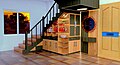 Closet under a staircase
 -
 Model of the cupboard under the staircase where the character Harry Potter grew up


See also
[edit]References
[edit]- ^ "oppgang". Det Norske Akademis ordbok (in Norwegian). Retrieved 2024-02-11.
- ^ "How not to mess up your loft conversion stairs". Resi. Retrieved 2025-03-21.
- ^ "trappehus". Det Norske Akademis ordbok (in Norwegian). Retrieved 2024-02-11.
- ^ a b "The History of Stairs: From Fascinating Architecture to Access Barriers | Stannah". Stannah Stairlifts. 2018-12-18. Archived from the original on 2024-02-28. Retrieved 2024-02-14.
- ^ Thomas, Neil M.; Skervin, Timmion; Foster, Richard J.; O'Brien, Thomas D.; Carpenter, Mark G.; Maganaris, Constantinos N.; Baltzopoulos, Vasilios; Lees, Carolyn; Hollands, Mark A. (2020-04-01). "Optimal lighting levels for stair safety: Influence of lightbulb type and brightness on confidence, dynamic balance and stepping characteristics". Experimental Gerontology. 132 110839. doi:10.1016/j.exger.2020.110839. ISSN 0531-5565. PMID 31958491. S2CID 210703463.
- ^ Van de Perre, Laurens; Danschutter, Stefan; Janssens, Kim; Hanselaer, Peter; Dujardin, Marc; Smet, Kevin A. G.; Ryckaert, Wouter R. (2019-12-01). "Safety perception of stairs with integrated lighting". Building and Environment. 166 106389. Bibcode:2019BuEnv.16606389V. doi:10.1016/j.buildenv.2019.106389. ISSN 0360-1323. S2CID 203123801.
- ^ "Byggteknisk forskrift (TEK17) med veiledning, III Bygningsdeler, § 12-14. Trapp" (PDF) (in Norwegian).
- ^ Ziavras, Valerie (2021-08-06). "Types of Permissible Vertical Openings". National Fire Protection Association. Retrieved 2024-02-14.
- ^ a b "Ofte stilte spørsmål". Branntips (in Norwegian Bokmål). Retrieved 2024-02-11.
- ^ "Frequently asked questions". Branntips EN. Retrieved 2024-02-14.
- ^ Mushro, Amanda (2023-08-21). "11 Awesome Under-Stairs Storage And Design Ideas To Make The Most Of Your Space". Forbes. Retrieved 2024-02-11.
- ^ Tyagi, Pooja Khann (2021-09-03). "How to turn the awkward space under the stairs into your favourite corner at home". Architectural Digest India. Retrieved 2024-02-14.
| Shared rooms | |
|---|---|
| Private rooms | |
| Spaces | |
| Technical, utility and storage |
|
| Great house areas | |
| Other | |
| Architectural elements | |
| Related | |

Staircase
View on GrokipediaOverview
Definition and Function
A staircase, commonly referred to as a stairway, is a structural assembly comprising one or more flights of steps that connect different vertical levels within a building or outdoor space. It consists of essential components such as treads—the horizontal surfaces on which users step—and risers—the vertical elements between treads—supported by frameworks like stringers, along with safety features including handrails and balustrades.[5][6] The fundamental function of a staircase is to enable safe and efficient vertical movement for occupants, facilitating routine access between floors in multi-level structures such as residences, offices, and public buildings. This circulation role supports daily activities by bridging elevations without reliance on mechanical aids like elevators.[6][7] In addition to general circulation, staircases play a critical role in emergency egress, serving as primary or secondary paths for evacuation during hazards like fires, ensuring unobstructed and continuous travel to exits. Building codes mandate their design to prioritize user safety, with uniform dimensions—for example, under US ADA guidelines, riser heights between 4 and 7 inches (102-178 mm) and tread depths of at least 11 inches (279 mm)—to minimize slip and fall risks; standards vary by jurisdiction.[5][8]Basic Components
The basic components of a staircase form its structural and functional core, enabling safe vertical movement between levels in buildings. These elements include the treads and risers that define each step, supportive stringers, safety features like handrails and balusters, and transitional landings. Standardized dimensions and materials ensure compliance with building codes, prioritizing ergonomics and fall prevention.[5][6] The tread is the horizontal surface of a step where the foot is placed, typically providing a minimum depth of 11 inches (279 mm) under US ADA guidelines for accessible stairs in commercial settings to accommodate comfortable stepping.[5] Treads must be uniform within a flight and free of open gaps to prevent tripping. The riser, the vertical face between treads, establishes the step height, generally ranging from 4 to 7 inches (102-178 mm) for accessibility under ADA standards, with uniformity required to avoid uneven strides that could cause falls; OSHA permits up to 9.5 inches (241 mm).[5] Stringers, also known as stringer boards, are the inclined structural supports along the sides of the staircase that carry the treads and risers, often triangular in cross-section for load distribution.[9] The nosing is the projecting edge of the tread overhanging the riser by no more than 1.5 inches (38 mm), often rounded or beveled to reduce injury risk during descent; it may include anti-slip treatments in high-traffic areas.[5] Handrails provide graspable support along the staircase, mounted at 34 to 38 inches (864-965 mm) above the nosing height under ADA and extending beyond the top and bottom steps for continuity.[5] Balusters, or spindles, are vertical posts spaced closely—no more than 4 inches (102 mm) apart under IBC standards for commercial guards—to support the handrail and form a barrier against falls; OSHA allows up to 19 inches (483 mm).[6] Newel posts are robust vertical anchors at the base, top, or turns, securing the balustrade system to the floor or stringer for overall stability.[9] Landings serve as level platforms at the head, foot, or intermediate turns of a staircase, matching the stair width to allow pausing and directional changes without abrupt edges.[6] These components collectively adhere to codes like the International Building Code (IBC) and OSHA standards, which mandate features such as 1.5-inch (38 mm) clearance behind handrails and rounded edges to enhance usability.[10]History
Ancient and Medieval Staircases
The earliest known staircases date back to the Neolithic period, with archaeological evidence from sites like the Tower of Jericho in the West Bank, where a stone staircase from the Pre-Pottery Neolithic A period (c. 8000 BCE) provided access to an 8.5-meter-tall tower.[11] In Europe, the oldest preserved wooden staircase, dating to approximately 1340 BCE during the Bronze Age, was discovered in the Hallstatt salt mine in Austria, constructed from yew wood and demonstrating early woodworking techniques for vertical mobility in mining contexts.[12] Stone staircases emerged later in the late 4th millennium BCE, as seen in the Tarxien temple complex in Malta, where they served functional roles in ritual spaces.[13] In ancient Mesopotamia, staircases were integral to fortified citadels, such as the Parthian-period (1st century BCE–2nd century CE) example at Amadiya in northern Iraq, featuring stone switchbacks paved with cobblestones and ashlar retaining walls for ascending steep terrain.[14] These designs integrated with defensive architecture, often incorporating post-holes for temporary structures and evolving through medieval reinforcements under the Zengids in the 12th century.[14] Greek architecture advanced monumental staircases from the 6th century BCE, initially utilitarian for retaining walls and viewing platforms, as at the Heraion in Perachora, but by the 5th century BCE, they assumed ceremonial functions in sanctuaries, such as the stepped terraces at the Heraion in Argos (460–440 BCE) that guided processions and enhanced ritual vistas.[13] Examples like the grand staircase at Temple M in Selinous (6th century BCE), spanning 75 meters in length and 9.8 meters in height, demarcated sacred spaces and provided kinesthetic experiences during ascents.[13] Roman staircases reflected urban density, particularly in insulae (multi-story apartment blocks) reaching up to eight stories, accessed by wooden straight flights containing 100–150 steps with even slopes for practical daily use.[15] Spiral designs proliferated in the Imperial period, exemplified by the helical staircase in Trajan's Column (113 CE), carved from stone or marble to optimize space in towers and public monuments.[16] These innovations prioritized efficiency in vertical circulation within crowded cities.[16] Medieval staircases emphasized defense and symbolism, particularly in castles where spiral designs predominated, built around a central newel post with narrow treads and tight turns to hinder assaults.[17] Directions varied, with some ascending clockwise and others counterclockwise depending on layout. In domestic architecture, English medieval homes featured wooden newel staircases, evolving from simple spiral forms around a central post (e.g., the 4.8-meter diameter example at Colchester Castle, 11th century) to more open, carved designs by the 14th century, integrating heraldry and grissaille painting for aesthetic enhancement.[18] These shifts marked a transition from purely functional elements to status symbols in manors and townhouses.[18]Modern Developments
In the early 20th century, the advent of Modernism revolutionized staircase design, emphasizing functionality, minimalism, and the integration of new materials like reinforced concrete and steel. Belgian architect Henry van de Velde pioneered free-floating staircases, exemplified by his design at the Bauhaus University in Weimar (1904–1911), which suspended steps without visible supports to create an illusion of weightlessness and align with Art Nouveau's organic flow before transitioning to stricter modernist principles.[19] Similarly, Le Corbusier advanced innovative forms with curved reinforced concrete staircases at Villa Savoye in Poissy (1928–1931), where the ramps and steps served as sculptural elements promoting fluid movement and aligning with his "architectural promenade" concept.[20] These developments marked a shift from ornate historical styles to clean lines and structural honesty, influenced by industrial advancements and the Bauhaus movement's focus on form following function.[21] The interwar and immediate postwar periods saw further innovations, such as Auguste Perret's double concrete staircase at the Economic and Social Council in Paris (1937–1946), demonstrating early use of prefabricated elements for durability and aesthetic simplicity.[22] Post-World War II architecture expanded these ideas, incorporating concrete and steel for monumental and efficient designs in public and institutional buildings. Architects like Louis Kahn integrated staircases as experiential cores, as seen in the National Parliament in Dhaka (1961–1982), where broad, light-filled steps fostered civic interaction amid brutalist forms.[23] Oscar Niemeyer's undulating concrete stairs at the Palácio do Itamaraty in Brasília (1960–1970) blended modernism with Brazilian organicism, while Carlo Scarpa's poetic concrete and wood compositions at the Brion Cemetery (1970–1972) highlighted tactile materiality and site-specific innovation.[24][25] This era prioritized accessibility and safety alongside aesthetics, responding to urbanization and building codes that standardized dimensions for mass construction.[21] In the 21st century, staircase design has embraced sustainability, digital fabrication, and multifunctional roles, transforming stairs into social and environmental assets, including in non-Western contexts such as the use of bamboo and recycled materials in sustainable designs in Southeast Asia.[26] The rise of floating and cantilevered staircases, often using tempered glass and engineered wood, enhances spatial openness and light penetration in contemporary homes and offices, as seen in modular prefabricated systems that reduce waste.[21] Innovations like 3D printing and parametric design allow for customized, lightweight structures, while eco-friendly materials such as recycled steel and low-VOC composites address environmental concerns.[27] Architects have reconceived stairs as communal hubs; for instance, Morphosis's "vertical piazza" at Cooper Union in New York (2009) functions as a multitasking space for networking, reflecting a shift from vertical circulation to horizontal sociability in post-Fordist environments.[28] MVRDV's orange staircase-amphitheater at TU Delft's School of Architecture integrates seating for gatherings, underscoring stairs' evolving role in fostering interaction within flexible, adaptive buildings.[28] These advancements, driven by globalization and technology, continue to balance utility with artistic expression.Types of Staircases
Straight and L-Shaped Stairs
Straight stairs, also known as straight-run stairs, consist of a single, uninterrupted flight of steps that ascend or descend vertically without any change in direction, making them the simplest and most common staircase configuration in both residential and commercial buildings.[29] This design typically requires connections only at the top and bottom, facilitating straightforward construction and installation of railings.[30] They are particularly suited to open spaces where linear floor area is available, often appearing in minimalist homes or as primary access in multi-story structures.[31] In terms of dimensions, straight stairs must adhere to building codes such as the International Building Code (IBC), which mandates a minimum tread depth of 11 inches (28 cm) and a maximum riser height of 7 inches (18 cm) to ensure safe footing and pacing.[32] Width requirements vary by occupancy: at least 36 inches (91 cm) for private or low-occupancy use, 44 inches (112 cm) for public spaces serving more than 50 people, and up to 60 inches (152 cm) for comfortable two-person passage.[31] Headroom must be at least 80 inches (203 cm) throughout, and landings at the top and bottom should measure no less than 36 inches (91 cm) in the direction of travel for straight runs.[33] No intermediate landing is required if the total rise is under 12 feet (3.66 m) or fewer than 16 risers, though exceeding this height necessitates a landing to break the flight and enhance safety.[30] The advantages of straight stairs include ease of navigation, as they allow for a consistent rhythm without turns, reducing the risk of missteps compared to more complex layouts.[30] They are cost-effective to construct, requiring minimal structural support beyond the endpoints, and permit the use of thinner treads or open risers for a more transparent, modern aesthetic.[29] However, their linear nature demands substantial floor space—often more than turning alternatives—and provides no visual or acoustic barrier between floors, potentially compromising privacy in multi-level homes.[30] L-shaped stairs, alternatively called quarter-turn stairs, incorporate a 90-degree turn midway through the ascent or descent, typically via a rectangular landing that connects two perpendicular flights of steps.[34] This configuration is ideal for corner placements in rooms with limited linear space, allowing the staircase to fold efficiently while providing a natural pause point at the landing.[29] Unlike straight runs, L-shaped designs often integrate with walls for added support, enhancing stability in residential or commercial settings where space optimization is key.[30] Construction of L-shaped stairs follows similar IBC guidelines to straight stairs, with the landing required to be at least 36 inches (91 cm) deep in the travel direction and matching the stair width to maintain flow.[35] The turn introduces additional complexity, such as reinforcing the landing structure—often with stringers or walls—and ensuring handrails transition smoothly around the corner, typically at 34–38 inches (86.5–96.5 cm) height.[31] For winders (triangular treads) in lieu of a full landing, codes may restrict their use or require a minimum 6-inch (15 cm) walkline tread depth, though landings are preferred for safety in most applications.[36] Key benefits of L-shaped stairs include improved safety through the landing, which minimizes fall distance and offers a resting spot, making them easier to navigate than uninterrupted straight flights exceeding 12 feet.[30] They add visual interest and privacy by creating a barrier between floors, potentially reducing sound transmission when enclosed by walls, and fit well in compact layouts without sacrificing functionality.[29] Drawbacks involve higher construction costs and complexity, as the turn demands precise framing and skilled railing installation, and the 90-degree angle can complicate moving bulky furniture.[30] Overall, both straight and L-shaped stairs prioritize accessibility and code compliance, with the choice depending on spatial constraints and aesthetic goals in architectural design.[36]Spiral and Curved Stairs
Spiral staircases feature treads radiating from a central newel post, forming a continuous spiral that ascends around a vertical axis, typically within a cylindrical or turret-like structure.[37] In contrast, curved staircases encompass a broader category of non-linear stairs, including elliptical, parabolic, or helical designs without a central support, where treads follow a sweeping arc supported by walls or stringers, allowing for more fluid transitions between levels.[38] Both types prioritize space efficiency and aesthetic appeal over the straightforward geometry of straight stairs, often serving as focal points in architecture.[39] The origins of spiral staircases trace back to ancient Roman engineering, with one of the earliest examples embedded in Trajan's Column in Rome, completed in 113 CE, where 185 marble steps spiral inside a 34.4-meter-high structure to access a viewing platform.[39] By the 11th century, they became integral to European medieval castles, particularly in Norman keeps, evolving from Roman and Carolingian precedents to link public and private spaces in elite structures.[37] In structures like Hedingham Castle (1140) and Dolbadarn Castle (1210-1240), these stairs marked transitions from public to private elite spaces, symbolizing lordship and hierarchical ascent, with widths varying (e.g., 64-153 cm).[37] Curved stairs, meanwhile, appeared in Romanesque churches by the 11th century for ceremonial access, but gained prominence in fortified settings for their ability to control movement without the tight radial constraints of spirals.[37] During the Renaissance, spiral and curved designs shifted toward grandeur and innovation, exemplified by the double-helix staircase at Château de Chambord (1519-1547), attributed to Leonardo da Vinci, where two independent spirals allow passage without encounter, blending functionality with symbolic ascent.[39] Francesco Borromini's helicoidal staircase in Palazzo Barberini (1633) introduced an elliptical form without a central newel, relying on cantilevered treads for a seamless curve, influencing Baroque architecture's emphasis on dynamic movement.[39] In 18th-19th century France, compagnonnage guilds elevated these forms through intricate wooden models, such as pearwood spirals (late 18th century) and mahogany curved double-revolutions with decorative busts (early 19th century), showcasing geometric precision and craftsmanship as status symbols.[38] Design principles for spiral and curved stairs emphasize geometric harmony, with spirals governed by newel diameter (typically 15-73 cm) and riser heights varying from 13-45 cm to match human gait, constructed from stone treads wedged into walls or around a central post for stability.[37] Curved variants employ stringers or cantilever supports to achieve broader radii, often lit by slits for orientation, and adhere to proportions like tread depths of 22-25 cm for safety.[38] Materials evolved from medieval stone and brick to Renaissance wood (e.g., walnut, pear) and modern steel or concrete, prioritizing load-bearing efficiency in compact spaces.[38] These designs demand precise calculation to avoid vertigo-inducing tight turns in spirals or uneven footing in curves.[39] In contemporary architecture, spiral and curved stairs offer space-saving solutions in residential lofts and commercial atriums, while maintaining historical symbolism of elevation and prestige; however, building codes limit their use in high-traffic areas due to accessibility concerns.[38] Their enduring appeal lies in transforming vertical circulation into sculptural elements, balancing utility with visual drama.[39]Design and Construction
Materials
Staircases are constructed using a variety of materials selected for their structural integrity, aesthetic qualities, durability, and suitability to specific environments, such as residential, commercial, or public settings.[40] Common materials include wood, concrete, metal (particularly steel), stone, and glass, each offering distinct properties that influence design choices in architecture and engineering.[41] The selection often balances factors like load-bearing capacity, maintenance requirements, and compliance with building codes.[42] Wood remains one of the most traditional and versatile materials for staircase construction, prized for its natural warmth, lightweight nature, and ease of customization through staining or painting.[40] Commonly used species include hardwoods like red and white oak, African mahogany, ash, and maple, which provide durability and a vintage or modern aesthetic, as well as softwoods such as pine and fir for more economical options.[43] In residential applications, wood framing is permitted under International Building Code (IBC) Sections 602 and 1011.7 for construction Types III, IV, and V, including light framing and heavy timber in mid-rise podium-style buildings.[42] Advantages include cost-effectiveness and design flexibility, though it requires regular maintenance to prevent wear and is less suitable for high-traffic areas due to susceptibility to moisture and pests.[41] Concrete, often reinforced with steel (RCC), is favored for its exceptional strength, longevity, and ability to be molded into complex shapes like straight, spiral, or sculptural forms, making it ideal for both structural support and aesthetic innovation.[40] It excels in supporting heavy loads in modern homes and public buildings, with finishes that can mitigate its inherently cold appearance.[41] Key benefits include high durability and fire resistance, but its weight necessitates robust foundational support, and modifications can be costly.[43] Under IBC guidelines, concrete is typically required for non-combustible construction in Types I and II, though it aligns well with mixed-use designs.[42] Metal, especially steel and aluminum, provides a sleek, modern profile with superior strength-to-weight ratios, enabling slender, industrial-style designs in contemporary and commercial spaces.[40] Steel stringers, for instance, are standard in commercial stair fabrication for their robustness and corrosion resistance when properly treated.[44] Advantages encompass versatility in finishes and high durability, though metals can feel cold to the touch and may require anti-rust coatings every 5-10 years in humid environments.[43] They are commonly used in limited-space or temporary installations, adhering to IBC requirements for non-combustible elements in certain building types.[42] Stone and brick offer timeless, rustic durability for traditional or outdoor staircases, with natural or artificial stone providing a vintage look and brick delivering low-cost, weather-resistant construction when combined with cement.[43] These materials are valued for their load-bearing capacity and low maintenance in historical or masonry-heavy structures, though they add significant weight and limit design fluidity compared to lighter alternatives.[41] Glass, typically tempered for safety, introduces transparency and light enhancement in luxury or minimalist designs, often paired with metal frames to create open, airy staircases in contemporary homes.[40] Its elegant, modern appeal comes with challenges like slipperiness, reduced privacy, and the need for frequent cleaning, making it less practical for high-traffic areas.[41] Despite these drawbacks, its use in premium applications underscores a trend toward visually unobtrusive architecture.[43]Dimensions and Building Codes
Staircase dimensions are governed by building codes to ensure safety, accessibility, and usability, with variations depending on whether the structure is residential, commercial, or public. These codes specify parameters such as riser height, tread depth, stairway width, headroom, and landing sizes to prevent accidents like tripping or falls. In the United States, the International Building Code (IBC) applies to commercial and public buildings, while the International Residential Code (IRC) covers one- and two-family dwellings. Internationally, standards like the UK's Building Regulations Part K provide similar guidelines, often harmonized with European norms but adapted nationally.[45][46][47] Riser height, the vertical distance between treads, typically ranges from 4 inches (102 mm) minimum to 7 inches (178 mm) maximum under the IBC for commercial stairs, ensuring a consistent slope that avoids excessive steepness. For residential stairs per the IRC, the maximum is slightly higher at 7.75 inches (197 mm), with a 4-inch minimum, allowing for more flexibility in home designs while maintaining safety. In the UK, domestic risers must be between 150 mm and 220 mm (5.9 to 8.7 inches), with the formula 2R + G (twice the rise plus the going) required to fall between 550 mm and 700 mm to optimize comfort and reduce fatigue.[45][46][48] Tread depth, or going, must be at least 11 inches (279 mm) in IBC-compliant commercial settings, measured nosing to nosing, while IRC residential treads require a 10-inch (254 mm) minimum. UK regulations mandate a minimum going of 220 mm (8.7 inches) for domestic stairs, promoting stable footing.[45][46][49] Stairway width ensures adequate passage for occupants, with IBC requiring a minimum clear width of 44 inches (1118 mm) between handrails for most commercial egress stairs serving 50 or more people, though 36 inches (914 mm) is permitted for smaller occupancies. Residential IRC standards set the minimum at 36 inches (914 mm), sufficient for typical household traffic. In the UK, private stairs in dwellings need a clear width of at least 800 mm (31.5 inches), increasing to 1200 mm (47.2 inches) overall or 1000 mm (39.4 inches) clear between handrails for public access stairs, with handrails on both sides for widths over 1000 mm (39.4 inches).[50][46][48] Headroom clearance, the vertical space above stairs, is standardized at 80 inches (2032 mm) minimum under both IBC and IRC, measured from the nosing edge upward to prevent collisions with overhead obstructions. UK codes similarly require at least 2 meters (78.7 inches) of headroom throughout the stair flight.[50][46][49] Landings provide level transitions at the top and bottom of stairs, with dimensions tied to the stairway width. IBC mandates landings at least as wide as the stair and 44 inches (1118 mm) deep in the direction of travel for commercial use, while IRC requires 36 inches (914 mm) minimum depth for residential. In UK domestic settings, landings must be at least 900 mm by 900 mm (35.4 by 35.4 inches), or match the stair width if larger. Variations in riser heights or tread depths within a single flight are limited to 3/8 inch (9.5 mm) under IBC and IRC to ensure uniformity and reduce trip hazards. These codes evolve through updates, such as the 2021 editions, incorporating accessibility features like those from the Americans with Disabilities Act (ADA) for ramps integrated into stairs.[32][46][47]| Parameter | IBC (Commercial, US) | IRC (Residential, US) | UK Building Regs (Domestic) |
|---|---|---|---|
| Riser Height | 4–7 in (102–178 mm) | 4–7.75 in (102–197 mm) | 150–220 mm (5.9–8.7 in) |
| Tread Depth | 11 in min (279 mm) | 10 in min (254 mm) | 220 mm min (8.7 in) |
| Width (Clear) | 44 in min (1118 mm); 36 in for <50 occupants | 36 in min (914 mm) | 800 mm min (31.5 in) |
| Headroom | 80 in min (2032 mm) | 80 in min (2032 mm) | 2 m min (78.7 in) |
| Landing Depth | 44 in min (1118 mm) | 36 in min (914 mm) | 900 mm min (35.4 in) |