Recent from talks
Nothing was collected or created yet.
Swarm robotics
View on WikipediaThis article is written like a personal reflection, personal essay, or argumentative essay that states a Wikipedia editor's personal feelings or presents an original argument about a topic. (May 2016) |


| Part of a series on |
| Multi-agent systems |
|---|
| Multi-agent simulation |
| Agent-oriented programming |
| Related |
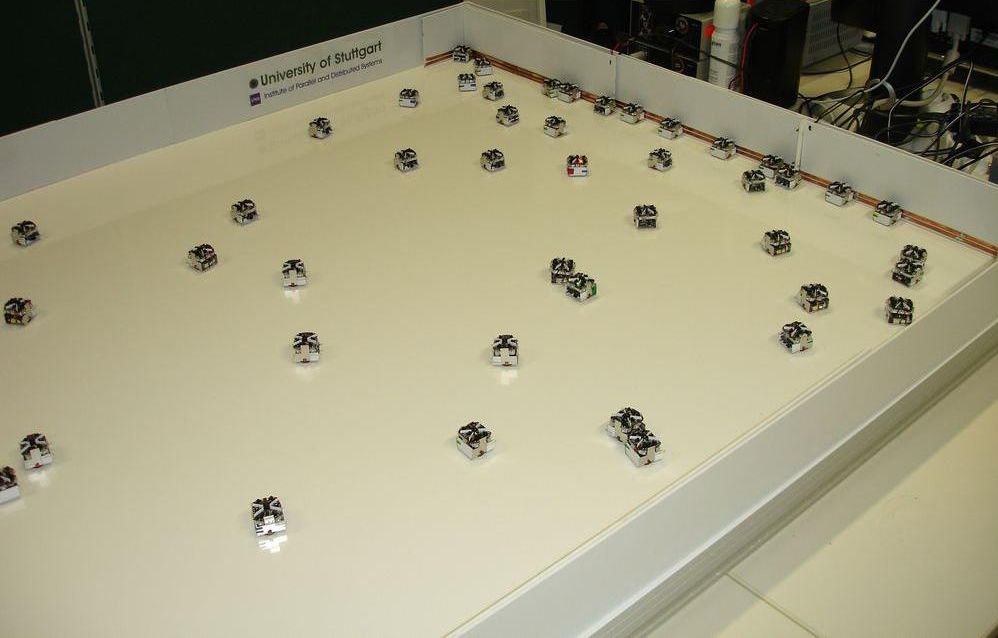
Swarm robotics is the study of how to design independent systems of robots without centralized control. The emerging swarming behavior of robotic swarms is created through the interactions between individual robots and the environment.[1] This idea emerged on the field of artificial swarm intelligence, as well as the studies of insects, ants and other fields in nature, where swarm behavior occurs.[2]
Relatively simple individual rules can produce a large set of complex swarm behaviors. A key component is the communication between the members of the group that build a system of constant feedback. The swarm behavior involves constant change of individuals in cooperation with others, as well as the behavior of the whole group.
Key Attributes of Robotic Swarms
[edit]The design of swarm robotics systems is guided by swarm intelligence principles, which promote fault tolerance, scalability, and flexibility.[1] Unlike distributed robotic systems in general, swarm robotics emphasizes a large number of robots. While various formulations of swarm intelligence principles exist, one widely recognized set includes:
- Robots are autonomous.
- Robots can interact with the surroundings and give feedback to modify the environment.
- Robots possess local perceiving and communicating capabilities, such as wireless transmission systems, like radio frequency or infrared.[3]
- Robots do not exploit centralized swarm control or global knowledge.
- Robots cooperate with each other to accomplish the given task.[4]
Miniaturization is also key factor in swarm robotics, as the effect of thousands of small robots can maximize the effect of the swarm-intelligent approach to achieve meaningful behavior at swarm-level through a greater number of interactions on an individual level.[5]
Compared with individual robots, a swarm can commonly decompose its given missions to their subtasks;[6] a swarm is more robust to partial failure and is more flexible with regard to different missions.[7]
History
[edit]The phrase "swarm robotics" was reported to make its first appearance in 1991 according to Google Scholar, but research regarding swarm robotics began to grow in early 2000s. The initial goal of studying swarm robotics was to test whether the concept of stigmergy could be used as a method for robots to indirectly communication and coordinate with each other.[5]
One of the first international projects regarding swarm robotics was the SWARM-BOTS project funded by the European Commission between 2001 and 2005, in which a swarm of up to 20 of robots capable of independently physically connect to each other to form a cooperating system were used to study swarm behaviors such as collective transport, area coverage, and searching for objects. The result was demonstration of self-organized teams of robots that cooperate to solve a complex task, with the robots in the swarm taking different roles over time. This work was then expanded upon through the Swarmanoid project (2006–2010), which extended the ideas and algorithms developed in Swarm-bots to heterogeneous robot swarms composed of three types of robots—flying, climbing, and ground-based—that collaborated to carry out a search and retrieval task.[5]
Applications
[edit]There are many potential applications for swarm robotics.[8] They include tasks that demand miniaturization (nanorobotics, microbotics), like distributed sensing tasks in micromachinery or the human body. A promising use of swarm robotics is in search and rescue missions.[9] Swarms of robots of different sizes could be sent to places that rescue-workers cannot reach safely, to explore the unknown environment and solve complex mazes via onboard sensors.[9] Swarm robotics can also be suited to tasks that demand cheap designs, for instance mining or agricultural shepherding tasks.[10]
Drone swarms
[edit]
Drone swarms are used in target search, drone displays, and delivery. A drone display commonly uses multiple, lighted drones at night for an artistic display or advertising. A delivery drone swarm can carry multiple packages to a single destination at a time and overcome a single drone's payload and battery limitations.[11] A drone swarm may undertake different flight formations to reduce overall energy consumption due to drag forces.[12]
Drone swarming can also introduce additional control issues connected to human factors and the swarm operator. Examples of this include high cognitive demand and complexity when interacting with multiple drones due to changing attention between different individual drones.[13][14] Communication between operator and swarm is also a central aspect.[15]
Military swarms
[edit]More controversially, swarms of military robots can form an autonomous army. U.S. Naval forces have tested a swarm of autonomous boats that can steer and take offensive actions by themselves. The boats are unmanned and can be fitted with any kind of kit to deter and destroy enemy vessels.[16]
During the Syrian Civil War, Russian forces in the region reported attacks on their main air force base in the country by swarms of fixed-wing drones loaded with explosives.[17]
Miniature swarms
[edit]Another large set of applications may be solved using swarms of micro air vehicles, which are also broadly investigated nowadays. In comparison with the pioneering studies of swarms of flying robots using precise motion capture systems in laboratory conditions,[18] current systems such as Shooting Star can control teams of hundreds of micro aerial vehicles in outdoor environment[19] using GNSS systems (such as GPS) or even stabilize them using onboard localization systems[20] where GPS is unavailable.[21][22] Swarms of micro aerial vehicles have been already tested in tasks of autonomous surveillance,[23] plume tracking,[24] and reconnaissance in a compact phalanx.[25] Numerous works on cooperative swarms of unmanned ground and aerial vehicles have been conducted with target applications of cooperative environment monitoring,[26] simultaneous localization and mapping,[27] convoy protection,[28] and moving target localization and tracking.[29]
Acoustic swarms
[edit]In 2023, University of Washington and Microsoft researchers demonstrated acoustic swarms of tiny robots that create shape-changing smart speakers.[30] These can be used for manipulating acoustic scenes to focus on or mute sounds from a specific region in a room.[31] Here, tiny robots cooperate with each other using sound signals, without any cameras, to navigate cooperatively with centimeter-level accuracy. These swarm devices spread out across a surface to create a distributed and reconfigurable wireless microphone array. They also navigate back to the charging station where they can be automatically recharged.[32]
Kilobot
[edit]Most efforts have focused on relatively small groups of machines. However, a Kilobot swarm consisting of 1,024 individual robots was demonstrated by Harvard in 2014, the largest to date.[33]
LIBOT
[edit]Another example of miniaturization is the LIBOT Robotic System[34] that involves a low cost robot built for outdoor swarm robotics. The robots are also made with provisions for indoor use via Wi-Fi, since the GPS sensors provide poor communication inside buildings.

Colias
[edit]Another such attempt is the micro robot (Colias),[35] built in the Computer Intelligence Lab at the University of Lincoln, UK. This micro robot is built on a 4 cm circular chassis and is a low-cost and open platform for use in a variety of swarm robotics applications.
Manufacturing swarms
[edit]Additionally, progress has been made in the application of autonomous swarms in the field of manufacturing, known as swarm 3D printing. This is particularly useful for the production of large structures and components, where traditional 3D printing is not able to be utilized due to hardware size constraints. Miniaturization and mass mobilization allows the manufacturing system to achieve scale invariance, not limited in effective build volume. While in its early stage of development, swarm 3D printing is currently being commercialized by startup companies.[36]
See also
[edit]- Ant robotics
- Autonomous agent – Type of autonomous entity in softwares
- Behavior-based robotics – Branch of robotics
- Flocking (behavior) – Swarming behaviour of birds when flying or foraging
- Gray Goo – Hypothetical end-of-the-world scenario
- Kilobot
- List of emerging technologies – New technologies actively in development
- Microbotics – Branch of robotics
- Multi-agent system – Built of multiple interacting agents
- Nanorobotics – Emerging technology field
- Nanotechnology in fiction – Fictional uses of nanotechnology
- Physicomimetics – Physics-based swarm intelligence
- Quadcopter – Helicopter with four rotors
- Robotic materials
- Shooting Star (drone)
- Swarm intelligence – Collective behavior of decentralized, self-organized systems
- Swarm robotic platforms
- Unconventional computing – Computing by new or unusual methods
- Unmanned aerial vehicle – Aircraft without any human pilot on board
References
[edit]- ^ a b Dorigo, Marco; Birattari, Mauro; Brambill, Manuele (2014). "Swarm Robotics". Scholarpedia. 9 (1): 1463. Bibcode:2014SchpJ...9.1463D. doi:10.4249/scholarpedia.1463.
- ^ Nguyen, Luong Vuong (2 October 2024). "Swarm Intelligence-Based Multi-Robotics: A Comprehensive Review". AppliedMath. 4 (4): 1192–1210. doi:10.3390/appliedmath4040064. ISSN 2673-9909.
- ^ Kernbach, Serge, ed. (2013-05-29), "Architectures and Control of Networked Robotic Systems", Handbook of Collective Robotics (0 ed.), Jenny Stanford Publishing, pp. 105–128, doi:10.1201/b14908-6, ISBN 978-0-429-06759-4, retrieved 2024-12-04
- ^ Brambilla, Manuele; Ferrante, Eliseo; Birattari, Mauro; Dorigo, Marco (17 January 2013). "Swarm robotics: a review from the swarm engineering perspective". Swarm Intelligence. 7 (1): 1–41. doi:10.1007/s11721-012-0075-2. hdl:2013/ULB-DIPOT:oai:dipot.ulb.ac.be:2013/153305. ISSN 1935-3812.
- ^ a b c Dorigo, Marco; Theraulaz, Guy; Trianni, Vito (18 June 2021). "Swarm Robotics: Past, Present, and Future [Point of View]". Proceedings of the IEEE. 109 (7): 1152–1165. doi:10.1109/JPROC.2021.3072740. hdl:2013/ULB-DIPOT:oai:dipot.ulb.ac.be:2013/326716. ISSN 0018-9219.
- ^ Hu, Junyan; Bhowmick, Parijat; Lanzon, Alexander (2020-11-10). "Two-layer distributed formation-containment control strategy for linear swarm systems: Algorithm and experiments". International Journal of Robust and Nonlinear Control. 30 (16): 6433–6453. doi:10.1002/rnc.5105. ISSN 1049-8923.
- ^ Kagan, Eugene, ed. (2020). Autonomous mobile robots and multi-robot systems: motion-planning, communication and swarming (1st ed.). Hoboken, NJ: John Wiley & Sons, Inc. ISBN 978-1-119-21286-7.
- ^ Cheraghi, Ahmad Reza; Shahzad, Sahdia; Graffi, Kalman (2021-01-03), Past, Present, and Future of Swarm Robotics, arXiv:2101.00671
- ^ a b Hu, J.; Niu, H.; Carrasco, J.; Lennox, B.; Arvin, F., "Voronoi-Based Multi-Robot Autonomous Exploration in Unknown Environments via Deep Reinforcement Learning" IEEE Transactions on Vehicular Technology, 2020.
- ^ Hu, J.; Turgut, A.; Krajnik, T.; Lennox, B.; Arvin, F., "Occlusion-Based Coordination Protocol Design for Autonomous Robotic Shepherding Tasks" IEEE Transactions on Cognitive and Developmental Systems, 2020.
- ^ Alkouz, Balsam; Bouguettaya, Athman; Mistry, Sajib (Oct 18–24, 2020). "Swarm-based Drone-as-a-Service (SDaaS) for Delivery". 2020 IEEE International Conference on Web Services (ICWS). pp. 441–448. arXiv:2005.06952. doi:10.1109/ICWS49710.2020.00065. ISBN 978-1-7281-8786-0. S2CID 218628807.
- ^ Alkouz, Balsam; Bouguettaya, Athman (Dec 7–9, 2020). "Formation-based Selection of Drone Swarm Services". MobiQuitous 2020 - 17th EAI International Conference on Mobile and Ubiquitous Systems: Computing, Networking and Services. pp. 386–394. arXiv:2011.06766. doi:10.1145/3448891.3448899. ISBN 9781450388405. S2CID 226955877.
- ^ Hocraffer, Amy; Nam, Chang S. (2017). "A meta-analysis of human-system interfaces in unmanned aerial vehicle (UAV) swarm management". Applied Ergonomics. 58: 66–80. doi:10.1016/j.apergo.2016.05.011. PMID 27633199.
- ^ Lewis, Michael (2013). "Human Interaction With Multiple Remote Robots". Reviews of Human Factors and Ergonomics. 9 (1): 131–174. doi:10.1177/1557234X13506688.
- ^ Kolling, Andreas; Phillip, Walker; Nilanjan, Chakraborty; Katia, Sycara; Michael, Lewis (2016). "Human interaction with robot swarms: A survey" (PDF). IEEE Transactions on Human-Machine Systems. 46 (1): 9–26. Bibcode:2016ITHMS..46....9K. doi:10.1109/THMS.2015.2480801. S2CID 9975315.
- ^ Lendon, Brad (6 October 2014). "U.S. Navy could 'swarm' foes with robot boats". CNN.
- ^ Madrigal, Alexis C. (2018-03-07). "Drone Swarms Are Going to Be Terrifying and Hard to Stop". The Atlantic. Retrieved 2019-03-07.
- ^ Kushleyev, A.; Mellinger, D.; Powers, C.; Kumar, V., "Towards a swarm of agile micro quadrotors" Autonomous Robots, Volume 35, Issue 4, pp 287-300, November 2013
- ^ Vasarhelyi, G.; Virágh, C.; Tarcai, N.; Somorjai, G.; Vicsek, T. Outdoor flocking and formation flight with autonomous aerial robots. IEEE/RSJ International Conference on Intelligent Robots and Systems (IROS 2014), 2014
- ^ Faigl, J.; Krajnik, T.; Chudoba, J.; Preucil, L.; Saska, M. Low-Cost Embedded System for Relative Localization in Robotic Swarms. In ICRA2013: Proceedings of 2013 IEEE International Conference on Robotics and Automation. 2013.
- ^ Saska, M.; Vakula, J.; Preucil, L. Swarms of Micro Aerial Vehicles Stabilized Under a Visual Relative Localization. In ICRA2014: Proceedings of 2014 IEEE International Conference on Robotics and Automation. 2014.
- ^ Saska, M. MAV-swarms: unmanned aerial vehicles stabilized along a given path using onboard relative localization. In Proceedings of 2015 International Conference on Unmanned Aircraft Systems (ICUAS). 2015
- ^ Saska, M.; Chudoba, J.; Preucil, L.; Thomas, J.; Loianno, G.; Tresnak, A.; Vonasek, V.; Kumar, V. Autonomous Deployment of Swarms of Micro-Aerial Vehicles in Cooperative Surveillance. In Proceedings of 2014 International Conference on Unmanned Aircraft Systems (ICUAS). 2014.
- ^ Saska, M.; Langr J.; L. Preucil. Plume Tracking by a Self-stabilized Group of Micro Aerial Vehicles. In Modelling and Simulation for Autonomous Systems, 2014.
- ^ Saska, M.; Kasl, Z.; Preucil, L. Motion Planning and Control of Formations of Micro Aerial Vehicles. In Proceedings of the 19th World Congress of the International Federation of Automatic Control. 2014.
- ^ Saska, M.; Vonasek, V.; Krajnik, T.; Preucil, L. Coordination and Navigation of Heterogeneous UAVs-UGVs Teams Localized by a Hawk-Eye Approach Archived 2017-08-10 at the Wayback Machine. In Proceedings of 2012 IEEE/RSJ International Conference on Intelligent Robots and Systems. 2012.
- ^ Chung, Soon-Jo, et al. "A survey on aerial swarm robotics." IEEE Transactions on Robotics 34.4 (2018): 837-855.
- ^ Saska, M.; Vonasek, V.; Krajnik, T.; Preucil, L. Coordination and Navigation of Heterogeneous MAV–UGV Formations Localized by a ‘hawk-eye’-like Approach Under a Model Predictive Control Scheme. International Journal of Robotics Research 33(10):1393–1412, September 2014.
- ^ Kwon, Hyukseong; Pack, Daniel J. (2012). "A Robust Mobile Target Localization Method for Cooperative Unmanned Aerial Vehicles Using Sensor Fusion Quality". Journal of Intelligent & Robotic Systems. 65 (1–4): 479–493. doi:10.1007/s10846-011-9581-5. S2CID 254656907.
- ^ Itani, Malek; Chen, Tuochao; Yoshioka, Takuya; Gollakota, Shyamnath (2023-09-21). "Creating speech zones with self-distributing acoustic swarms". Nature Communications. 14 (1): 5684. Bibcode:2023NatCo..14.5684I. doi:10.1038/s41467-023-40869-8. ISSN 2041-1723. PMC 10514314. PMID 37735445.
- ^ "UW team's shape-changing smart speaker lets users mute different areas of a room". UW News. Retrieved 2023-09-21.
- ^ "Creating Speech Zones Using Self-distributing Acoustic Swarms". acousticswarm.cs.washington.edu. Retrieved 2023-09-21.
- ^ "A self-organizing thousand-robot swarm". Harvard. 14 August 2014. Retrieved 16 August 2014.
- ^ Zahugi, Emaad Mohamed H.; Shabani, Ahmed M.; Prasad, T. V. (2012), "Libot: Design of a low cost mobile robot for outdoor swarm robotics", 2012 IEEE International Conference on Cyber Technology in Automation, Control, and Intelligent Systems (CYBER), pp. 342–347, doi:10.1109/CYBER.2012.6392577, ISBN 978-1-4673-1421-3, S2CID 14692473
- ^ Arvin, F.; Murray, J.C.; Licheng Shi; Chun Zhang; Shigang Yue, "Development of an autonomous micro robot for swarm robotics," 2014 IEEE International Conference on Mechatronics and Automation (ICMA), vol., no., pp.635,640, 3-6 Aug. 2014 doi: 10.1109/ICMA.2014.6885771
- ^ "Technology". 25 July 2020. Archived from the original on 4 August 2020. Retrieved 16 August 2020.
External links
[edit]Swarm robotics
View on GrokipediaDefinition and Fundamental Principles
Core Characteristics
Swarm robotics involves the coordination of large numbers of relatively simple, physically embodied mobile robots that interact locally to achieve collective behaviors unattainable by individual agents.[8] These systems emphasize decentralized control, where no single robot or external authority directs the group; instead, each robot operates autonomously based on local sensory inputs and interactions with neighbors.[9] This approach enables emergence, in which complex global patterns and task performance arise from simple local rules without explicit programming of higher-level strategies.[10] A defining feature is scalability, allowing the addition of more robots to enhance performance without a proportional increase in design complexity, as behaviors rely on probabilistic interactions rather than rigid hierarchies.[9] Swarm systems also exhibit robustness and fault tolerance, particularly in high-risk environments, since the loss of individual robots does not critically impair overall functionality due to redundancy and distributed decision-making. This resilience ensures the swarm's mission remains viable even when units are compromised.[3] Robots typically employ local communication methods, such as infrared signals or proximity sensing, limited to short ranges, which constrains information flow and promotes self-organization.[11] Homogeneity is common, with identical or similar robots simplifying deployment and analysis, though heterogeneous swarms incorporating varied capabilities have been explored for specialized roles. Minimal human intervention is prioritized post-deployment, aligning with principles of autonomy and adaptability in dynamic environments.[3] These characteristics collectively enable applications requiring flexibility, such as exploration or manipulation in unstructured settings, where centralized systems falter.[12]Biological Inspirations and First-Principles Rationale
Swarm robotics draws primary inspiration from biological collectives where simple local interactions among agents yield sophisticated global patterns without centralized oversight, such as in social insect colonies, avian flocks, and piscine schools. Ant colonies, for example, exemplify stigmergy—a mechanism of indirect communication via environmental modifications like pheromone trails—that enables efficient foraging and nest construction; individual ants follow probabilistic rules based on trail strength, collectively optimizing paths to food sources through positive feedback reinforcement.[10] Empirical studies of species like Argentine ants (Linepithema humile) demonstrate this, as colonies rapidly converge on shortest routes among branching paths, achieving near-optimal solutions via differential evaporation rates of pheromones that favor persistent high-traffic trails. Bee hives and termite mounds similarly inspire division of labor and self-organization, where task allocation emerges from local stimulus-response rules rather than innate specialization, allowing colonies to adapt to fluctuating demands like resource scarcity.[10] Avian and aquatic swarms provide models for motion coordination: bird flocks, observed in species such as European starlings (Sturnus vulgaris), maintain group integrity through three core heuristics—collision avoidance (separation), velocity matching (alignment), and centroid attraction (cohesion)—sensed via limited visual fields of about 120 degrees, producing murmurations that enhance predator evasion via dilution and confusion effects.[10] Fish schools, as in herring (Clupea harengus), exhibit parallel dynamics for hydrodynamic efficiency and defense, with individuals aligning to neighbors within 1-2 body lengths to minimize energy expenditure during long migrations while diluting individual risk.[10] These natural systems, studied through field observations and simulations, underscore how finite sensing and computation suffice for emergent robustness, informing robotic analogs like Reynolds' boids model adapted for hardware. The first-principles rationale for emulating these in robotics stems from the causal advantages of decentralization over hierarchical control: local rules enable linear scalability (O(n) interactions per agent) versus quadratic communication costs (O(n²)) in centralized architectures, averting bottlenecks as swarm size grows beyond tens of units.[13] This mirrors biological causality, where feedback loops in agent-environment interactions amplify adaptive behaviors, yielding fault tolerance—swarms sustain functionality amid 10-50% agent loss, as validated in simulations and insect analogs—without single-point vulnerabilities that cascade failures in monolithic systems.[10] Such designs prioritize empirical verifiability through metrics like task completion rates under perturbations, favoring causal realism in unpredictable environments over brittle top-down optimization.[13]Historical Development
Origins in Swarm Intelligence
The concept of swarm intelligence, which underpins swarm robotics, originated from modeling the decentralized, self-organizing behaviors observed in natural systems such as ant colonies, bee hives, and bird flocks, where collective intelligence emerges from local interactions among simple agents without central coordination.[14] These biological analogies emphasized principles like stigmergy—indirect communication via environmental modifications—and positive feedback loops that amplify efficient patterns, providing a first-principles foundation for scalable artificial systems.[15] The term "swarm intelligence" was formally introduced by Gerardo Beni and Jing Wang in 1989, specifically in the context of cellular robotic systems, where they proposed that large numbers of simple, identical robots could achieve complex pattern formation and task distribution through nearest-neighbor rules and probabilistic state changes, mimicking cellular automata.[16] This work marked the initial bridge from theoretical swarm models to robotics, highlighting how emergent global behaviors could arise from local sensing and actuation, independent of hierarchical control. Building on this, Marco Dorigo's 1992 PhD thesis developed ant colony optimization (ACO), an algorithm inspired by ant pheromone trails that enabled virtual agents to solve combinatorial optimization problems like the traveling salesman, laying algorithmic groundwork later adapted for physical robot coordination.[17] Further consolidation occurred in the late 1990s, with Eric Bonabeau, Marco Dorigo, and Guy Theraulaz's 1999 book Swarm Intelligence: From Natural to Artificial Systems, which systematically analyzed insect-derived models—such as division of labor and foraging—and demonstrated their applicability to distributed artificial systems, including early robotic prototypes. Concurrently, experimental validations emerged, such as Beckers, Holland, and Deneubourg's 1994 work on stigmergic coordination in small robot groups simulating ant nest-building, which tested swarm principles in physical hardware and revealed challenges like interference in real-world scalability.[18] These developments shifted swarm intelligence from simulation-based algorithms to the practical origins of swarm robotics, prioritizing robustness through redundancy and fault tolerance over individual agent sophistication.[15]Key Milestones and Pioneering Experiments
The conceptual foundations of swarm robotics emerged in the late 1980s with Gerardo Beni's introduction of cellular robotic systems, where groups of simple, autonomous robots coordinate in n-dimensional space through limited local interactions to achieve collective intelligence.[19] In 1989, Beni and Jing Wang formalized "swarm intelligence" as the emergent problem-solving behavior in such decentralized multi-agent systems, drawing parallels to biological collectives without relying on central control.[4] These ideas laid the groundwork for physical implementations, transitioning from simulations to hardware experiments. Early pioneering physical experiments in the 1990s demonstrated basic collective behaviors. In 1993, Christopher Kube and Hong Zhang implemented a system of 8 to 20 physical mobile robots that cooperatively pushed boxes, mimicking ant foraging through trial-and-error local rules without explicit communication, achieving success rates of up to 90% for aligned objects.[4] By 1994, Ralf Beckers, Özgür Holland, and Jean-Louis Deneubourg tested stigmergic coordination—indirect communication via environmental modifications—in small robot groups performing clustering and sorting tasks, validating insect-inspired mechanisms for self-organization.[15] A major milestone came with the SWARM-BOTS project (2001–2005), led by Marco Dorigo at EPFL and IRIDIA, which developed s-bots capable of self-assembling into a cohesive "swarm-bot." Experiments with up to 12 s-bots showed the group navigating rough terrain, bridging gaps up to 45 cm wide, and transporting objects 5 times heavier than a single unit by forming temporary structures via gripper connections and local sensory feedback. This project empirically proved scalability in physical self-assembly and fault tolerance, as the swarm adapted to robot failures by redistributing tasks. In 2012, Michael Rubenstein, Radhika Nagpal, and colleagues at Harvard's Wyss Institute introduced the Kilobot platform, enabling the first large-scale swarm of 1,024 simple, centimeter-scale robots to self-organize into complex shapes like stars and letters. Using probabilistic local rules for neighbor detection via infrared signals, the experiment completed assembly in 12 hours, highlighting the feasibility of decentralized algorithms for thousand-robot swarms despite individual limitations in speed and precision.[5] These demonstrations underscored emergence from simple interactions, influencing subsequent scalable platforms. Parallel efforts included James McLurkin's work at Rice University, where from the early 2000s he advanced distributed multi-robot systems with up to 100 units for formation marching and search tasks, emphasizing robust communication protocols resilient to noise. In 2011, McLurkin deployed low-cost R-one robots in classroom experiments, scaling to dozens for real-time coordination in dynamic environments.[20]| Milestone | Year | Key Achievement | Researchers/Institution |
|---|---|---|---|
| Cellular robotics concept | 1988 | Introduced swarm-like coordination in multi-robot systems | G. Beni, T. Fukuda |
| Swarm intelligence formalized | 1989 | Emergent behavior in decentralized agents | G. Beni, J. Wang |
| Cooperative box-pushing | 1993 | Physical robots emulate ant transport with local rules | C. Kube, H. Zhang |
| Stigmergy in clustering | 1994 | Environmental mediation for self-organization | R. Beckers et al. |
| SWARM-BOTS self-assembly | 2001–2005 | Gap-bridging and heavy transport with 12 robots | M. Dorigo et al., EPFL |
| Kilobots large-scale assembly | 2012 | 1,024 robots form shapes via local probabilistic rules | M. Rubenstein, R. Nagpal, Harvard |
