Hubbry Logo
Five Dynasties and Ten Kingdoms periodFive Dynasties and Ten Kingdoms periodMain
Open search
Five Dynasties and Ten Kingdoms period
Community hub
Five Dynasties and Ten Kingdoms period
logo
8 pages, 0 posts
0 subscribers
Be the first to start a discussion here.
Five Dynasties and Ten Kingdoms period
from Wikipedia

Five Dynasties and Ten Kingdoms
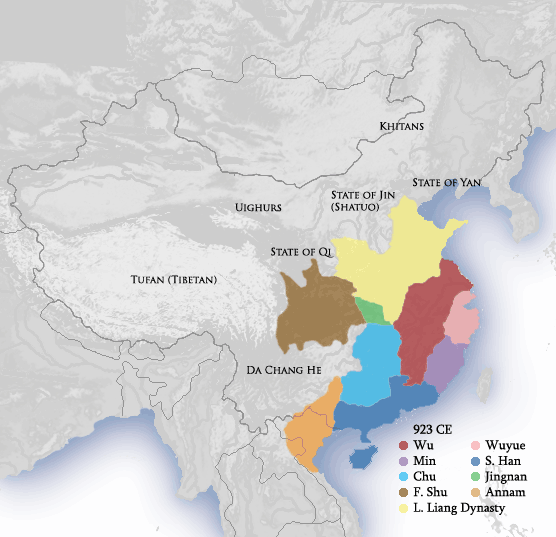
The Later Liang (yellow) and contemporary kingdoms
Traditional Chinese五代十國
Simplified Chinese五代十国
Transcriptions
Standard Mandarin
Hanyu PinyinWǔ dài shí guó
Wade–GilesWu3 tai4 shih2 kuo2
IPA[ù.tâɪ.ʂɻ.kwǒ]
Yue: Cantonese
Yale RomanizationNg5 doi6 sap6 gwok3
IPA[ŋ tɔj˨ sɐp̚˨ kʷɔk̚˧]

The Five Dynasties and Ten Kingdoms period (Chinese: 五代十國) was an era of political upheaval and division in Imperial China from 907 to 979. Five dynastic states quickly succeeded one another in the Central Plain, and more than a dozen concurrent dynastic states, collectively known as the Ten Kingdoms, were established elsewhere, mainly in South China. It was a prolonged period of multiple political divisions in Chinese imperial history.[1]

Traditionally, the era is seen as beginning with the fall of the Tang dynasty in 907 and reaching its climax with the founding of the Song dynasty in 960. In the following 19 years, Song gradually subdued the remaining states in South China, but the Liao dynasty still remained in China's north (eventually succeeded by the Jin dynasty), and the Western Xia was eventually established in China's northwest.

Many states had been de facto independent long before 907 as the late Tang dynasty's control over its numerous fanzhen officials waned, but the key event was their recognition as sovereign by foreign powers. After the Tang collapsed, several warlords of the Central Plain crowned themselves emperor. During the 70-year period, there was near-constant warfare between the emerging kingdoms and the alliances they formed. All had the ultimate goal of controlling the Central Plain and establishing themselves as the Tang's successor.

The last of the Five Dynasties and Ten Kingdoms regimes was Northern Han, which held out until Song conquered it in 979. For the next several centuries, although the Song controlled much of South China, they coexisted alongside the Liao dynasty, Jin dynasty, and various other regimes in China's north, until finally all of them were conquered by the Yuan dynasty.

Background

[edit]
Palace Banquet by Anonymous, Five Dynasties and Ten Kingdoms period

Towards the end of the Tang dynasty, the imperial government granted increased powers to the jiedushi (Chinese: 節度使), the regional military governors. The An Lushan (755–763) and Huang Chao rebellions weakened the imperial government, and by the early 10th century the jiedushi commanded de facto independence from its authority. In the last decades of the Tang dynasty, they were not even appointed by the central court anymore, but developed hereditary systems, from father to son or from patron to protégé. They had their own armies rivaling the "palace armies" and amassed huge wealth, as testified by their sumptuous tombs.[2] Due to the decline of Tang central authority after the An Lushan Rebellion, there was a growing tendency to superimpose large regional administrations over the old districts and prefectures that had been used since the Qin dynasty (221–206 BC). These administrations, known as circuit commissions, would become the boundaries of the later Southern regimes; many circuit commissioners became the emperors or kings of these states.[3]

The historian Hugh Clark proposed a three-stage model of broad political trends during this time period. The first stage (880–910) consists of the period between the Huang Chao Rebellion and the formal end of the Tang dynasty, which saw chaotic fighting between warlords who controlled approximately one or two prefectures each. The second stage (910–950) saw the various warlords stabilize and gain enough legitimacy to proclaim new dynasties. The third stage (950–979) saw the forceful reunification of China by the Later Zhou dynasty and its successor the Song dynasty, and the demilitarisation of the provinces. Southern China, divided into several independent dynastic kingdoms, was more stable than the North which saw constant regime change. Consequently, the Southern kingdoms were able to embark on trade, land reclamation, and infrastructure projects, laying the groundwork for the Song Dynasty economic boom. This economic shift to the south also led to a vast southward migration.[4]

North

[edit]

According to Nicholas Tackett, the three provinces of Hebei (Chengde, Youzhou, Weibo) were able to maintain much greater autonomy from the central government in the aftermath of the An Lushan rebellion. With their administration under local military control, these provinces never submitted tax revenues, and governorships lapsed into hereditary succession. They engaged in occasional war with the central government, or against each other, and Youzhou seemed to conduct its own foreign policy. This meant that the culture of these northeastern provinces started diverging from the capital. Many of the elites in post-Tang China, including the future emperors of the Song dynasty, came from this region.[5]

The administrations of the Five Dynasties and the early Song Dynasty shared a pattern of being disproportionately drawn from the families of military governors in northern and northwestern China (Hebei, Shanxi, Shaanxi), their personal staff, and the bureaucrats who served in the capitals of the Five dynasties. These families had risen to prominence due to the unraveling of central authority after the An Lushan Rebellion, despite lacking esteemed ancestry.[6] The historian Deng Xiaonan argued that many of these military families, including the Song imperial family, were of mixed Han Chinese-Turkic-Kumo Xi ancestry.[7]

The term "Five Dynasties" was coined by Song dynasty historians and reflects the view that the successive regimes based in Kaifeng, controlled the Central Plain and possessed the Mandate of Heaven. The first of the Five Dynasties was founded by Zhu Wen, the rebel defector turned warlord who ultimately ended the Tang dynasty. The rest of the Five Dynasties as well as the Song dynasty all emerged from a military organization originally led by Shatuo Turks whose commanders replaced each other in frequent coup d'état. The Later Tang was founded by Li Cunxu, the son of Shatuo leader Li Keyong, who was the main military rival to Zhu Wen in the late Tang. The Later Jin founder Shi Jingtang was the son of a Shatuo commander in Li Keyong's army and became the son-in-law of the Later Tang general and emperor Li Siyuan, who was himself an adopted son of Li Keyong. The Later Han founder Liu Zhiyuan was a Shatuo officer under Li Siyuan and Shi Jintang. The father of the Later Zhou founder Guo Wei fought in Li Keyong's army and Guo served under Liu Zhiyuan. The father of Song founder Zhao Kuangyin served in the armies of Later Tang, Later Han, and Later Zhou. Zhao, also a professional soldier, rose through the ranks of the Later Zhou before seizing the throne in the Chenqiao Mutiny in 960, which ended the era of the Five Dynasties.

The Qing historian Wang Fuzhi (1619–1692) wrote that this period could be compared to the earlier Warring States period of ancient China, remarking that none of the rulers could be described as "Son of Heaven". The Five Dynasties' rulers, despite claiming the status of emperor, sometimes dealt with each other on terms of diplomatic equality out of pragmatic concern. This concept of "sharing the Mandate of Heaven" as "sibling states" was the result of the brief balance of power. After the reunification of China by the Song dynasty, the Song embarked on a special effort to denounce such arrangements.[8][9]

South

[edit]

The Southern regimes generally had more stable and effective government during this period.[10] Even the rulers of the Southern states were almost all military leaders from the North with their key officers and elite forces also hailing from the North since the bulk of the Tang army was based in the North.[11] The founders of Wu and Former Shu were 'rogues' from Huainan and Xuchang respectively, the founder of Min was a minor government staffer from Huainan, the founder of Wuyue was a 'rogue' from Hangzhou, the founder of Chu was (according to one source) a carpenter from Xuchang, the founder of Jingnan was a slave from Shanzhou and the founder of Southern Han was a southern tribal chief.[12] The Southern kingdoms were founded by men of low social status who rose up through superior military ability, who were later scorned as "bandits" by future scholars. However, once established, these rulers took great pains to portray themselves as promoters of culture and economic development so as to legitimize their rule; many wooed former Tang courtiers to help administer their states.[13]

The economies of each of the southern regions had prospered in the late Tang. Guangdong and Fujian were the sites of important port cities trading exotic goods, the middle Yangtze and Sichuan were centers of tea and porcelain production, and the Yangtze delta was a center of extremely high agricultural production and an entrepot for the other regions. The regions were economically interdependent. Sui and Tang's policies, while paying little attention to developing the South, gave the South room to innovate free of tight administrative controls. The dominant northern officials had been unwilling to serve in the South during the Tang, and so southerners were recruited by the Tang to serve in a local capacity under the "Southern Selection" supplemental system. These southern officials became the administrative core of the Ten Kingdoms and later dominated the bureaucracy by the mid-Song.[14]

Significant jiedushi

[edit]
Map of warlords ("jiedushi") in 902, before the end of Tang dynasty

North China

South China

Five Dynasties

[edit]

Later Liang (907–923)

[edit]
Later Liang in 907 AD

During the Tang dynasty, the warlord Zhu Wen was originally a member of Huang Chao's rebel army, he took on a crucial role in suppressing the Huang Chao Rebellion. For this function, he was awarded the Xuanwu Jiedushi title. Within a few years, he had consolidated his power by destroying neighbours and forcing the move of the imperial capital to Luoyang, which was within his region of influence. In 904, he executed Emperor Zhaozong of Tang and made Zhaozong's 13-year-old son Emperor Ai of Tang a subordinate ruler. Three years later, he induced the boy emperor to abdicate in his favour. He then proclaimed himself emperor, thus beginning the Later Liang.

Later Tang (923–936)

[edit]
Later Tang in 926 AD

In the final years of the Tang dynasty, rival warlords declared independence in the provinces they governed—not all of which recognized the emperor's authority. Li Keyong was the jiedushi for the Hedong circuit in present Shanxi, forming a polity called Jin (晉). His son Li Cunxu and Liu Shouguang fiercely fought the regime forces to conquer northern China; Li Cunxu succeeded. He defeated Liu Shouguang (who had proclaimed a Yan Empire in 911) in 915, and declared himself emperor in 923; within a few months, he brought down the Later Liang regime. Thus began the Shatuo Later Tang—the first in a long line of conquest dynasties. After reuniting much of northern China, in 924 Cunxu received the submission of Shaanxi's Qi kingdom, and in 925 Cunxu conquered the Former Shu, a regime that had been set up in Sichuan.

Later Jin (937–947)

[edit]
Later Jin in 939 AD

The Later Tang had a few years of relative calm, followed by unrest. In 934, Sichuan again asserted independence. In 936, Shi Jingtang rebelled against Li Congke, the fourth emperor of the Later Tang. Shi Jingtang, a Shatuo jiedushi from Taiyuan, was aided by the Khitan-led Liao dynasty in his rebellion. In return for their aid, Shi Jingtang promised annual tribute and the Sixteen Prefectures (modern northern Hebei and Beijing) to the Khitans. The rebellion succeeded, and Shi Jingtang became emperor in this same year.

Not long after the founding of Later Jin, the Liao came to regard the emperor as a proxy ruler for China. In 943, the Khitans declared war and within three years seized the capital, Kaifeng, marking the end of Later Jin. But while they had conquered vast regions of China, the Khitans were unable or unwilling to control those regions and retreated from them early in the next year.

Later Han (947–951)

[edit]
Later Han in 949 AD

To fill the power vacuum, the jiedushi Liu Zhiyuan entered the imperial capital in 947 and proclaimed the advent of the Later Han, establishing a third successive Shatuo reign. This was the shortest of the five dynasties. Following a coup in 951, General Guo Wei, a Han Chinese, was enthroned, thus beginning the Later Zhou. However, Liu Chong, a member of the Later Han imperial family, established a rival Northern Han regime in Taiyuan and requested Khitan aid to defeat the Later Zhou.

Later Zhou (951–960)

[edit]
Later Zhou in 951 AD

After the death of Guo Wei in 954, his adopted son Chai Rong succeeded the throne and began a policy of expansion and reunification. One month after Chai Rong took the throne, Liu Chong, Emperor of Northern Han, allied with Liao dynasty to launch an assault on Later Zhou. Against the advice of Minister Feng Dao, Chai Rong decided to lead his army against the incursion. When Chai Rong engaged Liu Chong at Gao Ping (in modern Jincheng), two of Chai's generals, Fan Aineng and He Hui, fled from the battlefield along with their troops. At this critical moment, Chai Rong risked his life to break through the defense and crushed Liu's forces. After this campaign, Chai Rong consolidated his power.[15] Between 956 and 958, forces of Later Zhou conquered much of Southern Tang, the most powerful regime in southern China, which ceded all the territory north of the Yangtze in defeat. In 959, Chai Rong attacked the Liao in an attempt to recover territories ceded during the Later Jin. After many victories, he succumbed to illness.

In 960, the general Zhao Kuangyin staged a coup and took the throne for himself, founding the Northern Song dynasty. This is the official end of the Five Dynasties and Ten Kingdoms period. During the next two decades, Zhao Kuangyin and his successor Zhao Kuangyi defeated the other remaining regimes in South China, conquering Northern Han in 979, starting the Song dynasty era in 982.

Ten Kingdoms

[edit]
Riverbank by Dong Yuan (932–962)
Summer Palace of Emperor Ming (明皇避暑宮) by Guo Zhongshu (929–977)

Unlike the dynasties of northern China, which succeeded one another in rapid succession, the regimes of South China were generally concurrent, each controlling a specific geographical area. These were known as "The Ten Kingdoms" (in fact, some claimed the title of Emperor, such as Former Shu and Later Shu). Each court was a center of artistic excellence. The period is noted for the vitality of its poetry and for its economic prosperity. Commerce grew so quickly that there was a shortage of metallic currency. This was partly addressed by the creation of bank drafts, or "flying money" (feiqian), as well as by certificates of deposit. Wood block printing became common during this period, 500 years before Johannes Gutenberg's press.

The Ten Kingdoms were:

Only ten are traditionally listed, hence the era's name. Some historians, such as Bo Yang, count eleven, including Yan and Qi but not the Northern Han, viewing it as simply a continuation of Later Han. This era also coincided with the founding of the Liao dynasty in the north, and the Dali Kingdom in the southwest.

Other regimes during this period include Zhao, Yiwu Circuit, Dingnan Circuit, Wuping Circuit, Qingyuan Circuit, Yin, Ganzhou Uyghur Kingdom, Guiyi Circuit and Xiliangfu.

Yang Wu

[edit]

The Yang Wu (902–937) was established in modern-day Jiangsu, Anhui, and Jiangxi. It was founded by Yang Xingmi, who became a Tang dynasty military governor in 892. The capital was initially at Guangling (present-day Yangzhou) and later moved to Jinling (present-day Nanjing). The kingdom fell in 937 when it was taken from within by the founder of the Southern Tang.

Wuyue

[edit]

The Wuyue was the longest-lived (907–978) and among the most powerful of the southern states. Wuyue was known for its learning and culture. It was founded by Qian Liu, who set up his capital at Xifu (modern-day Hangzhou). It was based mostly in modern Zhejiang province but also held parts of southern Jiangsu. Qian Liu was named the Prince of Yue by the Tang emperor in 902; the Prince of Wu was added in 904. After the fall of the Tang dynasty in 907, he declared himself king of Wuyue. Wuyue survived until the eighteenth year of the Song dynasty, when Qian Shu surrendered to the expanding dynasty.

Min

[edit]

The Min (909–945) was founded by Wang Shenzhi, who named himself the Prince of Min with its capital at Changle (present-day Fuzhou). One of Shenzhi's sons proclaimed the independent state of Yin in the northeast of Min territory. The Southern Tang took that territory after the Min asked for help. Despite declaring loyalty to the neighboring Wuyue, the Southern Tang finished its conquest of Min in 945.

Southern Han

[edit]

The Southern Han (917–971) was founded in Guangzhou by Liu Yan. His brother, Liu Yin, was named regional governor by the Tang court. The kingdom included Guangdong, Guangxi, and Hainan. It was finally conquered by the Song dynasty.

Ma Chu

[edit]

The Ma Chu (927–951) was founded by Ma Yin with the capital at Changsha. The kingdom held Hunan and northeastern Guangxi. Ma was named regional military governor by the Tang court in 896, and named himself the Prince of Chu with the fall of the Tang in 907. This status as the Prince of Chu was confirmed by the Southern Tang in 927. The Southern Tang absorbed the state in 951 and moved the royal family to its capital in Nanjing, although Southern Tang rule of the region was temporary, as the next year former Chu military officers under the leadership of Liu Yan seized the territory. In the waning years of the Five Dynasties and Ten Kingdoms period, the region was ruled by Zhou Xingfeng. In 963, the region was annexed by Song dynasty.

Northern Han

[edit]

Though considered one of the ten kingdoms, the Northern Han was based in the traditional Shatuo stronghold of Shanxi. It was founded by Liu Min (劉旻), formerly known as Liu Chong (劉崇), after the Later Han fell to the Han Chinese-led Later Zhou in 951. With the protection of the powerful Liao dynasty, the Northern Han maintained nominal independence until the Song dynasty wrested it from the Khitans in 979.

Jingnan (also known as Nanping)

[edit]

The smallest of the southern states, Jingnan (924–963), was founded by Gao Jichang, a former general of Liang. It was based in Jiangling and held two other districts southwest of present-day Wuhan in Hubei. Gao was in the service of the Later Liang (the successor of the Tang in North China). Gao's successors claimed the title of King of Nanping after the fall of the Later Liang in 924. It was a small and weak kingdom, and thus tried to maintain good relations with each of the Five Dynasties. The kingdom fell to advancing armies of the Song in 963.

Former Shu

[edit]
The Yueyang Tower by Li Sheng (fl. 908–925)

Former Shu (907–925) was founded after the fall of the Tang dynasty by Wang Jian, who held his court in Chengdu. The kingdom held most of present-day Sichuan, western Hubei, and parts of southern Gansu and Shaanxi. Wang was named military governor of western Sichuan by the Tang court in 891. The kingdom fell when his son surrendered in the face of an advance by the Later Tang in 925.

Later Shu

[edit]

The Later Shu (935–965) is essentially a resurrection of the previous Shu state that had fallen a decade earlier to the Later Tang. Because the Later Tang was in decline and Li Cunxu was killed in a revolt, Meng Zhixiang found the opportunity to reassert Shu's independence. Like the Former Shu, the capital was at Chengdu and it basically controlled the same territory as its predecessor. The kingdom was ruled well until forced to succumb to Song armies in 965.

Southern Tang

[edit]
A painting depicting weiqi players by Zhou Wenju (fl. 942–961)

The Southern Tang (937–975) was the successor state of Wu as Li Bian (Emperor Liezu) took the state over from within in 937. Expanding from the original domains of Wu, it eventually took over Yin, Min, and Chu, holding present-day southern Anhui, southern Jiangsu, much of Jiangxi, Hunan, and eastern Hubei at its height. The kingdom became nominally subordinate to the expanding Song in 961 and was invaded outright in 975, when it was formally absorbed into the Song dynasty.

Transitions between the Ten Kingdoms

[edit]
Song dynasty's conquest of China (960–979)

Although more stable than northern China as a whole, southern China was also torn apart by warfare. Wu quarreled with its neighbours, a trend that continued as Wu was replaced with Southern Tang. In the 940s Min and Chu underwent internal crises which Southern Tang handily took advantage of, destroying Min in 945 and Chu in 951. Remnants of Min and Chu, however, survived in the form of Qingyuan Jiedushi and Wuping Jiedushi [zh] for many years after. With this, Southern Tang became the undisputedly most powerful regime in southern China. However, it was unable to defeat incursions by the Later Zhou between 956 and 958, and ceded all of its land north of the Yangtze River.

The Song dynasty, established in 960, was determined to reunify China. Jingnan and Wuping Jiedushi were swept away in 963, Later Shu in 965, Southern Han in 971, and Southern Tang in 975. Finally, Wuyue and Qingyuan Jiedushi gave up their land to Northern Song in 978, bringing all of southern China under the control of the central government.

In common with other periods of fragmentation, the Five Dynasties and Ten Kingdoms period resulted in a division between northern and southern China. The greater stability of the Ten Kingdoms, especially the longevity of Wuyue and Southern Han, would contribute to the development of distinct regional identities within China. The distinction was reinforced by the Old History and the New History. Written from the northern viewpoint, these chronicles organized the history around the Five Dynasties (the north), presenting the Ten Kingdoms (the south) as illegitimate, self-absorbed and indulgent.[2]

Culture

[edit]

The Five Dynasties and Ten Kingdoms period turned away from the international cultural mood of the Tang dynasty and appears as a transition towards the solidified national culture of the Song dynasty.[16] Throughout the period, there was marked cultural and economic growth, rather than decline.[1]

Several Northern dynasties originated in the northeast, and centralisation of the north led to a migration of provincial elites into the capital, particularly northeasterners, creating a new metropolitan culture.[4] After the unification of China by the Song dynasty, the culture, arts and literature of the Southern states were incorporated into the new regime. The Song dynasty adopted a distinctively Southern Chinese cultural outlook. The preserved cultural traditions of Southern Tang, Wu Yue and Later Shu were used to rebuild the cultural landscape of the north. Southern libraries were transported north, Southeastern architecture was promoted in the new capital, and Southeastern Buddhist icons, clergy and relics were concentrated in the new capital so as to reintegrate these traditions into the imperial culture. This was distinct from the five Northern dynasties, who never supported extended monastic lineage networks but instead typically sought to restrict them and draw on their economic and military resources.[17]

Although short, the period saw cultural innovations in different areas. Pottery saw the appearance of "white ceramics"/ In painting, the "varied landscape" of China was inspired by Taoism. It emphasized the sacredness of mountains as places between heaven and earth and depicted the natural world as a source of harmony.[18]

Early Snow on the River (五代南唐 趙幹 江行初雪圖); shan shui painting by Zhao Gan.

Law

[edit]

In later tradition, the Five Dynasties is viewed as a period of judicial abuse and excessive punishment. This view reflects both actual problems with the administration of justice and the bias of Confucian historians, who disapproved of the decentralization and militarization that characterized this period. While Tang procedure called for delaying executions until appeals were exhausted, this was not generally the case in the Five Dynasties.[19]

Other abuses included the use of severe torture. The Later Han was the most notorious dynasty in this regard. Suspects could be tortured to death with long knives and nails. The military officer in charge of security of the capital is said to have executed suspects without inquiry.[19]

The Tang code of 737 was the basic statutory law for this period, together supplemental edicts and collections.[19] The Later Liang promulgated a code in 909.[19] This code was blamed for delays in the administration of justice and said to be excessively harsh with respect to economic crimes. The Later Tang, Later Jin, and Later Zhou also produced recompilations. The Later Han was in power too briefly to make a mark on the legal system.[19]

See also

[edit]

References

[edit]

Further reading

[edit]
[edit]
Revisions and contributorsEdit on WikipediaRead on Wikipedia
from Grokipedia
The Five Dynasties and Ten Kingdoms (907–960) was an era of intense political fragmentation and military upheaval in , succeeding the Tang dynasty's collapse and preceding the dynasty's unification efforts. This period featured five ephemeral dynasties—Later Liang, , Later Jin, Later Han, and —that sequentially dominated the northern heartland, often through coups and invasions involving Jurchen and Turkic generals, while ten rival kingdoms, including Wu, , , and , maintained relative stability and prosperity in the River valley and beyond. Characterized by chronic warfare, shifting alliances, and economic strain from constant levies and displacements, the era nonetheless preserved Tang cultural legacies and fostered innovations in , techniques, and Buddhist , particularly in the southern polities less ravaged by northern conflicts. The 's reforms under Shizong, including monetary stabilization and military modernization, laid groundwork for Zhao Kuangyin's 960 coup that initiated rule, effectively ending the dynastic successions in the north while southern kingdoms succumbed to conquest by 979.

Historical Background

Decline and Fall of the Tang Dynasty

The (755–763 CE), initiated by the Sogdian-Turkic general as military commissioner of Fanyang, Pinglu, and Hedong (河東) circuits, marked the onset of Tang decline by shattering central authority and economic foundations. An Lushan's forces captured the secondary capital in 756 CE and the primary capital later that year, forcing Emperor Xuanzong to flee to ; the rebellion was quelled only in 763 CE through alliances with Uyghur cavalry, but at the cost of provincial autonomy for (military governors) who suppressed the insurgents. Population registered in tax censuses plummeted from approximately 53 million households in 754 CE to 17 million by 764 CE, reflecting massive casualties, migrations, and agricultural devastation that eroded the equal-field system's productivity and imperial revenue. Eunuch influence exacerbated institutional decay, evolving from advisory roles under Xuanzong—exemplified by Gao Lishi's sway—to outright control over imperial guards and successions post-rebellion. Figures like Li Fuguo manipulated enthronements, such as that of Emperor Daizong in 762 CE, while eunuchs supervised armies and treasuries, fostering factional strife between them and scholar-officials that paralyzed decision-making. Fiscal strains intensified in the 9th century as withheld taxes for local armies, prompting the two-tax system's introduction in 780 CE under Chancellor Yang Yan during Emperor Dezong's reign (779–805 CE) to base levies on actual land and household wealth rather than nominal quotas, yet by tax farmers and officials undermined collections, burdening peasants and sparking desertions. Emperor Xianzong (唐憲宗, r. 805–820 CE) mounted aggressive reforms to reclaim authority, dispatching armies to subdue defiant , imposing tax quotas, and relying on ministers like Pei Du and Li Jifu to dismantle oversized commands, achieving temporary reconquests in regions like and Pinglu circuits. Military desertions, driven by unpaid wages and abusive officers, fueled mutinies such as the 868 CE Pang Xun uprising originating from troops, highlighting systemic failures in soldier loyalty to the throne over local commanders. However, Xianzong's assassination in 820 CE—allegedly by eunuch Chen Hongzhi or implicated courtiers—halted momentum, as subsequent rulers lacked resolve to sustain suppression. The Confucian bureaucracy's emphasis on civil meritocracy via examinations, while efficient for administration, proved inadequate against militarized jiedushi whose hereditary commands bypassed central oversight, as post-rebellion necessities prioritized regional forces loyal to generals rather than the . This structural mismatch—rooted in over-reliance on a scholar-official class untrained in coercion—allowed warlords to entrench autonomy, retaining revenues and troops, while eunuch-civilian rivalries further fragmented policy enforcement, culminating in unchecked provincial power by the early . Empirical patterns of recurring rebellions and fiscal shortfalls underscored how initial over-centralization pre-755 CE, followed by devolved military necessities, eroded the dynasty's causal cohesion without viable mechanisms for reintegration.

Rise of Jiedushi and Regional Autonomy

The (節度使), or military governors, were initially appointed in 711 CE as frontier commanders to manage defense circuits against threats from Tibetans, Türks, and Khitans, with Heba Yansi serving as the first jiedushi of the Hexi circuit. By the Tianbao era (742–756 CE), their authority expanded to encompass military, civilian administration, judicial functions, and financial control within their circuits, a development exacerbated by the (755–763 CE), which demonstrated their capacity to challenge central authority when governors like mobilized independent forces. This shift arose from the Tang court's reliance on regional forces for rapid response to border incursions and internal unrest, delegating revenue collection and troop maintenance to sustain defenses amid strained imperial finances. Fiscal and military decentralization further entrenched autonomy, as governors retained the majority of local tax revenues to fund personal armies, often withholding imperial shares and thereby eroding central fiscal capacity. Specific instances included ignoring edicts by refusing tribute payments, renaming administrative circuits—such as Zelu to Zhaoyi jun—and even minting their own coins to finance operations independent of Chang'an's oversight. These powers incentivized personal loyalty from soldiers and officials to the governor, who controlled promotions and pay, rather than to the distant emperor, fostering a system where regional commanders could amass private forces exceeding 100,000 troops in some cases by the late 9th century. By the 880s CE, following the Rebellion (875–884 CE), over 20 circuits operated with de facto independence, exemplified by , who as Xuanwu consolidated control through alliances and conquests, ultimately deposing the Tang in 907 CE. This autonomy directly precipitated the political fragmentation of the Five Dynasties and Ten Kingdoms era, as weakened imperial enforcement allowed governors to prioritize local power consolidation over national unity, transforming temporary delegations into hereditary domains.

The Five Dynasties

Later Liang (後梁) (907–923)

The Later Liang dynasty was founded on September 19, 907, when (also known as Zhu Quanzhong (朱全忠)), a military governor who had previously served in the rebellion before surrendering to Tang forces, compelled to abdicate and proclaimed himself Emperor Taizu. Zhu's power base centered in the eastern prefecture of Bianzhou (modern ), which he leveraged for its strategic location and water transportation advantages along the , facilitating military logistics and economic control. Initially establishing the capital at , Zhu's regime faced persistent challenges from rival warlords like of Jin, limiting expansion beyond central and northern . Zhu Taizu's rule was characterized by ruthless consolidation tactics, including the systematic elimination of potential rivals within the Tang imperial clan and his own family, which sowed seeds of internal discord. Historical accounts attribute to him and his antecedents, such as Huang Chao's forces, the destruction of Buddhist temples to seize assets for funding prolonged warfare, exacerbating social instability. These purges, driven by and resource needs, undermined loyalty among his subordinates and heirs, contributing to the dynasty's fragility. In July 912, Zhu Taizu was assassinated by his son Zhu Yougui during a drunken banquet at Luoyang, who briefly ascended as emperor but was overthrown and killed in March 913 by his half-brother Zhu Youzhen, who took the throne as Emperor Mo and relocated the capital to Kaifeng for enhanced defensibility amid ongoing threats. Under Emperor Mo, Later Liang mounted campaigns, including efforts against the rival Yan state following internal upheavals there, though these yielded limited territorial gains against entrenched foes. The dynasty collapsed in 923 when Li Cunxu of Later Tang captured Kaifeng, ending its 16-year tenure marked by betrayal and ineffective governance.

Later Tang (後唐) (923–936)

The Later Tang dynasty was established on December 19, 923, when , a Turkic leader and son of the former Jin king , captured the Later Liang capital of , forcing Emperor Mo to commit suicide and ending the Liang regime. proclaimed himself Emperor Zhuangzong, claiming to restore the Tang dynasty rather than founding a new one, thereby invoking imperial legitimacy despite the non-Han origins of his cavalry-based forces. He relocated the capital from to in late 923 to emphasize this Tang continuity, though practical administration remained centered in due to Chang'an's dilapidation from prior wars. Li Cunxu's conquests expanded Later Tang control over northern China, incorporating former Liang territories and subduing rival warlords by 924, but his rule was destabilized by favoritism toward entertainers and actors, leading to administrative neglect and resentment among military elites. In 926, a by palace guards amid a theater-induced fire in resulted in his death, highlighting the tensions between his martial prowess and governance failures. Power transitioned to , an adoptive brother and fellow general who ascended as Mingzong, stabilizing the dynasty through merit-based appointments and efforts to integrate Han bureaucracy with Shatuo military traditions. Mingzong's reign (926–933) achieved temporary prosperity via tax reforms and suppression of influence, yet persistent fiscal pressures arose from sustaining large Shatuo-dominated armies and rewarding loyalists, exacerbating corruption and uneven revenue collection across reconquered provinces. His death triggered succession crises: (933–934) faced coups from maternal relatives, while Li Congke (934–936) contended with factional strife and autonomy. The dynasty's collapse accelerated in 936 when Hedong Shi Jingtang, frustrated by demotions and resource shortages, allied with the Khitan , ceding the Sixteen Prefectures in for support. Shi Jingtang's forces, bolstered by 100,000 Liao cavalry, besieged and forced Li Congke's suicide by immolation in 937, marking the end of rule and underscoring the causal role of ethnic military reliance, internal betrayals, and in its rapid downfall after initial conquests. This overdependence on non-Han troops, inherited from foundations, undermined central authority as regional commanders leveraged foreign alliances against the court.

Later Jin (後晉) (937–947)

The Later Jin dynasty (937–947) was founded by Shi Jingtang (石敬瑭) (r. 936–942), a Shatuo Turkic general who rebelled against the Later Tang in 936 and secured military support from the Khitan-led Liao dynasty under Emperor Taizu (Yelü Deguang). In exchange for Liao assistance in overthrowing Later Tang emperor Li Congke, Shi pledged to cede the Sixteen Prefectures—a strategic region encompassing modern-day Beijing, Tianjin, and parts of Hebei and Shanxi—to Liao control, recognize the Liao emperor as his "father emperor," and provide annual tribute payments in silk and silver. This alliance enabled Shi's forces, bolstered by Liao cavalry, to capture Luoyang in late 936 and Kaifeng shortly after, leading to his proclamation as emperor on November 28, 936, with the dynasty's establishment retroactively dated to 937. The cession of the Sixteen Prefectures was formalized in 938, stripping Later Jin of vital northern buffer territories in that had historically served as defenses against steppe incursions. Despite this territorial loss, Shi's regime maintained administrative continuity with prior dynasties, retaining Tang-era bureaucratic structures and fiscal systems centered in , though reliant on Shatuo military elites for stability. Annual tribute obligations to Liao, documented in contemporary records as ongoing transfers of silk bolts and silver taels, imposed a persistent economic burden that prioritized over internal consolidation, effectively rendering Later Jin a and eroding sovereign autonomy. These payments, while enabling short-term rule, diverted resources from military reforms, leaving the dynasty vulnerable to the very power it depended upon, as evidenced by Liao's unchallenged influence over northern borders. Shi Jingtang died on July 28, 942, precipitating a resolved by the enthronement of his adoptive son and nephew, Shi Chonggui (r. 943–947). Shi Chonggui's attempts to assert independence, including reduced deference to Liao, provoked invasion in 946–947; Liao forces under Emperor Taizong overran , capturing Shi and extinguishing the dynasty in 947. The Liao exposed causal weaknesses in Later Jin's structure: the initial cession forfeited defensible heartlands, while demands fostered dependency without reciprocal loyalty, as Liao's opportunistic demonstrated, prioritizing empirical patterns of nomadic exploitation over idealized alliances.

Later Han (後漢) (947–951)

The Later Han dynasty was founded on March 10, 947, by Liu Zhiyuan, a Shatuo Turkic military governor of Bingzhou (modern Taiyuan, Shanxi), who exploited the collapse of the Later Jin amid a devastating Liao invasion. Earlier that year, Later Jin general Du Chongwei betrayed Emperor Shi Chonggui (r. 944–947) by surrendering to Liao forces during their campaign, facilitating the fall of the Jin capital at Bianzhou (modern Kaifeng). With the death of Liao Emperor Taizong in early 947 prompting a Khitan retreat, Liu Zhiyuan advanced southward from his Jinyang base, accepted submissions from opportunistic warlords like Du Chongwei, and proclaimed himself emperor, establishing the capital at Bianzhou. Of Shatuo origin, Liu's regime continued the pattern of Five Dynasties reliance on Turkic cavalry elites for control over northern China, prioritizing military consolidation over bureaucratic reforms. Liu Zhiyuan, posthumously titled Emperor Gaozu, reigned for less than a year, focusing on repelling residual Liao threats and stabilizing core territories in and . His sudden death from illness on March 10, 948, elevated his seven-year-old son, Liu Chengyou (posthumously Emperor Yin), to the throne under regency by high officials and eunuchs. The child emperor's rule exacerbated factional strife at court, with power struggles among generals and officials undermining governance. Without substantive administrative innovations to address entrenched autonomy or fiscal weaknesses inherited from prior dynasties, the Later Han maintained a narrow focus on military loyalty, leaving it vulnerable to internal dissent. By 951, escalating suspicions at court—prompted by rumors of Guo Wei's disloyalty—threatened the chief general's position, leading him to with troops from Chanzhou. Guo Wei, a officer who had risen through Later Han ranks, marched on Bianzhou, forcing Yin's suicide and ending the dynasty after four years. This coup highlighted the dynasty's core failure: overdependence on transient military alliances without institutional reforms to mitigate risks amid ongoing regional and economic strains from prior conflicts. Remnants of Later Han support in the north persisted briefly as the under Liu Chong, but the central regime dissolved into control.

Later Zhou (後周) (951–960)

The Later Zhou dynasty was founded in 951 by Guo Wei (posthumously Emperor Taizu), a military commissioner who capitalized on the collapse of the Later Han following the assassination of its child emperor Liu Chengyou amid palace unrest. Guo Wei, having risen through military service under previous regimes, proclaimed himself emperor on the first day of the new year, establishing as the capital and adopting policies aimed at stabilizing the fragmented northern territories previously controlled by warlords. His brief reign until his death in 954 focused on initial administrative consolidation, including efforts to alleviate peasant burdens through land redistribution of abandoned estates and badlands to private cultivators, which laid groundwork for economic recovery in the war-torn north. Upon succeeding as Emperor Shizong (Chai Rong, r. 954–959), Guo Wei's adopted heir intensified military efforts to reclaim lost territories. Chai Rong launched campaigns against the , recapturing fringe areas of the Yan-Yun in 959, including key prefectures north of present-day , though full recovery eluded him due to Liao's Khitan cavalry strength. He also subdued incursions and annexed western territories from , demonstrating tactical prowess in sieges and logistics that enhanced Later Zhou's prestige as a unification precursor. These victories stemmed from disciplined infantry reforms and personal leadership, temporarily weakening Liao's hold on ceded Tang-era borderlands. Infrastructure repairs, such as dykes and waterways, supported these operations by bolstering agricultural output and troop mobility. Administrative innovations under both rulers emphasized centralization and fiscal efficiency, unifying disparate tax offices under a single state fiscal commissioner to streamline revenue collection and curb corruption, while updating the legal code in the Da-Zhou xingtong to refine Tang precedents for better enforcement. Tax reductions and expanded inheritable land allotments empirically increased state revenues by fostering peasant productivity, as evidenced by stabilized coinage minting and trade revival with neighbors like Liao and southern states. Chai Rong prioritized civilian oversight via strengthened grand counselors, diminishing unchecked military influence and promoting capable officials through inspections rather than alone. These measures, rooted in pragmatic , boosted northern China's economic base without relying on exploitative monopolies. Following Chai Rong's death from illness in 959, his young son Chai Zongxun (Emperor Gong) ascended amid vulnerability to coups. In early 960, amid reports of a fabricated Liao-Northern Han invasion, general Zhao Kuangyin marched from the northern front, staged the Chenqiao mutiny where troops acclaimed him emperor, and entered unopposed, deposing the child ruler without bloodshed. This transition preserved Later Zhou's reformist framework, with Zhao adopting its administrative structures to found the , marking continuity in unification ambitions rather than a sharp break.

The Ten Kingdoms

Wu and Southern Kingdoms

The Kingdom of Wu, also known as , emerged in 902 when Yang Xingmi (852–905), a military governor in the region, was granted the title Prince of Wu by the declining , marking the effective beginning of its independence amid the empire's fragmentation. Controlling territories along the including modern-day parts of , , , and provinces, with its capital at Guangling (present-day ), Wu leveraged its position in the fertile circuit south of the to establish a regime insulated from the immediate northern chaos of the Five Dynasties. Unlike the rapid turnover of northern dynasties, Wu maintained relative continuity through four rulers from the Yang family, though real power increasingly shifted to regent-generals like Xu Wen after Yang Xingmi's death. Yang Xingmi's successors included his son Yang Wo (r. 905–908), who adopted the dynastic name Wu but was assassinated; Yang Longyan (r. 908–920), a child ruler under regency; and Yang Pu (r. 920–937), the final nominal emperor whose authority was eclipsed by Xu Wen and his son Xu Zhigao. Wu's military strength derived from naval superiority on the and its tributaries, enabling effective riverine defenses against incursions from northern powers like Later Liang (907–923) and eastern rivals such as Wu-Yue (907–978), which helped secure its borders without extensive land campaigns. This aquatic focus, combined with reconstruction efforts under Yang Xingmi to restore local administration post-Tang wars, fostered economic stability through taxation on salt production, silk weaving, and riverine trade, generating revenue that sustained the regime longer than many contemporaries. In contrast to the northern emphasis on and conquest, Wu prioritized hydraulic infrastructure to mitigate Yangtze flooding, with dike repairs and canal maintenance supporting agriculture in the delta, as evidenced by enduring remnants in the region. These measures, alongside networks exploiting the Yangtze's navigability, contributed to Wu's longevity until internal factionalism allowed Xu Zhigao to depose Yang Pu in 937 and proclaim the , absorbing Wu's territories and naval assets. Early southern regimes like Wu exemplified how geographic barriers and economic self-sufficiency enabled pockets of order amid broader disunity, setting precedents for subsequent kingdoms in the region.

Min and Chu

The Min kingdom was established in 909 by Wang Shenzhi, a former Tang military governor who declared himself Prince of Min following the dynasty's collapse, controlling the mountainous region of modern province with its capital at Changle (present-day ). Wang Shenzhi ruled until 925, fostering initial stability through administrative control over local circuits, but his death triggered succession disputes among his sons, including Wang Yanhan (925–926), Wang Yanjun (926–935), and Wang Jipeng (935–938), marked by assassinations and coups within the family. Further instability ensued under Wang Yanxi (939–942) and Wang Yanzheng (943–945), as generals and relatives vied for power, exacerbating ethnic tensions between settlers and indigenous Min populations in the rugged terrain. The kingdom's economy leaned on maritime trade, which laid foundations for later Song-era seafaring expansion, though northern dynasties remained more isolated from such southern coastal activities. Min's internal divisions weakened its defenses, enabling the to conquer it in autumn 945 after exploiting fraternal conflicts and local disloyalty. The kingdom, or Ma Chu, emerged in 926 under Ma Yin, a figure appointed regional governor in 896 who consolidated power in modern province and northeastern , with its capital at Tanzhou (present-day ). Ma Yin governed until 929, promoting prosperity through low initial taxes and barter systems, exporting while importing and horses to support a stable agrarian base. Succession after his death devolved into familial strife, with sons Ma Xisheng (930–931) and Ma Xifan (932–946) facing challenges from brothers, followed by Ma Xiguang (947–949), Ma Xi'e (950–951), and others amid rising taxes, extravagant court expenditures, and administrative decay. These divisions, compounded by reliance on nominal allegiance to northern powers for protection against rivals like Wu, eroded Chu's cohesion without evident formal alliances to nomadic groups. Chu succumbed to Southern Tang conquest in 951, as internal fragmentation invited external intervention and prevented unified resistance.

Wuyue and Jingnan

The Kingdom of Wuyue (吳越)[/page/Wuyue] was established in 907 by Qian Liu (852–932), a former Tang military governor who controlled the fertile region of modern province, with its capital at . Under Qian Liu and his successors, adapted to the era's fragmentation by prioritizing internal stability and , including the construction of extensive seawalls and dikes to reclaim land from the sea and mitigate flooding, which bolstered agricultural output in coastal areas. The kingdom became renowned for its silk production, alongside paper and porcelain, leveraging its coastal position for maritime trade that extended to and Korea, contributing to regional prosperity amid northern instability. Wuyue rulers demonstrated cultural patronage through substantial investments in , commissioning numerous temples and pagodas as markers of legitimacy and social order, evidenced by surviving inscriptions documenting royal endowments and reconstruction efforts. This resilience allowed to maintain autonomy longer than many contemporaries, ultimately submitting peacefully to the in 978 under Qian Chu, avoiding conquest through timely diplomatic surrender. In contrast, Jingnan (荊南, also known as Nanping) emerged in 924 as a diminutive buffer state founded by Gao Jixing (858–929), who had served as a Later Liang military governor in Jingzhou (modern Jiangling, Hubei), controlling a narrow territory along the Yangtze River confined by larger neighbors. Lacking military might, Jingnan survived nearly four decades by adept diplomacy, paying tribute and feigning subservience to successive northern dynasties—including Later Liang, Later Tang, Later Jin, Later Han, and Later Zhou—while avoiding direct confrontation and exploiting their rivalries. This strategy of nominal allegiance to multiple overlords preserved its independence until Song forces annexed it in 963, marking the end of its precarious existence without significant cultural or economic legacies beyond administrative continuity.

Shu States and Northern Han

The Shu states emerged in the isolated , leveraging its mountainous barriers and fertile lands for relative autonomy amid the central plain's turmoil. was established in 907 by Wang Jian, a former Tang who proclaimed himself after the dynasty's collapse, ruling from until his death in 918. His successor, Wang Yan, oversaw a period of cultural and , but empirical accounts link the regime's fall in 925 to internal decay, including eunuch-led court intrigue and excessive indulgence in luxuries that eroded readiness, enabling conquest by forces under . Later Shu arose in 934 under Meng Zhixiang, a Tang-appointed who declared independence after Former Shu's annexation, maintaining control over the same western territories until its absorption by the in 965. served as the capital, benefiting from the basin's agricultural surplus, including production and bronze coinage that supported trade and taxation, fostering prosperity insulated by geography from northern invasions. Meng's son, Meng Chang, ruled until the end, with the state's longevity attributable to defensive terrain rather than expansive ambitions, though similar patterns of court excess contributed to vulnerabilities exploited by armies. Northern Han, persisting from 951 to 979, represented a Turkic remnant in the northern periphery, founded by Liu Chong—who claimed the Later Han imperial mantle— with its capital at in modern . Its survival hinged on strategic alliances with the , providing mutual defense against Song incursions, as evidenced by joint military support that delayed conquest until Song forces overwhelmed in 979 following Liu Chong's death. This peripheral position, buffered by steppe nomads, allowed semi-independence despite lacking the Shu states' economic base, underscoring how geographic and diplomatic factors sustained these outliers amid unification pressures.

Southern Tang and Transitions

The (南唐) emerged in 937 when Li Bian, a military leader who had risen under the preceding Wu kingdom, compelled Emperor Yang Pu to abdicate and declared himself emperor, renaming the state with its capital at Jiangning (modern ). This transition marked the state's adoption of imperial trappings and ambitions beyond its Wu origins, focusing on consolidation in the region. Under Li Bian (r. 937–943) and his son Li Jing (r. 943–961), pursued expansion, launching campaigns that absorbed neighboring kingdoms and illustrated southern consolidation dynamics. In 945–947, forces conquered the Kingdom of Min, securing and eliminating a rival along the eastern coast, though the effort strained resources. By 951, the conquest of extended control westward, after which the splinter state of Jingnan in the former territories accepted vassal status, paying tribute and recognizing overlordship, thereby integrating borderlands without full annexation. The accession of Li Yu (r. 961–975) shifted emphasis toward cultural patronage amid defensive postures, fostering a renaissance in poetry, painting, and music that contrasted with military exertions. Li Yu, a prolific ci poet whose works lamented transience and personal fate, employed verse in diplomatic overtures, including submissions to northern courts that blended literary finesse with political deference. At its zenith circa 951, Southern Tang territory spanned modern fully and portions of , , , , and , supported by economic vitality from commerce. Southern Tang's river navy, dominating the with advanced vessels and tactics, formed a causal bulwark against northern unification drives, repelling incursions through fluvial control and prolonging independence despite overextension from absorptions. This naval edge delayed advances until 975, when coordinated assaults breached defenses, forcing Li Yu's capitulation and integrating the kingdom into domains, ending its role in southern fragmentation.

Military Dynamics

Warfare Patterns and Strategies

Warfare in the Five Dynasties and Ten Kingdoms period emphasized opportunistic short campaigns over elaborate grand strategies, with outcomes frequently determined by the defection or co-option of rather than sustained military confrontations. , as semi-autonomous regional governors inheriting Tang-era military commands, wielded control over local forces and revenues, making their allegiance a decisive factor in conflicts; shifts in loyalty enabled rapid territorial gains without exhaustive battles, as governors prioritized personal gain amid the era's instability. This pattern contributed to the quick turnover of northern dynasties, where betrayals by subordinates or allies accelerated regime collapses, reflecting causal dynamics rooted in decentralized power rather than unified command structures. Siege operations predominated as a core tactic, given the fortified nature of key cities that anchored political authority and supply lines, compelling attackers to invest time in encircling defenses to induce capitulation through starvation or internal revolt. Notable examples include assaults on central strongholds like , where prolonged efforts—often spanning months—highlighted the logistical challenges and preference for attrition over risky open-field engagements. Such minimized direct combat losses but imposed heavy strains on besiegers and defenders alike, underscoring a pragmatic approach shaped by limited resources and the high cost of assembling large armies. Casualty figures recorded in dynastic histories, such as Ouyang Xiu's New History of the Five Dynasties (Xin Wudai Shi), detail battle and siege losses typically numbering in the thousands per engagement, aggregating to significant population drains through direct violence, , and displacement over the half-century span. These impacts strained northern regions but fell short of , as evidenced by sustained administrative continuity and demographic resilience in the southern Ten Kingdoms, where conflicts were more contained. Historical annals further document truces and ad hoc alliances that punctuated hostilities, enabling intermittent trade along waterways like the , which refuted portrayals of perpetual by demonstrating pragmatic pauses for economic recovery.

Armies, Innovations, and Jiedushi Influence

The , or military governors, exerted dominant control over the armies during the Five Dynasties and Ten Kingdoms period, inheriting a system from late Tang where they commanded permanent standing forces across numerous provincial circuits, often exceeding 40 such commands by the . These forces comprised professional long-service soldiers known as guanjian, numbering nearly 1 million troops empire-wide, with jiedushi retaining the largest share of revenues to sustain their garrisons independently of the capital. Hereditary recruitment practices in some regions bound soldiers to specific units and commanders, fostering units that functioned as private armies loyal primarily to the jiedushi rather than the state. Northern armies particularly relied on elite Shatuo Turkic cavalry for mobility and , with these nomadic horsemen playing pivotal roles in suppressing rebellions and securing dynastic transitions, such as the establishment of the in 923. Infantry formations supplemented this cavalry core, drawing from landless recruits who served lifelong terms, often exhibiting mercenary-like dependence on reliable pay from their governors. manipulated payrolls by controlling local fiscal apparatuses, withholding funds from the central government to ensure troop fidelity, which directly facilitated coups like Zhu Wen's usurpation of the Tang throne in 907. Military innovations remained limited, with no major technological breakthroughs; armaments continued Tang precedents, including crossbows whose mechanisms showed incremental refinements in durability and precision based on period artifacts, though these did not alter battlefield dynamics significantly. The shift to professionalized forces under , while enabling rapid maneuvers, engendered systemic vulnerabilities: soldiers' allegiance prioritized commanders' largesse over imperial orders, precipitating frequent mutinies—99 documented in late Tang alone, typically over pay reductions—and enabling warlords to topple regimes at will, thus perpetuating the era's instability.

Economic and Social Conditions

Agriculture, Trade, and Prosperity

The southern regions south of the River maintained robust agricultural output during the Five Dynasties and Ten Kingdoms period (907–960), with cultivation serving as the economic foundation and generating surpluses that supported dense populations amid political division. Local rulers in kingdoms like Wu and implemented measures to enhance farming, including improvements and , which sustained productivity inherited from the Tang era despite northern disruptions. In the under the (907–925) and (934–965), fertile alluvial soils enabled high yields of , , and cash crops like , with state-led tea monopolies extracting significant revenue through taxes on production and sales, evidencing export-oriented to northern markets. Tax records from the Shu regimes document annual tea levies exceeding thousands of jin (approximately 500–600 grams each), reflecting organized agricultural specialization and interstate commerce via overland routes. Trade flourished along the Yangtze River, functioning as a vital artery connecting southern kingdoms such as Wu (902–937), Jingnan (924–963), and (937–975), where hubs facilitated the exchange of , , , and salt, countering narratives of widespread with evidence of commercial continuity. Urban centers like , capital of the Shu states, preserved pre-Tang prosperity through markets specializing in textiles, , and teas, while (Jinling) under southern rulers hosted active ports and artisan guilds. Political fragmentation into competing polities enabled localized fiscal policies, including reduced tax burdens relative to late Tang overextension, which attracted merchants and farmers, thereby promoting efficiency and growth in productive regions over centralized decay. Regimes minted copper coins, with observed debasements in content during fiscal strains indicating sustained monetary circulation driven by demand rather than mere inflation from collapse.

Social Structures and Population Impacts

The period's incessant warfare and political fragmentation prompted massive southward migrations, fundamentally altering demographic distributions across China. By the Five Dynasties era (907–960), the population ratio between southern and northern regions had shifted to 3:1, reflecting accelerated refugee flows from northern instability toward the more stable Ten Kingdoms. This movement, building on late Tang disruptions like the Huang Chao Rebellion, concentrated people in southern riverine and coastal areas, where agricultural innovations and relative peace enabled substantial growth; southeastern populations expanded by approximately 695% from 742 to 1200, while the middle Yangtze region grew by 483%. Northern areas, conversely, experienced stagnation or decline, with overall Chinese population estimates dropping from Tang peaks near 50 million to around 30–40 million amid displacement and losses. Elite structures underwent profound turnover, as Tang-era aristocratic clans waned in favor of provincial families and civil bureaucrats who prioritized talent over . Examination of over 1,000 tomb epitaphs and biographies indicates that 43% of elites after 880 exhibited first- or second-generation migration, often in response to conflict (33% of cases) or career pursuits (28%), fostering a merit-based that integrated northern immigrants into southern polities. In the Ten Kingdoms, this fluidity elevated non-aristocratic groups, including officers who comprised up to 45% of elites by 890–1000, alongside civil officials; traditional Confucian scholar dominance eroded as local power bases formed through intermarriage and state incentives like capital allotments. Northern famines underscored governance failures rather than irreversible systemic collapse, with the 942–944 drought and locust plague in the Yellow River basin—under Later Jin rule—starving roughly one-tenth of the regional populace through inadequate relief and hoarding by warlords. Southern kingdoms, buoyed by migrant labor and trade, avoided comparable scale catastrophes, maintaining population registers that evidenced household expansions in areas like Nan Tang and Nan Han prefectures. Merchant lineages in these realms further diversified class dynamics, leveraging wealth from routes like Sichuan's assay systems to secure influence, though they remained distinct from scholar-officials in a society where officeholding conferred primary status.

Cultural and Intellectual Life

Literature, Arts, and Scholarship

The of the Five Dynasties and Ten Kingdoms period largely preserved Tang poetic forms while advancing the ci lyric, particularly in southern kingdoms like Shu and . In 940, scholars at the Shu court compiled the Huajian ji, an of approximately 500 ci poems by 18 late Tang and contemporary authors, emphasizing themes of romance and nature that reflected courtly refinement amid political fragmentation. This collection marked an early systematization of ci as a distinct genre, bridging Tang experimentation with maturity. Li Yu, the last ruler of (r. 961–975), exemplified the period's poetic pinnacle through his ci, which poignantly captured personal loss and imperial decline following his kingdom's conquest. Works such as "Po Zhen Zi" evoked the irrevocable shift from to , employing vivid of fallen and endless sorrow to convey existential impermanence. His verses, blending emotional depth with technical innovation in stanza structure, influenced subsequent ci masters despite his political failures. In the arts, southern regimes provided crucial patronage, sustaining Tang stylistic legacies with modest innovations, especially in . The court supported artists like Dong Yuan (c. 934–c. 962) and Juran, who pioneered techniques emphasizing atmospheric moisture and textured brushwork, departing from northern monumentality toward subtler, ink-dominant expressions suited to Jiangnan's misty terrains. rulers, through consistent sponsorship, preserved traditions, commissioning works that continued Tang realism in court and Buddhist contexts without major rupture. Scholarship advanced through the dissemination of , inherited from late Tang, which facilitated reproduction of historical and literary texts in stable southern centers. Fragments from caches confirm the technique's use for non-religious materials by the mid-10th century, aiding preservation amid northern turmoil. Traditional Song-era , prioritizing the legitimacy of northern dynasties, often marginalized these southern outputs, yet from surviving artifacts underscores their role in cultural continuity.

Religion and Philosophical Shifts

![Painting by Chinese artist Li Cheng][float-right] During the Five Dynasties and Ten Kingdoms period (907–960), Buddhism faced varying fortunes across regions, with northern regimes exerting fiscal pressures through temple confiscations while southern kingdoms sustained monastic traditions, particularly Chan lineages. In the north, the Later Zhou dynasty under Emperor Shizong (r. 954–959) promulgated an edict in 955 mandating the melting of bronze Buddha statues to produce currency and armaments, alongside the abolition of non-imperially sanctioned monasteries, which eliminated over 3,000 temples and redistributed their assets to fund military campaigns against the Liao. This measure targeted the economic power of Buddhist institutions, which held vast landholdings and served as lenders and agricultural innovators, thereby extracting resources to address state insolvency amid warfare. In contrast, southern polities like , Min, and provided patronage to Chan sects, elevating regional monks from peripheral status to influential figures through land grants and temple constructions that preserved doctrinal lineages disrupted by northern turmoil. Monasteries in these areas amassed wealth equivalent to regional economies, owning estates that employed thousands and mitigated social instability by offering famine relief and communal in fragmented power structures, as evidenced by records on steles indicating sustained lay support despite political flux. Far from , religious institutions filled vacuums, with Buddhist networks causally stabilizing populations through economic self-sufficiency and ritual continuity, countering narratives of decline by demonstrating adaptive resilience. Philosophical undercurrents hinted at Confucian revitalization, particularly in under the Shu states, where critiques of Buddhist otherworldliness presaged Song-era Neo-Confucian syntheses blending metaphysical inquiry with ethical praxis, though full articulation awaited post-unification stability. Popular practices emphasized practical devotion over doctrinal orthodoxy, with Chan emphasizing direct insight amid chaos, reflecting a causal shift toward internalized spirituality resilient to state interference.

Administration and Law

Governance Models

The governance models of the Five Dynasties and Ten Kingdoms period (907–960 CE) emphasized pragmatic adaptations of institutions amid fragmentation, prioritizing regional stability through decentralized authority rather than centralized ideological uniformity. Regional rulers, often former (military governors), formalized their appointments to legitimize control over territories, blending military command with administrative oversight inherited from Tang practices. This approach allowed for localized fiscal and bureaucratic management, where success hinged on equilibrating martial and civilian elements to sustain revenue and order without over-centralization. In the Shu kingdoms (, 907–925 CE; , 934–965 CE), rulers like Wang Jian integrated civil officials into governance to counterbalance the influence of generals and adopted kin, retaining Tang-style bureaucratic recruitment to administer Sichuan's fertile lands effectively. Similarly, the (937–975 CE) under Li Bian and successors advanced civil transformation by conducting examinations to select literati, fostering a merit-based cadre that supported administrative continuity despite military origins. These southern models demonstrated how exam retention enabled pragmatic civilian input, stabilizing rule in prosperous peripheries disconnected from northern turmoil. Northern dynasties, particularly (951–960 CE), pursued fiscal innovations such as systematic land surveys under Chancellor Wang Pu, which recalibrated tax assessments based on arable acreage and yields, empirically boosting state revenues by addressing post-Tang underreporting and enabling military campaigns. This causal mechanism—tying revenue to verifiable land data—contrasted with earlier laxity, underscoring how empirical measurement supported governance viability. Regimes faltered where civil-military balance eroded, as in eunuch-dominated courts reminiscent of late Tang excesses, which prioritized palace intrigue over territorial administration, leading to rapid turnover. The legal frameworks of the Five Dynasties and Ten Kingdoms period primarily inherited the Tang Code of 737 CE as the core statutory basis, supplemented by regime-specific edicts and regional collections to address immediate governance needs amid fragmentation. This continuity reflected the absence of comprehensive overhauls, as military rulers prioritized stability over systemic innovation, resulting in patchwork enforcement where central edicts clashed with local decrees. For instance, the Later issued a penal code in 909 CE, intended to standardize punishments but often adapted to suppress dissent or consolidate power, leading to documented inconsistencies in application across territories. Bureaucratic structures mirrored Tang models in form—central ministries handling fiscal, judicial, and personnel affairs—but devolved into inefficiency due to militarized appointments and pervasive . Historical records note bribes routinely funneled through clerical intermediaries for official posts, exacerbating delays in legal proceedings and undermining impartiality, as loyalties superseded meritocratic ideals. Enforcement varied sharply; northern dynasties like enforced Tang-derived statutes more rigorously in core areas to legitimize rule, while southern kingdoms appended localized rules favoring economic elites, such as protective edicts for merchants in Wu-Yue to sustain revenues. Efforts to reform bureaucracy surfaced sporadically, notably under Later Zhou's Emperor Shizong (Chai Rong, r. 954–959), who initiated purges targeting corrupt officials and streamlined administrative processes to reduce , purging dozens of mid-level functionaries documented in dynastic annals for extorting taxes. These measures, while yielding short-term fiscal gains, faltered against entrenched influence, illustrating how imperatives—such as rapid military mobilization—consistently trumped sustained legal uniformity, fostering a landscape of over codified ideals.

Foreign Relations

Interactions with Liao and Khitans

The establishment of the Later Jin dynasty in 936 by Shi Jingtang, a Turkic general, relied on military support from the Liao dynasty's Deguang (r. 926–947), who provided 70,000 cavalry to defeat Later forces. In return, Shi acknowledged Liao suzerainty, ceding the Sixteen Prefectures—key northern territories including Yan (modern ) and Yun (modern )—formalized by treaty in 938, which positioned Liao forces along the Great Wall's southern flank. This arrangement included annual payments of 30,000 bolts of from Later Jin to Liao, serving as a calculated exchange to stabilize the frontier amid Jin's fragile internal consolidation. Subsequent Five Dynasties regimes, including Later Han (947–951) and (951–960), inherited this vassal-like relationship, facing recurrent Liao raids that exploited Han disunity for territorial gains and tribute extraction. Liao's Khitan cavalry enabled swift incursions into the northern plains, compelling defensive postures rather than offensive reclamation until Later Zhou's emperor Chai Rong (r. 954–959) shifted strategy. In 959, Chai initiated counter-campaigns targeting Liao-held positions, recapturing portions of the Guannan region and disrupting Khitan supply lines through targeted strikes documented in contemporary annals. These operations demonstrated tactical reversals possible under unified command, though Chai's death from illness that year halted further advances. Such interactions underscored pragmatic power equilibria: Liao's nomadic mobility pressured fragmented Han states into and concessions not due to cultural or inferiority, but because internal wars prevented coordinated defenses, allowing Khitan forces to dictate border terms until unification. Raids and functioned as de facto tolls on routes and agricultural yields, with Liao leveraging the ceded prefectures' fortifications to sustain dominance over the Youyan circuit.

Other Nomadic and Peripheral Contacts

The Later Shu kingdom (934–965) pursued alliances with Tibetan polities in the western highlands, dispatching envoys in the 940s to procure superior warhorses vital for its military apparatus through and arrangements rather than coercive campaigns. These exchanges, documented in contemporary annals, supplied Shu with cavalry resources amid regional instability, underscoring a pragmatic focus on over territorial expansion. In contrast, the regime (951–979), hemmed in by more powerful neighbors, subordinated itself to the immediately after its founding, tendering annual tribute—including silk, silver, and grain—in return for Khitan military succor against incursions from the south. This dependency, necessitated by Northern Han's limited manpower and territory, diverged sharply from the southern kingdoms' capacity for autonomous engagements with peripheral entities, enabling the latter to negotiate terms without ceding . Peripheral trade extended to the nascent (est. 937), heir to Nanzhao's domain in , where southern states like (917–971) facilitated overland commerce in salt, silver, and herbal goods, bypassing direct conquest amid Dali's internal consolidation. Similarly, border frictions with Dai Viet (independent from 939) prompted 's abortive 930 offensive into Annam, repulsed by Vietnamese defenders, after which interactions devolved into sporadic and commodity flows emphasizing mutual economic utility over domination. Uighur polities in the distant northwest, fragmented post-khaganate, maintained nominal links with northern dynasties like (923–936), trading horses and furs for Chinese manufactures, though these waned amid central disarray.

Legacy and Historiographical Debates

Transition to Song Unification

In early 960, amid reports of a Liao-Northern Han invasion, Later Zhou general Zhao Kuangyin marched from with elite troops toward the northern frontier. At Chenqiao Station on February 2, his soldiers mutinied, acclaiming him emperor and draping him in the imperial yellow robe, a bloodless coup that capitalized on the fragility of the child ruler Chai Zongxun's regime. Zhao returned to the capital, where the young emperor abdicated without resistance, allowing Zhao to found the while retaining institutions and personnel to ensure continuity. This transition built directly on Later Zhou precedents, including military campaigns under Emperor Shizong (Chai Rong, r. 954–959) that had already subdued key southern territories like those of Jingnan and Southern Tang's western holdings, weakening the Ten Kingdoms' defenses. Zhao Kuangyin, as Emperor Taizu (r. 960–976), prioritized centralizing military command to neutralize warlord threats, a vulnerability exposed in prior dynasties' rapid turnovers. He implemented reforms inherited and expanded from , such as reallocating troops from regional commands to capital-based units under direct imperial oversight, and famously persuaded powerful generals to retire through the "cup of wine" persuasion in 962, granting them estates and honors in exchange for disbanding private armies. These measures reduced autonomous military fiefs from over 200 under the Tang to fewer, loyal forces, enabling systematic campaigns without internal rebellions. Taizu's unification strategy emphasized negotiated surrenders over prolonged sieges, preserving administrative elites to facilitate integration. Later Shu fell in 965 after its ruler Meng Chang surrendered , retaining local officials in Song service. Southern Han capitulated in 971, followed by in 975, where Li Yu yielded after naval defeats, accepting demotion to marquess while Song incorporated Tang bureaucracy and scholars without mass purges. Such terms, verified in Song annals, minimized resistance by honoring elite status, culminating in Wu-Yue's voluntary submission in 978. By 979, these absorptions ended the Ten Kingdoms, restoring nominal unity under Song rule.

Assessments of Chaos versus Continuity

Traditional historiography, exemplified by Ouyang Xiu's New History of the Five Dynasties (completed circa 1053), depicted the period as an era dominated by militarism and moral decay, with frequent usurpations and short-lived regimes underscoring a breakdown in civilized order. This perspective, shaped by scholars seeking to legitimize their unification as a restoration of Tang-era , prioritized political instability as the defining feature, often framing the era as an of and ethical failure. Modern scholarship challenges this "dark age" narrative, arguing for substantial continuity in socioeconomic structures amid political fragmentation. Historians such as Peter Lorge highlight that economic indicators, including agricultural output and commercial activity, exhibited resilience rather than collapse, with no evidence of systemic decline in across fragmented regimes. Tax records from southern kingdoms demonstrate sustained or increasing revenues, reflecting population stability and in regions like the Yangzi Delta, where rice cultivation intensified to support growing urban centers. Causal analysis reveals that fragmentation fostered administrative experimentation, such as decentralized fiscal management and merit-based recruitment, which later informed centralization efforts without requiring wholesale reinvention. However, northern warfare inflicted verifiable demographic costs, including depopulation from conflicts that displaced millions southward between 907 and 960, contrasting with southern prosperity evidenced by expanded trade networks and estimated populations nearing 32 million overall. These disparities underscore that while military disruptions eroded northern capacities, they did not halt broader adaptive continuities, privileging empirical metrics over ideologically inflected chaos portrayals.

References

Add your contribution
Related Hubs
User Avatar
No comments yet.