


Community hub
Recent from talks
Contribute something
Nothing was collected or created yet.
Traffic congestion
View on Wikipedia

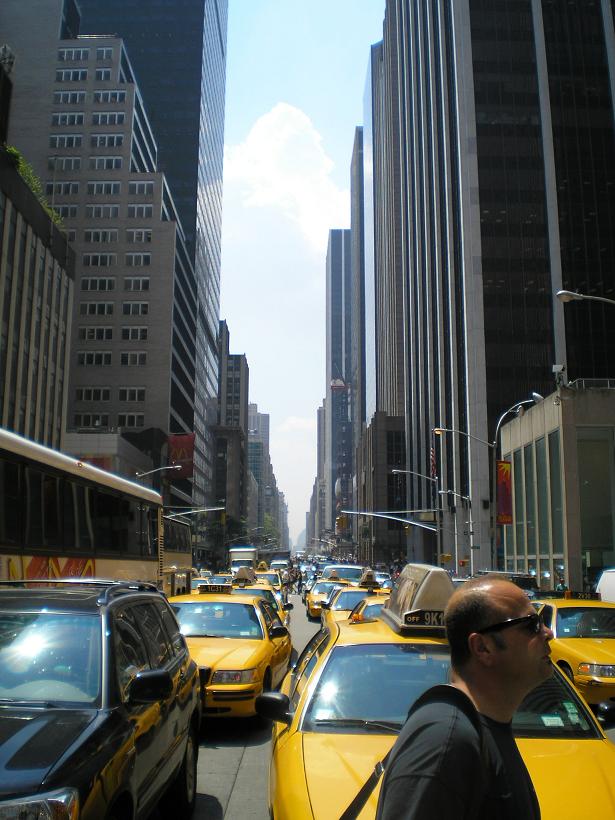
Traffic congestion is a condition in transport that is characterized by slower speeds, longer trip times, and increased vehicular queuing. Traffic congestion on urban road networks has increased substantially since the 1950s, resulting in many of the roads becoming obsolete.[2] When traffic demand is great enough that the interaction between vehicles slows the traffic stream, this results in congestion. While congestion is a possibility for any mode of transportation, this article will focus on automobile congestion on public roads. Mathematically, traffic is modeled as a flow through a fixed point on the route, analogously to fluid dynamics.
As demand approaches the capacity of a road (or of the intersections along the road), extreme traffic congestion sets in. When vehicles are fully stopped for periods of time, this is known as a traffic jam,[3][4] a traffic snarl-up (informally)[5][6] or a tailback.[7] Drivers can become frustrated and engage in road rage. Drivers and driver-focused road planning departments commonly propose to alleviate congestion by adding another lane to the road; however, this is ineffective as increasing road capacity induces more demand for driving.[8]
Causes
[edit]- Bottlenecks (40.0%)
- Traffic incidents (25.0%)
- Work zones (10.0%)
- Bad weather (15.0%)
- Poor signal timing (5.00%)
- Special events / other (5.00%)


Traffic congestion occurs when a volume of traffic generates demand for space greater than the available street capacity; this point is commonly termed saturation. Several specific circumstances can cause or aggravate congestion; most of them reduce the capacity of a road at a given point or over a certain length, or increase the number of vehicles required for a given volume of people or goods. About half of U.S. traffic congestion is recurring, and is attributed to sheer volume of traffic; most of the rest is attributed to traffic incidents, road work and weather events.[11][12] In terms of traffic operation, rainfall reduces traffic capacity and operating speeds, thereby resulting in greater congestion and road network productivity loss.
Individual incidents such as crashes or even a single car braking heavily in a previously smooth flow may cause ripple effects, a cascading failure also known as traffic waves, which then spread out and create a sustained traffic jam when, otherwise, the normal flow might have continued for some time longer.[13]
Separation of work and residential areas
[edit]People often work and live in different parts of the city. Many workplaces are located in a central business district away from residential areas, resulting in workers commuting. According to a 2011 report published by the United States Census Bureau, a total of 132.3 million people in the United States commuted between their work and residential areas daily.[14]
Movement to obtain or provide goods and services
[edit]
People may need to move about within the city to obtain goods and services, for instance to purchase goods or attend classes in a different part of the city. Brussels, a Belgian city with a strong service economy, has one of the worst traffic congestion in the world, wasting 74 hours in traffic in 2014.
Economic theories
[edit]
Congested roads can be seen as an example of the tragedy of the commons. Because roads in most places are free at the point of usage, there is little financial incentive for drivers not to over-use them, up to the point where traffic collapses into a jam, when demand becomes limited by opportunity cost. Privatization of highways and road pricing have both been proposed as measures that may reduce congestion through economic incentives and disincentives [citation needed]. Congestion can also happen due to non-recurring highway incidents, such as a crash or roadworks, which may reduce the road's capacity below normal levels.

Economist Anthony Downs argues that rush hour traffic congestion is inevitable because of the benefits of having a relatively standard work day [citation needed]. In a capitalist economy, goods can be allocated either by pricing (ability to pay) or by queueing (first-come first-served); congestion is an example of the latter. Instead of the traditional solution of making the "pipe" large enough to accommodate the total demand for peak-hour vehicle travel (a supply-side solution), either by widening roadways or increasing "flow pressure" via automated highway systems, Downs advocates greater use of road pricing to reduce congestion (a demand-side solution, effectively rationing demand), in turn putting the revenues generated therefrom into public transportation projects.
A 2011 study in The American Economic Review indicates that there may be a "fundamental law of road congestion." The researchers, from the University of Toronto and the London School of Economics, analyzed data from the U.S. Highway Performance and Monitoring System for 1983, 1993 and 2003, as well as information on population, employment, geography, transit, and political factors. They determined that the number of vehicle-kilometers traveled (VKT) increases in direct proportion to the available lane-kilometers of roadways. The implication is that building new roads and widening existing ones only results in additional traffic that continues to rise until peak congestion returns to the previous level.[15][16]
Classification and modeling
[edit]Qualitative classification of traffic is often done in the form of a six-letter A–F level of service (LOS) scale defined in the Highway Capacity Manual, a US document used (or used as a basis for national guidelines) worldwide. While this system generally uses delay as the basis for its measurements, the particular measurements and statistical methods vary depending on the facility being described. For instance, while the percent time spent following a slower-moving vehicle figures into the LOS for a rural two-lane road, the LOS at an urban intersection incorporates such measurements as the number of drivers forced to wait through more than one signal cycle.[17]
Another classification schema of traffic congestion is associated with some common spatiotemporal features of traffic congestion found in measured traffic data. Common spatiotemporal empirical features of traffic congestion are those features, which are qualitatively the same for different highways in different countries measured during years of traffic observations. Common features of traffic congestion are independent[clarification needed] on weather, road conditions and road infrastructure, vehicular technology, driver characteristics, day time, etc. Examples of common features of traffic congestion are the features [J] and [S] for, respectively, the wide moving jam and synchronized flow traffic phases found in Boris Kerner's three-phase traffic theory. The common features of traffic congestion can be reconstructed in space and time with the use of the ASDA and FOTO models.


Some traffic engineers have attempted to apply the rules of fluid dynamics to traffic flow, likening it to the flow of a fluid in a pipe. Congestion simulations and real-time observations have shown that in heavy but free flowing traffic, jams can arise spontaneously, triggered by minor events ("butterfly effects"), such as an abrupt steering maneuver by a single motorist. Traffic scientists liken such a situation to the sudden freezing of supercooled fluid.[21]
Because of the poor correlation of theoretical models to actual observed traffic flows, transportation planners and highway engineers attempt to forecast traffic flow using empirical models. Their working traffic models typically use a combination of macro-, micro- and mesoscopic features, and may add matrix entropy effects, by "platooning" groups of vehicles and by randomizing the flow patterns within individual segments of the network. These models are then typically calibrated by measuring actual traffic flows on the links in the network, and the baseline flows are adjusted accordingly.
A team of MIT mathematicians has developed a model that describes the formation of "phantom jams", in which small disturbances (a driver hitting the brake too hard, or getting too close to another car) in heavy traffic can become amplified into a full-blown, self-sustaining traffic jam. Key to the study is the realization that the mathematics of such jams, which the researchers call "jamitons", are strikingly similar to the equations that describe detonation waves produced by explosions, says Aslan Kasimov, lecturer in MIT's Department of Mathematics. That discovery enabled the team to solve traffic-jam equations that were first theorized in the 1950s.[22]
Negative impacts
[edit] | This section possibly contains original research. (January 2017) |

Traffic congestion has a number of negative effects:
- Wasting time of motorists and passengers ("opportunity cost"). As a non-productive activity for most people, congestion reduces regional economic health.
- Delays, which may result in late arrival for employment, meetings, and education, resulting in lost business, disciplinary action or other personal losses.
- Inability to forecast travel time accurately, leading to drivers allocating more time to travel "just in case", and less time on productive activities.
- Wasted fuel increasing air pollution and carbon dioxide emissions owing to increased idling, acceleration and braking.
- Wear and tear on vehicles as a result of idling in traffic and frequent acceleration and braking, leading to more frequent repairs and replacements.
- Stressed and frustrated motorists, encouraging road rage and reduced health of motorists
- Emergencies: blocked traffic may interfere with the passage of emergency vehicles traveling to their destinations where they are urgently needed.
- Spillover effect from congested main arteries to secondary roads and side streets as alternative routes are attempted ('rat running'), which may affect neighborhood amenity and real estate prices.
- Higher chance of collisions due to tight spacing and constant stopping-and-going.
Road rage
[edit]Road rage is aggressive or angry behavior by a driver of an automobile or other motor vehicle. Such behavior might include rude gestures, verbal insults, deliberately driving in an unsafe or threatening manner, or making threats. Road rage can lead to altercations, assaults, and collisions which result in injuries and even deaths. It can be thought of as an extreme case of aggressive driving.

The term originated in the United States in 1987–1988 (specifically, from Newscasters at KTLA, a local television station), when a rash of freeway shootings occurred on the 405, 110 and 10 freeways in Los Angeles, California. These shooting sprees even spawned a response from the AAA Motor Club to its members on how to respond to drivers with road rage or aggressive maneuvers and gestures.[23]
Economic loss
[edit]
![[icon]](https://en.wikipedia.org/wiki/File:Wiki_letter_w_cropped.svg) | This section needs expansion. You can help by adding to it. (December 2019) |
| Area | Loss in billions | Note |
|---|---|---|
| US | $305 [24] | [25] |
| UK | $52.01 | [26] |
| NYC | $33.7 | |
| LA | $19.2 | [27] |
| Manila | $18.615 | [28] |
| Bangladesh | $11.4 | [29] |
| SF | $10.6 | |
| Atlanta | $7.1 | |
| Jakarta | $5 | [30] |
| Dhaka | $4.463 | [31] |
| GTHA | $3.3 | [32] |
Positive effects
[edit]

Congestion has the benefit of encouraging motorists to retime their trips so that expensive road space is in full use for more hours per day. It may also encourage travellers to pick alternate modes with a lower environmental impact, such as public transport or bicycles.[33]
It has been argued that traffic congestion, by reducing road speeds in cities, could reduce the frequency and severity of road crashes.[34] More recent research suggests that a U-shaped curve exists between the number of accidents and the flow of traffic, implying that more accidents happen not only at high congestion levels, but also when there are very few vehicles on the road.[35]
Countermeasures
[edit]Improving road infrastructure
[edit]
_Aston_Expressway.jpg)

- Increasing road capacity is standard response to congestion, perhaps by widening an existing road or adding a new road, bridge or tunnel. However, this has been shown to result in attracting more traffic, otherwise known as induced demand. The result can be greater congestion on the expanded artery itself or on auxiliary roads.[8] In a similar vein, Braess's paradox shows that adding road capacity might make congestion worse, even if demand does not increase. In his paper, "The Law of Peak Hour Express Way Congestion", published in 1962, Anthony Downs formulated this phenomenon as a "law": "on urban commuter expressways, peak-hour traffic congestion rises to meet maximum capacity."[36]
- Junction improvements
- Grade separation, using bridges (or, less often, tunnels) freeing movements from having to stop for other crossing movements
- Ramp signaling, 'drip-feeding' merging traffic via traffic signals onto a congested motorway-type roadway
- Reducing junctions
- Local-express lanes, providing through lanes that bypass junction on-ramp and off-ramp zones
- Limited-access road, roads that limit the type and amounts of driveways along their lengths
- Reversible lanes, where certain sections of highway operate in the opposite direction on different times of the day(s) of the week, to match asymmetric demand. These pose a potential for collisions, if drivers do not notice the change in direction indicators. This may be controlled by variable-message signs or by movable physical separation
- Separate lanes for specific user groups (usually with the goal of higher people throughput with fewer vehicles)
- Bus lanes as part of a busway system
- Express toll lanes
- HOV lanes, for vehicles with at least three (sometimes at least two) riders, intended to encourage carpooling
- Slugging, impromptu carpooling at HOV access points, on a hitchhiking or payment basis
- Market-based carpooling with pre-negotiated financial incentives for the driver
Urban planning and design
[edit]City planning and urban design practices can have a huge impact on levels of future traffic congestion, though they are of limited relevance for short-term change.
- Grid plans including fused grid road network geometry, rather than tree-like network topology which branches into cul-de-sacs (which reduce local traffic, but increase total distances driven and discourage walking by reducing connectivity). This avoids concentration of traffic on a small number of arterial roads and allows more trips to be made without a car.
- Zoning laws that encourage mixed-use development, which reduces distances between residential, commercial, retail, and recreational destinations and encourage cycling and walking. Cycling modal share is strongly associated with the availability of local cycling infrastructure.[37]
- Carfree cities, car-light cities, and eco-cities designed to eliminate the need to travel by car for most inhabitants.[38][39]
- Transit-oriented development are residential and commercial areas designed to maximize access to public transport by providing a transit station or stop (train station, metro station, tram stop, or bus stop).
Supply and demand
[edit]

Congestion can be reduced by either increasing road capacity (supply), or by reducing traffic (demand). Capacity can be increased in a number of ways, but needs to take account of latent demand otherwise it may be used more strongly than anticipated. Critics of the approach of adding capacity have compared it to "fighting obesity by letting out your belt" (inducing demand that did not exist before). For example, when new lanes are created, households with a second car that used to be parked most of the time may begin to use this second car for commuting.[40][41] Reducing road capacity has in turn been attacked as removing free choice as well as increasing travel costs and times, placing an especially high burden on the low income residents who must commute to work.[citation needed]
Increased supply can include:
- Adding more capacity at bottlenecks (such as by adding more lanes at the expense of hard shoulders or safety zones, or by removing local obstacles like bridge supports and widening tunnels)
- Adding more capacity over the whole of a route (generally by adding more lanes)
- Creating new routes
- Traffic management improvements (see separate section below)
Reduction of demand can include:
- Parking restrictions, making motor vehicle use less attractive by increasing the monetary and non-monetary costs of parking, introducing greater competition for limited city or road space.[42] Most transport planning experts agree that free parking distorts the market in favor of car travel, exacerbating congestion.[43][44]
- Park and ride facilities allowing parking at a distance and allowing continuation by public transport or ride sharing. Park-and-ride car parks are commonly found at metro stations, freeway entrances in suburban areas, and at the edge of smaller cities.
- Reduction of road capacity to force traffic onto other travel modes. Methods include traffic calming and the shared space concept.
- Road pricing, charging money for access onto a road/specific area at certain times, congestion levels or for certain road users
- "Cap and trade", in which only licensed cars are allowed on the roads.[45] A limited quota of car licenses are issued each year and traded in a free market fashion. This guarantees that the number of cars does not exceed road capacity while avoiding the negative effects of shortages normally associated with quotas. However, since demand for cars tends to be inelastic, the result are exorbitant purchase prices for the licenses, pricing out the lower levels of society, as seen Singapore's Certificate of Entitlement scheme.[46]
- Congestion pricing, including:
- Congestion zone charges, in which entry via car to a certain area, such as the inner part of a city, requires payment. Enforcement may be a physical boundary (e.g., toll stations) or it may be virtual, via spot checks or cameras. Major examples include congestion pricing in New York City; Singapore's electronic road pricing; the London congestion charge; and the Stockholm congestion tax.
- Fixed (the same at all times of day), variable (higher at peak times), or dynamic (higher during actual congestion) toll roads, toll bridges, toll tunnels, and toll lanes
- Managed lanes
- High-occupancy toll lanes
- Reversible lanes
- High-occupancy vehicle lanes
- Bus lanes
- Truck lane restrictions and climbing lanes, to allow faster vehicles to move unimpeded
- Allowing driving on highway shoulders at peak times
- Road space rationing, where regulatory restrictions prevent certain types of vehicles from driving under certain circumstances or in certain areas.
- Number plate restrictions based on days of the week, as practiced in several large cities in the world, such as Athens,[47] Mexico City, Manila, and São Paulo.[48] In effect, such cities are banning a different part of the automobile fleet from roads each day of the week. Mainly introduced to combat smog, these measures also reduce congestion. A weakness of this method is that richer drivers can purchase a second or third car to circumvent the ban.[citation needed]
- Permits, where only certain types of vehicles (such as residents) are permitted to enter a certain area, and other types (such as through-traffic) are banned.[48] For example, Bertrand Delanoë, the mayor of Paris, has proposed to impose a complete ban on motor vehicles in the city's inner districts, with exemptions only for residents, businesses, and the disabled.[49]

- Policy approaches, which usually attempt to provide either strategic alternatives or which encourage greater usage of existing alternatives through promotion, subsidies or restrictions.
- Incentives to use public transport, increasing modal shares. This can be achieved through infrastructure investment, subsidies, transport integration, pricing strategies that decrease the marginal cost/fixed cost ratios,[50][51] improved timetabling and greater priority for buses to reduce journey time e.g. bus lanes or bus rapid transit .[52][53]
- Cycling promotion through legislation, cycle facilities, subsidies, and awareness campaigns.[54] The Netherlands has been pursuing cycle friendly policies for decades, and around a quarter of their commuting is done by bicycle.[55][56]
- Promotion of more flexible work place practices. For example, a flexible workplaces pilot was undertaken in Brisbane, Australia during 2009 to test the applicability of a voluntary travel behavior change program to achieve transport system outcomes, particularly as they related to managing congestion, either through mode shift or peak spreading. During the one-month Pilot, amongst almost 900 Brisbane CBD workers across 20 private and public sector organizations, shifts of more than 30% out of the morning and afternoon peak travel was recorded.[57]
- Remote work encouraged through legislation and subsidies.[58]
- Online shopping promotion,[59][60] potentially with automated delivery booths helping to solve the last mile problem and reduce shopping trips made by car.[citation needed]
Traffic management
[edit]
Use of so-called intelligent transportation systems, which guide traffic:
- Traffic reporting, via radio, GPS and mobile apps, to advise road users
- Variable message signs installed along the roadway, to advise road users[61]
- Navigation systems, possibly linked up to automatic traffic reporting
- Traffic counters permanently installed, to provide real-time traffic counts
- Automated highway systems, a future idea which could reduce the safe interval between cars (required for braking in emergencies) and increase highway capacity by as much as 100% while increasing travel speeds[citation needed]
- Parking guidance and information systems providing dynamic advice to motorists about free parking
- Active traffic management[62] system opens up UK motorway hard shoulder as an extra traffic lane; it uses CCTV and VMS to control and monitor the traffic's use of the extra lane.
Other associated
[edit]
- School opening times arranged to avoid rush hour traffic (in some countries, private car school pickup and drop-off traffic are substantial percentages of peak hour traffic).[citation needed]
- Considerate driving behavior promotion and enforcement. Driving practices such as tailgating, frequent lane changes, and impeding the flow of traffic can reduce a road's capacity and exacerbate jams. In some countries signs are placed on highways to raise awareness, while others have introduced legislation against inconsiderate driving.
- Visual barriers to prevent drivers from slowing down out of curiosity (often called "rubbernecking" in the United States). This often includes crashes, with traffic slowing down even on roadsides physically separated from the crash location. This also tends to occur at construction sites, which is why some countries have introduced rules that motorway construction has to occur behind visual barrier
- Speed limit reductions, as practiced on the M25 motorway in London. With lower speeds allowing cars to drive closer together, this increases the capacity of a road. Note that this measure is only effective if the interval between cars is reduced, not the distance itself. Low intervals are generally only safe at low speeds.
- Lane splitting/filtering, in which some jurisdictions allow motorcycles, scooters and bicycles to travel in the space between cars, buses, and trucks.[63][64]
- Reduction of road freight avoiding problems such as double parking with innovative solutions including cargo bicycles and Gothenburg's Stadsleveransens.[65]
- Reducing the quantity of cars that are on the road,[66] i.e. through proof-of-parking requirements, circulation plans, corporate car sharing, bans on on-street parking or by increasing the costs of car ownership
By country
[edit]Australia
[edit]| External videos | |
|---|---|
 Traffic Jam Problem In Australia (1965) Traffic Jam Problem In Australia (1965) |

Traffic during peak hours in major Australian cities, such as Sydney, Melbourne, Brisbane and Perth, is usually very congested and can cause considerable delay for motorists. Australians rely mainly on radio and television to obtain current traffic information. GPS, webcams, and online resources are increasingly being used to monitor and relay traffic conditions to motorists.[citation needed] Based on a survey in 2024, Brisbane is the most congested city in Australia and 10th in the world, with drivers averagely losing 84 hours throughout the year.[67]
Bangladesh
[edit]
Traffic jams have become intolerable in Dhaka. Some other major reasons are the total absence of a rapid transit system; the lack of an integrated urban planning scheme for over 30 years;[68] poorly maintained road surfaces, with potholes rapidly eroded further by frequent flooding and poor or non-existent drainage;[69] haphazard stopping and parking;[70] poor driving standards;[71] total lack of alternative routes, with several narrow and (nominally) one-way roads.[72][73]
Brazil
[edit]
According to Time magazine, São Paulo has the world's worst daily traffic jams.[10] Based on reports from the Companhia de Engenharia de Tráfego, the city's traffic management agency, the historical congestion record was set on May 23, 2014, with 344 kilometres (214 mi) of cumulative queues around the city during the evening rush hour.[74] The previous record occurred on November 14, 2013, with 309 kilometres (192 mi) of cumulative queues.[74]
Despite implementation since 1997 of road space rationing by the last digit of the plate number during rush hours every weekday, traffic in this 20-million-strong city still experiences severe congestion. According to experts, this is due to the accelerated rate of motorization occurring since 2003 and the limited capacity of public transport. In São Paulo, traffic is growing at a rate of 7.5% per year, with almost 1,000 new cars bought in the city every day.[75] The subway has only 61 kilometres (38 mi) of lines, though 35 further kilometers are under construction or planned by 2010. Every day, many citizens spend between three up to four hours behind the wheel. In order to mitigate the aggravating congestion problem, since June 30, 2008, the road space rationing program was expanded to include and restrict trucks and light commercial vehicles.[76][77]
Canada
[edit]
According to the Toronto Board of Trade, in 2010, Toronto is ranked as the most congested city of 19 surveyed cities, with an average commute time of 80 minutes.[80]
China
[edit]
The Chinese city of Beijing started a license plate rationing since the 2008 Summer Olympics whereby each car is banned from the urban core one workday per week, depending on the last digit of its license plate. As of 2016, 11 major Chinese cities have implemented similar policies.[81] Towards the end of 2010, Beijing announced a series of drastic measures to tackle the city's chronic traffic congestion, such as limiting the number of new plates issued to passenger cars to 20,000 a month, barring vehicles with non-Beijing plates from entering areas within the Fifth Ring Road during rush hours and expanding its subway system.[82] The government aims to cap the number of locally registered cars in Beijing to below 6.3 million by the end of 2020.[83] In addition, more than nine major Chinese cities including Shanghai, Guangzhou and Hangzhou started limiting the number of new plates issued to passenger cars in an attempt to curb the growth of car ownership.[84][85] In response to the increased demand to public transit caused by these policies, aggressive programs to rapidly expand public transport systems in many Chinese cities are currently underway.[86]
A unique Chinese phenomenon of severe traffic congestion occurs during Chunyun Period or Spring Festival travel season.[87] It is a long-held tradition for most Chinese people to reunite with their families during Chinese New Year. People return to their hometown to have a reunion dinner with their families on Chinese New Year. It has been described as the largest annual human migration in the world.[88][89] Since the economic boom and rapid urbanization of China since the late 1970s, many people work and study a considerable distance from their hometowns. Traffic flow is typically directional, with large amounts of the population working in more developed coastal provinces needing travel to their hometowns in the less developed interior. The process reverses near the end of Chunyun. With almost 3 billion trips[90] made in 40 days of the 2016 Chunyun Period, the Chinese intercity transportation network is extremely strained during this period.
The August 2010 China National Highway 110 traffic jam in Hebei province caught media attention for its severity, stretching more than 100 kilometres (62 mi) from August 14 to 26, including at least 11 days of total gridlock.[91][92][93] The event was caused by a combination of road works and thousands of coal trucks from Inner Mongolia's coalfields that travel daily to Beijing. The New York Times has called this event the "Great Chinese Gridlock of 2010."[93][94] The congestion is regarded as the worst in history by duration, and is one of the longest in length after the 175 kilometres (109 mi) long Lyon-Paris traffic jam in France on February 16, 1980.
Recently, in Hangzhou City Brain has become active, reducing traffic congestion somewhat.[95]
A 2021 study of subway constructions in China found that in the first year of a new subway line, road congestion declined.[96]
Greece
[edit]
Since the 70s, the traffic on the streets of Athens has increased dramatically, with the existing road network unable to serve the ever-increasing demand. In addition, it has also caused an environmental burden, such as the photochemical smog. To deal with it, the Daktylios has been enforced.
India
[edit] |
.jpg)
The number of vehicles in India is quickly increasing as a growing middle class can now afford to buy cars. India's road conditions have not kept up with the exponential growth in number of vehicles.
Various causes for this include:
- Private encroachments
- Non cooperation among drivers
- Unscientific road design
- Lack of free ways/exit ways where local roads and main roads intersect
- Lack of demarcated footpaths
- Lack of bus bays
- Lack of cycle tracks
- Lack of coordination among various government departments (e.g. digging of roads by telecom/water department and leaving it open)
Indonesia
[edit]
According to a 2015 study by motor oil company Castrol, Jakarta is found to be the worst city in the world for traffic congestion. Relying on information from TomTom navigation devices in 78 countries, the index found that drivers are stopping and starting their cars 33,240 times per year on the road. After Jakarta, the worst cities for traffic are Istanbul, Mexico City, Surabaya, and St. Petersburg.[97]
Daily congestion in Jakarta is not a recent problem. The expansion of commercial area without road expansion shows worsening daily congestion even in main roads such as Jalan Jenderal Sudirman, Jalan M.H. Thamrin, and Jalan Gajah Mada in the mid-1970s.[98]
In 2016, 22 people died as a result of traffic congestion in Java. They were among those stuck in a three-day traffic jam at a toll exit in Brebes, Central Java called Brebes Exit or 'Brexit'. The traffic block stretched for 21 km here and thousands of cars clogged the highway. Many people died because of carbon monoxide poisoning, fatigue or heat.[99]
New Zealand
[edit]
New Zealand has followed strongly car-oriented transport policies since after World War II (especially in Auckland, where one third of the country's population lives, is New Zealand's most traffic congested city, and has been labeled worse than New York for traffic congestion with commuters sitting in traffic congestion for 95 hours per year),[100] and currently has one of the highest car-ownership rates per capita in the world, after the United States.[101] Traffic congestion in New Zealand is increasing with drivers on New Zealand's motorways reported to be struggling to exceed 20 km/h on an average commute, sometimes crawling along at 8 km/h for more than half an hour.
Philippines
[edit].jpg)
(2017-08-04).jpg)
According to a survey by Waze, traffic congestion in Metro Manila is called the "worst" in the world, after Rio de Janeiro, São Paulo, and Jakarta.[102] It is worsened by violations of traffic laws, like illegal parking, loading and unloading, beating the red light, and wrong-way driving.[103] Traffic congestion in Metro Manila is caused by the large number of registered vehicles, lack of roads, and overpopulation, especially in the cities of Manila and Caloocan, as well as the municipality of Pateros.[104]
Traffic caused losses of ₱137,500,000,000 on the economy in 2011, and unbuilt roads and railway projects also causes worsening congestion.[105] The Japan International Cooperation Agency (JICA) feared that daily economic losses will reach Php 6,000,000,000 by 2030 if traffic congestion cannot be controlled.[106]
Turkey
[edit]
In recent years, the Istanbul Metropolitan Municipality has made huge investments on intelligent transportation systems and public transportation. Despite that, traffic is a significant problem in Istanbul. Istanbul has chosen the second most congested[107] and the most sudden-stopping traffic in the world.[108] Travel times in Turkey's largest city take on average 55 percent longer than they should, even in relatively less busy hours.[109]
United Kingdom
[edit]
In the United Kingdom the inevitability of congestion in some urban road networks has been officially recognized since the Department for Transport set down policies based on the report Traffic in Towns in 1963:
Even when everything that it is possibly to do by way of building new roads and expanding public transport has been done, there would still be, in the absence of deliberate limitation, more cars trying to move into, or within our cities than could possibly be accommodated.[110]

The Department for Transport sees growing congestion as one of the most serious transport problems facing the UK.[111] On December 1, 2006, Rod Eddington published a UK government-sponsored report into the future of Britain's transport infrastructure. The Eddington Transport Study set out the case for action to improve road and rail networks, as a "crucial enabler of sustained productivity and competitiveness". Eddington has estimated that congestion may cost the economy of England £22 bn a year in lost time by 2025. He warned that roads were in serious danger of becoming so congested that the economy would suffer.[112] At the launch of the report Eddington told journalists and transport industry representatives introducing road pricing to encourage drivers to drive less was an "economic no-brainer". There was, he said "no attractive alternative". It would allegedly cut congestion by half by 2025, and bring benefits to the British economy totaling £28 bn a year.[113]
A congestion charge for driving in central London was introduced in 2003. In 2013, ten years later, Transport for London reported that the scheme resulted in a 10% reduction in traffic volumes from baseline conditions, and an overall reduction of 11% in vehicle kilometers in London. Despite these gains, traffic speeds in central London became progressively slower.
United States
[edit]


The Texas Transportation Institute estimated that, in 2000, the 75 largest metropolitan areas experienced 3.6 billion vehicle-hours of delay, resulting in 5.7 billion U.S. gallons (21.6 billion liters) in wasted fuel and $67.5 billion in lost productivity, or about 0.7% of the nation's GDP. It also estimated that the annual cost of congestion for each driver was approximately $1,000 in very large cities and $200 in small cities. Traffic congestion is increasing in major cities and delays are becoming more frequent in smaller cities and rural areas.
30% of traffic is cars looking for parking.[114]
According to traffic analysis firm INRIX in 2019,[115] the top 31 worst US traffic congested cities (measured in average hours wasted per vehicle for the year) were:
| City | Hours wasted per vehicle | Cost of congestion per driver | |
|---|---|---|---|
| 1 | Boston, Massachusetts | 149 hours | $2,205 |
| 2 | Chicago, Illinois | 145 hours | $2,146 |
| 3 | Philadelphia, Pennsylvania | 142 hours | $2,102 |
| 4 | New York City, New York | 140 hours | $2,072 |
| 5 | Washington, D.C. | 124 hours | $1,835 |
| 6 | Los Angeles, California | 103 hours | $1,524 |
| 7 | San Francisco, California | 97 hours | $1,436 |
| 8 | Portland, Oregon | 89 hours | $1,317 |
| 9 | Baltimore, Maryland | 84 hours | $1,243 |
| 10 | Atlanta, Georgia | 82 hours | $1,214 |
| 11 | Houston, Texas | 81 hours | $1,199 |
| 12 | Miami, Florida | 81 hours | $1,199 |
| 13 | New Orleans, Louisiana | 79 hours | $1,169 |
| 14 | Seattle, Washington | 74 hours | $1,095 |
| 15 | Stamford, Connecticut | 74 hours | $1,095 |
| 16 | Providence, Rhode Island | 70 hours | $1,036 |
| 17 | San Diego, California | 70 hours | $1,036 |
| 18 | Austin, Texas | 69 hours | $1,021 |
| 19 | Sacramento, California | 64 hours | $947 |
| 20 | Dallas, Texas | 63 hours | $932 |
| 21 | Denver, Colorado | 63 hours | $932 |
| 22 | Hartford, Connecticut | 61 hours | $903 |
| 23 | Minneapolis, Minnesota | 52 hours | $770 |
| 24 | Charlotte, North Carolina | 49 hours | $725 |
| 25 | San Juan, Puerto Rico | 46 hours | $681 |
| 26 | Cleveland, Ohio | 44 hours | $651 |
| 27 | Columbus, Ohio | 43 hours | $636 |
| 28 | Milwaukee, Wisconsin | 41 hours | $607 |
| 29 | Detroit, Michigan | 39 hours | $577 |
| 30 | San Antonio, Texas | 39 hours | $577 |
| 31 | Boulder, Colorado | 37 hours | $548 |
The most congested highway in the United States, according to a 2010 study of freight congestion (truck speed and travel time), is Chicago's Interstate 290 at the Circle Interchange. The average truck speed was just 29 mph (47 km/h).[116]
See also
[edit]

References
[edit]- ^ "Congestion pricing in New York gets the go-ahead after all. Maybe". The Economist. November 21, 2024. Retrieved November 21, 2024.
But traffic is bad most days, with more than 900,000 cars entering Manhattan's central business district. INRIX, a traffic-data firm, found that New York City leads the world in urban traffic congestion among the cities scored, with the average driver stationary for 101 hours a year.
- ^ Caves, R. W. (2004). Encyclopedia of the City. Routledge. p. 141.
- ^ Treiber, Martin; Kesting, Arne (October 11, 2012). Traffic Flow Dynamics: Data, Models and Simulation. Springer Science & Business Media. ISBN 978-3-642-32459-8. Archived from the original on March 30, 2021. Retrieved October 29, 2020.
- ^ May, Adolf Darlington (1990). Traffic Flow Fundamentals. Prentice Hall. ISBN 978-0-13-926072-8. Archived from the original on March 30, 2021. Retrieved October 29, 2020.
- ^ Hotelier & Caterer: Official Magazine of FEDHASA. Ramsay Son & Parker. July 1993. Archived from the original on March 30, 2021. Retrieved October 29, 2020.
- ^ Eve: The Essence of Africa's New Woman. Oakland Media Services Limited. 2004. Archived from the original on March 30, 2021. Retrieved October 29, 2020.
- ^ "TAILBACK". Cambridge Dictionary.
- ^ a b Schneider, Benjamin (September 6, 2018). "CityLab University: Induced Demand". Bloomberg News. Retrieved January 18, 2022.
- ^ "An Initial Assessment of Freight Bottlenecks on Highways" (PDF). Federal Highway Administration. Cambridge Systematics, Inc. October 2005. Archived (PDF) from the original on June 1, 2023. Retrieved June 9, 2023.
- ^ a b Andrew Downie (April 21, 2008). "The World's Worst Traffic Jams". Time. Archived from the original on August 26, 2013. Retrieved June 20, 2008.
- ^ "Congestion: A National Issue". August 29, 2008. Archived from the original on July 25, 2008. Retrieved September 25, 2008.
- ^ Essien, Aniekan; Petrounias, Ilias; Sampaio, Pedro; Sampaio, Sandra (2018), The Impact of Rainfall and Temperature on Peak and Off-Peak Urban Traffic, Lecture Notes in Computer Science, vol. 11030, Springer International Publishing, pp. 399–407, doi:10.1007/978-3-319-98812-2_36, ISBN 978-3-319-98811-5, S2CID 52046271, archived from the original on January 26, 2020, retrieved December 1, 2019
- ^ "Science Hobbyist: Traffic Waves". Archived from the original on October 8, 2003. Retrieved September 29, 2003.
- ^ "Transportation Report By USCB". Archived from the original on October 20, 2017. Retrieved May 6, 2018.
- ^ "Fundamental Law of Road Congestion: Evidence from U.S. Cities". journalistsresource.org. November 17, 2014. Archived from the original on February 21, 2012. Retrieved March 6, 2012.
- ^ Duranton, Gilles; Turner, Matthew A. (2011). "The Fundamental Law of Road Congestion: Evidence from U.S. Cities" (PDF). American Economic Review. 101 (6): 2616–52. doi:10.1257/aer.101.6.2616. Archived (PDF) from the original on October 13, 2019. Retrieved September 23, 2019.
- ^ Traffic Engineering, Third Edition. Roger P. Roess, Elana S. Prassas, and William R. McShane. ISBN 0-13-142471-8
- ^ Asaf Hazut (April 2019), "Speed-volume curve for the Arlozorov-Hashalom section of the Ayalon Highway on weekdays, May 2017", Annual convention of the Israeli Society for Transportation Research, Hebrew University of Jerusalem
- ^ Joe Cortright (April 22, 2020), "What Covid-19 teaches us about how to fix freeways", City Observatory
- ^ SH1 Northbound at Green Lane – What happens here?, Waka Kotahi NZ Transport Agency, 2016
- ^ Critical Mass – Ball, Philip, ISBN 0-09-945786-5
- ^ "Mathematicians Take Aim At 'Phantom' Traffic Jams". ScienceDaily. Archived from the original on July 23, 2018. Retrieved October 5, 2014.
- ^ ""Road rage" meaning and origin, Phrases.org.uk". Archived from the original on June 21, 2009. Retrieved October 5, 2014.
- ^ "Gridlock woes: Traffic congestion by the numbers". Smart Cities Dive. Archived from the original on March 28, 2018. Retrieved March 28, 2018.
- ^ Rahim, Zamira. "Here's How Much Sitting In Traffic Is Costing You". Money.com. Archived from the original on August 24, 2020. Retrieved March 28, 2018.
- ^ "Home". newburghgazette.com. Archived from the original on March 28, 2018. Retrieved March 28, 2018.
- ^ "Here's How Much Traffic Congestion Costs the World's Biggest Cities". February 11, 2018. Archived from the original on March 28, 2018. Retrieved March 28, 2018.
- ^ Isla, Rouselle (May 26, 2016). "Find Out What's The Cost of Traffic In Metro Manila". iMoney.ph. Archived from the original on March 28, 2018. Retrieved March 28, 2018.
- ^ "Traffic jam: The ugly side of Dhaka's development". The Daily Star. May 13, 2018. Archived from the original on May 15, 2018. Retrieved May 14, 2018.
- ^ "Jakarta foots US$5b annual bill for traffic jams: Minister". The Jakarta Post. Archived from the original on March 28, 2018. Retrieved March 28, 2018.
- ^ "Colossal loss". The Daily Star. March 25, 2018. Archived from the original on March 27, 2018. Retrieved March 28, 2018.
- ^ "Costs of Congestion". www.metrolinx.com. Archived from the original on March 28, 2018. Retrieved March 28, 2018.
- ^ "Congestion - Friend or Foe? - W R Blunden 1983". Archived from the original on March 9, 2015. Retrieved October 5, 2014.
- ^ "Maximum fares for metropolitan and outer metropolitan buses from January 2014 - Draft Report, p. 37, citing work by LECG "Value of Sydney bus externalities and optimal Government subsidy - Final report", September 2009, p. 17" (PDF). Archived (PDF) from the original on May 25, 2017. Retrieved July 12, 2018.
- ^ Kumar, Nishant; Raubal, Martin (2021). "Applications of deep learning in congestion detection, prediction and alleviation: A survey". Transportation Research Part C: Emerging Technologies. 133 103432. arXiv:2102.09759. Bibcode:2021TRPC..13303432K. doi:10.1016/j.trc.2021.103432. hdl:10230/42143. S2CID 240420107.
- ^ Downs 1962, p. 393.
- ^ Mueller, N (2018). "Health impact assessment of cycling network expansions in European cities" (PDF). Preventive Medicine. 109: 62–70. doi:10.1016/j.ypmed.2017.12.011. hdl:10230/42143. PMID 29330030. S2CID 3774985. Archived from the original on March 30, 2021.
- ^ "British to help China build 'eco-cities'". The Observer. November 6, 2005. Archived from the original on April 14, 2016.
- ^ McGray, Douglas (April 24, 2007). "Wired, Pop-Up Cities: China Builds a Bright Green Metropolis, 04.24.07". Wired. Archived from the original on March 25, 2010. Retrieved October 5, 2014.
- ^ Kay, Jane Holtz. "Dreaming of a Clean Car?". Archived from the original on May 18, 2008.
- ^ "2005 Mayors Luncheon". the NAIOP website, Tampa Bay, United States. Archived from the original on September 27, 2007.
- ^ Hermann Knoflacher (2006). "A new way to organize parking: the key to a successful sustainable transport system for the future". Environment and Urbanization. 18 (2): 387–400. Bibcode:2006EnUrb..18..387K. doi:10.1177/0956247806069621. S2CID 153752634.
- ^ Shoup, Donald C. (2005). The High Cost of Free Parking. American Planning Association. ISBN 978-1-884829-98-7.
- ^ Knoflacher, Hermann (January 2001) [2001]. Stehzeuge. Der Stau ist kein Verkehrsproblem (in German). Vienna: Böhlau. ISBN 978-3-205-98988-2.
- ^ Goddard, Haynes (July 1997). "Using Tradeable Permits to Achieve Sustainability in the World's Large Cities". Environmental and Resource Economics. 10 (1): 63–99. doi:10.1023/A:1026444113237. S2CID 154186781.
- ^ Toh, Rex S. (March–April 1994). "The high cost of motoring in Singapore". Business Horizons. Archived from the original on October 17, 2015. Retrieved October 2, 2017.
- ^ "LEDA Measure: License plate based traffic restrictions, Athens, Greece". LEDA database. Archived from the original on February 27, 2008. Retrieved April 9, 2008.
- ^ a b "Regulatory restrictions". KonSULT, the Knowledgebase on Sustainable Urban Land use and Transport. Institute for Transport Studies, University of Leeds. Archived from the original on August 25, 2004.
- ^ Henley, Jon (March 15, 2005). "Paris drive to cut traffic in centre by 75%". The Guardian. London. Archived from the original on September 18, 2014.
- ^ Simon, Hermann; Robert J Dolan. "Price Customization". Marketing Management. 7 (3). American Marketing Association.
- ^ Link, Heike (March 2004). "PEP-A Yield-Management Scheme for Rail Passenger Fares in Germany". Japan Railway & Transport Review. 38: 54.
- ^ Andersen, Bjørn (January 1993). "A survey of the Swiss public transport system and policy". Transport Reviews. 13 (1): 61–81. doi:10.1080/01441649308716835.
- ^ May, Adrian (March 16, 2007). "The philosophy and practice of Taktfahrplan: a case-study of the East Coast Main Line" (Working Paper). Working Paper 579. Institute of Transport Studies, University of Leeds, Leeds, UK. Archived from the original on December 10, 2007.
- ^ Ogilvie, David; Egan, Matt; Val Hamilton; Mark Petticrew (September 22, 2004). "Promoting walking and cycling as an alternative to using cars: systematic review". British Medical Journal. 329 (7469): 763. doi:10.1136/bmj.38216.714560.55. PMC 520994. PMID 15385407.
- ^ Rietveld, Piet; Daniel, Vanessa (August 2004). "Determinants of bicycle use: do municipal policies matter?". Transportation Research Part A: Policy and Practice. 38 (7): 531–550. Bibcode:2004TRPA...38..531R. doi:10.1016/j.tra.2004.05.003.
- ^ "Cycling in the Netherlands" (PDF). Rijkswaterstaat (Dutch Ministry of Transport, Public Works and Water Management). Archived from the original (PDF) on May 28, 2008.
- ^ Marinelli, P. A. Cleary, N. Worthington Eyre, H. and Doonan, K. 2010. Flexible Workplaces: Achieving the worker's paradise and transport planner's dream in Brisbane, Proceedings of the 33rd Australasian Transport Research Forum, September 29-October 1, 2010, Canberra.
- ^ Matt Rosenberg (September 26, 2007). "Slow But Steady "Telework Revolution" Eyed". Cascadia Prospectus. Archived from the original on October 27, 2007. Retrieved October 7, 2007.
- ^ "Motoring Towards 2050 – Roads and Reality". RAC foundation. Archived from the original on January 20, 2009.
- ^ "Smarter Choices – Changing the way we travel". Department for Transport. June 24, 2005. Archived from the original on April 8, 2008. Retrieved April 21, 2008.
- ^ "Reducing delay due to traffic congestion". Social Impact Open Repository. Archived from the original on September 5, 2017. Retrieved September 5, 2017.
- ^ Highways Agency (October 25, 2007). "M42 Active Traffic Management Results – First Six Months" (PDF). Department for Transport. Archived from the original (PDF) on March 6, 2008. Retrieved December 31, 2007.
- ^ "Glossary". National Agenda for Motorcycle Safety. US Department of Transportation National Highway Traffic Safety Administration/Motorcycle Safety Foundation. Archived from the original on April 6, 2010. Retrieved September 18, 2010.
- ^ "Define:Lane Splitting". Motorcycle Glossary.com. Archived from the original on January 6, 2009. Retrieved January 6, 2009.
- ^ "Gridlock and Traffic Congestion in Cities – Is This the Solution?". Go Supply Chain. April 19, 2017. Archived from the original on April 27, 2017. Retrieved April 26, 2017.
- ^ "Ten common myths about bike lanes – and why they're wrong". TheGuardian.com. July 3, 2019. Archived from the original on August 8, 2020. Retrieved September 5, 2020.
- ^ "2024 Traffic Rankings: The World's Most Congested Cities Revealed". ftnnews. January 7, 2025. Retrieved January 10, 2025.
- ^ "Corruption in Plan Permission Process in RAJUK: A Study of Violations and Proposals" (PDF). August 2007. Archived from the original (PDF) on April 16, 2012.
- ^ "The Financial Express | Financial Online Newspaper". Thefinancialexpress-bd.com. Archived from the original on July 26, 2012. Retrieved July 12, 2018.
- ^ "Haphazard parking causes more traffic jams in Dhaka". Demotix. Archived from the original on October 6, 2014. Retrieved October 5, 2014.
- ^ Quaium, Ridwan (July 26, 2012). "Two important behaviour changes for road safety: Tolerance and patience". The Financial Express. Archived from the original on May 25, 2017.
- ^ "Traffic Jam at Dhaka". Teletalk Bangladesh. Archived from the original on January 29, 2021. Retrieved December 25, 2020.
- ^ Md. Mirazul Islam (August 14, 2011). "Traffic jam". The Daily Star. Archived from the original on March 30, 2021. Retrieved May 5, 2012.
- ^ a b EFE (May 23, 2014). "São Paulo sofre engarrafamento recorde de 344 quilômetros" [São Paulo suffers record traffic jam of 344 kilometers] (in Portuguese). UOL Economia. Archived from the original on May 26, 2014. Retrieved May 25, 2014.
- ^ Shankowsky, Josh. "Largest Traffic Jams in History". Community Couch. Snap SEO. Archived from the original on March 30, 2021. Retrieved February 15, 2021.
- ^ "Kassab restringe carga e descarga em SP e inclui caminhões no rodízio" (in Portuguese). Folha de S.Paulo Online. April 1, 2008. Archived from the original on April 6, 2008. Retrieved June 20, 2008.
- ^ Folha de S.Paulo (June 18, 2008). "Kassab cria rodízio para caminhão no centro" (in Portuguese). INTELOG. Archived from the original on December 7, 2008. Retrieved June 20, 2008.
- ^ Kalinowski, Tess (January 7, 2010). "GTA commuter crawl gets slower". Toronto Star. Archived from the original on January 10, 2010. Retrieved December 23, 2010.
- ^ Kennedy, Brendan (January 7, 2010). "GTA's worst routes: Highway 401". Toronto Star. Archived from the original on February 6, 2012. Retrieved December 23, 2010.
- ^ John Spears; Tess Kalinowski (March 30, 2010). "Toronto commuting times worst of 19 major cities, study says". Toronto Star. Archived from the original on May 2, 2010. Retrieved December 23, 2010.
- ^ "The great crawl". The Economist. Archived from the original on January 7, 2018. Retrieved January 7, 2018.
- ^ "To Tackle Traffic Jam, Beijing Sets New Car Plate Quota, Limits Out-of-Towners". ChinaAutoWeb.com. Archived from the original on December 28, 2010. Retrieved January 13, 2011.
- ^ 相镔. "Beijing takes aim at congestion, pollution with new car limits- China.org.cn". www.china.org.cn. Archived from the original on June 16, 2018. Retrieved June 22, 2018.
- ^ "China's Nanjing city considers limiting issuance of car plates". Reuters. July 26, 2016. Archived from the original on January 8, 2018. Retrieved January 7, 2018.
- ^ "4 Lessons from Beijing and Shanghai Show How China's Cities Can Curb Car Congestion | World Resources Institute". www.wri.org. April 10, 2015. Archived from the original on January 20, 2018. Retrieved January 20, 2018.
- ^ "In response to growth, Chinese cities choose metros". The Transport Politic. January 17, 2018. Archived from the original on September 7, 2018. Retrieved January 20, 2018.
- ^ "When all of China goes on vacation at once". CNN Travel. January 13, 2017. Archived from the original on January 8, 2018. Retrieved January 7, 2018.
- ^ "China's holiday rush begins early". 2009. Archived from the original on January 19, 2018. Retrieved January 7, 2018.
- ^ "Earth's biggest human migration on a map". CNN Travel. February 18, 2015. Archived from the original on January 8, 2018. Retrieved January 7, 2018.
- ^ "2017年春运发送旅客近30亿人次". Archived from the original on March 16, 2017. Retrieved January 7, 2018.
- ^ Leo Hickman (August 23, 2010). "Welcome to the world's worst traffic jam". The Guardian. Archived from the original on October 17, 2015. Retrieved September 20, 2010.
- ^ "The great crawl of China". The Economist. August 26, 2010. Archived from the original on October 22, 2010. Retrieved September 20, 2010.
- ^ a b Michael Wines (August 27, 2010). "China's Growth Leads to Problems Down the Road". The New York Times. Archived from the original on January 21, 2012. Retrieved September 20, 2010.
- ^ Jonathan Watts (August 24, 2010). "Gridlock is a way of life for Chinese". The Guardian. Archived from the original on September 15, 2013. Retrieved September 20, 2010.
- ^ "Alibaba's 'City Brain' is slashing congestion in its hometown". January 15, 2019. Archived from the original on June 4, 2020. Retrieved June 4, 2020.
- ^ Gu, Yizhen; Jiang, Chang; Zhang, Junfu; Zou, Ben (2021). "Subways and Road Congestion". American Economic Journal: Applied Economics. 13 (2): 83–115. doi:10.1257/app.20190024. ISSN 1945-7782. S2CID 233521120. Archived from the original on March 30, 2021. Retrieved March 30, 2021.
- ^ Pantazi, Chloe (February 2, 2015). "The Worst Traffic In The World Is In..." Thrillist. Archived from the original on August 16, 2016. Retrieved June 12, 2016.
- ^ Merrillees, Scott (2015). Jakarta: Portraits of a Capital 1950-1980. Jakarta: Equinox Publishing. pp. 116–7. ISBN 978-602-8397-30-8. Archived from the original on March 30, 2021. Retrieved October 29, 2020.
- ^ "Twelve people die in traffic jam in Indonesia at junction called 'Brexit'". The Guardian. Agence France-Presse. July 8, 2016. Archived from the original on July 9, 2016. Retrieved July 9, 2016.
- ^ Mees, Paul; Dodson, Jago (April 2006). "Backtracking Auckland: Bureaucratic rationality and public preferences in transport planning" (PDF). Urban Research Program Issues Paper 5. Griffith University. Archived from the original (PDF) on April 13, 2008.
- ^ "Modern Society". Te Ara: The Encyclopedia of New Zealand. Archived from the original on March 24, 2008. Retrieved April 25, 2008.
- ^ Tan, Lara (October 2, 2015). "Metro Manila has 'worst traffic on earth', longest commute - Waze". CNN Philippines. Archived from the original on January 23, 2016. Retrieved January 17, 2016.
- ^ Liquicia, Chi. "Manila traffic: the agony, without the ecstasy". Latitude News. Archived from the original on February 8, 2016. Retrieved January 17, 2016.
- ^ "10 Alarming Facts about Traffic in Metro Manila that You Should Know". FAQ.ph. Archived from the original on January 18, 2016. Retrieved January 17, 2016.
- ^ Visconti, Katherine (September 26, 2012). "Traffic and infrastructure delays cost the Philippines". Rappler. Archived from the original on December 29, 2015. Retrieved January 17, 2016.
- ^ Dela Cruz, Chrisee (August 2, 2016). "DPWH chief Villar: Metro traffic jam 'can be solved in 2-3 years". Rappler. Archived from the original on August 6, 2016. Retrieved August 7, 2016.
- ^ "TomTom European Traffic Index" (PDF). Archived from the original (PDF) on December 7, 2013. Retrieved February 5, 2014.
- ^ "'Dur-kalk'ta dünya lideri İstanbul". sabah.com.tr. October 2, 2013. Archived from the original on October 6, 2014. Retrieved October 5, 2014.
- ^ "Istanbul drowning in traffic chaos, report announces - LOCAL". April 5, 2013. Archived from the original on October 6, 2014. Retrieved October 5, 2014.
- ^ Traffic in Towns. Penguin Books in association with HMSO. 1963–1964. Para 30.
- ^ "Tackling congestion on our roads". Department for Transport. Archived from the original on April 23, 2008.
- ^ "Delivering choice and reliability". Department for Transport. Archived from the original on November 22, 2008.
- ^ Rod Eddington (December 2006). "The Eddington Transport Study". UK Treasury. Archived from the original on March 24, 2008.
- ^ "Cruising for Parking" (PDF). Archived (PDF) from the original on March 15, 2016. Retrieved August 11, 2016.
- ^ Levin, Tim. "The 31 US cities that had the worst traffic in 2019 according to a study". Business Insider. Retrieved November 25, 2021.
- ^ "Table 3-9. Top 25 Freight Highway Locations by Freight Congestion Index Rating: 2010". U.S. Department of Transportation. 2011. Archived from the original on June 6, 2013. Retrieved July 26, 2013.
Bianchi Alves, B., & Darido, G. (February 7, 2016). Sustainable cities, two related challenges: high quality mobility on foot and efficient urban logistics (Part II). Retrieved November 2, 2019, from https://blogs.worldbank.org/transport/sustainable-cities-two-related-challenges-high-quality-mobility-foot-and-efficient-urban-logistics-1. 2019 Top 100 Truck Bottlenecks. (February 14, 2019). Retrieved November 3, 2019, from https://truckingresearch.org/2019/02/06/atri-2019-truck-bottlenecks/. Haag, M., & Hu, W. (October 27, 2019). 1.5 Million Packages a Day: The Internet Brings Chaos to N.Y. Streets. Retrieved November 1, 2019, from https://www.nytimes.com/2019/10/27/nyregion/nyc-amazon-delivery.html?searchResultPosition=1. Popovich, N., & Lu, D. (October 10, 2019). The Most Detailed Map of Auto Emissions in America. Retrieved November 1, 2019, from https://www.nytimes.com/interactive/2019/10/10/climate/driving-emissions-map.html?module=inline. Reed, S. (September 21, 2018). In London, Electric Trucks Are Helping UPS Make 'Eco-Friendly' Deliveries. Retrieved November 3, 2019, from https://www.nytimes.com/2018/09/21/business/energy-environment/electric-ups-trucks-in-london.html?module=inline. Rooney, K. (April 3, 2019). Online shopping overtakes a major part of retail for the first time ever. Retrieved November 2, 2019, from https://www.cnbc.com/2019/04/02/online-shopping-officially-overtakes-brick-and-mortar-retail-for-the-first-time-ever.html.
Further reading
[edit]- Downs, Anthony (July 1962). "The Law of Peak Hour Expressway Congestion". Traffic Quarterly. 16 (3): 393–409. ISSN 0041-0713. Retrieved January 19, 2022.
- B.S. Kerner, Introduction to Modern Traffic Flow Theory and Control: The Long Road to Three-Phase Traffic Theory, Springer, Berlin, New York 2009
- B.S. Kerner, The Physics of Traffic, Springer, Berlin, New York 2004
- Koslowsky, Meni; Avraham N. Kluger; and Mordechai Reich. Commuting Stress, New York: Plenum, 1995.
- Koslowksky, Meni; Krausz, Moshe. "On the Relationship Between Commuting, Stress Symptoms, and Attitudinal Measures". Journal of Applied Behavioral Science. 1993: 485–92.
- Nagel, K.; Schreckenberg, M. (1992). "A Cellular Automaton Model for Freeway Traffic". Journal de Physique I. 2 (12): 2221–2229. Bibcode:1992JPhy1...2.2221N. doi:10.1051/jp1:1992277. S2CID 37135830.
- Victoria Transport Policy Institute (March 2013), Smart Congestion Relief – Comprehensive Analysis Of Traffic Congestion Costs and Congestion Reduction Benefits
- R. Wiedemann, Simulation des Straßenverkehrsflusses. Schriftenreihe des IfV, 8, 1974. Institut für Verkehrswesen. Universität Karlsruhe (in German).
External links
[edit]
| International | |
|---|---|
| National | |
| Other | |
