


Community hub
Recent from talks
Contribute something
Nothing was collected or created yet.
Volume
View on Wikipedia
| Volume | |
|---|---|
 A measuring cup can be used to measure volumes of liquids. This cup measures volume in units of cups, fluid ounces, and millilitres. | |
Common symbols | V |
| SI unit | cubic metre |
Other units | Litre, fluid ounce, gallon, quart, pint, tsp, fluid dram, in3, yd3, barrel |
| In SI base units | m3 |
| Extensive? | yes |
| Intensive? | no |
| Conserved? | yes for solids and liquids, no for gases and plasma[a] |
Behaviour under coord transformation | conserved |
| Dimension | L3 |
Volume is a measure of regions in three-dimensional space.[1] It is often quantified numerically using SI derived units (such as the cubic metre and litre) or by various imperial or US customary units (such as the gallon, quart, cubic inch). The definition of length and height (cubed) is interrelated with volume. The volume of a container is generally understood to be the capacity of the container; i.e., the amount of fluid (gas or liquid) that the container could hold, rather than the amount of space the container itself displaces. By metonymy, the term "volume" sometimes is used to refer to the corresponding region (e.g., bounding volume).[2][3]
In ancient times, volume was measured using similar-shaped natural containers. Later on, standardized containers were used. Some simple three-dimensional shapes can have their volume easily calculated using arithmetic formulas. Volumes of more complicated shapes can be calculated with integral calculus if a formula exists for the shape's boundary. Zero-, one- and two-dimensional objects have no volume; in four and higher dimensions, an analogous concept to the normal volume is the hypervolume.
History
[edit]Ancient history
[edit]
The precision of volume measurements in the ancient period usually ranges between 10–50 mL (0.3–2 US fl oz; 0.4–2 imp fl oz).[4]: 8 The earliest evidence of volume calculation came from ancient Egypt and Mesopotamia as mathematical problems, approximating volume of simple shapes such as cuboids, cylinders, frustum and cones. These math problems have been written in the Moscow Mathematical Papyrus (c. 1820 BCE). In the Reisner Papyrus, ancient Egyptians have written concrete units of volume for grain and liquids, as well as a table of length, width, depth, and volume for blocks of material.[4]: 116 The Egyptians use their units of length (the cubit, palm, digit) to devise their units of volume, such as the volume cubit[4]: 117 or deny (1 cubit × 1 cubit × 1 cubit), volume palm (1 cubit × 1 cubit × 1 palm), and volume digit (1 cubit × 1 cubit × 1 digit).[4]: 117
The last three books of Euclid's Elements, written in around 300 BCE, detailed the exact formulas for calculating the volume of parallelepipeds, cones, pyramids, cylinders, and spheres. The formula were determined by prior mathematicians by using a primitive form of integration, by breaking the shapes into smaller and simpler pieces. A century later, Archimedes (c. 287 – 212 BCE) devised approximate volume formula of several shapes using the method of exhaustion approach, meaning to derive solutions from previous known formulas from similar shapes. Primitive integration of shapes was also discovered independently by Liu Hui in the 3rd century CE, Zu Chongzhi in the 5th century CE, the Middle East and India.
Archimedes also devised a way to calculate the volume of an irregular object, by submerging it underwater and measure the difference between the initial and final water volume. The water volume difference is the volume of the object. Though highly popularized, Archimedes probably does not submerge the golden crown to find its volume, and thus its density and purity, due to the extreme precision involved.[5] Instead, he likely have devised a primitive form of a hydrostatic balance. Here, the crown and a chunk of pure gold with a similar weight are put on both ends of a weighing scale submerged underwater, which will tip accordingly due to the Archimedes' principle.[6]
Calculus and standardization of units
[edit]
In the Middle Ages, many units for measuring volume were made, such as the sester, amber, coomb, and seam. The sheer quantity of such units motivated British kings to standardize them, culminated in the Assize of Bread and Ale statute in 1258 by Henry III of England. The statute standardized weight, length and volume as well as introduced the peny, ounce, pound, gallon and bushel.[4]: 73–74 In 1618, the London Pharmacopoeia (medicine compound catalog) adopted the Roman gallon[7] or congius[8] as a basic unit of volume and gave a conversion table to the apothecaries' units of weight.[7] Around this time, volume measurements are becoming more precise and the uncertainty is narrowed to between 1–5 mL (0.03–0.2 US fl oz; 0.04–0.2 imp fl oz).[4]: 8
Around the early 17th century, Bonaventura Cavalieri applied the philosophy of modern integral calculus to calculate the volume of any object. He devised Cavalieri's principle, which said that using thinner and thinner slices of the shape would make the resulting volume more and more accurate. This idea would then be later expanded by Pierre de Fermat, John Wallis, Isaac Barrow, James Gregory, Isaac Newton, Gottfried Wilhelm Leibniz and Maria Gaetana Agnesi in the 17th and 18th centuries to form the modern integral calculus, which remains in use in the 21st century.
Metrication and redefinitions
[edit]On 7 April 1795, the metric system was formally defined in French law using six units. Three of these are related to volume: the stère (1 m3) for volume of firewood; the litre (1 dm3) for volumes of liquid; and the gramme, for mass—defined as the mass of one cubic centimetre of water at the temperature of melting ice.[9] Thirty years later in 1824, the imperial gallon was defined to be the volume occupied by ten pounds of water at 17 °C (62 °F). This definition was further refined until the United Kingdom's Weights and Measures Act 1985, which makes 1 imperial gallon precisely equal to 4.54609 litres with no use of water.[10]
The 1960 redefinition of the metre from the International Prototype Metre to the orange-red emission line of krypton-86 atoms unbounded the metre, cubic metre, and litre from physical objects. This also make the metre and metre-derived units of volume resilient to changes to the International Prototype Metre.[11] The definition of the metre was redefined again in 1983 to use the speed of light and second (which is derived from the caesium standard) and reworded for clarity in 2019.[12]
Properties
[edit]As a measure of the Euclidean three-dimensional space, volume cannot be physically measured as a negative value, similar to length and area. Like all continuous monotonic (order-preserving) measures, volumes of bodies can be compared against each other and thus can be ordered. Volume can also be added together and be decomposed indefinitely; the latter property is integral to Cavalieri's principle and to the infinitesimal calculus of three-dimensional bodies.[13] A 'unit' of infinitesimally small volume in integral calculus is the volume element; this formulation is useful when working with different coordinate systems, spaces and manifolds.
Measurement
[edit]The oldest way to roughly measure a volume of an object is using the human body, such as using hand size and pinches. However, the human body's variations make it extremely unreliable. A better way to measure volume is to use roughly consistent and durable containers found in nature, such as gourds, sheep or pig stomachs, and bladders. Later on, as metallurgy and glass production improved, small volumes nowadays are usually measured using standardized human-made containers. This method is common for measuring small volume of fluids or granular materials, by using a multiple or fraction of the container. For granular materials, the container is shaken or leveled off to form a roughly flat surface. This method is not the most accurate way to measure volume but is often used to measure cooking ingredients.
Air displacement pipette is used in biology and biochemistry to measure volume of fluids at the microscopic scale.[14] Calibrated measuring cups and spoons are adequate for cooking and daily life applications, however, they are not precise enough for laboratories. There, volume of liquids is measured using graduated cylinders, pipettes and volumetric flasks. The largest of such calibrated containers are petroleum storage tanks, some can hold up to 1,000,000 bbl (160,000,000 L) of fluids. Even at this scale, by knowing petroleum's density and temperature, very precise volume measurement in these tanks can still be made.
For even larger volumes such as in a reservoir, the container's volume is modeled by shapes and calculated using mathematics.
Units
[edit]
To ease calculations, a unit of volume is equal to the volume occupied by a unit cube (with a side length of one). Because the volume occupies three dimensions, if the metre (m) is chosen as a unit of length, the corresponding unit of volume is the cubic metre (m3). The cubic metre is also a SI derived unit.[15] Therefore, volume has a unit dimension of L3.[16]
The metric units of volume uses metric prefixes, strictly in powers of ten. When applying prefixes to units of volume, which are expressed in units of length cubed, the cube operators are applied to the unit of length including the prefix. An example of converting cubic centimetre to cubic metre is: 2.3 cm3 = 2.3 (cm)3 = 2.3 (0.01 m)3 = 0.0000023 m3 (five zeros).[17]: 143
Commonly used prefixes for cubed length units are the cubic millimetre (mm3), cubic centimetre (cm3), cubic decimetre (dm3), cubic metre (m3) and the cubic kilometre (km3). The conversion between the prefix units are as follows: 1000 mm3 = 1 cm3, 1000 cm3 = 1 dm3, and 1000 dm3 = 1 m3.[1] The metric system also includes the litre (L) as a unit of volume, where 1 L = 1 dm3 = 1000 cm3 = 0.001 m3.[17]: 145 For the litre unit, the commonly used prefixes are the millilitre (mL), centilitre (cL), and the litre (L), with 1000 mL = 1 L, 10 mL = 1 cL, 10 cL = 1 dL, and 10 dL = 1 L.[1]
Various other imperial or U.S. customary units of volume are also in use, including:
- cubic inch, cubic foot, cubic yard, acre-foot, cubic mile;
- minim, drachm, fluid ounce, pint;
- teaspoon, tablespoon;
- gill, quart, gallon, barrel;
- cord, peck, bushel, hogshead.
Capacity and volume
[edit]Capacity is the maximum amount of material that a container can hold, measured in volume or weight. However, the contained volume does not need to fill towards the container's capacity, or vice versa. Containers can only hold a specific amount of physical volume, not weight (excluding practical concerns). For example, a 50,000 bbl (7,900,000 L) tank that can just hold 7,200 t (15,900,000 lb) of fuel oil will not be able to contain the same 7,200 t (15,900,000 lb) of naphtha, due to naphtha's lower density and thus larger volume.[18]: 390–391
Computation
[edit]Basic shapes
[edit]
| 1. | A cone and a cylinder have radius r and height h. |
| 2. | The volume ratio is maintained when the height is scaled to h' = r √π. |
| 3. | Decompose it into thin slices. |
| 4. | Using Cavalieri's principle, reshape each slice into a square of the same area. |
| 5. | The pyramid is replicated twice. |
| 6. | Combining them into a cube shows that the volume ratio is 1:3. |
For many shapes such as the cube, cuboid and cylinder, they have an essentially the same volume calculation formula as one for the prism: the base of the shape multiplied by its height.
Integral calculus
[edit]
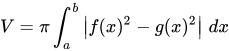
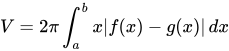
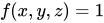
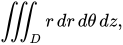
The calculation of volume is a vital part of integral calculus. One of which is calculating the volume of solids of revolution, by rotating a plane curve around a line on the same plane. The washer or disc integration method is used when integrating by an axis parallel to the axis of rotation. The general equation can be written as:where and are the plane curve boundaries.[19]: 1, 3 The shell integration method is used when integrating by an axis perpendicular to the axis of rotation. The equation can be written as:[19]: 6 The volume of a region D in three-dimensional space is given by the triple or volume integral of the constant function over the region. It is usually written as:[20]: Section 14.4


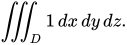
In cylindrical coordinates, the volume integral is
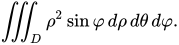
In spherical coordinates (using the convention for angles with as the azimuth and measured from the polar axis; see more on conventions), the volume integral is


Geometric modeling
[edit]
A polygon mesh is a representation of the object's surface, using polygons. The volume mesh explicitly define its volume and surface properties.
Derived quantities
[edit]- Density is the substance's mass per unit volume, or total mass divided by total volume.[21]
- Specific volume is total volume divided by mass, or the inverse of density.[22]
- The volumetric flow rate or discharge is the volume of fluid which passes through a given surface per unit time.
- The volumetric heat capacity is the heat capacity of the substance divided by its volume.
See also
[edit]Notes
[edit]- ^ At constant temperature and pressure, ignoring other states of matter for brevity
References
[edit]- ^ a b c "SI Units - Volume". National Institute of Standards and Technology. April 13, 2022. Archived from the original on August 7, 2022. Retrieved August 7, 2022.
- ^ "IEC 60050 — Details for IEV number 102-04-40: "volume"". International Electrotechnical Vocabulary (in Japanese). Retrieved 2023-09-19.
- ^ "IEC 60050 — Details for IEV number 102-04-39: "three-dimensional domain"". International Electrotechnical Vocabulary (in Japanese). Retrieved 2023-09-19.
- ^ a b c d e f Imhausen, Annette (2016). Mathematics in Ancient Egypt: A Contextual History. Princeton University Press. ISBN 978-1-4008-7430-9. OCLC 934433864.
- ^ Rorres, Chris. "The Golden Crown". Drexel University. Archived from the original on 11 March 2009. Retrieved 24 March 2009.
- ^ Graf, E. H. (2004). "Just what did Archimedes say about buoyancy?". The Physics Teacher. 42 (5): 296–299. Bibcode:2004PhTea..42..296G. doi:10.1119/1.1737965. Archived from the original on 2021-04-14. Retrieved 2022-08-07.
- ^ a b "Balances, Weights and Measures" (PDF). Royal Pharmaceutical Society. 4 Feb 2020. p. 1. Archived (PDF) from the original on 20 May 2022. Retrieved 13 August 2022.
- ^ Cardarelli, François (6 Dec 2012). Scientific Unit Conversion: A Practical Guide to Metrication (2nd ed.). London: Springer Science+Business Media. p. 151. ISBN 978-1-4471-0805-4. OCLC 828776235.
- ^ Cox, Edward Franklin (1958). A History of the Metric System of Weights and Measures, with Emphasis on Campaigns for its Adoption in Great Britain, and in The United States Prior to 1914 (PhD thesis). Indiana University. pp. 99–100. ProQuest 301905667.
- ^ Cook, James L. (1991). Conversion Factors. Oxford [England]: Oxford University Press. pp. xvi. ISBN 0-19-856349-3. OCLC 22861139.
- ^ Marion, Jerry B. (1982). Physics For Science and Engineering. CBS College Publishing. p. 3. ISBN 978-4-8337-0098-6.
- ^ "Mise en pratique for the definition of the metre in the SI" (PDF). International Bureau of Weights and Measures. Consultative Committee for Length. 20 May 2019. p. 1. Archived (PDF) from the original on 13 August 2022. Retrieved 13 August 2022.
- ^ "Volume - Encyclopedia of Mathematics". encyclopediaofmath.org. Retrieved 2023-05-27.
- ^ "Use of Micropipettes" (PDF). Buffalo State College. Archived from the original (PDF) on 4 August 2016. Retrieved 19 June 2016.
- ^ "Area and Volume". National Institute of Standards and Technology. February 25, 2022. Archived from the original on August 7, 2022. Retrieved August 7, 2022.
- ^ Lemons, Don S. (16 March 2017). A Student's Guide to Dimensional Analysis. New York: Cambridge University Press. p. 38. ISBN 978-1-107-16115-3. OCLC 959922612.
- ^ a b The International System of Units (PDF). V3.01 (9th ed.). International Bureau of Weights and Measures. Aug 2024. ISBN 978-92-822-2272-0.
- ^ Treese, Steven A. (2018). History and Measurement of the Base and Derived Units. Cham, Switzerland: Springer Science+Business Media. ISBN 978-3-319-77577-7. LCCN 2018940415. OCLC 1036766223.
- ^ a b "Volumes by Integration" (PDF). Rochester Institute of Technology. 22 September 2014. Archived (PDF) from the original on 2 February 2022. Retrieved 12 August 2022.
- ^ Stewart, James (2008). Calculus: Early Transcendentals (6th ed.). Brooks Cole Cengage Learning. ISBN 978-0-495-01166-8.
- ^ Benson, Tom (7 May 2021). "Gas Density". Glenn Research Center. Archived from the original on 2022-08-09. Retrieved 2022-08-13.
- ^ Cengel, Yunus A.; Boles, Michael A. (2002). Thermodynamics: an engineering approach. Boston: McGraw-Hill. p. 11. ISBN 0-07-238332-1.
External links
[edit]
 Perimeters, Areas, Volumes at Wikibooks
- Volume at Wikibooks

| International | |
|---|---|
| National | |
| Other | |

Volume
View on GrokipediaDefinition and Fundamentals
Definition and Scope
Volume is a fundamental measure in geometry and physics that quantifies the amount of three-dimensional space occupied by a substance or enclosed by a surface.[3] Unlike length, which describes one-dimensional extent, or area, which captures two-dimensional surface, volume extends to the full spatial occupancy in three dimensions, typically expressed in cubic units.[10] This concept applies to both bounded regions, such as the interior of a solid object, and unbounded spaces, though practical measurements focus on finite enclosures.[11] The term "volume" derives from the Latin volumen, meaning "a roll" (as in a scroll or manuscript), which evolved to signify "bulk" or "mass" based on the physical size of such rolls.[12] In modern usage, it presupposes Euclidean space, where distances and angles follow classical geometric rules, enabling consistent measurement without curvature or relativistic effects.[13] In mathematics, volume serves as an abstract measure for any three-dimensional region, including solids, regardless of material composition.[14] By contrast, in physics, it often emphasizes the space displaced by matter, such as liquids, gases, or solids, and is crucial for concepts like density (mass per unit volume).[15] For instance, the volume of a cube illustrates a simple enclosure formed by flat faces, while that of a sphere demonstrates a curved boundary containing space uniformly.[16] Common units include the cubic meter for general measurements.[17]Mathematical Foundations
In three-dimensional Euclidean space , volume serves as a scalar quantity that quantifies the measure of bounded regions, assigning a non-negative real number to each such region to represent its "size." This scalar nature distinguishes volume from vectorial measures, as it yields a single numerical value rather than a directional entity. The foundational additivity axiom ensures that for any two disjoint bounded regions and , the volume of their union equals the sum of their individual volumes: . This property extends to finite collections of disjoint regions and forms the basis for decomposing complex shapes into simpler components while preserving total measure.[18] A key theorem establishing the mathematical framework for volume comparison is Cavalieri's principle, which posits that two solids share the same volume if they are contained between parallel planes of equal distance and every plane parallel to these bounding planes intersects both solids in cross-sections of equal area. This principle enables the equivalence of volumes without requiring direct computation of integrals or dissections, relying instead on the uniformity of cross-sectional areas along a common axis. Formulated in the 17th century but rooted in earlier infinitesimal ideas, it underscores volume's dependence on layered accumulation of areas, providing a rigorous tool for proving equalities among polyhedra, cones, and other figures.[19] Volume exhibits invariance under rigid transformations in Euclidean space, meaning that translations, rotations, and reflections preserve the measure of any region. These isometries maintain distances and angles, ensuring that the intrinsic spatial extent remains unchanged regardless of the region's position or orientation. This property aligns with the Euclidean group's action on , where volume functions as an invariant functional under such motions.[20] In vector calculus, the concept of signed volume extends the scalar measure to oriented regions, assigning positive or negative values based on the region's orientation relative to a chosen basis. For instance, a parallelepiped spanned by vectors , , and has signed volume given by the scalar triple product , which can be zero, positive, or negative depending on whether the vectors form a degenerate, right-handed, or left-handed system. This signed formulation is essential for handling oriented manifolds and supports theorems like the divergence theorem by incorporating directional consistency.[21]Historical Development
Ancient and Pre-Modern Concepts
Early civilizations in Mesopotamia and Egypt developed practical methods for estimating volumes, primarily driven by needs in construction, agriculture, and architecture around 2000 BCE. Babylonian mathematicians, as evidenced in cuneiform tablets, computed volumes of simple solids like rectangular prisms using the product of length, width, and height, with more complex shapes like pyramids handled through approximate empirical rules based on base areas multiplied by height, though exact formulas for cylinders and pyramids remain fragmentary. Egyptian scribes, in papyri such as the Moscow Mathematical Papyrus dated to approximately 1850 BCE, recorded the volume of a truncated square pyramid as , where is the height and the side lengths of the bases; this formula, remarkably accurate, suggests derivation through dissection or empirical measurement rather than rigorous proof. For cylinders, the Rhind Mathematical Papyrus (c. 1650 BCE) approximated the base area using for a circle of diameter , then multiplied by height, reflecting a practical . In ancient Greece, conceptual advancements built on these empirical foundations, shifting toward more systematic geometric treatments. Euclid's Elements (c. 300 BCE) provided qualitative definitions of volume in Book XI, describing solids as "magnitudes" that could be compared for equality through congruent bases and heights or by superposition, without quantitative formulas but establishing volume as a third dimension analogous to area. Archimedes (c. 287–212 BCE) achieved exact calculations in On the Sphere and Cylinder, proving the volume of a sphere as and a cone as using the method of exhaustion to bound volumes between inscribed and circumscribed polyhedra, equating the sphere's volume to two-thirds that of its circumscribing cylinder. These results, while innovative, drew indirectly from earlier traditions; for instance, the pyramid volume formula akin to the Egyptian one appears in later compilations attributed to Heron of Alexandria (c. 10–70 CE), possibly reflecting lost Hellenistic syntheses of Egyptian methods. Non-Western traditions offered parallel approximations, often tied to ritual and engineering. The Indian Sulba Sutras (c. 800–500 BCE), manuals for Vedic altar construction, implied volume calculations through layered brick arrangements forming falcon-shaped altars, using geometric transformations to equate areas and extend to three dimensions, though without explicit general formulas and relying on approximations like . Similarly, ancient Chinese texts such as the Nine Chapters on the Mathematical Art (c. 100 BCE–200 CE) included empirical volume estimates for cylindrical granaries, approximating the circular base area and multiplying by height, prioritizing numerical computation over proof. These ancient and pre-modern approaches were limited by the absence of general integration methods, confining calculations to specific shapes through physical dissection, stacking, or ad hoc rules, which often introduced errors for irregular forms and lacked universality until later developments.Standardization Through Calculus
The invention of integral calculus in the late 17th century by Isaac Newton and Gottfried Wilhelm Leibniz marked a pivotal advancement in the computation of volumes, shifting from discrete geometric approximations to continuous integration methods. Newton developed the foundations of infinitesimal calculus during his isolation at Woolsthorpe Manor from 1665 to 1667, conceptualizing integration as the summation of infinitesimally thin slices to determine areas under curves and, by extension, volumes of solids of revolution. Independently, Leibniz formulated his version around 1675, introducing notation like the integral sign ∫ and dx, which facilitated the systematic evaluation of definite integrals for volume by accumulating cross-sectional areas along an axis. This paradigm enabled the general calculation of volumes for a wide class of shapes previously limited by Archimedean exhaustion techniques.[22] In the 18th century, Leonhard Euler and Joseph-Louis Lagrange further formalized the application of integral calculus to volumes, extending it to arbitrary solids through multiple integrals. Euler's Introductio in analysin infinitorum (1748) established the analytical framework for functions and infinite series, while his multi-volume Institutionum calculi integralis (1768–1770) detailed techniques for quadrature and integration, including the use of triple integrals to compute volumes as ∭ dV over regions in three dimensions. This work provided rigorous methods for evaluating volumes of complex solids by decomposing them into integrable parts. Lagrange complemented these efforts in his Mécanique analytique (1788) and earlier variational papers, where he employed volume integrals in the calculus of variations to derive equations governing physical systems, emphasizing algebraic rigor over geometric intuition and enabling computations for irregular volumes without reliance on limits of sums.[23][24] Concurrent with these mathematical developments, early efforts toward unit standardization began to intersect with volume measurement in the late 18th century, particularly through the French Academy of Sciences. In 1791, the Academy proposed the meter as one ten-millionth of the Earth's meridional quadrant, leading to a provisional meter bar constructed in 1793 based on available geodetic data. By 1795, this culminated in the definition of the cubic meter (stère) as the volume of a cube with one-meter sides, establishing a decimal-based unit for solid capacity that aligned with the emerging metric framework. However, imperial systems in Britain and its colonies retained inconsistencies, such as the cubic foot varying slightly by region due to differing yard definitions, hindering uniform volume standardization until later reforms.[25] A key milestone in relating surface and volume integrals emerged in the early 19th century through Carl Friedrich Gauss's formulation of what is now known as the divergence theorem. In his 1813 work on the theory of attraction, Gauss demonstrated that the flux of a vector field through a closed surface equals the volume integral of its divergence within the enclosed region, expressed as ∯_S \mathbf{F} \cdot d\mathbf{S} = ∭_V \nabla \cdot \mathbf{F} , dV. This theorem provided a foundational tool for interconverting surface and volume calculations, influencing fields like electrostatics and fluid dynamics while reinforcing the analytical standardization of volume computations.[26]Metrication and Modern Redefinitions
The metric system originated with a decree by the French National Convention on April 7, 1795, which established the liter as the unit of capacity, defined as one cubic decimetre (dm³).[27] This foundational step integrated volume measurement into a decimal-based framework tied to natural standards, replacing disparate local units across France.[28] Throughout the 19th and early 20th centuries, metrication spread globally through legislative adoption; for instance, Germany mandated it in 1872, and by the mid-20th century, over 90% of nations had incorporated metric units for trade, science, and industry, facilitated by international treaties like the 1875 Metre Convention.[29][30] The International System of Units (SI), formalized in 1960 by the 11th General Conference on Weights and Measures (CGPM), designated the cubic meter as the base unit of volume, derived from the meter defined as 1,650,763.73 wavelengths of the orange-red emission line of krypton-86 in vacuum.[31] This prototype-based approach ensured reproducibility but relied on physical artifacts prone to drift. The 2019 CGPM redefinition anchored all SI units to invariant fundamental constants, with the meter now fixed by the speed of light in vacuum (exactly 299,792,458 m/s), and the kilogram tied to the Planck constant (h = 6.62607015 × 10^{-34} J s); consequently, the cubic meter achieves fundamental invariance, independent of material standards, enhancing precision in volume measurements across disciplines.[32] Despite widespread adoption elsewhere, metrication in the United States remains incomplete as of 2025, operating as a hybrid system where customary units predominate in everyday and industrial contexts, though federal policy since the 1975 Metric Conversion Act promotes voluntary SI use for trade and commerce.[33] Challenges include entrenched infrastructure, educational inertia, and economic costs of transition, with only partial implementation in sectors like pharmaceuticals and beverages.[34] In space applications, relativity introduces redefinitions of volume; special relativity's length contraction reduces measured volume by a factor of along the motion direction for high-velocity objects, as observed in particle accelerators or spacecraft, while general relativity accounts for spacetime curvature effects on local volume elements in gravitational fields. Post-2000 developments in digital standardization have advanced precise volume metrics through ISO 10303 (STEP), an international standard for neutral product data exchange in CAD software, enabling accurate 3D geometric modeling and automated volume calculations across disparate systems without loss of fidelity.[35] Updates to STEP parts, such as ISO 10303-108 for parametric exchange, support computational volume determination in engineering workflows, promoting interoperability in global manufacturing.[36]Physical and Mathematical Properties
Intrinsic Properties
In mathematics, volume is characterized by properties of additivity and monotonicity when defined as the Lebesgue measure on Euclidean spaces. Countable additivity states that for any countable collection of pairwise disjoint Lebesgue measurable sets whose union is also measurable, the volume of the union equals the sum of the individual volumes: .[18] This property ensures that volume behaves consistently under decomposition into non-overlapping parts, foundational to integration and analysis. Monotonicity complements this by asserting that if a measurable set is contained in another measurable set , then .[37] Consequently, volume strictly increases under set expansion, preserving order in inclusions and supporting limits in geometric constructions. The Lebesgue measure provides a modern, rigorous framework for assigning volumes to irregular sets in , extending classical notions beyond rectifiable boundaries to any set satisfying the Carathéodory criterion of measurability.[38] This definition resolves paradoxes like the Banach-Tarski decomposition by restricting to measurable sets, where volume remains well-defined and finite for bounded regions, enabling precise quantification of fractals and pathological shapes in set theory. In physics, an intrinsic property of volume for ideal liquids and solids is incompressibility, meaning their volume remains essentially constant under moderate pressure changes due to strong intermolecular forces that resist density alterations.[39] This contrasts with gases, which exhibit compressibility as described by Boyle's law, where volume inversely proportional to pressure at constant temperature: .[40] Such constancy under pressure underscores volume's role as a conserved quantity in hydrostatics for these phases. Dimensional homogeneity further defines volume's intrinsic scaling: as a quantity of dimension length cubed , it transforms under similarity by the cube of the linear scale factor, so if all lengths are multiplied by , volume multiplies by .[41] This cubic scaling holds universally in homogeneous physical equations, ensuring consistency across scales in geometry and mechanics.Relational Properties in Geometry and Physics
In geometry, volume exhibits a fundamental relational property with surface area through the isoperimetric inequality, which asserts that for a given surface area , the maximum possible enclosed volume is achieved by a sphere. This inequality is expressed in three dimensions as , with equality holding precisely when the domain is a sphere.[42] The theorem, first proved by Jakob Steiner in 1841 using geometric symmetrization, underscores the sphere's optimality in enclosing volume while minimizing surface area, a principle that extends to higher dimensions and influences problems in calculus of variations.[43] In physics, volume relates directly to buoyancy via Archimedes' principle, which states that the upward buoyant force on an immersed object equals the weight of the fluid displaced by its volume. For an object of volume submerged in a fluid of density , the buoyant force is , where is gravitational acceleration; this relation explains flotation when the object's weight is less than or equal to .[44] Additionally, gravitational potential energy for an object in a uniform field scales linearly with its volume, assuming constant density , as the energy depends on mass , which is proportional to volume .[45] A key geometric relation connecting volume to surface properties is the divergence theorem, which equates the volume integral of a vector field's divergence over a region to the flux through its bounding surface. Mathematically, for a vector field and volume with boundary surface , this theorem links internal volume-based divergences to external surface fluxes, forming a cornerstone of vector calculus with applications in electromagnetism and fluid dynamics.[46] In fractal geometry, volume scaling deviates from Euclidean norms due to non-integer dimensions, where the Hausdorff measure provides a generalized "volume" that relates nonlinearly to the scaling factor. For a fractal set with Hausdorff dimension (where typically), the measure scales as under linear scaling by , contrasting with integer-dimensional volumes that scale as ; this framework, introduced by Felix Hausdorff in 1918, quantifies the irregular "space-filling" behavior of fractals like the Sierpinski gasket.[47]Measurement and Units
Common Units and Conversions
The cubic meter (m³) serves as the base unit of volume in the International System of Units (SI), applicable to solids, liquids, and gases alike.[4] Derived units employ SI prefixes for scalability; for instance, the liter (L), a non-SI accepted unit, equals m³ or one cubic decimeter (dm³), while the milliliter (mL) is m³ or one cubic centimeter (cm³).[1] Imperial and customary systems use cubic inches (in³) for small volumes and cubic feet (ft³) for larger ones, with liquid measures like the US gallon (exactly 3.785412 L) and the UK imperial gallon (4.54609 L).[48] These reflect historical definitions tied to the inch, now standardized in SI terms. Standard conversions facilitate cross-system use; for example, 1 m³ equals 1000 L or approximately 35.314667 ft³.[48]| Unit | Equivalent in m³ | Equivalent in L |
|---|---|---|
| 1 liter (L) | 1 | |
| 1 milliliter (mL) | 0.001 | |
| 1 cubic foot (ft³) | 0.02831685 | 28.31685 |
| 1 US gallon | 0.003785412 | 3.785412 |
| 1 UK imperial gallon | 0.00454609 | 4.54609 |
Volume Versus Capacity
In practical measurement contexts, volume refers to the total three-dimensional space occupied by a solid object, such as a rock, quantified in cubic units like cubic centimeters or cubic meters.[1] In contrast, capacity denotes the maximum amount of substance, typically a liquid or granular material, that a container can hold without overflowing, often expressed in units like liters or milliliters for the internal space available.[51] This distinction is crucial in applications where solids are assessed for their intrinsic occupancy versus containers evaluated for their containment potential, such as a bottle's liquid limit.[52] Measuring volume for irregular solids commonly employs the water displacement method, where the object is submerged in a fluid, and the increase in fluid level corresponds to the object's volume, as derived from Archimedes' principle stating that the buoyant force equals the weight of the displaced fluid.[44] For capacity, assessment involves direct filling of the container to its designated brimful level or marked fill line, ensuring the measurement reflects the usable internal volume under standard conditions.[53] These methods highlight the contextual adaptation: displacement avoids direct geometric calculation for solids, while filling verifies practical holding limits for vessels. Although units for volume and capacity often overlap—such as liters for both—their application contexts differ significantly; for instance, an engine's displacement measures the total cylindrical volume swept by the pistons during operation, typically in liters, whereas a fuel tank's capacity indicates the maximum fuel volume it can contain, also in liters but focused on storage rather than mechanical sweep.[54][55] This overlap can lead to misinterpretation if not contextualized properly. International standards, particularly those developed by the International Organization for Standardization (ISO) since the 1980s, define packaging capacity precisely to mitigate such issues; for example, ISO 16104 specifies that liquid-containing packaging must be filled to at least 98% of its brimful capacity during testing, where brimful capacity is the volume to the point of overflow.[53] Conflation of volume and capacity has resulted in errors, notably in medical dosing, where measuring small volumes relative to a syringe's labeled capacity (e.g., less than 20% of it) increases the risk of unacceptable inaccuracies exceeding 5%, potentially leading to under- or overdosing.[56] Such standards and awareness emphasize the need for clear differentiation in labeling and measurement protocols.Computational Methods
Volumes of Basic Shapes
The volumes of fundamental geometric solids, such as cubes, prisms, spheres, cylinders, cones, and pyramids, are determined using closed-form formulas that quantify the space enclosed by their surfaces. These formulas are derived primarily through geometric dissection—breaking the shape into simpler components like prisms or tetrahedra—or by limits of approximations, such as stacking infinitesimal cones to approximate a sphere. For physical applications, such as calculating mass, the formulas assume uniform density throughout the solid, meaning the material is homogeneous and fills the geometric volume completely without voids or variations.[57][58][59] The following table summarizes the standard volume formulas for these basic shapes, where variables denote linear dimensions (e.g., side lengths, radii, heights) in consistent units:| Shape | Volume Formula | Key Variables |
|---|---|---|
| Cube | : side length | |
| Rectangular Prism | : length, : width, : height | |
| Sphere | : radius | |
| Cylinder | : radius of base, : height | |
| Cone | : radius of base, : height | |
| Pyramid | : area of base, : height |