


Community hub
Recent from talks
Contribute something
Nothing was collected or created yet.
Weather lore
View on Wikipedia | This article needs additional citations for verification. (January 2009) |

Weather lore is the body of informal folklore related to the prediction of the weather and its greater meaning.
Much like regular folklore, weather lore is passed down through speech and writing from normal people without the use of external measuring instruments. The origin of weather lore can be dated back to primeval people and their usage of star studying in navigation.[1] However, more recently during the Late Middle Ages, the works of two Greek philosopher-poets, Theophrastus of Eresus on Lesbos and Aratus of Macedonia, are known for shaping the prediction of weather. Theophrastus and Aratus collated their works in two main collections for weather lore: On Weather Signs and On Winds. These were used for helping farmers with harvest, merchants for trade and determining the weather the next day.[2]
Astrology and weather lore have been closely interlinked for many years - with each planet often being associated with a weather state. For example, Mars is red and must therefore be hot and dry. Prevalent in ancient Roman thought, astrologists used weather lore to teach commoners of the star and cloud formations and how they can be used to see the future.[2] From this, three main schools of weather lore thoughts developed during the Late Middle Ages as Astrology became more popular throughout Europe.[3] One which related to winds and clouds and had some scientific basis. A second type connected with saints' days possessed doubtful validity but was quite popular nonetheless during the Middle Ages. A third type treated the behaviour of birds and animals, which has been found to be controlled more by past and present weather rather than to be a true indication of the future.[1]
Before the invention of temperature measuring devices, such as the mercury thermometer, it was difficult to gather predictive, numerical data. Therefore, communities used their surroundings to predict and explain the weather in upcoming days.[4]
Today, the majority of weather lore can be found in proverbs. However, much of the weather lore fantasy is still prevalent in today's seasonal calendar, with mentions such as the annual saints' days, the passage of the months, and weather predictions made from animal behaviour. The creation of the astrological signs in Babylonian mythology can also be attributed to the study of stars and its association with weather lore.[2]
.jpg)
Occurrence of "weather"
[edit]
Weather can be defined as the constant shift in conditions relating to temperature, cloudiness, rainfall etc. at a particular time and place.[5] A significant portion of weather occurs in Earth's middle latitudes, between roughly 30° to 60° North and South.
A great percentage of the world's population lives in the equatorial regions,[6] but for the most part, these regions do not experience weather as it is understood by this definition. The Sahara in northern Africa, for instance, is almost uniformly hot, sunny and dry all year long especially due to the non-stop presence of high atmospheric pressure aloft, whereas weather trends on the Indian subcontinent and in the western Pacific, for instance, the monsoonal belt, occur gradually over the very long term, and the diurnal weather patterns remain constant.
Weather folklore, therefore, refers to this mid-latitude region of daily variability. While most of it applies equally to the Southern Hemisphere, the Southern Hemisphere resident may need to take into account the fact that weather systems rotate opposite to those in the North. For instance, the "crossed winds"[7] rule (see below) must be reversed for the Australian reader.
Common proverbs
[edit]When clouds look like black smoke
[edit]- When clouds look like black smoke
- A wise man will put on his cloak
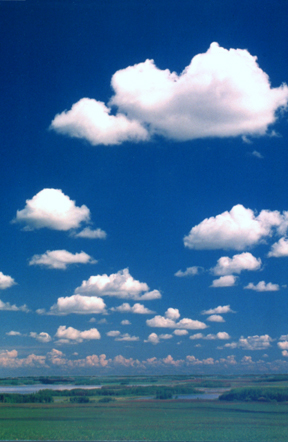
Thick, moisture-laden storm clouds absorb sunlight. It gives them an appearance that somewhat resembles black smoke.
Red sky at night
[edit]
- Red sky at night, shepherd's delight.
- Red sky in the morning, shepherd's warning.
(In a common variation, "shepherd" is replaced by "sailor")
A red sky – in the morning or evening – is a result of high pressure air in the atmosphere trapping particles of dust or soot. Air molecules scatter the shorter blue wavelengths of sunlight, but particles of dust, soot and other aerosols scatter the longer red wavelength of sunlight in a process called Rayleigh scattering. At sunrise and sunset, the sun is lower in the sky causing the sunlight to travel through more of the atmosphere so scattering more light.[9] This effect is further enhanced when there are at least some high level clouds to reflect this light back to the ground.[10]
When weather systems predominantly move from west to east, a red sky at night indicates that the high pressure air (and better weather) is westwards. In the morning the light is eastwards, and so a red sky then indicates the high pressure (and better weather) has already passed, and an area of low pressure is following behind.[11]

Low-pressure regions
[edit]
- When the wind is blowing in the North
- No fisherman should set forth,
- When the wind is blowing in the East,
- 'Tis not fit for man nor beast,
- When the wind is blowing in the South
- It brings the food over the fish's mouth,
- When the wind is blowing in the West,
- That is when the fishing's best!
In western European seas, this description of wind direction is an excellent illustration of how the weather events of an active low pressure area[12] present themselves. With the approach of a low, easterly winds typically pick up. These gusty winds can be unpleasant for a number of reasons; they are often uncomfortably warm, dry, and dusty in the summer and bitterly cold in the winter. Northerly winds, which follow around a low, are cold and blustery. Sailing in conditions of northerly winds requires expertise and a boat capable of handling heavy waves. Southerly winds usually bring warm temperatures, and though they may not necessarily feed the fish, they do provide pleasant fishing weather. Wind and weather observations will be different for a low passing to the north of the observer than for one passing to the south. When a low passes to the north, the winds typically pick up from the east, swing to southerly (possibly accompanied by light precipitation, usually not) with the passage of the low's warm front, and then switch to northwesterly or westerly as the cold front passes. Typically, if there is any heavy precipitation, it will accompany the passage of the cold front. When a low passes to the south, on the other hand, winds will initially pick up from the east, but will gradually shift to northerly. Overcast skies and steady precipitation often occur as the center of the low passes due south, but skies will clear and winds will gradually become westerly as the low moves off to the east. No observer will experience all the weather elements of a low in a single passage.[13]
Calm conditions
[edit]- No weather is ill if the wind be still.
Calm conditions, especially with clear skies, indicate the dominance of a high pressure area. Because highs are broad regions of descending air, they discourage the formation of phenomena typically associated with weather, such as clouds, wind, and precipitation. Calm conditions, though, may also result from a circumstance known as "the calm before the storm," in which a large thunderstorm cell to the west may be updrafting the westerly surface wind before it can arrive locally. This situation is readily identifiable by looking to the west – such an approaching storm will be close enough to be unmistakable. In winter, though, calm air and clear skies may signal the presence of an Arctic high,[14] typically accompanied by very cold air, and it is difficult to imagine describing a temperature of –35 °C (–31 °F) as pleasant.
Ring around the Moon
[edit]- When halo rings the Moon or Sun, rain's approaching on the run
 |
 |
A halo around the Sun or Moon is caused by the refraction of that body's light by ice crystals at high altitude. Such high-level moisture is a precursor to moisture moving in at increasingly lower levels, and is a good indicator that an active weather system is on its way. Halos typically evolve into what is known as "milk sky", when the sky appears clear, but the typical blue is either washed-out or barely noticeable. This high, thick cirrostratus cloud is a clear indicator of an approaching low. In the coldest days of winter, a halo around the Sun is evidence of very cold and typically clear air at and above the surface. But sun dogs are indicators that weather conditions are likely to change in the next 18 to 36 hours.[15][citation needed]
Humidity indicators
[edit]Moisture in the air causes wood to swell, making doors and windows sticky, and salt is a very effective absorber of moisture. With a high level of moisture in the air, the likelihood of precipitation is increased.[16] The magnesium carbonate and later calcium silicate in iodized salt acts as an anti-clumping agent in humid conditions, leading to Morton Salt's umbrella girl logo and slogan "When it rains, it pours".
Fog
[edit]Fog is formed when the air cools enough that the vapour pressure encourages condensation over evaporation. In order for the air to be cool on a summer night, the sky must be clear, so excess heat can be radiated into space. Cloudy skies act like a blanket, absorbing and reradiating the heat, keeping it in. So if it is cool enough (and clear enough) for fog to form, it will probably be clear the next day.[citation needed] Winter fog is the result of two entirely different circumstances. Above the ocean or a large lake, air is typically more humid than above land. When the humid air moves over cold land, it will form fog and precipitation. (To the east of the North American Great Lakes, this is a common phenomenon, and is known as the "lake effect.")[17] In northerly climates, ice fog may form when the temperature drops substantially below freezing. It is almost exclusively an urban phenomenon, when the air is so cold that any vapor pressure results in condensation, and additional vapour emitted by automobiles, household furnaces, and industrial plants simply accumulates as fog.

Cloud movement
[edit]- If clouds move against the wind, rain will follow.
This rule may be true under a few special circumstances, otherwise it is false. By standing with one's back to the ground-level wind and observing the movement of the clouds, it is possible to determine whether the weather will improve or deteriorate.[13] For the Northern Hemisphere, it works like this: If the upper-level clouds are moving from the right, a low-pressure area has passed and the weather will improve; if from the left, a low pressure area is arriving and the weather will deteriorate. (Reverse for the Southern Hemisphere.) This is known as the "crossed-winds" rule.[7] Clouds traveling parallel to but against the wind may indicate a thunderstorm approaching. Outflow winds typically blow opposite to the updraft zone, and clouds carried in the upper level wind will appear to be moving against the surface wind. However, if such a storm is in the offing, it is not necessary to observe the cloud motions to know rain is a good possibility. The nature of airflows directly at a frontal boundary can also create conditions in which lower winds contradict the motions of upper clouds, and the passage of a frontal boundary is often marked by precipitation. Most often, however, this situation occurs in the lee of a low pressure area, to the north of the frontal zones and convergence region, and does not indicate a change in weather, but rather, that the weather, fair or showery, will remain so for a period of hours at least.[13]
Fallibility of lore
[edit]One of the problems in testing the veracity of traditions about the weather is the wide variety to be found in the details of sayings and traditions. Some variations are regional, while others exhibit less of a pattern.
Empirical studies
[edit]One case where weather lore has been studied for reliability against actual weather observations is the Groundhog Day lore. It predicts that if the groundhog sees its shadow on this day (February 2), six weeks of winter remain. One analysis concluded the creature demonstrated no ability to predict.[18] Other studies gave accuracy percentages, but differing figures.[a] and some of the numbers were slightly better than hazarded guess (33% accurate), according to one source.[21] In other words, there is no appreciable correlation between cloud cover on that day, and the imminence of springlike weather.
There are some meteorological bases suggested, but it is a fuzzy mechanism, and fixing a precise date compromises the effectiveness.[21]
Calendrical lore
[edit]There are weather lore marked by dates on the year's calendar.
January
[edit]The Hispanic tradition of cabañuelas predicts the weather for the year based on the 12, 18 or 24 days of January or August.[23]
February
[edit]There are weather lore around February 2, known as Candlemas, Brigid's Day, or St. Blaise's Day (St. Blaze's Day). One French lore says that if it rains on Candlemas (Chandeleur) there will be forty more days of rain: Quand il pleut pour la Chandeleur, il pleut pendant quarante jours.[24] Groundhog Day also falls on this day.
Candlemas and animals
[edit]Groundhog Day, observed in the U. S. and Canada, also falls on February 2 and is thought to derive from the Candlemas weather lore in Europe, particularly the German which features the badger as the predictor. An example of such German weather rhyme translates as:
- If the badger is in the sun at Candlemas,
- he will have to go back into his hole for another four weeks.[b][25]
There are also French counterparts. One for Saint-Vallier in Lorraine states:
- If it is fair weather on Candlemas,
- the bear returns to its cave for six weeks[c]
And another from Courbesseaux says that if it is sunny on Candlemas the wolf returns to its cave for six weeks, and if not, for forty days.[26]
In French Canada, it may be a marmot or groundhog (siffleux), bear, skunk, otter etc. which if it sees its shadow on Candlemas, causes winter to prolong for 40 days.[27]
English traditional weather lore recites, "If Candlemas Day be fair and bright Winter will have another fight If Candlemas Day brings cloud and rain Winter won't come again"[28]
March
[edit]Lion and Lamb
[edit]An English proverb describes typical March weather:
In the 19th century it was used as a prediction contingent on a year's early March weather:
March thunderstorms
[edit]"Blows its horn" refers to thunderstorms. While March thunderstorms indicate that the weather is unusually warm for that time of year (thunderstorms can occur only with a sufficiently large temperature difference between ground and sky and sufficient amounts of moisture to produce charge differential within a cloud).[31]
July
[edit]In the British Isles, Saint Swithun's day (July 15) is said to forecast the weather for the rest of the summer. If St Swithun's day is dry, then the legend says that the next forty days will also be dry: "St.Swithin's Day if thou be fair, 'Twill rain for forty days no mair; St. Swithin's Day if thou dost rain, For forty days it will remain.". If however it rains, the rain will continue for forty days.
There is a scientific basis to the legend of St Swithun's day. Around the middle of July, the jet stream settles into a pattern which, in the majority of years, holds reasonably steady until the end of August. When the jet stream lies north of the British Isles then continental high pressure is able to move in; when it lies across or south of the British Isles, Arctic air and Atlantic weather systems predominate.[32]
August
[edit]The Hispanic tradition of cabañuelas predicts the weather for the year based on the first 12, 18 or 24 days of January or August.[23]
November
[edit]A Swedish proverb uses 30 November (St Andrew's day, referencing the name day of Anders, a localised variant) as an indicator of the weather over Christmas (Anders slaskar, julen braskar, translation: Slushy Anders [St. Andrew's day], frozen Christmas).[33]
Other feast days
[edit]In France, Saint Medard (June 8), Urban of Langres (April 2), and Saint Gervase and Saint Protais (June 19) are credited with an influence on the weather almost identical with that attributed to St Swithun in England, while in Flanders there is St Godelieve (July 6) and in Germany the Seven Sleepers Day (June 27).
In Russia, the weather on the feast of the Protecting Veil is popularly believed to indicate the severity of the forthcoming winter.[34]
There was an old proverb from Romagna that ran: "Par San Paternian e' trema la coda a e' can."[citation needed] ("On St. Paternian's day, the dog's tail wags"). This Cervian proverb refers to the fact that the cold began to be felt around the saint's feast day.[citation needed] A farmers' saying associated with Quirinus' feast day of March 30 was "Wie der Quirin, so der Sommer" ("As St. Quirinus' Day goes, so will the summer").[35]
The Ice Saints is the name given in German, Austrian, and Swiss folklore to a period noted to bring a brief spell of colder weather in the Northern Hemisphere under the Julian Calendar in May, because the Roman Catholic feast days of St. Mamertus, St. Pancras, and St. Servatus fall on the days of May 11, May 12, and May 13 respectively.
In Northern Spain, the four yearly periods of ember days (témporas) are used to predict the weather of the following season.[citation needed]
Biological signs
[edit]Animal signs
[edit]Seagulls
[edit]Sometimes the lore is concurrent with existing conditions, more than prediction, as in:
Seagulls tend to sleep on the water. However, seagulls, like people, find gusty, turbulent wind difficult to contend with, and under such circumstances, the water is also choppy and unpleasant. Seagulls huddled on the ground may be a sign that the weather is already bad.
Cows in pasture
[edit]
- A cow with its tail to the West makes the weather best,
- A cow with its tail to the East makes the weather least
Cows prefer not to have the wind blowing in their faces, and so typically stand with their backs to the wind. Since westerly winds typically mean arriving or continuing fair weather and easterly winds usually indicate arriving or continuing unsettled weather, a cowvane is as good a way as any of knowing what the weather will be up to for the next few hours.
Pets eating grass
[edit]- Cats and dogs eat grass before a rain.
While it is true that cats and dogs eat grass, it has nothing to do with the weather and is because cats and dogs are not exclusively carnivorous. Some researchers believe that dogs eat grass as an emetic when feeling ill.[36][citation needed]
Frogs
[edit]_b_385.jpg)
Centered in the German-speaking world, there was the belief that frogs could predict the weather. It grew from observing European tree frogs climb up vegetation in sunny weather, and led to frogs being held inside jars equipped with a small ladder. The term Wetterfrosch (weather frog) has survived as a humorous, if somewhat derogatory epithet for meteorologists, insinuating their predictions can not be trusted.
Leeches
[edit]Some early barometers used leeches in a jar to predict when a storm was coming. This is because leeches tend to climb and become agitated when low pressure is approaching.
Plant signs
[edit]Onion skins
[edit]- Onion skins very thin
- Mild winter coming in;
- Onion skins thick and tough
- Coming winter cold and rough.[37]
This verse, and so many others like it, attempts to predict long-range conditions. These predictions have stood the test of time only because they rely on selective memory: people remember when they have predicted correctly and forget when predictions don't hold.[38] One possible factor which could provide these predictions with a thin edge of credibility is that there is some degree of consistency in weather from year to year. Drought cycles or El Niño winters are a perfect example of such circumstances. A pattern of cool summers and warm winters, for instance, can produce patterns in other natural events sensitive enough to be affected by changes in temperature or precipitation.
Meteorological signs
[edit]Early-morning rain
[edit]- Rain before seven, clear by eleven.
Late-night rains and early morning rains may simply be the last precipitation of a passing weather front. However, since fronts pass at night as often as they do in the day, morning rain is no predictor of a dry afternoon. However, this lore can describe non-frontal weather. Given sufficient surface heating, a late-day rainstorm may continue to develop into the night, produce early precipitation, then dissipate by late morning. This, though, is the exception rather than the rule. Only 40% of rain is produced by convective events – 60% is the result of a frontal passage.[39]
Explanatory notes
[edit]- ^ Some figures are "exactly 50 percent" accurate (Farmer's Almanac);[19] 28% (The National Geographic Society);[20] 39 % (National Climatic Data Center);[21] But a Middlebury College team in its analysis method found 70% accuracy in temperature high/low predictions.[22]
- ^ Wenn sich der Dachs zu Lichtmeß sonnt, so gehet er wieder auf vier Wochen in sein Loch.
- ^ French (Lorraine patois): "Quand i fat bé és Chandolles, l'ours se r'tire dos sè grotte pu hée semaines".
- ^ In Wales this proverb is applied to the month of April more often than March, especially in the borders.
References
[edit]- ^ a b Hazen, H. A. (July 1900). "The Origin and Value of Weather Lore". The Journal of American Folklore. 13 (50): 191–198. doi:10.2307/533883. JSTOR 533883.
- ^ a b c Encyclopedia of climate and weather. Schneider, Stephen Henry., Root, Terry Louise., Mastrandrea, Michael D. (2nd ed.). New York: Oxford University Press. 2011. ISBN 978-0-19-531386-4. OCLC 714802771.
{{cite book}}: CS1 maint: others (link) - ^ F.R.S, D. Brunt SC D. (1946-06-01). "Meteorology and Weather Lore". Folklore. 57 (2): 66–74. doi:10.1080/0015587X.1946.9717813. ISSN 0015-587X.
- ^ Bergen, Fanny D.; Newell, W. W. (1889). "Weather-Lore". The Journal of American Folklore. 2 (6): 203–208. doi:10.2307/534149. ISSN 0021-8715. JSTOR 534149.
- ^ Bridgewater, S. (January 1976). "Criteria for selection of nursing textbooks". The Journal of Nursing Education. 15 (1): 3–5. ISSN 0148-4834. PMID 1477.
- ^ United States Department of Agriculture (retrieved 2006 November 27)
- ^ a b Sailnet.com (Retrieved 2006 April 24)
- ^ WXSYS (retrieved 2007 February 15)
- ^ Augustine, John; Smith, Lisa (September 2014). "The Red sky in morning sailor take warning". National Oceanic and Atmospheric Administration, Earth System Research Laboratory Global Monitoring Division.
- ^ Corfidi, Stephen F. (September 2014). "The Colors of Sunset and Twilight". National Oceanic and Atmospheric Administration. (expanded from Weatherwise magazine, June/July 1996)
- ^ "Red sky at night and other weather lore".
- ^ Morehead Planetarium and Science Centre (Retrieved 2006 April 24)
- ^ a b c Watts, Alan (1968). Instant Weather Forecasting in Canada. pp. 191–192. LCCN 68-9173.
- ^ nsidc.colorado.edu (retrieved 2007 February 26)
- ^ The Weather Network (retrieved 2007 February 15)
- ^ Dotson, J. Dianne (23 April 2018). "How Temperature & Humidity are Related". Sciencing.
- ^ The Weather Doctor (Retrieved 2006 April 24)
- ^ National Oceanic and Atmospheric Administration (January 29, 2002). "Climate-Watch, Special: Groundhog Day 2002". NOAA. Archived from the original on 2002-02-19.
The table shows no predictive skill for the groundhog during the most recent years of this analysis
- ^ Thomas, R. B. (1998), The Farmer's Almanac, p. 67, cited in Aaron et al. (2001), p. 28
- ^ Allison, Christine (1995), 365 days of gardening, p. 353, cited in Aaron et al. (2001), p. 28
- ^ a b c "Le jour de la marmotte, science ou folklore?". Radio-Canada. February 2, 2017. Retrieved December 26, 2015.
- ^ Aaron, Michael A.; Boyd, Brewster B. Jr.; Curtis, Melanie J.; Sommers, Paul M. (January 2001), "Punxsutawney's Phenomenal Phorecaster", The College Mathematics Journal, 32 (1): 26–29, doi:10.1080/07468342.2001.11921847, JSTOR 2687216, S2CID 123766510. doi:10.2307/2687216.
- ^ a b Diccionario de la lengua española (in Spanish) (23rd ed.). Real Academia Española. Retrieved 19 September 2019.
- ^ "It's going to rain for 40 days..." The Connexion. 2 February 2017.
- ^ "Wenn sich der Dachs zu Lichtmeß sonnt, so gehet er wieder auf vier Wochen in sein Loch." In: Lewenau, Joseph Arnold Ritter von (1823), Der angewandte Fresenius; oder, Sammlung geordneter allgemeiner Witterungs- und sogenannter Bauernregeln, Vienna, J.G. Mösle, p. 20.
- ^ Adam, Lucien (1881). Les patois lorrains. Vol. 1. Maisonneuve. p. 386.
- ^ Rodrigue, Denise (1983). Le cycle de Pâques au Québec et dans l'Ouest de la France. Presses Université Laval. pp. 34, 36. ISBN 9782763769035.
- ^ "BBC - Religions - Christianity: Candlemas".
- ^ Thomas Fuller (1732). Gnomologia. B. Barker.
- ^ Punch v. 48. Tom Taylor. 1865.
- ^ uwsp.edu Archived 2007-05-29 at the Wayback Machine (retrieved 2007 February 26)
- ^ Tom Coghlan Last updated at 12:01AM, April 16, 2012. "The Times, Follow St Swithin: book a British break". Timesonline.co.uk. Retrieved 2012-04-16.
{{cite news}}:|author=has generic name (help)CS1 maint: multiple names: authors list (link) CS1 maint: numeric names: authors list (link)[dead link] - ^ Anders slaskar, julen braskar from SMHI (Swedish Meteorological and Hydrological Institute), accessed on 16 July 2015.
- ^ wscsd.org Archived 2007-02-27 at the Wayback Machine (retrieved 2006 November 27)
- ^ Quirinus von Rom (von Neuss) – Ökumenisches Heiligenlexikon
- ^ Petstyle.com (retrieved 2007 February 15)
- ^ About Onions: Quotes Archived 2006-09-23 at the Wayback Machine (retrieved 2006 November 27)
- ^ "Weather wise - Everything2.com". everything2.com. Retrieved 2017-10-31.
- ^ Alberta Agriculture (retrieved 2007 February 26)
Further reading
[edit]- Bill Giles. The Story of Weather. ISBN 0-11-400355-6).
External links
[edit]- Weather lore and proverbs
- Skywatch – Signs of the Weather
- (in Spanish) ParemioRom – Weather proverbs in the Romance languages
| International | |
|---|---|
| National | |
| Other | |

Weather lore
View on GrokipediaIntroduction
Definition and Scope
Weather lore refers to the body of traditional knowledge and informal practices used by communities to interpret and predict weather patterns, often termed folk meteorology due to its reliance on empirical observations of natural phenomena rather than scientific instruments.[6] This encompasses proverbs, rhymes, and signs derived from everyday encounters with the environment, such as changes in the sky or animal behaviors, serving as a pre-scientific method for forecasting that has persisted across cultures for centuries.[7] Unlike modern meteorology, which employs data from satellites, radar, and mathematical models for precise predictions, weather lore depends on qualitative, pattern-based insights accumulated through generations without formal verification.[8] The scope of weather lore extends to both short-term predictions, such as anticipating rain within hours or days based on immediate atmospheric cues, and longer-term outlooks for seasonal trends, though the former are generally more accurate and reliable due to their grounding in observable, localized changes.[9] These traditions distinguish themselves from contemporary forecasting by prioritizing accessible, non-technological indicators—drawing briefly from nature's signs like cloud formations or wind shifts—while lacking the quantitative precision and global scale of scientific approaches.[8] Overall, weather lore functions as a cultural tool for practical decision-making in agriculture, navigation, and daily life, bridging human experience with environmental rhythms.[6] The term "lore" itself originates from Old English lār, denoting "teaching," "learning," or "doctrine," which evolved to signify bodies of traditional knowledge transmitted orally within communities, emphasizing its role in folklore as inherited wisdom rather than written doctrine.[10] In the context of weather lore, this etymology underscores its transmission through generations via storytelling and communal sharing, preserving predictive insights in the absence of literacy or technology.[10]Historical Development
The origins of weather lore trace back to ancient agricultural societies, where reliable weather predictions were essential for crop planning and survival. In Mesopotamia, Babylonian clay tablets dating to approximately 2000 BCE document early attempts to forecast weather patterns by observing celestial phenomena, such as the positions and appearances of stars and planets, which were believed to influence atmospheric conditions.[11] Similarly, in ancient Greece around 700 BCE, the poet Hesiod incorporated weather signs into his poem Works and Days, presenting a rudimentary almanac that linked stellar risings and other astronomical events to seasonal changes and farming activities.[12] These early records reflect a blend of empirical observation and mythological interpretation, forming the foundation of systematic weather prediction in agrarian cultures. During the medieval period in Europe, weather lore became more formalized through the compilation of almanacs and illuminated manuscripts, which integrated folk knowledge with astrological insights to aid rural communities. By the 14th century, English scribes produced detailed records, such as the calendar in British Library manuscript Royal 7 F VIII, which chronicled monthly weather events from 1269 to 1270 alongside notes on planetary influences to derive predictive rules for future conditions.[13][14] These texts often drew from classical sources like Aristotle's Meteorology while incorporating local oral traditions, emphasizing observable signs to guide agricultural and maritime endeavors. Herbals of the era, such as those compiling plant-based seasonal indicators, further embedded weather wisdom within broader compendia of natural knowledge, though almanacs served as the primary vehicles for dissemination. The invention of the printing press in the mid-15th century played a pivotal role in standardizing and spreading weather lore, transforming ephemeral oral traditions into widely accessible printed almanacs that reached farmers, sailors, and scholars across Europe. This preservation mechanism sustained the practice through the early modern era, even as empirical methods gained traction. In the 19th century, scholarly collections began to systematize global proverbs and signs; for instance, Richard Inwards' Weather Lore (1893), published by the Royal Meteorological Society, amassed sayings from ancient texts to contemporary folklore, highlighting patterns like halo formations around the moon as rain harbingers.[15] Into the 20th century, compilations like Albert Lee's Weather Wisdom (1976) continued this tradition, analyzing historical lore against emerging scientific data while underscoring its cultural persistence.[16] The rise of scientific meteorology in the mid-19th century, facilitated by telegraph networks for real-time data sharing, gradually shifted reliance from lore to instrumental forecasting, though traditional knowledge endured in rural and maritime contexts. Weather lore's calendrical elements, often aligned with agricultural cycles, exemplify this enduring link between celestial timing and earthly rhythms.[12]Observational Signs
Sky and Cloud Indicators
One of the most enduring pieces of weather lore involves the color of the sky at sunrise and sunset, encapsulated in the proverb "Red sky at night, shepherd's delight; red sky in the morning, shepherd's warning." This saying originates from observations by shepherds and sailors, where a red sky at night signals clear weather ahead due to the scattering of sunlight by atmospheric particles under high-pressure conditions, allowing dust and aerosols to remain suspended longer. Conversely, a red sky in the morning indicates approaching low-pressure systems and potential storms, as the light scatters through particles carried by incoming weather fronts from the west. Atmospheric halos, appearing as rings around the sun or moon, serve as another key visual indicator in weather lore, often predicting rain within hours to days. These halos form when sunlight or moonlight refracts through hexagonal ice crystals in high-altitude cirrus clouds, which typically precede warm fronts and increasing moisture. A halo around the moon, in particular, is associated with precipitation arriving in 24 to 48 hours, as the cirrus clouds signal the approach of a low-pressure system that may thicken into rain-producing layers.[17][18][19] Cloud formations and shapes have long been interpreted as omens of changing weather, with specific patterns tied to impending rain or storms. A "mackerel sky," characterized by rippled altocumulus clouds resembling the scales of a mackerel fish, often heralds approaching rain, as these mid-level clouds form in unstable air ahead of a warm front, typically leading to showers within 6 to 12 hours.[20] Similarly, clouds appearing as dark, smoke-like masses—often cumulus congestus or early cumulonimbus formations—indicate developing thunderstorms, where the dense, towering structure blocks light and signals intense updrafts capable of producing heavy rain and lightning.[21] Rainbows, formed by the refraction of sunlight in raindrops, carry positional significance in traditional lore, with their appearance relative to the time of day offering clues about weather progression. A morning rainbow in the western sky serves as a warning of approaching rain, as it indicates rain to the west moving eastward toward the observer with the prevailing weather patterns. In contrast, an evening rainbow in the eastern sky suggests clearing conditions ahead, as it indicates rain that has passed and is continuing to the east. This interpretation aligns with broader observations of sky phenomena linking visual cues to shifting humidity and pressure patterns in Northern Hemisphere temperate regions.[5][22]Wind, Pressure, and Atmospheric Signs
In weather lore, particularly in temperate regions of Europe and North America, wind direction has long been interpreted as a predictor of forthcoming conditions, with easterly winds often associated with unsettled and inclement weather. The proverb "When the wind is in the east, 'tis neither good for man nor beast" reflects this belief, originating in early 17th-century English folklore and linking persistent easterly flows to cold, dry, and stormy patterns that disrupt daily life and agriculture.[23] Similarly, winds with an easterly component are proverbially tied to rain or snow, contrasting with westerly winds, which are deemed favorable for fair weather due to their association with warmer, moister air masses from the Atlantic.[24] These observations stem from historical patterns where easterlies in mid-latitudes often accompany low-pressure systems advancing from continental interiors, bringing chill and precipitation.[23] Atmospheric pressure changes, discerned through folk indicators like barometer readings or subtle environmental cues, form another cornerstone of weather prediction in lore. A falling barometer, signaling low-pressure regions, is traditionally viewed as heralding increased humidity—often described as "sticky" or muggy conditions—that precedes storms, as moist air converges and rises ahead of fronts.[24] In contrast, a rising or high barometer indicates stable high-pressure systems, promising clear skies and settled weather, with proverbs noting that "a gradual rise... indicates settled fair weather."[24] Rapid pressure drops, such as two or three tenths of an inch in four hours, were especially ominous, foretelling gales, as recorded in 19th-century collections of sailor and farmer wisdom.[23] These signs underscore the lore's emphasis on pressure gradients as drivers of instability, where low-pressure zones amplify humidity and storm potential through converging winds.[24] The "calm before the storm" captures a widely recognized atmospheric prelude in folklore, where an unnatural stillness signals an impending pressure drop and sudden weather shift. This phenomenon, noted as "always a calm before a storm," arises when low-pressure systems approach, temporarily suppressing surface winds while building internal energy for release.[23] In tropical and temperate traditions alike, dead calms under low barometric readings were heeded as unreliable lulls, often preceding violent gales or hurricanes, advising caution for travelers and seafarers.[23] Such observations highlight the lore's practical value in recognizing transitional phases where atmospheric tension mounts before explosive changes.[24] Fog serves as a nuanced sign in weather lore, typically indicating stable, humid air masses that can herald either clearing or light precipitation. A falling fog—dissipating from the ground upward—is proverbially linked to fair weather, as it suggests warming and mixing in high-pressure environments, while rising fog portends rain by trapping moisture near the surface.[23] In coastal and inland temperate areas, summer fogs were seen as benevolent for agriculture, promising "fair weather," whereas winter fogs below tree level often preceded heavier rain due to persistent humid layers.[23] These interpretations align with fog's role as a marker of saturation, where stable conditions either lift to clarity or condense into drizzle.[24] Cloud movement provides dynamic clues to wind shifts and rain in traditional lore, with fast-moving low clouds signaling approaching instability. When low-level clouds race across the sky or move against the surface wind, it indicates crosswinds from shifting pressure gradients, commonly preceding rain or snow within hours.[24] Proverbs warn that "clouds moving apparently against a surface wind... very commonly precede rain," as upper-level flows overtake slower ground winds ahead of fronts.[24] In particular, rapidly increasing or scudding cumulus clouds at low altitudes foretell thunderstorms, driven by accelerating updrafts in low-pressure troughs.[23] This focus on motion distinguishes atmospheric signs from static visuals, emphasizing velocity as a harbinger of turbulent changes.[24]Biological Indicators
Animal Behavior Signs
In weather lore, observations of animal behaviors have long been interpreted as indicators of impending atmospheric changes, particularly storms and rain, based on traditional knowledge passed down through generations. These signs often stem from animals' physiological sensitivities to variations in barometric pressure, humidity, and other environmental cues, though scientific validation varies. For instance, many species exhibit altered activity patterns in response to low-pressure systems associated with foul weather.[25] Seagulls flying inland or low over water is a classic sign of approaching storms in maritime folklore. This behavior arises from the birds' acute sensitivity to subtle fluctuations in air and water pressure, which drop ahead of storm fronts, prompting them to seek shelter or adjust flight paths to avoid turbulent conditions. Studies on avian responses to weather confirm that seabirds like gulls detect these pressure changes through specialized sensory organs, leading them to move inland hours before severe weather arrives.[25][26] The proverb that cows lying down in pastures signals rain reflects observations of their barometric sensitivity and practical adaptations. Traditionally, this is linked to cows sensing falling pressure and rising humidity, which may cause digestive discomfort or prompt them to lie down to avoid insects stirred by moist air or to preserve dry grazing spots before the ground becomes wet. However, scientific studies show no reliable correlation between cows lying down and impending rain; cows rest or ruminate at various times unrelated to weather.[27][28] Domestic pets, such as dogs and cats, eating grass excessively is viewed in lore as a harbinger of rain, tied to weather-induced digestive upset. Low barometric pressure preceding storms can cause nausea or gastrointestinal sensitivity in animals, leading them to ingest grass as a natural emetic or to soothe their stomachs. However, grass-eating is a common behavior for digestion, nutritional, or other reasons, with no scientific evidence linking it specifically to atmospheric changes or rain prediction.[29][30] Frogs croaking loudly or jumping actively often signals rising humidity before rain, as their vocalizations intensify in moist conditions conducive to breeding. Male frogs call more frequently when humidity increases, attracting mates to water bodies that will soon swell with precipitation; jumping may reflect heightened activity in anticipation of suitable breeding environments. Scientific accounts confirm that amphibian choruses peak with elevated moisture levels, though the response is more to current rain than precise prediction. Leeches becoming active in low glass tubes, as in historical barometers, similarly indicates low pressure, since these invertebrates climb toward the surface when atmospheric changes signal storms, a principle exploited in 19th-century devices like the tempest prognosticator.[31][32][33][34] Birds roosting early or varying their flight altitude—high in stable weather, low before storms—correlates with pressure systems and approaching fronts in traditional lore. Early roosting occurs as birds detect falling barometric pressure, which discomforts their inner ears and prompts shelter-seeking before turbulent winds arrive; low flight follows insects dropping to lower altitudes in humid, low-pressure air. High-altitude soaring, conversely, thrives in high-pressure fair weather due to favorable thermals. Empirical studies on migration and storm responses validate these patterns, showing birds adjust behaviors to minimize energy expenditure during adverse conditions.[35][36][37]Plant and Insect Responses
In traditional weather lore, the thickness of onion skins has long been observed as an indicator of impending winter severity. Thick, tough layers suggest a harsh, cold winter ahead, while thin skins predict a mild one. This is a longstanding belief, though onion skin thickness primarily results from growing conditions and variety, with no scientific evidence supporting its use as a weather predictor.[38][39] Pine cones provide another plant-based sign for short-term weather changes, particularly rain. When humidity rises before a storm, the scales of pine cones close tightly to protect seeds from moisture, signaling impending wet weather; conversely, open scales indicate dry conditions. This response is a natural adaptation where hygromorphic tissues in the cones swell with increased humidity, causing the scales to curl inward.[40][41] Certain plants exhibit physical changes in response to dropping barometric pressure, often preceding rain. Leaves may turn upward or show their undersides, appearing lighter or silvery, due to shifts in wind direction or increased humidity affecting leaf petioles; these signs are particularly noted in trees like maples and oaks, where high humidity causes leaves to curl or flip. These observations form part of folklore, though they offer limited reliable prediction.[42][43] Corn husks offer insights into upcoming seasonal conditions through their tightness in traditional lore. Thick, tight husks around the ears are said to indicate a harsh, cold winter ahead, as a form of natural protection; loose, thinner husks suggest a milder one. Husk density reflects the plant's growth during the summer, with no scientific basis for weather prediction.[44][45] Insect behaviors complement these plant indicators, often responding to similar atmospheric cues like pressure and humidity changes. Ants, for instance, build higher or steeper mounds and walls around their hills before rain, possibly detecting falling barometric pressure to prevent flooding; this activity intensifies as storms approach. Bees likewise stay close to or inside their hives during short flights, signaling imminent rain, as they avoid foraging in wet conditions to protect the colony. These patterns align with brief references to animal reactions to humidity shifts, though insect responses emphasize communal preparations over individual movements.[46][47][48]Calendrical and Seasonal Lore
Monthly Weather Proverbs
Monthly weather proverbs in weather lore often link conditions in one month to outcomes in subsequent seasons, serving as traditional guides for agricultural planning and long-term forecasts. These sayings, rooted in centuries of observation, emphasize patterns like precipitation, temperature shifts, and their impacts on crops and weather transitions. While not scientifically precise, they reflect empirical insights from pre-modern societies reliant on farming.[49] In January, proverbs highlight the interplay between thaws, snow, and later frosts or harvests. A common saying anticipates a thaw during the month, signaling a temporary mild spell amid winter cold.[50] Snowy conditions in January are viewed as beneficial, as they insulate the soil and promise good crops, such as when "oak trees bend with snow in January."[51] Such lore also warns that an early thaw may presage late frosts in May, potentially damaging emerging crops. February proverbs focus on its reputation for wetness despite its brevity, portraying it as a month with enduring influence on spring. The adage "February fill-dyke, be it black or be it white" describes heavy rain or snow that fills ditches, either as dark water or white slush, ensuring moist ground for later growth but risking floods.[49] This short month is said to "borrow days" from March if stormy, extending its wet effects into early spring. March lore captures the month's volatile transition from winter to spring, using animal metaphors for weather shifts. "March comes in like a lion and goes out like a lamb" illustrates blustery, cold beginnings yielding to milder ends, aiding the awakening of nature.[52] Thunderstorms in March are prognosticated to bring fruitful orchards and bountiful yields, as the early moisture and nitrogen from lightning fertilize the soil for a productive year.[53] July proverbs revolve around the "dog days," the hottest period from early to mid-month, associated with the rising of Sirius, the Dog Star. Intense heat during these days predicts a dry harvest, favoring grain ripening but warning of drought risks. Conversely, rain in July, especially when crops are filling, is prized for swelling wheat heads and ensuring plentiful flour supplies.[49] August sayings emphasize harvest timing and seasonal balances. A hot and dry August is believed to secure a successful reaping without harm to yields, though it may lead to wetter conditions in September for replenishing stores.[49] The harvest moon, rising full and low in late summer, is noted for providing extended evening light to gather crops, with clear skies during this phase auguring favorable autumn weather. November proverbs signal the onset of winter, tying conditions to subsequent snows. Ice in early November that can bear a duck's weight predicts a mild winter with little snow thereafter.[49] These forecasts prepare for a long winter by advising stockpiling based on early signs. Proverbs for May occasionally overlap with feast days like those of the Three Chilly Saints (Mamertus, Pancras, and Servatus on May 11–13), which warn of potential frosts despite spring's advance.[54]Traditional Feast Days and Rituals
Traditional feast days in various cultures have long been intertwined with weather lore, where specific holidays served as focal points for rituals and proverbs aimed at forecasting seasonal changes, particularly those affecting agriculture and daily life. These observances often blended Christian saint's days with pre-existing pagan traditions, using the weather on the day to predict broader patterns like the duration of winter or the quality of harvests. Rituals might include communal blessings, feasting, or observations of natural signs during these dates to invoke favorable conditions. For example, in ancient China, the 24 solar terms of the traditional calendar, dating to around 300 B.C., associated specific dates with expected weather shifts, such as the "Start of Spring" (Lichun) around February 4 signaling warmer conditions and planting preparation.[3] Candlemas, observed on February 2, marks a key midpoint in winter and features prominent weather predictions rooted in European folklore. An old English rhyme states: "If Candlemas be fair and bright, / Come, Winter, have another flight; / If Candlemas brings clouds and rain, / Go Winter, and come not again."[55] This proverb suggests that clear skies signal prolonged cold, while overcast conditions herald an early spring. In continental Europe, the tradition involved hibernating animals such as badgers, bears, or foxes emerging to check for their shadow; if seen, it foretold six more weeks of winter, a practice adapted in America as Groundhog Day with the groundhog (Marmota monax) serving as the predictor.[56][57] St. Swithin's Day, celebrated on July 15 in English tradition, centers on a proverb linking the day's weather to extended summer conditions: "St Swithin’s day if thou dost rain / For forty days it will remain / St Swithin’s day if thou be fair / For forty days ‘twill rain nae mare."[4] Originating from a 10th-century legend about the Anglo-Saxon bishop St. Swithun's delayed reburial, which supposedly triggered 40 days of rain, this lore reflects anxieties over harvest timing and has roots in earlier pagan weather auguries assigned to saint's days.[4] St. Martin's Day, or Martinmas, on November 11, traditionally signals the onset of winter through observations of frost and temperature. Folklore holds that the first significant frost around this date marks winter's arrival, following a brief warm period known as St. Martin's Summer, a spell of mild weather in late autumn.[58][59] Related proverbs, such as "Ice before Martinmas enough to bear a duck; the rest of winter is sure to be but muck," predict mild conditions if the day is icy, emphasizing the day's role in harvest-end rituals like goose feasting to ensure winter preparedness.[58] The proverb describing March as entering "like a lion and going out like a lamb" ties weather volatility to equinox rituals around the vernal equinox on or near March 21. This saying, common in English and American folklore, interprets stormy, cold beginnings (the lion) transitioning to calmer, warmer ends (the lamb) as a forecast for spring's progression, often observed during communal gatherings or seasonal blessings.[52] Lammas, on August 1, serves as a harvest festival with lore predicting crop maturation based on the day's conditions. A traditional proverb notes, "After Lammas Day, corn ripens as much by night as by day," attributing faster ripening to heavy dews in the ensuing period and signaling the peak of the grain harvest.[60] Rituals involved baking and blessing loaves from the first grains, with fair weather on Lammas viewed as auspicious for abundant yields.[49]Cultural and Regional Variations
European Traditions
European weather lore encompasses a rich tapestry of proverbs, rituals, and observations passed down through generations, often intertwined with agricultural cycles and seasonal festivals across the continent. In Britain, nautical traditions heavily influenced sayings that guided sailors in anticipating storms, while in continental Europe, lore frequently linked specific dates to crop yields and vintages, reflecting the region's reliance on farming and viticulture. These traditions, rooted in pre-Christian practices, were later adapted to Christian feast days, providing practical insights into weather patterns for rural communities.[61] British weather lore includes nautical proverbs warning of impending gales, such as "Mackerel sky and mare's tails make tall ships carry low sails," referring to cirrocumulus and cirrus clouds resembling fish scales and horse tails, which signal approaching bad weather due to high-altitude winds. This saying originated among sailors who relied on cloud formations to reef sails early, avoiding sudden storms in the North Sea and Atlantic. Such observations highlight the empirical basis of British lore, where sky signs—detailed elsewhere—were crucial for maritime safety.[62] In Germany, Bauernregeln (farmers' rules) connect March thunder to agricultural outcomes, with the proverb "Auf Märzendonner folgt ein gutes Jahr - viel Frost und Regen bringt Gefahr" suggesting that thunder in March heralds a fruitful year, though subsequent frosts pose risks to early growth. In wine-growing regions like the Rhine Valley, similar lore ties early spring weather to vintages, as in "Grasmücken im März eh' die Weinstöcke sprießen, verkündet, ein gutes Jahr ist verhießen," where warblers arriving before vines bud predict a bountiful harvest. Walpurgis Night on April 30 marks the transition to spring planting; folklore holds that crops planted around this pagan-derived festival, such as grains or onions, would thrive if protected by rituals like bonfires to ward off evil and ensure favorable weather.[63][64] Scandinavian traditions emphasize midsummer signs for crop prosperity, particularly on St. John's Day (June 24), when dew collected at dawn was believed to hold magical properties for fertility. In Sweden and Norway, fine weather on this day was thought to indicate abundant harvests, drawing from ancient beliefs in the solstice's potency for bountiful yields. This practice underscores the region's focus on hay and grain cycles, where midsummer weather directly impacted winter stores.[65] French lore often associates national holidays with viticultural forecasts, though specific proverbs vary regionally. More broadly, July sayings like those tied to Saint Swithin equivalents warn of prolonged wet spells affecting harvests. These reflect France's deep integration of weather observation with winemaking heritage.[53] Many European weather traditions trace historical ties to Celtic and Roman festivals, which marked seasonal shifts with rituals attuned to atmospheric changes. Celtic celebrations like Beltane (May 1) involved fires to purify livestock before summer pastures, invoking protection from late frosts, while Imbolc (February 1) used animal behaviors for spring predictions. Roman influences, such as the Floralia in late April honoring Flora for blooming, blended with these to form hybrid lore, emphasizing fertility rites that evolved into modern saint's day observances across Britain and the continent.[66]North American Folklore
North American weather lore encompasses a rich tapestry of traditions shaped by European colonists, African American influences, and indigenous peoples, particularly in regions like the Appalachians and the Southeast. These practices often blend imported customs with local observations of nature, emphasizing practical predictions for farming and survival in varied climates from the Northeast to the Southwest. While some signs draw from Old World roots, such as the red sky proverb imported by early settlers, adaptations reflect the unique environmental cues of the continent. A quintessential example is Groundhog Day, observed on February 2, which evolved from the European Christian festival of Candlemas into a distinctly American ritual. In this tradition, a groundhog emerges from hibernation; if it sees its shadow and retreats, six more weeks of winter are forecasted, whereas no shadow signals an early spring. The most famous iteration centers on Punxsutawney Phil in Punxsutawney, Pennsylvania, where the event traces back to 1887, when local newspaper editor Clymer Freas publicized the first official celebration, drawing crowds to the annual rite. German settlers in the 18th century contributed to its development by substituting the groundhog for badgers used in similar European weather divinations.[67][57][68] Appalachian folklore, prevalent among rural communities in the eastern mountains, relies on accessible natural indicators for short- and long-term forecasts. A rainbow appearing in the morning serves as a warning of impending rain, as it suggests a storm front advancing from the west, while one in the evening portends clear weather. For winter predictions, locals examine persimmon seeds from ripe fruit in late summer or fall: a spoon-shaped kernel predicts abundant snow to "spoon" out, a fork shape indicates a mild winter with powdery snow, and a knife foretells harsh cold with little precipitation. These sayings, passed down orally, highlight the region's emphasis on plant-based omens tied to agricultural cycles.[43][69][70] Indigenous North American traditions incorporate animal and ritualistic signs, often integrated into broader cultural practices. Among various tribes, the eagle's behavior is observed as a weather harbinger; flying low signals an approaching storm, reflecting its sensitivity to atmospheric changes as a sacred messenger between earth and sky. Pueblo peoples, including the Hopi and Zuni, perform the Corn Dance during harvest seasons as a ceremonial appeal for rain to ensure future crop growth, with dancers embodying corn maidens and invoking moisture through rhythmic steps and chants. These rituals underscore the spiritual connection to weather patterns essential for sustenance.[71][72] Colonial adaptations gave rise to terms like "Indian summer," describing a period of unseasonably warm, dry weather in late October or November after the first frost. Originating in 18th-century eastern North America, the phrase likely stemmed from settlers noting Native Americans' opportunistic hunting or burning practices during these balmy spells, which facilitated late-season activities before deep winter set in. In Southern regional variations, the emergence and activity of June bugs (scarab beetles active in early summer) coincide with stable, warm conditions favorable for their flight. Such lore illustrates how European imports merged with New World observations to form practical, community-shared wisdom.[73][74][51]Scientific Perspective
Empirical Validation Studies
Scientific research has tested the predictive power of weather lore through comparisons with meteorological records, historical weather data, and controlled observations, revealing varying degrees of accuracy across different proverbs and regions. These studies often highlight how traditional sayings perform better for short-term forecasts in predictable atmospheric conditions but falter in complex or rapidly changing weather patterns. The "red sky at night, sailor's delight; red sky in morning, sailor's warning" proverb has partial empirical support in mid-latitudes, linked to aerosol scattering in high-pressure systems.[75][76] Groundhog Day predictions, a staple of North American folklore, demonstrate low reliability; analyses of over 130 years of records from Punxsutawney Phil show an accuracy rate of only 39% as of 2021, worse than random chance (50%), as reviewed in meteorological assessments including a 2017 NOAA report and studies in the Weather journal; more recent data indicate about 30% accuracy over the past decade.[77][78] Observations of animal behavior, such as cows lying down before rain, have been examined in studies on livestock thermoregulation, but no reliable causal link to weather prediction has been established.[79] Cloud-based lore, like "mackerel skies" (altocumulus undulatus formations), is associated with rain within 12 hours in temperate regions, based on UK Met Office observations of cloud patterns preceding precipitation.[62] Overall, empirical studies, such as a 2020 analysis of 28 Polish weather proverbs, indicate that most achieve accuracy below 50%, though a few exceed it (up to 83%) in stable climates with consistent seasonal patterns; their reliability drops significantly in variable or extreme weather regimes, where modern forecasting outperforms traditional methods.[80]Explanations for Accuracy and Limitations
The accuracy of certain weather lore stems from empirical observations rooted in atmospheric physics and biology. For instance, the reddish hue of the sky at dawn or dusk arises from Rayleigh scattering, where shorter blue wavelengths are dispersed by air molecules and particles, allowing longer red wavelengths to dominate when sunlight travels through a thicker atmospheric path. This phenomenon often signals the position of high- or low-pressure systems: a red sky in the evening typically indicates clear conditions to the west under high pressure, while a red morning sky suggests incoming moisture-laden air from the east under low pressure, aiding short-term forecasts in mid-latitudes.[75][81] Similarly, animal behaviors in lore reflect sensitivities to environmental cues; birds and other species detect drops in barometric pressure via specialized inner-ear structures like the Vitali organ (paratympanic organ), prompting flight adjustments or shelter-seeking before storms, while many animals sense infrasound waves—low-frequency vibrations from approaching weather fronts—that humans cannot hear.[82][83] However, weather lore's reliability is limited by cognitive and environmental factors. Confirmation bias leads observers to remember and transmit instances where predictions align with outcomes while overlooking failures, perpetuating proverbs through selective cultural reinforcement of successes over generations. Regional variability further undermines universality; for example, the red sky proverb holds in temperate zones due to prevailing westerly winds but falters in the tropics, where trade winds blow eastward and weather patterns are more erratic, often producing red skies unrelated to incoming storms.[84][85][81] Psychological tendencies like pareidolia also contribute to inaccuracies, as people interpret ambiguous cloud formations as meaningful shapes or omens, imposing patterns where none predict weather reliably.[86] In conceptual terms, persistent clear weather in lore often correlates with high-pressure systems, where subsidence—downward air motion—compresses and warms the atmosphere, inhibiting cloud formation and stabilizing conditions over days. Empirical validation studies have shown variable success rates for such lore in specific regions, though these are detailed in dedicated analyses.[87] Historically, weather lore served as a vital heuristic in pre-instrumental eras, enabling communities to anticipate changes without tools, but modern meteorology supplements it with satellite imagery and numerical models for global precision. Nonetheless, it remains useful in remote or indigenous areas lacking technological access, where traditional observations of bio-indicators continue to inform adaptive practices alongside scientific data.[88][89]References
- https://en.wikisource.org/wiki/Handbook_of_Meteorology/Folklore