Hubbry Logo
High-pressure areaHigh-pressure areaMain
Open search
High-pressure area
Community hub
High-pressure area
logo
8 pages, 0 posts
0 subscribers
Be the first to start a discussion here.
High-pressure area
High-pressure area
from Wikipedia

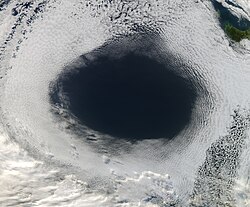
Satellite image showing a high-pressure area south of Australia, evidenced by the clearing in the clouds[1]

A high-pressure area, high, or anticyclone, is an area near the surface of a planet where the atmospheric pressure is greater than the pressure in the surrounding regions. Highs are middle-scale meteorological features that result from interplays between the relatively larger-scale dynamics of an entire planet's atmospheric circulation.

The strongest high-pressure areas result from masses of cold air which spread out from polar regions into cool neighboring regions. These highs weaken once they extend out over warmer bodies of water.

Weaker—but more frequently occurring—are high-pressure areas caused by atmospheric subsidence: Air becomes cool enough to precipitate out its water vapor, and large masses of cooler, drier air descend from above.

Within high-pressure areas, winds flow from where the pressure is highest, at the center of the area, towards the periphery where the pressure is lower. However, the direction is not straight from the center outwards, but curved due to the Coriolis effect from Earth's rotation. Viewed from above, the wind direction is bent in the direction opposite to the planet's rotation.

On English-language weather maps, high-pressure centers are identified by the letter H. Weather maps in other languages may use different letters or symbols.

Wind circulation in the Northern and Southern hemispheres

[edit]

The direction of wind flow around an atmospheric high-pressure area and a low-pressure area, as seen from above, depends on the hemisphere. High-pressure systems rotate clockwise in the northern Hemisphere; low-pressure systems rotate clockwise in the southern hemisphere.[2]

High pressure systems in the temperate latitudes generally bring warm weather in summer, when the amount of heat received from the Sun during daytime exceeds what is lost at night, and cold weather in winter when the amount of heat lost at night exceeds what is gained during daytime.[3]

In the Southern Hemisphere the result is similar. Australia and the southern cone of South America get hot, dry summer weather from the subtropical ridge and cooler wetter winter weather as cold fronts from the southern oceans take over.[4]

The term cyclone was coined by Henry Piddington of the British East India Company to describe the devastating storm of December 1789 in Coringa, India.[5] A cyclone forms around a low-pressure area. Anticyclone, the term for the kind of weather around a high-pressure area, was coined in 1877 by Francis Galton.[6]

A simple rule is that for high-pressure areas, where generally air flows from the center outward, the coriolis force given by the earth's rotation to the air circulation is in the opposite direction of earth's apparent rotation if viewed from above the hemisphere's pole. So, both the earth and winds around a low-pressure area rotate counter-clockwise in the northern hemisphere, and clockwise in the southern. The opposite to these two cases occurs in the case of a high. These results derive from the Coriolis effect.[7]

Formation

[edit]
A surface weather analysis for the United States on 21 October 2006. High pressure areas are labeled "H".

High-pressure areas form due to downward motion through the troposphere, the atmospheric layer where weather occurs. Preferred areas within a synoptic flow pattern in higher levels of the troposphere are beneath the western side of troughs. On weather maps, these areas show converging winds (isotachs), also known as convergence, near or above the level of non-divergence, which is near the 500 hPa pressure surface about midway up through the troposphere, and about half the atmospheric pressure at the surface.[8][9]

High pressure systems are also called anticyclones. On English-language weather maps, high-pressure centers are identified by the letter H in English,[10] within the isobar with the highest pressure value. On constant pressure upper level charts, it is located within the highest height line contour.[11]

Typical conditions

[edit]
The subtropical ridge shows up as a large area of black (dryness) on this water vapor satellite image from September 2000.

Highs are frequently associated with light winds at the surface and subsidence through the lower portion of the troposphere. In general, subsidence will dry out an air mass by adiabatic, or compressional, heating.[12] Thus, high pressure typically brings clear skies.[13] During the day, since no clouds are present to reflect sunlight, there is more incoming shortwave solar radiation and temperatures rise. At night, the absence of clouds means that outgoing longwave radiation (i.e. heat energy from the surface) is not absorbed, giving cooler diurnal low temperatures in all seasons. When surface winds become light, the subsidence produced directly under a high-pressure system can lead to a buildup of particulates in urban areas under the ridge, leading to widespread haze.[14] If the low level relative humidity rises towards 100 percent overnight, fog can form.[15]

Strong, vertically shallow high-pressure systems moving from higher latitudes to lower latitudes in the northern hemisphere are associated with continental arctic air masses.[16] Once arctic air moves over an unfrozen ocean, the air mass modifies greatly over the warmer water and takes on the character of a maritime air mass, which reduces the strength of the high-pressure system.[17] When extremely cold air moves over relatively warm oceans, polar lows can develop.[18] However, warm and moist (or maritime tropical) air masses that move poleward from tropical sources are slower to modify than arctic air masses.[19]

In climatology

[edit]
The Hadley cell carries heat and moisture from the tropics towards the northern and southern mid-latitudes. It deposits drier air, contributing to the world's great deserts.

The horse latitudes, or torrid zone,[20] is roughly at the 30th parallel and is the source of warm high pressure systems. As the hot air closer to the equator rises, it cools, losing moisture; it is then transported poleward where it descends, creating the high-pressure area.[21] This is part of the Hadley cell circulation and is known as the subtropical ridge or subtropical high. It follows the track of the sun over the year, expanding north (south in the Southern Hemisphere) in spring and retreating south (north in the Southern Hemisphere) in fall.[22] The subtropical ridge is a warm core high-pressure system, meaning it strengthens with height.[23] Many of the world's deserts are caused by these climatological high-pressure systems.[24]

Some climatological high-pressure areas acquire regionally based names. The land-based Siberian High often remains quasi-stationary for more than a month during the most frigid time of the year, making it unique in that regard. It is also a bit larger and more persistent than its counterpart in North America.[25] Surface winds accelerating down valleys down the western Pacific Ocean coastline, causing the winter monsoon.[26] Arctic high-pressure systems such as the Siberian High are cold core, meaning that they weaken with height.[23] The influence of the Azores High, also known as the Bermuda High, brings fair weather over much of the North Atlantic Ocean and mid to late summer heat waves in western Europe.[27] Along its southerly periphery, the clockwise circulation often impels easterly waves, and tropical cyclones that develop from them, across the ocean towards landmasses in the western portion of ocean basins during the hurricane season.[28] The highest barometric pressure ever recorded on Earth was 1,085.7 hectopascals (32.06 inHg) measured in Tosontsengel, Zavkhan, Mongolia on 19 December 2001.[29]

A particularly hot summer such as 2003 which saw the subtropical ridge expand more than usual can bring heat waves as far north as Scandinavia—conversely, while Europe had record-breaking summer heat in 2003 due to a particularly strong subtropical ridge, its counterpart in North America was unusually weak, and temperatures across the continent that spring and summer were wet and well below normal.[30]

Connection to wind

[edit]

Atmospheric air flows from areas of high pressure to areas of low pressure resulting in wind.[31] Since stronger high-pressure systems contain cooler or drier air, the air mass is more dense and flows towards areas that are warm or moist where air is less dense and atmospheric pressure at the surface is lower. The larger the pressure difference between a high-pressure system and a low-pressure system, the higher the wind speed. The coriolis force caused by the Earth's rotation is what gives winds within high-pressure systems their clockwise circulation in the northern hemisphere (as the wind moves outward and is deflected right from the center of high pressure) and counterclockwise circulation in the southern hemisphere (as the wind moves outward and is deflected left from the center of high pressure). Friction with land slows down the wind flowing out of high-pressure systems and causes wind to flow more outward than would be the case in the absence of friction. This results in the 'actual wind' or 'true wind', including ageostrophic corrections, which add to the geostrophic wind that is characterized by flow parallel to the isobars.[7]

See also

[edit]

References

[edit]
Revisions and contributorsEdit on WikipediaRead on Wikipedia
from Grokipedia
A high-pressure area, also known as an anticyclone, is a in the Earth's atmosphere where the surface exceeds that of surrounding areas, typically measured in millibars or hectopascals. This elevated pressure results from denser, cooler air sinking toward the surface and diverging outward from the center, creating a stable atmospheric column. High-pressure areas are fundamental to patterns, often spanning hundreds to thousands of kilometers and influencing regional climates through their persistence or movement. High-pressure systems generally bring fair conditions, including clear skies, low , and minimal , as the descending air warms adiabatically and suppresses formation and vertical motion. Winds associated with these systems flow outward from the high-pressure center, rotating clockwise in the and counterclockwise in the due to the Coriolis effect. These circulation patterns can lead to temperature inversions, where warmer air aloft traps cooler surface air, potentially causing or buildup in stagnant conditions. High-pressure areas form through various mechanisms, including the cooling of air masses that increases and promotes , or as part of semi-permanent features like subtropical highs driven by global circulation cells such as the . In mid-latitudes, they often develop ahead of upper-level ridges in the , blocking the progression of storms and extending periods of dry . While beneficial for outdoor activities, prolonged high-pressure dominance can exacerbate droughts or heatwaves in summer and cold snaps in winter by limiting moisture influx.

Definition and Characteristics

Definition

A high-pressure area, also known as an anticyclone or high, is a region near the Earth's surface where the exceeds that of the surrounding environment. These systems are identified on meteorological maps through isobars—lines connecting points of equal —that often form closed, oval-shaped contours encircling a central point of maximum . The term "anticyclone" specifically refers to the large-scale wind circulation pattern rotating around this high-pressure center, distinguishing it as a coherent atmospheric feature. Unlike low-pressure areas, or cyclones, where the pressure gradient drives converging air masses inward toward the center, high-pressure areas exhibit a diverging flow as air spreads outward from the high toward adjacent lower-pressure zones, resulting in at the core. This outward typically produces lighter winds compared to the stronger inflows around lows, with circulation directions opposing those of cyclones due to the —clockwise in the and counterclockwise in the . High-pressure areas manifest across a range of spatial scales, from smaller mesoscale features spanning tens to hundreds of kilometers, often linked to localized or dynamic processes, to expansive synoptic-scale systems covering thousands of kilometers, and including semi-permanent subtropical highs that persist seasonally and influence broader circulation. These variations in size allow high-pressure systems to play roles from transient modifiers to enduring components of global atmospheric patterns.

Physical Properties

High-pressure areas exhibit high atmospheric stability primarily due to the of air masses, which suppresses vertical motion and promotes the development of temperature inversions. In these systems, descending air warms adiabatically, creating a layer of warmer air aloft that overlies cooler surface air, thereby inhibiting and reducing vertical mixing within the . This stability is a key thermodynamic feature, as the inversion layer acts as a cap on upward air parcels, limiting and enhancing the persistence of the high-pressure regime. The subsidence process involves warmer air from upper atmospheric levels descending toward the surface, where it undergoes adiabatic compression. This compression increases the air's temperature without heat exchange with the surroundings, following the dry adiabatic lapse rate for unsaturated conditions. The dry adiabatic lapse rate is defined as Γ=gCp9.8K/km\Gamma = \frac{g}{C_p} \approx 9.8 \, \text{K/km}, where gg is the acceleration due to gravity (approximately 9.81 m/s²) and CpC_p is the specific heat capacity of dry air at constant pressure (about 1004 J/kg·K); this rate quantifies the warming of sinking air parcels by roughly 9.8°C per kilometer of descent. In high-pressure areas, the , which directs air from regions of higher to lower pressure, is balanced by the Coriolis effect acting on the rotating air masses, leading to geostrophic flow. This balance results in of air at the surface, where air spreads outward from the high-pressure center, further reinforcing the aloft and maintaining the system's structure. Mid-latitude high-pressure areas, or anticyclones, typically span diameters of 1,000 to 3,000 km, encompassing large-scale regions that influence over continental scales.

Formation Processes

Subsidence and Adiabatic Heating

In high-pressure areas, refers to the downward vertical motion of air masses, which is primarily driven by horizontal convergence of air in the upper . This convergence aloft forces air to descend to maintain mass continuity in the atmospheric column, resulting in widespread sinking motion that characterizes anticyclonic systems. As subsiding air descends through increasing pressure levels, it undergoes adiabatic compression, leading to a temperature increase without any external heat exchange. This process follows the dry adiabatic lapse rate, where the temperature change with height for a descending air parcel is given by dTdz=Γ\frac{dT}{dz} = -\Gamma with Γ\Gamma representing the dry adiabatic lapse rate, approximately 9.8 K/km under standard conditions. The compression work done on the air parcel converts potential energy into thermal energy, warming the air at a rate determined by the specific heat capacity of dry air and gravitational acceleration. The adiabatic heating from often produces a inversion, where increases with height in the lower , creating a stable layer that inhibits vertical mixing and . This inversion acts as a cap, suppressing the formation and development of clouds by trapping moisture and preventing upward motion necessary for . Such inversions are common in the subsidence zones of persistent high-pressure systems, contributing to clear skies and dry conditions at the surface. A notable example of subsidence occurs through radiative cooling at night in clear areas under high-pressure influence, where surface cooling enhances local sinking motion and strengthens the inversion layer. This nighttime amplifies the overall stability, as the cooled near-surface air becomes denser and promotes further descent from aloft, often observed in fair-weather anticyclones during winter months.

Dynamic and Thermal Influences

High-pressure areas often form dynamically through interactions between upper-level atmospheric flows, particularly involving Rossby waves and jet streams. Rossby waves, large-scale undulations in the mid-latitude westerly winds, create ridges of high aloft where anticyclonic circulation predominates. In these ridges, upper-level convergence occurs due to the deceleration of air as it approaches the ridge crest, promoting and the development of surface below. interactions amplify this process; the polar , embedded within Rossby waves, features jet streaks that enhance convergence on the anticyclonic side of ridges, further strengthening the upper-level forcing for high-pressure formation. Thermal influences contribute significantly to the initiation and sustenance of high-pressure areas, especially over continental regions during cold seasons. of the surface air over snow-covered or icy landmasses increases air , creating horizontal contrasts that drive convergence at low levels and the buildup of . For instance, the exemplifies this mechanism, where intense winter cooling over the expansive Eurasian landmass leads to persistent cold air pooling and surface , with mean sea-level pressures often exceeding 1030 hPa. This thermal forcing interacts with dynamic processes, as the dense cold air enhances upper-level convergence in nearby ridges. On a planetary scale, high-pressure areas frequently arise in the descent zones of large-scale circulation cells, such as the . In the , around 30° , the poleward-returning upper branch of the subsides, producing semi-permanent high-pressure belts like the subtropical highs. This descent is driven by the need to balance the equatorward mass transport from rising air in the , resulting in widespread upper-level divergence that reinforces surface through adiabatic compression. The recognition of these dynamic and thermal influences on high-pressure areas emerged in the through the advent of synoptic mapping enabled by . Meteorologists like , who conducted global observations in the 1880s, documented anticyclones on early charts, linking them to upper-air patterns and continental cooling, thus laying foundational insights into their formation mechanisms.

Wind and Circulation Patterns

Northern Hemisphere Circulation

In the Northern Hemisphere, winds around a high-pressure area, or anticyclone, rotate clockwise due to the Coriolis effect, which deflects moving air to the right relative to the Earth's surface. This rotation results from the interaction between the pressure gradient force directing air outward from the high-pressure center and the Coriolis force altering its path. At the surface, the circulation leads to , where air spreads outward in a spiraling pattern away from the center, often producing light winds near the core with speeds typically ranging from 5 to 20 km/h due to weak gradients. This outward flow is balanced by convergence aloft in the upper , where air streams inward toward the anticyclone's axis, maintaining the system's stability through . A prominent example is the , a semi-permanent subtropical anticyclone centered near 30°N, whose clockwise circulation drives the northeast equatorward, contributing to the meridional flow in the .

Southern Hemisphere Circulation

In the , high-pressure areas, or anticyclones, exhibit counterclockwise circulation at the surface due to the Coriolis effect deflecting air to the left of its intended path. This deflection arises from , causing outward-flowing air from the high-pressure center to spiral counterclockwise, in contrast to the clockwise rotation observed in the . The drives air away from the center, promoting similar to systems, which contributes to clear skies and stable conditions beneath. The larger proportion of ocean coverage in the Southern Hemisphere influences high-pressure systems, making them more persistent and semi-permanent compared to their Northern counterparts, as oceanic surfaces provide a more uniform thermal environment with less disruption from landmasses. Subtropical highs, centered around 30°S, descend over vast ocean expanses, enhancing their stability and leading to continuous belts of high pressure that drive consistent wind patterns across the region. These systems often exhibit reduced variability due to the muted land-ocean thermal contrasts. A notable example is the Australian High, part of the subtropical , which influences weather patterns across by blocking fronts and affecting . This high-pressure system promotes southeast equatorward and southwest poleward, facilitating the transport of moisture and heat in the while maintaining the overall counterclockwise flow.

Weather Conditions

Surface Weather Features

High-pressure areas at the surface are characterized by clear skies and sunny conditions, as inhibits vertical motion and suppresses , preventing the development of clouds and . This descending air warms adiabatically, increasing its capacity to hold and leading to of any existing clouds, resulting in fair dominance. often reveals these systems through bright, clear radiances in visible channels, contrasting with cloudy regions associated with low-pressure areas. In the center of a high-pressure system, winds are typically light and calm due to weak pressure gradients, fostering stable atmospheric conditions. However, in valleys or low-lying , radiative under these clear, calm nights can lead to formation or , as heat loss to cools the surface rapidly and allows cold air drainage to pool. This radiative enhances temperature inversions near the ground, trapping moisture and promoting or hoar on surfaces. For example, when high pressure dominates the United Kingdom, particularly in winter, it leads to mostly settled and largely dry conditions across the region, with temperatures below average, widespread frost possible, and precipitation limited to occasional showers. Relative humidity in high-pressure areas exhibits a pronounced diurnal cycle, often reaching high values—approaching 100%—at night due to surface cooling, which can result in formation, while daytime values remain low as solar heating evaporates moisture and dries the lower atmosphere. Large dew point depressions, typically exceeding 10–20°C aloft, further indicate the presence of dry air overriding the surface layer, reinforcing the overall despite nocturnal spikes.

Associated Phenomena

High-pressure areas, through prolonged , can induce significant adiabatic warming as descending air compresses and heats, contributing to extreme heat events such as heatwaves. This warming is exacerbated when blocking highs persist, trapping heat near the surface and preventing cooler air . For instance, the , which resulted in over 70,000 excess deaths, was driven by a persistent blocking high-pressure system over much of the continent, leading to record temperatures and prolonged hot conditions. Similar dynamics have been observed in other events, where subsidence inhibits cloud formation and allows intense solar heating to amplify surface temperatures. The sinking motion in high-pressure systems suppresses vertical uplift, inhibiting the formation of clouds and , which can prolong conditions in affected regions. This creates stable atmospheric layers that limit moisture convergence, exacerbating drying and deficits, as seen in various North American s where high-pressure ridges blocked tracks. In such scenarios, the lack of rainfall combines with increased under clear skies to intensify agricultural and hydrological stress. High-pressure areas often foster temperature inversions that trap pollutants near the surface, particularly in urban environments, leading to elevated levels and poor air quality. These inversions, enhanced by , reduce vertical mixing and allow emissions from vehicles and industry to accumulate, as documented in where stagnant high-pressure conditions routinely worsen photochemical smog. Stability inversions under these systems can persist for days, concentrating particulate matter and in the . In arid desert regions dominated by high-pressure systems, intense surface heating under clear skies can generate localized thermal instabilities, occasionally producing dust devils as rare convective phenomena. These short-lived vortices arise from buoyant updrafts in the superadiabatic , lifting loose sand and dust into visible columns, though they are more frequent in anticyclonic fair-weather conditions typical of subtropical highs.

Climatological Significance

Role in Global Climate Patterns

High-pressure areas, particularly the semi-permanent subtropical highs, play a pivotal role in driving the Hadley circulation, a fundamental component of Earth's atmospheric transport system that redistributes heat from the to higher latitudes. These highs form at the descending branches of the Hadley cells, where air cooled aloft sinks, creating zones of high around 30° latitude in both hemispheres. This inhibits cloud formation and , fostering arid conditions in subtropical regions, while the resulting divergence at the surface fuels the that converge near the . For instance, the Hawaiian High, a prominent North Pacific subtropical anticyclone, strengthens the northeast , which transport moisture across the and influence oceanic patterns essential for global heat balance. The position and intensity of subtropical highs significantly affect the (ITCZ), the band of low pressure where from both hemispheres meet and rise, driving tropical rainfall. Stronger highs can push the ITCZ equatorward by enhancing trade wind convergence, while seasonal shifts in solar heating cause the ITCZ to migrate northward in boreal summer and southward in austral summer, with highs adjusting accordingly to maintain the Hadley cell's integrity. This dynamic interplay modulates the timing and intensity of wet and dry seasons across equatorial regions, contributing to the stability of global precipitation patterns over annual cycles. In mid-latitudes, transient blocking highs disrupt the prevailing , altering storm tracks and introducing variability into hemispheric climate patterns. These persistent anticyclones, often associated with upper-level ridges in the , divert the jet stream into amplified waves, slowing the progression of weather systems and leading to prolonged regional anomalies such as heatwaves or cold outbreaks. The (NAO), a key index of this variability, reflects phases where positive NAO strengthens mid-latitude and negative NAO features blocking highs that weaken them, thereby influencing winter climate over and through changes in heat and moisture transport. Within general circulation models (GCMs), high-pressure systems are essential features for accurately simulating dynamics, as they represent the large-scale that modulates convective activity and rainfall distribution. GCMs incorporate these highs to capture the interplay between subtropical anticyclones and monsoon lows, enabling predictions of seasonal onset, intensity, and propagation, such as the Indian summer monsoon's dependence on the positioning of the Mascarene High. Improved resolution in modern GCMs better resolves these features, reducing biases in forecasts and enhancing understanding of climate change impacts on these circulations.

Regional High-Pressure Systems

The polar highs are semi-permanent areas of high situated over the and regions, characterized by cold air masses that sink due to in winter, making them strongest during that season. These systems contribute to the cold, dry conditions typical of polar climates, with the polar high influencing weather patterns and the counterpart similarly affecting the . Subtropical highs represent large-scale, semi-permanent anticyclones located around 30° in both hemispheres, formed by descending air in the Hadley and Ferrel cells. Notable examples include the in the North Atlantic, centered near the Islands and influencing European and North American weather; the Hawaiian High, or , positioned off the and affecting Pacific ; and the Mascarene High in the South , near the , which modulates Southern African and circulation. These systems migrate seasonally, shifting poleward in summer (up to 5° ) and equatorward in winter due to the movement of the , thereby influencing the positions of and storm tracks. Continental high-pressure systems provide key examples of regionally dominant features, such as the , a cold, wintertime anticyclone over that intensifies in December–February, driving northerly cold surges and extreme winter conditions across . Similarly, the High, a subtropical system over the western North Atlantic, steers tropical cyclones by controlling steering winds, often directing Atlantic hurricanes westward into the or northward along the U.S. East Coast during the hurricane season. In the mid-latitudes of Western Europe, high-pressure systems dominating the United Kingdom often lead to settled and largely dry conditions, with below-average temperatures, the possibility of widespread frost, and precipitation limited to occasional showers. These blocking anticyclones can persist, altering regional weather patterns and contributing to prolonged cold spells. Satellite observations and reanalysis data since 2000 indicate trends of intensification in several regional highs, with some evidence of latitudinal shifts, linked to anthropogenic climate change, including a strengthening of the Azores High with positive sea-level pressure anomalies and an enhancement of the Siberian High amid Arctic amplification. These shifts, observed through instruments like those on NASA's Aqua satellite and NOAA's reanalysis products, suggest broader implications for global circulation patterns, such as altered monsoon dynamics and storm paths. Recent analyses as of 2025 indicate ongoing poleward shifts in the Hadley circulation, further influencing these high-pressure systems.

References

Add your contribution
Related Hubs
User Avatar
No comments yet.