

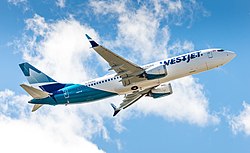

WestJet
View on Wikipedia
WestJet is a Canadian airline headquartered in Calgary, Alberta.[9] Founded in 1994, it is the second largest airline in Canada and the eighth-largest airline in North America by frequency.[10] It began operations in 1996 with 220 employees, three aircraft, and five destinations,[11] and was launched as a low-cost alternative to the country's major airlines.[12]
Key Information


WestJet operates scheduled, charter, and cargo air service, transporting more than 25 million passengers per year in over 100 destinations across North America, Caribbean, Europe, Asia, and Central America.[13][14][15] WestJet utilizes Calgary International Airport as its exclusive global connecting hub,[16] with Toronto Pearson International Airport being a strategic secondary hub. The airline has two direct subsidiaries: WestJet Encore,[17] which operates the De Havilland Canada Dash 8, the Q400NextGen, on routes in Western Canada, and WestJet Cargo, which operates three cargo aircraft, all Boeing 737s (800BCF), which were previously used as WestJet passenger aircraft and converted for cargo use.
WestJet is not a member of any major airline alliances,[18] such as Star Alliance, Oneworld, or SkyTeam. However, it utilizes codeshare and interline agreements with various airlines.[19]
History
[edit]1994–1999: First flights
[edit]
WestJet was founded on June 27, 1994,[20] by Clive Beddoe, David Neeleman, Mark Hill, Tim Morgan, and Donald Bell. WestJet was based on the low-cost carrier business model pioneered by Southwest Airlines and Morris Air in the United States. Its original routes were all located in Western Canada, which gave the airline its name.
On February 29, 1996, the first WestJet flight operated by a Boeing 737-200 departed. Initially, the airline served Calgary, Edmonton, Kelowna, Vancouver and Winnipeg with a fleet of three second-hand Boeing 737-200s and 225 employees. By the end of that same year, the company had added Regina, Saskatoon and Victoria to its network.
In mid September 1996, WestJet's fleet was grounded due to a disagreement with Transport Canada over maintenance schedule requirements. The airline suspended all service for two weeks before resuming flights.[21]
In early 1999, Clive Beddoe stepped down as WestJet's CEO and was replaced by former Air Ontario executive Steve Smith. In July 1999, WestJet made its initial public offering of stock at 2.5 million shares, opening at $10 per share.[22] The same year, the cities of Thunder Bay, Grande Prairie, and Prince George were added to WestJet's route map.
In 2000, WestJet CEO Steve Smith was released from WestJet after 18 months in the position, due to differences in management style;[23] Smith went on to head rival Air Canada's low-cost subsidiary Zip. After Smith's departure, Clive Beddoe again became CEO of the company, a position he held until July 2007.[24]
2000–2003: Domestic expansion
[edit]
Due to restructuring in the Canadian airline industry resulting from Air Canada's takeover of Canadian Airlines in 2000, WestJet expanded into Eastern Canada, beginning service to the cities of Hamilton and Ottawa, Ontario, and Moncton, New Brunswick. The airline selected John C. Munro Hamilton International Airport to be the focus of its Eastern Canadian operations and its main connection point in Eastern Canada.
In 2001, WestJet's expansion continued with routes to Comox, along with Sault Ste. Marie, Sudbury, Ontario, Thompson and Brandon, Manitoba; however, service to each of these four cities has since been withdrawn. Service to Brandon, Manitoba and Sudbury, Ontario,[25] was subsequently resumed by WestJet's wholly owned subsidiary, WestJet Encore.
In 2002, the airline also added another two new Eastern Canadian destinations: the Ontario cities of London and Toronto. In April 2003, WestJet added Windsor, Montreal, Halifax, St. John's and Gander.
WestJet entered into a two-year agreement with Air Transat in August 2003 whereby WestJet aircraft would be filled by Transat's two main tour operators, World of Vacations and Transat Holidays. These chartered flights operated largely to destinations in Mexico and the Caribbean and the planes were operated by WestJet crews. This agreement between WestJet and Air Transat was amicably terminated in February 2009.[26]
In 2004, rival airline Air Canada accused WestJet of industrial espionage and filed a civil suit against WestJet in Ontario Superior Court. Air Canada accused WestJet of accessing Air Canada confidential information via a private website to gain a business advantage.[27] On May 29, 2006, WestJet admitted to the charges levelled by Air Canada and agreed to pay C$5.5 million in legal and investigation fees to Air Canada and donate C$10 million to various children's charities in the names of Air Canada and WestJet.[28]
2004–2006: International expansion
[edit]In January 2004, WestJet announced that it was moving the focus of its Eastern operations from Hamilton to Toronto the following April, fully moving into the lucrative Toronto–Ottawa–Montreal triangle and tripling the total number of its flights out of Toronto Pearson International Airport.[29]
.jpg)
In 2004, several U.S. destinations were added or announced. These included San Francisco, Los Angeles, Phoenix, Tampa, Fort Lauderdale, Orlando and LaGuardia Airport in New York City.[30] In early 2005, Palm Springs and San Diego were added to the company's list of destinations, while New York–LaGuardia was dropped. In April 2005, it announced new seasonal service to Charlottetown and ceased service to Gander. In fall 2005, Fort Myers and Las Vegas were added to the growing list of destinations.
In late August 2005, WestJet flew to Baton Rouge, Louisiana, transporting members of a Vancouver-based urban search and rescue team to assist with Hurricane Katrina relief efforts.[31]
After rumours and speculation surrounding the implementation of extended-range twin-engine operations (ETOPS), WestJet announced new service to Hawaii from Vancouver on September 20, 2005. In December 2005, the airline began flying from Vancouver to Honolulu and Maui.
WestJet's first scheduled service outside Canada and the United States began in 2006, to Nassau, The Bahamas. This was considered a huge milestone within the company's long-term destination strategy and was a vital goal for future international market presence.
In September 2006, Sean Durfy took over as president of WestJet from founder Clive Beddoe.[32]
On October 26, 2006, WestJet announced that it had its best quarterly profit to date, of C$52.8 million.
2007–2009: Continued growth
[edit]
In 2007, WestJet announced that it would begin flights from Deer Lake in Newfoundland, Saint John in New Brunswick and Kitchener-Waterloo in Ontario. In June 2007, WestJet added seven new international seasonal flights to Saint Lucia, Jamaica, the Dominican Republic, Mexico as well as a third Hawaiian destination, Kona.
The same year, WestJet commissioned the construction of a new six-story head office building, next to their existing hangar facility at the Calgary International Airport. The building was constructed following the Leadership in Energy and Environmental Design (LEED) Green Building Rating System, featuring a rainwater retention system and geothermal heating. The first employees moved in during the first quarter of 2009, and the building officially opened the following May.[33] The WestJet Campus building was certified as LEED Gold standard in October 2011.[34]
In May 2008, WestJet launched daily non-stop service to Quebec City. The next month, WestJet commenced seasonal service between Calgary and New York City via Newark Liberty International Airport. In May 2009, the airline launched new seasonal service to the cities of Yellowknife, Northwest Territories[35] and Sydney, Nova Scotia;[36] service to Yellowknife was later extended through the winter of 2009–10.
During the 2000s (decade), WestJet made significant gains in domestic market share against Air Canada. In 2000, it held only 7% to Air Canada's 77%, though by the end of 2009 WestJet had risen to 38%, against Air Canada's 55%.[37]
In late April 2009, WestJet temporarily suspended service to several of its destinations in Mexico due to the outbreak of influenza A (H1N1) in the country. The suspension of service to Cabo San Lucas, Mazatlán and Puerto Vallarta lasted from early May until mid June, with seasonal service to Cancún being restored the following fall.[38]
In July 2009, WestJet announced 11 new international destinations for its winter schedule. These included expanded service to the United States, to Atlantic City, New Jersey, Lihue (Kauai), Hawaii and Miami, Florida. New Caribbean destinations included Providenciales, in the Turks and Caicos Islands; Sint Maarten, Netherlands Antilles; Freeport, The Bahamas; as well as the cities of Varadero, Holguín and Cayo Coco in Cuba. Ixtapa and Cozumel were also added to the list of destinations served in Mexico.[39][40]
In November 2009, WestJet announced service to the British island territory of Bermuda, which commenced in May 2010.[41] WestJet also resumed seasonal service to Windsor, Ontario that same month.[citation needed]
2010–2016: Overseas expansion
[edit]In March 2010, Sean Durfy resigned from his position as WestJet's CEO, citing personal reasons.[42] He was replaced by Gregg Saretsky, a former executive at Canadian Airlines and Alaska Airlines and previously vice-president of WestJet Vacations and Executive Vice-president of Operations.
In July 2010, WestJet announced service to Santa Clara, Cuba, New Orleans and Grand Cayman bringing the total number of destinations to 71. Service to New Orleans lasted only one season and did not return the next year.
In late 2010, WestJet announced it was wet-leasing a Boeing 757 aircraft to expand service between Calgary to Honolulu and Maui and Edmonton to Maui, on a seasonal basis.[43][44] Also that year, the Canadian Transportation Agency (CTA), an independent administrative tribunal of the Government of Canada that regulates airlines, found WestJet's baggage policies to be unreasonable and/or contrary to the requirements of the Canada Transportation Act and/or the Air Transport Regulations on several different occasions.[45][46][47][48][49][50]
On January 26, 2011, after Air Canada terminated California service, WestJet announced plans to enter service to John Wayne Airport in Orange County, California from Vancouver and Calgary starting May of that year.[51]
.jpg)
In November 2011, WestJet won an auction for time slots at New York's LaGuardia Airport ushering in a return to service to New York.[52] Details of WestJet's scheduled service to LaGuardia were officially announced in January 2012.[53] From 2012 to 2014, WestJet further expanded into the United States by adding Chicago via O'Hare International Airport, Dallas Fort Worth International Airport, Myrtle Beach International Airport, and New York's John F. Kennedy International Airport.
On November 15, 2013, WestJet announced their first destination in Europe. Seasonal service from St. John's, Newfoundland to Dublin, Ireland, would operate from June to October 2014.[54]
In January 2014, WestJet chartered an Atlas Air Boeing 747-400 to transport stranded passengers and luggage during the 2013 Central and Eastern Canada ice storm. The charter flew from Toronto Pearson International Airport to Calgary International Airport.[55]
On July 7, 2014, WestJet announced that it was in the "advanced stages of sourcing" four wide-body aircraft that would begin flying by the fall of 2015.[56] These would initially serve on the seasonal Alberta-Hawaii routes when WestJet's service agreement with Thomas Cook Airlines—who currently fly these routes on behalf of WestJet—expires in the spring of 2015. WestJet would take delivery of four Boeing 767-300ERs in summer 2015.[57] WestJet took delivery of the first of these aircraft on August 27, 2015.[58][59]
On June 16, 2015, WestJet announced the launch of service to London's Gatwick Airport on May 6, 2016. It is the carrier's third transatlantic destination after Dublin and Glasgow. The majority of flights to London use the wide-body 767-300ER aircraft.[60] On September 15, 2015, WestJet flights to London direct from Edmonton, St. John's, Vancouver, Winnipeg (seasonal) Calgary and Toronto (year-round) went on sale to the public.[61] During winter months, WestJet continued to serve the seasonal Edmonton - Maui, Calgary - Honolulu, and Calgary - Maui flights with the 767-300ER aircraft before their eventual retirement in 2020.
2017–2019: Transition to full-service carrier
[edit].jpg)
In April 2017, WestJet announced plans to launch an ultra-low-cost carrier in late 2017.[62] The new airline would operate using Boeing 737-800 aircraft, and compete with new entrants to the market, such as Flair Airlines.[63] The launch of the new airline, named Swoop, was delayed until June 2018.[64]
On December 6, 2017, WestJet and Delta Air Lines signed a preliminary memorandum of understanding to extend their current codeshare agreement into a joint venture, pending regulatory and board approval.[65] On July 19, 2018, WestJet and Delta Air Lines signed a definitive ten-year agreement into a joint venture between the two airlines.[66] This joint venture would have served more than 95% of the Canada–U.S. demand. The airlines' current frequent flier programs would also be updated to be more closely aligned, and the airlines will be co-located at key hub airports. However, in November 2020, Delta and WestJet agreed to scrap their plans for a joint venture, as the demands of the United States Department of Transportation were seen "unreasonable and unacceptable" by both airlines.[67]
While announcing an expansion of the senior leadership team on January 11, 2018, Gregg Saretsky reconfirmed the airline's strategic goal to become a global, full-service carrier.[68]
On March 8, 2018, the CEO of WestJet, Gregg Saretsky retired.[69] He was replaced by company vice-president, Ed Sims.
On May 8, 2018, WestJet announced that it would be adding the Boeing 787-9 to its fleet. The first aircraft was delivered to the airline in January 2019.[10]
On May 10, 2018, WestJet's unionized pilots voted 91 percent in favour of strike action. The key issue in negotiations was the outsourcing of work to operate Swoop aircraft.[70] On May 25, 2018, WestJet and the Air Line Pilots Association (ALPA) agreed to a settlement process through the Federal Mediation and Conciliation Service.[71]
On May 14, 2018, WestJet announced new 2-2 Premium Economy seating to replace its previous 3-3 seats which had a middle seat blocker. The new seats feature a wider configuration on 737 aircraft. The offering began on its Boeing 737 MAX 8 aircraft in winter 2018,[72] with all 737s being reconfigured by 2020.
On May 31, 2018, WestJet operated its first flight to Europe with the inaugural flight from Halifax Stanfield International Airport to Paris' Charles de Gaulle Airport.[73]
The Canadian Union of Public Employees (CUPE) announced its application to the Canadian Government for certification of WestJet's approximately 3,200 flight attendants on July 9, 2018. On July 31, 2018, the Government of Canada via the Canada Industrial Relations Board (CIRB) issued an interim order certifying CUPE as the accredited union for WestJet mainline flight attendants.[74][75]

On October 12, 2018, WestJet announced its new branding, along with details on the arrival on the Boeing 787-9. WestJet changed its slogan from "Owners Care" to "Love where you're going", announced a new logo (however, that logo was seen back in May with the announcement of the Boeing 787-9 along with its livery), announced the Boeing 787 routes and launch dates, and an overall new brand image. Boeing 787 flights were announced to commence on April 28, 2019, with service from Calgary International Airport to London Gatwick, with service to Paris and Dublin following.[76]
On May 13, 2019, WestJet announced it had reached an agreement to be purchased by Onex Corporation for $5 billion Canadian dollars. At the time, it had 13 Boeing 737 MAX jets in suspended operation, with another 57 of the type ordered from the manufacturer. The purchase price of WestJet was slashed heavily due to the grounding of the MAX aircraft.[77]
2020–2022: COVID-19 pandemic
[edit]Due to the COVID-19 pandemic response required by world governments including Canada, WestJet faced an unprecedented decline in demand for flights along with the rest of the aviation industry. In addition, there were numerous cases of COVID-19 reported on board WestJet flights.[78]
In March 2020, WestJet suspended all international flights,[79] resulting in widespread workforce adjustments. Approximately half of the employees, totalling 6,900, were laid off on March 24.[80] Subsequently, on April 9, WestJet temporarily rehired 6,400 employees through the federal wage subsidy program (CEWS).[81] Additional layoffs followed, with approximately 8,000 employees between April and June,[82][83] as part of a restructuring plan, leaving only 4,500 employees on the payroll. Before the pandemic, WestJet employed over 14,000 individuals.[84] By February 2021, the company laid off an additional 250 staff members due to ongoing travel restrictions.[citation needed] However, it is noteworthy that a majority of employees were successfully recalled by February 2022, reflecting the company's efforts in adapting to the challenging circumstances.

In June, 2021, WestJet announced that they would begin dedicated freighter operations using converted Boeing B737-800BCF Freighters in an attempt to benefit from the heavy cargo operations that occurred globally during the pandemic, but also to disrupt the air cargo industry in Canada.[85] Although the first freighter was delivered in April, 2022 [86] they would not be certified by transport Canada for over a year after delivery in April 2023, with operations beginning later that same month. Initially, there were three BCF's in the fleet, with a fourth joining later on that year.[87]
2022–present: Focus on Western Canada and strategic low-cost plan
[edit]On June 16, 2022, WestJet announced that it will be reaffirming the airline's commitment to "embracing its cost-conscious roots in service of affordable air travel for Canadians". With this in mind, the current CEO has announced that the airline will be returning to its low-cost roots, shifting its focus to western Canada, and investing in leisure routes.[88] This change resulted in numerous routes and destinations in eastern Canada to be dropped.[89][90]
On September 29, 2022, WestJet announced it had placed an order for an additional 42 Boeing 737 MAX 10 aircraft, making the airline's narrow-body order book the largest in Canada.[91]
On October 6, 2022, WestJet's CEO, Alexis von Hoensbroech, and Alberta Premier, Jason Kenney, announced a major partnership between the Government of Alberta and the WestJet Group. The agreement outlined that Calgary International Airport would become WestJet's sole global hub and the company would designate the airport as "the only airport where WestJet connects directly to intercontinental destinations"[92] Additionally, WestJet would base its entire Boeing 787 Dreamliner fleet in Calgary, opening up the potential for new routes to Europe and Asia. WestJet would also base over 100 aircraft in Calgary and double its capacity at the airport before the end of the decade.[93]
On December 5, 2022, WestJet announced its first destination in Asia, with service from Calgary International Airport to Narita International Airport beginning with three times weekly service on April 30, 2023. WestJet also announced new routes from Calgary to Barcelona–El Prat Airport and Edinburgh Airport, both being served three times a week beginning in May 2023, as well as frequency increases on existing European routes as a part of their plan to increase capacity in Calgary by more than 25% in 2023.[94]
In November 2023, WestJet announced the restart of transatlantic service in Eastern Canada utilizing its Boeing 737 MAX 8 fleet, with the return of service from Toronto to Dublin and Edinburgh,[95] St. John's to London (Gatwick)[96] and Halifax to Dublin, Edinburgh and London (Gatwick). The airline also announced the expansion of transatlantic service from Calgary with new non-stop flights to Keflavík Airport in Reykjavik, Iceland. WestJet also revealed plans to expand its Asian footprint with new seasonal service from Calgary International Airport to South Korea's Incheon International Airport.[95]
In June 2024, WestJet's aircraft mechanic union launched a three-day strike, forcing over 1000 flights to be cancelled in the lead up to the Canada Day long weekend.[97] In October 2024, WestJet will be transitioning all WestJet Link routes from Link to Encore, ending the airline's six-year capacity purchase agreement with Pacific Coastal Airlines.[98] The change is announced as a growth strategy for WestJet's regional network, which will see the WestJet Link routes now being operated by WestJet Encore's 78-seat Bombardier Q400, as opposed to Pacific Coastal's 34-seat Saab 340B.
In March 2025, WestJet decided their dedicated freighter network was no longer viable and would not be part of the airlines long-term plans. As a result, the airline began the process of ending its dedicated freighter network and focusing their cargo operations on belly cargo.[99] At the time, two of the airlines four Boeing B737-800BCF's were in storage, with the other two primarily operating flights for Cargojet on that airlines route between Newark Liberty International Airport to L.F. Wade International Airport in Bermuda.[100] This decision was also led by Kirsten de Bruijn's (Executive VP of Westjet Cargo) decision to exit WestJet.
In June 2025, WestJet suffered a data breach attack from what they describe as a "sophisticated, criminal third party." The data exposed in the breach included names, contact details and travel documents, though no payment information was exfiltrated. WestJet made a notice to U.S. residents on September 29, 2025.[101][102]
In September 2025, WestJet ordered 60 737 MAX 10 and 7 787-9 Dreamliner aircraft, worth US$10,000,000,000 making this the largest-ever Canadian order of Boeing airplanes.[103][104]
Acquisition of Sunwing
[edit]On March 2, 2022, the WestJet Group announced its intent to acquire the Canadian low-cost airline Sunwing. Both WestJet and Sunwing reported that they had reached a mutual, definitive agreement for the merger. Following the close of the transaction, the two airlines would create a new "tour business operating unit" which would be led by current Sunwing CEO Stephen Hunter, which would bind the two airlines' vacation units - Sunwing Vacations and WestJet Vacations - together. The "tour business operating unit" would be based out of Sunwing's head office in Toronto, while the operations of Sunwing would be transitioned and managed at WestJet's head office in Calgary. The acquisition announcement was made shortly after WestJet's new CEO Alexis Von Hoensbroech assumed the role. Shortly after, the Canadian Competition Bureau was asked to review this intent.[105]
On October 26, 2022, the Canadian Competition Bureau sent a letter to Transport Canada under the Government of Canada, raising "significant concerns" and "uncertainty" on the acquisition. The letter raised concerns about the elimination of competition between the two airlines, which would result in "substantial lessening" or "prevention" of competition in the sale of airline vacation packages to Canadians, specifically for ones which are for sun destinations, such as Mexico or the Caribbean. The report stated that "the proposed transaction will result in one of Canada's largest integrated tour operations being acquired by one of its primary rivals in the provision of vacation packages." The report also stated that "overall, WestJet and Sunwing account for 37 percent of non-stop capacity between Canada and sun destinations, and 72 percent of non-stop capacity between Western Canada and sun destinations." The report also outlined warnings in which for the acquisition would take place, it would likely result in "higher ticket prices and lower services offered."
In the report, the Competition Bureau also raised concerns about the "monopoly" that the merger would create on 16 routes between Canada and Mexico or the Caribbean. However, in an emailed statement to the Canadian Broadcasting Corporation which was sent on October 26, 2022, from Sunwing spokesperson Melanie Anne Filipp said that the routes which were identified by the Competition Bureau were "predominately" in Western Canada and accounted for a "very small portion of Sunwing's operations" - just over 10 percent - and were "primarily seasonal routes". As well, Filipp says that 6 out of 16 routes that the Competition Bureau had identified as a concern were no longer being operated by Sunwing. "We remain confident that this transaction is good news for Canadians."[106]
News outlets have also been quoting Air Canada and Air Transat's failed merger.[107] The acquisition, which was set to merge Canada's largest airline with Canada's third largest and top leisure airline, fell through, even after the Canadian government gave Air Canada and Transat the green light to go through with the merger, which saw Air Canada buyout Air Transat for just over US$150 million. It fell through after European Union regulators refused to grant Air Canada and Transat A.T. the go-ahead for the buyout, which is where Air Transat and Air Canada gain lots of revenue - on trans-Atlantic flights from Canada to Europe. In April 2021, Air Canada and Air Transat mutually agreed to terminate the buyout.
On March 10, 2023, the Canadian federal government formally approved the WestJet-Sunwing merger. "Today's decision was not taken lightly, especially in light of everything that happened over the holidays for those who flew with Sunwing,” Canadian Transport Minister Omar Alghabra said in a statement, as he referred to the chaos during the December 2022 North American winter snowstorm that disrupted millions who had travel plans over the winter holidays. Sunwing's handling over the situation was heavily criticized as it left thousands stranded in Cancún, Mexico. “After considering the pros and cons, we have made the decision that will allow Sunwing to continue to provide affordable vacation packages to Canadians, create more good jobs and protect current jobs as well as Canadians who have already purchased tickets.” he continued. However, with the green light, are several conditions in which the merger must follow. It goes as follows:[108]
- Extending Sunwing vacation packages to five new Canadian cities
- Maintaining a vacations business head office in Toronto and a regional head office in Montreal for at least five years
- Improve regional connectivity and baggage handling
- Boost net employment at Sunwing's aforementioned Toronto head office
- Gradually ending its seasonal plane-leasing practice to protect jobs in Canada (refers to Sunwing's seasonal practices of leasing its Boeing 737 aircraft to airlines in Europe, such as TUI, whom it has leased its aircraft to during the summer season for several years now.)
_Boeing_737-800_in_Toronto_(YYZ).jpg)
On May 1, 2023, the WestJet Group completed its acquisition of Sunwing Vacations and Sunwing. Stephen Hunter, formerly the CEO of Sunwing Vacations, has been appointed CEO of the WestJet Group's Vacations Business, responsible for all tour operating and vacation package businesses of both the Sunwing Vacations and WestJet Vacations brands. The WestJet Group's newly combined tour operator businesses, comprising WestJet Vacations and Sunwing Vacations, will be headquartered in Toronto, Ontario and will continue to operate a Montreal office.
On June 17, 2023, WestJet confirmed it will wind down Sunwing, integrating the low-cost carrier into its mainline business within two years as part of a plan to streamline operations on an unknown date.[108]
On September 29, 2023, WestJet stated via an announcement that they aim to merge Sunwing's entirety into WestJet by October 2024. They plan to integrate all of Sunwing's 18 Boeing 737 aircraft into WestJet's mainline fleet and transition more than 2,000 current Sunwing employees into WestJet's existing structure by that date. This merger is on top of WestJet's decision to shut down Swoop, its former ultra-low-cost carrier which it brought into the market in 2017. As of October 2023, Swoop has been fully integrated into WestJet; however, the aircraft from Swoop retain the Swoop livery and cabin.[109][110]
Corporate affairs
[edit]Ownership and structure
[edit]
WestJet Airlines Ltd. is operated by WestJet Group, a private company, incorporated and domiciled in Canada, which since December 2019 has been owned by Toronto-based private equity firm Onex Corporation.[111]
On May 13, 2019, WestJet announced that it had accepted an offer from Onex Corporation to purchase the company, a $5-billion deal that would require shareholder approval (in July) and regulatory approval. The offer was for $31 a share, substantially higher than the closing price of approximately $18 at the close of trading on the previous business day.[112] Completion of the acquisition was announced on December 11, 2019, after the regulator had determined that WestJet will continue to meet Canadian ownership and control requirements if Onex amends its bylaws to ensure any matters voted on by the board of directors are done with a majority of Canadian directors present.
WestJet's shares were withdrawn from the market, having previously been publicly traded on the Toronto Stock Exchange (TSX) under the symbol WJA.[113]
On May 9, 2025, Delta Air Lines acquired 15% of WestJet for US$300 million, with Korean Air acquiring a 10% stake for US$220 million. Onex Group retained the other 75%.[114][115]
WestJet Encore
[edit]
WestJet Encore is WestJet's affiliated regional airline, which commenced operations on June 24, 2013, with a fleet of De Havilland Canada Dash 8 twin-turboprop aircraft.[116] WestJet Encore was granted its separate Air Operator Certificate from Transport Canada, on June 12, 2013.[117] It was set up to serve smaller communities in Canada.
WestJet Vacations
[edit]WestJet Vacations is a subsidiary of the Sunwing Vacations Group. The vacation arm was established to provide customers with comprehensive travel packages, combining flights and accommodations to various destinations. The service was officially launched in June 2006,[118] allowing WestJet to extend its offerings beyond air travel and cater to the growing demand for all-inclusive vacation options.[119]
WestJet Vacations offers a range of travel packages, including flights, accommodations, and sometimes car rentals or other amenities. These packages are designed to provide customers with convenience and cost savings when planning their vacations. The destinations covered by WestJet Vacations span across popular tourist spots in Mexico, the Caribbean, the United States, and other locations.
Sunwing Vacations Group
[edit]The recently established Sunwing Vacations Group, a part of the WestJet Group, comprises five prominent vacation and travel brands: Sunwing Vacations, WestJet Vacations, Vacation Express (a U.S. tour operator), and travel retailers SellOffVacations.com and Luxe Destination Weddings. This development follows the WestJet Group's acquisition of Sunwing, finalized in May 2023. Despite their integration, each brand under the Sunwing Vacations Group umbrella will maintain its unique identity, collectively representing the largest vacation brands in North America, as highlighted by Andrew Dawson, President of Tour Operations for Sunwing Vacations Group.[120]
Former subsidiaries
[edit]WestJet Link
[edit]
WestJet Link, launched in June 2018, was a capacity purchase agreement with Pacific Coastal Airlines operating flights on behalf of WestJet.[121] The service "link[ed]" passengers from WestJet's hubs at Calgary and Vancouver to smaller communities in Western Canada using Saab 340B aircraft.[122] The agreement ended in October 2024, with WestJet transitioning most routes from Link to Encore.[98]
Swoop
[edit]Swoop was an ultra low-cost carrier (ULCC) owned by WestJet that commenced operations on June 20, 2018. Swoop operated a fleet of Boeing 737-800 aircraft, and later received Boeing 737MAX8 aircraft.[123] All of these aircraft were transferred to WestJet's fleet at the end of its life.[citation needed] Swoop fully integrated with WestJet's mainline operations on October 28, 2023.[124]
Business trends
[edit]The key trends for the WestJet Group (including subsidiaries) are:
| (years ending December 31) | 2012 | 2013 | 2014 | 2015 | 2016 | 2017 | 2018 |
|---|---|---|---|---|---|---|---|
| Turnover (C$m) | 3,427 | 3,662 | 3,977 | 4,029 | 4,123 | 4,507 | 4,733 |
| Net profit after tax (C$m) | 242 | 269 | 317 | 368 | 295 | 279 | 91 |
| Number of employees (FTE at year end) | 7,742 | 8,000 | 8,698 | 9,211 | 9,988 | 11,089 | 11,624 |
| Number of passengers (m) | 17.4 | 18.5 | 19.7 | 20.3 | 22.0 | 24.1 | 25.5 |
| Passenger load factor (%) | 82.8 | 81.7 | 81.4 | 80.0 | 81.8 | 83.6 | 83.8 |
| Number of aircraft (at year end) | 100 | 113 | 122 | 140 | 153 | 168 | 177 |
| Notes/sources | [113] | [113] | [113] | [113] | [113] | [125] | [14] |
Annual accounts do not appear to have been published for 2019 onward, as WestJet became a private company that year and no longer publicizes this information.
Destinations and hubs
[edit]Hubs
[edit]WestJet currently operates two hubs.
- Calgary: WestJet's Western Canada global hub. WestJet's fleet of Boeing 787-9 aircraft are based at this airport.
- Toronto–Pearson: WestJet's Eastern Canada hub connecting to destinations across Canada and sun destinations.
Destinations
[edit]WestJet and WestJet Encore currently fly to more than 100 destinations in 28 countries[11][126] throughout North and Central America, the Caribbean and Europe including 39 cities in Canada and 29 in the United States. WestJet provides the most Canadian flights to Cancún, Puerto Vallarta, Las Vegas and Orlando, offering non-stop routes (some of them seasonal) from twelve Canadian cities to Cancun and Puerto Vallarta, nine to Las Vegas and eleven to Orlando. Since 2008, WestJet is the largest international carrier, by volume of passengers, flying into Las Vegas.[127][128] WestJet also serves 20 destinations in the Caribbean and seven in Mexico, some on a seasonal basis.

In July 2015, WestJet announced flights to Gatwick Airport operated by Boeing 767 aircraft, which had not previously been part of the airline's fleet, starting spring 2016.[129]
In January 2018, WestJet announced its first flight to mainland Europe. WestJet started flying between Halifax and Paris in May 2018. The airline in this route is being operated with its new Boeing 737 MAX 8 aircraft.[130]
In October 2018, new international destinations and routes were announced. Starting in 2019, WestJet began direct flights from Calgary to Dublin and Paris. WestJet is using its new Boeing 787 aircraft to fly these new routes.[131] In addition, the current Calgary to Gatwick Airport route, which was formerly served by WestJet's Boeing 767 aircraft, has been replaced by new Boeing 787 Dreamliner aircraft.[132] At the end of October, WestJet also announced two new destinations. It began flights between Calgary and Atlanta, WestJet's expected joint-venture carrier Delta Air Lines' largest hub, in March 2019. WestJet is the only carrier operating a direct route between Calgary and Atlanta. The airline also announced flights between Toronto and Barcelona, its second destination in mainland Europe which began in May 2019.[133] In June 2021, WestJet announced the opening of a new route from Calgary to Amsterdam[134] followed by Seattle in November 2021,[135] providing convenient connections for business and leisure travellers.
In 2022, WestJet embraced a focus on offering connections to a major international hub and replaced its previous service to London Gatwick with a new route to London Heathrow Airport in March,[136] and Rome was added to WestJet's European offerings in May.[137]
In 2023, WestJet strengthened its presence in the United States, and its partnership with Delta Air Lines with new routes to Detroit in May and Minneapolis and Washington Dulles in June.[138] The Detroit service strengthens WestJet's presence in the U.S. Midwest, and Minneapolis gained year-round transborder connectivity with the new route, while Washington Dulles offers access to the political and business hub of the United States capital.
Services to Tokyo, WestJet's first destination outside of North America and Europe, began in April 2023.[139] Bonaire, the 'B' in ABC Islands, joined WestJet's vacation destinations in December 2023.[140]
In 2024, the airline announced upcoming services to Reykjavík, Iceland (Keflavík)[141] and Seoul, South Korea both to begin in May.[142]
Alliances and codeshare agreements
[edit]History
[edit]In 1999, WestJet was in talks regarding a possible 'feeder' arrangement for Air Canada's network.[143] These talks were discontinued when Air Canada went forward with the acquisition of Canadian Airlines the following year.
In 2005, WestJet began a limited interline agreement with Taiwan-based China Airlines, in part to test the company's capability to partner with other carriers.[144]
In 2006, WestJet announced it had been in talks with 70 airlines around the world interested in an interline or codeshare agreement.[145][146][147] In August 2006, in a Globe and Mail interview, then-WestJet CEO Sean Durfy stated that WestJet was in talks with Oneworld. Durfy said that, if a deal with Oneworld were reached, it would allow WestJet to maintain its scheduling flexibility;[148] Durfy was later quoted in 2007 saying that a deal for WestJet to join the Oneworld alliance was unlikely.[149] Despite this, WestJet did formalize a deal with Oneworld in November 2008, to partner on sales of travel to corporate and business travellers.[150]
In July 2008, WestJet announced it had signed a memorandum of understanding to build a distribution and codeshare agreement with U.S.-based Southwest Airlines. However, in April 2010, WestJet announced that the airline partnership with Southwest Airlines was terminated, and in October 2010, WestJet partnered with American Airlines instead[151] and later added Delta Air Lines. In light of a possible joint venture between WestJet and Delta, American and WestJet ceased their codeshare agreement on July 31, 2018.[152][153]
In 2017, WestJet, easyJet and Norwegian Air Shuttle teamed up to provide direct connections at London Gatwick Airport. The scheme, dubbed by easyJet as "Worldwide by easyJet" allows passengers to connect from easyJet flights to American and Canadian destinations with WestJet and Norwegian.
Codeshare agreements
[edit]As of January 2025, WestJet has codeshare agreements with the following airlines:[19]
- Aeroméxico
- Air France
- Air Transat
- Azores Airlines
- Cathay Pacific
- China Airlines
- China Eastern Airlines
- China Southern Airlines
- Condor
- Delta Air Lines
- Emirates
- Hainan Airlines
- Hong Kong Airlines
- Japan Airlines
- KLM
- Korean Air
- LATAM Airlines
- Philippine Airlines
- Qantas
- Virgin Atlantic[citation needed]
- XiamenAir
Interline agreements
[edit]As of January 2025, WestJet additionally maintains interlining agreements with the following airlines:[19]
- Aer Lingus
- Air China
- Air New Zealand
- Air North
- Air Tahiti Nui
- Air Transat
- Alaska Airlines
- American Airlines
- British Airways
- Canadian North
- Central Mountain Air
- El Al
- Etihad Airways
- EVA Air
- Fiji Airways
- Finnair
- Icelandair
- LOT Polish Airlines
- Pacific Coastal Airlines
- Pakistan International Airlines
- PAL Airlines
- Qatar Airways
- Royal Air Maroc
- TAP Air Portugal
- Tunisair
- United Airlines
- Virgin Australia
Fleet
[edit]Current fleet
[edit]As of August 2025[update], WestJet operates an all-Boeing mainline fleet composed of the following aircraft:[5][154]
| Aircraft | In service | Orders | Passengers | Notes | Refs | ||||
|---|---|---|---|---|---|---|---|---|---|
| J | W | Y+ | Y | Total | |||||
| Boeing 737-700 | 36 | — | — | 12 | 12 | 108 | 132 | Already being phased out, with more planned to be in the future. No date has been set for total retirement of this variant. | [155] |
| Boeing 737-800 | 36 | — | — | 12 | 24 | 138 | 174 | [156][157][158] | |
| 19 | — | — | 189 | 189 | 10 transferred from Swoop with its configuration and livery. 9 transferred from Sunwing with its configuration. All to be reconfigured by the end of 2025. | ||||
| 12 | 36 | 132 | 180 | New standard configuration. All economy configured aircraft to receive this configuration first. | [159][160] | ||||
| Boeing 737 MAX 8 | 32 | 14 | — | 12 | 24 | 138 | 174 | [161][162] | |
| 24 | — | — | 189 | 189 | 6 transferred from Swoop with its configuration and livery. 9 transferred from Lynx Air with its configuration. 9 transferred from Sunwing with its configuration. All to be reconfigured by the end of 2025. | ||||
| 12 | 36 | 132 | 180 | New standard configuration. All economy configured aircraft to receive this configuration first. | [163][164] | ||||
| Boeing 737 MAX 10 | — | 102 | — | 12 | 200 | 212 | Launch customer. Order with 47 options. Deliveries until 2034.[165][166] |
[167] | |
| Boeing 787-9 | 7 | 7 | 16 | 28 | 60 | 216 | 320 | Order with 4 options. Deliveries until 2034.[165] |
[168] |
| WestJet Cargo fleet | |||||||||
| Boeing 737-800BCF | 3 | — | Cargo | Planned to be phased out. Multiple are stored. | [169][170] | ||||
| Total | 157 | 123 | |||||||
Fleet strategy
[edit]_C-FWBX_(2991378010).jpg)
.jpg)

.jpg)
The mainline fleet currently consists entirely of Boeing aircraft, while wholly owned subsidiary Encore flies Bombardier Q400s. 20 aircraft were initially ordered with options for up to 25 more. The first two units were delivered in mid June 2013.[171] Scheduled passenger service on these aircraft began on June 24, 2013.[172] The first Boeing 737 Next Generation, a 737-700 delivery took place in 2001, and the first deliveries of 737-600 and 737-800 aircraft began in 2005, with the final 737-600 aircraft delivered in September 2006.
Boeing confirmed on August 2, 2007 that WestJet had placed an order for 23 Boeing 737 Next Generation aircraft. The order was primarily for 737-700 but with conversion rights to the larger Boeing 737-800s.[173]
In the winter season before acquiring their Boeing 767s and Boeing 787s, WestJet temporarily wet leased some Boeing 757-200s to expand service between Alberta and Hawaii. From February through April 2011, a single aircraft was leased for this purpose;[43][44] in the winter of 2011–12, a single aircraft was again leased.[174] For the winter seasons from 2012 to 2015, this was expanded to two aircraft.[175][176] In April 2013, it was announced that WestJet would sell ten of its oldest 737-700s and purchase ten 737-800s to modernize and increase capacity of its fleet.
In May 2014, CEO Gregg Saretsky announced that WestJet was considering acquiring wide-body aircraft to operate long-haul international routes. By July of the same year, Saretsky confirmed that wide-body service would begin in 2015.[177] In June 2014, WestJet announced that the wide-body aircraft were to be second-hand Boeing 767-300ERs sourced from Qantas.[178] The four Boeing 767s were an average of 25 years old, which meant that they needed frequent repairs and downtime for sourcing parts.[179] This resulted in a poor on-time performance of 38 percent in 2016,[179] costing the airline approximately $5 million in the second quarter of 2016.[179] In 2017, WestJet reduced the number of flights from Winnipeg and Edmonton to reduce utilization of the planes for the summer of 2017 to cope with any unforeseen delays or cancellations.[179]
In late December 2016, 77% of WestJet pilots approved a new deal that will increase pay for pilots flying wide-body aircraft such as the Boeing 767, Boeing 787 or Airbus A330. In a statement, the airline said that it was seeking more large aircraft intending to add new destinations. Saretsky also stated that he hoped for wide-body growth to be responsible, but quick. As of May 2, 2017, WestJet announced the purchase of up to 20 Boeing 787-9 Dreamliner aircraft; 10 were firm orders with deliveries from 2019 through 2021, and 10 were options for delivery between 2020 and 2024.[180][181] WestJet ended up only purchasing seven Boeing 787-9 aircraft and cancelled the remaining orders. It is believed that the cancelled Boeing 787 orders may have been converted to Boeing 737 MAX orders instead.[citation needed]
Historical fleet
[edit]Many of the first planes in WestJet's fleet were Boeing 737-200s, with their registrations including the letters "WJ" in them. For example, C-FCWJ, C-FGWJ, C-FIWJ, C-FKWJ, C-FLWJ, C-GGWJ, and multiple more. This theme did not continue with the rest of the aircraft entering the fleet later on.[citation needed]
In 2003 and 2004, WestJet donated two of its 737-200s to post-secondary schools in western Canada, one to the British Columbia Institute of Technology[182] and a second to the Southern Alberta Institute of Technology's Art Smith Aero Centre.[183] In early 2005, it was announced that the Boeing 737 fleet would be retired and replaced by newer, more fuel-efficient 737 Next Generation series aircraft. On July 12, 2005, WestJet announced that it had completed the sale of its remaining 737-200 to Miami-based Apollo Aviation Group.[184] On January 9, 2006, the last Boeing 737-200 was flown during a fly-by ceremony at the WestJet hangar in Calgary, piloted by WestJet founder Don Bell and was a charter flight from Las Vegas to Calgary.[citation needed]
Boeing's 767s were first introduced to test the demand of flights to Europe, mainly to see if they could be successful with the routes. These 767s were aquired from Qantas, which had recently entirely retired their fleet of 767s. In July 2020, WestJet retired their fleet of four Boeing 767-300ER aircraft due to the COVID-19 pandemic.[185] In January 2021, it was announced that the four 767-300 aircraft from WestJet were to be among a total of 11 to be purchased by Amazon and converted to freight use.[186][187] As the testing was over, WestJet was comfortable with the European-Canadian market and would later utilize Boeing 787-9s, as pictured above.
In the past, WestJet operated the following aircraft:[citation needed]
| Aircraft | Total | Introduced | Retired | Notes |
|---|---|---|---|---|
| Boeing 737-200 | 25 | 1996 | 2006 | |
| Boeing 737-600 | 13 | 2006 | 2021 | Retired due to the COVID-19 pandemic. |
| Boeing 757-200 | 1 | 2011 | 2011 | Leased from North American Airlines. |
| 7 | 2011 | 2015 | Wet-leased from Thomas Cook Airlines. | |
| Boeing 767-300ER | 4 | 2015 | 2020 | Retired due to the COVID-19 pandemic. |
Livery
[edit]
.jpg)

.jpg)
WestJet's aircraft are painted white except for the lettering on the fuselage, wings and vertical stabilizer.
The tail is divided roughly into slanted thirds, coloured (from front to back) navy blue, white and teal. This pattern is used on the outside of the blended winglets at the end of the wings while, on the inside, the winglets are painted white with "WestJet.com" in dark blue lettering.
In February 2010, WestJet introduced a special livery on one Boeing 737-800 aircraft promoting its customer-service promise, or "Care-antee", in both English and French. This aircraft also featured a new tail design. In 2013, the Care-antee aircraft underwent a second livery change in partnership with Disney, featuring Mickey Mouse from the movie Fantasia and adopting the name "Magic Plane". A second Disney aircraft was completed in 2015, named "Frozen Plane", with characters Elsa and Anna on the vertical stabilizer and a similar theme in the cabin.[188] Following the new CEO's decision, the Disney aircraft were repainted into the normal livery in 2024.
In May 2018, WestJet unveiled a new livery, the first significant change since the inception of the company. It includes a new font for the word "WestJet"; written across the middle of the aircraft fuselage is "The Spirit of Canada" on the port side and "L'esprit du Canada" on the starboard side. An updated, stylized maple leaf on the aircraft tail is also included.[189] Beginning in August 2022 with aircraft C-GLWS, a revised livery excluding "The Spirit of Canada" titles was introduced with all subsequent aircraft deliveries and repaints not receiving those titles.[citation needed]
On January 17, 2019, WestJet's first Dreamliner was delivered with the name 'Clive Beddoe', a tribute to one of its founder and former chairman of the board of directors.[citation needed] The aircraft is painted in its new livery.[citation needed]
In April 2022, WestJet Cargo's first dedicated freighter, a Boeing B737-800BCF, was delivered. It featured the airlines standard livery that was introduced in 2018, except it had largo "CARGO" titles following the WestJet titles on the side of the aircraft, as well as "In partnership with GTA" titles at the front of the aircraft. These titles are English on one side, and French on the other and signify the partnership WestJet began with GTA Aviation to help sell capacity on the freighters.[86]
On October 28, 2023, WestJet's subsidiary Swoop was integrated into WestJet's mainly operations.[citation needed] All of the aircraft (Boeing 737-800s and 737MAX8s) were added to the fleet, with no repainting. Swoop branding was still visible on the aircraft after the Swoop's ending, with smaller WestJet logo stickers put on the aircraft. All of the 16 aircraft are scheduled to be repainted by the end of 2025, along with configuration editing to fit the WestJet normal.
On May
In 2024, all special livery planes were repainted to the new WestJet livery, leaving no special liveries to be spotted. However, Swoop and Sunwing (May 2025 onward) liveries can been seen on WestJet aircraft due to no repainting. They are expected to be repainted by the end of 2025.
On May 28, 2025, Sunwing flew its final flight since WestJet bought ownership of the airline. A total of 18 aircraft were transferred from Sunwing to WestJet, without being repainted, and still with their all-economy configurations. The configurations are expected to be modified into the WestJet normal.
Accidents and incidents
[edit]- February 17, 2008 – WestJet Flight 849, a Boeing 737-700 (registration C-GLWS) flying from Calgary International Airport to Ottawa Macdonald-Cartier International Airport, had landed long on Runway 07 and overran approximately 100 feet in two (2) feet of snow. Tower activated the crash alarm, and emergency vehicles were dispatched. No one was injured.[190]
- June 5, 2015 – WestJet Flight 588, a Boeing 737-600 (registration C-GWCT) flying from Toronto Pearson International Airport, overran the runway into grass at Montréal–Trudeau International Airport during heavy rain. The aircraft was not damaged.[191]
- March 7, 2017 – WestJet Flight 2652 from Toronto's Pearson International Airport to Princess Juliana International Airport descended too low until the ground warning system issued an alert in a heavy rain shower with low visibility. The crew initially lined up on a beach side hotel and mistook it for the runway. A go-around was executed and the plane was landed safely.[192][193]
- January 5, 2018 – WestJet Flight 2425, a Boeing 737-800 (registration C-FDMB) flight from Cancun to Toronto, was struck while parked and on approach to the gate by a Sunwing Boeing 737-800 (registration C-FPRP) being towed at Toronto Pearson International Airport. A fire on the Sunwing aircraft's tail was put out by fire crews at the airport. 168 passengers and 6 crew were on board the WestJet aircraft and were evacuated but none were injured; the Sunwing aircraft had no passengers as it was being re-positioned.[194][195]
- January 5, 2020 – WestJet Flight 248, a Boeing 737-800 (registration C-FUJR) flight from Toronto to Halifax, overran the runway into grass while landing in Halifax during heavy snow. The aircraft was not damaged.[196]
- August 9, 2023 – WestJet Flight 346, a Boeing 737-700 (registration C-FWSI) flying from Comox Valley Airport, collided with a CC-130H Hercules of the Royal Canadian Air Force while taxiing on the ground. None of the passengers or crew members were injured; The RCAF aircraft was unoccupied during the collision.[197] The aircraft was repaired and returned to service.
- September 7, 2025 – WestJet Flight 2276, a Boeing 737-800 (registration C-GWSR) flying from Toronto Pearson International Airport to Princess Juliana International Airport on the island of Sint Maarten made a hard landing on Runway 10. The right main gear subsequently collapsed upon contact with the ground. No one was injured, however three people were taken to hospital for precautionary evaluation.[198]
References
[edit]- ^ a b "ICAO Designators for Canadian Aircraft Operating Agencies, Aeronautical Authorities and Services" (PDF). Nav Canada. July 11, 2024. p. 8. Retrieved February 27, 2023.
WestJet Airlines: WJA, WESTJET
- ^ Transport Canada (2019-08-28), Civil Aviation Services (CAS) AOC. wwwapps.tc.gc.ca.
- ^ "Federal Aviation Administration - Airline Certificate Information - Detail View". av-info.faa.gov. Archived from the original on March 29, 2020. Retrieved June 27, 2019.
- ^ Sherif, Omar. "Westjet says it will make Calgary its global hub in announcing pact with province". CBC News. Retrieved January 8, 2023.
- ^ a b "Canadian Civil Aircraft Register: Quick Search Result for WestJet". Transport Canada. Retrieved December 9, 2024.
- ^ "WestJet on ch-aviation.com". ch-aviation.com. Retrieved November 21, 2023.
- ^ https://www.aerotime.aero/articles/delta-korean-air-france-klm-westjet
- ^ "The WestJet Group says Annyeong-haseyo to South Korea with first flight between Calgary and Seoul". Cision Canada. Retrieved May 18, 2024.
- ^ "[1]." CAPA. Retrieved on October 3, 2017. "WestJet Airline Profile."
- ^ a b "WestJet unveils its Dreamliner 'Spirit of Canada' to the world". Retrieved June 15, 2018.
- ^ a b "Our history". WestJet. Retrieved April 28, 2024.
- ^ "Canadian Low-Cost Carrier Departs From No-Frills Model". The Wall Street Journal. July 28, 2015. Retrieved November 17, 2015.
- ^ "Route map". www.westjet.com. Retrieved April 28, 2024.
- ^ a b "WestJet 2018 Annual Report" (PDF). Retrieved February 11, 2019.
- ^ "Back to Basics: How Alexis von Hoensbroech is Steering WestJet's Transformation". Business Traveler USA. December 5, 2023. Retrieved April 28, 2024.
- ^ "WestJet announces Calgary as exclusive global connecting hub | Calgary Economic". www.calgaryeconomicdevelopment.com. Retrieved May 29, 2025.
- ^ "De Havilland Dash 8-400 (Q400)". www.westjet.com. Retrieved April 28, 2024.
- ^ Matt (February 26, 2024). "Airlines Partners of WestJet (updated February 26, 2024)". Pointshogger. Retrieved April 28, 2024.
- ^ a b c "Our airline partners". WestJet. Retrieved January 14, 2025.
- ^ "WestJet Airlines Ltd". www.sedar.com.
- ^ "WestJet Returns September 1996". CBC News Edmonton. Uploaded by:FDematos82. September 1996. Retrieved June 28, 2010.
- ^ "WestJet IPO makes a strong debut". CBC News. July 13, 1999. Archived from the original on November 7, 2012. Retrieved February 23, 2009.
- ^ Keyser, Tom (October 18, 2000). "WestJet's fun culture deserves to be copied". Business Edge. Retrieved February 27, 2009.
- ^ Sorensen, Chris (July 25, 2007). "'Mr. WestJet' stepping down as CEO - again". Toronto Star. Retrieved February 27, 2009.
- ^ "WestJet to return to Sudbury" (Press release). Sudbury Star. November 1, 2016. Retrieved December 19, 2016.
- ^ "Transat and WestJet agree amiably to terminate air transportation agreement" (Press release). WestJet. February 13, 2009. Archived from the original on January 15, 2013. Retrieved February 21, 2009.
- ^ "Air Canada suing WestJet". The Globe and Mail. Toronto. April 6, 2004. Archived from the original on April 29, 2009. Retrieved February 23, 2009.
- ^ "WestJet and Air Canada Issue Joint Press Release" (Press release). Marketwire. May 29, 2006. Archived from the original on March 2, 2009. Retrieved February 23, 2009.
- ^ "WestJet shifts operations to Toronto from Hamilton". CBC News. January 14, 2004. Archived from the original on August 16, 2009. Retrieved February 22, 2009.
- ^ "WestJet to begin flying to U.S cities in October". CBC News. February 4, 2004. Archived from the original on March 22, 2009. Retrieved February 22, 2009.
- ^ "2005 WestJet Annual Report" (PDF) (Press release). WestJet. 2006. p. 14. Retrieved July 1, 2010.
- ^ "Shakeup at WestJet as CEO Sean Durfy quits". theglobeandmail. March 15, 2010. Archived from the original on October 16, 2023. Retrieved October 10, 2023.
- ^ "WestJet welcomes its WestJetters "home"" (Press release). CNW Group. May 4, 2009. Retrieved May 8, 2009.
- ^ "WestJet earns green gold". Calgary Herald. October 21, 2011. Retrieved October 21, 2011. [permanent dead link]
- ^ "WestJet launches service to and from Yellowknife". WestJet Media Room.
- ^ "WestJet launches service to and from Sydney, NS". WestJet Media Room.
- ^ Jang, Brent (February 20, 2010). "WestJet closing gap with Air Canada". Globe & Mail. Toronto. Archived from the original on February 21, 2010. Retrieved February 20, 2010.
- ^ "WestJet updates advisory for guests travelling to and from Mexico" (Press release). CNW Group. April 28, 2009. Archived from the original on June 8, 2010. Retrieved July 1, 2010.
- ^ Lewis, Simon (July 28, 2009). "WestJet's direct service to Grand Bahama". The Bahamas Weekly. Archived from the original on September 8, 2024.
- ^ "WestJet adds 11 new U.S. and international destinations". WestJet.
- ^ "WestJet announces service to Bermuda" (Press release). CNW Group. November 23, 2009. Retrieved January 27, 2010.
- ^ Ladurantaye, Steve (March 16, 2010). "Shakeup at WestJet as CEO Sean Durfy quits". The Globe and Mail. Toronto. Archived from the original on May 29, 2010. Retrieved July 1, 2010.
- ^ a b "WestJet leases Boeing 757-200 to provide additional non-stop service from Alberta to Hawaii" (Press release). WestJet. December 21, 2010. Retrieved October 22, 2010.
- ^ a b "WestJet to lease a Boeing 757-200 for Hawaii". Seattle Post-Intelligencer. December 23, 2010. Retrieved December 24, 2010.
- ^ "Winnipeg airline passenger wins 3rd baggage complaint". CBC News. March 31, 2010.
- ^ Waldie, Paul (November 25, 2010). "Regulator orders WestJet to boost lost luggage compensation". Globe and Mail. Toronto.
- ^ "Court won't hear WestJet appeal on luggage liability". CTV News. March 11, 2011. Archived from the original on March 9, 2012.
- ^ "WESTJET AIRLINES LTD. v. CANADIAN TRANSPORTION [sic] AGENCY ET AL". Federal Court of Appeal. March 10, 2011. Archived from the original on September 28, 2011. Retrieved May 7, 2011.
- ^ "WestJet ordered to pay for damaged bag". CBC. July 23, 2010. Archived from the original on November 9, 2012.
- ^ "Agency quashes WestJet limit on baggage claims". Winnipeg Free Press.
- ^ "WestJet announces service to Orange County". WestJet. January 26, 2011. Retrieved January 28, 2011.
- ^ Jang, Brent (November 23, 2011). "WestJet wins coveted LaGuardia slots in New York City - The Globe and Mail". The Globe and Mail. Toronto.
- ^ "WestJet | WestJet announces service to LaGuardia". Newswire.ca. Archived from the original on February 21, 2014. Retrieved May 23, 2012.
- ^ "Céad míle fáilte! WestJet welcomes Dublin to our network" (Press release). WestJet. November 15, 2013. Retrieved November 23, 2013.
- ^ "Westjet charters Atlas Air 747 to alleviate YYZ weather backlog - Skies Magazine - Aviation is our Passion". Retrieved August 10, 2015.
- ^ Lu, Vanessa (July 7, 2014). "WestJet to fly wide-body planes in 2015". Toronto Star.
- ^ Keenan, Greg (July 7, 2014). "WestJet eyes international expansion with plane purchase". The Globe and Mail.
- ^ Kaufmann, Bill (August 27, 2015). "Calgary-based airline WestJet welcomes Boeing 767-300 into fleet". Calgary Sun. Archived from the original on March 10, 2016. Retrieved September 17, 2018.
- ^ "WestJet takes delivery of first of 4 Boeing 767-300 aircraft". Financial Post. August 28, 2015.
- ^ "WestJet to Launch Service to London-Gatwick". Huffington Post Canada. June 16, 2015. Retrieved June 18, 2015.
- ^ "WestJet to offer 1st transatlantic flights with bigger planes to London next spring". cbc.ca. Retrieved October 12, 2016.
- ^ "WestJet plans to launch new discount airline". Maclean's. April 20, 2017. Retrieved April 21, 2017.
- ^ "WestJet to launch 'ultra-low-cost' no-frills carrier". CBC News. April 20, 2017. Retrieved April 22, 2017.
- ^ "WestJet delays launch of discount airline until 2018". CBC News. August 1, 2017.
- ^ "Delta and WestJet agree to form joint venture". Cision. WestJet. Retrieved June 2, 2018.
- ^ "Delta and WestJet to create new transborder joint venture | Delta News Hub". Delta News Hub. Retrieved January 8, 2021.
- ^ Shepardson, David (November 21, 2020). "Delta, WestJet scrap planned joint venture after U.S. demands". Reuters. Retrieved April 12, 2021.
- ^ "WestJet Prepares for Global Expansion". WestJet. Retrieved January 20, 2018.
- ^ "WestJet Airlines chief executive Gregg Saretsky retires, replaced by Ed Sims". CTV News. March 8, 2018. Retrieved March 8, 2018.
- ^ "WestJet Pilots Vow Not to Disrupt Long Weekend as a Goodwill Gesture". CTV News. May 10, 2018. Retrieved May 11, 2018.
- ^ "Settlement process reached between WestJet Pilots and WestJet". Retrieved June 15, 2018.
- ^ "Comfort Redefined". WestJet. Retrieved August 31, 2018.
- ^ "WestJet launches first flight to the City of Light". Retrieved June 15, 2018.
- ^ "CUPE files application with CIRB to represent WestJet flight attendants | CTV News". www.ctvnews.ca. July 10, 2018. Retrieved January 28, 2019.
- ^ Bell, David (August 1, 2018). "3,000 WestJet cabin crew employees officially unionized, CUPE says". CBC News. Retrieved January 28, 2019.
- ^ "Welcome to the new WestJet". WestJet. October 12, 2018. Retrieved October 13, 2018.
- ^ "Onex slashed proposed offer for WestJet because of grounding of Boeing 737 Max planes". The Globe and Mail. June 24, 2019.
- ^ Impacted Flights – Coronavirus (COVID-19), WestJet, March 6, 2020
- ^ "WestJet to suspend all international and U.S. flights for 30 days starting Sunday". National Post. March 17, 2020.
- ^ WestJetters step up to minimize layoffs during COVID-19 crisis, WestJet, March 24, 2020
- ^ "WestJet plans to use federal wage subsidy to rehire 6,400 employees". Calgary Herald. April 9, 2020.
- ^ "'Last resort': WestJet laying off 1,700 pilots". Calgary Herald. April 17, 2020.
- ^ "WestJet to lay off 3,000 more employees as demand for service craters". CBC. April 22, 2020.
- ^ Stephenson, Amanda (April 22, 2020). "WestJet employee head count down to 25% of pre-COVID levels". Calgary Herald. Retrieved January 28, 2023.
- ^ "WestJet Cargo Announces Dedicated Freighters to Better Serve Canada". www.newswire.ca (Press release). June 23, 2021. Retrieved July 6, 2025.
- ^ a b "WestJet Cargo's first Boeing 737-800 Converted Freighter lands in Calgary". www.westjet.com. Retrieved July 6, 2025.
- ^ Times, STAT (March 20, 2023). "WestJet Cargo gets Transport Canada nod certifying its 737-800 BCF". www.stattimes.com. Retrieved July 6, 2025.
- ^ "Securing the future: how a growing, stronger, sustainable WestJet benefits Canadians". www.westjet.com. Retrieved January 28, 2023.
- ^ Pail, Anjuli (January 30, 2023). "WestJet cancels direct flights between 3 Canadian cities and Europe for summer 2023". CBC News. Retrieved May 18, 2023.
- ^ "More N.B. flights cut: WestJet cancels Moncton-Toronto flights starting in May". CBC News. March 10, 2023. Retrieved May 18, 2023.
- ^ "WestJet Group inks deal with Boeing for an additional 42 737-10 aircraft plus 22 options".
- ^ Sherif, Omar (October 6, 2022). "WestJet says it will make Calgary its global hub in announcing pact with province". Canadian Broadcasting Corporation. Archived from the original on January 11, 2023.
- ^ "Bold: WestJet Goes All-In on Calgary". October 6, 2022.
- ^ "WestJet announces new service to Japan and Europe as part of planned expansion from YYC Calgary International Airport".
- ^ a b "WestJet growth plan soars with intercontinental expansion across Canada". www.westjet.com. Retrieved May 19, 2024.
- ^ "WestJet addresses key air access gap from St. John's with addition of direct transatlantic flights to London". www.westjet.com. Retrieved May 19, 2024.
- ^ Maimann, Kevin (July 1, 2024). "WestJet cancellations continue after mechanics' strike ends, frustrating and confusing travellers". CBC News.
- ^ a b "WestJet transitions WestJet Link routes to WestJet Encore for fall 2024". www.westjet.com. Retrieved May 19, 2024.
- ^ Brett, Damian (March 27, 2025). "WestJet confirms end of freighter operations and de Bruijn exit". Air Cargo News. Retrieved July 6, 2025.
- ^ "Live Flight Tracker - Real-Time Flight Tracker Map". Flightradar24. Retrieved July 6, 2025.
- ^ "Canada's WestJet says some passenger data exposed in cybersecurity breach". Reuters. September 29, 2025. Retrieved September 30, 2025.
- ^ "WestJet says some passengers' personal info stolen in June security breach". CBC News. The Canadian Press. September 29, 2025. Retrieved September 30, 2025.
- ^ "WestJet ordering new Boeing aircraft including 737-10 Max and 787-9 Dreamliners". thecanadianpressnews.ca. September 3, 2025. Archived from the original on September 4, 2025.
- ^ @BoeingAirplanes (September 3, 2025). "Thank you, @WestJet, for the largest-ever Canadian order of Boeing airplanes with 67 more jets! 🍁 This includes: ✈️ 60 737-10 jets ✈️ Seven 787-9 airplanes" (Tweet) – via Twitter.
- ^ "WestJet Group to acquire Sunwing Vacations and Sunwing Airlines".
- ^ "Canadian Competition Bureau has "concerns" about planned WestJet Sunwing merger".
- ^ "Will history repeat itself between WestJet and Sunwing merger?". November 17, 2022.
- ^ a b Reynolds, Christopher (June 17, 2023). "WestJet to shut down Sunwing Airlines, merge it with mainline business". Toronto Star. Retrieved June 17, 2023.
- ^ "WestJet to merge Sunwing Airlines by October 2024". Global News. September 29, 2023.
- ^ "WestJet will shut down Swoop by October 2023". Global News. June 9, 2023.
- ^ Stephenson, Amanda (December 11, 2019). "Onex's $5B acquisition of WestJet closes". Calgary Herald. Retrieved April 12, 2020.
- ^ "What the sale of WestJet means for jobs, fares, routes — and investors". CBC News. May 14, 2019. Retrieved May 14, 2019.
Ryder speculates that Onex, with its sizable war chest for acquisitions, might want to buy one of the discount airlines in Canada and merge it with Swoop, WestJet's ultra-low-cost carrier.
- ^ a b c d e f "2016 Annual Report" (PDF). February 6, 2017. Retrieved September 26, 2017.
- ^ "Delta, Korean Air to strengthen partnerships with WestJet". www.westjet.com. Retrieved May 29, 2025.
- ^ WestJet snuggles up to SkyTeam Airliner World July 2025 page 15
- ^ Deveau, Scott (November 7, 2012). "WestJet's new regional carrier Encore aims for mid-June takeoff". Financial Post. Retrieved January 17, 2013.
- ^ [2] World Airline News, WestJet Encore receives Air Operator Certificate. Retrieved January 29, 2018.
- ^ "WestJet Vacations marks 10 years and millions of memories". www.newswire.ca. Retrieved February 14, 2024.
- ^ "WestJet Annual Information 2006" (PDF). Retrieved February 14, 2024.
- ^ "Newly created Sunwing Vacations Group is WestJet Group's vacation division". Travelweek. October 13, 2023. Retrieved February 14, 2024.
- ^ "WestJet Link launch delayed". www.newswire.ca.
- ^ "WestJet introduces WestJet Link". WestJet. November 24, 2017. Retrieved November 25, 2017.
- ^ "Low-cost airline Swoop's maiden flight lands in Abbotsford". British Columbia. June 19, 2018. Retrieved June 29, 2018.
- ^ Evans, Peter (June 9, 2023). "WestJet shutting down discount airline Swoop". CBC News.ca. CBC News. Retrieved June 9, 2023.
- ^ "Management's Discussion and Analysis of Financial Condition and Operating Results for the years ended December 31, 2017 and 2016" (PDF). www.westjet.com. Retrieved March 22, 2018.
- ^ "WestJet Flights and Destinations - FlightConnections". www.flightconnections.com. April 28, 2024. Retrieved April 28, 2024.
- ^ Russell, Scott (May 28, 2009). "Fiscal year 2009 (Starts July 2008) Enplaned and Deplaned International Passengers" (PDF). McCarran International Airport. Clark County Department of Aviation. Archived from the original (PDF) on July 14, 2011.
- ^ Velotta, Richard (April 30, 2010). "WestJet is McCarran's biggest growth story". Las Vegas Sun. Retrieved July 1, 2010.
- ^ "WestJet announces service to London Gatwick". mediaroom.com.
- ^ "WestJet heads to Paris and London from Halifax". newswire.ca.
- ^ "WestJet announces new direct Dreamliner flights to Europe from Calgary | Calgary Herald". calgaryherald. October 10, 2018.
- ^ "WestJet Announces Calgary to Europe Flights For New Dreamliners". TravelPulse.
- ^ "WestJet Adds Toronto-Barcelona and Calgary-Atlanta for 2019". TravelPulse.
- ^ "WestJet introduces service to Amsterdam from Calgary". WestJet. June 14, 2021. Retrieved June 14, 2021.
- ^ WESTJET, an Alberta Partnership (November 4, 2021). "WestJet's inaugural flight between Calgary and Seattle takes off". www.newswire.ca. Retrieved April 23, 2024.
- ^ WESTJET, an Alberta Partnership (March 27, 2022). "WestJet Takes Off for London's Heathrow Airport". newswire.ca. Retrieved April 23, 2024.
- ^ WESTJET, an Alberta Partnership (May 8, 2022). "Ciao Roma! WestJet takes off for The Eternal City". www.newswire.ca. Retrieved April 23, 2024.
- ^ WESTJET, an Alberta Partnership (February 13, 2023). "WestJet brings new U.S. destinations and enhanced domestic connectivity to summer schedule as airline's new growth strategy takes flight". www.newswire.ca. Retrieved April 23, 2024.
- ^ WESTJET, an Alberta Partnership (April 30, 2023). "History in the making: WestJet celebrates inaugural flight to Tokyo's Narita International Airport". www.newswire.ca. Retrieved April 23, 2024.
- ^ WESTJET, an Alberta Partnership (July 4, 2023). "WestJet to serve as Canada's gateway to world-renowned shore diving destination, Bonaire". www.newswire.ca. Retrieved April 23, 2024.
- ^ WESTJET, an Alberta Partnership (November 15, 2023). "WestJet growth plan soars with intercontinental expansion across Canada". newswire.ca. Retrieved April 23, 2024.
- ^ WESTJET, an Alberta Partnership (December 14, 2023). "WestJet adds direct connectivity between Seoul and Calgary to summer 2024 schedule". newswire.ca. Retrieved April 23, 2024.
- ^ Hegeman, Holly (March 11, 1999). "For Canadian Airlines, More Money Isn't the Answer; New Management Is". TheStreet.com. Retrieved July 16, 2009.
- ^ Karp, Aaron (November 20, 2007). "WestJet in talks with Air France regarding interline agreement". Air Transport World Online. Retrieved August 1, 2009.
- ^ Jang, Brent (April 1, 2010). "WestJet chief laying the groundwork". Globe and Mail. Toronto. Archived from the original on April 3, 2010. Retrieved April 1, 2010.
- ^ "WestJet shopping for global partners". Globe and Mail. Toronto. June 3, 2010. Archived from the original on June 5, 2010. Retrieved June 3, 2010.
- ^ "WestJet teams up with British Airways". Canada.com. December 8, 2010. Retrieved March 3, 2011. [permanent dead link]
- ^ Jang, Brent (August 31, 2006). "WestJet Looks to Fly Higher with Oneworld". The Globe and Mail. Toronto. Archived from the original on September 2, 2006. Retrieved October 31, 2006.
- ^ "WestJet says link up with alliance not likely". Toronto Star. June 6, 2007. Retrieved February 23, 2009.
- ^ "Oneworld and WestJet introduce global travel program for businesses in Canada" (Press release). WestJet. November 4, 2008. Archived from the original on May 24, 2015. Retrieved February 23, 2009.
- ^ Deveau, Scott (October 4, 2010). "WestJet, American may strike code deal". Financial Post. Retrieved December 22, 2010. [permanent dead link]
- ^ Schoenberger, Michael (March 9, 2018). "Analysis: WestJet and Delta want to expand with a joint venture. What's the impact? - Travelweek". Travelweek. Retrieved June 15, 2018.
- ^ Travelweek Group (December 27, 2017). "WestJet, AA move to cut ties in wake of Delta deal - Travelweek". Travelweek. Retrieved June 15, 2018.
- ^ "Commercial". www.boeing.com. Retrieved June 11, 2025.
- ^ "Boeing 737-700 Next-Generation".
- ^ Tamm, Heike (August 9, 2024). "Aergo Capital acquires and leases back eight aircraft to WestJet". AviTrader Aviation News. Retrieved January 19, 2025.
- ^ "Boeing 737-800 Next Generation".
- ^ "WestJet continues fleet expansion, adding Sunwing aircraft".
- ^ https://www.airwaysmag.com/new-post/westjet-new-boeing-737-cabin
- ^ https://www.westjet.com/en-ca/aircraft/cabin-updates
- ^ "Boeing 737-8 MAX".
- ^ "WestJet gears up for summer growth after snapping up planes from defunct Lynx Air". The Globe and Mail. January 21, 2025. Retrieved February 7, 2025.
- ^ https://www.airwaysmag.com/new-post/westjet-new-boeing-737-cabin
- ^ https://www.westjet.com/en-ca/aircraft/cabin-updates
- ^ a b "WestJet secures its largest-ever aircraft order with Boeing" (Press release). WestJet. September 3, 2025.
- ^ Ostrower, Jon (July 24, 2025). "Unresolved engine anti-ice fix pushes 737 Max 7 and 10 certifications into 2026". The Air Current. Retrieved August 4, 2025.
- ^ "WestJet Group inks deal with Boeing for an additional 42 737-10 aircraft plus 22 options" (Press release). WestJet. September 29, 2022.
- ^ "Boeing 787-9 Dreamliner".
- ^ "WestJet Cargo's first Boeing 737-800 Converted Freighter lands in Calgary" (Press release). WestJet. April 8, 2022.
- ^ "WestJet Cargo to end freighter operations as EVP Kirsten de Bruijn announces departure". caasint.com. March 27, 2025.
- ^ "WestJet receives keys to new planes as it begins planning for 'march east'". Calgary Herald. June 7, 2013. Archived from the original on June 9, 2013. Retrieved June 7, 2013.
- ^ "WestJet Encore Celebrates Inaugural Q400 Flight from Calgary". Airline Reporter. June 24, 2013. Retrieved June 24, 2013.
- ^ "Boeing Confirms WestJet Order for 23 Next-Generation Boeing 737 Airplanes" (Press release). The Boeing Company. August 2, 2007. Archived from the original on March 16, 2009. Retrieved February 23, 2009.
- ^ "Boeing 757 in WestJet Airlines history". Airfleets.net. Retrieved January 17, 2013.
- ^ "Non-stop flights between Alberta and Hawaii on Thomas Cook Airlines". WestJet. Retrieved January 17, 2013.
- ^ "Boeing 757 Active with WestJet Airlines". Airfleets.net. Retrieved January 17, 2013.
- ^ "WestJet plans to fly wide-body planes by fall 2015". CBC News. July 7, 2014. Retrieved August 10, 2015.
- ^ "WestJet goes widebody: Boeing 767 enters service - Skies Magazine". skiesmag.com. November 6, 2015. Retrieved October 12, 2016.
- ^ a b c d Johnson, Tracy (May 30, 2017). "WestJet cuts back on London flights to try to curb delays and cancellations". CBC News. Retrieved July 13, 2017.
- ^ Johnson, Tracy (January 5, 2017). "With pilots deal, WestJet set to expand long-haul flights". CBC News. Archived from the original on January 6, 2017. Retrieved January 8, 2017.
- ^ Karp, Aaron (December 27, 2016). "WestJet to pursue more widebody aircraft following pilots' approval". Air Transport World. Archived from the original on December 29, 2016. Retrieved January 8, 2017.
- ^ "WestJet donates 737-200 aircraft to BCIT Aerospace" (Press release). British Columbia Institute of Technology. October 1, 2003. Archived from the original on July 3, 2004. Retrieved February 23, 2009.
- ^ "WestJet Donates Boeing 737-200 Aircraft to SAIT's Art Smith Aero Centre for Training and Technology" (Press release). CCNMatthews. October 21, 2004. Retrieved March 5, 2011.
- ^ "Westjet sells its Boeing 737s to Miami-based airline". National Post. July 13, 2005. ProQuest 355031078. Retrieved February 27, 2021.
- ^ Davis, Aaron (July 15, 2020). "WestJet To Phase Out Boeing 767 Fleet". Airways Magazine. Archived from the original on July 17, 2020. Retrieved January 8, 2021.
- ^ "Amazon Makes First Aircraft Purchase to Expand Cargo Network". Bloomberg News. January 5, 2021.
- ^ "WestJet celebrates first freighter". Airliner World. June 2022. p. 12.
- ^ Hounstow, Greg (October 10, 2015). "Our second custom-painted aircraft, inspired by Disney's Frozen". WestJet. Retrieved October 19, 2015.
- ^ "WestJet unveils its Dreamliner 'Spirit of Canada' to the world". Cision. WestJet. Retrieved June 2, 2018.
- ^ "Runway Excursion Incident B737-76N C-GLWS 02-17-2008". aviation-safety.net. February 18, 2008. Retrieved February 18, 2008.
- ^ "Aviation Investigation Report" (PDF). Transportation Safety Board of Canada. 2017. Retrieved January 28, 2018.
- ^ Campion-Smith, Bruce (June 4, 2018). "Cockpit alarm warned WestJet pilots who flew too low during approach to Sint Maarten". Toronto Star. Retrieved April 8, 2024.
- ^ "TSB releases report on WestJet's missed approach close to water in St. Maarten". CTVNews. June 4, 2018. Retrieved April 8, 2024.
- ^ Arnone, Annie (January 5, 2018). "WestJet passengers evacuated after plane clips jet on Pearson tarmac". The Star. Retrieved January 5, 2018. Retrieved January 28, 2018.
- ^ Transportation Safety Board of Canada. "Aviation Investigation A18O0002". www.tsb.gc.ca. Retrieved May 23, 2018.
- ^ "Airline Incidents for aircraft registration C-FUJR". AeroInside. 2020. Retrieved July 23, 2020.
- ^ "Boeing 737-700 (C-FWSI) Hercules CC-130 (130337) - From the Investigator". Canada.ca - Flight Safety Investigation reports. Royal Canadian Air Force. October 18, 2023. Retrieved October 23, 2024.
- ^ "WestJet plane from Toronto makes 'hard landing' in St. Maarten". CBC News. September 7, 2025. Retrieved September 8, 2025.
External links
[edit] Media related to WestJet at Wikimedia Commons
- Official website

- WestJet Magazine, WestJet's inflight magazine Archived October 11, 2022, at the Wayback Machine

.svg)


| Features | |
|---|---|
| History | |
| Geography | |
| Economy | |
| Politics | |
| Public services | |
| Education | |
| Culture | |
| Transportation | |

| Airline subsidiaries | |||||
|---|---|---|---|---|---|
| Air marketing brands |
| ||||
| Key people | |||||
| Fleet | |||||
| History | |||||
| Accidents and incidents |
| ||||
| Other subsidiaries and assets |
| ||||
| Former certificated airline subsidiaries | |||||
| Accidents and incidents |
|  |
|---|---|---|
| Services | ||
| People | ||
| Subsidiaries | ||
| Acquisitions | ||
This list is incomplete | ||
| International | |
|---|---|
| National | |
WestJet
View on GrokipediaHistory
Founding and initial operations (1996–1999)
WestJet initiated commercial operations on February 29, 1996, with its first flight departing Calgary for Vancouver on a leased Boeing 737-200. Headquartered in Calgary, the airline launched with a fleet of three such aircraft, 220 employees, and service to five initial destinations: Calgary, Edmonton, Kelowna, Vancouver, and Winnipeg. Founded by Calgary entrepreneurs Clive Beddoe (initial chairman and CEO), Tim Morgan (VP of operations), Don Bell (VP of customer service), and Mark Hill (director of strategic planning), WestJet adopted a low-cost carrier model emphasizing point-to-point routes, high aircraft utilization, and employee profit-sharing to compete against larger incumbents like Air Canada.[3][9][1] Early operations encountered challenges, including a 17-day grounding in September 1996 ordered by Transport Canada due to inadequate maintenance record-keeping, which disrupted service but was resolved without safety incidents. Despite this, WestJet reported C$2.5 million in profits for its first six months and expanded its fleet to four aircraft by year-end. The airline prioritized Western Canadian markets, offering fares up to 50% lower than competitors while maintaining a focus on customer service through employee ownership incentives, with profit-sharing distributions beginning in 1996. By November 1996, WestJet had carried its 500,000th passenger.[3][1] In 1997, the fleet grew to six Boeing 737-200s, and WestJet carried 760,000 passengers while adding charter services to Las Vegas and initiating cargo operations in October. Fleet expansion continued into 1998, reaching eleven aircraft by year-end, with passenger traffic rising to 1.7 million and revenues hitting C$125.9 million, yielding C$12.4 million in pre-tax profits; employee numbers exceeded 600. By mid-1999, the fleet had increased to eleven aircraft before acquiring five more to total sixteen, enabling service to additional domestic points. WestJet went public on the Toronto Stock Exchange in July 1999, with full-time equivalent staff growing from 665 to 881 and sales reaching C$203.57 million, reflecting sustained operational growth amid competitive pressures.[3][10][11]Domestic market growth (2000–2006)
In 2000, WestJet carried 3.4 million passengers across 15 primarily western Canadian destinations, reflecting rapid capacity expansion with available seat miles increasing 52.6% from the prior year and revenue passenger miles growing 60.9%.[12] The airline's low-cost model emphasized point-to-point service from its Calgary base, leveraging an all-Boeing 737 fleet to serve growing demand in underserved regional markets.[12] By 2002, WestJet had added a net of eight aircraft to its fleet, boosting available seat miles by over 55% and enabling further penetration into eastern Canada, including the establishment of Hamilton as an operational hub.[13] This period marked aggressive domestic route buildup, with services extended to additional cities in Ontario and the Maritimes, such as Ottawa and Moncton, to capture market share from incumbents like Air Canada.[1] Passenger traffic continued to outpace capacity, supporting consistent profitability amid rising competition post-Air Canada’s merger with Canadian Airlines. Through 2005–2006, WestJet's revenue passenger miles surged 54.7% to 723 million in one year and reached 831.3 million by March 2006 (up 15% year-over-year), driven by fleet modernization with Boeing 737 Next-Generation variants and deliveries scheduled through 2006.[14][15] By year-end 2006, the carrier served 11.2 million passengers at 23 Canadian destinations, employing nearly 6,000 staff and achieving net earnings of $114.7 million, a 378% increase from prior levels.[16] This growth eroded Air Canada's dominance, elevating WestJet's domestic market share from approximately 7% in 2000 toward 20–30% by mid-decade through efficient operations and customer-focused service.[17]International and network expansion (2007–2016)
In 2007, WestJet advanced its international expansion by initiating scheduled services to Montego Bay in Jamaica, Puerto Plata, and Punta Cana in the Dominican Republic, targeting leisure travel demand in the Caribbean.[18] That June, the airline added seven new seasonal international routes, including to Saint Lucia, additional Jamaica service, the Dominican Republic, Mexico, and a third frequency to Hawaii, leveraging leased Boeing 757 aircraft for longer-haul sun destinations from Alberta.[19] These additions built on prior U.S. and nascent non-North American routes, emphasizing seasonal capacity to high-yield vacation markets while maintaining low-cost operations.[20] By 2009, WestJet announced 11 new international destinations for its winter schedule, further diversifying its sun-focused network across the U.S., Mexico, and the Caribbean to capture seasonal leisure traffic.[21] This expansion reflected a strategic shift toward allocating a growing portion of capacity to international routes, which by 2010 encompassed 36 destinations and represented 15% of the airline's overall scheduled seat capacity.[21] Domestically, network growth averaged 3.3% annually from 2007 to 2016, supporting connectivity to international gateways through hubs like Calgary and Toronto, though international services drove disproportionate revenue gains from higher yields.[22] The period saw initial forays into longer-haul operations, including sustained Hawaii service with Boeing 757 leases, which WestJet planned to replace with owned wide-body alternatives by late 2014 to reduce costs and enhance reliability.[20] In 2013, the launch of WestJet Encore introduced Bombardier Q400 regional jets, enabling higher-frequency feeder services to smaller Canadian markets and bolstering the core network's reach to international departure points. By 2014, WestJet achieved a milestone with its first scheduled transatlantic service, a seasonal Toronto-Dublin route operated four times weekly using the Boeing 737-700, marking entry into the European market and challenging Air Canada's dominance on select transborder and overseas paths.[23] Expansion continued into 2016 with the conversion of European services to year-round operations, including three weekly flights from Calgary and daily from Toronto to London Gatwick, utilizing narrow-body aircraft to test demand before wide-body commitments.[24] Overall, these developments increased WestJet's international footprint from primarily short-haul sun routes to include transatlantic connectivity, with the network growing to support over 80 destinations by mid-decade through a mix of organic route additions and fleet efficiencies.[25] This phase prioritized empirical demand signals in leisure and business segments, avoiding overexpansion into unproven markets amid fuel cost volatility.[18]Shift toward hybrid service model (2017–2019)
In September 2017, WestJet announced the creation of Swoop, an ultra-low-cost carrier subsidiary, to capture the budget segment of the market while enabling the mainline operation to pursue higher-margin premium services on longer routes.[26] This strategic segmentation marked a departure from WestJet's traditional low-cost carrier model, allowing differentiation through enhanced onboard experiences without alienating price-sensitive customers.[27] Concurrent with the Swoop launch, WestJet revealed plans to acquire ten Boeing 787-9 Dreamliners, with initial deliveries scheduled for 2019, to facilitate entry into transatlantic and longer-haul international markets featuring multi-class cabins including business class.[28] The widebody aircraft were configured to include lie-flat business seats, premium economy, and standard economy, reflecting a hybrid approach that blended competitive pricing with differentiated service levels for premium passengers.[29] By October 2018, WestJet introduced a refreshed brand identity emphasizing global ambitions and targeted premium travelers, coinciding with reported 70 percent year-over-year growth in premium cabin revenues for the fourth quarter.[30][31] This reorientation positioned the airline as a hybrid competitor to full-service carriers like Air Canada, particularly on international routes, while maintaining cost efficiencies inherited from its low-cost origins. In June 2019, WestJet detailed the onboard experience for its incoming Dreamliner fleet, highlighting Canadian-themed enhancements across business, premium, and economy cabins, with the first 787-9 entering revenue service later that year to destinations such as London Gatwick.[29][32] The rollout underscored the hybrid model's viability, as premium product uptake supported network expansion amid competitive pressures in the Canadian aviation sector.Pandemic response and restructuring (2020–2022)
In March 2020, WestJet responded to the onset of the COVID-19 pandemic and associated travel restrictions by grounding the majority of its fleet and sharply curtailing operations, reducing its active aircraft from 173 to a minimal number while shrinking its workforce from approximately 15,000 to 5,000 employees. On March 24, 2020, the airline announced temporary layoffs affecting about 6,900 workers—nearly half of its pre-crisis staff of 14,000—as demand for air travel plummeted due to lockdowns and border closures.[33][34] To enhance passenger safety, WestJet introduced measures including aircraft fogging for disinfection, enhanced cleaning protocols, and a zero-tolerance policy for mask non-compliance starting in August 2020, alongside voluntary refunds to original payment methods for flights cancelled at the pandemic's outset, beginning systematically on November 2, 2020—making it the first major Canadian carrier to do so.[35][36] As recovery stalled, WestJet pursued restructuring to achieve cost alignment with persistently low demand, announcing on June 24, 2020, permanent layoffs of 3,333 employees—about 22% of its remaining workforce—to eliminate redundancies and streamline operations amid a 95% drop in bookings. The airline relied on internal liquidity and the Canada Emergency Wage Subsidy (CEWS), which directly supported employee retention without broader federal intervention, explicitly stating in April 2021 that it operated self-sufficiently aside from this program. Unlike competitors such as Air Canada, which secured billions in government loans and equity stakes, WestJet ended negotiations for similar aid in July 2021, citing sufficient private financing and a strategy to avoid dilutive public support.[37][38][39] Further operational adjustments in 2021 addressed renewed disruptions, including federal testing mandates and the Omicron variant; in January 2021, WestJet reduced capacity by a third, imposing furloughs, temporary layoffs, unpaid leaves, and hour reductions on thousands of staff while implementing a hiring freeze. By late December 2021, Omicron-driven staffing shortages and cancellations led to additional flight cuts, with over 15% of January schedules affected, underscoring the airline's adaptive but constrained recovery amid regulatory and health pressures. These measures preserved core viability without bankruptcy or state bailouts, positioning WestJet for gradual resumption by 2022.[40][41]Post-pandemic recovery and strategic refocus (2023–present)
Following the severe disruptions of the COVID-19 pandemic, WestJet achieved a return to profitability in 2023, marking a key milestone in its recovery with expanded fleet and destination networks alongside increased employee headcount surpassing pre-pandemic levels.[42][43] The airline reported a 13 percent increase in capacity between Eastern and Western Canada, including new nonstop services, while implementing operational enhancements to improve reliability and guest experience.[44] This rebound aligned with broader Canadian aviation trends, where domestic market shares for major carriers like WestJet stabilized post-2022, though transborder demand remained uneven.[45] In tandem with recovery efforts, WestJet pursued a strategic refocus emphasizing its origins as a low-cost carrier rooted in Western Canada, divesting non-core operations and simplifying its network to reduce complexity and costs.[46][47] By 2023, the airline relocated its De Havilland Q400 regional fleet primarily to Western hubs, enhancing connectivity in that region while curtailing eastern expansions that had strained resources during prior growth phases.[46] This shift included an Operational Excellence program targeting digital upgrades, IT stability, and supply chain efficiencies to bolster resilience against disruptions like those seen in summer 2024.[48] Leadership adjustments in early 2025 further prioritized guest-facing improvements, aligning executive roles with core service delivery goals.[49] Fleet modernization underpinned the refocus, with WestJet leasing five Boeing 737 MAX 8 aircraft for delivery in early 2025 to support capacity growth.[50] In September 2025, the carrier placed its largest-ever order with Boeing for 60 737-10 MAX and seven 787-9 Dreamliners, valued at approximately US$10 billion, with options for additional units to extend fleet planning through 2034 and double widebody capacity for long-haul leisure routes.[51] In February 2026, WestJet converted six of the 737-10 MAX orders into two additional 787-9 Dreamliners, increasing the firm orders for 787-9 to nine while reducing the firm 737-10 MAX orders to 54.[52] Network adjustments reflected this emphasis on sun destinations and domestic connectivity. In 2024, WestJet launched its first non-stop service from Calgary to New York (JFK) on May 16, 2024.[53] In winter 2025-2026, the airline added routes like Calgary to Puerto Plata and Vancouver to Liberia, alongside resumed Vancouver-Halifax service.[54][55] However, softer transborder demand prompted cuts to nine U.S. routes in summer 2025, including suspensions from Fort Lauderdale to Los Angeles.[56] Financial pressures persisted amid these initiatives, with Fitch Ratings affirming WestJet's 'B' issuer default rating in December 2024 but noting high leverage at 5.7x as of September 2024, expected to rise in 2025 due to margin compression.[57] In October 2025, WestJet sold a 25 percent equity stake to international partners including Delta Air Lines for US$550 million, providing capital for growth while Onex, its majority owner, anticipates an initial public offering within two years.[58][59] This transaction supported ongoing investments but highlighted ongoing challenges in achieving sustainable margins compared to U.S. peers.[60]Acquisition of Sunwing Airlines
Announcement and regulatory approval
On March 2, 2022, WestJet Airlines Ltd. announced a definitive agreement to acquire Sunwing Airlines Inc. and Sunwing Vacations Inc. from Sunwing's parent company, for an undisclosed amount, aiming to combine the two leisure-focused carriers to enhance capacity and vacation offerings in the Canadian market.[61] The transaction was positioned as a strategic move to create synergies in tour operations, fleet utilization, and route networks, with WestJet stating it would preserve Sunwing's brand while integrating operations over time.[62] The acquisition faced review by multiple Canadian regulatory bodies, including the Competition Bureau, the Canadian Transportation Agency (CTA), and Transport Canada, due to concerns over potential reductions in competition on certain sun destination routes from Western Canada.[63] On October 26, 2022, the CTA issued a positive determination, concluding that the merger was not likely to result in an undue concentration of market power or reduced service on domestic or international routes.[64] The Competition Bureau's examination, initiated earlier, focused on leisure travel markets but did not block the deal, though it informed subsequent conditions.[65] Final regulatory approval came on March 10, 2023, when the Minister of Transport, under the Canada Transportation Act, authorized the transaction subject to strict terms and conditions to mitigate anti-competitive risks.[63] These included commitments to maintain capacity on key vacation routes from Calgary and Edmonton to sun destinations for at least three years, provide transparency on pricing and availability, and ensure no net reduction in seats or flights that could harm consumers.[66] Following this approval, the acquisition closed on May 1, 2023, marking the transfer of ownership while integration proceeded under the imposed safeguards.[62]Integration process and operational synergies
The integration of Sunwing Airlines into WestJet commenced following the acquisition's completion on May 31, 2023, with a phased approach focused on aligning operations, fleet, and personnel under WestJet's mainline structure.[67] Initial steps included retaining Sunwing's brand and independent operations through 2023 to ensure continuity, while planning a full merger into WestJet's network to streamline leisure-focused routes.[68] By April 2025, the transfer of Sunwing's 18 Boeing 737 aircraft began, with three initially entering service to support both WestJet and Sunwing Vacations flights, preserving compatibility with WestJet's all-Boeing fleet.[69] Operational unification culminated on May 28, 2025, when Sunwing ceased independent operations, and all narrowbody jets—including Sunwing's assets alongside 16 former Swoop and nine former Lynx aircraft—were consolidated under a single Air Operator Certificate (AOC).[70] This process involved harmonizing maintenance, scheduling, and regulatory compliance, with unionized staff integrated progressively to accommodate training requirements and minimize disruptions.[71] Delays shifted the timeline from an original October 2024 target to April 2025, and ultimately May 2025, attributed to complexities in aircraft transitions and workforce alignment rather than regulatory hurdles.[72] Synergies emerged from the merger's scale, enabling WestJet to operate a unified 737-centric fleet that reduced variant-related costs in training, parts inventory, and ground handling.[73] The consolidation eliminated duplicate administrative functions and branding overheads, fostering efficiencies in route optimization for sun destinations and vacations, where Sunwing's leisure expertise complemented WestJet's domestic network.[74] While specific cost savings figures remain undisclosed, the structure supports long-term reductions in operational redundancies, enhanced capacity utilization, and a more consistent passenger product across integrated bookings and services.[75] This integration positions WestJet with greater competitive leverage in Canada's leisure market, though it has raised concerns among analysts about potential fare increases from diminished low-cost options.[76]Challenges and outcomes
The acquisition faced initial regulatory scrutiny from the Competition Bureau, which in October 2022 identified potential reductions in competition on approximately 40 leisure routes to destinations in Mexico, the Caribbean, and Florida, prompting recommendations for remedies such as divestitures or capacity commitments to mitigate market concentration.[77] Approval was granted by Transport Canada on March 10, 2023, under the Canada Transportation Act, but subject to binding conditions including preserved seat capacity on key sun routes, prohibitions on slot hoarding at constrained airports, and enhanced reporting to ensure public interest safeguards.[66] WestJet was also required to repay Sunwing's outstanding federal pandemic loan of C$316.9 million upon closing, adding financial pressure amid post-acquisition integration costs.[78] Operational integration encountered delays, with the initial timeline for merging Sunwing's Boeing 737 fleet and workforce into WestJet's mainline operations pushed from late 2024 to May 2025 due to complexities in cabin reconfigurations for 43 narrowbody aircraft (including former Sunwing and other subsidiary assets) and harmonizing systems.[79][80] Labor disputes arose, particularly involving maintenance technicians represented by AMFA and IAMAW, leading to Canada Industrial Relations Board directives in December 2024 for negotiations on seniority, contracts, and working conditions to resolve integration-related tensions.[81] By May 28, 2025, WestJet completed the full integration, retiring the Sunwing Airlines brand after its final commercial flight and unifying all narrowbody operations under WestJet Airlines, enabling streamlined leisure travel offerings and network synergies in vacation packages and sun destinations.[82][83] The merger preserved Sunwing's tour operator arm within WestJet Vacations while enhancing competitive positioning against Air Canada and Flair Airlines, with projected long-term margin improvements from cost savings and fleet efficiencies, though Fitch Ratings noted near-term pressures in June 2025 by revising WestJet's outlook to negative amid broader industry normalization challenges.[60] Overall, the process strengthened WestJet's market share in Canadian leisure aviation without reported capacity reductions on monitored routes post-approval.[65]Business model and strategy
Low-cost carrier origins and principles
WestJet was incorporated on June 27, 1994, by Clive Beddoe and co-founders Mark Hill, Don Bell, and Tim Morgan, with the aim of launching a low-cost carrier in Canada inspired by the Southwest Airlines model.[9] [1] The airline commenced operations with its inaugural flight on February 29, 1996, departing Calgary for Vancouver using a leased Boeing 737-200, initially serving five destinations in Western Canada: Calgary, Edmonton, Kelowna, Vancouver, and Winnipeg, with a starting fleet of three aircraft and 250 employees.[84] [19] [85] The core principles of WestJet's low-cost carrier model emphasized point-to-point routing to underserved regional markets, high aircraft utilization through quick turnarounds, and a standardized all-Boeing 737 fleet to minimize maintenance and training costs.[86] [3] No-frills service focused on low fares and operational efficiency, while differentiating through friendly guest interactions and value-oriented amenities like complimentary checked baggage, avoiding the hub-and-spoke networks dominated by legacy carriers.[87] [11] This approach enabled rapid growth by capturing demand in price-sensitive short-haul markets, with early emphasis on Western Canadian routes to build density and profitability.[9] From inception, WestJet integrated an employee-centric culture via profit-sharing programs distributed biannually and stock ownership opportunities, aligning staff incentives with company performance under the "Owners Care" philosophy to enhance service quality and retention.[88] [89] These elements, combined with lean operations and a commitment to safe, affordable travel, underpinned WestJet's founding strategy to disrupt Canada's airline industry dominated by higher-cost incumbents.[1] [87]Evolution to hybrid model and competitive positioning
WestJet's transition from a pure low-cost carrier to a hybrid model accelerated in the late 2010s, incorporating elements of full-service carriers such as tiered cabin products and enhanced amenities while retaining operational efficiencies like point-to-point routing and high aircraft utilization. In 2018, the airline introduced WestJet Premium, a dedicated cabin class offering extra legroom, priority boarding, and enhanced meals on select long-haul routes, marking a departure from its original single-class configuration.[90] This was complemented by the 2019 deployment of Boeing 787-9 Dreamliners equipped with Premium seating, enabling competitive transatlantic and sunbelt services with differentiated fare classes including Basic, Econo, and Premium options.[1] By blending low base fares with optional ancillary revenues from seat selection, baggage, and onboard sales, WestJet achieved higher yield management flexibility, contributing to its recognition as the second-best hybrid airline globally in 2025 by AirlineRatings.com for fleet expansion and service evolution.[91] The hybrid approach further evolved in 2025 with a major cabin refresh program targeting 43 Boeing 737 aircraft, introducing 12 Premium recliner seats in a 2-2 layout—mirroring those on the 787 fleet—alongside 36 Extended Comfort economy seats with increased legroom and recline, set to debut in October.[92] [93] This retrofit addresses previous all-economy narrowbody limitations, allowing WestJet to extend premium offerings to domestic and short-haul flights previously lacking such segmentation. The strategy preserves LCC roots through standardized Boeing fleets for maintenance cost control and employee-driven service culture, while adopting full-service traits like loyalty program integration via WestJet Rewards, which incentivizes upselling across cabins.[94] In competitive positioning, WestJet's hybrid model differentiates it from Air Canada's dominant full-service network (holding approximately 55% domestic market share) by emphasizing affordability and leisure-focused routes, particularly from Western Canadian hubs like Calgary, where it captures about 36% of capacity.[95] Against emerging rivals like Porter Airlines, which prioritizes premium regional service with Embraer E195-E2 jets but limited network breadth, WestJet leverages its larger fleet of 143 aircraft for extensive sun destinations and transborder connectivity, offering value-oriented premium alternatives without Air Canada's higher fare premiums.[96] Versus ultra-low-cost competitors like Flair Airlines, the hybrid structure provides reliability advantages—such as fewer cancellations tied to superior crew retention—and optional comforts, enabling WestJet to target price-sensitive leisure travelers while extracting revenue from business and upscale segments. This positioning supports strategic goals of Western Canada dominance and leisure leadership, with projected economic impacts exceeding $35 billion by 2028 through network growth.[97]Recent growth initiatives and fleet investments
In 2023 and 2024, WestJet advanced its post-pandemic recovery through targeted network expansions, emphasizing Western Canada connectivity, leisure markets, and cost discipline to bolster resilience as a hybrid low-cost carrier. The airline positioned Calgary International Airport (YYC) as its primary global hub to enable efficient connections for North American and sun destination routes, supporting broader ambitions for domestic dominance and international leisure growth.[46][42] Capacity initiatives included a 13% summer increase in Edmonton since 2022, culminating in the region's largest-ever winter schedule in 2024 with added Boeing 737 frequencies. For summer 2025, WestJet projected 10% overall network growth and 12% domestic seat expansion, launching services to new Canadian points like Sudbury and Sydney alongside inaugural U.S. routes to Raleigh/Durham, Anchorage, and Salt Lake City. Winter 2025/26 plans featured six new Calgary departures to sun spots including Guadalajara and Panama City, expanding to 305 total routes and 62 Latin American, Caribbean, and U.S. leisure destinations while prioritizing affordability through lower fares on 70% of capacity.[98][99][100] Fleet modernization formed a cornerstone of these efforts, with WestJet leasing five Boeing 737 MAX 8s in January 2024 to augment near-term capacity, enabling up to 22 new 737 MAX deliveries by year-end alongside existing orders. On September 3, 2025, the airline finalized its largest-ever Boeing commitment for 67 aircraft—comprising 60 737-10 MAX narrowbodies for high-density routes and seven 787-9 Dreamliners to double its widebody fleet for long-haul efficiency—elevating the 737-10 backlog to 107 units and the total order book to 123 firm aircraft plus 40 options, with phased deliveries through 2034 under a multi-billion-dollar growth investment. This commitment was adjusted in February 2026 when WestJet converted six 737-10 orders into two 787-9 Dreamliners, bolstering its widebody capacity for long-haul expansion.[52] These acquisitions emphasize fuel-efficient commonality with WestJet's existing Boeing-centric operations, currently spanning 193 aircraft, to sustain expansion amid competitive pressures.[50][51][101][102]Corporate affairs
Ownership structure and major stakeholders
WestJet Airlines Ltd. operates as a privately held company under the control of the Onex Group, which includes Onex Partners and its affiliated funds and co-investors, holding a 75% equity stake as of October 2025.[103][104] This structure ensures Onex's majority ownership and decision-making authority over strategic operations. The remaining 25% is distributed among strategic minority investors: Delta Air Lines with 12.7%, Korean Air with 10%, and Air France-KLM with 2.3%, following a transaction closed on October 22, 2025, valued at approximately US$550 million.[103][105] The Onex Group's involvement began with its full acquisition of WestJet in December 2019, purchasing all outstanding shares for $31 each in a deal totaling about $3.5 billion in equity (including $5 billion with assumed debt), which delisted the airline from the Toronto Stock Exchange.[106][107] Prior to this, WestJet had been publicly traded since its founding in 1996, with a notable employee share ownership plan that held up to 20% of shares at its peak but was phased out post-acquisition. Onex, a Toronto-based private equity firm founded in 1984, has leveraged its aviation sector expertise in managing WestJet, focusing on operational efficiencies and growth.[108] Key stakeholders include Onex Corporation, led by founder and CEO Gerald W. Schwartz, whose firm manages over $50 billion in assets and emphasizes value creation through active ownership.[108] The minority airline partners provide not only capital but also potential synergies in network expansion and codesharing, though they lack board control or veto rights per the deal terms.[103] No other significant shareholders are publicly disclosed, reflecting the opaque nature of private equity holdings.Financial performance and key metrics
WestJet achieved profitability in 2023, marking three consecutive profitable quarters following operational restructuring and network adjustments.[109] Adjusted EBITDA for the year approximated $1 billion, driven by passenger traffic growth surpassing prior expectations.[110] Liquidity stood in excess of $2 billion at December 31, 2023, supporting a debt restructuring that reduced leverage.[111] In 2024, operating profits were projected to exceed pre-pandemic levels, according to Moody's analysis, amid continued demand recovery.[112] The airline's credit profile reflected this resilience, with S&P Global Ratings upgrading WestJet to 'B' from 'B-' in February 2024, citing improved EBITDA margins.[110] Fitch Ratings affirmed the 'B' rating with a stable outlook in December 2024 but revised it to negative in June 2025, attributing pressures to a 15.5% immediate wage increase from a mechanics' union agreement and broader inflationary costs.[57] [60] A key valuation milestone occurred on October 22, 2025, when majority owner Onex sold a 25% equity stake in WestJet to Delta Air Lines, Korean Air, and Air France-KLM for US$550 million, implying an enterprise valuation of roughly US$2.2 billion.[58] Onex retained 75% ownership and control, with plans for a potential initial public offering within two years.[59] Pre-pandemic revenue reached approximately US$3.8 billion in 2019, providing a benchmark for post-recovery growth, though exact 2023-2024 figures remain undisclosed due to WestJet's private status.[113]Subsidiaries and related operations
WestJet Encore operates as the regional subsidiary of WestJet Group, providing feeder services to smaller communities across Western Canada using a fleet of De Havilland Canada Dash 8-400 turboprop aircraft. Launched in 2013 and headquartered in Calgary, Alberta, Encore connects remote destinations to WestJet's main hubs, enhancing network efficiency with short-haul routes averaging under 200 miles. As of October 2025, it maintains a fleet of 35 active aircraft, supporting seasonal demand fluctuations in regions like British Columbia and Alberta.[114][115] In May 2023, WestJet Group acquired Sunwing Airlines and Sunwing Vacations, integrating the low-cost carrier's narrowbody operations into WestJet Airlines under a unified Air Operator Certificate by May 28, 2025. This consolidation absorbed Sunwing's Boeing 737 fleet and leisure-focused routes, primarily to sun destinations, while Sunwing Vacations continues as a related operation handling packaged tours and charters complementary to WestJet's network. The integration aimed to streamline costs and expand vacation offerings without maintaining Sunwing as a separate subsidiary.[67][116] WestJet Cargo functions as an internal division handling freight on passenger aircraft bellies, perishables, live animals, and ad-hoc charters, pivoting from a short-lived dedicated freighter network launched in 2023. The scheduled Boeing 737-800 freighter service, utilizing four converted aircraft, ceased in August 2024 due to insufficient demand, with two planes stored and the others available for charter to third parties. This shift emphasizes opportunistic cargo revenue tied to WestJet's passenger operations rather than standalone freighter routes.[117][118]Former subsidiaries and divestitures
WestJet established Swoop as an ultra-low-cost carrier subsidiary in 2018 to compete in the budget segment, operating Boeing 737 aircraft on leisure and domestic routes. The subsidiary faced ongoing losses amid high fuel costs and competitive pressures, leading WestJet to announce its shutdown on June 9, 2023, with all flights ceasing operations on October 29, 2023. Swoop's 13 aircraft and routes were subsequently absorbed into WestJet's mainline network, eliminating the separate brand to streamline costs and unify operations under a single air operator certificate.[119][120] In 2022, WestJet launched WestJet Link as a regional connectivity brand, contracting Pacific Coastal Airlines to operate Saab 340 turboprops on short-haul routes from hubs like Vancouver and Calgary to smaller communities. Due to low demand and operational inefficiencies, WestJet discontinued the Link brand effective October 27, 2024, transitioning affected routes to WestJet Encore's De Havilland Dash 8-Q400 fleet for improved efficiency and capacity alignment. This move consolidated regional services without selling assets, focusing instead on core network optimization.[121][122] WestJet acquired Sunwing Airlines, a leisure-focused carrier, in May 2023 for approximately C$537 million to expand vacation market share. Sunwing operated 18 Boeing 737s primarily on sun destinations from Canadian cities. Full integration concluded on May 28, 2025, merging Sunwing's fleet, routes, and personnel into WestJet's operations under a unified air operator certificate, thereby dissolving the independent subsidiary structure while retaining vacation products under WestJet Vacations. This absorption added narrowbody capacity but required harmonizing crew contracts and systems, contributing to WestJet's hybrid model evolution.[67][83] No major asset sales or external divestitures of subsidiaries occurred; instead, these changes reflected internal restructuring to address post-pandemic recovery challenges, including labor disputes and capacity constraints, prioritizing financial sustainability over separate branding.[123]Network and operations
Hubs, focus cities, and route strategy
WestJet designates Calgary International Airport (YYC) as its primary hub and exclusive global connecting hub, a role formalized in October 2022 to centralize international long-haul operations, including all Boeing 787 Dreamliner flights to Europe and other distant markets.[124] This hub connects over 80 cities directly, serving as the network's core for both domestic and international traffic. Toronto Pearson International Airport (YYZ) functions as a secondary hub, supporting eastern Canada connectivity and some transborder flights, though with reduced emphasis compared to Calgary's central role.[125] The airline maintains focus cities in Vancouver International Airport (YVR), Edmonton International Airport (YEG), and Winnipeg James Armstrong Richardson International Airport (YWG) to facilitate regional and point-to-point services, particularly for high-frequency domestic routes like Vancouver-Calgary, which operates 969 flights in 2025.[126] These locations enable feeder traffic to the Calgary hub via subsidiaries such as WestJet Encore, which handles short-haul regional routes from these bases using Bombardier Q400 aircraft. WestJet has transitioned former WestJet Link operations to Encore by October 2024, consolidating regional strategy under the mainline structure.[121] WestJet's route strategy prioritizes leisure-oriented growth, with a shift from pure point-to-point low-cost operations to a hybrid model featuring Calgary-centric hubbing for connections while preserving direct services. For winter 2025-2026, it schedules 221 non-stop routes to sun destinations in Mexico, the Caribbean, Central America, and the southern U.S., including six new routes from Calgary such as to Guadalajara and Panama City, emphasizing affordability and capacity expansion to 305 total routes serving 62 such markets.[54][127] Summer 2025 sees 10% network-wide capacity growth, including 12% domestically, with 11 new routes like resumed services to Moncton and new U.S. links to Nashville and Austin, alongside international extensions via codeshares.[128] This approach integrates cargo opportunities on leisure routes and long-haul expansions, aiming for operational resilience and market share gains in competitive Canadian aviation.[129][46]Destinations served
As of October 2025, WestJet serves 131 destinations worldwide, including 43 domestic locations in Canada and 88 international destinations across 32 countries.[130] The airline's route network emphasizes connectivity within Canada, leisure travel to sun destinations in the Americas, and seasonal transatlantic flights to Europe, with operations totaling 305 routes during peak winter periods.[54] Domestically, WestJet provides extensive coverage of Canadian cities, spanning all provinces and territories through mainline Boeing 737 flights and WestJet Encore's regional De Havilland Dash 8-Q400 services from focus cities like Calgary and Vancouver.[130] Principal hubs include Calgary International Airport (YYC), Toronto Pearson International Airport (YYZ), and Vancouver International Airport (YVR), which together account for the majority of domestic departures; other notable cities served include Montreal (YUL), Edmonton (YEG), Winnipeg (YWG), Halifax (YHZ), and smaller regional airports such as Saskatoon (YXE) and Regina (YQR).[55] Recent domestic expansions as of April 2025 added non-stop service between Saskatoon and Regina, alongside resumed Vancouver-Halifax routes, enhancing connectivity in Western and Atlantic Canada.[55] Internationally, WestJet prioritizes resort and vacation markets, operating to 62 Latin American, Caribbean, and U.S. sun destinations during the 2025-26 winter season.[54] In the United States, the airline flies to approximately 40 cities across 20 states, focusing on leisure hubs such as Honolulu (HNL) in Hawaii, Orlando (MCO) and Tampa (TPA) in Florida, Phoenix (PHX) in Arizona, and Las Vegas (LAS) in Nevada.[131] Mexico and Central America feature prominently with direct service to beach resorts including Cancún (CUN), Puerto Vallarta (PVR), Los Cabos (SJD), and new winter 2025-26 additions like Cozumel (CZM) from Calgary and Liberia (LIR) from Vancouver.[132] Caribbean routes extend to over 20 islands and territories, such as Montego Bay (MBJ) in Jamaica, Nassau (NAS) in the Bahamas, Punta Cana (PUJ) in the Dominican Republic, and Puerto Plata (POP), with expanded frequencies from eastern Canadian cities like Montreal and Québec City to destinations including Samaná (AZS) and San Andrés (ADZ).[127] European services, operated seasonally with Boeing 787 Dreamliners from hubs like Toronto and Calgary, connect to four primary gateways: London Gatwick (LGW) in the United Kingdom, Paris Charles de Gaulle (CDG) in France, Dublin (DUB) in Ireland, and Edinburgh (EDI) in Scotland.[131] These routes, introduced progressively since 2015, target demand for cultural and business travel but represent a smaller portion of the network compared to leisure-focused Americas services.[133] WestJet does not operate direct long-haul flights to Asia or other regions beyond these, relying instead on interline partnerships for broader global reach.[130]Alliances, codeshare, and interline agreements
WestJet operates independently of major global airline alliances such as Star Alliance, oneworld, or SkyTeam, relying instead on bilateral codeshare and interline agreements to broaden its route network and provide passengers with enhanced connectivity options, including single-ticket bookings and through-baggage handling.[134] These partnerships, detailed on WestJet's official airline partners page, encompass over 20 codeshare carriers that enable reciprocal flight designator usage, allowing WestJet to market seats on partner-operated flights and vice versa.[134] Key codeshare partners include Delta Air Lines for extensive U.S.-Canada transborder routes, Air France and KLM Royal Dutch Airlines for European connections via Paris Charles de Gaulle and Amsterdam Schiphol airports, Aeromexico for Mexican destinations, Emirates for Middle East and Europe extensions, Qantas for Australia-Pacific access, Japan Airlines, Cathay Pacific, Korean Air, LATAM Airlines, and Virgin Atlantic, among others such as China Airlines, China Eastern, China Southern, Condor, Hainan Airlines, Hong Kong Airlines, Philippine Airlines, and Xiamen Air.[134] An expansion of the Air France and KLM codeshares, announced May 15, 2025, added broader European network access through these hubs, streamlining itineraries for WestJet passengers.[135] Similarly, a reciprocal codeshare enhancement with Aeromexico on July 2, 2025, introduced 10 new Mexican destinations, building on existing Mexico-Canada links.[136] A June 10, 2024, codeshare expansion with Virgin Atlantic further supports connectivity to India and U.K. points via Toronto-London Heathrow, effective summer 2025.[137] Complementing codeshares, WestJet has forged interline agreements to facilitate multi-carrier itineraries without codesharing. These include a June 11, 2025, pact with Scandinavian Airlines System (SAS) for seamless Canada-Scandinavia links to Denmark, Norway, and Sweden; a June 30, 2025, agreement with Saudia expanding combined reach to 100 global destinations; a July 24, 2025, interline with Kenya Airways granting access to 35 African routes via Nairobi; and an August 28, 2025, interline agreement with Copa Airlines that is not a codeshare partnership, including no codeshare on the PTY-YYZ route which Copa operates directly. The agreement enables seamless connections, single-ticket booking, through baggage handling, and check-in, with each airline using its own flight codes. It primarily supports WestJet's connectivity to 37 Latin American destinations beyond Panama City, especially through WestJet's new direct Calgary-Panama City service that began in December 2025.[138] Such agreements prioritize operational efficiency, including single check-in and baggage transfer, while WestJet's Rewards program allows point earning and redemption on many partner flights based on booking class and distance.[139]Fleet
Current fleet composition
As of September 2025, WestJet's passenger fleet totals 193 aircraft, consisting of 147 Boeing 737 narrow-body jets for mainline operations, seven Boeing 787-9 Dreamliners for long-haul routes, and 39 De Havilland Canada Dash 8-400 turboprops primarily operated by subsidiary WestJet Encore for regional services.[51][140] The Boeing 737 variants in service include the Next Generation 737-700 and 737-800 models alongside the newer 737 MAX 8, with the latter comprising approximately 54 units dedicated to domestic, transborder, and leisure routes.[141][142][143] The fleet's average age stands at around 11 years, reflecting ongoing modernization efforts focused on fuel-efficient models like the 737 MAX and 787-9 to support network expansion.[51] Excluding four Boeing 737-800 freighters converted for cargo operations under WestJet BCF, the composition emphasizes single-aisle efficiency for short- to medium-haul flights and wide-body capacity for transatlantic and transpacific services from western Canadian hubs.[143]| Aircraft Type | In Service | Primary Operator | Notes |
|---|---|---|---|
| Boeing 737-700/800/MAX 8 | 147 | WestJet | Narrow-body; mix of legacy NG and MAX variants |
| Boeing 787-9 Dreamliner | 7 | WestJet | Wide-body; long-haul configuration |
| De Havilland Canada Dash 8-400 | 39 | WestJet Encore | Regional turboprop; up to 78 seats |