Hubbry Logo
AnkleAnkleMain
Open search
Ankle
Community hub
Ankle
logo
8 pages, 0 posts
0 subscribers
Be the first to start a discussion here.
Ankle
Ankle
from Wikipedia
Ankle
Human ankle
Lateral view of the human ankle
Details
Identifiers
Latintarsus
MeSHD000842
TA98A01.1.00.041
TA2165
FMA9665
Anatomical terminology

The ankle, the talocrural region[1] or the jumping bone (informal) is the area where the foot and the leg meet.[2] The ankle includes three joints: the ankle joint proper or talocrural joint, the subtalar joint, and the inferior tibiofibular joint.[3][4][5] The movements produced at this joint are dorsiflexion and plantarflexion of the foot. In common usage, the term ankle refers exclusively to the ankle region. In medical terminology, "ankle" (without qualifiers) can refer broadly to the region or specifically to the talocrural joint.[1][6]

The main bones of the ankle region are the talus (in the foot), the tibia, and fibula (both in the leg). The talocrural joint is a synovial hinge joint that connects the distal ends of the tibia and fibula in the lower limb with the proximal end of the talus.[7] The articulation between the tibia and the talus bears more weight than that between the smaller fibula and the talus.

Structure

[edit]

Region

[edit]

The ankle region is found at the junction of the leg and the foot. It extends downwards (distally) from the narrowest point of the lower leg and includes the parts of the foot closer to the body (proximal) to the heel and upper surface (dorsum) of the foot.[8]: 768 

Ankle joint

[edit]

The talocrural joint is the only mortise and tenon joint in the human body,[9]: 1418  the term likening the skeletal structure to the woodworking joint of the same name. The bony architecture of the ankle consists of three bones: the tibia, the fibula, and the talus. The articular surface of the tibia may be referred to as the plafond (French for "ceiling").[10] The medial malleolus is a bony process extending distally off the medial tibia. The distal-most aspect of the fibula is called the lateral malleolus. Together, the malleoli, along with their supporting ligaments, stabilize the talus underneath the tibia.

Because the motion of the subtalar joint provides a significant contribution to positioning the foot, some authors will describe it as the lower ankle joint, and call the talocrural joint the upper ankle joint.[11] Dorsiflexion and Plantarflexion are the movements that take place in the ankle joint. When the foot is plantar flexed, the ankle joint also allows some movements of side to side gliding, rotation, adduction, and abduction.[12]

The bony arch formed by the tibial plafond and the two malleoli is referred to as the ankle "mortise" (or talar mortise). The mortise is a rectangular socket.[1] The ankle is composed of three joints: the talocrural joint (also called talotibial joint, tibiotalar joint, talar mortise, talar joint), the subtalar joint (also called talocalcaneal), and the Inferior tibiofibular joint.[3][4][5] The joint surface of all bones in the ankle is covered with articular cartilage.

The distances between the bones in the ankle are as follows:[13]

  • Talus - medial malleolus : 1.70 ± 0.13 mm
  • Talus - tibial plafond: 2.04 ± 0.29 mm
  • Talus - lateral malleolus: 2.13 ± 0.20 mm

Decreased distances indicate osteoarthritis.

Ligaments

[edit]
Ligaments of ankle and feet

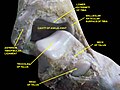
The ankle joint is bound by the strong deltoid ligament and three lateral ligaments: the anterior talofibular ligament, the posterior talofibular ligament, and the calcaneofibular ligament.

  • The deltoid ligament supports the medial side of the joint, and is attached at the medial malleolus of the tibia and connect in four places to the talar shelf of the calcaneus, calcaneonavicular ligament, the navicular tuberosity, and to the medial surface of the talus.
  • The anterior and posterior talofibular ligaments support the lateral side of the joint from the lateral malleolus of the fibula to the dorsal and ventral ends of the talus.
  • The calcaneofibular ligament is attached at the lateral malleolus and to the lateral surface of the calcaneus.

Though it does not span the ankle joint itself, the syndesmotic ligament makes an important contribution to the stability of the ankle. This ligament spans the syndesmosis, i.e. the articulation between the medial aspect of the distal fibula and the lateral aspect of the distal tibia. An isolated injury to this ligament is often called a high ankle sprain.

The bony architecture of the ankle joint is most stable in dorsiflexion.[14] Thus, a sprained ankle is more likely to occur when the ankle is plantar-flexed,[15] as ligamentous support is more important in this position. The classic ankle sprain involves the anterior talofibular ligament (ATFL), which is also the most commonly injured ligament during inversion sprains. Another ligament that can be injured in a severe ankle sprain is the calcaneofibular ligament.

Retinacula, tendons and their synovial sheaths, vessels, and nerves

[edit]

A number of tendons pass through the ankle region. Bands of connective tissue called retinacula (singular: retinaculum) allow the tendons to exert force across the angle between the leg and foot without lifting away from the angle, a process called bowstringing.[11] The superior extensor retinaculum of foot extends between the anterior (forward) surfaces of the tibia and fibula near their lower (distal) ends. It contains the anterior tibial artery and vein and the tendons of the tibialis anterior muscle within its tendon sheath and the unsheathed tendons of extensor hallucis longus and extensor digitorum longus muscles. The deep peroneal nerve passes under the retinaculum while the superficial peroneal nerve is outside of it. The inferior extensor retinaculum of foot is a Y-shaped structure. Its lateral attachment is on the calcaneus, and the band travels towards the anterior tibia where it is attached and blends with the superior extensor retinaculum. Along with that course, the band divides and another segment attaches to the plantar aponeurosis. The tendons which pass through the superior extensor retinaculum are all sheathed along their paths through the inferior extensor retinaculum and the tendon of the fibularis tertius muscle is also contained within the retinaculum.

The flexor retinaculum of foot extends from the medial malleolus to the medical process of the calcaneus, and the following structures in order from medial to lateral: the tendon of the tibialis posterior muscle, the tendon of the flexor digitorum longus muscle, the posterior tibial artery and vein, the tibial nerve, and the tendon of the flexor hallucis longus muscle.

The fibular retinacula hold the tendons of the fibularis longus and fibularis brevis along the lateral aspect of the ankle region. The superior fibular retinaculum extends from the deep transverse fascia of the leg and lateral malleolus to calcaneus. The inferior fibular retinaculum is a continuous extension from the inferior extensor retinaculum to the calcaneus.[9]: 1418–9 

Mechanoreceptors

[edit]

Mechanoreceptors of the ankle send proprioceptive sensory input to the central nervous system (CNS).[16] Muscle spindles are thought to be the main type of mechanoreceptor responsible for proprioceptive attributes from the ankle.[17] The muscle spindle gives feedback to the CNS system on the current length of the muscle it innervates and to any change in length that occurs.

It was hypothesized that muscle spindle feedback from the ankle dorsiflexors played the most substantial role in proprioception relative to other muscular receptors that cross at the ankle joint. However, due to the multi-planar range of motion at the ankle joint there is not one group of muscles that is responsible for this.[18] This helps to explain the relationship between the ankle and balance.

In 2011, a relationship between proprioception of the ankle and balance performance was seen in the CNS. This was done by using a fMRI machine in order to see the changes in brain activity when the receptors of the ankle are stimulated.[19] This implicates the ankle directly with the ability to balance. Further research is needed in order to see to what extent does the ankle affect balance.

Function

[edit]

Historically, the role of the ankle in locomotion has been discussed by Aristotle and Leonardo da Vinci. There is no question that ankle push-off is a significant force in human gait, but how much energy is used in leg swing as opposed to advancing the whole-body center of mass is not clear.[20]

Clinical significance

[edit]
A diagram illustrating varying severity of ankle sprain

Traumatic injury

[edit]

Of all major joints, the ankle is the most commonly injured. If the outside surface of the foot is twisted under the leg during weight bearing, the lateral ligament, especially the anterior talofibular portion, is subject to tearing (a sprain) as it is weaker than the medial ligament and it resists inward rotation of the talocrural joint.[8]: 825 

Fractures

[edit]
Fracture of both sides of the ankle with dislocation as seen on anteroposterior X-ray. (1) fibula, (2) tibia, (arrow) medial malleolus, (arrowhead) lateral malleolus

An ankle fracture is a break of one or more of the bones that make up the ankle joint.[21] Symptoms may include pain, swelling, bruising, and an inability to walk on the injured leg.[21] Complications may include an associated high ankle sprain, compartment syndrome, stiffness, malunion, and post-traumatic arthritis.[21][22]

Ankle fractures may result from excessive stress on the joint such as from rolling an ankle or from blunt trauma.[21][22] Types of ankle fractures include lateral malleolus, medial malleolus, posterior malleolus, bimalleolar, and trimalleolar fractures.[21] The Ottawa ankle rule can help determine the need for X-rays.[22] Special X-ray views called stress views help determine whether an ankle fracture is unstable.

Treatment depends on the fracture type. Ankle stability largely dictates non-operative vs. operative treatment. Non-operative treatment includes splinting or casting while operative treatment includes fixing the fracture with metal implants through an open reduction internal fixation (ORIF).[21] Significant recovery generally occurs within four months while completely recovery usually takes up to one year.[21]

Ankle fractures are common, occurring in over 1.8 per 1000 adults and 1 per 1000 children per year.[22][23] In North America this figure increases to more than 14 in ever 10,000 patients admitted to the Emergency Room.[24] They occur most commonly in young males and older females.[22]

Imaging

[edit]

The initial evaluation of suspected ankle pathology is usually by projectional radiography ("X-ray").

Tibiotalar surface angle (TTS)

Varus or valgus deformity, if suspected, can be measured with the frontal tibiotalar surface angle (TTS), formed by the mid-longitudinal tibial axis (such as through a line bisecting the tibia at 8 and 13 cm above the tibial plafond) and the talar surface.[25] An angle of less than 84 degrees is regarded as talipes varus, and an angle of more than 94 degrees is regarded as talipes valgus.[26]

For ligamentous injury, there are three main landmarks on X-rays: The first is the tibiofibular clear space, the horizontal distance from the lateral border of the posterior tibial malleolus to the medial border of the fibula, with greater than 5 mm being abnormal. The second is tibiofibular overlap, the horizontal distance between the medial border of the fibula and the lateral border of the anterior tibial prominence, with less than 10 mm being abnormal. The final measurement is the medial clear space, the distance between the lateral aspect of the medial malleolus and the medial border of the talus at the level of the talar dome, with a measurement greater than 4 mm being abnormal. Loss of any of these normal anatomic spaces can indirectly reflect ligamentous injury or occult fracture, and can be followed by MRI or CT.[27]

Abnormalities

[edit]

Clubfoot or talipes equinovarus, which occurs in one to two of every 1,000 live births, involves multiple abnormalities of the foot.[28] Equinus refers to the downard deflection of the ankle, and is named for the walking on the toes in the manner of a horse.[29] This does not occur because it is accompanied by an inward rotation of the foot (varus deformity), which untreated, results in walking on the sides of the feet. Treatment may involve manipulation and casting or surgery.[28]

Ankle joint equinus, normally in adults, relates to restricted ankle joint range of motion(ROM).[30] Calf muscle stretching exercises are normally helpful to increase the ankle joint dorsiflexion and used to manage clinical symptoms resulting from ankle equinus.[31]

Occasionally a human ankle has a ball-and-socket ankle joint and fusion of the talo-navicular joint.[32]

History

[edit]

The word ankle or ancle is common, in various forms, to Germanic languages, probably connected in origin with the Latin angulus, or Greek αγκυλος, meaning bent.[33]

Other animals

[edit]

Evolution

[edit]

It has been suggested that dexterous control of toes has been lost in favour of a more precise voluntary control of the ankle joint.[34]

See also

[edit]

Footnotes

[edit]

References

[edit]

Additional images

[edit]
[edit]
Revisions and contributorsEdit on WikipediaRead on Wikipedia
from Grokipedia
The ankle, also known as the talocrural joint, is a hinged synovial joint formed by the articulation of the distal tibia, fibula, and the talus bone of the foot, creating a stable mortise-and-tenon structure essential for weight-bearing and locomotion. This joint complex, which also encompasses the subtalar joint and distal tibiofibular syndesmosis, enables primary movements of dorsiflexion and plantarflexion in the sagittal plane, while the subtalar joint facilitates inversion and eversion for adapting to uneven terrain. The ankle's stability is maintained by a network of ligaments, including the lateral collateral ligaments—anterior talofibular (ATFL), calcaneofibular (CFL), and posterior talofibular (PTFL)—on the outer side, the robust medial deltoid ligament, and the syndesmotic ligaments binding the tibia and fibula. Surrounding muscles, such as the anterior and posterior tibialis, gastrocnemius, and peroneals, provide dynamic support and power these motions through their tendons crossing the joint. Functionally, the ankle absorbs and distributes forces during activities like walking, running, and , with the talar dome's convex shape allowing approximately 65° of total in the (10–20° dorsiflexion and 45–55° plantarflexion). Its anatomical design, including the broader anterior talar width for stability in dorsiflexion, underscores its role in balance and , making it prone to injuries such as sprains when ligaments like the ATFL— the weakest component—are overstretched. Clinically, the ankle's vulnerability to trauma highlights its biomechanical importance, as disruptions can impair and lead to chronic instability without proper ligament integrity.

Anatomy

Bones and Articulations

The ankle joint's skeletal framework is primarily composed of three bones: the , , and talus, which together form the ankle mortise. The , the larger weight-bearing bone of the lower , contributes the medial and posterior aspects of the mortise through its distal articular surface and the medial , a prominent bony projection that extends inferiorly and posteriorly. The , positioned laterally, forms the lateral aspect of the mortise via its distal end, which includes the lateral , a structure that projects inferiorly and slightly posteriorly to articulate with the talus. The talus, the second largest in the foot, serves as the tenon within this mortise; its body features a convex trochlear surface superiorly that articulates with the tibial plafond (the broad, concave distal tibial articular surface), while its lateral and medial aspects contact the malleoli, creating a stable, bracket-shaped socket covered in . This mortise configuration ensures close congruity, with the talar dome fitting snugly to transmit forces from the to the foot. The ankle complex includes three primary s: the talocrural, , and s, each contributing to overall foot mobility. The talocrural joint, or ankle proper, is a hinge-type formed by the articulation of the talar trochlea with the tibial plafond and malleoli; it permits primarily one degree of freedom, allowing flexion-extension movements such as dorsiflexion and plantarflexion. The , a plane-type between the talus and , facilitates triplanar motion with effectively one degree of freedom, enabling inversion and eversion to adapt to uneven surfaces. The , also known as Chopart's joint, is a compound biaxial comprising the talonavicular and calcaneocuboid articulations; it allows one primary degree of freedom for supination and pronation, linking the hindfoot to the midfoot. Anatomical variations in the ankle's bony structure include accessory ossicles, such as the os trigonum, a small that arises from the posterior talar process and is present in approximately 10% of feet, with higher prevalence in East Asian populations. These variations, often bilateral in 2% of cases, can influence mechanics but are typically asymptomatic. Biomechanically, the precise alignment of the , , and talus within the mortise positions the ankle as a modified , primarily restricting motion to flexion-extension (typically 10-20° dorsiflexion and 40-50° plantarflexion) while providing inherent stability through osseous congruity and load distribution during . This configuration optimizes energy transfer in , with the mortise widening slightly in dorsiflexion to accommodate the broader anterior talar dome, thereby minimizing shear forces across the .

Ligaments and Soft Tissues

The complex, located on the medial aspect of the ankle, is a robust, fan-shaped structure that provides primary resistance to eversion and external rotation of the talus. It comprises a superficial layer and a deep layer, both originating from the medial of the . The superficial layer includes three main components: the tibionavicular ligament, which attaches to the and ; the tibiocalcaneal ligament, extending to the sustentaculum tali of the ; and the posterior tibiotalar ligament, inserting onto the medial of the talus. These fibers are oriented in a triangular , with bundles arranged to withstand tensile forces, enhancing medial stability during weight-bearing activities. The deep layer of the deltoid ligament features the anterior and posterior tibiotalar ligaments, which directly anchor the talus to the tibia, preventing excessive valgus angulation and posterior translation. These deeper fibers run more horizontally and are taut in plantarflexion, contributing to the ligament's overall tensile strength, which exceeds that of the lateral complex by a factor of 2-3. On the lateral side, the ligaments form a less robust Y-shaped complex to counter inversion and internal rotation: the anterior talofibular ligament (ATFL) extends from the anterior inferior fibula to the talar neck, with fibers oriented anteromedially to resist anterior drawer and inversion, exhibiting a tensile strength of about 139 N; the calcaneofibular ligament (CFL) courses from the lateral malleolus to the calcaneus, providing stability in dorsiflexion with a strength around 346 N and fibers angled posteroinferiorly; and the posterior talofibular ligament (PTFL), the strongest lateral component at approximately 261 N, connects the posterior fibula to the posterior talus, tightening in dorsiflexion to limit excessive inversion. Collectively, these ligaments maintain talar centering within the ankle mortise, with the deltoid resisting eversion (typically up to 15-20°) and the lateral group limiting inversion (typically up to 30-35°). Retinacula serve as fibrous bands that secure tendons across the ankle, preventing during motion. The superior extensor retinaculum is a broad, transverse spanning from the to the above the , while the inferior extensor retinaculum forms a Y-shaped structure attaching to the and dorsal midfoot, both holding the extensor tendons (such as tibialis anterior and extensor digitorum longus) in place anteriorly. Laterally, the superior and inferior peroneal retinacula (often termed supinator retinacula due to their role in stabilizing evertor tendons) anchor the peroneus longus and brevis tendons behind the lateral , with the superior band blending into the and the inferior attaching to the to maintain tendon alignment during eversion. These structures, composed of dense , ensure efficient force transmission without bowstringing. The ankle's soft tissues include the and , which encapsulate the talocrural articulation. The fibrous capsule surrounds the , attaching proximally to the tibial and fibular epiphyses and distally to the talus, reinforced by the collateral ligaments to contain and limit excessive translation. Lining the capsule, the produces lubricating fluid and is richly vascularized, facilitating nutrient diffusion to avascular . Both the capsule and ligaments are densely innervated by mechanoreceptors, including Ruffini and Pacini corpuscles, which provide proprioceptive feedback on position and motion, contributing to reflexive stabilization.

Muscles, Tendons, and Neurovascular Structures

The ankle region is supported and mobilized by muscles organized into anterior, lateral, and posterior compartments of the leg, with their tendons crossing the joint to insert on the foot bones. In the anterior compartment, the tibialis anterior originates from the upper two-thirds of the lateral surface of the and the adjacent , inserting on the medial surface of the medial and the base of the first metatarsal; it primarily functions in dorsiflexion and inversion of the foot, innervated by the deep peroneal nerve and supplied by the anterior tibial artery. The extensor hallucis longus arises from the anterior surface of the middle third of the and the , inserting on the dorsal aspect of the distal of the great toe; it contributes to dorsiflexion of the foot and great toe extension, also innervated by the deep peroneal nerve with vascular supply from the anterior tibial artery. The lateral compartment features the peroneus longus and brevis muscles, which originate from the head and shaft of the , respectively; the peroneus longus inserts on the base of the first metatarsal and medial cuneiform via a groove on the , while the peroneus brevis inserts on the base of the fifth metatarsal, both promoting eversion of the foot with the peroneus longus additionally aiding plantarflexion, innervated by the superficial peroneal nerve and supplied by the peroneal artery. Posterior compartment muscles include the superficial gastrocnemius, which originates from the posterior surfaces of the femoral condyles and inserts via the on the posterior , and the deeper soleus, arising from the posterior , , and soleal line, also inserting on the ; both drive plantarflexion, with the gastrocnemius receiving dual innervation from the branches and vascular supply from the posterior tibial and peroneal arteries, while the soleus is solely innervated by the . The deep posterior tibialis posterior originates from the posterior surfaces of the and and the , inserting on the navicular, cuneiforms, and bases of metatarsals 2–4; it facilitates inversion and plantarflexion, innervated by the and supplied by the . Tendons of these muscles are enveloped in synovial sheaths to minimize as they pass around the malleoli and over bony prominences; for instance, the common peroneal sheath encloses both peroneal tendons behind the lateral , extending approximately 2 cm proximal and distal to the tip, while individual sheaths cover the tibialis posterior and flexor tendons medially. Synovial e, such as the retrocalcaneal located between the anterior inferior aspect of the and the posterosuperior , provide lubrication to reduce shear forces during plantarflexion, typically measuring 1–2 cm in height and containing 1–1.5 ml of fluid. Arterial supply to the ankle and foot arises from the bifurcation into the anterior and posterior tibial arteries, with the peroneal artery branching from the posterior tibial about 2.5 cm distal to the popliteal; the anterior tibial continues as the dorsalis pedis on the dorsal foot, anastomosing with the lateral tarsal and arcuate arteries to form the dorsal arch, while the posterior tibial divides into medial and lateral plantar branches beneath the flexor retinaculum, uniting with the deep plantar arch for sole . Venous drainage parallels the arterial system via superficial (great and small saphenous) and deep veins (anterior and posterior tibial, peroneal) that accompany the arteries and converge into the popliteal vein. Lymphatic vessels in the ankle region collect superficial and deep fluids, draining primarily to the before ascending to the inguinal nodes, with medial structures following tibial pathways and lateral ones via peroneal routes. Major nerves supplying the ankle include the , which courses posteriorly behind the medial under the flexor retinaculum, branching into medial and lateral plantar nerves for motor innervation of posterior compartment muscles and intrinsic foot muscles, with sensory distribution to the sole via calcaneal, medial, and lateral plantar branches. The deep peroneal nerve travels anteriorly with the anterior tibial artery, innervating anterior compartment muscles and providing sensory supply to the first dorsal web space. The superficial peroneal nerve descends in the lateral compartment to innervate peroneal muscles, emerging subcutaneously about 10–12 cm proximal to the lateral to supply sensation to the dorsum of the foot except the first web space. The sural nerve, formed by branches from the tibial and common peroneal nerves, runs posteriorly to provide sensory innervation to the lateral and fifth .

Sensory Components

The sensory components of the primarily consist of mechanoreceptors that provide proprioceptive feedback essential for balance, joint position awareness, and reflexive responses. These receptors detect mechanical stimuli such as stretch, pressure, and vibration, integrating signals to the via afferent nerves like the . Key mechanoreceptors in the ankle include Golgi tendon organs located in the , which sense tension and inhibit excessive to prevent overload; Ruffini endings embedded in , which are slow-adapting receptors that monitor static joint position and ligament strain; Pacinian corpuscles within the capsules, which are rapid-adapting and detect high-frequency vibrations and sudden movements; and muscle spindles in the surrounding muscles such as the gastrocnemius and soleus, which monitor muscle length changes and contribute to dynamic . These receptors are distributed variably, with Pacinian corpuscles being the most prevalent in ankle collateral ligaments, followed by Ruffini endings, while Golgi tendon organs are spaced along musculotendinous junctions. These mechanoreceptors play a critical role in by conveying information on position sense and facilitating arcs, such as the , where muscle spindles in the surae detect stretch and trigger a monosynaptic response via Ia afferents in the to restore equilibrium. This feedback loop enhances postural stability during locomotion and prevents injury by modulating muscle activity in response to perturbations. Free endings, classified as type IV mechanoreceptors, are widely distributed throughout ankle ligaments, capsules, and surrounding soft tissues, serving primarily as nociceptors to detect painful stimuli like or excessive mechanical stress, with higher densities noted in ligamentous structures compared to capsules. Age-related changes diminish the function of these receptors, leading to reduced sensitivity and acuity in , such as higher detection thresholds for motion in older adults due to alterations in muscle spindles and ligamentous endings. Pathological conditions, including post-injury scenarios like ankle sprains, further impair receptor integrity, resulting in deafferentation and decreased reflexive responsiveness that compromises balance.

Function

Movements and Kinematics

The ankle joint complex facilitates several primary movements essential for locomotion and balance. Dorsiflexion, the upward flexion of the foot toward the shin, typically ranges from 0° to 20° at the talocrural joint, allowing the foot to clear the ground during the swing phase of . Plantarflexion, the downward pointing of the foot, exhibits a greater range of 0° to 50°, enabling propulsion during push-off. These motions occur primarily at the talocrural articulation between the , , and talus. Inversion and eversion, which involve medial and lateral tilting of the foot, respectively, occur mainly at the and contribute to a combined range of approximately 30° to 50° across the ankle complex. Inversion accounts for about 23° to 35°, while eversion is limited to 12° to 15°, reflecting the joint's role in adapting to uneven surfaces. These movements are coupled with subtalar pronation and supination, enhancing overall foot stability. Muscles such as the tibialis anterior and peroneals drive these motions, while ligaments like the deltoid and lateral collateral complexes limit extremes to prevent excessive deviation. Ankle kinematics integrate within the lower limb chain, where motion couples with the and to optimize energy efficiency during activities like walking. For instance, ankle plantarflexion synchronizes with knee extension and hip flexion in the stance phase, ensuring smooth progression. The talocrural joint's rotation follows screw-axis theory, modeling its motion as helical rotation around an instantaneous screw axis that shifts with joint position, typically aligning near the talar dome for pure movement. This coupling minimizes compensatory adjustments at proximal joints, as evidenced by coordinated angular velocities across the chain. Range of motion is commonly measured using goniometry, a handheld device that quantifies angular displacement in non-weight-bearing or weight-bearing positions for clinical accuracy. Factors such as a tight can restrict dorsiflexion by up to 10°, altering mechanics and increasing injury risk. Other influences include tightness or muscle imbalances, assessed via passive and active testing protocols. Gender and age variations in ankle motion are well-documented, with females generally exhibiting greater overall range than males due to differences in ligament laxity and joint geometry. Studies reveal that women have approximately 4° to 5° more dorsiflexion and 3° more inversion/eversion compared to men across age groups. ROM peaks in early adulthood (ages 14-20) and declines progressively after age 60, attributed to degenerative changes in and soft tissues. These patterns, observed in living subjects, underscore the need for age- and sex-specific normative data.

Stability and Load-Bearing

The ankle joint achieves static stability primarily through the bony architecture of the mortise, formed by the distal and articulating with the talus, which provides inherent congruence to resist excessive motion. This osseous configuration, combined with the medial and lateral ligaments (anterior talofibular, calcaneofibular, and posterior talofibular), constrains inversion and eversion, particularly in positions where compressive forces enhance joint conformity. In dorsiflexion, the broader anterior talar dome increases contact within the mortise, maximizing bony stability, whereas plantar flexion reduces this contact, shifting reliance to ligamentous restraints. Dynamic stability supplements these passive structures through muscle co-contraction, where antagonistic groups like the peroneus longus and brevis actively control eversion to counter inversion moments during locomotion. These peroneal muscles generate eccentric forces to maintain mediolateral equilibrium, with reciprocal activation patterns between invertors (e.g., tibialis posterior) and evertors ensuring balanced force transmission across the joint. Sensory feedback from proprioceptors briefly aids this process by modulating muscle responses to perturbations, though primary control remains muscular. In load-bearing, the ankle transmits forces equivalent to approximately five times body weight during the stance phase of normal walking, with peak loads distributed across the tibia-talus interface over an average contact area of approximately 11–13 cm², resulting in compressive stresses of several MPa for a 70 kg individual. This underscores the joint's role in efficient force vectoring, where the congruent talar dome and mortise minimize shear while maximizing axial load transfer to the foot. The close-packed position in maximal dorsiflexion optimizes this by achieving maximal articular surface , enhancing overall stability under load. External factors such as and surface terrain significantly influence ankle stability by altering biomechanical demands. High-top shoes, for instance, can delay peroneal muscle pre-activation but increase overall restraint against inversion through enhanced mechanical support. Uneven or compliant terrains, like , reduce ground reaction force predictability, necessitating greater muscular compensation to maintain equilibrium and increasing mediolateral stress on the . Appropriate with adequate traction and cushioning mitigates these effects, promoting consistent load distribution.

Role in Locomotion

The ankle plays a pivotal role in the , particularly through the coordinated actions of plantarflexion and dorsiflexion that facilitate efficient forward progression. During the push-off phase of terminal stance, the ankle plantarflexors generate substantial mechanical power, contributing up to 50% of the positive work required for in a single stride. This explosive plantarflexion redirects the body's forward, enabling the transition to the swing phase. In contrast, during the swing phase, ankle dorsiflexion elevates the foot to ensure adequate toe clearance from the ground, preventing tripping and maintaining smooth limb advancement. At initial contact during heel strike, the ankle absorbs impact energies through eccentric contraction of the dorsiflexors, such as the tibialis anterior, which controls foot placement and dissipates ground reaction forces to minimize shock transmission up the kinetic chain. This mechanism helps stabilize the body during weight acceptance, with the plantarflexors and dorsiflexors briefly referencing their roles in powering subsequent phases for overall dynamic balance. In running compared to walking, the ankle exhibits heightened demands on the plantarflexors for greater , as the involves a flight phase and requires more forceful push-off to achieve aerial progression. Additionally, the ankle contributes to enhanced shock in running through increased and rapid storage-release in tendons, adapting to higher impact loads while preserving locomotor . Pathophysiological conditions like flatfoot (pes planus) impair these functions by reducing the medial longitudinal arch's ability to compress and recoil, leading to diminished energy return during push-off and overall reduced efficiency in locomotion economy. This results in higher metabolic costs for the same walking speed, as the loss of arch-mediated elastic energy storage shifts greater reliance onto muscular effort.

Clinical Aspects

Injuries and Trauma

Ankle injuries and trauma encompass a range of acute conditions resulting from external forces, with sprains and fractures being the most prevalent. Ankle sprains, particularly lateral ones, account for approximately 85% of all ankle injuries and are especially common in athletic populations, where they represent nearly half of all reported ankle traumas. In the United States, the incidence of ankle sprains is estimated at 2 per 1,000 people annually, with higher rates among athletes due to repetitive high-impact activities such as , football, and soccer. These injuries often lead to significant morbidity, including high recurrence rates exceeding 70% in individuals without proper rehabilitation, primarily due to impaired and residual instability. Lateral ankle sprains, the most frequent type, typically occur via an inversion mechanism combined with plantarflexion, leading to tears in the anterior talofibular ligament (ATFL) in about 65% of cases. This mechanism places tensile stress on the lateral ligament complex, starting with the ATFL and potentially progressing to the calcaneofibular ligament (CFL) if the force is greater. Sprains are classified into grades I through III based on the extent of ligament damage: grade I involves minor stretching with minimal fiber disruption and no instability; grade II features partial tears with moderate swelling and some laxity; and grade III indicates complete ligament rupture, significant swelling, bruising, and joint instability. Ankle fractures, often resulting from higher-energy trauma, include isolated lateral fractures classified by the Danis-Weber , which categorizes them into types A (below the syndesmosis, typically stable), B (at the syndesmosis level, potentially unstable), and C (above the syndesmosis, usually requiring syndesmotic fixation). A common severe variant is the of the tibial plafond, caused by axial loading forces such as falls from height or accidents, where the talus is driven upward into the distal , causing intra-articular . Associated complications frequently accompany these injuries, including syndesmotic disruptions in up to 20% of ankle sprains and fractures, which can lead to chronic instability if not addressed. Osteochondral lesions of the talus, involving and subchondral bone damage, occur in approximately 21% of isolated syndesmotic injuries and are often linked to inversion trauma, contributing to persistent pain and early . typically involves clinical assessment supplemented by such as X-rays or MRI, while severe cases may necessitate surgical intervention like repair or fixation.

Congenital and Acquired Disorders

Congenital disorders of the ankle primarily involve structural deformities present at birth that affect the alignment and function of the foot and ankle joint. Clubfoot, or talipes equinovarus, is a common condition characterized by the foot being turned inward and downward due to abnormal positioning of the talus and calcaneus relative to the tibia. The incidence of clubfoot is approximately 1 per 1,000 live births globally. Mutations in the PITX1 gene have been identified as a cause in some cases of isolated clubfoot, leading to disruptions in hindlimb development through altered transcription of downstream genes like TBX4. These genetic links were established in studies following 2010, highlighting PITX1 haploinsufficiency as a key factor in familial and sporadic presentations. Flatfoot, or pes planus, represents another congenital anomaly involving the collapse or absence of the medial longitudinal arch of the foot, which can extend to affect ankle alignment. Congenital variants include flexible pes planus, where the arch reforms on tiptoeing, and rigid forms associated with underlying bony abnormalities. The prevalence of congenital flexible pes planus is estimated at 20% to 30% in young children, often resolving spontaneously by adolescence, though persistent cases may lead to ankle . Rigid congenital flatfoot variants are less common and typically stem from coalitions or accessory bones that limit subtalar motion. Tarsal coalition is a congenital fusion or bridging between two or more tarsal bones, most frequently the talus and or and navicular, resulting in restricted hindfoot motion and potential ankle stiffness. The overall incidence of tarsal coalition is approximately 1% to 3% in the general population, though symptomatic cases are rarer, affecting about 3.5 per 100,000 children annually. This anomaly arises from failure of segmentation during embryonic development, leading to fibrous, cartilaginous, or bony unions that alter ankle . Acquired disorders encompass chronic conditions that develop over time due to repetitive stress, degeneration, or secondary changes in the ankle . Post-traumatic is a prevalent acquired , occurring in 20% to 50% of individuals following significant ankle injuries, where initial damage progresses to joint space narrowing and subchondral sclerosis. Risk factors such as exacerbate degenerative changes by increasing mechanical load on the tibiotalar , thereby accelerating breakdown and formation in the ankle. Chronic ankle often progresses to through repetitive microtrauma and uneven load distribution, particularly affecting the medial compartment after long-standing lateral ligament laxity. Achilles tendinopathy is an acquired overuse disorder involving degeneration and inflammation of the Achilles tendon insertion or mid-substance, commonly resulting from repetitive eccentric loading in activities like running. It manifests as pain and swelling posterior to the ankle, with histopathological changes including tendon thickening and neovascularization. Ankle impingement syndromes are acquired entrapment conditions causing pain from or bony overgrowth during motion. Anterior impingement arises from repetitive dorsiflexion, leading to or osteophytes at the tibial-talar margin, while posterior impingement involves compression of the posterior ankle structures during plantarflexion, often due to os trigonum or scarring. Symptoms of these disorders may occasionally overlap with those of acute injuries, such as pain on specific ankle ranges.

Diagnosis and Imaging

Diagnosis of ankle pathology typically begins with a thorough clinical examination to assess for fractures, ligamentous instability, and other injuries. The , developed to screen for fractures following acute ankle trauma, demonstrate high sensitivity of approximately 98% in identifying clinically significant fractures, thereby reducing unnecessary radiographs by 30-40%. These rules involve specific physical tests, such as palpation of the posterior edge of the lateral and the base of the fifth metatarsal, along with assessing pain on active ankle dorsiflexion. For evaluating chronic lateral ankle instability, often resulting from ligament tears after inversion sprains, the anterior drawer test is commonly employed; it involves applying anterior force to the while stabilizing the , with excessive anterior talar translation (>10 mm) indicating instability, though sensitivity varies (54-100%) depending on the examiner and patient factors. Imaging modalities play a crucial role in confirming clinical suspicions, particularly for bony and abnormalities in conditions like fractures or disruptions. Conventional X-rays remain the initial choice for assessing bony alignment and detecting fractures, with standard views (anteroposterior, lateral, and mortise) allowing measurement of parameters such as the tibiotalar angle, which normally ranges from 0° to 10° in neutral position, to evaluate alignment deviations in varus or valgus deformities. (MRI) excels in visualizing s, offering high sensitivity (up to 90%) for detecting tears, such as those in the , and damage, including chondral lesions or early changes, through detailed assessment of signal intensity and morphology. provides a non-invasive, real-time option for dynamic evaluation of , particularly in assessing peroneal subluxation or during movement, with the ability to detect tears or effusions that may be missed on static . Advanced imaging techniques enhance diagnostic precision for complex cases. Computed tomography (CT) offers superior detail for fracture characterization, especially intra-articular or posterior malleolar fragments, enabling to guide surgical planning in unstable fractures. Weight-bearing MRI, an emerging functional tool, assesses joint stability under load, revealing subtle instabilities or loading abnormalities not apparent in non-weight-bearing scans, with studies showing its utility in quantifying talar tilt in chronic instability.

Treatment and Management

Treatment and management of ankle conditions typically begin with conservative approaches, which are effective for most acute injuries and early-stage disorders, aiming to reduce pain, swelling, and instability while promoting healing. For ankle sprains, the protocol—rest, , compression, and elevation—is recommended in the initial 48 to 72 hours to minimize inflammation and protect the . plays a central role in conservative management, focusing on strengthening exercises such as resistance band training and proprioceptive drills using balance boards to improve stability and prevent recurrent sprains. These interventions enhance postural control and functional outcomes, particularly in patients with chronic instability. For structural issues like flatfoot, such as arch supports or custom shoe inserts provide medial arch elevation and reduce tendon strain, often sufficient for mild cases without surgical intervention. When conservative measures fail, particularly in cases of persistent impingement or severe instability, surgical options are considered to restore anatomy and function. Arthroscopic debridement addresses anterior ankle impingement by removing bony spurs and soft-tissue scar tissue through small incisions, allowing for quicker recovery and minimal complications compared to open procedures. For chronic lateral ankle instability, the modified Brostrom procedure involves direct repair and imbrication of the anterior talofibular and calcaneofibular ligaments, often augmented with the inferior extensor retinaculum. In end-stage ankle arthritis, total ankle arthroplasty replaces the joint surfaces to preserve motion, offering better functional scores and gait improvement than arthrodesis (fusion), which eliminates motion but provides durable pain relief in high-demand patients. Arthroplasty is preferred for lower-activity individuals to maintain subtalar compensation and daily mobility, while fusion is indicated for failed prior surgeries or inflammatory arthropathies. Rehabilitation follows a phased progression tailored to the injury severity, starting with acute protection to control swelling and protect tissues through immobilization or bracing for 1-2 weeks. The subacute phase emphasizes restoring and strength via gentle and isometric exercises, progressing to dynamic balance around 4-6 weeks. Advanced stages focus on functional integration, including agility drills and sport-specific simulations, with return-to-sport criteria met when patients achieve symmetric strength, full , and pain-free performance on tests like the single-leg hop. This structured approach reduces re-injury risk by 50-70% in athletes. Overall outcomes are favorable with appropriate interventions; the Brostrom procedure achieves 85-95% success in stabilizing the ankle long-term, with low revision rates under 10%. demonstrates significant reduction and improved quality-of-life scores at 2-5 years, though fusion may offer higher survivorship in select cohorts. Multidisciplinary care, integrating orthopedics, , and for custom and , optimizes recovery and addresses comorbidities like or alignment issues.

Historical and Comparative Perspectives

Historical Development

The understanding of the ankle's and dates back to ancient civilizations, where preservation techniques and early medical observations laid foundational knowledge. In , mummification processes, practiced for over 4,000 years, meticulously preserved skeletal structures including the ankle bones through wrapping and impregnation with preservatives like , allowing modern analyses to reveal details of foot and ankle . Around 400 BCE, , in works such as On the Articulations and On Fractures, provided the first systematic descriptions of ankle dislocations, attributing them to falls or twists and recommending reduction via traction and splinting to restore alignment, emphasizing rest and bandaging to prevent complications like . During the , anatomical study advanced through direct , culminating in ' De Humani Corporis Fabrica (1543), which included detailed illustrations and descriptions of the ankle's ligaments, such as the transverse ligament, correcting earlier inaccuracies from and establishing a more precise view of joint structure based on human cadavers. This work shifted focus from speculative to empirical observation, influencing subsequent generations in identifying the ankle's stabilizing components. In the 18th and 19th centuries, clinical descriptions of ankle injuries gained prominence with Percivall Pott's 1765 treatise Some Few General Remarks on Fractures and Dislocations, where he detailed bimalleolar ankle fractures—now known as Pott's fractures—based on his personal experience, advocating immobilization over to promote . The 20th century saw the rise of orthopedics as a specialty, with G. Broström's 1966 procedure introducing direct repair of the lateral ankle ligaments for chronic instability, using imbrication of the anterior talofibular and calcaneofibular ligaments to restore function without grafts. Post-2000 developments emphasized minimally invasive techniques, with ankle arthroscopy evolving rapidly; the two-portal posterior approach, introduced by C. Niek van Dijk in 2000, expanded therapeutic applications for intra-articular issues like impingement and osteochondral lesions, gaining widespread adoption in the due to improved and instruments that reduced recovery times compared to open surgery.

Comparative Anatomy in Animals

In quadrupedal mammals, the ankle , known as the tarsus or hock, exhibits variations adapted to locomotor demands. In , the hock consists of the tarsal bones articulating with the and metatarsals, forming a hinge-like structure that supports high-speed galloping. This works in conjunction with the (knee) via the stay apparatus, where the locks behind the femoral trochlea, allowing passive stabilization and efficient weight transfer without continuous muscular effort, which enhances endurance and speed during locomotion. In contrast, the dog's tarsus features a more flexible , comprising the talus and with multiple articulations that permit inversion, eversion, and rotation. This configuration enables rapid directional changes and agility in predatory pursuits, as the joint facilitates terrain and quick maneuvers. Among , the ankle retains arboreal adaptations, with a mediolaterally expanded distal and a more mobile talocrural allowing up to 45 degrees of dorsiflexion and significant inversion for grasping during . In comparison, the human ankle shows a reduced fibular contribution to the joint, with a slender articulating with the talus laterally via the lateral and connected to the by syndesmotic ligaments, prioritizing stability for bipedal propulsion over flexibility. In birds, the ankle region is modified into the , a fused formed by the distal tarsals and metatarsals II–IV, creating a rigid, elongated structure that extends from the intertarsal to the toes. This fusion enhances perching stability by distributing weight along a single bony element, preventing slippage on branches and supporting prolonged upright postures. Reptiles, such as , retain more separate tarsal elements for flexibility in sprawling , but avian evolution has streamlined this for aerial and perching lifestyles. Functional adaptations in ankle structure also reflect weight distribution strategies across mammals. Plantigrade species like bears contact the ground with the entire sole, including tarsals and metatarsals, which broadens the base for stable and shock absorption during foraging or standing, with the positioned low to maximize leverage. Digitigrade species like cats elevate the , relying on elongated metatarsals and a raised tarsus for weight concentration on toes, enabling explosive acceleration and reduced ground contact time for speed, though at the cost of less stability on uneven surfaces.

Evolutionary Aspects

The transition from aquatic fish to terrestrial tetrapods during the Late period, approximately 375 million years ago, marked a pivotal shift in limb evolution, with the emergence of ankle-like structures capable of supporting body weight against substrates. Fossils such as roseae reveal a robust pectoral with skeletal elements homologous to the , , , , and , including a functional "ankle" formed by distal radials that allowed for rotation and load-bearing during shallow-water ambulation. This of rays into limb bones facilitated the initial push-off motions essential for emerging onto land, bridging the gap between sarcopterygian fish fins and the more rigid hindlimb joints of early amphibians. By around 365 million years ago, like and exhibited further advancements, with polydactylous feet featuring proximal tarsal bones (precursors to the astragalus and ) that formed a primitive ankle for partial weight support, though still adapted for paddling in aquatic environments. In mammalian evolution, the ankle underwent significant modifications from the arboreal grasping apparatus of early to the stable, propulsive structure suited for bipedal hominids, with key changes emerging around 6 million years ago during the divergence from chimpanzee-like ancestors. Arboreal possessed a mobile talocrural joint enabling extensive dorsiflexion and inversion for climbing, but in early hominids such as and , the joint began stabilizing through a deeper talar trochlea, reducing lateral deviation and enhancing alignment for upright walking. Concurrently, the development of a longitudinal arch in the foot, first evident in transitional forms, transformed the hindfoot into a rigid for , integrating the ankle more effectively with the midfoot for efficient energy transfer during locomotion. Human-specific adaptations further refined the ankle for running and stability, including the pronounced loss of pronation and supination mobility at the compared to apes, which prioritizes movement for balanced weight distribution. The fibula's reduction in size and weight-bearing role—slender and articulating with the talus laterally via the lateral while connected to the by syndesmotic ligaments—streamlined the lower , minimizing rotational stress and optimizing the talocrural for rapid, repetitive dorsiflexion. These changes enable elastic storage in the and plantar structures, recoiling up to 50% of the energy expended during the stance phase of running, a trait absent in quadrupedal mammals. Fossil evidence from , exemplified by the 3.2-million-year-old partial skeleton "" (AL 288-1), provides direct insights into these bipedal traits, with the distal and displaying a squared anterior margin and deep trochlear notch on the talus for secure articulation and even load transfer. This morphology indicates habitual with limited midfoot flexibility, distinguishing it from ape ankles while retaining some climbing capability, and supports the timeline of ankle stabilization predating modern by over 2 million years.

References

Add your contribution
Related Hubs
User Avatar
No comments yet.