Hubbry Logo
AntilocapridaeAntilocapridaeMain
Open search
Antilocapridae
Community hub
Antilocapridae
logo
8 pages, 0 posts
0 subscribers
Be the first to start a discussion here.
Antilocapridae
Antilocapridae
from Wikipedia

Antilocapridae
Temporal range: Early Miocene–recent
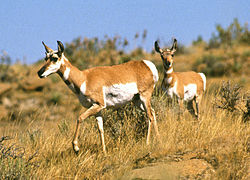
Pronghorns in Fort Keogh, Montana
Scientific classification Edit this classification
Kingdom: Animalia
Phylum: Chordata
Class: Mammalia
Order: Artiodactyla
Suborder: Ruminantia
Infraorder: Pecora
Family: Antilocapridae
J. E. Gray, 1866
Type genus
Antilocapra
Ord, 1815
Genera

See text

The Antilocapridae are a family of ruminant artiodactyls endemic to North America. Their closest extant relatives are the giraffids.[1] Only one species, the pronghorn (Antilocapra americana), is living today; all other members of the family are extinct. The living pronghorn is a small ruminant mammal resembling an antelope.

Description

[edit]

In most respects, antilocaprids resemble other ruminants. They have a complex, four-chambered stomach for digesting tough plant matter, cloven hooves, and small, forked horns. Their horns resemble those of the bovids, in that they have a true horny sheath, but, uniquely, they are shed outside the breeding season, and subsequently regrown. Their lateral toes are even further diminished than in bovids, with the digits themselves being entirely lost, and only the cannon bones remaining. Antilocaprids have the same dental formula as most other ruminants: 0.0.3.33.1.3.3.

Classification

[edit]

The antilocaprids are ruminants of the clade Pecora. Other extant pecorans are the families Giraffidae (giraffes), Cervidae (deer), Moschidae (musk deer), and Bovidae (cattle, goats and sheep, wildebeests and allies, and antelopes). The exact interrelationships among the pecorans have been debated, mainly focusing on the placement of Giraffidae, but a large-scale ruminant genome sequencing study in 2019 suggested that Antilocapridae are the sister taxon to Giraffidae, as shown in the cladogram below.[2]

Ruminantia

Evolution

[edit]

The ancestors of pronghorn diverged from the giraffids in the Early Miocene.[2] This was in part of a relatively late mammal diversification following a climate change that transformed subtropical woodlands into open savannah grasslands.[2]

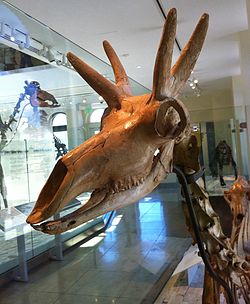
The antilocaprids evolved in North America, where they filled a niche similar to that of the bovids that evolved in the Old World. During the Miocene and Pliocene, they were a diverse and successful group, with many different species. Some had horns with bizarre shapes, or had four, or even six, horns. Examples include Osbornoceros, with smooth, slightly curved horns, Paracosoryx, with flattened horns that widened to forked tips, Ramoceros, with fan-shaped horns, and Hayoceros, with four horns.[3][4]

Species

[edit]
  • Subfamily Antilocaprinae
  • Subfamily †Merycodontinae
    • Genus †Cosoryx
      • Cosoryx cerroensis
      • Cosoryx furcatus
      • Cosoryx ilfonensis
    • Genus †Merriamoceros
      • Merriamoceros coronatus
    • Genus †Merycodus (syn. Meryceros and Submeryceros)[9][10]
      • Merycodus crucensis
      • Merycodus hookwayi
      • Merycodus joraki
      • Merycodus major
      • Merycodus minimus
      • Merycodus minor
      • Merycodus necatus
      • Merycodus nenzelensis
      • Merycodus prodromus
      • Merycodus sabulonis
      • Merycodus warreni
    • Genus †Paracosoryx[11]
      • Paracosoryx alticornis
      • Paracosoryx burgensis
      • Paracosoryx dawesensis
      • Paracosoryx furlongi
      • Paracosoryx loxoceros
      • Paracosoryx nevadensis
      • Paracosoryx wilsoni
    • Genus †Ramoceros
      • Ramoceros brevicornis
      • Ramoceros marthae
      • Ramoceros merriami
      • Ramoceros osborni
      • Ramoceros palmatus
      • Ramoceros ramosus

References

[edit]
Revisions and contributorsEdit on WikipediaRead on Wikipedia
from Grokipedia
Antilocapridae is a monotypic family of artiodactyls in the order Artiodactyla, comprising only the living species Antilocapra americana, commonly known as the , a fleet-footed endemic to the grasslands and shrublands of western . The family originated in the epoch approximately 19 million years ago in , with early members of the subfamily Merycodontinae exhibiting small-bodied forms and simple, dorsally directed . Over time, Antilocapridae achieved peak generic diversity of six during the middle , but underwent significant declines, particularly in the and , leaving the as the sole extant representative. Phylogenetically, the family is closely allied with , sharing traits like cheek teeth and permanent bony horn cores covered by keratinous sheaths, though pronghorns uniquely shed their horn sheaths annually, unlike true bovids or cervids. Physically, pronghorns are medium-sized ungulates, standing about 3 feet (0.9 m) at the shoulder and weighing around 115 pounds (52 kg), with a tan to reddish-brown coat, white rump patch, and exceptional eyesight providing nearly 320-degree up to 3 miles (4.8 km) away. Their slender legs and lightweight build enable sustained speeds of up to 55 miles per hour (88 km/h), making them the fastest land in the , an likely evolved for evading predators on open plains. Males possess prominent, pronged horns up to 18 inches (46 cm) long, while females have shorter spikes; both sexes exhibit two white throat patches used in visual signaling during social interactions. Pronghorns inhabit open, arid to semiarid ecosystems such as shortgrass prairies, steppes, and shrublands, preferring low-rolling with slopes under 30% and annual of 10-15 inches (25-38 cm), where visibility is unobstructed for predator detection. Their range spans from and in through the to , though historical distributions were broader before European settlement and reduced populations. Ecologically, they are mixed feeders, consuming forbs, browse, grasses, and cacti in varying proportions by season and region, with a preference for vegetation 15-24 inches (38-61 cm) tall; they require water sources within 3 miles (5 km) and benefit from prescribed fires that enhance forage availability. Reproductively, pronghorns breed from late summer to fall, with lasting about 252 days and fawns born typically in May-June; females produce single offspring in their first year and twins thereafter, while males reach maturity at 16 months. Lifespans average 7-10 years in the wild, with predators including coyotes, bobcats, mountain lions, and golden eagles posing primary threats, especially to fawns. Several , such as A. a. sonoriensis and A. a. peninsularis, are federally listed as endangered due to habitat loss and low numbers, underscoring ongoing conservation efforts to restore migratory corridors and manage predation.

Taxonomy and Phylogeny

Etymology and Naming

The family name Antilocapridae is derived from the Antilocapra, combining the Greek root antilope () and the Latin capra (), reflecting the animal's antelope-like agility and goat-like features such as its horns and build. The was first scientifically described by American naturalist George Ord in 1815 as Antilope americana, grouping it with Old World antelopes due to morphological similarities, which led to the persistent "pronghorn antelope" despite its distinct lineage. Ord soon revised the genus to Antilocapra americana in 1818 to distinguish it more accurately. The family Antilocapridae was formally proposed by British zoologist in 1866, who emphasized its unique horn structure in classifying it separately from other ruminants. Early 19th-century taxonomies often aligned Antilocapridae closely with the family, based on shared traits like digestion and social behaviors. 20th-century refinements, driven by detailed anatomical studies, solidified its status as a monotypic North American family distinct from , with further genetic analyses in the late 20th and early 21st centuries confirming its phylogenetic proximity to within Artiodactyla.

Classification and Extant Species

Antilocapridae belongs to the kingdom Animalia, phylum Chordata, class Mammalia, order Artiodactyla, suborder Ruminantia, and family Antilocapridae. The family is monotypic, containing only the single extant genus , with no other living genera recognized. The sole surviving species is Antilocapra americana, commonly known as the , which represents the only extant member of the family. This species includes five recognized : A. a. americana (American pronghorn), A. a. oregona (Oregon pronghorn), A. a. mexicana (Mexican pronghorn), A. a. peninsularis (Peninsular pronghorn), and A. a. sonoriensis (). The subspecies exhibit physical distinctions, such as size variations, with A. a. peninsularis being notably smaller in body size and horn length compared to the larger A. a. americana. Phylogenetically, Antilocapridae is positioned closely to the families and Cervidae within the lineage.

Evolutionary Relationships

Antilocapridae occupies a basal position within the of , consistently supported by molecular phylogenies as the to , which includes giraffes and okapis. Early molecular studies in the 2000s, utilizing (mtDNA) and nuclear genes, recovered this relationship, positioning Antilocapridae and as the earliest diverging lineages among extant pecorans, separate from the comprising , Cervidae, and . This topology reflects a rapid radiation of pecoran families during the Oligocene-Miocene transition, with Antilocapridae diverging from other approximately 25-30 million years ago. Key synapomorphies uniting Antilocapridae with other include advanced digestion characterized by the presence of an , a specialized chamber in the stomach that enhances nutrient absorption through microbial fermentation, alongside a compact adapted for locomotion. Within Antilocapridae specifically, branched or pronged cranial appendages, such as the forked horns of the (Antilocapra americana), represent a diagnostic feature distinguishing them from the unbranched horns of , though both families share the broader pecoran trait of permanent, bony-cored cranial ornamentation covered in sheaths. These adaptations underscore the family's evolutionary divergence while maintaining core physiologies. Genomic analyses from the late and have reinforced this phylogenetic placement, confirming Antilocapridae's position as the oldest extant pecoran branch through whole-genome sequencing of multiple species, which highlights unique genetic signatures tied to their North American following Miocene migration across the Bering from Eurasian ancestors. These studies reveal no close living relatives outside , emphasizing the family's isolated evolutionary trajectory in the after the initial dispersal event.

Physical Description

Morphology and Anatomy

Members of the Antilocapridae family, represented solely by the pronghorn (Antilocapra americana), possess a slender, deer-like build optimized for swift movement across open terrains. Adults typically measure 1 to 1.5 meters in head-body length, stand 75 to 100 cm at the shoulder, and weigh 35 to 60 kg, with males generally larger than females. This lightweight frame, supported by long, slender legs, enables exceptional agility and endurance. The head of pronghorns is characterized by distinctive forked horns unique to the family, present in both sexes and annually , shedding the sheath while retaining the bony core. In males, these horns can extend up to 40 cm, featuring a forward-pointing prong near the tip, whereas females bear shorter, less branched versions typically under 10 cm. This structure distinguishes Antilocapridae from true antelopes and deer, combining elements of horn and morphology. Sensory adaptations include large, protruding eyes positioned to provide a panoramic field of vision spanning approximately 320 degrees, allowing near-complete without head movement. The prominent muzzle houses well-developed olfactory organs, supporting a keen for detecting distant threats or resources. follows a formula of 0/3 incisors, 0/1 canines, 3/3 premolars, and 3/3 molars (total 32 teeth), with molars suited for grinding abrasive vegetation.

Unique Adaptations

Antilocapridae, commonly known as , exhibit remarkable speed adaptations that enable them to achieve bursts of up to 98 km/h, making them the fastest land mammal in the . This capability is supported by physiological enhancements, including lungs that are approximately twice the size of those in similarly sized mammals, which facilitate greater oxygen intake during high-intensity activity. Additionally, their features enhanced oxygen diffusion efficiency, driven by a large windpipe and elevated erythrocyte counts, allowing sustained aerobic performance over distances where other ungulates would falter. For in arid environments, rely on a prominent white rump patch, which serves primarily for visual signaling to alert the herd of danger by flashing conspicuously over long distances. Complementing this, their nasal passages contain extensive, scrolled turbinate bones that cool and humidify inhaled air, preventing respiratory water loss and overheating in hot conditions through countercurrent heat exchange. These structures enable efficient , as exhaled air transfers heat back to the , conserving body water during prolonged exposure to extreme diurnal temperature swings. As ruminants, pronghorns possess a four-chambered optimized for microbial , where , , and fungi break down in tough that other herbivores avoid. This process occurs primarily in the , the largest chamber, yielding volatile fatty acids as an energy source and allowing pronghorns to thrive on fibrous desert plants like and forbs.

Distribution and Habitat

Geographic Range

The family Antilocapridae, represented solely by the pronghorn (Antilocapra americana), is endemic to North America, with its current geographic range spanning western and central regions from southern Alberta and Saskatchewan in Canada southward through the western United States to northern Mexico, including states such as Sonora, Chihuahua, and Baja California. Core populations are concentrated in the Great Plains, Intermountain West deserts, and sagebrush steppe habitats, where the species occupies open, arid, and semi-arid landscapes across an estimated extent of occurrence of approximately 3.5 million square kilometers. This distribution reflects adaptations to expansive, treeless terrains, though fragmented by human development and fencing that limits connectivity. Historically, prior to European colonization in the early , the 's range was far more extensive, covering much of western from south-central to the high plains north of , extending eastward to the and the Gulf Coast of , and westward to the . At that time, populations numbered around 35 million individuals, roaming vast grasslands alongside herds. However, intensive overhunting during the drastically reduced numbers to fewer than 20,000 by the 1920s, contracting the range and isolating certain , such as the peninsular pronghorn (A. a. peninsularis), which is now restricted to isolated desert regions in , . While many pronghorn populations are relatively sedentary, some exhibit conditional seasonal migrations in response to resource availability and weather, with individuals or herds moving up to 160–200 kilometers between summer and winter ranges, particularly in areas like Wyoming's Greater Yellowstone Ecosystem. These movements are shorter and less obligatory than those of sympatric species such as bison, often involving northeastward spring migrations and southwestward fall returns along traditional routes, though they remain vulnerable to barriers like roads and fences.

Habitat Types and Preferences

Antilocapridae, represented solely by the extant species Antilocapra americana (), primarily inhabit open grasslands, shrublands, and semi-desert ecosystems across western . These habitats feature expansive, low-relief landscapes that provide unobstructed visibility essential for detecting predators from afar. Pronghorn favor flat or gently rolling terrain with slopes typically less than 30 percent, as steeper or more rugged areas limit their high-speed flight capabilities and foraging efficiency. Shrub-steppe communities, dominated by species like (Artemisia spp.), are particularly preferred, supporting the family's evolutionary adaptations for speed and vigilance in open environments. Key environmental requirements for Antilocapridae include moderate annual levels ranging from approximately 150 to 500 mm, which sustain the herbaceous critical for their sustenance without promoting excessive woody growth. These arid to semi-arid conditions correlate with highest densities, as excessive rainfall can lead to denser plant cover that hinders mobility and visibility. actively select areas with vegetation cover less than 50 percent to facilitate foraging on accessible forbs and grasses, while the interspersed bare ground or rocky patches aid in and escape routes. The family avoids dense forests and wetlands, which offer poor sightlines and impede rapid movement, restricting their distribution to non-forested, upland regions. Microhabitat preferences within these ecosystems span elevations from 300 to 2,500 , encompassing diverse but consistently open terrains from floors to montane grasslands. exhibit seasonal shifts, often migrating to higher altitudes during summer to access cooler temperatures and fresher forage in mesic meadows, before descending to lower, wind-swept winter ranges for reduced accumulation. These elevational movements, sometimes covering tens of kilometers, optimize resource availability while minimizing exposure to . Such patterns underscore the family's reliance on heterogeneous landscapes that allow dynamic use tied to climatic variation.

Behavior and Reproduction

Social Structure and Daily Activities

Pronghorns exhibit flexible social structures that vary by season, , and , typically forming herds of 3 to 25 individuals during much of the year, with larger aggregations of up to 1,000 animals in fall and winter for enhanced predator vigilance. These groups often consist of mixed-sex bands or female-only herds, while young males form bachelor groups of 2 to 10 individuals, and mature males may remain solitary outside the breeding period. Dominance hierarchies based on age and size influence interactions within these bands, with adult females and males establishing linear rankings that reduce conflict during foraging and movement. Daily activities follow a diurnal pattern, with peak activity occurring at dawn and dusk for movement and vigilance, followed by midday resting in shaded areas to avoid heat stress. Individuals alternate between short bouts of ruminating, standing alerts, and brief sleep periods throughout the day, covering home ranges of 2.6 to 5.2 square kilometers in summer. Territorial males engage in regular patrolling of their defended areas, using visual scans and rapid trots to monitor boundaries and intruders, a that intensifies in high-quality habitats. Communication among pronghorns relies on a combination of vocalizations, postural displays, and olfactory signals to convey alarms, dominance, and group cohesion. Vocal signals include snort-wheezes as warnings of danger and bleats from young to solicit attention, while postural displays feature the erection of white rump hairs visible up to 3 kilometers away for rapid predator alerts and ear folding by aggressive males to accentuate horn size. Scent marking occurs primarily through subauricular glands located on the cheeks, where males rub secretions onto vegetation in a sniff-paw-urinate sequence to delineate territories and signal status.

Mating Systems and Life Cycle

Antilocapridae, represented primarily by the pronghorn (Antilocapra americana), exhibit a polygynous mating system in which males defend territories or mobile harems during the annual rut. Breeding typically occurs from mid-September to early October, with males establishing dominance through aggressive displays and combats to attract females. In this system, successful males may control harems of up to 15 females, while subordinate males often fail to mate until older and stronger. Males utilize their pronged horns in ritualized displays and clashes to assert territorial control during courtship. Gestation in lasts 245–255 days, with most births occurring in late spring from late May to early June. Females commonly produce twins under favorable nutritional conditions, averaging 1.9 fawns per doe, though singles predominate in poorer habitats. Newborn fawns are precocial, able to stand and follow their mothers shortly after birth, and employ a hiding strategy in cover for the first few weeks. Fawn to recruitment age reaches up to 70% in optimal conditions with abundant and low predation pressure, though rates can drop to 30% or lower in challenging environments. Pronghorn fawns are weaned between 1 and 2 months of age, typically by late , after which they form nursery groups. is attained at 15–16 months, with females often breeding in their first year and males participating once they can hold territories, usually by age 2. In the wild, pronghorn lifespan averages 7–10 years, influenced by predation and quality, while individuals in can live up to 15 years.

Ecology and Interactions

Diet and Foraging Behavior

Antilocapridae, commonly known as pronghorns, are herbivorous mammals that exhibit a mixed feeding strategy, functioning as both browsers and grazers depending on seasonal availability and conditions. Their diet primarily consists of , which make up 52.2–60.3% of intake, followed by shrubs at 22.6–28.2%, graminoids at 8.7–15.7%, and at 5.5–9.6%. This composition reflects their opportunistic nature, with providing the highest protein levels (32.4–62.4% of dietary protein intake) compared to graminoids (1.2–43.1%), shrubs (18.7–21.3%), and (2.6–7.4%). Seasonal shifts occur, with forb consumption peaking during early and spring growth periods, while shrub intake increases in winter to compensate for reduced forb availability. Foraging behavior in pronghorns is highly selective, targeting nutrient-rich parts such as tender leaves and apical growth in open grasslands and shrublands to optimize energy intake. They exhibit opportunistic feeding, switching between forage types based on quality and abundance, and typically consume 1.5–2.5% of their body weight in daily, equating to approximately 900 grams for a 40 kg adult during maintenance periods. In arid environments, pronghorns meet much of their requirements through with high moisture content (over 75%), reducing reliance on free-standing sources during wetter seasons or availability. Nutritional adaptations in Antilocapridae include a microbiome specialized for fermenting high-fiber diets, enabling efficient breakdown of forbs and shrubs despite a relatively small volume that limits extensive processing. microbes facilitate the of fibrous materials, with in vitro digestibility averaging 57% for grasses, 42% for forbs, and 55% for shrubs, supporting their ability to extract nutrients from diverse, often lignocellulose-rich vegetation. This microbial community also aids in metabolizing secondary compounds in browse, allowing pronghorns to tolerate and utilize plants that might otherwise be challenging for other ruminants.

Predators, Defense Mechanisms, and Symbiosis

Pronghorn (Antilocapra americana), the sole extant species in the family Antilocapridae, face predation primarily from coyotes (Canis latrans), which account for the majority of fawn mortality, often 43-79% in regions like Yellowstone National Park. Bobcats (Lynx rufus) also prey on young pronghorn, while golden eagles (Aquila chrysaetos) occasionally target fawns. For adults, wolves (Canis lupus) and mountain lions (Puma concolor) pose threats, though their impact is lower, with wolves responsible for about 11% of adult predation in monitored areas. To counter these predators, rely on exceptional speed, sustaining runs of approximately 65 km/h over several kilometers, allowing evasion through endurance rather than short bursts. Additional defenses include acute vision for early detection of threats up to 4 miles away and alarm signaling via erection of white rump hairs, creating a visible flash that alerts the group and coordinates flight. Group vigilance in herds enhances collective monitoring, while horn sparring is infrequent and primarily occurs among males during intra-specific rather than against predators. Symbiotic relationships involve mutualism with black-tailed prairie dogs (Cynomys ludovicianus), benefiting from the ' engineering of open foraging areas with higher-quality vegetation. Pronghorns also experience competition with domestic , such as sheep and , for resources, which can increase nutritional stress and facilitate transmission in overlapping habitats. Parasitic interactions, such as infestations by ticks () and gastrointestinal worms (e.g., nematodes), are common, with high prevalence (up to 94%) and notable impacts on fawn survival (30-60% mortality in some cases) and population health, particularly under or conditions, though arid habitats may limit certain transmission rates.

Evolutionary History

Fossil Record

The fossil record of Antilocapridae documents a diverse group of ruminants endemic to , with remains spanning from the late Oligocene or early Miocene to the . The family first appears in the fossil record approximately 21–23 million years ago during the Late Arikareean North American Land Mammal Age, based on a partial left (KUVP 48020) preserving three lower molars recovered from the Harrison Formation in eastern . This specimen, likely belonging to an indeterminate merycodontine antilocaprid, exhibits primitive dental features such as ectostylids on the molars and a C-shaped hypoconulid on the m3, predating previously known records by 3–4 million years and indicating an earlier from Eurasian ruminant ancestors. Early genera include Merycodus and Paracosoryx, which are documented from Early Hemingfordian (~18 Ma) deposits and represent the basal diversification of the family. Subsequent Miocene fossils reveal a radiation of over 50 extinct species across at least 13 genera, showcasing morphological diversity in body size, limb proportions, and cranial structures adapted to open habitats. Major fossil-bearing sites are concentrated in formations, such as the Harrison Formation in and , where multiple taxa including Merycodus have been unearthed, providing evidence of early grassland ecosystems. The Ash Hollow Formation in , dating to the middle (Barstovian, ~13.5 Ma), has yielded pronghorn relatives like Merycodus, alongside other , highlighting the family's role in savanna communities. Transitional forms from these sites, such as species of Merycodus, display evolving horn structures—from simple, deer-like ossicones to the branched, deciduous horns characteristic of later antilocaprids—reflecting adaptations for display and defense amid expanding grasslands. In the Pleistocene, the fossil record shifts toward more specialized forms, with genera like Capromeryx representing dwarf species that persisted until the late Rancholabrean (~0.25–0.01 Ma). Capromeryx, first appearing in the Pliocene (~5 Ma) but abundant in Pleistocene deposits such as Rancho La Brea in California, includes diminutive taxa like C. minor, which measured under 60 cm at the shoulder and exhibited reduced horn spikes possibly linked to insular or resource-scarce environments. Fossils from sites across the southwestern United States and Mexico, including New Mexico's Blancan deposits, document Capromeryx alongside larger contemporaries like Stockoceros, indicating coexistence of size extremes during the Ice Age. Many Pleistocene antilocaprids, including several Capromeryx species, went extinct around 11,000 years ago, coinciding with rapid climate shifts from glacial to interglacial conditions that altered vegetation and habitat availability across North America.

Origins and Extinctions

The family Antilocapridae originated in during the early epoch, approximately 21–23 million years ago, with the earliest known fossils dating to the Late Arikareean n Land Mammal Age and indicating immigration from Eurasian ancestors. These initial representatives, such as primitive merycodontines, emerged in western n ecosystems transitioning from forested habitats to more open woodlands and savannas. Antilocapridae is considered derived from Eurasian stock and evolved endemically on the continent within the superfamily , with no evidence of later migrations via the for its founding lineages. During the , Antilocapridae underwent significant radiation, diversifying into multiple subfamilies adapted to the expanding grasslands following the global decline of C3-dominated forests around 15–20 million years ago. This period saw the development of key traits like deciduous forked horns and high-speed locomotion, enabling exploitation of open habitats. By the , the family achieved peak diversity, with at least 13 extinct genera documented alongside the ancestor of the modern , reflecting adaptations to increasingly arid, grass-dominated landscapes across . The Antilocapridae suffered massive extinctions toward the end of the Pleistocene epoch, around 10,000 years ago, with over 99% of its species lost as part of the broader North American megafauna collapse. This event reduced the family from dozens of species across multiple genera to a single surviving species, Antilocapra americana. Primary causes included rapid climate warming at the termination of the last glacial period, which altered vegetation and habitats, combined with the arrival of Paleoindian hunters approximately 15,000–13,000 years ago, who targeted large herbivores through overkill mechanisms. No Antilocapridae species survived in the Old World, as the family never dispersed beyond North America despite periodic Bering land bridge connectivity during the Pleistocene.

Conservation Status

The global population of pronghorns (Antilocapra americana), the sole extant species in the family Antilocapridae, is estimated at approximately 750,000 mature individuals (circa 2016), with overall numbers stable but showing regional increases (e.g., +43% in as of 2025) and distributed in fragmented subpopulations across western . This stability follows a remarkable recovery from near-extinction levels, though certain remain highly vulnerable; for instance, the peninsular pronghorn (A. a. peninsularis) persists at approximately 300-500 wild individuals (as of 2023-2025), primarily in , , due to ongoing isolation and low rates. exacerbates this fragmentation, as converts native grasslands into croplands, isolating herds and limiting among populations. Natural threats significantly influence , particularly in arid regions where are adapted. Prolonged droughts reduce availability and sources, leading to and elevated fawn mortality, as observed in southwestern U.S. subpopulations during severe dry periods. Disease outbreaks pose an additional risk, with pronghorns showing predicted susceptibility to (CWD), a fatal disorder already prevalent in sympatric cervids, potentially threatening herd health if transmission occurs. Human-induced impacts continue to challenge pronghorn viability, building on a history of severe exploitation. Unregulated overhunting in the late decimated populations by over 90%, reducing numbers from tens of millions to fewer than 15,000 by 1900. Today, fencing associated with ranching and agriculture creates barriers to seasonal migrations, confining herds to suboptimal ranges and increasing vulnerability to environmental stressors. collisions along highways further contribute to mortality, with pronghorns' migratory behavior heightening collision risks in developed areas.

Conservation Measures and Management

The (Antilocapra americana), the only extant in the Antilocapridae, is assessed as Least Concern on the , reflecting stable and widespread populations across much of its North American range. However, specific subspecies face heightened risks and are subject to targeted protections; for instance, the (A. a. sonoriensis) and peninsular pronghorn (A. a. peninsularis) are listed as Endangered under the U.S. Endangered Species Act, prohibiting take and mandating safeguards on federal lands. In the United States, hunting of is strictly regulated by state wildlife agencies through permit systems, bag limits, and seasonal quotas, which function similarly to protections under migratory game bird frameworks by ensuring harvests do not exceed sustainable levels. These regulations, enforced across western states like , , and , prioritize population viability while allowing controlled recreation. Key management practices emphasize active intervention to enhance population resilience and connectivity. Translocation programs have been instrumental, with wildlife agencies capturing and relocating to augment declining herds; notable examples include Arizona Game and Fish Department efforts to move individuals to Mexico's El Pinacate y Biosphere Reserve, boosting cross-border populations of endangered . Habitat restoration initiatives commonly involve grazing management, where stocking rates are adjusted or excluded to promote native plants and reduce competition, as implemented in refuges and public lands managed by the . Sustainable hunting practices further support management, with annual harvests in many regions limited to 10-25% of the estimated population, often focusing on does and subadults to balance rates without impeding growth. These efforts have yielded significant successes, exemplified by the pronghorn's dramatic recovery from roughly 13,000 individuals continent-wide in the 1920s—decimated by overhunting and loss—to an estimated population exceeding 700,000 today. Protected areas like the Cabeza Prieta National Wildlife Refuge in have played a pivotal role, particularly in rebounding the from fewer than 30 animals in the early 2000s to over 200 through captive rearing, translocations, and enhancements, with the U.S. population now exceeding 650 as of 2024. Such refuges, combined with binational cooperation, demonstrate effective models for maintaining in arid ecosystems.

References

Add your contribution
Related Hubs
User Avatar
No comments yet.