Hubbry Logo
East IndiesEast IndiesMain
Open search
East Indies
Community hub
East Indies
logo
8 pages, 0 posts
0 subscribers
Be the first to start a discussion here.
East Indies
East Indies
from Wikipedia
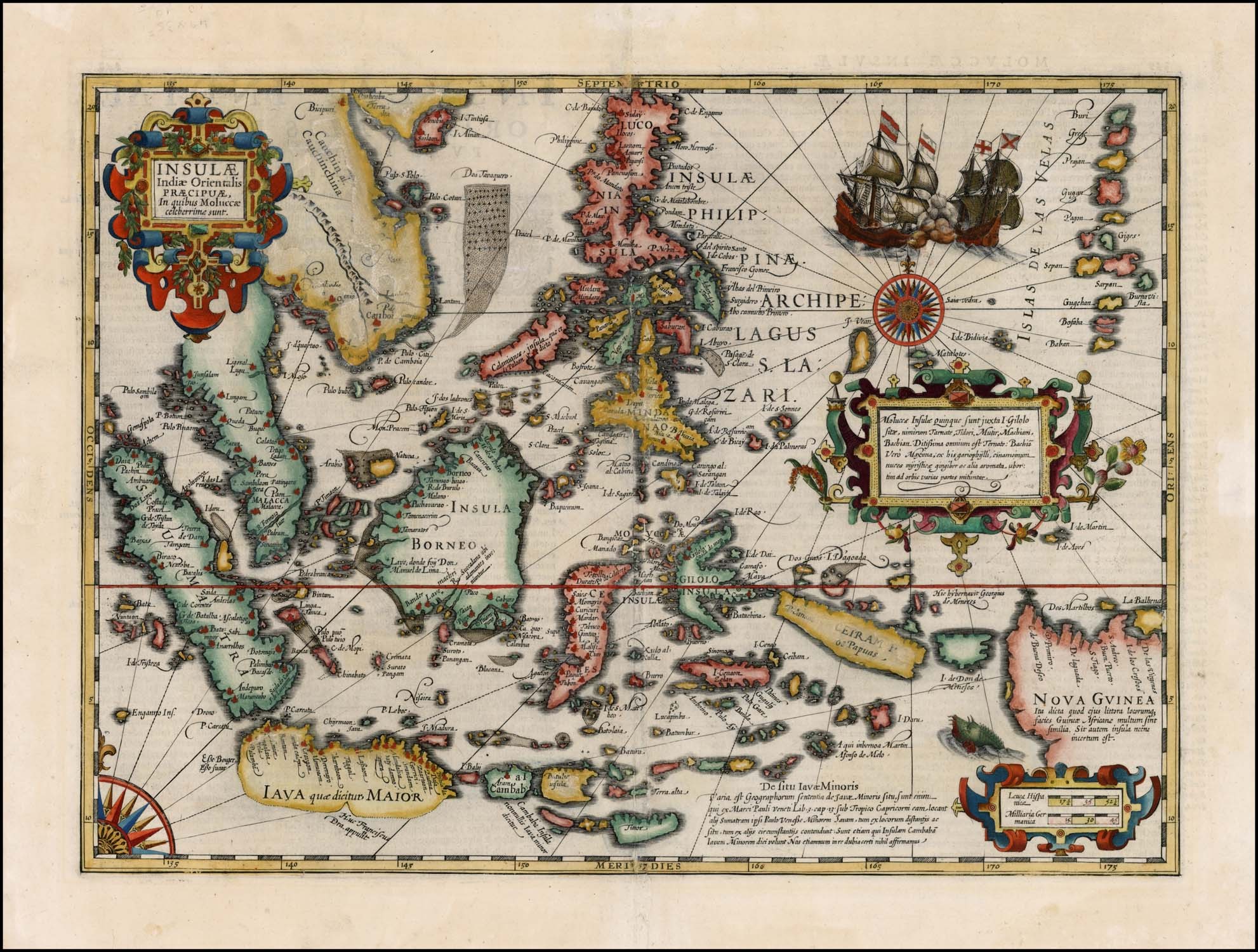
A 1606 map of the East Indies
An 1801 map of the East Indies
  East Indies
  West Indies (present-day; historically included the Americas entirely)
  Countries sometimes included in West Indies

The East Indies (or simply the Indies) is a term used in historical narratives of the Age of Discovery. The Indies broadly referred to various lands in the East or the Eastern Hemisphere, particularly the islands and mainlands found in and around the Indian Ocean by Portuguese explorers, soon after the Cape Route was discovered. In a narrow sense, the term was used to refer to the Malay Archipelago, which today comprises the Philippine Archipelago, Indonesian Archipelago, Borneo, and New Guinea. Historically, the term was used in the Age of Discovery to refer to the coasts of the landmasses comprising the Indian subcontinent and the Indochinese Peninsula along with the Malay Archipelago.[1][2][3]

Overview

[edit]

During the era of European colonization, territories of the Spanish Empire in Asia were known as the Spanish East Indies for 333 years before the American conquest and later the independence of the Philippines. Dutch occupied colonies in the area were known for about 300 years as the Dutch East Indies until Indonesian independence. The East Indies may also include the former French Indochina, former British territories Brunei, Hong Kong and Singapore and former Portuguese Macau and Timor. It does not, however, include the former Dutch New Guinea, which is geographically considered to be part of Melanesia.

The inhabitants of the East Indies are never called East Indians, as they are not linguistically related to South Asia, most specifically the Indo-Aryan languages. It distinguishes them both from inhabitants of the Caribbean (which is also called the West Indies) and from the indigenous peoples of the Americas who are often called American Indians. However, in colonial times, the non-Indian Southeast Asians were also called "Indians".

Peoples of the East Indies comprise a wide variety of cultural diversity, and the inhabitants do not consider themselves as belonging to a single ethnic group. The region is mostly populated by the Austronesians, who first expanded from the island of Taiwan, and later on during the early modern period, when East Asians such as the Han Chinese started to migrate south and became known as the Peranakans or Straits Chinese.

Buddhism, Christianity, Islam and Hinduism are the most popular religions throughout the region, while Sikhism, Jainism, Chinese folk religion and various other traditional beliefs and practices are also prominent in some areas. The major languages in this area draw from a wide variety of language families such as the Austronesian and Sino-Tibetan languages, and should not be confused with the term Indo-Aryan, a group of languages spoken in the Indian subcontinent. Speakers of Austroasiatic, Tai–Kadai, and Hmong–Mien languages also live in the region.

Regions of the East Indies are sometimes known by the colonial empire they once belonged to, hence, Spanish East Indies means the Philippines, Dutch East Indies means Indonesia, and British East Indies refers to Malaysia.

Historically, the king of Abyssinia (modern Ethiopia) was identified with "Prester John of the Indies", since that part of the world was imagined to be one of "Three Indias".

History

[edit]
Batavia, Dutch East Indies.

Exploration of the East Indies by European powers began in the last three years of the 15th century and continued into the 16th century, led by the Portuguese explorers.[4] The Portuguese described the entire region they discovered as the Indies. Eventually, the region would be broken up into a series of Indies: The East Indies, which was also called "Old Indies" or "Great Indies", consisting of India, and the West Indies, also called "New Indies" or "Little Indies", consisting of the Americas.[5]

These regions were important sources of trading goods, particularly cotton, indigo and spices after the establishment of European trading companies: the British East India Company and Dutch East India Company, among others, in the 17th century.

The New World was initially thought to be the easternmost part of the Indies by explorer Christopher Columbus, who had grossly underestimated the westerly distance from Europe to Asia. Later, to avoid confusion, the New World came to be called the "West Indies", while the original Indies came to be called the "East Indies".

The designation East Indian was once primarily used to describe people of all of the East Indies, in order to avoid the potential confusion from the term American Indian who were once simply referred to as Indians (see the Native American name controversy for more information).

See also

[edit]

References

[edit]
Revisions and contributorsEdit on WikipediaRead on Wikipedia
from Grokipedia
The East Indies refers to the historical geographical region comprising the islands of , particularly , which includes modern-day , , , the , and East Timor, distinguished from the following European voyages that initially conflated the with Asia.
This vast archipelago, spanning over 3,000 islands and lying between the Asian mainland and , became a focal point of global commerce due to its abundant natural resources, especially spices such as cloves, , and pepper originating from the Moluccas, known as the Spice Islands.
European exploration intensified in the late 15th century, with Portuguese navigators like seeking direct sea routes to bypass Middle Eastern intermediaries, leading to the establishment of trading posts and eventual colonial footholds by , , Britain, and the .
The (VOC), chartered in 1602, achieved dominance in the region by securing monopolies on key spices through military means and fortified settlements, culminating in the founding of Batavia in 1619 as the administrative center of the , which persisted as a until Indonesia's in 1945.
The East Indies' colonial era facilitated the transfer of wealth to via extractive enterprises, including the cultuurstelsel system of mandatory crop cultivation from 1830 to 1870, which generated substantial revenues but imposed heavy labor demands on indigenous populations, shaping the region's economic and political trajectory toward post-colonial nation-states.

Definition and Geography

Etymology and Terminology

The term "Indies" originated from the Latin India, which derived from the Hindu referring to the and the lands beyond it, entering around the 13th century as "Ynde" to denote and adjacent eastern regions. European explorers sought direct maritime access to these spice-rich areas, known collectively as the Indies, to bypass Ottoman-controlled land routes. In 1492, , aiming for the Indies via a western route, encountered the and labeled them the , believing them peripheral to ; this misapprehension necessitated the prefix "East" to specify the original Asian territories, with "East Indies" entering English usage by 1568 to encompass , Indochina, and Southeast Asian islands such as the . Historically, "the Indies" often served as shorthand for the East Indies in trade and navigational contexts, distinguishing them from the while broadly including subcontinental ; however, by the , as colonial administrations separated British from island possessions, "East Indies" predominantly referred to , excluding the Indian mainland. This evolution reflected practical distinctions in European imperial spheres, with entities like the (VOC, established 1602) applying it specifically to their Indonesian territories, later formalized as the colony. In modern terminology, "East Indies" persists in historical scholarship for the pre-colonial and colonial-era island groups of , the , and nearby archipelagos, though it has largely yielded to "" for geopolitical precision; the term avoids conflation with proper, whose name retains the ancient Indus without the broader "Indies" extension.

Geographical Boundaries and Composition

The East Indies historically denoted a expansive maritime region in , primarily comprising the in its narrower definition, which extends from the southern tip of the southeastward across thousands of islands to the western fringes of . This archipelago forms the core geographical composition, encompassing over 17,000 islands characterized by volcanic activity, tropical rainforests, and diverse ecosystems shaped by tectonic plate interactions along the . In broader historical usage, particularly during European exploration from the , the term occasionally incorporated adjacent continental areas of Further India (modern Indochina) and even extended westward to parts of the , though these were often distinguished in practice by trade-focused designations. Key island groups within the East Indies include the , , , and —which constitute the largest landmasses and served as centers of early spice production and population density due to fertile volcanic soils supporting intensive agriculture. The , stretching eastward from to , along with the (historically the Moluccas or Spice Islands, famed for cloves and ), add to the composition, featuring rugged terrains and strategic sea lanes that facilitated pre-colonial trade. The Philippine archipelago, comprising over 7,600 islands, was frequently included in East Indies mappings from the late onward, reflecting Spanish claims and the region's integration into global maritime routes. Portions of New Guinea's western half were intermittently encompassed, particularly under Dutch administration, highlighting the fluid boundaries influenced by colonial partitions rather than strict natural delimiters. These boundaries were not rigidly defined by natural features alone but evolved through navigational charts and imperial interests, with the western limit often set by the and the eastern by the , separating the region from . The overall area covers roughly 1.9 million square kilometers of land, with marine territories amplifying its strategic value for controlling monsoon winds essential to historical sailing. Variations in delineation across maps, such as those from the 17th to 19th centuries, underscore the term's contextual application, prioritizing economic resources like spices over precise .

Relation to Broader "Indies" Concept

The term "Indies" derives from the Latin Indi, referencing the lands beyond the , originally denoting the and extending to adjacent regions in South and valued for trade in spices, textiles, and precious metals. In the late , during the Age of Discovery, European powers such as and sought maritime routes to these Indies to access their wealth directly, circumventing Ottoman-dominated overland paths established since ancient times. The broader "Indies" thus encompassed territories from eastward to the and the Spice Islands (present-day ), forming the economic incentive for transoceanic voyages. The East Indies specifically designated the eastern extension of this concept, focusing on island chains and peninsulas like , , the , and , where European expeditions confirmed rich , , and pepper sources by the early . This contrasted with the , a term coined post-1492 to differentiate Columbus's unintended discoveries—believed to be the western fringe of —from the actual East Indies reached via the or Pacific routes. Columbus initially labeled his findings simply as the Indies, reflecting his navigational miscalculation of , which led him to underestimate the distance to ; the East-West qualifier emerged as Magellan's 1519–1522 and subsequent explorations clarified the Pacific barrier. Historians note that the "Indies" nomenclature persisted due to its association with imperial commerce, with the East Indies embodying the original target of exploration while the represented a serendipitous diversion, influencing colonial divisions until the . The distinction underscores causal geographic misconceptions driving expansion, as European maps and treaties, such as the 1494 , partitioned these perceived Indies spheres between Spain and Portugal.

Pre-Colonial Foundations

Indigenous Trade Networks

The indigenous trade networks of the East Indies, encompassing the and adjacent islands, originated with Austronesian maritime expansions that established inter-island exchanges by approximately 2000 BCE, utilizing outrigger canoes equipped with sails and leveraging monsoon wind patterns for navigation across , the , and eastern routes toward . These networks facilitated the movement of essential goods such as spices (including cloves from the and nutmeg from Banda), metals like tin from the , rice surpluses from and , aromatic woods such as and gaharu (), gold, slaves, and textiles, often bartered in port-to-port voyages rather than large-scale centralized systems. Archaeological evidence from sites in and indicates that such local exchanges predated intensive connections, with small-scale peddling by indigenous merchants handling diverse cargoes in bustling harbors like those in western . By the 7th century CE, the polity, centered in on , organized and expanded these networks into a that controlled the , a chokepoint linking the to the , thereby taxing indigenous and foreign vessels while exporting regional spices, resins, and ivory to and . 's fleet enforced tribute from vassal ports across , , and the , integrating local networks with tributary trade that peaked between the 8th and 11th centuries, when Chinese records note annual embassies carrying cargoes valued in thousands of taels of gold equivalent. This system relied on indigenous techniques for perahu vessels capable of ocean crossings, fostering economic interdependence among societies without reliance on overland routes. In the 14th to 16th centuries, the Empire in eastern further consolidated indigenous maritime dominance, deploying large jong warships—some displacing up to 1,000 tons and crewed by hundreds—to safeguard trade lanes extending from to the and eastern , protecting shipments of rice, pepper, and exotic bird-of-paradise plumes. Seafaring ethnic groups like the and Makassarese from played pivotal roles, establishing entrepôts along the and for relaying goods such as sea cucumbers, tortoise shell, and slaves to regional markets, with their perahu designs enabling agile long-distance voyages that predated European interference. These networks, characterized by fluid alliances and hybrid trading communities at ports, sustained economic vitality through decentralized mechanisms until disrupted by external powers around 1500 CE.

Political Entities and Societies

The pre-colonial East Indies encompassed a mosaic of political entities, from expansive maritime empires reliant on naval power and trade dominance to smaller, agrarian-based kingdoms and decentralized groups, reflecting the region's archipelagic and economic interdependence on sea routes. These polities often operated within overlapping spheres of influence, with central rulers exerting authority over core territories while maintaining relationships with peripheral vassals, facilitated by wet-rice , artisanal crafts, and in spices, gold, and forest products. Societies were typically stratified, featuring hereditary elites, free commoners, and enslaved populations captured through warfare or , with rooted in personal loyalties rather than rigid bureaucracies. Prominent among these was the polity, a thalassocratic kingdom centered in , , that rose around 670 CE and peaked by the 9th century through control of the Strait, amassing wealth from tolls on . Ruled by maharajas who claimed divine sanction via Buddhism, its political structure integrated local chieftains into a loose , supported by a fleet of war prahus and fortified riverine ports; the society included diverse ethnic groups—Malay, Javanese, Indian traders—with elites patronizing monasteries and merchants dominating exchanges in , cloves, and , though internal stratification and external raids by Chola forces from contributed to its fragmentation by the 11th century. In Java, the Majapahit kingdom, founded in 1293 CE after the fall of , evolved into the era's largest archipelagic power, encompassing direct rule over eastern Java and alongside over 80 vassal territories from to by the mid-14th century. Under King (r. 1350–1389) and his patih (prime minister) , who swore the oath to unify the Nusantara realm, the empire's administration featured a with rakryan (high officials) overseeing taxation, , and military levies, while provincial bupati (regents) managed local affairs under a syncretic Hindu-Buddhist emphasizing the ruler's sakti (spiritual power). Social organization emphasized noble lineages tied to agrarian surpluses from sawah fields, with labor and trade in rice, textiles, and metals sustaining expansion, though succession disputes and vassal revolts precipitated decline by the early . Further north, the Philippine islands featured fragmented units—kinship-based settlements of 30 to 100 households each—governed by datus who wielded authority through consensus among (nobles) and (freemen), focusing on coastal trade, swidden farming, and intertribal raids rather than centralized states. Larger confederations occasionally formed, as in the case of alliances among Visayan or barangays for defense or plunder, but isolation by sea distances preserved autonomy; societal norms included bilateral inheritance, tattooed warriors ( deriving from "savage" in Malay), and slavery from captives, with penetrating and by the 14th century via Bornean traders. On the , entities like , emerging around the 2nd century CE in the northern region, functioned as entrepôts linking Indian and Chinese commerce, with monarchs adopting Hindu-Buddhist titles and overseeing gold mines and pepper plantations amid a society of Malay speakers, Mon-Khmer groups, and foreign merchants. These polities, often tributary to until the , exemplified riverine hierarchies where rulers mobilized labor for hydraulic works and fleets, fostering cosmopolitan ports that presaged later sultanates.

European Exploration and Early Contact

Age of Discovery Motivations

The principal motivations for European powers, particularly , to explore routes to the East Indies during the were economic, driven by the immense profitability of the . Spices such as from and , cloves and from the Moluccas (Spice Islands), and commanded prices in Europe up to 60,000% higher than their production costs in , due to their uses in , , and luxury cuisine amid limited alternatives for flavoring and antimicrobial needs. By the , annual European spice imports exceeded 1,000 tons, with pepper alone accounting for over half, underscoring the scale of demand that fueled voyages seeking direct sourcing to capture margins previously siphoned by intermediaries. Geopolitical disruptions intensified this imperative: the Ottoman conquest of in 1453 severed reliable overland caravan routes through the , imposing tariffs, piracy risks, and religious hostilities that inflated costs by factors of 10 or more, while maintained a near-monopoly on redistribution via Mediterranean ports. chroniclers and royal decrees emphasized circumventing these "infidel" Muslim traders—Arab, Persian, and Ottoman—who controlled transshipment from ports to the , allowing Europeans to envision profits from bulk direct trade rather than fragmented resale. This causal chain—from supply scarcity and transport monopolies to profit —propelled state-sponsored expeditions, as evidenced by Portugal's investment of over 10 million in navigational advancements by 1498. Portugal's leadership stemmed from its Atlantic-facing geography, shipbuilding innovations like the , and strategic vision under figures such as (1394–1460), who from 1415 onward directed probes down Africa's coast explicitly to outflank Islamic trade networks and access spices. King Manuel I's 1497 commission of Vasco da Gama's fleet prioritized a route to Calicut () and beyond to the East Indies, with instructions centered on spice procurement treaties rather than mere mapping, reflecting mercantile realism over exploratory curiosity. While secondary drivers included quests for gold (as in African coastal entrepôts) and evangelization to counter Islam's expansion—aligned with Portugal's legacy—these were subordinated to trade dominance, as da Gama's 1499 return with 20-fold cargo value demonstrated the viability of spice monopolies. Spain's parallel efforts, via Columbus's 1492 westward voyage and Magellan's 1519–1522 circumnavigation reaching the (then lumped with East Indies), mirrored these incentives but pivoted after Treaty (1494) divided spheres, ceding eastern routes to while Spain targeted western access to the same spice sources. Empirical outcomes validated the focus: by 1512, Portuguese control of secured funneling of East Indies spices, yielding annual revenues equivalent to Portugal's entire GDP and bankrolling further empire-building.

Portuguese and Spanish Expeditions

The Portuguese, building on Vasco da Gama's establishment of a maritime route to in 1497–1499, sought direct access to the lucrative of the East Indies, particularly the Moluccas (Spice Islands) renowned for and . In 1511, led an expedition that conquered the Sultanate of , a critical entrepôt controlling regional trade routes to the archipelago, enabling further penetration into the region. From Malacca, António de Abreu commanded the first European fleet to reach the and Moluccas in 1512, departing in November 1511 with three ships and establishing initial trading contacts; his companion Francisco Serrão remained in , fostering alliances with local sultans and securing clove cargoes that yielded immense profits upon return to . These voyages, supported by fortified feitorias (trading posts) and naval superiority, allowed to monopolize direct European access to East Indies spices via the , bypassing Arab and Venetian intermediaries. Spain, constrained by the 1494 —which allocated eastern routes to —pursued a western passage across the Atlantic and Pacific to claim the Moluccas under papal demarcation lines, amid disputes over the antimeridian placement. , a Portuguese navigator in Spanish service, led the Armada de Molucca expedition departing in 1519 with five ships and 270 men, aiming to circumnavigate via the and load spices for return. The fleet reached the in March 1521, where Magellan was killed in local conflicts in April, but survivors under Juan Sebastián Elcano arrived at in the Moluccas in November 1521, trading for 50 tons of cloves before the Victoria completed the first , returning to in 1522 with 17 survivors and spices valued at over 7 million maravedís. Encounters with entrenched Portuguese forces led to skirmishes, and subsequent Spanish voyages, such as García Jofre de Loaísa's 1525 fleet of seven ships, suffered heavy losses from and hostilities, failing to displace Portuguese dominance in the core East Indies. These expeditions demonstrated the perils of the Pacific crossing but laid groundwork for Spanish footholds in the Philippines rather than the Moluccas.

Colonial Period

Establishment of Trading Posts

The Portuguese pioneered European trading posts in the East Indies to secure access to spices like cloves, , and mace, beginning with the conquest of on August 24, 1511, by Afonso de Albuquerque's fleet of approximately 1,200 men, which defeated Sultan Mahmud Shah's forces and established a fortified controlling between , , and the archipelago. This post, equipped with a stone fortress () completed by 1512, served as a base for further expeditions, imposing customs duties on passing ships and disrupting Muslim trading networks to favor direct European-Asian commerce. Expanding into the Moluccas—the core spice-producing region—Portuguese forces under António de Brito constructed Fort Kastela on between 1521 and 1522, allying with local Sultan Bayanullah to counter rival and secure exports, which totaled over 1,000 bahars (approximately 200 metric tons) annually by the mid-16th century. In 1568, they established a fortress on Ambon to dominate and mace production, fortifying it against local resistance and Spanish incursions, with the post exporting up to 500 bahars of spices yearly under Portuguese monopoly claims granted by the 1494 . These feitorias (trading factories) relied on naval superiority, with garrisons of 100-300 men, but faced chronic understaffing and native revolts, limiting long-term control. The Dutch, organized under the Vereenigde Oostindische Compagnie (VOC) chartered on March 20, 1602, with a monopoly on trade east of the , established their first permanent post in , , in 1603, following initial voyages that captured carracks for intelligence on spice routes. This factory, initially a wooden warehouse protected by local alliances, facilitated pepper and exchanges, growing to handle 50-100 ships annually by 1610 amid rivalry with . English factors concurrently set up a post in Banten in 1602, but Dutch aggression, including the 1603 seizure of Ambon from the Portuguese, shifted momentum, with VOC forts emphasizing cannon emplacements for defense against both Europeans and locals. By 1619, these efforts culminated in the founding of Batavia (modern ) as a consolidated , displacing earlier scattered outposts.

Dutch East India Company Dominance

![Kali Besar river in Batavia, Dutch East Indies][float-right] The (VOC), formally the Vereenigde Oostindische Compagnie, was chartered on March 20, 1602, by the , consolidating smaller trading ventures into a single entity with a 21-year monopoly on all Dutch maritime trade to via the Cape of Good Hope or . This monopoly empowered the VOC to establish trading posts, negotiate treaties, maintain armed forces, and engage in hostilities to secure commercial interests, marking it as the world's first with quasi-sovereign authority. By pooling capital from investors, the VOC raised 6.4 million guilders initially, enabling large-scale operations that outmatched fragmented rivals. Early VOC efforts focused on wresting control of the lucrative from the , who had dominated since the early . The company captured Ambon in , using it as a base for clove procurement, and enforced exclusive contracts with local rulers in the Moluccas. Under Governor-General , the VOC sacked Jayakarta on May 30, 1619, and founded Batavia (modern ) as its fortified Asian headquarters, providing a strategic hub for ship repairs, warehousing, and administration. Batavia's canals and defenses mirrored Dutch , supporting a growing European and Asian while serving as a launchpad for expeditions. To monopolize and mace production, the VOC targeted the , where spices fetched prices up to 14,000% markup in . In 1621, Coen orchestrated a brutal , deploying 2,000 troops and executing or enslaving much of the Bandanese population—estimated at 15,000—after they resisted exclusive trade deals, repopulating the islands with Javanese slaves to cultivate under company oversight. This campaign, involving mass killings and forced relocation, secured VOC exclusivity over global nutmeg supply, as the company destroyed rival trees and banned smuggling. Similar tactics in the Moluccas for cloves involved uprooting trees outside controlled areas to sustain high prices. Further consolidating dominance, the VOC, allied with forces, besieged and captured Portuguese-held on January 14, 1641, after a six-month campaign involving 18 warships and 2,000 troops, ending Iberian control over the Malayan Strait and redirecting tin and spice flows. By the mid-17th century, the VOC operated 150 merchant ships, 40 warships, and employed 57,000 personnel, establishing over 100 forts across the East Indies and generating profits exceeding 3.5 million guilders annually from spices alone. This military-commercial apparatus suppressed local resistance, outcompeted English interlopers, and enforced monopolies through blockades and punitive raids, cementing Dutch preeminence until intra-European conflicts eroded gains in the .

British and Other European Rivalries

The English (EIC), chartered in 1600, entered the East Indies to contest the Dutch VOC's emerging monopoly on spices such as and cloves, establishing joint factories in the Moluccas by 1603. Dutch authorities viewed these as threats to their exclusive trading rights, granted by local sultans, leading to escalating hostilities including seizures of English ships and blockades of ports. The rivalry peaked with the on 9 March 1623, when VOC governor Herman van Speult ordered the torture and execution of ten English factors, ten Japanese mercenaries, and one Portuguese on for an alleged plot to seize the fort; the Dutch claimed confessions under torture validated the charges, though English accounts emphasized fabricated evidence to eliminate competition. This incident, which killed 21 individuals total, fueled outrage in , contributing to the Third Anglo-Dutch War (1672–1674) and prompting the EIC to abandon the Moluccas by 1624, redirecting to less contested pepper trades in and . The three Anglo-Dutch Wars of 1652–1654, 1665–1667, and 1672–1674, driven by mercantilist competition over global trade routes, extended to Asian waters with EIC-VOC naval skirmishes near the and in the , disrupting shipments but failing to dislodge Dutch control over key East Indies entrepôts like Batavia (founded ). The VOC's superior fleet—peaking at over 150 ships annually by mid-century—and fortified monopolies in Banda and Ambon ensured British gains remained marginal, limited to inter-island smuggling. In response, the EIC fortified Bencoolen (modern ) on Sumatra's west coast in 1685, constructing to tap indigenous pepper gardens and evade Dutch patrols; the settlement, expanded with by 1714, exported up to 1,000 tons of pepper yearly at its height but suffered high mortality from disease and local raids, sustaining British presence until ceded to the Netherlands in 1824. The (1780–1784), precipitated by Dutch support for American independence, weakened VOC finances, setting the stage for Napoleonic-era shifts; Britain occupied Dutch East Indies holdings from 1795, culminating in the 1811 invasion of by a 10,000-strong expedition under Robert Stopford, which captured Batavia after minimal resistance from Governor-General Herman Daendels' forces. Lieutenant-Governor Thomas administered from September 1811 to 1816, enacting the system to tax land directly (yielding revenues of 11 million rupees in 1813) and curbing labor, though these reforms prioritized efficiency over sustainability. reverted to Dutch rule under the 1814 Treaty of Paris and 1815 , but the brief occupation exposed VOC vulnerabilities and informed later British strategies in Malaya. French involvement via the Compagnie des Indes Orientales (1664–1769) was peripheral, with failed attempts at East Indies outposts overshadowed by Dutch blockades and the company's focus on Indian textiles; by the Seven Years' War (1756–1763), French assets in were captured by Britain, curtailing any rivalry. Minor players like the Danish Asiatic Company traded sporadically in cinnamon from Ceylon but lacked military capacity to contest core East Indies spices, reinforcing the Anglo-Dutch axis as the era's dominant dynamic. The 1824 Anglo-Dutch Treaty formalized divisions, assigning Britain preeminence in the while affirming Dutch , averting further armed clashes.

Administrative and Economic Systems

The (VOC), chartered in 1602, operated as a quasi-sovereign entity with administrative powers including treaty-making, , and military action in the East Indies. Its governance structure featured the Heeren XVII, a board of 17 directors overseeing operations from , while Batavia (modern ), established in 1619, functioned as the central hub for regional administration under a appointed from 1610. Economically, the VOC enforced monopolies on spices like and cloves, procuring goods through direct , coercion, and alliances with local rulers, yielding annual dividends averaging 18% in the mid-17th century. Following the VOC's bankruptcy and dissolution in 1799, the Dutch government nationalized its territories, forming the Netherlands East Indies with a in Batavia exercising centralized authority by 1816. Administration increasingly relied on , delegating local governance to sultans and rajas while maintaining Dutch oversight through residents and controllers in key regions like and . The 19th-century , enacted in 1830 under , mandated Javanese villagers to devote one-fifth of their farmland to export crops such as sugar, coffee, and indigo, delivering portions as payment for land taxes, which generated over 800 million guilders for the Dutch treasury between 1831 and 1877. In the , centered on the from 1565, administration fell under a in , appointed by the Spanish crown, who managed a incorporating indigenous datus in a hierarchical system akin to feudal encomiendas for tribute collection. Economically, this supported the trade from 1565 to 1815, exchanging Chinese silks for Mexican silver, with annual voyages transporting up to 1,000 tons of goods and fostering monopolistic control over transpacific commerce. Portuguese administration in East Indies outposts like (captured 1511) and emphasized fortified trading factories governed by captains under the Estado da Índia viceroyalty from , prioritizing commerce over extensive territorial control through pacts with local potentates. Their economy centered on intra-Asian networks, exporting spices and textiles while importing slaves and horses, though lacking the VOC's scale and leading to limited long-term dominance. British efforts in the East Indies, via the , focused on entrepôts like Bencoolen (1685) and later the Straits Settlements (Singapore from 1819), transitioning to direct Crown rule by 1867 with a resident counselor administering free-port trade policies that boosted tin and rubber exports without the forced cultivation prevalent in Dutch domains.

Economic Exploitation and Development

Spice Trade Monopoly

The Portuguese initiated efforts to control the in the East Indies following Vasco da Gama's voyage around the in 1497, which disrupted prior Arab dominance over routes to . By 1511, they captured as a key entrepôt and extended influence to the Moluccas, establishing forts in and to secure cloves, while exploring nutmeg sources in the . However, Portuguese monopoly attempts faced persistent local resistance from sultans and rival traders, limiting full control despite the 1529 assigning the Moluccas to Portugal in exchange for Spanish claims westward. The Dutch United East India Company (VOC), chartered in 1602 with a on Dutch Asian trade, aggressively supplanted Portuguese positions to enforce a more rigorous spice monopoly focused on high-value "fine spices" like from Ambon and from Banda. VOC forces seized Ambon in 1605, compelling local producers via treaties to sell exclusively to the company and uprooting clove trees on neighboring islands to concentrate production. In , Jan Pieterszoon led the conquest of the , resulting in the deaths of thousands of Bandanese through combat, starvation, and execution—estimates range from 2,000 to over 10,000—followed by the enslavement or deportation of survivors, with plantations thereafter worked by imported slaves under direct VOC oversight. These measures, including systematic "extirpation" campaigns destroying excess spice trees and naval blockades, sustained artificially high European prices by restricting global supply. Economically, the VOC's spice monopoly generated substantial profits during the 17th century, with returns averaging 18% annually and peaking at over 40% in peak years between 1635 and 1690, funding the through dividends and intra-Asian trade networks. Cloves and , nearly exclusive to the Moluccas, commanded prices equivalent to by weight in , enabling the VOC to amass capital for forts, fleets, and further conquests while local economies were reoriented toward company quotas enforced by pass systems and punitive raids. The monopoly eroded in the 18th century due to smuggling by competitors, corruption within the VOC, and disruptions from European wars; British forces during the occupied key islands and uprooted spice trees to undermine Dutch control. A pivotal blow came in the 1770s when French horticulturist Pierre Poivre smuggled and plants to (), from which they spread to other colonies, undercutting scarcity-driven prices. By the VOC's in 1799, spice revenues had declined sharply, with Banda operations reporting losses exceeding 66,000 guilders by mid-century, shifting Dutch focus toward less monopolizable commodities like and sugar.

Cash Crop Plantations and Forced Labor

In the , the , implemented in 1830 by Governor-General , compelled Javanese villagers to dedicate up to 20% of their land and labor to export-oriented cash crops such as , , and in lieu of monetary taxes. This policy, enforced through local elites and colonial officials, prioritized Dutch fiscal recovery post-Napoleonic Wars, generating approximately 19% of the ' state income between 1832 and 1852 from colonial profits. However, it imposed severe burdens, with over 1.1 million people subjected to forced cultivation labor by 1840, leading to widespread , , and excess mortality estimated in the hundreds of thousands due to diverted resources from subsistence farming. The system persisted until gradual reforms after 1870, transitioning to private plantations reliant on indentured "" labor for crops like rubber and , often under coercive contracts that refined elements of until formal abolition in 1860. In , rubber expanded rapidly after 1890 following the crop's commercialization, drawing hundreds of thousands of Indian and Chinese coolies through indentured systems involving debt advances and multi-year contracts enforced by kanganies (overseers) or Chinese secret societies. These laborers, often recruited under false pretenses of wages and conditions, faced harsh plantation regimes with long hours, poor housing, and high mortality from disease and overwork, resembling coerced labor despite legal prohibitions on post-1834. By the , rubber estates employed over 500,000 migrants, fueling Malaya's export economy but prompting investigations into abuses like physical punishment and restricted mobility, which colonial reports attributed to labor shortages and profit motives rather than systemic benevolence. Under Spanish rule in the Philippines, the system from the 1570s granted colonists rights to indigenous labor and tribute, directing forced workers to sugar and tobacco plantations alongside polos y servicios () mandates requiring periodic unpaid service. Encomenderos extracted quotas of crops or labor from assigned barangays, contributing to depopulation through overexploitation and epidemics, with tobacco monopolized as a state by the 1780s via estancos that compelled cultivation under penalty. This evolved into estates by the 19th century, where debt peonage bound tenants to perpetual labor on export sugar fields, sustaining Manila's trade but eroding communal lands and self-sufficiency. Portuguese Timor saw forced labor systems from the , with households compelled to grow and for export under chefas (head taxes) and conscripted work on colonial plantations, preserving pre-colonial tribute mechanisms while introducing coercion that devastated local . These practices, intensified in the early , involved rotational forced shifts and seizures, resulting in population declines and resistance, yet persisted until as a low-investment extractive model yielding minimal . Across the East Indies, such regimes underscored a pattern where European powers prioritized commodity exports—spiking global supplies of by over 50% and rubber production exponentially—over indigenous welfare, with empirical records indicating labor as a causal driver of both economic gains and demographic losses.

Infrastructure and Technological Transfers

European colonial powers in the East Indies developed infrastructure primarily to support resource extraction, trade, and administrative control, introducing technologies adapted from metropolitan practices to tropical conditions. In the , road construction evolved from local labor-intensive methods to organized projects between 1800 and 1950, incorporating European , materials, and maintenance techniques that expanded connectivity for transport. By the end of Dutch rule in 1947, the road network totaled approximately 75,000 kilometers, concentrated in to link plantations and ports efficiently. Railway development began in the with narrow-gauge lines suited to the archipelago's terrain, facilitating the Cultivation System's export demands for , , and other commodities; the Semarang-Joana line, constructed amid liberal colonial reforms, exemplified this shift toward mechanized transport integrating steam locomotives and European track standards. Ports like Belawan in were engineered in the late 19th century with dredging and quay facilities to handle growing international shipping, replacing older sites and incorporating hydraulic technologies for deeper drafts. These projects transferred knowledge in , such as bridge-building with and hybrids resilient to seismic activity, though primarily benefiting export-oriented economies over broad local welfare. In British-controlled territories like Malaya and , infrastructure focused on linking tin mines and rubber plantations to export hubs; railways and paved roads were constructed from the late , with the railway reaching over 1,000 miles by 1910 to streamline commodity flows using standard-gauge tracks and signaling systems imported from Britain. Singapore's harbor expansions, including breakwaters and godowns, adopted steam-powered cranes and dredging tech by the 1900s, enhancing its role as a node while disseminating expertise. Spanish rule in the introduced 19th-century modernizations like Manila's port upgrades with steam infrastructure and initial railways for abaca and exports, alongside stone bridges (puentes) and trams employing European rail tech adapted for volcanic soils. Technological transfers included canals and aqueducts for and export crops, drawing on Iberian but often reliant on forced indigenous labor, yielding durable yet extractive systems that persisted post-colonially. Portuguese efforts in enclaves like and emphasized fortified ports over extensive networks, with limited transfers of and designs for defense rather than inland development. Overall, these initiatives embedded Western mechanical and organizational technologies, boosting throughput for colonial but entrenching dependencies on imported expertise and maintenance.

Conflicts and Resistance

Intra-European Wars

The (1602–1661), part of broader conflicts, featured Dutch assaults on Portuguese Asian holdings to secure spice monopolies in the East Indies. The Dutch captured Ambon from the Portuguese in 1605, establishing a base for further expansion, and seized after a from January to August 1641, disrupting Portuguese trade networks across . These operations, driven by VOC privateers and fleets, resulted in Dutch control over key entrepôts like and by 1650, though Portugal retained pockets in until later treaties. Anglo-Dutch rivalries escalated in the region through commercial sabotage rather than large-scale battles, culminating in the 1623 , where Dutch authorities in Ambon executed ten English factors and several Japanese mercenaries on charges of conspiracy, prompting outrage in England and contributing to the Third Anglo-Dutch War (1672–1674). While the four Anglo-Dutch Wars (1652–1784) focused primarily on naval engagements in European waters and the Atlantic, they indirectly curbed English expansion in the East Indies by enforcing Dutch dominance via blockades and seizures of rival shipping, with the VOC maintaining superior fortified positions in and the Moluccas. The Napoleonic Wars triggered direct British intervention against Dutch (and French-influenced) possessions. Following the 1799 French occupation of the , Britain seized Dutch outposts like in 1795, but the decisive campaign occurred in 1811 when a British expeditionary force of 13,000 troops under Lieutenant-General Samuel Auchmuty and Robert Stopford landed near Batavia (modern ) on August 4. Dutch-French forces under Governor-General and successor , numbering about 14,000 with local levies, retreated after initial skirmishes, suffering defeat at the Battle of Fort Cornelis on August 26, where British assaults overwhelmed the defenses despite heavy casualties from tropical diseases. remained under British administration until the 1816 Anglo-Dutch Treaty of restored it to the , formalizing partitions that confined British influence to Malaya and . These conflicts, totaling fewer than 5,000 European combat deaths but disrupting trade for years, underscored the East Indies' role as a peripheral theater in European power struggles.

Local Uprisings and Rebellions

The , fought from 1825 to 1830 in , represented a major indigenous challenge to Dutch colonial authority, led by Prince , a Javanese noble with religious and anti-colonial motivations. The conflict erupted after Dutch officials planned a road through land containing a sacred revered by Diponegoro's followers, exacerbating broader resentments over Dutch reforms, forced labor demands, and cultural encroachments that disrupted traditional Javanese agrarian and spiritual practices. Diponegoro mobilized tens of thousands of peasants and warriors, employing guerrilla tactics across rugged terrain, which initially allowed rebels to control significant areas and inflict defeats on Dutch expeditions. Dutch forces, reinforced with European troops and local auxiliaries, eventually prevailed through superior logistics and firepower, capturing Diponegoro in 1830 via deception; the war resulted in approximately 200,000 Javanese deaths from combat, famine, and disease, while costing the Dutch equivalent of 20 million guilders and prompting fiscal reforms like the to extract revenue more systematically. In Sumatra, the Padri War (1803–1837) involved reformist Muslim Padris seeking to impose stricter Islamic practices against traditional Minangkabau customs, drawing Dutch intervention on the side of adat leaders to secure trade interests and prevent regional instability. Padris, influenced by Wahhabi ideas from returning pilgrims, launched jihads against local elites, leading to civil strife that weakened Minangkabau resistance to European expansion; Dutch alliances with adat forces enabled conquest of key strongholds, culminating in the exile of Padri leader in 1837. This conflict, while primarily intra-indigenous, facilitated Dutch consolidation of control over West Sumatra's pepper and , with an estimated 100,000 casualties underscoring the interplay of religious reform and colonial opportunism. The (1873–c. 1914) marked one of the longest and costliest Dutch campaigns, as the Acehnese sultanate resisted driven by Dutch ambitions to monopolize trade routes in the and exploit resources like pepper and oil. Acehnese forces, under uleebalang commanders and religious leaders, adopted in swamps and highlands, inflicting heavy losses on Dutch expeditions—over 10,000 Dutch troops died, alongside tens of thousands of Acehnese from combat and scorched-earth tactics. Dutch general J.B. van Heutsz's "concentration" policy from 1896 onward relocated populations to isolate guerrillas, combining military pressure with promises of local autonomy, leading to formal submission by 1904, though sporadic resistance persisted until 1914; the war bankrupted Dutch finances temporarily and hardened colonial administration across the Indies. Balinese resistance to Dutch expansion peaked in ritualistic confrontations, including the 1906 intervention against Badung and other southern kingdoms, where rulers opted for —mass suicides by stabbing or keris disembowelment—rather than capitulation, killing hundreds of elites and followers in defiance of colonial ultimatums over trade disputes and internal exiles. Similar uprisings in (1894) saw Balinese and Sasak warriors assault Dutch garrisons before defeat, reflecting cultural codes prioritizing honorable death over subjugation; these events enabled Dutch incorporation of Bali by 1908, ending independent rajadoms but preserving some Hindu customs under . In British-controlled parts of the East Indies, such as Malaya, localized revolts like the Naning War (1831–1832) arose from attempts to impose tribute on semi-autonomous Minangkabau polities, resulting in brief guerrilla clashes that affirmed British without widespread escalation. These incidents, though smaller, highlighted patterns of resistance to revenue extraction, often quelled through alliances with compliant sultans and superior . Overall, such uprisings demonstrated indigenous agency against colonial overreach but were systematically suppressed, reinforcing European dominance until broader nationalist stirrings in the 20th century.

World War II Occupations

The Japanese invasion of the began on January 11, 1942, with landings on Island in and attacks on Celebes (), following the December 7, 1941, assault on . Japanese forces rapidly advanced, capturing key oil fields and ports; the [Battle of the Java Sea](/page/Battle_of_the_Java Sea) on February 27, 1942, resulted in a decisive defeat for Allied naval forces, paving the way for the invasion of . By early March, Dutch commander surrendered unconditionally on March 8, 1942, ending organized resistance and marking the start of full occupation across the archipelago. Under Japanese military administration, the region was divided into three administrative areas: Sumatra under the 25th Army, under the 16th Army, and the eastern islands under the Japanese Navy. Approximately 90,000 Dutch civilians and 40,000 military personnel were interned in camps, while European and Indo-European males faced forced labor or execution for suspected resistance. To secure local cooperation, Japan co-opted Indonesian nationalists like and into advisory roles, establishing organizations such as Putera in March 1943 for mass mobilization and the Volunteer Army (PETA) in October 1943 to train indigenous militias, ostensibly for defense but also to bolster the war effort. These bodies, later reorganized into Jawa Hokokai in March 1944, promoted pan-Asian ideology under the , though promises of independence were repeatedly deferred to prioritize Japan's needs. Economic policies emphasized resource extraction to fuel 's war machine, with oil from and prioritized for shipment to the home islands amid Allied interdiction. The romusha forced labor system conscripted over 200,000 Javanese workers for infrastructure projects, including the Burma-Thailand railway, where mortality rates exceeded 50% due to , disease, and abuse. Rice production was redirected to , exacerbating local s and ; a estimate attributes around 4 million deaths in to , forced labor, and related hardships during the occupation. Resistance remained sporadic, including underground networks and mutinies like the 1945 PETA revolt, but was harshly suppressed, fostering resentment that later fueled anti-colonial sentiment. The occupation inadvertently accelerated by dismantling Dutch authority and providing military training to locals, though Japanese exploitation eroded initial goodwill. Following Japan's surrender on August 15, 1945, and Hatta proclaimed independence on August 17, exploiting the power vacuum before Allied forces, including British troops in parts of the region, could restore order. This declaration triggered the , as Dutch attempts to reassert control clashed with empowered independence fighters, ultimately leading to recognition of sovereignty in 1949.

Decolonization and Legacy

Independence Movements

The independence movements in the East Indies intensified after , driven by nationalist leaders who capitalized on the power vacuum left by defeated colonial powers and Japanese occupiers, amid global shifts toward . In the (modern ), the Japanese surrender on August 15, 1945, prompted and to declare independence on August 17, 1945, in , establishing the Republic of . Dutch forces, returning with Allied support, sought to reimpose colonial rule through military operations like Operatie Product in 1947 and Operatie Kraai in 1948, but faced guerrilla resistance from Republican armies totaling around 220,000 fighters by 1948. International condemnation, including a in August 1947 calling for a ceasefire and U.S. threats to withhold aid, compelled the to negotiate at the Conference in , culminating in the transfer of sovereignty on December 27, 1949, though West New Guinea remained disputed until 1962. In the Philippines, formerly under Spanish rule until 1898 and then U.S. control following the (1899-1902), independence advocates pushed for sovereignty through legislative acts amid wartime alliances. The Tydings-McDuffie Act of March 24, 1934, promised independence after a 10-year commonwealth transition, establishing the Philippine Commonwealth on November 15, 1935, with Manuel Quezon as president. Japanese occupation from 1942 to 1945 disrupted progress but fueled anti-colonial resolve; post-liberation, the U.S. granted full independence on July 4, 1946, via the Treaty of Manila, with as the first president of the Third Republic, though U.S. military bases persisted under a 1947 agreement until 1991. British Malaya's path involved suppressing the (1948-1960), a communist led by the with up to 8,000 guerrillas, which British forces countered through resettlement of 500,000 rural Chinese into "New Villages" and intelligence operations, enabling negotiations for the Federation of Malaya's independence on August 31, 1957, under . This federation expanded into in 1963, incorporating , , and , but Singapore's expulsion on August 9, 1965, due to racial tensions and economic disputes, resulted in its separate republic status. Portuguese Timor (modern East Timor), a minor holding, saw declare independence on November 28, 1975, after Portugal's withdrawal, but invaded on December 7, 1975, annexing it until a 1999 UN favored independence, leading to formal sovereignty on May 20, 2002, following UN administration.

Post-Colonial State Formations

The territories formerly comprising the East Indies transitioned into independent states primarily between 1946 and 1984, with formations influenced by negotiated transfers of power, internal political consolidations, and regional geopolitical pressures. These new entities grappled with integrating diverse ethnic, linguistic, and religious populations inherited from colonial administrative divisions, often resulting in centralized unitary systems in archipelagic and the , contrasted with federal arrangements in peninsular and Bornean . Border delineations largely followed colonial precedents, though disputes persisted, such as 's incorporation of West Papua via the 1969 Act of Free Choice, which involved contested plebiscites amid international scrutiny. Indonesia's post-colonial state emerged from the Dutch East Indies after the 1945 proclamation of independence by Sukarno and Hatta, culminating in Dutch recognition via the Hague Agreement on December 27, 1949, which established a federal United States of Indonesia comprising 16 constituent states. This federal framework dissolved rapidly due to centrifugal tendencies and centralizing pressures, leading to the formation of a unitary Republic of Indonesia on August 17, 1950, under a provisional constitution that emphasized presidential authority and economic nationalization. Political instability prompted a return to the 1945 constitution in 1959, enabling Sukarno's Guided Democracy, a system blending authoritarian centralism with Pancasila ideology to suppress federalist and Islamist factions. The Philippines achieved sovereignty from U.S. administration on July 4, 1946, under the provisions of the 1934 Tydings-McDuffie Act, which had established a government and scheduled after a transitional decade marked by Japanese occupation. The new republic retained the 1935 constitution, featuring a with bicameral legislature and emphasis on U.S.-style democratic institutions, though early governance under President faced insurgency and elite capture of land reforms. This structure persisted despite later deviations, such as Ferdinand Marcos's 1972 declaration of , which centralized power until 1986. In , the attained independence on August 31, 1957, as a with Malay sultans retaining symbolic roles and a dominated by the United Malays National Organisation (UMNO). Expansion into the occurred on September 16, 1963, merging Malaya with the self-governing entities of , , and under the , which granted special autonomies to Bornean states to address indigenous rights and resource control amid opposition from Indonesia's Konfrontasi campaign. Singapore's expulsion on August 9, 1965, via the Independence of Singapore Agreement, stemmed from irreconcilable ideological clashes over versus policies, yielding a with a strongman-led developmental under . Brunei, a since 1888 and self-governing from 1971, secured full independence on January 1, 1984, rejecting merger into due to oil revenue disputes and preserving absolute monarchical rule under Hassanal Bolkiah, who assumed executive, legislative, and judicial powers without a written until 1959's partial framework. The state emphasized Islamic governance and resource nationalism, with no elected legislature post-independence. East Timor, detached from Portuguese Timor after the 1974 , briefly declared independence on November 28, 1975, under before Indonesia's invasion on December 7, 1975, integrated it as a until a UN-supervised on August 30, 1999, where 78.5% voted for separation amid militia violence. Transitional administration by the UN from 1999 to 2002 culminated in Timor-Leste's sovereignty on May 20, 2002, adopting a with a 2002 prioritizing reconciliation and petroleum fund management, though fragility persisted with 2006 civil unrest.

Enduring Economic and Cultural Impacts

![Kali Besar River in Jakarta, illustrating colonial-era urban development][float-right] The economic structures imposed during the colonial period, centered on plantations and resource extraction, have profoundly shaped post-independence economies across the East Indies. In , regions near Dutch-built sugar factories from the 1830s to 1870s demonstrate sustained economic advantages, including 6-7% higher employment and 25-30% lower agricultural dependence today, driven by persistent such as railroads—twice as dense within 1 km of former factory sites—and enhanced from associated educational investments averaging one additional year of schooling. These patterns reflect causal persistence from industrial clustering and transport networks that facilitated diversification beyond agriculture. In Malaysia, colonial expansions in tin, rubber, and other exports propelled per capita GDP growth exceeding double between 1870 and 1929, establishing export-led models that underpinned later booms. Conversely, extractive institutional frameworks in many Southeast Asian colonies fostered long-term inequality by prioritizing metropolitan gains over local inclusive development, contributing to heterogeneous outcomes where initial colonial endowments influenced post-colonial trajectories, with some areas experiencing entrenched . The inherited a similarly agrarian orientation from Spanish rule, perpetuating reliance on commodities like and , which comprised over 20% of exports as late as the 1970s, though diversification efforts post-independence mitigated some vulnerabilities. Culturally, European powers left indelible marks through linguistic integrations and built environments. Portuguese maritime dominance introduced loanwords into Bahasa and regional languages, evident in terms for trade and navigation that endure in modern vocabulary. Dutch colonial urban planning in produced hybrid architectural styles, as seen in Jakarta's old town with canals and warehouses blending European functionality and tropical adaptations, influencing contemporary cityscapes and heritage preservation. In the , Spanish governance embedded Catholicism, fundamentally altering religious demographics and fostering syncretic practices in fiestas and art that define national identity. The spice trade's legacy persists in global culinary dissemination, with Indonesian and cloves—once monopolized by Europeans—now anchoring a multi-billion-dollar export sector, intertwining local agrarian traditions with international markets.

References

Add your contribution
Related Hubs
User Avatar
No comments yet.