


Community hub
Recent from talks
Contribute something
Nothing was collected or created yet.
Bow tie
View on Wikipedia

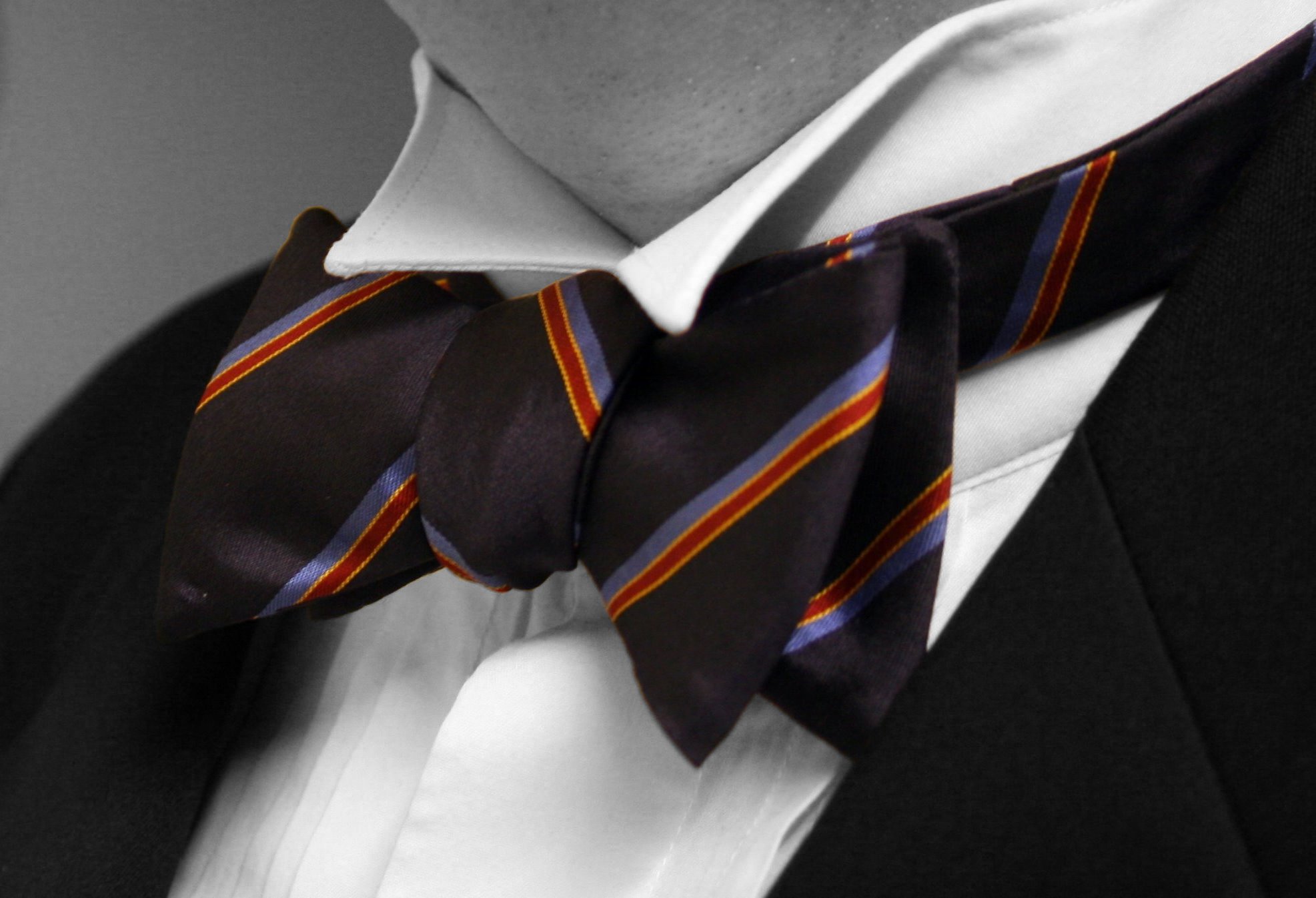
The bow tie or dicky bow[1] /boʊ/ is a type of neckwear, distinguishable from a necktie because it does not drape down the shirt placket, but is tied just underneath a winged collar. A modern bow tie is tied using a common shoelace knot, which is also called the bow knot for that reason. It consists of a ribbon of fabric tied around the collar of a shirt in a symmetrical manner so that the two opposite ends form loops.
There are generally three types of bow ties: the pre-tied, the clip-on, and the self-tie. Pre-tied bow ties are ties in which the distinctive bow is sewn onto a band that goes around the neck and clips to secure. Some "clip-ons" dispense with the band altogether, instead clipping straight to the collar. The traditional bow tie, consisting of a strip of cloth that the wearer has to tie by hand, is also known as a "self-tie", "tie-it-yourself", or "freestyle" bow tie.
Bow ties may be made of any fabric material, but most are made from silk, polyester, cotton, or a mixture of fabrics. Some fabrics (e.g., wool or velvet) are much less common for bow ties than for ordinary four-in-hand neckties.
Origin and history
[edit]The bow tie originated among Croatian mercenaries during the Thirty Years' War of the 17th century: the Croat mercenaries used a scarf around the neck to hold together the opening of their shirts. This was soon adopted (under the name cravat, derived from the French for "Croat") by the upper classes in France, then a leader in fashion, and flourished in the 18th and 19th centuries. It is uncertain whether the cravat then evolved into the bow tie and four-in-hand necktie, or whether the cravat gave rise to the bow tie, which in turn led to the four-in-hand necktie.
The most traditional bow ties are usually of a fixed length and are made for a specific size neck. Sizes can vary between approximately 14 inches (36 cm) and 19 inches (48 cm) as with a comparable shirt collar. Fixed-length bow ties are preferred when worn with the most formal wing-collar shirts, so as not to expose the buckle or clasp of an adjustable bow tie. Adjustable bow ties are the standard when the tie is to be worn with a less formal, lie-down collar shirt that obscures the neckband of the tie. "One-size-fits-all" adjustable bow ties are a later invention that helps to moderate production costs.

The lavallière is a type of cravat similar to the bow tie that was popularly worn in the 19th century in France. It is of a similar fashion to the bow tie but has a larger knot and drooping ends.
Wearers
[edit]To its devotees, the bow tie suggests iconoclasm of an Old World sort, a fusty adherence to a contrarian point of view. The bow tie hints at intellectualism, real or feigned, and sometimes suggests technical acumen, perhaps because it is so hard to tie. Bow ties are worn by magicians, country doctors, lawyers and professors and by people hoping to look like the above. But perhaps most of all, wearing a bow tie is a way of broadcasting an aggressive lack of concern for what other people think.
— Warren St John in The New York Times, 2005[2]

Popular perception tends to associate bow tie wearers with particular professions, such as architects,[3] debt collectors, attorneys,[4] university professors, teachers, waiters, and politicians. Pediatricians frequently wear bow ties, for infants cannot grab them the way they could grab a four-in-hand necktie. Bow ties do not readily droop into places where they would get soiled or where they could, whether accidentally or deliberately, strangle the wearer. Clowns sometimes use an oversized bow tie for comic effect. Classical musicians traditionally perform in white tie or black tie ensembles, of which both designs are bow ties. Bow ties are also associated with weddings, mainly because of their almost universal inclusion in traditional formal evening-wear.
Bow ties, or slight variations thereof, have also made their way into women's wear, especially business attire. The 1980s saw professional women, especially in law, banking, and the corporate world, donning very conservative tailored suits, with a rise of almost 6 million units in sales.[5] These were often worn with buttoned-up blouses, some with pleats up the front like tuxedo shirts, and accessorized with bow ties that were slightly fuller than the standard bow ties worn by their male counterparts, but typically consisting of the same fabrics, colors, and patterns as men's ties.[citation needed]
Russell Smith, style columnist for Toronto's The Globe and Mail, records mixed opinions of bow tie wearers. He observed that bow ties were experiencing a potential comeback among men,[6][7] though "the class conscious man recoils at the idea" of pre-tied bow ties and "[l]eft-wingers ... recoil at what they perceive to be a symbol of political conservatism." He argues that anachronism is the point, and that bow tie wearers are making a public statement of their disdain for changing fashion. Such people may not be economic conservatives, he argues, but they are social conservatives. In Smith's view, the bow tie is "the embodiment of propriety", an indicator of fastidiousness, and "an instant sign of nerddom in Hollywood movies", but "not the mark of a ladies' man" and "not exactly sexy".[7] He attributes the building of this image to the association of the bow tie with newspaper editors (because of their fastidiousness with words), high-school principals, and bachelor English teachers. Most men, he observes, only wear bow ties with formal dress.
Types
[edit]Self-tie
[edit]There are usually two shapes of self-the bow ties available: the "bat wing", which is parallel-sided like a cricket bat, and the "thistle", also known as the "butterfly". An example of each can also be seen below. Which is worn is a matter of personal preference. Some other shapes do exist; for instance, the Diamond Point, with pointed tips at both ends. This is a double-ended type, with both ends shaped, though occasionally, ties are tied in the single-ended type, in which only one end flares out to give the batwing or thistle shape, and the other remains thin. To tie one of these requires careful consideration, to ensure the broader end finishes in front of the thinner one.
- Self-Tie Bows
-
 Silk bow ties. Fixed length with "thistle" ends (left) and adjustable with "bat wing" ends (right).
 -
 Bright Yellow patterned self-tie bow tie, made of cotton, designed and made in the UK
 -
 Bow tie, type Butterfly, silk
 -
 Bow tie, type Batwing, wool
 -
 Bow tie, type Diamond Point, silk


Pre-tie
[edit]Shown below on the right is one style of pre-tie/ready-tie bow tie. Wearing a ready-tied bow tie at formal occasions requiring a black or white tie dress code is usually considered a faux pas, though at occasions such as Schools Leavers' Proms or ones at which the participants are unlikely to have had much experience wearing bow ties, it may be commonplace.
As shown in the pictures below, another type of ready-tie bow tie is the wooden bow tie, a fairly new product made mostly in the U.S and Canada. Other materials are also in use. An example would be bow ties that are made of natural bird feathers; this too is a fairly new product made mostly in the U.S. and Europe (in Poland).
- Pre-Tie Bows
-
 A pre-tied bow tie
 -
 Informal bow tie
 -
 Wooden bow tie, made in Canada and U.S
 -
 Bow tie made of feathers, made in Poland


Clip-on
[edit]A clip-on does not go around the neck but clips to the collar points.
Continental or crossover
[edit]
A continental tie, also called a crossover tie, is a type of bow tie partly covered by the dress shirt collar.[8][9]
Gallery
[edit]-
 Elio Di Rupo, former Prime Minister of Belgium, is a regular wearer of bow ties.
 -
 Marcello Ferrada de Noli, professor emeritus, Sweden, frequently wears self-tied bow ties.
 -
 Johan Krouthén wearing a 19th-century style bow tie.
 -
-
 Michael Maxey, president of Roanoke College, is well known for wearing bow-ties.
 -

-
 Paul Reubens as Pee-wee Herman wore a trademark red bow tie.
 -
 Donald Tsang, former Chief Executive of Hong Kong, is well known for wearing self-tied bow ties.


,_Biochemist_(2551001689).jpg)


.jpg)

References
[edit]- ^ "DICKY BOW definition and meaning". Collins English Dictionary. Glasgow: HarperCollins. Archived from the original on April 12, 2024. Retrieved April 12, 2024.
- ^ St John, Warren (June 26, 2005). "A Red Flag That Comes in Many Colors". The New York Times. Retrieved October 22, 2008.
- ^ Hammel, Bette Jones (1989). From Bauhaus to Bowties. Minneapolis, MN: Hammel, Green, & Abrahamson. p. 134. ISBN 978-0-9622610-0-8.
- ^ Cook, Joan (February 19, 1988). "The Law; In Celebration of 'Dignified Frivolity'". The New York Times. Retrieved October 22, 2008.
- ^ Euse, Erica (March 21, 2016). "The Revolutionary History of the Pantsuit". Vice.com. Retrieved March 11, 2019.
- ^ Smith, Russell (2007). Men's Style. Macmillan. p. 135. ISBN 978-0-312-36165-5.
- ^ a b Smith, Russell (November 15, 2008). "Rock the bow tie without looking nerdy". The Globe and Mail.
Bow ties are tricky. They carry strong connotations: conservative, newspaperman, high-school principal. They are instant signs of nerddom in Hollywood movies. They look fastidious but not exactly sexy.
- ^ "Why You Should Try Out Orlando Bloom's 'Continental Tie' At Your Next Formal Do". Esquire. October 19, 2018. Retrieved May 30, 2025.
- ^ says, David V. (November 28, 2011). "Flashback: The Continental Tie". www.gentlemansgazette.com. Retrieved May 30, 2025.
External links
[edit]
| Headwear | |||||||||
|---|---|---|---|---|---|---|---|---|---|
| Neckwear | |||||||||
| Underwear and lingerie |
| ||||||||
| Tops | |||||||||
| Bottoms |
| ||||||||
| Full-Body Wear |
| ||||||||
| Coats and outerwear |
| ||||||||
| Nightwear | |||||||||
| Swimwear | |||||||||
| Legwear | |||||||||
| Footwear | |||||||||
| Accessories |
| ||||||||
| Dress codes |
| ||||||||
| Related | |||||||||

| International | |
|---|---|
| National | |
| Other | |

Bow tie
View on GrokipediaHistory
Origins in Military and Early Fashion
The bow tie's origins lie in the practical neckwear adopted by Croatian mercenaries during the Thirty Years' War (1618–1648), a conflict that drew fighters from across Europe, including Croats serving various armies such as the Habsburg and French forces. These soldiers tied scarves around their necks primarily to secure the openings of their loose-fitting shirts and to shield against saber cuts during close combat, forming rudimentary knots that resembled early bow shapes.[2][1] The term "cravat," derived from the French cravate (itself from the German Krabat or Croatian Hrvat meaning Croat), emerged to describe this style, marking the transition from battlefield utility to formalized accessory.[10] Upon returning to France, soldiers and observers introduced the cravat to Parisian society in the mid-17th century, where it rapidly evolved into a fashionable item among the aristocracy. King Louis XIV (reigned 1643–1715), impressed by the Croatian style during military reviews, commissioned custom cravats of fine lace and silk for his personal guard, the Mousquetaires de la Garde, thereby institutionalizing it as a mark of elite status.[11][12] By the late 1600s and into the 1700s, variations of knotted cravats—including butterfly-like bows—appeared in court portraits and civilian attire, tied in elaborate styles that signified refinement and military heritage, though they remained broader and less structured than modern bow ties.[1] This period established neckwear as an essential component of formal dress, influencing subsequent European fashion trends while retaining ties to martial origins.[13]19th-Century Formalization
The bow tie formalized in the early 19th century as a refined derivative of the cravat, transitioning from the looser, more varied knots of 18th-century neckwear to a structured, symmetrical bow configuration that emphasized elegance and uniformity in formal dress. This evolution reflected broader shifts in menswear toward precision and restraint, with the bow tie's fixed shape allowing for quicker donning compared to intricate cravat ties, thereby suiting the rising demands of industrialized urban life and professional etiquette.[4][14] By the mid-19th century, white silk bow ties had become standard for white tie evening attire, complementing tailcoats in Anglo-American formal conventions imported from England, where they signified refined status among the elite. In Europe, particularly France, upper-class adoption elevated the bow tie's role in ceremonial and diplomatic settings, with variants like the lavallière—featuring dangling ends—gaining traction as artistic or bohemian alternatives while retaining the core bow motif. This period marked the bow tie's detachment from military origins, cementing its association with civilian sophistication amid expanding textile production that enabled consistent silk sourcing.[15][16] The 1880s saw further institutionalization, as bow ties integrated into standardized wardrobe essentials for formal events, influencing sartorial codes that persisted into the tuxedo era; their prominence paralleled the decline of elaborate cravats, prioritizing practicality without sacrificing visual symmetry. Fashion illustrators and tailors of the time documented these ties in periodicals, underscoring their role in projecting composure and hierarchy in Victorian society.[17]20th-Century Popularization and Variations
In the early 20th century, bow ties became a staple of formal menswear, particularly paired with the tuxedo or dinner jacket, which gained prominence after its introduction in the late 19th century. By the 1910s, the black silk bow tie emerged as the conventional choice for black tie attire, reflecting a standardized aesthetic for evening events among the upper classes and professionals.[18] The pointed-end batwing and butterfly shapes persisted from the Edwardian era, while a brief trend for rounded-end bow ties appeared around 1900–1910, offering subtle variations in silhouette for formal dress.[19] During the 1920s, bow ties extended beyond elite circles into broader popular culture amid the Jazz Age's relaxed formality, serving as a signature accessory for men across social strata and often featuring bold patterns or colors to match the era's exuberant fashion.[1] Their appeal grew among academics, politicians, and surgeons due to the hygienic advantages of a non-dangling knot, which minimized contamination risks in professional settings like operating rooms—a practical edge over ascot or four-in-hand ties.[20] Mid-century developments included the single-end bow tie's popularity in the 1930s among elegant dressers, characterized by one untied end for adjustability, alongside ongoing refinements in shapes such as thistle (with fringed ends), semi-batwing, and diamond-point designs, which allowed for personalized flair within conservative formal codes.[21] Hollywood figures like Fred Astaire and Charlie Chaplin further popularized the bow tie in the 1930s–1950s through cinematic depictions of refined sophistication, embedding it in global perceptions of style despite the concurrent rise of wider long ties.[22] While formal black variants dominated evening wear, casual iterations in silk or cotton with patterned motifs began appearing in non-professional contexts by the 1950s, foreshadowing later diversification.[14]21st-Century Resurgence and Trends
In the early 21st century, bow ties experienced a resurgence driven by their adoption among younger demographics seeking distinctive sartorial elements amid casual fashion dominance.[23] This revival positioned bow ties as symbols of individuality and confidence, contrasting with conventional neckties and appealing to those favoring classic yet whimsical accessories.[24] Contemporary trends emphasize bold, innovative designs, including vibrant colors, geometric patterns, florals, and abstract prints, which allow wearers to make statements in both formal and casual settings.[25] [26] Bow ties have expanded beyond traditional menswear into casual attire and women's fashion, reflecting broader versatility and a shift from purely formal connotations.[26] Self-tie variants, prized for their craftsmanship, underscore this evolution as ultimate fashion statements for discerning individuals.[27] Market analyses indicate steady growth, with the global bow tie sector estimated at $500 million in 2025 and projected to expand at a 5% compound annual growth rate through 2033, fueled by demand for formal wear and renewed interest in heritage accessories.[28] Runway appearances in 2024-2025 further affirm their currency, adapting to modern aesthetics without obsolescence.[29] This persistence aligns with perceptions of bow ties as markers of sophistication and intellect, enduring despite fluctuating preferences.[30]Design and Construction
Materials and Components
Bow ties are primarily constructed from silk, valued for its smooth texture, sheen, and durability in formal settings.[6][31] Other common fabrics include cotton and linen, which offer breathability and lightness for casual or warm-weather use.[32][33] Wool, often in barathea weave, provides texture and warmth suitable for cooler occasions, while velvet adds a plush finish for evening wear.[6][34] Polyester serves as a cost-effective synthetic alternative, mimicking silk's appearance but with lesser luster and breathability.[33][35] The core components of a self-tie bow tie include the main bow fabric, cut on the bias to facilitate folding and achieve a natural drape.[36] An interior lining, typically a woven cotton-blend or interfacing, adds structure and prevents wrinkling without the use of fusible adhesives in higher-quality models.[36] The neckband, often matching the bow fabric or in a plainer weave, connects to adjustable metal hardware such as hooks, eyes, and sliding adjusters made of durable zinc-coated steel or similar alloys to secure around the collar.[36][37] Pre-tied variants replace the tying fabric with a fixed bow loop, often attached via clips or straps, reducing components but limiting adjustability.[38] Niche constructions may incorporate non-textile materials like wood or feathers for the bow, though these remain uncommon and primarily decorative.[34]
Shapes and Styles
Bow ties are differentiated primarily by the shape of their bow ends, with the most common styles being butterfly (also known as thistle), batwing, and diamond point.[39][40] The butterfly shape features broad, flared ends that curve outward from the center knot, creating a symmetrical, winged appearance; this is the traditional and most versatile form, suitable for formal black-tie events.[39][41] The batwing style, characterized by straight, narrow ends with minimal taper, produces a sleek, minimalist bow often considered more modern and less formal.[39][42] Its rectangular profile aligns well with contemporary suits, though it may appear understated compared to fuller shapes.[43] Diamond point bow ties have ends that taper to a sharp point, resulting in an asymmetrical knot where one point faces outward and the other inward, adding a distinctive, elegant flair.[42][44] This variation derives from pointed-end adaptations of butterfly or batwing bases and suits both formal and semi-formal occasions.[45] Additional variations include size adjustments, such as jumbo butterfly for larger knots or slim diamond for narrower profiles, influencing perceived formality and face shape compatibility.[46] Thistle ends specifically refer to the softly rounded, flared term synonymous with standard butterfly bows, while batwing denotes straight cuts.[40] Less common shapes like club round, with curved edges, offer casual alternatives but remain niche.[42] Selection depends on collar style, face proportions, and event context, with wider bows complementing spread collars and narrower ones suiting pointed collars.[39]Manufacturing Processes
Bow ties are manufactured through a combination of fabric preparation, cutting, sewing, assembly, and finishing processes, with variations depending on whether the production emphasizes artisanal craftsmanship or mass efficiency. For premium self-tie bow ties, fabric such as silk is often sourced in woven or printed forms; woven silk involves threading motifs directly into the material using specialized looms, while printed silk applies patterns via screen or digital methods post-weaving. [47] [48] Cutting begins with marking patterns on the fabric, followed by precise hand-cutting to minimize waste and ensure shape integrity, as practiced by manufacturers like Beau Ties of Vermont, where each tie is individually hand-cut from high-quality fabrics. [49] In higher-end production, fabric strips are bias-cut—angled at 45 degrees relative to the weave—for enhanced flexibility and drape, requiring four strips totaling approximately 72 inches for a standard adult bow tie. [50] Mass-produced bow ties, by contrast, may use automated die-cutting or laser methods for speed, though this can compromise edge precision compared to manual techniques. [50] Sewing incorporates an interior lining to provide structure and shape retention; quality producers hand-stitch a non-fusible woven cotton blend lining, avoiding heat-activated fusible interlinings that degrade over time by melting synthetic adhesives into the fabric. [50] Seams are meticulously stitched, often with careful trimming of curves and excess material to prevent bulk, followed by assembly of the bow halves and attachment of adjustable components like metal hooks, coated sliders, and neckbands for durability. [49] [50] Artisanal processes, such as those at Beau Ties, encompass up to 22 distinct steps, including lining attachment, precise pressing with irons to set folds, and firm stitching of components without reliance on machinery. [49] Finishing involves snipping threads, attaching labels with fabric details, and a final quality inspection to verify symmetry, stitching integrity, and overall craftsmanship, as each handmade tie undergoes individual checks in Italian or American workshops. [47] [49] Pre-tied bow ties diverge by employing fixed shaping through sewing or adhesive fixation post-assembly, rather than adjustable self-tying mechanisms, while clip-on variants integrate simple metal clips instead of neckbands. [50] These methods prioritize longevity in premium lines, contrasting with cheaper industrial approaches that favor fusible bonds for rapid output but risk fabric stiffening or separation after repeated use. [50]Types by Tying Mechanism
Self-Tie Bow Ties
Self-tie bow ties require the wearer to manually form the bow knot, distinguishing them from pre-tied or clip-on variants by allowing customization of the knot's size and shape.[51] They typically consist of a single adjustable strap or separate bow and neckband components, with the bow fabric cut and sewn to fold into the characteristic shape when tied.[52] Construction involves woven fabrics such as silk for formal wear, cotton for casual options, or wool for textured variations, often reinforced with interfacing to maintain structure during tying and wear.[53] The neckband features a hook-and-eye or sliding buckle closure for adjustability across collar sizes ranging from 13 to 20 inches, ensuring a secure fit without visible hardware post-tying.[54] Manufacturing entails cutting rectangular fabric pieces for the bow loops and center, sewing seams right-sides together, turning them out, and attaching to the strap, with edges finished to prevent fraying.[55] In formal etiquette, self-tie bow ties are preferred for black-tie events due to their authentic appearance, as the manually tied knot avoids the uniform, factory-perfected look of pre-tied models that cannot be adjusted or untied.[56] This preference stems from the natural asymmetry and adjustability, which provide better comfort during extended wear and a bespoke aesthetic valued by menswear traditionalists.[57] While requiring practice to tie consistently—typically 5 to 10 minutes per attempt—they are adjustable for precise neck fit, reducing slippage compared to fixed pre-tied options.[58]Pre-Tied Bow Ties
Pre-tied bow ties feature a fixed, sewn knot attached to an adjustable band that encircles the neck, secured via a hook-and-eye or slide mechanism, distinguishing them from self-tie variants that require manual knotting.[54] This design ensures a uniform bow shape without user intervention, appealing to those seeking simplicity in formal attire.[59] Introduced in the mid-20th century alongside the prevalence of soft turndown collars, pre-tied bow ties gained traction as an accessible alternative to self-tying, particularly with elastic fastenings that simplified wear.[60] Their development addressed the demand for quick application in everyday and event settings, evolving from earlier pre-made neckwear concepts that faced ridicule in the Edwardian period but found acceptance as collar styles softened post-World War II.[19] Manufacturing typically involves stitching the pre-formed bow—often from silk, cotton, or synthetic fabrics—to a fabric or elastic strap sized for standard neck circumferences, with adjustments ranging from 13 to 20 inches.[14] Advantages include rapid donning, ideal for time-constrained occasions like weddings or rentals, and consistent appearance that avoids asymmetrical knots common in novice self-tying attempts.[52] They perform well with thicker materials such as wool or velvet, where self-tying proves challenging due to fabric rigidity.[61] However, detractors note their potential to appear artificial, especially in lower-quality versions with overly rigid or mismatched proportions, diminishing the bespoke elegance of self-tied options.[51] In contemporary markets, pre-tied bow ties hold a significant share driven by convenience, particularly among non-experts and in costume or uniform applications, though exact figures vary; broader neckwear trends show self-tied dominating at 72.1% in 2023, with bow tie segments favoring pre-tied for accessibility.[62] [63] They remain staples in black-tie rentals and children's formalwear, balancing functionality against traditionalist critiques of diminished skill involvement.[57]Clip-On Bow Ties
Clip-on bow ties consist of a pre-formed bow attached to a metal clip that fastens directly to the shirt collar, eliminating the need for tying or an adjustable neckband.[60] This design ensures consistent knot appearance and length without user adjustment.[64] The clip-on mechanism originated as an advancement in tie technology during the 1920s, with the two-clip bow tie emerging to secure the pre-tied shape more reliably than earlier single-clip versions.[60] While the broader clip-on tie was patented in 1928 by Joseph W. Less in Clinton, Iowa, for safer workwear that detached under pressure, this innovation extended to bow ties for everyday convenience.[65][66] Advantages include rapid application, ideal for individuals lacking tying skills, children, or time-constrained settings, and a breakaway feature enhancing safety by preventing strangulation risks.[67][64] They maintain uniform presentation, avoiding asymmetrical knots from improper self-tying.[64] In fashion etiquette, clip-on bow ties face criticism for lacking the authenticity of self-tie versions, often perceived as juvenile or unsuitable for formal black-tie events where purists advocate hand-tying to demonstrate proficiency.[54][68] They find acceptance in casual, professional, or safety-critical contexts like certain uniforms, but traditional menswear guides recommend against them for sophisticated occasions to uphold craftsmanship.[69][70]Crossover and Other Variants
The crossover bow tie, also referred to as the continental tie, consists of a wide fabric strip, typically black silk, satin, or a polyester-wool blend, that crosses over itself at the throat and fastens via a covered snap, button, or decorative pin.[71] This mechanism allows for quick attachment and a neat, uniform appearance partially obscured by the shirt collar, making it suitable for professional servicewear.[72] Adjustable to neck sizes from 14 to 17 inches, it traces origins to early 20th-century adaptations of traditional bow ties for military and formal uniforms, prioritizing consistency over manual tying.[73] Historically employed in contexts requiring standardized dress, such as U.S. Navy attire or aviation roles, the crossover variant emphasizes durability and ease, with the crossed ends providing a structured bow without adjustable loops.[74] Its fastening avoids clips or straps visible at the neck, reducing slippage during extended wear, though it has declined in civilian use since the mid-20th century in favor of more versatile self-tie or clip-on options.[71] Other variants incorporate alternative fastening for convenience or novelty, including magnetic closures that enable snap-on attachment to the collar without traditional clips, using embedded neodymium magnets for secure hold.[75] Zipper mechanisms, hidden within the knot, permit size adjustment by pulling a discreet zipper on the reverse side, blending pre-tied aesthetics with modifiable fit for formal events.[76] Velcro-backed straps appear in custom or DIY models, offering peel-and-stick adjustability, though primarily in casual or pet accessories rather than standard menswear.[77] These methods, while innovative, remain niche compared to conventional types, often criticized for lacking the authenticity of hand-tied knots.[54]Usage and Etiquette
Tying Techniques
Tying a self-tie bow tie involves forming a symmetrical double bow using a method derived from the square (reef) knot, akin to securing a shoelace bow.[78] This technique requires manual dexterity and practice to achieve even loops and a centered knot, distinguishing it from pre-tied or clip-on variants that bypass user involvement.[79] The process begins with the bow tie draped around the neck beneath the shirt collar, ensuring one end extends approximately 1.5 to 2 inches longer than the other for balanced folding.[80][81] The standard tying sequence proceeds as follows:- Cross the longer end over the shorter end to form an "X" shape at the front of the neck.[82]
- Pass the longer end behind the shorter end and upward through the neck loop created by the fabric.[82]
- Fold the shorter end horizontally into a bow loop, positioning it against the neck loop.[80]
- Drape the longer end over the center of the folded shorter bow and tuck it behind to form a crossing point.[82]
- Create a second bow loop with the longer end by folding it and inserting the tip through the back loop behind the first bow.[78]
- Gently pull both bow ends to tighten the knot while adjusting the loops for symmetry and centering the structure under the chin.[83]