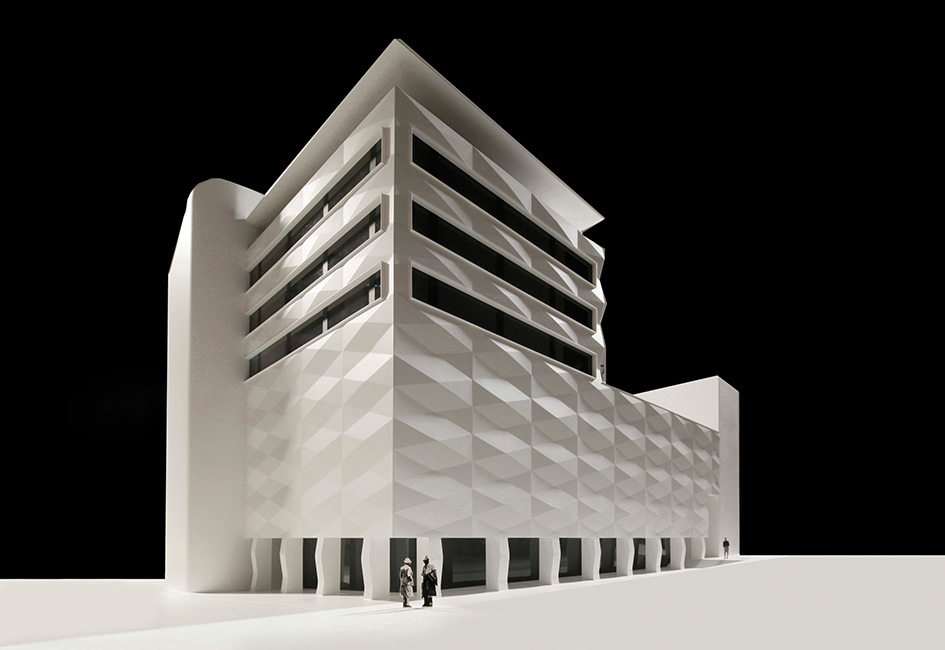
Recent from talks
Nothing was collected or created yet.
Architectural model
View on Wikipedia

An architectural model is a type of scale model made to study aspects of an architectural design or to communicate design intent. They are made using a variety of materials including paper, plaster, plastic, resin, wood, glass, and metal.
Models are built either with traditional handcraft techniques or via 3D printing technologies such as stereolithography, fused filament fabrication, and selective laser sintering.[1]
History
[edit]
The use of architectural models dates to pre-history. Some of the oldest standing models were found in Malta at Tarxien Temples. Those models are now stored at the National Museum of Archaeology in Malta.[2]
Purpose
[edit]
Architectural models are used by architects for a range of purposes, including:
- Ad hoc or "sketch" models are sometimes made to study the interaction of volumes, different viewpoints, or concepts during the design process. They're useful in explaining a complicated or unusual design to builders. They also serve as a focus for discussion between architects, engineers, and town planners.
- Presentation models can be used to exhibit, visualize, or sell a final design.
A model also serves as a show piece. Once a building is finished, the model is sometimes featured in a common area of the building.
Types of models include:
- Exterior models are models of buildings that usually include some landscaping or civic spaces around the building.
- Interior models are models showing interior space planning, finishes, colors, furniture, and beautification.
- Landscaping design models are models of landscape design and development, representing features such as walkways, small bridges, pergolas, vegetation patterns, and beautification. Landscape design models usually represent public spaces and, in some cases, include buildings as well.
- Urban models are typically built at a much smaller scale (starting from 1:500 and less, 1:700, 1:1000, 1:1200, 1:2000, and 1:20,000), representing several city blocks, even a town or village, a large resort, a campus, an industrial facility, a military base, and so on. Urban models are a tool for town and city planning and development. Urban models of large urban areas are displayed at museums such as the Shanghai Urban Planning Exhibition Center, the Queens Museum in New York,[3] the Beijing Planning Exhibition Hall, and the Singapore City Gallery.
- Engineering and construction models show isolated building or structure elements and components and their interactions.
-
A model by architect Lorenzo Winslow which he used to explore the structure of the Grand Staircase at the White House for his redesign of the East Wing.
-
Model of a museum building.
-
Model of a building interior.
-
A scale replica model of the now demolished Capitol Theatre in Causeway Bay, Hong Kong
-
A model used for urban planning in the Buenos Aires Province
-
Model of New York City, World's Fair (1964)
Virtual modeling
[edit]Buildings are increasingly designed in software with CAD (computer-aided design) systems. Early virtual modeling involved the fixing of arbitrary lines and points in virtual space, mainly to produce technical drawings. Modern packages include advanced features such as databases of components, automated engineering calculations, visual fly-throughs, dynamic reflections, and accurate textures and colors.[4][5]
As an extension to CAD (computer-aided design) and BIM (building information modeling), virtual reality architectural sessions are also being adopted. This technology enables participants to be immersed in a 1:1 scale model, essentially experiencing the building before it is built.
List of CAD and BIM software
[edit]Materials
[edit]Rough study models can be made quickly using cardboard, wooden blocks, polystyrene, foam, foam boards, and other materials. Such models are an efficient design tool for the three-dimensional understanding of a structure, space, or form, and are used by architects, interior designers, and exhibit designers.
Common materials used for centuries in the construction of architectural models were card stock, balsa wood, basswood, and other woods. Modern professional architectural model builders use 21st-century materials, such as Taskboard (a flexible and lightweight wood/fiberboard), plastics, wooden and wooden-plastic composites, foams, foam board, and urethane compounds.
Several companies produce ready-made pieces for structural components (e.g., girders, beams), siding, furniture, figures (people), vehicles, trees, bushes, and other features that are found in the models. Features such as vehicles, people figurines, trees, streetlights, and others are called "scenery elements" and serve not only to beautify the model but also to help the observer obtain a correct feel of the scale and proportions represented by the model.
Increasingly, rapid prototyping techniques such as 3D printing and CNC routing are used to automatically construct models directly from CAD plans.[6]
-
An earthenware model of two residential towers, made during the Han dynasty in China.
-
A wooden exterior model of the Royal Military College of Canada grounds.
Cork models
[edit]A cork model is an architectural model made predominantly of cork. The art of cork modeling is also called phelloplasty (Greek φελλός phellos, cork).
In Napoli in the sixteenth century, cork was being used to create Christmas cribs. The 18th and early 19th centuries saw an increase in the popularity of crib-making there.
The invention of architectural models made of cork was self-attributed to Augusto Rosa (1738–1784), but Giovanni Altieri (documented 1766–1790) and Antonio Chichi (1743–1816)[7] were already active in Rome as manufacturers of cork models.
Chichi's models were copied by Carl May (1747–1822) and his son Georg Heinrich May (1790–1853).
Other artists include Luigi Carotti (Rome), Carlo Lucangeli (1747–1812, Rome, Naples), Domenico Padiglione and his sons Agostino and Felice (Naples), and Auguste Pelet (1785–1865, Nîmes). In Marseille, several scale models were made representing archaeological digs by Hippolyte Augier (1830–1889) (Marseille History Museum/Musée d’Histoire de Marseille) or Stanislas Clastrier (1857–1925).
Dieter Cöllen is an example of a contemporary phelloplast that continues the art.
Collections
[edit]Many cork models of classical monuments in Italy were made and sold to tourists during their Grand Tour.[7] Cork, especially when carefully painted, was ideal to reproduce the weathered look of wall surfaces.
As a rule, they were produced on a large scale (the Colosseum in Aschaffenburg is three meters long and one meter high) and with high precision.
Cork models were esteemed in the princely courts of the 18th century. They were also acquired for their scientific value by schools of architecture in the late 18th and early 19th centuries, or by institutions like the Society of Antiquaries of London and the British Museum, as a way of introducing the general public to ancient architecture.
Despite their fragility, cork models have often survived better than wooden models threatened by wood-destroying insects.
Apart from kings and princes, cork models were collected by people such as Filippo Farsetti (1703–1744) in Venice, Pierre Gaspard Marie Grimod d'Orsay (1748–1809), and the architect Louis-François Cassas in France, Charles Townley, or Sir J. Soane in London, who turned his home into a museum, and Sir John Soane's Museum, housing a collection of 14 models in cork of Roman and Greek buildings.
Chichi's cork models can be found at the Imperial Academy of Arts in Saint Petersburg, Russia (34 models made around 1774); Schloss Wilhelmshöhe, Kassel (33 models made 1777–1782); Hessisches Landesmuseum Darmstadt (26 models acquired 1790–91); and the Herzogliches Museum Gotha (12 models acquired after 1777–1778; see Wikipedia in German).
The largest collection of cork models by Carl May, with 54 pieces (after war losses), is in Aschaffenburg (Schloss Johannisburg); another large collection of his models is in the Staatliches Museum Schwerin.
In France, the Musée des Antiquités Nationales à Saint-Germain-en-Laye has works by Rosa,[8] Lucandeli[9] and Pelet.[10] The Musée archéologique de Nîmes (Musée archéologique de Nîmes) and the Marseille History Museum also have cork models.
Modern cork models of antique buildings by Dieter Cöllen are exhibited in the Praetorium in Cologne.[11]
Scales
[edit]Architectural models are being constructed at a much smaller scale than their 1:1 counterpart.
The scales and their architectural use are broadly as follows:
- 1:1 full (or real) size for details
- 1:2 Details
- 1:5 Details
- 1:10 Interior spaces and furniture
- 1:20 Interior spaces and furniture
- 1:50 Interior spaces, detailed floor plans, and different floor levels
- 1:100 Building plans and layouts
- 1:200 Building plans and layouts
- 1:500 Building layouts or site plans
- 1:1000 Urban scale for site or location plans
- 1:1250 Site plans
- 1:2500 Site plans and city maps
- 1:5000 City maps/Island
Sometimes model railroad scales such as 1:160 and 1:87 are used due to the ready availability of commercial figures, vehicles, and trees in those scales, and models of large buildings are most often built in approximately that range of scales due to size considerations.
See also
[edit]References
[edit]- ^ "Guide to 3D Printing Architectural Models". Formlabs. Retrieved 2022-09-02.
- ^ Pace, Anthony (2004). "Tarxien". In Daniel Cilia (ed.). Malta before History – The World's Oldest Free Standing Stone Architecture. Miranda Publishers. ISBN 978-9990985085.
- ^ Museum, Queens. "Queens Museum | The Panorama of the City of New York". Queens Museum | The Panorama of the City of New York. Retrieved 2022-12-24.
- ^ "What is Architectural Visualisation?". Flying 3D. Retrieved 18 June 2015.
- ^ "What is Accurate Visual Representation?". Flying 3D. Retrieved 18 June 2015.
- ^ Gibson, Ian; Kvan, Thomas; Ming, Ling Wai (2002). "Rapid prototyping for architectural models". Rapid Prototyping Journal. 8 (2): 91–95. doi:10.1108/13552540210420961.[permanent dead link]
- ^ a b Antigone (2022-02-05). "Cork Models of the Ruins of Rome". Antigone. Retrieved 2025-04-03.
- ^ "Cat'zArts – Résultats de recherche".
- ^ "Archäologische Zone – Jüdisches Museum".
Further reading
[edit]Fankhänel, Teresa. The Architectural Models of Theodore Conrad: The “Miniature Boom” of Mid-Century Modernism. London: Bloomsbury, 2021.
Lepik, Andres. Das Architekturmodell in Italien, 1335–1550. Römische Studien Der Bibliotheca Hertziana, Bd. 9. Worms: Wernersche Verlagsgesellschaft, 1994.
Liptau, Ralf. Architekturen Bilden: Das Modell in Entwurfsprozessen Der Nachkriegsmoderne. Bielefeld: Transcript, 2019.
Lund, David. A History of Architectural Modelmaking in Britain: The Unseen Masters of Scale and Vision. London ; New York: Routledge, Taylor & Francis, 2023.
Mindrup, Matthew. The Architectural Model: Histories of the Miniature and the Prototype, the Exemplar and the Muse. Cambridge, Massachusetts: The MIT Press, 2019.
Smith, Albert C. Architectural Model as Machine: A New View of Models from Antiquity to the Present Day. Amsterdam: Elsevier, 2004.
Architectural model
View on GrokipediaHistory
Ancient Origins
The earliest known architectural models date back to the Chalcolithic period, with a notable ceramic example from the Gumelnița culture in present-day Romania, created around 4600–3900 BCE and interpreted as a ritual representation of multiple buildings. In Mesopotamia, by the Early Dynastic period (c. 2900–2350 BCE), terracotta house models from sites like Babylon illustrate simple domestic structures, likely used in funerary or symbolic contexts.[8] Similarly, in ancient Egypt, predynastic tombs (c. 3900–3100 BCE) contain early clay and wooden models of granaries and boats with architectural elements, serving as grave goods to symbolize sustenance and shelter in the afterlife.[9] These models were primarily ritualistic or funerary, rather than practical design tools, reflecting beliefs in providing the deceased with representations of essential structures for the afterlife. In Egypt, wooden tomb models from the Middle Kingdom (c. 2050–1710 BCE), such as those from the tomb of Meketre, depict detailed scenes of houses, temples, and daily life activities like baking and boating, intended to magically activate provisions and labor for the tomb owner.[10] Clay "soul houses"—miniature dwellings with offering tables—also appear in Egyptian tombs from this era, designed to receive libations and ensure eternal comfort.[10] In Mesopotamia, the terracotta models similarly functioned as votive offerings, buried with the dead to invoke protection or continuity of domestic life.[8] In ancient China, ceramic and wooden models from the Han dynasty (c. 206 BCE–220 CE) served similar funerary purposes, depicting homes, granaries, and watchtowers for the afterlife.[11] Across the ancient Americas, stone and ceramic architectural effigies from Maya culture (c. 200–900 CE) and later Aztec culture (15th–16th centuries CE) served comparable non-prototypical roles as tomb offerings, embodying sacred spaces rather than serving as blueprints. For instance, a carved stone house model from Copán, Honduras (c. 550–900 CE), represents a thatched-roof dwelling possibly linked to elite residences or ritual structures, placed in burials to symbolize ancestral homes or divine abodes.[12] Aztec ceramic temple models, often depicting truncated pyramids with stairways, were similarly interred as funerary dedications, invoking spiritual presence without direct ties to construction planning.[12]Classical and Medieval Developments
In the Greco-Roman world, architectural models transitioned from primarily ritualistic functions to more practical applications in engineering and design, building on foundational influences from earlier ancient civilizations. Wooden maquettes, dating to the 1st century BCE, were constructed to aid in the planning of temples and aqueducts, enabling architects to evaluate proportions, structural stability, and site integration before full-scale construction.[13] These models also functioned as votive offerings, presented in temples to invoke divine favor for ambitious projects like aqueduct systems that spanned hundreds of kilometers. Medieval European architecture saw the refinement of models as essential tools for coordinating large-scale ecclesiastical projects amid the rise of Gothic innovation. From the 12th to 14th centuries, wooden and ivory models of cathedrals were commissioned to support structural planning and secure ecclesiastical approval, depicting intricate features such as pointed arches, ribbed vaults, and flying buttresses. For instance, the 13th-century oak model from Kinsarvik, Norway (measuring 96 cm high), illustrates a T-shaped ground plan with a prominent crossing tower, painted lancet windows, and pinnacles, serving both as a construction blueprint and a symbolic representation of the Heavenly Jerusalem within church settings.[14] Similarly, the Borgund model from the same period, with its quatrefoil windows and cross motifs, exemplifies guild craftsmanship in visualizing stave church designs for regional patrons.[14] In Byzantine and Islamic contexts between 800 and 1200 CE, architectural design relied on drawings and geometric patterns for religious structures, with limited evidence of physical models beyond decorative ivories.Renaissance to Modern Era
During the Renaissance, architectural models evolved from rudimentary medieval aids into sophisticated maquettes that integrated artistic perspective with engineering precision, serving as vital tools for conceptualization and patron approval. Filippo Brunelleschi (1377–1446) exemplified this shift by submitting detailed wooden models for the dome of Florence Cathedral (Santa Maria del Fiore), constructed between 1418 and 1436; these models demonstrated his innovative double-shell design and herringbone brickwork, allowing the Opera del Duomo to visualize the unprecedented 45-meter span without centering scaffolds.[15] Crafted from materials like wood, wax, and terracotta, such maquettes enabled architects to test spatial relationships and structural feasibility, drawing briefly on classical Roman influences to revive proportional harmony in design.[16] By the 18th century, innovations in materials further refined model-making for accuracy and portability. Roman architect Augusto Rosa (1738–1784) invented precise cork models of ancient ruins, such as the Arch of Constantine and Temple of Vesta, which offered lightweight, detailed replicas ideal for study and souvenir collection during the Grand Tour era; these models, often scaled at 1:50 or finer, captured intricate details like entablatures and friezes with carving tools adapted from woodworking.[17] Rosa's technique, supplementing his income through sales to European elites, marked a transition toward more standardized, reproducible representations that emphasized archaeological fidelity over purely functional prototyping.[18] The 19th and early 20th centuries saw the professionalization of model-making amid industrialization, with mass-produced scale models becoming staples at international expositions to promote urban visions and technological progress. At the 1893 World's Columbian Exposition in Chicago, visitors encountered numerous miniature replicas, including a detailed model of the U.S. Treasury Building constructed from silver filigree, which highlighted Beaux-Arts grandeur and influenced the City Beautiful movement.[19] Following World War II, this practice intensified with the emergence of specialized model-making firms, such as Theodore Conrad's studio in Jersey City, which produced high-fidelity plaster and wood models for postwar projects like skyscrapers and public buildings, driven by booming reconstruction demands and a separation of model craft from architectural design.[20] In Britain, a similar postwar boom led to dedicated workshops handling complex commissions, professionalizing the trade through standardized techniques and materials like acrylics. The late 20th century transitioned architectural models toward hybrid analog-digital forms, incorporating photography for enhanced presentation and early computer-aided design (CAD) for precision. Model photography, flourishing from the 1960s, allowed architects to simulate built environments through staged lighting and contextual backdrops, bridging physical prototypes with client visualizations.[21] CAD systems, emerging in the 1960s with precursors like Sketchpad and gaining traction in architecture by the 1980s via software such as AutoCAD, enabled rapid 2D-to-3D modeling, reducing reliance on manual fabrication while integrating parametric adjustments for structural analysis.[22] By 2025, AI-assisted tools like Arkdesign.ai and TestFit have revolutionized conceptualization, generating iterative designs from textual prompts or site parameters, optimizing layouts for sustainability and efficiency in seconds—exemplifying a shift where algorithms augment human creativity in early-stage ideation.[23]Purposes and Uses
Design Visualization and Development
Architectural models play a crucial role in the early stages of design by facilitating conceptual sketching and massing studies, allowing architects to visualize form, volume, and spatial relationships in three dimensions before committing to detailed drawings.[6] These models enable rapid iteration, helping designers explore abstract ideas tangibly and assess how elements interact within the proposed environment.[24] By constructing simple representations, architects can evaluate the overall composition and make adjustments to achieve harmonious proportions and functional layouts.[25] Sketch models, often made from quick prototypes such as foam or paper, are particularly valuable for testing proportions and aesthetics without the need for extensive resources or time.[25] These rudimentary forms allow architects to experiment freely, refining visual and tactile qualities that two-dimensional sketches cannot fully capture.[26] Such models encourage creative exploration, where minor modifications can reveal optimal configurations for balance and appeal.[27] One key benefit of these models is their ability to identify potential design flaws early, such as issues with light and shadow effects or circulation paths, preventing costly revisions later in the process.[26] Physical manipulation of the model under various lighting conditions demonstrates how natural light penetrates spaces, highlighting areas of glare or inadequate illumination.[25] Similarly, navigating the model's pathways uncovers inefficiencies in movement, ensuring smoother user flow before advancing to comprehensive plans.[6] A notable historical example is Le Corbusier's use of physical models in the 1920s for urban planning projects like the Plan Voisin, where models helped visualize high-density arrangements and spatial dynamics on a grand scale. These models allowed him to iterate on vertical towers and green spaces, refining his vision for efficient modern cities.[28][29] In addition to internal development, such models briefly serve presentation purposes by providing clients with an intuitive grasp of evolving concepts.[6]Communication and Presentation
Architectural models function as essential instruments for conveying design intent to clients, stakeholders, and the public, bridging the gap between conceptual sketches and realized experiences by offering tangible or interactive representations of proposed structures. High-fidelity presentation models are particularly employed in marketing projects to showcase intricate details, such as spatial layouts and aesthetic elements, thereby facilitating persuasive narratives around development potential. In real estate contexts, illuminated site models incorporate LED lighting systems to simulate day-night cycles or emphasize specific features like building facades and surrounding landscapes, creating dynamic displays that captivate potential buyers and investors during sales presentations.[30] These models significantly contribute to client approvals and public exhibitions by providing a concrete medium for discussion and visualization, often leading to refined designs through direct stakeholder input. For instance, the presentation model for Zaha Hadid's Heydar Aliyev Center (2007-2012) in Baku, Azerbaijan, utilized 3D printing to demonstrate the building's fluid, seamless integration with its landscaped plaza and urban context, embodying Hadid's philosophy of liberating architectural form from rigid planes and aiding in the project's cultural and public endorsement.[31] Architectural models surpass traditional 2D drawings in effectiveness for presentation by delivering intuitive insights into three-dimensional spatial dynamics, material textures, and environmental interactions, which reduce misinterpretations and foster greater client engagement. This is amplified through immersive features, including physical setups that permit walkthroughs around scaled site models to assess proportions and flows, or VR integrations with digital models that enable virtual navigation and real-time modifications during client reviews.[32][33] In the 2020s, such models have proven instrumental in urban planning pitches for obtaining funding and regulatory approvals, as their vivid depictions of project scale, sustainability, and community integration build investor confidence and streamline public consultations.Analysis, Testing, and Education
Architectural models play a crucial role in structural and environmental testing by simulating real-world conditions to evaluate performance and safety. For instance, wind tunnel models were extensively used in the design of the Burj Khalifa, where rigid-model force balance tests at a 1:500 scale and full aeroelastic model tests helped assess aerodynamic loads and building accelerations.[34] These tests, conducted in facilities like RWDI's wind tunnels, revealed that aeroelastic modeling reduced predicted accelerations from 37 milli-g to 12 milli-g for a 5-year return period wind event, informing iterative shape modifications such as setbacks to minimize wind effects.[35] High Reynolds number tests on a 1:50 scale model further validated the results, ensuring the tower's stability at heights up to 828 meters.[34] In educational settings, physical models facilitate hands-on learning of architectural principles and construction techniques. Universities like Imam Abdulrahman Bin Faisal University employ physical models in first-year design studios to help students visualize spatial relationships and internal structures, enhancing critical thinking and design communication.[36] A blended approach combining sketching and model-making has proven most effective, leading to improved performance in project design by allowing students to explore ideas through tangible representations.[36] At institutions such as Gdańsk University of Technology, physical models of historical structures, like Gothic churches, aid in understanding abstractions and three-dimensional forms, with over 75% of students reporting improved comprehension of architectural history.[37] Analytical applications extend to urban planning, where scale models simulate traffic flow and sustainability metrics to inform decision-making. BIM-based models integrated with traffic simulation tools, such as Autodesk InfraWorks, optimize highway alignments by predicting congestion and environmental impacts, as demonstrated in a case study of Pakistan's Dera Ghazi Khan Northern Bypass, which reduced travel time by 20% and costs by 6.48%.[38] For sustainability, urban building energy modeling (UBEM) using standards like CityGML and tools such as EnergyPlus enables city-scale simulations of energy consumption and emissions, supporting retrofit analyses and policy development.[39] These models address interoperability challenges to validate outcomes against measured data, promoting efficient urban resource management.[39] In preservation and historical analysis, replicas of ancient structures provide insights into construction and cultural significance without risking originals. Wooden architectural models from the Tomb of Meketre (ca. 2000 B.C.) in ancient Egypt, depicting granaries and workshops, served as afterlife microcosms and now enable study of Middle Kingdom building practices through preserved artifacts in collections like the Metropolitan Museum of Art.[40] Similarly, Eastern Han Dynasty (1st–early 3rd century A.D.) watchtower models emulate full-scale architecture for funerary purposes, offering epigraphic and structural analysis of ancient Chinese design standards.[10] Such Egyptian replicas, evolved from Predynastic traditions, facilitate non-invasive research into spatial and ritual functions of historical monuments.[40]Types of Models
Physical Models
Physical architectural models are tangible, three-dimensional scale representations of buildings or structures, constructed to physically embody design concepts and facilitate hands-on evaluation, in contrast to digital models that rely on software simulations.[41] These models serve as essential tools in the architectural design process, allowing architects to explore spatial relationships, proportions, and forms through direct manipulation rather than virtual interfaces.[25] Physical models encompass several subtypes tailored to different stages of design development. Conceptual models are rough, abstract approximations—often resembling three-dimensional sketches—that prioritize idea exploration and initial form studies without fine detailing.[42] Working models incorporate functional elements, such as moving parts to simulate mechanisms like doors, windows, or structural components, enabling testing of operational aspects.[1] Presentation models, by contrast, feature polished finishes and precise detailing to communicate the final design intent to clients or stakeholders with high visual fidelity.[43] The construction of physical models typically involves sequential processes of cutting components to scale, assembling them into coherent forms, and adding detailing for clarity and realism. Cutting establishes the basic shapes and outlines, often using manual or mechanical methods to achieve accuracy.[44] Assembly follows, joining elements to build the overall structure and test spatial integrity.[45] Detailing enhances the model with textures, colors, or elements that highlight key features, ensuring it effectively conveys the design's nuances.[46] Key advantages of physical models include their tactile interaction, which allows designers and clients to physically engage with the form, fostering intuitive understanding of scale and spatial dynamics that screens cannot replicate.[47] They require no technology, making them accessible in any setting and independent of power sources or software compatibility.[48] Additionally, their portability supports on-site reviews, where models can be transported to construction locations for direct comparison with the actual environment.[49] In hybrid workflows, physical models can complement digital counterparts by providing a tangible reference for refining virtual designs.[50] A notable example is Frank Lloyd Wright's model of the Solomon R. Guggenheim Museum, developed in the 1940s, which was used to test the iconic spiral form and ramp system, allowing Wright to refine the building's organic geometry through iterative physical adjustments.[51] This model, completed around 1945, played a crucial role in visualizing and validating the museum's unconventional design before construction began in 1956.[52]Digital Models
Digital models in architecture represent virtual three-dimensional representations of buildings and spaces, created and manipulated through computer software to facilitate design, analysis, and visualization. These models enable architects to explore complex geometries and environmental interactions that would be challenging or impossible with traditional methods. Unlike physical models, digital versions allow for instantaneous iterations and integrations with data-driven simulations, transforming the architectural workflow since their inception. The transition from two-dimensional drafting to three-dimensional digital modeling began in the 1980s with the advent of computer-aided design (CAD) systems, which initially focused on wireframe representations but evolved to support solid modeling by the late 1980s, becoming standard for complex projects by the 1990s. Early CAD tools like AutoCAD, introduced in 1982 by Autodesk, revolutionized drafting by enabling precise geometric constructions in a digital environment. This shift was driven by advancements in computing power, allowing architects to move beyond flat plans to volumetric explorations. Building Information Modeling (BIM) software, such as Revit developed by Autodesk in 2000, extended CAD capabilities by incorporating parametric relationships and metadata, where elements like walls or windows are defined by intelligent parameters that update across the model automatically. Tools like Rhinoceros (Rhino), first released in 1998 by McNeel & Associates, further popularized NURBS-based modeling for organic and freeform shapes, supporting real-time modifications through scripting and plugins. These software platforms form the backbone of digital model creation, allowing users to generate detailed representations from conceptual sketches to construction-ready files. Digital models excel in parametric design, where algorithms define building components based on variables like site constraints or user inputs, enabling automated generation of variations; for instance, tools in Grasshopper for Rhino facilitate this by visually programming responsive geometries. Real-time modifications are achieved through dynamic linking in BIM environments, where changes to one element propagate instantly to related parts, reducing errors in large-scale projects. Simulations integrated into these models, such as daylighting analysis using software like Autodesk's Insight, evaluate natural light penetration and energy performance by processing environmental data against the virtual structure. By 2025, advancements in artificial intelligence have introduced AI-generated layouts, where machine learning algorithms, such as those in Autodesk's generative design tools, optimize floor plans based on criteria like occupancy and sustainability, producing hundreds of options in minutes for human refinement. Integration with virtual reality (VR) and augmented reality (AR) provides immersive walkthroughs; for example, platforms like Unreal Engine combined with BIM exports allow stakeholders to navigate photorealistic models in VR headsets, enhancing collaboration and client feedback. These technologies, accelerated by cloud computing, have made digital models indispensable for sustainable and adaptive architecture.Materials and Fabrication
Traditional Materials and Techniques
Traditional architectural models were primarily constructed using readily available natural and basic synthetic materials that allowed for manual manipulation and precision in representing building forms and structures. Wood, particularly balsa and plywood, served as key materials for structural elements due to their lightweight nature and ease of shaping; balsa wood, with its fine grain and low density, was favored for delicate components, while plywood provided sturdy bases or frameworks that could withstand assembly stresses.[44] Paper and cardboard offered versatility for quick prototypes, enabling architects to create lightweight representations of facades, roofs, or site plans through folding and layering, often in various thicknesses to simulate depth and texture. Foam board, consisting of a foam core sandwiched between paper layers, emerged as a popular choice for lightweight bases and massing studies, prized for its clean cuts and ability to form smooth, expansive surfaces without excessive weight.[44] Cork models represented a significant innovation in the 18th century, particularly for capturing the intricate details of urban landscapes and ancient ruins. Originating in Italy, this technique was pioneered by Agostino (or Augusto) Rosa around the 1760s, who crafted precise scaled models of Roman antiquities, such as the Colosseum and Arch of Constantine, using cork's natural texture to mimic weathered stone and rubble with remarkable fidelity.[53] Rosa's Vatican-associated works, including models displayed alongside artifacts from the Vatican Museums, highlighted cork's advantages in portability and durability, allowing detailed recreations of complex architectural ensembles that were ideal for study by Grand Tourists and scholars.[54] The material's pock-marked surface and warm tone naturally evoked the patina of aged masonry, facilitating accurate depictions of every joint and fragment in ruined structures without the need for extensive finishing.[53] In the Renaissance, wax emerged as a material for creating intricate models that allowed sculptors and architects to refine complex details before committing to stone or bronze. For instance, Lorenzo Ghiberti employed preliminary wax models in developing the relief panels for the Gates of Paradise on Florence's Baptistery doors, enabling precise adjustments to figural and architectural elements through its malleable properties.[55] This approach leveraged wax's ability to hold fine contours and be easily modified, making it suitable for preliminary studies of ornamental features in architectural commissions. Core techniques for assembling these models relied on manual processes that emphasized craftsmanship and precision. Hand-cutting formed the foundation, with tools such as X-Acto knives and scalpels used to score and slice materials along straightedges or curves, ensuring clean edges on wood, paper, or foam without splintering or tearing; sharp blades and cutting mats were essential to maintain accuracy during repeated passes. Gluing followed, employing adhesives like PVA for porous surfaces such as paper and wood, or specialized wood glues for joints requiring strength, often applied via syringes for controlled placement and minimal excess. Painting completed the models, using acrylics or oils to add realism through layered washes that simulated materials like brick or stone, tested under varied lighting to achieve depth and shadow effects. These methods, honed over centuries, prioritized tactile skill and iterative refinement in model construction.[44]Modern Materials and Digital Fabrication
In contemporary architectural model-making, synthetic materials have become staples due to their versatility and performance characteristics. Acrylic, also known as plexiglass, is prized for its transparency and ease of fabrication, allowing modelers to simulate glass facades and structural elements with high clarity and durability.[56] Resins, particularly those used in casting and 3D printing, provide exceptional strength and fine detail reproduction, enabling the creation of robust components that withstand handling and transport.[57] These materials offer advantages over traditional options by supporting precise cutting and assembly, though their petroleum-based origins have prompted shifts toward sustainability. Sustainability has driven the adoption of eco-friendly synthetics, such as recycled plastics, which reduce environmental impact while maintaining functional qualities. For instance, 100% recycled acrylic variants like GreenCast minimize waste through recyclability, aligning with broader goals in model production by 2025.[58] These options are processed via designated recycling streams, promoting reuse in educational and professional studios without compromising transparency or structural integrity. Digital fabrication techniques have revolutionized model production by enabling rapid prototyping and complex geometries unattainable through manual methods. 3D printing, utilizing Fused Deposition Modeling (FDM) for cost-effective large-scale models and Stereolithography (SLA) for intricate details, allows architects to iterate designs swiftly with minimal material waste.[59] Laser cutting excels in producing precise, flat panels from sheets of acrylic or wood, facilitating modular assembly for facades and site representations.[59] Complementing these, CNC milling subtractively shapes durable materials like foams and metals, yielding high-fidelity prototypes that integrate seamlessly with digital workflows. The integration of digital models, particularly through Building Information Modeling (BIM), streamlines hybrid production by exporting files directly to fabrication tools. Parametric software such as Grasshopper interfaces with BIM to generate toolpaths for CNC milling, optimizing material use and enabling customized outputs like curved surfaces or jointed components.[59] This process reduces production time through structural simulations, bridging virtual design and physical realization.[60] Emerging trends emphasize biodegradable materials and eco-friendly finishes to support regenerative architecture principles. Materials like mycelium-based composites offer compostable alternatives for model elements, decomposing naturally while providing acoustic and insulating simulations.[61] Eco-friendly finishes, such as water-based sealants on resins, minimize volatile emissions and align with circular economy practices, fostering models that reflect sustainable building strategies. By 2025, these innovations prioritize low-impact production, enhancing the role of models in advocating for environmentally responsive design.[58]Scales and Standards
Common Scales
Architectural models employ standardized scale ratios to represent buildings, sites, and urban environments at reduced sizes, ensuring consistency in design communication and fabrication. These ratios express the proportional relationship between the model and the real-world structure, typically denoted as 1:x, where 1 unit on the model corresponds to x units in reality. Common scales balance detail level with practicality, allowing architects to convey spatial relationships without constructing full-size prototypes.[62] Metric and imperial systems coexist in architectural modeling, with equivalents facilitating international collaboration. In the metric system, scales like 1:50 mean 1 millimeter on the model equals 50 millimeters in reality. Imperial scales, prevalent in the United States, use fractions of an inch to represent feet; for instance, 1/4 inch = 1 foot equates to a 1:48 ratio, as 0.25 inches on the model represents 12 inches (1 foot) in reality. Similarly, 1/8 inch = 1 foot is 1:96, and 1/16 inch = 1 foot is 1:192. These conversions approximate metric counterparts, such as 1:50 aligning closely with 1:48 for general building models.[63][64] The following table summarizes prevalent scale ratios, their metric and imperial equivalents, and typical applications:| Scale Ratio | Imperial Equivalent | Typical Application |
|---|---|---|
| 1:20 | 3/5" = 1' (exact 1:20) | Detailed interior models, emphasizing furniture and spatial flow.[65] |
| 1:25 | 1/2" = 1' (1:24 exact) | High-detail interiors or facades, suitable for studying textures and joinery.[63] |
| 1:50 | 1/4" = 1' (1:48 approx.) | General building models, capturing overall form and basic proportions.[62] |
| 1:100 | 1/8" = 1' (1:96 approx.) | Site models, integrating buildings with immediate surroundings.[62] |
| 1:200 | 1/16" = 1' (1:192 approx.) | Urban context models, showing multiple structures in relation to streets.[63] |
| 1:500 | 1/4" = 10' (approx.) | Large-scale planning models for master plans or city overviews.[65] |
