


Community hub
Recent from talks
Contribute something
Nothing was collected or created yet.
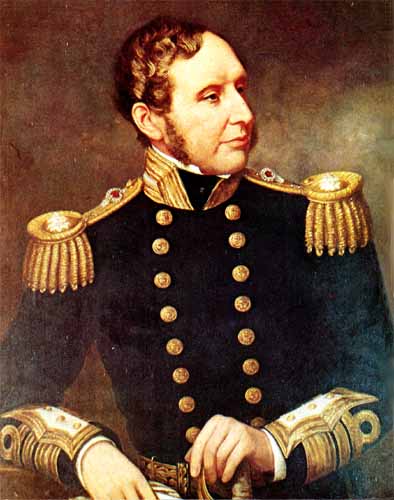
Robert FitzRoy
View on Wikipedia
Vice-Admiral Robert FitzRoy FRS (5 July 1805 – 30 April 1865) was an English officer of the Royal Navy, politician and scientist who served as the second governor of New Zealand between 1843 and 1845.
Key Information


He achieved lasting fame as the captain of HMS Beagle during FitzRoy's famous survey expedition to Tierra del Fuego and the Southern Cone, which took Charles Darwin round the world.
FitzRoy was a pioneering meteorologist who made accurate daily weather predictions, which he called by a new name of his own invention: "forecasts".[2] In 1854 he established what would later be called the Met Office, and created systems to get weather information to sailors and fishermen for their safety.[2]
He was an able surveyor and hydrographer.
As Governor of New Zealand, serving from 1843 to 1845, he tried to protect the Māori from illegal land sales claimed by British settlers.[3]
Early life and career
[edit]Robert FitzRoy was born at Ampton Hall, Ampton, Suffolk, England, into the upper echelons of the British aristocracy and a tradition of public service. Through his father, General Lord Charles FitzRoy, Robert was a fourth great-grandson of Charles II of England; his paternal grandfather was Augustus Henry FitzRoy, 3rd Duke of Grafton. His mother, Lady Frances Stewart, was the daughter of the first Marquess of Londonderry and the half-sister of Viscount Castlereagh, who became Foreign Secretary. From the age of four, Robert FitzRoy lived with his family at Wakefield Lodge, their Palladian mansion in Northamptonshire.
Robert's half-brother Sir Charles FitzRoy later served as Governor of New South Wales, Governor of Prince Edward Island and Governor of Antigua.
In February 1818 at the age of 12, FitzRoy entered the Royal Naval College, Portsmouth, and in the following year he entered the Royal Navy. At the age of 14, he embarked as a voluntary student aboard the frigate HMS Owen Glendower, which sailed to South America in the middle of 1820, and returned in January 1822. He was promoted to midshipman while on the vessel, then served as such on HMS Hind.
He completed his course with distinction and was promoted lieutenant on 7 September 1824, having passed the examination with 'full numbers' (100%), the first to achieve this result. After serving on HMS Thetis, in 1828 he was appointed flag lieutenant to Rear-Admiral Sir Robert Waller Otway, commander-in-chief of the South American station, aboard HMS Ganges.
At that time Beagle, under Captain Pringle Stokes, was carrying out a hydrographic survey of Tierra del Fuego, under the overall command of Captain Phillip Parker King in HMS Adventure. Pringle Stokes became severely depressed and fatally shot himself. Under Lieutenant Skyring, the ship sailed to Rio de Janeiro, where Otway appointed FitzRoy as (temporary) captain of the Beagle on 15 December 1828. By the ship's return to England on 14 October 1830, FitzRoy had established his reputation as a surveyor and commander.
During the survey, some of his men were camping onshore when a group of Fuegian natives made off with their boat. His ship gave chase and, after a scuffle, the culprits' families were brought on board as hostages. Eventually FitzRoy held two boys, a girl and two men (one man escaped). As it was not possible to put them ashore conveniently, he decided to "civilise the savages", teaching them "English ... the plainer truths of Christianity ... and the use of common tools" before returning them as missionaries.[4]
The sailors gave them names: the girl was called Fuegia Basket (so named because the replacement for the stolen boat was an improvised coracle that resembled a basket), the younger boy Jemmy Button (FitzRoy allegedly 'purchased' him with a large pearl button), the man York Minster (after the large rock so-named near which he was captured). The second, elder, boy he named Boat Memory. FitzRoy brought the four back with the ship to England. Boat Memory died following a smallpox vaccination. The others were cared for and taught by the trainee missionary Richard Matthews; they were considered civilised enough to be presented at Court to King William IV and Queen Adelaide in the summer of 1831.
HMS Beagle's second voyage
[edit]In early May 1831 FitzRoy stood as Tory candidate for Ipswich in the general election, but was defeated. His hopes of obtaining a new posting and organising a missionary project to Tierra del Fuego appeared to be failing. He was arranging for the charter of a ship at his own expense to return the Fuegians with Matthews when his friend Francis Beaufort, Hydrographer to the British Admiralty, and his "kind uncle", the Duke of Grafton, interceded on his behalf at the Admiralty. On 25 June 1831 FitzRoy was re-appointed commander of the Beagle. He spared no expense in fitting out the ship.
He was conscious of the stressful loneliness of command. He knew of the suicides both of Captain Stokes and of his uncle Viscount Castlereagh, who had cut his own throat in 1822 while in government office. FitzRoy talked to Beaufort in August 1831, asking him to find a suitable gentleman companion for the voyage. Such a companion should share his scientific tastes, make good use of the expedition's opportunities for researching natural history, dine with him as an equal, and provide a semblance of normal human friendship.[5] While those Beaufort first approached (including Professor J. S. Henslow of the University of Cambridge) turned the opportunity down, FitzRoy eventually approved Charles Darwin for the position. Before they left England, FitzRoy gave Darwin a copy of the first volume of Charles Lyell's Principles of Geology, a book the captain had read that explained terrestrial features as the outcome of a gradual process taking place over extremely long periods. FitzRoy took a request from Lyell to record observations on geological features, such as erratic boulders.[6]
FitzRoy and Darwin got on well together, but there were inevitable strains during the five-year survey voyage. The captain had a violent temper, his outbursts had gained him the nickname "Hot Coffee",[7] which resulted in quarrels sometimes "bordering on insanity", as Darwin later recalled. On a memorable occasion in March 1832 at Bahia, Brazil, Darwin was horrified at tales of the treatment of slaves. FitzRoy, while not endorsing brutality, recounted how an estancia owner once asked his slaves if they wished to be free and was told they did not. Darwin asked FitzRoy if he thought slaves could answer such a question honestly when it was posed by their master, at which the captain lost his temper and, before storming out, told Darwin that if he doubted his word they could no longer live together; effectively he banished Darwin from his table. Before nightfall FitzRoy's temper cooled and he sent an apology, with the request that Darwin "continue to live with him." They avoided the subject of slavery from that time on. None of their quarrels were over religious or doctrinal issues; such disagreements came after the voyage.[5]
At the island of "Buttons Land" in Tierra del Fuego they set up a mission post, but when they returned nine days later, the possessions had been looted. Matthews gave up, rejoining the ship. He left the three "westernised" Fuegians to continue the missionary work.
While in the Falkland Islands, FitzRoy bought a schooner out of his own funds to assist with the surveying tasks he had been asked to complete. He had it refitted and renamed Adventure, hoping that the cost would be reimbursed by the Admiralty. They returned to the mission post but found only Jemmy Button. He had returned to native ways and refused the offer to go with them back to England.
At Valparaíso in 1834, while Darwin was away from the ship exploring the Andes, the Admiralty reprimanded FitzRoy for buying the Adventure. He took the criticism badly, selling the schooner and announcing they would go back to recheck his survey, then resigning his command with doubts about his sanity. The ship's officers persuaded him to withdraw his resignation and continue as planned once Darwin returned to the ship.[7] FitzRoy continued his voyage, sailing on to the Galápagos Islands, Tahiti, New Zealand, Australia and South Africa. He detoured to Bahia in Brazil on the return voyage so that he could carry out an additional check, to ensure the accuracy of his longitude measurements before returning to England.
Return from the voyage
[edit]Soon after the Beagle's return on 2 October 1836, FitzRoy married Mary Henrietta O'Brien, a young woman to whom he had long been engaged. Darwin was amazed, as not once during the entire five years of the trip had FitzRoy spoken about being engaged.
FitzRoy was awarded the Royal Premium by the Royal Geographical Society in 1837. Extracts from his diary read to the society on 8 May 1837 included the observation:
- Is it not extraordinary, that sea-worn, rolled, shingle-stones, and alluvial accumulations, compose the greater portion of these plains? How vast, and of what immense duration, must have been the actions of these waters which smoothed the shingle-stones now buried in the deserts of Patagonia!"[8]
FitzRoy wrote his account of the voyage, including editing the notes of the previous captain of the Beagle. It was published in May 1839 as the Narrative of the Surveying Voyages of H.M.S. Adventure and Beagle, in four volumes, including Darwin's Journal and Remarks, 1832–1836 as the third volume. FitzRoy's account includes a section of Remarks with reference to the Deluge in which he admits that, having read works "by geologists who contradict, by implication, if not in plain terms, the authenticity of the Scriptures" and "while led away by sceptical ideas," he had remarked to a friend that the vast plain of sedimentary material they were crossing "could never have been effected by a forty days' flood." He wrote that in his "turn of mind and ignorance of scripture," he was willing to disbelieve the Biblical account. Concerned that such ideas might "reach the eyes of young sailors," he explains in detail his renewed commitment to a literal reading of the Bible, with arguments that rock layers high in the mountains containing sea shells are proof of Noah's Flood and that the six days of creation could not have extended over aeons because the grass, herbs and trees would have died out during the long nights.[9][10]
R. D. Keynes, in his introduction to the 2001 edition of Darwin's diary, suggests that FitzRoy had undergone a religious conversion.[10] He was dissociating himself from the new ideas of Charles Lyell, which he had accepted during the voyage, and from Darwin's account which embraced these ideas. Under the influence of his very religious wife, he asserted a new commitment to the doctrine of the established Church of England.[7]
In 1841 FitzRoy was elected as a Tory as one of the two members of Parliament for Durham. He was appointed Acting Conservator of the River Mersey in 1842.
Governor of New Zealand
[edit]
The first governor of New Zealand, Captain William Hobson, R.N., died in late 1842. The Church Missionary Society, which had a strong New Zealand presence, suggested FitzRoy as his successor and he was appointed by the government. He took up his new task in December 1843. On the journey to New Zealand, he met William John Warburton Hamilton and made him his private secretary.[11]
His instructions were to maintain order and protect the Māori, while satisfying the land hunger of the settlers pouring into the country. He was given very few military resources. Government revenue, mainly from customs duties, was woefully inadequate for his responsibilities.
One of his first tasks was to enquire into the circumstances surrounding the Wairau Affray, in which there had been violent conflict between settlers and the Maori. He found the actions of the colonists to have been illegal and declined to take any action against Te Rauparaha. He did not have the troops to meet him on anything like equal terms. But the New Zealand Company and the settlers felt betrayed and angry. He appointed a Government Superintendent for the area, to establish a ruling presence. Fitzroy also insisted that the New Zealand Company pay the Māori a realistic price for the land they claimed to have purchased. These moves made him very unpopular.
Land sales were a continuing vexatious issue. The settlers were eager to buy land and some Māori were willing to sell, but under the provisions of the Treaty of Waitangi, land sales required the Government as an intermediary, and were thus extremely slow. FitzRoy changed the rules to allow settlers to purchase Māori land directly, subject to a duty of ten shillings per acre. But land sales proved slower than expected.
To meet the financial shortfall, FitzRoy raised the customs duties, then replaced them with property and income taxes. All these expedients failed. Before long the Colony was faced with bankruptcy, and FitzRoy was forced to begin issuing promissory notes, paper money without backing.
Meanwhile, the Māori in the far North, around the Bay of Islands, who had been the first to sign the Treaty of Waitangi, were feeling increasingly sidelined and resentful of the changes that had taken place in New Zealand. To signal their resentment, Hōne Heke cut down the flagpole at Kororāreka. Rather than address the problems, FitzRoy had the flagpole re-erected. Hone Heke cut it down again, four times altogether; by the fourth occasion the First New Zealand War, sometimes called the Flagstaff War or the Northern War, was well under way.
FitzRoy quickly realized that he did not have the resources to bring about a quick end to the war. Meanwhile, the spokesmen for the New Zealand Company were active back in the United Kingdom, lobbying against FitzRoy's governorship, which they presented to the House of Commons in a very poor light. As a result, he was shortly afterwards recalled and replaced by George Grey, then governor of South Australia. Grey was given the backing and financial support that FitzRoy had needed but was denied.
Later life and impact on meteorology
[edit]
FitzRoy returned to Britain in September 1848 and was made superintendent of the Royal Naval Dockyards at Woolwich. In March 1849 he was given his final sea command, the screw frigate HMS Arrogant.[12]
In 1850, FitzRoy retired from active service, partly due to ill health. The following year, in 1851, he was elected to the Royal Society with the support of 13 fellows, including Charles Darwin.[13]
In 1854, on the recommendation of the President of the Royal Society, FitzRoy was appointed as chief of a new department to deal with the collection of weather data at sea. His title was Meteorological Statist to the Board of Trade, and he had a staff of three. This was the forerunner of the modern Meteorological Office. He arranged for captains of ships to provide information, with tested instruments being loaned for this purpose, and for computation of the data collected.[14]


FitzRoy soon began to work on strategies to make weather information more widely available for the safety of shipping and fishermen. He directed the design and distribution of a type of barometer which, on his recommendation, was fixed at every port to be available to crews for consultation before setting out to sea. Stone housings for such barometers are still visible at many fishing harbours.[15] The invention of several different types of barometers was attributed to him. These became popular and continued in production into the 20th century, characteristically engraved with Admiral FitzRoy's special remarks on interpretation, such as: "When rising: In winter the rise of the barometer presages frost."[16]
A storm in 1859 that caused the loss of the Royal Charter inspired FitzRoy to develop charts to allow predictions to be made in which he coined the term "weather forecast".[14] Fifteen land stations were established to use the new telegraph to transmit to him daily reports of weather at set times. The first daily weather forecasts were published in The Times in 1861.[2] The 1859 storm resulted in the Crown distributing storm glasses, then known as "FitzRoy's storm barometers", to many small fishing communities around the British Isles.[17]
In 1860, FitzRoy introduced a system of hoisting storm warning cones at the principal ports when a gale was expected. He ordered fleets to stay in port under these conditions.[18] The Weather Book, which he published in 1863, was far in advance of the scientific opinion of the time.[19] Queen Victoria once sent messengers to FitzRoy's home requesting a weather forecast for a crossing she was about to make to the Isle of Wight.[2]
Many fishing fleet owners objected to the posting of gale warnings, which required that fleets not leave the ports. Under this pressure, FitzRoy's system was abandoned for a short time after his death. The fishing fleet owners reckoned without the pressure of the fishermen, for whom FitzRoy had been a hero responsible for saving many lives. The system was eventually reinstated in simplified form in 1874.[18]
When The Origin of Species was published FitzRoy was dismayed and apparently felt guilty for his part in the theory's development. He was in Oxford on 30 June 1860 to present a paper on storms and attended the meeting of the British Association for the Advancement of Science at which Samuel Wilberforce attacked Darwin's theory. During the debate FitzRoy, seen as "a grey haired Roman nosed elderly gentleman", stood in the centre of the audience and "lifting an immense Bible first with both and afterwards with one hand over his head, solemnly implored the audience to believe God rather than man". As he admitted that The Origin of Species had given him "acutest pain", the crowd shouted him down.[20]
FitzRoy debunked Lieutenant Stephen Martin Saxby's lunar weather forecasting method as pseudoscience. Saxby tried to counter FitzRoy's arguments in the second edition of his book Saxby Weather System (1864).[21]
Death and legacy
[edit]
FitzRoy had been promoted to rear-admiral on the reserved list in 1857[22] and was advanced to vice-admiral in 1863.[23] In the coming years, internal and external troubles at the Meteorological Office, financial concerns as well as failing health, and his struggle with depression took their toll.[24]
On 30 April 1865, Vice-Admiral FitzRoy died by suicide[25] by cutting his throat with a razor.[26] This took place at Lyndhurst, Westow Hill, Norwood.[1] He died after exhausting his entire fortune (some £6,000, equivalent to £724,609 in 2023) on public expenditure.
When this came to light, in order to prevent Fitzroy's widow and daughter living in destitution, his friend and colleague Bartholomew Sulivan began an Admiral FitzRoy Testimonial Fund, which succeeded in getting the government to pay £3,000 of this sum[27] (Charles Darwin contributed £100).[28] Queen Victoria gave the special favour of allowing his widow and daughter the use of grace and favour apartments at Hampton Court Palace.[29]
FitzRoy is buried in the front churchyard of All Saints' Church in Upper Norwood, south London where his footstone reads[30]
"The wind goeth toward the south,
and turneth about unto the north;
it whirleth about continually,
and the wind returneth again
according to his circuits"
Ecclesiastes 1.6.
His memorial was restored by the Meteorological Office in 1981 with the same inscription.[30][31]
FitzRoy's publications arising from the Beagle expeditions were influential on Chilean exploration and settlement of Patagonia. His recommendation on establishing a British base on the Straits of Magellan to aid the travel between the British Isles and Australia contributed to the Chilean decision to occupy the straits in the 1840s.[32] FitzRoy's book Sailing Directions for South America led Chilean Navy hydrographer Francisco Hudson to investigate in the 1850s the possible existence of a sailing route through internal waters from the Chiloé Archipelago to the Straits of Magellan.[33] Enrique Simpson found instead FitzRoy's mapping of little use, noting in 1870 that "Fitzroy's chart, that is quite exact until that point [Melinka 43° 53' S], is worthless further ahead...". Thus south of Melinka, Simpson relied more in the late 18th-century sketches of José de Moraleda y Montero.[34] Simpson's contemporary Francisco Vidal Gormaz was critical of the overall work of FitzRoy and Darwin, stating that they had failed to acknowledge the importance of the Patagonian islands.[35]
Personal life
[edit]Robert FitzRoy married twice. He married Mary Henrietta O'Brien, daughter of Major General Edward James O'Brien and Rachel Charlotte Frobisher, in 1836.[36] They had four children: Emily-Unah, Fanny, Katherine and Robert O'Brien. After the death of his first wife, he married Maria Isabella Smyth, daughter of John Henry Smyth of Heath Hall, Heath, West Yorkshire (son of the politician John Smyth), in London in 1854. Smyth had married his first cousin, Lady Elizabeth Anne FitzRoy—both being grandchildren of the 3rd Duke of Grafton, as was Robert FitzRoy. Lady Elizabeth was daughter of the 4th Duke of Grafton and was a first cousin of Robert FitzRoy. Maria Isabella was therefore Robert's first cousin once removed. They had one daughter, Laura Maria Elizabeth (1858–1943).[36]
Memorials
[edit]A neighbourhood in the city of Punta Arenas Chile, was named in his honour in 1964.
A memorial to FitzRoy is erected atop a metamorphic outcrop beside the Bahia Wulaia dome middens on Isla Navarino, in the Chilean part of Tierra del Fuego archipelago, South America.[37][38] It was presented in his bicentenary (2005) and commemorates his 23 January 1833 landing on Wulaia Cove. Another memorial, presented also in FitzRoy's bicentenary, commemorates his Cape Horn landing on 19 April 1830.[37]


Mount Fitz Roy at the Argentina–Chile border was named after him by the Argentine scientist and explorer Francisco Moreno. It is 3,440 m (11,286 ft) high. The aboriginals had not named it, and used the word chaltén (meaning smoking mountain) for this and other peaks.
Fitzroy River, in northern Western Australia, was named after him by Lieutenant John Lort Stokes who, at the time, commanded HMS Beagle (previously commanded by FitzRoy).
The South American conifer Fitzroya cupressoides is named after him, as well as the Delphinus fitzroyi, a species of dolphin discovered by Darwin during his voyage aboard the Beagle.[40]
Fitzroy, Falkland Islands and Port Fitzroy, New Zealand are also named after him.
The World War II Captain class frigate HMS Fitzroy (K553) was named after him, as was the weather ship Admiral Fitzroy (formerly HMS Amberley Castle).
In 2010 New Zealand's National Institute of Water and Atmospheric Research (NIWA) named its new IBM supercomputer "FitzRoy" in honour of him.[41]
On 4 February 2002, when the shipping forecast sea area Finisterre was renamed to avoid confusion with the (smaller) French and Spanish forecast area of the same name, the new name chosen by the UK's Meteorological Office was "FitzRoy", in honour of their founder.
FitzRoy has been commemorated by the Fitzroy Building at the University of Plymouth, home of Plymouth Business School,[42] and previously used by the School of Earth, Ocean and Environmental Science.
There is blue plaque on FitzRoy's house at 38 Onslow Square, London.[43]
Vice-Admiral Robert FitzRoy was commemorated on two stamps issued by the Royal Mail for the Falkland Islands and St Helena.
Fitzroy River and Fitzroy Crossing in Western Australia are named after FitzRoy. Fitzroy Island in Queensland, Australia, is named after FitzRoy's paternal grandfather, Augustus Henry Fitzroy.
In fiction
[edit]The BBC made a BAFTA award-winning television series in 1978 titled The Voyage of Charles Darwin where Captain Robert Fitzroy was played by actor Andrew Burt with Malcolm Stoddard as Darwin with a storyline that followed the historic interaction between Darwin and FitzRoy before and after their time together on HMS Beagle. [44]
In 1997, the play FitzRoy by Juliet Aykroyd was first performed at the University of Reading.[45] It has since been performed under the title The Ostrich and the Dolphin[46] – alluding to Darwin's rhea and the dusky dolphin, named Delphinus fitzroyi by Darwin – before being published as Darwin & FitzRoy in October 2013.[47]
A novel by Argentinian writer, Sylvia Iparraguirre, entitled Tierra del Fuego, was published in 2000.[48] It retells the story of Fitzroy's experiment with "civilizing" the Yamaná from the perspective of a fictional narrator, British-Argentinian Jack Guevarra. The novel received the Sor Juana de la Cruz prize and was translated into English by Hardie St. Martin.[49]
A novel entitled This Thing of Darkness by Harry Thompson was published in 2005 (it was published in the U.S. in 2006 under the title To the Edge of the World). The novel's plot followed the lives of FitzRoy, Darwin and others connected with the Beagle expeditions, following them between the years of 1828 and 1865. It was a nominee on the long list for the 2005 Man Booker Prize[50] (although Thompson died in November 2005).
The novel Darwin's Dreams by Sean Hoade was published in 2008 and republished in a new edition in 2016. The novel begins with the first meeting of Darwin and FitzRoy and ends with Darwin receiving notice of FitzRoy's suicide. The plot is interlaced with fictional "dreams" that imagine how the world would be if the ideas of evolutionary thinkers over the millennia had been literally true. The dreams also show how Darwin's subconscious dealt with major themes in his life such as the death of his beloved daughter Annie and his lifelong friendship and rivalry with FitzRoy.[51]
The play Darwins Kapten was published by Henning Mankell in 2009, and had its world premiere in 2010 at the Royal Dramatic Theatre in Stockholm. It is about Darwin and his journey on the Beagle: many years after the five-year long voyage, Darwin receives a message that his captain on the ship, FitzRoy, has died by suicide. The play portrays the reception of Darwin's discoveries, as well as the consequences of taking a stand against existing ideas in a world that is built on belief in God as the only creator of life.[52]
See also
[edit]References
[edit]- Citations
- ^ a b FITZROY Robert Esq... who died 30 April 1865 at Lyndhurst Weston Hill Norwood in the County of Surrey" in Wills and Administrations (England and Wales), ancestry.co.uk, accessed 7 January 2023 (subscription required)
- ^ a b c d Moore, Peter (30 April 2015). "The birth of the weather forecast". BBC News. Retrieved 30 April 2015.
- ^ "Robert FitzRoy biography". New Zealand history (NZ Govt website).
- ^ Adam Kuper (2017). The Reinvention of Primitive Society: Transformations of a Myth. London: Taylor & Francis. p. 26.
- ^ a b Browne, Janet (7 August 2003). Charles Darwin: Voyaging. Pimlico. ISBN 1-84413-314-1.
- ^ Introduction by Janet Browne and Michael Neve to – Darwin, Charles (1989). Voyage of the Beagle. London: Penguin Books. ISBN 0-14-043268-X.
- ^ a b c Desmond, Adrian; Moore, James (1991). Darwin. London: Michael Joseph, Penguin Group. ISBN 0-7181-3430-3.
- ^ FitzRoy, R. (1837). "Extracts from the Diary of an Attempt to Ascend the River Santa Cruz, in Patagonia, with the boats of his Majesty's sloop Beagle". Journal of the Royal Geographical Society of London. 7: 114–26. doi:10.2307/1797517. JSTOR 1797517.
- ^ FitzRoy, Robert (1839). "Chapter XXVIII: A Very Few Remarks with Reference to the Deluge". Narrative of the Surveying Voyages of His Majesty's Ships Adventure and Beagle between the years 1826 and 1836, describing their examination of the southern shores of South America, and the Beagle's circumnavigation of the globe. Proceedings of the second expedition, 1831–36, under the command of Captain Robert Fitz-Roy, R.N. London: Henry Colburn.
- ^ a b Keynes, R. D., ed. (2001). Charles Darwin's Beagle Diary. Cambridge: Cambridge University Press. pp. xxi–xxii.
- ^ Scholefield 1940, p. 349.
- ^ Agnew, Duncan Carr (January 2004). "Robert Fitzroy and the Myth of the 'Marsden Square': Transatlantic Rivalries in Early Marine Meteorology". Notes and Records of the Royal Society of London. 58 (1). London, UK: The Royal Society: 26. doi:10.1098/rsnr.2003.0223. JSTOR 4142031. S2CID 145354564.
- ^ "List of Fellows of the Royal Society 1660–2007" (PDF). The Royal Society Library and Information Services. Retrieved 21 September 2016.
- ^ a b Mellersh, H. E. L. (1968). FitzRoy of the Beagle. Hart-Davis. ISBN 0-246-97452-4.
- ^ "Scottish Harbour Barometers". Banffshire Maritime & Heritage Association. Archived from the original on 25 December 2014. Retrieved 17 September 2012.
- ^ "Admiral FitzRoy's special remarks". Queenswood.com. Archived from the original on 5 July 2007.
- ^ "Storm Glass". The Weather Notebook. Mount Washington Observatory. 7 May 2004. Archived from the original on 20 January 2015.
- ^ a b Kington, John (1997). Hulme, Mike; Barrow, Elaine (eds.). Climates of the British Isles: Present, Past and Future. Routledge. p. 147. ISBN 978-0-41513-016-5.
- ^ "The Royal Charter Gale and the world's first National Forecasting Service". Met Office website.
- ^ Desmond, Adrian J.; Moore, James R. (1991). Darwin. London: Michael Joseph. p. 495. ISBN 0-7181-3430-3. OCLC 26502431.
- ^ Saxby, S. M. (1864). Saxby Weather System.
- ^ "No. 21968". The London Gazette. 17 February 1857. p. 539.
- ^ "No. 22772". The London Gazette. 18 September 1863. p. 4561.
- ^ Gribbin, John & Mary (2003). FitzRoy. Review. ISBN 0-7553-1181-7
- ^ "Robert Fitzroy". Encyclopædia Britannica. Retrieved 15 June 2009.
- ^ Browne, E. Janet (2002). Charles Darwin: The Power of Place. Vol. 2. Princeton University Press. p. 264. ISBN 0-691-11439-0.
- ^ Darwin, Charles (19 December 2002). The Correspondence of Charles Darwin:, Volume 13; Volume 1865, page 259. Cambridge University Press. ISBN 9780521824132.
- ^ "Letter no. 4908 – Charles Shaw to Charles Darwin". Darwin Correspondence Project. 3 October 1865. Retrieved 17 February 2016.
- ^ Taylor, James (17 May 2016). 'The Voyage of the Beagle' by James Taylor, page 182. Bloomsbury USA. ISBN 9781844863273.
- ^ a b Gilbert, Gilbert (1981). "The Fitzroy Grave - an Epilogue". Norwood Review. The Norwood Society.
- ^ Gilbert, Hildat (1979). "Admiral Robert Fitzroy - his Grave". Norwood Review. The Norwood Society.
- ^ Talbott, Robert D. (1974). "The Strait of Magellan". A history of the Chilean boundaries (A Replica ed.). The Iowa State University Press. pp. 75–76. ISBN 0-8138-0305-5.
- ^ Sepúlveda Ortíz, Jorge (1998), "Francisco Hudson, un destacado marino poco conocido en nuestra historia" (PDF), Revista de Marina (in Spanish): 1–20, archived from the original (PDF) on 23 January 2019, retrieved 17 February 2019
- ^ Simpson, E. (1874). Esploraciones hechas por la Corbeta Chacabuco al mando del capitán de fragata don Enrique M. Simpson en los Archipiélagos de Guaitecas, Chonos i Taitao. Santiago. Imprenta Nacional.
- ^ Núñez, Andrés G.; Molina O., Raúl; Aliste A., Enrique; Bello A., Álvaro (2016). "Silencios geográficos de Patagonia-Aysén: Territorio, nomadismo y perspectivas para re-pensar los margenes de la nación en el siglo XIX" [Geographical silences in Patagonia-Aysén: Territory, nomadism and perspectives for re-thinking the margins of Chile in the nineteenth century]. Magallania (in Spanish). 44 (2): 107–130. doi:10.4067/S0718-22442016000200006.
- ^ a b Charles Mosley, Burke's Peerage Ltd, ed. (2003). Burke's Peerage, Baronetage and Knightage. Vol. 2 (107th ed.). p. 1617.
- ^ a b "Homenaje a un navegante singular" (in Spanish). Patrimonio Cultural De Chile. Archived from the original on 2 July 2007. Retrieved 5 July 2020.
- ^ Hogan, C. Michael (2008). "Bahia Wulaia Dome Middens". Megalithic Portal.
- ^ "About the Inn". Admiral Fitzroy Inn. Archived from the original on 20 August 2019. Retrieved 15 May 2021.
- ^ Bryson, Bill (2005). A Short History of Nearly Everything. London: Transworld. p. 481.
- ^ "NIWA Installs new IBM supercomputer". Geekzone. 21 July 2010.
- ^ "£14.5million project creates a new home for the Plymouth Business School". 26 January 2024.
- ^ "FitzRoy, Admiral Robert (1805-1865)". English Heritage. Retrieved 19 May 2020.
- ^ "The Voyage of Charles Darwin". IMDb.com. Retrieved 19 May 2020.
- ^ Aykroyd, Juliet (8 October 2013). Darwin & FitzRoy. Sulivan & Stokes. Retrieved 23 March 2017 – via Amazon.
- ^ "The Ostrich and the Dolphin (play)". UK Theatre Web. Retrieved 23 March 2017.
- ^ "Authors: Juliet Aykroyd". Stay Thirsty Media. Retrieved 23 March 2017.
- ^ "Tierra del Fuego". Northwestern University Press. Archived from the original on 25 September 2020. Retrieved 5 July 2020.
- ^ "Sor Juana Inés de la Cruz Literature Award - 1999 - Sylvia Iparraguirre". Guadalajara International Book Fair. Retrieved 5 July 2020.
Tierra del Fuego is the novel with which the Argentinean Sylvia Iparraguirre won the 1999 Sor Juana Inés de la Cruz Prize for a novel written by women, awarded by the Guadalajara International Book Fair.
- ^ "This Thing of Darkness". Man Booker Prize. 2005. Retrieved 23 March 2017.
- ^ Hoade, Sean. "Darwin's Dreams". Archived from the original on 8 August 2016. Retrieved 28 June 2016.
- ^ Mankell, Henning. "Darwin's Captain". henningmankell.com. Archived from the original on 22 February 2015. Retrieved 10 June 2015.
- Bibliography
- Narrative of the surveying voyages of His Majesty's Ships Adventure and Beagle between the years 1826 and 1836, describing their examination of the southern shores of South America, and the Beagle's circumnavigation of the globe.
- King, P. P. (1839). FitzRoy, Robert (ed.). Narrative of the surveying voyages of His Majesty's Ships Adventure and Beagle between the years 1826 and 1836, describing their examination of the southern shores of South America, and the Beagle's circumnavigation of the globe. Proceedings of the first expedition, 1826–30, under the command of Captain P. Parker King, R.N., F.R.S. Vol. I. London: Henry Colburn. Retrieved 27 January 2009.
- FitzRoy, Robert (1839). Narrative of the surveying voyages of His Majesty's Ships Adventure and Beagle between the years 1826 and 1836, describing their examination of the southern shores of South America, and the Beagle's circumnavigation of the globe. Proceedings of the second expedition, 1831–36, under the command of Captain Robert Fitz-Roy, R.N. Vol. II. London: Henry Colburn. Retrieved 27 January 2009.
- FitzRoy, Robert (1839). Narrative of the surveying voyages of His Majesty's Ships Adventure and Beagle between the years 1826 and 1836, describing their examination of the southern shores of South America, and the Beagle's circumnavigation of the globe. Vol. Appendix to Volume II. London: Henry Colburn. Retrieved 27 January 2009.
- FitzRoy, Robert (2012) [1846]. Remarks on New Zealand, in February 1846 (Digitised first ed.). London: W. and H. White. ISBN 978-0-902041-13-4.
- FitzRoy, Robert (1859). Notes on Meteorology. Board of Trade.
- FitzRoy, Robert (1860). Barometer Manual. Board of Trade.
- FitzRoy, Robert (1863). The Weather Book: A Manual of Practical Meteorology. London: Longman, Green, Longman, Roberts, & Green.
- Collins, Philip R. (2007). FitzRoy and his barometers. Baros Books. ISBN 978-0-948382-14-7.
- Gribbin, John & Gribbin, Mary (2003). FitzRoy: The Remarkable Story of Darwin's Captain and the Invention of the Weather Forecast. Review. ISBN 0-7553-1182-5.
- Marks, Richard Lee (1991). Three Men of The Beagle. New York: Alfred A. Knopf. ISBN 0-394-58818-5.
- Mellersh, H. E. L. (1968). FitzRoy of the Beagle. Hart-Davis. ISBN 0-246-97452-4.
- Moon, Paul (2000). FitzRoy: Governor in Crisis 1843–1845. David Ling Publishing. ISBN 0-908990-70-7.
- Nichols, Peter (2003). Evolution's Captain: The Dark Fate of the Man Who Sailed Charles Darwin Around the World. HarperCollins. ISBN 978-0060-08877-4. UK edition: Evolution's Captain: The Tragic Fate of Robert FitzRoy, the Man Who Sailed Charles Darwin Around the World (Profile Books, 2003) ISBN 978-1-8619-7451-8
- Scholefield, Guy Hardy, ed. (1940). A Dictionary of New Zealand Biography : A–L (PDF). Vol. I. Wellington: Department of Internal Affairs. Retrieved 21 September 2013.
- Taylor, James (2008). The Voyage of the Beagle: Darwin's extraordinary adventure aboard FitzRoy's famous survey ship. Naval Institute Press. ISBN 978-1-59114-920-0.
- Thompson, Harry (2005). This Thing of Darkness. Headline Review. ISBN 0-7553-0281-8.
External links
[edit]
- O'Byrne, William Richard (1849). . . John Murray – via Wikisource.
 Works by or about Robert Fitzroy at Wikisource
- Hansard 1803–2005: contributions in Parliament by Robert FitzRoy
- Science Museum | Heavy Weather | Admiral FitzRoy and the FitzRoy barometer
- BBC – h2g2 – Robert FitzRoy
- Dictionary of New Zealand Biography
- Government House, Wellington biography
- Image of Robert FitzRoy's commemorative plaque in Horn Island (Chile)
- Image of Robert FitzRoy's memorial at Wulaia Bay (Chile)
- Works by Robert FitzRoy at Project Gutenberg
- Works by or about Robert FitzRoy at the Internet Archive
- The Weather Book
- Robert FitzRoy FRS: sailing into the storm – an audio lecture by Dr John Gribbin at Royal Society website
- BBC News Magazine – The birth of the weather forecast


Robert FitzRoy
View on GrokipediaVice-Admiral Robert FitzRoy (5 July 1805 – 30 April 1865) was a British Royal Navy officer, hydrographer, and scientist renowned for commanding HMS Beagle during its second survey voyage (1831–1836), which carried naturalist Charles Darwin and contributed to coastal mapping of South America.[1][2]
FitzRoy advanced hydrographic surveying techniques during the Beagle expeditions, producing accurate charts of Patagonia and Tierra del Fuego, and later served as the second Governor of New Zealand (1843–1845), where he sought to mediate conflicts between Māori and British settlers amid the New Zealand Wars, though his policies favoring Māori land rights strained relations with colonists and led to his recall.[3][4]
In his meteorological career, FitzRoy established Britain's first national weather service as superintendent of the Meteorological Department (1854–1865), introducing telegraphic storm warnings, synoptic charts, and public weather forecasts published in The Times—innovations that reduced maritime losses despite initial skepticism—and he devised the FitzRoy barometer for shipboard use to aid safe navigation.[1][2]
Early Life and Naval Entry
Family Origins and Childhood
Robert FitzRoy descended from an aristocratic lineage with royal ties through the illegitimate offspring of King Charles II. His paternal line connected to Henry FitzRoy, 1st Duke of Grafton (1663–1690), the eldest illegitimate son of Charles II and Barbara Villiers, which established the FitzRoy surname's tradition among royal bastards ("fitz" meaning "son of" the king, and "Roy" for royal). His grandfather, Augustus FitzRoy, 3rd Duke of Grafton (1735–1811), served as Prime Minister from 1768 to 1770, while his father, General Lord Charles FitzRoy (1764–1829), second son of the 3rd Duke, pursued a military career in the British Army and owned estates including Ampton Hall in Suffolk.[5][6] On his mother's side, Lady Frances Anne Stewart (1777–1810) was the daughter of Robert Stewart, 1st Marquess of Londonderry (1739–1821), linking FitzRoy to the Stewart family of Irish and British nobility.[3] Born on 5 July 1805 at Ampton Hall, Suffolk, FitzRoy experienced an early childhood marked by familial privilege and loss. From age four, the family resided at Wakefield Lodge in Northamptonshire, a hunting lodge granted to the FitzRoys by the crown. His mother died on 9 February 1810 at Lympstone, Devon, leaving him orphaned on the maternal side at under five years old; his father remarried but focused on military duties. FitzRoy had three full siblings—George (b. circa 1800), Frances (1803–1878), and Emily (b. 1808)—and a half-brother, Charles Augustus (1796–1858), from his father's prior marriage to Frances Mundy (d. 1797). His maternal uncle, Robert Stewart, 2nd Marquess of Londonderry (better known as Viscount Castlereagh), who held key roles as Foreign Secretary and Leader of the House of Commons, died by suicide on 12 August 1822 when FitzRoy was 17.[3][7][8][1] FitzRoy's formal education began early in preparation for naval service, reflecting the era's expectations for aristocratic sons pursuing military careers. In February 1818, at nearly 13 years old, he enrolled at the Royal Naval College in Portsmouth, completing a rigorous 20-month curriculum in mathematics, classics, navigation, and fortification with distinction. He formally entered the Royal Navy the following year in 1819, embarking on a path that leveraged his family's connections and his own aptitude.[3][3]Initial Training and First Commands
FitzRoy entered the Royal Naval College at Portsmouth in February 1818, at the age of nearly 13, where he completed a 20-month training course covering mathematics, classics, history, geography, English, French, drawing, and naval subjects, earning distinction and the institution's first medal.[3] In 1819, he joined the Royal Navy as a college volunteer and progressed to midshipman, beginning active service aboard HMS Owen Glendower, a frigate deployed to South America.[9] He continued as midshipman on HMS Hind, followed by service as a lieutenant—after his promotion on 7 September 1824—on HMS Thetis and as flag lieutenant to Rear-Admiral Sir Robert Otway aboard HMS Ganges starting in August 1828.[3] These early postings provided practical experience in seamanship, surveying, and Mediterranean and South American waters, though without major combat engagements.[10] FitzRoy received his first independent command in November 1828 at age 23, when Lieutenant Pringle Stokes, captain of HMS Beagle during its ongoing hydrographic survey of Patagonia, Tierra del Fuego, and the Straits of Magellan, died by suicide on 12 August 1828.[3] Promoted to commander for the role, FitzRoy assumed charge of the 10-gun brig to complete the mission, demonstrating early aptitude in navigation and leadership by refining chronometric methods for accurate coastal mapping and returning to England in October 1830 with detailed charts that advanced British hydrography.[11] This command marked his transition from subordinate officer to expedition leader, earning Admiralty recognition for efficiency despite the voyage's challenges, including harsh weather and crew morale issues under prior leadership.[3]Pre-Beagle Surveying Expeditions
South American Coastal Surveys
In 1826, the British Admiralty dispatched HMS Adventure, commanded by Captain Philip Parker King, and the tender ship HMS Beagle, under Captain Pringle Stokes, to conduct a comprehensive hydrographic survey of the southern coasts of South America, from the Río de la Plata southward to Tierra del Fuego.[12] The expedition aimed to chart harbors, straits, and coastlines to support navigation and British trade interests in the region.[11] Stokes's mental health deteriorated amid the harsh conditions, leading to his suicide on 21 September 1828 at Puerto del Hambre (Port Famine) in the Straits of Magellan; 23-year-old Lieutenant Robert FitzRoy was then appointed to command the Beagle and promoted to captain shortly thereafter.[1] Under FitzRoy's leadership, the surveys intensified, employing small boats for inshore work, theodolites for triangulation, and chronometers—including several purchased at his own expense—for precise longitude determinations.[11] [13] His teams mapped extensive sections of Patagonia, the Falkland Islands, and Tierra del Fuego, correcting prior inaccuracies and identifying safe anchorages amid treacherous tides and weather.[14] A key accomplishment was the detailed resurvey of the Straits of Magellan, where FitzRoy navigated and charted its complex channels, producing maps that enhanced passage safety for sailing vessels and endured as references into the late 19th century.[14] [15] He also fixed longitudes for multiple South American ports, contributing to Admiralty charts that advanced global hydrography.[14] The Beagle completed her portion of the mission and returned to England in October 1830, having amassed data that filled critical gaps in coastal knowledge.[11] FitzRoy's command demonstrated rigorous methodology, boosting crew morale after prior setbacks and earning him recognition as a skilled surveyor.[16]Leadership and Innovations in Hydrography
In 1828, Robert FitzRoy, then 23 years old, assumed command of HMS Beagle after the suicide of Lieutenant Pringle Stokes during the ongoing hydrographic survey of South America's southern coasts, directed overall by Captain Philip Parker King aboard HMS Adventure.[1] Under FitzRoy's leadership, the Beagle conducted meticulous examinations of the Río de la Plata estuary, portions of the Patagonian coast, and the Falkland Islands in 1828–1829, before focusing intensively on the Straits of Magellan from late 1829 to early 1830.[14] These efforts entailed systematic coastal profiling via lead-line soundings, triangulation from shore stations, and astronomical fixes for latitude, yielding foundational data on tides, currents, and navigational hazards in regions previously mapped imprecisely by explorers like James Cook.[17] FitzRoy demonstrated resolute leadership by maintaining crew discipline amid harsh weather, supply shortages, and isolation, while prioritizing merit-based promotions and scientific documentation; he personally led boat parties for close-inshore work and enforced daily logs of observations to ensure data integrity.[15] His innovations centered on enhancing positional accuracy, notably through the deployment of multiple marine chronometers—typically four to six instruments rated for reliability—to cross-verify longitudes via lunar distances and time sights, forming a continuous meridian chain from Montevideo to Cape Horn with errors minimized to under 0.5 arcminutes in key locales.[18][1] This rate-checking protocol, combined with barometric leveling for coastal elevations, addressed chronometer irregularities from temperature fluctuations and gales, surpassing contemporaneous methods reliant on single devices or dead reckoning.[19] The surveys culminated in Admiralty charts published in the 1830s, including detailed plans of the Straits of Magellan that delineated narrows, anchorages, and reefs with sufficient fidelity to support commercial shipping for decades; FitzRoy's volume of the expedition narrative, issued in 1839, appended tabular data on over 200 positions fixed during his tenure.[17] These achievements underscored his role in advancing hydrography from exploratory sketches toward empirically grounded cartography, though constrained by the era's instrumental limits and the Beagle's 235-ton displacement unsuitable for prolonged deep-water operations.[14]The HMS Beagle Circumnavigation
Voyage Commissioning and Crew Selection
Following the completion of the Beagle's first surveying voyage to South America in 1830, Robert FitzRoy was reappointed as commander for a second expedition on 25 June 1831 to continue hydrographic surveys of the region's coasts and complete chronometric measurements for longitude determination. The vessel was formally commissioned on 4 July 1831 and underwent extensive refitting in dock to prepare for prolonged foreign service, including reinforcements to the hull and improvements to living quarters, with FitzRoy personally funding portions of the upgrades due to limited Admiralty resources.[20] The expedition's primary objectives were scientific and naval, focusing on accurate charting amid challenging weather and terrain, originally planned for two years but extended to nearly five.[1] FitzRoy exercised significant authority in crew selection, prioritizing experienced sailors and specialists for the demanding survey work. The standard complement included approximately 65 officers and ratings, comprising lieutenants, mates, a surgeon, assistant surgeon, purser, midshipmen, and warrant officers such as the master and boatswain, drawn from Royal Navy personnel to ensure discipline and seamanship proficiency.[21] Key appointments included John Clements Wickham as first lieutenant and Bartholomew James Sulivan as second lieutenant, both of whom had prior experience with FitzRoy and contributed to navigational precision.[22] To mitigate the psychological strains observed in the previous voyage—particularly the suicide of the prior captain, Pringle Stokes, attributed to isolation—FitzRoy sought a scientifically inclined gentleman companion to share his cabin and provide intellectual stimulation. Initially considering Francis Beaufort's nephew, he ultimately selected Charles Darwin, a 22-year-old recent Cambridge graduate recommended by professor John Stevens Henslow, after a personal interview confirmed Darwin's suitability as an unpaid naturalist and supernumerary observer.[1] Darwin's role was informal, funded by his family, allowing him to collect specimens independently while assisting with general observations. Additionally, FitzRoy included three indigenous Fuegians—York Minster, Fuegia Basket, and Jemmy Button—rescued during the first voyage, intending to educate them in England and return them as missionaries to promote civilization among their people, reflecting his paternalistic views on cultural upliftment.[23] Other supernumeraries encompassed an instrument maker, artists for sketching, and a servant for Darwin, Syms Covington, enhancing the expedition's capacity for data recording and analysis.Key Scientific Observations and Challenges
The second voyage of HMS Beagle, commanded by FitzRoy from December 1831 to October 1836, prioritized hydrographic surveying of South American coasts, with FitzRoy overseeing meticulous longitude determinations using 22 marine chronometers maintained in a dedicated low-ship compartment on sawdust-padded shelves to minimize vibrations and temperature fluctuations.[18][24] These instruments enabled precise meridian distance measurements, correcting prior navigational errors and producing detailed charts of Patagonia, Tierra del Fuego, and the Falklands that remained authoritative for decades.[25] FitzRoy supplemented shipboard work with small-boat expeditions, deploying seven open boats for inshore surveys inaccessible to the vessel, yielding comprehensive soundings, tidal data, and coastal profiles despite the inherent risks of shallow, uncharted waters.[26][11] FitzRoy also conducted systematic meteorological recordings throughout the circumnavigation, logging daily barometric pressure, temperature, wind direction, and sea conditions, which informed his later forecasting methods and highlighted correlations between atmospheric pressure drops and storm onset—observations drawn from direct exposure to volatile southern ocean weather patterns.[27] These efforts extended to geological notations on Tierra del Fuego's strata and seismic activity, aligning with his commitment to empirical data over speculative theory, though he integrated theological interpretations of design in natural formations.[28] The voyage presented severe environmental challenges, including a near-catastrophic incident on 13 January 1833 off the Falklands, when a massive wave flooded the decks, capsized the ship temporarily, and swept away a whaleboat, testing the crew's resilience amid unrelenting gales and rogue seas characteristic of the region.[29] Logistical strains compounded this, with the Beagle operating in isolation without resupply convoys, leading to chronic shortages of provisions, cramped quarters for the 65-man crew, and monotonous rations that exacerbated health issues like scurvy risks, despite FitzRoy's proactive lemon juice distributions.[11][11] Precise surveying demanded prolonged anchoring in hostile anchorages, fostering crew fatigue and occasional discipline issues, while FitzRoy's high standards for chronometer accuracy required constant vigilance against mechanical failures from humidity and motion.[30] Interpersonal tensions arose from the command's isolation, though FitzRoy mitigated potential mutiny through firm leadership and the inclusion of a companion naturalist to alleviate his prior mental strains from solitary duty.[1]Relationship with Charles Darwin
Robert FitzRoy selected Charles Darwin as the unpaid naturalist and gentleman companion for the second voyage of HMS Beagle in August 1831, following recommendations from Darwin's Cambridge mentor, John Stevens Henslow, and influenced by FitzRoy's prior experience with the previous captain's suicide, which underscored his preference for a socially compatible shipmate to mitigate isolation. The voyage commenced on December 27, 1831, and concluded on October 2, 1836, at Falmouth, England, during which the two men shared the captain's cabin and collaborated on observations in geology, meteorology, and natural history, with Darwin crediting FitzRoy's navigational precision and scientific acumen.[1] Despite mutual respect—Darwin once describing FitzRoy as "everything that is delightful" in a 1832 letter—their proximity led to occasional intense quarrels, exacerbated by FitzRoy's volatile temper and a depressive episode in September 1834 at Valparaíso, Chile, which temporarily impaired his command decisions and strained interpersonal dynamics aboard. FitzRoy's paternalistic views on indigenous peoples and slavery, rooted in his earlier efforts to "civilize" Fuegian natives, occasionally clashed with Darwin's emerging abolitionist sentiments, though these differences did not derail the expedition's scientific output. Post-voyage, their collaboration persisted initially through joint publications, including FitzRoy's 1839 Narrative of the Surveying Voyages, which incorporated Darwin's geological findings, but personal tensions surfaced as Darwin perceived FitzRoy's interpretations as "perverted" in a 1839 letter.[1] The relationship deteriorated sharply after the 1859 publication of Darwin's On the Origin of Species, as FitzRoy, a devout Anglican who upheld biblical literalism and divine creation, viewed evolutionary theory as antithetical to scriptural authority and publicly denounced it as undermining moral order. At the British Association for the Advancement of Science meeting in Oxford on June 30, 1860, during the debate between Thomas Huxley and Samuel Wilberforce on Darwin's ideas, FitzRoy intervened by holding aloft a Bible, declaring, "Have we the right to set aside the Word of God?" and expressing regret for having appointed Darwin to the Beagle, thereby enabling the research that produced the theory. This public rift marked the culmination of their intellectual divergence, with limited correspondence thereafter; Darwin later reflected ambivalently on FitzRoy's suicide on April 30, 1865, amid ongoing mental health struggles.[1]Post-Voyage Hydrographic Career
Admiralty Appointments and Charting Advances
Upon returning to England in October 1836 after commanding the second voyage of HMS Beagle, Robert FitzRoy focused on processing the extensive hydrographic data gathered during the surveys of South American coasts from 1831 to 1836. The Admiralty tasked him with preparing this material for official publication, resulting in the issuance of detailed nautical charts and accompanying sailing directions that corrected previous inaccuracies and enhanced maritime navigation in the region.[17] These outputs, including the hydrographic appendix to FitzRoy's Narrative of the Surveying Voyages published in 1839, incorporated precise position fixes derived from multiple chronometer ratings, reducing longitude errors to within one nautical mile in many cases.[1] FitzRoy advanced nautical charting by emphasizing the integration of visual references, such as panoramic sketches of headlands and coastal profiles, directly onto charts to aid visual identification during approach— a method he detailed in his reports to Hydrographer Francis Beaufort and which influenced subsequent Admiralty practices for safer pilotage.[20] He also pioneered systematic barometric leveling for topographic detail, combining pressure readings with astronomical observations to map elevations accurately, as demonstrated in surveys of Patagonia and Tierra del Fuego where heights were calibrated against known benchmarks.[28] These innovations stemmed from first-hand challenges during the Beagle expeditions, where incomplete prior charts had endangered the vessel, and FitzRoy's outputs were credited by the Royal Society in his 1851 fellowship election for elevating hydrographic standards.[28] In September 1848, after his recall from the governorship of New Zealand, the Admiralty appointed FitzRoy as acting superintendent of the Woolwich Dockyard, a role he held until 1850 while overseeing trials of early steam-screw propulsion in HMS Arrogant.[3] This administrative position involved coordinating naval repairs and experimental fittings, indirectly supporting hydrographic efforts by ensuring vessels suitable for survey missions, though FitzRoy retired from active sea duty thereafter.[1] His dockyard tenure reflected the Admiralty's recognition of his technical expertise, honed through prior surveying commands, but marked the transition from fieldwork to oversight roles amid his growing focus on meteorology.[31]Falkland Islands and Pacific Surveys
Following the return of HMS Beagle in October 1836, FitzRoy dedicated significant effort to compiling and publishing the hydrographic data gathered during the voyage, including detailed surveys of the Falkland Islands conducted in 1833–1834 under his command. These surveys encompassed coastal mapping, soundings, tidal observations, and anchorage assessments around East and West Falkland, producing foundational charts that informed British naval navigation and colonial interests in the region.[32][33] Officers such as William Robinson and Bartholomew James Sulivan assisted in the fieldwork, employing chronometric measurements and lead-line soundings to delineate reefs, harbors, and channels with precision previously unavailable.[34] FitzRoy's 1833 report on the islands' strategic value emphasized their suitability for a naval base and penal settlement, advocating for reassertion of British sovereignty amid Argentine claims, based on empirical assessments of resources, climate, and defensibility.[10] The resulting Admiralty charts, refined and issued post-voyage, integrated FitzRoy's data with triangulation methods he pioneered, enhancing accuracy for transatlantic shipping routes.[35] In his 1839 Narrative of the Surveying Voyages, FitzRoy detailed the Falklands work, underscoring challenges like adverse weather and incomplete prior Spanish charts, while verifying positions via astronomical observations fixed to Greenwich meridian.[36] FitzRoy's Pacific surveys, also executed during the Beagle's 1835 transit from South America, focused on hydrographic profiling of islands including Tahiti, where the vessel anchored on November 17, 1835, for harbor soundings and reef delineation. Depths in Papeete harbor reached 7–10 fathoms, with FitzRoy noting coral lagoon formations and tidal ranges of about 1 foot, contributing to early understandings of atoll structures.[36] Further observations in New Zealand waters, arrived December 1835, mapped approaches to Hokianga and Bay of Islands, recording soundings up to 20 fathoms and identifying navigational hazards like sandbars.[36] Post-voyage analysis in the Narrative synthesized these Pacific data, applying barometric and chronometric corrections to produce reliable latitude-longitude fixes, which the Admiralty incorporated into subsequent Pacific charts. FitzRoy's emphasis on empirical validation over speculative geography corrected errors in earlier explorers' accounts, such as Cook's, by cross-referencing multiple observation sets.[36] These efforts advanced causal understanding of oceanic currents and coastal morphologies, aiding safer passage for merchant vessels in the expansive Pacific theater.Tenure as Governor of New Zealand
Arrival and Initial Reforms
Robert FitzRoy arrived in Auckland, New Zealand, on 23 December 1843 aboard the ship Bangalore, accompanied by his wife, three children, and father-in-law, to assume the role of governor amid a colony facing financial insolvency and escalating Māori-settler tensions.[3] The colonial government, established in 1840 under his predecessor William Hobson, was already bankrupt upon his arrival, with ongoing deficits exacerbated by limited revenue sources like customs duties.[37] In his first weeks, FitzRoy prioritized stabilizing finances and addressing land disputes. He broadened existing customs duties initially to generate revenue but soon recognized their inadequacy, leading to experimental measures including the issuance of debentures totaling £37,000 by November 1845 to fund administration.[3] [37] On 26 January 1844, he reached Wellington to investigate the Wairau Affray of June 1843, where 22 settlers had been killed; concluding there was no evidence of a legitimate land sale and that Māori had been provoked by unreasonable European actions, he refused demands for vengeance against Ngāti Toa, emphasizing justice and settler safety over retaliation.[38] [3] Key initial reforms focused on land policy to resolve claims and raise funds. On 26 March 1844, FitzRoy waived the Crown's right of pre-emption, allowing direct negotiations and purchases from Māori owners while imposing a tax of 10 shillings per acre to generate revenue for the colony; this was reduced to 1 penny per acre on 10 October 1844 amid settler complaints.[3] He also confirmed Māori legal rights in disputed claims, issuing Crown grants for lands in Wellington and Nelson with additional compensation payments to Māori vendors, and quashed the New Zealand Company's 60,000-acre award in Taranaki in August 1844 due to lack of valid title.[3] These steps aimed to legitimize settlements while protecting Māori interests, though they provoked hostility from settler groups like the New Zealand Company.[3] Further financial innovations included attempts at property and income taxes, alongside printing money to cover shortfalls, reflecting the colony's inability to achieve self-sufficiency as expected by British authorities.[37]Maori Land Rights and Treaty Enforcement
Upon assuming the governorship on 23 December 1843, Robert FitzRoy inherited a colonial administration burdened by debt and unable to fund Crown purchases of Māori land under the pre-emption clause of the Treaty of Waitangi, which granted the Crown exclusive rights to buy directly from Māori to prevent exploitation by private settlers.[39] [4] FitzRoy initially upheld this monopoly, recognizing Māori interpretations of the Treaty as allowing sales only after Crown refusal rather than absolute prohibition, as expressed in his address to chiefs on 26 December 1843.[39] To address settler demands for land amid squatting and unrest, while enabling Māori to sell "land they could really spare," he issued a proclamation on 26 March 1844 waiving pre-emption temporarily, permitting direct sales subject to Protector of Aborigines consultation, surveys, and a 10-shilling-per-acre fee to generate government revenue.[3] [39] This policy facilitated 57 certificates for approximately 2,337 acres in initial sales, primarily small parcels around Auckland such as Remuera and One Tree Hill, with prices averaging 16 shillings per acre paid in cash or goods.[39] FitzRoy imposed safeguards, including reservations for pā (fortified villages), urupā (burial grounds), cultivations, and a "tenths" reserve of one-tenth of sold land for Māori benefit, alongside requirements for tribal boundary agreements and exclusion of disputed areas.[39] [3] He also quashed excessive New Zealand Company claims, such as reducing a 60,000-acre Taranaki award in August 1844 and upholding Commissioner William Spain's investigations that protected Māori sites at Wellington, thereby enforcing Treaty guarantees of chieftainship over lands and treasures.[3] Additionally, the Native Exemption Ordinance of 1844 allowed Māori to pay fines in compensation rather than imprisonment, incorporating customary dispute resolution by chiefs to align colonial law with Treaty Article 3's extension of British subject rights while respecting Māori customs.[4] Responding to Māori grievances over high fees and potential unrest, FitzRoy reduced the tax to 1 penny per acre on 10 October 1844, prompting a surge to 192 certificates for about 99,528 acres by late 1845, often in larger blocks across Auckland and the Hauraki Gulf.[39] [3] However, the waivers led to chaotic transactions, boundary disputes, and sales of communally contested land, undermining long-term Māori retention despite short-term income gains.[39] The Colonial Office deemed the policy a breach of Treaty obligations, contributing to FitzRoy's recall on 1 October 1845; his successor, George Grey, reimposed pre-emption on 15 June 1846 and discarded the tenths reserves.[4] [39] FitzRoy's approach, driven by fiscal necessity and aimed at averting rebellion, prioritized pragmatic balance over strict monopoly enforcement but exacerbated land alienation tensions.[3] [4]Economic Policies and Colonial Conflicts
FitzRoy inherited a financially insolvent colonial administration upon his arrival in New Zealand on 23 December 1843, with revenues insufficient to cover expenditures amid rapid settler influx and military demands.[40] To address the deficit, he expanded customs duties in early 1844, the colony's primary revenue source, but this failed to achieve solvency as imports and spending outpaced collections.[37] In April 1844, lacking imperial funds, FitzRoy authorized the issuance of government debentures as a form of paper currency, totaling £37,000 by November 1845, intended to finance salaries, military operations, and infrastructure; however, this unauthorized measure spurred inflation and drew rebuke from the Colonial Office for exceeding his remit.[14] Desperate for revenue and seeking to mitigate Māori grievances over land alienation, FitzRoy waived the Crown's pre-emption monopoly on 26 March 1844, permitting direct sales from Māori to private settlers with a fixed upset price to generate fees; this policy aimed to boost government income while affirming Māori proprietary rights under the Treaty of Waitangi, though it undermined systematic Crown purchases and invited speculative dealings.[3] On 10 October 1844, he further adjusted land fiscal policy by reducing the Crown's land purchase tax from 5% to 1d. per acre following settler complaints that it exceeded fair compensation to Māori vendors.[3] These expedients reflected pragmatic responses to fiscal crisis but prioritized short-term relief over long-term colonial stability, exacerbating tensions by appearing to favor Māori interests against settler expansion. FitzRoy's tenure coincided with escalating colonial conflicts, particularly the Northern War initiated by Māori chief Hōne Heke's flagpole felling protests against British sovereignty symbols, which erupted prior to his governorship but persisted under his watch; he pursued negotiation over escalation, dispatching envoys to avert broader hostilities while reinforcing garrisons at key sites like Kororāreka.[3] A pivotal flashpoint was the June 1843 Wairau Affray, where 22 Nelson settlers died clashing with Ngāti Toa over disputed land; FitzRoy's inquiry concluded the settlers had provoked the violence by ignoring Māori rights, refusing demands for retribution or military reprisal, which inflamed pakehā (settler) outrage and branded him as unduly sympathetic to indigenous claims.[38] [3] Land disputes fueled broader antagonism, as FitzRoy upheld Māori customary titles against fraudulent settler purchases, validating claims in Wellington and Nelson districts and withholding Crown grants until verified, contrary to expectations of unchecked colonization; he repeatedly declined settler requests for troops to dislodge Māori occupants, enforcing treaty obligations amid illegal encroachments.[3] [41] This stance, while aligned with Colonial Office directives on Māori protection, alienated influential New Zealand Company interests and settler lobbies, who petitioned London for his removal, portraying his policies as obstructive to economic development and imperial progress; the resulting impasse contributed to his recall in November 1845.[42]Recall and Official Criticisms
FitzRoy's governorship faced mounting pressures from financial insolvency, escalating settler-Maori tensions, and lobbying by the New Zealand Company, culminating in his recall by the Colonial Office on April 30, 1845, with the announcement made in the House of Commons on May 5, 1845.[3][41] Upon inheriting a bankrupt colonial administration in December 1843, FitzRoy implemented emergency measures including the issuance of £37,000 in government debentures in April 1844—declared legal tender despite lacking explicit authorization—and the waiver of the Crown's pre-emption right on March 26, 1844, to facilitate direct settler purchases from Maori owners, initially taxed at 10 shillings per acre and later reduced to 1 penny per acre on October 10, 1844.[3][37] These steps, alongside the abolition of customs duties in September-October 1844 and the introduction of a property and income tax, temporarily staved off collapse but deviated from imperial guidelines, drawing accusations of fiscal irresponsibility from London.[3][37] Official criticisms centered on FitzRoy's unauthorized financial innovations, which the Colonial Office under Lord Stanley attributed to personal mismanagement rather than the colony's structural deficits, as evidenced in Stanley's minute advising recall for failing to enforce self-financing and maintain order amid conflicts like the Wairau Affray and Northern War.[43][37] He was also faulted for inadequate communication, such as not promptly raising a militia or detailing Maori-settler disputes, and for policies perceived as overly protective of Maori land rights, including quashing a 60,000-acre Taranaki land award in August 1844 and confirming limited Crown grants, which fueled settler discontent expressed in outlets like the Nelson Examiner.[3] The New Zealand Company, advocating rapid settler expansion, lobbied aggressively in Britain—exemplified by Charles Buller's parliamentary attacks—portraying FitzRoy's equitable approach to Treaty of Waitangi obligations as obstructive, though this reflected the company's vested interests in unchecked land acquisition over Maori customary tenure.[3][41] While the Colonial Office's censure emphasized procedural breaches and governance lapses, contemporary evaluations and later historical analyses suggest FitzRoy was hampered by insufficient funding—his successor George Grey received triple the budget—and served as a scapegoat for systemic failures in colonial policy, including underestimating Maori autonomy and settler demands.[41][43] FitzRoy departed New Zealand in January 1846, his personal finances depleted from subsidizing public needs, underscoring the resource constraints that official critiques largely overlooked.[3][41]Meteorological Innovations and Leadership
Establishment of the Meteorological Department
In response to mounting maritime losses from storms, particularly highlighted by events like the 1859 Royal Charter disaster that claimed over 450 lives, the British Board of Trade established a dedicated meteorological department on August 1, 1854, to collect and disseminate weather observations for the benefit of seafarers.[44] Vice-Admiral Robert FitzRoy, leveraging his naval expertise in hydrography and surveying from voyages including the HMS Beagle, was appointed as its inaugural superintendent, initially titled "Meteorological Statist."[1] This role tasked him with organizing voluntary weather reports from ships at sea and coastal stations, using telegraphic networks to compile data on barometric pressure, wind, and temperature patterns.[45] The department's founding stemmed from FitzRoy's advocacy, including his 1853 voluntary offer to the government amid discussions on forming a national weather service to mitigate shipwrecks, which averaged around 1,000 annually in British waters during the mid-19th century.[46] Lacking formal forecasting mechanisms at inception, the initiative prioritized empirical data gathering over prediction, with FitzRoy distributing standardized barometers—over 4,000 units by 1860—to fishing vessels and merchant ships for consistent pressure readings that could signal approaching gales.[47] Initial operations were modest, housed within the Board of Trade's London offices, relying on a small staff and collaborators like the Royal Navy and merchant marine to forward logs, enabling rudimentary storm track analysis based on observed pressure gradients.[48] FitzRoy's leadership emphasized causal links between atmospheric pressure falls and hazardous weather, drawing from first-hand Pacific surveying data where he noted rapid barometer drops preceding cyclones.[31] By 1855, the department issued its first formal report, documenting over 200 observation sites and advocating expanded telegraphic relays from key ports like Liverpool and Aberdeen.067<1305:rfateh>2.0.co;2) This groundwork laid the empirical foundation for later advancements, though funding constraints—initial budget under £1,000 annually—limited scope to maritime safety rather than public bulletins.[49] The establishment marked a shift from ad hoc naval logs to systematic national monitoring, prioritizing verifiable instrumental data over anecdotal reports to inform safer navigation routes.[50]Development of Forecasting Methods
FitzRoy's forecasting methods emphasized empirical correlations between barometric pressure changes, wind directions, and impending weather, drawing from his naval observations and systematic data collection. He advocated rules such as a falling barometer signaling increased wind or rain, with rapid falls indicating gales, while a steady rise with dry conditions foretold fair weather; wind backing against the sun (e.g., from southwest to northwest) worsened prospects, whereas veering with the sun suggested improvement.[51] These principles, detailed in his 1863 Barometer and Weather Guide, prioritized short-notice predictions for maritime safety, cautioning that "long foretold, long last; short notice, soon past."[51] To operationalize these, FitzRoy coordinated a network of voluntary observers at British and Irish coastal stations, who transmitted daily 9 a.m. readings of pressure, temperature, wind, and other variables via electric telegraph to central offices, commencing September 3, 1860.[47] This real-time data aggregation enabled analysis of pressure tendencies and synoptic patterns, facilitating storm warnings hoisted as visual signals—such as drums or cones—at ports starting February 1861, directly responding to the 1859 Royal Charter gale's 459 fatalities.[47][45] Public general forecasts followed on August 1, 1861, published in The Times for 24-48 hours ahead across northern, southern, and western regions, exemplified by predictions like "wind south-southwest to west-northwest, moderate to fresh, with some showers."[47][45] FitzRoy coined the term "forecasting the weather" to distinguish these probabilistic maritime advisories from mere "prognostications," issuing them thrice weekly by 1863, though limited by telegraph coverage and observer reliability.[45] His approach integrated altitude corrections for barometers (adding 0.1 inch per 100 feet) and combined metrics, like low thermometer with falling pressure signaling snow, underscoring causal links from pressure gradients to storm propagation.[51]Synoptic Weather Analysis and Warnings
FitzRoy advanced synoptic weather analysis by leveraging telegraphic communications to gather simultaneous meteorological observations from coastal stations, lighthouses, and ships across Britain and parts of Europe, enabling the construction of composite weather charts that depicted pressure, wind, and temperature patterns over large areas.[52][53] This approach, formalized under his direction at the Meteorological Department starting in 1860, allowed for the identification of storm systems propagating across regions, as demonstrated in his post-mortem analyses of events like the Royal Charter gale of October 25–26, 1859, where he retrospectively plotted barometric data to illustrate predictable pressure gradients.[47][54] Central to his methodology was the issuance of gale warnings, initiated as a national storm warning service on February 1, 1861, primarily to protect coastal shipping from sudden depressions tracked via these synoptic plots.[47][55] Warnings were signaled using visual codes, such as north or south cones hoisted at ports to indicate wind direction and severity, with "gale warning" becoming a term he coined for imminent severe weather expected within 24 hours.[53] By August 1861, this system extended to public predictions published daily in The Times, providing 24- to 48-hour outlooks based on synoptic interpretations, though FitzRoy preferred "forecast" or "prediction" to underscore empirical uncertainty rather than certainty.[44][47] These innovations relied on standardized reporting protocols, including coded telegrams to expedite data transmission, which FitzRoy refined to minimize errors in plotting isobars and wind fields—precursors to modern synoptic meteorology.[56] Despite initial skepticism from scientific peers questioning the predictability of chaotic atmospheric dynamics, empirical validation came from successful warnings that averted losses in subsequent storms, such as those in 1861–1863, affirming the causal linkage between observed pressure falls and gale formation.[55][57] The system's emphasis on real-time data integration over purely statistical aggregation distinguished FitzRoy's work, laying groundwork for operational forecasting despite funding constraints that limited station coverage to about 80 voluntary observers by 1863.[53]Empirical Basis and Long-Term Impact
Robert FitzRoy's meteorological methods were rooted in empirical observations gathered from naval expeditions and systematic ship reporting, emphasizing precise measurements of barometric pressure, temperature, wind force, and direction using standardized instruments like aneroid barometers. During the HMS Beagle voyage from 1831 to 1836, FitzRoy recorded daily weather data, which informed his later analyses of storm dynamics and pressure gradients.[27] By 1854, as superintendent of the newly formed Meteorological Department under the Board of Trade, he expanded this approach by compiling telegraphic reports from coastal observatories and merchant vessels, enabling the construction of retrospective synoptic charts from 1857 onward to identify patterns in atmospheric circulation.[58] These charts plotted isobaric lines based on barometer readings, providing a data-driven foundation for inferring wind flows and storm trajectories rather than relying on anecdotal or theoretical speculation alone.[56] FitzRoy's insistence on verifiable data over prophetic terminology led him to coin "forecast" in 1860 to denote predictions derived from observed trends, such as falling pressure preceding gales, validated against historical ship logs and post-event verifications.[45] He distributed over 4,000 barometers to fishing ports and lighthouses by 1863, instructing users to interpret readings empirically—e.g., rapid drops signaling danger—thus decentralizing basic forecasting while centralizing advanced synthesis in London.[59] This network yielded datasets that confirmed correlations between pressure anomalies and cyclone paths, as detailed in his 1863 The Weather Book, which tabulated thousands of observations to refute purely cyclical weather theories.[60] The long-term impact of FitzRoy's initiatives includes the institutionalization of the United Kingdom Meteorological Office, established in 1854 and operationalized for public forecasts by August 1, 1861, when daily predictions appeared in The Times, marking the birth of routine weather reporting that evolved into global numerical models.[61] His storm warning system, deploying visual signals like cones (up for southerly gales, down for northerly) from 1861, demonstrably curbed losses after events like the 1859 Royal Charter wreck, influencing subsequent national early warning frameworks and reducing maritime fatalities through proactive alerts.[62] By professionalizing data collection and analysis, FitzRoy's framework facilitated advancements in synoptic meteorology, including the integration of upper-air observations and telegraphic grids, which underpin modern services handling billions of data points daily for disaster mitigation.[55] Despite funding cuts after his 1865 death, the department's survival and expansion validated the efficacy of empirically grounded public meteorology over ad hoc predictions.[63]