Hubbry Logo
Dirt roadDirt roadMain
Open search
Dirt road
Community hub
Dirt road
logo
8 pages, 0 posts
0 subscribers
Be the first to start a discussion here.
Dirt road
Dirt road
from Wikipedia
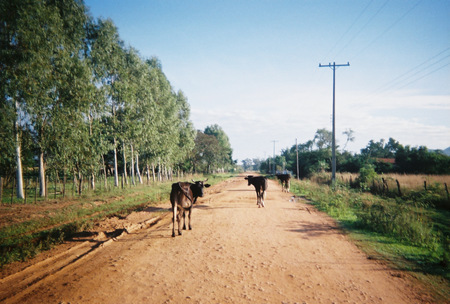
Cattle on a dirt road in Paraguay.

A dirt road or dirt track is a type of unpaved road not paved with asphalt, concrete, brick, or stone;[1] made from the native material of the land surface through which it passes, known to highway engineers as subgrade material.[citation needed]

Terminology

[edit]

Similar terms

[edit]

Terms similar to dirt road are dry-weather road, earth road, or the "Class Four Highway" designation used in China. A track, dirt track, or earth track would normally be similar but less suitable for larger vehicles—the distinction is not well-defined. Laterite and murram roads, depending on material used, may be dirt roads or improved roads.[citation needed]

Improved road

[edit]

Unpaved roads with a harder surface made by the addition of material such as gravel and aggregate (stones), might be referred to as dirt roads in common usage but are distinguished as improved roads by highway engineers. Improved unpaved roads include gravel roads and macadamized roads.[citation needed]

Characteristics

[edit]

Compared to a gravel road, a dirt road is not usually graded regularly to produce an enhanced camber to encourage rainwater to drain off the road, and drainage ditches at the sides may be absent. They are unlikely to have embankments through low-lying areas. This leads to greater waterlogging and erosion, and after heavy rain the road may be impassable even to off-road vehicles. For this reason, in some countries, such as Australia and New Zealand and Finland, they are known as dry-weather roads.[citation needed]

A dirt road in Kärsämäki, Finland

Dirt roads take on different characteristics according to the soils and geology where they pass, and may be sandy, stony, rocky or have a bare earth surface, which could be extremely muddy and slippery when wet, and baked hard when dry. They are likely to become impassable after rain. They are common in rural areas of many countries, often very narrow and infrequently used, and are also found in metropolitan areas of many developing countries, where they may also be used as major highways and have considerable width.[citation needed]

Dirt roads almost always form a washboard-like surface with ridges. The reason for this is that dirt roads have tiny irregularities; a wheel hitting a bump pushes it forward, making it bigger, while a wheel pushing over a bump pushes dirt into the next bump. However, the surface can remain flat for velocities less than 5 mph (8 km/h).[2]

Driving on dirt roads

[edit]

While most gravel roads are all-weather roads and can be used by ordinary cars, dirt roads may only be passable by trucks or four-wheel drive vehicles, especially in wet weather, or on rocky or very sandy sections. It is as easy to become bogged in sand as it is in mud; a high clearance under the vehicle may be required for rocky sections.[citation needed]

Driving on dirt roads requires great attention to variations in the surface and it is easier to lose control than on a gravel road.[citation needed]

[edit]

References

[edit]

See also

[edit]
Revisions and contributorsEdit on WikipediaRead on Wikipedia
from Grokipedia
A dirt road, also known as an , is an unpaved roadway constructed primarily from the native or material of the land surface through which it passes, distinguishing it from gravel roads that incorporate added aggregate layers. These roads typically lack any sealed or hardened surface, relying on the natural for traction and support, and are most common in rural, low-traffic areas where cost-effective access is prioritized over durability. Historically, dirt roads dominated transportation networks, comprising approximately 90% of the roughly 2 million miles of roads in the United States in , before widespread paving efforts began in the early . Globally, approximately 80-85% of roads are unsurfaced or lightly surfaced low-volume routes, particularly in developing regions where unpaved networks facilitate local connectivity but face challenges from limited investment. As of 2020, unpaved roads—including dirt roads—in the United States account for about 1.2 million miles, representing approximately 30% of the total public road mileage and serving essential roles in rural and agricultural communities. Dirt roads offer advantages such as lower initial construction and maintenance costs compared to paved alternatives. Their permeable surfaces can reduce runoff compared to paved roads and support natural . However, they are susceptible to , including , dust generation, and pollution during rainfall, which can impair and road passability. Maintenance practices, such as grading and crowning with tools like the split-log drag, are crucial to mitigate ruts, mud, and washouts, ensuring safe travel for vehicles, pedestrians, and in these often scenic, low-impact corridors.

Definition and Terminology

Core Definition

A dirt road is an unpaved road constructed primarily from native or other natural earth materials, without a sealed or bound surface such as , or stone, and without added aggregates such as . This distinguishes it from paved roads, which feature durable, engineered surfacing to withstand higher traffic and weather exposure, as well as from gravel roads that incorporate added aggregate layers. Dirt roads are typically found in rural or remote areas where traffic volumes are low, often serving agricultural, residential, or recreational purposes rather than high-capacity . Key attributes of dirt roads include a standard width of approximately 5.5 to 7.3 (18 to 24 feet) for low-volume rural applications, allowing passage for light vehicles like passenger cars and small trucks but with limited load-bearing capacity suited primarily to such . Their supports average daily volumes of 400 vehicles or fewer, with subgrades often requiring to prevent rutting under even moderate loads from heavier equipment. Legal and regulatory definitions of dirt roads vary by jurisdiction, but , they are commonly classified as "unimproved" or "unpaved" surfaces under federal and local standards, encompassing roadways using natural earth materials maintained only for basic passability. For instance, rural roads falling into this category are regulated by state or guidelines that prioritize minimal for low-traffic routes. The term "dirt road" originated in early 19th-century , with attestations dating to 1835 referring to simple, earth-packed paths in or rural settings. By the , it had become a standard descriptor for unpaved routes, as evidenced in . Dirt roads are commonly referred to by several synonyms in and common usage, reflecting variations in surface composition and regional preferences. " road" denotes an unpaved route formed mainly from native without added aggregates, emphasizing the natural earthen as the primary surfacing element. In , the term "unmetalled road" is frequently used to describe such unpaved surfaces, derived from the historical practice of "metalling" roads with or other binders; an unmetalled road lacks this binding layer and relies on compacted earth. While these terms overlap, dirt roads must be distinguished from broader or narrower categories in road engineering terminology, as well as from roads, which involve added aggregate for surfacing and are considered a distinct type of unpaved road. An "unsealed road" encompasses a wider range of unpaved surfaces, including both dirt roads and those surfaced with or other aggregates, as it simply refers to any route without a bituminous or seal to prevent penetration. In contrast, a "track" or "" represents a narrower, often informal path designed primarily for non-vehicular or light off-road use, such as , biking, or animal passage, lacking the width and grading typical of vehicular dirt roads. Regional variations in terminology highlight adaptations to local materials and climates. In tropical regions of , , and , "laterite road" specifically refers to dirt roads constructed using lateritic soils—iron- and aluminum-rich residual soils formed through intense —which provide natural cohesion and when compacted, making them suitable for low-volume in humid environments. These roads leverage the soil's high plasticity and strength after drying, as documented in tropical practices. Engineering standards further differentiate between improved and unimproved dirt roads based on and features. An improved dirt road incorporates stabilization measures such as regular grading to create a crowned profile for drainage, installation of culverts or ditches to manage water flow, and occasional application of chemical stabilizers to enhance load-bearing capacity and reduce , aligning with best practices for rural unpaved . Unimproved dirt roads, by comparison, lack these enhancements and consist of minimally cleared or naturally formed earth surfaces with little to no engineered intervention, resulting in higher susceptibility to rutting and .

Historical Development

Ancient and Pre-Modern Roads

The earliest indications of dirt roads appear in ancient around 3500 BCE, where the invention of the for transportation led to the formation of rudimentary paths worn by wheeled vehicles such as carts pulled by oxen or onagers. These paths, often no more than compacted earth tracks, facilitated the movement of goods and people across the flat alluvial plains of the and rivers, marking the beginnings of organized overland travel in the . In the , dirt roads known as viae terrenae served as secondary routes complementing the more famous paved viae publicae, consisting of simple leveled earth surfaces worn by foot traffic, animals, and occasional wheeled carriages. These unpaved tracks were common in rural or less-trafficked areas, relying on natural and minimal grading rather than engineered foundations, and they extended the empire's connectivity beyond major highways. During the medieval period in , dirt roads formed the backbone of local and regional transportation networks, typically maintained through communal labor and serving as the primary means of travel for peasants, merchants, and pilgrims across varied terrains. In the colonial , similar unpaved routes predominated, with settlers adapting to challenging landscapes by constructing corduroy roads—temporary structures made by laying logs perpendicular across muddy or swampy ground to prevent wagons and livestock from sinking. These log-based paths, common in 17th- and 18th-century and the mid-Atlantic colonies, exemplified rudimentary to bridge wetlands and forests. Pre-19th century dirt roads were constrained by their dependence on manual labor for construction and upkeep, often involving local farmers or convicts using basic tools like shovels and drags to level surfaces and clear vegetation. Seasonal challenges exacerbated these issues, particularly in temperate and humid climates where heavy rains transformed paths into deep quagmires, rendering them nearly impassable for weeks and necessitating detours or delays in travel and trade. Such conditions frequently led to ruts deepening over time, further complicating maintenance without mechanical aids. Dirt roads held profound cultural importance as vital segments of ancient trade networks, including the unpaved portions of the , where well-trodden earth paths across Central Asia's deserts and steppes enabled the exchange of , spices, and ideas between East and West for over a millennium. These routes, lacking formal paving, fostered intercultural connections by accommodating caravans of camels and horses through diverse and often harsh environments.

19th and 20th Century Evolution

In the early 19th century, Scottish engineer introduced the process in Britain, layering crushed stone over a compacted and graded to create more stable and drainage-resistant roads that reduced mud and erosion compared to traditional dirt paths. This innovation, implemented widely from the 1810s onward under turnpike trusts, elevated dirt roads from rudimentary tracks to engineered surfaces capable of supporting heavier traffic, influencing road standards across and beyond. In the United States, westward expansion fueled by the Homestead Act of 1862— which granted 160-acre plots to settlers, spurring agricultural development and rural connectivity—led to the proliferation of basic dirt roads to link homesteads, towns, and markets. By around 1900, the U.S. had amassed over 2 million miles of primarily unpaved earth roads, reflecting the scale of this settlement-driven infrastructure growth amid limited federal oversight. The rise of automobiles in the early 20th century exposed the inadequacies of dirt roads, which became impassable in wet conditions and dusty in dry ones, prompting the Good Roads Movement and federal intervention through the Federal Aid Road Act of 1916. This legislation allocated $75 million over five years for states to improve rural post roads, prioritizing the grading, draining, and surfacing of dirt routes to accommodate motor vehicles while matching local funds. Globally, colonial administrations in Africa and Asia built extensive dirt road networks from the late 19th century to extract resources like minerals and crops, connecting inland areas to ports with minimal investment in durability; for instance, British and French efforts in sub-Saharan Africa created thousands of miles of graded tracks for administrative and economic control. These systems, often no more than cleared paths with basic drainage, facilitated trade but prioritized colonial needs over local sustainability. The Dust Bowl era of the 1930s in the U.S. Great Plains starkly revealed the erosion vulnerabilities of dirt roads, where prolonged drought and windstorms stripped topsoil from unpaved surfaces, creating impassable ruts and contributing to widespread dust clouds that buried routes and farms alike. This catastrophe, affecting over 100 million acres and displacing thousands, underscored how dirt roads amplified soil loss through poor stabilization, prompting early conservation efforts like contour plowing alongside road grading. Post-World War II, urban areas in industrialized nations saw a rapid decline in dirt roads due to paving booms; in the U.S., federal investments under the Interstate Highway Act of 1956 accelerated the conversion of thousands of miles to asphalt and concrete, reducing urban dirt routes from predominant to negligible by the 1960s. In developing regions of Africa and Asia, post-colonial governments inherited these colonial dirt networks, where economic constraints allowed many to persist into the late 20th century as primary rural arteries despite gradual upgrades in select areas. By the 1950s, industrialized countries shifted decisively to all-weather roads, with Europe's motorway expansions and U.S. interstates emphasizing sealed surfaces for year-round reliability and higher speeds.

Construction and Design

Materials and Building Techniques

Dirt roads are primarily constructed using native as the foundational material, which typically consists of a mix of clay, , and depending on local . These soils provide the and surface layer, with clay-rich soils offering cohesion for stability while sandy loams ensure better drainage. In cases where native soil lacks sufficient strength or is prone to , additives such as lime or are incorporated for stabilization; lime reacts with clay particles to reduce plasticity and increase , while cement forms a cementitious bond for enhanced durability. The construction process begins with site clearing, where vegetation, topsoil, and debris are removed to expose a stable , often scarified to a depth of 6 to 12 inches (150 to 300 mm) to eliminate organics and prepare for compaction. Grading follows, using scrapers or bulldozers to the roadbed to the desired alignment and width, incorporating a camber or crown with a cross-slope of 2 to 5% to facilitate drainage and prevent water pooling. Compaction is then applied with rollers, such as vibratory or pneumatic types, to achieve the required —typically 95% of maximum dry density per AASHTO standards—ensuring the subgrade can support traffic loads. The drivable surface consists of the compacted native , which may require periodic grading to maintain and stability. Historically, dirt road construction relied on traditional hand labor techniques, employing picks, shovels, and animal-drawn scrapers to clear and grade paths, a method prevalent through the 19th century. Mechanized techniques emerged in the 1920s with the widespread adoption of bulldozers, motor graders, and early earthmoving equipment, significantly increasing efficiency and allowing for more precise shaping and compaction. Standards for dirt road construction, particularly for rural unpaved roads, are guided by organizations like the American Association of State Highway and Transportation Officials (AASHTO), which recommend subgrade preparation to a minimum depth of 6 inches (150 mm) with proper compaction and drainage features to ensure longevity under low-volume traffic. These guidelines emphasize soil testing for classification (e.g., AASHTO A-4 to A-7 soils suitable for lime stabilization) and integration of stabilization where native materials fall short.

Geometric and Structural Features

Dirt roads typically follow the natural contours of the to minimize costs and environmental disruption, resulting in alignments that are often curved rather than straight, with horizontal curves designed to blend into the . Vertical alignment is similarly adaptive, incorporating gradual grades that avoid steep inclines where possible, though sight distances may be limited due to or . Superelevation on curves is uncommon on dirt roads due to maintenance challenges from material displacement, but when applied, it involves raising the outer edge of the road surface up to a maximum cross-slope of 4-6% to provide lateral stability for vehicles, transitioning from the normal without exceeding the overall slope limits to prevent . The cross-section of a dirt road is engineered primarily for effective water runoff and stability, commonly featuring a crowned profile with a straight "A" shape that slopes downward from the center at 4-6% (approximately 1/2 to 3/4 inch per foot) to direct surface toward the edges. Alternatively, a V-shaped cross-section may be used in flatter terrains or for temporary roads, where the entire surface funnels to a central low point before diversion to side ditches, though this design requires careful management to avoid ponding. Typical widths for two-way traffic range from 4 to 7 meters (13 to 23 feet), accommodating vehicles while allowing for shoulders that slope at 3-5% to enhance drainage and provide recovery space; narrower widths of 3-4 meters are sometimes seen on low-volume rural access roads. Structurally, dirt roads lack a binder course found in paved surfaces, relying instead on a sub-base layer of compacted native earth to distribute loads and provide foundational support. This sub-base is typically 150-300 mm (6-12 inches) thick, compacted to achieve adequate density based on strength and expected traffic loads, with geotextiles sometimes incorporated over weak s to prevent and improve stability. The surface is the compacted native , which relies on its inherent cohesion and regular for durability. Drainage adaptations are integral to maintaining structural integrity, with roadside ditches typically 0.5-1 meter deep and sloped at 1-2% to convey away from the road prism, often armored with on erodible soils to control velocities. Culverts, usually corrugated metal or pipes of 300-600 mm , are installed at intervals of 30-120 meters depending on road grade and to cross-drain under the roadway, angled slightly to match ditch flow. In low-traffic areas, bridges are minimized in favor of fords—shallow crossings armored with or stone to allow natural passage—reducing costs while preserving environmental flow, though they require periodic removal to prevent scour.

Physical and Environmental Characteristics

Surface Properties

Dirt roads exhibit varied surface compositions primarily determined by local types, which influence their inherent stability and handling characteristics. Sandy compositions result in loose, dusty surfaces that shift easily under load due to low cohesion among particles, leading to frequent displacement and reduced structural integrity. Clayey compositions, in contrast, feature fine particles that bind tightly, creating a compact but potentially unstable surface as they become sticky and pliable when saturated, though this section focuses on inherent traits independent of moisture. Gravel-mixed compositions incorporate coarser aggregates with soil fines, providing greater overall stability through improved interlocking and load-spreading capabilities compared to pure or clay surfaces. The texture of dirt road surfaces is typically rough and uneven, characterized by natural undulations and progressive formation of from repeated , which deepen over time and alter the surface profile. Traction on these surfaces stems from the frictional interaction between tires and the soil-aggregate matrix, with a coefficient of friction generally ranging from 0.4 to 0.6 under dry conditions, reflecting moderate grip from particle interlocking and . This value can drop significantly to around 0.2 when wet, as the surface transitions to a more slippery state due to reduced , though inherent dry traction provides a baseline for control. Load distribution on dirt roads depends on the soil's inherent , which varies from 50 to 200 kPa across different compositions, with sandy s at the lower end due to poor compaction and clayey or gravel-mixed at the higher end from better particle binding. These surfaces are particularly prone to rutting under heavy loads, such as those from trucks, where pressures cause localized deformation forming tracks typically 5-10 cm deep after repeated passes, as the yields without sufficient . Dust generation arises from the fine particles in dirt road surfaces, which become airborne under traffic, especially on dry days when loose materials like or are dislodged, producing PM10 levels that can reach up to 100 µg/m³ near the road, impacting through suspended particulates. This inherent propensity for fine particle release is more pronounced in sandy compositions lacking cohesive fines.

Interaction with Weather and Terrain

Dirt roads, characterized by their loose, uncompacted surfaces, interact dynamically with conditions, often leading to significant alterations in usability and stability. During rainfall, water infiltration into the creates , rendering the surface slippery and reducing traction for , which can increase the of skidding or becoming stuck. This formation is exacerbated by heavy or prolonged , as seen in rural areas where even moderate turns dirt paths into hazardous quagmires. Additionally, induces on dirt roads, with rates varying by and intensity but commonly reaching 10-22 tons per per year in unsealed surfaces, contributing to sediment loss and road degradation. In dry conditions, the absence of moisture causes the soil to harden and crack, forming fissures that weaken the structural integrity and allow for deeper penetration of future water. These cracks can propagate under traffic or thermal expansion, further destabilizing the roadbed. Concurrently, dry weather promotes dust generation, where vehicle traffic lifts fine particles into the air, potentially contributing to dust storms in arid or windy regions, as unpaved roads serve as major sources of fugitive dust emissions. Such dust can reduce visibility and affect air quality along these routes. Terrain plays a critical role in how dirt roads respond to environmental forces, with adaptations often necessary for viability. In hilly areas, the combination of steep slopes and loose makes dirt roads particularly prone to landslides, where gravitational forces and saturated conditions from can trigger mass movement of , blocking or destroying sections of the route. Conversely, in flat wetlands with low-bearing, waterlogged , dirt roads require reinforcements such as constructions—layers of logs placed to the travel direction—to distribute weight and prevent sinking or rutting. These adaptations help maintain passage through otherwise impassable soft . Seasonal variations amplify these interactions, often rendering dirt roads temporarily unusable. In monsoon-prone regions like parts of , intense seasonal rains transform dirt tracks into deep mud, making them impassable for weeks and isolating communities. In contrast, winter freezing in colder climates enhances road stability; frozen increases by up to 50% or more compared to unfrozen states, allowing heavier loads without excessive deformation. This temporary strengthening occurs as ice binds particles, improving overall support. Climate-specific challenges further define dirt road performance in extreme environments. In tropical areas, laterization processes affect lateritic soils common to these roads; during wet seasons, the soil remains soft and workable, but it hardens significantly in the due to iron oxide accumulation, forming a durable, cement-like crust that resists wear. In arid regions, persistent winds erode the surface, removing 1-2 cm of material annually through abrasion and particle transport, which diminishes road thickness and elevates maintenance needs over time.

Usage and Operation

Driving Techniques

Driving on dirt roads requires adjusted techniques to account for reduced traction and variable surfaces compared to paved roads. These methods emphasize control and predictability to minimize risks like skidding or loss of response. Speed is crucial, with recommended limits of 20-40 km/h to maintain control, especially on loose or uneven where higher speeds can lead to hydroplaning-like effects or washboard vibrations. On hills, drivers should build and preserve by accelerating steadily in low gears before inclines, avoiding the need for excessive that could cause wheel spin. Steering and braking inputs must be gentle and progressive to prevent skids, as abrupt movements can displace loose material and cause the vehicle to fishtail. For braking, apply pressure smoothly and allow extra stopping distance—often double that on pavement—while using engine braking in low gears on descents. Engaging four-wheel drive (4WD) in low range enhances traction on slippery or steep sections, particularly when surface properties reduce grip from mud or sand. Vehicle preparation includes checking tire pressure and reducing it slightly below highway levels for improved contact with uneven dirt surfaces, along with ensuring proper inflation for the load to avoid pinch flats. Avoid sudden acceleration to prevent digging into soft soil, and select low gears from the start for better torque distribution. In special scenarios like , stay within established ruts to maintain traction and avoid getting stuck, using steady to keep without spinning wheels. For dusty conditions, activate low-beam headlights for better and maintain at least 100 meters between vehicles to allow clouds to settle, reducing the of rear-end collisions.

Maintenance Practices

Maintenance of dirt roads involves regular interventions to preserve surface integrity and functionality, primarily through grading and repairs that address from and environmental factors. Routine tasks include grading the road surface every 1-3 months, depending on volume and conditions, to smooth out and irregularities using motor graders operated at low speeds of 3-5 mph. This process redistributes existing material across the surface, helping to maintain a uniform profile without requiring new aggregates. Potholes are typically filled with local or , compacted during the grading operation to prevent further degradation. Drainage maintenance is essential to mitigate water accumulation, which exacerbates on dirt roads. This entails seasonally clearing ditches and culverts—often in spring and autumn or after storms—to remove debris and ensure unobstructed flow, using tools like excavators or graders. Following erosion events, the road's —a slight in the center with a 4-6% cross-slope or about ½-¾ inch fall per foot—is reapplied during grading to direct water off the surface. Cost-effective methods vary by location and road usage. In rural areas, community labor is commonly employed for basic tasks like ditch clearing and minor reshaping, leveraging local resources to minimize expenses. For higher-traffic roads, mechanized equipment such as motor graders is preferred to handle more frequent and intensive maintenance. Annual costs for these practices typically range from $500 to $2,000 per kilometer, influenced by factors like material availability and traffic levels. Ongoing monitoring ensures timely interventions. Visual inspections are conducted regularly to identify washouts, ruts, or drainage blockages, often following or at set intervals. Simple tools, such as levels, are used to verify the camber or , confirming it meets design standards for effective water shedding.

Advantages, Disadvantages, and Impacts

Operational Benefits and Challenges

Dirt roads offer several operational benefits, particularly in terms of cost and adaptability. Their initial construction costs are substantially lower than those of paved roads, typically ranging from 10-20% of the expense for asphalt or concrete equivalents, making them feasible for resource-limited areas. Additionally, repairs can be performed easily by local communities using basic tools and materials, such as grading or adding gravel, without requiring specialized equipment or contractors. Historically, these roads were essential for agricultural access, with nearly all U.S. farms located on dirt or unimproved roads in 1900, facilitating connectivity to markets before widespread paving in the mid-20th century. Despite these advantages, dirt roads present significant operational challenges related to vehicle durability and safety. They accelerate vehicle wear, with tires experiencing accelerated wear due to abrasion from loose and uneven . All-weather accessibility is limited, as heavy rain can render them impassable during wet seasons in certain climates, leading to isolation during storms and requiring alternative driving techniques like reduced speeds to navigate or ruts. Accident rates are approximately 1.5 times higher on unpaved roads compared to paved ones, primarily due to factors like poor , skidding, and obstacles. In terms of accessibility, dirt roads remain vital for remote communities, providing the primary where paving is uneconomical, such as in rural agricultural or indigenous areas like the . However, they pose barriers for emergency services; ambulances and other vehicles can face delays on rough or muddy sections, exacerbating response times in isolated locations. In modern contexts, approximately 80% of global roads remain unpaved, particularly in developing regions, according to recent studies as of 2024, though this proportion is declining in developed nations as investments prioritize paving for improved reliability.

Environmental and Economic Effects

Dirt roads significantly contribute to through , which can lead to substantial in nearby waterways. Unpaved surfaces are highly susceptible to from rainfall and traffic, with studies indicating that roads can account for up to 35% of in affected watersheds, and in some forested or steep terrains, contributions reaching 38-55% of river loads. This not only alters aquatic ecosystems by increasing and smothering habitats but also exacerbates downstream flooding and imbalances. Additionally, dirt roads fragment habitats, particularly in forested areas, by creating barriers that disrupt and , with road networks often destroying up to 10-20% of contiguous in rural landscapes. generated from these roads further impairs air quality, carrying fine particulates that can travel kilometers and pose respiratory risks to nearby communities, while also settling on and reducing . is increasing risks on dirt roads through more intense rainfall events as of 2025. Economically, dirt roads offer initial construction savings compared to paved alternatives, with costs typically ranging from approximately $50,000 to $150,000 per kilometer for dirt or roads versus $300,000 to $600,000 per kilometer for rural asphalt paving, making them viable for low- rural areas in resource-limited settings. However, long-term maintenance expenses can be higher for unpaved roads due to frequent grading, dust suppression, and repairs, though lifecycle costs depend on traffic volume. In developing countries, reliance on such networks perpetuates cycles, where poor road conditions hinder , healthcare delivery, and ; unpaved roads comprise over 90% of networks in many low-income nations, affecting an estimated 1 billion people globally by limiting economic opportunities and increasing transport costs. Sustainability efforts for dirt roads include eco-friendly upgrades such as permeable surfaces, which integrate stabilization or porous grids to enhance infiltration and reduce runoff by up to 80%, thereby mitigating while supporting . In terms of , dirt road construction emits far less CO2 than paved options—primarily due to avoiding energy-intensive asphalt or production, which accounts for 70% of paved road emissions—but ongoing and inefficiency on rough surfaces can elevate operational particulate and fuel-related emissions over time. Policy responses often involve international aid for transitioning dirt roads to paved , as seen in China's , which since 2013 has funded over 10,000 kilometers of road upgrades in partner countries like those in and , boosting trade volumes by 20-30% in connected regions while addressing environmental concerns through greener standards. These conversions aim to break poverty traps by improving connectivity, though they require balancing economic gains against potential habitat losses.

References

Add your contribution
Related Hubs
User Avatar
No comments yet.