Hubbry Logo
Committees of correspondenceCommittees of correspondenceMain
Open search
Committees of correspondence
Community hub
Committees of correspondence
logo
8 pages, 0 posts
0 subscribers
Be the first to start a discussion here.
Committees of correspondence
from Wikipedia
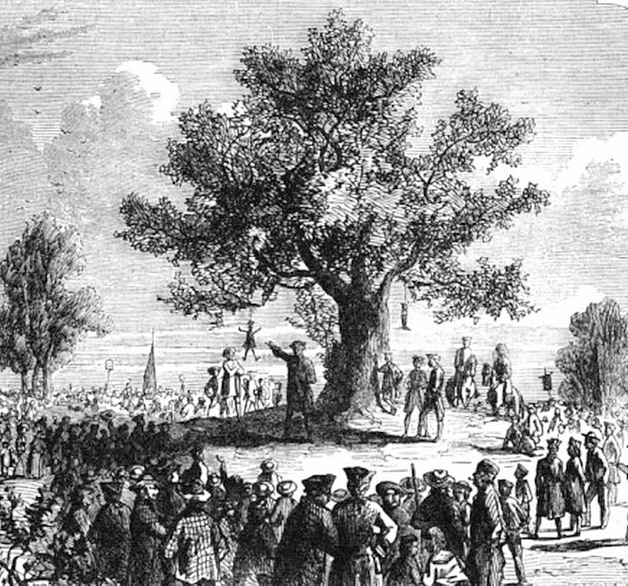
The Boston Committee of Correspondence, which usually gathered at the Liberty Tree in Boston Common

The committees of correspondence were a collection of American political organizations that sought to coordinate opposition to British Parliament and, later, support for American independence during the American Revolution. The brainchild of Samuel Adams, a Patriot from Boston, the committees sought to establish, through the writing of letters, an underground network of communication among Patriot leaders in the Thirteen Colonies. The committees were instrumental in setting up the First Continental Congress, which convened in Philadelphia in September and October 1774.

Function

[edit]

The function of the committees was to alert the residents of a given colony of the actions taken by the British Crown, and to disseminate information from cities to the countryside. The news was typically spread via hand-written letters or printed pamphlets, which would be carried by couriers on horseback or aboard ships. The committees were responsible for ensuring that this news accurately reflected the views of Patriots, and was dispatched to the proper receiving groups. Many correspondents were members of colonial legislative assemblies, and others were also active in the Sons of Liberty and Stamp Act Congress.[1]

A total of about 7,000 to 8,000 Patriots served on these committees at the colonial and local levels, comprising most of the leadership in their communities; Loyalists were naturally excluded. The committees became the leaders of the American resistance to Great Britain, and largely directed the Revolutionary War effort at the state and local level.

The committees promoted patriotism and home manufacturing, advising Americans to avoid luxuries, and lead a more simple life. The committees gradually extended their power over many aspects of American public life. In late 1774 and early 1775, they supervised the elections of provincial conventions, which began the operation of a true colonial government.[2]

History

[edit]

The first committees of correspondence were established in Boston in 1764 to rally opposition to the Currency Act and unpopular reforms imposed on the customs service.[3]

During the Stamp Act crisis the following year, the Province of New York formed a committee to urge common resistance among its neighbors to the new taxes. The Province of Massachusetts Bay's correspondents responded by urging other colonies to send delegates to the Stamp Act Congress that fall. The resulting committees disbanded after the crisis was over.

After the Boston Massacre skirmish on March 5, 1770, pro-revolutionary Patriot leaders in Boston ― Loyal Nine ― substantiated an increasingly hostile dilemma in the British redcoats stern occupancy sanctioned by the Georgian royal crown. The Massachusetts colonists established the first long-standing committee with the approval of a town meeting in October of 1772. By spring 1773, Patriots decided to follow the Massachusetts system and began to set up their own committees in each colony. The Colony of Virginia appointed an eleven-member committee in March, quickly followed by the colonies of Rhode Island, Connecticut, the Province of New Hampshire, and the Province of South Carolina. By February 1774, 11 colonies had set up their own committees; of the thirteen colonies that eventually rebelled, only the provinces of North Carolina and Pennsylvania did not.

Delaware

[edit]

In Delaware Colony, a committee of correspondence was established by Thomas McKean after ten years of agitation centered in New Castle County. In neighboring Kent County, Caesar Rodney set up a second committee, followed by Sussex County. Following the recommendation of the First Continental Congress in 1774, the committees were replaced by elected "committees of inspection" with a subcommittee of correspondence. The new committees specialized in intelligence work, especially the identification of men opposed to the Patriot cause. The committees were a driving force in popularizing the demand for independence.

The correspondence committees exchanged information with others in Boston, Philadelphia, and elsewhere. Their leadership was often drawn upon to provide Delaware with executive leaders. The committees of inspection used publicity as weapons to suppress disaffection and encourage patriotism. With imports from Britain cut off, the committees sought to make America self-sufficient, so they encouraged the cultivation of flax and the raising of sheep for wool. The committees helped organize local militia in the hundreds and later in the counties and all of Delaware. With their encouragement, the Delaware Assembly elected delegates to Continental Congress favorable to independence.[4]

Massachusetts

[edit]

In November 1772 in the Province of Massachusetts Bay, Samuel Adams, Joseph Warren, and Mercy Otis Warren formed a committee in response to the Gaspée Affair and to the recent British decision to have the salaries of the royal governor and judges be paid by the British Crown rather than the colonial assembly, a measure which effectively stripped the colony of its means of holding public officials accountable to their constituents.

In the following months, more than one hundred other committees were formed in towns and villages throughout Massachusetts. The Massachusetts committee's headquarters, based in Boston and led by Adams, became a model for other Patriot groups. The meeting establishing the committee set its purpose, outlining "the rights of the colonists, and of this province in particular, as men, as Christians, and as subjects; to communicate and publish the same to the several towns in this province and to the world as the sense of this town."[5]

Maryland

[edit]

The Province of Maryland became the eighth of the thirteen colonies to appoint a committee of correspondence on October 15, 1773.[6] The Maryland committee stated that there was an "absolute necessity of a general and firm union of sister colonies to preserve common liberties", and called for a meeting of this union to be held in Philadelphia.[7]

New Jersey

[edit]

New Jersey formed a Committee of Correspondence on February 8, 1774.[8] The New Jersey Committee of Correspondence consisted of a nine-member panel and met in New Brunswick, New Jersey on May 31, 1774 to respond to the emergency message of the Boston Committee of Correspondence regarding the Port Act.

New York

[edit]
Fraunces Tavern in Lower Manhattan, the meeting place of the Committee of Fifty on May 16, 1774

On January 20, 1774, New York formed their Committee of Correspondence.[8]

In response to the news that the Port of Boston would be closed under the Boston Port Act, an advertisement was posted at the coffee house on Wall Street in New York City, a noted place of resort for shipmasters and merchants, inviting merchants to meet on May 16, 1774, at the Fraunces Tavern "in order to consult on measures proper to be pursued on the present critical and important situation."[9] At the meeting, chaired by Isaac Low, the committee resolved to nominate a 50-member committee of correspondence to be submitted to the public. On May 17, 1774, they published a notice calling on the public to meet at the coffee house on May 19 at 1 p.m. to approve the committee and appoint others as they may see fit.[10] At the meeting on May 19, Francis Lewis was also nominated and the entire Committee of Fifty-one was confirmed.[11]

On May 23, 1774, the committee met at the coffee house and appointed Isaac Low as permanent chairman and John Alsop as deputy chairman.[12] The committee then formed a subcommittee, which produced a letter in response to the letters from Boston, calling for a "Congress of Deputies from the Colonies" to be assembled, which became known as the First Continental Congress and was approved by the committee.[13]

On May 30, 1774, the Committee formed a subcommittee to write a letter to the supervisors of New York's counties to exhort them to also form similar committees of correspondence, which was adopted in a meeting of the Committee on May 31.[14]

On July 4, 1774, a resolution was approved to appoint five delegates contingent upon their confirmation by the freeholders of the City and County of New York, and to request that the other counties also send delegates.[15] Isaac Low, John Alsop, James Duane, Philip Livingston, and John Jay were then appointed, and the public of the City and County was invited to attend City Hall and approve the appointments on July 7.[16] This caused friction with the more radical Sons of Liberty, known as the Committee of Mechanics faction, who held a meeting in the fields on July 6.[17] Three counties, Westchester, Duchess, and Albany acquiesced to the five delegates, while three counties, Kings, Suffolk, and Orange, sent delegates of their own.[18]

North Carolina

[edit]

By 1773, the political situation had deteriorated. There was concern about the courts. Massachusetts' young and ardent Boston patriot, Josiah Quincy Jr.,[19] visited North Carolina for five days. He spent the night of March 26, 1773, at Cornelius Harnett's home near Wilmington, North Carolina. The two discussed and drew up plans for a Committee of Correspondence. The committee's purpose: communicate circumstances and revolutionary sentiment among the colonies. It was after this meeting that Quincy dubbed Harnett the "Samuel Adams of North Carolina."[20][21]

In December 1773, the North Carolina Committee of Correspondence formed in Wilmington. Although Harnett was absent, he was made chairman of the committee. Other members included John Harvey, Robert Howe, Richard Caswell, Edward Vail, John Ashe, Joseph Hewes, Samuel Johnston, and William Hooper.[22][23]

Pennsylvania

[edit]

Pennsylvania Assembly deliberated the purposes of the colony committee of correspondence in 1764 to 1765. The Royal Crown endowing progressive parliamentary taxation decrees with the thirteen coloniesNo taxation without representation — prompt the Pennsylvania Assembly to convene a disclosure committee. The committee was voted upon appointing Joseph Galloway, Giles Knight, Thomas Livezey, Isaac Pearson, and Joseph Richardson as a joint colonial agent conveying the internal proceedings of British America. The correspondence committee was officially agreed upon by the Pennsylvania Assembly on October 16, 1765.[24]

In December 1773, the Boston colonists orchestrated an act of political dissent at Boston's Dock Square specifically as the establishment of the Green Dragon Tavern frequented by proclaimed prerevolutionary Patriots.[25][26]

Where we met for consignment of tea

The Boston Caucus developed a pungence of the duties pressed by the Parliament of Great Britain with regards to British imports or merchant trade. The obscure conspirators commandeering the maritime property of East India Company who perceived by Isaac Barré termed the assailants as Sons of Liberty valiantly substantiating Parliamentary opposition as consequential declaration at Boston Harbor in December of 1773. The Tea Act of 1773 coerced the Boston Harbor insurrection reciprocating the Parliament of Great Britain to impose authoritarian hardship reforms through British absolutism endured by the Massachusetts colonists.[27] The autocracy proceedings surmised as grievances and retaliatory resolutions emerged as the Intolerable Acts often referred to as the Coercive Acts or Punitive Acts.

The Able Doctor

On May 20, 1774, the Province of Pennsylvania convened a multicolonial meeting at City Tavern in Philadelphia to deliberate the taxation proceedings of the Parliament of Great Britain. The Boston Harbor closure sanctioned by the Boston Port Act of 1774 was densely fathomed by the British America colonists at the prerevolutionary tête-à-tête.[28]

In May 1774, Paul Revere delivered a circular letter — Massachusetts Circular Letter — from the Boston Committee of Correspondence petitioning the boycott of maritime imports from Great Britain.[29] The Boston Committee of Correspondence letter arrived prior to the May 20, 1774 colonial meeting in Philadelphia, Pennsylvania with an attendance of two hundred British America colonists.

Among the last to form a committee of correspondence, the Province of Pennsylvania did so at the meeting in Philadelphia on May 20, 1774. In a compromise between the more radical and more conservative factions of political activists, the committee was formed by combining the lists each faction proposed. That committee of 19 diversified and grew to 43, then to 66, and finally to two different groups of 100 between May 1774 and its dissolution in September 1776. Ultimately, 160 men from Pennsylvania participated in one or more of the committees, though only four were regularly elected to all of them: Thomas Barclay, John Cox Jr., John Dickinson, and Joseph Reed.[30]

South Carolina

[edit]

In the seventeenth century, South Carolina colony was granted Carolina Charter of 1663 vested by King Charles II on March 24, 1663.[31] The royal charter established the Southern Colonies territory as a proprietary colony governed by a lord proprietor who served primarily with distinction as a royalist.[32]

By 1717, the Carolina Charter Colonists acquired a dissatisfaction with the absolute lords and proprietors governing the colonial province bidding the General Assembly to enact the Carolina Charter Conscription Act of 1717.[33] In the early eighteenth century, the South Carolina colonists contrived a militia resolution to abolish the proprietary rule beseeching a crown colony for an ordained rule of governance.[34] The southern province insurrection incited by Arthur Middleton subsequently became known as the Revolution of 1719 in the colony of South Carolina.[35]

In 1721, the southern colony General Assembly enacted an ordinance endorsed by James Moore Jr. to establish a Committee of Correspondence. The disclosure committee would cultivate an acquaintance with the thirteen colonies and the Carolina's civil and provincial dilemmas. The ordinance declaration would necessitate a printing press for the dissemination of pamphlets as authorized by Francis Nicholson on September 21, 1721.[36] During the American Revolution, the Carolina correspondence committee served as the principal authorship for information exchange throughout the English colonies and province of South Carolina.[37][38]

In 1732, Thomas Whitmarsh published the first issue of the South Carolina Gazette on January 8, 1732.[39][40] The Carolina Gazette publication satisfactorily commemorated the civil responsibilities and enlightenment regarding colonial governance and constitutional information during the Georgian era.

Virginia

[edit]

In early March 1773, Dabney Carr proposed the formation of a permanent Committee of Correspondence before the Virginia House of Burgesses. Virginia's own committee was formed on March 12, 1773. Its members were Peyton Randolph, Robert Carter Nicholas, Richard Bland, Richard Henry Lee, Benjamin Harrison, Edmund Pendleton, Patrick Henry, Dudley Digges, Dabney Carr, Archibald Cary, and Thomas Jefferson.[41]

Other colonies

[edit]

By July 1773, Rhode Island, Connecticut, and New Hampshire had also formed committees.

With Pennsylvania's action in May 1774, all of the colonies that eventually rebelled had established such committees.[42]

The colonial committees successfully organized common resistance to the Tea Act and even recruited physicians who would write that drinking tea would make Americans "weak, effeminate, and valetudinarian for life."

These permanent committees performed the important planning necessary for the First Continental Congress, which convened in September 1774. The Second Congress created its own committee of correspondence to communicate the American interpretation of events to foreign nations.

These committees were replaced during the revolution with Provincial Congresses.

By 1780, committees of correspondence had also been formed in Great Britain and Ireland.[43]

See also

[edit]

Footnotes

[edit]

References

[edit]

Historical documents archive

[edit]

Further reading

[edit]
[edit]
Revisions and contributorsEdit on WikipediaRead on Wikipedia
from Grokipedia
The Committees of Correspondence were decentralized networks of patriot organizations formed across the thirteen American colonies in the early 1770s to enable intercolonial exchange of information, coordinate political resistance to British imperial policies, and cultivate public awareness of colonial under the British constitution. The inaugural committee emerged in , , on November 2, 1772, when town selectmen appointed a 21-member body to investigate and publicize crown expenditures after Governor Thomas Hutchinson refused to disclose them, marking an initial step toward systematic colonial vigilance against perceived administrative overreach. This model proliferated rapidly: Virginia's resolved in March 1773 to establish corresponding committees at the county level for propagating resolutions and maintaining liaison with other colonies, while similar bodies arose in New York, , and by year's end, often appointed by legislatures or town meetings to disseminate circular letters outlining grievances such as the and judicial manipulations. These committees functioned as proto-revolutionary infrastructures, relaying news of events like the and Britain's Coercive Acts, enforcing non-importation agreements through local enforcement, and bridging isolated colonial assemblies into a proto-federal communication grid that preempted royal censorship. Their defining achievement lay in forging ideological cohesion among disparate regions—merchants in , planters in , and artisans in —by framing British measures as violations of traditional English liberties rather than mere fiscal disputes, thereby accelerating the shift from protest to organized rebellion. In practice, they evolved into Committees of Inspection and Safety by 1774-1775, assuming quasi-governmental powers to regulate trade, suppress , and prepare militias, which British authorities denounced as seditious conspiracies undermining lawful governance. Though lacking formal authority, their mobilization proved pivotal in convening the in 1774, as delegates arrived primed by shared correspondence to petition unified redress or, failing that, collective defiance.

Definition and Purpose

Conceptual Origins

The concept of committees of correspondence originated in the colonial tradition of inter-town communication, particularly within New England's system, where local assemblies exchanged letters to address shared grievances and coordinate responses to external threats. This practice drew from Puritan congregationalism, which emphasized autonomous communities maintaining epistolary ties for mutual support, as seen in earlier exchanges during crises like in the 1670s. By the mid-18th century, such networks evolved amid escalating tensions with Britain, providing a decentralized mechanism for disseminating information on parliamentary acts perceived as encroachments on colonial liberties. The immediate conceptual catalyst emerged in in 1772, prompted by the burning of the HMS Gaspee and Governor Thomas Hutchinson's refusal to prosecute the perpetrators, highlighting the colonies' vulnerability to unchecked royal authority. , leveraging Whig principles of republican vigilance against corruption and tyranny—rooted in thinkers like and James Harrington—proposed a standing committee to articulate colonists' rights, solicit opinions from other towns, and foster unified sentiment. This innovation transformed responses, such as the 1764 committee against the , into a proactive, ongoing structure for interlocal correspondence, emphasizing empirical assessment of British policies through shared intelligence rather than isolated protests. Broader intellectual foundations lay in the Enlightenment-era recognition that required reliable causal chains of information flow across geographically separated polities, countering the British Empire's divide-and-rule tactics. Influenced by the of 1765, which employed temporary committees for intercolonial petitions, the model prioritized factual reporting of events—like tax impositions and quartering of troops—to build consensus on violations of natural rights, without presuming centralized authority. This approach reflected a first-principles understanding that depended on vigilant, transparent communication to detect and resist creeping absolutism, predating formal revolutionary bodies and enabling the conceptual shift from passive subjects to active resistors.

Core Objectives and Mechanisms

The Committees of Correspondence were established primarily to create structured channels for intercolonial communication, enabling the rapid dissemination of information about British policies and colonial grievances, thereby fostering unity among disparate patriot groups. In , on November 2, 1772, spearheaded the formation of the first such committee through a town meeting, tasking it with stating the of colonists and the under British rule, preparing reports on parliamentary infringements, and corresponding with other towns to gauge sentiments and share updates on encroachments like the recent Gaspee affair and the Somerset case. This objective extended beyond local coordination to educating the populace on natural and alerting them to threats, as articulated in Adams's circular promoting vigilance against "the insidious designs of arbitrary power." A secondary aim was to organize collective resistance by confirming mutual assistance and debating strategies, transforming isolated protests into synchronized actions across colonies; for instance, the committees debated responses to the of 1773 and coordinated boycotts, laying groundwork for broader defiance seen in events like the . Virginia's echoed this in March 1773 by creating a standing committee of eleven members to maintain "a correspondence and communication with our sister colonies" respecting steps toward preserving liberty, directly addressing Massachusetts' model to counter British divide-and-rule tactics. These efforts prioritized empirical reporting of facts—such as troop movements or judicial decisions—over abstract theory, emphasizing causal links between imperial actions and colonial erosion. Operationally, the committees functioned through a tiered network: town-level bodies, typically 3 to 21 elected members, monitored local events, enforced non-importation agreements, and forwarded intelligence upward; county and provincial committees then aggregated this data into circular letters dispatched to counterparts in other colonies, often numbering dozens by 1774. This mechanism relied on trusted patriot networks rather than formal postal systems to evade British interception, with correspondence volumes surging post-Intolerable Acts— alone issued multiple addresses in 1774 calling for extralegal conventions. By mid-1774, over 80 towns had committees, enabling real-time coordination that evolved into the , where delegates used prior exchanges to draft unified petitions and resolutions. This decentralized yet interconnected structure proved causally effective in amplifying resistance, as fragmented colonies without it lacked the informational cohesion to sustain prolonged opposition.

Historical Context

British Policies Provoking Resistance

Following the French and Indian War, which concluded in 1763, the British Parliament enacted policies to generate revenue from the American colonies to offset war debts and fund ongoing military presence. The Stamp Act of March 22, 1765, imposed the first direct tax on the colonies, requiring stamps on legal documents, newspapers, licenses, and other printed materials, affecting colonists from lawyers to tavern owners. This provoked widespread opposition, including riots in Boston and New York, formation of the Sons of Liberty, and the Stamp Act Congress in October 1765, where nine colonies declared the act violated their rights by imposing taxation without representation. Although repealed in 1766, Parliament's accompanying Declaratory Act asserted its authority to legislate for the colonies "in all cases whatsoever," maintaining underlying tensions. The of 1767 escalated grievances by levying duties on imported goods such as glass, lead, paint, paper, and tea, while establishing a Board of Customs in and authorizing writs of assistance for searches. Colonists responded with non-importation agreements, boycotts organized by merchants, and protests that culminated in events like the on March 5, 1770, where British troops fired on a crowd, killing five. Partial repeal in 1770 retained the tea duty, signaling continued assertion of parliamentary taxing power, which fueled merchant discontent and nascent intercolonial coordination efforts. Enforcement of customs laws intensified resistance, exemplified by the on June 9, 1772, when Rhode Islanders burned the HMS Gaspee after it ran aground while pursuing suspected smugglers, prompting a that threatened colonial jury trials by allowing trials in . The of 1773, granting the a tea monopoly and undercutting colonial smugglers, led to the on December 16, 1773, where colonists dumped 342 chests of tea into . In retaliation, the (known as in the colonies), passed in 1774, closed Boston Port until compensation, altered ' charter to reduce self-governance, quartered troops in private homes, and extended the Quebec Act's boundaries, perceived as favoring Catholics and restricting western expansion. These measures, affecting approximately 10,000-15,000 Bostonians directly through economic shutdown and altering governance for over 300,000 in , galvanized unified colonial opposition.

Earlier Colonial Networks and Influences

Transatlantic legislative committees of correspondence emerged in North American and colonies as early as the 1690s, appointed by colonial assemblies to maintain communication with agents stationed in . These bodies represented colonial interests to the British government, addressing disputes with royal governors, trade regulations, and intercolonial conflicts, thereby establishing a precedent for structured intercolonial and transatlantic coordination. For instance, Virginia's committee collaborated with its London agent during 1765–1766 to advocate for the repeal of the , demonstrating their role in mobilizing against parliamentary taxation. In the , amid escalating British revenue measures, colonies increasingly adopted circular letters and committees to foster intercolonial resistance, building on earlier legislative models. Assemblies in , New York, , and circulated letters protesting the Revenue Act of 1764, the of 1765, and the of 1767, aiming to unify opposition and share intelligence on imperial policies. 's 1768 circular letter, which urged other colonies to petition against taxation without representation, provoked a reprimand from British Lord Hillsborough but galvanized colonial solidarity by highlighting shared grievances. Concurrently, local networks such as committees in major cities coordinated protests through informal correspondence and public mobilization, while merchant associations in ports like debated non-importation agreements against the Townshend duties in 1767–1770. These efforts, though often temporary and dissolving after policy repeals, exemplified early mechanisms for disseminating news and enforcing economic resistance across colonies. These pre-1772 networks directly influenced the formalized Committees of Correspondence of the revolutionary era by providing tested frameworks for and against perceived encroachments on colonial . The emphasis on correspondence with agents and circular communications underscored the value of sustained intercolonial ties, which leaders like and adapted into permanent structures in 1772–1773 to monitor British moves and prepare unified responses. Such precedents shifted from episodic protests to proactive networks, enabling colonies to counter imperial divide-and-rule tactics with coordinated resolve.

Formation Across Colonies

Initial Establishment in Massachusetts and Virginia

The first standing committee of correspondence was established in Boston, Massachusetts, on November 2, 1772, through a vote by the Boston Town Meeting, comprising 21 members led by Samuel Adams. This committee was formed in direct response to the British Parliament's decision to pay the salaries of colonial officials, including Governor Thomas Hutchinson, from crown revenues rather than colonial treasuries, thereby undermining local legislative control and prompting colonists to organize systematic communication to articulate grievances and coordinate resistance. The Boston committee drafted "The Rights of the Colonists," a document outlining natural rights, constitutional principles, and specific violations by British policies, which was distributed to foster awareness and unity within Massachusetts towns. Encouraged by the example, urged all towns in the to form their own local committees of correspondence, resulting in over 80 such bodies across the province by early 1773 to facilitate information exchange on British encroachments and local enforcement of patriot resolutions. These town-level committees marked an from ad hoc responses to structured networks, emphasizing and mutual vigilance against arbitrary authority. In Virginia, the House of Burgesses established a colony-wide Committee of Correspondence on March 12, 1773, consisting of 11 members including Peyton Randolph, Richard Henry Lee, and Patrick Henry, explicitly to monitor and respond to threats against colonial liberties such as the recent gaspee incident and ongoing parliamentary assertions of sovereignty. Unlike Massachusetts's initial focus on intra-provincial town coordination, Virginia's committee was designed from inception for intercolonial communication, promptly dispatching circular letters to assemblies in other colonies proposing the formation of standing committees to exchange intelligence on British actions and promote unified opposition. This initiative built on earlier Virginia resolutions but formalized a broader strategy, influencing subsequent adoptions in colonies like Rhode Island and Connecticut by late 1773.

Expansion to Mid-Atlantic and Southern Colonies

Following Virginia's resolution of March 12, , which urged other colonial assemblies to establish standing committees for intercolonial communication on matters affecting American liberties, several Mid-Atlantic and responded by forming their own committees of correspondence during the latter half of and early 1774. These bodies aimed to exchange intelligence on British policies, coordinate resistance, and foster unity, mirroring the models in and . In the Southern colonies, adoption was relatively swift. South Carolina's provincial assembly appointed a committee on September 10, 1773, consisting of prominent figures including , to correspond with other colonies on grievances such as taxation without representation. Georgia followed on October 15, 1773, establishing a amid growing concerns over the and naval enforcement. Maryland formed its on October 23, 1773, with members like tasked with monitoring British troop movements and relaying resolves to northern counterparts. North Carolina's assembly created one on December 18, 1773, shortly before the , emphasizing enforcement of non-importation agreements. These southern committees, numbering around 21 members each in key assemblies, facilitated the rapid dissemination of Virginia's circular letters, strengthening regional networks against perceived imperial overreach. Expansion into the Mid-Atlantic colonies occurred somewhat later, reflecting political divisions and Quaker-influenced caution in . Delaware established its committee on December 18, 1773, led by figures such as , following years of agitation in New Castle County over customs enforcement. New York appointed its committee on January 20, 1774, marking it as the eleventh colony to do so; this body, initially comprising 51 members under leaders like , focused on coordinating responses to the impending . New Jersey's assembly authorized formation on February 8, 1774, amid tea destruction incidents in Greenwich and Princeton, enabling active participation in intercolonial planning. , however, delayed until later in 1774, lacking an initial intercolonial committee in direct response to Virginia's call due to assembly hesitancy, though local committees emerged to address the . By mid-1774, these Mid-Atlantic groups had integrated into the broader network, exchanging over 100 letters annually on topics from trade boycotts to military preparations.

Involvement in Northern and Frontier Areas

In northern colonies such as , , and , committees of correspondence emerged rapidly following the ' resolution of March 12, 1773, which urged intercolonial communication on British encroachments. appointed a of nine members on May 21, 1773, to correspond with other colonies and monitor imperial policies, with local town committees in places like Farmington and forming resolutions against acts such as the . established its by July 1773, facilitating coordination on resistance measures including non-importation agreements. followed suit on May 27, 1773, with its assembly selecting a to exchange intelligence on parliamentary actions, which by 1774 included convening provincial conventions to align with southern and mid-Atlantic efforts. New York's involvement intensified in 1774 amid divided merchant and radical factions, as the Committee of Correspondence—expanded to fifty-one members on —drafted letters to affirming support for non-consumption of British goods post-Intolerable Acts, though internal debates delayed unified action until provincial congresses superseded it. These northern bodies primarily disseminated circular letters detailing grievances like the Quebec Act's perceived favoritism toward Catholics, fostering a network that by late 1774 linked over eleven colonies in preparing delegates for the . In frontier regions, particularly Pennsylvania's backcountry, committees arose later but with pronounced radicalism among Scotch-Irish settlers wary of eastern Quaker influence and British land policies. Following the of 1774, backcountry counties like Westmoreland and formed committees between June and November, enforcing boycotts and organizing musters independent of Philadelphia's more conciliatory assembly. These groups coordinated with Virginia's frontier committees in areas like , sharing reports on aftermath and threats to western expansion, which amplified calls for armed defense against perceived imperial alliances with Native Americans. By , such frontier networks had evolved into committees of , bridging rural discontent with coastal patriot leadership to sustain supply lines and intelligence during early hostilities.

Operational Structure and Activities

Local Committee Functions

Local committees of correspondence primarily served as grassroots mechanisms for collecting and circulating information on British encroachments within towns and counties, enabling rapid local responses to imperial policies. Established starting in on November 2, 1772, these bodies tasked members—often selectmen or prominent citizens—with compiling statements of colonial rights, documenting specific grievances such as the payment of governors' salaries from customs duties, and distributing circular letters to adjacent towns for consultation and endorsement. In , for instance, the committee's initial letter prompted responses from 118 towns within six months, fostering intra-colonial dialogue on threats like the of 1773. This function extended to monitoring local merchants and officials, reporting suspected violations of colonial unity to higher provincial committees. Enforcement of economic resistance formed a core local duty, particularly after adoption of non-importation pacts. Committees investigated traders importing British goods in defiance of agreements like the 1768-1770 merchant covenants or the 1774 , publicizing names of non-compliers in newspapers and gazettes to invoke community and economic pressure without formal legal . In , county-level groups post-1774 scrutinized imports and exports, seizing contraband shipments and coordinating with inspectors sympathetic to the patriot cause, thereby sustaining boycotts that reduced British trade by up to 90% in some ports by late 1774. Such actions blurred into quasi-judicial roles, as committees adjudicated disputes over compliance and urged oaths of adherence, effectively supplanting royal authority in everyday commerce. Public mobilization and opinion-shaping rounded out local operations, with committees convening town meetings to ratify resolutions, elect delegates to provincial conventions, and rally support for direct actions like the on December 16, 1773. They disseminated pamphlets and broadsides interpreting events—such as framing the Coercive Acts of 1774 as tyrannical assaults—to stoke resentment, while organizing mutual aid for affected families and coordinating drills in frontier counties. By mid-1774, over 2,000 such local entities across colonies had assumed these roles, transitioning from advisory groups to instruments of amid eroding loyalty to .

Intercolonial Correspondence and Coordination

The intercolonial committees of correspondence emerged as a vital network for exchanging intelligence and aligning colonial responses to British encroachments, beginning with the Committee's initiative in November 1772. Led by , this body drafted a circular letter articulating colonial rights under the British constitution and grievances against recent parliamentary acts, dispatching it to towns across and select committees in other colonies to solicit reciprocal statements and foster unified opposition. This outreach prompted the to establish a standing intercolonial committee on March 12, 1773, in response to the burning of the HMS Gaspee, which formalized correspondence with agents in Britain and other colonies to monitor and counter imperial policies. By early 1774, intercolonial committees operated in all colonies except , expanding to all thirteen by year's end, with membership exceeding 7,000 individuals who coordinated through letters carried by horseback messengers. These exchanges disseminated detailed accounts of British preparations, such as troop reinforcements in , and economic pressures like the of 1773, enabling colonies to synchronize boycotts and nonimportation pledges; for instance, Virginia's committee urged and others on May 29, 1774, to enforce agreements suspending trade with Britain until grievances were redressed. In spring 1774, following Parliament's passage of the Coercive Acts, Boston's committee rapidly circulated appeals for material aid and joint remonstrances, galvanizing support from distant colonies like and , which in turn amplified calls for provincial conventions. This correspondence network not only informed local committees of unfolding events but also harmonized enforcement of resolutions, such as organizing relief for Boston and selecting delegates, culminating in the convened on September 5, 1774, where representatives from twelve colonies debated collective petitions and sanctions against Britain. Through these mechanisms, the committees transformed disparate provincial grievances into a cohesive strategy of resistance, laying the groundwork for broader revolutionary mobilization.

Enforcement of Resolutions and Public Mobilization

The committees of correspondence, often in coordination with committees of inspection or observation, played a central role in enforcing colonial resolutions against British policies, particularly non-importation, non-exportation, and non-consumption agreements aimed at economic pressure. Following the adoption of the Continental Association on October 20, 1774, by the First Continental Congress, local committees were tasked with monitoring merchants, residents, and trade activities to ensure compliance, investigating suspected violations through inspections of cargo and records. Offenders faced public exposure, with names published in newspapers and broadsides to encourage social ostracism and economic boycotts of their businesses, as seen in Boston where violators of the 1768 non-importation agreement were shamed via street posters and gazettes to deter resumption of British imports after partial repeals. Enforcement extended to promoting and , with committees discouraging and lavish events—such as curtailing elaborate funerals—to align with goals and foster communal discipline. In cases of persistent defiance, committees could recommend exclusion from patriot networks or, in extreme instances, referral to emerging committees of for further action, though primary reliance was on reputational damage rather than formal legal penalties. These mechanisms proved effective in sustaining boycotts, as evidenced by widespread adherence in 1774–1775, which disrupted British trade and heightened imperial economic strain prior to open hostilities. For public mobilization, the committees disseminated circular letters, resolutions, and intelligence to galvanize sentiment, organizing town meetings and electing delegates to broader assemblies, as in where the committee linked 118 towns within months of its November 1772 formation to oppose gubernatorial salary reforms. They sponsored annual commemorations, such as the March 5 observances led by , which drew crowds to reinforce anti-British resolve through speeches and publications until 1783. In response to the , committees called for collective days of fasting, humiliation, and prayer— designating June 1, 1774, for this purpose—to unify and signal with affected ports like . These efforts transformed abstract grievances into active participation, bridging local action with intercolonial strategy. Sites like Boston's served as focal points for such mobilizations, hosting rallies where committees read resolutions aloud to crowds, amplifying calls for enforcement and resistance.

Role in Escalating Tensions

Response to the

The passage of the Coercive Acts, known in the colonies as the , beginning with the on March 31, 1774 (effective June 1), prompted the activation and expansion of committees of correspondence networks to coordinate intercolonial opposition. These committees, leveraging prior structures from the and early , disseminated news of the punitive measures—which included port closures, alterations to the , and provisions for quartering troops—and framed them as threats to all colonial liberties rather than isolated punishments for the . The Committee of Correspondence issued circular letters emphasizing the Acts as a "," urging other colonies to provide material support and join in resistance, which elicited donations of food, supplies, and funds from as far as to Georgia. In the spring and summer of , committees at town, county, and provincial levels proliferated, with new formations in response to the Acts; by late , networks operated in 11 of the 13 colonies, encompassing approximately 7,000 members who focused on mobilizing and enforcing . Provincial committees, such as Virginia's, advocated nonimportation of British goods, as evidenced by correspondence on May 29, , to figures like , while local committees drafted resolutions condemning the Acts as unconstitutional encroachments on rights secured by charters and . The Boston committee formulated the , a pledge for boycotting British imports and exports, which committees propagated to sustain pressure on without immediate armed conflict. These bodies facilitated rapid communication to organize the , convening in on September 5, 1774, where delegates selected via committee processes addressed the Acts collectively; the Congress adopted the Continental Association on October 20, 1774, mandating nonimportation, nonconsumption, and nonexportation agreements enforced by local committees through inspections and public shaming of non-compliers. In , county-level committees produced the on September 9, 1774, rejecting the Acts' legitimacy, calling for non-compliance, militia readiness, and economic boycotts, which the Congress endorsed and committees disseminated widely to unify resistance. This coordinated response transformed disparate grievances into a structured intercolonial strategy, escalating tensions by institutionalizing defiance while committees continued monitoring compliance and countering British divide-and-rule tactics.

Bridging to the First Continental Congress

The intercolonial networks established by the committees of correspondence facilitated the rapid dissemination of proposals for a unified colonial response to British policies, culminating in the convening of the on September 5, 1774, in . Following the passage of the in 1774, committees in multiple colonies exchanged intelligence and advocated for a general congress to coordinate grievances and countermeasures, with Virginia's committee playing a pivotal role by issuing a circular letter on May 27, 1774, urging other colonies to select delegates for such a meeting. This correspondence enabled the selection of representatives from 12 colonies, many of whom were active committee members, ensuring the assembly reflected organized patriot sentiment rather than ad hoc gatherings. A critical mechanism of this bridging was the committees' role in mobilizing local conventions to produce actionable resolves that influenced the 's agenda. In , county conventions convened in August and September 1774, prompted by committee directives, to draft statements of defiance; the Suffolk County Convention, for instance, adopted the on September 9, 1774, which declared the unconstitutional, called for non-payment of taxes, economic boycotts of British goods, and the formation of militia units. carried these resolves to , where the Congress endorsed them on September 17, 1774, incorporating their principles into the broader , thus validating the committees' strategy of decentralized yet synchronized resistance. This coordination through correspondence not only bridged local agitation to continental action but also laid the groundwork for subsequent bodies like the Committees of Safety, which enforced 's non-importation and non-exportation agreements post-adjournment on October 26, 1774. The committees' emphasis on information exchange and mutual reinforcement demonstrated their evolution from advisory networks to instruments of intercolonial governance, directly enabling the Congress to function as a amid escalating .

Controversies and Criticisms

British Imperial Perspective

British colonial governors and officials regarded the committees of correspondence as subversive entities that undermined royal authority and fomented disloyalty among colonists. Thomas Hutchinson, governor of Massachusetts Bay from 1771 to 1774, explicitly criticized the committees in his January 1773 address to the General Court, arguing that their resolves denied Parliament's supreme authority and alienated subjects' affections from the sovereign, thereby promoting unconstitutional opposition to imperial governance. Similarly, Andrew Oliver, Hutchinson's lieutenant governor, denounced the Boston committee formed in November 1772 as "a set of wicked seditious Levellers" intent on propagating "treason and rebellion" through inflammatory propaganda. In Virginia, Governor John Murray, fourth , responded to the ' establishment of a standing intercolonial committee in March 1773 by dissolving the assembly on May 26, 1774, after it passed resolutions sympathetic to Boston's plight following the Tea Party, interpreting the committee's formation as an unlawful extension of legislative power beyond royal oversight. Dunmore's action reflected a broader imperial stance that such committees constituted irregular bodies operating parallel to established government, evading gubernatorial control and coordinating resistance across colonies without parliamentary sanction. British administrators, including military figures like General , viewed the networks as dangerous conduits for mobilizing public sentiment against taxes and trade regulations, exacerbating tensions that culminated in events like the on December 16, 1773. Parliament under Prime Minister Lord North escalated measures to dismantle these organizations through the Coercive Acts of 1774, particularly the , which revoked the colony's 1691 , rendered town meetings subject to gubernatorial approval, and made the upper appointive by —explicitly designed to curtail the committees' ability to convene, correspond, and enforce extralegal resolutions such as boycotts. These acts framed the committees not as legitimate advisory bodies but as seditious associations akin to unlawful assemblies, guilty of disseminating libels that incited and disrupted imperial commerce. From 's vantage, the committees represented a causal breach in colonial obedience, transforming localized grievances into a unified challenge to , justified by the need to preserve order amid what officials perceived as orchestrated anarchy rather than reasoned protest.

Loyalist Objections and Internal Patriot Debates

Loyalists regarded the Committees of Correspondence as extralegal entities that undermined royal governance and fomented rebellion by coordinating resistance outside established channels. Governor Hutchinson denounced the committee, established on November 2, 1772, as a body of "deacons, atheists, and black-hearted fellows, whom one would not choose to meet in the dark," viewing it as an independent revolutionary apparatus threatening British authority. He further described the emerging network of town committees as "the foulest, subtlest, and most venomous serpent that ever issued from the eggs of " in a letter to Lord Dartmouth dated November 3, 1772, emphasizing their role in mobilizing public sentiment against . Critics among Loyalists contended that the committees violated colonial charters by assuming legislative and enforcement powers, such as publicizing names of individuals who contravened boycotts, thereby intimidating non-supporters and eroding social order. This perception of illegality intensified as committees excluded Loyalists from participation and enforced non-importation agreements through community pressure, which Loyalists saw as coercive rather than legitimate protest. Within the Patriot movement, the committees amplified coordination but also exposed fault lines between radicals pushing for escalated defiance and moderates wary of provoking outright separation from Britain. Figures like Samuel Adams leveraged the networks to propagate confrontational strategies, yet moderates such as Joseph Galloway in Pennsylvania advocated restraint, fearing the committees' momentum toward independence would invite chaos without constitutional remedies. Galloway's Plan of Union, introduced to the First Continental Congress on September 28, 1774—a assembly facilitated by intercolonial correspondence—proposed a grand council elected by colonial assemblies alongside a Crown-appointed president-general to handle internal affairs while affirming parliamentary supremacy over external matters; it was defeated 13–0 on October 22, 1774, with radicals expunging it from records to avoid diluting resistance. These debates underscored tensions over the committees' enforcement mechanisms, with some Patriots concerned that public shaming and risked alienating potential allies and mirroring the arbitrary authority they opposed in Britain. Galloway's eventual withdrawal from the Assembly in 1775, citing irreversible radicalism, illustrated how committee-driven unity masked underlying divisions that persisted until solidified Patriot resolve.

Accusations of Sedition and Radicalism

British colonial officials, particularly Governor Thomas Hutchinson of , accused the committees of correspondence of undermining royal authority by establishing unauthorized networks that propagated resistance to parliamentary acts. In correspondence and addresses to the colonial assembly, Hutchinson warned that the formation of these committees in multiple towns following provocative resolves served to entrench "misguided principles" that encouraged defiance of British policy, viewing them as a mechanism for sustaining agitation rather than legitimate discourse. These bodies faced charges of from imperial administrators, who regarded their intercolonial communications and enforcement of non-importation agreements as illegal combinations akin to against . For instance, after the committees coordinated responses to the of 1773, British officials in and the colonies labeled their activities as sowing "seeds of " among the populace, with reports to highlighting how the networks facilitated the spread of inflammatory rhetoric that bordered on by organizing boycotts and public mobilizations without gubernatorial approval. Critics, including Loyalist writers and moderate Patriots, further denounced the committees as radical instruments dominated by agitators like , arguing that their extra-legal operations radicalized public opinion beyond reasoned protest into outright rebellion. Loyalist pamphlets from the period, such as those responding to the of September 1774—which the committees helped disseminate—accused them of inciting "treasonable" actions by framing British measures as tyrannical and justifying armed resistance, thereby alienating potential conciliators and escalating toward open conflict.

Long-Term Impact and Legacy

Contributions to American Independence

The Committees of Correspondence significantly advanced American independence by establishing an intercolonial network that unified disparate colonial assemblies against British authority, enabling coordinated resistance that escalated from protest to . Formed initially in on November 2, 1772, under Samuel Adams's initiative, these bodies rapidly proliferated, with establishing a provincial committee in March 1773 and by 1774, committees existing in nearly every colony to exchange intelligence on British policies and colonial responses. This communication infrastructure countered British efforts to isolate colonies, fostering a rooted in shared grievances over taxation and , which proved essential for the ideological and logistical buildup to the Declaration of Independence. By disseminating detailed reports on events such as the and , the committees mobilized public sentiment and organized boycotts, weakening British economic leverage and radicalizing opinion toward separation. For instance, the Boston committee's circular letters in 1772-1773 prompted other colonies to form analogous groups, creating a postal system for revolutionary correspondence that bypassed official channels and reached thousands, including through printed pamphlets and meetings. This unification was causal in bridging regional differences—southern and northern merchants, for example, aligned on non-importation agreements—laying the groundwork for unified action that made viable against a distant . The committees directly facilitated the transition to formal independence measures by recommending and organizing the in 1774, where delegates, informed by committee networks, adopted the condemning the and endorsing non-violent resistance evolving into armed defense. As tensions peaked in 1775, many committees morphed into Committees of Safety, procuring arms, training , and coordinating responses to Lexington and Concord, effectively functioning as shadow governments that sustained revolutionary momentum until the Continental Congress declared independence on July 4, 1776. Their role in embedding principles of mutual defense and among colonists ensured that local patriot committees persisted post-declaration, enforcing loyalty oaths and suppressing loyalist activity to consolidate the war effort.

Influence on Post-Revolutionary Governance

The committees of correspondence established precedents for committee-based deliberation and inter-jurisdictional coordination that shaped the operational structure of post-revolutionary governance. Their model of locally appointed bodies exchanging information and enforcing collective resolutions evolved into the Continental Congress's reliance on committees, where standing and ad hoc groups handled over 90 percent of business, including , , and from 1774 onward. This committee-centric approach persisted under the , with the Confederation Congress appointing similar bodies for oversight, and directly informed Article I of the U.S. , which empowered each congressional chamber to establish its own rules, including committees for specialized legislative work. By networking autonomous colonial assemblies into a "continental community" through recurrent correspondence—exchanging over 55 letters in early networks like the committees in 1766 and 151 donation letters during the 1774-1775 —the committees demonstrated practical avant la lettre, enabling unified action without supranational . This decentralized coordination, which bridged local vigilance with broader union (as in the 1773 Assembly Network linking 11 legislatures), influenced the Constitution's federal framework, where states cooperate via while retaining , echoing the committees' emphasis on representative legitimacy and rapid information flows via express riders and verified dispatches. Leaders like , who authored Virginia's 1773 call for committees, later advocated federalist principles at the 1788 ratification debates, embedding habits of committee-driven accountability into the early republic's institutions. Post-independence, the committees' legacy manifested in state legislatures' adoption of analogous systems for internal governance, such as oversight committees in and constitutions drafted 1776-1780, prioritizing local enforcement of resolutions within a confederal union. Their decline after 1777, as formal state governments supplanted provisional bodies, underscored a transition to institutionalized , yet re-emerged informally in the Democratic-Republican societies, reinforcing vigilance against centralized overreach in the young republic.

Scholarly Assessments and Modern Reinterpretations

Richard D. Brown's 1970 study of the Boston Committee of Correspondence from 1772 to 1774 portrays these bodies as innovative political instruments that bypassed traditional elite structures by directly engaging town meetings across , distributing circular letters to solicit responses on British encroachments, and thereby cultivating widespread participation in resistance efforts, which eroded and propelled toward . This assessment underscores the committees' effectiveness in mobilizing over 200 towns through structured correspondence, fostering a proto-democratic that aligned local sentiments with broader patriot objectives. Later historiographical works build on Brown's framework, emphasizing the intercolonial committees' function in forging unity amid diversity. For instance, analyses of correspondence networks from 1765 to 1775 highlight how these groups—typically comprising 3 to 15 members per locality—exchanged detailed reports on events like the of 1773, enabling synchronized boycotts and propaganda that constructed a shared "continental community" resistant to parliamentary authority. Scholars attribute to them the "cement of union" among the colonies, as they disseminated 1773 and coordinated pre-Congressional strategies, with participation expanding to all 13 colonies by 1774. Modern reinterpretations refine these views by scrutinizing the committees' dual role as both unifying and coercive mechanisms. While affirming their causal impact in escalating tensions—evidenced by their evolution into Committees of Safety that enforced non-importation and suppressed loyalist activity—some assessments note elite dominance, as appointments often favored and classes, limiting true input despite town-level input. Recent also positions them as early models of networked , prefiguring structures by balancing local autonomy with , though critiques highlight their suppression of internal debate as a pragmatic necessity for cohesion rather than unalloyed . These interpretations prioritize empirical archival evidence from committee minutes, revealing operational over ideological purity in driving the shift from to .

References

Add your contribution
Related Hubs
User Avatar
No comments yet.