


Community hub
Recent from talks
Contribute something
Nothing was collected or created yet.
Degtyaryov machine gun
View on Wikipedia
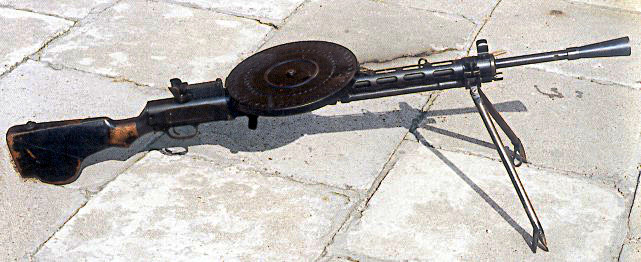
The Degtyaryov machine gun (Russian: Пулемёт Дегтярёва Пехотный (ПДП), romanized: Pulemyot Degtyaryova Pekhotny (PDP), lit. 'Degtyarev Infantry Machinegun' or DP-27/DP-28 is a light machine gun firing the 7.62×54mmR cartridge that was primarily used by the Soviet Union, with service trials starting in 1927, followed by general deployment in 1928.[8][9]
Key Information


Besides being the standard Soviet infantry light machine gun (LMG) during World War II, with various modifications it was used in aircraft as a flexible defensive weapon, and it was equipped on almost all Soviet tanks in WWII as either a flexible bow machine gun or a co-axial machine gun controlled by the gunner. It was improved in 1943 producing the DPM, but it was replaced in 1946 with the RP-46 which improved on the basic DP design by converting it to use belt feed. The DP machine gun was supplemented in the 1950s by the more modern RPD machine gun and entirely replaced in Soviet service by the general purpose PK machine gun in the 1960s.[10]
Service use
[edit]![[icon]](https://en.wikipedia.org/wiki/File:Wiki_letter_w_cropped.svg) | This section needs expansion. You can help by adding to it. (April 2024) |

Despite its limitations, the DP had a reputation as a relatively effective light support weapon. It was nicknamed the "Record player" (proigryvatel') by Red Army troops because of its rotating disc-shaped pan magazine.[5]
The first uses of the DP-27 in war were with the Republican forces in the Spanish Civil War. On 25 October 1936, the SS Kursk docked at Cartegena, delivering 150 Degtaryov machine guns along with 9,000 Winchester Model 1895 rifles. The Cabo Palos delivered 3 DT tank machine guns on 7 May 1937. On 7 February 1938 the SS Bonafacio arrived in Bassens and included numerous weapons in its cargo delivery, including DP & DT machine guns.[11][12][13]
Many were captured by the Finnish army in the Winter War and the Continuation War and partially replaced the Lahti-Saloranta M/26. The DP received the nickname Emma in Finnish service after a popular waltz, again due to the magazine's resemblance to a record player. In the summer of 1944, the Finnish army had about 3400 Finnish-made Lahti-Salorantas and 9,000 captured Soviet-made Degtyarevs on the front. Captured examples were operated by the Volkssturm, the late-war German militia, and in German service the Degtyarev received the designation Leichtes Maschinengewehr 120(r).[14]
The Chinese Nationalists received 5,600 DPs from the USSR and used them in the Second Sino-Japanese War and the Chinese Civil War. The North Korean and Chinese Communists used the DP in the Korean War and copied the DPM as the Type 53.[14]
Examples of all variants of the DP machine gun were given or sold to the Viet Minh in the First Indochina War[15] by the USSR and Chinese Communists. Similarly, in the Vietnam War to the NVA and Vietcong.[16][17]
DPMs have also been recovered from Taliban fighters during the War in Afghanistan[18] while DPs or DPMs have been spotted in 2014 in the Northern Mali conflict.[19] During the 2022 Russian invasion of Ukraine, a few of the backline Ukrainian forces were issued surplus DPMs.[20][21]
System
[edit]The Degtyaryov light machine gun (DP) operates using a gas-operated mechanism and magazine-fed ammunition. The gas engine features a long-stroke piston and a gas regulator located under the barrel.
The barrel itself is quick-detachable, partially covered by a protective shroud, and equipped with a conical removable flash hider (early models lacked both a flash hider and threading for it). The barrel was prone to overheating during intensive fire: due to its thin walls, it would heat up quickly (especially in later models where ribbed radiators were omitted for simplicity), and thus short bursts were necessary to prevent disabling the gun (combat rate of fire was up to 80 rounds per minute). Replacing the barrel during combat was difficult—it required a special wrench to remove the lock and protect the hands from burns.
The bolt was locked using two locking lugs that spread sideways when the firing pin moved forward. Once the bolt reached the forward position, the bolt carrier continued moving, and the widened middle section of the firing pin, connected to it, pushed the rear ends of the locking lugs outward into the grooves of the receiver, securely locking the bolt. After firing, the bolt carrier moved backward under the action of the gas piston. During this, the firing pin was retracted, and special bevels on the carrier brought the locking lugs inward, disengaging them from the receiver and unlocking the bolt. The recoil-operating spring was located under the barrel and could lose elasticity when overheated during intense fire, which was one of the relatively few but significant disadvantages of the DP. Additionally, the locking lugs required precise fitting to achieve symmetrical locking (though this was not a major practical drawback).
_(5869944940).jpg)
The weapon was fed by flat pan magazines—“platters”—in which cartridges were arranged in a circle with bullets facing the center. This design ensured reliable feeding of rimmed cartridges but had notable drawbacks: large size and weight of the empty magazine, difficulty in transport and reloading, and susceptibility to damage during combat due to deformation. Initial magazines held 49 rounds, later replaced by 47-round ones with improved reliability. The machine gun was issued with three magazines and a metal box for their transport.
Although the DP magazine externally resembled the magazine of the Lewis gun, its operating principle was entirely different; for example, in the Lewis gun, the disk rotated using energy from the bolt via a complex lever system, while in the DP, it was powered by a pre-tensioned spring inside the magazine.


The trigger mechanism allowed only fully automatic fire from an open bolt. It was housed in the trigger frame, attached to the receiver with a cross-pin. There was no conventional safety; instead, it had an automatic safety lever that disengaged when gripping the neck of the stock. During intense fire, the need to constantly press the safety lever tired the shooter, and the rifle-type stock did not aid in maintaining a firm grip during burst fire. The tank version, the DT, had a more successful trigger frame design, featuring a standard safety and a pistol grip. The upgraded version, the DPM, adopted a similar trigger frame. Interestingly, Finnish-modified DPs during overhaul were fitted with a manual safety in addition to the original automatic one.
The DP was fired using a detachable bipod (bipod), which was sometimes lost in the heat of battle due to insecure attachment or became loose, significantly reducing stability and ease of use. The DPM later adopted a fixed bipod. Spent casings were ejected downward.
Accessories
[edit]The machine gun's accessories include[22]:
- a sectional cleaning rod for cleaning the barrel bore;
- a wrench-screwdriver for disassembly and assembly;
- a crank cleaning rod with a bristle brush for cleaning the chamber through the top receiver port without full disassembly;
- a gas path cleaning tool;
- two drifts for pushing out pins and dowels;
- an extractor for removing torn cartridge case necks.
All accessories were packed in a box-bag or a canvas pouch.
Sound Suppressor
[edit]At the end of 1941, the SG-DP (Special Sound Suppressor for the “DP” LMG), likely developed with I.G. Mitin's involvement, was created. It used low-charge rounds with light bullets, reaching a muzzle velocity of 330 m/s. The suppressor enabled silent automatic fire up to 300 m (with a lethal range of up to 500 m). It was adopted by the Red Army on May 27, 1942. In June 1942, Plant No. 2 of the NKVD in Kovrov planned to produce 500 units[23]. The suppressor weighed 1.3 kg, and the overall length of the machine gun with it was 1332 mm[24].
After testing in July 1942, the SG-DP was revised at Kovrov's OKB-2 by designers A.M. Marantsev and I.V. Dolgushev. The improved suppressor had a reduced inner diameter from 16 to 14.5 mm. It weighed 1.15 kg, had an 85 mm muzzle attachment, and an overall length of 291 mm[24].


In late 1942, the suppressor was tested at the NIPSVO as the SG-42 (Special Suppressor Model 1942). It was presumably used at the front and mass-produced, although production volume is unknown. Postwar tests in February–March 1948 found the suppressors unreliable, and they were decommissioned[25][26].
Between 1948–1950, the suppressor was further developed into the KB-P-535 at OKB-2. It weighed 0.96 kg with obturators, measured 301 mm in length, 68 mm in height, and 34 mm in width. The DP with this suppressor measured 1310 mm[26].
In March–April 1950, the KB-P-535 suppressors were tested with the RP-46 machine gun but again failed to meet requirements[26][27].
Snowshoe
[edit]Due to the legs of the machine gun sinking into snow or loose soil, various devices were developed, such as the snowshoe.
The snowshoe for the DP consists of metal plates hinged together with a stretched canvas fabric. Two of the plates, with eyelets and straps, are used to attach the bipod legs, while a canvas strap with buckle secures it to the trigger guard.
The snowshoe supports the DP during firing from deep snow, swampy, or sandy ground in summer[28].
Magazines and ammunition could also conveniently be placed on the snowshoe.
Designation
[edit]The Degtyaryov machine gun was accepted for Red Army service in 1927 with the official designation 7,62-мм ручной пулемет обр. 1927 г (7.62mm Hand-Held Machine Gun Model 1927). It was called the ДП-27 (DP-27), although some western sources refer to it as the DP-28.[5]
Variants
[edit]
- DPM, modernized version adopted in 1943–44, with a more robust bipod fastened to the cooling jacket and the recoil spring housed in a tube projecting from the rear of the receiver which necessitated a pistol grip for this model of the weapon (manufactured in China as the Type 53)[29]
- DA, for mounting and loading in aircraft (Дегтярёва авиационный, Degtyaryova Aviatsionny; ДА). Also used in tandem mounts known as DA-2. Employed in the early versions of the Tupolev TB-3 bomber and in the Polikarpov R-5 and Polikarpov Po-2 army cooperation aircraft. The DA weighed 7.1 kg empty and 11.5 kg with standard ammunition load. Its rate of fire was 600 rounds per minute. It was built between 1928 and March 1930 with 1,200 units delivered.[30] It was soon superseded by the ShKAS, which had a much higher rate of fire.
- DT and DTM, for mounting and loading in armoured fighting vehicles (Дегтярёва танковый, Degtyaryova Tankovy; ДТ and ДТМ)[31]
- DTM-4, (ДТМ-4) quad mounted variant.[32]

- RP-46 (Ротный пулемет - company machine gun): metallic-belt fed version adopted in 1946 with a heavier barrel to allow prolonged sustained fire. About 500 rounds could be fired continuously before the barrel had to be swapped or allowed to cool down. Also had a user-adjustable gas system, with three holes of varying diameters provided, to cope with varying environmental conditions and residue buildup. Although the empty weight of the RP-46 exceeded that of DP by 2.5 kg, when considered together with a single ammo box of 250 rounds, the RP-46 weighed 10 kg less than the DP together with the same amount of ammunition in DP pans. The RP-46 remained in Soviet service for 15 years before it was replaced (together with the SGM) by the PK machine gun.[5] The RP-46 was later manufactured in China as the Type 58 and in North Korea as the Type 64.[33] The RP-46 could still fire from DP-style magazines by removing its belt-feeding system.[34]
Users
[edit] Afghanistan: DPM[35] and RP-46 variants[36]
 Albania: RP-46 variant.[37]
 Algeria: RP-46 variant.[37]
 Angola: RP-46 variant.[37]
 Benin: RP-46 variant.[37]
 Bulgaria: RP-46 variant.[38]
 Central African Republic: RP-46 variant.[37]
 Republic of China: Received 5,600 from the Soviet Union as aid from 1938.[39][40]
 People's Republic of China: DPM and RP-46 locally built as Type 53 and Type 58[41]
 Comoros: RP-46 and Type 58 variants.[37]
 Congo-Brazzaville: RP-46 variant.[37]
 Cuba: DP, DT, DTM,[42] DPM and RP-46 variants.[37]
 Czechoslovakia: DP, DPM and RP-46 variants.[43]
 Egypt[2]
 Equatorial Guinea: RP-46 variant.[37]
 Ethiopia: RP-46 variant.[37]
 Finland: Used captured examples during World War II.[44]
 East Germany: DT and DTM variants.[45]
 Germany: Captured models were issued to the Volkssturm.[46]
 Hungary: DP, DPM and DTM variants.[47] Locally produced as M-27.[1]
 Indonesia[48]
 Iraq: Iraqi insurgents used RP-46 variant.[18]
 Kingdom of Italy: The Italian Army in Russia used captured examples as they were more reliable than the Breda 30.[49]
 Laos: RP-46 variant.[37]
 Libya: RP-46 variant.[37]
 Nigeria: RP-46 variant.[37]
 North Korea: DPM, Type 53 and RP-46 variants.[50][51]
 PAIGC[52]
 Palestine Liberation Organization[53]
 Poland: Used by Polish Army in USSR during World War II[54] and then during the Cold War era (DPM and RP-46 variants).[55]
 Romania: DP and DPM used after the war.[56]
 Seychelles: RP-46 variant.[37]
 Somalia: RP-46 variant.[37]
 Soviet Union[57]
 Spanish Republic[58]
 Sri Lanka: Type 58 variant[59]
 Sudan: RP-46 variant.[37]
 Syria: RP-46 variant.[6]
- Syrian opposition: Regular DP27.[60] Used by the Martyrs Of Islam rebel faction.[61]
 Tanzania: RP-46 variant.[37]
 Togo: RP-46 variant.[37]
 Ukraine[62][63]
 Vietnam: DPM, Type 53, RP-46 and Type 58 variants[64]
 Yemen[2]
 Yugoslavia[65]
 Zambia: RP-46 variant.[66]


See also
[edit]References
[edit]- ^ a b Schmidl, Erwin; Ritter, László (10 November 2006). The Hungarian Revolution 1956. Elite 148. Osprey Publishing. p. 63. ISBN 9781846030796.
- ^ a b c "WWII weapons in Yemen's civil war". wwiiafterwwii.wordpress.com. 9 September 2018.[self-published source]
- ^ "Armenian RP-46 during Nagorno-Karabakh War". Pinterest. Retrieved 2 March 2020.
- ^ "DP-28 in action During Georgian Civil War". 20 August 2017.
- ^ a b c d e McNab, Chris (2022). Soviet Machine Guns of World War II. Osprey Publishing.
- ^ a b "Syrie: les ISIS Hunters, ces soldats du régime de Damas formés par la Russie". France-Soir (in French). 30 May 2017. Archived from the original on 10 September 2017. Retrieved 4 September 2018.
- ^ Suciu, Peter (29 June 2020). "Meet the DP-28: The Red Army's "Record Player" (Or Killer Machine Gun)". National Interest. Retrieved 23 December 2022.
- ^ McCollum, Ian (13 August 2021). "Stalin's Record Player: The DP-27 Light Machine Gun". www.forgottenweapons.com. Retrieved 19 April 2024.
- ^ "RPD machine gun DP-27 caliber cartridge 7,62 mm | soldat.pro – military experts. Unites the best!".
- ^ "Неудачам вопреки: как появился легендарный советский пулемет ДП". Российская газета (in Russian). 21 December 2021. Retrieved 19 April 2024.
- ^ "Spanish Civil War for NUTS! – Part One, Small Arms". 11 November 2019.
- ^ "Stalin's Record Player: The DP-27 Degtyaryov LMG". 12 December 2023.
- ^ Heinz, Leonard R. (10 December 2016). Small Arms of the Spanish Civil War (PDF). p. 18. Retrieved 15 February 2025.
- ^ a b Suciu, Peter (12 December 2023). "Stalin's Record Player: The DP-27 Degtyaryov LMG". The Armory Life. Retrieved 19 April 2024.
- ^ "The French Indochina War 1946–54". United States.
- ^ "Degťarev DPM / NAM 64-75". www.nam-valka.cz.
- ^ "Viet Cong Fighter". United States.
- ^ a b Small Arms Survey (2012). "Surveying the Battlefield: Illicit Arms In Afghanistan, Iraq, and Somalia". Small Arms Survey 2012: Moving Targets. Cambridge University Press. p. 321. ISBN 978-0-521-19714-4. Archived from the original (PDF) on 31 August 2018. Retrieved 30 August 2018.
- ^ "Small arms recovered in Mali raid | Armament Research Services". armamentresearch.com. 24 December 2014. Archived from the original on 28 November 2022. Retrieved 3 September 2015.
- ^ Trevithick, Joseph (26 January 2022). "Needy Ukrainian Reserve Units Could Be Armed With Pre-World War II DP-27 Machine Guns". The Drive. Archived from the original on 8 March 2023. Retrieved 30 March 2023.
- ^ Network, Frontier India News (24 January 2022). "Why are 100-year-old Degtyaryov machine guns in the spotlight in the Ukraine - Russia tensions?". Frontier India. Archived from the original on 30 March 2023. Retrieved 30 March 2023.
- ^ Наставление по стрелковому делу (НСД-38) ручной пулемёт ДП. Москва: Государственное военное издательство НКО СССР. 1939.
- ^ Chumak, Ruslan (2015). "Ленинградские «Брамиты»". Журнал «Калашников» (in Russian). pp. 34–36. Archived from the original on 25 September 2015. Retrieved 12 September 2015.
- ^ a b Chumak, Ruslan (2014). "Звук выстрела совершенно отсутствует…". Журнал «Калашников» (in Russian). p. 98. Archived from the original on 18 November 2015. Retrieved 13 September 2015.
- ^ Журнал «Калашников» № 8/2010. Yuri Ponomaryov “Biography of PBS”, p. 30 Archived 2014-08-12 at the Wayback Machine
- ^ a b c Chumak, Ruslan (2014). "Звук выстрела совершенно отсутствует…". Журнал «Калашников» (in Russian). p. 99. Archived from the original on 18 November 2015. Retrieved 13 September 2015.
- ^ Журнал «Калашников» № 9/2010. Yuri Ponomaryov “Biography of PBS. Continuation” p. 28 Archived 2015-05-04 at the Wayback Machine
- ^ Glazatov, V.V.; Gorina, M.E.; Musatova, E.A., eds. (1944). Памятка по применению в зимних условиях волокуш, лыжных установок и снегоступов для пулемётов, противотанковых ружей, миномётов и боеприпасов к ним (in Russian). М.: Военное издательство Народного Комиссариата Обороны. pp. 6–7.
- ^ "Degtyarev DPM LMG Light Support / Vehicle Machine Gun Specifications and Pictures". www.militaryfactory.com. Retrieved 19 April 2024.
- ^ Широкорад А.Б. (2001) История авиационного вооружения Харвест (Shirokorad A.B. (2001) Istorya aviatsionnogo vooruzhenia Harvest. ISBN 985-433-695-6) (History of aircraft armament), page 70
- ^ Blagonravov, A. (10 January 1974). Degtyarev (DT) 7-62mm Tank Machine Gun (PDF) (Technical report). Translated by Leo Kanner Associates. Army Foreign Science and Technology Center, Charlottesville, Virginia: National Technical Information Service. Retrieved 15 February 2025.
- ^ "Image: 2010051007.jpg, (440 × 358 px)". bratishka.ru. 3 September 2010. Archived from the original on 23 February 2013. Retrieved 3 September 2015.[better source needed]
- ^ Семен Федосеев (2009). Пулеметы России. Шквальный огонь. Яуза / Коллекция / ЭКСМО. pp. 322–327. ISBN 978-5-699-31622-9.
- ^ Small Arms Identification and Operation Guide--Eurasian Communist Countries, Defense Intelligence Agency ST-HB-07-03-74, p. 238
- ^ Small Arms Survey (2012). "Surveying the Battlefield: Illicit Arms In Afghanistan, Iraq, and Somalia". Small Arms Survey 2012: Moving Targets. Cambridge University Press. p. 332. ISBN 978-0-521-19714-4. Archived from the original (PDF) on 31 August 2018. Retrieved 30 August 2018.
- ^ Bhatia, Michael Vinai; Sedra, Mark (May 2008). Small Arms Survey (ed.). Afghanistan, Arms and Conflict: Armed Groups, Disarmament and Security in a Post-War Society. Routledge. p. 65. ISBN 978-0-415-45308-0.
- ^ a b c d e f g h i j k l m n o p q r Jones, Richard D.; Ness, Leland S., eds. (27 January 2009). Jane's Infantry Weapons 2009/2010 (35th ed.). Coulsdon: Jane's Information Group. ISBN 978-0-7106-2869-5.
- ^ Gander, Terry J.; Cutshaw, Charles Q., eds. (2001). Jane's Infantry Weapons 2001/2002 (27th ed.). Coulsdon: Jane's Information Group. ISBN 9780710623171.
- ^ Shih, Bin (2022). China's Small Arms of the 2nd Sino-Japanese War (1937-1945) (2021 ed.). Independently published. p. 176. ISBN 979-8473557848.
- ^ Jowett, Philip (10 July 2005). The Chinese Army 1937–49: World War II and Civil War. Men-at-Arms 424. Osprey Publishing. p. 15. ISBN 9781841769042.
- ^ Smith 1969, p. 297.
- ^ Smith 1969, p. 22.
- ^ Scarlata, Paul (15 December 2016). "Eastern Bloc Firestorm: The Czech UK vz. 59 Machine Gun". Military Surplus Magazine. Archived from the original on 26 September 2020. Retrieved 6 January 2019.
- ^ Soviet Machine guns and Light Machine guns in the Winter War at winterwar.com
- ^ Smith 1969, p. 381.
- ^ W. Darrin Weaver (2005). Desperate Measures: The Last-Ditch Weapons of the Nazi Volkssturm. Collector Grade Publications. p. 329. ISBN 978-0889353725.
- ^ Lugosi, József (2008). "Gyalogsági fegyverek 1868–2008". In Lugosi, József; Markó, György (eds.). Hazánk dicsőségére: 160 éves a Magyar Honvédség. Budapest: Zrínyi Kiadó. p. 384. ISBN 978-963-327-461-3.
- ^ Smith 1969, p. 461.
- ^ Riccio, Ralph (2013). Italian small arms of the first & second world wars. Schiffer Publishing. p. 160. ISBN 9780764345838.
- ^ "NORTH KOREA COUNTRY HANDBOOK | MARINE CORPS INTELLIGENCE ACTIVITY" (PDF). 2 November 1998. Retrieved 3 September 2015.
- ^ "North Korean Small Arms (Democratic People's Republic of Korea)". Small Arms Review. Vol. 16, no. 2. June 2012. Archived from the original on 2 February 2019. Retrieved 3 February 2019.
- ^ Djaló, Amadú Bailó (2010). Guineense, Comando, Português [Guinean, Commando, Portuguese] (in Portuguese). Lisboa: Associação de Comandos. p. 139. ISBN 978-989-95601-1-6.
- ^ Laffin, John (15 June 1982). Arab Armies of the Middle East Wars 1948–73. Men-at-Arms 128. Osprey Publishing. p. 37. ISBN 9780850454512.
- ^ Zaloga, Steven J. (1982). The Polish Army 1939–45. Men-at-Arms 117. Osprey Publishing. p. 39. ISBN 9780850454178.
- ^ Smith 1969, p. 526.
- ^ Smith 1969, p. 533.
- ^ Degtyarev DP DPM RP-46 (Russia / USSR) at modernfirearms.net
- ^ Thompson, Leroy; MacSwan, Ken (1985). Uniforms of the Soldiers of Fortune. Poole: Blandford Press. pp. 117–118. ISBN 9780713713282.
- ^ Smith, Chris (October 2003). In the Shadow of a Cease-fire: The Impacts of Small Arms Availability and Misuse in Sri Lanka (PDF). Occasional Paper No. 11. Small Arms Survey. p. 14. Archived from the original (PDF) on 12 January 2011.
- ^ "Footage of weapons which were handed over by rebels to the Syrian Arab Army in Southern Damascus". YouTube. 12 May 2018. Archived from the original on 22 December 2021.
- ^ "Syrian Civil War: WWII weapons used". November 2019.
- ^ sapeurgalanet (25 January 2022). "Кулемет ДП-27". YouTube. Archived from the original on 3 June 2023. Retrieved 25 March 2022.
- ^ Chris McGrath (7 March 2022). "Russians Continue Assault On Outskirts Of Kyiv". Getty Images. Retrieved 25 March 2022.
- ^ Rottman, Gordon L. (10 February 2009). North Vietnamese Army Soldier 1958–75. Warrior 135. Osprey Publishing. p. 31. ISBN 9781846033711.
- ^ Smith 1969, p. 723.
- ^ Zambia Watchdog (9 June 2017). "Zambia dented, instability to continue up to 2021 – Economist Group". Zambian Watchdog. Zambia Watchdog. Archived from the original on 16 June 2021. Retrieved 15 June 2017.


- Smith, Joseph E. (1969). Small Arms of the World (11 ed.). Harrisburg, Pennsylvania: The Stackpole Company. ISBN 978-0-8117-1566-9.
External links
[edit]
- The Battles of the Winter War
- Modern Firearms – Degtyarev DP DPM RP-46
- Soviet DT-28 Repair and Operation Manual(in Russian)
- Degtyarov machine gun variants(in Russian)
- "75 лет ручному пулемёту Дегтярёва" (PDF). 22 April 2010. Archived from the original (PDF) on 15 August 2014. Retrieved 3 September 2015.
Degtyaryov machine gun
View on GrokipediaDevelopment
Origins and Design Process
Vasily Alekseevich Degtyaryov, a prominent Soviet weapons designer born on January 2, 1880, in Tula, Russia, led the development of the Degtyaryov machine gun as part of his extensive work on small arms.[6] A disciple of renowned gunsmith Vladimir Fyodorov, Degtyaryov headed the Soviet Union's first firearms design bureau at the Kovrov Arms Factory starting in 1918, where he focused on automatic weapons.[7] His prior contributions included early prototypes of light machine guns in the 1920s, building on Fedorov's 1916 automatic rifle designs, and an automatic rifle developed in 1926 using gas-operated mechanics.[8] In the post-World War I era, the Soviet Red Army sought a domestic light machine gun to replace imported models like the Danish Madsen, which had been used during the conflict but proved costly and logistically challenging for mass production.[5] The requirements emphasized reliability in harsh environmental conditions, portability for infantry squads, and compatibility with the existing 7.62×54mmR rimmed cartridge from the Mosin-Nagant rifle to simplify logistics.[3] This need prompted a 1924 competition involving designers like Degtyaryov, Fyodor Fyodorov, and Fyodor Tokarev, aimed at creating an affordable, rugged weapon for squad automatic fire.[8] Degtyaryov began the design process in 1924, focusing on a gas-operated system with a long-stroke gas piston to ensure robust operation under field conditions.[6] Key innovations included a flapper-locking mechanism, inspired by earlier designs like the Kjellman-Friberg system, to securely lock the bolt while managing the recoil of the full-power cartridge, and a top-mounted pan magazine holding 47 rounds to prevent rimlock issues common with rimmed ammunition in belt or box feeds.[9] Early prototypes, developed between 1924 and 1926 in collaboration with Fyodorov, addressed feeding reliability but encountered engineering challenges such as barrel overheating during sustained fire and excessive recoil affecting accuracy.[8] By 1927, Degtyaryov completed a refined prototype that balanced simplicity and durability, incorporating a fixed barrel with a bipod for stability despite initial recoil concerns.[7]Testing and Adoption
Field trials for the Degtyaryov light machine gun commenced in the Soviet Union during the late 1920s, with initial prototype evaluations occurring in December 1926. Two improved prototypes underwent rigorous testing, firing a total of 40,000 rounds under adverse conditions, which resulted in only 0.6% stoppages, demonstrating high reliability.[10] Following these preliminary assessments, the redesigned weapon, designated as the DP-27, was subjected to official Red Army trials at the Kovrov plant from January 17 to 21, 1927. The machine gun passed all required evaluations without major failures, confirming its suitability for infantry use.[3] Based on trial feedback, minor refinements were implemented to enhance operational performance, including adjustments to the gas system and overall ergonomics. The Soviet military formally adopted the DP-27 as its standard light machine gun on December 21, 1927, with the designation later updated to DP-28 upon entry into production in 1928. Initial manufacturing began at the Kovrov Machine Building Plant, marking a key step in Soviet small arms independence.[11] Production scaled rapidly to meet Red Army demands, with total production reaching approximately 800,000 units through expanded facilities and wartime mobilization efforts, primarily during World War II.[12] This output underscored the weapon's central role in Soviet infantry tactics.Design and Operation
Operating Mechanism
The Degtyaryov DP-28 light machine gun employs a gas-operated mechanism utilizing a long-stroke gas piston that drives a flapper locking mechanism to lock the breech. This design relies on high-pressure propellant gases diverted through a port in the barrel to actuate the piston, which is rigidly attached to the bolt carrier, ensuring reliable cycling without short-stroke or recoil-operated variants in the base model.[3] In the firing cycle, upon ignition of the 7.62×54mmR cartridge, gases are tapped from the barrel and directed into the gas cylinder, where they expand to drive the piston and bolt carrier rearward. This rearward movement first retracts the flapper lugs to unlock the bolt from the receiver, allowing extraction and ejection of the spent cartridge case via a fixed ejector; the carrier then continues rearward to cock the striker, after which the return spring compresses. On the forward stroke, the bolt carrier strips a fresh round from the pan magazine, chambers it, and extends the flapper lugs to lock, readying the weapon for the next shot. The mechanism fires from an open-bolt position to aid cooling and prevent cook-off.[13] Safety features include a manual safety lever located on the left side of the receiver, which, when engaged, blocks the trigger and sear to prevent firing, and a hinged dust cover over the top-mounted feed opening that shields the mechanism from debris ingress during operation. The cyclic rate of fire is 550 rounds per minute, with an effective range of 800 meters when using the standard iron sights. Unique to the design, the return spring surrounds the gas piston shaft beneath the barrel for compactness, though this placement contributed to overheating issues in prolonged fire, and the gravity-assisted pan magazine rotates via studs on the bolt carrier that engage the drum's sprocket during recoil.[3]Specifications and Components
The Degtyaryov DP-28 light machine gun is chambered for the 7.62×54mmR rimmed cartridge, a full-powered round that provides substantial stopping power for infantry support roles.[1] The muzzle velocity of the projectile is 840 m/s, contributing to an effective firing range of 200 to 800 meters, influenced by the type of sights employed.[14] Ballistically, the cartridge delivers approximately 3,500 J of muzzle energy, enabling penetration through light cover such as thin wooden barriers or soft soil at typical engagement distances.[15] Key dimensions of the DP-28 include an overall length of 1,270 mm and a barrel length of 604 mm, making it a relatively compact light machine gun for its era despite its robust construction.[1] The unloaded weight is 9.12 kg (with an empty magazine), increasing to 11.3 kg when fitted with a fully loaded magazine, which balances portability with sustained fire capability.[16] The feed system utilizes a 47-round double-stack pan magazine mounted atop the receiver, with rounds held individually in radial compartments, rims alternating to aid reliable feeding of the rimmed cartridges under field conditions.[1] Primary components encompass a barrel encased in a fixed perforated shroud for heat dissipation and user protection, a folding bipod attached to the barrel for stability during prone firing, a wooden buttstock with integrated cleaning kit compartment, and a separate wooden pistol grip for control.[15] Sighting is provided by adjustable iron sights, featuring a front post and a rear tangent notch scalable up to 2,000 meters for long-range adjustment.[14]| Specification | Detail |
|---|---|
| Caliber | 7.62×54mmR |
| Muzzle Velocity | 840 m/s |
| Effective Range | 200–800 m |
| Overall Length | 1,270 mm |
| Barrel Length | 604 mm |
| Weight (Unloaded) | 9.12 kg |
| Weight (Loaded) | 11.3 kg |
| Magazine Capacity | 47 rounds (pan) |