Hubbry Logo
DiscobolusDiscobolusMain
Open search
Discobolus
Community hub
Discobolus
logo
8 pages, 0 posts
0 subscribers
Be the first to start a discussion here.
Discobolus
Discobolus
from Wikipedia

Roman bronze reproduction of Myron's Discobolus, 2nd century AD (Glyptothek, Munich)
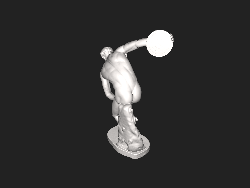
3D model of a replica at National Gallery of Denmark, Denmark.

The Discobolus by Myron ("discus thrower", Greek: Δισκοβόλος, Diskobólos) is an ancient Greek sculpture completed at the start of the Classical period in around 460–450 BC that depicts an ancient Greek athlete throwing a discus. Though the original Greek bronze cast is lost, the work is known through numerous Roman copies, both full-scale ones in marble, which is cheaper than bronze,[1] such as the Palombara Discobolus, the first to be recovered, and smaller scaled versions in bronze.

A norm in Ancient Greek athletics, the Discobolus is presented nude. His pose appears unnatural to a human and is considered as per modern standards a rather inefficient way to throw the discus.[2]

Myron's skill is evident in his ability to convey a sense of movement of the body at the moment of its maximum tension and splendor within a static medium, transforming a routine athletic activity into a representation of balance and harmony. Myron is often credited with being the first sculptor to master this style. However, the great effort of the athlete is not reflected in his facial expression, which displays only a tenuous concentration. The torso shows no muscular strain, even though the limbs are outflung. The other trademark of Myron embodied in this sculpture is how well the body is proportioned: the symmetria. The athlete's body demonstrates a sense of proportion, with meticulous attention to detail in every muscle and sinew, capturing the dynamics of a thrower's physical actions. The contrapposto stance, subtly shifting the athlete's weight from one leg to the other, imparts a semblance of motion and adds an element of realism to the artwork. The potential energy expressed in this sculpture's tightly wound pose, expressing the moment of stasis just before the release, is an example of the advancement of Classical sculpture from Archaic sculpture.

As Clark observed, "Myron has created the enduring pattern of athletic energy. He has taken a moment of action so transitory that students of athletics still debate if it is feasible, and he has given it the completeness of a cameo. To a modern eye, it may seem that Myron's desire for perfection has made him suppress too rigorously the sense of strain in the individual muscles".[3]

The Discobolus was sculpted at a time when Greece was at the zenith of its artistic and athletic achievements. The ancient Olympic Games were not just sporting events but were deeply intertwined with Greek culture and religion. Myron's work embodies the Greek philosophy of the harmonious development of body and mind, an idea known as kalokagathia, where physical beauty and prowess were celebrated as integral components of a virtuous life.

Reputation in the past

[edit]
The discobolus motif on an Attic red-figured cup, c. 490 BC, is static by comparison.
Roman discus thrower from Stabiae, Villa Arianna, 1st century AD

Myron's Discobolus was long known from descriptions, such as the dialogue in Lucian of Samosata's work Philopseudes:

A Discobolus in the National Roman Museum in Palazzo Massimo alle Terme.

When you came into the hall," he said, "didn't you notice a totally gorgeous statue up there, by Demetrios the portraitist?" "Surely you don't mean the discus-thrower," said I, "the one bent over into the throwing-position, with his head turned back to the hand that holds the discus, and the opposite knee slightly flexed, like one who will spring up again after the throw?

"Not that one," he said, "that's one of Myron's works, that Diskobolos you speak of..."

— Lucian of Samosata, Philopseudes c. 18[4]

Discobolus and Discophorus

[edit]

Prior to this statue's discovery, the term Discobolus had been applied in the 17th and 18th centuries to a standing figure holding a discus, a Discophoros, which Ennio Quirino Visconti identified as the Discobolus of Naukydes of Argos, mentioned by Pliny (Haskell and Penny 1981:200).

Discobolus Palombara or Lancellotti

[edit]

The Discobolus Palombara, the first copy of this famous sculpture to have been discovered, was found in 1781. It is a 1st-century AD copy of Myron's original bronze. Following its discovery at a Roman property of the Massimo family, the Villa Palombara on the Esquiline Hill, it was initially restored by Giuseppe Angelini; the Massimo installed it in their Palazzo Massimo alle Colonne and then at Palazzo Lancellotti. The Italian archaeologist Giovanni Battista Visconti identified the sculpture as a copy from the original of Myron. It was instantly famous, though the Massimo jealously guarded access to it (Haskell and Penny 1981:200).

In 1937, Adolf Hitler negotiated to buy it, and eventually succeeded in 1938, when Galeazzo Ciano, Minister of Foreign Affairs, sold it to him for five million lire, over the protests of Giuseppe Bottai, Minister of Education, and the scholarly community. It was shipped by rail to Munich and displayed in the Glyptothek; it was returned in 1948. It is now in the National Museum of Rome, displayed at the Palazzo Massimo.

Townley Discobolus

[edit]

After the discovery of the Discobolus Palombara a second notable Discobolus was excavated, at Hadrian's Villa in 1790, and was purchased by the English antiquary and art dealer established in Rome, Thomas Jenkins, at public auction in 1792. (Another example, also found at Tivoli at this date, was acquired by the Vatican Museums.) The English connoisseur Charles Townley paid Jenkins £400 for the statue, which arrived at the semi-public gallery Townley commissioned in Park Street, London, in 1794. The head was wrongly restored, as Richard Payne Knight soon pointed out, but Townley was convinced his was the original and better copy.

It was bought for the British Museum, with the rest of Townley's marbles, in July 1805.[5]

Other copies

[edit]

Other Roman copies in marble have been recovered, and torsos that were already known in the 17th century but that had been wrongly restored and completed, have since been identified as further repetitions after Myron's model. For one such example, in the early 18th century Pierre-Étienne Monnot restored a torso that is now recognized as an example of Myron's Discobolus as a Wounded Gladiator who supports himself on his arm as he sinks to the ground; the completed sculpture was donated before 1734 by Pope Clement XII to the Capitoline Museums, where it remains.[6]

Yet another copy was discovered in 1906 in the ruins of a Roman villa at Tor Paterno in the former royal estate of Castel Porziano, now also conserved in the Museo Nazionale Romano.[7]

In the 19th century, plaster copies of Discobolos could be found in many large academic collections, now mostly dispersed.

Bodies: The Exhibition includes a recreation of the Discobolus. The Discus Thrower is plastinated human corpse posed like the original sculpture, discus included.[8]

See also

[edit]

Notes and references

[edit]
[edit]
Revisions and contributorsEdit on WikipediaRead on Wikipedia
from Grokipedia

The Discobolus (Discus Thrower) is a lost bronze sculpture attributed to the artist Myron of Eleutherae, dated to approximately 460–450 BCE, portraying a nude male athlete captured in the tensed pose immediately preceding the release of a discus. Known today solely through Roman-era marble copies and a rare bronze replica from the 2nd century CE, the work exemplifies the Classical Greek pursuit of harmonious proportions, dynamic motion, and idealized human anatomy in athletic representation. Myron's design innovatively conveys rotational energy and contraposto balance, marking a technical advancement in capturing sequential action within a static form, which influenced subsequent Hellenistic and Roman art. The statue's enduring legacy lies in its embodiment of —excellence in physical prowess and aesthetic perfection—reflecting the cultural centrality of competitive athletics in ancient Greek society, particularly at events like the .

Original Statue and Creation

Artist, Date, and Context

Myron of Eleutherae, an Athenian sculptor born near the border of and , worked primarily in during the mid-5th century BC, with an active career spanning approximately 480–440 BC. Ancient sources, including in his Natural History, praise Myron for his innovative depictions of athletes and animals that conveyed a sense of rhythm (rhythmos) and poised movement within static forms, distinguishing his style from earlier rigid archaic figures. Pausanias also references Myron's statues at sites like the Altis at Olympia, underscoring his reputation for anatomical realism derived from empirical observation of human and animal bodies. The Discobolus (Discus Thrower) is attributed to Myron and dated to circa 460–450 BC, aligning with the transition from the to the High Classical period in , a time of cultural flourishing after the Persian Wars' conclusion in 479 BC. This era saw ' democracy invest in celebrating kalokagathia—the unity of physical , , and civic excellence—often through dedications honoring athletic prowess in pan-Hellenic competitions like the Olympics or local . Myron's work likely originated as a votive or commemorative piece for such a sanctuary or setting, prioritizing representations of peak human capability over divine mythology, as evidenced by its focus on a generic rather than a named .

Materials, Techniques, and Lost Original

![Roman bronze copy of Myron’s Discobolus, 2nd century CE (Glyptothek Munich)][float-right] The original Discobolus by Myron was crafted in using the technique, a where a model supported by an armature was formed over a clay core, invested in a ceramic mold, heated to evaporate the wax, and filled with molten alloy. This method allowed for the intricate hollow-casting of life-sized figures, with separate sections joined by welding and surface details chased for refinement. Greek bronzes of the Classical period, including Myron's works, featured embellishments such as inlaid eyes of silver, glass, or stone for lifelike expression, and copper overlays on lips and nipples to simulate natural coloration and texture. These details, evidenced in surviving bronzes and described in ancient sources like Pliny the Elder, enhanced realism but are only inferred for the Discobolus from Roman marble copies lacking such attachments and comparative Hellenistic examples. No verified bronze original of the Discobolus survives, as the vast majority of Classical Greek bronze sculptures were melted down for metal reuse, driven by bronze's economic value exceeding its artistic worth during Roman imperial demands for currency, armaments, and infrastructure. Archaeological patterns show bronze recycling intensified in amid invasions and fiscal crises, contrasting with copies' survival due to lower scrap value and burial in sites less prone to systematic looting. Surviving Greek bronzes, like the Riace Warriors, represent exceptions preserved by submersion or accidental burial, underscoring a against exposed, reusable bronzes in Mediterranean contexts.

Description and Form

Pose, Proportions, and Anatomy

The Discobolus depicts a nude male athlete in a pose, with the weight distributed primarily on the straightened right leg while the left leg is bent forward, toes positioned to grip the ground. The torso twists dynamically, hips facing forward and shoulders rotated oppositely to form a , enhancing balance and implied motion. The right arm extends backward over the shoulder holding the discus, the left arm bends across the body near the thigh, and the head turns sharply rightward toward the discus. Roman marble copies provide consistent dimensions approximating life-size scale, such as the Lancellotti at 1.55 meters in and the Townley at 1.70 meters, with variations due to restorations including bases or plinths. Proportions adhere to early Classical Greek ideals of , featuring elongated yet balanced limbs and a torso-to-head near 7:1, as measurable in extant copies through caliper assessments revealing symmetrical muscle groupings and joint alignments. Anatomical rendering emphasizes empirical accuracy, with tensed deltoids and muscles in the right , contracted obliques and abdominal folds from the spinal twist, and prominent veins and sinews in the forearms indicating preparatory strain. The balanced weight shift produces an S-curved spine, while relaxed left-side musculature contrasts the engaged right, reflecting detailed study of athletic physiques rather than rigid .

Interpretations of Movement and Realism

The Discobolus portrays the discus thrower in a coiled wind-up position, with the twisted to produce via counter-rotation between the hips—shifted forward on the left side—and the shoulders, drawn back on the right. This configuration stores in the body's connective tissues and muscles, aligning with the biomechanical demands of generating explosive in throwing motions, as observed in rotational sports. The right leg bears the weight in a bent stance for stability, while the extended left leg anticipates the pivot, embodying a moment of maximal potential before uncoiling. Ancient descriptions emphasize the statue's success in implying motion through tensed and balanced rhythmos. , in Philopseudes (section 18), details the figure's forward-leaning body, bent right , extended left , and head turned toward the discus, capturing the interplay of restraint and readiness that suggests imminent release. praised Myron's bronzes for their lifelike vigor, interpreting the pose as a realistic rendition of athletic strain rather than static form. These accounts refute views of contrived rigidity, highlighting instead the contrast between compressed tension and latent action as a hallmark of fifth-century BCE sculptural . Modern evaluations reveal nuances in the pose's practicality versus realism. Recreations, including a 1936 Berlin Olympics documentary where decathlete Erwin Ischinger attempted the throw and encountered strain, underscore challenges in achieving distance from this static wind-up compared to run-up techniques. Yet, the configuration mirrors ancient standing discus methods involving a three-quarter , prioritizing observed human kinetics—rooted in Greek competitive —over optimized performance, thus affirming causal fidelity to bodily in an agonistic society.

Artistic Significance and Analysis

Innovations in Classical Greek Sculpture

Myron's Discobolus, created around 460–450 BCE, marked a pivotal innovation by depicting an athlete in mid-motion, capturing the coiled tension prior to releasing the discus, in contrast to the frontal, immobile poses of Archaic kouroi and korai. This work introduced a twisted contrapposto-like stance, with the rotated relative to the hips and legs asymmetrically engaged, fostering a sense of rhythmic balance (rhythmos) and enabling the statue's form to unfold dynamically from various angles, thus advancing sculptural three-dimensionality beyond planar compositions. Myron pioneered precise modeling of muscular tension and vascular details, as ancient commentators like noted his emphasis on sinews and veins to convey internal and , evident in the Discobolus's rendered abdominal strain and limb extensions. These techniques elevated the athletic nude as an embodiment of disciplined physical prowess, influencing successors such as in refining proportional canons while prioritizing action over mere symmetry.

Criticisms and Anatomical Debates

, in his (c. 95 CE), alluded to ancient detractors who faulted the for its non-upright posture, deeming the "violent and elaborate attitude" improper and strained, though he rebutted this by emphasizing the technical prowess required to render such a difficult pose convincingly in . , writing in (77 CE), similarly observed that Myron advanced realism through greater rhythmic variety and proportional precision compared to , but at the cost of overall harmony, as his figures favored "violent contortions" that disrupted balanced composure, a critique applicable to the 's twisted form prioritizing over serene equilibrium. Modern anatomical examinations, drawing on replicas and athlete , highlight potential discrepancies in the statue's . The exaggerated spinal rotation and contralateral head turn generate disproportionate on the torso, which contrasts with observed discus-throwing where such extremes risk destabilizing the pivot leg and reducing release , as evidenced by kinetic analyses of elite throwers maintaining a more aligned forward for balance. These findings suggest the pose, while visually rhythmic, deviates from efficient human mechanics, prompting debates on whether Myron stylized for artistic effect—evoking preparatory coiling—or fell short of anatomical fidelity, especially when juxtaposed with ' , whose achieves proportional stability without comparable torsional strain. Defenders attribute the torsion to bronze's capacity for implied motion, yet empirical comparisons to living athletes underscore a between aesthetic and biomechanical realism.

Roman Copies and Variants

Overview of Replication and Survival

Roman elites commissioned numerous marble copies of Myron's bronze Discobolus during the 1st and 2nd centuries AD, primarily through specialized workshops that employed techniques such as creating plaster casts from Greek models and using measurement points to scale figures into stone via the pointing method. These replicas, exceeding twenty in known full-scale examples and fragments, served to adorn private villas and symbolize mastery of Greek paideia—the classical ideal of cultured education and physical excellence—rather than supporting mass public production. Archaeological evidence indicates replication was driven by demand among wealthy patrons for prestigious athletic iconography, concentrating copies in high-status sites like Emperor Hadrian's Villa at Tivoli, where multiple exemplars were displayed. Marble predominated over for these copies due to its relative affordability and suitability for static display in domestic settings, though variants existed in smaller scales; however, adaptations were necessary, including added struts like tree trunks for structural support, as lacked the tensile strength of . Some copies feature signed bases attributing them to Roman or associated workshops, while others show minor alterations such as adjusted head orientations or pose tweaks—evident in resting discus-bearer variants inspired by related athletic types—demonstrating intentional customization for Roman tastes and contexts rather than fidelity loss or degradation from the original schema. Survival patterns favor marble exemplars because bronze was routinely melted for reuse in weaponry, coinage, or other practical ends across antiquity and the medieval period, whereas 's lower scrap value and greater resistance to such allowed many copies to endure burial in estates until systematic excavations from the onward. This material bias, combined with depositional contexts in protected villa complexes rather than exposed public forums, accounts for the disproportionate preservation of over , providing the primary evidentiary base for reconstructing Myron's lost original. Empirical data from sites like underscore how not only spurred initial production but also inadvertently ensured through secluded, archaeologically recoverable settings.

Discobolus Palombara (Lancellotti)

![Discobolus Palombara in Palazzo Massimo][float-right] The Discobolus Palombara, also known as the Lancellotti Discobolus, is a Roman copy of Myron's original Greek , discovered on March 14, 1781, during excavations at the Villa Palombara on Rome's Esquiline Hill, a property owned by the . The statue measures 1.55 meters in height and features a characteristic ancient repair where the head was rotated incorrectly, with the figure's gaze directed away from the discus rather than toward it. Following its unearthing, the sculpture received initial restorations in the late , including adjustments by sculptors such as , which further misaligned the head by positioning it to face downward, compounding the pre-existing ancient join. These interventions aimed to reassemble the fragmented piece but deviated from the intended Classical pose, as evidenced by comparisons with other copies and ancient descriptions. The statue passed through private ownership, including the Lancellotti family, before being sold in 1938 to for 5 million as part of efforts to acquire exemplars of ideal forms. Post-World War II, it was repatriated to in 1948 among looted artworks recovered from German holdings. Today, it resides in the Palazzo Massimo alle Terme of the National Roman Museum, where modern analyses confirm the non-original joins through visual and structural examination.

Townley Discobolus

The Townley Discobolus, a Roman marble copy of Myron's lost Greek bronze original from the mid-5th century BCE, was excavated in 1791 at in Tivoli, near . The statue, initially acquired by the art dealer Thomas Jenkins at auction following its discovery, underwent restoration before being purchased by the English antiquarian Charles Townley in the late 18th century. Townley, a prominent collector, added it to his renowned assemblage of classical sculptures, which later formed part of the British Museum's holdings after his death; the museum acquired the piece in 1805. Carved from high-quality white marble likely sourced from Parian quarries, the statue measures approximately 1.55 meters in height and retains its ancient plinth, distinguishing it among surviving copies as unusually complete. Its dynamic pose captures the athlete in the instant before releasing the discus, with tensed musculature and coiled torso emphasizing rotational tension, though the right arm's extension preserves the preparatory wind-up phase. Authenticity as a faithful replication of Myron's was affirmed in 19th-century through comparisons of its proportions and stylistic traits—such as abstracted, rhythmic anatomy—to literary descriptions by ancient authors like and , alongside other verified copies. The head, detached at discovery, was reattached around 1792 by the Roman sculptor Carlo Albacini, but incorrectly oriented to face forward and downward rather than turned upward and backward toward the discus, fundamentally altering the figure's gaze and implied concentration. This misalignment, while executed with technical skill, has drawn empirical critique for disrupting the original's causal logic of motion—where the eyes should track the discus arc—and imposing a static, frontal alien to the bronze archetype's tensed asymmetry, as evidenced by better-preserved variants. Despite such distortions, the Townley copy was exhibited in Townley's residence as an icon of classical athletic vigor, influencing 19th-century perceptions of Greek realism until curators highlighted the restoration's inaccuracies through side-by-side analyses with unadulterated torsos.

Other Notable Copies

Approximately twenty full-scale Roman marble copies of Myron's Discobolus survive, alongside numerous fragments, primarily from the 2nd century CE, indicating widespread replication during the Imperial era. These replicas often include added struts for structural support or slight proportional adjustments adapted for marble medium. The ' exemplar features the head correctly oriented forward over the left shoulder, consistent with ancient accounts of the pose, distinguishing it from copies with erroneous restorations. This 2nd-century CE copy measures about 133 cm in height and preserves anatomical details closely aligned with the lost bronze original. The houses a copy assembled from fragments discovered around near Castel Porziano, , which restorers deemed superior in anatomical fidelity to the Vatican version due to better-preserved proportions and muscle tension. In 1956, presented a Discobolus to the as gratitude for repatriating Nazi-looted , including a Discobolus copy; dedicated on March 1 in Washington, D.C.'s Reservation 105, it stands on a and base, symbolizing post-World War II cultural restitution.

Historical Reception and Rediscovery

Ancient Descriptions and Mentions

lists the Discobolus among Myron's statues in Natural History 34.57, cataloging it alongside works such as the Perseus, Hercules Lance-Bearer, and others, while characterizing Myron's style as advancing realism through greater rhythmic variety and proportional precision compared to Polyclitus, albeit deficient in graceful elegance. This enumeration underscores the statue's recognition in Roman antiquity as a example of early Classical bronzework, valued for its technical innovation in depicting human form. Lucian of Samosata provides a vivid description in Philopseudes 18, portraying the Discobolus as the discus-thrower "bent over in the position of the throw, with his head turned back toward the hand that holds the discus, and with one knee bent over the other," in a that satirizes philosophical admirers of sculptures for ascribing profound meaning to such athletic figures while confirming the work's widespread renown and visual distinctiveness. Pausanias mentions multiple athletic statues by Myron at Olympia, including depictions of runners and boxers dedicated in honor of victories, linking the sculptor's production to the panhellenic festivals where such works commemorated —the pursuit of physical and moral excellence—though he does not explicitly reference the Discobolus itself. Similarly, Callistratus' Descriptions of Statues evokes the animated of Myronic bronzes in athletic poses, emphasizing their lifelike tension and embodiment of competitive prowess, consistent with the Discobolus's contextual valorization in Greek sanctuaries. No surviving ancient text specifies the original dedication site for the Discobolus, with inferences drawing from Myron's Eleutherae origins near Eleusis or Olympian ties, reflecting its role in celebrating disciplined human achievement rather than narrative mythology.

Renaissance to Enlightenment Reputation

Roman copies of the Discobolus began to surface in Italy during the late 18th century, with the Lancellotti example excavated on the Esquiline Hill in Rome in 1781, marking a key moment in its physical rediscovery after centuries known mainly through ancient texts. Prior to this, Renaissance humanists valued the statue via descriptions in Pliny the Elder's Natural History (ca. 77 CE), where Myron's work was commended for capturing the "tension" of the athlete's poised throw and the innovative twist of the torso, exemplifying early classical realism in motion. This literary esteem aligned with Renaissance efforts to emulate Greek ideals of proportion and vitality, fostering continuity in appreciating the statue's form as a model of human potential, though without extant examples for direct study. Johann Joachim Winckelmann, in his Geschichte der Kunst des Alterthums (1764), elevated Myron's Discobolus within his framework of Greek art's serene grandeur, emphasizing its balanced and rhythmic harmony as embodiments of noble simplicity—qualities he argued surpassed Roman imitations and inspired Enlightenment-era . Winckelmann's analysis, drawn from ancient accounts like Quintilian's praise of its lifelike torsion, reinforced the statue's role in promoting rational beauty tied to humanistic ideals of measured emotion and physical perfection, influencing artists and collectors to seek similar exemplars. These rediscoveries spurred anatomical interest among scholars and sculptors, who dissected the statue's depiction of tensed musculature—such as the oblique abdominals and deltoids—to inform studies of human kinetics, bridging classical form with emerging scientific . However, early restorations of the copies often erred by aligning the head forward rather than rearward toward the discus, imposing a more static interpretation that diluted the original's dynamic intent and introduced interpretive biases favoring composure over exertion. Engravings circulating in the late , post-1781, disseminated this idealized image across , embedding the Discobolus in Enlightenment discourse on aesthetic rationality and corporeal harmony.

19th-20th Century Acquisitions and Restorations

The Townley Discobolus, a Roman marble copy excavated at in Tivoli in 1791, was acquired by English collector Charles Townley in 1794 following restoration by Italian sculptor Carlo Albacini, who repositioned the head to gaze toward the discus in a manner inconsistent with the original pose's forward-facing gaze as inferred from ancient descriptions and comparative evidence. Townley purchased it for £400 through dealer Thomas Jenkins during era, when British aristocrats sought classical antiquities for private galleries. Upon Townley's death in 1805, the acquired the statue as part of his collection for £20,000, where the erroneous head restoration has remained despite scholarly recognition of its inaccuracy based on anatomical and compositional analysis. The Discobolus Palombara (also known as Lancellotti), the earliest known Roman copy discovered in 1781 at the Villa Palombara on Rome's Esquiline Hill and owned by the , was displayed in their before being sold in 1938 to the German government for placement in Munich's . Following , the statue was transferred to in 1948 and installed in the National Roman Museum at Palazzo Massimo alle Terme, reflecting post-war repatriation efforts for looted or seized . Restorations of various copies during this period often prioritized aesthetic completeness over fidelity, as seen in the Townley example's persistent head misalignment, critiqued in 19th-century scholarship for disrupting the balance and torsion central to Myron's design. Institutional placements, such as the British Museum's integration into its classical galleries and the temporary display, underscored the era's emphasis on displaying Roman copies as proxies for lost Greek originals, though flawed interventions complicated interpretive accuracy. ![Discobolus Palombara in National Roman Museum][float-right]

Modern Controversies and Legacy

Political Appropriations and Misuses

The Discobolus, with its depiction of poised athletic tension, has been ideologically co-opted in modern political contexts, particularly by regimes seeking to project ideals of bodily perfection onto national or racial narratives. In 1937, during Adolf Hitler's state visit to , he expressed admiration for the Lancellotti Discobolus, a second-century Roman copy then in private Italian hands, prompting its sale to the following year for 5 million lira amid pressure from the regime. The acquisition, facilitated under Benito Mussolini's fascist government as a diplomatic gesture strengthening the Italo-German axis, marked an early instance of Nazi plunder in . Nazi propagandists, led by , repurposed the statue to exemplify supposed racial superiority, claiming its harmonious proportions evidenced Nordic influence on despite the work's clear Hellenistic origins and Roman replication. Upon its public unveiling in on July 24, 1938, Hitler declared the Discobolus a symbol of the "Germanic race's" physical and spiritual essence, aligning it with eugenics-driven ideology and displaying it prominently during events like the 1936 Berlin Olympics to evoke disciplined vitality. This racialized interpretation distorted the statue's original Greek context of kalokagathia—the integrated pursuit of physical prowess and moral virtue—into pseudoscientific justification for exclusionary policies, contrasting sharply with its ancient Roman appropriations by emperors like , who collected copies for cultural prestige rather than ethnic myth-making. Such misuses highlight the Discobolus's formal universality—its dynamic and idealized —as a vector for ideological projection, enabling both inspirational roles in athletic promotion and detrimental distortions like fascist body politicization. While Nazi exploitation drew later critiques, such as those framing classical male forms as cautionary against manipulative "body politics" in contemporary discourse, historical patterns reveal no intrinsic bias in the sculpture itself but rather opportunistic adaptation by authoritarian states to legitimize power through visual symbolism. Empirical records of its deployments, from imperial patronage to , underscore this adaptability without endorsing any single as definitive.

Ownership Disputes and Repatriation Claims

The Discobolus Palombara, a second-century CE Roman bronze copy of Myron's original, has been at the center of a 2023 repatriation request from Germany's Staatliche Antikensammlungen in Munich to Italy's National Roman Museum. The Munich institution alleged that the statue's transfer to Italy in 1948 constituted an illegal export, as it had become German state property following its acquisition during the Nazi era. Italian authorities acquired the piece in 1937 from a private collection and exchanged it with Nazi Germany in 1938 as part of diplomatic overtures between Mussolini and Hitler. After World War II, Allied forces restituted the statue to Italy in 1948 under post-war protocols aimed at reversing Axis acquisitions, a process Italy defends as compliant with prevailing restitution laws that prioritized return to pre-war owners or states. Italy's culture minister rejected the German claim in December 2023, asserting the Discobolus Palombara's status as a integral to Italian heritage and unaffected by subsequent export regulations. The dispute echoes broader precedents for returning Nazi-held artworks, where Allied policies differentiated between looted private property and state-to-state transfers amid Axis defeat, often favoring restitution to victim nations over retaining contested wartime gains. No legal resolution has been reached, with maintaining its position despite the statue's longstanding display in since 1960. In contrast, the Townley Discobolus, a copy housed in the since 1815, faces no active ownership or claims. Its documented originates from a legal excavation near Tivoli, , in 1791, followed by export approval granted in 1792 via papal license to collector Charles Townley. While the has encountered pressures for other holdings, such as the sculptures, empirical records confirm the Townley piece's acquisition adhered to contemporary Roman export norms without subsequent challenges from Italian authorities. Recent internal scandals involving thefts from the Townley gem collection do not implicate the Discobolus itself.

Cultural Impact and Enduring Symbolism

![Discobolus in National Roman Museum][float-right] The Discobolus serves as a perennial emblem of the modern Olympic movement, embodying the classical Greek pursuit of physical and moral excellence through athletic discipline. Revived by in the late 19th century, its dynamic pose of poised tension and anatomical precision has been invoked to represent the harmony of body and mind in competitive sports, appearing on Olympic stamps and in promotional imagery since the early . This symbolism underscores empirical evidence of human potential realized through rigorous , contrasting with narratives prioritizing innate equality over cultivated skill. In artistic and philosophical discourse, the statue exemplifies arete—the ancient ideal of virtue achieved via balanced effort—capturing the male form's realistic musculature and as a pinnacle of representational accuracy. Its influence extends to modern replicas and interpretations that reaffirm this focus on disciplined realism, often critiquing abstracted or softened depictions in contemporary by highlighting verifiable biomechanical harmony. While some analyses deconstruct its form through lenses, primary athletic and sculptural evidence prioritizes its ties to observable and proportion. Enduring copies in institutions worldwide, including the and , perpetuate its legacy as a touchstone for human achievement grounded in first-principles of and motion. Recent advancements, such as 3D scans from the 2020s, facilitate examinations of its original bronze likely features, enabling precise metric analysis of twist and counterbalance for broader accessibility and scholarly verification.

References

Add your contribution
Related Hubs
User Avatar
No comments yet.