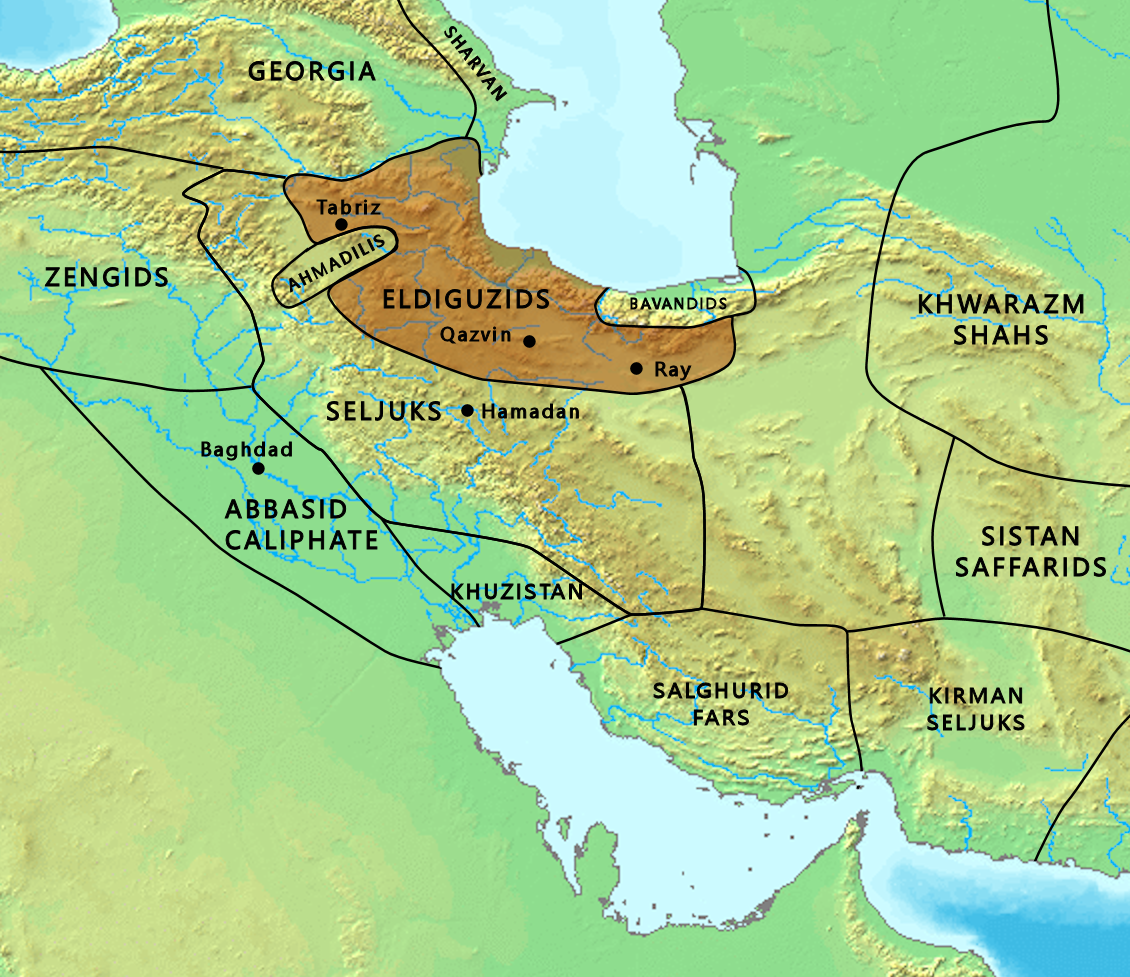
Eldiguzids
Eldiguzids
Main page
1735532

Eldiguzids

logo
Community Hub0 subscribers
Read side by side
from Wikipedia
Map of medieval Europe in 1190 showing the territory of Eldiguzids in the lower right corner

Key Information

Double-page from the Qur'an dedicated to Abu’l-Qasim Harun ibn 'Ali ibn Zafar, the vizier of Özbeg (r 1210–1225), last ruler of Eldiguzids. Khalili Collection of Islamic Art

The Ildegizids,[4] Eldiguzids[5][6] or Ildenizids, also known as Atabegs of Azerbaijan[7][8] (اتابکان آذربایجان Atabakan-e Āzarbayjan), were an Atabegate of the Seljuk Empire, and a Sunni Muslim Turkic[6] dynasty[9] (started by Eldiguz of Kipchak[6] origin), which controlled most of northwestern Persia,[5] eastern Transcaucasia, including[5] Arran,[5][6][8] most of Iranian Azerbaijan,[5][6][8] and Jibal.[5][6][8] At their maximum extent, the territory under their control, roughly corresponds to most of north-western Iran, most of the regions of modern Azerbaijan and smaller portions in modern Armenia (southern part), Turkey (northeastern part) and Iraq (eastern part). Down to the death in war 1194 of Toghril b. Arslan, last of the Great Seljuq rulers of Iraq and Persia, the Ildenizids ruled as theoretical subordinates of the Sultans, acknowledging this dependence on their coins almost down to the end of the Seljuqs.[5] Thereafter, they were in effect an independent dynasty, until the westward expansion of the Mongols and the Khwarazm-Shahs weakened and then brought the line to its close.[5]

Atabeg (literally "father-lord" in Turkic) was the title conferred upon the Turkic officers who served as guardians of minor Seljuq rulers.[10] In the political circumstances of the time, Atabegs were not only tutors and vice-regents of their princes, but also de facto rulers.[10] At the height of Eldiguzid power, their territory stretched from Isfahan in the south to the borders of Kingdom of Georgia and Shirvan in the north. However, closer to the end of their reign amidst continuous conflicts with the Kingdom of Georgia, the Eldiguzid territory shrank to include only Azerbaijan and eastern Transcaucasia.[6]

The historical significance of the Atabeg of Azerbaijan lies in their firm control over north-western Persia during the later Seljuq period and also their role in Transcaucasia as champions of Islam against the Bagratids of Georgia.[6]

Shams ad-Din Eldiguz

[edit]

In 1136, Sultan Ghiyath ad-Din Mas'ud (c. 1134–1152) appointed Shams ad-Din Eldiguz (c. 1135/36–1175) to be an atabeg of Arslan-Shah,[8] the juvenile successor of the throne and transferred Azerbaijan to his possession as iqta. Eldegiz chose Barda as his residence, and attracted the local emirs to his camp.

He made himself virtually independent ruler of Azerbaijan by 1146. His marriage with the widow of Sultan Toghrul II (1132–1133; Masud's brother and predecessor) afforded him to intervene in the dynastic strife which erupted upon Mas'ud's death in 1152. He succeeded, in 1160, in deposing Suleiman-Shah and installing his stepson Arslan-Shah (c.1160–1175) as a Sultan. Conferred with the rank of Atabeg, Eldiguz now became a chief protector of the Sultan's authority.[10]

The word azam (meaning "great" in Arabic) was added to his title and he was also known as Atabek-e Azam. All of the state's subsequent rulers used to hold this title. During his reign, Eldiguz could subdue a spacious territory between the Caucasus and Persian Gulf. The territory belonging to him stretched from the gate of Tbilisi up to Makran.[citation needed] He had possessed Iranian Azerbaijan, Arran, Shirvan, Jibal, Hamadan, Gilan,[citation needed] Mazandaran,[citation needed] Isfahan and Rey. The Atabegs of Mosul, Kerman and Fars as well as the feudals of Shirvan, Khuzestan, Ahlat, Arzan-ar-Rum and Maragha became his liegemen.

Campaigns against Georgia

[edit]

Kingdom of Georgia, whose army was additionally strengthened by the Kipchak mercenaries, became the strongest rival of the Shams al-Din Eldiguz. In 1138, Georgian king Demetrius I, attacked the earthquake-ridden city of Ganja.[11] While leaving the city, his troops carried off the well-known gate of Ganja as their trophy, which up to this date remains on display at the Gelati monastery.[12] From 1161 onwards Georgians began to make plundering raids and outright conquests on Ani, Dvin, Ganja, Nakhchivan and other regions controlled by Atabegs.[13][14]

Eldiguz formed a coalition with other Seljuqids in the beginning of the 1160s to fight against the Georgians, and in 1163 the allies inflicted a defeat on king George III of Georgia.[citation needed] The Seljuqid rulers were jubilant, and they prepared for a new campaign. However, this time they were forestalled by George III, who marched into Arran at the beginning of 1166, occupied a region extending to faraway cities as Nakhchivan and Beylagan, devastated the land and returned with prisoners and booty. There seemed to be no end to the war between George III and atabeg Eldiguz. But the belligerents were exhausted to such an extent that Eldiguz proposed an armistice. George had no alternative but to make concessions. Eldiguz restored Ani to its former rulers, the Shaddadids, who became his vassals.[citation needed]

In 1173, Atabeg Eldiguz began another campaign against Georgia but he was defeated.[citation needed] Atabeg's troops retreated and Eldiguz died in 1174 in Nakhchivan.

Muhammad Jahan Pahlavan

[edit]
Momine Khatun Mausoleum was commissioned by Eldiguzid Atabeg Jahan Pahlawan in honor of his mother, Mu'mine Khatun

After the death of Shams al-Din Eldiguz, in 1175, the Seljuq Sultan Arslan Shah tried to escape from the yoke of the Grand Atabeg of Azerbaijan but failed, and was poisoned to death by Shams ad-Din's son, the new Grand Atabeg Muhammad Jahan Pahlavan (c.1174–1186).[15] Pahlavan transferred his capital from Nakhchivan to Hamadan in western Iran, and made his younger brother, Qizil Arslan Uthman, the ruler of Azerbaijan. In 1174, Qizil Arslan captured Tabriz, which subsequently became his capital.[16]

Jahan Pahlavan suppressed all rebellious emirs and appointed faithful mamluks to key positions. He apportioned each of them any region or town as Iqta. The twelve years of his rule are considered the most peaceful period of the state's existence. Under his reign the central power was strengthened and no foreign enemy invaded the territory belonging to the Atabegs. Friendly relations with Khwarazm Shahs, the rulers of Central Asia, were founded. All those facts had positive influence on the development of science, handicraft, trade and arts.

Qizil Arslan

[edit]
King Qizil Arslan welcomes the poet Nizami.

After Muhammad Jahan Pahlavan's death his brother Qizil Arslan (c.1186–1191) ascended the throne. He continued his successful struggle against the Seljuq rulers. At the same time the central power began to get weaker as mamluks who had strengthened their power in their allotments did not want to obey the Sultan. Even Shirvanshah Akhsitan I who used to be Atabegs' liegeman attempted to intervene the interior affairs of the Eldiguzids and opposed Qizil Arslans aspiration to the throne. In the response to this, Qizil Arslan invaded Shirvan in 1191, reached to Derbent and subordinated the whole Shirvan to his authority. In 1191 Toghrul III, the last Seljuq ruler was overthrown by Qizil Arslan. Then, by Khalif's leave, he proclaimed himself a Sultan.

The same year Qizil Arslan, who had become the sole ruler of the Great Seljuq Empire, was assassinated. The power was divided among his three sons: Abu Bakr, Qutluq Inandj and Amir Mihran. Abu Bakr governed Azerbaijan and Arran, and his brothers were the rulers of Khorasan and several neighboring regions. Soon, these three successors began to fight for the throne. Victorious in power struggle, Abu Bakr "Jahan-pahlavan" (c. 1195–1210) had his elder brother Qutluq Inandj assassinated and forced the younger brother, Amir Mihran, to take refuge at the court of the latter's brother-in-law, Shirvanshah Akhsitan I (c.1160-1196). The Shirvanshah together with Amir Mihran headed for Tbilisi, the capital of Kingdom of Georgia, and appealed for help to Queen Tamar of Georgia, an official protector of Shirvan. Received with great honors at the Georgian court, they were given desired support, and the Georgian army led by Consort David Soslan marched to Shirvan.

Helmet related to the period of Eldiguzids. National Art Museum of Azerbaijan, Baku

The Eldiguzid atabeg Abu Bakr attempted to stem the Georgian advance, but suffered a defeat at the hands of David Soslan at the Battle of Shamkor[17] and lost his capital to a Georgian protégé in 1195. Although Abu Bakr was able to resume his reign a year later, the Eldiguzids were only barely able to contain further Georgian forays.[18][19] The State's defense capability was stricken. Khorezmshahs' and Georgians' non-stopping forays aggravated the situation in the country and speeded up its decay.

In 1209, the Georgian army laid waste to Ardabil – according to the Georgian and Armenian annals – as a revenge for the local Muslim ruler's attack on Ani and his massacre of the city's Christian population.[20] In a great final burst, the Georgian army led an army through Nakhchivan and Julfa, to Marand, Tabriz, and Qazvin in northwest Iran, pillaging several settlements on their way.[20]

Uzbek

[edit]

After the death of Qizil Arslan, the power was divided among Jahan Pahlavan's sons, however, soon they started to fight for the throne. Abu Bakr came to the fortress of Alinja. The fortress, along with all the treasures, was at the disposal of Jahan Pahlavan's other widow, Zahida Khatun. Abu Bakr captures the fortress and the treasury. Qizil Arslan's nephews began to rule independently, and one of the Mamluks of Jahan Pahlavan, Mahmud Anas Oglu, freed Toghrul III from his prison and regains the sultanate throne in May 1192. However, soon after, in 1194, after a long war with the Khwarazm Shahs, Sultan Togrul III was defeated and the existence of the Iraqi Seljuk Sultanate came to an end.[4][9]

After defeated by Abu Bakr, Amir Amiran Omar went to gain a support from Shirvanshah Akhsitan I and Georgian Tsarina Tamar. In 1194, the united Georgian-Shirvan and Amir Amiran Omar's troops defeated Abu Bakr in the battles of Shamkir and Beylagan. Later, the Georgians trying to capture Ganja, temporarily occupied it, but soon Abu Bakr's troops drove the Georgians out of Ganja.[9] This process was speeded up during the reign of Atabeg Uzbek (c.1210–1225), who was enthroned after Abu Bakr's death. During his reign, the country was attacked by Mongols and Georgians.[9] In that period, Armenian prince Hasan-Jalal Dawla (founder of House of Hasan-Jalalyan cadet branch of Siunia dynasty[21]) (c.1215–1262) began his separatist activities, a fact which shook the fundamentals of the weakened State[citation needed]. In 1225, Khwarazm Shah Jalal-ad-din dethroned the Ildegizid Uzbek Muzaffar al-Din and set himself up in the capital of Tabriz on the 25 of July in 1225.[9]

List of Eldiguzid atabegs

[edit]
  1. Eldigüz (ca. 1135 or 1136–1174 or 1175)
  2. Muhammad Jahan Pahlawan, son of Eldigüz (1174 or 1175–1186)
  3. Qizil Arslan, son of Eldigüz (1186–1191)
  4. Qutluq Inandj, stepson of Muhammad Jahan Pahlawan (1191)
  5. Nusrat al-Din Abu Bakr, son of Muhammad Jahan Pahlawan (1191–1210)
  6. Muzaffar al-Din Uzbek, son of Muhammad Jahan Pahlawan (1210–1225)

Genealogy of House of Ildiguz

[edit]
House of Ildiguz

Atabegs of Azerbaijan

Ildiguz
r. 1136–1175
Muhammad
r. 1175–1186
Qizil-Arslan I
r. 1186–1191
Qutluq-Inanch
r. 1191–1191
Abu Bakr
r. 1191–1210
Öz-Beg
r. 1210–1225
Qizil-Arslan II
r. 1225–1225

See also

[edit]

References

[edit]

Sources

[edit]
[edit]
Revisions and contributorsEdit on WikipediaRead on Wikipedia
from Grokipedia
The Eldiguzids, also designated as the Atabegs of Azerbaijan, constituted a Turkic dynasty of Kipchak provenance that administered the provinces of Azerbaijan and Arran—encompassing modern northwestern Iran, the Republic of Azerbaijan, and adjacent Caucasian territories—from the appointment of their progenitor Shams al-Din Eldiguz as atabeg in 1136 until the dynasty's termination in 1225.[1][2] Originating as military governors under the faltering Seljuk Sultanate of Iraq, they transitioned to semi-autonomous rule amid the empire's fragmentation, leveraging martial prowess to safeguard their domains against external aggressors.[1] Shams al-Din Eldiguz, elevated from servile status to atabeg by Sultan Mas'ud as tutor to the heir Arslan-Shah, repelled recurrent Georgian incursions into Arran, thereby securing regional stability and laying the groundwork for dynastic consolidation through alliances with adjacent potentates in Rey, Maragheh, and Fars.[1] Successors such as Muhammad Jahan Pahlavan and Qizil Arslan extended territorial sway into northern Iraq and Armenia, intermittently challenging Seljuk suzerainty—Qizil Arslan even styling himself sultan—while contending with Khwarezmian ambitions and Byzantine forays.[2] The dynasty's tenure marked a zenith of localized Turkic authority in the post-Seljuk interregnum, fostering administrative dyarchy and cultural efflorescence, though internal fratricide and the cataclysmic Mongol irruption under Özbeg's demise precipitated its eclipse.[2]

Origins and Rise

Seljuk Empire Context and Founding by Shams ad-Din Eldiguz

The death of Seljuk Sultan Mahmud II on September 11, 1131, precipitated a period of internal division and weakening central authority within the empire, as rival claimants including his son Dawud and brother Mas'ud vied for power, fostering the rise of semi-autonomous regional atabegates to manage fragmented territories.[3] Mas'ud eventually consolidated sultanic rule from 1133 to 1152, but the empire's cohesion eroded, enabling military commanders to govern provinces independently while nominally loyal to the sultan.[4] Shams ad-Din Eldiguz, a Kipchak Turkic military slave who had served under both Mahmud II and Mas'ud, was appointed atabeg of Arran (encompassing much of modern Azerbaijan) around 1136–1137, receiving the province as an iqta fief and responsibility for tutoring the minor Seljuk prince Arslan ibn Tughril.[3][4] This elevation from mamluk status reflected the sultan's reliance on trusted Turkic officers to counter local emirs and tribal disruptions in the power vacuum.[1] In his role, Eldiguz focused on stabilizing Arran and adjacent areas of northwestern Persia by subduing unruly local lords, forging alliances with neighboring atabegs such as those in Fars and Maragheh, and repelling incursions that threatened Seljuk holdings, thereby establishing the administrative and military groundwork for the Eldiguzid atabegate.[1][5] His governance emphasized control over key centers like Barda and Nakhchivan, which served as bases for maintaining order amid the broader Seljuk fragmentation.[1]

Early Consolidation in Azerbaijan and Arran

Shams al-Din Eldiguz, appointed atabeg of Arran and Azerbaijan by Seljuk Sultan Mas'ud around 1136, initially focused on securing administrative control over these core territories, which encompassed the provinces south of the Aras River and east of the Caspian, including key urban centers such as Tabriz in Azerbaijan and Ganja in Arran.[6][4] By the mid-12th century, his governance extended effective authority over these areas, enabling the suppression of local disorders and the integration of fiscal systems inherited from prior Seljuk oversight, though direct control over peripheral sites like Baku in Shirvan remained indirect through alliances with the Shirvanshahs rather than outright annexation.[7] To solidify power, Eldiguz forged alliances with regional Turkic military elites, such as the Ahmadili atabegs in nearby Maragheh, maintaining a pact against central Seljuk interference until approximately 1156, which helped neutralize potential internal challenges from ambitious local amirs.[1] These coalitions, combined with leveraging Persian administrative personnel for tax collection and judicial functions, allowed him to quell sporadic revolts among semi-autonomous landholders in Arran, where ethnic mixtures of Persians, Kurds, and Turkic settlers often fueled unrest.[7] Such measures ensured loyalty from provincial governors, who were co-opted into the atabeg's military retinue, thereby transforming nominal Seljuk vassalage into de facto autonomy without overt rebellion.[4] By the 1150s, this consolidation manifested in Eldiguz's ability to influence Seljuk throne successions, as regional amirs deferred to his arbitration in installing compliant sultans, establishing a dyarchic model where atabeg authority overshadowed the sultan's in Azerbaijan and Arran.[7] This period laid the groundwork for dynastic continuity, with Eldiguz designating his sons as successors to provincial commands, prioritizing military garrisons in fortified cities like Ganja to deter incursions from Georgian forces probing Arran's borders.[6] While maintaining ritual fealty to the Baghdad-based Seljuk court through tribute and titles, Eldiguz's pragmatic governance prioritized local stability over ideological conformity, fostering a Turkic-Persian hybrid elite that underpinned the dynasty's early resilience.[1]

Key Rulers and Reigns

Shams ad-Din Eldiguz (c. 1136–1175)

Shams al-Din Eldiguz (Ildeniz), a Kipchak Turk of servile origin, was appointed atabeg of Azerbaijan by Seljuk Sultan Ghiyath ad-Din Mas'ud in 1136 (or 1137) to govern Arran and adjacent territories on behalf of the juvenile prince Arslan-Shah, thereby laying the foundation for the Eldiguzid dynasty's semi-autonomous rule.[6][1] Initially a mamluk under earlier Seljuk sultans, Eldiguz leveraged his military command to consolidate authority, achieving de facto independence by around 1146 through effective administration and defense of core territories against peripheral threats.[8] His tenure emphasized stabilizing the atabegate's fiscal base, including the issuance of silver dirhams struck in his name across mints in Azerbaijan, which signified monetary control and supported local trade along routes connecting the Caucasus to Iranian highlands.[9] Eldiguz prioritized Sunni orthodoxy amid regional sectarian tensions, extending patronage to orthodox scholars and institutions to counter Ismaili Nizari influences emanating from Alamut, thereby aligning his regime with broader Seljuk efforts to reinforce Hanafi and Shafi'i doctrines in Azerbaijan and Arran.[1] This religious policy complemented administrative measures that fortified urban centers like Tabriz and Ganja as hubs for commerce and governance, with verifiable extensions of influence into fringe areas of northern Iraq and Armenian borderlands achieved through opportunistic alliances rather than sustained conquests.[8] Such steps enhanced the atabegate's resilience, enabling Eldiguz to maintain equilibrium with the nominal Seljuk overlords in Baghdad while fostering economic viability via controlled taxation and caravan security. Eldiguz died in late 1175 or early 1176, leaving a consolidated power structure that transitioned to his sons without immediate fragmentation, though his passing prompted brief Seljuk attempts to reassert central authority.[10] His rule exemplified pragmatic state-building, prioritizing defensive consolidation and orthodox consolidation over expansive campaigns, which set precedents for subsequent Eldiguzid rulers in navigating Seljuk decline.[1]

Muhammad Jahan Pahlavan (1175–1190)

Muhammad Jahan Pahlavan, son of Shams ad-Din Eldiguz, succeeded his father as atabeg of Azerbaijan and Arran following Eldiguz's death in 1174 or 1175. His title, Jahan Pahlavan (meaning "champion of the world"), reflected ambitions for broader authority beyond the atabegate's traditional remit, signaling a shift toward asserting semi-independent royal status amid weakening Seljuk oversight.[11] Upon ascension, he faced immediate challenges from Seljuk Sultan Tughril III, who sought to curtail Eldiguzid autonomy by backing rival claimants and withholding formal recognition, prompting Muhammad to prioritize military consolidation over expansion. To secure legitimacy, Muhammad pursued diplomatic ties with the Abbasid Caliph in Baghdad, leveraging caliphal endorsement as a counterweight to Seljuk influence, though direct investitures remain sparsely documented in contemporary chronicles.[11] Relations with the Seljuks remained adversarial; Tughril's resentment of Eldiguzid power led to skirmishes, but Muhammad avoided open war by maintaining nominal fealty while fortifying defenses in core territories. Internally, he suppressed rebellions by feudal emirs in Azerbaijan and adjacent regions, replacing disloyal holders with mamluk commanders granted iqta lands to ensure loyalty and streamline revenue collection.[11] This centralization extended Eldiguzid control westward, incorporating Hamadan as the new capital by circa 1176, marking the dynasty's farthest territorial reach into central Iran at roughly 200,000 square kilometers encompassing Arran, Azerbaijan, and parts of Jibal.[7] Dynastic cohesion was furthered by strategic appointments: Muhammad delegated Azerbaijan and Arran to his son Nusrat al-Din Abu Bakr, while granting his brother Qizil Arslan semi-autonomous oversight of western provinces, averting immediate fragmentation despite underlying tensions.[7] These measures stabilized the realm during his reign until 1186, fostering administrative efficiency through Turkic military elites and Persian bureaucratic traditions, though over-reliance on familial divisions sowed seeds for later disputes.[11] Muhammad's death in Hamadan that year transitioned power to Qizil Arslan, underscoring the atabegate's reliance on personal authority rather than institutionalized succession.

Qizil Arslan (1190–1197)

Qizil Arslan succeeded his brother Muhammad Jahan Pahlavan as atabeg of the Eldiguzids following the latter's death in 1186, amid immediate challenges from internal factions loyal to his nephews, the young sons of Muhammad supported by their mother Inanj Khatun.[7] This opposition reflected broader power struggles within the dynasty, as Qizil Arslan sought to consolidate control over Azerbaijan and Arran without nominal Seljuk oversight.[12] In 1191, Qizil Arslan defeated the Seljuk sultan Tughril III, who had attempted to reassert direct authority over Azerbaijan, thereby achieving a temporary peak of autonomy for the Eldiguzids from Great Seljuk suzerainty.[7] Encouraged by the Abbasid caliph in Baghdad, he proclaimed himself sultan that same year, issuing coins in this title as a defiance of Seljuk claims, though this elevation was short-lived and lacked broader recognition beyond his domains.[7] [12] Qizil Arslan's reign ended abruptly in late 1191 when he was poisoned, reportedly by Inanj Khatun, his brother's widow whom he had married to strengthen his position, amid ongoing intrigues and the resurgence of rival claimants.[7] His death precipitated further fragmentation, as power shifted to figures like Nusrat al-Din Abu Bakr, marking the close of a period of assertive independence under Eldiguzid rule.[7]

Uzbek (1197–1215)

Muzaffar al-Din Uzbek ibn Muhammad Pahlawan succeeded Nusrat al-Din Abu Bakr as atabeg of the Eldiguzids in 1210, initiating a 15-year rule amid mounting external pressures and internal challenges. As a son of the earlier ruler Muhammad Jahan Pahlavan, Uzbek inherited a fragmented authority structure following years of dynastic strife that dated back to the power vacuum after Qizil Arslan's death in 1197. His tenure emphasized defensive postures against incursions from the Kingdom of Georgia, whose armies under Queen Tamar occupied several border settlements in Azerbaijan and Arran during the early 1210s before being forced to retreat due to logistical strains and Eldiguzid counter-efforts.[13] To fortify his position, Uzbek pursued diplomatic alliances, notably marrying a daughter of the Seljuk Sultan Toghrul III, which aimed to leverage waning Seljuk influence against common foes. Militarily, his forces maintained vigilance along the northern frontiers, repelling probing Georgian raids that sought to exploit Eldiguzid vulnerabilities post-Abu Bakr. Administratively, Uzbek oversaw a period of relative stability, with his vizier Abu’l-Qasem Harun fostering scholarly patronage in Tabriz, the de facto capital, though the state grappled with resource strains from prolonged defenses.[13] By 1215, internal fissures deepened as separatist activities emerged, exemplified by the rebellion of Hassan Djalal Mikhranid in Khachen, signaling the erosion of centralized control. Uzbek's efforts to purge disloyal elements and realign provincial governors proved insufficient to halt decentralization, setting the stage for further fragmentation. His death in Tabriz in 1225—preceded by these mid-reign instabilities—left no stable heir, accelerating the dynasty's decline amid Khwarazmian advances.[13][14]

Successors and Fragmentation (1215–1225)

Following the consolidation under Nusrat al-Din Abu Bakr, Muzaffar al-Din Uzbek (r. 1210–1225) faced mounting internal challenges that accelerated the dynasty's fragmentation from approximately 1215 onward. Separatist activities by regional lords, notably Hassan Djalal Mikhranid (r. 1215–1262) in Khachen (Artsakh), undermined central control, as these vassals exploited Uzbek's preoccupation with external threats to assert independence and expand local domains.[13] Rival claimants within the Eldiguzid family and among Turkmen amirs further eroded unity, with conflicting reports on the fate of Uzbek's sons contributing to disputed successions and partition bids over key territories like Azerbaijan and Arran.[15] These dynamics reflected a shift toward localized power struggles, as military elites prioritized personal loyalties over dynastic cohesion. The atabegs' nominal subordination to the Seljuk sultans, already tenuous, dissolved amid bids for full autonomy, with Uzbek unable to enforce tribute or military obligations from fractious subordinates. By 1225, this internal disarray left the Eldiguzid realm vulnerable, devoid of a viable unified leadership structure.[16]

Military History

Campaigns against the Kingdom of Georgia

The Eldiguzids conducted military campaigns against the Kingdom of Georgia primarily to secure control over Arran, Shirvan, and adjacent border regions, countering Georgian efforts to expand southward into Muslim-held territories in the South Caucasus. These conflicts, spanning the mid-12th to early 13th centuries, involved reciprocal invasions driven by strategic imperatives: the Eldiguzids sought to protect trade routes and agricultural lands in Arran while preventing encirclement, whereas Georgian rulers under George III and later Tamar aimed to consolidate dominance over Transcaucasia and push into Azerbaijan proper. Shams ad-Din Eldiguz effectively thwarted multiple Georgian incursions during his reign (c. 1136–1175), maintaining stability in Azerbaijan amid broader Seljuk decline by leveraging alliances with regional Muslim powers.[1] In the 1160s, tensions escalated with cross-border raids; Georgian forces under George III devastated parts of Arran in 1166, capturing prisoners and compelling Eldiguz to reinforce defenses around Ganja and surrounding areas. Eldiguz responded by forming coalitions that checked Georgian advances, though exact battle outcomes remain sparsely documented beyond chroniclers' accounts of mutual exhaustion leading to temporary truces by the 1170s. Under Muhammad Jahan Pahlavan (1175–1190), campaigns focused on defensive consolidation rather than offensive pushes, with Eldiguzid forces repelling probing Georgian attacks into Shirvan while avoiding overextension amid internal Seljuk rivalries. Territorial control fluctuated, but the Eldiguzids retained core holdings in Arran, using fortified positions to deter deeper incursions.[6] The 1190s marked intensified clashes during Qizil Arslan's rule (1190–1197), as Georgian expansion under Queen Tamar targeted Eldiguzid vassals in Shirvan and Dvin. In 1191, Qizil Arslan counterinvaded Shirvan, advancing to Derbent and reasserting nominal suzerainty over local emirs to block Georgian access to the Caspian littoral. However, Georgian forces under David Soslan inflicted a decisive defeat on Eldiguzid prince Abu Bakr—Qizil Arslan's son—at the Battle of Shamkor in June 1195, halting an Eldiguzid attempt to stem Georgian gains and resulting in significant Eldiguzid casualties and loss of momentum in the region. This battle underscored the shifting balance, with Georgians temporarily securing tribute from Shirvan and parts of Arran.[6] Under Uzbek (1197–1215), Georgian offensives peaked with the 1209–1211 campaigns into northern Persia, where forces under Amirspasalar Ivane Mkhargrdzeli captured cities including Tabriz, Ardabil, and Ganja, imposing vassalage on weakened Eldiguzid holdings. Eldiguzid resistance inflicted delays but failed to prevent these territorial concessions, though core Azerbaijan remained intact due to logistical limits on Georgian projection southward. These losses reflected Eldiguzid overreliance on cavalry-heavy forces vulnerable to Georgian infantry and alliances with Cuman auxiliaries, yet the dynasty recovered partial control in Shirvan by 1212 before Mongol pressures eclipsed the rivalry. Overall, the campaigns yielded no permanent Eldiguzid conquests in Georgia but succeeded in containing expansion beyond Arran, with estimated combined casualties in major engagements numbering thousands, based on medieval estimates of fielded armies (10,000–20,000 per side).[6]

Conflicts with Seljuks, Khwarazmians, and Other Regional Powers

The Eldiguzids, initially appointed as atabegs to govern on behalf of Seljuk sultans in Azerbaijan, increasingly asserted autonomy through military confrontations with their nominal overlords. Shams ad-Din Eldiguz, in alliance with the Ahmadili atabeg Arslan Aba, waged war against Seljuk forces until 1156, consolidating control over Arran and adjacent territories despite theoretical subordination to the sultanate. This pattern of defiance escalated under later rulers; Muhammad Jahan Pahlavan exploited dynastic disputes following the death of Seljuk Sultan Masud in 1152, leveraging his marriage to the sultan's widow Mumine Khatun to intervene in succession struggles and expand influence into Iraq.[1] The most direct rebellion occurred during Qizil Arslan's reign (1190–1197), when he clashed with the last effective Seljuk sultan of Iraq, Toghrul III. In 1190, Qizil Arslan defeated Toghrul's forces, compelling the sultan to surrender and subsequently imprisoning him alongside Shah Malik, thereby effectively ending Seljuk suzerainty over Azerbaijan. Qizil Arslan then sought legitimacy by aligning with Abbasid Caliph al-Nasir, who endorsed his claim to sultanic authority amid the caliph's own rivalries with Toghrul, including support for anti-Seljuk coalitions that weakened the sultan's position. These actions reflected a strategic pivot from vassalage to independence, bolstered by treaties with the caliphate that provided religious and political cover against remaining Seljuk loyalists.[17][18] Tensions with the rising Khwarazmian Empire emerged in the early 13th century, as Khwarazmshah Muhammad II expanded aggressively into western Iran. Under Muzaffar al-Din Uzbek (r. 1197–1215), the Eldiguzids faced incursions that forced Uzbek to flee temporarily to Azerbaijan after Khwarazmian forces advanced from Isfahan, with his vassal Nusrat al-Din withdrawing armies to cover the retreat and preserve core territories. This pressure highlighted the shifting power balance, as Khwarazmian dominance over former Seljuk lands encroached on Eldiguzid borders without full-scale invasion at the time. The decisive confrontation came post-Uzbek's death amid fragmentation; in July 1225, Khwarazmshah Jalal al-Din Mangburni, fleeing Mongol pursuit, overthrew the weakened Eldiguzid regime, capturing Tabriz and establishing temporary rule over Azerbaijan until 1231.[19][20] Interactions with other powers, such as the Zengids in northern Iraq and Ayyubids further south, involved sporadic border disputes and opportunistic alliances rather than prolonged wars. The Eldiguzids occasionally coordinated with Zengid forces against shared threats like Georgian incursions but competed for influence in Mesopotamian trade routes, leading to minor clashes over frontier fortresses. Similarly, tensions with Ayyubid expansion in Armenia prompted defensive skirmishes, though no major treaties or betrayals are recorded beyond ad hoc support for rival claimants in regional power vacuums. These dynamics underscored the Eldiguzids' role in a fragmented landscape of Turkic atabegates, where survival hinged on balancing Seljuk decline against emergent threats like Khwarazmian ambition.[4]

Governance and Society

Administrative Structure and Territorial Control

The Eldiguzids governed as atabegs under nominal Seljuk suzerainty, functioning as hereditary provincial rulers who delegated authority through the iqta system to secure military loyalty and local administration. This framework involved granting revocable revenue assignments or land concessions (eqṭāʿ) to amirs, mamluks, and officials, who in turn collected taxes such as kharaj while providing troops for campaigns, thereby minimizing the need for a centralized provincial bureaucracy.[21] For instance, Muhammad b. Eldiguz (r. 1175–1186) appointed slave commanders to districts across northwestern Persia, including Azerbaijan, to enforce control and extract resources.[21] Their administrative hierarchy featured Turkic military elites at the apex, who relied on inherited Persian bureaucratic mechanisms for fiscal management, record-keeping, and judicial functions, adapted from Seljuk practices. Taxation was decentralized via iqta holders, who retained surpluses after remitting fixed shares to the atabeg, fostering a balance between central oversight and local autonomy but also enabling fragmentation as grantees accrued de facto hereditary rights.[22] [21] Core territories centered on Azerbaijan and Arrān—the lowland region between the Aras and Kura rivers—with extensions into Jebāl and fluctuating control over adjacent areas of northwestern Iran amid conflicts with neighbors like Georgia and the Khwarazmians.[22] At peak influence in the late 12th century, domains spanned from the Caucasus foothills southward toward Isfahan, defended through iqta-based levies rather than permanent standing armies, though borders remained porous due to vassal dependencies and rival encroachments.[22]

Economy, Culture, and Patronage

The Eldiguzid economy relied on the agricultural productivity of the Arran plain and trade along Silk Road routes passing through their territories. Cities such as Ganja, Barda, and Tabriz served as key commercial hubs, fostering markets and craftsmanship that supported regional exchange.[23] Barda, in particular, regained prominence as a political and economic center with thriving bazaars like al-Qurki.[23] The dynasty issued its own silver dirhams and other coinage from mints in Tabriz, Ganja, and other centers, reflecting assertions of economic sovereignty amid Seljuk overlordship.[7] Cultural life under the Eldiguzids blended Persian literary traditions with Sunni Islamic patronage, though direct Turkic cultural impositions remain sparsely documented. The atabegs supported Persianate arts, as evidenced by Qizil Arslan's reception and patronage of the poet Nizami Ganjavi, to whom the epic Khosrow and Shirin was dedicated around 1180.[24] Nizami, based in Ganja, exemplified the flourishing of romantic and philosophical poetry in the region during this era.[23] Patronage extended to religious and monumental architecture, promoting Sunni orthodoxy in areas with lingering Shi'a or heterodox influences. Shams al-Din Eldiguz commissioned the Momine Khatun Mausoleum in Nakhchivan in 1186, a decagonal brick tower designed by Ajami ibn Abubekr al-Nakhjivani, standing as a testament to architectural innovation and funerary piety.[25] Structures like Ozbeg's palace in Tabriz and mausoleums in Nakhchivan further highlight investments in urban and sacred buildings, though comprehensive records of madrasa constructions are limited.[23] This era saw modest advancements in science, arts, and trade, influenced by the dynasty's Sunni Turkic rulers yet rooted in established Iranian urban traditions.[23]

Decline and Fall

Internal Divisions and Khwarazmian Pressure

Following the death of Qizil Arslan in 1197, but particularly intensifying after 1215 during the rule of his successor Muzaffar al-Din Uzbek (r. 1215–1225), the Eldiguzid dynasty suffered from escalating family feuds and assassinations that undermined central authority. Relatives and local governors, including branches descended from earlier rulers like Muhammad Jahan Pahlavan, contested control over core territories such as Tabriz and Ganja, leading to fragmented loyalty among military commanders and reduced capacity to mobilize unified forces. These internal conflicts, often triggered by disputes over inheritance and influence, resulted in the assassination of key figures and the rise of semi-independent amirs, eroding the dynasty's cohesive governance structure.[26] Compounding these divisions, Khwarazm-Shah Muhammad II exploited the Eldiguzids' vulnerabilities through aggressive expansions into their western domains around 1217–1220. Muhammad's forces captured strategic cities like Hamadan without significant resistance, reflecting the Atabegs' diminished defensive posture amid familial strife. This incursion stripped the Eldiguzids of vital fortresses and revenue sources in central and western Iran, severely curtailing their fiscal base and ability to fund campaigns or maintain armies. The loss of these assets not only accelerated territorial contraction but also intensified internal rivalries, as competing factions scrambled for remaining resources in Azerbaijan and Arran.[27][28] By 1220, the combined effects of factionalism and Khwarazmian incursions had reduced Eldiguzid holdings to primarily Azerbaijan and eastern Transcaucasia, with central authority nominal at best. Local rulers prioritized personal survival over dynastic unity, fostering a climate of intrigue and betrayal that left the realm ill-prepared for further threats. These pre-Mongol weaknesses, rooted in causal failures of succession mechanisms and external opportunism, marked the dynasty's irreversible slide toward collapse.[26]

Mongol Invasion and End of the Dynasty

In late 1220, Mongol generals Jebe and Subutai, detached from Genghis Khan's main army during the pursuit of the fleeing Khwarazmshah Muhammad II, invaded Azerbaijan from the south, initiating the first Mongol incursion into Eldiguzid territory. Their forces ravaged key cities, including Zanjan, Qazvin, Maragheh, Ardabil, Bailagan, Barda, and Ganja, which fell in 1221 amid widespread destruction and massacres.[29][30] Facing the Mongol onslaught, Atabeg Muzaffar al-Din Uzbek (r. 1210–1225) submitted and negotiated a ransom payment, prompting Jebe and Subutai to withdraw northward through the Derbent Pass in 1221–1222 without establishing permanent control or garrisons.[31] This temporary accommodation preserved Eldiguzid nominal independence but left the state economically depleted and militarily weakened, as the raiders' path of devastation disrupted administrative centers and tribute flows. The dynasty's end came in 1225, when Khwarazmian prince Jalal al-Din Mangburni, himself evading Mongol pursuit, exploited this vulnerability by invading Azerbaijan, defeating Uzbek's forces, and capturing Tabriz on 25 July. Uzbek was dethroned and killed shortly thereafter, extinguishing the Eldiguzid line.[16] The conquered territories were fragmented among local warlords before full subjugation by Hulagu Khan's Ilkhanate forces in the 1250s, with surviving Eldiguzid elites dispersing into Mongol service or regional successor polities.[32]

Legacy and Historical Assessment

Architectural and Cultural Contributions

The Eldiguzids commissioned enduring architectural monuments, most notably the Momine Khatun Mausoleum in Nakhchivan, constructed in 1186 by atabeg Jahan Pahlawan (r. 1175–1191) in honor of his wife Mu'mine Khatun.[25] Designed by the architect Ajami ibn Abu Bakr al-Nakhshabani, the 25.5-meter-tall structure features a dodecagonal drum supporting a ribbed dome, with geometric brickwork and turquoise tiles exemplifying the transitional Seljuq-Nakhchivan architectural style blending Persian and local Caucasian elements.[25] This mausoleum, part of a larger complex that included madrasas, underscores the dynasty's investment in funerary and educational architecture amid their Sunni orthodoxy.[25] In cultural patronage, the Eldiguzids supported Persianate literature and learning, with atabeg Qizil Arslan (r. 1186–1191) serving as a key benefactor to the poet Nizami Ganjavi (1141–1209), who flourished in Ganja under their rule and produced epic works like the Khamsa. The dynasty's rulers, as Turkic atabegs integrating into Persian-Islamic traditions, minted coins such as silver dirhams and copper fals in mints including Tabriz and Hamadan, bearing caliphal names, Quranic inscriptions, and tamghas that reflected standardized Islamic iconography and economic-cultural cohesion.[33] These numismatic artifacts, including rare gold issues, demonstrate artistic engraving techniques aligned with broader Seljuq monetary traditions.[33] The Eldiguzids' emphasis on Sunni scholarship extended to fostering centers of orthodox Islamic learning, countering heterodox movements like Ismailism, though specific madrasa foundations remain sparsely documented beyond associated complexes like that at the Momine Mausoleum.[25] Their contributions thus preserved and adapted Persian-Islamic cultural forms within a Turkic military framework, influencing regional artistic expression until the Mongol conquests disrupted patronage networks.

Role in Regional Turkic and Islamic History

The Eldiguzids, originating as Kipchak Turks appointed as atabegs under the Seljuk Empire, significantly advanced Turkic ethnogenesis in Azerbaijan and adjacent regions by promoting the settlement of Oghuz and Kipchak tribal groups from the 1130s onward. Their military administration integrated Turkic nomads into the local power structure, fostering linguistic and cultural Turkification amid a backdrop of Iranian and Caucasian populations, which laid foundational demographics for the modern Azerbaijani Turkic identity. This process countered earlier Persianate dominance and facilitated a power dynamic where Turkic agency shaped regional demographics independently of central Seljuk directives.[34] In geopolitical terms, the dynasty functioned as a strategic buffer shielding southern Islamic territories from northern incursions by the Kingdom of Georgia and lingering Byzantine influences in the Caucasus during the mid-12th century. Through campaigns such as the 1163 invasion led by founder Shams al-Din Eldiguz against Georgian forces and subsequent defenses against expansions under Kings George III and Tamar, the Eldiguzids repelled advances into Arran and Shirvan, preserving Turkic-held lands up to their territorial peak stretching from Isfahan to Georgia's borders by the 1180s. These conflicts underscored their role in stabilizing the frontier, preventing Georgian consolidation of the South Caucasus and thereby sustaining Seljuk-era Islamic-Turkic expansion southward.[6][35] The Eldiguzids contributed to the consolidation of Sunni Islam across Persia and the Caucasus by enforcing orthodox Hanafi and Shafi'i doctrines in their domains, which spanned diverse religious landscapes including Shi'a pockets and Ismaili strongholds. As Sunni rulers from 1136 to 1225, they patronized religious institutions that reinforced Sunni hegemony, indirectly paving the way for later Turkic polities in the region despite the eventual Mongol disruptions. Scholarly assessments vary on their autonomy from Seljuk overlordship: while formally vassals administering on behalf of Seljuk princes, their partitioning of Seljuk territories post-1190s fragmentation—evident in rulers like Muhammad Jahan Pahlavan's expansions—demonstrates de facto independence, challenging views of them as mere subordinates and highlighting Turkic initiatives in Islamic state-building.[18][34]

List of Eldiguzid Atabegs

Genealogy of the Eldiguzid House

References

User Avatar
No comments yet.