Hubbry Logo
Carnot cycleCarnot cycleMain
Open search
Carnot cycle
Community hub
Carnot cycle
logo
8 pages, 0 posts
0 subscribers
Be the first to start a discussion here.
Carnot cycle
Carnot cycle
from Wikipedia

A Carnot cycle is an ideal thermodynamic cycle proposed by French physicist Sadi Carnot in 1824 and expanded upon by others in the 1830s and 1840s. By Carnot's theorem, it provides an upper limit on the efficiency of any classical thermodynamic engine during the conversion of heat into work, or conversely, the efficiency of a refrigeration system in creating a temperature difference through the application of work to the system.

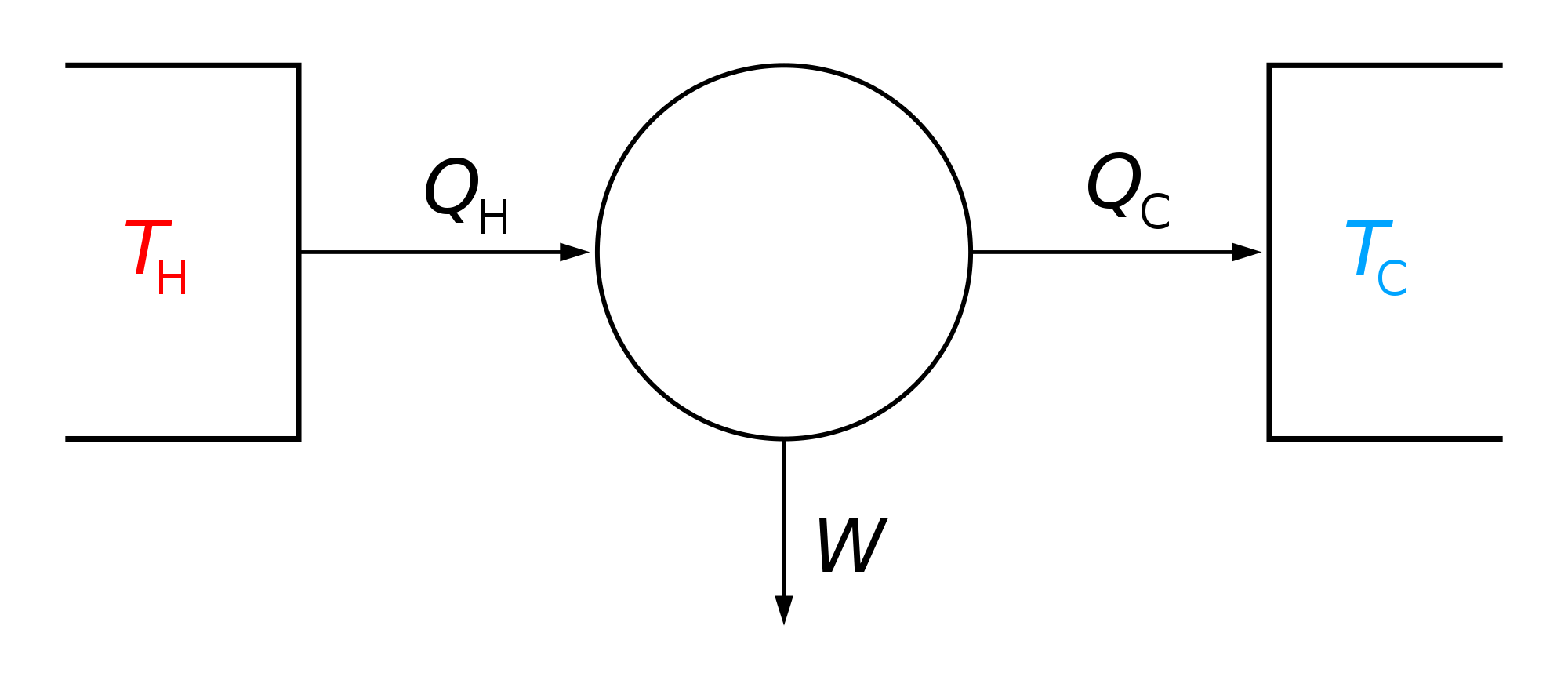
In a Carnot cycle, a system or engine transfers energy in the form of heat between two thermal reservoirs at temperatures and (referred to as the hot and cold reservoirs, respectively), and a part of this transferred energy is converted to the work done by the system. The cycle is reversible, merely transferring thermal energy between the thermal reservoirs and the system without gain or loss. When work is applied to the system, heat moves from the cold to hot reservoir (heat pump or refrigeration). When heat moves from the hot to the cold reservoir, the system applies work to the environment. The work done by the system or engine to the environment per Carnot cycle depends on the temperatures of the thermal reservoirs per cycle such as , where is heat transferred from the hot reservoir to the system per cycle.

External videos
video icon Carnot cycle from The Mechanical Universe

Stages

[edit]

A Carnot cycle is an idealized thermodynamic cycle performed by a Carnot heat engine, consisting of the following steps:

  1. Isothermal expansion. Heat (as an energy) is transferred reversibly from the hot temperature reservoir at constant temperature TH to the gas at a temperature infinitesimally less than TH. (The infinitesimal temperature difference allows the heat to transfer into the gas without a significant change in the gas temperature. This is called isothermal heat addition or absorption.) During this step (1 to 2 on Figure 1), the gas is in thermal contact with the hot temperature reservoir, and is thermally isolated from the cold temperature reservoir. The gas is allowed to expand, doing work on the surroundings by pushing up the piston (Stage One figure, right). Although the pressure drops from points 1 to 2 (figure 1) the temperature of the gas does not change during the process because the heat transferred from the hot temperature reservoir to the gas is exactly used to do work on the surroundings by the gas. There is no change in the gas internal energy, and no change in the gas temperature. Heat QH > 0 is absorbed from the hot temperature reservoir. Note: the text in this image incorrectly states "the heat ... is absorbed by the ideal gas particles..." There are no gas particles in the ideal gas model. In the ideal gas model, the gas is a continuum with state variables: Pressure and Temperature. Molecular weight and molecular symmetry are relevant to the molecular theory of gas, not the ideal gas model. Molecules don't absorb or emit heat, and molecules are not part of the ideal gas model. The text should read:"the heat ... is absorbed by the gas as internal energy ..."

  2. (reversible adiabatic) expansion of the gas ( work output). For this step (2 to 3 on Figure 1) the gas in the engine is thermally insulated from both the hot and cold reservoirs, thus they neither gain nor lose heat. It is an adiabatic process. The gas continues to expand with reduction of its pressure, doing work on the surroundings (raising the piston; Stage Two figure, right), and losing an amount of internal energy equal to the work done. The loss of internal energy causes the gas to cool. In this step it is cooled to a temperature that is infinitesimally higher than the cold reservoir temperature TC. Note: the text in this image incorrectly states "...allows the gas particles to cool..." There are no gas particles in the ideal gas model. The text should read:"...allows the gas to cool..."

  3. Isothermal compression. Heat is transferred reversibly to the low temperature reservoir at a constant temperature TC (isothermal heat rejection). In this step (3 to 4 on Figure 1), the gas in the engine is in thermal contact with the cold reservoir at temperature TC, and is thermally isolated from the hot reservoir. The gas temperature is infinitesimally higher than TC to allow heat transfer from the gas to the cold reservoir. There is no change in temperature, it is an isothermal process. The surroundings do work on the gas, pushing the piston down (Stage Three figure, right). An amount of energy earned by the gas from this work exactly transfers as a heat energy QC < 0 (negative as leaving from the system, according to the universal convention in thermodynamics) to the cold reservoir.

  4. Compression. (4 to 1 on Figure 1) Once again the gas in the engine is thermally insulated from the hot and cold reservoirs, and the engine is assumed to be frictionless and the process is slow enough, hence reversible. During this step, the surroundings do work on the gas, pushing the piston down further (Stage Four figure, right), increasing its internal energy, compressing it, and causing its temperature to rise back to the temperature infinitesimally less than TH due solely to the work added to the system. At this point the gas is in the same state as at the start of step 1.

Figure 1: A Carnot cycle illustrated on a PV diagram to illustrate the work done. 1-to-2 (isothermal expansion), 2-to-3 (adiabatic expansion), 3-to-4 (isothermal compression), 4-to-1 (adiabatic compression).

In this case, since it is a reversible thermodynamic cycle (no net change in the system and its surroundings per cycle)[1][2]
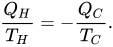
This is true as and are both smaller in magnitude and in fact are in the same ratio as .

The pressure–volume graph

[edit]

When a Carnot cycle is plotted on a pressure–volume diagram (Figure 1), the isothermal stages follow the isotherm lines for the working fluid, the adiabatic stages move between isotherms, and the area bounded by the complete cycle path represents the total work that can be done during one cycle. From point 1 to 2 and point 3 to 4 the temperature is constant (isothermal process). Heat transfer from point 4 to 1 and point 2 to 3 are equal to zero (adiabatic process).

Properties and significance

[edit]
Figure 4: A Carnot cycle taking place between a hot reservoir at temperature TH and a cold reservoir at temperature TC.

The Carnot cycle

[edit]
Figure 5: A visualization of a Carnot cycle

Evaluation of the above integral is particularly simple for a Carnot cycle. Due to energy conservation, the net heat transferred, , is equal to the work performed[2]


The efficiency is defined to be:

where

  • W is the work done by the system (energy exiting the system as work),
  • > 0 is the heat taken from the system (heat energy leaving the system),
  • > 0 is the heat put into the system (heat energy entering the system),
  • is the absolute temperature of the cold reservoir, and
  • is the absolute temperature of the hot reservoir.

This is the Carnot heat engine working efficiency definition as the fraction of the work done by the system to the thermal energy received by the system from the hot reservoir per cycle. This thermal energy is the cycle initiator.

Reversed Carnot cycle

[edit]

A Carnot heat-engine cycle described is a totally reversible cycle. That is, all the processes that compose it can be reversed, in which case it becomes the Carnot heat pump and refrigeration cycle. This time, the cycle remains exactly the same except that the directions of any heat and work interactions are reversed. Heat is absorbed from the low-temperature reservoir, heat is rejected to a high-temperature reservoir, and a work input is required to accomplish all this. The PV diagram of the reversed Carnot cycle is the same as for the Carnot heat-engine cycle except that the directions of the processes are reversed.[3]

Carnot's theorem

[edit]

It can be seen from the above diagram that for any cycle operating between temperatures and , none can exceed the efficiency of a Carnot cycle.

Carnot's theorem is a formal statement of this fact: No engine operating between two heat reservoirs can be more efficient than a Carnot engine operating between those same reservoirs. Thus, Equation 3 gives the maximum efficiency possible for any engine using the corresponding temperatures. A corollary to Carnot's theorem states that: All reversible engines operating between the same heat reservoirs are equally efficient. Rearranging the right side of the equation gives what may be a more easily understood form of the equation, namely that the theoretical maximum efficiency of a heat engine equals the difference in temperature between the hot and cold reservoir divided by the absolute temperature of the hot reservoir. Looking at this formula an interesting fact becomes apparent: Lowering the temperature of the cold reservoir will have more effect on the ceiling efficiency of a heat engine than raising the temperature of the hot reservoir by the same amount. In the real world, this may be difficult to achieve since the cold reservoir is often an existing ambient temperature.


In mesoscopic heat engines, work per cycle of operation in general fluctuates due to thermal noise. If the cycle is performed quasi-statically, the fluctuations vanish even on the mesoscale.[4] However, if the cycle is performed faster than the relaxation time of the working medium, the fluctuations of work are inevitable. Nevertheless, when work and heat fluctuations are counted, an exact equality relates the exponential average of work performed by any heat engine to the heat transfer from the hotter heat bath.[5]

Efficiency of real heat engines

[edit]

Carnot realized that, in reality, it is not possible to build a thermodynamically reversible engine. So, real heat engines are even less efficient than indicated by Equation 3. In addition, real engines that operate along the Carnot cycle style (isothermal expansion / adiabatic expansion / isothermal compression / adiabatic compression) are rare. Nevertheless, Equation 3 is extremely useful for determining the maximum efficiency that could ever be expected for a given set of thermal reservoirs.

This can help illustrate, for example, why a reheater or a regenerator can improve the thermal efficiency of steam power plants by increasing the value of and why the thermal efficiency of combined-cycle power plants (which incorporate gas turbines operating at even higher temperatures) exceeds that of conventional steam plants. The first prototype of the diesel engine was based on the principles of the Carnot cycle.

As a macroscopic construct

[edit]

The Carnot heat engine is, ultimately, a theoretical construct based on an idealized thermodynamic system. On a practical human-scale level the Carnot cycle has proven a valuable model, as in advancing the development of the diesel engine. However, on a macroscopic scale limitations placed by the model's assumptions prove it impractical, and, ultimately, incapable of doing any work.[6] As such, per Carnot's theorem, the Carnot engine may be thought as the theoretical limit of macroscopic scale heat engines rather than any practical device that could ever be built.[7]

See also

[edit]

References

[edit]
[edit]
Revisions and contributorsEdit on WikipediaRead on Wikipedia
from Grokipedia
The Carnot cycle is a theoretical thermodynamic cycle that achieves the highest possible efficiency for converting heat into work in a heat engine operating between two fixed temperatures, consisting of four reversible processes: two isothermal and two adiabatic. Proposed by French engineer and physicist Nicolas Léonard Sadi Carnot in 1824, it was detailed in his seminal work Réflexions sur la puissance motrice du feu et sur les machines propres à développer cette puissance (Reflections on the Motive Power of Fire and on Machines Fitted to Develop That Power), which analyzed the efficiency of steam engines and laid the foundation for the second law of thermodynamics, based on the then-prevailing caloric theory of heat. In the cycle, an ideal working substance—such as a perfect gas—undergoes isothermal expansion at the hot reservoir temperature ThT_h, absorbing QhQ_h; followed by adiabatic expansion to the cold reservoir temperature TcT_c; then isothermal compression at TcT_c, rejecting QcQ_c; and finally adiabatic compression back to the initial state. These processes are represented on a pressure-volume as a closed loop, with the area enclosed equaling the net work output. The efficiency η\eta of the Carnot cycle is η=1TcTh\eta = 1 - \frac{T_c}{T_h}, where temperatures are in , providing an upper bound for any reversible and demonstrating that depends solely on temperatures, not the . This formula implies no engine can convert all heat to work, as some must be rejected to the cold , a principle central to the second law of . Carnot's cycle, later formalized with concepts by and William Thomson () in the 1850s, underpins the analysis of real engines like internal combustion and systems, highlighting irreversibilities that reduce practical efficiencies below the Carnot limit. Its reversible nature makes it a benchmark for thermodynamic performance, influencing fields from power generation to climate modeling.

History

Sadi Carnot's Contributions

(1796–1832) was a French military engineer whose brief career bridged the and the early . Born in on June 1, 1796, as the son of , a renowned and revolutionary leader, Sadi entered the in 1812 and graduated in 1814 amid the turmoil of Napoleon's final campaigns. He then pursued advanced studies in military engineering at the École d'Application in , serving as an officer in the until his resignation in 1828, when he turned to independent engineering research. Disillusioned by France's technological lag behind Britain in development, Carnot shifted focus to engineering research, driven by a patriotic desire to enhance national industrial competitiveness through improved efficiency. In 1824, at age 28, Carnot published his seminal work, Réflexions sur la puissance motrice du feu et sur les machines propres à développer cette puissance (Reflections on the Motive Power of Fire and on Machines Fitted to Develop that Power), a slim volume of 118 pages issued at his own expense in Paris, with 600 copies printed. Drawing on observations of steam engines, Carnot proposed an idealized theoretical cycle for a heat engine operating reversibly between two heat reservoirs at different temperatures, positing that this configuration yields the maximum possible motive power from heat. He envisioned the engine as a closed system where a working fluid undergoes a sequence of transformations, absorbing heat from a hot reservoir and rejecting it to a cold one, without specifying the fluid's nature to emphasize universality. Carnot's original framework centered on the principle that an engine's is bounded by the disparity between the reservoirs, independent of the processes or substances involved, and achievable only through reversible operations that avoid dissipative losses. He described the cycle's core changes as isothermal expansions and compressions—where the interacts with the reservoirs at constant —interlinked by adiabatic transformations, in which no is exchanged. This , rooted in the then-prevailing yet presciently abstract, highlighted reversible processes as the cornerstone for attaining peak performance, laying groundwork for thermodynamic ideals without resolving heat's nature. Despite its insight, Carnot's treatise garnered little attention during his lifetime; he died of in 1832, with only a few copies sold during his lifetime. The work's significance emerged in the 1850s through independent rediscoveries: William Thomson (later ) encountered it in 1848 while studying heat engines and incorporated its principles into his absolute temperature scale by 1851, while Rudolf Clausius referenced it in his 1850 memoir on heat efficiency, adapting the cycle to articulate foundational thermodynamic principles. These efforts propelled Carnot's ideas into prominence, transforming his overlooked analysis into a pillar of .

Historical Context and Influences

The Carnot cycle emerged during the height of the , when were transforming economies in Britain and . James Watt's 1769 patent for an improved , featuring a separate condenser, boosted from the Newcomen engine's roughly 1% to about 2-3%, enabling broader applications in , , and transportation. By the early 19th century, the demand for even greater efficiency was acute in , where engineers sought to rival British industrial dominance amid resource constraints and military needs, prompting theoretical analyses of heat engines to optimize performance without excessive fuel consumption. Preceding Carnot's work, the dominated understandings of , positing it as an invisible, self-repellent that flows from hotter to colder bodies without creation or destruction, a concept advanced by in the late 18th century through experiments like the ice calorimeter co-developed with . Laplace extended this by treating as a conserved in , influencing early thermodynamic models, while Joseph Fourier's 1822 Théorie Analytique de la Chaleur established the mathematical framework for conduction via partial differential equations, independent of caloric assumptions yet providing tools that indirectly shaped Carnot's critique of inefficient engines and fallacies. These ideas framed as a transferable substance, allowing Carnot to model engine cycles without invoking mechanical equivalents initially. Following the 1824 publication of Réflexions sur la puissance motrice du feu, Carnot's ideas faced initial neglect and critique from contemporaries focused on practical , though they gained traction through Émile Clapeyron's 1834 graphical reformulation. By the mid-19th century, William Thomson (later ) in 1848 adapted Carnot's principle to define an absolute temperature scale, reconciling it with emerging laws, while in 1850 reformulated the cycle within a mechanical theory of , introducing the concept of and fully abandoning caloric in favor of heat-work equivalence. This integration marked the foundation of classical , emphasizing reversible processes over caloric flow. In a revealing 1830 on expansion in engines, unpublished until 1878, Carnot began shifting toward these mechanical views, analyzing variable steam volumes and foreshadowing the first law of through detailed calculations.

Fundamental Concepts

Reversible Processes

A reversible thermodynamic process is one in which both the system and its surroundings can be returned to their exact initial states without any net change in the universe, achieved through a series of infinitesimal steps where the system remains in thermodynamic equilibrium at every stage. This contrasts with irreversible processes, where dissipation such as friction or uncontrolled heat transfer leaves permanent changes. Key characteristics of reversible processes include their quasi-static nature, meaning they proceed infinitely slowly to maintain equilibrium, with no dissipative effects like or that would generate . Additionally, for state functions such as or , the integrals along the forward and reverse paths are equal, ensuring no net work or is lost to irreversibilities. Examples of reversible processes include the isothermal expansion or compression of an , where heat exchange with a keeps constant while the system follows the equilibrium path defined by the . Another is a reversible , such as the frictionless expansion of a gas in an insulated container with no heat loss to the surroundings, preserving constant . The mathematical foundation for reversible work in a process depicted on a pressure-volume (PV) diagram is given by the infinitesimal work element: δW=PdV\delta W = -P \, dV where PP is the and dVdV is the volume change, integrated along the equilibrium path to yield the maximum possible work for a given change. In contrast, an like free expansion into a performs no work (W=0W = 0) despite a volume increase, as there is no opposing . Reversible processes serve as the ideal prerequisite for the Carnot cycle, which assumes them to achieve the theoretical maximum by eliminating all irreversibilities that would reduce useful work output.

Heat Reservoirs and the Second Law

Thermal reservoirs, also known as reservoirs, are idealized bodies with infinite that maintain a constant regardless of the amount of transferred to or from them. In the context of thermodynamic cycles like the Carnot cycle, two such reservoirs are typically involved: a hot reservoir at ThT_h serving as a heat source, and a cold reservoir at TcT_c (where Th>TcT_h > T_c) acting as a sink. These reservoirs enable isothermal heat transfers, where the working fluid absorbs QhQ_h from the hot reservoir and rejects QcQ_c to the cold reservoir without altering the temperatures of the reservoirs themselves. The second law of thermodynamics imposes fundamental constraints on heat engines interacting with these reservoirs, establishing limits on the conversion of into work. The Kelvin-Planck statement asserts that it is impossible for any device operating in a cycle to absorb from a single reservoir and convert it entirely into work without producing other effects. Similarly, the Clausius statement declares that it is impossible to construct a cyclic device whose sole effect is to transfer from a colder body to a hotter body without external work input. Together, these statements prohibit machines of the second kind, which would violate the directional flow of energy dictated by temperature differences. Sadi Carnot's 1824 analysis of engines operating between two reservoirs anticipated these limits, demonstrating that depends solely on the reservoir temperatures and setting an upper bound unachievable by real engines. This insight was later formalized as the second law by in the 1850s, who reconciled Carnot's with James Joule's work on as motion, integrating the concept into a broader framework of and irreversibility. A key concept emerging from these constraints is , a that quantifies the degree of irreversibility in thermodynamic processes. For reversible processes, the change in ΔS\Delta S is defined as: ΔS=dQrevT\Delta S = \int \frac{dQ_\text{rev}}{T} where dQrevdQ_\text{rev} is the infinitesimal reversible and TT is the absolute . This definition highlights how increases in irreversible processes involving heat reservoirs, underscoring the second law's prohibition on reversing natural flows without work.

Cycle Description

The Four Stages

The Carnot cycle consists of four reversible processes executed with an as the in a , returning the gas to its initial state after one complete cycle and producing net positive work given by the W=PdV>0W = \oint P \, dV > 0. These stages are enabled by reversible processes and interaction with two heat reservoirs at constant temperatures ThT_h (hot) and TcT_c (cold). Each stage is reversible, resulting in no net over the cycle. Stage 1: Isothermal Expansion. In the first stage, the undergoes reversible isothermal expansion at the hot temperature ThT_h, absorbing QhQ_h from the while the increases from V1V_1 to V2V_2. The system performs work on the surroundings during this expansion, with the remaining constant due to the isothermal condition for an . Stage 2: Adiabatic Expansion. The second stage involves reversible adiabatic expansion, during which no is transferred to or from the , and the gas decreases from ThT_h to TcT_c as the volume expands further to V3V_3. This cooling occurs through a decrease in the gas's , which is converted into additional work done by the . Stage 3: Isothermal Compression. In the third stage, the gas experiences reversible isothermal compression at the cold reservoir temperature TcT_c, rejecting heat QcQ_c to the cold reservoir as the volume decreases from V3V_3 to V4V_4. Work is done on the system by the surroundings during this compression, maintaining constant internal energy for the ideal gas. Stage 4: Adiabatic Compression. The final stage is reversible adiabatic compression, with no , raising the gas back from TcT_c to ThT_h as reduces to the initial value V1V_1. The increase in during this process is achieved through work input from the surroundings, completing the cycle.

Thermodynamic Diagrams

The Carnot cycle is commonly represented graphically using thermodynamic diagrams that plot key state variables, aiding in the visualization of the cycle's processes and quantities such as work and heat transfer. The two primary diagrams are the pressure-volume (PV) diagram and the temperature-entropy (TS) diagram, each offering distinct insights into the cycle's behavior for an ideal working fluid like a gas. In the PV diagram, the Carnot cycle appears as a closed loop consisting of two isothermal processes depicted as hyperbolic curves and two adiabatic processes shown as steeper curves connecting them. The isothermal expansion occurs along a at the higher ThT_h, where decreases as increases while is absorbed; this is followed by an adiabatic expansion along a curve where no heat is exchanged, leading to a drop to TcT_c. The isothermal compression at TcT_c traces another with decreasing and heat rejected, and the adiabatic compression returns to the initial state along a steeper curve. For an , the adiabatic processes follow the relation PVγ=constantPV^\gamma = \text{constant}, where γ=Cp/Cv\gamma = C_p / C_v is the ratio of specific heats, resulting in curves that are steeper than the isotherms due to the absence of . The area enclosed by this loop represents the net work output of the cycle per unit mass or mole, providing a direct graphical measure of the engine's performance. The TS diagram presents the Carnot cycle as a rectangle, with temperature plotted vertically and entropy horizontally, offering a clearer view of heat transfers and entropy changes. The top horizontal line at ThT_h represents the isothermal expansion, spanning an entropy increase of ΔS=Qh/Th\Delta S = Q_h / T_h, where QhQ_h is the heat absorbed; the right vertical line is the adiabatic expansion, where entropy remains constant (ΔS=0\Delta S = 0) as temperature decreases to TcT_c. The bottom horizontal line at TcT_c shows the isothermal compression with an entropy decrease of ΔS=Qc/Tc\Delta S = Q_c / T_c (where QcQ_c is the magnitude of heat rejected), and the left vertical adiabat returns to the starting entropy with no change. The heights of the rectangle correspond to ThT_h and TcT_c, while the widths reflect the normalized heat transfers Qh/ThQ_h / T_h and Qc/Tc|Q_c| / T_c, which are equal in magnitude for the cycle. The enclosed area of the rectangle equals the net work, (ThTc)ΔS(T_h - T_c) \Delta S, but more importantly, the closed loop with vertical adiabats visually confirms the cycle's reversibility, as the net entropy change over the cycle is zero (ΔScycle=0\Delta S_\text{cycle} = 0), distinguishing it from irreversible processes that would show a net entropy production. These diagrams complement each other in analysis: the PV diagram is particularly useful for calculating work through the enclosed area and understanding volume and pressure variations during the four stages, while the TS diagram excels in illustrating balances and heat interactions, emphasizing the theoretical limits imposed by the second law. Both confirm the cycle's closure, returning to the initial after completing the processes.

Thermodynamic Analysis

Heat and Work Calculations

The analysis of the Carnot cycle often assumes an as the working substance, for which the UU depends solely on , with the change given by ΔU=nCvΔT\Delta U = n C_v \Delta T, where nn is the number of moles, CvC_v is the at constant volume, and ΔT\Delta T is the change. For the isothermal processes in the cycle, ΔT=0\Delta T = 0, so ΔU=0\Delta U = 0. In the first stage, reversible isothermal expansion at the hot reservoir temperature ThT_h, the system absorbs heat QhQ_h from the reservoir while expanding from volume V1V_1 to V2>V1V_2 > V_1. The heat transfer is Qh=nRThln(V2/V1)Q_h = n R T_h \ln(V_2 / V_1), where RR is the universal gas constant. Using the first law of (ΔU=QW\Delta U = Q - W, with WW as work done by the system), ΔU=0\Delta U = 0 implies the work done by the system W1=Qh>0W_1 = Q_h > 0. The second stage is reversible adiabatic expansion, with no heat transfer (Q2=0Q_2 = 0). The temperature drops from ThT_h to the cold reservoir temperature Tc<ThT_c < T_h, so ΔU2=nCv(TcTh)<0\Delta U_2 = n C_v (T_c - T_h) < 0. By the first law, the work done by the system is W2=ΔU2=nCv(ThTc)>0W_2 = -\Delta U_2 = n C_v (T_h - T_c) > 0. During the third stage, reversible isothermal compression at TcT_c, the system rejects heat QcQ_c to the cold reservoir while the volume decreases from V3V_3 to V4<V3V_4 < V_3. The heat transfer is Qc=nRTcln(V4/V3)Q_c = n R T_c \ln(V_4 / V_3), which is negative due to the volume ratio being less than unity, and the magnitude Qc<Qh|Q_c| < Q_h. With ΔU3=0\Delta U_3 = 0, the work done by the system is W3=Qc<0W_3 = Q_c < 0, corresponding to work input to the system of magnitude W3=Qc|W_3| = |Q_c|. The fourth stage is reversible adiabatic compression, again with Q4=0Q_4 = 0. The temperature rises from TcT_c to ThT_h, yielding ΔU4=nCv(ThTc)>0\Delta U_4 = n C_v (T_h - T_c) > 0. The work done by the system is W4=ΔU4=nCv(TcTh)<0W_4 = -\Delta U_4 = n C_v (T_c - T_h) < 0, corresponding to work input to the system of magnitude W4=nCv(ThTc)|W_4| = n C_v (T_h - T_c). Over the complete cycle, the net work output is the sum of the stage works: Wnet=W1+W2+W3+W4=Qh+QcW_\text{net} = W_1 + W_2 + W_3 + W_4 = Q_h + Q_c (noting Qc<0Q_c < 0), or equivalently Wnet=QhQcW_\text{net} = Q_h - |Q_c|. The total change in internal energy is zero (ΔUcycle=0\Delta U_\text{cycle} = 0), as expected for a cyclic process, confirming the first law balance δQ=δW\oint \delta Q = \oint \delta W. Due to the reversibility of all processes, the cycle satisfies Qh/Th=Qc/TcQ_h / T_h = - Q_c / T_c.

Efficiency Derivation

The thermal efficiency η\eta of a heat engine is defined as the net work output divided by the heat input from the hot reservoir, η=Wnet/Qh\eta = W_\text{net} / Q_h. For a cyclic process, the first law of thermodynamics gives Wnet=QhQcW_\text{net} = Q_h - |Q_c|, where Qc|Q_c| is the magnitude of the heat rejected to the cold reservoir, yielding η=1Qc/Qh\eta = 1 - |Q_c| / Q_h. In the Carnot cycle, heat transfers occur isothermally at the hot reservoir temperature ThT_h and cold reservoir temperature TcT_c. For reversible processes, the second law implies that the total entropy change over the cycle is zero, dQrev/T=0\oint dQ_\text{rev} / T = 0. Since no heat is exchanged during the adiabatic stages, this reduces to Qh/Th+Qc/Tc=0Q_h / T_h + Q_c / T_c = 0. With QcQ_c negative, Qc/Tc=Qh/Th|Q_c| / T_c = Q_h / T_h, so Qc/Qh=Tc/Th|Q_c| / Q_h = T_c / T_h. Thus, the efficiency is η=1Tc/Th\eta = 1 - T_c / T_h, with temperatures in Kelvin. This result assumes full reversibility in all stages; any irreversibility, such as friction or non-quasistatic processes, reduces the efficiency below this value. The formula depends solely on the reservoir temperatures, independent of the working fluid, establishing it as the theoretical maximum for heat engines between ThT_h and TcT_c. This derivation forms the basis for Carnot's theorem on efficiency limits. For an ideal gas working substance, the ratio can be confirmed via stage-specific calculations. During isothermal expansion at ThT_h, Qh=nRThln(V2/V1)Q_h = n R T_h \ln(V_2 / V_1); during isothermal compression at TcT_c, Qc=nRTcln(V3/V4)|Q_c| = n R T_c \ln(V_3 / V_4). The adiabatic stages relate volumes such that ln(V2/V1)=ln(V3/V4)\ln(V_2 / V_1) = \ln(V_3 / V_4), derived from the adiabatic condition TVγ1=constantT V^{\gamma - 1} = \text{constant}, giving Th/Tc=(V3/V2)γ1=(V4/V1)γ1T_h / T_c = (V_3 / V_2)^{\gamma - 1} = (V_4 / V_1)^{\gamma - 1}. This equality ensures Qc/Qh=Tc/Th|Q_c| / Q_h = T_c / T_h.

Significance

Carnot's Theorem

Carnot's theorem asserts that no heat engine operating between two thermal reservoirs at temperatures ThT_h (hot) and TcT_c (cold) can achieve an efficiency greater than that of a reversible engine, such as the , and that all reversible engines between the same reservoirs possess identical efficiency given by η=1TcTh\eta = 1 - \frac{T_c}{T_h}, where temperatures are in absolute scale. This establishes the Carnot efficiency as the universal upper bound for heat-to-work conversion, independent of the working substance or cycle details. The theorem was originally conceived by Sadi Carnot in 1824 but formally proved and popularized by William Thomson (Lord Kelvin) in 1851, who built upon Carnot's principles to align them with the emerging second law of thermodynamics. Kelvin's contribution emphasized the theorem's implications for the impossibility of perpetual motion machines of the second kind. A classical proof proceeds by contradiction: suppose an engine A operates irreversibly between the same reservoirs with efficiency ηA>η\eta_A > \eta (Carnot efficiency). Coupling A with a reversible Carnot engine B operated in reverse as a —absorbing from the cold reservoir and rejecting it to the hot one—yields a composite system where the net work input to B is less than the net work output from A, resulting in overall positive work from a single flow without increase, violating Clausius's statement of the second law that cannot spontaneously flow from cold to hot without work. Thus, no such engine A can exist, confirming the Carnot limit. An alternative proof invokes : in any irreversible engine, ΔS>0\Delta S > 0 within the system or surroundings reduces the available work compared to a reversible , where ΔS=0\Delta S = 0, thereby lowering the effective below the Carnot value. This entropic perspective, formalized post-Kelvin by Clausius, underscores that irreversibilities universally diminish performance. The theorem implies that the temperatures ThT_h and TcT_c alone dictate the absolute ceiling for any , rendering material choices and cycle configurations secondary to achieving reversibility.

Reversed Carnot Cycle

The reversed Carnot cycle functions as an ideal model for a or by executing the Carnot cycle processes in reverse order. It consists of four reversible stages: adiabatic compression of the , isothermal heat rejection to the hot at ThT_h, adiabatic expansion, and isothermal heat absorption from the cold at TcT_c. In operation, the cycle absorbs heat Qc|Q_c| from the cold during the isothermal expansion at TcT_c and rejects heat QhQ_h to the hot during the isothermal compression at ThT_h. This process transfers heat from the lower- reservoir to the higher- one, opposing the natural thermal gradient, and requires a net work input W=QhQcW = Q_h - |Q_c| to drive the cycle. The performance of the reversed Carnot cycle is quantified by the (COP). For , the COP is defined as the ratio of absorbed from the cold reservoir to the work input: COPR=QcW\text{COP}_R = \frac{|Q_c|}{W} For a reversible cycle, this yields COPR=TcThTc.\text{COP}_R = \frac{T_c}{T_h - T_c}. For example, consider a refrigeration cycle operating between a cold reservoir at Tc=2CT_c = -2^\circ \text{C} (271 K) and a hot reservoir at Th=39CT_h = 39^\circ \text{C} (312 K). The Carnot COP for refrigeration is then COPR=271312271=271416.61.\text{COP}_R = \frac{271}{312 - 271} = \frac{271}{41} \approx 6.61. For pumping, the COP measures the delivered to the hot reservoir per unit work: COPH=QhW=ThThTc.\text{COP}_H = \frac{Q_h}{W} = \frac{T_h}{T_h - T_c}. These COP expressions derive from the second law of thermodynamics applied to reversible processes, where the change is zero over the cycle, implying QhTh=QcTc\frac{Q_h}{T_h} = \frac{|Q_c|}{T_c}. Substituting into the work relation W=QhQcW = Q_h - |Q_c| gives W=Qc(ThTc1)W = |Q_c| \left( \frac{T_h}{T_c} - 1 \right), leading directly to the temperature-based COP formulas. The reversed Carnot cycle establishes the theoretical maximum COP for any or heat pumping device operating between two fixed temperatures; irreversible real-world systems can approach but never surpass this bound due to generation. This limit extends Carnot's to reversed operations.

Real-World Applications

Ideal versus Actual Engines

The Carnot cycle represents an idealized that operates under strict assumptions of reversibility, wherein all processes occur quasi-statically over infinite time to maintain equilibrium, with no mechanical , perfect to eliminate leaks, and no dissipative losses. These conditions ensure that the cycle achieves the theoretical maximum for given reservoir temperatures, as dictated by the second law of thermodynamics. In contrast, actual heat engines encounter fundamental limitations from irreversibilities that deviate from these ideals. Mechanical friction in pistons, bearings, and turbines dissipates energy as , while unintended leaks occur across gradients due to imperfect insulation. Operations at finite speeds introduce non-equilibrium effects, such as and gradients within the , and material constraints—such as strength limits at high temperatures or —restrict achievable conditions. These factors collectively reduce the conversion of to work, making real engines inherently less efficient than their Carnot counterparts. This efficiency gap is evident in practical applications: Otto cycle engines in gasoline vehicles typically attain 20-30% thermal efficiency, and Diesel engines achieve 30-40%, far below the Carnot limit of 50-70% for comparable hot reservoir temperatures around 800-1000 and cold reservoirs near 300 . For instance, steam turbines in conventional power plants operate at 30-40% , compared to a Carnot of about 60% under similar temperature conditions. The second law of thermodynamics remains valid for real engines, mandating that their is strictly less than the Carnot efficiency because irreversibilities generate (S_gen > 0), increasing the total entropy of the universe and limiting available work output. loss, representing the destruction of useful energy potential, and availability analysis further quantify these inefficiencies by assessing how much work could have been extracted under reversible conditions but is lost due to such .

Practical Approximations and Examples

Engineers approximate the Carnot cycle in practical heat engines through techniques such as multi-stage compression and expansion to better mimic isentropic processes, regenerative heating to recover internally, and the use of high-temperature materials like nickel-based superalloys for blades to approach higher hot-reservoir temperatures. These methods reduce irreversibilities and elevate the average temperature during addition, thereby increasing closer to the Carnot limit without achieving perfect reversibility. In steam power plants, the Rankine cycle serves as a key approximation to the Carnot cycle, particularly through superheating the steam to raise the temperature of heat addition and avoid wet steam erosion in turbines, which enhances efficiency by making the process more akin to the isothermal expansion stage. The Stirling engine provides another near-reversible approximation via its internal regenerator, which stores and reuses heat during cyclic compression and expansion of a fixed gas volume, theoretically matching Carnot efficiency under ideal conditions. In automotive applications, the Otto cycle partially approximates the Carnot cycle through its isentropic compression and expansion phases, though constant-volume heat addition limits its efficiency compared to the ideal isothermal processes. Historically, the , patented in 1849 and widely adopted in the 1850s, improved efficiency by about 30% over conventional engines through advanced that enabled variable cutoff and better distribution, advancing practical performance toward theoretical limits like those of the Carnot cycle. In modern power generation, combined-cycle gas turbines integrate Brayton and Rankine cycles to achieve efficiencies exceeding 60%, approaching Carnot bounds by utilizing exhaust from the gas turbine to drive a , with overall performance enhanced by high inlet temperatures. For , the in jet engines relies on isentropic approximations for compressor and stages, while cooling techniques—such as internal air channels and coatings—allow operation near material limits to sustain high temperatures and boost efficiency. Future trends in heat engines emphasize , including ceramics and nickel superalloys with improved creep resistance, to enable higher operating temperatures and further narrow the gap to Carnot ; for example, as of 2025, Carnot Engines has developed a hydrogen-fueled that achieves approximately 70% of the theoretical Carnot , demonstrated in a 40-day . However, the second law of imposes fundamental caps, preventing efficiencies from exceeding the theoretical maximum for given reservoir temperatures.

Theoretical Interpretations

Macroscopic Construct

The Carnot cycle, from a macroscopic perspective, models the working substance as a continuum characterized by bulk thermodynamic properties such as PP, VV, TT, and SS. This approach treats the system as a continuous medium without regard to its underlying molecular structure, focusing instead on aggregate behaviors. The cycle is conceptualized as a closed sequence of four reversible processes—two isothermal and two adiabatic—that connect a series of states, ensuring that the system returns to its initial condition after one full loop. This macroscopic framework offers significant advantages for analysis at engineering scales, where it provides reliable predictions of system performance by emphasizing average properties over microscopic fluctuations. By disregarding atomic-level details, the model simplifies computations and enables the design of practical heat engines that approximate ideal behavior under continuum assumptions. The formulation of the Carnot cycle relies on the foundational laws of classical : the zeroth law establishing equilibrium, conserving through ΔU=[Q](/page/Q)[W](/page/W)\Delta U = [Q](/page/Q) - [W](/page/W), and the second law dictating the directionality of flow and increase. State functions like UU, H=U+PVH = U + PV (relevant for considering potential open-system extensions), and SS are employed to describe path-independent changes across the cycle's equilibrium states. As a , the Carnot cycle serves to empirically validate the second law by demonstrating that no can exceed its derived bound, η=1TCTH\eta = 1 - \frac{T_C}{T_H}, thereby establishing an upper limit on heat-to-work conversion without invoking microscopic mechanisms. This macroscopic output underscores the cycle's role in setting theoretical benchmarks for real engines. However, the macroscopic construct of the Carnot cycle has limitations at small scales, where quantum coherence and finite-size statistical effects disrupt the continuum assumptions, allowing deviations from classical bounds and second-law predictions.

Microscopic and Statistical Views

In , the Carnot cycle is interpreted as the collective behavior of an ensemble of particles, where macroscopic thermodynamic quantities arise from averages over microscopic configurations. The system is modeled as a large number of interacting particles following Hamiltonian dynamics, with emerging as T=23kBp22mT = \frac{2}{3k_B} \left\langle \frac{p^2}{2m} \right\rangle, linking it directly to the average per degree of freedom, where kBk_B is Boltzmann's constant, pp is , and mm is mass. This probabilistic framework, developed in the late , shows how the cycle's isothermal and adiabatic processes correspond to controlled changes in the volume accessible to the particles, maintaining equilibrium distributions like the Maxwell-Boltzmann at each stage. Microscopic reversibility underpins this view, as the equations of motion for individual particles are time-symmetric, yet the Carnot cycle exhibits apparent irreversibility on macroscopic scales, raising : how can irreversible thermodynamic behavior derive from reversible microscopic laws? The resolution lies in the dependence on initial conditions; typical starting microstates in lead to trajectories that rapidly explore high- regions, making reverse evolution statistically improbable without precise preparation. Thus, the Carnot cycle traces reversible paths in , but its directionality emerges from the overwhelming probability of forward evolution due to entropy maximization. Entropy provides the key probabilistic justification, defined microscopically by Boltzmann as S=kBlnΩS = k_B \ln \Omega, where Ω\Omega counts the microstates consistent with a macrostate. In the Carnot cycle, the net entropy change ΔS=0\Delta S = 0 over the full loop implies equal Ω\Omega for the hot and cold reservoir interactions in forward and reverse directions, preserving reversibility as a balance of microstate multiplicities. The fluctuation-dissipation theorem bridges microscopic fluctuations to macroscopic dissipation, revealing how small-scale random motions in the working fluid generate the irreversible entropy production that upholds the second law in the Carnot cycle, even though individual particle paths are reversible. Molecular dynamics simulations, treating the system as interacting atoms, approximate these cycles by evolving trajectories under controlled potentials, confirming that efficiency bounds hold amid thermal noise. Recent advances extend this to quantum regimes, where Carnot-like cycles operate in nanoscale devices such as engines, with work and heat defined via quantum expectation values; however, the remains capped at 1Tc/Th1 - T_c / T_h, as quantum coherence cannot evade the without violating the second . Studies from the 2020s, including implementations with superconducting qubits, demonstrate these engines achieving near-Carnot performance under weak coupling. For instance, in 2025, experimental realizations using superconducting qubits have demonstrated cyclic quantum heat engines and absorption refrigerators operating near the Carnot limit under controlled thermal environments. This highlights ' universality across scales.

References

Add your contribution
Related Hubs
User Avatar
No comments yet.



