Recent from talks
Nothing was collected or created yet.
Lenoir cycle
View on Wikipedia| Thermodynamics |
|---|

The Lenoir cycle is an idealized thermodynamic cycle often used to model a pulse jet engine. It is based on the operation of an engine patented by Jean Joseph Etienne Lenoir in 1860. This engine is often thought of as the first commercially produced internal combustion engine. The absence of any compression process in the design leads to lower thermal efficiency than the more well known Otto cycle and Diesel cycle.
The cycle
[edit]In the cycle, an ideal gas undergoes[1][2]
- 1–2: Constant volume (isochoric) heat addition;
- 2–3: Isentropic expansion;
- 3–1: Constant pressure (isobaric) heat rejection.
The expansion process is isentropic and hence involves no heat interaction. Energy is absorbed as heat during the isochoric heating and rejected as work during the isentropic expansion. Waste heat is rejected during the isobaric cooling which consumes some work.
Constant volume heat addition (1–2)
[edit]In the ideal gas version of the traditional Lenoir cycle, the first stage (1–2) involves the addition of heat in a constant volume manner. This results in the following for the first law of thermodynamics:

There is no work during the process because the volume is held constant:
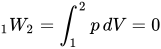
and from the definition of constant volume specific heats for an ideal gas:
Where R is the ideal gas constant and γ is the ratio of specific heats (approximately 287 J/(kg·K) and 1.4 for air respectively). The pressure after the heat addition can be calculated from the ideal gas law:
Isentropic expansion (2–3)
[edit]The second stage (2–3) involves a reversible adiabatic expansion of the fluid back to its original pressure. It can be determined for an isentropic process that the second law of thermodynamics results in the following:
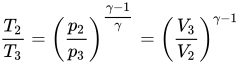
Where for this specific cycle. The first law of thermodynamics results in the following for this expansion process: because for an adiabatic process:
Constant pressure heat rejection (3–1)
[edit]The final stage (3–1) involves a constant pressure heat rejection back to the original state. From the first law of thermodynamics we find: .
From the definition of work: , we recover the following for the heat rejected during this process: .
As a result, we can determine the heat rejected as follows: . For an ideal gas, .
Efficiency
[edit]
The overall efficiency of the cycle is determined by the total work over the heat input, which for a Lenoir cycle equals
Note that we gain work during the expansion process but lose some during the heat rejection process. Alternatively, the first law of thermodynamics can be used to put the efficiency in terms of the heat absorbed and heat rejected,
Utilizing that, for the isobaric process, T3/T1 = V3/V1, and for the adiabatic process, T2/T3 = (V3/V1)γ−1, the efficiency can be put in terms of the compression ratio,
where r = V3/V1 is defined to be > 1. Comparing this to the Otto cycle's efficiency graphically, it can be seen that the Otto cycle is more efficient at a given compression ratio. Alternatively, using the relationship given by process 2–3, the efficiency can be put in terms of rp = p2/p3, the pressure ratio,[2]
Cycle diagrams
[edit]References
[edit]- ^ V. Ganesan (7 July 2008). Internal Combustion Engines. Tata McGraw-Hill Publishing Company. ISBN 9780070648173. Retrieved 2013-04-04.
- ^ a b Gupta, H. N. (2013-05-19). Fundamentals of Internal Combustion Engines (2nd ed.). PHI Learning Pvt. Ltd. p. 60. ISBN 9788120346802. Retrieved 2020-05-19.
Lenoir cycle
View on GrokipediaHistory and Background
Inventor and Development
Jean Joseph Étienne Lenoir (1822–1900), a self-taught Belgian engineer, is credited with inventing the first commercially viable internal combustion engine, which forms the basis of the Lenoir cycle. Born on January 12, 1822, in Mussy-la-Ville, Luxembourg (then part of the Kingdom of the Netherlands, later Belgium), Lenoir moved to Paris in 1838 after working various jobs, including as an electroplater. There, he experimented with electricity and gas applications, leading to his development of a novel engine in 1859 that burned fuel directly inside the cylinder rather than relying on external combustion like steam engines.[7][8] On January 24, 1860, Lenoir received French patent No. 43,224 for his "air motor expanded by gas combustion," describing a three-stroke operation: intake of a gas-air mixture, combustion via electric spark ignition, and exhaust. The engine featured a single-cylinder, double-acting design converted from a steam engine, with slide valves for admitting the fuel mixture and expelling exhaust, and no compression stroke for added mechanical simplicity. It ran on coal gas mixed with air, ignited by a "jumping spark" from a Ruhmkorff induction coil, making it one of the earliest uses of spark ignition in engines.[9][10][7] Lenoir's motivation stemmed from the desire to create a more compact and responsive power source than bulky steam engines, which required boilers and constant water supply, by enabling internal combustion without the complexity of compression. Early models were stationary, horizontal units producing around 2 horsepower from an 18-liter displacement at approximately 130 RPM, suitable for light industrial tasks like powering printing presses or pumps. By 1865, over 140 such engines had been sold in Paris, marking the cycle's initial commercialization.[8][11][7]Historical Significance
The Lenoir cycle powered the first commercially produced internal combustion engine, patented by Étienne Lenoir in 1860, marking a pivotal transition from external combustion engines like steam power to internal designs that burned fuel directly within the cylinder.[12] By 1865, several hundred units had been sold and deployed primarily for stationary applications such as water pumping and operating printing presses, demonstrating early practical viability for gaseous fuels like coal gas in industrial settings.[13] This engine predated Nikolaus Otto's four-stroke cycle by 16 years, with Otto's design patented in 1876, and represented a foundational step in proving the operational potential of spark-ignition internal combustion without compression, influencing the trajectory of engine evolution despite its rudimentary form.[14] However, the Lenoir engine's limitations—thermal efficiency of around 4%, excessive fuel consumption, and significant operational noise—contributed to its decline in the 1870s as Otto's more efficient cycle gained prominence.[15] Ultimately, the Lenoir cycle's historical significance lies in its role as a proof-of-concept for gaseous fuel combustion in reciprocating engines, paving the way for subsequent innovations in automotive and industrial power systems by highlighting the advantages of internal over external combustion.[5]Thermodynamic Description
Cycle Processes
The Lenoir cycle is an idealized thermodynamic cycle comprising three distinct processes that model the operation of certain pulse combustion engines, assuming the working fluid behaves as an ideal gas with constant specific heats.[2][16] The first process (1-2) is constant volume heat addition, or isochoric combustion, during which a fuel-air mixture is ignited within a fixed-volume chamber, such as a cylinder with the piston at top dead center, leading to a rapid increase in pressure and temperature while the volume remains constant at .[2] This heat input per unit mass is given by where is the specific heat at constant volume, and and are the temperatures at the initial and final states of this process, respectively; no work is performed during this step due to the absence of volume change.[16] The second process (2-3) involves isentropic expansion, an adiabatic and reversible process where the high-pressure gas drives the piston outward, converting thermal energy into mechanical work as the volume expands from to , resulting in a decrease in temperature to and pressure.[2] The work output per unit mass is with no heat transfer occurring.[16] The third process (3-1) is constant pressure heat rejection, or isobaric exhaust, in which the expanded gases are expelled from the chamber at constant pressure , cooling the working fluid back to the initial temperature and completing the cycle.[2] The heat rejected per unit mass is where is the specific heat at constant pressure; again, no work is performed as the volume change occurs without piston motion in the idealized model.[16] Unlike four-stroke cycles such as the Otto cycle, the Lenoir cycle lacks a dedicated compression process, relying instead on atmospheric pressure for intake and achieving closure through the isobaric exhaust stroke.[2]Key Assumptions and Idealizations
The Lenoir cycle is analyzed using the air-standard cycle framework, in which the working fluid is idealized as air behaving as a perfect gas. This assumption simplifies the thermodynamic modeling by applying the ideal gas law, , throughout the cycle, where deviations from ideality due to high temperatures or pressures are neglected.[17] A key idealization involves constant specific heats for the working fluid, with the specific heat at constant volume and at constant pressure treated as independent of temperature. This leads to a constant ratio for air, facilitating analytical derivations of temperatures and pressures across the cycle processes.[17][18] The cycle processes are further idealized as reversible to represent the theoretical maximum performance. The isochoric heat addition and isobaric heat rejection are assumed quasi-static, ensuring no entropy generation from finite-rate heat transfer, while the expansion is modeled as isentropic, excluding friction, turbulence, or heat transfer losses.[18] Unlike cycles with a compression stroke, the Lenoir cycle assumes no mechanical compression, with intake occurring at atmospheric pressure and the expansion defined by a volume ratio . This simplification overlooks real-engine valve timing losses, where imperfect synchronization leads to backflow or incomplete filling.[18] Under the air-standard approach, the working fluid is purely air, disregarding the chemical kinetics of fuel combustion, dissociation of combustion products, or variable composition during heat addition and rejection. This treats heat input as an external transfer rather than a reactive process.[17] In practice, these idealizations overestimate performance, as real Lenoir-based engines exhibit reduced efficiency from incomplete combustion, which fails to release all fuel energy; conductive and convective heat losses to cylinder walls and surroundings; and irreversible exhaust processes, including throttling and mixing losses.[17][18]Performance Analysis
Efficiency Derivation
The thermal efficiency of the idealized Lenoir cycle is derived from energy balances applied to its three processes: constant-volume heat addition (1-2), isentropic expansion (2-3), and constant-pressure heat rejection (3-1), assuming an ideal gas with constant specific heats.[3] The heat input during the constant-volume process 1-2 is given bywhere is the specific heat at constant volume, and , are the temperatures at states 1 and 2, respectively. The heat rejected during the constant-pressure process 3-1 is
where is the specific heat at constant pressure, and is the temperature at state 3. The net work output is the difference:
[3] The thermal efficiency is then
Since , this simplifies to
[3] To express in terms of the expansion ratio (noting ), apply the isentropic relation for process 2-3:
For the isobaric process 3-1 (), the ideal gas law yields , so
Equating the expressions for gives , or
Substituting into the differences: and , the efficiency becomes
[3] For the pressure relation during isentropic expansion, . Since and constant volume from 1-2 implies , this is consistent with the temperature relations derived above. The efficiency increases monotonically with , approaching unity asymptotically as increases; in idealized models, it can reach 25-50% for , though real implementations yield significantly lower values due to irreversibilities and incomplete expansion.[3][4]


