


Community hub
Recent from talks
Contribute something
Nothing was collected or created yet.
Forkhead box C1
View on Wikipedia


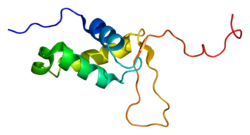
Forkhead box C1, also known as FOXC1, is a protein which in humans is encoded by the FOXC1 gene.[5][6][7]
Function
[edit]This gene belongs to the forkhead family of transcription factors which is characterized by a distinct DNA-binding fork head domain. The specific function of this gene has not yet been determined; however, it has been shown to play a role in the regulation of embryonic and ocular development.
Heart development and somitogenesis
[edit]FOXC1 and its close relative, FOXC2 are both critical components in the development of the heart and blood vessels, as well as the segmentation of the paraxial mesoderm and the formation of somites. Expression of the Fox proteins range from low levels in the posterior pre-somitic mesoderm (PSM) to the highest levels in the anterior PSM. Homozygous mutant embryos for both Fox proteins failed to form somites 1–8, which indicates the importance of these proteins early on in somite development.[8]
In cardiac morphogenesis, FOXC1 and FOXC2 are required for the proper development of the cardiac outflow tract. The outflow tract forms from a cell population known as the secondary heart field. The Fox proteins are transcribed in the secondary heart field where they regulate the expression of key signaling molecules such as Fgf8, Fgf10, Tbx1, Isl1, and Bmp4.[9]
Clinical significance
[edit]Mutations in this gene cause various glaucoma phenotypes including primary congenital glaucoma, autosomal dominant iridogoniodysgenesis anomaly, and Axenfeld–Rieger syndrome type 3.[5] FOXC1 mutations are also found in association with Dandy–Walker malformation.[10]
Role in cancer
[edit]FOXC1 induces the epithelial to mesenchymal transition (EMT), which is a process where epithelial cells separate from surrounding cells and begin migration. This process is involved in metastasis, giving FOXC1 a crucial role in cancer. The over expression of FOXC1 results in the up-regulation of fibronectin, vimentin, and N-cadherin, which contribute to cellular migration in nasopharyngeal carcinoma (NPC). The knockout of FOXC1 in human NPC cells down-regulated vimentin, fibronectin, and N-cadherin expression.[11]
FOXC1 transcription factor regulates EMT in basal-like breast cancer (BLBC). Activation of SMO-independent Hedgehog signaling by FOXC1 alters the cancer stem cell (CSC) properties in BLBC cells.[12] These CSCs, which are regulated by FOXC1 signaling, contribute to tumor proliferation, tissue invasion, and relapse.[13]
See also
[edit]References
[edit]- ^ a b c GRCh38: Ensembl release 89: ENSG00000054598 – Ensembl, May 2017
- ^ a b c GRCm38: Ensembl release 89: ENSMUSG00000050295 – Ensembl, May 2017
- ^ "Human PubMed Reference:". National Center for Biotechnology Information, U.S. National Library of Medicine.
- ^ "Mouse PubMed Reference:". National Center for Biotechnology Information, U.S. National Library of Medicine.
- ^ a b "Entrez Gene: FOXC1 forkhead box C1".
- ^ Pierrou S, Hellqvist M, Samuelsson L, Enerbäck S, Carlsson P (October 1994). "Cloning and characterization of seven human forkhead proteins: binding site specificity and DNA bending". The EMBO Journal. 13 (20): 5002–12. doi:10.1002/j.1460-2075.1994.tb06827.x. PMC 395442. PMID 7957066.
- ^ Nishimura DY, Swiderski RE, Alward WL, Searby CC, Patil SR, Bennet SR, et al. (June 1998). "The forkhead transcription factor gene FKHL7 is responsible for glaucoma phenotypes which map to 6p25". Nature Genetics. 19 (2): 140–7. doi:10.1038/493. PMID 9620769. S2CID 34692231.
- ^ Kume T, Jiang H, Topczewska JM, Hogan BL (September 2001). "The murine winged helix transcription factors, Foxc1 and Foxc2, are both required for cardiovascular development and somitogenesis". Genes & Development. 15 (18): 2470–82. doi:10.1101/gad.907301. PMC 312788. PMID 11562355.
- ^ Seo S, Kume T (2006). "Forkhead transcription factors, Foxc1 and Foxc2, are required for the morphogenesis of the cardiac outflow tract". Developmental Biology. 296 (2): 421–436. doi:10.1016/j.ydbio.2006.06.012. PMID 16839542.
- ^ Haldipur P, Gillies GS, Janson OK, Chizhikov VV, Mithal DS, Miller RJ, et al. (December 2014). "Foxc1 dependent mesenchymal signalling drives embryonic cerebellar growth". eLife. 3 e03962. doi:10.7554/eLife.03962. PMC 4281880. PMID 25513817.
- ^ Ou-Yang L, Xiao SJ, Liu P, Yi SJ, Zhang XL, Ou-Yang S, et al. (December 2015). "Forkhead box C1 induces epithelial‑mesenchymal transition and is a potential therapeutic target in nasopharyngeal carcinoma". Molecular Medicine Reports. 12 (6): 8003–9. doi:10.3892/mmr.2015.4427. PMC 4758279. PMID 26461269.
- ^ Han B, Qu Y, Jin Y, Yu Y, Deng N, Wawrowsky K, et al. (November 2015). "FOXC1 Activates Smoothened-Independent Hedgehog Signaling in Basal-like Breast Cancer". Cell Reports. 13 (5): 1046–1058. doi:10.1016/j.celrep.2015.09.063. PMC 4806384. PMID 26565916.
- ^ Han B, Qu Y, Jin Y, Yu Y, Deng N, Wawrowsky K, et al. (November 2015). "FOXC1 Activates Smoothened-Independent Hedgehog Signaling in Basal-like Breast Cancer". Cell Reports. 13 (5): 1046–1058. doi:10.1016/j.celrep.2015.09.063. PMC 4806384. PMID 26565916.
Further reading
[edit]- Sperling R, Bustin M (July 1975). "Dynamic equilibrium in histone assembly: self-assembly of single histones and histone pairs". Biochemistry. 14 (15): 3322–31. doi:10.1021/bi00686a006. PMID 1170889.
- Pierrou S, Hellqvist M, Samuelsson L, Enerbäck S, Carlsson P (October 1994). "Cloning and characterization of seven human forkhead proteins: binding site specificity and DNA bending". The EMBO Journal. 13 (20): 5002–12. doi:10.1002/j.1460-2075.1994.tb06827.x. PMC 395442. PMID 7957066.
- Hromas R, Moore J, Johnston T, Socha C, Klemsz M (June 1993). "Drosophila forkhead homologues are expressed in a lineage-restricted manner in human hematopoietic cells". Blood. 81 (11): 2854–9. doi:10.1182/blood.V81.11.2854.2854. PMID 8499623.
- Larsson C, Hellqvist M, Pierrou S, White I, Enerbäck S, Carlsson P (December 1995). "Chromosomal localization of six human forkhead genes, freac-1 (FKHL5), -3 (FKHL7), -4 (FKHL8), -5 (FKHL9), -6 (FKHL10), and -8 (FKHL12)". Genomics. 30 (3): 464–9. doi:10.1006/geno.1995.1266. PMID 8825632.
- Longhurst TJ, O'Neill GM, Harvie RM, Davey RA (November 1996). "The anthracycline resistance-associated (ara) gene, a novel gene associated with multidrug resistance in a human leukaemia cell line". British Journal of Cancer. 74 (9): 1331–5. doi:10.1038/bjc.1996.545. PMC 2074757. PMID 8912525.
- Mears AJ, Mirzayans F, Gould DB, Pearce WG, Walter MA (December 1996). "Autosomal dominant iridogoniodysgenesis anomaly maps to 6p25". American Journal of Human Genetics. 59 (6): 1321–7. PMC 1914875. PMID 8940278.
- Gould DB, Mears AJ, Pearce WG, Walter MA (September 1997). "Autosomal dominant Axenfeld-Rieger anomaly maps to 6p25". American Journal of Human Genetics. 61 (3): 765–8. doi:10.1016/S0002-9297(07)64340-7. PMC 1715932. PMID 9326342.
- Jordan T, Ebenezer N, Manners R, McGill J, Bhattacharya S (October 1997). "Familial glaucoma iridogoniodysplasia maps to a 6p25 region implicated in primary congenital glaucoma and iridogoniodysgenesis anomaly". American Journal of Human Genetics. 61 (4): 882–8. doi:10.1086/514874. PMC 1715988. PMID 9382099.
- Nishimura DY, Swiderski RE, Alward WL, Searby CC, Patil SR, Bennet SR, et al. (June 1998). "The forkhead transcription factor gene FKHL7 is responsible for glaucoma phenotypes which map to 6p25". Nature Genetics. 19 (2): 140–7. doi:10.1038/493. PMID 9620769. S2CID 34692231.
- Mears AJ, Jordan T, Mirzayans F, Dubois S, Kume T, Parlee M, et al. (November 1998). "Mutations of the forkhead/winged-helix gene, FKHL7, in patients with Axenfeld-Rieger anomaly". American Journal of Human Genetics. 63 (5): 1316–28. doi:10.1086/302109. PMC 1377542. PMID 9792859.
- Swiderski RE, Reiter RS, Nishimura DY, Alward WL, Kalenak JW, Searby CS, et al. (September 1999). "Expression of the Mf1 gene in developing mouse hearts: implication in the development of human congenital heart defects". Developmental Dynamics. 216 (1): 16–27. doi:10.1002/(SICI)1097-0177(199909)216:1<16::AID-DVDY4>3.0.CO;2-1. PMID 10474162.
- Mirzayans F, Gould DB, Héon E, Billingsley GD, Cheung JC, Mears AJ, et al. (January 2000). "Axenfeld-Rieger syndrome resulting from mutation of the FKHL7 gene on chromosome 6p25". European Journal of Human Genetics. 8 (1): 71–4. doi:10.1038/sj.ejhg.5200354. PMID 10713890.
- Lehmann OJ, Ebenezer ND, Jordan T, Fox M, Ocaka L, Payne A, et al. (November 2000). "Chromosomal duplication involving the forkhead transcription factor gene FOXC1 causes iris hypoplasia and glaucoma". American Journal of Human Genetics. 67 (5): 1129–35. doi:10.1016/S0002-9297(07)62943-7. PMC 1288555. PMID 11007653.
- Nishimura DY, Searby CC, Alward WL, Walton D, Craig JE, Mackey DA, et al. (February 2001). "A spectrum of FOXC1 mutations suggests gene dosage as a mechanism for developmental defects of the anterior chamber of the eye". American Journal of Human Genetics. 68 (2): 364–72. doi:10.1086/318183. PMC 1235270. PMID 11170889.
- Wang WH, McNatt LG, Shepard AR, Jacobson N, Nishimura DY, Stone EM, et al. (April 2001). "Optimal procedure for extracting RNA from human ocular tissues and expression profiling of the congenital glaucoma gene FOXC1 using quantitative RT-PCR". Molecular Vision. 7: 89–94. PMID 11320352.
- Kawase C, Kawase K, Taniguchi T, Sugiyama K, Yamamoto T, Kitazawa Y, et al. (December 2001). "Screening for mutations of Axenfeld-Rieger syndrome caused by FOXC1 gene in Japanese patients". Journal of Glaucoma. 10 (6): 477–82. doi:10.1097/00061198-200112000-00007. PMID 11740218. S2CID 43165728.
- Dintilhac A, Bernués J (March 2002). "HMGB1 interacts with many apparently unrelated proteins by recognizing short amino acid sequences" (PDF). The Journal of Biological Chemistry. 277 (9): 7021–8. doi:10.1074/jbc.M108417200. PMID 11748221. S2CID 39560486.
- Berry FB, Saleem RA, Walter MA (March 2002). "FOXC1 transcriptional regulation is mediated by N- and C-terminal activation domains and contains a phosphorylated transcriptional inhibitory domain". The Journal of Biological Chemistry. 277 (12): 10292–7. doi:10.1074/jbc.M110266200. PMID 11782474.
- Borges AS, Susanna R, Carani JC, Betinjane AJ, Alward WL, Stone EM, et al. (February 2002). "Genetic analysis of PITX2 and FOXC1 in Rieger Syndrome patients from Brazil". Journal of Glaucoma. 11 (1): 51–6. doi:10.1097/00061198-200202000-00010. PMID 11821690. S2CID 26094053.
- Freyaldenhoven BS, Fried C, Wielckens K (July 2002). "FOXD4a and FOXD4b, two new winged helix transcription factors, are expressed in human leukemia cell lines". Gene. 294 (1–2): 131–140. doi:10.1016/S0378-1119(02)00702-3. PMID 12234674.
External links
[edit]- FOXC1+protein,+human at the U.S. National Library of Medicine Medical Subject Headings (MeSH)
This article incorporates text from the United States National Library of Medicine, which is in the public domain.
PDB gallery | |
|---|---|
|
