Hubbry Logo
FlamingoFlamingoMain
Open search
Flamingo
Community hub
Flamingo
logo
8 pages, 0 posts
0 subscribers
Be the first to start a discussion here.
Flamingo
Flamingo
from Wikipedia

Flamingos
Temporal range: 25–0 Ma Late Oligocene – Recent
James's flamingos (P. jamesi)
Scientific classification Edit this classification
Kingdom: Animalia
Phylum: Chordata
Class: Aves
Order: Phoenicopteriformes
Family: Phoenicopteridae
Bonaparte, 1831
Genera
      global distribution

Flamingos or flamingoes[a] (/fləˈmɪŋɡz/) are a type of wading bird in the family Phoenicopteridae, which is the only extant family in the order Phoenicopteriformes. There are four flamingo species distributed throughout the Americas (including the Caribbean), and two species native to Afro-Eurasia.

A group of flamingos is called a "flamboyance",[2] or a "stand".[3]

Etymology

[edit]

The name flamingo comes from Portuguese or Spanish flamengo 'flame-colored'; in turn, the word comes from Provençal flamenc – a combination of flama 'flame' and a Germanic-like suffix -ing. The word may also have been influenced by the Spanish ethnonym flamenco 'Fleming' or 'Flemish'. The name of the genus, Phoenicopterus, is from Ancient Greek φοινικόπτερος (phoinikopteros) 'crimson/red-feathered';[4] other genera names include Phoeniconaias, which means 'crimson/red water nymph (or naiad)', and Phoenicoparrus, which means 'crimson/red bird (though, an unknown bird of omen)'.

Taxonomy and systematics

[edit]

The family Phoenicopteridae was introduced by the French zoologist Charles Lucien Bonaparte in 1831, with Phoenicopterus as the type genus.[5][6]

Traditionally, the long-legged Ciconiiformes, probably a paraphyletic assemblage, have been considered the flamingos' closest relatives and the family was included in the order. Usually, the ibises and spoonbills of the Threskiornithidae were considered their closest relatives within this order. Earlier genetic studies, such as those of Charles Sibley and colleagues, also supported this relationship.[7] Relationships to the waterfowl were considered as well,[8] especially as flamingos are parasitized by feather lice of the genus Anaticola, which are otherwise exclusively found on ducks and geese.[9] The peculiar presbyornithids were used to argue for a close relationship between flamingos, waterfowl, and waders.[10] A 2002 paper concluded they are waterfowl,[11] but a 2014 comprehensive study of bird orders found that flamingos and grebes are not waterfowl, but rather are part of Columbea, along with doves, sandgrouse, and mesites.[12]

Relationship with grebes

[edit]
Many molecular and morphological studies support a relationship between grebes and flamingos.

Recent molecular studies have suggested a relation with grebes,[13][14][15] while morphological evidence also strongly supports a relationship between flamingos and grebes. They hold at least 11 morphological traits in common, which are not found in other birds. Many of these characteristics have been previously identified on flamingos, but not on grebes.[16] The fossil palaelodids can be considered evolutionarily, and ecologically, intermediate between flamingos and grebes.[17]

For the grebe-flamingo clade, the taxon Mirandornithes ("miraculous birds" due to their extreme divergence and apomorphies) has been proposed. Alternatively, they could be placed in one order, with Phoenocopteriformes taking priority.[17]

Phylogeny

[edit]
Comparison between lesser and greater flamingos, in Nakuru, Kenya

The cladogram below showing the phylogenetic relationships between the six extant flamingo species is based on a study by Roberto Frias-Soler and collaborators that was published in 2022.[18]

Phoenicopteriformes
Phoeniconaias

Lesser flamingo (Phoeniconaias minor)

Phoenicoparrus

Andean flamingo (Phoenicoparrus andinus)

James's flamingo (Phoenicoparrus jamesi)

Phoenicopterus

Chilean flamingo (Phoenicopterus chilensis)

Greater flamingo (Phoenicopterus roseus)

American flamingo (Phoenicopterus ruber)

Phoenicopteridae

Species

[edit]

Six extant flamingo species are recognized by most sources, and were formerly placed in one genus (have common characteristics) – Phoenicopterus. As a result of a 2014 publication,[19] the family was reclassified into two genera.[20] In 2020, the family had three recognized genera, according to HBW.[21]

Image Species Geographic location
Greater flamingo
(Phoenicopterus roseus)
Old World Parts of Africa, S. Europe and S. and SW Asia (most widespread flamingo).
Lesser flamingo
(Phoeniconaias minor)
Africa (e.g. Great Rift Valley) to NW India (most numerous flamingo).
Chilean flamingo
(Phoenicopterus chilensis)
New World Temperate S. South America.
James's or Puna flamingo
(Phoenicoparrus jamesi)
High Andes in Peru, Chile, Bolivia and Argentina.
Andean flamingo
(Phoenicoparrus andinus)
High Andes in Peru, Chile, Bolivia and Argentina.
American or Caribbean flamingo
(Phoenicopterus ruber)
Caribbean islands, Caribbean Mexico, southern Florida,[22] Belize, coastal Colombia, northern Brazil, Venezuela and Galápagos Islands.

Prehistoric species of flamingo:

Description

[edit]
Two flamingos with their ankles circled in red
Andean flamingo amidst a flock of James's flamingos, in Bolivia

Flamingos usually stand on one leg with the other tucked beneath the body. The reason for this behaviour is not fully understood. One theory is that standing on one leg allows the birds to conserve more body heat, given that they spend a significant amount of time wading in cold water.[32] However, the behaviour also takes place in warm water and is also observed in birds that do not typically stand in water. An alternative theory is that standing on one leg reduces the energy expenditure for producing muscular effort to stand and balance on one leg. A study on cadavers showed that the one-legged pose could be held without any muscle activity, while living flamingos demonstrate substantially less body sway in a one-legged posture.[33]

While walking, a flamingo's legs may appear to bend backwards. This appearance is due to the middle joint on their legs being their ankle, not their knee.[34] Flamingos also have webbed feet that aid with swimming and they may stamp their feet in the mud to stir up food from the bottom.[34][35]

Flamingos are capable flyers, and flamingos in captivity often require wing clipping to prevent escape. A pair of African flamingos which had not yet had their wings clipped escaped from the Wichita, Kansas, zoo in 2005. One was spotted in Texas 14 years later. It had been seen previously by birders in Texas, Wisconsin and Louisiana.[36]

Mixed flock of greater and lesser flamingos, in Tanzania

Young flamingos hatch with grayish-red plumage, but adults range from light pink to bright red due to aqueous bacteria and beta-carotene obtained from their food supply. A well-fed, healthy flamingo is more vibrantly colored, thus a more desirable mate; a white or pale flamingo is usually unhealthy or malnourished. Captive flamingos are a notable exception; even if adequately nourished, they may turn a pale pink if they are not fed carotene at levels comparable to the wild.[37]

The greater flamingo is the tallest of the six different species of flamingos, standing at 3.9 to 4.7 feet (1.2 to 1.4 m) with a weight up to 7.7 pounds (3.5 kg), and the shortest flamingo species (the lesser) has a height of 2.6 feet (0.8 m) and weighs 5.5 pounds (2.5 kg). Flamingos can have a wingspan as small as 37 inches (94 cm) to as big as 59 inches (150 cm).[38]

Flamingos can open their bills by raising the upper jaw as well as by dropping the lower.[39]

Behavior and ecology

[edit]

Feeding

[edit]
Closeup of a greater flamingo showing the beak's lamellae, in France
Captive American flamingos feeding

Flamingos are omnivores who filter-feed on brine shrimp, cyanobacteria, larvae, insects, mollusks and crustaceans. Their bills are adapted to separate mud and silt from the food they eat and are uniquely used upside-down. The filtering of food is assisted by hairy structures called lamellae, which line the mandible, and their large, rough tongue. By rapidly retracting their head, flamingos generate vortexes that stir up sediment and shrimp. Flamingos further induce directional flows by chattering their beaks, while their stomping creates eddies to trap invertebrates.[40][41]

The pink or reddish color of flamingos comes from carotenoids in their diet of animal and plant plankton. American flamingos are a brighter red color because of the beta carotene availability in their food while the lesser flamingos are a paler pink due to ingesting a smaller amount of this pigment. These carotenoids are broken down into pigments by liver enzymes.[42] The source of this varies by species, and affects the color saturation. Flamingos whose sole diet is blue-green algae are darker than those that get it second-hand by eating animals that have digested blue-green algae.[43]

Feeding traces from a Chilean flamingo

Though flamingos prefer to drink freshwater, they are equipped with glands under their eyes that remove extra salt from their bodies. This organ allows them to drink saltwater as well.[44]

Vocalizations

[edit]
American flamingos vocalizing at the Stone Zoo in Stoneham, Massachusetts, US

Flamingos are considered very noisy birds with their noises and vocalizations ranging from grunting or growling to nasal honking. Vocalizations play an important role in parent-chick recognition, ritualized displays, and keeping large flocks together. Variations in vocalizations exist in the voices of different species of flamingos.[45][46]

Life cycle

[edit]

Flamingos are very social birds; they live in colonies whose population can number in the thousands. These large colonies are believed to serve three purposes for the flamingos: avoiding predators, maximizing food intake, and using scarce suitable nesting sites more efficiently.[47] Before breeding, flamingo colonies split into breeding groups of about 15 to 50 birds. Both males and females in these groups perform synchronized ritual displays.[48] The members of a group stand together and display to each other by stretching their necks upwards, then uttering calls while head-flagging, and then flapping their wings.[49] The displays do not seem directed towards an individual, but occur randomly.[49] These displays stimulate "synchronous nesting" (see below) and help pair up those birds that do not already have mates.[48]

Flamingos form strong pair bonds, although in larger colonies, flamingos sometimes change mates, presumably because more mates are available to choose.[50] Flamingo pairs establish and defend nesting territories. They locate a suitable spot on the mudflat to build a nest (the female usually selects the place).[49] Copulation usually occurs during nest building, which is sometimes interrupted by another flamingo pair trying to commandeer the nesting site for their use. Flamingos aggressively defend their nesting sites. Both the male and the female contribute to building the nest, and to protecting the nest and egg.[51] Same-sex pairs have been reported.[52]

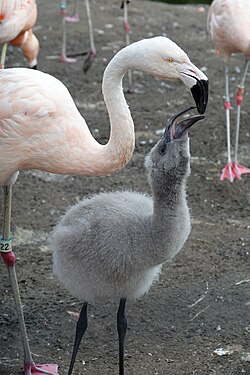
After the chicks hatch, the only parental expense is feeding.[53] Both the male and the female feed their chicks with a kind of crop milk, produced in glands lining the whole of the upper digestive tract (not just the crop). The hormone prolactin stimulates production. Crop milk contains both fat and protein, as with mammalian milk, but unlike mammalian milk, it contains no carbohydrates.[54] (Pigeons and doves also produce crop milk, though just in the glands lining the crop, which contains less fat and more protein than flamingo crop milk.)[55]

For the first six days after the chicks hatch, the adults and chicks stay in the nesting sites. At around 7–12 days old, the chicks begin to move out of their nests and explore their surroundings. When they are two weeks old, the chicks congregate in groups, called "microcrèches", and their parents leave them alone. After a while, the microcrèches merge into "crèches" containing thousands of chicks. Chicks that do not stay in their crèches are vulnerable to predators.[56] When young flamingos are around three to three and a half months old, their flight feathers will finish growing in, allowing them to fly.[57]

Status and conservation

[edit]

In captivity

[edit]
Flamingos at Paradise Park, a zoo in Cornwall

The first flamingo hatched in a European zoo was a Chilean flamingo at Zoo Basel in Switzerland in 1958. Since then, over 389 flamingos have grown up in Basel and been distributed to other zoos around the globe.[58]

Greater, a greater flamingo who was at least 83 years old and believed to be the oldest in the world, died at the Adelaide Zoo in Australia in January 2014.[59]

Zoos have used mirrors to encourage flamingos to breed. The mirrors are thought to give the flamingos the impression that they are in a larger flock than they actually are.[60]

Relationship with humans

[edit]

Ancient Roman cuisine

[edit]
Pink flamingo prepared for cooking (Bardo Museum)

While many different kinds of birds were valued items in Roman food, flamingos were among the most prized in Ancient Roman cuisine. An early reference to their consumption, and especially of their tongues, is found in Pliny the Elder, who states in the Natural History:

Latin: phoenicopteri linguam praecipui saporis esse apicius docuit, nepotum omnium altissimus gurges [Translated:] Apicius, that very deepest whirlpool of all our epicures, has informed us that the tongue of the phœnicopterus is of the most exquisite flavour.

— Natural History, liber X, chapter 67[61][62]

Although a few recipes for flamingos are found in Apicius' extant works, none refer specifically to flamingo tongues. The three flamingo recipes in the De re coquinaria (On the Subject of Cooking) involve the whole creature:

  • 220: roasted with an egg sauce, a recipe for wood pigeons, squabs, fattened fowl; flamingo is an afterthought.
  • 230: boiled; parrot may be substituted.
  • 231: roasted with a must sauce.[63]

Suetonius mentions flamingo tongues in his Life of Vitellius:[64]

Most notorious of all was the dinner given by his brother to celebrate the emperor's arrival in Rome, at which two thousand of the choicest fishes and seven thousand birds are said to have been served. He himself eclipsed even this at the dedication of a platter, which on account of its enormous size he called the "Shield of Minerva, Defender of the City." In this he mingled the livers of pike, the brains of pheasants and peacocks, the tongues of flamingos and the milt of lampreys, brought by his captains and triremes from the whole empire, from Parthia to the Spanish strait.

— Suetonius, Life of Vitellius[65]

Martial, the poet, devoted an ironic epigram, alluding to flamingo tongues:

Latin:

Dat mihi penna rubens nomen; sed lingua gulosis

Nostra sapit: quid, si garrula lingua foret?

[Translated:] My red wing gives me my name; but it is my tongue that is considered savoury by epicures. What, if my tongue had been able to sing?

— Epigrammata 71, Book 13[66][67]

There is also a mention of flamingo brains in a later, highly contentious source, detailing, in the life of Elagabalus, a food item not apparently to his liking as much as camels' heels and parrot tongues, in the belief that the latter was a prophylactic:

In imitation of Apicius he frequently ate camels-heels and also cocks-combs taken from the living birds, and the tongues of peacocks and nightingales, because he was told that one who ate them was immune from the plague. He served to the palace-attendants, moreover, huge platters heaped up with the viscera of mullets, and flamingo-brains, partridge-eggs, thrush-brains, and the heads of parrots, pheasants, and peacocks.[68]

Other

[edit]
Moche ceramic depicting flamingo (200 AD). Larco Museum, Lima, Peru

Notes

[edit]

References

[edit]
[edit]
Revisions and contributorsEdit on WikipediaRead on Wikipedia
from Grokipedia
Flamingos are a group of wading birds belonging to the family Phoenicopteridae, the sole extant family within the order , consisting of six distributed across tropical and subtropical regions worldwide. These birds are renowned for their striking pink to red —resulting from ingested through their diet—long, slender legs adapted for wading in shallow waters, sinuous necks, and downward-curving bills specialized for filter-feeding on small aquatic organisms like , crustaceans, and . Ranging in height from about 0.8 to 1.4 meters and weighing 1.5 to 4 kilograms, flamingos exhibit with males generally larger than females, and they often stand on one leg while resting, a whose purpose remains unclear but may aid in . The six species are classified into three genera: (greater flamingo, P. roseus; , P. ruber; , P. chilensis), Phoeniconaias (lesser flamingo, P. minor), and Phoenicoparrus (Andean flamingo, P. andinus; puna flamingo, P. jamesi). These species vary in size and coloration intensity, with the being the tallest and most widespread, while the is the smallest and most numerous, often forming flocks of up to a million individuals. Flamingos inhabit a range of environments, including saline or alkaline lakes, lagoons, estuaries, and coastal mudflats, primarily in , southern Europe, , the , and the ; some, like the , thrive at high altitudes up to 4,500 meters in the . These habitats are often harsh and nutrient-rich, supporting the and that form the core of their diet, which flamingos obtain by sweeping their heads side-to-side in water while upside-down, using lamellae in their bills as strainers. Highly gregarious, flamingos live in large colonies known as "flamboyances," ranging from dozens to hundreds of thousands of birds, where they engage in synchronized group displays such as head-flagging, marching, and wing-spreading to attract mates and maintain social bonds. Vocalizations include low honks, growls, and bleats for communication within flocks. During breeding, which is often synchronized in colonies to coincide with environmental conditions like rainfall, pairs form monogamous bonds and construct conical mud mound nests about 30–60 cm high, into which the female lays a single egg incubated by both parents for 27–31 days. Chicks hatch with gray down, are fed nutrient-rich "" by adults, and quickly join crèches for communal protection while parents forage; fledging occurs after 70–77 days, though young remain dependent for several months. While no flamingo species is currently classified as endangered, populations face threats from habitat loss due to water diversion, , and , as well as human disturbances like egg harvesting; conservation efforts include protected reserves in key breeding areas, such as those for the vulnerable . Their ecological role as filter-feeders helps maintain health by controlling blooms and nutrient cycles in otherwise inhospitable environments.

Naming and Taxonomy

Etymology

The word "flamingo" entered English in the 1560s, derived from or Spanish flamengo, originally meaning "Flemish" or referring to people from , who were stereotyped in medieval as having a ruddy, pinkish that resembled the bird's distinctive . This association shifted over time, with flamengo (later flamenco in Spanish) also coming to denote "flame-colored," directly evoking the bird's vibrant pink-to-red feathers, which are produced by dietary pigments like . The term's deeper linguistic roots trace to Latin flamma ("flame"), from the Proto-Indo-European bhleg- ("to shine" or "flash"), combined with a Germanic suffix -enc indicating belonging, as seen in Provençal flamenc ("flame-colored"). This fiery connotation aligns with the bird's striking appearance, distinguishing it in European languages from earlier descriptors. In ancient texts, the bird was known to the Greeks as phoinikopteros (φοινικόπτερος), meaning "red-winged" or "Phoenician-winged," a name reflecting its crimson flight feathers and possibly alluding to the Phoenicians' association with purple-red dyes. Aristotle referenced this or a similar waterbird in his Historia Animalium (ca. 350 BCE), describing its long legs, curved beak, and habitat in brackish lagoons, marking one of the earliest systematic accounts of the species. The genus name , used in modern , directly preserves this Greek root.

Systematics

Flamingos are classified within the order , which contains a single extant family, Phoenicopteridae. This family encompasses all six living species of flamingos, distinguished as wading birds adapted to aquatic environments. The family Phoenicopteridae is currently recognized as comprising three genera: , Phoeniconaias, and Phoenicoparrus, according to the 2020 update in Birds of the World (formerly Handbook of the Birds of the World). Phoenicopterus includes the larger species such as the greater, American, and Chilean flamingos; Phoeniconaias is monotypic, containing only the ; and Phoenicoparrus encompasses the Andean and James's flamingos. This three-genus arrangement reflects morphological and genetic distinctions among the species. Historically, flamingo taxonomy has undergone revisions based on phylogenetic analyses. Prior to 2014, all species were placed in a single genus, Phoenicopterus. A 2014 molecular study proposed a split into two genera, grouping the greater, American, and Chilean flamingos in Phoenicopterus and reassigning the lesser, Andean, and James's flamingos to Phoenicoparrus, with Phoeniconaias considered a junior synonym. This two-genus classification was not universally adopted, and the 2020 recognition of three genera restored Phoeniconaias for the lesser flamingo based on further evidence of its distinct deep-keeled bill morphology. Key morphological traits define the Phoenicopteridae, including fully webbed feet that facilitate swimming and wading in shallow waters, and a uniquely down-curved bill equipped with comb-like lamellae for filter-feeding on small organisms such as , , and . These adaptations, including the bill's internal sieve-like structures, enable efficient extraction of food from and while excluding larger particles.

Phylogeny

The phylogeny of flamingos (family Phoenicopteridae, order ) has been elucidated through molecular analyses, revealing a basal split into two major clades: one comprising the (Phoenicopterus roseus), (Phoenicopterus ruber), and (Phoenicopterus chilensis), and the other including the (Phoeniconaias minor), (Phoenicoparrus andinus), and (Phoenicoparrus jamesi). This dichotomy reflects morphological distinctions in bill structure (shallow- vs. deep-keeled) and genetic divergence, with the six extant species sharing a common ancestor estimated to have diverged around 13 million years ago during the epoch. A 2022 multilocus phylogenetic study utilizing mitochondrial and nuclear DNA sequences confirmed this , demonstrating that the shallow-billed species form a group sister to the deep-billed radiation, which exhibits further internal branching among the latter taxa. The analysis supports the monophyly of Phoenicopteridae and highlights limited genetic differentiation within clades, consistent with high mobility and among populations. This framework aligns with prior molecular evidence but provides refined resolution for intra-family relationships. Broader genomic investigations place as an early-diverging lineage within , emerging shortly after the –Palaeogene extinction event approximately 66 million years ago. A 2024 whole-genome analysis of 363 bird species, incorporating sequence data from representatives across avian orders, estimated the divergence of (flamingos and grebes) at approximately 67 million years ago, underscoring flamingos' ancient roots among waterbirds, with their unique adaptations evolving in isolation from later neoavian radiations.

Species

There are six extant of flamingos in the family Phoenicopteridae, each adapted to specific environments with variations in size, intensity, bill structure, and coloration that reflect their dietary and ecological niches. These are distributed across , , , and the , often in alkaline or saline waters where they filter-feed on , , and small organisms. The (Phoenicopterus roseus) is the largest species, reaching heights of up to 145 cm and exhibiting pale pink plumage derived from its diet of carotenoid-rich algae and crustaceans. It features a distinctive downward-curving bill adapted for bottom-feeding in shallow waters and long, pinkish legs, with no significant beyond slight male size advantage. This species has the widest distribution, spanning from through the Mediterranean region, , and into and . It is classified as Least Concern by the IUCN due to its stable and increasing populations across its range. In contrast, the (Phoeniconaias minor) is the smallest, measuring 80–90 cm in height with bright pink to deep rose plumage, a deep-keeled bill containing over 10,000 filtering lamellae for straining microscopic from water, and thin pink legs. Its compact size and specialized bill enable efficient feeding in dense algal blooms. Primarily found in , particularly around soda lakes in , with smaller populations in western Africa, Madagascar, and , it undertakes nomadic movements in search of food. The is listed as Near Threatened by the IUCN owing to sensitivities. The (Phoenicopterus ruber), also known as the Caribbean flamingo, stands about 120 cm tall with vibrant deep pink to red resulting from a diet high in from and blue-green , a long S-curved neck, and bright pink legs. Its bill has a pronounced downward bend for filter-feeding in coastal lagoons. Native to the islands, northern , the , and occasionally southern , it forms large, social flocks. It holds Least Concern status on the , reflecting its broad range and recovering populations. The Chilean flamingo (Phoenicopterus chilensis) measures 110–130 cm in height, displaying pale pink plumage with a subtle white base, black flight feathers, and notably grayish legs with pinkish-red joints and feet, distinguishing it from more vibrantly colored relatives. Its bill is slightly shorter and straighter than that of the greater flamingo, aiding in feeding on diatoms and small invertebrates. Confined to southern South America, from central Peru through the Andes to southern Argentina and Chile, it prefers coastal and inland wetlands. The IUCN categorizes it as Near Threatened due to ongoing habitat pressures. High-altitude specialists include the (Phoenicoparrus andinus), which reaches 110–150 cm with light pink body plumage accented by reddish tones on the head and upper breast, a yellow bill with a black tip, and uniquely yellow legs—features that set it apart for its cold, saline lake habitats. The bill's deep structure supports filter-feeding on diatoms in mineral-rich waters. Endemic to the Andean highlands from southern through , northern , and northwestern , it migrates altitudinally with seasonal changes. It is assessed as Vulnerable by the IUCN because of rapid population declines from exploitation and habitat degradation. Finally, (Phoenicoparrus jamesi), or puna flamingo, is similar in size at 90–100 cm, with salmon-pink plumage, crimson streaks on the neck, a short yellow bill tipped in black (shorter than in congeners), and bright red legs. Its narrow upper facilitates precise filtering in high-elevation lagoons. Restricted to the Andean plateaus of , , , and , it breeds in remote salt lakes and descends to lower elevations post-breeding. The species is Near Threatened according to the IUCN, with populations rebounding from historical lows through protected areas. Key differences among the species include variations in bill curvature and lamellae density, which correlate with prey size—finer in the lesser flamingo for plankton versus coarser in the greater for larger items—and leg coloration, from yellow in Andean and James's flamingos for camouflage in mineral sediments to red or pink in others for thermoregulation. Habitat preferences further diverge, with Old World species favoring African soda lakes and the South American trio exploiting Andean salt flats versus coastal estuaries.

Evolutionary Relationships

Relation to Grebes

Flamingos and grebes together form the avian , a relationship initially proposed based on shared morphological features that distinguish them from other birds. This is supported by at least 11 distinct synapomorphies, including a unique skull structure with a broad, flattened culmen and specialized salt-excreting nasal glands adapted for aquatic or saline environments. Other synapomorphies encompass modifications to the for enhanced neck flexibility and a distinctive humeral morphology for muscle attachment, reflecting adaptations to water-associated lifestyles despite divergent ecological niches. Molecular phylogenetic studies prior to 2024 provided robust genetic evidence reinforcing this sister-group relationship within the early-diverging . Genome-scale analyses, incorporating sequences from multiple nuclear loci, consistently placed as one of the basal lineages of modern birds, emerging shortly after the Cretaceous-Paleogene . These findings aligned with morphological data, showing high congruence in tree topologies that positioned flamingos () and grebes (Podicipediformes) as reciprocal monophyletic sister taxa, separate from other neoavian orders. A 2024 family-level genomic study further affirmed the , utilizing whole-genome sequences from representatives across avian families to resolve deep phylogenetic branches with unprecedented resolution. This analysis confirmed as sister to all other , with their divergence estimated at 67.4 million years ago (95% : 66.2–68.9 Ma), near the K-Pg boundary, placing it among the earliest neoavian divergences, with doves (Columbiformes) branching more distantly within the broader neoavian tree. A 2025 morphological study on the avian quadrate further supports ' position by identifying a shared derived feature with certain other neoavian groups, reinforcing its early placement in the phylogeny. Despite this close evolutionary tie, flamingos and grebes exhibit marked ecological differences, such as flamingos' upside-down filter-feeding mechanism using lamellae in to strain small organisms from shallow waters, contrasted with grebes' pursuit-diving adaptations for catching and aquatic prey.

Fossil Record

The fossil record of flamingos reveals an ancient lineage within the , with the earliest known fossils dating to the early Eocene epoch, approximately 50 million years ago. One of the oldest representatives is Juncitarsus, discovered in the Green River Formation of , , which exhibits primitive features linking it to the basal clade that includes both flamingos and grebes. Although initially classified as an early flamingo, Juncitarsus is now regarded as the sister to the flamingo-grebe lineage, providing key evidence for their from more generalized shorebird- or anseriform-like ancestors during this period. These early fossils indicate that proto-flamingos were already adapting to aquatic and wading lifestyles in subtropical environments of the . During the Miocene epoch (approximately 23 to 5.3 million years ago), flamingos underwent significant diversification, particularly in Europe and Asia, where fossil deposits reveal a peak in species richness and morphological variety. This period saw the proliferation of the extinct family Palaelodidae, alongside early members of the modern Phoenicopteridae, with abundant remains from lacustrine and coastal sites such as those in the Ebro Basin of Spain and the Rusinga Island in Kenya. Notable examples include Palaelodus species, which displayed elongated necks and legs suited for wading but retained more robust, goose-like builds compared to extant flamingos, illustrating a transitional phase in the evolution toward the specialized filter-feeding forms seen today. The Miocene also marks the global spread of phoenicopteriforms, with fossils extending to North America and even southern continents like Australia, though direct evidence from Antarctica remains absent. Over 20 extinct species have been described across the fossil record, spanning from the Eocene to the Pleistocene, highlighting the evolutionary shift from stocky, goose-like waders to the slender, long-legged modern flamingos adapted for hypersaline environments. At least 19 species belong to Phoenicopteridae, including Miocene forms like from European deposits, while 13 species are attributed to Palaelodidae, which coexisted with early true flamingos before declining in the . These extinct taxa demonstrate progressive refinements in bill structure and skeletal proportions, with evidence of ancient distributions emphasizing North America's role as a cradle for early diversification, as seen in Eocene and later Miocene-Pliocene sites. The overall timeline underscores flamingos' resilience and adaptability, originating in the and achieving near-cosmopolitan presence by the .

Physical Description

Morphology

Flamingos possess a slender body adapted for life in aquatic environments, characterized by exceptionally long, thin legs and a flexible that enable effective wading in shallow waters. The legs, which can exceed the body length in proportion, are supported by a tibiotarsus and that provide stability on uneven substrates, while the elongated , comprising 18 or 19 , allows for precise maneuvering during feeding. These adaptations facilitate access to food sources in hypersaline lakes and lagoons, where flamingos spend much of their time immersed up to their bodies. The feet are fully webbed, with the front three toes connected by that aids propulsion in water and prevents sinking into soft mud during locomotion. This webbing, combined with the long legs, supports efficient swimming and wading, allowing flamingos to traverse deeper waters than many other wading birds and to stir sediments for . The apparent "bent knee" visible in their characteristic S-shaped standing posture is actually the ankle joint (intertarsal joint), with the true positioned high and hidden near the body; this configuration, along with passive gravitational stays in the proximal limb, enables stable one-legged perching with minimal muscular effort, conserving energy during rest. The is distinctly downturned and lamellate, featuring parallel ridges (lamellae) along the margins that function as a for filter-feeding on small organisms like , crustaceans, and diatoms. During feeding, the head is inverted, and the fleshy acts as a piston-like , drawing in and expelling it through the lamellae at high rates, up to 12 strokes per second, while foot stomping and head movements generate vortices to trap prey. Skeletal adaptations for balance include a , pneumatized and elongated wing elements, supporting short-distance flights between feeding sites despite the bird's large size; the and are robust yet streamlined to maintain equilibrium during these bursts of activity.

Coloration and Plumage

Flamingos derive their characteristic pink to red hues from pigments, primarily alpha- and beta-carotene, obtained through their diet of carotenoid-rich , , and such as . These pigments are metabolized and deposited into the feathers during growth and molting, with the intensity of coloration varying based on dietary availability; in the absence of sufficient , as sometimes occurs in captive birds fed unsupplemented diets, the plumage fades to white or pale gray. Greater flamingos, for example, exhibit particularly vibrant rosy tones due to high levels of canthaxanthin and in their food sources. The bare skin on flamingos' faces and legs also displays striking carotenoid-based colors, typically bright pink or red on the facial skin, which serves as a visual signal during social interactions. Leg coloration varies by species: for instance, the greater and American flamingos have pinkish-red legs, while the Andean flamingo features distinctive yellow legs accented with black patches. These bare-part colors intensify during breeding seasons, reflecting physiological health and carotenoid reserves. Juvenile flamingos hatch with downy gray or white plumage that transitions to a mottled gray-brown feathering as they , dominated by pigments rather than . This juvenile coloration persists through gradual molts, with full adult pink hues developing over 2–3 years as dietary are incorporated into replacing feathers; the process is slower in species like the , sometimes extending to 4–6 years for complete maturation. Flamingo feathers exhibit low levels of ultraviolet (UV) reflectance compared to many other birds, with coloration primarily in the human-visible serving key roles in displays and mate selection. While some UV reflection occurs across avian plumages, including flamingos, it does not appear to play a prominent signaling function in their behaviors.

Size and Variation

Flamingos display considerable interspecific variation in physical dimensions, with adult heights ranging from 90 to 140 cm and weights from 1.5 to 4.5 kg across the six recognized species. The lesser flamingo (Phoeniconaias minor) represents the smallest end of this spectrum, typically measuring 90 to 110 cm in height and weighing 1.5 to 2.5 kg, while the greater flamingo (Phoenicopterus roseus) is among the largest, standing 120 to 145 cm tall and weighing up to 4.5 kg. Similarly, the American flamingo (Phoenicopterus ruber) averages 120 to 150 cm in height and 2 to 4 kg in weight, contributing to the overall family range. These measurements highlight the adaptive diversity within the Phoenicopteridae, where larger species often inhabit more expansive wetland systems. Sexual dimorphism in flamingos is minimal, with males typically slightly larger than females in both linear dimensions and mass, though the differences are often subtle and insufficient for reliable field identification without additional metrics. This pattern holds across species, where females may be 5-10% smaller on average, potentially linked to reproductive roles but not markedly influencing overall morphology. Intraspecific variation, including geographic differences, is generally limited but observable in certain populations, such as larger-bodied American flamingos in the nutrient-rich coastal lagoons of the Yucatan Peninsula compared to those in more fragmented habitats. These variations, often clinal and influenced by local food availability, result in up to 10-15% differences in body mass within the ' range. Flamingo growth patterns are characterized by rapid early development, with chicks achieving near-adult size within the first year. Hatching at around 70-100 g, juveniles grow exponentially through high-protein diets, reaching 80-90% of adult height and weight by 3-6 months and full skeletal maturity by 12 months, though plumage and behavioral maturity extend to 3-6 years. This accelerated supports early independence in colonial environments.

Habitat and Distribution

Preferred Habitats

Flamingos thrive in alkaline and saline lakes, lagoons, and estuaries characterized by high concentrations of , diatoms, and , which form the basis of their diet. These environments are often hypersaline and lack significant vegetation, providing open spaces for large flocks to forage and rest. The birds show a strong preference for shallow waters, typically ranging from 20 to 50 cm in depth, allowing them to wade and filter-feed effectively without needing to swim. In tropical and subtropical zones, flamingos favor warm water temperatures that support the proliferation of their primary food sources. Their ability to inhabit such extreme environments stems from physiological adaptations, including specialized salt glands located in the nasal passages that actively excrete excess , enabling tolerance to salinities exceeding 100 g/L—far beyond levels lethal to most birds. This osmoregulatory mechanism allows flamingos to drink hypersaline water and consume salty prey without . Seasonal movements are a key aspect of their use, with flocks migrating to hypersaline lakes and lagoons during breeding periods when water levels recede to expose suitable nesting substrates like mudflats or salt crusts. These shifts ensure access to concentrated food resources and isolated sites that minimize predation risks, though variations exist among such as the favoring more alkaline soda lakes compared to the greater flamingo's broader tolerance for brackish estuaries.

Geographic Range

Flamingos are distributed across both the and , with species exhibiting distinct geographic ranges shaped by their ecological requirements. In the , the (Phoenicopterus roseus) occupies a broad area from eastward through the Mediterranean Basin to Southwest and , including populations in . The (Phoeniconaias minor), primarily restricted to , breeds mainly at in , , and , with smaller sites in , , and extends non-breeding ranges to the and . In the , the ( ruber) is native to the Caribbean region, including , , and the of , with resident populations in northern such as , , and . South American species include the ( chilensis), which breeds in central , , , and , wintering in and southeastern ; the (Phoenicoparrus andinus), confined to high-altitude plateaus in , , , and ; and James's flamingo (Phoenicoparrus jamesi), similarly limited to Andean highlands in these countries, with occasional lowland occurrences in . Vagrant records highlight occasional extralimital appearances, such as greater flamingos in , USA, and various European countries like and , while American flamingos have been reported as vagrants in , , and . Lesser flamingos occasionally appear as vagrants in and . These sightings often stem from storm-driven displacements or exploratory movements beyond core ranges. Flamingo populations engage in nomadic movements, traveling distances up to 1,000 km to locate suitable feeding or breeding sites, particularly in response to rainfall patterns that affect water levels and food availability in alkaline lakes and lagoons. Such irregular dispersals are common among species like the greater and lesser flamingos, while species, including the Andean and James's flamingos, show seasonal migrations between highland breeding areas and lower-altitude wintering grounds influenced by similar environmental cues.

Behavior

Feeding and Diet

Flamingos are primarily filter-feeders, employing a unique mechanism where they immerse their specialized bill upside down in shallow to capture food. The 's lamellae, comb-like structures along the edges, act as strainers, while the tongue functions as a piston-like , drawing in mixed with small organisms and expelling the filtered liquid. This process allows them to efficiently microscopic prey from the or , with head movements sweeping side to side to maximize . Their diet consists mainly of such as Spirulina, (Artemia spp.), and small or larvae, which provide the bulk of their nutritional needs. Adult flamingos typically consume 60–270 grams (dry weight) of food per day, varying by and availability, often continuously to meet these requirements in nutrient-rich environments. This varied intake supports their high metabolic demands, particularly during breeding seasons when energy expenditure increases. Flamingos often in large groups within shallow waters, where coordinated movements enhance efficiency by stirring up sediments and concentrating prey. These communal efforts involve slow walking and rhythmic head sweeps, reducing individual costs while minimizing competition through spacing. Such are crucial for exploiting patchy food resources effectively. A key component of their diet is , pigments derived from and crustaceans, which are vital for both plumage coloration and overall health. These compounds serve as antioxidants, protecting cells from and supporting immune function, while their deposition in feathers signals nutritional status to potential mates. Without sufficient carotenoids, flamingos may exhibit faded coloration and compromised vitality.

Locomotion and Posture

Flamingos exhibit distinctive walking behaviors adapted to their aquatic habitats, often employing a high-stepping when wading through . This motion involves lifting the legs higher than during terrestrial walking to minimize hydrodynamic drag, particularly in intermediate depths where step height peaks to clear the water surface more effectively. Their long, thin legs, referenced briefly from morphological descriptions, facilitate this efficient across shallow lagoons and mudflats. A characteristic posture during rest or vigilance is the one-legged stance, where the tucks one foot against its body while balancing on the other; this reduces heat loss through unfeathered legs in varying temperatures and requires minimal effort due to a passive gravitational locking mechanism in the leg joints. Flight is a primary mode of long-distance travel for flamingos, though their relatively short, broad s necessitate a running takeoff involving several steps and wing flaps before becoming airborne. Once aloft, they achieve cruising speeds of up to 50 km/h, often in flocks arranged in loose V-formations or diagonal lines to optimize aerodynamic and reduce energy expenditure during migrations that can span 300-600 km nightly. The neck extends forward and legs trail backward in flight, enhancing streamlining. Swimming occurs infrequently, primarily in deeper waters beyond wading depth, where partially webbed feet provide propulsion similar to paddling; birds may float in groups or briefly submerge to access submerged resources, but this is secondary to their terrestrial and wading locomotion. During periods of rest, including , flamingos adopt a posture with the head resting on the back and bill tucked into the feathers of the , often while standing on one leg to further conserve and maintain balance with low input. This tucked position minimizes exposure to environmental extremes and allows for quick arousal if needed, though it slightly increases vulnerability to predators compared to alert stances.

Vocalizations

Flamingos produce a range of vocalizations essential for social communication, flock coordination, and parent-offspring interactions, often characterized by nasal honking similar to those of geese. These calls are typically low-pitched and resonant, enabling effective transmission over long distances in large flocks or across expansive habitats. Key vocalization types include contact calls, flight calls, calls, and warning calls, with structural variations identified through sonographic . Contact calls, frequently honking or trumpeting in quality, maintain flock unity and allow parents to recognize individual amid noisy colonies; these are given singly or in series and exhibit individuality in duration, , spectral bandwidth, and energy distribution. Flight calls consist of gooselike double honks produced during aerial movement to keep group members synchronized. and warning calls manifest as growling or grunting, signaling or potential danger to the flock. Sonographic studies on Chilean and Caribbean flamingos reveal four primary structural forms: repetitive (rapid short notes), tonal ( ), buzzy (broad-spectrum ), and combination (repetitive with tonal elements), which collectively support diverse communicative functions. Chick vocalizations differ markedly, featuring high-pitched calls such as "kwik," "wirruck-wirruck," and "tji-urr" to solicit parental attention and feeding. During feeding activities, adults emit low gabbling noises rather than remaining silent, while breeding colonies experience heightened vocal activity, including grunts and growls integrated into ritualized displays for and mate attraction. These acoustic signals, varying slightly by , underscore the role of vocalizations in the highly gregarious lifestyle of .

Reproduction and Life Cycle

Breeding Behavior

Flamingos typically exhibit seasonal , forming pair bonds that last for a single breeding season, though pairs may switch mates between seasons or after breeding failure. While primarily monogamous, occurs rarely in some populations, with females occasionally mating with multiple males. Sex ratios in breeding colonies are generally equal, but seasonal biases can lead to temporary skews favoring one sex in species like the greater flamingo. Courtship begins months before breeding and involves elaborate, synchronized group displays to attract mates and synchronize . These rituals include head-flagging, where birds rhythmically swing their heads side to side with extended; marching in coordinated groups; mutual between potential partners; and neck arching to display coloration enhanced by pigments from preen secretions. Vocal calls often accompany these visual displays, adding an auditory element to the rituals. Only fully colored adults participate, with copulation occurring privately after pairs separate from the group. Breeding occurs in massive , ranging from hundreds to over one million birds, which promotes synchronous laying and hatching to overwhelm predators and ensure chick survival. formation and breeding are triggered by environmental cues, particularly rainfall that raises levels and boosts food availability in alkaline lakes and wetlands. This is critical, as isolated or small groups rarely breed successfully.

Nesting and Eggs

Flamingos construct nests in large , typically selecting sites in shallow alkaline or saline waters on mudflats, islands, or lake shores to minimize predation risks from terrestrial and avian threats. These locations elevate nests above fluctuating water levels while deterring ground-based predators through inaccessibility. Nest building is a effort by both parents, who use their beaks and feet to scrape and pile , , or into a conical resembling a , often 20–40 cm high with a shallow central depression for the . Materials may include small stones, vegetation, or feathers when available, and nests are positioned closely together within the colony for communal protection. Construction intensifies following pair formation during , with the male often initiating the mound before the female contributes. Following a period that can last several weeks, the female lays a single large , rarely two, with a chalky shell measuring about 7.8–9 cm long and weighing around 90–140 g. The thick, porous shell provides protection in the harsh, arid environments typical of flamingo habitats. Incubation begins immediately upon laying and lasts 27–32 days, during which both parents alternate shifts, balancing on their large, webbed feet to cover and warm the against the nest's depression. This foot-based brooding maintains optimal temperatures of 35–37°C, essential for embryonic development in variable conditions.

Development and Lifespan

Flamingo chicks are born semi-precocial, hatching with their eyes open, covered in downy gray or white feathers, and capable of walking shortly after emerging from the egg. These hatchlings weigh approximately 50 to 100 grams and possess straight bills and dark gray legs, which gradually pinken as they mature. Both parents provide intensive care immediately after hatching, regurgitating a nutrient-rich substance known as from their upper digestive tract to feed the chick. This feeding continues for about 70 days, supplying essential proteins, fats, and pigments that support rapid growth during the early weeks. As the chicks develop, they leave the nest within 5 to 8 days to join communal crèches—large groups of young birds supervised by a small number of vigilant adults from the colony, which can number in the hundreds or thousands. This social structure enhances protection from predators while parents continue foraging and provision. Fledging occurs between 70 and 100 days, when chicks achieve their first flight and begin transitioning to self-feeding as their bills hook and fully develop. Full independence follows at 3 to 6 months, by which time juveniles approach adult size but retain grayish that slowly acquires pink hues over the next few years. Flamingos reach between 3 and 6 years of age, though first breeding often occurs later, around 6 to 8 years, depending on species and environmental conditions. In the wild, their lifespan typically ranges from 20 to 30 years (up to 50 years), while individuals in captivity can live 30 to 60 years (up to 80 years or more).

Conservation Status

The global population of all flamingo species is estimated at approximately 4-5 million individuals, with the lesser flamingo (Phoeniconaias minor) being the most numerous at 2.2-3.24 million birds. The greater flamingo (Phoenicopterus roseus) follows with 690,000-910,000 individuals, while the American flamingo (Phoenicopterus ruber) numbers 150,000-205,000 mature individuals. Other species include the Chilean flamingo (Phoenicopterus chilensis) at around 200,000-300,000, James's flamingo (Phoenicoparrus jamesi) at 154,000, and the Andean flamingo (Phoenicoparrus andinus) at 34,000-39,000. Population trends vary across species, with some showing recovery and others continued declines. The lesser flamingo population is declining due to ongoing pressures from habitat degradation and climate change, leading to its classification as Near Threatened by the IUCN. James's flamingo has recovered significantly from historical lows of around 10,000-20,000 individuals in the mid-20th century, attributed to conservation efforts, though it is still listed as Near Threatened. Similarly, the American flamingo has shown signs of increase, with a 2024 range-wide census documenting over 100 individuals in Florida alone—indicating potential recolonization—and in July 2025, a group of 125 was observed in the Everglades, the largest such sighting in a decade; stable to growing numbers in the Caribbean, such as 5,303 in Turks and Caicos in early 2025. In contrast, the has experienced a rapid decline from 50,000-100,000 individuals in the 1980s-1990s to its current estimate of 34,000-39,000, primarily due to habitat degradation, earning it a Vulnerable status from the IUCN. The population, estimated at 283,000 in 2010 coordinated censuses, appears stable but is classified as Near Threatened owing to suspected future declines. Overall, three flamingo species—lesser, Chilean, and James's—are rated Near Threatened, and one—the Andean—is Vulnerable, reflecting ongoing conservation concerns despite recoveries in some populations. The greater and American flamingos are both assessed as Least Concern, with generally stable or increasing trends.

Threats and Protection

Flamingos face multiple anthropogenic and environmental threats that jeopardize their habitats and populations. Habitat degradation is a primary concern, driven by activities that abstract and pollute wetlands, as seen in breeding sites where industrial developments encroach on critical areas. Similarly, construction and water abstraction alter in soda lakes essential for s, reducing available feeding and breeding grounds. from industrial effluents further degrades these ecosystems, contaminating food sources like and leading to of metals in eggs and eggshells. exacerbates these issues by causing lakes to dry up through altered rainfall patterns and increased evaporation, diminishing primary productivity in East African soda lakes that support lesser flamingo foraging. Egg collection by local communities disrupts breeding success, particularly at key sites where nests are easily accessible. Direct persecution also poses risks, including hunting and for meat and, to a lesser extent, feathers, though such activities have declined in some regions due to enforcement. Avian outbreaks, triggered by warm temperatures and organic in shallow waters, have caused significant mortality events; for instance, a sewage spill at Kamfers Dam in threatened populations by promoting bacterial toxin production. These episodic die-offs compound ongoing pressures, contributing to population instability across . Conservation efforts focus on habitat protection and international coordination to mitigate these threats. Key breeding and feeding sites, such as in —the primary breeding ground for lesser flamingos—have been designated as Ramsar wetlands of international importance, enabling collaborative management to address degradation and disturbance. All six flamingo are listed under Appendix II, regulating international trade in live birds, eggs, and feathers to prevent overexploitation. The Flamingo Specialist Group, established under IUCN-SSC and in the 1980s, coordinates global monitoring, , and action plans to track trends and implement site-specific protections, including disturbance reduction at breeding colonies. These measures have stabilized some populations, though ongoing vigilance is required amid escalating environmental pressures.

Captivity and Zoos

Flamingos present several challenges in captive management due to their specialized requirements for diet and . In zoos, they require a diet rich in , such as canthaxanthin at 23 mg/kg, to maintain their characteristic coloration, which also supports social signaling and reproductive ; commercial feeds mimicking foods like arthropods and , with 20-40% protein, are essential to prevent deficiencies in vitamins A and E or from high-energy diets. Adequate is critical, with a minimum of 1.4 per in outdoor enclosures to allow for natural behaviors, and flocks of at least 40 individuals recommended to stimulate breeding through group displays; insufficient can lead to stress, aggression, and reduced fertility. Mixed-species exhibits have shown success with compatible like non-aggressive waterfowl or , provided predator controls such as electric fences are in place, though risks of transmission and for food necessitate careful monitoring and separate feeding stations. Breeding programs for flamingos in captivity have evolved significantly since the mid-20th century, with the first successful rearing of a chick occurring at Hialeah Race Track in Florida in 1942, followed by the first zoo hatching at San Antonio Zoo in 1952. Today, breeding is routine in major institutions, such as the San Diego Zoo and Safari Park, which have raised offspring from four of the six flamingo species through techniques like artificial incubation, egg pulling, and fostering with species like American flamingos to support greater flamingo chicks; these programs emphasize large flocks of 50-100 birds to mimic wild colony dynamics and improve reproductive success rates. Environmental cues, including 12 hours of daylight and carotenoid supplementation, are manipulated to trigger synchronous nesting, with clutches typically consisting of one egg incubated for 28-32 days by both parents. Captive flamingos often achieve greater longevity than their wild counterparts, with the record held by a greater flamingo named Greater, which lived to 83 years at Adelaide Zoo before being euthanized in 2014 due to age-related complications. Flamingo programs in zoos play a key role in education and conservation, where hand-reared chicks are prepared for release into the wild to bolster populations; for instance, zoos like the Maryland Zoo and Oklahoma City Zoo have supported the hand-rearing and rehabilitation of over 285 lesser flamingo chicks in South Africa for eventual reintroduction following drought-related abandonments. These efforts, coordinated through groups like the Association of Zoos and Aquariums' Andean Flamingo Species Survival Plan, also educate visitors on wetland conservation by showcasing natural behaviors in immersive exhibits.

Human Interactions

Cultural and Symbolic Role

In , flamingos were primarily represented as hieroglyphs and rarely in broader , yet they held symbolic significance linked to the sun god due to their bright plumage evoking the colors of dawn and rebirth. Their association with and transformation stemmed from observations of their vibrant appearance, which mirrored the life-giving rays of the sun in Egyptian cosmology. Flamingos feature prominently in , particularly in that capture their exotic elegance and naturalistic poise. These depictions, often found in bathhouses and villas, portray flamingos wading in serene landscapes or as prepared delicacies, reflecting the bird's status as a luxurious import from distant regions. Notable examples include a from the Bardo National Museum in showing a flamingo amid aquatic scenes, and recent discoveries in Turkey's Heraclea ad Latmus featuring flamingos alongside dolphins and eels in intricate floor designs. In modern contexts, flamingos symbolize grace, balance, and vibrancy, drawing from their slender, one-legged stance and communal flocking behavior that emphasizes harmony and individuality. This imagery informs brand logos, such as the iconic pink flamingo emblem of the hotel, which conveys tropical sophistication and enduring allure since its 1946 opening. The bird's pink hue has also elevated it as an LGBTQ+ icon, popularized by ' 1972 cult film , where it embodies flamboyance, subversion of norms, and unapologetic identity through its association with drag performer Divine. Flamingos permeate contemporary pop culture, often highlighting their playful and elegant traits. In animations, they appear as croquet mallets wielded by the Queen of Hearts in Alice in Wonderland (), adding whimsical absurdity, and as the spirited Yo Yo Flamingo in 's "" segment, where a lone dances defiantly with a amid a flock.

Historical Uses

In , the tongue of the flamingo was prized as a culinary for its reputed exquisite flavor, as noted by the naturalist in his Natural History. This rare treat was reserved for the elite, often featured in lavish banquets to demonstrate wealth and sophistication, with recipes preserved in the 5th-century cookbook describing preparations like braised flamingo in spiced sauces. The saw intensified trade in live flamingos for emerging zoos across and , prompting widespread captures from wild populations in , the , and . This demand, combined with simultaneous for the fashion industry, significantly depleted certain populations, such as those in . Colonial expansion in the from the onward altered flamingo habitats through agricultural development, including the drainage of wetlands and salt flats for crops and livestock grazing, which reduced breeding sites and foraging areas in regions like the and northern . These changes, driven by European settlement and land conversion, persisted into later centuries and contributed to localized declines in flamingo numbers.

Modern Conservation Efforts

Modern conservation efforts for flamingos emphasize proactive, collaborative initiatives that engage communities, advance scientific research, and leverage sustainable economic activities to safeguard habitats and populations worldwide. The IUCN Species Survival Commission's Flamingo Specialist Group (FSG), a network of over 235 experts from 57 countries, coordinates global actions including the development of species-specific action plans for threatened flamingos, such as the , and facilitates information exchange through its biannual Flamingo bulletin. This group collaborates with organizations like , the , WWF, and to promote monitoring and management strategies that address habitat degradation and other pressures. Community-based programs have proven effective in integrating local with measures, particularly in . At in , WWF's Lake Bogoria Community-Based Wetlands Project (2001-2005) empowered Maasai and other adjacent —numbering around 10,000 people—through the establishment of a Water Resource Users' Association for sustainable water management and a Community Association to curb . These efforts, supported by the Lake Bogoria National Reserve, include from , allocating 6% of park fees (approximately KES 10 million annually) to local development, which incentivizes habitat protection and reduces poaching threats to flamingo feeding grounds rich in . Research initiatives, such as tracking, provide critical insights into migration patterns to inform targeted conservation. In , studies on lesser and greater flamingos departing from Botswana's Makgadikgadi Pans revealed extensive use of small, temporary wetlands across , , and , highlighting the need to protect these under-monitored sites for refueling during nomadic movements. Similarly, the FSG coordinated a 2024 simultaneous aerial census of American flamingos across 12 and American countries, documenting 229,705 individuals and identifying key sites like Venezuela's lagoons, which guides prioritization efforts. Ecotourism generates funding for restoration while raising awareness, as seen in France's region, home to the country's only breeding colony. WWF's and projects in the promote sustainable visitation to wetlands, channeling proceeds into habitat management alongside local partners to maintain brackish lagoons essential for flamingo foraging. Complementing this, the Tour du Valat research center's "Adopt a Flamingo" initiative allows individuals and businesses to sponsor birds, directly funding wetland restoration activities like salinity control and reed bed rehabilitation in the Rhône Delta. Global collaborations extend to reintroduction trials, particularly for the in the . In , ongoing protection programs under the National Enterprise for the Protection of Flora and Fauna have supported population recovery, with exploratory reintroduction efforts drawing on ex-situ breeding to restore historical haunts, coordinated through the Global Caribbean Flamingo Action Network. The FSG's small grants program further bolsters such initiatives, awarding funds in 2024-2025 for projects in regions like the Yucatan Peninsula to enhance connectivity between captive and wild populations. As of 2025, these efforts have shown promise, including successful breeding in Yucatan reserves and increased sightings in signaling wetland recovery.

References

Add your contribution
Related Hubs
User Avatar
No comments yet.