


Community hub
Recent from talks
Contribute something
Nothing was collected or created yet.
Nintendo video game consoles
View on Wikipedia

The Japanese multinational consumer electronics company Nintendo has developed eight home video game consoles and multiple portable consoles for use with external media, as well as dedicated consoles and other hardware for their consoles. As of September 19, 2025[update], Nintendo has sold over 869.95 million hardware units.[1]
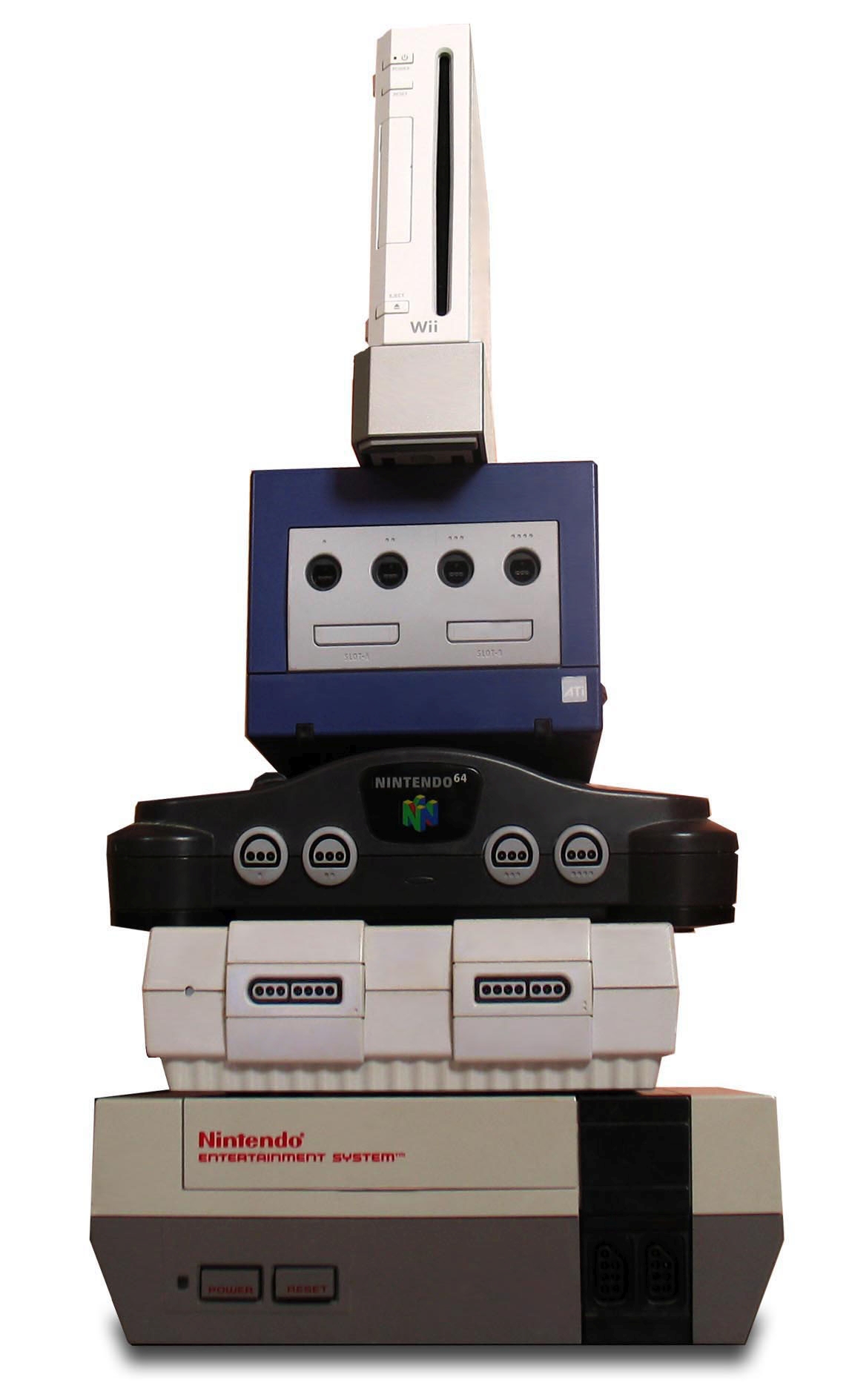
The company's first console, the Color TV-Game, was a success in Japan but was never released in other territories. Their first systems to achieve worldwide success were the Game & Watch handheld series, before achieving greater worldwide success with the Nintendo Entertainment System (NES), originally released as the Family Computer (Famicom) in Japan in 1983. The NES restarted the video game industry after the video game crash of 1983, and was an international success. In 1989, Nintendo released the Game Boy, which became the first handheld console to sell in large numbers. In the early 1990s, Nintendo's market lead began to decrease; although the 1990 Super Nintendo Entertainment System (SNES) was a strong seller, the Sega Genesis was a very strong contender. Nintendo and Sega would both lose a significant portion of the console market towards the end of the 1990s, as Sony's PlayStation became the most popular console, beating the Nintendo 64, though Nintendo managed to sell more than Sega Saturn.
The Dreamcast, released in 1998, PlayStation 2, released in 2000, and Microsoft's Xbox, released in 2001, would eventually relegate Nintendo to third place in the international market, despite the release of the GameCube. However, they retained their lead in the handheld console market, with the Game Boy Color and Game Boy Advance models. Towards the middle of the 2000s, Nintendo introduced the first successful handheld device with a touch screen (DS) and the first successful console designed for motion controlled inputs (the Wii); they became some of the best-selling consoles of all time. In 2011, Nintendo became the first major company to release a handheld game console with stereoscopic 3D capabilities, with the 3DS, which had very strong sales from the beginning. The Wii U, released in November 2012, was much less successful, and sales were significantly lower than predicted. The Nintendo Switch, by contrast, was released in March 2017 and has become the company's best-selling home console and overall third best-selling console of all time. A successor, the Nintendo Switch 2, was released on June 5, 2025.
Home consoles
[edit]Color TV-Game (1977–1983)
[edit]
Color TV-Game is a series of five dedicated home consoles released only in Japan. Each of the consoles contained a small number of games and a built-in controller. In total, approximately 3 million units were sold.[2]
The Color TV-Game series consists of:
- Color TV-Game 6, released June 1, 1977, with six variations of Pong: Tennis, Hockey, and Volleyball in Singles or Doubles mode. Sold approximately 1 million units.
- Color TV-Game 15, released June 8, 1977, with 15 variations of Pong. This was the most popular console in the series, selling just over 1 million units.
- Color TV-Game Racing 112, released June 8, 1978, with a racing game. Notable for being the first Nintendo project that Shigeru Miyamoto worked on. Sold approximately half a million units.
- Color TV-Game Block Breaker, released April 23, 1979, with a game based on Breakout. Sold approximately half a million units.
- Computer TV-Game, released December 12, 1980, with Computer Othello. Sold in limited quantities.
Family Computer and Nintendo Entertainment System (1983 and 1985)
[edit]
The Nintendo Entertainment System (NES) is an 8-bit home video game console. It was first released in Japan on July 15, 1983, as the Family Computer (Famicom) and would become Nintendo's first home video game console released outside Japan. It was released in US test markets as the redesigned NES in October 1985 and fully launched in North America the following year. The NES was distributed in South America, Europe, Asia, Oceania, and Africa throughout the 1980s under various names.
Selling 61.91 million units worldwide, the NES helped revitalize the video game industry following the video game crash of 1983, and set the standard for subsequent consoles in everything from game design to business practices. The NES was the first console for which the manufacturer openly courted third-party developers. The console also launched many of Nintendo's most iconic franchises, such as The Legend of Zelda and Metroid. Nintendo continued to repair Famicom consoles in Japan until October 31, 2007, attributing the decision to discontinue support to an increasing shortage of the necessary parts.[3][4][5]
Nintendo released a software emulation-based version of the Nintendo Entertainment System on November 10, 2016. Called the NES Classic Edition, it is a dedicated console that comes with a single controller and 30 preloaded games.[6]
Super Famicom and Super Nintendo Entertainment System (1990 and 1991)
[edit]
The Super Nintendo Entertainment System (SNES), colloquially shortened to Super Nintendo, is a 16-bit home video game console that was released in 1990 in Japan, 1991 in North America, 1992 in Europe and Oceania, and 1993 in South America. It was first released in Japan on November 21, 1990, where it is known as the Super Famicom. In South Korea, it is known as the Super Comboy and was distributed by Hyundai Electronics.
The SNES is Nintendo's third home console (second outside of Japan), following the Nintendo Entertainment System. Whereas the earlier console had struggled in the PAL region and large parts of Asia, the SNES was a global success, albeit one that could not match its predecessor's popularity in Northeast Asia and North America—due in part to increased competition from Sega's Genesis console. Despite its relatively late start, the SNES became the bestselling console of the 16-bit era, selling 49.10 million systems worldwide.[7] The SNES library is known for upgrading some of Nintendo's most famous franchises, and making the games even more critically acclaimed, such as Super Metroid, The Legend of Zelda: A Link to the Past, Final Fantasy IV and VI, Donkey Kong Country, and Super Mario World, as well starting some popular franchises such as Star Fox and Mega Man X.
Similarly to the NES Classic Edition released prior, Nintendo released a software-emulation-based version of the Super Nintendo Entertainment System on September 29, 2017. Called the Super NES Classic Edition, it, like its predecessor, is a dedicated console that comes with two controllers and 21 preloaded games, one of which, Star Fox 2, is a title originally developed for the system that went unreleased.[8]
Nintendo 64 (1996 and 1997)
[edit]
The Nintendo 64 (N64), is a 64-bit home video game console released starting on June 23, 1996 in Japan, September 29, 1996 in North America, and March 1, 1997 in Europe and Australia. The Nintendo 64 was Nintendo's third home video game console for the international market. It was released with three launch games in Japan (Super Mario 64, Pilotwings 64, and Saikyo Habu Shogi) and two in North America (Super Mario 64 and Pilotwings 64). PAL regions also had three launch titles (Super Mario 64, Shadows of the Empire and Pilotwings 64) with Turok: Dinosaur Hunter delayed until three days after launch. Other key games included Donkey Kong 64, Diddy Kong Racing, Banjo-Kazooie, two games in The Legend of Zelda series, GoldenEye 007, Mario Kart 64, Super Smash Bros., and Star Fox 64. The Nintendo 64 sold 32.93 million systems.[7]
GameCube (2001)
[edit]
The GameCube was released on September 14, 2001. It is Nintendo's sixth generation home video game console, the same generation as Sega's Dreamcast, Sony's PlayStation 2, and Microsoft's Xbox. Until the console's unveiling at Space World 2000, the design project was known as Dolphin—this can still be seen in the console and its accessories' model numbers. The GameCube is the most compact sixth generation console. The GameCube is Nintendo's first game console to use optical discs rather than game cartridges. An agreement with the optical drive manufacturer Matsushita led to a DVD-playing GameCube system named the Panasonic Q, which was only released in Japan. Much of Nintendo's core line-up centered on sequels to their established hit franchises such as Super Mario Sunshine, Super Smash Bros. Melee, The Legend of Zelda: Wind Waker, Metroid Prime, Pokémon Colosseum, and Star Fox Adventures, while new franchises like Animal Crossing and Pikmin were born, although the former franchise had seen a Japan-exclusive release on the N64. The GameCube has sold 21.74 million units.[7]
Wii (2006)
[edit]
Nintendo released the Wii on November 19, 2006, as their seventh generation home video game console. Nintendo designed the console to appeal towards a wider audience than those of its main competitors, the PlayStation 3 and Xbox 360, including "casual" players and audiences that were new to video games.[9][10]
These aims were emphasized by the console's distinguishing feature, the Wii Remote—a handheld motion controller that can detect motion and rotation in three dimensions, using a mixture of internal sensors and infrared positioning. The controller includes an expansion port that can be used to connect other accessories, such as the Nunchuk—an attachment with an analog stick and additional buttons, a "Classic Controller" gamepad providing a traditional control scheme, and Wii MotionPlus—an accessory designed to enhance the motion detection capabilities of the original Wii Remote models.[9][10]
The Wii's internal hardware is an updated derivative of that of the GameCube; in comparison to its seventh-generation competitors, the Wii had lower overall graphics capabilities, and does not output in high-definition.[11][9] The Wii also featured internet-enabled features; the Nintendo Wi-Fi Connection service allowed supported games to offer online multiplayer and other features, while the WiiConnect24 feature allowed messages and updates to be downloaded while the console was in standby. Through Wii Shop Channel, additional games and apps could be downloaded or purchased for the console, including Virtual Console—a selection of classic video games emulated from older consoles. That service has been discontinued as of January 30, 2019. Early models of the Wii also had backwards compatibility with GameCube games and controllers, but this was dropped from later hardware revisions, namely the Wii Family Edition and the Wii Mini.
The Wii was a major success for Nintendo; in April 2007, the Wall Street Journal declared that Nintendo had "become the company to beat in the games business", citing the success of the Wii and the portable Nintendo DS line.[12] As of March 31, 2016[update], the Wii has sold 101.63 million consoles worldwide.[13] Wii Sports—a collection of sports minigames that were designed to leverage the Wii Remote, was bundled with the console outside of Japan, and had a major cultural impact as the console's "killer app" among the mainstream audience.[14][15]
Wii U (2012)
[edit]
The Wii U was released on November 18, 2012 as a direct successor to the Wii, and the first entry in the eighth generation of home video game consoles. The Wii U's distinguishing hardware feature is the GamePad, a tablet-like controller which contains a touchscreen that wirelessly streams a video output from the console. The GamePad's display can be used to provide alternative or complementary perspectives within a game, or as the main display instead of a television.[16][17] In particular, Nintendo promoted the concept of "asymmetric" multiplayer, where a player with the GamePad would have a different objective and perspective than that of other players.[18] Alongside the GamePad, the Wii U supports Wii controllers and games. A conventional gamepad known as the Wii U Pro Controller was also released.[19][20][17]
The Wii U featured more-extensive online functionality than the Wii, using the Nintendo Network platform; as with the Wii, it supported online multiplayer and downloading and purchasing new games and apps, but also allowed video chat. It previously featured an internal social network known as Miiverse, which allowed users to write and draw posts in game-specific communities, the service was discontinued on November 8, 2017. Players of today can still participate in online usage of Wii U programs through a online service known as "Pretendo", also being available for the 3DS family of systems.[21][22][23][24] Nintendo also attempted to provide second screen experiences for television programming for the Wii U through a feature known as Nintendo TVii,[25][26] but it was discontinued outside of Japan in August 2015.[27] Unlike the Wii, the Wii U's hardware is capable of high-definition graphics.[17]
The Wii U was met with low adoption, attributed by Nintendo executives to a lack of third-party support; poor marketing of the system, which led to a lack of clarity of the Wii U game pad from being a tablet device; and the subsequent release of the PlayStation 4 and Xbox One the following year.[28][29] However, some critics argued that the Wii U still had advantages over PS4 and Xbox One, including its lower cost and notable early exclusives such as Super Mario 3D World.[30][31] Sales steadily increased following the release of several notable first-party exclusives, including new entries in the Mario Kart and Super Smash Bros. franchises,[32][33][34] and the new franchise Splatoon.[35]
In January 2017, a Nintendo spokesperson stated that production of the console had ended, with 13.56 million units sold worldwide.>Makuch, Eddie (January 31, 2017). "Wii U Production Ends Worldwide". GameSpot. Archived from the original on August 21, 2017. Retrieved August 20, 2017.</ref>
Handheld consoles
[edit]Game & Watch (1980–1991)
[edit]
The Game & Watch series of handheld electronic games made by Nintendo and created by its game designer Gunpei Yokoi from 1980 to 1991. Each featured a single game that could be played on a segmented LCD screen, in addition to a clock and an alarm. Most titles had a "GAME A" (easy mode) and a "GAME B" (hard mode) button. Game B is usually a faster, more difficult version of Game A. Different models were manufactured, with some consoles having two screens (the Multiscreen Series) and a clam-shell design. The Nintendo DS later reused this design. The Game & Watch made handhelds vastly popular. Many toy companies followed in the footsteps of Game & Watch, such as Tiger Electronics and their Star Wars themed games. Nintendo's Game & Watch units were eventually superseded by the original Game Boy. Each Game & Watch was only able to play one game, due to the use of a segmented LCD display pre-printed with an overlay. The speed and responsiveness of the games was also limited by the time it took the LCD to change state.
The Game & Watch series sold 43.4 million units worldwide, including 12.87 million units in Japan and 30.53 million overseas.[36]
Game Boy (1989)
[edit]
The Game Boy is an 8-bit handheld game console, the first such device developed by Nintendo, featuring interchangeable ROM cartridges, allowing it to act more like a portable version of a home console. It launched in Japan on April 21, 1989, followed by North America later that year and other territories from 1990 onwards. The device features a dot-matrix display, a directional pad, four game buttons, a single speaker, and uses Game Pak cartridges. Despite mixed reviews criticizing its monochrome graphics compared to competitors, the Game Boy's affordability, battery life, and extensive game library propelled it to market dominance. The Game Boy received several redesigns during its lifespan, including the smaller Game Boy Pocket (1996) and the Game Boy Light (1998). By the time sales ended in March 2003, all variants of the monochrome Game Boy and the Game Boy Color combined had sold 118.69 million units worldwide, making them the fourth best-selling system of all time.[7][37] Its best-selling games are Pokémon Red, Blue, and Yellow which collectively shipped 46 million units worldwide.[38][39]
Game Boy Color (1998)
[edit]
The Game Boy Color (GBC or CGB) was a transitional upgrade of the original Game Boy,[40] part of the fifth generation of handheld consoles, made to better compete with the WonderSwan and Neo Geo Pocket. Compared to the original Game Boy, the Game Boy Color features a color TFT screen rather than monochrome, a processor that can operate twice as fast, and four times as much memory. It retains backward compatibility with games initially developed for its predecessor. While the handheld was slightly thicker, taller and had a smaller screen than its immediate predecessor, the Game Boy Pocket, the Color was significantly smaller than the original Game Boy. By the time sales ended in March 2003, all variants of the monochrome Game Boy and the Game Boy Color combined had sold 118.69 million units worldwide, making them the fourth best-selling system of all time. Its best-selling games are Pokémon Gold and Silver, which collectively shipped 23 million units worldwide.[38][39]
Game Boy Advance (2001)
[edit]
The Game Boy Advance (GBA) is a 32-bit handheld game console which was released in Japan on March 21, 2001, and to international markets that June. It was later released in mainland China in 2004, under the name iQue Game Boy Advance. Compared to the Game Boy Color it succeeded, the console offered a significantly more powerful ARM7 processor and improved graphics, while retaining backward compatibility with games initially developed for its predecessor. The original model was followed in 2003 by the Game Boy Advance SP, a redesigned model with a frontlit screen and clamshell form factor. A newer revision of the SP with a backlit screen was released in 2005. A miniaturized redesign, the Game Boy Micro, was released in September 2005. Across all models in the Game Boy Advance series, 81.51 million units were sold worldwide. Its best-selling games are Pokémon Ruby and Sapphire, which collectively shipped 16 million units worldwide. The GBA was officially discontinued by the end of 2010.
Pokémon Mini (2001)
[edit]
The Pokémon Mini (stylized as Pokémon mini) is an 8-bit handheld game console designed and manufactured by Nintendo in conjunction with The Pokémon Company and themed around the Pokémon media franchise. It is the smallest game system with interchangeable cartridges ever produced by Nintendo, weighing just under two and a half ounces (71 grams). It was also Nintendo's cheapest console ever produced at US$45 (equivalent to $80 in 2024) and came bundled with the game Pokémon Party mini. It was first released in North America on November 16, 2001, and was only available for purchase at the Pokémon Center and via its website. This was followed by releases in Japan on December 14, 2001, and in Europe on March 15, 2002. Features of the Pokémon mini include an internal real-time clock, an infrared port used to facilitate multiplayer gaming, a reed switch for detecting shakes, and a motor used to implement force feedback. Sales of the Pokémon Mini were poor and only ten games were released, five of which were exclusive to Japan.
Nintendo DS (2004)
[edit]
The Nintendo DS (iQue DS in China) is a handheld game console developed and manufactured by Nintendo, released on November 21, 2004, as the first system in the Nintendo DS family. It is visibly distinguishable by its horizontal clamshell design, and the presence of two displays, the lower of which acts as a touchscreen. The system also has a built-in microphone and supports wireless IEEE 802.11 (Wi-Fi) standards, allowing players to interact with each other within short range (10–30 meters, depending on conditions) or over the Nintendo Wi-Fi Connection service via a standard Wi-Fi access point. According to Nintendo, the letters "DS" in the name stand for "Developers' System" and "Double Screen", the former of which refers to the features of the handheld designed to encourage innovative gameplay ideas among developers.[41] The system was known as "Project Nitro" during development.
On March 2, 2006, Nintendo released the Nintendo DS Lite, a redesigned model of the Nintendo DS, in Japan. It was later released in North America, Australia, and Europe. A second redesign of the Nintendo DS, the Nintendo DSi, was released on November 1, 2008, in Japan, on April 2, 2009, in Australia, April 3, 2009, in Europe, and April 5, 2009, in North America. It contains two cameras and downloadable software capabilities, plus a built-in flash memory and web browser. An SD card slot replaces the Game Boy Advance cartridge slot. A similar model, known as the Nintendo DSi XL, was released in 2009 in Japan and 2010 worldwide. It features the same configurations as its predecessor, but is slightly larger and features a large stylus designed for home use.
As of December 31, 2013, Nintendo DS consoles have sold 154.98 million units, including 93.86 million Nintendo DS Lites, and the Nintendo DSi consoles have sold 41.33 million units.[7] It is currently Nintendo's best-selling video game console of all time.
Nintendo 3DS (2011)
[edit]
Although the name and look of the device are similar to that of the DS series, the Nintendo 3DS is the successor to the DS and is a brand new console. The Nintendo 3DS was released on February 26, 2011. It contains three cameras, two on the outside (for 3D photographs) and one internal one above the top screen. The bottom screen is a touch screen comparable to the DS bottom screens, and the top screen is Wide Screen and an autostereoscopic 3D LCD. Autostereoscopy is a process that sent different images to the left and right eyes to enable the viewer to view the screen in 3D "without the need for special glasses". The 3DS is said to have enhanced Nintendo's online experience. In July 2012, the 3DS XL was released, similar to the change between the DSi and DSi XL. It has 90% larger screens and design changes such as a matte finish and the stylus in a more accessible area. The Nintendo 2DS was released on October 12, 2013. It is a variant designed to be affordable without the clamshell design or 3D capabilities of the 3DS. Another redesign, the New Nintendo 3DS and New 3DS XL, was released in Japan in October 2014, Australia for November 2014, and everywhere else in February 2015. It includes a C-Stick, ZR and ZL shoulder buttons, and a much faster CPU, allowing for more software specifically for the New Nintendo 3DS (such as Xenoblade Chronicles 3D). Like the original 3DS, the New Nintendo 3DS also has an XL form. As of December 31, 2013, Nintendo has sold 42.74 million units, including 15.21 million Nintendo 3DS XLs and 2.11 million Nintendo 2DS units.[7]
The last handheld console in the 3DS family was the New Nintendo 2DS XL, which was released in June/July 2017 across five different countries. Production ceased on all Nintendo 3DS family systems on September 16, 2020.[42][43][44]
Hybrid and tabletop consoles
[edit]Virtual Boy (1995)
[edit]
The Virtual Boy was the first portable game console capable of displaying true 3D graphics. Most video games are forced to use monocular cues to achieve the illusion of three dimensions on a two-dimensional screen, but the Virtual Boy was able to create a more accurate illusion of depth through an effect known as parallax. The Nintendo 3DS also uses this technology. In a manner similar to using a head-mounted display, the user looks into an eyepiece made of neoprene on the front of the machine, and then an eyeglass-style projector allows viewing of the monochromatic (in this case, red) image. It was released on July 21, 1995, in Japan and August 14, 1995, in North America and at a price of around US$180. It was never released in Europe, although a release schedule was initially planned. The system met with a lukewarm reception that was unaffected by continued price drops. Exactly 14 titles were released for Virtual Boy in North America, but only a few were met with positive reception. Nintendo discontinued the Virtual Boy within a few months of release.
Nintendo Switch (2017)
[edit]
The Nintendo Switch was released on March 3, 2017, and is Nintendo's second entry in the eighth generation of video game consoles. The system was code-named "NX" prior to its official announcement. It is a hybrid device that can be used as a home console inserted to the Nintendo Switch Dock attached to a television, stood up on a table with the kickstand, or as a tablet-like portable console. It features two detachable wireless controllers called Joy-Con, that can be used individually or attached to a grip to provide a more traditional gamepad form. Both Joy-Con are built with motion sensors and HD Rumble, Nintendo's haptic vibration feedback system for improved gameplay experiences. However, only the right Joy-Con has an NFC reader on its analog joystick for Amiibo and an IR sensor on the back. The Nintendo Switch Pro Controller is a traditional style controller much like that of the GameCube.
The Nintendo Switch has currently sold 150.83 million units as of February 4, 2025, outselling all of Nintendo's previous video game consoles, except the Nintendo DS, making it the best-selling home console from Nintendo and the third best-selling video game console of all time.[45]
The Nintendo Switch Lite is a more affordable version of the Nintendo Switch released by Nintendo on September 20, 2019. The Switch Lite console is similar to a regular Nintendo Switch and can play almost all standard Switch games, but is a handheld portable-only version and is also slightly smaller. It comes in five color variations: grey, turquoise, coral, yellow, and blue, as well as some special editions. Its Joy-Con controllers cannot be detached like in the original Nintendo Switch model.[46]
A second variation, the Nintendo Switch – OLED Model, was released in 2021, which makes several adjustments and improvements over the original, including an improved kickstand, a larger OLED screen, and more storage (64 GB instead of the regular 32 GB present in the original Nintendo Switch and Switch Lite).
Nintendo Switch 2 (2025)
[edit]
On January 16, 2025, Nintendo announced its successor to the Nintendo Switch after 8 years, the Nintendo Switch 2. The Switch 2 is backwards compatible with most physical and digital Switch games. The console was released on June 5, 2025. Like the original Switch, it can be used as a portable handheld, as a tablet, or connected via the dock to an external display. The Joy-Con 2 controllers can be used while attached to or detached from the device. It has a larger liquid-crystal display and more internal storage than the original Switch. It has updated graphics, controllers, and social features. It supports 1080p resolution and a 120Hz refresh rate in handheld or tabletop mode, and 4K resolution with a 60Hz refresh rate when docked.[47]
Nintendo reported on June 10, 2025, four days from release, that the Switch 2 had sold more than 3.5 million units worldwide, which made it the company's fastest selling console to date.[48] Famitsu reported that the console had sold 947,931 units in Japan within the first four days of its release, surpassing the Switch's launch of 329,152 units sold in the region.[49] IGN said that launch sales of the Switch 2 in these first four days were twice as much as the launch sales of the Switch in all regions.[50]
Other hardware
[edit]- Game Boy Camera – a monochrome camera cartridge for the original version of the Game Boy which includes a picture editor and the ability to print pictures via Game Boy Printer.
- Satellaview – only released in Japan, an add-on for the Super Famicom (Japanese SNES) which allowed anyone to download games by a satellite.
- Game Boy Player – an adapter for playing Game Boy games on the GameCube.
- Game Boy Printer – an adapter designed for printing things from the Game Boy onto adhesive stickers. For example, it was used for printing out Game Boy Camera pictures and Pokémon information from the Pokédex in the Game Boy Pokémon games.
- e-Reader – an add-on for the Game Boy Advance for scanning special "e-Reader cards", paper cards with specially encoded data printed on them.
- iQue Player – a version of the Nintendo 64, with double the clock speed and downloadable games, released only in China.
- Nintendo 64DD – only released in Japan, this add-on system's games are on rewritable magnetic disks. Games released include a paint and 3D construction package, F-Zero X Expansion Kit, for creating new F-Zero X tracks, a sequel to the SNES version of SimCity, SimCity 64 and others.
- Mobile Adapter GB – only released in Japan, this peripheral allowed a Game Boy Color or Game Boy Advance to connect to a mobile phone and utilize its cellular network to connect to the Mobile System GB service. Together, they enabled online functionality for roughly 20 games, most notably Pokémon Crystal.[51]
- Pokémon Pikachu – a handheld device similar to the popular Tamagotchi toy which allows the user to take care of Pikachu in the manner of a pet.
- Super Game Boy – adapter for playing Game Boy games on the Super NES, displayed in color.
- Triforce – an arcade system based on GameCube hardware, developed in partnership with Sega and Namco.
- Computer Mah-jong Yakuman – a handheld Japanese mahjong game released in 1983 that featured the ability to connect two devices together with a cable, which inspired the Game Boy's Game Link Cable.
- GameCube Microphone – used in Karaoke Revolution Party, Mario Party 6, Mario Party 7 and Odama for the GameCube. It recognizes basic sounds and incorporates them into gameplay.
- Nintendo Gateway System – a proprietary hardware/software console available on commercial aircraft and hotel properties,[52] providing shopping, information, and interactive entertainment.[53]
- Panasonic Q – a version of the GameCube which could play DVDs developed by Panasonic released only in Japan.
- Visteon Dockable Entertainment System – a portable DVD player containing officially licensed Game Boy Advance hardware.
- Pokéwalker – a Pedometer used in Pokémon HeartGold and SoulSilver that can be used to enhance a Pokémon HeartGold and SoulSilver game by giving some special Pokémon and items as well as other added benefits that reward depending on how many steps one can take.
- Activity Meter – an Infrared (IR) Pedometer for use the Nintendo DS game, Personal Trainer: Walking.
- Fit Meter – a portable accessory for use with the Wii U game, Wii Fit U, that tracks the number of steps taken and the elevation climbed. It can also be synced with the game using the Wii U GamePad.
- Poké Ball Plus – a Joy-Con replacement used with Pokémon: Let's Go, Pikachu! and Let's Go, Eevee! that can be used similarly to it, and can also be used to bring the player's Pokémon character with them for in-game rewards.
- Game Boy Pocket Sonar – a fishing sonar peripheral for the Game Boy developed by Bandai.[citation needed]
References
[edit]- ^ "IR Information : Sales Data - Dedicated Video Game Sales Units".
- ^ Sheff, David; Eddy, Andy (1999). Game Over: How Nintendo Zapped an American Industry, Captured Your Dollars, and Enslaved Your Children. GamePress. p. 27. ISBN 978-0-9669617-0-6.
Nintendo entered the home market in Japan with the dramatic unveiling of Color TV-Game 6, which played six versions of light tennis. It was followed by a more powerful sequel, Color TV-Game 15. A million units of each were sold. The engineering team also came up with systems that played a more complex game, called "Blockbuster," as well as a racing game. Half a million units of these were sold.
- ^ 初代「ファミコン」など公式修理サポート終了. ITmedia News (in Japanese). ITmedia. October 16, 2007. Archived from the original on October 23, 2007. Retrieved January 20, 2008.
- ^ RyanDG (October 16, 2007). "Nintendo of Japan dropping Hardware support for the Famicom". Arcade Renaissance. Archived from the original on March 17, 2008. Retrieved January 20, 2008.
{{cite web}}: CS1 maint: bot: original URL status unknown (link) - ^ "Nintendo's classic Famicom faces end of road". AFP. October 31, 2007. Archived from the original (Reprint) on November 5, 2007. Retrieved November 9, 2007.
- ^ Nintendo. "NES Classic Edition". Archived from the original on March 16, 2017. Retrieved March 15, 2017.
- ^ a b c d e f "Consolidated Sales Transition by Region" (PDF). Nintendo. January 28, 2014. Archived (PDF) from the original on June 13, 2018. Retrieved January 29, 2014.
- ^ Nintendo. "SNES Classic Edition". Archived from the original on December 31, 2020. Retrieved May 14, 2020.
- ^ a b c Schiesel, Seth (November 24, 2006). "Getting Everybody Back in the Game". The New York Times. ISSN 0362-4331. Archived from the original on January 10, 2021. Retrieved August 20, 2017.
- ^ a b "Nintendo hopes Wii spells wiinner". USA Today. Archived from the original on May 22, 2011. Retrieved August 20, 2017.
- ^ Casamassina, Matt (March 29, 2006). "Revolution's Horsepower". IGN. Archived from the original on August 28, 2017. Retrieved August 20, 2017.
- ^ Nick Wingfield and Yukari Iwatani Kane, Wii and DS Turn Also-Ran Nintendo Into Winner in Videogames Business Archived September 19, 2020, at the Wayback Machine, Wall Street Journal, April 19, 2007
- ^ "IR Information : Sales Data – Hardware and Software Sales Units". Nintendo Co., Ltd. Archived from the original on October 24, 2016. Retrieved September 9, 2018.
- ^ Boyes, Emma (February 23, 2007). "Study: Wii kids lose weight". GameSpot. Archived from the original on September 9, 2018. Retrieved August 20, 2017.
- ^ "Iwata: Wii Sports 2 benched for now". GameSpot. September 18, 2007. Archived from the original on January 1, 2019. Retrieved August 20, 2017.
- ^ Crecente, Brian (November 16, 2012), The surprising (mundane) tech behind the Wii U's magical GamePad, archived from the original on January 10, 2021, retrieved August 20, 2017
- ^ a b c "Wii U review". Polygon. November 18, 2012. Archived from the original on November 12, 2020. Retrieved August 20, 2017.
- ^ Caoili, Eric. "Nintendo Unveils Wii U, Controller With Built-In 6.2" Touchscreen". Gamasutra. Archived from the original on May 9, 2012. Retrieved August 20, 2017.
- ^ Jon Fingas (June 5, 2012). "Nintendo: two Wii U Gamepads will work on one system". Engadget. Archived from the original on June 7, 2012. Retrieved June 5, 2012.
- ^ "Nintendo Unveils Hardcore Wii U Controller". Kotaku. June 3, 2012. Archived from the original on June 6, 2012. Retrieved June 12, 2012.
- ^ "Nintendo Wii U Adds Video Chat". InformationWeek. Archived from the original on December 25, 2014. Retrieved December 25, 2014.
- ^ "Wii U allows 12 user accounts per system, eShop downloads playable by all". Eurogamer. November 12, 2012. Archived from the original on December 25, 2014. Retrieved December 25, 2014.
- ^ "Wii U's online gaming and 'Miiverse' outlined, including video chat and web client". The Verge. June 3, 2012. Archived from the original on December 7, 2019. Retrieved December 24, 2014.
- ^ "Nintendo reveals English version of 'Mii WaraWara': the WaraWara Plaza". Polygon. November 7, 2012. Archived from the original on December 24, 2014. Retrieved December 24, 2014.
- ^ "Nintendo TVii for Wii U Hands-On". IGN. December 21, 2012. Archived from the original on December 25, 2014. Retrieved December 25, 2014.
- ^ "Nintendo TVii Streams Video, DVR, Live TV to Wii U". PC Magazine. Archived from the original on October 7, 2014. Retrieved October 13, 2014.
- ^ "Nintendo shutting down Wii U TVii service in August". Polygon. Vox Media. July 24, 2015. Archived from the original on July 25, 2015. Retrieved July 25, 2015.
- ^ Kohler, Chris (December 5, 2013). "What the Hell Is Wrong With Nintendo?". Wired. Archived from the original on December 29, 2013. Retrieved December 30, 2013.
- ^ Nowak, Peter (December 30, 2013). "Year in review: The biggest tech flops of 2013". CBC News. Archived from the original on November 11, 2020. Retrieved December 30, 2013.
- ^ "Xbox or PS4? Maybe that's the wrong question". CNET. Archived from the original on November 26, 2013. Retrieved December 14, 2013.
- ^ Suellentrop, Chris (November 24, 2013). "Mario Tries to Rescue His Console". The New York Times. Archived from the original on February 2, 2016. Retrieved December 12, 2013.
- ^ "Nintendo says Wii U just had its biggest month of sales". Polygon. January 16, 2015. Archived from the original on January 16, 2015. Retrieved February 22, 2015.
- ^ Pereira, Chris (June 2, 2014). "Mario Kart 8 Sells 1.2 Million, Becoming Wii U's Fastest-Selling Game". GameSpot. Archived from the original on June 24, 2014. Retrieved August 20, 2017.
- ^ "Nintendo at E3: A comeback is always just a game away". Ars Technica. Archived from the original on November 11, 2020. Retrieved August 20, 2017.
- ^ Phillips, Tom (June 1, 2015). "Splatoon is Wii U's fastest-selling new franchise in UK". Eurogamer. Archived from the original on June 1, 2015. Retrieved June 1, 2015.
- ^ "Iwata Asks: Game & Watch: 4. Absorbed in Development". Nintendo of America. Archived from the original on May 18, 2011. Retrieved June 23, 2013.
- ^ "A Brief History of Game Console Warfare: Game Boy". BusinessWeek. Archived from the original on May 9, 2007. Retrieved January 25, 2008.
- ^ a b "Japan Platinum Game Chart". The Magic Box. Archived from the original on December 13, 2007. Retrieved September 27, 2007.
- ^ a b "US Platinum Videogame Chart". The Magic Box. Archived from the original on April 21, 2007. Retrieved September 27, 2007.
- ^ Umezu; Sugino. "Nintendo 3DS (Volume 3 – Nintendo 3DS Hardware Concept)". Iwata Asks (Interview: Transcript). Interviewed by Satoru Iwata. Nintendo. Archived from the original on June 22, 2019. Retrieved March 7, 2011.
- ^ "Nintendo DS Frequently Asked Questions". Nintendo. Archived from the original on August 10, 2007. Retrieved April 2, 2006.
- ^ "Nintendo 3DS Family". Nintendo of Europe GmbH. Archived from the original on May 9, 2022. Retrieved September 17, 2020.
- ^ "ニンテンドー3DSシリーズ|任天堂". 任天堂ホームページ. Archived from the original on September 17, 2020. Retrieved September 17, 2020.
- ^ "Nintendo 3DS discontinued". GamesIndustry.biz. September 17, 2020. Archived from the original on September 20, 2020. Retrieved September 17, 2020.
- ^ "Consolidated Financial Highlights – Q4 FY2024" (PDF). Nintendo. May 7, 2024. Archived (PDF) from the original on May 7, 2024. Retrieved May 7, 2024.
- ^ "Consolevariations". Consolevariations. Archived from the original on June 2, 2021. Retrieved May 30, 2021.
- ^ "Nintendo Switch 2 - Nintendo - Official Site". Nintendo.com. Retrieved April 3, 2025.
- ^ Bankhurst, Adam (June 11, 2025). "Switch 2 Becomes 'Fastest-Selling' Nintendo Hardware Ever With Over 3.5 Million Units Sold Worldwide In Just Four Days". IGN. Retrieved June 11, 2025.
- ^ Romano, Sal (June 12, 2025). "Famitsu Sales: 6/2/25 – 6/8/25". Gematsu. Retrieved June 12, 2025.
- ^ Valentine, Rebekah (June 12, 2025). "Nintendo Switch 2 Outselling the OG Switch 2-to-1 Across the Globe". IGN. Archived from the original on June 12, 2025. Retrieved June 12, 2025.
- ^ Bertoli, Ben (August 25, 2019). "That Time Nintendo Took the Game Boy (and Pokémon) Online". Kotaku. Retrieved February 24, 2025.
- ^ Other Stuff. DieHard GameFan. Volume 1. Issue 12. No.12. P.163. November 1993.
- ^ "Gateway System Gets Shanghaied". GamePro. No. 56. IDG. March 1994. p. 186.
Nintendo video game consoles
View on GrokipediaOverview
Introduction
Nintendo video game consoles are dedicated hardware platforms developed and marketed by Nintendo Co., Ltd., designed primarily for interactive video game experiences, and spanning categories of home systems, portable handhelds, and hybrid devices that combine both functionalities.[9] These platforms have played a pivotal role in shaping the global video game industry since Nintendo's pivot from arcade manufacturing to consumer electronics.[3] Nintendo's entry into the console space began in 1977 with the Color TV-Game series of home systems, marking its transition from earlier arcade ventures, followed by portable innovations like Game & Watch in 1980, the landmark Family Computer (Famicom) in 1983, and subsequent generations leading to the hybrid Nintendo Switch in 2017 and its successor, the Nintendo Switch 2, released on June 5, 2025.[3][10] This timeline reflects Nintendo's commitment to evolving gaming hardware over nearly five decades, with a focus on officially released consumer products that exclude arcade cabinets, optional add-ons, and third-party peripherals.[3] Central to Nintendo's market philosophy is the creation of family-friendly entertainment that appeals across generations, emphasizing intuitive innovations in controls—such as motion sensing and touch interfaces—to broaden accessibility, while accommodating global variations like region-specific naming (e.g., Famicom and Super Famicom in Japan versus Nintendo Entertainment System and Super Nintendo Entertainment System in Western markets).[9][3] This approach prioritizes joyful, shared experiences over high-end technical specifications, distinguishing Nintendo's offerings in a competitive landscape.[9]Technological evolution
Nintendo's technological evolution began in the 1970s with dedicated home video game systems, such as the Color TV-Game series, which relied on fixed hardware for simple, Pong-like gameplay without programmable elements.[3] By the early 1980s, the company transitioned to programmable consoles using interchangeable cartridges, enabling diverse game libraries and greater versatility compared to earlier dedicated units.[3] This shift culminated in the introduction of 8-bit architecture with the Famicom/NES, featuring a Ricoh 2A03 CPU based on the MOS Technology 6502 running at approximately 1.79 MHz and a custom Picture Processing Unit (PPU) for 2D sprite and background rendering at 256x240 resolution.[11] Cartridge-based mappers further expanded memory limits, allowing for more complex titles beyond the system's base 64 KB addressing.[11] The 1990s marked the adoption of 16-bit processors, as seen in the Super Famicom/SNES with its Ricoh 5A22 CPU—a 16-bit superset of the 6502 operating at up to 3.58 MHz—offering enhanced computational capabilities including built-in multiplication and division units.[12] Graphics advanced through innovations like Mode 7, a hardware-accelerated affine transformation mode that enabled pseudo-3D effects via background scaling, rotation, and shearing on a single 8-bit-per-pixel layer, often using horizontal direct memory access (HDMA) for dynamic visuals.[12] This era progressed to true 3D rendering with the Nintendo 64's 64-bit architecture, which supported polygon-based graphics through its custom Reality Co-Processor, allowing for immersive spatial environments in games.[3] In the 2000s, hardware integrated optical disc drives for larger storage capacities, starting with mini-DVDs in systems like the GameCube and evolving to full-sized discs in successors, though playback focused on game media rather than video.[3] Motion controls emerged as a key input method via accelerometers in the Wii Remote (with gyroscopes added via the optional Wii MotionPlus accessory), enabling intuitive gesture-based interactions by detecting tilt, rotation, and acceleration in three dimensions without requiring precise aiming.[13] Online capabilities were introduced with built-in broadband connectivity, supporting wireless or Ethernet links for multiplayer gaming and services like the Wii Internet Channel, which utilized Opera-based browsing with Web 2.0 features.[13] Portable consoles innovated with dual-screen designs in the Nintendo DS, incorporating a resistive touchscreen on the lower display for stylus-based input alongside a standard upper screen, expanding interaction beyond traditional buttons.[3] The Nintendo 3DS advanced this by adding glasses-free stereoscopic 3D to the top screen, leveraging parallax barrier technology to deliver depth perception while retaining the dual-screen and touch functionality of its predecessor.[14] Hybrid consoles like the Nintendo Switch introduced detachable Joy-Con controllers, allowing seamless transitions between handheld and TV modes with modular input options.[3] The Switch 2 further refined this with features such as backward compatibility ensuring playability of Nintendo Switch games, HDR support enhancing color and contrast on compatible displays, 4K upscaling for docked play, and magnetic attachments for Joy-Con 2 controllers, providing secure, tool-free connection and added mouse-like functionality via integrated sensors.[15] Throughout its history, Nintendo has emphasized accessibility over raw processing power, prioritizing non-traditional input methods and user-friendly designs to broaden appeal, as exemplified by the Wii's motion controls which influenced subsequent hardware by demonstrating massive market success through intuitive play rather than high-end specs.[16]Home consoles
Color TV-Game (1977–1980)
The Color TV-Game series marked Nintendo's entry into the home video game market, developed under the leadership of engineer Gunpei Yokoi in Nintendo's newly formed Research and Development division to capitalize on the success of Atari's Pong and similar arcade games.[17] Prior to this, Nintendo had licensed the Magnavox Odyssey—the world's first home video game console—for distribution in Japan starting in 1975, providing the company with valuable insights into consumer electronics and gameplay mechanics that informed the design of its own hardware.[18] Released exclusively in Japan, the series consisted of dedicated consoles with built-in games, reflecting Nintendo's transition from traditional toys and playing cards to electronic entertainment during the late 1970s video game boom. Nintendo produced six variants of the Color TV-Game between 1977 and 1980, each featuring a fixed set of simple, non-programmable games tailored to popular genres like sports simulations and block-breaking puzzles. The inaugural model, Color TV-Game 6, launched in June 1977 and offered six variations of a Pong-style tennis game using built-in paddles. Later entries expanded on this formula, such as the 1978 Color TV-Game Racing 112, which included 112 driving game variants and introduced a light gun peripheral for target-shooting mechanics, and the 1979 Color TV-Game Block Kuzushi, focused on a Breakout-inspired title with paddle controls. These units were manufactured in collaboration with electronics partner Sharp Corporation, emphasizing affordability and ease of use for family entertainment.[19][20] Technically, the Color TV-Game consoles utilized hardwired printed circuit boards (PCBs) to implement gameplay logic directly into the hardware, eliminating the need for interchangeable media like cartridges and ensuring low-cost production. They output video signals via RF modulation for connection to standard televisions, with some models supporting basic composite video through modifications, and employed simple analog dials or joysticks for controls that supported two-player simultaneous play. Lacking expandability or software updates, the systems were inherently limited to their predefined game sets, which relied on discrete logic chips rather than microprocessors, aligning with the first generation of dedicated video game hardware.[20] The series achieved significant commercial success in Japan, selling approximately 3 million units across all models and establishing Nintendo as a viable player in the electronics sector.[21] This performance underscored the company's successful pivot from hanafuda cards and toys—exemplified by Yokoi's earlier Ultra Hand—to interactive gaming, though the fixed-game design constrained long-term consumer engagement compared to emerging competitors. Despite this milestone, the lack of programmability hindered replay value, contributing to the line's niche appeal.[18] Production of the Color TV-Game ended in 1980 with the release of the final model, Computer TV-Game, as the market became saturated with more versatile programmable consoles like the Atari VCS and Intellivision, which offered cartridge-based expandability and rendered dedicated systems obsolete.[20]Family Computer / Nintendo Entertainment System (1983–1995)
The Family Computer, known as the Famicom in Japan, was released on July 15, 1983, marking Nintendo's entry into the home video game market with a programmable console that supported interchangeable cartridges.[22] Following the 1983 North American video game crash, Nintendo adopted a cautious re-entry strategy, rebranding the system as the Nintendo Entertainment System (NES) and launching it in limited test markets in New York City on October 18, 1985, before a wider North American rollout in 1986.[23] This approach included marketing the NES not as a toy but as an "entertainment system," bundled with accessories like the Robotic Operating Buddy (R.O.B.) to distance it from the failed Atari era.[24] The NES featured an 8-bit Ricoh 2A03 processor, a customized MOS Technology 6502 variant running at 1.79 MHz in NTSC regions, paired with 2 KB of work RAM and 2 KB of video RAM for handling graphics and sound.[11] Games were distributed via ROM cartridges inserted into a top-loading slot, enabling a library of over 700 titles. Regional variants differed notably: the Famicom had a compact red-and-white design with hardwired controllers featuring a microphone on the second player unit, while the NES adopted a bulkier gray-and-black aesthetic with detachable rectangular joysticks and front-loading mechanism.[25] To combat unlicensed games and ensure quality control, the NES incorporated the 10NES lockout chip (also known as the Checking Integrated Circuit or CIC), which performed a proprietary authentication handshake with matching chips in official cartridges, effectively blocking imports and bootlegs unless bypassed.[26] Key expansions enhanced the system's capabilities, particularly in Japan; the Famicom Disk System, released on February 21, 1986, was a peripheral that attached via the cartridge slot, using proprietary 3.5-inch "Disk Cards" for rewritable storage and improved audio via an additional FM synthesis channel.[27] This add-on allowed for cheaper game distribution and user-save features, though it was plagued by reliability issues and piracy. The NES achieved massive commercial success, selling 61.91 million units worldwide by the end of its lifecycle, with launch titles like Super Mario Bros. (released in 1985) playing a pivotal role in driving adoption—its innovative platforming mechanics and accessibility sold over 40 million copies, helping revive the industry and establish Nintendo's dominance.[7] Variants extended the platform's reach, including the PlayChoice-10, an arcade cabinet launched in 1986 that housed up to 10 selectable NES games on swappable ROM boards, complete with a coin-operated timer for short play sessions.[28] Nintendo discontinued NES production in 1995, with the final licensed game being The Lion King, though support in Japan via the Famicom persisted longer, with manufacturing ending in 2003 due to parts scarcity. Post-discontinuation, unauthorized clone systems known as Famiclones proliferated, particularly in regions like Russia and South America, replicating the hardware to sustain the ecosystem.[29][30]Super Famicom / Super Nintendo Entertainment System (1990–2003)
The Super Famicom, released in Japan on November 21, 1990, marked Nintendo's entry into the 16-bit era, building briefly on the 8-bit foundations of the earlier Family Computer by introducing enhanced multimedia capabilities for home gaming.[31] The North American version, branded as the Super Nintendo Entertainment System (SNES), launched nearly a year later on August 23, 1991, in limited quantities due to production constraints including a chip shortage that delayed full nationwide availability until September 9.[32] This postponement was a deliberate regional strategy by Nintendo to sustain sales of the still-popular Nintendo Entertainment System, avoiding market saturation amid ongoing demand for 8-bit titles.[33] At its core, the SNES featured a 16-bit Ricoh 5A22 processor clocked at 3.58 MHz, paired with an advanced video processing unit that enabled Mode 7 effects for scaling and rotation of backgrounds, simulating pseudo-3D visuals in games like Super Mario World.[34] It included 128 KB of main RAM and 64 KB of video RAM, supporting up to 32,768 colors and resolutions as high as 512x448 pixels.[35] Regional design variations distinguished the models: the Japanese Super Famicom adopted a compact, rounded gray chassis with integrated controller ports and colorful buttons, while the North American SNES used a bulkier, boxy purple-and-gray enclosure with separate controller ports to align with local manufacturing and aesthetic preferences.[36] Nintendo expanded the SNES ecosystem with peripherals like the Super Scope light gun, released in 1992 for light-gun shooters such as Super Scope 6, and the SNES Mouse bundled with Mario Paint that same year for creative drawing applications. Japan-exclusive add-ons included the Satellaview satellite modem, launched on April 23, 1995, which enabled downloadable content and online features via St. GIGA broadcasts.[37] The console achieved global success, selling 49.10 million units worldwide, bolstered by iconic titles like The Legend of Zelda: A Link to the Past, released on November 21, 1991, in Japan.[7][38] Support continued through official remakes and production until 2003 in Japan, cementing its legacy as a cornerstone of 16-bit gaming amid competition from Sega's Genesis.[39]Nintendo 64 (1996–2002)
The Nintendo 64, marking Nintendo's entry into the fifth generation of video game consoles, was released in Japan on June 23, 1996, and in North America on September 29, 1996.[3] This system represented a significant shift from the 16-bit sprite-based gaming of the Super Nintendo Entertainment System to fully realized 3D environments, emphasizing polygonal graphics and immersive navigation. At its core, the console featured a 64-bit NEC VR4300 CPU clocked at 93.75 MHz, paired with a custom Reality Coprocessor that included the Reality Signal Processor for handling 3D transformations and rendering up to 150,000 polygons per second in optimized scenarios.[40] Unlike competitors adopting optical discs, the Nintendo 64 relied on ROM cartridges with capacities up to 64 MB, which provided instantaneous load times and anti-piracy measures but resulted in higher production costs that deterred some developers.[40] The standard controller introduced the analog thumbstick for precise 3D movement, a Z-trigger for actions, and an expansion port supporting up to four controllers natively, enabling multiplayer experiences like those in Mario Kart 64. An optional Rumble Pak accessory added haptic feedback via dual motors, enhancing immersion in titles such as Star Fox 64.[41][42] Despite its technical prowess in delivering groundbreaking 3D titles, the Nintendo 64 faced market challenges primarily from Sony's PlayStation, which captured greater third-party support due to the cost-effectiveness and larger storage of CD-ROMs for complex games with full-motion video and expansive soundtracks.[43] Nintendo's cartridge format, while enabling faster performance, limited developer flexibility and increased expenses, leading many studios—such as Square and Enix—to prioritize PlayStation ports of RPGs and other genres ill-suited to smaller media sizes. The console ultimately sold 32.93 million units worldwide, bolstered by flagship first-party releases including Super Mario 64 in 1996, which redefined platforming with open-world exploration, and The Legend of Zelda: Ocarina of Time in 1998, praised for its narrative depth and time-travel mechanics.[7][44] These successes helped maintain a loyal user base, but the system ceded overall market dominance to PlayStation's broader library and affordability. A notable variant was the Japan-exclusive 64DD, a magnetic disk drive peripheral launched on December 1, 1999, intended to expand cartridge games with up to 64 MB of writable storage for online features via the Randnet service. Priced at ¥20,000 (about $200 USD at the time), it supported enhancements like editable worlds in Mario Artist but suffered from chronic delays—originally promised in 1995—and a sparse library of only nine titles by discontinuation in 2001. The add-on's high cost, limited availability, and competition from more mature online platforms contributed to its commercial failure, with fewer than 15,000 units sold.[45]GameCube (2001–2007)
The Nintendo GameCube, codenamed Dolphin during development, was released in Japan on September 14, 2001, followed by North America on November 18, 2001.[3] It marked Nintendo's entry into the sixth-generation console market, emphasizing a compact form factor and integration with portable gaming, while building on the 3D graphics advancements of the Nintendo 64 through optical media storage.[46] The console featured a distinctive handlebar-shaped design measuring 11.4 cm x 15 cm x 16 cm, available in indigo (later renamed "GameCube purple"), black, and special editions, which facilitated easy portability and storage.[46] At its core, the GameCube utilized a custom IBM PowerPC "Gekko" processor running at 485 MHz, manufactured on a 0.18-micron process, paired with an ATI-designed "Flipper" graphics processing unit capable of handling advanced texture mapping and effects.[47][48] It included 24 MB of 1T-SRAM main memory and a 3 MB embedded frame buffer for graphics, supporting high-resolution output up to 480p via component video cables, though it lacked native HDMI support.[48] Games were distributed on proprietary 8 cm mini-DVD discs with a 1.5 GB capacity, a deliberate choice to deter piracy through non-standard sizing and encryption, despite limiting larger titles compared to competitors' full-sized DVDs.[46] Key accessories enhanced the GameCube's ecosystem, including the WaveBird wireless controller released in 2002, which used radio frequency for up to 30 feet of range and featured the standard ergonomic design with dual analog sticks and rumble feedback.[49] The Game Boy Player, a disc-based add-on, allowed compatibility with Game Boy, Game Boy Color, and Game Boy Advance titles on a television via a link cable, bridging Nintendo's handheld and home systems.[50] A broadband adapter, introduced in 2004, enabled limited online multiplayer for select titles like Phantasy Star Online Episode I & II, though adoption was hampered by the lack of widespread broadband and few supported games.[49] The GameCube achieved total worldwide sales of 21.74 million units, with approximately 4 million in Japan, positioning it as a niche success in its home market driven by strong first-party exclusives such as Super Smash Bros. Melee (released November 2001) and Metroid Prime (November 2002), which emphasized innovative gameplay and graphical fidelity.[7][7] Despite competition from the PlayStation 2 and Xbox, it carved out a dedicated user base through quality titles and portability features, before being discontinued worldwide in 2007 as Nintendo shifted focus to the Wii.[7]Wii (2006–2014)
The Nintendo Wii, launched globally in November 2006 with its North American debut on November 19, represented a pivotal shift in home console design by emphasizing intuitive motion controls to expand gaming's reach beyond traditional enthusiasts.[19] The console's hardware included a 729 MHz IBM Broadway processor, an ATI Hollywood graphics processing unit, and 88 MB of RAM (comprising 24 MB internal 1T-SRAM and 64 MB external GDDR3), which maintained continuity with the GameCube's optical disc format while introducing backward compatibility for GameCube titles via dedicated controller ports and memory slots.[51] Central to its appeal was the Wii Remote, a wireless controller equipped with a three-axis accelerometer for motion sensing and an infrared sensor for precise pointing, often paired with the Nunchuk attachment that added an analog stick and additional buttons for more complex inputs.[52] This design enabled natural, physical interactions like swinging for tennis or bowling in games, fostering accessibility for families and non-gamers by simulating real-world movements without requiring specialized skills or controllers.[53] Key innovations further enhanced the Wii's user-friendly ecosystem, including WiiConnect24, an always-on internet service that allowed the console to receive updates, weather forecasts, news, and messages even in standby mode, promoting seamless connectivity without constant user intervention.[54] The Virtual Console provided a digital storefront for emulated retro games from earlier Nintendo systems and select third-party titles, reviving classic software and appealing to nostalgic players while introducing historical gaming to newcomers.[55] Complementing these was the Wii Shop Channel, operational from its 2006 launch until its closure in 2019, where users could purchase downloadable content using Wii Points, including indie games via WiiWare and additional Virtual Console offerings.[56] These features, combined with the motion-centric interface, positioned the Wii as a social entertainment hub rather than a high-performance gaming machine, broadening its market to include seniors, children, and casual users who valued simplicity and physical engagement over graphical fidelity. The Wii's strategy proved extraordinarily successful, with lifetime sales reaching 101.63 million units worldwide, making it the best-selling seventh-generation home console and Nintendo's most commercially dominant system until surpassed by the Switch.[57] Bundled titles like Wii Sports, which sold 82.9 million copies by emphasizing accessible motion-based sports simulations, played a crucial role in driving adoption among non-traditional gamers, particularly families seeking affordable, active entertainment during the post-2008 economic recession when disposable income for premium hobbies was limited.[58] This mass-market focus revitalized Nintendo's position, capturing over 25% of U.S. households by 2009 and inspiring a surge in casual gaming titles that prioritized fun and inclusivity.[53] As support waned, a stripped-down Wii Mini variant launched in 2012—featuring a red design, built-in composite AV output, and 8 GB internal storage but lacking online capabilities, disc drive for GameCube games, and broader connectivity—served as a budget option for offline play.[59] Full online services, including Nintendo Wi-Fi Connection and the Shop Channel's core functions, ended on May 20, 2014, marking the console's transition to legacy status.[60]Wii U (2012–2017)
The Wii U, Nintendo's eighth-generation home console, launched globally in November 2012, beginning with North America on November 18, followed by Europe on November 30 and Japan on December 8.[61] It featured an IBM Power-based multi-core microprocessor (Espresso) clocked at 1.243 GHz, an AMD Radeon-based high-definition GPU (Latte) at 550 MHz, and 2 GB of DDR3 RAM shared between the system and graphics processing.[62][63] The console's signature accessory, the Wii U GamePad, incorporated a 6.2-inch resistive touchscreen (854x480 resolution) that enabled off-TV play and served as a second screen for games, though its utility was constrained by a battery life of approximately 3–5 hours depending on usage.[64] This design supported asymmetric gameplay, where the GamePad user could access unique perspectives, controls, or information—such as maps in Nintendo Land—distinct from the TV view shared by other players using traditional Wii Remotes.[65] Building on the Wii's motion control heritage, the Wii U offered full backward compatibility with nearly all Wii games and accessories, allowing users to play them via a dedicated Wii Mode that emulated the prior console's environment.[66] Additional features included the Miiverse social network, launched in December 2012, which integrated community posts, drawings, and game-specific discussions directly into the console's interface and supported web access until its discontinuation in November 2017.[67] Despite these innovations, the console faced challenges from its hardware's relatively modest performance compared to contemporaries like the PlayStation 4 and Xbox One, which offered superior GPU power (approximately 1.84 TFLOPS for PS4 versus Wii U's estimated 0.35 TFLOPS) and more robust multimedia capabilities.[68] Commercially, the Wii U underperformed, with lifetime sales reaching 13.56 million units worldwide by the end of its production run in late 2016.[7] Key titles like Super Mario 3D World (released November 2013) sold 5.89 million copies, showcasing strong first-party output, but the platform struggled with third-party support and was hampered by confusing marketing that often portrayed the GamePad as a Wii accessory rather than a new console.[69][70] Critics and analysts noted the branding ambiguity and launch timing—preceding the more powerful PS4 and Xbox One by a year—contributed to its failure to capture broad market share.[71] Nintendo discontinued manufacturing in 2017, shifting focus toward hybrid console designs, while the Wii U eShop for digital purchases closed on March 27, 2023, ending new content availability.[72]Portable consoles
Game & Watch (1980–1991)
The Game & Watch series, launched by Nintendo in 1980, marked the company's entry into portable electronic gaming and represented a pioneering use of liquid crystal display (LCD) technology for interactive entertainment. Designed primarily by Gunpei Yokoi, who led Nintendo's Research & Development 1 team, the series consisted of dedicated handheld devices that combined a single video game with a built-in digital clock and alarm function, emphasizing portability and affordability.[73][74] Inspired by everyday observations, such as commuters using LCD calculators on trains, Yokoi pitched the concept to Nintendo's president during a car ride, leading to a collaboration with Sharp Corporation to adapt calculator components for gaming. This "lateral thinking with withered technology" approach—repurposing mature, low-cost tech—enabled the production of compact, battery-efficient units targeted at children and casual players.[73][74] Each Game & Watch device featured a segmented LCD screen displaying static backgrounds with animated elements for gameplay, powered by simple microprocessors derived from calculator chips to ensure long battery life on standard button cells. The hardware evolved across several form factors, including the initial Silver and Gold series (compact, wristwatch-like designs), Wide Screen (horizontal layouts for broader action), Multi Screen (devices with two or three LCD panels connected by hinges for enhanced depth, such as in Oil Panic), Tabletop (upright stands mimicking arcade cabinets), Panorama (foldable colored screens with mirrors for dynamic viewing), and Crystal Screen (transparent panels allowing ambient light to illuminate the display for better visibility in later 1986 models). Controls typically included side buttons for actions and, notably, the debut of the cross-shaped D-pad in the 1982 Donkey Kong title, which became a staple in subsequent Nintendo controllers. Over its run from 1980 to 1991, the series encompassed 60 distinct titles, with Yokoi personally overseeing the design of approximately 50.[74][75] Key releases highlighted the series' innovative gameplay within hardware constraints, such as the debut title Ball (1980), where players balanced falling balls on a juggler's hands, establishing the core reflex-based mechanics. Donkey Kong (1982) adapted the arcade hit into a multi-screen format, introducing platforming elements and the D-pad for precise movement, while selling around 8 million units alone. These battery-powered, single-purpose designs prioritized simplicity and durability, influencing the portable gaming market by demonstrating viable handheld entertainment without complex programmability.[73][75] The series achieved commercial success, with total sales of 43.4 million units worldwide, revitalizing Nintendo's fortunes after earlier arcade ventures and even aiding Sharp's LCD division. Its LCD technology and ergonomic principles served as a direct precursor to the Game Boy, launched in 1989, by proving the feasibility of portable, low-power displays for gaming. Production ceased in 1991 as consumer demand shifted toward programmable handhelds with interchangeable software, though the legacy endured through re-releases, including the Game & Watch Gallery compilations on Game Boy starting in 1997, which modernized select titles with updated graphics and sound.[75][74][73]Game Boy (1989–2003)
The Game Boy, Nintendo's first major handheld console, was released in Japan on April 21, 1989, and subsequently launched in North America on July 31, 1989, with a European rollout in 1990.[76] Designed by Gunpei Yokoi, it built upon the dedicated LCD technology from earlier devices like the Game & Watch series but introduced interchangeable cartridges for expanded gameplay, marking a shift toward versatile portable entertainment.[3] The console's debut in Japan included a bundled copy of Tetris, which became an instant hit and helped drive initial sales by showcasing the system's addictive puzzle mechanics.[3] At its core, the Game Boy featured a custom Sharp LR35902 8-bit processor running at 4.19 MHz, paired with 8 KB of internal RAM for efficient monochrome graphics rendering.[77] Its display was a 160x144 pixel STN LCD screen capable of rendering four shades of gray, providing clear visuals despite the lack of color, while input was handled via a directional pad and two action buttons.[77] Powered by four AA batteries, the system offered approximately 15 hours of gameplay per set, emphasizing portability and reliability for on-the-go use.[78] A key innovation was the optional Link Cable accessory, which enabled two-player multiplayer connectivity for compatible titles like Tetris, fostering social gaming experiences without the need for external infrastructure.[79] The Game Boy achieved extraordinary commercial success, with the entire family of original models and variants selling 118.69 million units worldwide, establishing Nintendo's dominance in the portable gaming market for over a decade.[80] Its robust cartridge-based library, exceeding 1,000 titles, included iconic games that leveraged the system's grayscale visuals and simple controls to deliver timeless adventures and challenges.[78] Support for the original hardware persisted into the late 1990s, highlighted by 1998 add-ons such as the Game Boy Camera for digital photography and the Game Boy Printer for thermal output of images and game data.[81] Production and official support gradually phased out by 2003, as newer models like the Game Boy Color and Advance took precedence, though the original's legacy endures as a foundational portable console.[80]Game Boy Color (1998–2003)
The Game Boy Color (GBC) was released in Japan on October 21, 1998, followed by North America on November 18, 1998, Europe on November 23, 1998, and other regions shortly thereafter, marking Nintendo's effort to refresh its dominant handheld platform with color capabilities while maintaining broad accessibility.[82] Designed as a backward-compatible upgrade to the original Game Boy, the GBC addressed criticisms of its predecessor's monochrome display amid growing competition in the portable gaming market, effectively bridging the gap until the more advanced Game Boy Advance arrived in 2001.[83] This global rollout capitalized on the established Game Boy ecosystem, allowing seamless integration of existing software libraries.[84] At its core, the Game Boy Color retained the original Game Boy's 8-bit Sharp LR35902 processor, operating at 4.19 MHz (doubling to 8.38 MHz for specific color-related tasks), paired with 32 KB of RAM and 8 KB of video RAM, ensuring performance parity with prior titles.[85] The key upgrade was its thin-film transistor (TFT) color LCD screen, measuring approximately 2.3 inches with a 160 × 144 pixel resolution, capable of displaying up to 56 colors simultaneously from a palette of 32,768 possible hues, a vast improvement over the original's four shades of green.[86] Full backward compatibility with original Game Boy cartridges was preserved, automatically rendering them in monochrome mode on the color display, which encouraged continued use of the extensive existing game library without requiring hardware replacements.[77] Additional features included an integrated infrared (IR) port located at the top of the unit, enabling short-range wireless communication for multiplayer interactions or data transfer in supported games, such as simplified trading or battles without a link cable.[87] Nintendo also produced various special editions, including transparent casings in colors like clear, atomic purple, and fruit-inspired variants (e.g., grape and kiwi), which added aesthetic appeal and collector value to the standard opaque models.[88] The Game Boy Color achieved strong commercial success, selling approximately 49 million units worldwide by the end of its lifecycle in 2003, significantly extending the viability of the Game Boy family during a boom in portable entertainment.[89] Notable titles like Pokémon Yellow (released in 1999) exemplified its enhancements, offering colorized sprites, backgrounds, and animations that improved visual fidelity over the original monochrome Pokémon games while remaining playable on older hardware.[90] This success solidified Nintendo's handheld dominance, with the GBC's affordable color upgrade fostering a vibrant library of over 900 games and sustaining player engagement until the transition to 32-bit systems.[84]Game Boy Advance (2001–2008)
The Game Boy Advance (GBA), released globally starting in June 2001 following its Japanese debut on March 21, 2001, represented Nintendo's push into 32-bit handheld gaming, delivering enhanced graphics and sound capabilities in a portable form factor.[91] It featured a 16.8 MHz 32-bit ARM processor, support for up to 32,768 colors on a 2.9-inch TFT reflective screen with 240x160 resolution, and 32 KB of internal RAM alongside 256 KB of external work RAM.[91] The system maintained backward compatibility with Game Boy and Game Boy Color cartridges, allowing players to access a vast library of over 1,000 prior titles through an integrated cartridge slot, while introducing new games optimized for its advanced hardware.[91] Powered by two AA batteries for up to 15 hours of playtime, the original GBA measured 144.5 mm x 82 mm x 24.5 mm and weighed 140 grams, emphasizing portability despite its non-backlit screen.[91] To address user feedback on visibility, Nintendo introduced the Game Boy Advance SP in February 2003, initially with a frontlit screen in a clamshell design that folded to protect the display and included a rechargeable lithium-ion battery for 10-18 hours of use.[92] A revised AGS-101 model launched in 2005 with a brighter backlit screen, improving play in low-light conditions while retaining the same core 32-bit ARM hardware and compatibility features.[93] In 2005, the compact Game Boy Micro variant debuted in September, shrinking the system to keychain size (80 mm x 50 mm x 20 mm) with a 2-inch backlit screen, USB-rechargeable battery offering 5 hours of play, and interchangeable faceplates for customization, though it lacked backward compatibility with original GBA carts without adapters.[94] Additionally, the Game Boy Advance Wireless Adapter, released in 2004, enabled cable-free multiplayer for up to five players within 10 meters, supporting select titles like Pokémon FireRed and LeafGreen.[95] The GBA family achieved strong commercial success, with lifetime hardware sales reaching 81.51 million units worldwide, bolstered by iconic titles such as Pokémon Ruby and Sapphire, released in 2002 and selling over 16 million copies combined.[7][7] Support for new GBA software concluded in 2008, with the final licensed game, Samurai Deeper Kyo, arriving that February, as Nintendo shifted focus to its successor platforms.[96]Pokémon Mini (2001)
The Pokémon Mini is a compact handheld game console developed by Nintendo in collaboration with The Pokémon Company, serving as a dedicated platform exclusively for Pokémon-themed games and extending Nintendo's portable gaming lineage from the Game Boy series. Released initially in North America on November 16, 2001, it launched in Japan on December 14, 2001, and reached Europe on March 15, 2002.[97] Designed as a promotional product tied to the Pokémon franchise, the console featured postage stamp-sized ROM cartridges and was bundled with Pokémon Party Mini at launch, with a total library of ten exclusive titles including Pokémon Pinball Mini and Pokémon Puzzle Mini.[98] The hardware utilized a custom 8-bit Nintendo CPU operating at 4 MHz, paired with 4 KB of RAM and a 96 × 64 pixel monochrome LCD display for simple 1-bit graphics.[99] Audio was handled via a single-channel pulse-width modulation (PWM) system producing square waves at three volume levels, while input included a directional pad and action buttons. Additional features encompassed built-in rumble motors, a shock sensor for interactive gameplay, an infrared transceiver supporting multiplayer for up to six players within one meter, and a real-time clock backed by battery.[100] Cartridges held up to 4 Mbit of data in commercial releases, with no options for expansion beyond these media.[99] Measuring 74 mm × 58 mm × 23 mm, the device weighed 70 g when loaded with a cartridge and battery, making it notably smaller and lighter than contemporaries like the Game Boy Advance—approximately half the size and weight.[100] It was powered by a single AAA battery, offering up to 60 hours of continuous playtime, and came in three color variants: blue (themed after Wooper), green (after Celebi), and purple (after Chikorita).[101] Lacking broader compatibility or upgradability, the design emphasized portability and franchise-specific appeal, positioning it as a keychain-friendly novelty rather than a full-fledged system.[100] Sales of the Pokémon Mini were limited, with production ceasing by late 2002 after a short run of about 1 million units worldwide, reflecting its role as a niche promotional item amid the franchise's peak popularity.[102] The console was quickly discontinued as Nintendo redirected resources toward the Nintendo DS, announced in 2004, which offered more advanced dual-screen capabilities.[3]Virtual Boy (1995)
The Virtual Boy was a tabletop video game console developed by Nintendo's R&D3 division under Gunpei Yokoi, representing an ambitious early foray into stereoscopic 3D gaming. Released in Japan on July 21, 1995, and in North America on August 14, 1995, it was marketed as a portable successor to the Game Boy but positioned as a dedicated 3D immersion device rather than a traditional handheld.[103][104] The system utilized a headset-like visor that users placed over their eyes while seated at a supporting stand, aiming to simulate depth through binocular disparity without full virtual reality motion.[105] At its core, the Virtual Boy employed a custom NEC V810 32-bit RISC CPU operating at 20 MHz, paired with 1 MB of DRAM and dedicated graphics hardware for rendering simple 3D environments.[105] The display consisted of two independent red monochrome LED scanning arrays from Reflection Technology, each delivering a 384 × 224 resolution image to create a stereoscopic effect against a black background, though it lacked true color support and relied on wireframe or low-polygon models due to processing limitations.[105] This design required users to rest the unit on a table for stability, as it was not intended for free movement, and included no head-tracking functionality despite initial prototypes exploring such features.[106] Audio was handled by a basic stereo system, while input came from an ergonomic controller with dual D-pads and buttons, emphasizing the system's focus on immersive, stationary play.[105] Despite high expectations, the Virtual Boy achieved only modest commercial success, with approximately 770,000 units sold worldwide before its discontinuation in December 1995.[103] Critics and users widely panned it for health issues, including severe eye strain, headaches, and nausea induced by the flickering red monochrome visuals and prolonged focus on the narrow field of view, prompting Nintendo to include warnings and an automatic 30-minute timer to mitigate risks.[106] Just 22 games were ultimately released across both regions, with titles like Mario's Tennis (1995) showcasing basic 3D tennis simulation but highlighting the platform's graphical constraints.[107] The rapid market flop, exacerbated by its $180 price point and limited library, marked it as Nintendo's biggest hardware failure, though its stereoscopic approach foreshadowed 3D innovations in subsequent consoles.[104]Nintendo DS (2004–2014)
The Nintendo DS, released globally starting in November 2004, introduced groundbreaking dual-screen functionality and touch controls to portable gaming, enabling innovative gameplay mechanics that broadened appeal beyond traditional action titles to include simulation, puzzle, and educational genres.[9][108] The original model launched in North America on November 21, 2004, in Japan on December 2, 2004, in Australia on February 24, 2005, and in Europe on March 11, 2005.[108] Its hardware featured two 3-inch backlit LCD screens, each with a 256x192 resolution, where the bottom screen served as a resistive touchscreen for stylus-based input, paired with a built-in microphone for voice interactions.[109] The system was powered by a 67 MHz ARM9 processor for main operations and a 33 MHz ARM7 coprocessor, building on the 32-bit architecture from the Game Boy Advance while adding these novel input methods to foster creative game design.[110] These innovations allowed developers to layer interfaces, such as maps or inventories on the upper screen while using the lower for direct manipulation, which expanded portable gaming into accessible, intuitive experiences for casual players. For instance, touch controls facilitated precise actions like drawing or petting virtual animals, while the dual screens supported split-view multiplayer or augmented reality-like overlays, attracting a diverse audience including non-gamers.[111] The DS also included backward compatibility with Game Boy Advance cartridges via a dedicated slot, allowing access to over 1,000 existing titles without compromising the new features.[112] Nintendo iterated on the design with several variants to enhance usability and portability. The DS Lite, released in Japan on March 2, 2006, North America on June 11, 2006, and Europe on June 23, 2006, featured brighter screens with adjustable backlighting for improved visibility in various lighting conditions, a slimmer clamshell form factor, and rechargeable batteries, making it the dominant model in the lineup.[113] In 2008, the DSi variant launched in Japan on November 1, adding two 0.3-megapixel cameras for augmented reality applications and photo editing, along with internal storage for downloaded content, though it omitted the GBA slot to streamline the design.[114] The larger DSi XL followed in 2009, with 4.2-inch screens for enhanced readability, further emphasizing media and casual play features.[115] Key features like built-in Wi-Fi enabled wireless multiplayer for up to 16 players in supported games, fostering social connectivity without cables, while Sleep Mode—activated by closing the clamshell—suspended gameplay to conserve battery life, extending play sessions up to 10-19 hours depending on usage.[116][117] These elements, combined with the touch and dual-screen paradigm, propelled the DS family to sell 154.02 million units worldwide by the end of its lifecycle, surpassing previous handheld records and establishing touch-based portable gaming as a mainstream standard.[7] Notable titles exemplified the platform's genre-expanding potential, such as Nintendogs, released in North America on August 22, 2005, which used the touchscreen and microphone for nurturing virtual pets and became a bestseller with over 23 million units sold across its versions, appealing to a broad demographic including families and newcomers.[118] Similarly, Brain Age: Train Your Brain in Minutes a Day!, launched in North America on April 17, 2006, leveraged stylus input for cognitive exercises like math and reading drills, selling millions and popularizing "brain training" games that targeted adult players seeking mental stimulation.[119] Support for the ecosystem concluded with the shutdown of the Nintendo DSi Shop on March 31, 2017, ending digital purchases for DSiWare titles while preserving backward compatibility for physical media.[120]Nintendo 3DS (2011–2020)
The Nintendo 3DS handheld console was released worldwide beginning in March 2011, with launches in North America on March 27, Europe on March 25, and Australia on March 31.[121][122] It introduced glasses-free autostereoscopic 3D on its upper 3.53-inch widescreen LCD display, paired with a lower 3.02-inch resistive touchscreen, evolving the dual-screen and touch input foundation from the Nintendo DS in a more compact clamshell form.[123] The system is powered by a dual-core ARM11 processor clocked at 268 MHz, includes a Circle Pad for analog control, stereo speakers, a microphone, and dual cameras for 3D photography and video.[124] Built-in software at launch highlighted its capabilities, including pre-installed titles that showcased the 3D visuals. Key features emphasized enhanced portability and social connectivity, such as StreetPass for automatic local wireless exchanges of game data when users pass by each other, and Nintendo Network for online multiplayer, downloads, and eShop access via Wi-Fi.[125][126] The console offers full backward compatibility with Nintendo DS games, playable on the dual screens though without 3D support for those titles.[123] Augmented reality functionality comes via six included AR Cards, which use the outer cameras to overlay digital content onto real-world views for interactive mini-games and experiences.[127] The stereoscopic 3D display, while innovative, received mixed reception for causing eye strain in some users, prompting Nintendo to add a slider toggle to disable it easily from launch.[128] To address feedback on screen size and performance, Nintendo released the 3DS XL variant in July 2012 with 4.88-inch upper and 4.18-inch lower screens for improved visibility and battery life, maintaining the same core hardware.[129] In October 2014, the New 3DS launched in Japan with upgrades including a faster ARM11 CPU capable of 804 MHz bursts, additional RAM, a secondary C-Stick analog nub, ZL/ZR shoulder buttons, and face-tracking 3D for stable viewing without manual adjustments.[2] The New 3DS XL followed in February 2015 for North America and Europe, combining the larger screens with these enhancements for better portability and power in a bulkier design.[2] The 3DS family proved commercially successful, with lifetime sales of 75.94 million units worldwide as of September 30, 2025, bolstered by launch titles like Super Mario 3D Land that effectively utilized the 3D depth for platforming.[7] Production ended in September 2020, with sales of remaining stock continuing thereafter and the Nintendo eShop for the 3DS closing on March 27, 2023.[130][131]Hybrid consoles
Nintendo Switch (2017–present)
The Nintendo Switch is a hybrid video game console that combines portable and home gaming capabilities, allowing players to seamlessly transition between handheld mode and docked television play. Released globally on March 3, 2017, it was developed by Nintendo in response to the company's desire for versatile hardware that merges the portability of previous handheld systems with the power of home consoles.[132] The core hardware features an NVIDIA custom Tegra processor based on the Tegra X1 system-on-a-chip, a 6.2-inch capacitive touchscreen with 1280x720 resolution in handheld mode, and a dock that outputs up to 1080p resolution to a television when connected.[133][134] The console's detachable Joy-Con controllers, which attach to the sides of the unit for handheld play or can be used separately, incorporate advanced features such as HD Rumble for nuanced vibration feedback and an infrared (IR) camera on the right Joy-Con for motion detection and gesture recognition, building on Nintendo's heritage of motion controls from the Wii and touch input from the DS in a single package.[135] Unlike prior Nintendo consoles, the Switch lacks backward compatibility with physical cartridges or software from previous systems like the Wii U or 3DS, though it provides access to a digital eShop for purchasing and downloading games.[136] In September 2018, Nintendo launched Nintendo Switch Online, a subscription service offering online multiplayer functionality, cloud save data backups, and access to a library of classic games from older Nintendo systems, enhancing the console's connectivity and longevity.[137] The Switch has achieved massive commercial success, with over 154 million units sold worldwide as of September 2025, making it one of the best-selling consoles in history and surpassing the lifetime sales of the Nintendo DS.[138] Key launch titles like The Legend of Zelda: Breath of the Wild, released on March 3, 2017, exemplified the console's open-world design and hybrid play, contributing significantly to its early adoption.[139] In 2021, Nintendo introduced an OLED model variant with a larger 7-inch OLED screen for improved color and contrast, a wider adjustable stand, and enhanced audio, released on October 8 without altering the core hardware performance.[140] Nintendo continues to provide ongoing support through regular system updates, with the latest version 21.0.0 released on November 10, 2025, focusing on stability improvements, and has made no announcement regarding an end-of-life for the platform.[141][142]Nintendo Switch 2 (2025–present)
The Nintendo Switch 2, released globally on June 5, 2025, serves as the successor to the original Nintendo Switch, maintaining its hybrid portable-home console design while introducing significant hardware upgrades. Priced at a suggested retail of $449.99 in the United States, the system features a custom NVIDIA processor for enhanced performance, enabling smoother gameplay and support for more demanding titles without compromising the core portability that defined its predecessor.[10][143] Key hardware improvements include a larger 7.9-inch 1080p display for handheld mode, 4K output when docked to a TV, and magnetic Joy-Con 2 controllers with refined haptics for more immersive feedback during motion-based interactions. The console offers backward compatibility with the entire library of original Nintendo Switch games, allowing seamless access to thousands of existing titles via physical cartridges or digital downloads. Additional features encompass 256 GB of internal UFS storage—expandable via microSD Express cards—a lithium-ion battery providing approximately 2 to 6.5 hours of playtime depending on usage, HDR support for richer visuals, and integrated voice communication tools to facilitate multiplayer sessions.[144][145][146] At launch, the Nintendo Switch 2 was accompanied by over 25 new titles, including the following key games:- Mario Kart World, a flagship racing game introducing expansive open-world tracks and multiplayer enhancements tailored to the system's capabilities
- Metroid Prime 4: Beyond – Nintendo Switch 2 Edition
- Kirby Air Riders
- Pokémon Legends: Z-A – Nintendo Switch 2 Edition