Hubbry Logo
GasconyGasconyMain
Open search
Gascony
Community hub
Gascony
logo
8 pages, 0 posts
0 subscribers
Be the first to start a discussion here.
Gascony
Gascony
from Wikipedia

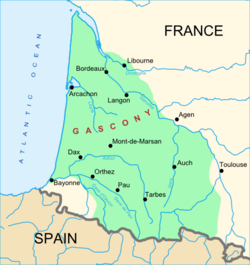
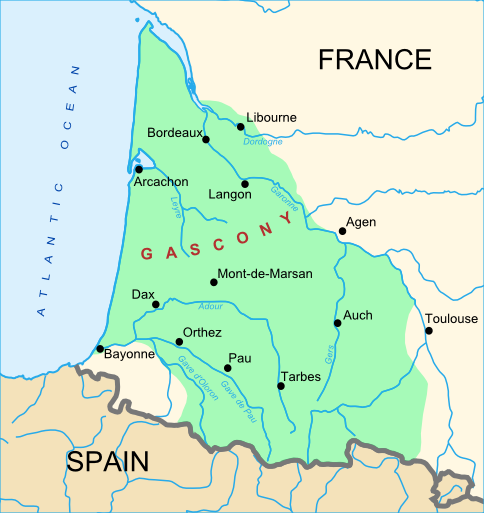
A map of Gascony, showing a wide definition of the region. Other definitions may encompass a smaller area.

Gascony (/ˈɡæskəni/; French: Gascogne [ɡaskɔɲ] ; Occitan: Gasconha [ɡasˈkuɲɔ])[1] was a province of the southwestern Kingdom of France that succeeded the Duchy of Gascony (602–1453). From the 17th century until the French Revolution (1789–1799), it was part of the combined Province of Guyenne and Gascony. The region is vaguely defined, and the distinction between Guyenne and Gascony is unclear; by some they are seen to overlap, while others consider Gascony a part of Guyenne. Most definitions put Gascony east and south of Bordeaux.

It is currently divided between the region of Nouvelle-Aquitaine (departments of Landes, Pyrénées-Atlantiques, southwestern Gironde, and southern Lot-et-Garonne) and the region of Occitanie (departments of Gers, Hautes-Pyrénées, southwestern Tarn-et-Garonne, and western Haute-Garonne).

Gascony was historically inhabited by Basque-related people who appear to have spoken a language similar to Basque. The name Gascony comes from the same root as the word Basque (see Wasconia below). From the Middle Ages until today, the Gascon language has been spoken, usually classified as a regional variety of the Occitan language.

Gascony is the land of d'Artagnan, who inspired Alexandre Dumas's character d'Artagnan in The Three Musketeers, as well as the land of Cyrano de Bergerac, the eponymous character of the play by Edmond Rostand and the home of Emily St. Aubert, the central character of The Mysteries of Udolpho by Ann Radcliffe. It is also home to Henry III of Navarre, who later became king of France as Henry IV.

History

[edit]
Typical view of the hilly countryside of Gascony, with the Pyrenees mountains in the far distance

Aquitania

[edit]

In pre-Roman times, the inhabitants of Gascony were the Aquitanians (Latin: Aquitani), who spoke a non-Indo-European language related to modern Basque.

The Aquitanians inhabited a territory limited to the north and east by the river Garonne, to the south by the Pyrenees mountain range, and to the west by the Atlantic Ocean. The Romans called this territory Aquitania, either from the Latin word aqua (meaning "water"), in reference to the many rivers flowing from the Pyrenees through the area, or from the name of the Aquitanian Ausci tribe, in which case Aquitania would mean "land of the Ausci".

In the 50s BC, Aquitania was conquered by lieutenants of Julius Caesar and became part of the Roman Empire.

Later, in 27 BC, during the reign of Emperor Augustus, the province of Gallia Aquitania was created. Gallia Aquitania was far larger than the original Aquitania, as it extended north of the Garonne, in fact all the way north to the river Loire, thus including the Celtic Gauls that inhabited the regions between the rivers Garonne and Loire.

Novempopulana

[edit]

In 297, as Emperor Diocletian reformed the administrative structures of the Roman Empire, Aquitania was split into three provinces. The territory south of the Garonne River, corresponding to the original Aquitania, was made a province called Novempopulania (that is, "land of the nine tribes"), while the part of Gallia Aquitania north of the Garonne became the province of Aquitanica I and the province of Aquitanica II. The territory of Novempopulania corresponded mostly to that of modern Gascony.

The Aquitania Novempopulana or Novempopulania suffered like the rest of the Western Roman Empire from the invasions of Germanic tribes, most notably the Vandals in 407–409. In 416–418, Novempopulania was delivered to the Visigoths as their federate settlement lands and became part of the Visigoth kingdom of Toulouse, while other than the region of the Garonne river their actual grip on the area may have been rather loose.

The Visigoths were defeated by the Franks in 507, and fled into Spain and Septimania. Novempopulania then became part of the Frankish Kingdom like the rest of southern France. However, Novempopulania was far away from the home base of the Franks in northern France, and was only very loosely controlled by the Franks. During all the troubled and historically obscure period, starting from early 5th-century accounts, the bagaudae are often cited, social uprisings against tax exaction and feudalization, largely associated to Vasconic unrest.

Duchy of Gascony

[edit]
The Duchy was meant to hold sway over the Basques (Vascones).

Old historical literature[example needed] sometimes[when?] claims the Basques took control of the whole of Novempopulania in the Early Middle Ages, founding its claims on the testimony of Gregory of Tours, on the etymological link between the words "Basque" and "Gascon" – both derived from "Vascones" or "Wasconia", the latter being used to name the whole of Novempopulania.

Modern historians reject this hypothesis, which is sustained by no archeological evidence. For Juan José Larrea, and Pierre Bonnassie, "a Vascon expansionism in Aquitany is not proved and is not necessary to understand the historical evolution of this region".[2] This Basque-related culture and race is, whatever the origin, attested in (mainly Carolingian) Medieval documents, while their exact boundaries remain unclear ("Wascones, qui trans Garonnam et circa Pirineum montem habitant" -- "Wascones, who live across the Garonne and around the Pyrenees mountains", as stated in the Royal Frankish Annals, for one).[3]

The word Vasconia evolved into Wasconia, and then into Gasconia[4] (w often evolved into g under the influence of Romance languages; cf. warranty and guarantee, warden and guardian, wile and guile, William and Guillaume). The gradual abandonment of the Basque-related Aquitanian language in favor of a local Vulgar Latin was not reversed. The replacing local Vulgar Latin evolved into Gascon. It was heavily influenced by the original Aquitanian language[citation needed] (for example, Latin f became h; cf. Latin fortia, French force, Spanish fuerza, Occitan fòrça, but Gascon hòrça). Interestingly, the Basques from the French side of the Basque Country traditionally call anyone who does not speak Basque a "Gascon".[citation needed]

Meanwhile, Viking raiders conquered several Gascon towns, among them Bayonne in 842–844. Their attacks in Gascony may have helped the political disintegration of the duchy until their defeat by William II Sánchez of Gascony in 982. In turn, the weakened ethnic polity known as Duchy of Wasconia/Wascones, unable to get around the general spread of feudalization, gave way to a myriad of counties founded by Gascon lords.

Angevin Empire

[edit]
Homage of Edward I (kneeling) to Philip IV (seated)
Coat of arms of Gascony

The 1152 marriage of Henry II and Eleanor of Aquitaine allowed the former to gain control of his new wife's possessions of Aquitaine and Gascony. This addition to his already plentiful holdings made Henry the most powerful vassal in France.[5]

In 1248, Simon de Montfort was appointed Governor in the unsettled Duchy of Gascony. Bitter complaints were excited by de Montfort's rigour in suppressing the excesses of both the seigneurs of the nobility and the contending factions in the great communes. Henry III yielded to the outcry and instituted a formal inquiry into Simon's administration. Simon was formally acquitted of the charges, but in August 1252 he was nevertheless dismissed. Henry then himself went to Gascony, pursuing a policy of conciliation; he arranged the marriage between Edward, his 14-year-old son, and Eleanor of Castile, daughter of Alfonso X. Alfonso renounced all claims to Gascony and assisted the Plantagenets against rebels such as Gaston de Bearn, who had taken control of the Pyrenees.[6]

In December 1259, Louis IX of France ceded to Henry land north and east of Gascony.[7] In return, Henry renounced his claim to many of the territories that had been lost by King John.

In May 1286, King Edward I paid homage before the new king, Philip IV of France, for the lands in Gascony. However, in May 1294, Philip confiscated the lands, initiating the Gascon War. Between 1294 and 1298, Edward sent three expeditionary forces to recover Gascony, but Philip was able to retain most of the territory until the Treaty of Paris in 1303.[8]

In 1324, when Edward II of England in his capacity as Duke of Aquitaine failed to pay homage to the French king after a dispute, Charles IV declared the duchy forfeit at the end of June 1324, and military action by the French followed. Edward sent his wife Isabella, who was sister to the French king, to negotiate a settlement. The Queen departed for France on 9 March 1325, and in September was joined by her son, the heir to the throne, Prince Edward (later Edward III of England). Isabella's negotiations were successful, and it was agreed that the young Prince Edward would perform homage in the king's place, which he did on 24 September and so the duchy was returned to the English crown.[9]

When France's Charles IV died in 1328 leaving only daughters, his nearest male relative was Edward III of England, the son of Isabella, the sister of the dead king; but the question arose whether she could legally transmit the inheritance of the throne of France to her son even though she herself, as a woman, could not inherit the throne. The assemblies of the French barons and prelates and the University of Paris decided that males who derive their right to inheritance through their mother should be excluded. Thus the nearest heir through male ancestry was Charles IV's first cousin, Philip, Count of Valois, and it was decided that he should be crowned Philip VI of France. Philip believed that Edward III was in breach of his obligations as vassal, so in May 1337 he met with his Great Council in Paris. It was agreed that Gascony should be taken back into Philip's hands, thus precipitating the Hundred Years War between England and France.[10][11] At the end of the Hundred Years' War, after Gascony had changed hands several times, the English were finally defeated at the Battle of Castillon on 17 July 1453; Gascony remained French from then on.[12]

Province of Guyenne and Gascony

[edit]
Flag of Gascony, Union Gascona (Gascon Union)

From the 17th century onwards, the government of Gascony [13] was united with Guyenne.[14] The government of Guyenne and Gascony (Guienne et Gascogne), with its capital at Bordeaux, lasted until the end of the Ancien Régime in 1792.[14]

Geography

[edit]
Current communes and departments included in the ancient province of Gascony

Gascony is limited by the Atlantic Ocean (western limit) and the Pyrenees mountains (southern limit); as the area of Gascon language, it extends to the Garonne (North), and close to the Ariège (river) (East) from the Pyrenees to the confluence of the Garonne with the Ariège. The other most important river is Adour, along with its tributaries Gave de Pau and Gave d'Oloron.

The most important towns are:

Bayonne, Dax and Tarbes are crossed by the Adour. Pau and Lourdes are crossed by the Gave de Pau. Mont-de-Marsan also belongs to the drainage basin of the Adour. The Gers (river), a tributary of the Garonne, flows through Auch.

References

[edit]
[edit]
Revisions and contributorsEdit on WikipediaRead on Wikipedia
from Grokipedia
Gascony (French: Gascogne) is a historical region in southwestern , located between the mountains to the south, the Atlantic Ocean to the west, and the River to the north, now divided primarily between the modern administrative regions of and Occitanie. The name originates from the Latin Vasconia, referring to the territory of the , an ancient people akin to the who inhabited the area before Roman conquest. Originally part of Roman Gallia Aquitania with as a key center, Gascony evolved into a semi-autonomous by the , marked by frequent conflicts with Frankish rulers and Basque-related independence movements. In the , it passed to English control via the following Henry II's marriage to , retaining strategic and economic value—especially through the trade—that fueled disputes leading to the , where French kings repeatedly sought to reclaim it, culminating in its full integration into by 1453. Gascony's defining characteristics include its rugged terrain supporting viticulture and pastoralism, a reputation for martial prowess and independent spirit among its inhabitants, and the Gascon language, a Romance variety within the Occitan group but distinguished by Basque substrate influences in and , which has preserved a unique cultural identity amid pressures from standard French.

History

Origins and Roman Era

The territory comprising modern Gascony formed part of ancient Aquitania, inhabited prior to Roman arrival by the , a population ethnically and linguistically distinct from the Celtic to the north, with affinities to Iberian peoples and speaking a non-Indo-European ancestral to Basque. This region, bounded by the River to the north, the to the south, and the Atlantic Ocean to the west, hosted over twenty Aquitanian tribes, including the Ausci (around modern ), Tarbelli (near Bigorre), and Sottiates (in the Landes area), who maintained tribal societies with limited urbanization and agriculture adapted to the wetland and forested terrain. Among these, the occupied the southeastern fringes near the , exhibiting cultural continuity with pre-Indo-European groups and relative isolation from Celtic influences. In 56 BC, during Julius Caesar's , Publius Crassus—son of and a lieutenant of Caesar—led the Roman subjugation of Aquitania, defeating Aquitanian forces in a campaign that secured the region south of the without full integration into the broader Gallic conquest. This military action, detailed in Caesar's , marked the initial Roman foothold, though resistance persisted among southern tribes like the , who retained autonomy under nominal Roman oversight. Under Emperor Augustus, Aquitania was formalized as a Roman province (Gallia Aquitania) by 27 BC, initially encompassing areas up to the Loire River but with the core Aquitanian lands south of the Garonne—encompassing proto-Gascon territory—experiencing partial Romanization through roads, villas, and trade along the Garonne axis. By the late 4th century AD, administrative reforms under Emperor Theodosius divided the province into three parts, with Aquitania Tertia (also called Novempopulania, "land of the nine peoples") corresponding to the southwest, including Gascon precursors; this subprovince, centered on cities like Eauze and Auch, saw lighter Roman imprint due to the rugged Pyrenean foothills and Basque-related populations, setting the stage for post-Roman ethnogenesis. The Vascones, integrated into Novempopulania, contributed to linguistic persistence, with their name later evolving into "Vasconia" for the emerging Gascon identity.

Medieval Duchy of Gascony

The , originally known as Vasconia, emerged as a distinct entity in the early medieval period following the Frankish conquest of Visigothic territories in around 531, with fuller integration under Merovingian rule by 632 or 633 when Charibert II asserted control over the region. Initially formed as a Frankish to manage the Basque populations, it maintained significant autonomy under local dukes who often resisted central Carolingian authority. In the late 8th century, Duke Lupus submitted to in 769 by handing over the rebel Hunald, marking formal acknowledgment of Frankish , though Gascony retained independence. pacified the duchy in 819 amid ongoing rebellions. During the 9th century, Gascony faced severe Viking incursions, with raids devastating in 848 and 864; Duke Seguin II died defending the city in 845, and Duke William I perished in a Viking battle near Brissarthe in October 866. The duchy was governed by a series of Basque-origin dukes, including Garcia I Sanchez in the late and Sancho Guillaume, who ruled until his death in 1032. Following Sancho's death, Gascony passed to Eudes of in 1032, who held it until his death in battle at Mauzé on 10 March 1039. By 1058, under , Gascony was fully merged into the larger , with the assuming the title Duke of Gascony; this union was solidified through marriages, such as that of William V to Sancha of Gascony around 1011. Throughout the 10th and 11th centuries, subsidiary counties like Fezensac and Astarac emerged by 920, alongside viscounties such as and Dax from the mid-9th century, reflecting feudal fragmentation while nominal ducal authority persisted. Gascony's political ties extended to neighboring and , influencing its resistance to northern powers like . By the early , the territory from to the was increasingly referred to as the duchy of , though Gascony proper retained ethnic and administrative distinctions until its incorporation into the Angevin holdings.

Integration into the Angevin Empire and Hundred Years' War

Gascony's incorporation into the Angevin Empire stemmed from the 1152 marriage of Henry, Count of Anjou, to Eleanor of Aquitaine, whose dowry included the vast Duchy of Aquitaine, of which Gascony formed the southern core. This union brought Gascony under Plantagenet control eight weeks after Eleanor's annulment from Louis VII of France, establishing Henry as Duke of Aquitaine and Gascony alongside his Norman and Anjou holdings. Crowned King of England in 1154, Henry II expanded these territories into the Angevin Empire, which by the 1170s extended from the Scottish borders to the Pyrenees, though Gascony's semi-autonomous lords often resisted direct royal oversight, sparking localized revolts against Angevin administrative reforms. Following the loss of , Anjou, and to II Augustus by 1204, Gascony remained a steadfast English possession under King John, retained through a combination of military defense and feudal homage disputes that preserved its status as an allodial rather than a strictly . Over the subsequent century, tensions escalated with French kings demanding homage for Gascony as part of , culminating in I's partial submission to IV in 1303 after conflicts like the 1294-1297 , yet English endured due to Gascon preference for lighter English taxation and privileges, particularly in wine exports to . The (1337-1453) crystallized these feudal frictions into open conflict when Philip VI confiscated , including Gascony, in 1337, prompting III to assert the English claim to the French throne while defending Gascony as a sovereign holding. Gascony emerged as a vital English foothold in southwestern , supplying troops and serving as a launchpad for campaigns; in 1345, English forces under the reclaimed much of the duchy from French incursions, bolstering III's position before the northern victory at Crécy in 1346. The Black Prince's 1355-1356 through Gascony devastated French lands, culminating in the capture of King John II at and the 1360 , which ceded full sovereignty over Gascony to , expanding it into a under , , until its revocation by Charles V in 1369 amid Gascon noble divisions. Despite intermittent French advances, Gascon loyalty to England persisted through the war's later phases, fueled by economic interdependence—Bordeaux's wine trade with England generated over 20,000 tuns annually by the 14th century—and resentment toward heavier French fiscal demands, with many Gascon lords, such as the Counts of Foix and , allying with the English until the final campaigns. English garrisons held key strongholds like and , supporting chevauchées and naval operations, but faltered after Henry V's death in 1422; by 1451, French forces under VII reconquered much of the duchy. The decisive on July 17, 1453, saw 5,000 French troops with superior artillery under Jean and Gaspard Bureau rout John Talbot's 6,000 English and Gascon allies, resulting in Talbot's death and the swift fall of by , terminating three centuries of English rule over Gascony. This defeat, marking the Hundred Years' War's effective end, stemmed from French logistical superiority and cannon technology, ending Plantagenet continental ambitions beyond .

French Provincial Period

After the decisive French victory at the on July 17, 1453, Gascony was reconquered from English control, marking the conclusion of the and the region's full integration into the Kingdom of France under Charles VII. This event ended over three centuries of Plantagenet dominion, which had begun with the marriage of Henry II and in 1152. The province retained a degree of local autonomy initially, but royal authority was progressively consolidated through the appointment of governors and the extension of French legal and fiscal systems. Gascony was merged administratively with Guyenne to form the gouvernement général de Guyenne et Gascogne, with serving as the capital from around 1462 onward. This military and civil government structure, typical of the , endured until the abolition of provincial governments in 1789 during the . Governors, often high nobles or military figures, oversaw defense, justice, and tax collection, while intendants appointed from the late under increasingly centralized royal control, implementing policies like the drainage of the marshy Landes region for and to support naval needs. The province contributed significantly to the kingdom's economy through wine production, much of it exported via , and pastoral activities such as sheep rearing for and . Socially, Gascony maintained distinct cultural traits, including the widespread use of the of Occitan, though French gradually predominated in official matters. The Wars of Religion in the 16th century saw Protestant communities, particularly in , flourish before Catholic reconquest under Henry IV, leading to a mix of religious tensions resolved by the in 1598. By the , Enlightenment ideas influenced local intellectuals, exemplified by Charles de Secondat, Baron de , born near in 1689, whose works critiqued absolutism while drawing on provincial experiences. Despite integration, regional identities persisted, with occasional resistance to central policies, such as during revolts in the mid-17th century.

Revolution and Modern Administrative Changes

During the , the sought to dismantle the fragmented administrative structure of the to foster national unity and administrative efficiency. On 4 August 1789, the abolition of feudal privileges effectively ended the legal distinctiveness of historic provinces like Gascony. The subsequent law of 22 December 1789 authorized the creation of departments as uniform territorial units, each approximately 9,000 square kilometers in area, with boundaries drawn to balance population and geography while minimizing old loyalties; these were formally established by decrees in early 1790. The territory of the former province of Gascony, which had been administered as part of the gouvernement of centered on , was subdivided among several new departments to eliminate regional autonomy. Key departments formed from Gascon lands included the Landes (created 4 March 1790 from districts around Dax and Chalosse), the (also 4 March 1790, from the and other eastern Gascon areas), and (4 March 1790, incorporating Agenais and southern Gascon extensions). Southwestern coastal and urban portions entered the department (4 March 1790, with as prefecture), while southern fringes overlapped into the Basses-Pyrénées (later , 4 March 1790). This partitioning reduced Gascony's cohesive identity, aligning local governance with Paris-directed prefectures and elected councils. In the , Gascony's lands have undergone further regional consolidation without restoring provincial status. The and 1972 laws introduced régions as planning and coordination entities, with (established 1972) absorbing Gironde, Landes, , and , while joined . A 2014 reform merged these into the larger region effective 1 January 2016, encompassing 12 departments and over 5.5 million inhabitants, emphasizing economic integration over historical divisions. Today, Gascony endures as a cultural reference rather than an administrative entity, with no dedicated departmental or regional framework, though local initiatives preserve its heritage amid centralized national policies.

Geography

Location and Boundaries

Gascony occupies a position in southwestern France, primarily within the modern administrative region of Nouvelle-Aquitaine, with extensions into Occitanie. It lies along the northern foothills of the Pyrenees mountain range, stretching from the Basque Country near the France-Spain border eastward toward Toulouse and northward to the area around Bordeaux. The region's boundaries are defined by prominent natural features: the Atlantic Ocean to the west, providing over 100 kilometers of coastline in the Landes department; the Pyrenees mountains to the south, marking the frontier with Spain; the Garonne River and its valley influencing the northern limits; and the eastern edge aligning roughly with the upper Garonne valley and areas around Toulouse. Historically, these boundaries encompassed an area of approximately 20,000 square kilometers during the French provincial period before the Revolution. In contemporary terms, Gascony aligns with the departments of Landes, Gers, and Hautes-Pyrénées in full, along with significant portions of Pyrénées-Atlantiques to the southwest, southern Lot-et-Garonne and southwestern Gironde to the north, and parts of Haute-Garonne to the east. This configuration reflects the historical province's core while adapting to post-Revolutionary administrative reforms that dissolved the old provincial boundaries in 1790.

Topography and Natural Features

Gascony's topography reflects its position within the Aquitaine Basin, shaped by Pyrenean folding, erosion, and sedimentary deposits from prehistoric times. The southern portions feature the northern foothills of the , offering elevated and rugged terrain that gives way northward to undulating hills and modest valleys with asymmetric profiles. Central areas, such as the department, exhibit alternating coteaux (hills) and valleys with low to moderate relief, influenced by underlying formations in subregions like Lomagne and Ténarèze. To the west, the landscape flattens into the vast Landes de Gascogne, a triangular expanse of nearly 1,300,000 hectares characterized by gently inclined plains sloping from southeast to northwest, with micro-relief including ancient dunes and sandy soils. This area, historically prone to marshy moors and shifting sands, now hosts Europe's largest artificial forest dominated by maritime pines (Pinus pinaster), planted extensively since the 19th century to combat coastal erosion. Along the Atlantic coast, extensive dune systems and the region's longest continuous beach stretch northward from the Adour River mouth. Key natural features include the Garonne River, which originates in the and flows northward through the eastern valleys, forming fertile alluvial plains and the approximate northern boundary of historical Gascony; the Adour River in the west, draining the Landes; and diverse wetlands, lagoons, and deltas supporting unique ecosystems. These rivers and coastal elements contribute to a varied that has historically facilitated and trade while posing flood risks in low-lying areas.

Climate and Environmental Challenges

Gascony features an with mild temperatures year-round, averaging between 9°C and 19°C, mild winters rarely dipping below freezing, and warm summers peaking in and . The region receives moderate to abundant rainfall, concentrated in spring and autumn, with frequent fog and mists, particularly in cooler months, alongside about 2,000 hours of annual sunshine supporting and . The expansive Landes de Gascogne forests, dominated by maritime pine monocultures planted since the to stabilize dunes, face heightened vulnerability to wildfires exacerbated by drier summers and prolonged droughts linked to . In July 2022, two major fires south of consumed over 20,000 hectares, including peatlands, leading to evacuations of approximately 20,000 residents and marking the largest blazes in the area since 1949. These events released significant smoke plumes affecting air quality across southwestern , with projections indicating a 1.5°C rise and 10% rainfall decline by 2050 could further elevate fire risks through reduced and increased flammability. Riverine and coastal flooding constitute another persistent threat, particularly along the River valley and the Atlantic shoreline, where heavy spring rains and storm surges have historically caused inundation. Climate models forecast intensified flood risks in , including Gascony, from altered precipitation extremes and sea-level rise, with coastal retreat already evident and potentially submerging low-lying areas near by mid-century under moderate emissions scenarios. Ongoing challenges include forest adaptation to warmer, drier conditions, with studies recommending diversified to mitigate monoculture vulnerabilities, alongside from post-fire landscapes and pesticide runoff during storms impacting in agricultural lowlands.

Demographics

Gascony's population is distributed across a predominantly rural landscape spanning the departments of , Landes, and , with approximate totals of 192,649, 428,427, and 332,226 residents respectively as of 2022, yielding an overall regional estimate exceeding 950,000 inhabitants when considering these core areas. remains low, averaging around 25-62 inhabitants per square kilometer in these departments, reflecting extensive agricultural lands and forested areas that limit . Settlement patterns emphasize small towns and villages, with concentrations near key urban centers such as (Gers, population exceeding 24,000 in 2023), (Landes, approximately 30,000), and (Lot-et-Garonne, around 35,000), which serve as administrative and economic hubs. Rural dispersal predominates, with over 80% of communes in Gers and Landes classified as low-density rural, contributing to a sparse distribution that has persisted since the post-World War II era due to agricultural dominance and limited industrialization. Demographic trends indicate a reversal from mid-20th-century stagnation or decline to modest growth over the past three decades, driven primarily by net positive migration rather than increase. In the SCoT de Gascogne territory, population has rebounded since the 1980s, mirroring departmental patterns where saw an annual average gain of 331 residents from 2016-2022 despite a negative birth-death balance, offset by inflows of retirees and remote workers attracted to affordable rural living. Landes experienced stronger annual growth of 0.9% in the same period, concentrated along the coast and around Dax, fueled by and retirement migration, while remained stable at 0.0% annual change. Aging demographics persist, with over 25% of residents aged 65+ in , exerting pressure on services but supported by inbound migration from denser urban regions like . Projections suggest continued slow expansion through 2030, contingent on sustained appeal for secondary residences and counter-urbanization trends.

Ethnic and Cultural Composition

The Gascons, the primary ethnic group historically associated with Gascony, descend from the ancient tribes, including the , who occupied the southwestern region of and northeastern Iberia prior to Roman subjugation in the 1st century BCE. These pre-Roman peoples exhibited cultural and linguistic affinities with proto-Basque groups, as evidenced by classical accounts describing their resistance to Roman expansion and non-Indo-European speech patterns distinct from neighboring . Roman colonization from 56 BCE onward introduced Latin, which evolved into the Romance-based , overlaying but not fully erasing the substrate influences. Genetic analyses of uniparental markers (Y-chromosome and mtDNA) from populations in southwestern and adjacent Iberia reveal a pre-Roman tribal structure persisting in Gascon-inhabited areas, with elevated frequencies of haplogroups like R1b-M153 and U5b, indicative of ancient Iberian continuity rather than heavy Germanic influx seen elsewhere in . Autosomal studies further distinguish Gascons and neighboring from northern French clusters, attributing this to geographic isolation in the foothills and limited post-Roman migrations, though they integrate into the broader Western European without isolationist extremes. These patterns underscore causal factors like terrain-barrier over millennia, rather than recent admixtures. Culturally, Gascon composition centers on a cohesive Occitan heritage, with the serving as a marker of identity despite its decline under French standardization policies since the . Roman Catholicism dominates, shaping communal rituals, saints' feasts, and moral frameworks, while stereotypes of Gascon bravado and hospitality—rooted in medieval warrior traditions—persist in and social norms. Unlike urban , rural Gascony retains agrarian customs, including communal harvests and , fostering ethnic homogeneity amid minimal historical influx from non-European sources. Modern integration into has diluted overt ethnic distinctions, but regional pride endures through associations like cultural revival groups, without formal separatist claims.

Language

The Gascon Dialect

Gascon is a Romance language variety traditionally spoken in the Gascony region of southwestern , geographically encompassing areas from the Adour River basin to the , including subvarieties such as Béarnais and Bigourdan. It is commonly classified as a of the Occitan macrolanguage, sharing typological features like the absence of subject clitics in verbal systems and conservation of a fully functional tense, yet distinguished by innovations arising from contact with pre-Roman Aquitanian substrates akin to Basque. This substrate influence, evident since Roman conquest around 56 BCE, imparted unique phonological, morphological, and syntactic traits not found in other Occitan dialects such as Provençal or Languedocien. A hallmark of Gascon is its énonciatif system, comprising preverbal particles (que, e, be, ja, se, non) that precede finite verbs to encode pragmatic nuances like assertion, uncertainty, emphasis, or exclamation, systematically differentiating declarative, interrogative, and exclamatory moods. Absent in other Occitan varieties, this system originated from Basque-Latin contact, with particles deriving from Latin roots (que from quid, e from et) grammaticalized via replica borrowing, first attested in 4th-century texts and systematically documented from the 12th century (e.g., Laloubère manuscript). Examples include Que vòli ("I want," assertive), E sabes? ("Do you know?," uncertain or hypothetical), and Be cantas plan ("You sing well!," exclamatory), with regional variations such as higher frequency of e (54 instances) over que (36) in Béarnais corpora. Phonologically, Gascon exhibits substrate-driven shifts, such as the of Latin initial /f/ to /h/ (e.g., filium > hilh "son"), unique among Occitan dialects, alongside mergers like Latin /b/ and /v/ into in western varieties from intervocalic /p/ as well. Lexical differentiation from core Occitan began during the (4th–5th centuries CE) and accelerated from the , yielding a conservative yet innovative bridging Gallo-Romance and Ibero-Romance, enriched by regional substrates and medieval textual traditions. Syntactically, it aligns with Occitan in maintaining analytic futures and periphrastic tenses but innovates through enunciative integration, reflecting a conservative from spoken forms.

Decline, Preservation Efforts, and Policy Debates

The use of Gascon has declined sharply since the mid-20th century due to state-driven policies, including mandatory education in since the 1880s and the dominance of French in media and administration, which reduced intergenerational transmission. A 1982 survey in found 51% of respondents could speak Gascon and 70% could understand it, but subsequent decades saw a marked drop, with classifying Gascon as "definitely endangered" by 2010 owing to limited transmission to younger generations. Estimates of fluent speakers range from 100,000 to 250,000 as of the early 2020s, primarily among those over 50, with urban migration and economic incentives favoring French accelerating the shift. Preservation efforts include grassroots associations such as the Institut d'Estudis Occitans, which promote Gascon through literature, theater, and festivals, alongside limited programs in regions like the department, where local initiatives emphasize to maintain oral traditions. Some primary schools in southwestern incorporate Gascon immersion classes, supported by regional councils, though participation remains low at under 5% of students due to parental preference for French proficiency. Digital projects, including online dictionaries and radio broadcasts, aim to document dialects, but critics argue these fail to reverse decline without broader institutional backing, as evidenced by stalled growth in speaker numbers despite decades of activism. French policy debates center on the 1951 Deixonne Law, which first permitted optional regional language teaching, and the 2008 recognizing "s" as 's heritage, yet implementation remains minimal, with French enshrined as the sole official language under Article 2 of the to preserve national unity. Advocates for Gascon, often aligned with Occitanist movements, push for ratification of the European Charter for Regional or Minority Languages—signed by in 1999 but never ratified—arguing it would enable co-official status and funding, while opponents, including officials, contend that prioritizing dialects risks fragmenting administrative cohesion and diluting French's global role. Regional assemblies in have allocated modest budgets for signage and media since 2016, but national resistance persists, with data showing only 2-3% of public school hours devoted to regional languages overall, fueling accusations of symbolic gestures over substantive support.

Culture

Culinary Traditions and Products

Gascon emphasizes rustic, hearty dishes derived from local , particularly the rearing of ducks and geese fed on introduced in the , which forms the basis for fat-rich preparations like and . Central to the tradition is the use of as a cooking medium, reflecting the region's self-sufficient farming practices where provides meat, , and preserved products. This contrasts with lighter styles by prioritizing bold flavors from preserved meats, slow-cooked stews, and fruit brandies, with meals often structured around farm-fresh ingredients like , beans, and prunes. Foie gras, produced by force-feeding ducks or geese with corn to enlarge the liver, remains a signature product, especially in the Gers department, where over 70% of France's output originates; the process yields a delicacy prized for its creamy texture when pan-seared or terrine-prepared. Confit de canard, involving salted duck legs slow-cooked in their own fat for preservation—a method dating to medieval times—serves as a staple protein, often reheated and crisped for dishes like cassoulet variations or simply paired with potatoes. Magret de canard, the pan-fried breast from fattened ducks, exemplifies modern adaptations of these traditions, grilled rare to retain juiciness and accompanied by local plums or Armagnac reductions. Armagnac, a grape-based brandy distilled once in column stills and aged in oak, constitutes Gascony's premier spirit, with production documented since 1310 in the region spanning , , and Landes; unlike Cognac's double , this yields earthier, more complex profiles from varieties like Ugni Blanc and Baco. Regulated under since 1936, it pairs with or prunes d'—plums cultivated since the 13th century by Benedictine monks in Agen for drying into wrinkled fruits used in tarts and sauces. Other products include , a thick enriched with and , and gascon, a thin almond-flour dusted with , alongside seasonal items like Lectoure melons and violet from the Armagnacais area. Wines from appellations such as Madiran (robust reds) and Pacherenc du Vic-Bilh complement these, underscoring the terroir-driven ethos where sandy soils and Atlantic influences shape flavor intensity.

Literature, Arts, and Folklore

Gascon literature forms a subset of the Occitan literary corpus, distinguished by its use of the , with a notable "" spanning 1550 to 1650. Pey de Garros (ca. 1525–1583), born in Lectoure, composed and translated the into Gascon in 1565, followed by a volume of in 1567, thereby elevating the dialect's status in vernacular . His works emphasized themes and linguistic pride, reflecting the era's regional linguistic assertions amid French centralization. In the 17th century, Gascon authors continued to advocate for their dialect through celebratory texts, such as those defending its expressive merits against dominant French, fostering a sense of cultural distinctiveness. The historical figure Charles de Batz-Castelmore d'Artagnan (1611–1673), a native of Lupiac in Gascony, inspired Alexandre Dumas's 1844 novel , portraying the archetypal bold Gascon adventurer and embedding regional traits into broader . Visual arts in Gascony historically feature Romanesque elements, evident in sculpted capitals and architectural details of churches like those in Lectoure and surrounding sites, which depict biblical scenes and local motifs from the medieval period onward. These works, dating primarily to the 11th–12th centuries, highlight the region's integration into southwestern France's Romanesque heritage, with intricate stone carvings symbolizing faith and feudal patronage. Folklore in Gascony encompasses oral traditions tied to rural life, including mythical beasts like the , a subterranean snail-serpent with extensible tentacles said to ensnare and devour prey, rooted in tales from areas like Hastingues to caution children. Secular customs persist, such as the hailhe de Nadau, involving hilltop bonfires lit sequentially on in Chalosse, a pre-Christian-derived adapted to mark the and community bonds. These elements underscore Gascon identity's blend of Basque-influenced and realism.

Sports and Social Customs

Rugby union holds a central place in Gascon sports culture, particularly in the southwestern departments encompassing historical Gascony such as the , where it fosters community bonds and local identity. In , the Rugby Club Auch (RCA), tracing its origins to the Football Vélo Club Auscitain founded in 1897, maintains over 430 licensees across youth, women's, and senior teams, reflecting widespread participation. The club has achieved promotion to France's league twice, in 2003/2004 and 2006/2007, under coach Henry Broncan, and supports a network of 400 fans and 130 partners, underscoring its role in social cohesion. This passion aligns with the broader southwestern French tradition, where rugby matches draw large crowds and reinforce village rivalries. Traditional games complement organized sports, including nine-pin skittles, a practice with roots in the 15th–16th centuries, adapted locally with six skittles in Chalosse alleys of villages like Lahosse and Castelnau-Tursan. In the Landes portion of Gascony, dove hunting emerges as a seasonal pursuit starting in , involving group excursions into forests followed by communal meals like omelets, emphasizing shared rituals over competition. Social customs revolve around seasonal festivals and rites that preserve Gascon heritage through communal gatherings. The Mayade on April 30 entails erecting decorated "Mais" pines outside homes to honor events like marriages or retirements, with recipients hosting meals for participants, a practice widespread in Chalosse and broader Landes. Christmas Eve features the Hailhe de Nadau bonfires, lit across hilltops in areas like Saint-Sever for crop protection in pagan origins, now serving as venues for singing, music, and among villagers. Annual events such as Les Gasconnades in Lectoure at the end of highlight traditional s and , while the Escota é Minja in L'Isle-Jourdain in late and Lo Rondèu de Castelnau biennially in late June emphasize music and , drawing locals to affirm regional identity.

Economy

Agriculture and Viticulture

Gascony's agricultural sector forms a of its economy, with the region ranking among France's leaders in agricultural employment per data from the French National Institute of Statistics and Economic Studies (INSEE). Predominant activities include crop cultivation such as and sunflowers on rolling hills, alongside specialized livestock farming focused on for meat, fat, and production. serves dual purposes as a field crop and primary feed for ducks, supporting systems that emphasize local, resource-efficient practices. Viticulture occupies a prominent role, particularly in the production of , France's oldest brandy, distilled once from white wines in column or armagnacais stills. The Armagnac AOC spans three sub-regions—Bas-Armagnac, Armagnac-Ténarèze, and Haut-Armagnac—covering roughly 5,300 hectares of vines authorized for eau-de-vie production, though the broader Gascon vineyard extends to about 15,000 hectares shared with IGP table wines and PDO Floc de Gascogne. Principal grape varieties include Ugni Blanc (for acidity and yield), Colombard, Folle Blanche, and Baco Blanc, with yields regulated to maintain ; approximately 5 liters of wine yield 1 liter of Armagnac at 45-52% alcohol. Poultry farming, especially of hybrid ducks (crosses of Muscovy and Pekin breeds), drives output, with Gascony—centered in the department—producing livers through maize-based over the final 12-14 days of a 100-day rearing cycle that begins with free-range . This method, rooted in regional traditions, yields fatty livers weighing 500-800 grams, alongside and preserved in rendered fat, contributing significantly to export-oriented gastronomic products. Geese play a lesser but complementary role, with both species raised on family farms emphasizing maize-fed finishing for organ enlargement via natural physiological response to overfeeding.

Forestry, Tourism, and Industry

The Landes de Gascogne forest, encompassing a significant portion of Gascony's forested lands, spans nearly 10,000 km² and consists primarily of even-aged maritime pine () monocultures harvested on a 40- to 50-year cycle. This managed woodland, covering around 1.5 million hectares across departments like and Landes, supports high-volume timber production, representing approximately 12% of France's total wood output as of 2015 data. In 2019, timber from the region was allocated roughly evenly between (43%) and industrial uses like pulp and (45%), underscoring its role in downstream processing industries such as sawmills and panel manufacturing. employs local rural economies through private ownership—over 90% of the area—and contributes to resin tapping traditions, though modern yields prioritize structural wood over historical naval stores. Tourism in Gascony emphasizes gastronomic and rural experiences, drawing visitors to Armagnac distilleries, foie gras producers, and vineyard routes in areas like Gers and Lot-et-Garonne, alongside coastal dunes and beaches in the Landes department. The region's appeal lies in its sunny climate—averaging 2,000 hours annually—and unspoiled landscapes, promoting "slow tourism" focused on local markets, medieval bastides, and outdoor activities like hiking in the Pyrenees foothills. Coastal tourism, particularly around Arcachon Bay and Hossegor, integrates with forestry interiors for eco-routes, though the sector remains secondary to agriculture, with limited large-scale infrastructure like high-capacity hotels constraining visitor volumes in inland Gers. Industrial activity in Gascony is modest and closely tied to primary sectors, with wood processing—via firms like Gascogne Bois handling maritime pine for export across —forming the core manufacturing base since the early . Food and beverage processing, including aging and duck product facilities, supplements this in rural departments, but heavy is absent, reflecting the region's agricultural dominance; , for instance, ranks as France's most agrarian department with minimal industrial GDP share. Overall, these activities generate localized employment without significant national-scale output, prioritizing value-added from natural resources over diversified factories.

Politics and Regional Identity

Administrative Integration into France

The reconquest of Gascony by French forces culminated in the Battle of Castillon on July 17, 1453, where artillery and infantry tactics decisively defeated the English army under John Talbot, effectively ending three centuries of English Plantagenet rule over the duchy since Eleanor of Aquitaine's marriage to Henry II in 1152. This victory, part of Charles VII's broader campaign from 1450–1453, integrated Gascony into the Kingdom of France without formal treaty cession, as English holdings were forfeited through military defeat rather than negotiation. Under the , Gascony lacked unified political administration and was fragmented among feudal lords, including the counts of , , and Albret, before being subsumed into the larger gouvernement of et Gascogne by the 17th century, with as its capital. This structure centralized royal oversight through a and , enforcing fiscal and judicial policies from while preserving local customs and estates-general meetings until their suppression in the . The disrupted this provincial framework; in 1790, the abolished the gouvernement of et Gascogne, subdividing Gascony into new departments to promote administrative uniformity and centralization. Key departments included the (initially named after ), Landes, , and portions of and , aligning boundaries with natural features and population centers rather than historical provinces. This reorganization dissolved feudal privileges and integrated Gascon territories fully into the national system, with local governance via elected councils subordinate to and later Napoleonic authorities.

Regionalism, Autonomy Claims, and Cultural Preservation Debates

Regionalist movements in Gascony are generally subdued compared to those in regions like or , manifesting primarily through cultural advocacy rather than demands for political . These efforts align with the broader Occitan revival, emphasizing linguistic and historical identity against France's centralized Jacobin tradition, which has historically marginalized regional vernaculars since the . The Partit Occitan, established in 1987 in , campaigns for protection and regional socioeconomic issues, including employment and , but garners limited electoral support, reflecting the dominance of national parties. Autonomy claims in Gascony are minimal and non-violent, lacking organized separatist structures; instead, they focus on within the framework of the European Charter for Regional or Minority Languages, which signed in 1999 but ratified only partially in 2021 for certain dialects, excluding full implementation for Occitan variants like Gascon due to constitutional concerns over national unity. Local associations, such as those in the department, advocate for greater fiscal and administrative leeway from the regional council, arguing that Paris-centric policies overlook Gascony's agrarian needs, but these remain rhetorical rather than legislative pushes. Cultural preservation debates revolve around the endangered status of Gascon, a Romance distinct from standard Occitan in and , spoken by an estimated 100,000-200,000 primarily in the Landes, Gers, and departments as of recent surveys. The 1951 Deixonne Law introduced optional instruction in schools, enabling limited Gascon classes—around 10-15 hours annually in select primary schools by the —but enrollment has declined amid French pressures. Proponents of preservation, including linguists and cultural groups like the Institut d'Estudis Occitans, contend that revitalization through bilingual signage, media, and festivals—such as the annual Fête de la Gasconha—counters assimilation, supported by a 2008 constitutional amendment affirming regional languages as French heritage. Critics, often aligned with statist views in academia and , highlight implementation costs and potential divisiveness, noting that Gascon's vitality is further eroded by and proximity to Basque-speaking areas, where cross-influences dilute distinctiveness.

References

Add your contribution
Related Hubs
User Avatar
No comments yet.