Hubbry Logo
Geography of DenmarkGeography of DenmarkMain
Open search
Geography of Denmark
Community hub
Geography of Denmark
logo
8 pages, 0 posts
0 subscribers
Be the first to start a discussion here.
Geography of Denmark
from Wikipedia

Denmark is a Nordic country located in Northern Europe. It consists of the Jutland Peninsula and several islands in the Baltic Sea, referred[1] to as the Danish Archipelago. Denmark is located southwest of Sweden and due south of Norway and is bordered by the German state (and former possession) Schleswig-Holstein to the south, with a 68-kilometre (42-mile) long land border.

Key Information

Denmark borders both the Baltic and North seas along its 8,750 km (5,440 mi) tidal shoreline. Denmark's general coastline is much shorter, at 1,701 km (1,057 mi), as it would not include most of the 1,419 offshore islands (each defined as exceeding 100 square metres (1,100 sq ft) in area) and the 180-kilometre long (110 mi) Limfjorden, which separates Denmark's second largest island, North Jutlandic Island, 4,686 km2 (1,809 sq mi) in size, from the rest of Jutland. No location in Denmark is further from the coast than 52 km (32 mi). The land area of Denmark is estimated to be 43,094 km2 (16,639 sq mi). However, it cannot be stated exactly since the ocean constantly erodes and adds material to the coastline, and there are human land reclamation projects. On the southwest coast of Jutland, the tide is between 1 and 2 m (3.28 and 6.56 ft), and the tideline moves outward and inward on a 10 km (6.2 mi) stretch.[2] A recent global remote sensing analysis suggested that there were 607 km2 (234 sq mi) of tidal flats in Denmark, making it the 42nd ranked country in terms of tidal flat extent.[3] Denmark has an Exclusive Economic Zone of 105,989 km2 (40,923 sq mi). When including the Faroe Islands and Greenland, the EEZ is the 15th largest in the world with 2,220,093 km2 (857,183 sq mi).

A circle enclosing the same total area as Denmark would have a diameter of 234 km (146 miles). Denmark has 443 named islands (1,419 islands above 100 m2 (1,100 sq ft)),[4] of which 72 are inhabited (as of 1 January 2007, Statistics Denmark). The largest islands are Zealand (Sjælland) and Funen (Fyn). The island of Bornholm is located east of the rest of the country, in the Baltic Sea. Many of the larger islands are connected by bridges; the Øresund Bridge connects Zealand with Sweden; the Great Belt Bridge connects Funen with Zealand; and the Little Belt Bridge connects Jutland with Funen. Ferries or small aircraft connect to the smaller islands. Main cities are the capital Copenhagen on Zealand; Århus, Aalborg and Esbjerg in Jutland; and Odense on Funen.

Denmark experiences a temperate climate, with mild, windy winters and cool summers. The local terrain is generally flat with a few gently rolling plains. The territory of Denmark includes the island of Bornholm in the Baltic Sea and the rest of metropolitan Denmark, but excludes the Faroe Islands and Greenland. Its position gives Denmark complete control of the Danish straits (Skagerrak and Kattegat) linking the Baltic and North Seas. The country's natural resources include petroleum, natural gas, fish, salt, limestone, chalk, stone, gravel, and sand.

Environment

[edit]
Denmark is highly urbanised. Here Greater Copenhagen in the capital region.
The Danish landscape is characterised by flat, arable land and sandy coasts.
Beech is a common tree throughout Denmark's sparse woodlands.

Climate

[edit]
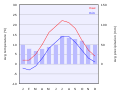
Climate data for Denmark (2001–2010)
Month Jan Feb Mar Apr May Jun Jul Aug Sep Oct Nov Dec Year
Mean daily maximum °C (°F) 3.3
(37.9)
3.3
(37.9)
6.1
(43.0)
11.5
(52.7)
15.5
(59.9)
18.5
(65.3)
21.6
(70.9)
21.2
(70.2)
17.5
(63.5)
12.3
(54.1)
7.9
(46.2)
4.2
(39.6)
11.9
(53.4)
Daily mean °C (°F) 1.5
(34.7)
1.2
(34.2)
3.0
(37.4)
7.5
(45.5)
11.4
(52.5)
14.6
(58.3)
17.4
(63.3)
17.2
(63.0)
13.8
(56.8)
9.4
(48.9)
5.7
(42.3)
2.2
(36.0)
8.8
(47.8)
Mean daily minimum °C (°F) −0.8
(30.6)
−1.3
(29.7)
−0.2
(31.6)
3.6
(38.5)
7.4
(45.3)
10.6
(51.1)
13.4
(56.1)
13.5
(56.3)
10.2
(50.4)
6.2
(43.2)
3.2
(37.8)
−0.3
(31.5)
5.5
(41.9)
Average precipitation mm (inches) 66
(2.6)
50
(2.0)
43
(1.7)
37
(1.5)
53
(2.1)
68
(2.7)
77
(3.0)
91
(3.6)
62
(2.4)
83
(3.3)
75
(3.0)
61
(2.4)
765
(30.1)
Average rainy days (≥ 1 millimetre (0.039 in)) 18 15 13 11 13 13 14 16 14 17 20 17 181
Mean monthly sunshine hours 47 71 146 198 235 239 232 196 162 111 58 45 1,739
Source: Danmarks Meteorologiske Institut
Climate data for Denmark (extremes, most 1961-1990)
Month Jan Feb Mar Apr May Jun Jul Aug Sep Oct Nov Dec Year
Record high °C (°F) 11.8
(53.2)
15.8
(60.4)
22.2
(72.0)
26.2
(79.2)
31.0
(87.8)
35.9
(96.6)
35.9
(96.6)
36.4
(97.5)
29.8
(85.6)
24.0
(75.2)
19.6
(67.3)
13.0
(55.4)
36.4
(97.5)
Record low °C (°F) −31.2
(−24.2)
−29.0
(−20.2)
−27.0
(−16.6)
−12.1
(10.2)
−6.0
(21.2)
−1.6
(29.1)
1.0
(33.8)
−0.1
(31.8)
−4.4
(24.1)
−9.0
(15.8)
−19.0
(−2.2)
−25.6
(−14.1)
−31.2
(−24.2)
[citation needed]

Land use

[edit]
Arable land: 55.99% Permanent crops: 0.14% Other: 42.87% (2012)

Irrigated land: 4,354 km2 (1,681 sq mi) (2007)

Total renewable water resources: 6 km3 (1.4 cu mi) (2011)

Drejø, Hjortø and Skarø seen from above. There are about 409 named Danish islands and around 70 of them are inhabited.

Freshwater withdrawal (domestic/industrial/agricultural):
total: 0.66 km3/a (0.16 cu mi/a) (58%/5%/36%)
per capita: 118.4 m3/a (4,180 cu ft/a) (2009)

Land reclamation

[edit]

In 2019, the government proposed building 9 new artificial islands, named project Holmene, which would create 3 km2 (1.2 sq mi) of reclaimed land, to be built from 2022 to 2040.[5]

In June 2021, lawmakers approved the construction of a 3 km2 (1.2 sq mi) island, named Lynetteholm, in the Copenhagen Harbor.[6] A spokesperson for the Climate Movement in Denmark (Klimabevægelsen i Danmark) said the organization would sue the government over environmental concerns.[7][needs update]

Agriculture

[edit]

Denmark has plenty of rain, flat landscape, and moderate climate. With 55.99% of its land considered as arable, Denmark has model characteristics for agriculture. 61% of the country's total area is cultivated [8] Farms in Denmark are remarkably large, averaging 70.0 hectares (172.9 acres) per farm. Additionally, homesteads exceeding 100 hectares (247 acres) make up more than 20% in Denmark. Many of these large farms harvest fruits and vegetables, the leading exports from Denmark are meat, fur, and dairy products.[8] The animal's diets in Denmark consist of mainly cereals since they are the dominant field crop. 75% of all cereal produced in Denmark is feed to the four most produced animals which are pigs, cattle, chicken and mink.[8] Denmark overproduces about 66% of food production compared to their own population size (5.7 million) being that they are able to feed 15 million people. This is a byproduct of being highly productive within the Danish agricultural production.[8]

In 1961, Denmark's Agricultural land represented 74.5% of land area. Fifty-six years later to 2015, Denmark has decreased its amount of Agricultural land down to 62.1%[9] then to 61% one year later in reference to "Facts and Figures - Danish Agriculture and Food"[8] The decrease in agricultural land comes as farmers are being well educated and the intensive amount of research and development is being implemented. It begins with advancements in agro-technology. The results have improved fertilization and nutrient use on arable land. Digestibility and nutrient uptake are developing from the improvements of new methods that are being implemented. Examples of these new methods are the addition of enzymes and microbial cultures.[8]

Natural hazards

[edit]
  • Flooding is a threat in some areas of the country

Current issues

[edit]
  • Air pollution, principally from vehicle and power plant emissions
  • Nitrogen and phosphorus pollution of the North Sea
  • Drinking and surface water becoming polluted from animal wastes and pesticides. Drinking water is very safe to drink, even though Denmark, unlike most countries, has almost no cleaning of drinking water

International agreements

[edit]
  • Party to: Air Pollution, Air Pollution-Nitrogen Oxides,
    Air Pollution-Sulphur 85, Air Pollution-Sulphur 94, Air Pollution-Volatile Organic Compounds, Antarctic Treaty, Biodiversity, Climate Change, Desertification, Endangered Species, Environmental Modification, Hazardous Wastes, Law of the Sea, Marine Dumping, Marine Life Conservation, Nuclear Test Ban, Ozone Layer Protection, Ship Pollution, Tropical Timber 83, Tropical Timber 94, Wetlands, Whaling
  • Signed, but not ratified: Air Pollution-Persistent Organic Pollutants, Antarctic-Environmental Protocol, Climate Change-Kyoto Protocol

Transnational issues

[edit]

Maritime claims

[edit]
Map showing the location of Denmark including the Faroe Islands and Greenland (pdf), collectively known as the Danish Realm.
  • Contiguous zone: 24 nmi (44.4 km; 27.6 mi)
  • Continental shelf: 200 m (660 ft) depth or to the depth of exploitation
  • Exclusive economic zone: 105,989 km2 (40,923 sq mi) (excludes Greenland and Faroe Islands). 200 nmi (370.4 km; 230.2 mi)
  • Territorial sea: 12 nmi (22.2 km; 13.8 mi)

Other issues

[edit]
  • Iceland disputes the Faroe Islands' fisheries median line.
  • Iceland, Ireland and the United Kingdom dispute Denmark's claim that the Faroe Islands' continental shelf extends beyond 200 nautical miles or about 370 km.
  • The Faroe Islands continue to study proposals for full independence.
  • Denmark is currently investigating the extent of the continental shelf of Greenland, in the hope that Greenland's Exclusive Economic Zone can be expanded. One of the areas investigated is the geographical North Pole.

Population

[edit]

Urban population

[edit]
  • Denmark's urban population accounts for 87.9% of its total population, with a 0.51% rate of change in urbanization.[10] Copenhagen remains the largest city in Denmark with a population of 1.2 million people and a metro population of 1.99 million. Copenhagen became Denmark's capital in 1443 and now currently sits with a population density of 6,800 per square kilometre (18,000/sq mi).[11][12]
  • About a quarter of Danes live in the capital Copenhagen.[13]

See also

[edit]

Notes

[edit]
[edit]
Revisions and contributorsEdit on WikipediaRead on Wikipedia
from Grokipedia
Denmark is a Nordic country in comprising the peninsula, which borders to the south, and an archipelago of over 400 islands in the , , , and , with and being the largest inhabited islands. Its land area totals 42,434 square kilometers, predominantly featuring low, flat to gently rolling plains formed by Pleistocene glaciation, with elevations rarely exceeding 100 meters and the highest point at Yding Skovhøj (173 meters). The terrain includes fertile covering much of the landscape, extensive sandy coasts, dunes, and lagoons, while controlling the that link the and , facilitating major maritime traffic. Denmark's temperate maritime climate is characterized by mild, windy winters, cool summers, high humidity, and frequent overcast skies, with average temperatures ranging from 0°C in winter to 17°C in summer, supporting but also exposing the low-lying areas to flooding risks from storm surges. accounts for about 69% of the land area, with the islands hosting over three-quarters of the concentrated in urban coastal zones, underscoring the geography's influence on dense settlement patterns and economic reliance on sea-based activities like fishing and shipping.

Location and Extent

Coordinates and Borders

Denmark occupies a position in , with its metropolitan territory extending from approximately 55° to 57° N latitude and 8° to 15° E longitude, encompassing the Peninsula and surrounding islands including in the . This places the country between the to the west and the to the east, separated from primarily by water except at its southern extent. The sole land border of Denmark is with along the southern edge of , measuring 68 kilometers in length and established in its current form following the 1920 plebiscites after . Maritime boundaries define relations with neighboring states: to the east across the strait with (extending about 115 kilometers in ) and to the northwest in the with , alongside indirect delimitations via international straits and exclusive economic zones. The , a 16-kilometer fixed link including segments, opened to traffic on July 1, 2000, connecting on to Malmö in and facilitating seamless cross-border movement without altering formal maritime boundaries. Internally, the Great Belt Fixed Link, opened for road traffic on June 14, 1998, bridges the 18-kilometer strait between the islands of and , enhancing domestic connectivity across Denmark's archipelagic structure.

Territorial Composition

Denmark's metropolitan territory, excluding the autonomous regions of and the , encompasses a total land area of 42,933 km². This comprises the peninsula, which forms the continental mainland and covers approximately 29,800 km², and an of over 440 islands. Of these islands, around 79 are inhabited, with the remainder consisting of smaller, often uninhabited landforms such as skerries and islets. The primary landmasses include the peninsula, which accounts for roughly two-thirds of the total area, and the major islands of (Sjælland, 7,031 km²), (Fyn, 2,985 km²), and (588 km²). hosts the capital and serves as the population center, while connects to via bridges, and lies detached in the . This peninsular-insular configuration underscores Denmark's fragmented geography, with land connections limited to the southern border with along . The terrain is predominantly lowland, with an average elevation of 34 meters above . The highest natural point is at 171 meters, located in central . This low-relief profile influences settlement patterns and infrastructure, emphasizing the country's reliance on bridges and ferries for internal connectivity.

Physical Geography

Topography and Geology

Denmark's topography features low relief dominated by plains and subtle hills, a direct consequence of Pleistocene glaciations that eroded pre-existing structures and deposited unconsolidated sediments across the region. The landscape lacks significant elevations, with the maximum height on the Jutland peninsula reaching 170.86 meters at Møllehøj in the Ejerbjerge hills of the eastern Lake District (Søhøjlandet). This area, encompassing rolling terrain interspersed with lakes and forests, represents the modest upland contrast to the broader flat expanses formed by glacial smoothing. Geologically, Denmark occupies the Danish Basin, an intracratonic sedimentary depression filled with layered deposits from to eras, primarily derived from erosion of the adjacent Scandinavian Shield. The surface is capped by thick sediments, including tills, moraines, and outwash plains from multiple glaciations, with the Pleistocene sequence comprising the dominant of glacial and waterlain sands and clays. The , the most recent major advance peaking during the around 20,000 years ago and retreating by circa 11,700 years ago, deposited these materials, resulting in sandy to loamy soils that characterize much of the terrain—sandy in western outwash areas and loamier on eastern moraines. Absent are mountains, volcanoes, or fault-block uplifts, as the basin's and glacial overprint preclude orogenic features.

Coasts, Islands, and Hydrology

Denmark possesses an extensive coastline measuring 7,314 kilometers, characterized by numerous indentations, fjords, and the presence of over 400 islands that contribute to its irregular shape. The coastal features vary regionally: the western shores feature wide sandy beaches backed by dunes, while the eastern and southern coasts include tidal flats, particularly in the area, and protected bays. On the island of in the , steeper cliffs rise along portions of the shoreline, contrasting with the predominantly low-lying, erodible profiles elsewhere. These coastal formations facilitate connectivity via bridges and ferries but also expose the land to erosion and flooding risks from storm surges. The country's island geography forms a fragmented archipelago, with approximately 406 named islands, of which around 70 are inhabited. (Sjælland), the largest at 7,031 square kilometers, hosts the capital and dominates the eastern region. Other major islands include (Fyn) at 2,985 square kilometers and Lolland at 1,243 square kilometers, separated from the peninsula by narrow straits such as the and , which historically shaped regional divisions and modern infrastructure links like the Øresund Bridge. This insular structure enhances maritime accessibility but increases vulnerability to sea-level changes affecting low-elevation coastlines. Denmark's is dominated by short rivers, shallow lakes, and reliance on , with no large-scale navigable waterways comparable to those in neighboring countries. The longest river, Gudenå, spans 176 kilometers through central , draining into Randers , while others like Skjern Å contribute significant discharge but remain modest in length and volume. Lakes are numerous but small, with Arresø on as the largest at 39.5 square kilometers, supporting local ecosystems and recreation. forms the primary resource, supplying nearly 100 percent of through aquifers recharged by and surface infiltration, underscoring the interconnectedness of surface and subsurface water systems.

Natural Resources

Denmark's primary geological resources are hydrocarbons extracted from the sector, where the first oil reserves were discovered in the Kraka field in 1966. Gas and condensate production has continued, with recent confirming additional resources in the Harald field as of October 2024. Non-hydrocarbon minerals include , , salt, , , and stone aggregates, with and stone extraction accounting for approximately 23% of output value in recent years. and related materials like lime support and industrial uses, though production volumes for lime decreased by 52% in 2019 compared to prior levels. Biological resources encompass fertile soils derived from glacial till deposits, which form a loamy to sandy matrix conducive to resource extraction and land productivity across much of the peninsula and islands. Coastal fisheries provide key , historically dominated by and stocks in the , , and , though total Danish landings have declined since the late 1990s due to stock reductions linked to pressures. data indicate persistent challenges in and populations, with European stocks showing overall declines amid fishing activities. Forest resources cover about 15% of Denmark's land area, primarily consisting of planted coniferous species such as Norway spruce and Sitka spruce, which comprise over 50% of forested land following 19th-century efforts after widespread historical reduced coverage to around 2%. These managed stands, often established on former agricultural or heathlands, emphasize dominance that has persisted into the present, with broadleaf species forming the remainder.

Climate and Meteorology

Climate Classification

Denmark's climate is predominantly classified as Cfb under the Köppen-Geiger system, representing a temperate oceanic subtype with mild summers, no dry season, and year-round precipitation exceeding potential evapotranspiration. This designation requires the warmest month to average below 22 °C, the coldest month above −3 °C, and the driest month to receive at least one-third the precipitation of the wettest month. The classification holds across mainland Denmark and major islands, with minor Cfc influences in northern extremities where winters are slightly cooler. The oceanic character stems from the , an extension of the , which transports warm waters to Denmark's coasts, elevating temperatures relative to latitude and reducing seasonal contrasts. Long-term station data indicate national annual mean temperatures of 8–9 °C, with southern regions like averaging near 9 °C and northern closer to 8 °C. Winter averages () range from 0–2 °C, while summer averages () fall between 15–17 °C, ensuring no month exceeds the Cfb threshold for hot summers. Annual precipitation measures 600–800 mm, distributed relatively evenly to satisfy the no-dry-season criterion, though westerly winds enhance totals in western to over 800 mm by orographically lifting moist Atlantic air. Eastern and southern areas receive closer to 600 mm, reflecting leeward effects from prevailing flows. These patterns align with Cfb's humid profile, supporting consistent moisture availability.

Seasonal Patterns and Extremes

Denmark's climate features distinct seasonal patterns shaped by its maritime location, with mild winters marked by frequent and occasional , transitioning to cool, relatively dry summers under the influence of prevailing westerly winds that moderate temperatures year-round. Winters from to typically see average temperatures near 0°C, with falling mostly as , though occurs intermittently, and systems from the North Atlantic can generate gusts exceeding 20 m/s. Springs ( to May) bring gradual warming and increased daylight, while autumns ( to ) are transitional with rising rainfall and wind activity, often culminating in the wettest months of and . Summers from to remain temperate, with average highs of 20–22°C and lows around 12–14°C, rarely featuring prolonged heat but occasionally interrupted by brief warm spells. Extreme weather events underscore the variability within these patterns, including record that highlight the limits of maritime moderation. The highest ever recorded is 36.4°C, observed at Vandel on 10 August 1975 during an exceptional heatwave. Conversely, the lowest reached -31.2°C at Hørsted in Thy on 8 January 1982, amid a severe snap with continental polar air masses overriding the usual oceanic influence. Such extremes are infrequent, with temperatures above 30°C or below -20°C occurring less than once per decade on average, confined mostly to inland or northern areas less buffered by sea breezes. Coastal fog is a recurrent feature, particularly in autumn and winter, arising from over cooler waters and persisting for over 20% of the time in low-lying coastal zones due to high and temperature inversions. Wind patterns amplify seasonal dynamics, with average speeds of 5–7 m/s across the country—higher in western and northern exposures—fostering frequent gales (Beaufort force 8 or above) during winter storms, yet true tropical hurricanes remain absent as Denmark lies beyond cyclone formation latitudes, experiencing instead intense extratropical depressions. These winds enhance evaporation in summer but contribute to and wave action in winter, without the sustained hurricane-force intensities seen in subtropical regions. Denmark's mean annual temperature has increased by approximately 1.5 °C since the 1870s, according to long-term observational records from the Danish Meteorological Institute (DMI). This warming trend accelerated in the latter half of the , with annual averages exceeding previous norms more frequently after the 1990s. Urban heat island effects in have amplified local temperature readings, contributing up to 1-2 °C higher maxima in built-up areas compared to rural stations during heat events. Precipitation patterns over the 20th and early 21st centuries show regional variability rather than a uniform national increase in totals, with western experiencing wetter conditions while eastern areas display more stable or fluctuating amounts. Extreme events, however, have intensified slightly since the , marked by heavier short-duration downpours; for instance, July 2021 saw record rainfall exceeding 150 mm in parts of and , triggering floods that affected and . Tide gauge measurements indicate a relative of about 1.0-1.5 mm per year across Danish stations since the late , with site-specific rates influenced by eustatic changes, ongoing glacial isostatic rebound (up to 1 mm/year uplift in northern ), and (1-2 mm/year in southern lowlands). These local vertical land motions result in net rises varying from near zero in rebound-dominated north to higher effective increases in subsiding south, as recorded at stations like (1.25 mm/year from 1889-2017).

Environment and Ecology

Biodiversity and Habitats

Denmark's habitats reflect its low-lying topography and temperate maritime climate, featuring coastal dunes, heathlands, wetlands, and fragmented forests with limited endemics due to post-glacial recolonization primarily from southern European refugia following the retreat of the Weichselian ice sheet around 10,000 years ago. Key ecosystems include sandy dunes along the and coasts supporting specialized pioneer vegetation, acidic heathlands dominated by heather ( vulgaris) and crowberry in regions like Thy National Park, freshwater and brackish wetlands with reed beds, and mixed deciduous woodlands of () and oak () covering about 13% of land area. The nation records approximately 35,000 species of multicellular plants and animals, encompassing native, introduced, and invasive taxa, with invertebrates comprising the majority at over 30,000 species including insects and arachnids. Vertebrate diversity includes around 70 mammal species, many introduced or reintroduced, such as native roe deer (Capreolus capreolus) and red deer (Cervus elaphus), alongside bats and seals in coastal areas. Bird species total over 300, with Denmark functioning as a critical stopover for migratory populations exceeding 400 species recorded annually, particularly waders and waterfowl in wetlands like the Wadden Sea where millions overwinter. Invasive species, notably the (Neovison vison) established from escapes originating in fur farms since the 1930s, have proliferated across wetlands and coasts, preying on native amphibians, small mammals, and ground-nesting birds, contributing to declines in species like water voles. Conservation measures protect roughly 15% of terrestrial land through national parks and sites, including the transboundary spanning , , and the , which harbors diverse and supports peak bird aggregations of up to 12 million individuals. Thy National Park exemplifies heathland preservation, safeguarding acid and dune systems against encroachment.

Land Use and Reclamation

Denmark's land use is dominated by , with approximately 59% devoted to arable crops, 13% to forests, and 8% to buildings and built-up areas, based on official accounts as of recent years. The remainder encompasses natural habitats, pastures, and other categories, reflecting a shaped by intensive cultivation on the country's flat terrain. Post-World War II, drainage initiatives accelerated to convert wetlands and low-lying moors into productive farmland, contributing to a substantial reduction in groundwater-dependent ecosystems over the preceding two centuries through systematic and systems. Historical land reclamation in Denmark emphasized dike-building to safeguard marshes against North Sea incursions, drawing lessons from disasters such as the Burchardi Flood of October 11, 1634, which overwhelmed defenses along southwestern Jutland's coast, inundating settlements and prompting reinforced coastal engineering. Efforts like those around Løgstør Bredning in the Limfjord region involved attempts to enclose lagoons and islets for agriculture, though many proved unsuccessful, leading to the persistence of reedbeds and meadows amid abandonment. In contemporary practice, large-scale polder creation has been minimal, with emphasis instead on bolstering existing dikes—totaling about 100 km in the area—and employing alongside slope protections to combat and storm surges. These measures demonstrated resilience during recent events, such as the 2023 floods, spurring targeted investments in dunes, barriers, and locks without pursuing expansive new reclamations.

Agriculture and Forestry

Agriculture in Denmark is concentrated on the flat plains of , where glacial deposits have formed fertile loamy and clayey soils conducive to arable farming, supported by the country's temperate maritime with adequate precipitation and moderate temperatures. Approximately 59% of Denmark's consists of agricultural crops, making it one of Europe's most intensively cultivated nations. Principal crops include , , , and oats, with cereals dominating due to the suitability of the level terrain for mechanized cultivation and drainage systems that mitigate waterlogging on heavy soils. Livestock farming, particularly pigs and dairy cattle, leverages the grassy pastures and fodder crops grown on these plains, with Denmark accounting for about 7% of the EU's pigmeat production. Pig herds numbered around 11.5 million heads in recent years, while dairy cows produce an average of 10,140 kg of milk annually per animal, enabled by on fertile eastern soils and efficient feed from local grains. The flat topography facilitates large-scale operations and manure distribution via , promoting nutrient recycling while addressing excess through geographic channeling into waterways. Forestry covers about 13% of Denmark's land, primarily consisting of plantations established since the mid-1800s to reclaim deforested heathlands and dunes, after had dwindled to 2-3% due to historical clearance for . State agencies oversee much of the public estate, favoring coniferous species like Norway spruce and for their rapid growth on sandy, nutrient-poor soils in Jutland's western regions, where natural broadleaf forests are scarce. Domestic wood production meets roughly 15-20% of national demand, with harvests focused on sustainable yields from these managed stands, though imports supplement and needs. Intensive practices in both sectors emphasize efficiency tied to Denmark's uniform and , with agricultural yields ranking high in EU comparisons for cereals and due to precision farming on reclaimable , while prioritizes even-aged monocultures adapted to coastal winds and poor soils for resilience. Manure from dense operations is integrated into crop rotations, with drainage infrastructure leveraging the low gradients to minimize runoff, though this geographic setup demands vigilant management to prevent leaching in rain-fed systems.

Human and Economic Geography

Population Distribution and Density

Denmark's population density stands at approximately 141 inhabitants per square kilometer as of 2024, reflecting a compact settlement pattern shaped by its archipelagic and peninsular . This figure masks significant regional disparities, with densities exceeding 300 inhabitants per square kilometer on major islands like , compared to under 100 in interior rural areas of the peninsula. Roughly 88.5% of the lives in urban areas, concentrated along coastal zones and on eastern islands rather than the western peninsular lowlands. , the most populous island, accounts for about 38% of the national total despite covering only around 16% of the land area, yielding a density of roughly 330 inhabitants per square kilometer. In contrast, Jutland's rural interiors maintain sparse populations, with densities often below 50 inhabitants per square kilometer, influenced by flatter terrain and historical agrarian dispersal. Post-1950 demographic shifts have intensified these patterns, as rural-to-urban migration accelerated from 68% urban in 1950 to over 85% by 1995, driven by consolidation toward coastal and island hubs. This exodus depopulated inland villages, while bolstering densities on and adjacent islands, a trend continuing into the with modest annual rates around 0.5%.

Urban Centers and Infrastructure

Denmark's primary urban center, , is situated on the eastern coast of , serving as the economic and administrative hub with strategic access to the strait. , the second-largest city, occupies a central position on the peninsula, facilitating inland connectivity across the mainland's flat topography. , on the island of , functions as a key intermediate settlement bridging and via engineered links. These centers have developed around geographic nodes where land meets waterways, with 's port historically enabling trade and leveraging 's arable plains for agro-industrial growth. Infrastructure networks are profoundly influenced by Denmark's archipelagic and low-relief geography, necessitating extensive bridges and tunnels to integrate fragmented islands. The , a 16-kilometer combined road and rail link completed in 2000, connects to , transforming regional accessibility across the strait. The Storebælt Bridge, spanning 18 kilometers between and since 1998, supports dense rail and road traffic, reducing ferry dependency on these narrow sea passages. The Tunnel, an 18-kilometer project under construction as of 2025 between Lolland (Denmark) and Fehmarn (Germany), aims to link to by 2029 despite immersion delays, enhancing freight corridors across the Baltic Sea's southern approaches. Denmark's predominantly flat terrain, with elevations rarely exceeding 100 meters, supports one of Europe's densest road and rail systems, including over 70,000 kilometers of paved roads and integrated . This level geography facilitates extensive , with alone boasting more than 400 kilometers of dedicated bike lanes that prioritize urban mobility in compact, low-gradient settings. However, the nation's low-lying coastal urban areas face recurrent disruptions from storm surges and rising sea levels, prompting adaptive measures like elevated barriers in 's harbors. Key ports shaped by maritime geography include on Jutland's coast, which provides direct access to offshore energy operations and handles significant . Its westerly position exploits the shallow approaches for industrial shipping, underscoring how Denmark's peninsular extensions enable specialized interfaces distinct from eastern Baltic-oriented harbors.

Economic Impacts of Geography

Denmark's strategic location between the and the , facilitated by its peninsular mainland and archipelagic extensions, positions it as a critical chokepoint for maritime trade routes connecting . The and straits, integral to Danish geography, handle substantial volumes of shipping traffic, enabling Denmark to rank as the world's fifth-largest maritime shipping nation, with approximately 75% of its exports transported by sea as of recent assessments. This geographic advantage has historically amplified trade efficiency, as evidenced by the Copenhagen Free Port, established in the early to exploit the city's coastal access and consolidate its role as a hub for and warehousing, fostering through tax-free handling of imports and exports until its phase-out in the . The shallow waters of surrounding seas, a direct consequence of Denmark's post-glacial with average depths under 50 meters in key areas, have enabled extensive offshore energy extraction and renewable development. production began in 1972 and gas in 1984, leveraging proximity to reserves and contributing significantly to state revenues, such as DKK 18.8 billion in from activities. Similarly, these shallow coastal zones support fixed-bottom offshore wind installations, exemplified by the Horns Rev 1 commissioned in 2002 with 160 MW capacity, which generated approximately 4.9 jobs per MW during construction and operation phases, spurring supply chain growth in ports like . Denmark's predominantly flat , with elevations rarely exceeding 100 meters, facilitates mechanized across roughly 60% of but heightens vulnerability to and storm surges due to limited natural barriers and high exposure along the 7,300 km coastline. Around 10% of faces potential risks, undermining and through nutrient loss and . events, amplified by this low-lying , have incurred cumulative economic losses nearing EUR 10.5 billion from 1980 to 2018, including damages from storms affecting western coasts through infrastructure disruption and farmland inundation.

Political and Maritime Geography

Administrative Divisions

Denmark's administrative divisions were fundamentally restructured by the kommunalreformen (municipal reform), which abolished the 14 traditional counties (amter) and established five larger regions while merging 271 municipalities into 98 to enhance administrative efficiency and local service delivery. The reform preserved a decentralized model suited to Denmark's , with regions handling regional hospitals, planning, and environmental oversight, while municipalities manage core local functions like schools, roads, and social services. The five regions—Capital Region (Hovedstaden), (Midtjylland), North Denmark Region (Nordjylland), (Sjælland), and (Syddanmark)—correspond to major geographic clusters. North Denmark Region encompasses the northern peninsula, characterized by its rural landscapes and coastal features; covers central , including inland plains; spans southern and the island of (Fyn), linked by bridges; includes the densely populated island of Zealand (Sjælland) and adjacent isles; the centers on greater but extends to the outlier island of in the . This alignment facilitates region-specific policies, such as tailored management in Jutland-based regions versus urban infrastructure in Zealand-oriented ones. The 98 municipalities, unchanged since minor post-reform adjustments and confirmed ahead of the November 2025 elections, delineate boundaries that respect natural topography, rivers, and insular separations to support geographically attuned governance. Islands like operate as standalone municipalities within the , a status formalized in 2003 by merging its prior five communes, enabling self-contained administration for its 588 km² Baltic outpost, 140 km east of mainland and reliant on ferries from , , or air links for integration. Similarly, Ærø Municipality governs the entire South Funen Archipelago island of Ærø, where ferry schedules from dictate economic and emergency planning, underscoring how divisions accommodate maritime isolation over rigid continental models. Prior to 2007, the counties—such as North Jutland County or County—mirrored historical provinces and provided intermediate governance layers more fragmented along geographic lines, but their dissolution centralized certain powers while empowering municipalities to address local variances like island ferry dependencies or 's agrarian extents. This structure promotes causal adaptation to Denmark's archipelagic form, with over 440 islands influencing decentralized decision-making on connectivity and .

Exclusive Economic Zone and Claims

Denmark maintains an exclusive economic zone (EEZ) extending 200 nautical miles from its baselines, as established under the Convention on the (UNCLOS), ratified by the country on November 16, 2004. This zone covers approximately 105,000 km² across the , , , and , generated from a coastline measuring 7,314 km that includes the peninsula and over 400 islands. Within the EEZ, Denmark exercises sovereign rights over living and non-living resources, including minerals and fish stocks, while allowing for foreign vessels on the surface. The territorial sea, limited to 12 nautical miles from baselines, underpins fisheries jurisdiction, with Denmark holding full sovereignty over marine resources in this inner zone. EEZ fisheries rights are critical for managing quotas of commercially vital species, such as North Sea cod, where Denmark's allocations are determined by total allowable catches set under EU common fisheries policy but bounded by national maritime limits. Overlapping claims with neighbors have been resolved via bilateral delimitations, including agreements with Sweden on continental shelf and fishing zones in the Baltic and Øresund, and with Germany in the North and Baltic Seas, often using median lines or negotiated equidistance principles. Similar treaties with Norway and the United Kingdom define North Sea boundaries, formalized through executive orders such as Denmark's 1996 promulgation of coordinates for these zones. Denmark's continental shelf claims originated with a 1968 proclamation asserting jurisdiction over the North Sea seabed adjacent to its coast, followed by ratifications and extensions in the 1970s to support hydrocarbon exploration amid growing offshore oil and gas interest. The 1971 treaty with Germany delimited the North Sea shelf using adjusted equidistance lines, resolving prior International Court of Justice proceedings from 1969 that rejected strict equidistance in favor of equitable principles. These claims extend to the natural prolongation of Denmark's land territory, enabling licensing for oil and gas extraction in areas like the Danish North Sea sector, where production began in the 1970s. No submissions for shelf extensions beyond 200 nautical miles have been made for metropolitan Denmark, as North Sea depths and geography confine claims within standard EEZ limits.

Transnational and Boundary Issues

Denmark's maritime boundaries in the were subject to delimitation disputes with and the in the 1960s, culminating in cases before the . The ICJ's judgment on February 20, 1969, rejected the strict application of the equidistance principle from the 1958 Geneva Convention on the Continental Shelf, instead advocating negotiation based on equitable principles to account for coastal configurations. This led to a bilateral agreement between and signed on January 28, 1971, finalizing the continental shelf boundary and facilitating resource exploration without further contention. In the region, cooperates trilaterally with and the under the Trilateral Wadden Sea Cooperation framework established in 1978, focusing on integrated management of shared intertidal ecosystems spanning approximately 12,000 square kilometers. This arrangement, which includes joint monitoring and conservation policies, has supported the area's designation as a in 2009 (extended to in 2014), emphasizing cross-border coordination on boundary-adjacent environmental governance rather than territorial disputes. Fixed cross-border infrastructure projects have reinforced boundary stability without sovereignty implications. The and tunnel link between , , and , , was authorized by a governmental agreement signed on March 23, 1991, enabling construction from 1995 and opening on July 1, 2000, to integrate transport networks while respecting existing maritime delimitations established in prior treaties. Similarly, the , an 18-kilometer immersed tunnel under construction between Rødbyhavn on Lolland, , and Puttgarden on , , is projected for completion around 2029, promising reduced travel times and enhanced connectivity but operating under frameworks that preserve national borders. Denmark's maritime boundaries with , delineated via agreements such as the continental shelf treaty in the and , rely on median-line principles and have seen no active disputes since , reflecting stable Nordic . Overall, Denmark's transnational issues emphasize resolved delimitations and collaborative , with no significant ongoing territorial frictions in its core European geography.

References

Add your contribution
Related Hubs
User Avatar
No comments yet.