


Community hub
Recent from talks
Contribute something
Nothing was collected or created yet.
Hang gliding
View on Wikipedia

Hang gliding is an air sport or recreational activity in which a pilot flies a light, non-motorised, fixed-wing heavier-than-air aircraft called a hang glider. Most modern hang gliders are made of an aluminium alloy or composite frame covered with synthetic sailcloth[1] to form a wing. Typically the pilot is in a harness suspended from the airframe, and controls the aircraft by shifting body weight in opposition to a control frame.
Early hang gliders had a low lift-to-drag ratio, so pilots were restricted to gliding down small hills. By the 1980s this ratio significantly improved, and since then pilots have been able to soar for hours, gain thousands of meters of altitude in thermal updrafts, perform aerobatics, and glide cross-country for hundreds of kilometers. The Federation Aeronautique Internationale and national airspace governing organisations control some regulatory aspects of hang gliding. Obtaining the safety benefits of being instructed is highly recommended and indeed a mandatory requirement in many countries.[2][3]
History
[edit]
In 1853, George Cayley invented a slope-launched, piloted glider. Most early glider designs were not conducive to safe flight; the problem was that early flight pioneers did not sufficiently understand the underlying principles that made a bird's wing work. Starting in the 1880s, technical and scientific advancements were made that led to the first truly practical gliders, such as those developed in the United States by John Joseph Montgomery. Otto Lilienthal built controllable gliders in the 1890s, with which he could ridge soar. His rigorously documented work influenced later designers, making Lilienthal one of the most influential early aviation pioneers. His aircraft was controlled by weight shift and is similar to a modern hang glider.

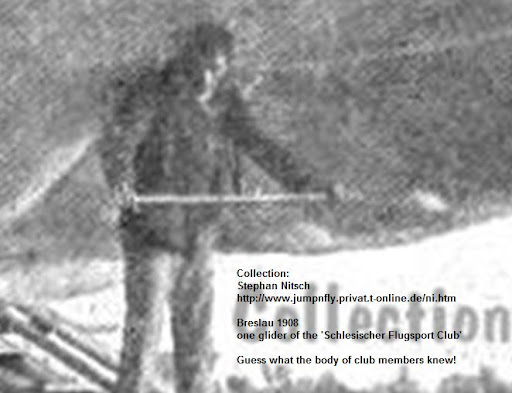
Hang gliding saw a stiffened flexible wing hang glider in 1904, when Jan Lavezzari flew a double lateen sail hang glider off Berck Beach, France. In 1910 in Breslau, the triangle control frame with hang glider pilot hung behind the triangle in a hang glider, was evident in a gliding club's activity.[4] The biplane hang glider was very widely publicized in public magazines with plans for building;[5] such biplane hang gliders were constructed and flown in several nations since Octave Chanute and his tailed biplane hang gliders were demonstrated. In April 1909, a how-to article by Carl S. Bates proved to be a seminal hang glider article that seemingly affected builders even of contemporary times. Many builders would have their first hang glider made by following the plan in his article.[6] Volmer Jensen with a biplane hang glider in 1940 called VJ-11 allowed safe three-axis control of a foot-launched hang glider.[7]

]
On 23 November 1948, Francis Rogallo and Gertrude Rogallo applied for a kite patent[8] for a fully flexible kited wing with approved claims for its stiffenings and gliding uses; the flexible wing or Rogallo wing, which in 1957 the American space agency NASA began testing in various flexible and semi-rigid configurations in order to use it as a recovery system for the Gemini space capsules. The various stiffening formats and the wing's simplicity of design and ease of construction, along with its capability of slow flight and its gentle landing characteristics, did not go unnoticed by hang glider enthusiasts. In 1960–1962 Barry Hill Palmer adapted the flexible wing concept to make foot-launched hang gliders with four different control arrangements.[9] In 1963 Mike Burns adapted the flexible wing to build a towable kite-hang glider he called Skiplane. In 1963, John W. Dickenson adapted the flexible wing airfoil concept to make another water-ski kite glider; for this, the Fédération Aéronautique Internationale vested Dickenson with the Hang Gliding Diploma (2006) for the invention of the "modern" hang glider.[10] Since then, the Rogallo wing has been the most used airfoil of hang gliders.
Components
[edit]Hang glider sailcloth
[edit]Hang glider sailcloth is normally made from woven or laminated fiber, such as dacron or mylar, respectively.
Woven polyester sailcloth is a very tight weave of small diameter polyester fibers that has been stabilized by the hot-press impregnation of a polyester resin. The resin impregnation is required to provide resistance to distortion and stretch. This resistance is important in maintaining the aerodynamic shape of the sail. Woven polyester provides the best combination of light weight and durability in a sail, with the best overall handling qualities.
Laminated sail materials using polyester film achieve superior performance by using a lower stretch material that is better at maintaining sail shape, but is still relatively light in weight. The disadvantages of polyester film fabrics are that the reduced elasticity under load generally results in stiffer and less responsive handling, and polyester laminated fabrics are generally not as durable or long-lasting as the woven fabrics.
Triangle control frame
[edit]In most hang gliders, the pilot is ensconced in a harness suspended from the airframe, and exercises control by shifting body weight in opposition to a stationary control frame, also known as a triangle control frame, or an A-frame. The control frame normally consists of 2 "down-tubes" and a control bar/base bar/base-tube. Either end of the control bar is attached to an upright tube or a more aerodynamic strut (a "down-tube"), where both extend from the base-tube and are connected to the apex of the control frame/ the keel of the glider. This creates the shape of a triangle or 'A-frame'. In many of these configurations additional wheels or other equipment can be suspended from the bottom bar or rod ends.
Images showing a triangle control frame on Otto Lilienthal's 1892 hang glider shows that the technology of such frames has existed since the early design of gliders, but he did not mention it in his patents. A control frame for body weight shift was also shown in Octave Chanute's designs. It was a major part of the now common design of hang gliders by George A. Spratt from 1929.[11] The most simple A-frame that is cable-stayed was demonstrated in a Breslau gliding club hang gliding meet in a battened wing foot-launchable hang glider in the year 1908 by W. Simon; hang glider historian Stephan Nitsch has collected instances also of the U control frame used in the first decade of the 1900s; the U is variant of the A-frame.
Training and safety
[edit]
Due to the poor safety record of early hang gliding pioneers, the sport has traditionally been considered unsafe. Advances in pilot training and glider construction have led to a much improved safety record. Modern hang gliders are very sturdy when constructed to Hang Glider Manufacturers Association, BHPA, Deutscher Hängegleiterverband, or other certified standards using modern materials. Although lightweight, they can be easily damaged, either through misuse or by continued operation in unsafe wind and weather conditions. All modern gliders have built-in dive recovery mechanisms such as luff lines in kingposted gliders, or "sprogs" in topless gliders.
Pilots fly in harnesses that support their bodies. Several different types of harnesses exist. At least one set of hang glider construction plans (Hall's Hawk) had instructions for constructing a harness. Pod harnesses are put on like a jacket and the leg portion is behind the pilot during launch. Once in the air the feet are tucked into the bottom of the harness. They are zipped up in the air with a rope and unzipped before landing with a separate rope. A cocoon harness is slipped over the head and lies in front of the legs during launch. After takeoff, the feet are tucked into it and the back is left open. A knee hanger harness is also slipped over the head but the knee part is wrapped around the knees before launch and just pick up the pilots leg automatically after launch. A supine or suprone harness is a seated harness. The shoulder straps are put on before launch and after takeoff the pilot slides back into the seat and flies in a seated position.
Pilots carry a parachute enclosed in the harness. In case of serious problems, the parachute is manually deployed (either by hand or with a ballistic assist) and carries both pilot and glider down to earth. Pilots also wear helmets and generally carry other safety items such as knives (for cutting their parachute bridle after impact or cutting their harness lines and straps in case of a tree or water landing), light ropes (for lowering from trees to haul up tools or climbing ropes), radios (for communication with other pilots or ground crew), and first-aid equipment.
The accident rate from hang glider flying has been dramatically decreased by pilot training. Early hang glider pilots learned their sport through trial and error and gliders were sometimes home-built. Training programs have been developed for today's pilot with emphasis on flight within safe limits, as well as the discipline to cease flying when weather conditions are unfavorable, for example: excess wind or risk cloud suck.
In the UK, a 2011 study reported there is one death per 116,000 flights, a risk comparable to sudden cardiac death from running a marathon or playing tennis.[12] An estimate of worldwide mortality rate is one death per 1,000 active pilots per year.[13][14]
Most pilots learn at recognised courses which lead to the internationally recognised International Pilot Proficiency Information card issued by the FAI.
Launch
[edit]Launch techniques include launching from a hill/cliff/mountain/sand dune/any raised terrain on foot, tow-launching from a ground-based tow system, aerotowing (behind a powered aircraft), powered harnesses, and being towed up by a boat. Modern winch tows typically utilize hydraulic systems designed to regulate line tension, this reduces scenarios for lock out as strong aerodynamic forces will result in additional rope spooling out rather than direct tension on the tow line. Other more exotic launch techniques have also been used successfully, such as hot air balloon drops from very high altitude. When weather conditions are unsuitable to sustain a soaring flight, this results in a top-to-bottom flight and is referred to as a "sled run". In addition to typical launch configurations, a hang glider may be so constructed for alternative launching modes other than being foot launched; one practical avenue for this is for people who physically cannot foot-launch.[15]
In 1983 Denis Cummings re-introduced a safe tow system that was designed to tow through the centre of mass and had a gauge that displayed the towing tension, it also integrated a 'weak link' that broke when the safe tow tension was exceeded. After initial testing, in the Hunter Valley, Denis Cummings, pilot, John Clark, (Redtruck), driver and Bob Silver, officianado, began the Flatlands Hang gliding competition at Parkes, NSW. The competition quickly grew, from 16 pilots the first year to hosting a World Championship with 160 pilots towing from several wheat paddocks in western NSW. In 1986 Denis and 'Redtruck' took a group of international pilots to Alice Springs to take advantage of the massive thermals. Using the new system many world records were set. With the growing use of the system, other launch methods were incorporated, static winch and towing behind an ultralight trike or an ultralight airplane.
Soaring flight and cross-country flying
[edit]
A glider in flight is continuously descending, so to achieve an extended flight, the pilot must seek air currents rising faster than the sink rate of the glider. Selecting the sources of rising air currents is the skill that has to be mastered if the pilot wants to achieve flying long distances, known as cross-country (XC). Rising air masses derive from the following sources:[16]
Thermals
- The most commonly used source of lift is created by the Sun's energy heating the ground which in turn heats the air above it. This warm air rises in columns known as thermals. Soaring pilots quickly become aware of land features which can generate thermals and their trigger points downwind, because thermals have a surface tension with the ground and roll until hitting a trigger point. When the thermal lifts, the first indicator are the swooping birds feeding on the insects being carried aloft, or dust devils or a change in wind direction as the air is pulled in below the thermal. An instrument developed by Frank Colver in the early 1970's specifically for hang gliders called the Colver Variometer made a very big difference as pilots were then able to HEAR when they were rising or at least descending slower. The variometer emitted a tone when it was turned on. After launch, as the sink rate increased, the instrument emitted a lower tone. As the sink rate decreased, the tone became higher, passing through the zero sink rate and then rising higher and higher as the rate of climb increased. As the thermal climbs, bigger soaring birds indicate the thermal. The thermal rises until it either forms into a cumulus cloud or hits an inversion layer, which is where the surrounding air is becoming warmer with height, and stops the thermal developing into a cloud. Also, nearly every glider contains an instrument known as a variometer (a very sensitive vertical speed indicator) which shows visually (and often audibly) the presence of lift and sink. Having located a thermal, a glider pilot will circle within the area of rising air to gain height. In the case of a cloud street, thermals can line up with the wind, creating rows of thermals and sinking air. A pilot can use a cloud street to fly long straight-line distances by remaining in the row of rising air.
- Ridge lift
- Ridge lift occurs when the wind encounters a mountain, cliff, hill, sand dune, or any other raised terrain. The air is pushed up the windward face of the mountain, creating lift. The area of lift extending from the ridge is called the lift band. Providing the air is rising faster than the gliders sink rate, gliders can soar and climb in the rising air by flying within the lift band parallel to the ridge. Ridge soaring is also known as slope soaring.
- Mountain waves
- The third main type of lift used by glider pilots is the lee waves that occur near mountains. The obstruction to the airflow can generate standing waves with alternating areas of lift and sink. The top of each wave peak is often marked by lenticular cloud formations.
- Convergence
- Another form of lift results from the convergence of air masses, as with a sea-breeze front. More exotic forms of lift are the polar vortices which the Perlan Project hopes to use to soar to great altitudes.[17] A rare phenomenon known as Morning Glory has also been used by glider pilots in Australia.[18]
Performance
[edit]
With each generation of materials and with the improvements in aerodynamics, the performance of hang gliders has increased. One measure of performance is the glide ratio. For example, a ratio of 12:1 means that in smooth air a glider can travel forward 12 metres while only losing 1 metre of altitude.
Some performance figures as of 2006:
- Topless gliders (no kingpost): glide ratio ~17:1, speed range ~30–145 km/h (19–90 mph), best glide at 45–60 km/h (28–37 mph)
- Rigid wings: glide ratio ~20:1, speed range ~35–130 km/h (22–81 mph), best glide at ~50–60 km/h (31–37 mph). .
- Ballast
- The extra weight provided by ballast is advantageous if the lift is likely to be strong. Although heavier gliders have a slight disadvantage when climbing in rising air, they achieve a higher speed at any given glide angle. This is an advantage in strong conditions when the gliders spend only little time climbing in thermals.
Stability and equilibrium
[edit]
Because hang gliders are most often used for recreational flying, a premium is placed on gentle behaviour, especially at the stall and natural pitch stability. The wing loading must be very low in order to allow the pilot to run fast enough to get above stall speed. Unlike a traditional aircraft with an extended fuselage and empennage for maintaining stability, hang gliders rely on the natural stability of their flexible wings to return to equilibrium in yaw and pitch. Roll stability is generally set to be near neutral. In calm air, a properly designed wing will maintain balanced trimmed flight with little pilot input. The flex wing pilot is suspended beneath the wing by a strap attached to their harness. The pilot lies prone (sometimes supine) within a large, triangular, metal control frame. Controlled flight is achieved by the pilot pushing and pulling on this control frame, thus shifting their weight fore or aft, and right or left in coordinated maneuvers.
- Roll
- Most flexible wings are set up with near neutral roll due to sideslip (anhedral effect). In the roll axis, the pilot shifts their body mass using the wing control bar, applying a rolling moment directly to the wing. The flexible wing is built to flex differentially across the span in response to the pilot applied roll moment. For example, if the pilot shifts their weight to the right, the right wing trailing edge flexes up more than the left, creating dissimilar lift that rolls the glider to the right.
- Yaw
- The yaw axis is stabilized through the backward-sweep of the wings. The swept planform, when yawed out of the relative wind, creates more lift on the advancing wing and also more drag, stabilizing the wing in yaw. If one wing advances ahead of the other, it presents more area to the wind and causes more drag on that side. This causes the advancing wing to go slower and to retreat back. The wing is at equilibrium when the aircraft is travelling straight and both wings present the same amount of area to the wind.
- Pitch
- The pitch control response is direct and very efficient. It is partially stabilized by the washout combined with the sweep of the wings, which results in a different angle of attack of the rear most lifting surfaces of the glider. The wing centre of gravity is close to the hang point and, at the trim speed, the wing will fly "hands off" and return to trim after being disturbed. The weight-shift control system only works when the wing is positively loaded (right side up). Positive pitching devices such as reflex lines or washout rods are employed to maintain a minimum safe amount of washout when the wing is unloaded or even negatively loaded (upside down). Flying faster than trim speed is accomplished by moving the pilot's weight forward in the control frame; flying slower by shifting the pilot's weight aft (pushing out).
Furthermore, the fact that the wing is designed to bend and flex, provides favourable dynamics analogous to a spring suspension. This provides a gentler flying experience than a similarly sized rigid-winged hang glider.
Instruments
[edit]To maximize a pilot's understanding of how the hang glider is flying, most pilots carry flight instruments. The most basic being a variometer and altimeter—often combined. Some more advanced pilots also carry airspeed indicators and radios. When flying in competition or cross country, pilots often also carry maps and/or GPS units. Hang gliders do not have instrument panels as such, so all the instruments are mounted to the control frame of the glider or occasionally strapped to the pilot's forearm.
Variometer
[edit]
Gliding pilots are able to sense the acceleration forces when they first hit a thermal, but have difficulty gauging constant motion. Thus it is difficult to detect the difference between constantly rising air and constantly sinking air. A variometer is a very sensitive vertical speed indicator. The variometer indicates climb rate or sink rate with audio signals (beeps) and/or a visual display. These units are generally electronic, vary in sophistication, and often include an altimeter and an airspeed indicator. More advanced units often incorporate a barograph for recording flight data and/or a built-in GPS. The main purpose of a variometer is in helping a pilot find and stay in the 'core' of a thermal to maximize height gain, and conversely indicating when he or she is in sinking air and needs to find rising air. Variometers are sometimes capable of electronic calculations to indicate the optimal speed to fly for given conditions. The MacCready theory answers the question on how fast a pilot should cruise between thermals, given the average lift the pilot expects in the next thermal climb and the amount of lift or sink he encounters in cruise mode.[19] Some electronic variometers make the calculations automatically, allowing for factors such as the glider's theoretical performance (glide ratio), altitude, hook in weight, and wind direction.
Radio
[edit]
Pilots sometimes use 2-way radios for training purposes, for communicating with other pilots in the air, and with their ground crew when traveling on cross-country flights.
One type of radio used are PTT (push-to-talk) handheld transceivers, operating in VHF FM. Usually a microphone is worn on the head or incorporated in the helmet, and the PTT switch is either fixed to the outside of the helmet, or strapped to a finger. Operating a VHF band radio without an appropriate license is illegal in most countries that have regulated airwaves (including United States, Canada, Brazil, etc.), so additional information must be obtained with the national or local Hang Gliding association or with the competent radio regulatory authority.
As aircraft operating in airspace occupied by other aircraft, hang glider pilots may also use the appropriate type of radio (i.e. the aircraft transceiver into Aero Mobile Service VHF band). It can, of course, be fitted with a PTT switch to a finger and speakers inside the helmet. The use of aircraft transceivers is subject to regulations specific to the use in the air such as frequencies restrictions, but has several advantages over FM (i.e. frequency modulated) radios used in other services. First is the great range it has (without repeaters) because of its amplitude modulation (i.e. AM). Second is the ability to contact, inform and be informed directly by other aircraft pilots of their intentions thereby improving collision avoidance and increasing safety. Third is to allow greater liberty regarding distance flights in regulated airspaces, in which the aircraft radio is normally a legal requirement. Fourth is the universal emergency frequency monitored by all other users and satellites and used in case of emergency or impending emergency.
GPS
[edit]GPS (global positioning system) can be used to aid in navigation. For competitions, it is used to verify the contestant reached the required check-points.
Records
[edit]Records are sanctioned by the FAI. The world record for straight distance is held by Dustin B. Martin, with a distance of 764 km (475 mi) in 2012, originating from Zapata, Texas.[20]
Judy Leden (GBR) holds the altitude record for a balloon-launched hang glider: 11,800 m (38,800 ft) at Wadi Rum, Jordan on 25 October 1994.[21] Leden also holds the gain of height record: 3,970 m (13,025 ft), set in 1992.[22]
The altitude records for balloon-launched hang gliders:
| Altitude (ft) | Location | Pilot | Date | Reference |
|---|---|---|---|---|
| 38,800 | Wadi Rum, Jordan | Judy Leden | 25 October 1994 | [23] |
| 33,000 | Edmonton, Alberta, Canada | John Bird | 29 August 1982 | [24] |
| 32,720 | California City, California, USA | Stephan Dunoyer | 9 September 1978 | [25] |
| 31,600 | Mojave Desert, California, USA | Bob McCaffrey | 21 November 1976 | [26] |
| 17,100 | San Jose, California, USA | Dennis Kulberg | 25 December 1974 | [27] |
Competition
[edit]Competitions started with "flying as long as possible" and spot landings. With increasing performance, cross-country flying has largely replaced them. Usually two to four waypoints have to be passed with a landing at a goal. In the late 1990s low-power GPS units were introduced and have completely replaced photographs of the goal. Every two years there is a world championship. The Rigid and Women's World Championship in 2006 was hosted by Quest Air in Florida. Big Spring, Texas hosted the 2007 World Championship. Hang gliding is also one of the competition categories in World Air Games organized by Fédération Aéronautique Internationale (World Air Sports Federation - FAI), which maintains a chronology of the FAI World Hang Gliding Championships.[28]
Other forms of competition include Aerobatic competitions, and Speedgliding competitions, wherein the goal is to descend from a mountain as fast as possible while passing through various gates in a manner similar to down-hill skiing.
Classes
[edit]
For competitive purposes, there are three classes of hang glider:[29]
- Class 1 The flexible wing hang glider, having flight controlled by virtue of the shifted weight of the pilot. This is not a paraglider. Class 1 hang gliders sold in the United States are usually rated by the Hang Gliders Manufacturers' Association.[30]
- Class 5 The rigid wing hang glider, having flight controlled by spoilers, typically on top of the wing. In both flexible and rigid wings the pilot hangs below the wing without any additional fairing.
- Class 2 (designated by the FAI as Sub-Class O-2) where the pilot is integrated into the wing by means of a fairing. These offer the best performance and are the most expensive.
Aerobatics
[edit]There are four basic aerobatic maneuvers in a hang glider:
- Loop — a maneuver that starts in a wings level dive, climbs, without any rolling, to the apex where the glider is upside down, wings level (heading back where it came from), and then returning to the start altitude and heading, again without rolling, having completed an approximately circular path in the vertical plane.
- Spin — A spin is scored from the moment one wing stalls and the glider rotates noticeably into the spin. The entry heading is noted at this point. The glider must remain in the spin for at least 1/2 of a revolution to score any versatility spin points.
- Rollover — a maneuver where the apex heading is less than 90° left or right of the entry heading.
- Climb over — a maneuver where the apex heading is greater than 90° left or right of the entry heading.
Comparison of hang gliders, paragliders, and gliders
[edit]Paragliders and hang gliders are both foot-launched glider aircraft from which cases the pilot is suspended ("hangs") below the lift surface, but hang gliders include a rigid aluminum frame, while paragliders are entirely flexible and look more similar to a parachute.[31] Gliders and sailplanes are structured from composite materials and may have wheels, propellers, and engines.[32][33]
| Paragliders | Hang gliders | Gliders/Sailplanes | |
|---|---|---|---|
| Undercarriage | pilot's legs used for take-off and landing | pilot's legs used for take-off and landing | aircraft takes off and lands using a wheeled undercarriage or skids |
| Wing structure | entirely flexible, with shape maintained purely by the pressure of air flowing into and over the wing in flight and the tension of the lines | generally flexible but supported on a rigid frame which determines its shape (note that rigid-wing hang gliders also exist) | rigid wing surface which totally encases wing structure |
| Pilot position | sitting in a harness | usually lying prone in a cocoon-like harness suspended from the wing; seated and supine are also possible | sitting in a seat with a harness, surrounded by a crash-resistant structure |
| Speed range (stall speed – max speed) |
slowest – typically 25 to 60 km/h for recreational gliders (over 50 km/h requires use of speed bar),[34] hence easier to launch and fly in light winds; least wind penetration; pitch variation can be achieved with the controls | faster than paragliders, slower than gliders/sailplaines | maximum speed up to about 280 km/h (170 mph);[35] stall speed typically 65 km/h (40 mph);[35] able to fly in windier turbulent conditions and can outrun bad weather; good penetration into a headwind |
| Maximum glide ratio | about 10, relatively poor glide performance makes long distance flights more difficult; current (as of July 2025[update]) world record is 609.9 kilometres (380 mi)[36] | about 17, with up to 20 for rigid wings | open class sailplanes – typically around 60:1, but in more common 15–18 meter span aircraft, glide ratios are between 38:1 and 52:1;[37] high glide performance enabling long distance flight, with 3,000 kilometres (1,900 mi) being current (as of November 2010[update]) record[38] |
| Turn radius | tightest turn radius[citation needed] | somewhat larger turn radius than paragliders, tigher than gliders/sailplanes[citation needed] | widest turn radius but still able to circle tightly in thermals[39] |
| Landing | smallest space needed to land, offering more landing options from cross-country flights; also easiest to pack up and carry like a bag to the nearest road | 15 m to 60 m length flat area required; can be derigged by one person and carried to the nearest road | landings can be performed in ~250 m length field. Aerial retrieve may be possible but if not, specialized trailer needed to retrieve by road. Some sailplanes have engines that remove the need for an out-landing, if successfully started on time |
| Learning | simplest and quickest to learn | teaching is done in single and two-seat hang gliders | teaching is done in a two-seat glider with dual controls |
| Convenience | packs smaller (easier to transport and store) | more awkward to transport and store; longer to rig and de-rig; often transported on the roof of a car | often stored and transported in purpose-built trailers about 9 metres long, from which they are rigged. Although rigging aids allow a single person to rig a glider, usually the rigging involves 2 or 3 people. Some frequently used sailplanes are stored already rigged in hangars. |
| Cost | cost of new is €1500 and up,[40] cheapest but shortest lasting (around 500 hours flying time, depending on treatment), active second-hand market[41] | cost of new glider very high (top of the range 18 m turbo with instruments and trailer €250,000) but it is long lasting (up to several decades), so active second-hand market; typical cost is from €2,000 to €145,000[42] |
Hang gliding in media
[edit]- 1971: Early rock video featuring hang gliding, Sweeney's Glider, is produced. It was made by Fitz Weatherby and featured Terry Sweeney.[43][44]
- 1973: First film made on the sport of hang gliding, Hang Gliding: The New Freedom, directed by Ron Underwood. It was distributed by Paramount Communications, a short film division of Paramount Pictures.[45]
See also
[edit]- Glider (disambiguation)
- Human-powered aircraft
- Kite types – Tethered objects which fly by aerodynamic forces
- Microlift glider – Class of gliders
- Nanolight
- Powered hang glider – Foot-launched powered hang glider
- Powered paraglider – Form of ultralight aviation
References
[edit]Notes
[edit]- ^ "Hang Glider Sailcloth Information - Wills Wing, Inc". willswing.com. Archived from the original on 22 May 2014. Retrieved 30 April 2017.
- ^ Meadows, G.W. "How to buy a hang glider". www.start-flying.com. Archived from the original on 7 March 2014. Retrieved 10 January 2014.
- ^ "Learning to Hang Glide". Hang Gliding Federation of Australia. Archived from the original on 26 January 2014. Retrieved 10 January 2014.
- ^ "1908 hang glider in Breslau territory with pilot hung by his left foot, a device used through 1900s (decade) up to today for natural bodily commute". Archived from the original on 1 January 2016. Retrieved 30 April 2017.
- ^ "Chanute Main Page". spicerweb.org. Archived from the original on 7 June 2017. Retrieved 30 April 2017.
- ^ "The Popular Mechanics Glider". mywebpages.comcast.net. Archived from the original on 7 February 2006. Retrieved 30 April 2017.
- ^ "Home Builders of the Future | VJ-11 Information Page. The history of the VJ-11 hang glider". sailplanehomebuilders.com. Archived from the original on 12 March 2009. Retrieved 30 April 2017.
- ^ "Patent US2546078 - Flexible kite - Google Patents". Retrieved 30 April 2017.
- ^ Ralph S. Cooper, D.V.M. "Carl S. Bates". earlyaviators.com. Archived from the original on 5 March 2016. Retrieved 30 April 2017.
- ^ "FAI Award: The FAI Hang Gliding Diploma". fai.org. Archived from the original on 18 May 2011. Retrieved 30 April 2017.
- ^ "Hang Glider Timeline EnterData". www.energykitesystems.net. Archived from the original on 14 May 2018. Retrieved 6 February 2018.
- ^ Risk of dying and sporting activities, archived from the original on September 4, 2012, retrieved May 31, 2011
- ^ "injury/fatality data? - Hang Gliding Org". Hang Gliding Org. May 2008. Archived from the original on 26 October 2017. Retrieved 26 October 2017.
- ^ "HG FAQ - Wills Wing". Wills Wing. Archived from the original on 14 May 2018. Retrieved 26 October 2017.
- ^ "Dan Buchanan". cableairport.com. Archived from the original on 28 September 2007. Retrieved 30 April 2017.
- ^ Pagen, Dennis (January 1992). Understanding the Sky - A Sport Pilot's Guide to Flying Conditions. Mingoville, Pennsylvania, USA: Dennis Pagen. p. 280. ISBN 978-0-936310-10-7.
- ^ "Home | Perlan Project". perlanproject.com. Retrieved 30 April 2017.
- ^ "Morning Glory Clouds of the Gulf of Carpentaria | A Guide to the Morning Glory". dropbears.com. Archived from the original on 20 July 2009. Retrieved 30 April 2017.
- ^ "Biography of DR. PAUL MAC CREADY" (PDF). Academy of Model Aeronautics. Archived from the original (PDF) on 27 September 2007. Retrieved 21 August 2007.
- ^ "Hang Gliding and Paragliding". fai.org. Archived from the original on 12 June 2017. Retrieved 30 April 2017.
- ^ Leden, Judy (2003). Flying with Condors. New York: Orion Books. Orion Publishing Group, Limited. ISBN 0-7528-0874-5.
- ^ "Hang Gliding and Paragliding". www.fai.org. Archived from the original on September 24, 2015. Retrieved October 22, 2015.
- ^ Leden, Judy (2003). Flying with Condors. New York: Orion Books. Orion Publishing Group, Limited. ISBN 0-7528-0874-5.
- ^ Edmonton Journal, 30 August 31, 1982; "Kerry Bissell, an official observer of the Soaring Association of Canada: It's 33,000 feet. If the reading is taken at the top of the trace mark, the record is 11,400 meters"
- ^ Hang Gliding magazine, December 1978, p35.
- ^ The Guinness Book of Records, 1982.
- ^ Sarasota Journal, 27 December 1974 p4D.
- ^ "Chronology of the FAI World Hang Gliding Championships". events.fai.org. Archived from the original on 4 October 2009. Retrieved 30 April 2017.
- ^ FAI Hang Gliding and Paragliding Commission. Classes of hang gliders.
- ^ Hang Gliders Manufacturers' Association - Home site.
- ^ "Paragliding, Hang Gliding and Speed Flying Explained – Hang Gliding and Paragliding Association of Canada". Hang Gliding and Paragliding Association of Canada. Retrieved 30 June 2024.
- ^ "Glider Handbook". Federal Aviation Administration. 29 March 2022. Retrieved 30 June 2024.
- ^ "Sailplane Construction & Cost". Soaring Society of America. 31 August 2019. Retrieved 30 June 2024.
- ^ "Technical data for Advance Omega 8". Advance AG. Archived from the original on 30 May 2013. Retrieved 22 October 2011.
- ^ a b Flight Manual of Scheicher ASW27b. Alexander Schleicher GmbH & Co. 2003.
- ^ "FAI Paragliding record". Fédération Aéronautique Internationale. Retrieved 25 July 2025.
- ^ "Handicap list 2008" (PDF). Deutsche Meisterschaft im Streckensegelflug. Deutscher Aero Club. Archived from the original (PDF) on 24 February 2009. Retrieved 7 August 2008.
- ^ "FAI records". Fédération Aéronautique Internationale. Archived from the original on 11 September 2011. Retrieved 30 November 2010.
- ^ Stewart, Ken (1994). The Glider Pilot's Manual. Airlife Publishing Ltd. p. 257. ISBN 1-85310-504-X.
- ^ "Brochures Ozone". Ozone France. Archived from the original on 27 October 2013. Retrieved 21 October 2011.
- ^ "Typical set of classified ads for paragliders". Archived from the original on 30 March 2012. Retrieved 22 October 2011.
- ^ "Typical set of classified ads for gliders". Archived from the original on 6 December 2010. Retrieved 18 January 2011.
- ^ From 'A' to 'Yellowjack'; a film study collection (PDF). Bloomington, Indiana: Indiana University Audio Visual Center. Retrieved 5 July 2024.
- ^ Weatherby, Fritz (1971). Sweeney's Glider (Motion picture). United States. Retrieved 5 July 2024.
- ^ "The New Freedom". IMDb.
Bibliography
[edit]- "Hang-gliding -- the new sport" (pdf). Flight International. 9 May 1974.
- Ann Welch (10 December 1977), "Hang-gliding review" (pdf), Flight International
- Ann Welch (14 June 1973), "LIKE A BIRD ON THE BREEZE" (pdf), Flight International: 921–923
- Paul Dees (September 2010), Hang Glider Design and Performance (PDF), American Institute of Aeronautics and Astronautics, archived (PDF) from the original on 2 August 2017
External links
[edit]
Kites and kite flying | ||
|---|---|---|
| Types by use |  | |
| Types by shape | ||
| Activities and applications | ||
| Parts | ||
| People | ||
| Other | ||

| International | |
|---|---|
| National | |
| Other | |


Hang gliding
View on GrokipediaHistory
Origins and early experiments
The origins of hang gliding trace back to the late 19th century, when aeronautical pioneers sought to emulate bird flight through unpowered, controllable gliders suspended from a frame, with the pilot shifting body weight for control. These early experiments laid the foundational principles of weight-shift control that define modern hang gliding. German engineer Otto Lilienthal is widely regarded as the father of human flight in gliders, conducting systematic tests from 1891 to 1896 that demonstrated sustained gliding was possible.[7] Lilienthal designed and built at least 16 different glider models, primarily monoplanes with stabilizing tail surfaces constructed from willow wood, bamboo, cotton fabric, and hemp cord, achieving over 2,000 flights from hills near Berlin. His 1894 glider, a representative example, measured approximately 6.6 meters in length with a wingspan of about 5.3 meters, allowing flights of up to 350 meters at speeds around 10-15 meters per second. Control was achieved exclusively through the pilot hanging beneath the wing and shifting position to alter the center of gravity, a technique that directly influenced subsequent hang glider designs. Lilienthal's work, rigorously documented in publications like Der Vogelflug als Grundlage der Fliegekunst (Bird Flight as the Basis of Aviation, 1889), inspired global experimentation but ended tragically with his death in a glider crash on August 10, 1896.[7][7][5] Building on Lilienthal's correspondence and designs, British engineer Percy Pilcher advanced glider experimentation in the mid-1890s, constructing several hang-style gliders including the Bat (1895) and Hawk (1896). Pilcher's Hawk, a more refined monoplane with a wheeled undercarriage, enabled flights lasting up to one minute and distances of up to 250 meters from Scottish hillsides, incorporating bamboo frames and silk sails for improved aerodynamics. His efforts, conducted with assistance from his sister Ella, emphasized practical soaring but were cut short by a fatal crash on September 30, 1899, while testing the uncompleted Green Bird powered glider.[8][8][9][10] In the United States, civil engineer Octave Chanute organized collaborative gliding tests in 1896 along the shores of Lake Michigan, focusing on multiplane designs for enhanced stability over single-wing configurations. Chanute's biplane glider, built with his associates Augustus Herring and William Paul Avery, featured a truss-like structure inspired by bridge engineering, with wings spanning 4.3 meters and a total weight under 20 kilograms, allowing short hops and glides of 30-60 meters in steady winds. These experiments, totaling nearly 1,000 flights, prioritized safety through redundant lifting surfaces and influenced the Wright brothers' early glider work, bridging 19th-century trials to powered flight. Chanute documented his findings in Progress in Flying Machines (1894), underscoring the viability of controlled gliding.[9][9][11]Development of modern designs
The foundation of modern hang glider designs traces back to the flexible wing invented by Francis Rogallo and his wife Gertrude in 1948, while Rogallo worked at the National Advisory Committee for Aeronautics (NACA, predecessor to NASA).[12] This delta-shaped wing, patented in 1951, used a lightweight, inflatable structure that could be controlled by weight shift, initially explored by NASA for spacecraft reentry parachutes in the early 1960s.[13] The Rogallos placed their design in the public domain in 1962, enabling widespread adaptation for recreational flight.[14] In the early 1960s, enthusiasts began adapting the Rogallo wing for foot-launched gliders. American engineer Barry Hill Palmer constructed one of the first foot-launchable versions between 1960 and 1962, incorporating weight-shift controls.[15] The pivotal breakthrough came in 1963 when Australian inventor John Dickenson developed the first practical modern hang glider, evolving a water-ski kite into a robust, foot-launched aircraft with a pendulum weight-shift system.[16] Dickenson's Mark I, built for approximately $24 using simple materials like plastic sheeting and wooden spars, achieved its first towed flight on September 8, 1963, over the Clarence River in Grafton, New South Wales, reaching 140 feet.[17] This design emphasized durability, ease of assembly, and intuitive control, setting the template for subsequent models.[4] Commercial development accelerated in the late 1960s and 1970s, transforming hang gliding from experimental builds to a global sport. In 1967, Australian Bill Moyes achieved the first foot-launched flight, covering 3 km from Mount Crackenback with an improved Dickenson wing, and later demonstrated ridge soaring.[18] Meanwhile, American Bill Bennett founded Delta Wing Kites and Gliders in 1969, producing the Phoenix series of second-generation designs.[17] Bennett's Phoenix VI (1974), with a 9.1-meter wingspan and features like tip battens and deflexor cables, enhanced stability, reduced stall speeds, and enabled safer water operations, using Dacron sailcloth over aluminum tubing.[19] These innovations improved glide ratios to around 8:1 and facilitated mass production, with thousands of units sold by the mid-1970s.[20] By the mid-1970s, designs evolved toward higher performance through increased aspect ratios and structural refinements. Early Rogallo-based gliders featured low aspect ratios near 1, but by the late 1970s, models achieved ratios of 5-6 via swept wings and luff lines to prevent sail collapse.[21] The introduction of double-surface sails in 1980 by Ultralight Products' Comet model enclosed the airfoil with upper and lower fabrics, reducing drag and boosting glide ratios to over 10:1, with coverage often exceeding 70% in later variants.[21] In the 1990s, topless configurations eliminated the kingpost using carbon fiber struts, further minimizing drag and achieving aspect ratios above 8 and glide ratios up to 17:1 in competition gliders.[21] Materials advanced from basic Dacron and aluminum to lightweight composites, enhancing portability and efficiency while maintaining weight-shift control as the core mechanism.[22]Key milestones and global spread
The origins of hang gliding trace back to the late 19th century, when German aviation pioneer Otto Lilienthal conducted over 2,000 successful gliding flights between 1891 and 1896 using willow-framed gliders covered in cotton, achieving controlled flights of up to 350 meters.[4] These experiments laid foundational principles for weight-shift control in unpowered flight, influencing later developments despite a lull in progress following Lilienthal's fatal crash in 1896.[23] A pivotal modern milestone occurred in 1963, when Australian engineer John W. Dickenson invented the sailwing, a flexible-wing hang glider inspired by NASA engineer Francis Rogallo's 1948 kite design, with its first successful flight on September 8, 1963, piloted by Rod Fuller over the Clarence River in Grafton, New South Wales. John W. Dickenson, inventor of the modern hang glider, passed away on July 5, 2023.[24] Dickenson's innovation, featuring a triangular control frame and sailcloth wing, enabled stable foot-launched gliding and sparked commercial production starting in Sydney in 1966.[24] By 1969, only a few dozen such gliders existed worldwide, but adoption surged in the early 1970s, reaching tens of thousands by 1975 as manufacturing expanded and the sport gained recreational appeal.[4] The global spread accelerated in the 1970s, with the sport reaching the United States in 1970 through imported Dickenson models and leading to the founding of the United States Hang Gliding Association (USHPA) in 1971 to standardize training and safety.[23] In the United Kingdom, the first Dickenson-style glider arrived in late 1971, with Geoff McBroom achieving the inaugural flight in March 1972, followed by rapid growth to over 3,000 licensed pilots by 1976 and the establishment of five domestic manufacturers by 1973.[24] Europe saw similar expansion, culminating in the formation of the FAI Hang Gliding and Paragliding Commission (CIVL) in 1975. An unofficial world championship was held that year in Kössen, Austria, won by Dave Cronk of the USA. The first official FAI World Hang Gliding Championships followed in 1976 in Kössen, crowning Terry DeLore of New Zealand as the inaugural champion. Bill Moyes, pioneer of foot-launched designs, died on September 24, 2024.[25] This event marked hang gliding's formal recognition as an international air sport, with national associations proliferating across continents, including in Germany, France, and Brazil, fostering competitive circuits and cross-border competitions that continue to draw pilots from over 50 countries today.[26]Components and Design
Airframe and control frame
The airframe of a hang glider forms the rigid structural skeleton that supports the sail and maintains the wing's shape during flight. In flex-wing designs, which constitute approximately 95% of modern hang gliders, the airframe is primarily constructed from lightweight aluminum alloy tubing, such as 6061-T6, to balance strength, weight, and cost.[27][28] Key components include the keel, a central longitudinal tube extending from the nose to the tail that serves as the primary spar; the leading-edge tubes, which form the forward boundary of the wing and converge at the nose; and the crossbar, a transverse tube connecting the leading edges to define the wing's span and facilitate assembly.[21] A kingpost rises vertically from the keel near the trailing edge, anchoring upper rigging wires that provide tension to keep the wing taut and stable.[29] The control frame, often referred to as the A-frame or basetube, is an integral part of the airframe, consisting of a triangular assembly of tubes positioned below the wing. Typically made from the same aluminum alloy, it includes two downtubes (angled sides) and a basetube (the forward cross-member), with the pilot suspended from a hang strap attached to the apex.[30] This frame connects to the main airframe via lower rigging cables—known as positive wires—that run from the base of the control frame to attachment points on the keel, leading edges, and crossbar, ensuring structural integrity under load.[29] The design enables weight-shift control: by shifting body position relative to the frame, the pilot alters the center of gravity, inducing pitch, roll, and yaw without mechanical linkages.[31] In rigid-wing hang gliders, which represent a smaller subset, the airframe incorporates composite materials like carbon fiber for spars and ribs to enhance stiffness and aerodynamic efficiency, differing from the flexible aluminum structures of flex wings. Recent designs (as of 2025) increasingly use carbon fiber reinforcements even in flex-wing airframes for reduced weight and improved performance.[32][33] Rigging cables, including four negative wires from the kingpost top to the leading edges and six positive wires from the control frame, are essential for load distribution and must be inspected regularly for wear, as they bear significant aerodynamic and inertial forces.[30] Overall, the airframe and control frame prioritize minimal weight—often under 40 kg for a single-place glider—while withstanding gust loads through rigorous testing, as per standards from organizations like the USHPA (following the dissolution of the HGMA in 2022) or DHV.[34][35]Sail materials and construction
The sail of a hang glider, which forms the airfoil providing lift, is constructed from lightweight, high-strength synthetic fabrics engineered for durability, low stretch, and aerodynamic efficiency under varying flight conditions. The predominant material is woven polyester fabric, often referred to by the trade name Dacron, valued for its balance of strength-to-weight ratio, resistance to ultraviolet degradation, and tear resistance.[1][21] This fabric typically weighs between 3 and 5 ounces per square yard (approximately 100-170 grams per square meter) to minimize overall glider mass while maintaining structural integrity.[36][15] Woven polyester consists of a tight interlaced grid of fine polyester yarns, frequently impregnated with a heat-set resin during manufacturing to reduce bias stretch and enhance shape retention. This construction allows the sail to conform precisely to the frame's geometry, forming a smooth upper surface for laminar airflow and a cambered lower surface for pressure distribution. Early hang glider sails evolved from less stable materials like cotton or nylon, but polyester became standard in the 1970s due to its superior performance in outdoor exposure and mechanical stress.[21][15] Alternative materials include composite laminated fabrics, which layer thin polyester films with reinforcing scrims of polyester or aramid fibers (such as Technora) bonded via adhesive or heat lamination. These offer minimal stretch—often less than 1% under load—for precise airfoil control in high-performance designs, though they are more prone to delamination over time and provide a stiffer feel compared to woven options.[15] Laminates are particularly used in competition gliders where maintaining camber is critical for speed and glide ratios exceeding 10:1.[27] Construction begins with computational or empirical pattern design to compensate for fabric distortion, using techniques like the billow method (which adds controlled fullness to panels for airfoil curvature) or transversal panel layouts to align seams perpendicular to stress lines. Fabric rolls are cut into 20-40 tailored panels using laser or rotary cutters for precision, with each panel shaped to follow the wing's planform and airfoil profile derived from NACA or custom sections. Panels are joined via overlapping seams sewn with UV-resistant bonded polyester thread in double-row or triple-step stitches, achieving seam strengths over 100 pounds per inch (445 N/cm). Trailing-edge batten pockets—typically 0.5-1 inch (1.3-2.5 cm) wide—are incorporated during sewing to house removable aluminum or composite battens that enforce the wing's camber, preventing flutter at speeds up to 60 mph (97 km/h).[37][38] The leading edge features a continuous Dacron or nylon sleeve, 2-4 inches (5-10 cm) in diameter, allowing it to slide over the frame's airfoil tubes for a taut fit without wrinkles. Keel and crossbar attachments use reinforced grommets, Velcro flaps, or zippered pockets to secure the sail, with tension adjusted via lacing or straps during assembly to achieve 5-10% camber. Final inspections verify seam integrity, air permeability, and overall weight, often under 50 pounds (23 kg) for a single-place sail, ensuring compliance with standards from bodies like the DHV or USHPA (post-HGMA dissolution in 2022).[38][15][35]Harness and pilot controls
The harness in hang gliding serves as the pilot's suspension system, attaching them to the glider's keel via carabiners or similar connectors, while providing ergonomic support during flight and enabling precise control inputs. Typically constructed from durable nylon webbing, padded foam, and reinforced fabrics, the harness distributes the pilot's weight evenly to minimize fatigue and ensure stability. It also incorporates safety features such as integrated reserve parachute deployment pockets and quick-release buckles for emergency egress.[39] Hang gliding harnesses are categorized into three primary types based on pilot position and intended use: knee-hanger trainers, cocoons, and pods. Knee-hanger harnesses, designed for novice pilots and ground training, feature a simple apron-like structure with a padded knee bar or loop that allows the pilot to hang upright with knees supported, facilitating easy entry, exit, and weight-shift practice during foot-launch simulations. This type promotes quick adjustments and reduces the risk of entanglement but offers limited protection for extended flights. Cocoon harnesses, suited for intermediate to advanced prone flying, envelop the pilot in a streamlined, zippered fabric shell where they lie face-down, with shoulder and chest straps securing them in a low-drag position; a line-operated zipper enables the pilot to transition into the harness post-launch for comfortable soaring. Pod harnesses, favored for cross-country and competition flying, provide a seated or semi-reclined posture within an aerodynamic fairing (the "pod") that encloses the lower body, reducing turbulence and drag while incorporating adjustable seatboards and foot supports for enhanced comfort over long durations; these often include variable geometry adjustments to fine-tune the pilot's center of gravity.[39][40] Pilot controls in hang gliding rely predominantly on weight-shift mechanisms integrated with the harness and the triangular control frame (A-frame), which the pilot grips at its base while suspended from its apex. To initiate turns (roll control), the pilot shifts their body weight laterally by leaning or pushing asymmetrically on the control bar, altering the glider's bank angle relative to the airflow; for pitch control—adjusting speed and climb—the pilot moves forward to increase angle of attack for dives or backward to reduce it for stalls or climbs. This intuitive system leverages the harness's pivot points, such as spreader bars or suspension lines, to transmit subtle body movements directly to the airframe without mechanical linkages, ensuring responsive handling across all harness types. Advanced pod designs may slightly restrict lateral freedom but compensate with precise suspension geometry for optimal weight distribution. In rare cases, supplemental control lines or spoilers can augment weight shift for fine adjustments, though these are not standard. Safety protocols emphasize pre-flight harness inspections to verify secure attachments and proper fit, as misalignment can impair control efficacy.[1][39]Training and Safety
Pilot certification programs
Pilot certification programs for hang gliding are primarily managed by national aviation associations, which establish progressive rating systems to ensure pilots develop the necessary skills, knowledge, and experience for safe flight. These programs emphasize ground handling, launch techniques, controlled flight, soaring, and risk management, often requiring supervised training, logged flights, and examinations. Internationally, the Fédération Aéronautique Internationale (FAI) provides a standardization framework through the International Pilot Proficiency Identification (IPPI) Card system, specifically the SafePro Delta scheme for hang gliders, which aligns national ratings into stages from ground skimming (Stage 0) to cross-country (Stage 4) and tandem flying (Stage 5).[41][42] In the United States, the United States Hang Gliding and Paragliding Association (USHPA) administers a five-level rating program for hang gliding pilots, denoted as H-1 through H-5, which tracks progression from beginner to expert. The H-1 Beginner rating requires demonstrating basic straight-line flight in light winds under supervision, including pre-flight checks, controlled launches, and safe landings, typically after initial tandem or solo training flights; no independent flying is permitted at this level.[43] The H-2 Novice rating builds on this with skills for light wind operations, 360-degree turns, and ridge soaring in mild conditions, requiring a minimum of 25 flights and passage of a written exam.[44][45] Advancing to H-3 Intermediate involves thermal soaring, steeper turns, and flying in moderate winds, with requirements including at least 30 flying days, 90 total flights, and 10 hours of solo airtime; pilots at this level can operate more independently at familiar sites.[46] The H-4 Advanced rating demands proficiency in turbulent conditions, cross-country navigation, and advanced maneuvers like wingovers, necessitating 80 flying days, 250 flights, 75 hours of airtime (including 25 hours in thermal lift), and demonstrated judgment for unfamiliar sites.[46] H-5 Master is the highest, reserved for pilots with exceptional experience, such as 500 flights (including 250 foot-launched) and 400 hours of airtime (including 200 in thermals), allowing tandem instruction privileges.[46] All USHPA ratings require membership, logged documentation, and endorsement by certified observers or instructors.[47] In the United Kingdom, the British Hang Gliding and Paragliding Association (BHPA) operates a tiered scheme starting with the Elementary Pilot (EP) badge, which covers ground handling and initial low-altitude flights for beginners.[48] The Club Pilot (CP) rating follows, achieved after school-based training and allowing supervised club flying, but not independent cross-country; it includes basic soaring and emergency procedures. Progression to full Pilot status requires additional logged experience, coaching, and mastery of the Pilot Foundation Syllabus, enabling XC flights in varied conditions. Advanced Pilot certification involves further assessments for high-performance flying and instruction.[48] BHPA ratings align with IPPI levels for international recognition.[49] Other national bodies, such as Germany's Deutscher Hang- und Gleiterflug Verband (DHV), mandate licenses for residents, emphasizing school-based training and equipment certification, with progression through supervised stages similar to SafePro Delta; foreign licenses may be validated for visitors but require local insurance and compliance.[50] These programs collectively prioritize safety, with ongoing education and recency requirements to maintain ratings.[44]Safety equipment and protocols
Safety in hang gliding relies on specialized equipment designed to mitigate risks during launch, flight, and landing, as well as adherence to standardized protocols established by governing bodies like the United States Hang Gliding and Paragliding Association (USHPA) and the Fédération Aéronautique Internationale (FAI). Essential protective gear includes a rigid helmet that meets aviation standards to protect against head impacts, which is mandatory under USHPA recommendations for all pilots. Harnesses, which secure the pilot to the glider's control frame, must be inspected for structural integrity, including carabiners, straps, and suspension lines, to prevent detachment or failure during maneuvers. A reserve parachute is strongly recommended by USHPA for all flights to provide an emergency descent option in case of glider failure, with deployment training emphasized in pilot certification programs. Additional instruments, such as variometers for detecting lift and radios for communication, enhance situational awareness but are not universally mandated. Protocols begin with rigorous pre-flight checks, where pilots verify the glider's airframe, sail tension, and control responsiveness through a "hang check" to ensure the equipment hangs correctly and responds to weight-shift inputs. USHPA guidelines require thorough inspections of the harness, canopy (sail), and backup reserve parachute before each flight, including confirmation that all connections are secure and free of wear. Weather assessment is critical, with pilots prohibited from launching in conditions like high winds exceeding site limits or low visibility, as outlined in FAR Part 103 for ultralight vehicles. Launch procedures often involve assistance from trained helpers to maintain the glider's position and ensure a clear path, particularly for foot-launches from slopes. In-flight safety emphasizes maintaining a "cone of safety" around the glider, avoiding collisions by yielding right-of-way to higher or faster aircraft, and monitoring for aerodynamic stalls or turbulence. Emergency protocols include immediate deployment of the reserve parachute if structural failure occurs, followed by steering the canopy to a safe landing zone. Post-flight debriefs and incident reporting to organizations like USHPA or FAI help refine safety practices, with programs like FAI's SAFE PRO HG providing staged training from ground handling to advanced soaring to build proficiency progressively. All operations must comply with local site rules and FAA regulations, prioritizing single-place flights unless tandem exemptions are granted for certified instructors.Risk factors and accident prevention
Hang gliding, while offering exhilarating flight experiences, involves inherent risks due to its dependence on variable environmental conditions and pilot skill. Primary risk factors include inadequate pilot training and experience, which contribute significantly to accidents, as novice pilots are more prone to errors in judgment during critical phases of flight. Strong winds, turbulence, and sudden weather changes also pose substantial dangers, potentially leading to loss of control or structural stress on the glider. Launch and landing phases are particularly hazardous, accounting for a majority of incidents due to terrain irregularities, improper technique, or insufficient site preparation. Equipment issues, such as sail tears or control frame misalignment, though less common, can exacerbate risks if pre-flight inspections are neglected.[51][52] Accidents in hang gliding often result in fractures, dislocations, or sprains to the extremities, with spinal and head injuries following as the next most frequent outcomes; multiple injuries are common in severe cases. Fatalities typically stem from severe brain trauma, spinal cord damage, or combined polytrauma, with collisions involving electrical wires occasionally causing burn injuries in addition to other harm. Overall mortality remains low, estimated at approximately 0.18 per 100 participants in analyzed cohorts, while in the United Kingdom, the fatality rate stood at one death per 116,000 flights as reported in the early 2010s, comparable to risks in activities like marathon running. These rates underscore that while serious injuries occur, fatalities are rare relative to flight volume, largely due to advancements in design and safety practices.[52][53][54] Prevention strategies emphasize rigorous training programs, such as those mandated by organizations like the United States Hang Gliding and Paragliding Association (USHPA), which require progressive certification to build proficiency in launch, flight control, and landing techniques. Pilots are advised to conduct thorough pre-flight equipment checks, including harness integrity, sail condition, and control responsiveness, to mitigate mechanical failures. Essential safety equipment includes helmets to reduce head trauma risk, energy-absorbing back protectors for spinal protection, and reserve parachutes for emergency deployment in cases of uncontrollable flight paths. Site selection plays a crucial role, with pilots encouraged to choose designated launch and landing zones free from obstacles like power lines or uneven terrain. Ongoing education through safety briefings, weather forecasting tools, and incident reporting systems further aids in identifying and avoiding hazards, contributing to a decline in accident rates over time.[6][55][51]Flight Techniques
Launch methods
Hang gliding employs several launch methods to get the pilot and glider airborne, each suited to different terrains and conditions. The choice of method depends on site availability, wind, pilot experience, and equipment. Traditional foot launches are common at hilly or cliff sites, while towed methods like aerotowing and winch towing enable flights from flat fields, expanding access to the sport in varied geographies. All methods emphasize rigorous pre-flight inspections, including harness attachment, control checks, and weather assessment, to mitigate risks such as stalls or collisions.[56] Foot launching remains the foundational and most widespread technique, particularly at established mountain sites. The pilot positions the glider facing into the wind on a sloped ramp or cliff edge, then runs forward to accelerate the wing to flying speed, typically 15-25 mph depending on glider design and conditions. As air flows over the sail, lift builds, allowing the pilot to shift weight forward and lift off smoothly while maintaining control via body movements suspended from the harness. This method demands good physical fitness for the run and precise timing to avoid stalling; training programs require demonstrations of consistent launches in winds under 5 mph on slopes no steeper than 5:1. Advantages include simplicity and no need for additional equipment, but it limits use to topographically favorable locations.[56][57] Aerotowing, a powered tow method, has become the predominant launch in flatland regions, especially in the United States. An ultralight aircraft or powered hang glider tows the pilot via a 150-200 foot drogue chute-equipped line, accelerating to 25-30 mph before rotation. The pilot maintains neutral pitch by pushing out on the control frame during the initial climb, releasing at 1,500-2,000 feet AGL via a standard weak-link release to prevent overstress. This technique allows access to thermals immediately after release and supports training through gradual altitude builds. The United States Hang Gliding and Paragliding Association (USHPA) regulates aerotow operations under FAA exemptions, requiring certified tow pilots and site-specific procedures to ensure safety.[58][59] Winch towing provides an efficient alternative for flat-field operations, particularly in Europe, where it is widely used for both training and competition. A ground-based winch reels in a 1,000-2,000 foot steel or Dyneema cable at speeds of 25-35 mph, propelling the glider into a steep 30-45 degree climb to 1,500-3,000 feet in under 30 seconds. The pilot must actively manage pitch and yaw to counteract torque and avoid "lockouts," where the glider rolls away from the tow path, by applying corrective weight shift. Release occurs automatically or manually at peak height. This method is cost-effective and quick for multiple launches but requires specialized equipment like payout reels and experienced operators to handle the high forces involved.[60][61] Other variants, such as static-line or vehicle towing, mirror winch principles but use vehicles for payout and retrieval, offering flexibility for remote sites. Regardless of method, pilots progress through certification levels—such as USHPA's Beginner to Master ratings—that mandate supervised practice in multiple techniques to build proficiency and safety awareness.[43]Soaring and cross-country strategies
In hang gliding, soaring strategies primarily revolve around exploiting natural sources of lift such as thermals, ridge lift, and occasionally mountain waves to maintain or gain altitude without engine power. Thermals, which are columns of rising warm air created by uneven surface heating, form the cornerstone of most soaring flights. These updrafts typically develop after ground inversions dissipate in the morning, often starting around 10:00 AM and peaking about 30 minutes to an hour after solar noon, depending on factors like surface type (e.g., dark asphalt heats faster than grass), humidity, and wind. Pilots detect thermals through visual cues including cumulus clouds marking their tops, birds soaring in circles, dust devils on the ground, or shadows from developing clouds; experienced pilots also monitor vario readings for sudden lift indications and adjust by entering coordinated turns at minimum sink speed, usually around 20-25 mph for typical hang gliders, to stay within the core.[62][63] Centering a thermal requires precise weight-shift control to maintain a tight, efficient circle, with bank angles of 35-55 degrees to maximize climb rates while avoiding stalls or slips; pilots aim to leave the thermal when the average climb rate drops to about two-thirds of its initial strength or upon reaching cloud base to prevent penetration into turbulent or moist air. Ridge soaring, in contrast, utilizes orographic lift from winds deflected upward by hills or ridges, allowing pilots to fly parallel to the slope at speeds slightly above minimum sink (e.g., 25-30 mph) to stay above terrain while monitoring for wind gradients that could cause sudden sink or turbulence. This method is reliable in steady winds of 10-20 mph perpendicular to the ridge but demands heightened awareness of rotor zones behind obstacles, where downdrafts can form; pilots maintain right-of-way by flying with the ridge on their right for consistent traffic flow. Wave soaring, less common for hang gliders due to altitude requirements, involves standing waves behind mountains in stable winds, but it carries risks of strong turbulence and is typically pursued only by advanced pilots with appropriate equipment.[64][65][66] Cross-country strategies extend soaring techniques to achieve distances beyond local sites, often 50-200 miles or more, by chaining lift sources while optimizing energy management. Pre-flight planning is essential, involving weather analysis for thermal potential (e.g., using soundings to predict inversion layers that cap lift at 5,000-10,000 feet), route selection along convergent winds or terrain features like lakes and ridges that trigger thermals, and identification of emergency landing fields within glide range—typically calculated using a 15:1 to 25:1 glide ratio depending on the glider model. During flight, pilots employ the MacCready principle to set variometer rings for expected climb rates (e.g., 300-600 fpm), flying at best glide speed (around 30-40 mph) between thermals to minimize time in sink, while scanning ahead for lift indicators like cloud streets or other gliders; in competition or adventure XC, gaggles form at strong thermals, allowing pilots to share cues but requiring vigilant collision avoidance. Decision-making emphasizes conservatism, such as backtracking to reliable lift if options dwindle or landing before fuel (altitude) runs low, with GPS navigation aiding precise tracking and retrieval coordination via radio or ground crew. Retrieval logistics, including vehicle follow-up, are critical for non-local flights, as pilots must select soft-field landings and prepare for self-rescue if needed.[64][67][68][69]Landing approaches
Landing approaches in hang gliding typically follow a standardized rectangular or "box" traffic pattern to ensure safe, controlled descents into designated landing zones (LZs), allowing pilots to manage altitude, airspeed, and wind while avoiding obstacles and other traffic. This pattern is adapted from powered aircraft procedures but simplified for unpowered flight, emphasizing energy management through coordinated turns and speed control to achieve a precise touchdown. Pilots enter the pattern upwind of the LZ at an altitude of 500–800 feet above ground level (AGL), depending on site-specific conditions and wind strength.[57] The pattern consists of four legs: downwind, base, final, and sometimes an initial upwind or crosswind entry. On the downwind leg, parallel to the LZ and upwind of it, pilots maintain a consistent airspeed of approximately 23 mph to assess wind conditions and select the landing spot, keeping the glider's nose at a shallow angle to preserve energy. As the pilot approaches the end of the downwind leg, a coordinated 90-degree turn initiates the base leg, where altitude is gradually bled off while turning toward the LZ, still at around 23 mph to avoid excessive sink rates. This leg allows for final adjustments to align with the wind direction.[57][70] Transitioning to the final leg involves another 90-degree turn into the wind, accelerating slightly to 25 mph for stability against gusts, while maintaining a steady glide path toward the target spot. During final approach, pilots monitor groundspeed, which should decrease as headwind increases, aiming for a touchdown with minimal forward momentum. For minor corrections on final, S-turns or shallow figure-8 maneuvers may be used to adjust path without sharp banks that could stall the wing. Low turns below 100 feet AGL are avoided to prevent loss of lift and potential injury.[57][70][71] The flare, or touchdown phase, begins at 4–5 feet above the ground: the pilot pushes out on the control bar to level the glider at trim speed (18–20 mph), then pulls back progressively to raise the nose, converting forward energy into lift for a soft, feet-first landing with near-zero groundspeed. Hands are positioned high on the uprights or at shoulder level for better control during the round-out. Post-landing, pilots immediately pitch the nose down to prevent propeller-like rotation, unhook from the harness, check for traffic, and clear the LZ by moving the glider aside.[57][70] Safety in landing approaches prioritizes conservative planning from high altitude, including early recognition of unsuitable conditions like gusty winds exceeding 12–15 mph for beginners or terrain hazards. Common errors, such as late transitions, excessive speed on base, or downwind illusions leading to premature flares, contribute significantly to accidents; pilots are trained to practice spot landings in open LZs before attempting restricted fields or top landings near launch sites. For top landings, approaches are made at an angle into the wind with extra airspeed, but these are advanced maneuvers requiring site-specific knowledge and are not recommended for novices.[71][70][72]Aerodynamics and Performance
Basic flight principles
Hang gliding operates on the same fundamental aerodynamic principles as other forms of unpowered flight, governed by four primary forces: lift, weight, drag, and thrust. Lift is the upward force generated by the airflow over the wing, counteracting the downward pull of weight (the combined mass of the pilot and glider). In the absence of an engine, thrust is minimal and typically derived from the initial launch speed or subsequent sinking motion through the air, while drag opposes forward motion as a resistive force from air friction and pressure differences.[73] The hang glider's wing, a flexible delta-shaped structure often constructed from aluminum tubing, Dacron sailcloth, and a taut keel, functions as an airfoil to produce lift. As the glider moves through the air, the curved upper surface causes air to accelerate over the top, creating lower pressure via Bernoulli's principle, while the flatter lower surface experiences higher pressure; additionally, the wing deflects airflow downward per Newton's third law, contributing to upward lift. The magnitude of lift depends on factors such as airspeed, wing area (typically 14-20 square meters for modern gliders), air density, and the angle of attack—the angle between the oncoming airflow and the wing's chord line. Optimal lift-to-drag ratios for modern flex-wing hang gliders range from 9:1 to 15:1 in straight flight, enabling efficient gliding.[74][75][76] Flight control in hang gliding is achieved primarily through weight-shift mechanisms rather than conventional ailerons or rudders. The pilot, suspended in a harness below the wing's center of gravity, manipulates a triangular control frame (control bar) to alter the glider's pitch, roll, and yaw. Pushing forward on the bar decreases the angle of attack for faster flight and steeper descent, while pulling back increases it for slower speeds and potential climb in updrafts; lateral shifts induce roll for turning. Maintaining equilibrium requires balancing these forces, as excessive angle of attack can lead to stall, where airflow separates from the wing, causing a sudden loss of lift and potential tumble.[73][76] To sustain flight beyond a simple descent, pilots exploit natural air movements like thermals (rising columns of warm air) or ridge lift (updrafts along slopes), converting potential energy from altitude into kinetic energy for cross-country travel. The glide ratio, a key performance metric, describes the horizontal distance covered per unit of altitude lost, typically 9-12 units for recreational flex-wing hang gliders under calm conditions.[74][76]Stability and equilibrium
Hang gliders are characterized by their flexible wing design, which provides a combination of inherent aerodynamic stability and reliance on pilot input to maintain equilibrium. Unlike rigid aircraft, hang gliders exhibit marginal static stability, particularly in pitch and roll, allowing for responsive control but requiring constant pilot vigilance to counteract disturbances such as gusts. Static stability refers to the initial tendency of the glider to return to equilibrium after a perturbation, while dynamic stability involves the oscillatory response over time; in hang gliders, these properties are tuned through wing geometry, including low aspect ratios and slight dihedral, to balance maneuverability with safety.[73][22] Equilibrium in hang gliding is achieved when the forces and moments acting on the glider balance, with lift equaling weight and no net torque about the center of gravity. The pilot maintains this state by adjusting position relative to the wing via a control bar, effectively shifting the center of gravity to control pitch (fore-aft movement changes angle of attack) and roll (lateral shifts induce banking). This weight-shift mechanism offsets the lift and drag vectors, producing control moments without conventional surfaces like ailerons or rudders; for instance, moving weight forward decreases pitch angle to accelerate, while sideward shifts exploit dihedral effects for coordinated turns. Longitudinal stability is enhanced by the wing's reflexed trailing edge, which creates a restoring moment if the angle of attack deviates from trim, though the system's overall neutrality in roll due to anhedral allows precise maneuvering in thermals.[77][21] Lateral-directional stability couples yaw and roll through the glider's swept planform and keel design, where sideslip induces a dihedral-like restoring force to promote equilibrium in turns. Pilots must actively manage yaw equilibrium, as the flexible sail can amplify oscillations if not damped by weight adjustments. Research indicates that modern hang gliders achieve a lift-to-drag ratio of approximately 10:1 in trimmed flight, with sink rates of 0.75–2 m/s, enabling sustained equilibrium in weak updrafts while the pilot's mass (typically 70–100 kg) significantly influences trim speed and stability margins. Aeroelastic effects from the flexible wing further contribute to damping, reducing dynamic instability modes, but pilots are trained to recognize and correct phugoid or spiral divergences promptly.[22][78]Performance parameters
Performance parameters in hang gliding refer to the aerodynamic characteristics that determine how efficiently a hang glider can maintain flight, cover distance, and respond to pilot inputs. Key metrics include the glide ratio (L/D, or lift-to-drag ratio), minimum sink rate, stall speed, trim speed, best glide speed, and maximum speed. These parameters vary based on glider design, wing loading, aspect ratio, and adjustments like variable geometry (VG) settings, which allow pilots to tune the sail tension for different conditions. Performance varies by type; flex-wing gliders typically achieve 9:1 to 15:1 L/D, while rigid-wings reach 15:1 to 25:1. Higher aspect ratios and optimized airfoil shapes in modern designs contribute to improved performance, with values validated through flight testing and computational models.[76] The glide ratio measures the horizontal distance traveled per unit of altitude lost in still air and is calculated as forward airspeed divided by vertical sink rate. For contemporary topless flex-wing hang gliders, such as the Wills Wing U2 or T2 series, typical glide ratios range from 12:1 to 16:1 at best L/D speeds, enabling cross-country flights of hundreds of kilometers when combined with lift sources.[76][79] In competition gliders like the Avian EVO 3, the L/D reaches approximately 15.5:1, dependent on harness configuration and pilot weight. Activating VG improves the glide ratio by reducing sail camber and drag, often increasing it by 1-2 points at the expense of handling responsiveness.[76] Minimum sink rate indicates the slowest rate of descent, crucial for thermaling to gain altitude. Modern hang gliders achieve minimum sink rates of 0.8 to 1.2 m/s (approximately 160-240 feet per minute) at speeds around 35-45 km/h (22-28 mph), with lower values in high-performance models under light wing loading.[76] For example, the Avian Cheetah 150 exhibits a minimum sink of 1.1 m/s at 40 km/h with VG off.[80] This parameter is optimized at a lower speed than best glide, as per polar curves derived from lift-to-drag relationships, where sink rate = (drag * weight) / (lift * air density).[81] Stall speed, the minimum airspeed for maintaining level flight, typically falls between 25 and 30 km/h (15-19 mph) for intermediate and advanced gliders at standard loading, increasing with VG tension or heavier pilots. Overall speed range spans from stall to typical maximum rough air speeds of 80-100 km/h (50-62 mph), with never-exceed (VNE) limits of 80-110 km/h (50-68 mph) depending on design; trim speeds around 40-50 km/h (25-31 mph) for efficient cruising.[76] Best glide speed, where maximum L/D occurs, is generally 10-15 km/h faster than minimum sink speed, balancing distance and penetration in headwinds.[81]| Parameter | Typical Value (Modern Hang Glider) | Notes/Example |
|---|---|---|
| Glide Ratio (L/D) | 9:1 to 17:1 | Flex-wing: 9-15:1; Avian EVO 3: 15.5:1; improves with VG; rigid up to 25:1[76] |
| Minimum Sink Rate | 0.8-1.2 m/s (160-240 fpm) | At 35-45 km/h; Wills Wing U2 ~0.9 m/s[76] |
| Stall Speed | 25-30 km/h (15-19 mph) | Increases with VG; Avian Cheetah: 28 km/h[80] |
| Speed Range | 25-90 km/h (16-56 mph) | Usable from stall to max rough air; trim ~40 km/h |
| Best Glide Speed | 45-60 km/h (28-37 mph) | Higher than min sink for optimal distance; VNE 80-110 km/h (50-68 mph)[81] |
Instruments and Technology
Variometers and altimeters
In hang gliding, variometers are essential instruments that measure the rate of climb or descent, providing pilots with real-time feedback on vertical air movement to identify and exploit rising currents such as thermals. These devices typically operate using the pitot-static system, where differences in static and total pressure indicate changes in altitude over time, often calibrated in feet per minute or meters per second. Unlike basic vertical speed indicators in powered aircraft, total energy variometers in gliders compensate for changes in airspeed by incorporating a sensing mechanism—such as a venturi tube or heated probe—that accounts for the glider's kinetic energy, ensuring the reading reflects net energy gain or loss from the atmosphere rather than pilot inputs.[82] This compensation is crucial during soaring, as it helps pilots distinguish true lift from transient effects like pulling up on the control bar, which could otherwise mimic climb rates.[82] Hang glider pilots rely on variometers during flight to maximize altitude gain, with audible alarms—such as increasing beep frequencies for positive vertical speed—allowing hands-free monitoring while scanning for lift sources. In practice, a variometer's needle or digital display swings positive in rising air, prompting the pilot to circle tightly to stay within the thermal core, potentially achieving climb rates of 500–1,000 feet per minute in strong conditions. Electrical variometers, common in modern hang gliding setups, may also integrate thermal detectors or averaging functions to smooth out turbulent readings, enhancing decision-making in cross-country flights.[1] For safety, pilots often pair variometers with backup audio cues to avoid fixation on the instrument during dynamic maneuvers.[83] Altimeters in hang gliding provide absolute altitude readings, primarily through barometric sensors that convert atmospheric pressure differences into height above sea level or a reference datum, using the standard pressure lapse rate of approximately 1 inch of mercury per 1,000 feet. These instruments are calibrated before flight to local conditions, ensuring accuracy within 50–100 feet under stable weather, though they require periodic resets due to pressure variations from weather fronts. In unpowered flight, altimeters help pilots maintain safe margins above terrain, track height loss during glides, and comply with airspace rules by monitoring altitude relative to terrain and obtaining necessary clearances for controlled airspace.[83] While GPS-based altimeters offer geometric height measurements with global consistency, barometric altimeters remain preferred in hang gliding for their rapid response to small vertical changes, which is vital for precise thermal navigation and competition scoring where height gain is calculated relative to launch altitude. Integrated instruments, such as those from manufacturers like Flytec or Naviter, combine variometer, barometric altimeter, and GPS functions into compact units weighing under 200 grams, displaying data on LCD screens with options for wireless connectivity to log flight paths. This multifunctionality reduces cockpit clutter while providing layered redundancy, as GPS altitude can lag by seconds and exhibit errors up to 50 meters in challenging satellite conditions.[84]GPS and navigation systems
GPS and navigation systems play a crucial role in modern hang gliding, enabling pilots to track their position, monitor ground speed, and plan cross-country routes with precision during unpowered flights. These systems utilize satellite-based technology to provide real-time data on location, heading, and estimated glide performance, which is particularly valuable for maintaining situational awareness in varying terrain and weather conditions. Integrated into compact flight instruments, GPS enhances safety by alerting pilots to restricted airspace and potential landing sites, while also supporting thermal hunting through correlated speed and altitude readings. Many modern units integrate FLARM for collision avoidance, alerting pilots to nearby aircraft via audio and visual warnings.[85][86] In hang gliding, GPS units are often combined with variometers and altimeters to form multifunctional flight computers that display essential navigation information on user-friendly screens. For instance, pilots can set waypoints for turnpoints or landing zones, allowing the device to calculate the glide ratio required to reach the target (GRT), which adjusts dynamically based on current altitude and wind estimates. During climbs, the GRT typically zeros out to prevent misleading data, helping pilots focus on soaring efficiency rather than constant adjustments. Representative devices like the Naviter Oudie 4 or Flymaster GPS M (as of 2025) are popular for this purpose, offering route navigation and performance metrics tailored to free-flight activities. The Flymaster GPS M supports advanced satellite reception from GPS, GLONASS, Galileo, and BeiDou systems, providing 3D positioning accurate to within meters for optimal route optimization in non-competitive cross-country flights.[87][86] For competition and record validation, GPS systems must generate secure tracklogs compliant with International Gliding Commission (IGC) standards, ensuring verifiable flight paths for Fédération Aéronautique Internationale (FAI) certification. The IGC format, a text-based standard, records timestamped 3D coordinates, barometric altitude, and pressure data at intervals of at least once per second, with built-in security features like checksums to prevent tampering. In FAI-sanctioned events under the Commission Internationale de Vol Libre (CIVL), tracklogs from approved GPS loggers are mandatory for scoring, with validation requiring at least 50% track coverage and adherence to cylinder tolerances around turnpoints. This system replaced older photographic evidence, allowing precise measurement of distances and speeds for badges and world records.[88][89] Beyond basic positioning, advanced GPS features in hang gliding instruments include digital maps for terrain visualization, wind vector overlays to predict drift, and automatic logging for post-flight analysis. Pilots use these to strategize cross-country tasks, such as selecting thermal triggers or retrieving gear via integrated live-tracking options in select models. However, reliance on GPS altitude is supplemented by barometric sensors for accuracy, as satellite-derived heights can vary due to ionospheric effects. Overall, these systems democratize long-distance flying by providing data-driven decision-making, though pilots must maintain proficiency in dead reckoning as a backup.[86][89]Radios and communication devices
In hang gliding, radios and communication devices play a critical role in enhancing safety and coordination, particularly during cross-country flights, competitions, and operations near controlled airspace. These devices enable pilots to communicate with ground crews for retrieval, share thermal locations or weather updates with fellow pilots, and contact air traffic control (ATC) when necessary. VHF transceivers are the most common type, operating in the 118-137 MHz aeronautical band or dedicated frequencies allocated for unpowered aircraft, allowing real-time voice transmission to mitigate risks such as mid-air collisions or landing issues in remote areas.[90] In the United States, the United States Hang Gliding and Paragliding Association (USHPA) holds a Federal Communications Commission (FCC) license granted in 2001 for specific frequencies in the 151-158 MHz range, including 151.625 MHz (often called USHPA Channel 1) and 151.925 MHz, designated for hang gliding activities such as competitions, retrievals, and member communications. Pilots must obtain USHPA radio authorization by passing an online exam covering FCC rules, etiquette, and emergency procedures, ensuring transmissions are limited to sport-related purposes and do not exceed 5 watts of power to minimize interference. For emergency use, pilots are advised to program national calling frequencies like 146.520 MHz (VHF ham simplex) alongside USHPA channels.[91][92][93] Internationally, the Fédération Aéronautique Internationale (FAI) governs radio use in competitions under Section 7A of its Sporting Code, permitting VHF radios with a maximum output of 5 watts solely for pilot-to-organizer or pilot-to-team communication, explicitly prohibiting contact with ATC except for clearances. In the United Kingdom, the British Hang Gliding and Paragliding Association (BHPA) requires all radio use to comply with Ofcom regulations, often utilizing shared gliding frequencies like 129.900 MHz for ground retrieval, while emphasizing avoidance of interference with emergency services. In Canada, the Hang Gliding and Paragliding Association of Canada (HPAC) designates 123.400 MHz for soaring communications and 464.000 MHz for club operations, with pilots cautioned against misuse that could lead to fines.[90][94][95] Beyond traditional radios, some pilots integrate satellite communicators or personal locator beacons (PLBs) for text-based messaging and GPS position reporting in areas without cellular coverage, providing an additional layer of redundancy for search-and-rescue scenarios. Proper etiquette, such as identifying callsigns, keeping transmissions concise, and listening before speaking, is universally emphasized to maintain clear channels and prevent overload during critical phases like launch or landing.[96][97]Competition and Records
Classes and competition formats
Hang gliding competitions are governed internationally by the Fédération Aéronautique Internationale (FAI) through its Commission Internationale de Vol Libre (CIVL), which defines five primary classes for free-flight vehicles, with Classes 1, 2, and 5 specifically applicable to hang gliders. Class 1 encompasses standard flexible-wing hang gliders, featuring a taut sail supported by an internal frame and controlled primarily by weight-shift, without rigid spars or powered propulsion.[26] These gliders represent the most common type in competitive flying due to their accessibility and performance in unpowered flight. Class 1 Sport is a subcategory for traditional kingpost hang gliders, which incorporate a central kingpost for structural support and are often limited to shorter spans or simpler designs to encourage participation among pilots using older equipment.[26] Class 2 includes rigid-wing hang gliders, designed with fixed, airfoil-shaped wings similar to swift birds, providing enhanced speed and glide ratios through preformed rigid structures, though requiring more setup time.[26] Class 5 covers powered hang gliders, integrating small engines or motors for self-launch capability, allowing competitions that blend soaring with powered segments while adhering to weight and safety limits.[26] In national contexts, such as those organized by the United States Hang Gliding and Paragliding Association (USHPA), competitions further subdivide Class 1 into Open Class 1 for unrestricted flexible-wing gliders, Sport Class 1 for entry-level or restricted designs, and Single Surface Class 1 for gliders using a single-layer sail without internal battens, promoting inclusivity across skill levels and equipment types.[98] These classifications ensure fair play by matching similar performance characteristics, with rules prohibiting modifications that alter aerodynamic advantages, such as excessive carbon fiber reinforcement in certain classes.[98] Pilots must comply with certification standards, including glider airworthiness verified by bodies like the Hang Glider Manufacturers Association, to participate.[99] The predominant competition format in hang gliding is cross-country (XC) racing, where pilots launch from a common site and navigate predefined routes or maximize distance using thermals and ridge lift, emphasizing strategy, meteorological knowledge, and endurance.[89] Tasks typically involve racing to a series of turnpoints, often totaling 100-200 kilometers, with formats including fixed-distance races, elapsed-time challenges, or free-distance flights scored by the farthest point reached.[100] Scoring employs the GAP (Gliding and Paragliding) system, developed by CIVL, which calculates points based on distance covered, time penalties for late finishes, and lead-out bonuses to reward aggressive starts, normalizing results across varying weather conditions.[100] Category 1 events, such as World Hang Gliding Championships, feature multi-day tasks tailored to each class, with separate leaderboards for open, women's, and sport divisions to foster broad participation.[89] National leagues, like the USHPA's National Team Selection Series (NTSS), aggregate scores from sanctioned XC contests to select teams for international events, requiring GPS-logged flights validated against IGC standards for accuracy.[101] While aerobatics and accuracy landings occur in specialized meets, XC remains the core format, with events requiring a minimum of pilots (e.g., 20 for Category 1 validation) and official observers to enforce rules on airspace and safety.[102]World records and achievements
Hang gliding world records are officially recognized and ratified by the Fédération Aéronautique Internationale (FAI) through its Hang Gliding and Paragliding Commission (CIVL), which categorizes them under class O-1 for flexible-wing hang gliders. These records encompass categories such as free distance, declared goal distance, out-and-return distance, triangular courses, speed over fixed courses, and height gain. Pilots must adhere to strict protocols, including the presence of FAI-sanctioned observers and GPS verification, to validate claims. Achievements in hang gliding often highlight exceptional endurance, navigation in varying weather conditions, and technological advancements in glider design, enabling flights that push the boundaries of unpowered, foot-launched flight.[103] The absolute free distance record, representing the farthest straight-line flight without predefined goals or turn points, stands at 764 km, set by American pilot Dustin B. Martin on July 3, 2012, launching from Zapata, Texas, USA, aboard a Wills Wing U2 145. This flight, lasting over 11 hours at an average speed of approximately 70 km/h, surpassed previous marks and demonstrated the potential for cross-country soaring in the Great Plains' thermal conditions. Martin's achievement was ratified by the FAI after verification, marking a milestone in open-distance hang gliding.[104][105] In the category of free distance using up to three turn points, Brazilian pilot Glauco Pinto established a world record of 630.9 km on October 10, 2019, from Tacima, Paraíba, Brazil, using an Icaro 2000 Mast R 14. This FAI-ratified flight also set concurrent records for straight distance to a declared goal (615.4 km) and open distance (621 km), showcasing Pinto's expertise in Brazil's coastal mountain wave and thermal systems. These marks underscore hang gliding's evolution toward structured cross-country tasks that balance exploration with precision.[106][107] For speed records, the fastest average speed over a 25 km triangular course is 65 km/h, achieved by German pilot Jochen Zeischka on July 19, 2020, in the Chabre, Laragne region, France, flying a rigid-wing Aeros Combat L. This FAI record highlights the aerodynamic efficiency of modern rigid hang gliders in dynamic mountain airflow. Larger course speeds, such as over 100 km triangles, have reached around 50 km/h, as exemplified by Dustin Martin's 49 km/h mark from July 26, 2009, in Texas, emphasizing the trade-off between distance and velocity in record pursuits.[108][109] Altitude-related achievements include the men's height gain record of 4,359 m, set by Austrian pilot Anton Raumauf in the Austrian Alps, FAI-approved and verified through barometric and GPS data. This surpasses earlier marks like Larry Tudor's 4,343 m gain from August 4, 1985, in California, USA, and illustrates the role of mountain waves in vertical soaring. Women's records include those set by Sasha Serebrennikova on January 2, 2018, with 408.0 km straight distance to a declared goal and 412.6 km free distance using up to 3 turn points, ratified by the FAI and reflecting growing female participation.[110][111][112]| Record Type | Value | Pilot (Nationality) | Date | Location | Source |
|---|---|---|---|---|---|
| Absolute Free Distance | 764 km | Dustin B. Martin (USA) | July 3, 2012 | Zapata, Texas, USA | FAI via XC Mag |
| Free Distance (3 Turn Points) | 630.9 km | Glauco Pinto (BRA) | October 10, 2019 | Tacima, Paraíba, Brazil | FAI |
| Declared Goal Distance | 615.4 km | Glauco Pinto (BRA) | October 10, 2019 | Tacima, Paraíba, Brazil | FAI |
| Speed (25 km Triangle) | 65 km/h | Jochen Zeischka (DEU) | July 19, 2020 | Chabre, Laragne, France | FAI |
| Height Gain (Men) | 4,359 m | Anton Raumauf (AUT) | January 3, 2016 | Burgsdorf, Namibia | Guinness/FAI |
| Declared Goal Distance (Women) | 408.0 km | Sasha Serebrennikova (RUS) | January 2, 2018 | Forbes, Australia | FAI |
Major events and championships
The Fédération Aéronautique Internationale (FAI) oversees the premier international competitions in hang gliding, including World Championships held biennially in different classes to promote the sport globally. These events emphasize cross-country racing, where pilots navigate set tasks using thermal updrafts and ridge lift, typically spanning 100-200 kilometers per day. The championships attract elite pilots from over 30 nations and serve as qualifiers for national teams, fostering advancements in glider design and pilot technique.[115] The FAI World Hang Gliding Class 1 Championship, for flexible-wing gliders, began in 1976 in Kössen, Austria, with New Zealander Terry DeLore as the inaugural winner flying an Australian-designed glider. Subsequent editions have rotated locations worldwide, such as Big Spring, Texas (2007, won by Attila Bertok of Hungary), and Tolmezzo, Italy (2022). In the most recent 24th edition held July 13-27, 2025, in Àger, Spain, Czech pilot Petr Benes claimed the overall title, with Italy securing the team championship; this event also featured concurrent Class 5 and Women's competitions. Historically, Austrian pilots like Manfred Ruhmer (2001 winner) have dominated, reflecting Europe's strong tradition in the discipline.[116][117][113] For rigid-wing gliders, the FAI World Hang Gliding Class 5 Championship commenced in 2006, highlighting advanced aerodynamics and speed. Key winners include Wolfgang Kothgasser of Austria in 2018 and Naoki Itagaki of Japan in the 2025 edition in Àger, Spain, where tasks emphasized precision in variable winds. The Women's World Hang Gliding Championship, integrated into Class 1 events since its inception around 1993, has seen German pilot Corinna Schwiegershausen secure four titles, including in 2006 and 2010; the 15th edition was held in 2025 in Àger, Spain, as part of the main championships. These championships often coincide to optimize logistics and share resources.[118][113][119][115] At the national level, competitions like the United States Hang Gliding and Paragliding Association (USHPA) Nationals crown annual champions through multi-site race-to-goal formats, with past winners including Niki Longshore in 2017. Australia's National Hang Gliding Championships, dating back to the 1970s, have produced world-class talents and often serve as pre-Worlds tuning events. The Annual Hang Gliding Spectacular in Jockey's Ridge State Park, North Carolina—running continuously since 1974—stands as the world's longest-running hang gliding competition, blending racing with aerobatics and drawing over 100 participants yearly. European Opens, such as the Kithairon Open in Greece, and regional events like Japan's Class 5 East Championship further build grassroots participation leading to international success.[120][116][121][115]Aerobatics
Fundamental maneuvers
Fundamental maneuvers in hang gliding aerobatics build on essential flight techniques such as straight and level flight, coordinated turns, speed control, and stall recovery, which pilots master through USHPA ratings like Beginner (H1) and Novice (H2). These basics enable safe control via weight-shift on the triangular control frame, practiced in smooth air at altitudes of at least 1,000 feet above ground level for error recovery.[43] Introductory aerobatic maneuvers include wingovers and stall turns, where pilots progressively increase bank angles to 90 degrees in oscillating turns or push into a vertical climb followed by a hammerhead stall to reverse direction. These develop precision and G-force tolerance, with entry speeds of 40-50 mph to prevent structural overload, and require safety margins of at least 500 feet away from terrain.[122]Advanced routines and competitions
Advanced routines in hang gliding aerobatics push the boundaries of pilot skill and glider performance, featuring choreographed sequences that link multiple high-difficulty maneuvers into fluid displays lasting several minutes. These routines emphasize precision, speed, and control, often incorporating elements like progressive wingovers that build to inversion, full loops requiring entry speeds of at least 80 km/h, and spins with multiple rotations to showcase dynamic stability. Pilots perform these at safe altitudes, typically above 600 meters, using reinforced gliders capable of withstanding +4g to -2g loads, with routines designed to highlight transitions between figures for seamless flow and visual appeal.[122] Competitions in hang gliding aerobatics are governed by the FAI's Hang Gliding and Paragliding Commission (CIVL) under Section 7B of the Sporting Code, which outlines rules for international events including safety requirements, equipment standards, and judging protocols.[123] Events are classified as Category 1 for world and continental championships, requiring FAI-sanctioned organization and international participation. The format generally includes a compulsory program of standardized figures and a free program allowing pilot creativity, with performances judged on a 10-point scale for factors such as technical difficulty (up to 30% of score), execution accuracy, amplitude consistency, and overall positioning relative to an imaginary box. The first FAI World Hang Gliding and Paragliding Aerobatic Championships took place in 2006 in Villeneuve, Switzerland, establishing the discipline as a formal competitive sport and attracting pilots from multiple nations. While subsequent international events have been held irregularly, CIVL continues to govern the sport under updated Section 7B rules as of 2025.[124] Preceding the FAI structure, events like the Red Bull Vertigo series (2000–2005) in Villeneuve popularized hang gliding aerobatics through judged freestyle routines, where pilots competed in open categories blending hang gliding and paragliding, with scores based on variety, risk, and spectator impact. Winners such as Mitchell McAleer, who claimed multiple titles in early Red Bull Vertigo events and later FAI championships, demonstrated pioneering routines involving double loops and tight spins, influencing modern competition standards.[125][126][127] National bodies like the USHPA also sanction domestic events, applying similar judging criteria while emphasizing participant waivers and risk acknowledgments to ensure safety. Ongoing developments in CIVL regulations continue to refine maneuver catalogs and scoring to promote fair play and innovation in advanced categories.Comparisons with Other Aircraft
Versus paragliders
Hang gliding and paragliding are both forms of foot-launched unpowered free flight, but they differ fundamentally in design, performance, and operation. Hang gliders feature a rigid or semi-rigid frame supporting a fixed wing, typically triangular in shape, with the pilot suspended below in a harness and controlling flight by shifting body weight via a control bar. In contrast, paragliders use a flexible, ram-air inflated wing made of fabric, with no rigid structural elements in the wing itself; the pilot sits or hangs in a harness connected by suspension lines and steers using brake toggles or weight shift.[128] These structural differences lead to variations in portability and setup. A typical hang glider weighs 25–40 kg (55–88 lb) and requires disassembly for transport, often necessitating a vehicle roof rack or trailer, while a paraglider wing weighs only 3–6 kg (7–13 lb) and packs into a backpack for easy hiking to launch sites.[129] Launch methods also diverge: hang gliders commonly employ foot-launch from hillsides, winch towing, or aerotowing behind a powered aircraft, demanding a longer run-up due to higher wing loading; paragliders favor reverse or forward foot-launches from slopes, with towing options, and benefit from the wing's ability to inflate on the ground using wind or pilot pull.[130] Performance characteristics highlight further contrasts. Hang gliders generally achieve higher glide ratios, typically 10:1 to 20:1 as of 2025, with advanced models exceeding 20:1, enabling better cross-country distances and penetration into headwinds up to 30–40 km/h (19–25 mph).[1] Paragliders offer glide ratios of 8:1 to 12:1 as of 2025, with slower minimum sink speeds (around 1–1.5 m/s) suited for thermaling but vulnerability to wing collapses in turbulence, limiting safe wind speeds to 20–25 km/h (12–15 mph).[131] Hang gliders provide greater speed range (20–80 km/h or 12–50 mph) and inherent stability from their rigid structure, reducing collapse risk, whereas paragliders excel in low-speed handling for precise landings but require active pilot input to maintain shape.[132] In terms of safety and training, hang gliders are often viewed as more forgiving for beginners due to their stability and lower susceptibility to sudden stalls, though their higher landing speeds (20–30 km/h or 12–19 mph) demand larger fields. Paragliders allow softer landings at 5–10 km/h (3–6 mph) but pose risks from asymmetric collapses, necessitating rigorous training in wing management.[130] Both sports report low fatality rates (approximately 1-1.5 per 1,000 pilot years as of recent studies), but hang gliding incidents more often involve structural failures, while paragliding ones stem from aerodynamic issues.[133] Competition formats reflect these traits, with separate categories under the FAI. Hang gliding events emphasize speed and arrival order, awarding points for leading and goal finishes; paragliding prioritizes distance and time, doubling leading points to account for slower group speeds and omitting arrival bonuses.[134] World records underscore the disparity: the hang gliding distance record exceeds 700 km (435 miles), compared to paragliding's over 580 km (361 miles) as of 2023, though paragliders dominate in hike-and-fly categories combining walking and flight.[103]| Aspect | Hang Glider | Paraglider |
|---|---|---|
| Wing Structure | Rigid or semi-rigid frame | Flexible, inflatable fabric |
| Weight (wing) | 25–40 kg | 3–6 kg |
| Glide Ratio | 10:1 to 20:1+ | 8:1 to 12:1 |
| Max Wind Speed | 30–40 km/h | 20–25 km/h |
| Launch Types | Hill, winch, aerotow | Hill, reverse/forward, tow |
| Portability | Requires vehicle transport | Backpack carry |
Versus powered gliders
Hang gliding and powered gliders represent two distinct approaches to unpowered or semi-powered flight within the broader category of gliding activities. Hang gliders are lightweight, non-motorized fixed-wing aircraft typically weighing around 70 pounds, featuring flexible wings supported by an aluminum or composite frame and controlled via weight-shift by the pilot suspended in a harness below the wing.[132] In contrast, powered gliders, also known as motor gliders, are a subclass of sailplanes equipped with a retractable engine and propeller, allowing self-launch capability while maintaining high-performance gliding characteristics when the powerplant is stowed to minimize drag. These aircraft weigh between 500 and 1,500 pounds, enclose the pilot in a cockpit with three-axis aerodynamic controls (ailerons, elevator, and rudder), and are designed for efficient soaring using atmospheric lift.[135][136] A primary difference lies in launch methods and accessibility. Hang gliders are foot-launched, often from hillsides or via tow from a vehicle, winch, or ultralight aircraft, emphasizing portability and minimal infrastructure—ideal for solo or small-group operations in varied terrains. Powered gliders, however, rely on their auxiliary engine (typically a small piston or turboprop) for takeoff from runways, eliminating the need for external towing and enabling independent operations, though they require airfields and more maintenance due to the power system. This self-launch feature enhances range and safety by providing power for emergencies or positioning into lift, but it adds complexity and weight compared to pure hang gliders.[132][135] Performance metrics further highlight their divergence. Hang gliders achieve glide ratios typically 10:1 to 20:1 as of 2025 and operate at lower speeds, suitable for recreational soaring in moderate conditions but limited in cross-country potential. Powered gliders, inheriting sailplane aerodynamics, routinely exceed 40:1 glide ratios and reach speeds up to 160 mph in dives, supporting advanced cross-country flights and competitions under organizations like the Fédération Aéronautique Internationale (FAI). However, hang gliding offers a more tactile, "hands-on" experience with direct pilot-wing interaction, while powered gliders provide greater comfort, instrumentation, and regulatory certification under bodies like the FAA, which mandates powered glider standards such as a maximum gross weight of 850 kg.[132][136] Cost is another factor: a new hang glider typically costs under $10,000, whereas powered gliders start at significantly higher prices due to their advanced construction and engines.[132]| Aspect | Hang Glider | Powered Glider |
|---|---|---|
| Weight | ~70 lbs | 500–1,500 lbs |
| Control | Weight-shift | 3-axis aerodynamic |
| Launch | Foot-launch or tow | Self-launch via engine |
| Glide Ratio | 10:1 to 20:1 | 40:1 or higher |
| Max Speed | Lower (typically <60 mph) | Up to 160 mph |
| Regulation | Minimal (USHPA guidelines) | FAA-certified |