Hubbry Logo
logo
Ice road
Community hub

Ice road

logo
0 subscribers
Read side by side
from Wikipedia

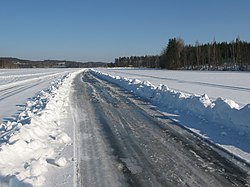
Ice road on Lake Saimaa in Finland
Ice road between Oulunsalo and Hailuoto. This is the longest ice road in Finland.
Truck on the former winter road between Inuvik and Tuktoyaktuk
Ice road, Sainte-Anne River, Quebec, Canada

An ice road or ice bridge[1][2][3][4] is a human-made structure that runs on a frozen water surface (a river, a lake or a sea water expanse).[5][6][7] Ice roads are typically part of a winter road, but they can also be simple stand-alone structures, connecting two shorelines.[8][9] Ice roads may be planned, built and maintained so as to remain safe and effective, and a number of guidelines have been published with information in these regards.[1][4][10][11] An ice road may be constructed year after year, for instance to service community needs during the winter.[4][12] It could also be for a single year or two, so as to supply particular operations, such as a hydroelectric project[8] or offshore drill sites.[13]

Ice bearing capacity

[edit]
The pressures of the water, related with ice buoyancy, upon short-term vertical loading an ice cover (adapted from[1][5]). Not to scale — for illustrative purposes only.

The ability of an ice road to safely support the weight of a vehicle, or any other loads applied onto it, referred to as bearing capacity, is the primary concern when designing, building and using that structure. Generally speaking, a vertically loaded ice cover will react in two ways: 1) it will sink, and 2) it will bend in flexure.[1][5] In order to meet the ice bearing criteria, the top surface should not sink below the water line and the applied flexural stress should not exceed the ice's flexural strength.[14] Three loading regimes have to be considered: a) maximum weight for standard usage or for parking during a short duration; b) a load that remains stationary during an extensive time period; and c) dynamic loading of the ice cover, from a traveling vehicle.

Maximum weight

[edit]

For standard traffic activities, guidelines typically use a simple empirical formula to determine the maximum vehicle weight that should be allowed on an ice road.[11][15] This formula, which was initially proposed in 1971,[16] is often referred to as Gold's formula:

where P is the load, h is the thickness and A is a constant with a unit of pressure. It may be linked with an idealized elastic response of the ice cover:[1]

where σmax is the maximum tensile strength at the bottom of an infinite ice plate resting on an elastic foundation. The parameter C is based on the theory of thick plates. Hence, with this idealized formulation, A is representative of the ice cover tensile strength. Although recommended values for A range from 3.5 to 10 kg/cm2 (50 to 142 psi), lower bound values are generally those that are used for safety purposes.[11][15] This level of conservatism is justified because, unlike human-made materials such as steel or concrete, natural ice covers inherently contain a large amount of structural flaws (fractures, water and air pockets).[2] Moreover, for a public road, which is relatively uncontrolled, such an approach introduces a high safety factor against breakthroughs and is therefore desirable. For industrial roads, the design may be less conservative so as to handle their functional requirements, i.e. higher A values can be used, but under the close supervision of a professional engineer.[4][2]

Maximum loading time

[edit]
Freeboard on an ice road at different time intervals

When using Gold's formula, a purely elastic response is assumed, which is, by definition, instantaneous and independent of loading time. Ice, however, naturally exists at a high homologous temperature, i.e. near its melting point. As is the case for any other material under these conditions, response to loading is not only elastic, but incorporates other components, namely:[17][18]

  1. A time-dependent recoverable component – this causes the development of microcracks, which can lead to fracturing and, ultimately, a breakthrough;
  2. A time-dependent irrecoverable component – this is commonly referred to as creep, which is related with the mechanisms responsible for glacier flow (long term) and plays a negligible role in the response of an ice road to loading.

Thus, an ice cover may be able to safely support a vehicle, but if it remains on the ice for too long, deformation will continue via microcracking, leading to the collapse of the ice cover below the vehicle. Recommendations vary as to how this can be avoided.[11][15] Some sources prescribe a maximum of two hours for a stationary load,[19][3][4] which is also what Gold recommended.[16] Others advise to use the freeboard of the ice as an indicator,[17][1][2][3] which can be done by drilling a hole in it and monitoring the distance between the water in the hole and the ice surface. The vehicle should be removed before the water reaches the surface in that hole. Another reason why the amount of freeboard matters is that if the water makes its way onto the ice surface (through cracks and fissures), the ice cover's bearing capacity diminishes rapidly, which can accelerate breakthrough.[14][1] For long-term loads, a professional engineer may have to be consulted.[4]

Dynamic loading

[edit]
Ice waves caused by a traveling vehicle – the vertical displacement of the ice surface, vastly exaggerated for illustrative purposes (see vertical scale at right), is indicated as a function of distance to vehicle. Adapted from,[20] and based on satellite imagery.

As a vehicle travels on the road, a dynamic loading regime is exerted onto the ice cover.[1][4] Below a specific speed, referred to as critical, the ice cover beneath the vehicle will assume the shape of a bowl moving with the vehicle, pushing away the water around it, as the keel of a boat does.[1] At (and above) the critical speed, a series of waves will form behind and in front of the vehicle. "If the celerity of these waves is the same as the vehicle speed, the deflection and the stresses in the ice sheet are amplified, similar to resonance in an oscillating system" (pp. 8–10).[1] The critical speed depends on ice thickness and water depth. Another issue that arises is the reflection of these waves from the shoreline back toward the vehicle. This can induce additional stresses on the ice – one way to mitigate this issue is to avoid approaching shorelines at 90 degrees.[4] The critical speed is what determines the speed limit for vehicles traveling on ice roads. That limit can be as low as 10 to 35 km/h (6 to 22 mph).[3][4] Dynamic loading of the ice cover may also dictate a minimum distance between vehicles.[4][2]

The effects of dynamic loading on a floating ice sheet has been investigated via field testing.[21][22][23] The most compelling evidence of such wave patterns, however, was captured by satellite imagery.[24][20]

Planning and construction

[edit]
A low head pump used for flooding an ice surface
Clear ice overlain by constructed white ice (hand/foot for scale at right)
Fracture planes in clear ice – boot for scale at lower left. Note the tire tread imprints at lower right.
Snowmobile used to pull a sleigh on which there is a ground-penetrating radar, to obtain a continuous ice thickness profile

When an ice road is part of a winter road, as is commonly the case, its design and construction is comprised within the overall road planning, i.e. in conjunction with the over-land segments.[2] Either way, factors that need to be addressed before construction include the following:

  • Schedule and operating windows: The start of the operation, i.e. when the field crew begins to work, is dependent on the ice thickness that is naturally achieved (typically under a snow cover). That thickness has to be sufficient to withstand the weight of light equipment that is then used to remove the snow cover. That snow acts as an insulator and removing it accelerates ice growth at the ice-water interface (along the bottom of the ice cover).
  • Traffic type and volume: This is about determining the transportation requirements for the operating season (e.g. equipment, supplies, fuel), and means to get that material across (e.g. vehicle types, weight, traffic volume).
  • Road right-of-way: This refers to the road width required to accommodate the traffic. This may range from 30 m (98 ft) to 60 m (200 ft). Ideally, it has to be wide enough to leave room on both sides for the snow banks and snow drift, with extra space between that snow and the actual travel lane.
  • Environmental and regulatory requirements: Licenses and permits vary from one jurisdiction to another. Examples can include time-limited land-use permits and access to water sources (for the protection of lakes and rivers).

Factors that need to be considered in route selection include the following:[2][3][12]

  • Deeper water is preferable, to avoid issues related with dynamic loading. Ice along shorelines and above shoals is prone to fracturing.
  • Avoid areas where there are strong water currents, or next to the mouth of small rivers and creeks. The temperature at the ice-water interface being 0 °C (32 °F), flow of water at a slightly higher temperature will thermally erode that interface, thereby reducing the ice thickness.[citation needed]
  • Consider the effects of water level changes, for instance upstream of a water body regulated by dams.
  • A review of historical ice conditions, using local knowledge and satellite imagery, can help decipher recurrent problematic areas, such as ice ridging.

Before first access to the ice, the following factors need to be considered:[2][4][3]

  • Due caution needs to be exercised – this includes appropriate personnel protective equipment (PPE) such as a flotation device, adequate training and working in pairs.
  • To further optimize safety, equipment and accessories should include: two-way radios, amphibious vehicles, winch on wheeled vehicles.
  • Ice thickness may be measured with ice augers, at required distance intervals or using a ground-penetrating radar (GPR). This is important, since an ice cover can vary as much as 70% in thickness over a few hundred meters, and the minimum ice thickness is used to determine the bearing capacity of the entire ice cover.[4]
  • Borehole drilling may be used to collect cores of the ice, so as to appreciate its internal structure, e.g. white ice versus clear ice.[12]

Snow cover removal is the first major operation in an ice road construction scheme.[2][3][12][25] It may only begin once the ice thickness is safe to support the machinery used for that operation. There are two ways of doing it, depending on available equipment and state of practice for that particular road. One is to pack the snow layer with tracked vehicles into a thin layer, thereby increasing its density and reducing its insulating properties. The other is to remove it altogether, typically with vehicles fitted with a snowplow.

Once the ice has reached the target thickness (via accelerated growth after removing the insulating effects of the snow), road construction per se may commence. At that point, the ice is able to safely support the heavier equipment required for that phase, which mostly consists of artificial thickening using a pump or a spraying system.[2][5] The aim is to bring the thickness up to what is required for the heaviest vehicles that are anticipated when the ice road opens.

Usage and maintenance

[edit]

Vehicles traveling on ice roads include ordinary automobiles and trucks of various sizes and weights. Standard winter tires are sufficient: in fact cleats and tire chains can damage the road surface.[12][25] Tire chains may be stored in the vehicle for emergency purposes;[2][4] they can also come in handy when traveling on a winter road with grades steeper than 8% on over-land segments.[2] Signage may indicate speed limits, for instance a maximum of 25 km/h (16 mph), and spacing between vehicles, for instance 500 m (1,600 ft) for loads more than 12,500 kg (27,600 lb).[2][4] These restrictions are to decrease the risks of damage to the ice cover, which would compromise its ability to support the weight it has been designed for.

Maintenance comprises two main tasks:[3][4][2][12]

  • Ice thickness monitoring: This can be done using drill holes or using ground-penetrating radar.
  • Trafficability monitoring: The ice surface can deteriorate with usage. It can also get damaged by natural processes, such as ridging and fracturing, which are typically induced by sharp changes in air temperature.

Road closure

[edit]

An ice road will typically be closed as a result of deterioration of the running or operating surface, before there is any risk of ice cover failure.[4] Surface deterioration can happen when the ice surface becomes too soft, or because of an excessive amount of meltwater on its surface.[3][25] Mid-season road closures can also happen for similar reasons, and also because of inclement weather, such as a blizzard.[3][12] If the ice road is part of a winter road, then closure can also be due to an over-land segment that has become unserviceable.

Ice road reinforcement

[edit]
An example of ice cover reinforcement, where four layers of stacked wooden logs were frozen into the ice (in,[26] from a description provided in[16]).

Ice crossings can be made to support higher loads if they are reinforced, and there are a number of ways this has been done in the past.[26][27][28] Also, because these structures are vulnerable to a warming climate, which reduces their operational lifespan,[29][30] they may benefit from reinforcement along problematic segments, such as creek crossings and where the winter road crosses a shoreline.

Media references

[edit]

See also

[edit]

References

[edit]
[edit]
Revisions and contributorsEdit on WikipediaRead on Wikipedia
from Grokipedia
An ice road is a temporary roadway built across frozen bodies of water, such as lakes, rivers, and sea ice, in polar and subpolar regions to provide seasonal overland access to remote areas where permanent infrastructure is impractical or impossible.[1] These routes are critical for transporting heavy equipment, fuel, construction materials, and supplies in Arctic environments, supporting industries like mining and oil extraction.[2] Typically operational only during the coldest months when ice thickness allows safe vehicle passage, ice roads form a vital transportation network in the circumpolar north, spanning thousands of kilometers annually.[1] Construction of an ice road begins with route selection based on water depth, ice stability, and local climate conditions, often prioritizing uniform depths over lakes or stable river sections to minimize hazards like currents or shifting channels.[3] The process involves clearing snow from the natural ice cover using plows to expose it to subfreezing air, promoting further thickening, followed by controlled flooding with water—sourced from nearby lakes or rivers via pumps—which freezes in layers to build required strength, adding approximately 1 inch of thickness per day.[3] Road widths vary by expected loads, ranging from 32 feet for light vehicles (up to 11,000 pounds) to 65 feet for heavy transports like super B-trains (up to 140,000 pounds), with safety margins determined by formulas such as Gold's equation (P = A × h², where P is load in pounds, A is a risk factor, and h is ice thickness in inches).[3] Ice roads are managed through rigorous monitoring of ice thickness—using manual augers or ground-penetrating radar—and environmental factors like cracks, snow accumulation, and warming trends, which can reduce load capacity by up to 50% during brief thaws above 32°F (0°C).[3] In regions like Alaska's North Slope, these roads facilitate oil field operations by bridging gaps between facilities, such as the 22-mile route connecting the Alpine and Kuparuk fields, using about 1 million gallons of water per mile while avoiding sensitive ecological areas through permitting and studies.[4] A notable example is the 475-kilometer (300-mile) ice road in Canada's Northwest Territories, which serves as the primary supply line for diamond mines at Ekati and Diavik, handling over 6,000 truckloads in a single season from mid-January to March, with speeds limited to 25 km/h (16 mph) for loaded vehicles to ensure stability.[2] As climate change shortens ice seasons and alters formation patterns, ongoing adaptations in design and uncrewed aircraft systems for surveillance are enhancing safety and sustainability.[3]

Overview and Types

Definition and Purpose

An ice road is a temporary, human-made transportation route constructed across frozen surfaces of rivers, lakes, or sea ice, designed to support vehicular traffic during winter months in cold regions. Unlike permanent roads built on stable land, ice roads rely on the natural formation of ice covers to provide a viable pathway where traditional infrastructure is absent or impractical. These routes are engineered to ensure safe passage for vehicles, including heavy trucks, by preparing the ice surface for load-bearing capacity.[3][5] The primary purpose of ice roads is to provide essential access to remote and isolated areas in Arctic and sub-Arctic regions, facilitating the transport of freight, supplies, fuel, and heavy equipment to communities, industrial sites, and mining operations. In environments where air transport is expensive and sea routes are seasonally unavailable, ice roads offer a cost-effective alternative for bulk goods movement, supporting economic activities like resource extraction and sustaining local populations during the harsh winter period. For instance, in Alaska and northern Canada, these roads enable the delivery of materials to remote mines, such as those along the Yukon River or in the Northwest Territories, where they serve as critical lifelines for seasonal logistics, and are vital for remote First Nations communities, where climate change is shortening seasons and threatening supply access as of 2025.[3][5][6] Ice roads are inherently seasonal, operational only when ice thickness and environmental conditions allow for sufficient bearing capacity, typically spanning 2 to 4 months from late fall freeze-up through early spring. Their duration varies by location and climate, with routes in regions like Alaska often active from December to March or April before thawing renders them unusable. This temporality underscores their role as a winter-specific solution, bridging gaps in year-round connectivity for northern transportation networks.[3][5]

Classification of Ice Roads

Ice roads are classified based on several key criteria, including the type of water body they traverse, their integration within broader transportation networks, variations in scale, and adaptations to environmental changes. These categorizations reflect the diverse geographical and operational contexts in which ice roads provide essential access to remote areas during winter months.[1][7] By water body, ice roads are distinguished between those over freshwater systems, such as frozen inland lakes and rivers, and those over sea ice. Freshwater ice roads form on still or flowing inland waters, where ice develops through thermal processes leading to stratified covers on lakes or competent sheets on rivers with mild slopes; these routes often require careful selection of deep, uniform crossings to ensure stability.[3][5] In contrast, sea ice roads traverse frozen coastal bays or ocean expanses, where saline ice incorporates brine pockets that affect its structural properties and thickness variability due to tides and currents.[7] Regarding integration, ice roads can be standalone structures dedicated solely to crossing frozen water bodies or segments incorporated into larger winter road systems that combine ice sections with overland trails. Standalone ice roads operate independently as direct corridors over water, prioritizing alignment for minimal environmental impact and efficient traversal.[5] Integrated ice roads, however, form critical links within extensive winter networks, facilitating seasonal supply chains by connecting frozen water crossings with snow-compacted land routes.[7] Scale variations further diversify ice roads, ranging from short local bridges, such as brief 100-meter crossings over narrow rivers or streams for community access, to long-haul routes spanning hundreds of kilometers for industrial transport of heavy equipment and supplies.[3][5] Short-scale ice roads typically support lighter traffic and require narrower cleared widths, while long-haul variants demand wider lanes and enhanced design to accommodate extreme loads over extended distances.[3] Emerging types include climate-adapted hybrid roads that incorporate artificial ice thickening to extend operational seasons amid warming trends. These hybrids employ techniques like controlled flooding to build additional white ice layers, increasing thickness by over one inch per day and enhancing bearing capacity for prolonged use in regions with shortening freeze periods.[7][5] Such adaptations address declining ice road viability, with networks in the Arctic experiencing an average reduction of about 10 days per decade in suitable conditions.[8] In response, some areas are developing hybrid or permanent alternatives, such as all-season roads in northern Ontario to sustain logistics amid shorter ice seasons, while recent efforts, such as U.S. Army research in November 2025 to standardize construction practices, aim to enhance reliability in changing conditions.[9][10]

Physical and Engineering Principles

Ice Formation and Bearing Capacity

Ice forms on water bodies through the natural freezing process when surface temperatures drop to the freezing point, initiating the growth of tiny needle-like or plate-shaped crystals that accumulate into a slush layer and consolidate into a thin ice sheet. This initial formation typically occurs on calm freshwater lakes, rivers, or seas during periods of sustained cold air temperatures. Once established, the ice cover expands laterally and thickens vertically via congelation growth at the ice-water interface, where latent heat released during freezing is conducted upward through the ice to the colder atmosphere above. The rate of this conductive heat transfer governs thickness accumulation and is proportional to the temperature gradient between the underlying water (near 0°C) and the air, while being inversely proportional to the existing ice thickness and any overlying snow cover.[11] In ideal conditions with air temperatures around -10°C and minimal snow cover, ice thickness can increase rapidly in the early stages, reaching 8-10 cm within the first 24 hours, after which the daily growth rate typically slows to 3-5 cm per day due to the insulating effect of the thickening ice layer itself. Snow plays a critical role as a thermal insulator, impeding heat conduction; even a thin layer of loose snow (a few centimeters) can equivalent to 2-4 meters of ice in insulation value, drastically reducing subsequent growth rates by limiting heat escape from the water below. For instance, hard-packed snow insulates comparably to 24-31 cm of ice, making snow removal a common practice to promote faster thickening on prospective ice roads. This conduction-driven process ensures that ice roads become viable only after sufficient cumulative cold exposure, often requiring weeks of sub-zero temperatures.[11] The bearing capacity of ice, which determines its ability to support static loads without failure, depends primarily on thickness and structural quality, with foundational estimates derived from Gold's formula:
P=Ah2 P = A h^{2}
where $ P $ is the allowable load in kilograms, $ h $ is the effective ice thickness in centimeters, and $ A $ is an empirical constant reflecting ice type and safety factors, typically 3.5-6 for clear freshwater ice under short-term static loading (less than 2 hours). Recent research notes limitations of Gold's formula for very heavy loads, recommending additional stress analysis.[12] This quadratic relationship highlights that bearing capacity scales with the square of thickness, meaning doubling the ice depth quadruples the supported load, all else equal. The formula applies specifically to floating clear ice sheets and assumes uniform conditions, providing a conservative basis for assessing viability in ice road contexts.[13] Minimum thickness thresholds for safe static support vary by vehicle weight and ice quality, with guidelines recommending 30-50 cm of clear ice for light vehicles (e.g., cars or small SUVs up to about 2,000 kg) and up to 1-2 m for heavy trucks (e.g., loads exceeding 20,000 kg) to account for safety margins in ice road applications. Ice quality profoundly influences these capacities: clear ice, characterized by large crystals and minimal air inclusions formed directly from water freezing, exhibits roughly twice the strength of white ice, which develops from refrozen surface snowmelt and is riddled with bubbles that reduce structural integrity by about 50%. Thus, white ice necessitates double the thickness of clear ice for equivalent bearing support, underscoring the importance of monitoring ice clarity during formation.[14][15][16]

Load Factors and Limitations

The bearing capacity of ice roads imposes strict maximum weight limits, typically 8-12 tonnes per axle depending on ice thickness, configuration, and regulatory standards, which vary with ice thickness and incorporate safety factors of 1.5-2 times the design load to account for uncertainties in ice quality and environmental conditions. These limits are calculated using empirical formulas such as Gold's equation, $ P = A h^2 $, to estimate gross vehicle weight (GVW), where $ P $ is the allowable load in kilograms, $ h $ is the ice thickness in centimeters, and $ A $ is a constant ranging from 4 to 6 for routine to enhanced operations, reflecting conservative risk levels; axle loads are then distributed accordingly. For example, at 50 cm thickness with $ A = 4 $, the gross vehicle weight limit is approximately 10 tonnes, increasing to 15 tonnes at $ A = 6 $.[17][3][18] Sustained loading on ice roads induces creep deformation, a time-dependent plastic flow that progressively reduces bearing capacity over hours to days, particularly for stationary or near-stationary loads exceeding a few minutes. This creep effect can lead to increased deflection and eventual failure if loads approach the maximum capacity, necessitating thicker ice or load restrictions for prolonged exposure; for moving traffic, the impact is minimal but still requires monitoring to prevent cumulative weakening.[3][19] Dynamic loading from vehicle motion introduces additional limitations, with critical speeds of 10-35 km/h potentially causing resonance that amplifies ice deflection by a factor of up to 2, effectively increasing the load impact by 1.5-3 times for speeds above 20 km/h. This resonance arises when vehicle speed matches the ice sheet's natural frequency, particularly in shallower water depths less than 6 meters, and is mitigated by enforcing speed limits such as 25 km/h for heavy loads and minimum vehicle spacing of 500 meters. The dynamic amplification is modeled through factors dependent on speed, ice thickness, and water depth, emphasizing the need for controlled operations to avoid fractures.[3][20] Environmental variables further constrain load capacities, as temperature fluctuations above 0°C increase melt risk and weaken ice structure, with warming above 32°F (0°C) for 24-48 hours reducing bearing capacity by approximately 50% due to thermal softening and potential cracking from rapid changes. In sea ice roads, salinity introduces brine pockets that can reduce compressive and tensile strength to 4-43% of freshwater ice (57-96% diminution), depending on salinity (e.g., 5-10 PSU) and ice age, as higher salinity lowers the freezing point and promotes weaker crystal structures. These effects are compounded in multiyear ice, where desalination partially mitigates but does not eliminate the strength reduction.[3][21][22]

Design, Planning, and Construction

Route Planning

Route planning for ice roads begins with rigorous site selection to ensure safety and structural integrity, prioritizing locations where water depth exceeds approximately 5 meters to prevent ice contact with the underlying bed and reduce the risk of bottom scour or instability.[3] Current patterns are evaluated to identify uniform flow areas, avoiding high-velocity reaches that could lead to uneven ice formation or thin spots, while topography is assessed to favor deep, consistent lake or river bottoms and steer clear of features like sandbars, islands, or shallows that might indicate shifting channels.[17][13] These criteria specifically aim to minimize hazards such as pressure ridges, which can reach up to 3 meters in height and pose significant risks to vehicle passage.[17] Scheduling the route is timed to align with natural freeze-up periods, typically occurring in November to December in Arctic regions, allowing for ice development over a feasible operational window of 60 to 90 days before spring thaw.[17] Planners rely on historical freeze-up data, long-range weather forecasts, and climate records to predict ice growth rates and determine the optimal start for surveys and construction, ensuring the route remains viable for heavy transport without exceeding load limitations based on ice thickness.[3][13] Pre-construction surveys form a critical feasibility assessment, involving systematic ice thickness probing using manual augers at spacings of 10 to 30 meters along proposed routes—closer in river areas affected by currents—and ground-penetrating radar (GPR) for continuous profiling to map variations.[17][13] Bathymetric mapping, often conducted via sonar or integrated GPR, delineates underwater topography to confirm suitable depths and avoid submerged obstacles, while environmental assessments evaluate factors like riverbank stability, potential cracks, and impacts on local ecosystems.[3] Regulatory approvals are essential preparatory steps, requiring permits from local authorities such as territorial governments in Canada, where guidelines mandate adherence to standards like the Northwest Territories Department of Transportation's "Guidelines for Safe Ice Construction" to protect wildlife corridors and ensure environmental compliance.[17] In Alberta, operators must develop an Ice Safety Plan under the Occupational Health and Safety Code, consulting engineers for routes supporting loads over 63,500 kg and incorporating site-specific risk evaluations.[13] These processes verify that planned routes meet legal and safety thresholds before any on-ice activities commence.[3]

Construction Techniques

Construction of ice roads begins with initial preparation of the planned route, focusing on enhancing the natural ice cover to support vehicle loads. Snow removal is a primary step, as accumulated snow insulates the ice and slows freezing; plowing exposes the surface to colder air, promoting faster ice growth and improving bearing capacity. This is typically done using snowplows or motor graders, with snow pushed to the sides to form windrows or berms that serve as buffers and aid traction.[3][17] Following snow clearance, artificial thickening is achieved by flooding the ice surface with water, often sourced from nearby lakes or rivers and pumped onto the bare ice in thin layers that freeze uniformly. This process adds clear, well-bonded ice equivalent to natural formation, with each flooding cycle potentially increasing thickness by about 2.5 cm (1 inch) per day under suitable temperatures below -10°C (14°F). Layers are applied sequentially, allowing time for freezing between applications, to build the required thickness—typically starting from a minimum of 30-40 cm (12-16 inches) for light vehicles and progressing to over 1 meter (3 feet) for heavy haul. In marginal areas with insufficient natural ice, additional methods like controlled water spraying ensure even coverage.[3][17] Road surfacing follows thickening, involving grading the ice to establish a smooth, level travel surface with standard widths of 8-10 meters (26-33 feet) for single lanes or up to 12 meters (40 feet) for two-way traffic, depending on load requirements. Snow berms, 3-5 meters wide, are maintained along the edges for stability and to prevent drift accumulation, while any uneven spots from ice floes are filled with ice chips or additional snow for a drivable path. Key equipment includes motor graders for shaping, high-volume pumps for flooding, front-end loaders for material handling, and ice augers for thickness verification during the process. Construction of a 10-20 km section generally takes 1-2 weeks, contingent on weather and ice growth rates, with monitoring every 2-3 days to assess progress.[3][17]

Operation, Usage, and Maintenance

Vehicle Operations

Vehicle operations on ice roads are governed by strict protocols to ensure the structural integrity of the ice and the safety of drivers. Heavy-duty trucks, typically semi-trailers designed for extreme conditions, are the primary vehicles permitted, with gross vehicle weights reaching up to 67 tonnes under specialized winter permits in regions like the Northwest Territories.[23] These trucks must be equipped with tire chains to enhance traction on the slippery surface, and load distribution is carefully managed to limit axle loads, often not exceeding approximately 10 tonnes per axle to prevent localized stress on the ice.[24] Additionally, vehicles are required to carry essential survival gear, including parkas, tool kits, wheel chocks, and emergency supplies, as breakdowns can strand drivers in remote areas for extended periods.[24] Speed limits are enforced to minimize dynamic loading from vehicle motion, which can weaken the ice through wave generation. Loaded trucks are typically restricted to 25 km/h on lake sections, while empty returns may reach 40 km/h, with lower limits of 10-15 km/h in flood zones or near shorelines.[24][3] Vehicle spacing protocols further reduce overload risks, requiring a minimum of 300 meters between trucks in convoys on ice surfaces, extending to 500 meters or 1 km for heavier loads or in certain jurisdictions like Manitoba.[24][3][25] Convoy systems are standard for safe transit, particularly on remote stretches, where groups of 2-4 trucks travel together under escort. Communication is maintained via CB radios for real-time coordination, with convoy leaders broadcasting positions and warnings, supplemented by GPS tracking in some operations.[24][26] Logistical support includes designated refueling stations at key hubs, such as Pickle Lake in Ontario or camps along the route in the Northwest Territories, to sustain long hauls without exceeding load limits from fuel weight.[6] Emergency kits and pre-trip inspections for fuel leaks are mandatory, ensuring vehicles can handle potential breakdowns while adhering to overall load factors that vary with ice thickness.[24]

Monitoring and Maintenance

Monitoring and maintenance of ice roads involve continuous assessment and repairs to ensure structural integrity and safe passage throughout the operational season. Thickness monitoring is a critical daily practice, typically conducted using manual core sampling with augers to drill into the ice and measure total and effective thickness, identifying layers such as clear ice, snow ice, or inclusions that affect bearing capacity.[3] Ground-penetrating radar (GPR) complements these efforts by providing non-invasive, continuous profiling of ice thickness over larger areas, calibrated against manual measurements for accuracy; this method is particularly useful for detecting variations and is recommended daily for moderate to substantial risk levels.[3] These measurements aim to maintain a safety factor determined by Gold's formula (P = A h², where P is allowable load, h is thickness, and A is a coefficient adjusted for risk, typically 50-85 psi for ice roads to provide margins against variability and undersampling).[3] Recent initiatives, such as Alaska's Safe Ice Roads for Alaska (SIRA) Program as of the 2024-2025 season, support enhanced monitoring through funding for advanced technologies and updated guidelines.[27] Surface maintenance focuses on preserving the road's drivability and strength by addressing environmental wear. Snow is regularly plowed to prevent accumulation that insulates the ice and slows refreezing, thereby enhancing bearing capacity; plowing is performed using specialized equipment like graders or snowplows, with procedures outlined to clear the surface without damaging the ice.[3] Cracks are repaired by filling them with packed snow or slush and then flooding with water to freeze into a solid seal, restoring continuity and preventing water infiltration that could weaken the structure—wet cracks, which reduce bearing capacity by up to 50%, require immediate attention to avoid hazards.[28][3] In areas affected by melting or resurfacing needs, such as warmer periods when frequency of these tasks increases due to accelerated thaw, additional flooding is applied to build new ice layers, typically adding about 1 inch per day under cold conditions.[3] Weather conditions necessitate responsive adjustments to sustain road viability. Temperature logs are maintained to track air temperatures, with load limits reduced by 50% if temperatures exceed 32°F (0°C) for 24-48 hours, as warmer conditions compromise ice strength through melting and reduced refreezing rates.[3] Blowing snow or storms prompt immediate surface checks and potential plowing to maintain visibility and edge definition, ensuring safe vehicle operations.[3] Dedicated maintenance crews, often operating in shifts to provide round-the-clock coverage during peak usage, handle these tasks with specialized tools including augers, GPR units, snowplows, ice cutters, and water pumps for flooding.[3] These teams conduct visual inspections, thickness surveys, crack repairs, and snow removal, with at least two members per operation equipped with personal protective equipment, flotation devices, and survival kits to mitigate risks; their efforts are intensified during warmer periods or high-traffic phases to extend the road's usability.[3]

Closure and Reinforcement

Closure Procedures

Closure procedures for ice roads are initiated to ensure public safety as environmental conditions lead to diminished ice integrity, preventing potential structural failures. Key indicators prompting closure include significant thinning of the ice cover, often to less than 50% of its initial design thickness, which compromises load-bearing capacity; widespread cracking that penetrates more than 50% of the ice depth; excessive surface water accumulation from melting; and softening of the upper ice layers that inhibits safe vehicle travel. Additionally, prolonged warming trends, such as air temperatures exceeding 0°C (32°F) for 24-48 hours, can reduce bearing capacity by up to 50%, signaling the need for immediate assessment and potential shutdown. These signs are monitored through routine inspections, often referencing maintenance indicators like increasing rut depths or water pooling observed during operations.[3][17] Notification protocols emphasize timely communication to minimize risks to users. Operators issue advance warnings, typically 48 hours in advance when feasible, through multiple channels including local radio broadcasts, television announcements, newspaper notices, social media updates, and a dedicated toll-free highway condition line (e.g., 1-800-661-0750 in the Northwest Territories). Traffic is halted progressively by posting "Road Closed" signs compliant with the Manual on Uniform Traffic Control Devices (MUTCD R11-2) at all access points, accompanied by physical barricades or snow berms to block entry. In cases of sudden deterioration, such as from storms, immediate halts are enforced, and stranded vehicles may require evacuation, often via helicopter rescue operations to extract individuals from remote sections.[3][17] Following closure, post-closure actions focus on securing the site and restoring the environment to the extent possible. All access points are reinforced with signage and barriers, which are monitored and maintained in accordance with public highways legislation to prevent unauthorized entry until complete melt. Environmental cleanup involves removing debris such as spilled fuels, hazardous materials, or construction remnants like culverts and corduroy from stream crossings, with spills reported immediately to authorities for remediation under environmental protection acts. Temporary structures, including bridges, are dismantled to avoid interference with spring thaw, and erosion-prone ruts are addressed through water diversion trenches leading to vegetated areas. Data logging is conducted throughout, recording closure metrics like ice thickness measurements, weather data, and incident reports for analysis in planning subsequent seasons' routes and improvements.[17] In northern latitudes, ice road closures typically occur in March to April, aligned with the onset of solar-driven surface melt and rising temperatures, even if air remains subfreezing; for instance, average closing dates in the Northwest Territories range from late March to mid-April depending on the route. Sudden closures can arise from unseasonal storms accelerating degradation.[29][3]

Reinforcement Methods

Reinforcement methods for ice roads are employed mid-season to address emerging weaknesses, such as cracks or thin spots, thereby extending operational life and enhancing load-bearing capacity without full reconstruction. These techniques target localized vulnerabilities identified through monitoring, allowing continued use under controlled conditions. Common approaches include bridging hazardous areas and integrating structural elements into the ice cover.[30] Basic reinforcements often involve placing rig mats or steel plates over weak spots to distribute vehicle loads and prevent breakthrough. Rig mats, typically constructed from wood or composite materials, are laid across cracks or thin ice sections to bridge them, supporting traffic while the underlying ice refreezes or stabilizes; for instance, they enable passage over wet cracks that would otherwise reduce bearing capacity by up to 50%. Steel plates serve a similar purpose, providing a rigid surface over hazardous ice to mitigate deflection and cracking under heavy loads, with edges marked for safety during operations on Arctic routes. These methods can significantly increase the supported load in affected areas by spreading pressure, with geogrid reinforcements showing up to 38% improvement in bearing capacity for thin ice in tests.[31][32] Advanced reinforcement techniques incorporate materials directly into the ice structure to bolster tensile strength and durability. Microscopic reinforcements, such as adding natural fibers or wood pulp to the ice matrix, enhance crack resistance and overall integrity, with laboratory tests showing up to three times greater strength. Macroscopic methods include laying geogrids, steel cables, or timber beams onto the ice surface before flooding to embed them, creating composite covers capable of sustaining higher axle loads; for example, polypropylene geogrids have been tested to increase plate-loading capacity by reinforcing weak segments on floating ice. Additionally, building ice berms—raised edges formed by piling and freezing water or snow—helps contain floodwater during repairs and redirects surface flow away from vulnerable road sections, preventing further erosion or thinning.[33][34] In response to shorter ice seasons observed since the 2010s due to climate warming, adaptations like geomembranes or geo-textiles placed under or within the ice provide thermal insulation and reinforcement, slowing melt rates and aiding thickness maintenance in marginal conditions. Snow fences are deployed alongside roads to trap drifting snow, enhancing localized insulation where controlled cover is beneficial for stability without excessive accumulation that hinders freezing. These measures collectively prolong usability, with benefits including reduced reliance on costlier air or alternative ground transport; for instance, reinforcements on northern Canadian routes have extended seasons by weeks, yielding substantial economic savings over emergency closures.[35]

Safety and Risks

Safety Measures

Safety on ice roads relies on rigorous training requirements to prepare drivers and operators for the unique hazards of frozen environments. Mandatory certifications often include ice road survival courses that cover critical topics such as hypothermia prevention, vehicle extraction techniques from ice breaks, and emergency response protocols.[36][37] For instance, personnel must complete training in first aid/CPR, ice rescue operations, and winter survival skills to ensure they can recognize and mitigate risks like sudden ice failure.[36] In regulatory contexts, such as under Canada's Occupational Health and Safety Regulations, employers are required to provide comprehensive training on ice hazards and rescue procedures before allowing work on ice-covered surfaces.[37] Equipment standards play a vital role in enhancing survivability and response capabilities. Vehicles operating on ice roads must be equipped with emergency beacons, such as satellite phones or two-way radios, to facilitate rapid communication in remote areas where cellular service is unavailable.[3][36] Ice rescue kits are standard, including personal flotation devices, lifelines, shovels, reflectors, and first aid supplies to support immediate self-rescue or aid to others in case of breakthrough.[3][36] Vehicle modifications are essential for traction and control, such as installing ice-suitable tires, chains, or grousers on tracks, along with cold-weather lubricants and functional lighting to maintain safe speeds and visibility.[3] These adaptations account for extended braking distances on ice, where stopping times can double compared to dry roads, as noted in general vehicle operation guidelines.[3] Signage and control measures provide ongoing warnings and restrictions to prevent overloading or traversal of unstable sections. Warning markers are placed to indicate thin ice areas, cracks, or pressure ridges, guiding drivers away from high-risk zones.[37][36] Entry points feature prominent signs detailing maximum gross vehicle weights (GVW), speed limits—typically 15 km/h (9 mph) for heavier loads—and emergency contact information, adhering to standards like the U.S. Manual on Uniform Traffic Control Devices (MUTCD).[3][38] Weight stations, often equipped with portable scales, are stationed at access points to verify compliance with load limits based on current ice conditions.[36] These controls also enforce vehicle spacing, such as 1 km between heavy loads, to minimize dynamic stresses on the ice.[36] Regulatory frameworks establish overarching standards to ensure consistent safety across jurisdictions. In the United States, the Federal Highway Administration (FHWA) provides guidelines through the MUTCD for signage on federal lands, emphasizing uniform traffic control to reduce confusion and accidents on temporary routes like ice roads.[3][38] These incorporate a safety factor of 1.5 in ice thickness calculations to account for local variability, requiring measured thicknesses to exceed minimum requirements by this margin for reliable load-bearing capacity.[39] In Canada, compliance with the Canada Labour Code and associated regulations mandates hazard prevention programs that include ice-specific assessments and controls.[37] Such frameworks prioritize conservative design, using tools like Gold's Formula to evaluate risk levels based on ice strength and load classes.[3]

Common Hazards and Incidents

Ice roads present several inherent hazards that threaten the safety of drivers and infrastructure. One primary risk is ice break-throughs, often triggered by vehicle overloads exceeding the ice's bearing capacity, which can lead to radial and circumferential cracking followed by structural collapse.[3] Wet cracks, extending through the full ice thickness, can reduce load-bearing capacity by up to 50%, amplifying the danger during heavy trucking operations.[3] Whiteouts from blowing snow drastically reduce visibility, creating drifts that obscure road edges and contribute to disorientation, particularly on open lake or river surfaces where horizons vanish.[3] In Arctic regions, wildlife crossings add another layer of peril, posing collision risks to slow-moving convoys. Notable incidents underscore these vulnerabilities. In 2001, a fuel tanker broke through the ice on Canada's Tibbitt to Contwoyto Winter Road due to excessive speed-induced fracturing, resulting in the vehicle floating but no fatalities; this event highlighted the rarity yet severity of such breakthroughs amid over 58,000 successful loaded trips between 2000 and 2007.[40] Another incident occurred in 2016 on the Deline winter road in the Northwest Territories, where a fuel truck plunged through thin ice, prompting investigations into construction quality but causing no deaths.[41] These events reflect a low overall structural failure rate—approximately one per tens of thousands of trips—but emphasize the potential for rapid escalation in remote areas.[40] Contributing factors to these hazards include human error, such as speeding beyond posted limits (e.g., 25 km/h on vulnerable sections), which amplifies dynamic stresses on the ice, and unpredictable thaws from warming periods exceeding 32°F for 24-48 hours, halving bearing capacity.[3] Climate variability has exacerbated risks post-2020, with shrinking lake ice durations—projected to decrease by 13-24 days under moderate warming—leading to thinner, less stable surfaces and shorter operational seasons.[42] In northern Canada, declining freezing indices by 174°C-days per decade further contribute to early-season instabilities and increased breakthrough potential.[40] Lessons from major incidents have driven innovations in monitoring, including the adoption of drone-based ground-penetrating radar (GPR) systems for real-time ice thickness assessment and hazard detection, such as cracks or thaws, enhancing safety on extended routes like those in Alaska spanning over 100 miles.[43] This technology allows for proactive identification of variability during shoulder seasons, reducing reliance on manual inspections in hazardous conditions.[43]

Environmental and Economic Impacts

Environmental Considerations

Ice roads pose significant risks to Arctic wildlife, particularly through disruption of migration patterns. For instance, migratory caribou herds, such as the Western Arctic Herd, exhibit altered behaviors when encountering ice roads, including back-and-forth movements, bouncing away, and tracing along road edges, which act as semi-permeable barriers.[44] These responses prolong encounters, with affected individuals spending an average of 14.3 days near roads compared to 4.9 days for unaltered movements, potentially delaying migrations and increasing energy expenditure during critical periods like fall and winter.[44] Vehicle traffic on ice roads further exacerbates avoidance, as caribou select habitats 1–3 km from high-traffic routes (>5 vehicles per hour) and show reduced crossing rates during insect harassment seasons, limiting access to calving grounds and foraging areas in regions like northern Alaska.[45] Fuel spills from tanker trucks and maintenance activities on ice roads threaten water and soil quality, with potential for long-term contamination in sensitive northern ecosystems. In Canada's Northwest Territories and Nunavut, tanker trucks transporting fuel along ice roads have caused spills that release hydrocarbons into adjacent lands and waterways, where slow degradation in cold conditions amplifies risks to groundwater and surface water.[46] Winter road maintenance practices, including the use of deicers like sodium chloride, contribute to soil salinization and runoff that pollutes nearby water bodies, harming vegetation and increasing the mobility of contaminants.[47] These inputs alter freeze-thaw cycles in aquatic environments, leading to sediment disturbance and reduced oxygen levels that impact fish and invertebrate communities beneath the ice.[47] Climate change intensifies the environmental challenges of ice roads by shortening viable seasons and reducing ice thickness, creating a feedback loop that affects ecosystems. Across the Pan-Arctic, potential ice road days have declined by an average of 7.45 days per decade from 1979–2017, with the Canadian Arctic experiencing steeper losses of 10.17 days per decade due to warmer air temperatures delaying freeze-up and accelerating melt. As of 2025, projections indicate continued declines, with amplified warming exacerbating ecosystem feedback loops.[8] Projections indicate that by 2050–2100, no regions will support optimal ice conditions (index of 11–12), with permafrost thaw stressing over 78% of former high-viability areas and further diminishing road usability.[8] For key routes like Canada's Tibbitt to Contwoyto Winter Road, seasons could shorten to 47–55 days under 2°C global warming, below the threshold for safe heavy-haul operations requiring at least 107 cm ice thickness.[48] Mitigation strategies emphasize low-impact routing and regulatory oversight to curb ecological harm. Route planning using uncrewed aerial systems (UAS) allows selection of paths that avoid sensitive habitats, such as caribou calving areas, reducing barrier effects on wildlife movement.[3] For example, guidelines in Ontario and the Northwest Territories enforce protections under the Fisheries Act, prohibiting machinery in spawning areas and requiring erosion controls at water crossings to preserve aquatic ecosystems.[49] These measures, including speed limits and traffic monitoring, aim to balance infrastructure needs with conservation in thawing Arctic landscapes.[45]

Economic Significance

Ice roads offer substantial economic advantages by drastically reducing transportation costs in remote northern regions, where alternatives like air freight are prohibitively expensive. Trucking over ice roads typically costs about $0.145 per tonne-kilometer, compared to approximately $1.90 per tonne-kilometer for air freight to Arctic mining sites.[50][51] This cost differential—often 10 to 15 times lower—makes large-scale operations feasible in areas without permanent infrastructure, such as Nunavut's diamond mines, where ice roads serve as the backbone for hauling heavy equipment, fuel, and supplies that would otherwise render projects uneconomical.[52] These routes are essential for industrial supply chains in the Arctic, handling the majority of annual goods to remote communities and supporting vital sectors like diamond and gold mining. For instance, the Tibbitt to Contwoyto Winter Road in Canada transports over 10,000 truckloads of cargo each season to diamond mines, accounting for up to 80% of their yearly resupply needs and enabling the movement of hundreds of thousands of tonnes of materials valued in the hundreds of millions of dollars.[53][54] Without ice roads, reliance on air or seasonal sealifts would increase costs dramatically, disrupting operations that contribute billions to regional economies through resource extraction.[55] Ice roads also generate seasonal employment and provide critical infrastructure alternatives to permanent roads, which can cost millions per kilometer to build in permafrost terrain. In Canada and Alaska, these operations create thousands of temporary jobs in trucking, construction, and maintenance, with major routes like those in the Northwest Territories employing hundreds of drivers and support staff per season at wages often exceeding $100,000 for the short period.[56][57] This workforce supports local economies while offering a low-cost connectivity solution for communities lacking year-round access, effectively bridging isolation without the environmental and financial burden of all-weather highways.[58] However, climate change poses rising economic challenges by shortening ice road seasons through warmer winters and thinner ice, potentially increasing operational costs and reducing viability. Projections indicate that suitable overland travel days could decline by 13% or more in the coming decades, with some models forecasting up to a 50% reduction in season length by 2040 due to decreased freezing-degree days and permafrost degradation.[59] This trend may force greater dependence on costlier alternatives, threatening the economic model for Arctic industries and communities.[60]

History and Global Examples

Historical Development

Ice roads have roots in the traditional practices of indigenous Arctic peoples, who have utilized frozen sea surfaces as vital pathways for millennia. Beginning around 2000 BC with the Pre-Dorset culture and continuing through the Dorset (~500 BCE–1500 CE) and Thule (~1000–1600 CE) periods, Inuit ancestors traversed sea ice using dog teams pulling sleds for hunting, trading, and seasonal migrations.[61] These nomadic bands relied on sea ice as a "highway" to connect communities, hunt marine mammals like seals and whales, and navigate using natural cues such as landmarks, the sun, and stars, all predating European colonization.[62] This indigenous knowledge emphasized safe ice travel, forming the foundational understanding of ice as a transport medium in extreme cold environments. The 20th century marked significant expansion of ice roads driven by industrial demands, particularly post-World War II resource extraction in northern regions. In Alaska, ice roads proliferated in the 1970s following the 1968 discovery of oil at Prudhoe Bay, supporting mining and oil operations on the North Slope where permanent roads were impractical; precursors to the Dalton Highway, constructed in 1974 as a haul road for the Trans-Alaska Pipeline.[63] Similarly, in Soviet Siberia, ice roads expanded with industrial development in remote areas to facilitate mining and oil extraction. Technological advances in the 1970s formalized ice road construction and operations, enabling safer heavy trucking. In Canada, researchers like N.K. Sinha and L. Gold at the National Research Council advanced ice mechanics through microstructural studies and field trials, developing models for ice deformation under load that informed early guidelines for bearing capacity and deflection limits.[7] These standards shifted from experiential methods to science-based designs, allowing trucks carrying up to 50 tons to operate on reinforced ice crossings over lakes and rivers, revolutionizing northern logistics for mining and exploration.[7] Post-2000 trends reflect adaptations to climate warming, with shorter ice seasons challenging traditional operations. For instance, the Tibbitt-to-Contwoyto Winter Road in Canada, a critical heavy-haul route, has experienced shorter operational seasons in recent years due to delayed freezing and earlier thaws, with projections indicating reductions of up to 33% by mid-century and prompting enhanced monitoring and reinforcement strategies.[60] As of 2025, the 2024–25 season opened later than historical averages, underscoring ongoing climate impacts.[64]

Notable Ice Roads Worldwide

One of the most prominent ice roads in North America is the Tibbitt-to-Contwoyto Winter Road in Canada's Northwest Territories, which spans over 400 kilometers from Tibbitt Bay near Yellowknife to Contwoyto Lake, serving as a vital supply route for remote diamond mining operations.[65][66] Constructed annually on frozen lakes and rivers, it enables the transport of heavy equipment and fuel that cannot be delivered by air, supporting mines such as Diavik and Ekati.[67] Recognized as the world's longest heavy-haul ice road, it operates from late January to early April, handling thousands of truckloads each season.[65] In Alaska, sections of the Dalton Highway, particularly the northern stretches beyond Coldfoot, incorporate ice bridges and frozen river crossings that transform parts of the 666-kilometer route into de facto ice roads during winter months.[68] These segments, used for hauling oilfield supplies to Prudhoe Bay, pose extreme challenges due to subzero temperatures and thin ice layers over rivers like the Sagavanirktok, requiring specialized trucking techniques featured in documentaries on Arctic logistics.[69] The highway's ice-dependent portions highlight the integration of seasonal ice infrastructure with permanent gravel roads in remote industrial corridors.[68] Another notable North American example is the Inuvik-Tuktoyaktuk Ice Road in the Northwest Territories, a 137-kilometer route connecting the community of Inuvik to the Arctic coastal village of Tuktoyaktuk until its permanent closure in April 2017.[70] Built over frozen channels of the Mackenzie River delta, it provided essential year-round access for residents, delivering goods like fuel and building materials during the brief winter season from December to April.[71] The road's decommissioning followed the completion of the all-season Inuvik-Tuktoyaktuk Highway, marking a shift from traditional ice-based connectivity to permanent infrastructure in the Arctic.[70] In Europe, ice crossings on Finland's Lake Saimaa enable timber harvesting and transport from remote islands during harsh winters, with roads constructed directly on the frozen surface to access forested areas inaccessible by boat in summer.[72] These seasonal routes, typically 1-5 kilometers in length per crossing, support the forestry industry by allowing heavy machinery to extract logs efficiently when ice thickness exceeds 50 centimeters, ensuring safe load-bearing for trucks.[72] Maintained by local authorities and companies, they exemplify short-haul ice roads tailored to regional resource extraction in boreal lake systems.[72] Russia's Kolyma River ice routes in Siberia form critical segments of the broader Kolyma Highway, facilitating gold transport from remote mining sites along the frozen river and tributaries during winter.[73] Stretching hundreds of kilometers through the Magadan region, these ice roads overlay the historic "Road of Bones" and enable convoys to deliver supplies to gold operations in areas cut off by summer thaws, operating under severe conditions with temperatures dropping below -50°C.[73] They remain essential for sustaining mining activities in one of the world's coldest inhabited regions.[73] Beyond these continents, Antarctic supply roads on the McMurdo Ice Shelf provide logistical support for scientific stations, with compacted snow paths extending up to 20 kilometers from McMurdo Station to inland airfields and field camps.[74] These roads, groomed annually during the austral summer, transport cargo like fuel and equipment weighing tens of thousands of kilograms, bridging the gap between sea ice runways and the Antarctic plateau while navigating crevasses and soft snow.[75] In emerging Asian contexts, Mongolia's developing ice routes over frozen rivers and lakes in the northern taiga, such as those near Khuvsgul Lake, are increasingly used for winter access to mining sites and remote herding communities, spanning 50-100 kilometers in key corridors.[76] These routes, often improvised with local engineering, reflect growing reliance on ice infrastructure amid expanding resource extraction in Central Asia's harsh winters.[77]

Cultural Depictions

Ice roads have captured the public imagination through various media, often portraying them as symbols of perilous adventure and human endurance in remote Arctic environments. The reality television series Ice Road Truckers, which originally aired on the History Channel from 2007 to 2017 and returned for a twelfth season in 2025, follows long-haul truckers navigating frozen lakes and rivers in Canada's Northwest Territories and Alaska to deliver supplies to isolated mining operations, emphasizing the high-stakes dangers of cracking ice and extreme weather while highlighting the truckers' resilient lifestyles.[78][79] In film, ice roads serve as dramatic backdrops for action and survival narratives. The 2021 Netflix thriller The Ice Road, directed by Jonathan Hensleigh and starring Liam Neeson, depicts a team of truckers racing across a frozen lake in northern Canada to rescue trapped diamond miners after a collapse, underscoring the fragility of the ice and the heroism required to traverse it.[80][81] Similarly, the 2008 independent drama Frozen River, written and directed by Courtney Hunt, explores themes of desperation and cross-border smuggling as two single mothers drive across the frozen St. Lawrence River between New York and Quebec to transport undocumented immigrants, portraying the ice crossing as a treacherous, makeshift pathway fraught with moral and physical risks.[82][83] Literature has also chronicled the human stories behind ice roads, contributing to their mythic status. Edith Iglauer's 1974 book Denison's Ice Road details the construction and traversal of ice routes in Canada's Arctic to support mining projects, drawing from the author's firsthand experiences and capturing the engineering ingenuity and isolation of these seasonal highways.[84] In the 2020s, documentaries have shifted focus to environmental vulnerabilities, such as the 2024 production Canada's Ice Roads: Highway to the Arctic by Autentic, which examines how warming temperatures are shortening the operational season for these vital routes and threatening northern communities' access to goods.[85] These portrayals have reinforced ice roads' image as emblems of rugged frontier life, inspiring real-world tourism. In Alaska, guided tours along routes like the Dalton Highway and Arctic Circle ice paths, offered by operators such as the Northern Alaska Tour Company, allow visitors to experience the stark beauty and challenges of winter travel, often marketed as adrenaline-fueled adventures that echo media depictions.[86][87]

References

User Avatar
No comments yet.