Hubbry Logo
Renaissance Revival architectureRenaissance Revival architectureMain
Open search
Renaissance Revival architecture
Community hub
Renaissance Revival architecture
logo
8 pages, 0 posts
0 subscribers
Be the first to start a discussion here.
Renaissance Revival architecture
from Wikipedia

Schwerin Palace in Mecklenburg (Germany), completed in 1857
Waddesdon Manor in Buckinghamshire (England), seat of the Rothschild family, 1874

Renaissance Revival architecture (sometimes referred to as "Neo-Renaissance") is a group of 19th-century architectural revival styles which were neither Greek Revival nor Gothic Revival but which instead drew inspiration from a wide range of classicizing Italian modes. Under the broad designation Renaissance architecture 19th-century architects and critics went beyond the architectural style which began in Florence and Central Italy in the early 15th century as an expression of Renaissance humanism; they also included styles that can be identified as Mannerist or Baroque. Self-applied style designations were rife in the mid- and later 19th century: "Neo-Renaissance" might be applied by contemporaries to structures that others called "Italianate", or when many French Baroque features are present (Second Empire).

The divergent forms of Renaissance architecture in different parts of Europe, particularly in France and Italy, has added to the difficulty of defining and recognizing Neo-Renaissance architecture. A comparison between the breadth of its source material, such as the English Wollaton Hall,[1] Italian Palazzo Pitti, the French Château de Chambord, and the Russian Palace of Facets—all deemed "Renaissance"—illustrates the variety of appearances the same architectural label can take.

Origins of Renaissance architecture

[edit]

The origin of Renaissance architecture is generally accredited to Filippo Brunelleschi (1377–1446).[2]: 243  Brunelleschi and his contemporaries wished to bring greater "order" to architecture, resulting in strong symmetry and careful proportion. The movement grew from scientific observations of nature, in particular, human anatomy.

Neo-Renaissance architecture is formed by not only the original Italian architecture but by the form in which Renaissance architecture developed in France during the 16th century. During the early years of the 16th century, the French were involved in the Italian Wars, bringing back to France not just the Renaissance art treasures as their war booty, but also stylistic ideas. In the Loire valley a wave of chateau building was carried out using traditional French Gothic styles but with ornament in the forms of pediments, arcades, shallow pilasters and entablatures from the Italian Renaissance.

In England, the Renaissance tended to manifest itself in large square tall houses such as Longleat House (1568–1580). Often these buildings had symmetrical towers which hint at the evolution from medieval fortified architecture. This is particularly evident at Hatfield House (1607–1612), where medieval towers jostle with a large Italian cupola. This is why so many buildings of the early English Neo-Renaissance style often have more of a "castle air" than their continental European contemporaries, which can add again to the confusion with the Gothic Revival style.

Birth of the Neo-Renaissance

[edit]
Mentmore Towers in Buckinghamshire. English Jacobethan Neo-Renaissance completed in 1854, derives motifs from Wollaton Hall completed in 1588.

When the revival of Renaissance style architecture came en vogue in the mid 19th century, it often materialized not just in its original form first seen in Italy, but as a hybrid of all its forms according to the whims of architects and patrons, an approach typical of the mid and late 19th century. Modern scholarship defines the styles following the Renaissance as Mannerist and Baroque, two very different, even opposing styles of architecture, but the architects of the mid 19th century understood them as part of a continuum, often simply called 'Italian', and freely combined them all, as well as Renaissance as it was first practiced in other countries.

Thus Italian, French and Flemish Renaissance coupled with the amount of borrowing from these later periods can cause great difficulty and argument in correctly identifying various forms of 19th-century architecture. Differentiating some forms of French Neo-Renaissance buildings from those of the Gothic revival can at times be especially tricky, as both styles were simultaneously popular during the 19th century.

As a consequence, a self-consciously "Neo-Renaissance" manner first began to appear c. 1840. By 1890 this movement was already in decline. The Hague's Peace Palace completed in 1913, in a heavy French Neo-Renaissance manner was one of the last notable buildings in this style.

Prague's National Theatre (Czech Republic), 1862

Charles Barry introduced the Neo-Renaissance to England with his design of the Travellers Club, Pall Mall (1829–1832). Other early but typical, domestic examples of the Neo-Renaissance include Mentmore Towers and the Château de Ferrières, both designed in the 1850s by Joseph Paxton for members of the Rothschild banking family. The style is characterized by original Renaissance motifs, taken from such Quattrocento architects as Alberti. These motifs included rusticated masonry and quoins, windows framed by architraves and doors crowned by pediments and entablatures. If a building were of several floors, the uppermost floor usually had small square windows representing the minor mezzanine floor of the original Renaissance designs. However, the Neo-renaissance style later came to incorporate Romanesque and Baroque features not found in the original Renaissance architecture which was often more severe in its design. John Ruskin's panegyrics to architectural wonders of Venice and Florence in the 1850s contributed to shifting "the attention of scholars and designers, with their awareness heightened by debate and restoration work"[3] from Late Neoclassicism and Gothic Revival to the Italian Renaissance.

Like all architectural styles, the Neo-Renaissance did not appear overnight fully formed but evolved slowly. One of the first signs of its emergence was the Würzburg Women's Prison, which was erected in 1809 designed by Peter Speeth. It included a heavily rusticated ground floor, alleviated by one semicircular arch, with a curious Egyptian style miniature portico above, high above this were a sequence of six tall arched windows and above these just beneath the slightly projecting roof were the small windows of the upper floor. This building foreshadows similar effects in the work of the American architect Henry Hobson Richardson whose work in the Neo-Renaissance style was popular in the US during the 1880s. Richardson's style at the end or the revival era was a severe mix of both Romanesque and Renaissance features.[2]: 300–318  This was exemplified by his "Marshall Field Warehouse" in Chicago (completed in 1887, now demolished). Neo-Renaissance was adopted early in Munich, often based directly on Italian Palazzi, first appearing in the Palais Leuchtenberg (1817–21), by Leo von Klenze, then adopted as a state style under the reign of Ludwig I of Bavaria for such landmarks as the Alte Pinakothek (1826–36), the Konigbau wing of the Munich Residenz (1825–35), and the Bavarian State Library (1831–43).

Development and expansion

[edit]

Europe

[edit]
The façade of the Vladimir Palace in Saint Petersburg, Russia, redolent of Alberti's designs, 1867–1872

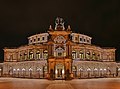
While the beginning of Neo-Renaissance period can be defined by its simplicity and severity, what came later was far more ornate in its design. This period can be defined by some of the great opera houses of Europe, such as Gottfried Semper's Burgtheater in Vienna, and his Opera house in Dresden. This ornate form of the Neo-Renaissance, originating from France,[2]: 311  is sometimes known as the "Second Empire" style, by now it also incorporated some Baroque elements. By 1875 it had become the accepted style in Europe for all public and bureaucratic buildings.[2]: p. 311, caption 938  In England, where Sir George Gilbert Scott designed the London Foreign Office in this style between 1860 and 1875, it also incorporated certain Palladian features.

Starting with the orangery of Sanssouci (1851), "the Neo-Renaissance became the obligatory style for university and public buildings, for banks and financial institutions, and for the urban villas" in Germany.[4] Among the most accomplished examples of the style were Villa Meyer in Dresden, Villa Haas in Hesse, Palais Borsig in Berlin, Villa Meissner in Leipzig; the German version of Neo-Renaissance culminated in such projects as the Town Hall in Hamburg (1886–1897) and the Reichstag in Berlin (completed in 1894).

In Austria, it was pioneered by such illustrious names as Rudolf Eitelberger, the founder of the Viennese College of Arts and Crafts (today the University of Applied Arts Vienna). The style found particular favour in Vienna, where whole streets and blocks were built in the so-called Neo-Renaissance style, in reality, a classicizing conglomeration of elements liberally borrowed from different historical periods.

Paris' Hôtel de Ville, completed c. 1880 in an unequivocal French Neo-Renaissance style
Peace Palace in The Hague, Netherlands, 1913. One of the last notable buildings in this style.

Neo-Renaissance was also the favourite style in Kingdom of Hungary in the 1870s and 1880s. In the fast-growing capital, Budapest many monumental public buildings were built in Neo-Renaissance style like Saint Stephen's Basilica and the Hungarian State Opera House. Andrássy Avenue is an outstanding ensemble of Neo-Renaissance townhouses from the last decades of the 19th century. The most famous Hungarian architect of the age, Miklós Ybl preferred Neo-Renaissance in his works.

In Russia, the style was pioneered by Auguste de Montferrand in the Demidov House (1835), the first in Saint Petersburg to take "a story-by-story approach to façade ornamentation, in contrast to the classical method, where the façade was conceived as a unit."[5]: 44  Konstantin Thon, the most popular Russian architect of the time, used Italianate elements profusely for decorating some interiors of the Grand Kremlin Palace (1837–1851). Another fashionable architect, Andrei Stackenschneider, was responsible for Mariinsky Palace (1839–1844), with "the faceted rough-hewn stone of the first floor" reminiscent of 16th-century Italian palazzi.[5]: 45 

The style was further elaborated by architects of the Vladimir Palace (1867–1872) and culminated in the Stieglitz Museum (1885–1896). In Moscow, the Neo-Renaissance was less prevalent than in the Northern capital, although interiors of the neo-Muscovite City Duma (1890–1892) were executed with emphasis on Florentine and Venetian décor. While the Neo-Renaissance is associated primarily with secular buildings, Princes Yusupov commissioned the interior of their palace church (1909–1916) near Moscow to be decorated in strict imitation of the 16th-century Venetian churches.

North America

[edit]
Biltmore House in Asheville, North Carolina (United States), owned by the Vanderbilt family, 1888–1895

The style spread to North America, where it became a favourite domestic architectural style of the wealthiest Americans. The Breakers in Newport, Rhode Island, was a residence of the Vanderbilt family designed by Richard Morris Hunt in 1892; it and contemporaneous Gilded Age mansions exemplify the ambitions of wealthy Americans in equaling and surpassing the ostentatious lifestyles of European aristocrats. During the latter half of the 19th century 5th Avenue in New York City was lined with "Renaissance" French chateaux and Italian palazzi, all designed in Neo-Renaissance styles. Most of these have since been demolished.

Features

[edit]
Staircase at the Château de Chambord completed in 1547. Variations of this design became a popular feature of the Neo-Renaissance.

One of the most widely copied features of Renaissance architecture were the great staircases from the chateaux of Blois and Chambord.[6] Blois had been the favourite residence of the French kings throughout the renaissance. The Francis I wing, completed in 1524, of which the staircase is an integral part was one of the earliest examples of French Renaissance.[7] French renaissance architecture was a combination of the earlier Gothic style coupled with a strong Italian influence represented by arches, arcades, balustrading and, in general, a more flowing line of design than had been apparent in the earlier Gothic. The Chateau de Blois's triumphal staircase was imitated almost from the moment of its completion, and was certainly the predecessor of the "double staircase" (sometimes attributed to Leonardo da Vinci) at the Château de Chambord just a few years later.

A Grand Staircase whether based on that of Blois, or the Villa Farnese was to become one of the features of Neo-Renaissance design. It became a common feature for the staircase to be not just a feature of the internal architecture but also the external. But whereas at Blois the stairs had been open to the elements in the 19th century new and innovative use of glass was able to give protection from the weather, giving the staircase the appearance of being in the true renaissance open style, when it was in fact a truly internal feature. Further and more adventurous use of glass also enabled the open and arcaded Renaissance courtyards to be reproduced as lofty halls with glazed roofs. This was a feature at Mentmore Towers and on a far larger scale at the Warsaw University of Technology, where the large glazed court contained a monumental staircase. The "Warsaw University of Technology staircase", though if Renaissance in spirit at all, is more in the lighter, more columned style of Ottaviano Nonni's (named il Mascherino) staircase designed for Pope Gregory XIII at Rome's Palazzo Quirinale in 1584, thus demonstrating that architects wherever their location were selecting their Neo-Renaissance styles regardless of geography

Combined historicism

[edit]

Gothic influences on the Renaissance Revival

[edit]
This Renaissance Revival doorway illustrates a Gothic influence on French Renaissance design. A basket-handle portal is surmounted by a floral ogee hood moulding.

Gothic influences on both period and revived Renaissance architecture are readily apparent, first as much building occurred during the period of transition from the Gothic to the Renaissance style; and also as Renaissance−era design took the form of the addition of Renaissance ornamentation to Gothic−era buildings thus creating an accretion of details from disparate sources. Architects who designed in the Renaissance Revival style usually avoided any references to Gothic Revival architecture, drawing instead on a variety of other classically based styles. [citation needed] However, there are exceptions and occasionally the two distinct styles are mixed. The sub-variety of Gothic design most frequently employed is floral Venetian Gothic[citation needed], as seen in the Doge's Palace courtyard, built in the 1480s.

Baroque influences on the Renaissance Revival

[edit]
The staircase at the Warsaw University of Technology, with strong Baroque Revival influences.

A common Baroque feature introduced into the Renaissance Revival styles was the "imperial staircase" (a single straight flight dividing into two separate flights).

The staircase at Mentmore Towers designed by Joseph Paxton, and the one at the Warsaw University of Technology designed by Bronisław Rogóyski and Stefan Szyller (late 19th century), both rise from pastiches of true Renaissance courtyards. Both staircases seem more akin to Balthasar Neumann's great Baroque staircase at the Würzburg Residenz than anything found in a true Renaissance Palazzo. The apparent Baroque style staircase at Mentmore is not without a Renaissance influence, its first flight is similar to "The staircase of the Giants" rises from the Doge's Palace Courtyard, designed when the Venetian Gothic was being uncomfortably merged with Renaissance style. Similarly to that at Mentmore, the Staircase of the Giant's terminates on to an arcaded loggia. Perhaps not ironically the Hall and Staircase at Mentmore were designed by Paxton to display furniture formerly housed in the Doge's Palace.

Paris is home to many historicist buildings that partake equally from Renaissance and Baroque source material, such as the Opera Garnier. However, the Parisian Hôtel de Ville faithfully replicates the true French Renaissance style, complete with the steeply pitched roofs and towers, as it was a reconstruction, completed c. 1880, of the previous Hôtel de Ville.[8]

In the British Raj in 1880, the façades of the 1777 Writers' building in Kolkata were redesigned in the Renaissance Revival style then popular in colonial India, though this version was remarkable in its unique design. Loggias of Serlian arches deceptively form an almost Indian appearance, yet they sit beneath a mansard roof. In what at first glance appears to be an Indian building, on closer examination shows a Historicist example of Classical Palladianism combined with the French Renaissance, a uniquely distinctive interpretation of the Renaissance Revival style.

Renaissance Revival interiors

[edit]
True Renaissance: The Villa Farnese: the curved staircase, tall segmented windows, and marble balustrading were all features frequently reproduced in the 19th century revival.

As mentioned above, the Neo-Renaissance style was in reality an eclectic blending of past styles, which the architect selected on the whims of his patrons. In the true Renaissance era there was a division of labour between the architect, who designed the exterior highly visible shell, and others—the artisans—who decorated and arranged the interior.[9] The original Italian mannerist house was a place for relaxation and entertaining, convenience and comfort of the interior being a priority; in the later Baroque designs, comfort and interior design were secondary to outward appearance. This was followed by the Neoclassical period, which gave importance to the proportions and dignity of interiors, but still lost the comfort and internal convenience of the mannerist period. It was during the Neo-Renaissance period of the 19th century that the mannerist comforts were re-discovered and taken a step further. Not only did the improved building techniques of the 1850s allow the glazing of formerly open loggias and arches with the newly invented sheets of plate glass, providing the first "picture windows", but also the blending of architectural styles allowed interiors and exteriors to be treated differently. It was at this time that the concept of "furnishing styles" manifested itself, allowing distinctions to be made between interior rooms and external appearances, and indeed between the various rooms themselves.[9] Thus the modern concept of treating a room individually, and differently from its setting and neighbours, came into its infancy. Classic examples of this are the great Rothschild house in Buckinghamshire, hybrids of various Renaissance chateaux, and 16th century English country houses, all with interiors ranging from "Versailles" to "Medici", and in the case of Mentmore Towers a huge central hall, resembling the arcaded courtyard of a Renaissance villa, conveniently glazed over, furnished in Venetian style and heated by a fireplace designed by Rubens for his house in Antwerp[10]

Legacy

[edit]

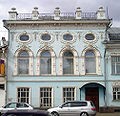
By the beginning of the 20th century, Neo-Renaissance was a commonplace sight on the main streets of thousands of towns, large and small, around the world. In southern Europe the Neo-Renaissance style began to fall from favour c. 1900. However, it was still extensively practiced in the 1910s in Saint Petersburg and Buenos Aires by such architects as Leon Benois, Marian Peretyatkovich, or Francisco Tamburini (picture).

In England it was so common that today one finds "Renaissance Italian Palazzi" serving as banks or municipal buildings in the centres of even the smallest towns. It has been said "It is a well-known fact that the nineteenth century had no art style of its own."[11] While to an extent this may be true, the same could be said of most eras until the early 20th century, the Neo-Renaissance in the hands of provincial architects did develop into a style not always instantly recognisable as a derivative of the Renaissance. In this less obvious guise the Neo-Renaissance was to provide an important undercurrent in totalitarian architecture of various countries, notably in Stalinist architecture of the Soviet Union, as seen in some pavilions of the All-Soviet Exhibition Centre.

Neo-Renaissance architecture, because of its diversity, is perhaps the only style of architecture to have existed in so many forms, yet still common to so many countries.

References

[edit]
[edit]
Revisions and contributorsEdit on WikipediaRead on Wikipedia
from Grokipedia
Renaissance Revival architecture is a historicist style that emerged in the mid-19th century across and , drawing inspiration from the classical forms, , and proportions of 15th- and 16th-century buildings while incorporating elements from French and other regional variants of the original period. This revival movement, popular in two main phases from approximately 1840 to 1885 and again from 1890 to 1915, reflected a broader 19th-century fascination with antiquity and historical , often employed in grand public buildings, commercial structures, and upscale residences to convey wealth, stability, and cultural sophistication. Key characteristics of Renaissance Revival architecture include symmetrical facades with balanced proportions, smooth stone walls, low-pitched hipped roofs often concealed by balustrades or deep cornices, and the prominent use of classical orders such as pilasters, columns, and entablatures. Rustication on the ground level, horizontal string courses dividing stories, round-arched or segmental windows framed by ornate stone trim, and at corners further define the style, with variations like the Italianate emphasis on Mediterranean details such as clay tile roofs and bracketed . In and furnishings, the style featured rich materials like and gilt-bronze, combined with motifs such as scrolling foliage, medallions, and tufted , blending Renaissance ornamentation with neoclassical restraint. The style's development was influenced by advancements in photography and travel, which allowed architects greater access to original Renaissance prototypes, leading to more accurate revivals compared to earlier 19th-century interpretations like Italianate. Prominent firms such as in the United States popularized Revival variants in the , applying them to institutional and governmental projects that emphasized monumental scale and formal classical details like columns, round arches, and balustrades. Notable examples include the Davenport Hotel in Spokane, Washington (1914, blending Revival with other elements), and the Capitol Theater in (1920). The Wilcox mansion in (1868–1870), whose interiors exemplify the ornate subtype with Corinthian columns and marble mantels. By the early 20th century, the style waned with the rise of but left a lasting legacy in urban landscapes, particularly in civic architecture that prioritized harmony and historical allusion.

Historical Background

Origins of Renaissance Architecture

Renaissance architecture originated in early 15th-century Italy, particularly in Florence, as a deliberate revival of classical Greek and Roman principles amid the broader cultural rebirth known as the Renaissance. This movement marked a departure from the verticality and irregularity of Gothic architecture, favoring instead symmetry, proportion, and geometric clarity inspired by ancient ruins such as the Pantheon and Colosseum in Rome. Architects sought to emulate the durability and elegance of antiquity, drawing on rediscovered texts like Vitruvius' De architectura, which emphasized beauty through harmony and human scale. Filippo Brunelleschi (1377–1446) is widely regarded as the founder of , initiating its development through innovative engineering and classical motifs in . His most iconic contribution was the dome of the Cathedral of Santa Maria del Fiore (), constructed between 1418 and 1436, which employed herringbone brickwork and tension rings to span the vast interior without scaffolding—a feat unmatched since antiquity. Brunelleschi's earlier works, such as the (1419), introduced modular designs based on cubic units and the use of Corinthian columns, establishing a new emphasis on rational planning and perspective in . These projects elevated the architect's role from medieval craftsman to intellectual artist, separating design from execution. Building on Brunelleschi's foundations, (1404–1472) formalized Renaissance principles through theoretical writings and practical designs, further solidifying the style's origins in humanist ideals. In his treatise (completed 1452, published 1485), Alberti adapted ' ideas to advocate for buildings that reflected divine and human proportions, influencing generations across Europe. Early examples include the facade of (c. 1446–1451) in , which layered Tuscan, Ionic, and Corinthian orders in pilasters and entablatures to create a harmonious urban palace, and the in (begun 1450), blending classical temple forms with Christian elements. Alberti's work extended the Florentine innovations to other Tuscan and northern Italian centers, promoting the integration of architecture with and for a unified aesthetic. This Florentine genesis, fueled by prosperous patronage from families like the Medici, quickly disseminated classical orders—Doric, Ionic, Corinthian, and Tuscan—along with arches, vaults, and domes, laying the groundwork for Renaissance architecture's expansion beyond . By the mid-15th century, these origins had transformed building practices, prioritizing mathematical precision and antique revival over medieval symbolism.

Birth of the Neo-Renaissance

The Neo-Renaissance style, also known as , originated in during the (1830–1848), emerging as a response to the neoclassical dominance and a burgeoning in historical revivalism amid rapid industrialization and the rise of the bourgeois class. This movement sought to recapture the grandeur of the original , particularly the era of King Francis I (r. 1515–1547), by incorporating elements such as symmetrical facades, classical orders, and ornate detailing into contemporary designs. It first manifested prominently in Parisian domestic architecture and interior decoration around 1835–1840, where architects and designers drew inspiration from 16th-century châteaux and palaces to create luxurious urban residences that symbolized wealth and cultural sophistication. Key to this early development was the shift toward eclectic historicism, influenced by archaeological rediscoveries and publications on prototypes, which allowed for a more interpretive approach than strict . Designers like those associated with the École des Beaux-Arts began experimenting with motifs such as pilasters, pediments, and rusticated bases in hôtels particuliers (private townhouses) along Paris's expanding boulevards, blending functionality with opulent ornamentation to appeal to the new elite. While no single building marks the absolute inception, examples from the 1840s, such as refined residential commissions in district and emerging suburban villas, exemplified this nascent style's focus on harmony and proportion derived from Italian and sources. The movement's birth was thus tied to France's cultural renaissance narrative, positioning the style as a bridge between past monarchic splendor and modern democratic aspirations. By the mid-1850s, under Napoleon III's Second Empire (1852–1870), the style gained monumental scale, transitioning from domestic to public and palatial structures that accelerated its establishment as a pan-European phenomenon. A seminal early grand example is the (1855–1859) in , commissioned by Baron James de Rothschild and designed by British engineer in collaboration with French architect Jules de Dietz, featuring a vast quadrilateral plan with Neo-Renaissance facades inspired by Italian palazzi and châteaux. This project, with its emphasis on iron-frame construction hidden behind classical exteriors, highlighted the style's adaptability to 19th-century engineering while evoking symmetry and grandeur. From , the aesthetic spread rapidly through architectural treatises and international expositions, influencing figures like in , who adapted it for German contexts in the 1840s–1850s, marking the style's transition from French innovation to broader revival.

Geographical Development

In Europe

Renaissance Revival architecture, also known as Neo-Renaissance, emerged across in the mid-19th century as part of a broader historicist movement that sought to revive classical forms from the original period of the 15th and 16th centuries. This style emphasized symmetry, proportion, and classical elements such as columns, pediments, and arches, often adapted to grand public buildings, opera houses, and civic structures during an era of rapid and national pride. In , it flourished particularly in Central and Western countries, where architects drew inspiration from Italian palazzos, French châteaus, and German town halls, blending these with local traditions to create monumental expressions of . The style peaked between the 1870s and 1890s before giving way to and around the turn of the . In , the style appeared in civic buildings like the Ayuntamiento de Sevilla (late 19th century). In , examples include the in St. Petersburg (1860, neo-Renaissance with Italian influences). In , Renaissance Revival manifested in opulent civic architecture that echoed the grandeur of châteaus while incorporating Second Empire embellishments. A prime example is the Hôtel de Ville in , reconstructed from 1873 to 1892 by architects Théodore Ballu and Édouard Deperthes after the original was destroyed in the ; its facade features round arches, Corinthian columns, and statues of notable Parisians, symbolizing republican ideals. French architects like Ballu adapted the style for projects, emphasizing rhythmic facades and sculptural detail to convey state authority. Germany saw Renaissance Revival as a symbol of unification and imperial ambition, with architects favoring robust, symmetrical designs inspired by historic buildings like those in . The Rathaus (City Hall), constructed from 1886 to 1897 under Martin Haller, stands as a towering example at 112 meters high, featuring a richly decorated facade with 647 rooms, gables, and a carillon tower that blends Flemish and Italian influences. In , the castle was renovated starting in 1857 by Georg Adolph Demmler and later Friedrich August Stüler, transforming a medieval fortress into a Neo-Renaissance with mansard roofs, dormers, and ornate interiors to serve as the ducal residence. This style proliferated in villas and public buildings across and , promoting a sense of continuity with the Holy Roman Empire's legacy. Italy, as the birthplace of the original , approached the revival with direct references to prototypes, often in commercial and cultural venues. The Galleria Vittorio Emanuele II in , completed in 1877 by Giuseppe Mengoni, exemplifies this with its cruciform plan, vaulted arcades, and octagonal glass dome adorned with mosaics, functioning as a covered shopping arcade that celebrated Italian unification. In , architects used the style to bridge historicism and modernity, emphasizing rustication and sculptural reliefs in urban infill projects. The Palazzo di Giustizia (Palace of Justice), built from 1888 to 1910 by Guglielmo Calderini, is an eclectic neo-baroque structure with Renaissance influences, including massive scale, facade, and classical orders, to house the . Across , the style adorned cultural institutions in the . In , the Staatsoper (State Opera), designed by August Sicard von Sicardsburg and Eduard van der Nüll and opened in 1869, showcases symmetrical facades, Corinthian pilasters, and a pedimented entrance along the Ringstrasse, embodying the empire's artistic . The Justizpalast (Palace of Justice) nearby, completed in 1881 by Wielemans von Monteforte, features similar classical elements including statues and arched loggias. In , Miklós Ybl's in (1884) rivals Vienna's with its marble-clad exterior, frescoed interiors, and chandelier-lit auditorium, highlighting Renaissance proportions in a nationalist context. In the and , Renaissance Revival suited museum and theater designs with a focus on functionality and ornament. The in , built from 1907 to 1913 by Louis Cordonnier with Dutch contributions, combines Renaissance arcades and towers in a stone facade to host the . Denmark's in , by Vilhelm Dahlerup and G.E.W. Møller (1896), draws from Italian palazzos with its arched windows and rhythmic colonnades, housing Nordic art collections. In the , Josef Schulz's in (1885) and Museum of Decorative Arts (1899) exemplify the style's spread under Habsburg rule, with symmetrical compositions and sculptural pediments promoting Bohemian cultural identity. In Britain, the style appeared more selectively, often blended with Tudor or Jacobean elements in what is termed Revival, reflecting a preference for native over continental forms. in underwent a mid-19th-century by Thomas Hopper and , incorporating Renaissance-inspired towers, loggias, and symmetrical wings to update the Elizabethan house into a Victorian estate symbolizing aristocratic continuity. , known for Gothic works, applied classical orders and rusticated bases here, influencing country house architecture. While less dominant than Gothic Revival, this adaptation appeared in urban clubs and libraries, such as aspects of the in (1837-1841) by , which evoked palazzos.

In North America

Renaissance Revival architecture arrived in during the mid-19th century, drawing inspiration from 15th- and 16th-century Italian palazzos and adapting classical elements to reflect the era's industrial prosperity and cultural aspirations. , the style gained traction in the as part of broader Beaux-Arts influences, emphasizing , grandeur, and ornate detailing for and institutional buildings. It surged in popularity following the 1893 in , which showcased neoclassical and Renaissance-inspired designs, and persisted until the 1930s, often manifesting as Italian Renaissance Revival with features like low-pitched roofs concealed by balustrades, rusticated stone bases, arched windows, and elaborate cornices. Key examples in the U.S. illustrate the style's evolution from restrained civic structures to opulent commercial landmarks. Mechanics Hall in , constructed in 1857 and designed by Elbridge Boyden, exemplifies the North Italian Renaissance mode with its symmetrical facade, rusticated lower levels, and layered brick-and-sandstone construction, symbolizing post-industrial optimism and educational ideals. In the early , the style adapted to urban growth, as seen in the Hotel (later Tutwiler Hotel) in , completed in 1929 under architect David O. Whilldin; this 19-story tower featured terracotta cladding, string courses, and arched fenestration in a Northern Italian variant, underscoring the region's economic boom. Federal buildings, such as the U.S. Courthouse in (built circa 1900s), incorporated Renaissance Revival elements like pilasters and pediments to convey governmental authority. In , Renaissance Revival manifested primarily through Italianate and Second Empire variants from the onward, blending British imperial influences with American eclecticism amid Confederation-era expansion. The style suited commercial and public edifices, prioritizing formal and durability over ecclesiastical forms. Notable instances include the Canada Life Building in (completed 1895), a steel-framed palazzo with terra-cotta ornamentation evoking reliability. The Château style, a French-inflected Renaissance Revival, emerged in railway hotels like the Château Frontenac in (begun 1892 by ), featuring steep roofs, turrets, and ornate detailing to promote national tourism and identity. These North American adaptations prioritized monumental scale and classical restraint, influencing urban skylines while adapting to local materials and climates.

In Other Regions

Renaissance Revival architecture manifested in Asia primarily through hybrid styles that adapted European neo-Renaissance forms to local cultural contexts, particularly in regions influenced by colonial trade and migration. In early 20th-century and its communities, "Chinese Renaissance" emerged as a distinctive variant, created by American-trained Chinese architects who fused symmetrical façades, classical pediments, and ornate detailing from Western Renaissance Revival with traditional Chinese elements like upturned eaves and . This style symbolized modernization and national identity during a period of rapid , lasting roughly from the 1910s to the 1950s. In , examples include the original buildings of the Chinese High School (established 1919), which featured balanced layouts and decorative motifs reflecting community prosperity under British colonial rule. Similarly, early structures at in the 1950s incorporated these hybrid features to evoke cultural heritage amid post-war development. In , particularly , Renaissance Revival appeared in urban civic and commercial buildings during the late 19th and early 20th centuries, often as part of a broader eclectic response to British imperial influences. Brisbane's Queen Street saw several neo-Renaissance structures erected between 1901 and 1941, including insurance offices and banks with classical columns, balustrades, and hipped roofs, designed to project stability and grandeur in the growing federation era. These buildings, constructed by local architects adapting imported styles, contributed to the city's commercial thoroughfare by emphasizing proportion and over ornate excess. In , interwar structures like the 1930s extensions blended Renaissance Revival with , using pilasters and arched windows to harmonize with the colonial landscape. Latin American adoption of Renaissance Revival was closely tied to neocolonial movements in the early , reviving Iberian classical forms to assert national identity post-independence. In , witnessed a surge in neocolonial architecture from the onward, incorporating neo-Renaissance elements such as rusticated bases, entablatures, and sculptural ornamentation in residences and public buildings as a reaction to the 1910 Centennial Exposition's eclectic pavilions. Prominent examples include the former home of artist Enrique Larreta, remodeled in 1926 with symmetrical façades and tiled roofs evoking palaces, designed to celebrate criollo heritage. In , while 16th-century colonial buildings like the Casa del Deán in (c. 1580) laid foundational Renaissance influences with Doric orders and proportional facades inspired by Sebastiano Serlio's treatises, 20th-century revivals extended these through Spanish Colonial Revival projects that reinterpreted neo-Renaissance in civic structures. In Africa, Renaissance Revival primarily arrived via European colonialism, notably in Italian East Africa during the 1920s–1930s, where classical elements were sometimes incorporated into administrative buildings to evoke imperial legacy. Asmara in Eritrea features early 20th-century colonial architecture with some arched loggias and stucco facades influenced by Italian metropolitan designs, though the city is predominantly known for its modernist buildings from the 1930s. These interventions, peaking under the Italian East Africa administration (1936–1941), often adapted existing structures to align with colonial visions.

Architectural Features

Exterior Elements

Renaissance Revival architecture emphasizes and classical proportions in its exterior design, drawing inspiration from 16th-century Italian palazzzi and villas to create a sense of grandeur and order. Facades are typically rectangular and balanced, featuring smooth or stone walls constructed from finely cut blocks, often with horizontal banding to delineate floor levels. Rustication is common at the ground level, where stones are roughly textured to provide a robust base, while upper stories employ smoother finishes accented by at the corners for structural emphasis and decoration. Roofs in Renaissance Revival buildings are low-pitched hipped forms or flat, often concealed behind prominent , balustrades, or short walls to evoke the monumental scale of classical structures. In smaller-scale examples, such as residences, hip roofs may extend with wide overhanging supported by carved brackets and covered in red clay tiles, enhancing the Italianate influence. The cornice line is a defining feature, articulated with elaborate moldings and entablatures that project outward, topped by balustrades in many designs to frame the skyline harmoniously. Windows are arranged in regular rows, varying in size and treatment by floor to guide the eye upward, with round-arched openings predominant in the Second Renaissance Revival phase (circa 1890–1915). These often consist of paired lights under a single arch separated by a slender colonette, framed by voussoirs, pilasters, or pediments for added classical detail; upper-floor windows may be smaller and square-headed with segmental arches. Multi-paned wood sashes or casements are typical, sometimes grouped in threes or set within one-story bay projections, contributing to the rhythmic facade composition. Entrances are centrally placed for , frequently recessed within arched doorways flanked by free-standing columns or pilasters in the Doric, Ionic, or Corinthian orders. Ornamentation includes wrought-iron balconies with classical motifs, such as urns or wreaths, and string courses that divide the facade horizontally, reinforcing the hierarchical organization of . Terra cotta or detailing, including friezes and panels, adds richness without overwhelming the overall restraint, as seen in examples like the Henry McCleary House in (1923), where and bracketed eaves highlight the style's blend of solidity and elegance.

Interior Design

Renaissance Revival interiors of the emulated the opulence of original palaces while incorporating eclectic elements from , resulting in spaces characterized by symmetry, proportion, and lavish ornamentation. These designs often blended architectural features like columns, pediments, and caryatids with motifs such as acanthus leaves, scrolls, and masks to create a sense of grandeur suitable for the era's affluent patrons. In , particularly during France's Second under , interiors emphasized historical revival through structured layouts and decorative schemes that evoked Italian palazzos and French châteaux. Key interior elements included paneled walls in dark woods like walnut or oak, often painted or gilded to mimic marble or stone, paired with coffered ceilings featuring molded medallions, trompe l'oeil paintings, and interlaced geometric patterns. Floors were typically covered in wall-to-wall carpets with intricate borders, while fireplaces boasted white Italian marble surrounds adorned with classical carvings. In European examples from the 1880s to 1900s, wood paneling was arranged vertically or horizontally, complemented by richly decorated staircases incorporating groin vaults, round arches, and patterned glass in doors and windows. Decorative accents such as overmantel mirrors, window cornices with sculpted heads, and silver-plated tableware further enhanced the formal atmosphere. Furniture in Renaissance Revival interiors was robust and intricately carved, favoring heavy oak or pieces with motifs drawn from 16th-century European designs, including bulbous legs, strapwork, and inlaid of flowers, tools, or mythological scenes. Upholstered items like sofas and armchairs were covered in rich fabrics such as scarlet satin or , often with gilded incising and mother-of-pearl inlays for added luxury. Prominent examples include the parlor suite by John Jelliff and Sons in the 1860s Wilcox House in , featuring classical anthemion pendants and floral bosses, which exemplified American adaptations of the style. In , firms like Maison Fourdinois produced bedside cabinets and consoles with Renaissance-inspired detailing for imperial residences, such as those at in 1860. These furnishings, combined with and enameled vases, underscored the style's role in displaying wealth during the and Second Empire periods.

Stylistic Influences and Variations

Gothic Integrations

While Renaissance Revival architecture primarily emphasized classical symmetry, proportion, and humanist scale inspired by 15th- and 16th-century Italian and French models, architects in the late 19th and early 20th centuries often integrated Gothic elements to introduce verticality, intricate ornamentation, and a sense of historical . This was particularly evident in institutional and public buildings, where the ordered planning and monumental forms of the Beaux-Arts variant of Renaissance Revival—itself a refined expression of principles—provided a structural framework for Gothic detailing such as pointed arches, , and pinnacles. Such integrations reflected the era's revivalist fervor, allowing designers to evoke medieval grandeur within modern, functionally rational layouts. A notable instance of this synthesis occurs in the reconstruction of Canada's Parliament Buildings in after the 1916 fire. Architects John A. Pearson and Jean Omer Marchand retained the original Gothic Revival silhouette with its pointed gables, turrets, and ornamental stonework, but reorganized the composition around Beaux-Arts axes of symmetry and hierarchical spatial progression, creating a balanced facade that harmonized Gothic expressiveness with Renaissance-derived monumentality. Similarly, Hart House at the , completed between 1911 and 1919 by the firm Sproatt and Rolph, combines Tudor Gothic motifs—including oriel windows and crenellated parapets—with a Renaissance-inspired quadrangle plan that emphasizes enclosed courtyards and symmetrical elevations, adapting medieval collegiate forms to contemporary academic needs. In the United States, the Lawyers Club at the exemplifies this blend through its incorporation of English in tall, narrow windows alongside Renaissance Revival features like sculptured gables, bundled chimney stacks, and broken pediments drawn from Elizabethan and Jacobean precedents. The building's entrance, featuring Tuscan columns and a Doric , underscores Beaux-Arts influences from the architects York and Sawyer's heritage, while the dining hall's hammer-beam ceiling nods to late Gothic monastic refectories, achieving a unified eclectic aesthetic. This approach extended to the broader style, where Gothic ornamental vocabulary adorned Renaissance Revival plans to symbolize intellectual continuity with European university traditions, as seen in structures like Yale's Sterling Memorial Library, which pairs Gothic detailing with symmetrical massing for dramatic yet orderly compositions. These Gothic integrations enriched Renaissance Revival architecture by countering its inherent horizontality with Gothic vertical thrust and decorative complexity, fostering a quality suited to cultural institutions. Influenced by architects like and firms trained at the École des Beaux-Arts, such hybrids declined with the rise of but left a lasting impact on educational and governmental designs.

Baroque Integrations

In the late 19th and early 20th centuries, Revival architecture frequently integrated elements to introduce greater dynamism and ornamentation, evolving beyond the style's initial emphasis on symmetrical, classical proportions inspired by 16th-century Italian palazzos. This fusion was particularly evident in the Beaux-Arts style, which combined Revival's structured facades and rusticated bases with 's dramatic flourishes, such as curved pediments, elaborate cartouches, and profuse sculptural decoration, to create imposing public edifices that conveyed imperial grandeur. The integration reflected the École des Beaux-Arts curriculum in , where architects trained to synthesize historical styles, adapting 's theatricality to modern urban contexts like expositions and civic buildings. In the United States, this stylistic blending manifested in eclectic designs for theaters, churches, and residences, where Baroque motifs enhanced the Revival's geometric rigor with organic, flowing details. For example, the Village Theatre in (1915–1916), designed by Adolph Woerner, primarily employs Classical and Revival forms but incorporates elements like expressive figurative ornamentation and polychrome terra cotta details. Similarly, the Church of the Incarnation in (1909–1910), by Emmanuel Louis Masqueray, mixes Revival symmetry—such as arched windows and a low-pitched roof—with Beaux-Arts features including broken pediments and volutes, creating a harmonious yet expressive ecclesiastical facade. These integrations often served functional purposes, with embellishments adding visual interest to otherwise planar surfaces while aligning with the era's preference for historicist eclecticism. European examples further illustrate this trend, particularly in regions with strong Baroque legacies, where Neo-Renaissance buildings adopted Baroque details for regional authenticity and lavishness. In Germany-influenced American immigrant architecture, such as Milwaukee's Brewery Hill neighborhood, architect Eugene Liebert blended German Renaissance Revival massing with scrolls and finials in homes like the Henry Harnischfeger House (1905), resulting in robust, decorative structures that celebrated ethnic heritage. In , early 20th-century works like the Library's McKim Building (1888–1895) by , though American, drew on Italian precedents to fuse Neo-Renaissance proportions with Baroque-inspired sculptural programs and grand staircases, emphasizing continuity between historical periods. Overall, these Baroque integrations enriched Renaissance Revival's formal vocabulary, bridging restrained with exuberant expression to suit the monumental needs of expanding cities.

Legacy and Impact

Influence on Later Architectural Movements

Renaissance Revival architecture, prominent in the 19th and early 20th centuries, profoundly shaped subsequent styles through its revival of classical symmetry, proportion, and ornamentation derived from precedents. This influence manifested in the Beaux-Arts movement, which adopted and expanded upon Renaissance Revival's tripartite compositional structure—base, shaft, and cornice—while integrating more lavish detailing for monumental public buildings. In the United States, architects trained at the École des Beaux-Arts in blended these elements, as seen in structures like the Jefferson Hotel in (1893–1895), where Renaissance-inspired arcades and cornices informed the opulent, eclectic aesthetic of Beaux-Arts designs. In , particularly Britain, Renaissance Revival served as a to Gothic Revival during the (1860–1914), promoting classical forms in public and commercial architecture and influencing the style around 1900. Architects like Sir Reginald Blomfield and employed palazzo-like facades and balanced proportions, as in the Foreign Office in (completed 1875), which emphasized urban unity and intellectual professionalism over medieval revivalism. This approach extended to Edwardian classicism, evident in buildings like the Institute of Chartered Accountants (1893, ) by John Belcher, where motifs blended with grandeur to foster a "Grand Manner" for civic projects. The style's emphasis on refined classical detailing also bridged to early 20th-century movements, indirectly informing (1930s–1950s) by providing a foundation for simplified, austere interpretations of symmetry amid the rise of . In the U.S., this transition appears in structures like the Virginia Department of Highways Building in Richmond (1939), which retained proportions but stripped ornamentation for a modern, functional aesthetic influenced by both Beaux-Arts eclecticism and emerging geometry. However, Renaissance Revival waned post-Great Depression (after 1929) as prioritized simplicity over , though its legacy persisted in resisting trends and shaping architectural education toward classical principles. In regions like , Renaissance Revival's Italianate features—such as rusticated bases and arched openings—influenced local Beaux-Arts applications in commercial buildings, exemplified by the Biltmore Hotel (1923) and Young's Market Building (1924), before yielding to streamlined in the 1930s. Globally, the style's focus on and proportion contributed to post-World War I revivals, reinforcing classical traditions in public architecture until mid-century shifts toward international .

Preservation and Modern Revivals

Preservation efforts for Renaissance Revival architecture have focused on protecting significant examples through national and local registries, landmark designations, and restoration projects that maintain the style's classical symmetry, ornate detailing, and monumental scale. , over 1,200 buildings classified under or related revival styles are listed on the , reflecting the style's widespread adoption in civic, commercial, and residential structures during the late 19th and early 20th centuries. These listings, managed by the , ensure regulatory protections against demolition or inappropriate alterations, emphasizing the architectural and historical value of features like rusticated stonework, pedimented entrances, and balustraded roofs. A notable example of recent preservation is the 2019 designation of 840 Broadway in as a by the New York City Landmarks Preservation Commission, following advocacy by Village Preservation. Built in 1899–1901 by architect Robert Maynicke, this 12-story steel-frame building exemplifies Renaissance Revival through its terra-cotta ornamentation, including Ionic columns and Acropolis-inspired motifs at the entrance, and serves as a testament to early 20th-century commercial development in Manhattan's garment district. Similarly, the Douglas County Courthouse in , constructed in 1912, is highlighted by local heritage organizations for its Beaux-Arts-infused Renaissance Revival elements, such as grand arches and sculptural details, underscoring ongoing municipal efforts to safeguard public architecture. Restoration projects have played a crucial role in revitalizing deteriorated Revival structures while adapting them for contemporary use. In 2012, the lobby of a 1928 Emery Roth-designed apartment building facing in New York underwent a meticulous restoration, reinstating original marble floors, , and wrought-iron details to preserve the style's opulent interior aesthetic. Internationally, a 2024 renovation of the 19th-century Edifício A'mar in Póvoa de Varzim, , by REM'A Arquitectos preserved core Revival features like facades and vaulted ceilings while introducing modern interventions, demonstrating how the style's formal proportions can integrate with sustainable updates. Organizations such as the Los Angeles Conservancy actively document and advocate for restorations of local examples, including the Clubhouse (1927), where efforts focus on conserving terracotta cladding and classical motifs. Modern revivals of Revival principles have emerged within the broader movement, particularly in public and institutional buildings seeking to evoke historical continuity and grandeur. A 2020 executive order from the (Executive Order 13967) initially mandated classical and -inspired designs as the preferred style for new federal buildings in the United States, though it was revoked in 2021; this policy was revived in 2025 via Executive Order 14344, aiming to connect contemporary structures to democratic traditions through elements like columnar orders and symmetrical facades and influencing projects such as expansions to historic courthouses. In , 21st-century works illustrate the style's adaptability in luxury residential contexts. These revivals prioritize proportion and ornamentation, drawing from seminal theorists like Alberti to counter modernist , though they remain selective rather than widespread.

References

Add your contribution
Related Hubs
User Avatar
No comments yet.