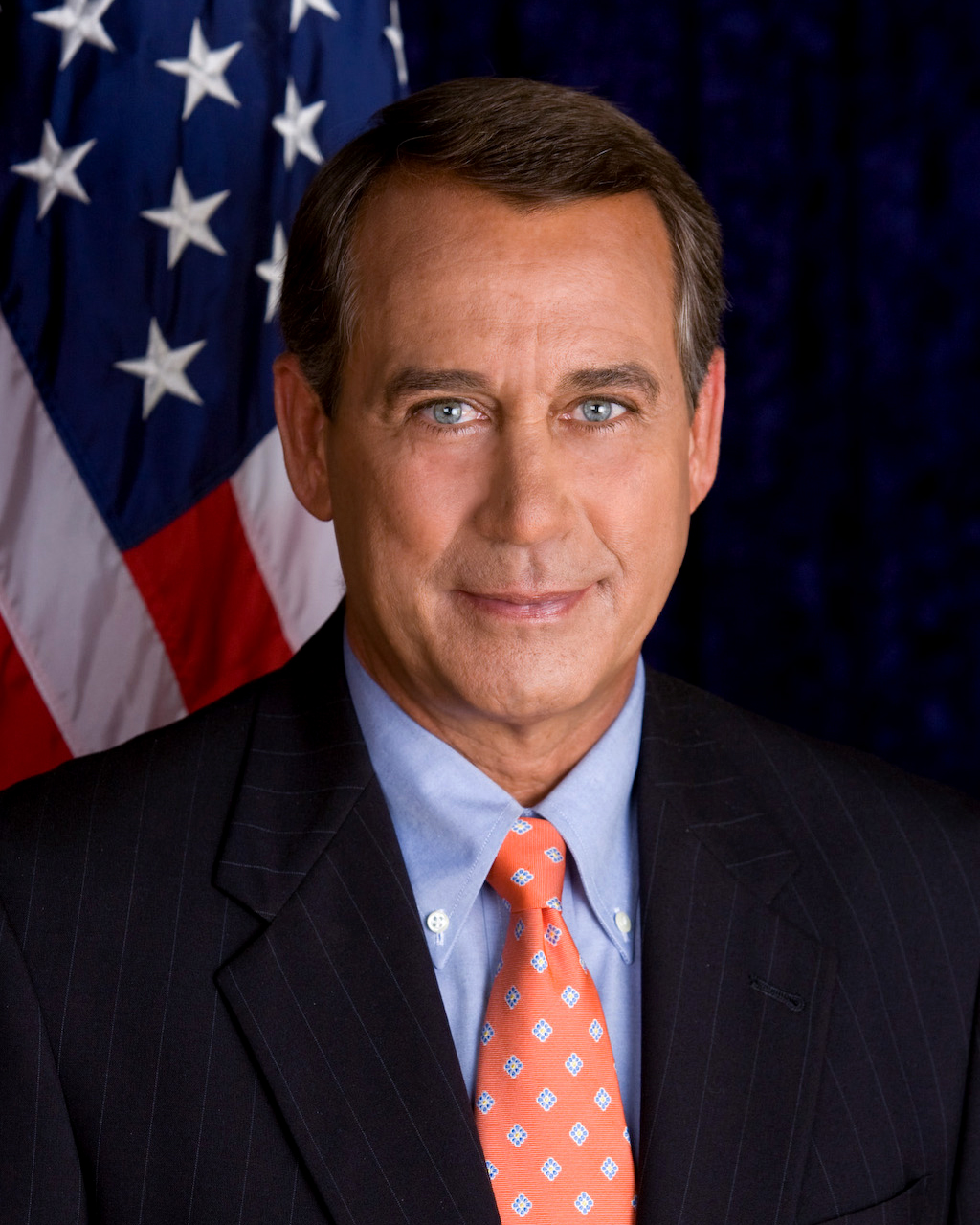

John Boehner
View on Wikipedia
John Andrew Boehner (/ˈbeɪnər/ BAY-nər;[a][3] born November 17, 1949) is an American former politician who served as the 53rd speaker of the United States House of Representatives from 2011 to 2015.[4] A member of the Republican Party, he served 13 terms as the U.S. representative for Ohio's 8th congressional district from 1991 to 2015. The district included several rural and suburban areas near Cincinnati and Dayton.
Key Information


Boehner previously served as the House minority leader from 2007 until 2011, and House majority leader from 2006 until 2007. In January 2011, he was first elected Speaker and then re-elected twice. Boehner resigned from the House of Representatives in October 2015 due to opposition from within the Republican conference.
In September 2016, Squire Patton Boggs, the third-largest lobbying firm in the U.S., announced that Boehner would join their firm. It was also announced that he would become a board member of Reynolds American.[5]
Early life and education
[edit]Boehner was born in Reading, Ohio, the son of Mary Anne (née Hall; 1926–1998) and Earl Henry Boehner (1925–1990), the second of twelve children. His father was of German descent and his mother had German and Irish ancestry.[10] He grew up in modest circumstances, sharing one bathroom with his eleven siblings in a two-bedroom house in Cincinnati.[11] He started working at his family's bar at age 8, a business founded by their grandfather Andy Boehner in 1938.[11] He has lived in Southwest Ohio his entire life.[12][13]
Boehner attended Cincinnati's Moeller High School and was a linebacker on the school's football team, where he was coached by future Notre Dame coach Gerry Faust.[21] Graduating from Moeller in 1968, when United States involvement in the Vietnam War was at its peak, Boehner enlisted in the United States Navy but was honorably discharged after eight weeks because of a bad back.[22] He earned his B.A. in business administration from Xavier University in 1977, becoming the first person in his family to attend college, taking seven years as he held several jobs to pay for his education.[11]
Early career
[edit]Shortly after his graduation in 1977, Boehner accepted a position with Nucite Sales, a small sales business in the plastics industry. He was steadily promoted and eventually became president of the firm, resigning in 1990 when he was elected to Congress.[3]
From 1981 to 1984, Boehner served on the board of trustees of Union Township, Butler County, Ohio. He then served as a member of the Ohio House of Representatives from 1985 to 1990.[23]
U.S. House of Representatives
[edit].jpg)
In 1990, Boehner ran against incumbent congressman Buz Lukens, who was under fire for having a sexual relationship with a minor. He was all but unknown when he entered a Republican primary that included Lukens and former congressman Tom Kindness. Despite being dramatically outspent, Boehner won with 49 percent of the vote.[24] He then handily beat his Democratic opponent, Greg Jolivette, in the November election. He was subsequently re-elected to Congress 12 times, each by a substantial margin.
Boehner's closest races were those in:
- 2006, when he defeated the Democratic Party candidate, U.S. Air Force veteran Mort Meier, 64% to 36%;[25]
- 2008, when he defeated Nicholas Von Stein, 68% to 32%;[26]
- 2010, when he garnered 66% percent of the vote in a four-way race against Democratic nominee Justin Coussoule, Constitution Party nominee Jim Condit, and Libertarian nominee David Harlow.[27]
Gang of Seven and Contract with America
[edit]During his freshman year, Boehner was a member of the Gang of Seven which was involved in bringing media attention to the House banking scandal.[28] The group also investigated the Congressional Post Office, leading to the indictment of Congressman Dan Rostenkowski.[24] Later, he, along with Newt Gingrich and several other Republican lawmakers, was one of the engineers of the Contract with America in 1994 that politically helped Republicans during the 1994 elections during which they won the majority in Congress for the first time in four decades.
Republican leadership
[edit]From 1995 to 1999, Boehner served as House Republican Conference Chairman, making him fourth-ranking House Republican behind Gingrich, Majority Leader Dick Armey and Majority Whip Tom DeLay.[24] During his time as Conference Chairman, Boehner championed the Freedom to Farm Act that, among other provisions, revised and simplified direct payment programs for crops and eliminated milk price supports through direct government purchases.
In the summer of 1997 several House Republicans, who saw Speaker Newt Gingrich's public image as a liability, attempted to replace him as Speaker. The attempted "coup" began July 9 with a meeting between Republican conference chairman Boehner and Republican leadership chairman Bill Paxon of New York. According to their plan, House Majority Leader Dick Armey, House Majority Whip Tom DeLay, Boehner and Paxon were to present Gingrich with an ultimatum: resign, or be voted out. However, Armey balked at the proposal to make Paxon the new Speaker and told his chief of staff to warn Gingrich about the coup.[29]
On July 11, Gingrich met with senior Republican leadership to assess the situation. He explained that under no circumstance would he step down. If he was voted out, there would be a new election for Speaker, which would allow for the possibility that Democrats – along with dissenting Republicans – would vote in Dick Gephardt as Speaker. On July 16, Paxon offered to resign from his post, feeling that he had not handled the situation correctly. Paxon was the only unelected member of the leadership group, having been appointed to his position by Gingrich.[30]
After Republicans lost seats in the 1998 elections, the House Republican leadership underwent a reorganization. Armey and DeLay kept their positions, but Gingrich was replaced by Dennis Hastert, and Boehner lost his position as conference chairman to J.C. Watts.[24]
Chairman of Committee on Education and Labor
[edit]_(4370442351).jpg)
Following the election of President George W. Bush, Boehner was elected as chairman of the House Education and the Workforce Committee, serving from 2001 until 2006. There he authored several reforms including the Pension Protection Act and a successful school choice voucher program for low-income children in Washington, D.C.[31]
Boehner and Senator Ted Kennedy authored the passage of the No Child Left Behind Act of 2001, which was signed by President George W. Bush in 2002.[32] Boehner said that it was his "proudest achievement" in two decades of public service.[33] Boehner was friends with Kennedy, also a Catholic, and every year they chaired fundraisers for cash-strapped Catholic schools.[34]
House Republican Leader
[edit]
After DeLay resigned as majority leader in 2005, Boehner, House majority whip Roy Blunt of Missouri, and Representative John Shadegg of Arizona, all sought to become Majority Leader.[24] Boehner campaigned as a reform candidate who wanted to reform the so-called "earmark" process and rein in government spending. In the second round of voting by the House Republican Conference, Boehner defeated Blunt with 122 to 109 votes. Blunt kept his previous position as majority whip, the no. 3 leadership positions in the House. There was some confusion on the first ballot for majority leader when the first count showed one more vote cast than Republicans present,[35] due to a misunderstanding as to whether the rules allowed Resident Commissioner of Puerto Rico Luis Fortuño to vote.[36]
After the Republicans lost control of the House in the 2006 elections, the House Republican Conference chose Boehner as the minority leader. While as Majority Leader he was second-in-command behind Speaker Dennis Hastert, as minority leader he was the leader of the House Republicans. As such, he was the Republican nominee for Speaker in 2006 and 2008, losing both times to Nancy Pelosi.
According to the 2008 Congress.org Power Ranking, Boehner was the 6th most powerful congressman (preceded by Speaker Pelosi, Majority Leader Hoyer, Ways and Means Committee chairman Sander M. Levin, Dean of the House John Dingell, and Appropriations Committee chairman Dave Obey, all Democrats) and the most powerful Republican.[37] As minority leader, Boehner served as an ex officio member of the Permanent Select Committee on Intelligence.
Speaker of the House (2011–2015)
[edit]
The Republicans won a majority in the House of Representatives during the 2010 midterm elections, with a net gain of 63 seats. During his solemn victory speech, Boehner broke into tears when talking about "economic freedom, individual liberty and personal responsibility...I hold these values dear because I've lived them...I've spent my whole life chasing the American Dream".[34] On November 17, 2010, Boehner was unanimously chosen by the House Republicans as their nominee for Speaker,[38][39] all but assuring his formal election to the post when the new Congress convened with a Republican majority in January 2011. He received the gavel from outgoing speaker Pelosi on Wednesday, January 5, 2011.[40] He was the first Speaker from Ohio since fellow Republicans Nicholas Longworth (1925 to 1931) and J. Warren Keifer (1881 to 1883). He was also the first speaker who has served both as majority and minority floor leader for his party since Texas Democrat Sam Rayburn.[citation needed]

As Speaker, he was still the leader of the House Republicans. However, by tradition, he normally did not take part in debate, although he had the right to do so, and rarely voted from the floor.[41] He was not a member of any House committees during his speakership.
Boehner was narrowly re-elected as Speaker of the House on January 3, 2013, at the beginning of the 113th United States Congress.[42] He received 220 votes, needing 214 to win.[43]
In July 2014, Boehner moved forward on a lawsuit to force the President to impose penalties on companies who failed to provide healthcare coverage for their employees.[44] Boehner had pressed for legislation to delay this mandate the previous year.[45] The third law firm selected finally filed the suit in November 2014, after Boehner criticized Obama's unilateral moves on immigration policy.[46]
Resignation
[edit]
On September 25, 2015, Boehner announced that he would step down as Speaker and resign from Congress at the end of October 2015. Boehner's resignation took place after Pope Francis' address to Congress the day before, an event considered by Boehner personally as the highest point in his legislative career. Sources in his office indicated he was stepping aside in the face of increasing discord while trying to manage the passage of a continuing resolution to fund the government. Conservative opposition to funding Planned Parenthood as part of the resolution, and stronger threats to Boehner's leadership on account of the controversy, prompted the resignation.[47]
Originally, House majority leader Kevin McCarthy of California had intended to run for Speaker and was seen as the prohibitive favorite. On October 8, 2015, McCarthy abruptly rescinded his candidacy, citing that he felt he could not effectively lead a fractured Republican Conference. After McCarthy's announcement, Boehner stayed on as Speaker until a successor was chosen.[48] After initially turning down requests from Republican leaders, Paul Ryan of Wisconsin, the Ways and Means Committee chairman and 2012 Republican vice presidential nominee, ran for Speaker with Boehner's blessing.[49] On October 29, 2015, in his final act as Speaker, Boehner presided over Ryan's election.[50] Boehner's resignation from Congress became official on October 31, 2015, at 11:59 p.m.[51]
Political positions
[edit]
.jpg)
A profile in the Pittsburgh Tribune-Review said, "On both sides of the aisle, Boehner earns praise for candor and an ability to listen."[52] The Plain Dealer says Boehner "has perfected the art of disagreeing without being disagreeable."[53]
Boehner has been classified as a "hard-core conservative" by OnTheIssues.[54] Although Boehner has a conservative voting record when he was running for House leadership, religious conservatives in the GOP expressed that they were not satisfied with his positions. According to The Washington Post: "From illegal immigration to sanctions on China to an overhaul of the pension system, Boehner, as chairman of the House Committee on Education and the Workforce, took ardently pro-business positions that were contrary to those of many in his party. Religious conservatives – examining his voting record – see him as a policymaker driven by small-government economic concerns, not theirs."[55]
Boehner opposes same-sex marriage, as evidenced by his vote for the Federal Marriage Amendment in both 2004 and 2006. In a letter to the Human Rights Campaign, Boehner stated, "I oppose any legislation that would provide special rights for homosexuals... Please be assured that I will continue to work to protect the idea of the traditional family as one of the fundamental tenets of western civilization."[56][57]
On May 25, 2006, Boehner issued a statement defending his agenda and attacking his "Democrat friends" such as Minority Leader Nancy Pelosi. Boehner said regarding national security that voters "have a choice between a Republican Party that understands the stakes and is dedicated to victory and a Democrat Party with a non-existent national security policy that sheepishly dismisses the challenges of a post-9/11 world and is all too willing to concede defeat on the battlefield in Iraq."
Boehner is a signer of Americans for Tax Reform's Taxpayer Protection Pledge.[58]
In June 2013, Boehner labeled former NSA contractor Edward Snowden a traitor after his leaks went public.[59]
"I'm not qualified to debate the science over climate change", Boehner said at a press conference on May 29, 2014, at which he criticized proposed federal regulations on coal-fired power plants.[60][61][62]
In 2011, Boehner opposed the NATO-led military intervention in Libya.[63] In 2015, Boehner supported the Saudi Arabian-led intervention in Yemen, saying: "I applaud the Saudis for taking this action to protect their homeland and to protect their neighborhood."[64]
Financial crisis
[edit]
On September 18, 2008, Congressman Boehner attended a closed meeting with congressional leaders, then-Treasury Secretary Henry Paulson and Federal Reserve Chairman Ben Bernanke, and was urged to craft legislation to help financially troubled banks. That same day (trade effective the next day), Congressman Boehner cashed out of an equity mutual fund.[65]
On October 3, 2008, Boehner voted in favor of the Troubled Asset Relief Program (TARP),[66] believing that the enumerated powers grant Congress the authority to "purchase assets and equity from financial institutions to strengthen its financial sector."
Boehner had been highly critical of several initiatives by the Democratic Congress and President Barack Obama, including the "cap and trade" plan that Boehner said would hurt job growth in his congressional district and elsewhere. He opposed the Patient Protection and Affordable Care Act and said that, if Republicans took control of the House of Representatives in the 2010 elections, they would do whatever it takes to stop the act. One option would be to defund the administrative aspect of the Act, not paying "one dime" of the salaries of the workers who would administer the plan.[67] He also led opposition to the 2009 stimulus and to Obama's first budget proposal, promoting instead an alternative economic recovery plan[68] and a Republican budget (authored by Ranking Rep. Paul Ryan, R-WI).[69] He advocated for an across-the-board spending freeze, including entitlement programs. Boehner favored making changes in Social Security, such as by raising the retirement age to 70 for people who have at least 20 years until retirement, as well as tying cost-of-living increases to the consumer price index rather than wage inflation, and limiting payments to those who need them.[67]
In 2011, Boehner called the No Taxpayer Funding for Abortion Act "one of our highest legislative priorities."[70][71]
In 2013, Boehner led his caucus in a strategy to freeze Defense spending in order to avoid reducing the deficit with revenue increases.[72]
As Republican House Leader, Boehner was a Democratic target for criticism of Republican views and political positions. In July 2010, President Barack Obama began singling out Boehner for criticism during his speeches.[73] In one speech, Obama mentioned Boehner's name nine times,[74] and accused him of believing that police, firefighters, and teachers were jobs "not worth saving".[75]
Later career
[edit]Politics
[edit]Boehner made headlines in April 2016 when he referred to Republican presidential candidate Ted Cruz as "Lucifer in the flesh" in an interview at Stanford University.[76] On May 12, after Donald Trump became the presumptive Republican nominee, Boehner's support for him (while distancing himself from Trump on several policies) became public; he also expressed satisfaction with Cruz not securing the nomination: "Thank God the guy from Texas didn't win."[77] On February 23, 2017, Boehner predicted Republicans would "fix" the Affordable Care Act and give it a different name as opposed to their stated intent to repeal and replace.[78]
On August 17, 2020, a spokesperson for Boehner stated that he would not endorse either President Trump or Joe Biden for the 2020 United States presidential election, saying: "The answer is no. I think he'd rather set himself on fire than get involved in the election. Nothing to see here."[79] Despite his critiques, Boehner confirmed he voted for Trump in the 2020 presidential election. Explaining his vote, he said: "At the end of the day, who gets nominated to the federal courts is the most important thing a President does."[80]
After the January 6 United States Capitol attack, Boehner called on Republicans to "awaken", saying: "The invasion of our Capitol by a mob, incited by lies from some entrusted with power, is a disgrace to all who sacrificed to build our Republic."[81] Boehner later congratulated Biden on his victory after the vote was certified.[81] He has frequently reiterated his feelings, on one account noting how Trump "Incited That Bloody Insurrection",[82] and called Ted Cruz "a reckless asshole who thinks he is smarter than everyone else".[83] Boehner said that Trump should "consider resigning" and that President Trump had "violated his oath of office to protect and defend the Constitution of the United States."[84] Boehner continued to express his disdain for Trump through 2023, where he stated his belief that the GOP needs to "move on" from Trump during a June interview with CBS News.[85]
Boehner's political memoir, titled On the House: A Washington Memoir, was published by St. Martin's Press on April 13, 2021. Excerpts began appearing early in April.[86] In this memoir, he lambasts Cruz, Michele Bachmann, Sean Hannity, Rush Limbaugh, and Trump. It also covers how the Tea Party movement, which forced him into retirement, later morphed into Trumpism.[87] In response to the criticism he received in the book, Cruz threatened to burn Boehner's book if his supporters could fulfil his “72-hour drive to raise $250,000” in campaign funds.[88]
Despite his resignation from politics, during the October 2023 Speaker of the House election following the removal of Kevin McCarthy, Boehner received one vote to reprise his role as Speaker of the United States House of Representatives.[89]
Business
[edit]Boehner joined the board of tobacco company Reynolds American on September 15, 2016.[90] In 2018, Boehner joined the board of Acreage Holdings, a cannabis corporation, to promote the medical use of cannabis and advocate for federal de-scheduling of the drug (a shift from his previous stance while in Congress).[91] In 2019, Boehner was named chair of the National Cannabis Roundtable, a cannabis lobbying organization.[92]
Controversies
[edit] |
In June 1995, Boehner distributed campaign contributions from tobacco industry lobbyists on the House floor as House members were weighing how to vote on tobacco subsidies.[93] In a 1996 documentary by PBS called The People and the Power Game, Boehner said "They asked me to give out a half dozen checks quickly before we got to the end of the month and I complied. And I did it on the House floor, which I regret. I should not have done so. It's not a violation of the House rules, but it's a practice that's gone on here for a long time that we're trying to stop and I know I'll never do it again."[94] Boehner eventually led the effort to change House rules and prohibit campaign contributions from being distributed on the House floor.[95] A September 2010 story in The New York Times said Boehner was "Tightly Bound to Lobbyists" and that "He maintains especially tight ties with a circle of lobbyists and former aides representing some of the nation's biggest businesses, including Goldman Sachs, Google, Citigroup, R.J. Reynolds, MillerCoors and UPS.".[96]
In November 2010, Boehner, along with Minority Whip Eric Cantor, called for the cancellation of an exhibit in the Smithsonian's National Portrait Gallery after he learned that it featured a video by David Wojnarowicz, A Fire in My Belly, that contained an image of a crucifix with ants crawling on it. Boehner spokesman Kevin Smith said, "Smithsonian officials should either acknowledge the mistake and correct it, or be prepared to face tough scrutiny beginning in January when the new majority in the House moves [in]."[97]
On January 1, 2013, after passing the fiscal cliff deal, Boehner adjourned the House without passing the $60 million Hurricane Sandy relief bill. Some Representatives, especially from the Northeast and including Republicans as well as Democrats, and New Jersey Governor Chris Christie harshly criticized Boehner.[98] Boehner later promised to pass the bill.[99]
Many Republicans were ready for a new House of Representatives Chairman following the 2014 mid-term elections. EMC Research reported 60% of participants in their telephone survey wanted a new chairman.[100] In the end there were a total of 25 votes against Boehner; 29 were needed in order to choose a new speaker. Boehner responded by removing those who opposed him from influential committees.[101]
Legacy
[edit]In reporting his pending retirement, Politico summarized his Speakership:
- Boehner came into power on the momentum of the 2010 tea party wave. But it was that movement that gave him constant problems. He clashed with social conservatives over the debt limit, government funding, Obamacare[102] and taxes. But his tenure will also be remembered for his complicated relationship with President Barack Obama. He and Obama tried – but repeatedly failed – to cut a deal on a sweeping fiscal agreement. But Boehner has had some significant victories, including the trade deal that Congress passed this year, and changes to entitlement programs.[103]
Paul Kane in The Washington Post emphasizes how none of the "big deals" he sought were ever reached:
- Boehner never landed the really big deal he craved. Not the $4 trillion tax-and-entitlement deal he reached for in 2011, not the repackaged version a year later and not the immigration overhaul he sought in 2014.[104]
Furthermore, Kane argues, Boehner's persona alienated conservative Republicans who demanded more vigorous attacks on Obama and instead perceived, "a country club Republican who loved to play 18 holes of golf and drink merlot afterward while cutting deals. In an era of shouting and confrontation, on talk radio or cable TV, Boehner's easygoing style did not fit."[104]
At the 2016 White House Correspondents' Dinner, Boehner appeared in a pre-recorded comedic video in which he humorously portrayed his relationship with President Obama, responding to a request for retirement advice with the remark, "So now you want my advice?"[105]
Personal life
[edit]Boehner and his wife Debbie were married in 1973, and lived in the Wetherington section of West Chester Township, Ohio. They have two daughters, Lindsay and Tricia.[106] Boehner has been known to be emotional and cry during noteworthy events.[107][108]
On May 15, 2016, Boehner was awarded the Laetare Medal, considered the highest honor for American Catholics, by the University of Notre Dame. The medal was awarded to Joe Biden at the same time.[109][110]
Publications
[edit]- Boehner, John (2021). On the House: A Washington Memoir. New York: St. Martin's Press. ISBN 978-1250238443. OCLC 1200038796.
Honors
[edit] Japan:
 Grand Cordon of the Order of the Rising Sun (14 March 2017)[111]


Electoral history
[edit]Congressional elections
[edit]- Note: vote percentages may not total 100% because of rounding.
| Party | Candidate | Votes | % | |
|---|---|---|---|---|
| Republican | John Boehner | 99,955 | 61 | |
| Democratic | Gregory Jolivette | 63,584 | 39 | |
| Party | Candidate | Votes | % | |
|---|---|---|---|---|
| Republican | John Boehner* | 176,362 | 74 | |
| Democratic | Fred Sennet | 62,033 | 26 | |
| Party | Candidate | Votes | % | |
|---|---|---|---|---|
| Republican | John Boehner* | 148,338 | 100 | |
| write-in | 87 | 0 | ||
| Party | Candidate | Votes | % | |
|---|---|---|---|---|
| Republican | John Boehner* | 165,815 | 70 | |
| Democratic | Jeffrey Kitchen | 61,515 | 26 | |
| Natural Law | William Baker | 8,613 | 4 | |
| Party | Candidate | Votes | % | |
|---|---|---|---|---|
| Republican | John Boehner* | 127,979 | 71 | |
| Democratic | John W. Griffin | 52,912 | 29 | |
| Party | Candidate | Votes | % | |
|---|---|---|---|---|
| Republican | John Boehner* | 179,756 | 71 | |
| Democratic | John G. Parks | 66,293 | 26 | |
| Libertarian | David Shock | 7,254 | 3 | |
| Party | Candidate | Votes | % | |
|---|---|---|---|---|
| Republican | John Boehner* | 119,947 | 71 | |
| Democratic | Jeff Hardenbrook | 49,444 | 29 | |
| Party | Candidate | Votes | % | |
|---|---|---|---|---|
| Republican | John Boehner* | 201,675 | 69 | |
| Democratic | Jeff Hardenbrook | 90,574 | 31 | |
| Party | Candidate | Votes | % | |
|---|---|---|---|---|
| Republican | John Boehner* | 136,863 | 64 | |
| Democratic | Mort Meier | 77,640 | 36 | |
| Party | Candidate | Votes | % | |
|---|---|---|---|---|
| Republican | John Boehner* | 202,063 | 68 | |
| Democratic | Nicholas Van Stein | 95,510 | 32 | |
| Party | Candidate | Votes | % | |
|---|---|---|---|---|
| Republican | John Boehner* | 142,731 | 66 | |
| Democratic | Justin Coussoule | 65,883 | 30 | |
| Libertarian | David Harlow | 5,121 | 2 | |
| Constitution | James Condit | 3,701 | 2 | |
| Party | Candidate | Votes | % | |
|---|---|---|---|---|
| Republican | John Boehner* | 246,378 | 99 | |
| Constitution | James Condit | 1,938 | 1 | |
| Party | Candidate | Votes | % | |
|---|---|---|---|---|
| Republican | John Boehner* | 126,539 | 67 | |
| Democratic | Tom Poetter | 51,534 | 27 | |
| Constitution | James Condit | 10,257 | 5 | |
Speaker of the House elections
[edit]- Note: vote percentages may not total 100% because of rounding.
| Party | Candidate | Votes | % | |
|---|---|---|---|---|
| Democratic | Nancy Pelosi (CA 8) | 233 | 54 | |
| Republican | John Boehner (OH 8) | 202 | 46 | |
| Total votes | 435 | 100 | ||
| Votes necessary | 218 | >50 | ||
| Party | Candidate | Votes | % | |
|---|---|---|---|---|
| Democratic | Nancy Pelosi* (CA 8) | 255 | 59 | |
| Republican | John Boehner
(OH 8) |
174 | 41 | |
| Total votes | 429 | 100 | ||
| Votes necessary | 215 | >50 | ||
| Party | Candidate | Votes | % | |
|---|---|---|---|---|
| Republican | John Boehner (OH 8) | 241 | 56 | |
| Democratic | Nancy Pelosi* (CA 8) | 173 | 40 | |
| Democratic | Heath Shuler (NC 11) | 11 | 3 | |
| Democratic | John Lewis (GA 5) | 2 | 0 | |
| Democratic | Dennis Cardoza (CA 18) | 1 | 0 | |
| Democratic | Jim Costa (CA 20) | 1 | 0 | |
| Democratic | Jim Cooper (TN 5) | 1 | 0 | |
| Democratic | Steny Hoyer (MD 5) | 1 | 0 | |
| Democratic | Marcy Kaptur (OH 9) | 1 | 0 | |
| Total votes | 432 | 100 | ||
| Votes necessary | 217 | >50 | ||
| Party | Candidate | Votes | % | |
|---|---|---|---|---|
| Republican | John Boehner* (OH 8) | 220 | 52 | |
| Democratic | Nancy Pelosi (CA 12) | 192 | 45 | |
| Republican | Eric Cantor (VA 7) | 3 | 1 | |
| Democratic | Jim Cooper (TN 5) | 2 | 0 | |
| Republican | Allen West[b] | 2 | 0 | |
| Republican | Justin Amash (MI 3) | 1 | 0 | |
| Democratic | John Dingell (MI 12) | 1 | 0 | |
| Republican | Jim Jordan (OH 4) | 1 | 0 | |
| Republican | Raúl Labrador (ID 1) | 1 | 0 | |
| Democratic | John Lewis (GA 5) | 1 | 0 | |
| Republican | Colin Powell[b] | 1 | 0 | |
| Republican | David Walker[b] | 1 | 0 | |
| Total votes | 426 | 100 | ||
| Votes necessary | 214 | >50 | ||
| Party | Candidate | Votes | % | |
|---|---|---|---|---|
| Republican | John Boehner* (OH 8) | 216 | 53 | |
| Democratic | Nancy Pelosi (CA 12) | 164 | 40 | |
| Republican | Dan Webster (FL 10) | 12 | 3 | |
| Republican | Louie Gohmert (TX 1) | 3 | 1 | |
| Republican | Ted Yoho (FL 3) | 2 | 0 | |
| Republican | Jim Jordan (OH 4) | 2 | 0 | |
| Republican | Jeff Duncan (SC 3) | 1 | 0 | |
| Republican | Rand Paul[b] | 1 | 0 | |
| Republican | Colin Powell[b] | 1 | 0 | |
| Republican | Trey Gowdy (SC 4) | 1 | 0 | |
| Republican | Kevin McCarthy (CA 23) | 1 | 0 | |
| Democratic | Jim Cooper (TN 5) | 1 | 0 | |
| Democratic | Peter DeFazio (OR 4) | 1 | 0 | |
| Republican | Jeff Sessions[b] | 1 | 0 | |
| Democratic | John Lewis (GA 5) | 1 | 0 | |
| Total votes | 408 | 100 | ||
| Votes necessary | 205 | >50 | ||
- Boehner received a majority of the votes cast, and thus won the election, but failed to obtain a majority of the full membership (218).[118]
| Party | Candidate | Votes | % | |
|---|---|---|---|---|
| Republican | Jim Jordan | 199 | 46.00 | |
| Republican | Steve Scalise | 7 | 1.62 | |
| Republican | Kevin McCarthy
(CA 20) |
5 | 1.15 | |
| Republican | Lee Zeldin[b] | 3 | 0.69 | |
| Republican | John Boehner[b] | 1 | 0.23 | |
| Republican | Other | 6 | 1.39 | |
| Democratic | Hakeem Jeffries
(NY 8) |
212 | 48.96 | |
| Total votes | 433 | 100 | ||
| Votes necessary | 217 | >50 | ||
Notes
[edit]References
[edit]- ^ Hanks, Patrick, ed. (2003). Dictionary of American Family Names. New York: Oxford University Press. p. 181. ISBN 0-19-508137-4.
- ^ "Biography". Archived from the original on March 12, 2015. Retrieved January 21, 2021.
- ^ a b c "John Boehner – 8th District of Ohio". U.S. House of Representatives. Archived from the original on May 13, 2009. Retrieved July 13, 2009.
- ^ "Boehner takes charge as new Congress convenes". CNN. January 5, 2011.
- ^ "John Boehner Joins Squire Patton Boggs, Law Firm Known for Lobbying". Fortune.com. Retrieved March 1, 2017.
- ^ Harnden, Toby (September 17, 2010). "John Boehner: the second of twelve kids". The Daily Telegraph. London. Retrieved November 23, 2020.
- ^ "Office of Speaker Boehner's Photos – January 2011". Facebook.
- ^ Thompson, Clifford (2006). Current Biography Yearbook 2006. H.W. Wilson Company. p. 58. ISBN 978-0-8242-1074-8.
- ^ "boehner". Freepages.genealogy.rootsweb.ancestry.com. Archived from the original on October 15, 2014. Retrieved October 28, 2013.
- ^ [6][7][3][8][9]
- ^ a b c Banikarim, Susie; Francis, Enjoli (November 3, 2010). "'American Dream': John Boehner Set to Take House Helm". ABC News.
- ^ Harnden, Toby (September 17, 2010). "John Boehner: the second of 12 kids from Ohio who is Barack Obama's elitist target". The Daily Telegraph. London.
- ^ Grunwald, Michael; Newton-Small, Jay (November 5, 2010). "Tanned, Tested, Ready: John Boehner". Time. Archived from the original on July 15, 2011. Retrieved October 28, 2013.
- ^ Brian Williams (interviewer) and John Boehner (interviewee) (January 6, 2011). Boehner talks about tearfulness: 'It's who I am'. NBC Nightly News. Event occurs at 3:03. Archived from the original on January 29, 2013.
- ^ Peter J. Boyer (December 13, 2010). "House Rule". The New Yorker.
- ^ Catalina Camia (December 6, 2010). "Boehner: Tea Party rally showed him need for strong GOP". USA Today.
- ^ "John Boehner: Speaker-in-Waiting?". CBS News. October 21, 2010.
- ^ Jennifer Steinhauer and Carl Hulse (October 14, 2010). "Boehner's Path to Power Began in Southern Ohio". The New York Times.
- ^ Eric Bradley (October 4, 2010). "John Boehner rose from humble roots". The Cincinnati Enquirer.
- ^ Deirdre Walsh (August 31, 2010). "President's critic powerful insider, little-known outside the Beltway". CNN. Archived from the original on July 7, 2012.
- ^ [14][15][16][17][18][19][20]
- ^ "Military service rare on delegation". Archived from the original on May 29, 2012. Retrieved June 2, 2009.
- ^ Boehner, John Andrew. US House of Representatives: History, Art & Archives. Retrieved March 16, 2015.
- ^ a b c d e Alberta, Tim (November 1, 2017). "John Boehner Unchained". Politico. Retrieved October 30, 2017.
- ^ "State Races: Ohio 2006 Elections". CNN. November 2006. Retrieved March 16, 2006.
- ^ "State Election Results". CNN. January 12, 2009. Retrieved November 22, 2010.
- ^ Official candidate list Archived June 14, 2011, at the Wayback Machine, Ohio Secretary of State
- ^ A Rabble-Rouser, Then and Now, The New York Times, Carl Hulse, July 4, 2009,
- ^ "Attempted Republican Coup: Ready, Aim, Misfire". CNN. Retrieved May 20, 2010.
- ^ Gingrich, Newt (1998). Lessons Learned the Hard Way. HarperCollins Publishers. pp. 159–160. ISBN 978-0-06-019106-1.
- ^ George F. Will (September 14, 2003). "Today's principle civil rights fight". Pittsburgh Tribune-Review. Archived from the original on July 20, 2012. Retrieved August 23, 2010.
- ^ Rotherham, Andrew J. (November 4, 2010). "Will John Boehner Be Good for Education?". Time. Archived from the original on November 5, 2010. Retrieved October 28, 2013.
- ^ Rudalevige, Andrew (June 10, 2002). "Accountability and Avoidance in the Bush Education Plan: The 'No Child Left Behind Act of 2001.'" (PDF). "Taking Account of Accountability" Conference, Program on Education Policy and Governance. Kennedy School of Government, Harvard University.
- ^ a b Grunwald, Michael; Newton-Small, Jay (November 5, 2010). "Tanned, Tested, Ready: John Boehner". Time. Archived from the original on July 11, 2011. Retrieved October 28, 2013.
- ^ "Roll Call". Archived from the original on February 4, 2006. Retrieved 2006-02-04.
{{cite web}}: CS1 maint: bot: original URL status unknown (link) - ^ "CNN". CNN. February 2, 2006. Retrieved June 14, 2010.
- ^ "Find and Contact Your Legislator". Archived from the original on September 18, 2008. Retrieved 2009-04-25.
{{cite web}}: CS1 maint: bot: original URL status unknown (link) - ^ "Boehner: New Leadership "Reflects a New Majority Ready to Listen and Go to Work". Office of the House Republican Leader. November 17, 2010. Archived from the original on November 22, 2010. Retrieved November 19, 2010.
- ^ Hooper, Molly K. (November 17, 2010). "Boehner favored as 61st House Speaker on his 61st birthday". The Hill. Archived from the original on July 14, 2012. Retrieved November 17, 2010.
- ^ Sanburn, Josh (January 6, 2011). "Boehner's Large Gavel: Why Is New Speaker's Gavel So Big?". Time. Archived from the original on January 9, 2011. Retrieved October 28, 2013.
- ^ "Representative John Boehner's Voting Records". Project Vote Smart. Retrieved October 11, 2013.
- ^ Silver, Nate (January 4, 2013). "Were the G.O.P. Votes Against Boehner a Historic Rejection?". The New York Times. Retrieved January 8, 2013.
- ^ Kane, Paul (January 3, 2013). "John Boehner reelected as House speaker". The Washington Post. Retrieved January 4, 2013.
- ^ Cassata, Donna (July 10, 2014). "House GOP Moves Ahead on Suing Obama". abcnews.go.com. Associated Press. Retrieved July 10, 2014.
- ^ Acosta, Jim (July 11, 2014). "White House: GOP voted to delay Obamacare mandate". www.cnn.com. CNN. Retrieved July 11, 2014.
- ^ Levey, Noam N. (November 22, 2014). "House Republicans sue Obama over Affordable Care Act enactment". www.stripes.com. Tribune Washington Bureau. Archived from the original on November 23, 2014. Retrieved November 22, 2014.
- ^ Steinhauer, Jennifer (September 25, 2015). "John Boehner Will Resign From Congress". The New York Times. Retrieved October 8, 2015.
- ^ DeBonis, Mike; Costa, Robert; Helderman, Rosalind S. (October 8, 2015). "House Majority Leader Kevin McCarthy drops out of race for House speaker". The Washington Post. Retrieved October 31, 2015.
- ^ Raju, Manu; Walsh, Deirdre; Kopan, Tal; Bash, Dana (October 21, 2015). "After caucus vote, Paul Ryan is pushing ahead with speaker bid". CNN. Retrieved October 31, 2015.
- ^ DeBonis, Mike (October 29, 2015). "Paul Ryan elected House speaker". The Washington Post. Retrieved October 31, 2015.
- ^ Gomez, Henry J. (October 30, 2015). "John Boehner exits, John Kasich books Stephen Colbert: Ohio Politics Roundup". Cleveland.com. Retrieved October 31, 2015.
- ^ Salena Zito (May 10, 2009). "Boehner's job: Recapture 'squandered' GOP brand". Pittsburgh Tribune-Review. Archived from the original on May 13, 2009. Retrieved June 3, 2009.
- ^ Eaton, Sabrina (March 8, 2009). "House Republican leader John Boehner of Ohio helps unite GOP". The Plain Dealer. Retrieved June 3, 2009.
- ^ "John Boehner on the Issues". Issues2000.org. Retrieved June 14, 2010.
- ^ Weisman, Jonathan (February 12, 2006). "Boehner, or GOP, Must Bend". The Washington Post. Retrieved June 14, 2010.
- ^ Equality magazine. Winter 2011 issue. "Vigilance!", page 5.
- ^ "John Boehner on Civil Rights". On the Issues. Retrieved October 28, 2013.
- ^ "The Taxpayer Protection Pledge Signers 112th Congressional List" (PDF). Americans for Tax Reform. Retrieved November 30, 2011.
- ^ LoGiurato, Brett (June 11, 2013). "John Boehner: Edward Snowden Is A 'Traitor'". San Francisco Chronicle.
- ^ Berman, Russell (May 29, 2014). "Boehner 'not qualified' to debate climate change". The Hill. Retrieved March 20, 2015.
- ^ Frumin, Aliyah (May 29, 2014). "John Boehner: I'm 'not qualified' to debate climate change". MSNBC. Retrieved March 20, 2015.
- ^ Davenport, Coral (October 30, 2014). "Why Republicans Keep Telling Everyone They're Not Scientists". The New York Times. Retrieved March 20, 2015.
- ^ "Boehner: House not with McCain on Libya campaign". CNN. June 22, 2011.
- ^ "Saudi Arabia Gets Bipartisan Backing for Yemen Airstrikes". U.S. News. March 27, 2015. Archived from the original on March 28, 2015.
- ^ "Lawmakers' inside advantage to trading". Marketplace. September 17, 2009. Retrieved September 20, 2009.
- ^ "Emergency Economic Stabilization Act of 2008". Office of the Clerk of the U.S. House of Representatives. October 3, 2008.
- ^ a b Wereschagin, Mike; Zito, Salena (June 29, 2010), "Obama's good for GOP, Boehner says", Pittsburgh Tribune-Review, archived from the original on July 2, 2010, retrieved September 12, 2010
- ^ "House GOP Economic Recovery Alternative Will Create 6.2 Million New American Jobs | Republican Leader John Boehner". Republicanleader.house.gov. Archived from the original on June 8, 2010. Retrieved June 14, 2010.
- ^ "Budget Committee Republicans, U.S. House of Representatives, Washington, D.C." House.gov. January 4, 2009. Archived from the original on March 6, 2010. Retrieved June 14, 2010.
- ^ Somashekhar, Sandhya. "Legislative proposal puts abortion rights supporters on alert." Washington Post, February 1, 2011.
- ^ Boehner, John (January 20, 2011). "Boehner press release on HR 3". Archived from the original on February 4, 2011.
- ^ Thompson, Loren (January 18, 2012). "Republicans Target Their Own Voters In Defense Budget Switch". Forbes. Retrieved October 28, 2013.
- ^ "Target GOP: Obama Takes Aim at Boehner, Barton - Political Punch". Archived from the original on December 4, 2010. Retrieved September 19, 2010.
- ^ Harnden, Toby (September 17, 2010). "John Boehner: the second of 12 kids from Ohio who is Barack Obama's elitist target". The Telegraph. Retrieved April 3, 2021.
- ^ James, Frank (September 12, 2010). "Obama Takes Boehner On By Name; Shades Of Clinton-Gingrich". NPR. Retrieved April 3, 2021.
- ^ Peterson, Kristina (April 28, 2016). "John Boehner Calls Ted Cruz 'Lucifer in the Flesh'". The Wall Street Journal. Retrieved April 28, 2016.
- ^ Mattingly, Phil (May 12, 2016). "John Boehner backs Donald Trump, thanks God Cruz didn't win". CNN.
- ^ Burlij, Terence (February 24, 2017). "Boehner: Obamacare repeal and replace 'not what's going to happen'". CNN.
- ^ Morrow, Brendan (August 17, 2020). "John Boehner would 'rather set himself on fire' than get involved in the 2020 election". The Week. Retrieved January 25, 2021.
- ^ Schnell, Mychael (April 13, 2021). "Boehner says he voted for Trump, didn't push back on election claims because he's retired". The Hill. Retrieved April 23, 2021.
- ^ a b Williams, Jordan (January 7, 2021). "Ex-Speaker Boehner after Capitol violence: 'The GOP must awaken'". The Hill. Retrieved April 2, 2021.
- ^ Haberman, Maggie (April 7, 2021). "Boehner Blasts Trump, Saying He 'Incited That Bloody Insurrection'". The New York Times. ISSN 0362-4331. Retrieved April 8, 2021.
- ^ Relman, Eliza (April 2, 2021). "Former GOP House Speaker John Boehner in new book excerpt calls Ted Cruz a 'reckless a--hole who thinks he is smarter than everyone else'". Business Insider. Retrieved April 8, 2021.
- ^ "John Boehner: Trump should 'consider resigning'". The Cincinnati Enquirer. January 12, 2021. Retrieved April 29, 2021.
- ^ "Former Republican House Speaker John Boehner says it's time for GOP "to move on" from Trump". www.cbsnews.com. June 8, 2023. Retrieved June 10, 2023.
- ^ Boehner, John (April 2, 2021). "Panic Rooms, Birth Certificates and the Birth of GOP Paranoia". Politico. Retrieved April 3, 2021.
- ^ Wong, Scott (April 11, 2021). "Boehner finally calls it as he sees it". The Hill. Retrieved April 11, 2021.
- ^ Pengelly, Martin (April 15, 2021). "Ted Cruz threatens to burn John Boehner's book over criticisms". The Guardian. New York. Retrieved April 17, 2021.
- ^ Gamio, Lazaro; Gómez, Martín González; Migliozzi, Blacki; Shao, Elena; Wu, Ashley; Murphy, John-Michael (October 17, 2023). "Live Count: Tracking the House Speaker Votes". The New York Times. ISSN 0362-4331. Archived from the original on October 18, 2023. Retrieved October 18, 2023.
- ^ Egan, Matt (September 15, 2016). "Heavy smoker John Boehner joins tobacco company's board". CNN Business. Retrieved March 1, 2017.
- ^ Gstalter, Morgan (April 11, 2018). "Boehner joins cannabis company board to push for medical use". The Hill. Retrieved April 11, 2018.
- ^ Tucker, Randy; Borchardt, Jackie (February 8, 2019). "John Boehner to chair new national cannabis lobbying group". The Cincinnati Enquirer. Retrieved March 5, 2019.
- ^ Dana Milbank (February 3, 2006). "Boehner Makes His Political Comeback". The Washington Post. Retrieved November 22, 2010.
- ^ "'The Rachel Maddow Show (transcript)". Nbcnews.com. September 30, 2010.
- ^ See House Rule IV 7 at rules.house.gov. Archived August 29, 2006, at the Wayback Machine
- ^ Lipton, Eric (September 11, 2010). "A G.O.P. Leader Tightly Bound to Lobbyists". The New York Times.
- ^ Trescott, Jacqueline (December 1, 2010). "Portrait Gallery removes crucifix video from exhibit after complaints". The Washington Post.
- ^ "Gov. Chris Christie Slams GOP Leader Boehner". ABC News. January 2013. Retrieved June 16, 2013.
- ^ "Boehner committed to move Hurricane Sandy relief bill in January". The Hill. January 2013. Retrieved June 16, 2013.
- ^ "National Telephone Survey of Republican Voters". EMC Research. January 2014. Retrieved January 5, 2014.
- ^ "Boehner takes revenge". Politico. January 6, 2014. Retrieved January 6, 2014.
- ^ Gautreaux, Ryan J. (2016). "Framing the Patient Protection and Affordable Care Act:A Content Analysis of Democratic and Republican Twitter Feeds". Archived from the original on November 20, 2020. Retrieved March 26, 2020.
- ^ Sherman, Jake; Palmer, Anna; Bresnahan, John; French, Lauren (September 25, 2015). "John Boehner heads for the exits". Politico. Retrieved April 2, 2021.
- ^ a b Kane, Paul (September 25, 2015). "After nearly five years, Boehner could never land the 'big deal' he wanted". Washington Post. Retrieved April 2, 2021.
- ^ Hanna, John (May 5, 2016). "Watch: Obama has little fun in retirement video spoof". The Florida Times‑Union. Retrieved June 29, 2025.
- ^ James Rowley (October 28, 2010). "Boehner's Blue-Collar Roots Frame Possible Next Speaker's Views". Business Week. New York, NY: Bloomberg L.P. Archived from the original on June 28, 2011. Retrieved November 22, 2010.
- ^ "All the times John Boehner cried". Roll Call. April 13, 2021. Retrieved January 9, 2023.
- ^ Schnell, Mychael (December 14, 2022). "Boehner gets emotional in Pelosi tribute: 'My girls told me, tell the Speaker how much we admire her'". The Hill. Archived from the original on December 14, 2022. Retrieved January 9, 2023.
- ^ Religion News Service (May 16, 2016). "Biden, Boehner receive high Catholic honor". New Boston Post. Retrieved July 31, 2020.
- ^ Hale, Christopher J. (May 16, 2016). "Joe Biden and John Boehner: Our Faith Inspires Political Compromise". Time. Retrieved July 31, 2020.
- ^ "Japan's Order of Rising Sun Conferred Upon Speaker Boehner by Prime Minister Abe in Tokyo – John Boehner". Johnboehner.com. Retrieved July 8, 2022.
- ^ a b c d e f g h i j k l "Election Statistics". Office of the Clerk of the House of Representatives. Archived from the original on December 26, 2007. Retrieved January 10, 2008.
- ^ "U.S. House of Representatives: November 5, 1996 - Ohio Secretary of State". Archived from the original on February 5, 2021. Retrieved February 1, 2021.
{{cite web}}: CS1 maint: bot: original URL status unknown (link) - ^ "153 Cong. Rec. 2 (2007)" (PDF). Congressional Record. Washington, D.C.: United States Government Publishing Office. Retrieved March 24, 2019.
- ^ "155 Cong. Rec. 3 (2009)" (PDF). Congressional Record. Washington, D.C.: United States Government Publishing Office. Retrieved March 24, 2019.
- ^ "157 Cong. Rec. 75 (2011)" (PDF). Congressional Record. Washington, D.C.: United States Government Publishing Office. Retrieved March 24, 2019.
- ^ "159 Cong. Rec. 21 (2013)" (PDF). Congressional Record. Washington, D.C.: United States Government Publishing Office. Retrieved March 24, 2019.
- ^ a b Heitshusen, Valerie; Beth, Richard S. (January 4, 2019). "Speakers of the House: Elections, 1913–2019" (PDF). CRS Report for Congress. Washington, D.C.: Congressional Research Service, the Library of Congress. Retrieved January 28, 2019.
- ^ "161 Cong. Rec. 29 (2015)" (PDF). Congressional Record. Washington, D.C.: United States Government Publishing Office. Retrieved March 24, 2019.
Further reading
[edit]- Barone, Michael, and Grant Ujifusa, The Almanac of American Politics 2006: The Senators, the Representatives and the Governors: Their Records and Election Results, Their States and Districts (2005) pp. 1328–32.
External links
[edit]- Congressman John Boehner official U.S. House website
- Friends of John Boehner official campaign website
- The Freedom Project political action committee
- Appearances on C-SPAN
- Biography at the Biographical Directory of the United States Congress
- Financial information (federal office) at the Federal Election Commission
- Legislation sponsored at the Library of Congress
- Profile at Vote Smart
| |||||||||||||||||||||||||||||||||||||||||||||||||||




| International | |
|---|---|
| National | |
| People | |
| Other | |

John Boehner
View on GrokipediaEarly Life and Education
Childhood and Family Background
John Boehner was born on November 17, 1949, in Reading, Ohio, a working-class suburb of Cincinnati.[10] [11] He was the second oldest of twelve children—nine boys and three girls—raised in a devout Roman Catholic household by parents Earl Henry Boehner, a bartender and small-business owner who also repaired refrigerators, and homemaker Mary Ann Boehner (née Hall).[3] [11] [10] The family lived in modest circumstances in a five-bedroom, one-bathroom home on Hill Street in Reading, where the children shared limited space and resources amid the demands of a large household.[10] Earl Boehner operated Andy's Cafe, a tavern inherited from his father, which served as both a livelihood and a site of early labor for the children, including John, who mopped floors there as a boy.[3] [11] Of German-Irish descent, the Boehners emphasized self-reliance and family duty, with Earl and Mary Ann instilling values shaped by their own working-class experiences.[12] [10]Education and Formative Experiences
Boehner attended Moeller High School, an all-male Catholic institution in Cincinnati, Ohio, graduating in 1968.[13] In the same year, he briefly enlisted in the United States Navy, serving for a short period before pursuing higher education.[13] He enrolled at Xavier University in Cincinnati, a Jesuit Catholic institution, where he worked multiple jobs—including as a janitor and in his family's bar—to finance his studies, becoming the first in his family to attend college.[14] [12] Boehner earned a Bachelor of Science in business administration in 1977.[13] [15] These experiences instilled a strong work ethic shaped by his upbringing as the second of 12 children in a working-class Catholic family in Reading, Ohio, where his father operated a bar and his parents held Democratic affiliations.[16] [17] The self-reliant path through education, amid financial constraints and family labor, informed Boehner's later emphasis on fiscal conservatism and limited government intervention.[14]Pre-Congressional Career
Business and Professional Roles
Following his graduation from Xavier University in 1977 with a degree in business administration, Boehner entered the private sector by joining Nucite Sales, a small firm in West Chester, Ohio, focused on sales and distribution in the plastics and packaging industry.[17][18] He started in a sales role, representing manufacturers of packaging materials.[9] Over the next decade, from 1977 to 1990, Boehner advanced within the company, rising to vice president and ultimately assuming the presidency after the owner's death, during which time he oversaw its operations and growth.[17][19][18] This experience as a small business executive provided Boehner with direct exposure to operational challenges in manufacturing and distribution, including regulatory compliance and market competition.[1][9] No other significant professional roles are documented for Boehner prior to his entry into elected office in 1990, with Nucite Sales forming the core of his pre-political business career.[3][20]Initial Political Involvement
Boehner's entry into politics stemmed from his experiences in the private sector, where he observed the adverse effects of high taxes and excessive regulations on small businesses and entrepreneurs.[3] He first sought public office in 1981, winning election to the board of trustees in Union Township, Butler County, Ohio—a suburban area near Cincinnati—where he served until 1984 and acted as board president that final year.[1][5] In 1984, Boehner successfully ran for the Ohio House of Representatives, securing a seat in the 57th district and beginning his tenure in January 1985; he was reelected twice, serving three terms through 1990.[21][18][22] As a state representative, Boehner represented constituents in southwestern Ohio, advocating for policies aligned with Republican priorities such as fiscal conservatism and reduced government intervention, though specific committee assignments from this period remain less documented in public records compared to his later federal roles.[23]Congressional Career (1991–2015)
Entry to the House and Early Tenure
John Boehner was elected to the United States House of Representatives in November 1990, representing Ohio's 8th congressional district after winning the Republican primary against incumbent Donald "Buz" Lukens, who had been weakened by a conviction for contributing to the delinquency of a minor in a sex scandal.[24][25] In the primary on May 8, 1990, Boehner secured 49 percent of the vote against Lukens and two other challengers.[25] He then defeated Democratic nominee Greg Jolivette in the general election, receiving 99,955 votes (61.1 percent) to Jolivette's 63,584.[26] Boehner was sworn into office on January 3, 1991, as part of the 102nd Congress, joining a Republican minority in the Democratic-controlled House.[1] Drawing from his background in business and plastics packaging, Boehner campaigned and entered Congress emphasizing a pro-business, anti-government intervention agenda aimed at reducing regulatory burdens and promoting economic growth.[27][28] During his initial years, Boehner focused on legislative efforts to reform congressional practices, including joining fellow freshmen in advocating for changes to automatic congressional pay raises, reflecting broader Republican pushes for fiscal restraint and institutional accountability amid public scrutiny of House operations.[29] As a member of the Class of 1990, he contributed to the Republican strategy building toward the 1994 midterms, positioning himself as a voice for conservative reform within the party.[30] Boehner also engaged in floor speeches and cosponsorships on issues like civil and constitutional rights, introducing resolutions such as H.Con.Res.194 in 1991.[31]Reform Efforts and the Gang of Seven
Upon entering the U.S. House of Representatives as part of the 102nd Congress in January 1991, Boehner aligned with a group of fellow Republican freshmen known as the Gang of Seven, who sought to expose and reform congressional perks and ethical lapses.[32][33] This informal coalition, comprising seven conservative newcomers including Boehner, Jim Nussle, and Scott Klug, criticized entrenched practices amid a Democratic majority that had controlled the House for decades.[30] Their efforts targeted institutional abuses, positioning Boehner early as a proponent of fiscal and ethical accountability in Congress.[34] The group's primary focus was the House banking scandal, revealed in early 1992, where the taxpayer-funded House bank had permitted members to overdraw checking accounts without fees or penalties for years.[35] An audit covering 1988 to 1991 identified 355 current and former members who had bounced checks, totaling over 20,000 overdrafts and $2.4 million in uncovered transactions, with 36 members exceeding 100 overdrafts each.[36][35] Boehner and the Gang of Seven, acting as outsiders against leadership, demanded a full investigation and the bank's immediate closure, amplifying media scrutiny through press conferences and floor speeches that highlighted the disparity between public outrage over personal check-bouncing and congressional impunity.[37][30] They extended criticism to the House post office, embroiled in embezzlement and money-laundering schemes involving over $1 million in stamps, further eroding public trust in Congress.[33] These campaigns yielded tangible results: the House bank ceased operations on July 31, 1992, and the post office was shuttered amid federal probes, marking rare concessions to freshman pressure.[3] Boehner also spearheaded rule changes prohibiting the distribution of campaign contributions on the House floor, addressing another perk that blurred official and political activities.[30] The scandals fueled voter discontent, contributing to high House turnover in the 1992 elections and setting the stage for the 1994 Republican majority, while elevating Boehner's profile as a reform advocate within GOP ranks.[38][39]Contract with America and GOP Ascendancy
In 1994, Boehner, then in his second term representing Ohio's 8th congressional district, collaborated with House Republican leader Newt Gingrich to develop the Contract with America, a legislative platform unveiled on September 27, 1994, by Republican candidates pledging to enact 10 specific reforms within the first 100 days of the 104th Congress if elected.[3][40] The contract emphasized fiscal restraint measures such as a balanced budget amendment, tax reductions including a $500 per child tax credit, welfare reform to impose work requirements, and congressional term limits, framing these as responses to perceived Democratic overreach under President Bill Clinton.[41] Boehner's contributions included advocating for the contract's education and workforce provisions, drawing from his experience as a former business owner critical of federal regulations, and serving as a key spokesman during the campaign rollout on the Capitol steps.[42] This effort positioned him as a reliable ally to Gingrich in mobilizing voter discontent with issues like the Clinton administration's failed health care overhaul and rising deficits, which exceeded $250 billion annually by 1993.[43] The contract's disciplined messaging proved instrumental in the November 8, 1994, midterm elections, where Republicans secured a net gain of 54 House seats—elevating their total to 230—and 8 Senate seats, achieving majorities in both chambers for the first time since 1954 and marking the "Republican Revolution."[44] Boehner's district-wide support surged, reflecting the national wave that punished Democrats for economic stagnation and policy missteps, with voter turnout favoring GOP candidates by margins averaging 5-7% in key races.[41] Post-election, the influx of 73 freshman Republicans, many contract signatories insistent on adherence, propelled Boehner into GOP leadership as conference chairman in January 1995, enhancing his influence on agenda-setting amid the new majority's push to enact elements like the Personal Responsibility and Work Opportunity Act by July 1996.[44] This ascendancy underscored Boehner's shift from reform agitator to institutional player, though internal tensions over spending cuts foreshadowed future intraparty conflicts.[30]Committee Leadership on Education and Workforce
Boehner was elected chairman of the House Committee on Education and the Workforce on January 10, 2001, following the Republican majority's retention of control in the 2000 elections.[45] In this role, he oversaw legislation addressing K-12 education, higher education, labor standards, and workforce development, emphasizing accountability, school choice, and federalism in education policy.[1] A cornerstone of Boehner's chairmanship was his leadership in crafting and passing the No Child Left Behind Act (NCLB), introduced by him as H.R. 1 on March 22, 2001. The bipartisan legislation, co-authored with Senator Ted Kennedy and signed into law by President George W. Bush on January 8, 2002, reauthorized the Elementary and Secondary Education Act of 1965, mandating annual standardized testing in reading and mathematics for grades 3-8, establishing statewide proficiency standards, and requiring schools to make "adequate yearly progress" or face interventions such as restructuring.[46] Boehner actively managed negotiations to secure passage, ensuring attendance at key meetings and bridging divides between Republican emphasis on accountability and Democratic priorities on funding.[47] The law allocated approximately $23.7 billion in federal education funding for fiscal year 2002, though critics later noted implementation challenges including unfunded mandates and narrowed curricula.[48] Beyond NCLB, Boehner advanced policies promoting school choice, building on his 1994 sponsorship of a bill allowing Title I funds for public school choice options.[45] Under his tenure, the committee passed measures to expand charter schools and voucher programs, including the 2004 reauthorization of the Individuals with Disabilities Education Act, which increased federal funding for special education to $11.7 billion while tying allocations to performance outcomes.[49] On workforce issues, Boehner prioritized pension reforms through the Pension Protection Act of 2006, which strengthened funding requirements for defined-benefit plans and enhanced participant protections amid corporate scandals like Enron, affecting over 40 million Americans covered by private-sector pensions.[3] Boehner's chairmanship concluded in early 2006 when he transitioned to House Majority Leader after the retirement of Tom DeLay, having reported out 48 bills from the committee during the 109th Congress alone.[50] [49] His efforts reflected a conservative approach favoring local control and market-based incentives over expanded federal oversight, though some analyses highlighted tensions with teacher unions over testing mandates.[51]Ascent to Republican Whip and Leader Positions
Following the Republican Party's capture of the House majority in the 1994 midterm elections, Boehner was elected Chairman of the House Republican Conference on January 4, 1995, securing the fourth-ranking leadership position within the party caucus.[18] In this capacity, he coordinated messaging, facilitated policy discussions, and represented the conference in internal deliberations until January 3, 1999.[52] His tenure emphasized unity amid the implementation of the Contract with America agenda, though it included controversies such as the 1995 distribution of tobacco industry checks to freshmen Republicans on the House floor, which drew ethics scrutiny but did not derail his standing.[5] After chairing the House Committee on Education and the Workforce from 2001 to 2006—where he played a central role in negotiating the No Child Left Behind Act's reauthorization in December 2001—Boehner's profile rose amid Republican leadership turmoil.[1] Majority Leader Tom DeLay resigned in January 2006 after a Texas indictment on money laundering charges, prompting a special election for the position.[53] On February 2, 2006, Boehner defeated Majority Whip Roy Blunt in the House Republican Conference vote, prevailing 122–109 after positioning himself as a reform-minded outsider committed to restoring ethical standards and party discipline.[53] He assumed the Majority Leader role for the final months of the 109th Congress, focusing on legislative priorities like tax cut extensions amid internal divisions. The Democratic takeover of the House following the November 2006 elections elevated Boehner to House Minority Leader. On November 17, 2006, he again bested Blunt in a two-round conference ballot, securing 122 votes to Blunt's 109 in the runoff after neither candidate obtained a majority in the first round.[54] This victory solidified his command of the reduced Republican caucus of 202 members, emphasizing fiscal conservatism and opposition to Democratic initiatives. Boehner was reelected unanimously to the post in November 2008 for the 111th Congress, despite ongoing intraparty tensions over spending and strategy.[55] His leadership style, blending negotiation with rank-and-file outreach, positioned him as the GOP's chief counterweight to Speaker Nancy Pelosi through 2010.Service as House Minority Leader
Following the Republican losses in the 2006 midterm elections, which resulted in Democrats gaining control of the House, Boehner was elected House Republican Leader on November 17, 2006, assuming the role of Minority Leader when the 110th Congress convened on January 3, 2007.[54][56] In this position, he led the GOP caucus in opposing the Democratic majority's legislative agenda under Speakers Nancy Pelosi, focusing on fiscal restraint, tax cuts, and resistance to expansive government spending, while navigating internal party divisions and positioning Republicans for future gains.[3] Boehner emphasized party unity against what he described as "job-crushing proposals," including efforts to block or amend bills on energy, healthcare, and economic recovery.[3] During the 2008 financial crisis, Boehner played a pivotal role in negotiations over the Emergency Economic Stabilization Act, which authorized the $700 billion Troubled Asset Relief Program (TARP) to stabilize banks and financial institutions. Initially skeptical of the Bush administration's proposal, he supported a revised version after incorporating Republican priorities like limits on executive pay and protections for taxpayers, though two-thirds of House Republicans voted against it on the first attempt, causing a market plunge before its eventual passage on October 3, 2008.[28][57] This episode highlighted tensions within the GOP caucus, with Boehner defending the measure as necessary to avert economic collapse despite conservative backlash against bailouts.[57] Boehner directed unified Republican opposition to President Barack Obama's early economic initiatives, including the $787 billion American Recovery and Reinvestment Act of 2009, which he criticized for excessive non-infrastructure spending and insufficient tax relief, urging all House Republicans to vote against it; not a single GOP member supported the final bill passed on February 13, 2009.[58][59] Similarly, he vehemently opposed the American Clean Energy and Security Act (cap-and-trade bill, HR 2454), which passed the House 219-212 on June 26, 2009, after Boehner delayed debate by reading much of a last-minute 300-page amendment aloud and labeling the legislation a massive energy tax that could cost families up to $3,100 annually in higher costs.[60][61] On healthcare reform, Boehner coordinated GOP resistance to the Affordable Care Act, delivering a March 21, 2010, floor speech imploring Democrats to abandon the effort as a "government takeover" and vowing full repeal if Republicans regained control; no House Republicans voted for the bill, which passed 219-212 amid intense partisan debate.[62][63] His strategy framed these policies as fiscally irresponsible expansions of federal power, rallying conservatives through public critiques and alternative proposals emphasizing market-based solutions.[62] Boehner's tenure as Minority Leader culminated in the 2010 midterms, where Republicans gained 63 House seats to reclaim the majority, crediting his leadership in exposing Democratic policies' shortcomings on jobs and spending; this paved the way for his election as Speaker in January 2011.[1] Throughout, he balanced partisan combat with selective bipartisanship, earning a reputation as a pragmatic yet staunch conservative negotiator amid a polarized environment.[64]Speakership (2011–2015)
Election and Initial Priorities
Following the Republican Party's gain of 63 seats in the 2010 midterm elections, which shifted control of the House of Representatives to the GOP, John Boehner was elected Speaker on January 5, 2011, for the 112th Congress.[65] In a roll-call vote, Boehner received 241 votes, surpassing the 218 needed for a majority, while outgoing Speaker Nancy Pelosi garnered 173 votes.[66] [67] This marked Boehner's ascension as the 61st Speaker, succeeding Pelosi and restoring Republican leadership in the chamber after four years of Democratic control.[68] In his inaugural address as Speaker, Boehner emphasized restoring fiscal discipline, declaring that "no longer can we fall short" on addressing the nation's mounting debt and deficits, which stood at over $14 trillion.[69] He pledged adherence to the Republican Pledge to America, a 2010 campaign document outlining commitments to reduce government spending, repeal the Affordable Care Act, and prioritize job creation through deregulation and tax relief.[70] Boehner highlighted the need for an "open process" in legislating, promising more transparency while underscoring that the House must represent "the people's priorities" over entrenched Washington interests.[68] Among Boehner's earliest legislative initiatives was the passage on January 19, 2011, of H.R. 2, a bill to repeal the Patient Protection and Affordable Care Act, which cleared the House by a 245-189 vote, fulfilling a core GOP mandate despite certain veto by President Obama.[1] The House also adopted a 2011 budget resolution in April that proposed $6.2 trillion in spending cuts over a decade, aiming to avert tax increases and balance the budget, though it faced Senate rejection.[71] Boehner further advanced institutional reforms, including a moratorium on earmarks to curb pork-barrel spending, aligning with demands from the incoming Tea Party-aligned freshmen for accountability.[72] These steps reflected Boehner's initial focus on reining in federal expansion amid economic recovery from the 2008 recession, though they set the stage for ongoing tensions with both Democrats and conservative hardliners within his caucus.[73]Fiscal Crises and Debt Limit Negotiations
Upon assuming the Speakership in January 2011, Boehner confronted immediate fiscal pressures, including the impending exhaustion of the $14.3 trillion statutory debt limit by summer.[74] He articulated the "Boehner Rule," stipulating that any debt ceiling increase must be accompanied by equivalent spending reductions to address long-term deficits.[75] This stance reflected Republican demands for fiscal restraint amid Tea Party-influenced congressional dynamics, though it complicated bipartisan talks with the Obama administration.[76] The 2011 debt ceiling impasse peaked in July, with Treasury Secretary Timothy Geithner warning of potential default after August 2.[77] Boehner proposed a plan to raise the limit by $1 trillion in exchange for $6 trillion in spending cuts and a balanced budget amendment, but it failed in the House on July 31 by a 245-176 vote, largely due to conservative defections.[78] Negotiations then yielded the Budget Control Act of 2011, enacted August 2, which suspended the debt limit through 2012 and authorized up to $2.4 trillion in increases, while capping discretionary spending at $917 billion over ten years and establishing a bipartisan committee for further deficit reduction, with sequestration triggers if it failed.[79][80] The House passed it 269-161, with Boehner voting in favor despite opposition from 66 Republicans who viewed the cuts as insufficient.[81] In late 2012, Boehner led talks to avert the "fiscal cliff"—the simultaneous expiration of 2001 and 2003 tax cuts, end of payroll tax relief, and onset of BCA sequestration cuts totaling about $500 billion over a decade.[82] Direct negotiations with Obama stalled repeatedly, with Boehner decrying White House inflexibility on entitlements and rejecting revenue increases without pro-growth reforms.[83][84] His "Plan B" to extend tax cuts for incomes under $1 million failed in the House on December 20, 2012, by 229-151, as 151 Republicans joined Democrats against it.[82] The resulting American Taxpayer Relief Act of 2012, passed January 1, 2013, permanently extended cuts for most earners, raised the top marginal rate to 39.6% on incomes over $400,000, and postponed sequestration for two months; Boehner permitted a vote without majority GOP support, relying on Democratic votes.[85] The October 2013 crisis intertwined debt limit hikes with demands to defund the Affordable Care Act, leading to a 16-day government shutdown starting October 1.[86] Boehner opposed shutdown tactics but conditioned debt ceiling action on spending concessions or Obama negotiations, stating on October 6 that no "clean" bills would advance without talks.[87] As the October 17 X-date approached, he floated short-term extensions but faced Freedom Caucus resistance.[88] Resolution came via a continuing resolution on October 16, reopening government with minor spending boosts and suspending the debt limit until February 7, 2014; passage again hinged on Democratic votes after GOP unity fractured.[86] These episodes underscored Boehner's pragmatic navigation of crises, prioritizing default avoidance over hardline stances, which drew conservative ire for perceived concessions.[89]Opposition to Obamacare Implementation
As Speaker of the House, John Boehner led repeated Republican efforts to obstruct the implementation of the Patient Protection and Affordable Care Act (ACA), enacted in March 2010, by prioritizing full repeal and targeted defunding measures. On January 19, 2011, shortly after assuming the speakership, the House passed H.R. 2, repealing the ACA in a 245-189 vote, with all Republicans supporting and no Democrats joining; Boehner described the law as a "job-killing" measure that would harm the economy, though the Senate did not act on it.[90] Subsequent House votes focused on dismantling key provisions, such as a May 2013 measure blocking the Internal Revenue Service from enforcing ACA-related taxes and mandates, passing 285-140, which Boehner framed as protecting Americans from bureaucratic overreach in implementation.[91] Boehner's strategy included over 50 House votes during his tenure to repeal or defund the ACA, with a notable escalation in 2013 when conservatives demanded defunding as a condition for government funding. On September 20, 2013, the House passed a continuing resolution funding federal operations through December but stripping ACA funding, approved 228-201, with Boehner endorsing it as essential to halting what he called the law's "train wreck" rollout, including the troubled HealthCare.gov exchange launch.[92] This precipitated the 16-day government shutdown starting October 1, 2013, after Senate Democrats rejected the defunding provision; Boehner had pledged to conservatives, "We're going to do everything to repeal the healthcare law," but ultimately allowed a clean funding bill on October 16 without ACA concessions, amid pressure from fiscal hawks.[93] [94] Further opposition targeted executive actions altering ACA timelines, which Boehner viewed as unconstitutional deviations from statutory implementation. In July 2014, the House authorized Boehner's lawsuit against President Obama, focusing on delays like the 2013 postponement of the employer mandate—a core ACA enforcement mechanism—arguing it bypassed Congress and undermined the law's original structure without repeal.[95] Boehner stated the suit was needed to enforce separation of powers, as the administration selectively implemented provisions Republicans deemed economically burdensome, such as projected premium increases and reduced workforce flexibility.[96] These efforts, while symbolically unifying House Republicans, largely failed legislatively due to Democratic Senate control and presidential vetoes, yet highlighted Boehner's commitment to using House majorities for fiscal and regulatory pushback against ACA expansion.[97]Bipartisan Compromises and Legislative Outputs
During Boehner's speakership, a key bipartisan compromise emerged in response to the 2011 debt ceiling crisis, culminating in the Budget Control Act of 2011, signed into law on August 2, 2011.[79] This legislation raised the debt limit by approximately $2.1 trillion while establishing caps on discretionary spending projected to reduce the deficit by $2.1 trillion over the subsequent decade, including $917 billion in immediate cuts and potential further reductions through a congressional committee process.[98] Boehner played a central role in negotiations with President Obama, securing what he described as 98% of his demands, primarily through spending restraints rather than revenue increases, though the deal faced resistance from conservative Republicans and ultimately relied on Democratic votes for passage in the House.[99] In December 2013, Boehner supported the Bipartisan Budget Act, enacted on December 26, 2013, which replaced some sequestration cuts from the 2011 act with a two-year agreement increasing spending caps by $63 billion while aiming for $23 billion in offsetting savings through measures like federal employee retirement adjustments.[100] Negotiated between House Budget Committee Chairman Paul Ryan and Senate Budget Committee Chair Patty Murray, the deal passed the House 332-94, with Boehner defending it against opposition from conservative groups like Heritage Action, emphasizing its role in averting deeper automatic cuts.[101] This compromise provided budgetary stability amid ongoing fiscal disputes, though it drew criticism for not achieving broader entitlement reforms. Toward the end of his tenure, Boehner facilitated the Bipartisan Budget Act of 2015, passed by the House on October 28, 2015, by a 266-159 vote largely on Democratic support, raising spending caps by $80 billion over two years and suspending the debt limit until March 2017.[102] This agreement, reached between congressional leaders and the White House, allowed Boehner to exit amid reduced shutdown risks and marked a pragmatic approach to fiscal policy, prioritizing continuity over ideological purity despite internal GOP divisions.[103] Boehner also backed the USA FREEDOM Act, signed on June 2, 2015, which curtailed National Security Agency bulk metadata collection under Section 215 of the Patriot Act, requiring warrants for specific selectors and enhancing transparency through greater FISA court opinions disclosure.[104] The House passed the bill 303-121 in May 2015, with Boehner aligning with bipartisan reformers and President Obama against extending the status quo, reflecting a compromise balancing national security and civil liberties post-Snowden revelations.[105] These efforts, while yielding tangible legislative outputs like spending restraint and surveillance limits, often necessitated Boehner bypassing regular order to secure Democratic votes, underscoring tensions with his party's right wing.[86]Internal GOP Challenges and Tea Party Conflicts
Boehner's speakership was marked by persistent internal divisions within the Republican caucus, exacerbated by the influx of Tea Party-aligned members following the 2010 midterm elections, which delivered the GOP a 63-seat gain in the House. These newer conservatives, prioritizing fiscal austerity and opposition to bipartisan deals, frequently clashed with Boehner's pragmatic approach to governance, viewing compromises—particularly on spending and debt—as capitulations to Democratic priorities.[106] This tension manifested in repeated challenges to his leadership, including procedural rebellions that forced Boehner to rely on Democratic votes for passage of key legislation, violating the informal Hastert Rule requiring majority GOP support.[41] A pivotal early conflict arose during the 2011 debt ceiling crisis, where Boehner's proposed "Plan B"—a bill to raise the limit unilaterally with spending cuts—failed on the House floor on May 9, 2011, after 38 conservative Republicans joined Democrats in opposition, demanding deeper reductions and refusing any increase without entitlement reforms.[100] The episode highlighted the caucus's ideological fracture, with Tea Party figures like Rep. Justin Amash criticizing Boehner for insufficient conservatism, ultimately leading to the Budget Control Act of 2011 as a compromise that averted default but imposed sequestration cuts decried by both parties. Similar dynamics played out in subsequent fiscal battles, such as the 2013 government shutdown from October 1 to 16, triggered by conservative insistence on defunding Obamacare via spending bills; Boehner could not corral enough GOP votes for a clean continuing resolution, resulting in a 16-day closure affecting 800,000 federal workers and costing an estimated $24 billion in economic output.[107] By late 2013, frustrations boiled over publicly when Boehner lambasted Tea Party-affiliated groups like Heritage Action for opposing a bipartisan budget deal negotiated with Sen. Patty Murray, accusing them on December 5, 2013, of having "lost all credibility" by encouraging primary challenges against Republicans willing to compromise.[108] This deal, passed December 18, 2013, set discretionary spending levels through 2015 but drew ire from fiscal hawks for not addressing long-term deficits aggressively enough. The emergence of the House Freedom Caucus in January 2015 formalized these hardline elements, comprising about 40 members who amplified demands for procedural purity and policy intransigence.[109] These conflicts peaked in 2015 amid threats of a conservative revolt. On September 17, 2015, Freedom Caucus member Rep. Mark Meadows filed a motion to vacate the speaker's chair, citing Boehner's alleged favoritism toward establishment allies and failure to advance conservative priorities like defunding Planned Parenthood without shutdown risks.[110] Facing potential ouster and unable to unify the caucus—where roughly 30-40 members consistently withheld support—Boehner announced his resignation on September 25, 2015, effective October 30, framing it as a step to avoid further party discord. Conservatives hailed the move as validation of their pressure tactics, while Boehner later reflected that the party's rightward shift rendered effective leadership untenable without constant concessions to the most ideological faction.[111][112] The episode underscored a broader causal dynamic: the Tea Party's electoral success amplified intra-party leverage but paralyzed legislative functionality, prioritizing ideological purity over pragmatic deal-making in a divided government.[41]Resignation Announcement and Departure
On September 25, 2015, House Speaker John Boehner announced his intention to resign from both the speakership and his congressional seat at the end of October, citing concerns that ongoing internal Republican Party divisions would inflict "irreparable damage" on the House institution.[113] [114] The decision followed a contentious week in which Boehner advanced a short-term government funding bill that avoided defunding Planned Parenthood—a demand from conservative factions—but required Democratic votes to pass, exacerbating tensions with the House Freedom Caucus and other right-wing members who threatened a motion to vacate the speakership.[8] [115] Boehner stated during a press conference that he had planned to retire earlier but remained due to leadership needs, and that the persistent "leadership turmoil" from intra-party conflicts over fiscal policy and spending priorities had become untenable.[7] [4] He emphasized his commitment to conservative principles but acknowledged the exhaustion of managing a fractured caucus, where repeated rebellions had stalled legislative progress on issues like debt ceiling increases and budget resolutions.[116] Boehner's announcement preempted a potential floor challenge to his position, averting immediate chaos but highlighting the causal role of ideological hardliners in forcing his exit, as conservative holdouts had repeatedly blocked party-line votes.[117] Boehner continued presiding over the House until October 30, 2015, when he formally resigned, paving the way for Paul Ryan to assume the speakership after securing sufficient Republican support.[118] [119] In a farewell address on the House floor on October 29, Boehner expressed no regrets, reflecting on his tenure's achievements in tax cuts and regulatory relief while underscoring the personal toll of partisan warfare.[120] His departure marked the end of a speakership defined by repeated fiscal standoffs, where institutional governance often yielded to factional demands, contributing to perceptions of Republican disarray ahead of the 2016 elections.[7]Political Ideology and Positions
Economic Policy and Tax Reform
As House Speaker, Boehner championed supply-side economic principles, arguing that lower tax rates would spur investment, job creation, and GDP growth by incentivizing work and entrepreneurship. He frequently emphasized that tax cuts, rather than increases, were essential for economic recovery, as evidenced by his advocacy for extending the 2001 and 2003 Bush-era tax cuts set to expire in 2010 and 2012.[121][122] In September 2010, Boehner proposed a plan to permanently extend all Bush tax provisions while pairing them with $900 billion in spending reductions over a decade, rejecting Democratic efforts to limit extensions to households earning under $250,000 annually.[123] Boehner's opposition to tax hikes was unwavering in principle, viewing them as detrimental to "job creators" and insisting that revenue growth should come from economic expansion, not rate increases.[124][125] During debt ceiling and fiscal negotiations, he conditioned any concessions on deep spending cuts, famously stating in June 2011 that the Republican-controlled House would not approve tax hikes amid efforts to address a $14 trillion deficit.[126] This stance aligned with his broader fiscal conservatism, which yielded over $3 trillion in projected spending reductions through deals like the 2011 Budget Control Act, though critics from within his party argued these fell short of balancing the budget.[99] On tax reform, Boehner prioritized overhauling the U.S. code to lower rates across brackets while broadening the base by eliminating loopholes, citing the 1986 Reagan reforms as a model for pro-growth simplification.[127][128] In February 2013, he declared comprehensive reform one of his highest priorities, aiming to reduce the seven individual brackets to two or three and achieve revenue neutrality through base broadening rather than new taxes.[129] However, he dismissed overly complex Democratic proposals as ineffective "blah, blah, blah," underscoring Republican skepticism toward plans lacking deep rate cuts.[130] The 2012 fiscal cliff negotiations tested Boehner's resolve, where his "Plan B" to extend Bush cuts for incomes under $1 million failed due to intra-party opposition, leading to a bipartisan deal that permanently extended most provisions but allowed top marginal rates to rise from 35% to 39.6% for households earning over $450,000.[131][84] Boehner defended the outcome as averting broader tax hikes on middle-class families while securing $500 billion in additional spending restraints, though it drew fire from conservatives for conceding any rate increases amid ongoing deficits exceeding $1 trillion annually.[132] Overall, his policies reflected a commitment to marginal rate reductions—evidenced by supporting extensions that preserved cuts on capital gains and dividends at 15%—to foster long-term growth, with empirical backing from post-2003 recovery data showing accelerated GDP and employment gains.[133]Social Conservatism and Cultural Issues
John Boehner's social conservatism stemmed from his devout Catholic faith, as the second of 12 children raised in a working-class family in Ohio, which shaped his emphasis on traditional family values and the sanctity of life.[16] He frequently cited his religion as informing his political stances, including annual fundraisers for Catholic schools alongside figures like Ted Kennedy, despite partisan divides. Boehner's positions aligned with orthodox Catholic teachings on key issues, though he faced criticism from some Catholic advocates for budget policies impacting social programs.[134] On abortion, Boehner maintained a staunch pro-life record throughout his congressional career, opposing legal abortion except in cases where the mother's life was endangered.[135] He earned a 100% rating from the National Right to Life Committee, reflecting votes against embryonic stem cell research expansion and efforts to prohibit public funding for abortions.[136] As Speaker, he prioritized defunding Planned Parenthood and passing a 20-week abortion ban, describing pro-life advocacy as integral to his identity: "Being pro-life is who I am."[137] [138] Boehner opposed same-sex marriage, consistently defining it as a union between one man and one woman, and voted for the Federal Marriage Amendment in 2004 and 2006 to codify this view federally.[139] He reiterated this stance amid evolving public opinion, stating he could not envision shifting even hypothetically, and defended states' roles in handling the issue while resisting federal recognition.[140] [141] [142] Regarding gun rights, Boehner championed Second Amendment protections, rejecting new federal gun control measures post-mass shootings and emphasizing enforcement of existing laws over expanded restrictions.[143] He opposed framing gun violence as a public health epidemic, asserting "a gun is not a disease" and that "guns don't kill people; people do," while agreeing that individuals with mental health issues should be barred from ownership.[144] [145] [146]Foreign Policy Stance
Boehner consistently advocated for a strong U.S. military presence and assertive foreign policy to counter threats from adversarial regimes and terrorist groups, criticizing President Obama's approach as insufficiently strategic.[147][148] He emphasized that "hope is not a strategy" in combating the Islamic State, urging congressional authorization for military force and decrying perceived presidential inaction amid rising global instability, including in the Middle East.[149][150] In the Middle East, Boehner was a staunch supporter of Israel, facilitating Prime Minister Benjamin Netanyahu's 2015 address to Congress to highlight shared security concerns over Iran's nuclear ambitions, despite White House objections.[150][151] He backed continued U.S. funding for Israel's Iron Dome missile defense system and affirmed congressional solidarity with Israel's right to self-defense against rocket attacks and terrorism.[152] On Iran, Boehner vehemently opposed the 2015 nuclear accord, labeling it a "bad deal" that provided sanctions relief without verifiable restraints on Tehran's nuclear program or ballistic missile development, and pledged to exhaust all legislative options to block it.[153][154][155] Regarding Iraq and Afghanistan, Boehner endorsed the U.S. interventions and warned against premature withdrawals that echoed perceived errors in Iraq, advocating sustained commitment to stabilize Afghanistan and prevent terrorist resurgence.[147] In 2014, as ISIS gains accelerated Iraq's instability, he accused Obama of "taking a nap" on the crisis and called for a comprehensive strategy beyond rhetoric.[148] Earlier, he supported supplemental funding for operations in both theaters while critiquing Obama's timelines as politically driven rather than security-based.[156]Notable Shifts, Including on Marijuana Legalization
During his tenure in Congress, Boehner consistently opposed marijuana legalization, reflecting traditional conservative skepticism toward altering federal drug policies. In 1999, he cast his sole vote on the issue against a medical marijuana amendment to a veterans' affairs bill.[157] As House Republican leader in 2011, he publicly declared himself "unalterably opposed" to legalizing marijuana, aligning with his lifetime 0% rating from the National Organization for the Reform of Marijuana Laws (NORML).[158][159] This stance persisted through his speakership (2011–2015), during which he prioritized enforcement of federal drug laws amid state-level experiments with medical cannabis.[160] Following his resignation from Congress in October 2015, Boehner reversed course on marijuana. In April 2018, he endorsed federal reform to legalize and decriminalize cannabis, stating that "my thinking on cannabis has changed" based on evidence of its medical benefits and the failures of prohibition-era policies.[158][161] He joined Acreage Holdings, a Canadian cannabis firm planning U.S. expansion, as a strategic advisor the same month, a role that positioned him to advocate for policy changes benefiting the industry.[160] By March 2019, Boehner urged Congress to end federal interference in state marijuana decisions and supported recreational legalization, marking a stark departure from his prior opposition.[157][162] The timing of Boehner's shift, occurring after his exit from elected office and amid lucrative private-sector opportunities in the burgeoning cannabis market—potentially worth $20 million in compensation—has drawn scrutiny over potential financial motivations.[163][164] Boehner has denied profit as the driver, emphasizing personal evolution through discussions with experts and observations of state-level outcomes, though skeptics, including libertarian analysts, question the sincerity given his unbroken anti-legalization record in office.[165][159] This reversal exemplifies a broader pattern among some post-Congress Republicans engaging with cannabis advocacy, contrasting with his earlier rigidity on social issues like drug policy.[165] Other policy evolutions were less pronounced but notable in Boehner's pragmatic approach to fiscal and immigration matters. Early in his career, he championed congressional reforms like banning floor distributions of campaign checks in 1996, shifting from tolerance of such practices. On immigration, as Speaker in January 2014, he helped formulate GOP principles that balanced border security with pathways for certain undocumented immigrants, a concession to bipartisan pressures despite intra-party resistance—though comprehensive reform stalled.[166] These adjustments reflected adaptation to legislative realities rather than ideological U-turns, unlike the marijuana pivot.Major Controversies
Tobacco Industry Ties and Ethical Questions
In 1995, Boehner, then a junior GOP whip, drew widespread criticism for distributing at least six campaign contribution checks totaling $5,000 from the tobacco company Brown & Williamson's political action committee to fellow Republican members on the House floor shortly before a vote on legislation to phase out federal price supports and marketing quotas for tobacco growers.[167][168] The practice, while legal under House rules at the time, was viewed by ethics watchdogs as an overt attempt to influence votes, prompting Boehner to issue an apology and advocate for banning such distributions as part of broader campaign finance reforms.[28][30] Over his congressional career spanning 1991 to 2015, Boehner was the leading recipient of campaign contributions from the tobacco industry, amassing more than $340,000 from tobacco PACs and executives, including at least $71,600 from lobbyist Bruce A. Gates, a tobacco industry figure.[169][28][170] These funds supported his pro-business positions, with Boehner arguing that adults have the right to consume legal products like tobacco despite health risks.[169] Boehner's legislative record aligned with tobacco interests; he consistently opposed measures aimed at curbing tobacco use, including restrictions on youth smoking and increased regulations on industry marketing practices.[171] Critics, including campaign finance reformers, highlighted these ties as evidence of undue industry influence, though Boehner maintained that contributions did not dictate his votes and emphasized his district's manufacturing interests over direct tobacco farming representation.[28][172] Ethical concerns persisted into his leadership roles, with reports documenting his social and travel ties to tobacco lobbyists, such as flights on corporate jets, fueling accusations of a "revolving door" culture despite no formal violations.[173][168] Boehner defended his actions as standard political fundraising, but the incidents underscored broader debates over lobbyist access in Congress.[174]Leadership Compromises and Fiscal Deal Criticisms
During Boehner's speakership, his pursuit of bipartisan fiscal agreements frequently drew sharp rebukes from conservative factions within the Republican Party, who viewed such compromises as capitulations that failed to deliver meaningful spending reductions or structural reforms. In the 2011 debt ceiling crisis, Boehner negotiated the Budget Control Act, which raised the debt limit by approximately $2.1 trillion while mandating $917 billion in discretionary spending cuts over ten years, supplemented by potential sequestration triggers for further reductions.[175] However, conservative groups like the Club for Growth condemned the plan for its backloaded cuts and absence of a balanced budget amendment, arguing it did not sufficiently address long-term fiscal imbalances.[176] Boehner's attempt at a "grand bargain" with President Obama in 2011, aiming for $4 trillion in deficit reduction through tax reforms and entitlement changes, collapsed amid internal GOP resistance and mutual recriminations, highlighting his challenges in unifying the party behind compromise deals.[177] Critics on the right accused him of prioritizing deal-making over principled stands, particularly as the agreement would have preserved higher tax rates for some without equivalent offsets in mandatory spending.[178] In the lead-up to the 2012 fiscal cliff, Boehner's "Plan B"—which sought to extend Bush-era tax cuts for incomes under $1 million while delaying broader negotiations—failed to pass the House due to defections from both fiscal hawks demanding deeper reforms and moderates wary of appearing obstructionist.[179] This episode underscored perceptions of Boehner's weakened leverage, as conservatives faulted him for not extracting concessions on spending in exchange for revenue increases via loophole closures.[180] The eventual resolution, brokered without his direct leadership, included $600 billion in new revenues alongside spending restraints, further fueling accusations that he had squandered Republican bargaining power post-2010 midterm gains.[181] The 2013 bipartisan budget agreement with Senator Patty Murray, crafted by Representative Paul Ryan, averted a government shutdown by setting spending caps at $1.012 trillion for FY2014 and $1.014 trillion for FY2015, but it effectively increased discretionary outlays by $26 billion over sequestration levels and deferred entitlement reforms.[182] Boehner publicly excoriated opposing Tea Party-aligned organizations such as Heritage Action and the Club for Growth, labeling their tactics as fundraising ploys that undermined party unity rather than genuine policy advocacy.[183] These groups countered that the deal represented fiscal irresponsibility, failing to capitalize on leverage from prior shutdown threats and perpetuating deficit spending without addressing root causes like Medicare and Social Security growth.[184] Throughout these episodes, Boehner's leadership style—emphasizing pragmatic negotiation to avoid default or shutdown defaults—was lambasted by hardline conservatives as emblematic of establishment weakness, prioritizing institutional stability over aggressive deficit hawkishness. Empirical assessments, such as those from the Congressional Budget Office, later indicated that while the Budget Control Act modestly restrained growth in outlays, overall federal deficits persisted due to unaddressed mandatory spending trajectories, validating some critiques of the deals' limited scope.[75] This internal discord contributed to recurrent leadership challenges, culminating in threats to his gavel and his eventual 2015 resignation.[185]Intra-Party Divisions and Perceived Weakness
John Boehner's tenure as Speaker of the House from January 2011 to October 2015 was marked by persistent intra-party divisions within the Republican caucus, primarily driven by the Tea Party faction's demands for stricter fiscal conservatism and opposition to compromises with Democrats. Tea Party-aligned members criticized Boehner for negotiating deals perceived as insufficiently aggressive against President Obama's agenda, such as the 2011 debt ceiling agreement that raised the limit while including spending cuts but fell short of conservative demands for deeper reductions. This faction, representing an intraparty challenge, frequently withheld support for Boehner's leadership, viewing his pragmatic approach as diluting core Republican principles on issues like government spending and Obamacare implementation.[186] Perceptions of Boehner's weakness intensified during high-stakes fiscal battles, where his easygoing leadership style struggled to corral a fractious majority reliant on narrow margins. In the 2012 fiscal cliff negotiations, Boehner's inability to secure unified GOP backing led to the collapse of his "Plan B" proposal, highlighting his challenges in enforcing party discipline amid defections from conservative hardliners.[187] By December 2013, Boehner publicly rebuked Tea Party advocacy groups like Heritage Action for opposing a bipartisan budget deal, accusing them of losing credibility by prioritizing ideological purity over practical governance, which further exposed rifts as unfavorable views of him rose among Tea Party sympathizers.[183][188] These tensions peaked in 2015 with the formation of the House Freedom Caucus, a group of approximately 30-40 conservative Republicans who amplified demands for Boehner's ouster over his willingness to pursue bipartisan solutions, such as funding government operations without defunding Planned Parenthood or Obamacare.[4] In January 2015, 25 Republicans voted against his reelection as Speaker, a symbolic rebuke that underscored his diminished control.[189] On September 25, 2015, facing mounting threats from this faction to block future agendas, Boehner announced his resignation effective October 31, citing exhaustion from managing the caucus's divisions and a desire to avoid further party destabilization.[7][114] Political analysts noted that while Boehner's exit relieved immediate pressure, it signaled deeper GOP fractures, with surveys indicating many Republicans viewed him as a weak leader unable to harness the party's rightward shift.[190][191]Bipartisan Deals and Conservative Backlash
During his tenure as Speaker of the House from 2011 to 2015, John Boehner negotiated several bipartisan agreements with the Obama administration to resolve fiscal crises, including debt ceiling increases and budget impasses, but these compromises frequently provoked intense opposition from conservative Republicans aligned with the Tea Party movement and later the House Freedom Caucus. Critics within his party accused Boehner of capitulating to Democratic demands, failing to secure sufficient spending cuts, and thereby perpetuating federal deficits rather than enforcing fiscal restraint.[192][7] In the 2011 debt ceiling crisis, Boehner's proposed bill to raise the limit by $900 billion in exchange for $917 billion in spending cuts over a decade collapsed on July 28 when approximately 60 conservative Republicans, many Tea Party freshmen, defected and voted against it, forcing its withdrawal just hours before the scheduled vote. This revolt stemmed from demands for deeper cuts and a balanced budget amendment, which the plan omitted, leading Boehner to declare the impasse "the biggest headache I've ever had" and highlighting intra-party divisions that nearly triggered a U.S. default.[193][194] The eventual Budget Control Act of 2011, passed on August 2, included $2.1 trillion in planned cuts but still drew conservative ire for not going far enough, with Tea Party founder Dick Armey blasting Boehner for insufficient austerity.[195] The 2013 fiscal cliff negotiations further exemplified tensions, as Boehner's "Plan B" to extend Bush-era tax cuts for incomes under $1 million failed in the House on January 1 due to conservative holdouts insisting on broader tax relief without revenue increases. Boehner then permitted a House vote on the Senate-passed American Taxpayer Relief Act, which raised taxes on high earners by allowing the top rate to increase from 35% to 39.6% while postponing spending cuts via sequestration; the bill passed 257-167, with 151 of 219 House Republicans opposing it, underscoring their rejection of the compromise as a tax hike victory for Democrats.[131][181] Boehner defended the maneuver as necessary to avert recession but faced accusations of weak leadership from fiscal hawks.[196] Subsequent budget deals amplified the backlash; the 2013 Bipartisan Budget Act, crafted with Senate Democrat Patty Murray, replaced $63 billion in sequestration cuts with equivalent savings elsewhere but allowed $23 billion in new discretionary spending, prompting Boehner on December 12 to publicly rebuke conservative groups like Heritage Action for "misleading" members and urging them to "go pound sand."[183][197] This rare outburst drew retaliatory fire from the right, who viewed the deal as a spending increase betrayal of 2010 midterm mandates. Similar resistance marked 2015 efforts, including opposition to funding Planned Parenthood and a stopgap spending bill, culminating in Boehner's resignation announcement on September 25, 2015, amid threats from the 40-member House Freedom Caucus to challenge his speakership over perceived inability to block Democratic priorities without shutdowns.[198][8][199]Post-Political Activities
Private Sector Roles and Lobbying
Following his resignation from the U.S. House of Representatives on October 31, 2015, Boehner adhered to the one-year cooling-off period for former members of Congress before engaging in lobbying activities, a restriction under federal ethics rules.[200] In September 2016, he transitioned to several private sector positions, leveraging his extensive congressional experience in policy and business advisory roles. On September 15, 2016, Boehner joined the board of directors of Reynolds American, the second-largest tobacco company in the United States by market share, which produces brands such as Camel and Newport; he had been a longtime smoker during his political career.[201] [202] Five days later, on September 20, 2016, he became a senior strategic advisor at Squire Patton Boggs, a multinational law firm ranked as the third-largest lobbying entity in Washington, D.C., at the time, with reported lobbying revenues exceeding $10 million annually.[203] [9] In this capacity, Boehner provided counsel on global business development and public policy strategy to corporate clients, without registering as a lobbyist, a designation critics described as exploiting exemptions in disclosure rules to influence policy indirectly.[204] He operated from offices in Washington, D.C., and Cincinnati, Ohio, and brought former congressional aides John Criscuolo and Amy Lozupone to the firm.[205] Boehner's private sector involvement expanded in subsequent years. On January 31, 2017, he was appointed as an independent director to the board of JBS Foods International, a subsidiary of the Brazilian multinational JBS S.A., the world's largest meat processing company, amid efforts to enhance governance and U.S. market compliance following federal investigations into the parent company's practices.[206] In April 2018, reflecting a personal evolution in views, Boehner joined the board of Acreage Holdings, a Canadian cannabis firm operating cultivation and distribution in 11 U.S. states, stating that "over the last few years, we've seen a sea change in attitudes toward marijuana" driven by state-level reforms and medical applications.[207] He resigned from Acreage in 2019 after the company entered a merger agreement with Canopy Growth, citing a desire to avoid perceived conflicts with ongoing policy debates.[208] These roles positioned Boehner at the intersection of corporate governance and policy influence, with compensation details for board seats typically including annual retainers around $200,000 plus stock options, though exact figures for his tenures remain undisclosed in public filings.[209] His advisory work at Squire Patton Boggs continued into the 2020s, including involvement in client disputes such as a 2022 legal challenge over alleged trade secrets in cannabis advocacy strategies.[210]Public Speaking, Endorsements, and Commentary
Following his resignation from Congress in October 2015, Boehner delivered his first post-Congress speech on November 18, 2015, addressing lessons of leadership and the need to reset America's economy amid a "supercharged" political atmosphere that hindered governance.[211] On May 15, 2016, he accepted the Laetare Medal at the University of Notre Dame, where he reflected on public service and Catholic values in a commencement-related address.[212] Boehner has since participated in paid speaking engagements, including events critiquing political polarization and party dynamics.[30] In endorsements, Boehner supported Ohio Governor John Kasich in the 2016 Republican presidential primaries, praising his fellow Ohioan as a pragmatic alternative on March 13, 2016.[213] He backed New Jersey State Senator Jon Bramnick's gubernatorial bid on January 30, 2024, highlighting Bramnick's moderate approach and long-term acquaintance, and headlined fundraisers for him later that year.[214] [215] Boehner refrained from endorsing either Donald Trump or Joe Biden in the 2020 presidential election.[30] Boehner's post-resignation commentary has focused on intra-party divisions and leadership failures. In a 2017 Politico interview, he labeled House Freedom Caucus members "idiots," "anarchists," and "assholes," specifically calling Representative Jim Jordan a "legislative terrorist" for obstructing deals and contributing to his own ouster, arguing the group prioritized disruption over governance.[30] [216] On Donald Trump, Boehner described his presidency as a "complete disaster" in a 2017 speech, blamed him for inciting the January 6, 2021, Capitol riot in 2021 remarks, and in 2023 urged the GOP to move beyond Trump, though he voted for him in 2020 citing greater policy alignment over Biden despite personal disdain.[217] [218] [219] In October 2024, speaking at the Mortgage Bankers Association annual conference, Boehner accused Trump of "hijacking" the Republican Party, attributing broader divisions to the system's winner-take-all structure rather than any single figure.[220]Memoir and Reflections on Career
In his 2021 memoir On the House: A Washington Memoir, published by St. Martin's Press on April 13, John Boehner provided an extensive reflection on his nearly 25-year congressional career, from his 1990 election to his 2015 resignation as Speaker of the House.[221] Boehner described the speakership as "the loneliest job in the world," emphasizing the intense pressures of managing a fractious Republican majority divided between establishment figures and emerging hardline conservatives.[222] He recounted early successes, such as leading a 1990s FBI sting operation that exposed House post office corruption, resulting in indictments and reforms, which he credited with restoring institutional integrity.[223] Boehner reflected on the ideological shifts within the Republican Party, particularly the rise of the Tea Party movement and later the Freedom Caucus, which he portrayed as transforming the House into "Crazytown" by prioritizing ideological purity over pragmatic governance.[224] He defended his bipartisan approach, distinguishing between "compromise" and finding "common ground," as exemplified in negotiations with President Barack Obama on the 2011 debt ceiling crisis and the 2013 fiscal cliff deal, which averted default and implemented spending cuts alongside tax adjustments.[225] Boehner expressed frustration with intra-party rebels who repeatedly derailed legislation, stating that the Freedom Caucus "wanted to be anything that I wasn't," ultimately contributing to his decision to resign on October 28, 2015, after failing to unify the conference behind a budget plan.[226] [227] Post-resignation interviews reinforced these themes, with Boehner voicing no regrets about stepping down and critiquing the GOP's trajectory under populist influences, including his later description of Donald Trump as a "grifter" who exploited voter distrust without evidence-based claims.[228] He highlighted personal coping mechanisms, such as golf outings and informal meetings with Obama, which built rapport amid partisan gridlock, and lamented the loss of institutional norms that once facilitated deal-making.[30] Boehner also reflected on his working-class Ohio roots shaping his fiscal conservatism, advocating for entitlement reforms to address long-term deficits, though he acknowledged the political difficulties in achieving them.[229] Overall, the memoir portrays Boehner's career as a battle to preserve legislative functionality against rising extremism, underscoring his belief that effective leadership required negotiation rather than confrontation.[230]Personal Life and Character
Family Dynamics and Personal Relationships
John Boehner was born on November 17, 1949, as the second of twelve children in a devout Catholic family in Reading, Ohio, where his father, Earl Henry Boehner, owned and operated a local bar.[231] The family resided in a modest five-bedroom, one-bathroom home on Hill Street, sharing limited space that included two bedrooms for much of Boehner's childhood, fostering a environment of close-knit interdependence and resourcefulness among siblings.[10] This large-family upbringing, marked by his mother's homemaking and his father's bar work, instilled in Boehner early lessons in hard work, frugality, and familial loyalty, which he later credited with building his interpersonal skills essential for political negotiation.[232] His older brother, Bob Boehner, noted that the emotional intensity and collaborative dynamics of their household prepared John for managing high-stakes group interactions in Congress.[233] Boehner married Deborah "Debbie" Gunlack on September 14, 1973, in a union that has endured over five decades without public reports of separation or divorce.[231] The couple raised two daughters, Lindsay and Tricia, in their longtime home in the Wetherington neighborhood of West Chester Township, Ohio, where they continue to reside.[3] Boehner has publicly described Debbie as the "love of his life," highlighting the stability of their partnership amid his demanding political career, which often required long separations but was supported by her role in maintaining family life.[234] Family gatherings remained a priority, as evidenced by the attendance of ten of his eleven siblings at his 2011 swearing-in as Speaker of the House, underscoring enduring sibling bonds forged in their shared working-class origins.[235] The dynamics of Boehner's immediate family reflected a traditional structure influenced by Catholic values, with Debbie handling primary child-rearing responsibilities while Boehner focused on business and later political pursuits following his 1977 graduation from Xavier University.[11] His daughters, though kept largely out of the public eye, benefited from the couple's commitment to privacy and normalcy despite Boehner's national prominence; no notable conflicts or estrangements have been documented in reliable accounts. Boehner's personal relationships extended to mentorship roles, such as guiding younger family members, but were primarily anchored in this core unit, which provided emotional ballast against the adversarial nature of Washington politics.[57] Overall, these relationships emphasized resilience and mutual support, traits Boehner attributed to his formative family experiences rather than external accolades.[232]Health Challenges and Public Persona
Boehner's health challenges primarily revolved around his longstanding heavy smoking habit, which he maintained at a rate of up to two packs of Camel Ultra Lights per day throughout his political career and beyond.[30][236] He publicly acknowledged the habit's risks, stating in 2010 that smoking was a "bad habit" but expressing no intent to quit, and continued despite peer pressure, such as from journalist Bob Schieffer in 2015.[236][237] In 2016, after resigning from Congress, he joined the board of directors at Reynolds American, the parent company of his preferred cigarette brand, a move consistent with his personal indulgence rather than health concerns.[238] Additionally, in April 2014, Boehner underwent a minor, unscheduled medical procedure to treat recurring back problems that had persisted for years.[239][240] Boehner's public persona was characterized by a distinctive orange-tinged complexion, frequently mocked and attributed to self-tanning products or salon visits, though he denied the latter in a 2010 60 Minutes interview, claiming it resulted from sun exposure and golfing.[241][242] He was also renowned for emotional vulnerability, often tearing up during speeches and interviews, including on election night in November 2010 when addressing supporters and again in the same 60 Minutes segment discussing his rise to leadership.[243][244] In his 2021 memoir On the House, Boehner reflected on these moments as genuine expressions of sentiment rooted in his working-class upbringing, chronicling multiple instances without apology.[243] This trait, combined with his affinity for merlot, golf, and cigarettes, led critics to caricature him as a relaxed "country club Republican" more attuned to leisure than ideological rigor.[5] Despite such portrayals, Boehner emphasized in interviews that personal habits like smoking and drinking outweighed presidential ambitions, prioritizing lifestyle over higher office in a 2014 statement.[245]Legacy and Historical Assessment
Key Achievements in Governance and Policy
As Speaker of the House from January 3, 2011, to October 29, 2015, John Boehner prioritized fiscal restraint amid partisan gridlock, negotiating bipartisan agreements that imposed significant spending caps while averting government shutdowns and debt defaults.[246] His tenure saw the enactment of the Budget Control Act of 2011 on August 2, 2011, which established discretionary spending caps yielding $917 billion in initial savings over ten years, supplemented by $1.2 trillion in automatic sequestration cuts activated in 2013, totaling over $2 trillion in reduced federal outlays compared to baseline projections.[99] These measures, forged through tense negotiations with President Obama, marked a rare instance of sustained spending restraint during divided government, without accompanying tax increases.[246] Boehner enforced a moratorium on earmarks upon assuming the speakership, extending the Republican conference's prior ban to the entire House and effectively curtailing congressional pet projects that had fueled perceptions of waste and corruption.[247] Implemented in 2011, this reform persisted through his term, reshaping legislative priorities toward broader policy debates rather than district-specific appropriations and contributing to a cultural shift in congressional budgeting.[72] In tax policy, Boehner played a pivotal role in the 2013 fiscal cliff resolution, codified in the American Taxpayer Relief Act of 2012 signed January 2, 2013, which permanently extended the 2001 and 2003 Bush-era tax cuts for individuals earning under $400,000 annually, preserving lower rates on income, capital gains, and dividends for most taxpayers while allowing top marginal rates to rise modestly.[5] This deal, negotiated amid brinkmanship, prevented broader tax hikes projected to exceed $500 billion annually and facilitated short-term economic stability.[5] Earlier in his career, as chairman of the House Committee on Education and the Workforce from 2001 to 2007, Boehner was the principal architect of the No Child Left Behind Act, signed into law on January 8, 2002, which introduced annual standardized testing, accountability metrics for schools receiving federal funds, and provisions for public school choice and supplemental services in underperforming districts.[1] [46] Complementing this, he sponsored the Pension Protection Act of 2006 (H.R. 4), enacted August 17, 2006, which mandated stricter funding standards for defined-benefit plans, enhanced disclosure requirements, and automatic enrollment options in 401(ks to bolster retirement security for millions of workers.[248] [249] Toward the end of his speakership, Boehner brokered a 2015 "doc fix" agreement, permanently reforming Medicare's sustainable growth rate formula via the Medicare Access and CHIP Reauthorization Act signed April 16, 2015, which stabilized physician reimbursements and extended the Children's Health Insurance Program, projecting hundreds of billions in long-term savings through value-based payment incentives.[5] These efforts underscored Boehner's pragmatic approach to governance, balancing conservative principles with institutional necessities.[5]Criticisms from Left and Right Perspectives
Democrats and liberal commentators criticized Boehner for enabling partisan obstructionism that precipitated fiscal crises, most notably the 16-day government shutdown beginning October 1, 2013, when House Republicans conditioned funding on defunding the Affordable Care Act, furloughing about 800,000 federal workers and causing an estimated $24 billion in economic losses according to Standard & Poor's analysis.[250] President Obama and Democratic leaders, such as Senate Majority Leader Harry Reid, faulted Boehner for refusing to allow a vote on a clean continuing resolution, despite his procedural authority under House rules to bypass opposition from his caucus, thereby prioritizing loyalty to conservative hardliners over averting disruption.[251] [252] These actions were seen as emblematic of Boehner's tenure yielding a "do-nothing" Congress, with productivity metrics showing the 113th Congress passing fewer bills than prior sessions amid repeated impasses. Boehner's approach to debt ceiling increases drew parallel rebukes from the left for injecting unnecessary volatility into financial markets through demands for spending cuts or policy concessions, as in the 2011 crisis where his abrupt exit from grand bargain talks with Obama heightened default risks before a last-minute resolution.[253] Critics argued this pattern reflected weak leadership unable to restrain ideological factions, eroding public trust and institutional norms, though some analyses noted Boehner's internal constraints from a polarized caucus limited his options for bipartisan deals. Conservatives, particularly Tea Party advocates and Freedom Caucus members, lambasted Boehner as emblematic of establishment complacency, accusing him of serial capitulation to Democratic priorities that undermined fiscal conservatism and core pledges like Obamacare repeal.[110] His endorsement of the December 2013 bipartisan budget agreement, which modestly raised spending caps in exchange for sequestration predictability, provoked backlash from groups like Heritage Action and the Club for Growth, who deemed it a betrayal of austerity commitments and lambasted the deal for lacking sufficient cuts.[183] Boehner countered by dismissing such critics as having "lost all credibility," highlighting tensions over his pragmatic governance style versus demands for uncompromising confrontation.[108] This intra-party discord intensified, culminating in Boehner's September 25, 2015, resignation announcement after over 30 conservatives signaled they would deny him the votes for another term as Speaker, primarily over his refusal to attach defunding riders to a spending bill addressing Planned Parenthood funding amid ongoing investigations.[254] Figures like Rep. Mark Meadows, who filed a motion to vacate the chair, exemplified the view that Boehner prioritized deal-making over ideological purity, fostering perceptions of him as a RINO (Republican In Name Only) who failed to harness the 2010 midterm mandate for transformative change.[111]Long-Term Influence on Republican Politics
Boehner's resignation as Speaker on September 25, 2015, amid unrelenting opposition from the House Freedom Caucus and other conservative factions, exemplified and intensified fractures within the Republican Party between its establishment wing and populist insurgents, setting a precedent for leadership instability that persisted in subsequent speaker elections.[255][256] This event underscored the growing leverage of ideological purists unwilling to compromise on fiscal and spending issues, contributing to a party dynamic where procedural disruptions overshadowed policy achievements and eroded institutional norms in the House GOP conference.[257] In the years following his departure from Congress, Boehner's public statements and 2021 memoir On the House amplified his role as a vocal defender of pragmatic conservatism against what he termed the "noisemakers" and "political terrorists" of the Tea Party movement and its successors, including sharp rebukes of figures like Ted Cruz and the House Freedom Caucus for prioritizing media stunts over governance.[258][228] He attributed much of the party's post-2010 dysfunction to these elements, arguing they corrupted legislative processes and weakened Republican electoral viability, while expressing alienation from the Trump-dominated iteration of the GOP, stating in 2018 that "there is no more Republican Party... There's the Trump party."[259][260] Boehner voted for Donald Trump in 2016 but withheld endorsement in 2020 and later condemned him for inciting the January 6, 2021, Capitol riot and abusing loyalists with election falsehoods, positioning his critiques as a cautionary voice for traditionalists amid the party's populist shift.[218][261][262] Boehner's selective endorsements further illustrated his enduring preference for moderate, establishment-aligned Republicans, such as his support for Ohio Governor John Kasich in the 2016 presidential primaries as an alternative to Trump and, more recently, New Jersey Assemblyman Jon Bramnick—a critic of Trump—in the 2024 gubernatorial race.[213][263] These actions, alongside his memoir's reflections, have sustained a narrative of GOP evolution under his influence as one where fiscal discipline and bipartisanship yielded to performative conservatism, influencing debates on party identity by exemplifying the tensions between its pre-Tea Party institutionalists and post-2015 populists, though critics from the right contend his own tenure enabled the rise of these challenges through insufficient confrontations with party radicals.[264][265]Electoral Record
U.S. House Campaigns and Victories
Boehner first sought election to the U.S. House of Representatives in Ohio's 8th congressional district in 1990, following the resignation of incumbent Republican Buz Lukens amid a sex scandal involving a minor. As a two-term state representative, Boehner secured the Republican nomination by defeating Lukens in the May 8 primary.[266] In the general election on November 6, he prevailed over Democratic nominee Clyde Wise with 62.6% of the vote to Wise's 37.4%, capturing the solidly Republican district encompassing southwestern Ohio manufacturing areas.[28] Boehner's district, rated R+13 by the Cook Partisan Voting Index in later years, proved reliably conservative, enabling consistent general election dominance without competitive Democratic opposition. He secured re-election twelve times from 1992 to 2014, never receiving less than 60% of the general election vote, often exceeding 65-70% against underfunded challengers. Specific results included 1998, with 70.7% (127,979 votes) against Democrat John W. Griffin; 2000, with 67.0% (179,756 votes) against John G. Parks; and 2012, with over 99% in an uncontested race after the Democratic nominee withdrew.[267][268][269] Primary challenges emerged sporadically from conservative activists critical of Boehner's leadership, particularly post-2010 Tea Party surge, but he dispatched them decisively. In 2012, he defeated tea party-backed Matt Becker by an 83%-17% margin (approximately 5-to-1), advancing to his twelfth term.[270] His 2014 re-election to a thirteenth term against Democrat Fred Kundrata yielded 66.6%, underscoring the district's entrenched Republican lean despite national polarization.[271]| Year | General Election Opponent | Boehner Vote % | Source |
|---|---|---|---|
| 1990 | Clyde Wise (D) | 62.6 | District analysis |
| 1998 | John W. Griffin (D) | 70.7 | [267] |
| 2000 | John G. Parks (D) | 67.0 | [268] |
| 2012 | Unopposed (write-in) | >99 | [269] |
| 2014 | Fred Kundrata (D) | 66.6 | Election reports |