


Community hub
Recent from talks
Contribute something
Nothing was collected or created yet.
Order of the Bath
View on Wikipedia
| Most Honourable Order of the Bath | |
|---|---|
![Civil Knight Grand Cross Star of The Most Honourable Order of the Bath: 'Rays of silver issuing from a centre and charged with three Imperial Crowns, one and two, within a circle gules whereon inscribed the motto of the Order in gold'[1]](https://en.wikipedia.org/wiki/File:Order_of_bath_star.jpg) Breast star of a Knight/Dame Grand Cross (Civil Division) | |
Awarded by .svg) the monarch of the United Kingdom | |
| Type | Order of chivalry |
| Established | 18 May 1725 |
| Country | United Kingdom |
| Motto | Tria juncta in uno ('Three joined in one') (Civil Division) Ich dien ('I serve') (Military Division) |
| Awarded for | Service to the Crown |
| Status | Currently constituted |
| Founder | George I |
| Sovereign | Charles III |
| Great Master | William, Prince of Wales |
| Grades | Knight/Dame Grand Cross (GCB) Knight/Dame Commander (KCB/DCB) Companion (CB) |
| Former grades | Knight Companion (KB) |
| Precedence | |
| Next (higher) | Order of St Patrick |
| Next (lower) | Order of the Star of India |
 Order of the Bath ribbon bar | |
.svg)
The Most Honourable Order of the Bath[2] is a British order of chivalry founded by King George I on 18 May 1725.[3] Recipients of the Order are usually senior military officers or senior civil servants, and the monarch awards it on the advice of His Majesty's Government.[4][5] The name derives from an elaborate medieval ceremony for preparing a candidate to receive his knighthood, of which ritual bathing (as a symbol of purification) was an element. While not all knights went through such an elaborate ceremony, knights so created were known as "knights of the Bath".[6]
George I constituted the Knights of the Bath as a regular military order.[7] He did not revive the order,[8] which did not previously exist, in the sense of a body of knights governed by a set of statutes and whose numbers were replenished when vacancies occurred.[9][10]
The Order consists of the Sovereign of the United Kingdom (currently King Charles III), the Great Master (currently William, Prince of Wales), and three Classes of members:[11]
- Knight Grand Cross (GCB) or Dame Grand Cross (GCB);
- Knight Commander (KCB) or Dame Commander (DCB); and
- Companion (CB).
Members belong to either the Civil Division or the Military Division.[12] Knight Companion (KB), the order's only class prior to 1815, is no longer an option.[13] Commonwealth citizens who are not subjects of the British monarch and foreign nationals may be made honorary members.[14]
The Order of the Bath is the fourth most senior of the British orders of chivalry, after the Order of the Garter, the Order of the Thistle, and the (dormant) Order of St Patrick.[15]
History
[edit]Knights of the Bath
[edit]
In the Middle Ages, a knighthood was often conferred with elaborate ceremonies. These usually involved the knight-to-be taking a bath (possibly symbolic of spiritual purification),[16] during which he was instructed in the duties of knighthood by more senior knights. He was then put to bed to dry. Clothed in a special robe, he was led with music to the chapel where he spent the night in a vigil. At dawn, he made confession and attended Mass, then retired to his bed to sleep until it was fully daylight. He was then brought before the King, who after instructing two senior knights to buckle the spurs to the knight-elect's heels, fastened a belt around his waist, then struck him on the neck (with either a hand or a sword), thus making him a knight.[17] It was this accolade which was the essential act in creating a knight, and a simpler ceremony developed, conferring knighthood merely by striking or touching the knight-to-be on the shoulder with a sword,[18] or 'dubbing' him, as is still done today. In the early medieval period, the difference seems to have been that the full ceremonies were used for men from more prominent families.[16]
From the coronation of Henry IV in 1399, the full ceremonies were restricted to major royal occasions, such as coronations, investitures of the Prince of Wales or royal dukes, and royal weddings,[19] and the knights so created became known as Knights of the Bath.[16] Knights Bachelor continued to be created with the simpler form of ceremony. The last occasion on which Knights of the Bath were created was the coronation of Charles II in 1661.[20]
From at least 1625,[21] and possibly from the reign of James I, Knights of the Bath were using the motto Tria juncta in uno (Latin for 'Three joined in one'), and wearing as a badge three crowns within a plain gold oval.[22] These were both subsequently adopted by the Order of the Bath; a similar design of badge is still worn by members of the Civil Division. Their symbolism however is not entirely clear. The 'three joined in one' may be a reference to the kingdoms of England, Scotland, and either France or Ireland, which were held (or claimed in the case of France) by English and, later, British monarchs. This would correspond to the three crowns in the badge.[23] Another explanation of the motto is that it refers to the Holy Trinity.[4] Nicolas quotes a source (although he is sceptical of it) who claims that prior to James I the motto was Tria numina juncta in uno (three powers/gods joined in one), but from the reign of James I, the word numina was dropped, and the motto understood to mean Tria [regna] juncta in uno (three kingdoms joined in one).[24]
Foundation of the order
[edit]The prime mover in the establishment of the Order of the Bath was John Anstis, Garter King of Arms, England's highest heraldic officer. Walpole was also eager to have the Order created to reduce the Duke of Montagu's financial claims on the government for a failed attempt at colonial expansion. Thus, allowing Montagu to become the Order's first Great Master, would encourage him to lay aside, or at least modify, his immense financial claim on the government.[25] Sir Anthony Wagner, a more recent holder of the office of Garter King of Arms (1961–1978),[26] wrote of Anstis's motivations:
It was Martin Leake's[27] opinion that the trouble and opposition Anstis met with in establishing himself as Garter so embittered him against the heralds that when at last in 1718 he succeeded, he made it his prime object to aggrandise himself and his office at their expense. It is clear at least that he set out to make himself indispensable to the Earl Marshal, which was not hard, their political principles being congruous and their friendship already established, but also to Sir Robert Walpole and the Whig ministry, which can by no means have been easy, considering his known attachment to the Pretender and the circumstances under which he came into office. ... The main object of Anstis's next move, the revival or institution of the Order of the Bath was probably that which it in fact secured, of ingratiating him with the all-powerful Prime Minister Sir Robert Walpole.[28]

The use of honours in the early eighteenth century differed considerably from the modern honours system, in which hundreds, if not thousands, of people each year receive honours on the basis of deserving accomplishments. The only honours available at that time were hereditary (not life) peerages and baronetcies, knighthoods, and the Order of the Garter (or the Order of the Thistle for Scots), none of which were awarded in large numbers (the Garter and the Thistle are limited to twenty-four and sixteen living members respectively). The political environment was also significantly different from today:
The Sovereign still exercised a power to be reckoned with in the eighteenth century. The Court remained the centre of the political world. The King was limited in that he had to choose Ministers who could command a majority in Parliament, but the choice remained his. The leader of an administration still had to command the King's personal confidence and approval. A strong following in Parliament depended on being able to supply places, pensions, and other marks of Royal favour to the government's supporters.[29]

The attraction of the new Order for Walpole was that it would provide a source of such favours to strengthen his political position. He made sure that most of the 36 new honorees were peers and MPs who would provide him with useful connections.[30] Crucially, roughly half of the founder-knights were descendants of 17th century knights of the bath.[31][32] George I having agreed to Walpole's proposal, Anstis was commissioned to draft statutes for the Order of the Bath. Early proposals for admit any man were dropped and Anstis included the traditional definition of a gentlemen for non-noble knights was included in the statutes, proof of ‘noble ancestry’ by which was meant armigerous birth of at least three generations on both paternal and maternal sides.[33] As noted above, he adopted the motto and badge used by the Knights of the Bath, as well as the colour of the riband and mantle, and the ceremony for creating a knight. The rest of the statutes were mostly based on those of the Order of the Garter, of which he was an officer (as Garter King of Arms).[34] The Order was founded by letters patent under the Great Seal dated 18 May 1725, and the statutes issued the following week.[35][36]
The Order initially consisted of the Sovereign, a Prince of the blood Royal as Principal Knight, a Great Master, and thirty-five Knights Companion.[37] Seven officers (see below) were attached to the Order. These provided yet another opportunity for political patronage, as they were to be sinecures at the disposal of the Great Master, supported by fees from the knights. Despite the fact that the Bath was represented as a military Order, only a few military officers were among the initial appointments (see List of knights companion of the Order of the Bath). They may be broken down into categories as follows (some are classified in more than one category):[38]
- Members of the House of Commons: 14
- The Royal Household or sinecures: 11
- Diplomats: 4
- The Walpole family, including the Prime Minister: 3
- Naval and Army officers: 3
- Irish peers: 2
- Country gentlemen with Court appointments: 2

The majority of the new Knights Companions were knighted by the King, and invested with their ribands and badges on 27 May 1725.[39] Although the statutes set out the full medieval ceremony which was to be used for creating knights, this was not performed, and indeed, was possibly never intended to be, as the original statutes contained a provision[40] allowing the Great Master to dispense Knights Companion from these requirements. The original knights were dispensed from all the medieval ceremonies with the exception of the Installation, which was performed in the Order's Chapel, the Henry VII Chapel in Westminster Abbey, on 17 June. This precedent was followed until 1812, after which the Installation was also dispensed with, until its revival in the twentieth century.[41] The ceremonies however remained part of the Statutes until 1847.[42]
Although the initial appointments to the Order were largely political, from the 1770s, appointments to the Order were increasingly made for non-aristocratic naval, military, or diplomatic achievements. This is partly due to the conflicts Britain was engaged in over this period.[20][43] The Peninsular War resulted in so many deserving candidates for the Bath, that a statute was issued allowing the appointment of Extra Knights in time of war, who were to be additional to the numerical limits imposed by the statutes, and whose number was not subject to any restrictions.[44] Another statute, this one issued some 80 years earlier, had also added a military note to the Order. Each knight was required, under certain circumstances, to supply and support four men-at-arms for a period not exceeding 42 days in any year, to serve in any part of Great Britain.[45] This company was to be captained by the Great Master, who had to supply four trumpeters, and was also to appoint eight officers for this body. However, the statute was never invoked.[39]
Restructuring in 1815
[edit]In January 1815, after the end of the Peninsular War, the Prince Regent (later George IV) expanded the Order of the Bath
to the end that those Officers who have had the opportunities of signalising themselves by eminent services during the late war may share in the honours of the said Order, and that their names may be delivered down to remote posterity, accompanied by the marks of distinction which they have so nobly earned.[13]
The Order was now to consist of three classes: Knights Grand Cross, Knights Commander, and Companions. At the same time, the large and small Naval Gold Medals were suspended, while the bearers became Knights Commander and Companions, respectively. The existing Knights Companion (of which there were 60)[46] became Knight Grand Cross; this class was limited to 72 members, of which twelve could be appointed for civil or diplomatic services. The military members had to be of the rank of at least major-general or rear admiral. The Knights Commander were limited to 180, exclusive of foreign nationals holding British commissions, up to ten of whom could be appointed as honorary Knights Commander. They had to be of the rank of lieutenant-colonel or post-captain. The number of Companions was not specified, but they had to have received a medal or been mentioned in despatches since the start of the war in 1803. A list of about 500 names was subsequently published.[47] Two further officers were appointed, an 'Officer of arms attendant on the Knights Commanders and Companions', and a 'Secretary appertaining to the Knights Commanders and Companions'.[13] The large increase in numbers caused some complaints that such an expansion would reduce the prestige of the Order.[4]
Victorian era
[edit],_by_Walter_William_Ouless.jpg)
In 1847, Queen Victoria issued new statutes eliminating all references to an exclusively military Order. As well as removing the word 'Military' from the full name of the Order, this opened up the grades of Knight Commander and Companion to civil appointments, and the Military and Civil Divisions of the Order were established. New numerical limits were imposed, and the opportunity also taken to regularise the 1815 expansion of the Order.[48][49] The 1847 statutes also abolished all the medieval ritual, but they did introduce a formal Investiture ceremony, conducted by the Sovereign wearing the Mantle and insignia of the Order, attended by the Officers and as many GCBs as possible, in their Mantles.[50]
In 1850, a special statute authorised appointments of Knight Commander and Companion, in the Military Division, to Commissariat and Medical officers serving with the Army and Navy, including those serving with the East India Company.[51]
In 1859, a further edition of the Statutes was issued; the changes related mainly to the costs[further explanation needed] associated with the Order. Prior to this date, it had been the policy that the insignia (which were provided by the Crown) were to be returned on the death of the holder; the exception had been foreigners who had been awarded honorary membership. In addition, foreigners had usually been provided with stars made of silver and diamonds, whereas ordinary members had only embroidered stars. The decision was made to award silver stars to all members, and only require the return of the Collar. The Crown had also been paying the fees due to the officers of the Order for members who had been appointed for the services in the recent war. The fees were abolished, and replaced with a salary of approximately the same average value. The offices of Genealogist and Messenger were abolished, and those of Registrar and Secretary combined.[52]
Contemporary era
[edit]
In 1910, after his accession to the throne, George V ordered the revival of the Installation ceremony,[20] perhaps prompted by the first Installation ceremony of the more junior Order of St Michael and St George, held a few years earlier,[53] and the building of a new chapel for the Order of the Thistle in 1911.[54] The Installation ceremony took place on 22 July 1913 in the Henry VII Chapel,[55][56] and Installations have been held at regular intervals since.
Prior to the 1913 Installation, it was necessary to adapt the chapel to accommodate the larger number of members. An appeal was made to the members of the Order, and following the Installation a surplus remained. A Committee was formed from the Officers to administer the 'Bath Chapel Fund', and over time this committee has come to consider other matters than purely financial ones.[57]
Another revision of the statutes of the Order was undertaken in 1925, to consolidate the 41 additional statutes which had been issued since the 1859 revision.[58]
Women were admitted to the Order in 1971.[20] In the 1971 New Year Honours, Jean Nunn became the first woman admitted to the order.[59] In 1975, Princess Alice, Duchess of Gloucester, an aunt of Elizabeth II, became the first woman to reach the highest rank, Dame Grand Cross.[20] Princess Alice (née Douglas-Montagu-Scott) was a direct descendant of the Order's first Great Master,[60] and her husband, who had died the previous year, had also held that office. The second Dame Grand Cross, Sally Davies, was appointed in the 2020 New Year Honours.[61][62]
Composition
[edit]Sovereign
[edit]The British Sovereign is the Sovereign of the Order of the Bath. As with all honours, except those in the Sovereign's personal gift,[a] the Sovereign makes all appointments to the Order on the advice of the Government.
Great Master
[edit]
The next-most senior member of the Order is the Great Master, of which there have been ten:
- 1725–1749 – John Montagu, 2nd Duke of Montagu[64][65]
- 1749–1767 – vacant
- 1767–1827 – Prince Frederick, Duke of York and Albany
- 1827–1830 – Prince William, Duke of Clarence and St Andrews (later King William IV)
- 1830–1837 – vacant
- 1837–1843 – Prince Augustus Frederick, Duke of Sussex[66][67]
- 1843–1861 – Albert, Prince Consort[68][69]
- 1861–1897 – vacant
- 1897–1901 – Albert Edward, Prince of Wales (later King Edward VII)[70][71]
- 1901–1942 – Prince Arthur, Duke of Connaught and Strathearn[72]
- 1942–1974 – Prince Henry, Duke of Gloucester[73]
- 1974–2022 – Charles, Prince of Wales (later King Charles III)[74]
- 2022–2024 – vacant
- 2024–present – William, Prince of Wales[75]
Originally a Prince of the Blood Royal, as the Principal Knight Companion, ranked next after the sovereign.[76] This position was joined to that of the Great Master in the statutes of 1847.[77] The Great Master and Principal Knight is now either a descendant of George I or 'some other exalted personage'; the holder of the office has custody of the seal of the order and is responsible for enforcing the statutes.[12]
Members
[edit]
The statutes also provide for the following:[20]
- 120 Knights or Dames Grand Cross (GCB) (of whom the Great Master is the First and Principal);
- 355 Knights Commander (KCB) or Dames Commander (DCB); and
- 1,925 Companions (CB).
Regular membership is limited to citizens of the United Kingdom and of other Commonwealth countries of which the British monarch is Sovereign. Appointees are usually officers of the armed forces or senior civil servants, such as permanent secretaries.[4]


Members appointed to the Civil Division must "by their personal services to [the] crown or by the performance of public duties have merited ... royal favour."[78] Appointments to the Military Division are restricted by the minimum rank of the individual. GCBs hold the rank of admiral in the Royal Navy, general in the British Army or Royal Marines, or air chief marshal in the Royal Air Force.[14] KCBs must at least hold the rank of vice admiral, lieutenant general in the Army or Marines, or air marshal.[79] CBs tend be of the rank of rear admiral, major general in the Army, Royal Navy or Royal Marines, or air vice marshal in the Royal Air Force, and in addition must have been Mentioned in Despatches for distinction in a command position in a combat situation, although the latter is no longer a requirement. Non-line officers (e.g. engineers, medics) may be appointed only for meritorious service in wartime.[80]

Commonwealth citizens not subjects of the British monarch and foreigners may be made honorary members.[81] Queen Elizabeth II established the custom of appointing visiting (republican) heads of state honorary GCBs, for example Gustav Heinemann and Josip Broz Tito (in 1972),[82] Ronald Reagan (in 1989), Lech Wałęsa (in 1991),[20] Censu Tabone (in 1992), Fernando Henrique Cardoso, George H. W. Bush (in 1993),[83] Nicolas Sarkozy (in 2008),[84] and Susilo Bambang Yudhoyono (in 2012), as well as Turkish President Abdullah Gül,[85] Slovenian President Danilo Türk,[86] Mexican President Felipe Calderón, and South African President Jacob Zuma[87] (royal heads of state are instead usually made Stranger Knights and Ladies Companion of the Order of the Garter). Foreign generals are also often given honorary appointments to the Order, for example: Marshal Ferdinand Foch and Marshal Joseph Joffre during the First World War; Marshal Georgy Zhukov,[88] King Abdul-Aziz of Saudi Arabia, General Dwight D. Eisenhower, General George C. Marshall, General Douglas MacArthur, General George S. Patton Jr. during the Second World War;[89] and General Norman Schwarzkopf and General Colin Powell after the Gulf War.[90][91] A more controversial member of the Order was Robert Mugabe, whose honour was stripped by the Queen, on the advice of the Foreign Secretary, David Miliband, on 25 June 2008 "as a mark of revulsion at the abuse of human rights and abject disregard for the democratic process in Zimbabwe over which President Mugabe has presided."[92]
Honorary members do not count towards the numerical limits in each class.[93] In addition, the statutes allow the Sovereign to exceed the limits in time of war or other exceptional circumstances.[94]
Officers
[edit]The office of Dean is held by the Dean of Westminster. The King of Arms, responsible for heraldry, is known as Bath King of Arms; he is not, however, a member of the College of Arms, like many heralds. The Order's Usher is known as the Gentleman Usher of the Scarlet Rod; he does not, unlike his Order of the Garter equivalent (the Gentleman Usher of the Black Rod) perform any duties in the House of Lords.[95]
There were originally seven officers, each of whom was to receive fees from the Knights Companion both on appointment, and annually thereafter. The office of Messenger was abolished in 1859.[52] The office of Genealogist was abolished at the same time, but revived in 1913.[96] The offices of Registrar and Secretary were formally merged in 1859, although the two positions had been held concurrently for the previous century.[97] An Officer of Arms and a Secretary for the Knights Commander and Companions were established in 1815,[13] but abolished in 1847.[98] The office of Deputy Secretary was created in 1925.[99]
Under the Hanoverian kings, certain of the officers also held heraldic office. The office of Blanc Coursier Herald of Arms was attached to that of the Genealogist, Brunswick Herald of Arms to the Gentleman Usher, and Bath King of Arms was also made Gloucester King of Arms with heraldic jurisdiction over Wales.[100] This was the result of a move by Anstis to give the holders of these sinecures greater security; the offices of the Order of the Bath were held at the pleasure of the Great Master, while appointments to the heraldic offices were made by the King under the Great Seal and were for life.[101]
Habit and insignia
[edit]_badge.jpg)


Members of the Order wear elaborate uniforms on important occasions (such as its quadrennial installation ceremonies and coronations), which vary by rank:
The mantle, worn only by Knights and Dames Grand Cross, is made of crimson satin lined with white taffeta. On the left side is a representation of the star (see below). The mantle is bound with two large tassels.[102]
The hat, worn only by Knights and Dames Grand Cross and Knights and Dames Commander, is made of black velvet; it includes an upright plume of feathers.[103]
The collar, worn only by Knights and Dames Grand Cross, is made of gold and weighs 30 troy ounces (933 g). It consists of depictions of nine imperial crowns and eight sets of flowers (roses for England, thistles for Scotland, and shamrocks for Ireland), connected by seventeen silver knots.[102]
On lesser occasions, simpler insignia are used: The star is used only by Knights and Dames Grand Cross and Knights and Dames Commander. Its style varies by rank and division; it is worn pinned to the left breast:
The star for military Knights and Dames Grand Cross consists of a Maltese Cross on top of an eight-pointed silver star; the star for military Knights and Dames Commander is an eight-pointed silver cross pattée. Each bears in the centre three crowns surrounded by a red ring bearing the motto of the Order in gold letters. The circle is flanked by two laurel branches, and is above a scroll bearing the words Ich dien (older German for 'I serve') in gold letters.[102] Stylised versions of this are known as Bath stars, and are used as epaulette pips to indicate British Army officer ranks and for police ranks.
The star for civil Knights and Dames Grand Cross consists of an eight-pointed silver star, without the Maltese cross; the star for civil Knights and Dames Commander is an eight-pointed silver cross pattée. The design of each is the same as the design of the military stars, except that the laurel branches and the words Ich dien are excluded.[102]
The badge varies in design, size, and manner of wearing by rank and division. The Knight and Dame Grand Cross' badge is larger than the Knight and Dame Commander's badge, which is in turn larger than the Companion's badge;[104] however, these are all suspended on a crimson ribbon. Knights and Dames Grand Cross wear the badge on a riband or sash, passing from the right shoulder to the left hip.[102] Knights Commander and male Companions wear the badge from a ribbon worn around the neck. Dames Commander and female Companions wear the badge from a bow on the left side:
The military badge is a gold Maltese Cross of eight points, enamelled in white. Each point of the cross is decorated by a small gold ball; each angle has a small figure of a lion. The centre of the cross bears three crowns on the obverse side, and a rose, a thistle and a shamrock, emanating from a sceptre on the reverse side. Both emblems are surrounded by a red circular ring bearing the motto of the Order, which are in turn flanked by two laurel branches, above a scroll bearing the words Ich dien in gold letters.[102]
The civil badge is a plain gold oval, bearing three crowns on the obverse side, and a rose, a thistle and a shamrock, emanating from a sceptre on the reverse side; both emblems are surrounded by a ring bearing the motto of the Order.[102]
On certain 'collar days' designated by the Sovereign, members attending formal events may wear the Order's collar over their military uniform or evening wear. When collars are worn (either on collar days or on formal occasions such as coronations), the badge is suspended from the collar.[102]
The collars and badges of Knights and Dames Grand Cross are returned to the Central Chancery of the Orders of Knighthood upon the decease of their owners. All other insignia may be retained by their owners.[102]
-
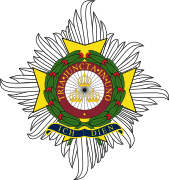 Star, Knight Grand Cross Military Division
 -
 Neck badge, awarded to Cecil Fane de Salis (1859–1948) in 1935
 -
 Star, awarded to Cecil Fane de Salis
 -
 Star and neck Badge awarded to Sir Charles Taylor du Plat
 -
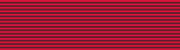 Medal Ribbon of the Order of the Bath

_in_1935.jpg)
_in_1935.jpg)

Chapel
[edit]

The Chapel of the Order is the Henry VII Lady Chapel in Westminster Abbey.[105] The Sovereign, Great Master, and the Knights and Dames Grand Cross are allotted stalls in the choir of the chapel, above which their heraldic devices are displayed.
Every four years, an installation ceremony, presided over by the Great Master, and a religious service are held in the chapel. The last such service was on Friday 16 May 2025, and was presided over by the King and the Prince of Wales.[106] The Sovereign and each knight who has been installed is allotted a stall in the choir of the chapel.[107]
As there are a limited number of stalls in the chapel, only the most senior Knights and Dames Grand Cross are installed. A stall made vacant by the death of a military Knight Grand Cross is offered to the next most senior uninstalled military GCB, and similarly for vacancies among civil GCBs.[105] Waits between admission to the Order and installation may be very long; for instance, Marshal of the Air Force David Craig, Baron Craig of Radley was created a Knight Grand Cross in 1984, but was not installed until 2006.[20]
Above each stall, the occupant's heraldic devices are displayed. Perched on the pinnacle of a knight's stall is his helm, decorated with a mantling and topped by his crest. Under English heraldic law, women other than monarchs do not bear helms or crests; instead, the coronet appropriate to the dame's rank (if she is a peer or member of the Royal family) is used.[105]
Above the crest or coronet, the knight's or dame's heraldic banner is hung, emblazoned with his or her coat of arms. At a considerably smaller scale, to the back of the stall is affixed a piece of brass (a 'stall plate') displaying its occupant's name, arms, and date of admission into the Order.
Upon the death of a Knight, the banner, helm, mantling, and crest (or coronet or crown) are taken down. The stall plates, however, are not removed; rather, they remain permanently affixed somewhere about the stall, so that the stalls of the chapel are festooned with a colourful record of the Order's Knights (and now Dames) throughout history.[108]
When the grade of Knight Commander was established in 1815, the regulations specified that they too should have a banner and stall plate affixed in the chapel.[13] This was never implemented (despite some of the KCBs paying the appropriate fees) primarily due to lack of space,[109] although the 1847 statutes allow all three classes to request the erection of a plate in the chapel bearing the member's name, date of nomination, and (for the two higher classes) optionally the coat of arms.[110]
Privileges
[edit]Precedence
[edit]
Members of the Order of the Bath are assigned positions in the order of precedence.[111] Wives of male members also feature on the order of precedence, as do sons, daughters, and daughters-in-law of Knights Grand Cross and Knights Commander; relatives of female members, however, are not assigned any special precedence. Generally, individuals can derive precedence from their fathers or husbands, but not from their mothers or wives. (See order of precedence in England and Wales for the exact positions.)
Knights Grand Cross and Knights Commander prefix 'Sir', and Dames Grand Cross and Dames Commander prefix 'Dame', to their forenames.[112] Wives of Knights may prefix 'Lady' to their surnames, but no equivalent privilege exists for husbands of Dames. Such forms are not used by peers and princes, except when the names of the former are written out in their fullest forms. Furthermore, honorary foreign members and clergymen do not receive the accolade of knighthood, and so are not entitled to the prefix 'Sir', unless the former subsequently become Commonwealth citizens.
Knights and Dames Grand Cross use the post-nominal GCB; Knights Commander use KCB; Dames Commander use DCB; Companions use CB.[113]
Heraldry
[edit]Knights and Dames Grand Cross are also entitled to receive heraldic supporters.[114] Furthermore, they may encircle their arms with a depiction of the circlet (a red circle bearing the motto) with the badge pendant thereto and the collar; the former is shown either outside or on top of the latter.
Knights and Dames Commander and Companions may display the circlet, but not the collar, around their arms. The badge is depicted suspended from the collar or circlet. Members of the Military division may encompass the circlet with 'two laurel branches issuant from an escrol azure inscribed Ich dien', as appears on the badge.
Members of the Order of the Bath and their children are able to be married in Westminster Abbey in London.[115]
Revocation
[edit]It is possible for membership in the Order to be revoked. Under the 1725 statutes, the grounds for this were heresy, high treason, or fleeing from battle out of cowardice. Knights Companion could in such cases be degraded at the next Chapter meeting. It was then the duty of the Gentleman Usher to 'pluck down the escocheon [i.e. stallplate] of such knight and spurn it out of the chapel' with 'all the usual marks of infamy'.[116]
Only two people were ever degraded: Lord Cochrane in 1813, and Eyre Coote in 1816, both for political reasons, rather than any of the grounds given in the statute. Lord Cochrane was subsequently reinstated, but Coote died a few years after his degradation.[117]
Under Queen Victoria's 1847 statutes, a member 'convicted of treason, cowardice, felony, or any infamous crime derogatory to his honour as a knight or gentleman, or accused and does not submit to trial in a reasonable time, shall be degraded from the Order by a special ordinance signed by the sovereign.' The Sovereign was to be the sole judge, and also had the power to restore such members.[118]
The situation today is that membership may be cancelled or annulled, and the entry in the register erased, by an ordinance signed by the Sovereign and sealed with the seal of the Order, on the recommendation of the appropriate minister. Such cancellations may be subsequently reversed.[119]
In 1923, the Italian dictator Benito Mussolini was made an honorary Knight Grand Cross, by King George V. Mussolini was stripped of his GCB in 1940, after he had declared war on the UK.[120]
George Pottinger, a senior civil servant, lost both his status of CB and Commander of the Royal Victorian Order (CVO) in 1975 when he was jailed for corruptly receiving gifts from the architect John Poulson.[121]
Romanian president Nicolae Ceauşescu was stripped of his honorary GCB status by Queen Elizabeth II on 24 December 1989, the day before his execution. Robert Mugabe, the President of Zimbabwe, was stripped of his honorary GCB status by the Queen, on the advice of the Foreign Secretary, David Miliband, on 25 June 2008, 'as a mark of revulsion at the abuse of human rights and abject disregard for the democratic process in Zimbabwe over which President Mugabe has presided.'[122]
Vicky Pryce, former wife of Chris Huhne, was stripped of her CB by Queen Elizabeth II on 30 July 2013, following her conviction for perverting the course of justice.[123]
Current Knights and Dames Grand Cross
[edit] | This section needs additional citations for verification. (May 2024) |
Sovereign and Great Master
[edit]| Name | Year of appointment | Present age |
|---|---|---|
| Charles III (ex officio) | 1974 as Great Master as The Prince of Wales; Sovereign since 2022 | 76 |
| William, Prince of Wales KG, KT, GCB, PC, ADC | 2024 | 43 |
Knights and Dames Grand Cross
[edit]Honorary Knights and Dames Grand Cross
[edit]Officers
[edit]
The Order of the Bath now[when?] has six officers:[124]
- Dean: Dean of Westminster (ex officio), the Very Rev. David Hoyle KCVO, MBE
- King of Arms: Air Chief Marshal Sir Stephen Dalton GCB, FRAeS[125]
- Registrar and Secretary: Major General James Gordon CB, CBE[126]
- Deputy Secretary: Lieutenant Colonel Stephen Segrave
- Genealogist: David White OStJ, Garter Principal King of Arms
- Lady Usher of the Scarlet Rod: Major General Susan Ridge CB[126]
See also
[edit]


For people who have been appointed to the Order of the Bath, see the following categories:
- Category: Knights Grand Cross of the Order of the Bath
- Category: Dames Grand Cross of the Order of the Bath
- Category: Knights Commander of the Order of the Bath
- Category: Dames Commander of the Order of the Bath
- Category: Knights Companion of the Order of the Bath
- List of knights and dames grand cross of the Order of the Bath
- List of knights companion of the Order of the Bath
- Category: Knights of the Bath
- Category: Companions of the Order of the Bath
- List of honorary British knights and dames
- List of people who have declined a British honour
- List of revocations of appointments to orders and awarded decorations and medals of the United Kingdom
- Ablution in Christianity
Notes
[edit]- ^ The Order of the Garter, the Order of the Thistle, the Order of Merit and the Royal Victorian Order are all awarded at the Sovereign's discretion and ministerial advice is not required.[63]
References
[edit]- ^ Montague-Smith, P.W., ed. (1968). Debrett's Peerage, Baronetage, Knightage and Companionage. Kingston-upon-Thames: Kelly's Directories Ltd. p. 896.
- ^ The word 'Military' was removed from the name by Queen Victoria in 1847. Letters Patent dated 14 April 1847, quoted in Statutes 1847.
- ^ Statutes 1725, although Risk says 11 May
- ^ a b c d "Order of the Bath". Royal.gov.uk. Official website of the British monarchy. Archived from the original on 2 January 2012. Retrieved 9 December 2011.
- ^ Statutes 1925, articles 8–12.
- ^ Anstis, Observations, p. 4.
- ^ Letters patent dated 18 May 1725, quoted in Statutes 1725.
- ^ The purely legendary pre-history was associated with Henry IV.
- ^ Wagner, Heralds of England, p 357, referring to John Anstis, who proposed the Order, says: "He had the happy inspiration of reviving this ancient name and chivalric associations, but attaching it, as it never had been before, to an Order or company of knights."
- ^ Perkins, The Most Honourable Order of the Bath, p. 1: "It can scarcely be claimed that a properly constituted Order existed at any time during the preceding centuries [prior to the reign of Charles II]".
- ^ Statutes 1925, article 2.
- ^ a b Statutes 1925, article 5.
- ^ a b c d e "No. 16972". The London Gazette. 4 January 1815. pp. 17–20.
- ^ a b Statutes 1925, article 8.
- ^ See, for example, the order of wear for orders and decorations Archived 28 January 2007 at the Wayback Machine, the Royal Warrant defining precedence in Scotland ("No. 27774". The London Gazette. 14 March 1905. pp. 2012–2014.), or the discussion of precedence at http://www.heraldica.org/topics/britain/order_precedence.htm
- ^ a b c Risk, History of the Order of the Bath, p. 6.
- ^ The Manner of making Knights after the custom of England in time of peace and at the Coronation, that is Knights of the Bath, quoted in Perkins, pp. 5–14.
- ^ According to Anstis (Observations, p. 73) such knights were sometimes known as Knights of the Sword or Knights of the Carpet
- ^ Anstis, p. 66.
- ^ a b c d e f g h "Order of the Bath feature article". Royal.gov.uk. Archived from the original on 29 September 2006. Retrieved 9 September 2006.
- ^ Risk, p. 114.
- ^ Nicolas, History of the orders of knighthood of the British empire, p. 38–39.
- ^ The later usage by the Order of the Bath does not make things any clearer. The presence of the rose, thistle, and shamrock (symbols of England, Scotland, and Ireland, respectively) in the Collar supports the above claim. The shamrocks however were not added until the 19th century, probably as a result of a suggestion of Sir Joseph Banks, who in his proposal observed that the presence of the shamrock would "greatly augment the meaning of the motto" (Risk, p 115). A further explanation for the crowns is provided in the 1725 statutes of the Order. The coat of arms which was to appear on the Order's seal (Azure three imperial crowns Or, that is, three gold imperial crowns on a blue background) was described as being anciently attributed to King Arthur.
- ^ Nicolas, p 38, quoting Bishop Kennet Register and Chronicle Ecclesiastical and Civil from the Restoration of King Charles II faithfully taken from the manuscripts of the Lord Bishop of Peterborough, (1728) p. 410.
- ^ Hanham, Andrew (2016). The Politics of Chivalry: Sir Robert Walpole, the Duke of Montagu and the Order of the Bath. Vol. 35. Parliamentary History. pp. 262–297.
- ^ Thomas Jr, Robert McG (20 May 1995). "Obituaries: Sir Anthony Wagner, 86, Dies; Medievalist and Senior Herald". The New York Times. Archived from the original on 30 June 2013. Retrieved 17 March 2025.
- ^ Garter King of Arms from 1754 to 1773, and an officer of arms for some 25 years before that
- ^ Wagner, pp. 348, 357.
- ^ Risk, p. 2.
- ^ Hanham, Andrew (2016). The Politics of Chivalry: Sir Robert Walpole, the Duke of Montagu and the Order of the Bath. Vol. 35. Parliamentary History. pp. 262–297.
- ^ Hanham, Andrew (2016). The Politics of Chivalry: Sir Robert Walpole, the Duke of Montagu and the Order of the Bath. Vol. 35. Parliamentary History. pp. 262–297.
- ^ In the words of his son, Horace Walpole, "The Revival of the Order of the Bath was a measure of Sir Robert Walpole, and was an artful bank of favours in lieu of places. He meant to stave off the demand for Garters, and intended that the Red [i.e. the Order of the Bath] should be a step to the Blue [the Order of the Garter]; and accordingly took one of the former for himself." Horace Walpole, Reminiscences (1788)
- ^ Hanham, Andrew (2016). The Politics of Chivalry: Sir Robert Walpole, the Duke of Montagu and the Order of the Bath. Vol. 35. Parliamentary History. pp. 262–297.
- ^ Nicolas, p. 237–238, footnote.
- ^ Risk, p. 4.
- ^ Statutes 1725.
- ^ Statutes 1725, article 2.
- ^ Risk, p. 15, 16.
- ^ a b Risk, p. 16.
- ^ Statutes 1725, article 6, the same article which state "[the Great Master shall] take especial care that ... the antient Rituals belonging to this Knighthood be observed with the greatest Exactness"
- ^ No Installation had been held between 1812 and the coronation of George IV in 1821, by which time the number of knights exceeded the number of stalls in the chapel. To allow the knights to wear their collars at the coronation (which they could not do until installed), they were dispensed from the Installation, and this precedent was subsequently followed. (Risk, p. 43).
- ^ Risk, p. 10.
- ^ Risk, p. 20.
- ^ Statute dated 8 May 1812, quoted in Statutes 1847.
- ^ Statute dated 20 April 1727, quoted in Statutes 1847.
- ^ The Times, 10 January 1815, p. 3.
- ^ "No. 17061". The London Gazette. 16 September 1815. pp. 1877–1882.
- ^ Letters Patent dated 14 April 1847.
- ^ The document by which the Prince Regent modified the structure of the Order in 1815 was a Warrant under the Royal sign-manual. This is of lesser authority than Letters Patent under the Great Seal, by which the Order and its Statutes were originally established. It had been questioned on a number of occasions whether the Statutes of the Order could be modified by anything less than such Letters Patent. The 1847 Letters Patent retroactively confirmed the validity of the 1815 document and the subsequent appointments to the Order
- ^ Risk, p. 61.
- ^ Special statute 1850. "No. 21127". The London Gazette. 16 August 1850. p. 2242.
- ^ a b Risk, p. 70.
- ^ Risk, p. 89.
- ^ Perkins, p. 122.
- ^ Risk, p. 92.
- ^ Perkins, pp. 124–131.
- ^ Risk, pp. 95–96.
- ^ 16 in Queen Victoria's reign, 6 in Edward VII's and 19 in George V's. (Risk, p. 97)
- ^ Allen, Philip (2004). "Nunn, Jean Josephine (1916–1982)". Oxford Dictionary of National Biography (online ed.). Oxford University Press. doi:10.1093/ref:odnb/66883. Retrieved 16 May 2014. (Subscription, Wikipedia Library access or UK public library membership required.)
- ^ Risk, p. 102.
- ^ "No. 62866". The London Gazette (Supplement). 28 December 2019. p. N3.
- ^ "New Year Honours list 2020 – Awards for NY2020" (PDF). GOV.UK. HM Government. Retrieved 30 August 2023.
- ^ "The Honours System of the United Kingdom; Orders, Decorations and Medals". Ceremonial Honours and Appointments Secretariat of the Cabinet Office of the Government of the United Kingdom. Archived from the original on 16 June 2025. Retrieved 29 July 2025.
Appointments... are the Sovereign's personal gift and ministerial advice is not required.
- ^ "No. 6376". The London Gazette. 25 May 1725. p. 1.
- ^ Nicolas, Appendix p. lxx gives the first four Great Masters, although he considers the latter three to have only been acting Great Masters
- ^ "No. 19570". The London Gazette. 19 December 1837. p. 3309.
- ^ "No. 19592". The London Gazette. 23 February 1838. p. 407.
- ^ Prince Albert was appointed acting Great Master sometime in 1843, and the appointment was made substantive by the 1847 Statutes, article 4. Risk says that he was appointed acting Great Master on 31 March 1843, however The Times, reporting the death of the Duke of Sussex (22 April 1843, pp. 4–5) says that the office of acting Great Master became vacant on his death. At any rate, when the executors of the Duke of Sussex delivered his insignia together with the seal and statutes to the Queen on 20 June (The Times, 21 June 1843, p. 6) Prince Albert was then acting Great Master.
- ^ "No. 20737". The London Gazette. 25 May 1847. pp. 1947–1957.
- ^ "No. 26867". The London Gazette. 25 June 1897. p. 3567.
- ^ The Times, 22 June 1897, p. 10.
- ^ "No. 27289". The London Gazette. 26 February 1901. p. 1414.
- ^ The Times, 25 February 1942, p. 7.
- ^ "No. 46428". The London Gazette. 10 December 1974. p. 12559.
- ^ Milss, Rhiannon (23 April 2024). "King recognises Queen and Prince William in honours list and creates new role for Kate, Princess of Wales". Sky News. Retrieved 23 April 2024.
- ^ Statutes 1725, article 4.
- ^ Letters Patent dated 14 April 1847, quoted in Statutes 1847.
- ^ Statutes 1925, article 9.
- ^ Statutes 1925, article 10.
- ^ Statutes 1925, article 12.
- ^ Statutes 1925, article 15.
- ^ The Times, 25 October 1972, p. 21.
- ^ The Times, 1 December 1993, p. 24.
- ^ Samuel, Henry (27 March 2008). "Nicolas Sarkozy awarded honorary title". Telegraph.co.uk. London, England: The Daily Telegraph. Archived from the original on 1 April 2008. Retrieved 24 December 2008.
- ^ "Abdullah Gül". tccb.gov.tr. Presidency of the Republic of Turkey. Retrieved 4 April 2012.
- ^ "Queen begins state visit to Slovenia". BBC News. 21 October 2008. Retrieved 22 October 2008.
- ^ Monare, Moshoeshoe (6 March 2010). "Zuma's taste of British protocol". Iol.co.za. Independent Online. Retrieved 9 December 2011.
- ^ The Times, Issue 50193; 13 July 1945; p. 4; col A.
- ^ The Times, 27 May 1943, p. 4.
- ^ The Times, 21 May 1991.
- ^ Branigan, Tania (12 May 2004). "Colin Powell claims Scottish coat of arms". The Guardian. London, England. Retrieved 24 December 2008.
- ^ Smyth, Chris (25 June 2008). "Queen strips Robert Mugabe of knighthood in 'revulsion' at violence". TimesOnline.co.uk. London, England: The Times. Archived from the original on 14 October 2008. Retrieved 24 December 2008.
- ^ Statutes 1925, article 18.
- ^ "In the event of any future wars or of any action or services civil or military meriting peculiar honour and reward ... to increase the numbers in any of the said classes and in any of the said divisions". Statutes 1925, article 17.
- ^ Marks & Payne 1978, p. 123
- ^ Risk, p. 93.
- ^ Risk, pp. 13, 70.
- ^ Statutes 1847, article 15.
- ^ Risk, 1972, p. 95
- ^ Statute dated 17 January 1726 (according to Risk, p. 14). Both the 1812 and 1847 editions of the Statutes give the date as 17 January 1725, but this is most probably a misprint since the Order was not founded until May 1725, and the additional statute also specified the office holders by name.
- ^ Risk, p. 14.
- ^ a b c d e f g h i Statutes 1925, article 23.
- ^ The hat was made of white satin (Statutes 1725, article 8), but was changed to black velvet at the command of George IV for his coronation (Nicolas, p. 198). The hat is not explicitly specified in the 1847 or 1925 statutes
- ^ Statutes 1925, articles 23, 24, 25.
- ^ a b c Statutes 1925, article 21.
- ^ "Royal.uk: The King and The Prince of Wales mark 300 years of the Order of the Bath". royal.uk.
- ^ Statutes 1812, article 8
- ^ Perkins 1920, p. 107
- ^ Risk, p. 40.
- ^ Statutes 1847, article 18.
- ^ Statutes 1925, article 22.
- ^ Statutes 1925, article 20.
- ^ "Order of the Bath". debretts.com. Archived from the original on 28 March 2016. The post-nominal letters are not mentioned in the Statutes of the Order.
- ^ Statutes 1925, article 28.
- ^ "FAQ: Westminster Abbey". Westminster-Abbey.org. Archived from the original on 28 February 2011. Retrieved 9 April 2016.
- ^ Statutes 1725, article 3.
- ^ Risk, p. 30.
- ^ Statutes 1847, article 26.
- ^ Statutes 1925, article 30.
- ^ Tharoor, Ishaan (1 February 2012). "Disgraced British Knights: A Not-So-Chivalrous History". Time. Time. Retrieved 1 August 2016.
- ^ "No. 46561". The London Gazette. 2 May 1975. p. 5731.
- ^ Smyth, Chris (25 June 2008). "Queen strips Robert Mugabe of knighthood in 'revulsion' at violence". The Times. Retrieved 8 May 2021.
- ^ "No. 60583". The London Gazette. 30 July 2013. p. 14994.
- ^ Court Circular, 17 May 2006.
- ^ "Central Chancery of the Orders of Knighthood". TheGazette.co.uk. The London Gazette, HM Government. 7 December 2018. Retrieved 22 December 2018.
- ^ a b "Central Chancery of the Orders of Knighthood". TheGazette.co.uk. The London Gazette, HM Government. 5 July 2024. Retrieved 6 July 2024.
Bibliograpghy
[edit]- Anstis, John (1752). Observations introductory to an historical essay, upon the Knighthood of the Bath. London: James Woodman.
- Galloway, Peter (2006). The Order of the Bath. Phillimore. ISBN 1-86077-399-0.
- Hanham, Andrew (2016). "The Politics of Chivalry: Sir Robert Walpole, the Duke of Montagu and the Order of the Bath". Parliamentary History. 35 (3): 262–297. doi:10.1111/1750-0206.12236.
- Marks, Richard; Payne, Ann (1978). British Heraldry from Its Origins to C. 1800. London: British Museum Publications Ltd. ISBN 978-0-71410-086-9.
- Nicolas, Nicholas H. (1842). History of the orders of knighthood of the British empire, Vol iii. London.
- Perkins, Jocelyn (1920). The Most Honourable Order of the Bath : a descriptive and historical account (2nd ed.). London: Faith Press.
- Risk, James C. (1972). The History of the Order of the Bath and its Insignia. London: Spink & Son. ISBN 978-0-90069-649-7.
- Statutes of the Most Honourable Order of the Bath. London. 1725.
- Statutes of the Most Honourable Order of the Bath. London. 1812.
- Statutes of the Most Honourable Order of the Bath. London. 1847.
- "Special statute of the Most Honourable Order of the Bath". TheGazette.co.uk. London Gazette. 1850. Retrieved 16 June 2020.
- Statutes of the Most Honourable Order of the Bath. London. 1925.
{{cite book}}: CS1 maint: location missing publisher (link) - "Royal Insight > Focus: The Order of the Bath". Royal.gov.uk. Official website of the British monarchy. May 2006. Archived from the original on 29 September 2006. Retrieved 9 September 2006.
Further reading
[edit]External links
[edit]
 Media related to Order of the Bath at Wikimedia Commons
- Order of the Bath – Central Chancery of the Orders of Knighthood
- The Order of the Bath – Royal Household website
- Order of the Bath – UK Cabinet Office
- The British honours system – UK Government
|  | |
| Orders of chivalry |
| ||||||||||||
|---|---|---|---|---|---|---|---|---|---|---|---|---|---|
| Military gallantry/bravery decorations |
| ||||||||||||
| Distinguished service decorations |
| ||||||||||||
| Civil bravery decorations |
| ||||||||||||
| Nursing service | |||||||||||||
| Meritorious service | |||||||||||||


_Ribbon.png)
_Ribbon.png)


.svg)


_UK_ribbon.png)


.png)
.png)
.png)
.png)

_UK.png)
_UK.png)
ribbon.jpg)


_ribbon.png)

| International | |
|---|---|
| National | |
| Other | |

Order of the Bath
View on GrokipediaHistory
Medieval Origins and Knights of the Bath
The ritual of bathing candidates for knighthood, symbolizing spiritual and moral purification, originated in medieval chivalric traditions as a preparatory step before dubbing, particularly for esquires elevated on grand occasions like royal coronations or military expeditions.[1] This practice drew from broader European customs of vigil and investiture described in chivalric manuals, where the bath—often conducted in a large wooden tub with scented water—preceded a night of prayer and the final accolade by the sovereign or his representative.[8] Early large-scale applications of the bathing ritual appear in English records from the early 14th century, such as the Feast of the Swans on 22 May 1306, when Edward I created 256 knights, including his son the Prince of Wales (later Edward II), following the ceremonial purification to vow participation in a crusade against the Holy Land.[9] The term "Knights of the Bath" specifically emerged later to denote those dubbed after this rite at coronations, with the first documented creation under that designation occurring at Henry IV's coronation on 13 October 1399, marking a precedent for honoring loyal retainers en masse during the transition of power.[10] Subsequent monarchs perpetuated the custom irregularly, as at Edward IV's coronation on 27 June 1461, when knights were similarly prepared and dubbed at the Tower of London on the eve of the ceremony, emphasizing the honor's ties to royal legitimacy and feudal allegiance rather than a permanent institution.[11] Unlike standing orders like the Garter (founded 1348), the Knights of the Bath conferred no ongoing privileges, collar, or chapter meetings; recipients were simply distinguished by the prestige of the occasion and their proximity to the sovereign, with lists preserved in heraldic rolls for posterity.[1] The practice persisted through the Tudor and Stuart eras, including at James I's coronation in 1603, but waned in formality until its revival as a structured order in the 18th century.[12]Formal Establishment in 1725
King George I formally established the Most Honourable Military Order of the Bath on 18 May 1725 through letters patent under the great seal, instituting it as a revival of the medieval tradition of Knights of the Bath created during royal coronations to honor military service.[4][13][2] The proposal originated from John Anstis, Garter King of Arms, who advocated for a structured military order amid the political and dynastic challenges of George I's early reign following the Hanoverian accession.[14] The statutes, published shortly thereafter in 20 articles, defined the order's governance, ceremonies, and insignia, emphasizing its military character with the Sovereign as head.[9][15] The original structure limited membership to a single class of Knights Companion (post-nominal KB), capped at 35 alongside the Sovereign and Great Master, with seven officers including a Dean, Registrar, and King of Arms to administer affairs.[4][6] This limitation aimed to maintain exclusivity for senior military officers distinguished by valor or long service, though the initial creation exceeded it slightly with 37 knights invested on 27 May 1725 at Westminster.[6][16] King George I appointed John Churchill, 1st Duke of Marlborough, as the inaugural Great Master, though Marlborough's declining health limited his active role; the position underscored the order's intent to recognize established military and courtly loyalty.[14] Ceremonial installation required knights to undergo a symbolic vigil and bathing ritual, adapted from medieval practices, followed by investiture with a mantle, collar of silver-gilt medallions depicting the saint's legend, and a badge suspended from a crimson ribbon.[15] The order's chapter met at Henry VII's Chapel in Westminster Abbey, reinforcing its ties to royal tradition while establishing a permanent framework distinct from ad hoc knighthoods.[17] This formalization marked a shift toward institutionalized honors, enabling George I to consolidate influence through merit-based rewards in a era of Jacobite threats and Whig dominance.[2]19th-Century Reforms and Expansion
In response to the conclusion of the Napoleonic Wars, the Prince Regent issued a royal warrant on 2 January 1815 reorganizing the Order of the Bath into three classes: Knights Grand Cross (GCB), Knights Commander (KCB), and Companions (CB), initially limited to military members to recognize distinguished service, particularly among officers at the Battle of Waterloo.[18][19] This expansion addressed the Order's prior limitation to approximately 36 Knights Companions, enabling hundreds of new appointments in 1815 and subsequent years, though without immediate strict numerical caps, which facilitated rapid growth but prompted later regularization.[18][20] Further reforms occurred on 14 April 1847, when Queen Victoria promulgated new statutes via letters patent, formally dividing the Order into military and civil branches across all three classes to accommodate rewards for civilian public service alongside military achievements, while removing the designation "Military" from the title and abolishing the medieval bathing ritual in favor of a structured investiture ceremony conducted by the Sovereign.[18][4] These statutes imposed defined limits—50 military and 25 civil GCBs, 102 military and 50 civil KCBs, and 525 military and 200 civil CBs, totaling 950 substantive members plus honorary foreign appointees—to control expansion amid Britain's growing imperial administration and bureaucracy.[18] The civil division's inaugural appointments appeared in 1848, including officials from domestic and colonial posts, marking the Order's adaptation to recognize non-combatant contributions to governance and diplomacy, though membership continued to exceed caps during wartime surges.[18] By the late 19th century, the Order had evolved into a primary honor for senior military and civil elites, with its structure influencing parallel institutions like the Order of the Star of India.[18]20th-Century Developments Amid Global Conflicts
During the First World War, the Order of the Bath saw a significant surge in military appointments to recognize distinguished service against the German Empire, with large numbers of Companions of the Bath (CB) and higher ranks awarded to senior officers. For instance, Field Marshal Douglas Haig was appointed Knight Grand Cross (GCB) on 1 January 1915, Admiral Sir David Beatty received the GCB following the Battle of Jutland on 31 May 1916, and Rear Admiral Reginald Tyrwhitt was made CB for actions at the Battle of Heligoland Bight on 28 August 1914. Posthumous honors were also granted, such as the Knight Commander of the Bath (KCB) to Brigadier-General John Gough in 1915. Over 350 CBs were appointed in 1918-1919 alone, many holding concurrent Companion of the Order of St Michael and St George (CMG), leading to membership exceeding statutory limits of around 1,400 by 1925. A 1917 statute permitted Companions to wear their badges around the neck, adapting insignia usage for wartime practicality.[21] Post-war conflicts from 1919 to 1925 continued this trend, with Bath awards allocated for operations in Afghanistan, Russia, Somaliland, and Waziristan, while installations in 1920 and 1924 honored wartime commanders like Haig, Beatty, and Sir John French. The order's role in rewarding command and staff excellence persisted without structural overhaul, though the demands of global conflict highlighted its military focus under Great Master Arthur, Duke of Connaught, who held the position from 1897 until his death in 1942.[21][22] In the Second World War, similar patterns emerged with special statutes enabling additional appointments against Nazi Germany, emphasizing key victories. Rear Admiral Henry Harwood received the KCB on 30 December 1939 for the Battle of the River Plate, Air Chief Marshal Hugh Dowding was promoted GCB on 7 January 1941 for the Battle of Britain, Lieutenant-General Alan Brooke (later Viscount Alanbrooke) was made KCB on 12 July 1940, and General Bernard Montgomery earned the CB for El Alamein in 1942. Posthumous CBs included Brigadier Claude Nicholson on 5 October 1945 for the defense of Calais. Naval leaders like Admiral Andrew Cunningham and Admiral Bruce Fraser were advanced to GCB in 1944 for Mediterranean and Home Fleet services, respectively; Louis Mountbatten progressed from CB in 1943 to KCB in 1945. Revocations targeted honorary members of enemy Axis powers, with German and Italian knights stripped in 1940 and Japanese in 1942, reflecting geopolitical shifts. Dominion integration advanced, as Canada received its first Bath awards in 1943, including CB for Lieutenant-General Henry Crerar. These wartime expansions underscored the order's adaptability amid global strife, without fundamental reforms.[22]Post-1945 Evolution and Contemporary Role
Following the end of World War II, the Order of the Bath increasingly emphasized civil service distinctions alongside military achievements, with approximately 80% of awards from 1976 to 2025 going to civilians.[22] This shift reflected broader post-war expansions in the civil service and a dilution of purely martial connotations, though it remained the premier order for senior armed forces officers.[1] In 1971, the order opened to women, with Jean Nunn becoming the first female Companion in the New Year's Honours; over 240 women have since been appointed, including Princess Alice, Duchess of Gloucester, as the inaugural Dame Grand Cross in 1975.[22][1] Reforms in the late 20th century addressed criticisms of automatic promotions tied to rank or tenure. A 1967 review reduced honours for state servants, while 1993 changes ended rank-based awards, prioritizing merit.[22] In 2004, the Public Administration Select Committee recommended abolishing the order amid concerns over politicization, but Prime Minister Tony Blair's government rejected the proposal, preserving its status.[22] Since 1926, roughly 7,000 new members have been appointed, with 1,400 promotions to Knight or Dame Commander and Grand Cross levels, contributing to over 18,000 total Gazette notifications.[22] Contemporary ceremonies have modernized while retaining tradition: investitures occur at royal residences or Westminster Abbey every four years, with the 2018 protocol introducing oath-taking without full medieval installation rituals.[22][1] The 2025 oath revision reaffirmed vows to defend the "innocent, vulnerable, orphans," echoing medieval roots.[22] Today, the order—capped at 120 Grand Crosses, 295 Commanders, and 1,455 Companions—recognizes exceptional service in government, diplomacy, and the military, with nominations via honours lists approved by the Sovereign.[1][4] Honorary memberships extend to foreign heads of state, underscoring its role in international relations.[22]Organizational Structure
The Sovereign's Authority
The British Sovereign holds the position of Sovereign Head of the Most Honourable Order of the Bath, exercising ultimate authority over its establishment, governance, membership, and ceremonial functions.[4] This role embodies the monarch's prerogative as the fount of honour in the United Kingdom's honours system, with the Order's statutes vesting discretionary powers in the Sovereign for appointments, promotions, and degradations of members.[4] King George I founded the Order on 18 May 1725 as a military institution comprising the Sovereign, a Great Master, and 36 Knights Companions, thereby initiating its structure under royal auspices.[4] Subsequent expansions, such as the 1815 restructuring by the Prince Regent (later George IV) into three classes—Knight or Dame Grand Cross (GCB), Knight or Dame Commander (KCB or DCB), and Companion (CB)—further demonstrated the Sovereign's capacity to adapt the Order's framework to recognize both military and civilian service.[4] Queen Victoria amended the statutes in 1847 to accommodate societal changes, including the introduction of a civil division, underscoring the Sovereign's oversight of legal and operational evolution.[4] Appointments to the Order are formally issued by the Sovereign, who approves elevations and new memberships, though in constitutional practice these occur on the advice of the Prime Minister for senior military officers and civil servants.[1] The Sovereign retains the power to confer honorary memberships outside standard limits and to regulate the Order's officers, including the Great Master, Dean, Bath King of Arms, Registrar, Usher of the Scarlet Rod, and Genealogist, all of whom operate under royal warrant.[4] Membership is capped at approximately 120 Knights and Dames Grand Cross, 295 Knights and Dames Commander, and 1,455 Companions, excluding the Sovereign and certain ex-officio positions, ensuring controlled expansion subject to royal discretion.[1] Ceremonially, the Sovereign presides over triennial installation services when attending, as exemplified by King Charles III's participation in the Order's 300th anniversary service at Westminster Abbey on 16 May 2025, where the monarch receives homage from new members.[13] These rituals, held in the Henry VII Chapel, involve the investiture of insignia and the affixing of armorial achievements, reinforcing the Sovereign's symbolic and authoritative centrality.[4] Queen Elizabeth II, for instance, installed the Great Master during the 250th anniversary in 1975, illustrating active royal involvement in maintaining traditions.[4] The Sovereign's authority extends to disciplinary matters, permitting the degradation of members for misconduct, though such actions are rare and historically tied to royal judgment.[22] This framework preserves the Order's status as a premier distinction for exemplary service, directly linked to the Crown's enduring prerogative.[1]Role of the Great Master
The Great Master serves as the principal officer subordinate to the Sovereign in the Most Honourable Order of the Bath, tasked with presiding over the order's proceedings during the Sovereign's absence due to state obligations. This role was established in the order's founding statutes of 1725, which specified the need for a deputy to manage "important, weighty, and urgent affairs" of the order when the Sovereign could not attend personally.[2] The position ranks as the First and Principal among the Knights and Dames Grand Cross, numbering no more than 120 in total.[19] Historically, the first Great Master was John Montagu, 2nd Duke of Montagu, appointed on 18 May 1725 by King George I shortly after the order's revival.[4] In the order's early structure, outlined in the 1725 statutes, the Great Master formed part of a cadre of seven officers, including the Dean, Bath King of Arms, Registrar, Chancellor, and two secretaries, responsible for the order's governance and ceremonial functions.[4] Over time, the role evolved from potentially more administrative duties—such as overseeing knightly installations and chapter meetings—to a predominantly ceremonial one, especially after it passed to members of the royal family in the 20th century.[22] In contemporary practice, the Great Master oversees the order's officers, participates in triennial or quadrennial chapter services at Westminster Abbey, and installs new members during oaths and investitures when the Sovereign is present or absent.[13] The position has been held by heirs to the throne since 1975: King Charles III (then Prince of Wales) was installed on 28 May 1975 for the order's 250th anniversary, retaining it until his accession in September 2022; his son, William, Prince of Wales, succeeded him and was formally installed on 16 May 2025 during a service marking the order's 300th anniversary, attended by King Charles III as Sovereign.[4][13] These services, held every four years with Sovereign attendance biennially, underscore the Great Master's function in maintaining the order's traditions amid its recognition of senior military and civil service.[13]Classes and Membership Criteria
The Most Honourable Order of the Bath is divided into three classes: Knights and Dames Grand Cross (post-nominal GCB), Knights and Dames Commander (KCB or DCB), and Companions (CB).[19][1] Each class encompasses both a Military Division, primarily for serving or retired officers of the British Armed Forces, and a Civil Division, for senior government officials and diplomats.[19][18] Membership limits are prescribed by the Order's statutes: no more than 120 Knights and Dames Grand Cross (including the Great Master as first and principal), 355 Knights and Dames Commander, and 1,825 Companions.[19] These limits apply across divisions, with historical statutes allocating specific quotas, such as 102 military and 50 civil for the second class in 1847, though numbers have expanded over time to accommodate post-war demands.[18][23] Appointments to all classes recognize exemplary service to the Crown, with nominations originating from government departments and processed through the UK honours system for approval by the Sovereign.[24][5] Eligibility is restricted to British subjects, though honorary memberships have been granted to foreign nationals; women became eligible for all classes from 1 January 1971.[24] In the Military Division, awards typically go to high-ranking officers—such as generals, admirals, or air chief marshals—for distinguished command or operational leadership, though not automatically upon promotion.[18][25] The Civil Division targets senior civil servants, ambassadors, or equivalent roles for sustained contributions to public administration, policy, or international relations.[24][1] Higher classes denote greater distinction: Knights and Dames Grand Cross are reserved for the most senior figures, often heads of armed services or top mandarins, while Knights and Dames Commander recognize mid-to-upper echelons of leadership, and Companions mark significant but less exalted achievements.[19][23] Vacancies arise through death or promotion to higher classes, maintaining statutory caps; the Great Master and other officers do not count toward member limits.[19] Awards are not hereditary and can be forfeited for misconduct, as governed by the Order's rules.[5]Officers and Administrative Functions
The administrative functions of the Order of the Bath are overseen by the Central Chancery of the Orders of Knighthood, which maintains membership records, processes appointments, and coordinates ceremonial installations held in the Henry VII Chapel at Westminster Abbey.[4] The Chancery ensures compliance with the order's statutes, handles genealogical verifications for new members, and manages updates to contact details for living knights and dames.[4] The order's officers, numbering eight in total, fulfill specialized roles in governance, heraldry, and ceremonies, distinct from the Sovereign and Great Master.[4] The Dean, held ex officio by the Dean of Westminster (currently Dr. David Hoyle KCVO MBE), presides over religious aspects, including installation services.[4] The Bath King of Arms (Air Chief Marshal Sir Stephen Dalton GCB) directs heraldic matters, such as the design and recording of members' armorial achievements displayed in the chapel.[4] The Registrar and Secretary (Major General James Gordon CB CBE) maintains the official register of members, administers appointments, and serves as the primary liaison for administrative queries.[4] Supporting this is the Deputy Secretary (Lieutenant Colonel Stephen Segrave), who assists in day-to-day operations and acts as Secretary to the Central Chancery.[4] The Genealogist (David White, Garter Principal King of Arms) verifies lineages and eligibility for membership, ensuring adherence to statutory criteria.[4] Ceremonial duties fall to the Usher of the Scarlet Rod (Major General Susan Ridge CB), who marshals processions, enforces protocols during investitures, and bears the scarlet rod as a symbol of authority.[4] These officers collectively ensure the order's continuity, with appointments typically drawn from military, clerical, or heraldic ranks to align with its emphasis on distinguished service.[4]Insignia, Ceremonies, and Symbols
Design and Components of Insignia
The insignia of the Most Honourable Order of the Bath include the badge, star, ribbon, collar, and mantle, with designs distinguishing military and civil divisions as well as ranks within the three classes: Knight or Dame Grand Cross (GCB), Knight or Dame Commander (KCB or DCB), and Companion (CB).[9] The core elements trace their form to the 1815 reorganization under King George III, which standardized the badges and stars for expanded membership.[18] The badge for the military division features a gold eight-pointed Maltese cross enamelled argent (white), with each point tipped by a small gold ball and gold lions at the re-entrant angles. At the center lies a red-enamelled disc depicting Saint George slaying the dragon in gold, encircled by a blue-enamel ring inscribed with the order's motto Tria juncta in uno ("three joined in one") in gold lettering, the whole surmounted by an Imperial crown.[26] In contrast, the civil division badge is an enamelled gold oval enclosing a sceptre from which emanate a rose, thistle, and shamrock—symbols of England, Scotland, and Ireland—flanked by three Imperial crowns, the ensemble pierced and bordered by a ring bearing the motto.[19] Knights and Dames Grand Cross wear the badge appended to a crimson sash across the body, while Knights Commander and male Companions suspend it from a ribbon around the neck, and female equivalents wear it from a bow on the left shoulder; Companions attach it to a chest ribbon.[2] Stars accompany the insignia for Grand Cross and Commander ranks, worn on the left breast. The military Grand Cross star comprises an eight-pointed silver rayed badge overlaid with the gold Maltese cross badge, featuring three Imperial crowns in alternate rays. The Commander military star omits the gold cross overlay, retaining the silver rays and crowns within a red-enamelled circle bearing the motto. Civil stars replicate the respective oval badge centrally, without the cross elements, on a silver eight-pointed field.[27][9] The ribbon, a crimson moiré silk band symbolizing the order's historical bathing ritual, measures 101 mm wide for sashes and narrower for neck or chest wear, with a pale blue variant for women's equivalents to match attire.[2] For Grand Cross members, the collar consists of eight Imperial crowns alternating with eight enamelled badges of the military division, linked by gold essences-à-fois knots, from which the central badge suspends via a white-enamel knot rather than a crown.[28] The mantle, worn at ceremonial investitures, is crimson velvet edged with white taffeta, embroidered with the collar and lined with white silk.[9] Civil division insignia for Companions and Commanders were formalized in the 1840s, introducing distinct oval badges and stars to reflect non-military service, though sharing the crimson ribbon.[18] All elements are manufactured to precise specifications by authorized firms, ensuring enamel work and gilding durability for generational heirlooms post-1859, when recipients retained insignia upon death.[29]Installation Rituals and Traditions
The name of the Order of the Bath derives from a medieval knighthood ritual involving a symbolic bath for spiritual and physical purification, accompanied by fasting, vigils, and prayer, which prepared candidates for dubbing.[4][2] This practice, rooted in Plantagenet and Tudor customs for coronation-related knighthoods, persisted until the reign of Charles II but was formally abolished in 1815, with the order retaining the nomenclature to evoke chivalric heritage rather than enacting literal immersion.[4][3] The inaugural installation on 17 June 1725 occurred in Henry VII Chapel at Westminster Abbey, conducted by the Great Master under delegated sovereign authority.[2] Knights processed with esquires, swore an oath to defend maidens, widows, and orphans, then received collars, white hats with plumes, and seating in designated stalls adorned with personal banners and armorial bearings.[2] These elements, modeled on the Order of the Garter, emphasized hierarchical precedence and loyalty, with the motto Tria juncta in uno (three joined in one) inscribed on badges symbolizing the union of England, Scotland, and Ireland.[2][4] Modern installations, revived in 1913 by George V for 46 Knights Grand Cross, adhere to the same format in Henry VII Lady Chapel, Westminster Abbey, occurring every four years with the Sovereign attending biennially thereafter.[4][3] The ceremony features a procession of officers, knights, and dames from the Abbey's Great West Door to the Quire and Chapel, where new Knights Grand Cross affirm oaths and assume stalls.[13] Traditions include affixing permanent armorial stall-plates to seats, alongside temporary banners, crests, and mantles returned to families upon a knight's death, preserving visual records of membership limited to 34 active stalls.[3][4] The 2025 tricentennial service on 16 May, attended by the Sovereign, installed the Prince of Wales as Great Master and five new Knights Grand Cross, underscoring continuity amid senior military and civil appointments.[13][3]The Chapel and Ceremonial Sites
The chapel of the Most Honourable Order of the Bath is located in the Henry VII Chapel, also known as the Lady Chapel, at the eastern end of Westminster Abbey in London.[1] This site was designated for the order following its revival as a military honor by King George I through letters patent issued on 18 May 1725.[3] The chapel, constructed between 1503 and 1519 under Henry VII's commission, features Perpendicular Gothic architecture with a fan-vaulted ceiling and serves as the spiritual and ceremonial heart of the order, where stalls are reserved for living knights and dames grand cross.[30] Installation ceremonies for new knights and dames grand cross occur quadrennially in the Henry VII Chapel, presided over by the Great Master and including a religious service.[31] These rituals, which trace roots to medieval traditions of knighthood, involve the formal investiture with insignia and the hanging of personal banners, crests, and hats from the chapel's stalls, preserving the order's history visually.[22] The most recent such event was scheduled for 16 May 2025, underscoring the chapel's ongoing role in maintaining ceremonial continuity.[31] Westminster Abbey remains the primary ceremonial site, with no other locations historically or currently designated for core order rituals like installations.[1] The chapel's exclusivity to the order's observances reflects its adaptation from a royal mausoleum—housing tombs of Henry VII, Elizabeth of York, and others—to a dedicated space for honoring military and civil merit within the British honors system.[30]Privileges and Honors
Precedence and Social Standing
The Order of the Bath holds the fourth most senior position among British orders of chivalry, succeeding the Order of the Garter, the Order of the Thistle, and the inactive Order of St Patrick.[4] This ranking establishes a foundational hierarchy for its members' precedence in official ceremonies, state processions, and formal seating, as outlined in the tables of precedence for England and Wales.[32] Knights and Dames Grand Cross (G.C.B.) precede baronets and Knights Grand Cross of subordinate orders, while Knights and Dames Commander (K.C.B./D.C.B.) follow G.C.B.s but outrank Knights Bachelor.[33] Companions (C.B.) rank below Knights Bachelor yet above companions of less senior orders like the Order of the British Empire.[33] Precedence privileges extend to family members, with wives of Knights Grand Cross afforded the standing equivalent to Dames Grand Cross, and wives of Knights Commander ranking above wives of Knights Bachelor.[32] These positions, codified in statutes such as those of 1725, 1815, and 1972, reflect the order's role in structuring hierarchical distinctions rooted in service merit rather than birthright.[32] In practice, this governs protocol at events like coronations or diplomatic functions, where higher precedence dictates order of entry and proximity to the sovereign. Socially, membership elevates recipients—predominantly senior military officers and civil servants—to a distinguished stratum, signaling exemplary leadership and loyalty.[1] G.C.B. and K.C.B./D.C.B. holders receive the honorific "Sir" or "Dame," alongside post-nominals that denote prestige in elite networks, while all classes enjoy ceremonial entitlements like stall allocations in Westminster Abbey's Henry VII Chapel.[1] This standing traces to medieval origins, where Knights of the Bath outranked Knights Bachelor upon elevation, a principle preserved to underscore the order's emphasis on proven valor over mere titular knighthood.[34] Though not conferring peerage, the Bath's cachet historically facilitated appointments to high command or governorships, reinforcing its function as a merit-based marker of influence within Britain's establishment.[4]Heraldic and Styling Privileges
Members of the Order of the Bath enjoy distinct heraldic privileges that allow them to incorporate elements of the order's insignia into their personal coats of arms, reflecting their rank and division. These privileges vary by class and include the right to encircle the shield with specific order symbols, employ specialized mantling, and, for the highest rank, add heraldic supporters. Such augmentations distinguish the bearer's achievements and signify their status within the British honors system.[6][23] Knights and Dames Grand Cross (GCB) hold the most extensive heraldic rights, mirroring those historically granted to Knights Companions of the original order. They may surround their arms with the full collar of the order, appended with the badge, and use a distinctive mantling of crimson doubled ermine, often featuring a star indicative of military or civil division. Additionally, GCBs are entitled to heraldic supporters, a rare privilege shared with recipients of other senior orders and peers, enhancing the grandeur of their full achievement.[6] Knights and Dames Commander (KCB/DCB) receive more limited but still notable privileges. They can encircle their armorial ensigns with the order's ribbon (riband) of crimson, the circle bearing the motto Tria juncta in uno, and a depiction of the badge. Their mantling consists of crimson lined with ermine, without the full doubling afforded to GCBs, and they lack the right to supporters.[23][6] Companions of the Bath (CB) do not receive heraldic augmentations to their arms, such as encirclement or special mantling, though they may display the order's badge in non-heraldic contexts. Styling privileges across all classes include the use of post-nominal letters—GCB, KCB/DCB, or CB—and, for knights and dames, the prefix "Sir" or "Dame" in formal address, underscoring the order's role in denoting distinguished service without conferring peerage.[6]Controversies, Criticisms, and Revocations
Historical Debates on Merit and Tradition
The Order of the Bath, instituted by King George I on 18 May 1725, initially featured appointments heavily influenced by political considerations rather than strict merit, with Prime Minister Robert Walpole securing places for relatives such as his son Robert Walpole Jr. and son-in-law Lord Hervey, alongside other allies, as recorded in the founding statutes that prioritized "gentlemen of blood" possessing coats of arms over demonstrated achievement.[2] This approach reflected a blend of medieval chivalric tradition—drawing on purported ancient rituals of purification and knighting—with contemporary patronage, leading contemporaries to view the order as an extension of court favoritism rather than a pure reward for valor or service.[35] By the 1770s, appointments increasingly shifted toward military merit for non-aristocratic officers, particularly in recognition of service during conflicts like the American Revolutionary War, marking a partial pivot from noble lineage to empirical performance in battle, though political endorsements from the government persisted as a key criterion.[36] This evolution intensified after the 1815 statutes under the Prince Regent, which expanded the order to 121 new knights primarily for contributions to the Napoleonic Wars, emphasizing battlefield distinction over hereditary status, yet debates arose in parliamentary inquiries over whether such expansions diluted traditional exclusivity or genuinely advanced merit-based selection.[2] In the Victorian era, Sir Robert Peel's 1840s memoranda critiqued proposals to extend the order to literary and scientific figures, arguing that its core military purpose should not be broadened to encompass non-combat merit, thereby preserving its foundational emphasis on martial tradition amid pressures for democratization of honors.[37] The 1847 statutes formalized a civil division alongside the military, allowing appointments for administrative service, which sparked further contention: proponents defended it as adapting tradition to modern bureaucracy, while critics, including military reformers, contended it rewarded longevity in office over exceptional valor, as evidenced in 1865 House of Commons discussions questioning specific Baltic campaign nominations lacking proportional merit assessment. Twentieth-century reforms highlighted ongoing tensions, with the 1960s Labour government under Harold Wilson reducing automatic civil service awards to curb perceived over-rewarding of bureaucrats, prioritizing verifiable distinction over institutional tenure.[22] The 2004 Public Administration Select Committee report questioned the order's dual role in recognizing merit versus serving as political appointments, recommending its abolition alongside similar honors for excessive focus on state servants, though the Blair administration retained it citing historical continuity and the absence of public demand for elimination.[38] These debates underscore a persistent causal dynamic: while tradition anchored the order's prestige, empirical merit—measured by wartime exploits or high-stakes service—gained precedence over time, yet political influence and seniority often mediated selections, as official gazettes and parliamentary records attest without evidence of systemic nepotism eclipsing capability.[39]Notable Revocations and Their Implications
The degradation of Thomas Cochrane, later 10th Earl of Dundonald, from the Order of the Bath occurred on 5 July 1814, following his conviction for participating in the Great Stock Exchange Fraud, where he was accused of spreading false rumors about Napoleon's death to manipulate shares.[40] As a Knight Companion (KB), Cochrane underwent a formal degradation ceremony at Horse Guards Parade, ordered by the Prince Regent, involving the removal of his insignia amid public spectacle, which underscored the era's emphasis on ritualistic dishonor to deter misconduct among military elites.[41] His case, reinstated in 1832 with full naval rank and later advanced to Knight Commander (KCB) in 1847, illustrated the order's capacity for reversal upon evidence of miscarriage of justice or political motivations, as contemporaries argued the punishment stemmed partly from Cochrane's radical parliamentary opposition to the government.[42] Similarly, General Sir Eyre Coote was degraded from the Order of the Bath in 1816 after a court-martial convicted him of conduct unbecoming an officer, including allegations of financial impropriety and mistreatment of subordinates during campaigns in the West Indies and India.[43] Dismissed from the army and stripped of his knighthood, Coote's case marked the second and last formal degradation in the order's early history, highlighting procedural rigor in addressing corruption but also the irreversible career damage, as he died in obscurity in 1823 without reinstatement.[44] These 19th-century instances, both involving military figures, demonstrated the order's statutes allowing deprivation for felony or disgraceful behavior, yet their rarity—only two in nearly a century—affirmed the institution's role in upholding chivalric standards amid wartime expansions.[45] In modern contexts, revocations have shifted to administrative processes via the Honours Forfeiture Committee, emphasizing disrepute over ceremonial degradation. Robert Mugabe's honorary Knight Commander of the Bath (KCB), awarded in 1994, was annulled on 25 June 2008 by Queen Elizabeth II on advice from Foreign Secretary David Miliband, citing Mugabe's orchestration of human rights violations, election rigging, and economic collapse in Zimbabwe.[46] This politically motivated stripping, amid calls dating to 2003, signaled the order's adaptability to foreign policy imperatives, eroding honorary prestige for heads of state while reinforcing that honors are conditional on sustained ethical conduct.[46] Vicky Pryce's Companion of the Bath (CB), granted in the 2009 Birthday Honours for civil service, was cancelled on 30 July 2013 after her conviction for perverting the course of justice in a speeding points swap with her then-husband Chris Huhne.[47] The committee deemed her actions brought the order into disrepute, prompting the Queen to annul the appointment, which exemplified the system's response to civilian criminality undermining public trust in honorees' integrity.[48] Collectively, these revocations imply a dual function: safeguarding the order's exclusivity by excising discredit, as seen in preserved membership limits (e.g., 115 military Knights Grand Cross), and adapting to contemporary norms, where political or judicial triggers prevail over historical rituals, thereby maintaining causal links between award and ongoing merit without frequent dilution of prestige.Modern Critiques Versus Defenses of Hierarchical Rewards
Critics of hierarchical reward systems, exemplified by the Order of the Bath, argue that they entrench elitism by disproportionately honoring individuals from established political, public sector, or upper-class backgrounds, thereby reinforcing class divisions rather than broadening meritocracy. Analysis of honours distributions shows a bias toward Whitehall insiders and party loyalists, with public sector and political service receiving elevated valuation, which sustains a self-perpetuating elite disconnected from broader societal contributions.[49] This perception is amplified by documented scandals and politicization, such as the 2024 Conservative critique of Sadiq Khan's knighthood as a "reward for failure" amid London's governance challenges, and recurring New Year's Honours controversies where awards appear tied to partisan service over objective excellence.[50] [51] Such instances fuel claims that these systems, rooted in feudal traditions, undermine egalitarian ideals in contemporary Britain, lacking sufficient diversity at higher ranks like Knight Grand Cross and prioritizing insider networks over grassroots achievers.[52] [53] Proponents counter that hierarchical honors like those in the Order of the Bath provide low-cost, non-monetary incentives that demonstrably motivate voluntary public and military service, fostering a culture of excellence without fiscal burden on the state. By signaling prestige and recognition, these awards enhance soft power internationally and encourage sustained contributions, as evidenced by their role in upholding military hierarchies where clear status distinctions—such as Companion or Knight Commander ranks—bolster command structures and operational cohesion in the British armed forces.[54] [55] Empirical research on public service motivation supports this, indicating that symbolic recognition strengthens organizational identification and performance outcomes, particularly in hierarchical institutions where intrinsic rewards align with prosocial behaviors and long-term commitment.[56] Defenders emphasize that, despite imperfections, abolishing such systems would erode traditions proven effective over centuries in eliciting elite-level dedication, with the Order's merit-based military appointments—conferred for distinguished command or civil roles—serving as a causal mechanism for loyalty and discipline absent in purely egalitarian alternatives.[5] [57] While acknowledging politicization risks, advocates note independent vetting committees mitigate biases, preserving the system's net value in rewarding verifiable achievements like wartime leadership or administrative reforms.[39]References
- https://en.wikisource.org/wiki/Dictionary_of_National_Biography%2C_1885-1900/Coote%2C_Eyre_%281762-1824%253F%29