Hubbry Logo
AryadevaAryadevaMain
Open search
Aryadeva
Community hub
Aryadeva
logo
8 pages, 0 posts
0 subscribers
Be the first to start a discussion here.
Aryadeva
Aryadeva
from Wikipedia

Aryadeva
Nagarjuna and Aryadeva

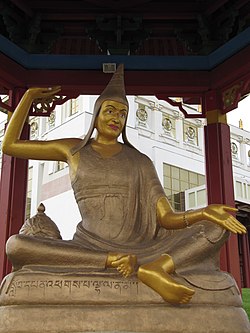
Āryadeva (fl. 3rd century CE) (IAST: Āryadeva; Tibetan: འཕགས་པ་ལྷ་, Wylie: 'phags pa lha, Chinese: 提婆 菩薩 Tipo pusa meaning Deva Bodhisattva), was a Mahayana Buddhist monk, a disciple of Nagarjuna and a Madhyamaka philosopher.[1] Most sources agree that he was from "Siṃhala", which some scholars identify with Sri Lanka.[1] After Nagarjuna, he is considered to be the next most important figure of the Indian Madhyamaka school.[2][3]

Āryadeva's writings are important sources of Madhyamaka in East Asian Buddhism. His Catuḥśataka (Four Hundred Verses) was influential on Madhyamaka in India and China and his *Śataka (Bailun, 百論, T. 1569) and Dvādaśamukhaśāstra (both translated by Kumārajīva in the 4th century) were important sources for the East Asian Madhyamaka school.[1] Āryadeva is also known as Kanadeva, recognized as the 15th patriarch in Chan Buddhism and some Sinhalese sources also mention an elder (thera) called Deva which may also be the same person.[1] He is known for his association with the Nalanda monastery in modern-day Bihar, India.[4]

Biography

[edit]
Aryadeva

The earliest biographical sources on Aryadeva state that he was a Buddhist monk who became a student of Nagarjuna and was skilled in debate.[3][2]

According to Karen Lang:

The earliest information we have about the life of Aryadeva occurs in the hagiography translated into Chinese by the Central Asian monk Kumarajiva (344–413 c.e.). It tells us that he was born into a Brahmin family in south India and became the spiritual son of Nagarjuna. Aryadeva became so skilled in debate that he could defeat all his opponents and convert them to Buddhism. One defeated teacher’s student sought him out and murdered him in the forest where he had retired to write. The dying Aryadeva forgave him and converted him to Buddhism with an eloquent discourse on suffering.[5]

Lang also discusses Xuanzang's (7th century) writings which mention Aryadeva:

He reports that Aryadeva came to south India from the island of Simhala because of his compassion for the ignorant people of India. He met the aging Nagarjuna at his residence on Black Bee Mountain, located southwest of the Satavahana capital, and became his most gifted student. Nagarjuna helped Aryadeva prepare for debate against Brahmanical teachers who had defeated Buddhist monks in the northeastern city of Vaisali for the previous twelve years. Aryadeva went to Vaisali and defeated all his opponents in less than an hour.[5]

Tom Tillemans also notes that Aryadeva's origins in Siṃhaladvīpa (Sri Lanka) are supported by his commentator Candrakīrti (sixth century C.E.), and "may possibly be confirmed by references in the Ceylonese chronicles Dīpavaṃsa and Mahāvaṃsa to a “Deva” who lived in the second half of the third century at the time when the Indian Vetullavāda sect of Great Vehicle Buddhism was temporarily implanted in Śrī Laṅka."[6]

Works

[edit]

Most of Āryadeva's works were not preserved in the original Sanskrit but mainly in Tibetan and Chinese translations.

Four Hundred Verses

[edit]

The Catuḥśataka śāstra kārikā (the Four Hundred Verse Treatise) is Āryadeva's main work. It is available in fragmentary Sanskrit, in Xuanzang's Chinese translation of the second part only, and in a full Tibetan translation.[7]

It is a work of sixteen chapters. David Seyfort Ruegg outlines the content as follows:

(i—iv) Elimination of the erroneous positing of things as permanent (nitya), pleasant (sukha), pure (asubha or suci), and self (atman) (according to Candrakirti these four chapters which dispel the four viparyasas explain the nature of mundane things so that they may be abandoned and buddhahood may be achieved), (v) The Bodhisattva's practice (which makes it practically possible to achieve Buddhahood). (vi) Elimination of the defilements (klesa) which hinder the preceding, (vii) Elimination of attachment to the enjoyment of seemingly desirable sensory objects (visaya), which causes the defilements to arise and increase. And (viii) the practice of the disciple. The first eight chapters of the Catuḥśataka are thus concerned with the preparation of those who practise the path. The last eight chapters then explain the non-substantiality of the dharmas. They deal in turn with the negation (pratisedha) of (ix) permanent entities, (x) self (atman), (xi) time, (xii) dogmatic opinions (drsti), (xiii) sense-faculties and their objects, (xiv) the positing of doctrinal extremes (antagraha, e.g. existence, non-existence, both, and neither) with special reference to identity and difference, and (xv) the positing of conditioned (samskrta) things as real. Finally chapter xvi, entitled 'An exposition of the cultivation of ascertainment for master and disciple', is devoted to a consideration of logical and epistemological problems in the doctrine of sunyata. In particular, it is pointed out (in conformity with Vigrahavyavartani 29—30) that he who does not maintain a thesis (paksa) based on the positions of existence (sat), non-existence (asat), and both cannot be attacked in logic by an opponent (xvi. 25).[8]

There also exists a complete commentary to this text by Chandrakirti which is only extant in Tibetan.[9]

Xuanzang also translated Dharmapāla’s commentary to verses 201–400 of the Catuḥśataka, published as Dasheng Guang bailun shi lun (大乘廣百論釋論, T. 1571).[1]

Other attributed texts

[edit]

Two other texts which are attributed to Āryadeva in the Chinese tradition (but not the Tibetan) are the following:

  • Śataśāstra (Bailun, 百論, Treatise in One Hundred Verses, Taisho 1569), which only survives in Kumarajiva's Chinese translation. However, according to Ruegg, the attribution of this work to Aryadeva is uncertain.[10] This text also comes with a commentary by an author known as Vasu (婆藪).[1] This text is closely connected to the Catuḥśataka.
  • Akṣaraśataka (Baizi lun, 百字論, One Hundred Syllables, T. 1572) and its Vritti is sometimes attributed to Nagarjuna in the Tibetan tradition, but the Chinese tradition attributes this to Āryadeva.[11]

Possible wrong attributions

[edit]

Chinese sources attribute a commentary to Nagarjuna's Madhyamakasastra ascribed to a "Pin-lo-chieh" ("Pingala") as being a work of Āryadeva. But this attribution has been questioned by some scholars according to Ruegg.[2]

Vincent Eltschinger also notes three other texts in the Chinese canon which are attributed to Āryadeva, but these attributions are dubious according to Eltschinger:[1]

  • *Mahāpuruṣaśāstra, Dazhangfu lun (大丈夫論, T. 1577)
  • Tipo pusa po Lengqie jing zhong waidao xiaosheng sizong lun (Treatise on the Refutation of Heterodox and Hīnayāna Theses in the Laṅkāvatārasūtra 提婆菩薩破楞伽經中外道小乘四宗論, T. 1639)
  • Tipo pusa shi Lengqie jing zhong waidao xiaosheng niepan lun (Treatise on the Explanation of Nirvāṇa by Heterodox and Hīnayāna Teachers in the Laṅkāvatārasūtra 提婆菩薩釋楞伽經中外道小乘涅槃論 T. 1640)

The Hastavalaprakarana (Hair in the Hand) is attributed to Dignaga in the Chinese tradition and to Āryadeva in the Tibetan tradition. Modern scholars like Frauwallner, Hattori and Ruegg argue that it is likely by Dignaga.[11][1]

According to Ruegg "the bsTan'gyur also contains two very short works attributed to Aryadeva, the *Skhalitapramathanayuktihetusiddhi and the *Madhyamakabhramaghata".[12]

Tillemans writes that while Tibetans attribute the Destruction of Errors about Madhyamaka (*madhyamakabhramaghāta), "this text copiously borrows from the Verses on the Heart of  Madhyamaka (madhyamakahṛdayakārikā) and Torch of Dialectics (tarkajvālā) of Bhāviveka, a celebrated Mādhyamika who lived in the sixth century (i.e., 500-570 C.E.)" and thus cannot be Aryadeva's.[6]

The Tantric Āryadeva

[edit]

Several important works of esoteric Buddhism (most notably the Caryamelapakapradipa or "Lamp that Integrates the Practices" and the Jñanasarasamuccaya) are attributed to Āryadeva. Contemporary research suggests that these works are datable to a significantly later period in Buddhist history (late ninth or early tenth century) and they are seen as being part of a Vajrayana Madhyamaka tradition which included a later tantric author also named Āryadeva.[13] Tillemans also notes that the Compendium on the Essence of Knowledge (jñānasārasamuccaya) "gives the fourfold presentation of Buddhist doctrine typical of the doxographical (siddhānta) literature, a genre which considerably post-dates the third century".[6]

Traditional historians (for example, the 17th century Tibetan Tāranātha), aware of the chronological difficulties involved, account for the anachronism via a variety of theories, such as the propagation of later writings via mystical revelation. A useful summary of this tradition, its literature, and historiography may be found in Wedemeyer 2007.

References

[edit]

Bibliography

[edit]
[edit]
Revisions and contributorsEdit on WikipediaRead on Wikipedia
from Grokipedia
Āryadeva (fl. ca. 225–250 CE) was an influential Indian and philosopher, best known as the primary disciple of Nāgārjuna and a foundational figure in the school of Mahāyāna , where he advanced the doctrine of (śūnyatā) through dialectical arguments against inherent existence. Born into a royal family in Siṃhala (modern-day ), he renounced the throne, ordained as a , studied Buddhist scriptures, and traveled to southern to become Nāgārjuna's direct student, excelling in debates with non-Buddhist scholars. His seminal text, the Catuḥśataka (Four Hundred Stanzas), a verse in 16 chapters, systematically refutes the views of Brahmanical schools like Sāṃkhya and Vaiśeṣika, as well as rival Buddhist doctrines, by demonstrating the impermanence, conditionality, and lack of independent in all phenomena to dispel attachments such as permanence and self-preoccupation. Another key work, the Śataśāstra (One Hundred Treatise), translated into Chinese by , critiques erroneous views on nirvāṇa and influenced East Asian Buddhist traditions, particularly the Sanlun school. Āryadeva's philosophy emphasizes a "thesisless quietism," using to undermine metaphysical commitments without asserting positive doctrines, thereby guiding practitioners toward the path of and .

Biography and Historical Context

Early Life and Origins

Aryadeva, a pivotal figure in early , is traditionally dated to the 3rd century CE, with his activities flourishing during that period in southern . Traditional accounts place his birth in Simhala, identified as modern-day , where he was born into a and later renounced the throne to pursue monastic life. Alternative sources, such as the biography translated into Chinese by Kumarajiva (344–413 CE), describe him as originating from a South Indian family, highlighting the regional ambiguities in his origins that reflect the fluid transmission of hagiographical narratives across Buddhist traditions. These accounts often include legendary elements, such as a miraculous birth from a lotus flower, underscoring the mythic embellishments common in early Buddhist biographies. Biographical details about Aryadeva are primarily drawn from later hagiographical traditions (7th–16th centuries CE), which vary and include legendary elements, with little contemporary historical evidence available. From an early age, Aryadeva underwent rigorous monastic training, mastering the Tripitaka and engaging with non-Buddhist philosophies in his homeland before traveling to mainland . In or southern , he received initial and immersed himself in foundational , laying the groundwork for his later philosophical pursuits. His exposure to texts during this formative period is noted in traditional sources, where he encountered key doctrines that would shape his interpretations, though specific texts remain unspecified in the earliest records. Hagiographies from later eras blend historical facts with legendary feats, such as offering one of his eyes to an aged devotee, which earned him the epithet "Kanadeva" or "one-eyed," illustrating the blend of reverence and narrative flair in preserving his legacy.

Discipleship under

Aryadeva is universally recognized in Indian, Tibetan, and Chinese Buddhist traditions as the primary disciple of Nāgārjuna, the founder of the school, during the CE. Flourishing around 225–250 CE, Aryadeva succeeded Nāgārjuna as the leading exponent of philosophy in , where he played a crucial role in preserving and disseminating his teacher's doctrines. Traditional accounts preserved in Tibetan and Chinese sources depict Aryadeva as Nāgārjuna's direct spiritual heir, who consolidated the school's foundational principles after Nāgārjuna's passing. According to Candrakīrti's commentary on Aryadeva's Catuḥśataka, composed in the , Aryadeva was born into the royal family of Simhala (modern ) as the son of King Pañcāśṛṅga and initially known as Kāñcana . Renouncing his claim to the throne during the reign of King Vohārikatissa (3rd century CE), he traveled to the Deccan region in to study under Nāgārjuna, becoming his devoted pupil. These , echoed in Tibetan sources like Abhayākaragupta's 11th-century Caturāśītisiddhapravṛtti and Chinese Mahāyāna texts such as the Mahāprajñāpāramitāśāstra, highlight Aryadeva's transformation from prince to under Nāgārjuna's guidance. Under Nāgārjuna's mentorship, Aryadeva received direct transmission of key teachings, including the doctrine of () and the two truths—conventional and ultimate—which form the core of Nāgārjuna's . Tibetan traditions, particularly in the Kagyü school's lineage, portray Aryadeva as instrumental in systematizing these concepts, ensuring their continuity beyond Nāgārjuna's lifetime through his own compositions and oral instructions. Chinese sources similarly affirm this heirship, attributing to Aryadeva commentaries that elucidate Nāgārjuna's views on as the absence of inherent , thereby establishing him as the pivotal link in the lineage.

Debates, Later Activities, and Death

Following his discipleship under , Aryadeva engaged in prominent public debates that showcased the school's logical rigor against non-Buddhist opponents. In one notable encounter at Vaisali, local Buddhist monks had been repeatedly defeated by Brahmanical teachers, prompting the king to summon Aryadeva for a formal . Drawing on principles of , Aryadeva decisively refuted the opponents' positions in less than an hour, silencing them and affirming the superiority of Buddhist dialectics, as recounted in traditional Indian and Chinese pilgrimage accounts. These debates, preserved in hagiographical narratives rather than contemporary inscriptions or archaeological records, highlight Aryadeva's role in defending and propagating teachings during the 3rd century CE. In his later years, Aryadeva undertook missionary efforts across northern , including conversions of defeated adversaries who embraced after intellectual confrontations. For instance, his with the Brahmanical scholar Matricheta not only vanquished the opponent's theistic arguments but also led to Matricheta's eventual and composition of Buddhist hymns, demonstrating Aryadeva's emphasis on compassionate persuasion over mere victory. These activities extended influence, with Aryadeva employing concepts from his Catuḥśataka as dialectical tools to dismantle doctrinal extremes. Traditional biographies in the Tibetan canon portray this phase as one of active dissemination, though direct epigraphic evidence remains absent, underscoring the reliance on later historiographical traditions like those of and Bu ston. Aryadeva's life ended violently due to the resentment stirred by his successful refutations of non-Buddhist schools. According to Tibetan hagiographies, he was assassinated by a vengeful disciple of a defeated heretic teacher, who stabbed him in an act of retaliation. On his deathbed, Aryadeva exemplified by dismissing his attendants, forgiving the assassin, and delivering final teachings that enlightened the killer, leading to his conversion before Aryadeva's passing near Kanci in . This account, drawn from sources such as Taranatha's , emphasizes Aryadeva's bodhisattva-like compassion amid adversity, though it lacks corroboration from 3rd-century artifacts and rests on 12th- to 17th-century Tibetan compilations.

Philosophical Contributions to Madhyamaka

Core Concepts of Emptiness

Aryadeva's central philosophical contribution lies in his elaboration of (), defined as the absence of inherent or intrinsic existence in all phenomena, which arise solely through dependent origination on causes and conditions. Extending Nāgārjuna's foundational teachings, Aryadeva applies this concept systematically to ethical realms, such as non-attachment to worldly desires, and perceptual realms, where sensory experiences are shown to be illusory and devoid of independent reality, thereby guiding practitioners toward liberation from suffering. Aryadeva places unique emphasis on the emptiness of the (pudgala-nairātmya) and the emptiness of phenomena (dharma-nairātmya), treating them as interconnected aspects of a single . For the , he demonstrates through logical that no permanent, independent entity exists within the psycho-physical aggregates, conceptual classes, or causal sources, using examples like the illusory adherence to an "inner " or the impermanent role of kings to illustrate how self-grasping arises from and must be discarded to uproot afflictions. In the domain of phenomena, Aryadeva refutes inherent existence in entities such as —mere absence without form—atoms, which dissolve into parts and lack permanence, and everyday objects like vases, which are mere imputations on conglomerates of substances, extending to perceptual illusions like mirages that appear real but lack substantiality. Central to Aryadeva's framework are the two truths—conventional (saṃvṛti-satya) and ultimate (paramārtha-satya)—which delineate the relative, illusion-like functionality of in mundane affairs from their ultimate , ensuring that insight into does not negate ethical action or perceptual engagement. This distinction avoids reification, the erroneous imputation of inherent reality to dependently arisen things, by steering between the extremes of eternalism (positing true ) and (denying all functionality). Aryadeva's logical structure unfolds through reductio arguments: if a possessed inherent , it would be uncaused and eternal, yet reveals all things as conditioned and impermanent; thus, their follows, with the interdependence of one entity implying universal , as "the of one implies the of all."

Refutation of Doctrinal Extremes

Aryadeva's refutation of doctrinal extremes centers on demonstrating how both eternalism (śāśvatavāda) and (ucchedavāda) arise from a fundamental misapprehension of (śūnyatā), the core insight that all phenomena lack inherent existence. Eternalism posits enduring, independent entities such as a permanent self or unchanging dharmas, while nihilism denies continuity and causal efficacy, implying total annihilation after death. In his Catuḥśataka (Four Hundred Verses), Aryadeva argues that these views fail to grasp dependent origination, leading to absurd consequences: eternalism renders change impossible, as an unchanging entity cannot interact or decay, whereas nihilism undermines by eliminating karmic repercussions. To dismantle these positions, Aryadeva employs the prasanga method, a form of that exposes internal contradictions in opponents' doctrines without asserting positive claims of his own. This dialectical approach reveals the logical incoherence of assuming inherent existence or non-existence. For instance, against the school's assertion that exist substantially across past, present, and future, Aryadeva questions how a could transition between times without altering its , leading to the absurdity of simultaneous existence and non-existence; if a is truly permanent, it cannot "become" present from the future, nor cease in the past. Such arguments target substantialist philosophies broadly, showing that positing real, independent entities inevitably collapses into one extreme or the other. Unlike Nagarjuna's more abstract, prose-based analyses in the Mūlamadhyamakakārikā, Aryadeva's refutations are distinctly pedagogical, presented in concise verses designed for monastic study and memorization. This verse format facilitates step-by-step deconstruction, making complex dialectics accessible to audiences training in , while emphasizing as the middle path that transcends both extremes without falling into them.

Relation to Nagarjuna's Teachings

Āryadeva, recognized as Nāgārjuna's principal disciple, maintained a profound alignment with his teacher's core doctrines, particularly in their mutual advocacy for the (madhyamā pratipad), which steers clear of eternalist and nihilist extremes. Both emphasized non-duality (advaya), positing that all phenomena lack inherent existence (svabhāva), rendering them (śūnya) of independent reality while dependently arisen. This shared rejection of svabhāva forms the bedrock of their philosophical system, where is not a nihilistic void but a liberating insight into the interdependent nature of reality, enabling freedom from reification and . In contrast, Āryadeva's methodological and applicative emphases diverge from Nāgārjuna's more purely dialectical style. Nāgārjuna's Mūlamadhyamakakārikā primarily employs an apophatic strategy of deconstruction, using reductio ad absurdum to expose the inconsistencies in opponents' views without advancing affirmative propositions. Āryadeva, however, introduces more systematic refutations, such as the "neither one nor many" (naikānekavāda) dialectic, to methodically dismantle substantialist claims across Buddhist and non-Buddhist schools. Moreover, Āryadeva extends Madhyamaka into explicit ethical dimensions, linking emptiness realization to bodhisattva ethics, meditation on illusions, and the practical eradication of afflictions (kleśa), thereby orienting the philosophy toward soteriological and moral practice in a way that complements but surpasses Nāgārjuna's debate-focused approach. Modern scholarship positions Āryadeva as a "second founder" of , crediting him with systematizing Nāgārjuna's insights and adapting them for broader pedagogical and ethical utility, thus ensuring the tradition's doctrinal coherence and transmission. His contributions, especially in the Catuḥśataka, are viewed as forming a unified "father-son" corpus with Nāgārjuna's works, integral to the school's development. Scholarly debate persists over the Akutobhayā, an early commentary on the traditionally attributed to Nāgārjuna, with some questioning its authorship, underscoring the intertwined nature of their intellectual legacies.

Major Works and Texts

The Four Hundred Verses (Catuḥśataka)

The Catuḥśataka (Four Hundred [Stanzas]), also known as the Catuḥśataka-kārikā, is Āryadeva's principal philosophical treatise, composed in during the mid-3rd century CE as a systematic exposition of thought for aspiring s. The work consists of exactly 400 verses organized into 16 chapters of 25 verses each, blending practical guidance on bodhisattva cultivation with dialectical refutations of erroneous views. Its structure divides broadly into two halves: the first eight chapters address the elimination of afflictions (kleśa) through insight into their illusory nature, while the latter eight focus on refuting misconceptions about external objects and doctrinal extremes, thereby establishing the epistemological foundations of (). The opening chapters (1–4) outline methods for rejecting fundamental misconceptions that fuel : belief in permanence (chapter 1), sensory pleasure as ultimate (chapter 2), inherent purity (chapter 3), and a substantial (ātman, chapter 4). These are followed by chapters on practices (chapter 5), countering afflictions (chapter 6), detaching from sensual desires (chapter 7), and the ethical conduct of the practitioner (chapter 8). The second half shifts to ontological analysis, examining the refutation of permanent entities (chapter 9), the (chapter 10), time (chapter 11), speculative views (dṛṣṭi, chapter 12), faculties and their objects (chapter 13), extreme positions like eternalism and (chapter 14), conditioned phenomena (chapter 15), and culminating in a between teacher and student (chapter 16). A central theme throughout is the illusion-like (māyopama) quality of all phenomena, where Āryadeva employs to demonstrate that clinging to real existence in either afflictions or objects leads to contradiction, urging reliance on conventional truth while realizing ultimate . For instance, in verses addressing afflictions, he likens them to mirages, devoid of intrinsic nature yet appearing vividly due to ignorance. The Catuḥśataka also engages non-Buddhist schools, such as Sāṃkhya and Vaiśeṣika, by critiquing their posits of eternal souls or atoms, integrating these refutations into the bodhisattva's path of accumulating merit and wisdom. This epistemological approach underscores Madhyamaka's prasaṅga method, avoiding positive assertions while dismantling opponents' positions to reveal the free from extremes. The text's emphasis on practical application distinguishes it as a manual for yogic deeds (yogacaryā), guiding practitioners toward non-conceptual wisdom. Preservation of the Catuḥśataka relies on fragmentary manuscripts, collated in modern editions from sources like those used by Candrakīrti in his 7th-century commentary, the Catuḥśataka-ṭīkā. The complete text survives in Tibetan translation within the Tengyur (Toh. 3846), rendered by teams including Jinamitra and Jñānagarbha in the late 8th to early 9th centuries during the Tibetan imperial period. A complete Chinese translation was made by in the 7th century CE (T. 1570), contributing to its study in East Asian traditions. This multilingual transmission facilitated the text's influence across Indian, Tibetan, and East Asian Buddhist traditions, with commentaries by figures like Dharmapāla and Candrakīrti preserving interpretive lineages.

Other Attributed Works

In addition to the Catuḥśataka, Āryadeva is traditionally attributed with the Jñānasārasamuccaya, a succinct that synthesizes key aspects of ethics and , emphasizing the cultivation of through the refutation of inherent in moral and cognitive frameworks, though modern scholars debate its authorship due to doctrinal differences. This work, comprising verses on the path to enlightenment, is preserved exclusively in Tibetan translation within the Derge Tengyur (Toh. 3851), reflecting its transmission through early Tibetan collections of Indian texts. Another attributed composition is the Akṣaraśataka (Hundred Syllables Treatise), a 100-verse that employs linguistic and logical scrutiny to elucidate the of phenomena, particularly through syllogistic arguments demonstrating impermanence and interdependence in verbal and conceptual constructs. fragments survive alongside complete Tibetan and Chinese versions, the latter translated by Bodhiruci in the early 6th century (Taishō 1572), underscoring its role in cross-cultural dissemination of dialectics. These attributions are supported by references in classical Indian commentaries and colophons in Tibetan and Chinese canons, where the Jñānasārasamuccaya and Akṣaraśataka are explicitly linked to Āryadeva as extensions of his foundational expositions on non-substantiality, though some are subject to scholarly debate.

Disputed and Spurious Attributions

The Śataśāstra (Hundred Treatise), preserved solely in its Chinese translation by Kumārajīva from 404 CE (T. 1569), has been traditionally attributed to Āryadeva but faces scholarly debate regarding authorship due to notable stylistic differences from his undisputed works like the Catuḥśataka and indications of a possibly later composition. Scholars point to its concise prose structure and emphasis on refuting non-Buddhist schools, which diverge from the verse-based dialectical approach typical of early Madhyamaka texts associated with Āryadeva. Among spurious attributions, the Hastavākyaprakaraṇa (Treatise on the Statements of the Hand) has been rejected by modern scholars on grounds of doctrinal inconsistencies with core principles, such as its apparent deviation from the radical doctrine central to Āryadeva's teachings. David Seyfort Ruegg, in his 1981 analysis, highlights these inconsistencies, arguing that the text likely originates from a later period or different author within the broader tradition. Criteria for attributing works to Āryadeva generally involve linguistic analysis to assess verse style and terminology alignment with known fragments, doctrinal consistency with Madhyamaka's emphasis on emptiness (), and evaluation of historical testimonies from Indian, Tibetan, and Chinese catalogs. For instance, texts preserved only in translation, like the Śataśāstra, undergo scrutiny for potential interpolations, while Tibetan-exclusive works such as the Jñānasārasamuccaya and Madhyamakabhramaghāta are often deemed spurious based on these standards, as noted by Hajime Nakamura.

Legacy and Influence

Impact on Indian and Tibetan Buddhism

Aryadeva's philosophical framework, particularly his elaboration of emptiness (śūnyatā) and refutation of inherent existence, played a foundational role in the development of the Prāsangika-Madhyamaka subschool within Indian Buddhism during the 5th to 7th centuries CE. As Nāgārjuna's primary disciple, Aryadeva's works provided the interpretive basis for later thinkers like Buddhapālita (c. 5th century), who advanced consequentialist (prasaṅga) methods to critique opponents without asserting independent syllogisms, thereby establishing key Prāsangika hermeneutics. Candrakīrti (c. 7th century), in turn, defended and expanded Aryadeva's positions in commentaries such as the Catuḥśatakaṭīkā, emphasizing reductio ad absurdum arguments to undermine essentialist views across Buddhist and non-Buddhist schools, thus solidifying Prāsangika as the pinnacle of Madhyamaka exegesis. In Tibetan Buddhism, Aryadeva's texts were systematically translated and incorporated into the Tengyur (bsTan 'gyur), the section of the Tibetan canon dedicated to Indian treatises and commentaries, ensuring their preservation and study across monastic lineages. Tsongkhapa (1357–1419), the founder of the Gelugpa school, extensively engaged with Aryadeva's writings in his seminal works, such as the Ocean of Reasoning (rTsa shes kyi nyi ma, 1408), where he highlighted Aryadeva's refutations of misconceived views on to advocate for a refined Prāsangika interpretation aligned with dependent origination. This emphasis influenced Gelugpa doctrinal training, positioning Aryadeva's insights as essential for debating epistemological and ontological subtleties. Aryadeva's legacy significantly shaped ongoing debates between the Svātantrika and Prāsangika subschools in Tibetan , particularly through his texts' role in clarifying the use of autonomous inferences versus purely consequentialist approaches to establishing . While no archaeological evidence attests to his life or direct institutions, his strong textual legacy—transmitted via commentaries and canonical inclusion—underscores his enduring impact on these interpretive rivalries, with Prāsangika proponents like Tsongkhapa invoking Aryadeva to critique Svātantrika concessions to conventional validity.

Transmission to East Asian Traditions

The transmission of Āryadeva's ideas to East Asian Buddhist traditions began in the early 5th century through the translations of the Central Asian monk Kumārajīva (344–413 CE), who rendered key Madhyamaka texts into Chinese during his tenure at the Yaowangsi and Xiaoyao temples in Chang'an under the Eastern Jin and Later Qin dynasties. Among these, Kumārajīva's translation of Āryadeva's Śataśāstra (One Hundred Treatise) in 404 CE played a pivotal role, forming one of the foundational texts for the emerging Sanlun (Three Treatise) school alongside Nāgārjuna's Mūlamadhyamakakārikā and Dvādaśanikāyaśāstra. This school, emphasizing the doctrine of emptiness (śūnyatā) as the core of Madhyamaka thought, integrated Āryadeva's refutations of extremes despite ongoing doctrinal disputes with rival traditions like the Chengshi (Satyaśāsī) and emerging Tathāgatagarbha schools, which challenged its non-substantialist interpretations. Āryadeva's significance extended into Chan () lineages, where he was recognized as the 15th Indian patriarch following Nāgārjuna, linking philosophy to the meditative transmission narratives that shaped Chan identity from the onward. This patriarchal positioning, drawn from Chan records like the Jingde chuandeng lu (1004 CE), underscored Āryadeva's role in bridging doctrinal analysis with direct insight practices, influencing Chan masters such as Sengzhao (374–414 CE), a disciple of who further elaborated on in works like the Zhaolun. The Sanlun tradition spread from China to Korea during the Three Kingdoms period, establishing it as a foundational influence on Korean Madhyamaka interpretations. In Japan, the school arrived in 625 CE via the Korean monk Hyegwan (Ekan), becoming known as Sanron-shū and ranking among the six Nara schools; it was patronized at temples like Gangō-ji, where Āryadeva's Śataśāstra informed debates on emptiness within the broader doctrinal framework. Although the Sanron school declined by the Heian period, its emphasis on Āryadeva's ideas persisted indirectly in later sects, including elements of the Kegon (Huayan) school's synthesis of Madhyamaka with interpenetration doctrines.

Modern Scholarly Interpretations

In the late , scholars like Malcolm David Eckel examined the ethical dimensions of Aryadeva's , emphasizing how his refutations in the Catuḥśataka integrate moral practice with philosophical analysis of , portraying not as absolute rules but as conventional means to realize non-inherent existence. , in his 2002 collection Empty Words, highlights Aryadeva's logical innovations, such as his extension of arguments to critique inherentism across doctrines, positioning him as a pivotal figure in developing 's dialectical method beyond Nagarjuna's foundational texts. Post-2010 scholarship has increasingly debated Aryadeva's role in non-sectarian , viewing his works as foundational for later syntheses that transcend Prāsaṅgika-Svātantrika divides; for instance, contributors to the 2015 volume and : Allies or Rivals? argue that Aryadeva's emphasis on universal facilitates dialogue between and other Mahāyāna schools without dogmatic allegiance. Interpretations often portray Aryadeva as bridging philosophy and practice, with his verses offering both deconstructive logic and soteriological guidance for bodhisattvas, as seen in modern translations and commentaries on the Catuḥśataka, such as Karen Lang's 1986 work. Critiques of Eurocentric views in Aryadeva scholarship underscore how early Western analyses overlooked indigenous Asian interpretive contexts, such as Tibetan commentarial traditions that emphasize his texts' meditative applications over purely logical dissection; Kopf's 2001 study Beyond Personal Identity exemplifies this by recontextualizing Aryadeva's doctrine within East Asian non-dual frameworks ignored by colonial-era Indologists. Scholarly gaps persist due to the absence of archaeological evidence linking Aryadeva to specific historical sites, limiting material corroboration of textual accounts, yet growing interest in digital editions of Tibetan translations—such as those digitized by the Buddhist Digital Resource Center (BDRC) as of 2025—has enabled fresh comparative analyses of variant readings in his attributed works, revealing nuances in non-sectarian interpretations.

Distinctions from Later Figures

The Tantric Āryadeva

The Tantric Āryadeva, distinct from the earlier Madhyamaka philosopher who served as a namesake precursor, flourished in the early 9th century CE as a key figure in late Indian tantric Buddhism, particularly within the Vajrayāna tradition centered in eastern India. Associated with the Ārya school of Guhyasamāja exegesis, he contributed to the development of esoteric practices during the Pala dynasty's patronage of tantric institutions like Nālandā and Vikramaśīlā. Traditional Tibetan and Indian accounts link him to Nāgārjuna's tantric lineage, depicting him as a direct successor who transmitted advanced yogic methods from the Esoteric Community (Guhyasamāja) tradition. Āryadeva's most influential work, the Caryāmelāpakapradīpa (Lamp Uniting the Practices), offers a comprehensive guide to yogic cultivation, emphasizing realization through a gradual path that integrates physical, verbal, and mental disciplines. Presented as a between a master and disciple, the text outlines stages of tantric practice, from preparatory vows to the nondual union of bliss and emptiness, drawing on the to harmonize antinomian elements with broader Mahāyāna frameworks. Its structured approach to advanced yogas, including and subtle-body manipulations, exerted significant influence on later tantric commentaries in both and . Other texts attributed to this Āryadeva include the Cittaviśuddhiprakaraṇa (Treatise on the Purification of Mind), which justifies transgressive tantric conduct—such as ritual sexuality—as a means to purify mental defilements while aligning with Mahāyāna . Scholarly analysis dates these compositions to the early , reflecting a doctrinal evolution toward esotericism that marks Āryadeva as a separate from his classical counterpart, with no evidence of direct continuity in authorship or biography. This consensus arises from linguistic, doctrinal, and chronological discrepancies, underscoring the Tantric Āryadeva's role in the maturation of Vajrayāna .

Scholarly Debates on Identity and Attribution

In Tibetan Buddhist traditions, the classical philosopher Āryadeva, active in the third century CE, is frequently conflated with a later tantric master of the same name, resulting in a unified hagiographical that portrays a single figure renowned for both philosophical and esoteric contributions. This merging likely stems from the prestige of the lineage, which later tantric authors invoked to legitimize their works, as seen in colophons and commentaries that attribute tantric texts like the Caryāmelāpakapradīpa to the early Āryadeva. Modern scholars, however, emphasize clear distinctions between these figures based on chronological evidence and stylistic differences in their compositions. The classical Āryadeva's works, such as the Catuḥśataka, reflect early dialectics focused on (), while tantric attributions involve later medieval developments in Vajrayāna practices, dating to the eighth century or beyond. Christian K. Wedemeyer, in his analysis of tantric , argues that such identifications were strategic, conferring authoritative continuity on esoteric traditions without historical basis, as the tantric Āryadeva's era aligns more closely with the maturation of Guhyasamāja . Further complexities arise from potential overlaps with other historical figures named Āryadeva or similar epithets, including the "elder deva" (thera deva) referenced in Sri Lankan chronicles like the and , which some scholars propose as a reference to the master due to shared South Indian or Sinhalese origins. Attribution in these cases relies on manuscript colophons, doctrinal coherence, and cross-references in Indian and Tibetan catalogs, which often reveal pseudepigraphic tendencies in tantric corpora. As of 2025, ongoing scholarly discussions in tantric studies continue to interrogate these cross-attributions, particularly those perpetuated in colonial-era translations that blurred Indian doxographical lines, with recent analyses highlighting the need for philological reevaluation of and Tibetan sources to disentangle authentic from apocryphal lineages.

References

Add your contribution
Related Hubs
User Avatar
No comments yet.