Hubbry Logo
KhanateKhanateMain
Open search
Khanate
Community hub
Khanate
logo
7 pages, 0 posts
0 subscribers
Be the first to start a discussion here.
Contribute something
Khanate
Khanate
from Wikipedia

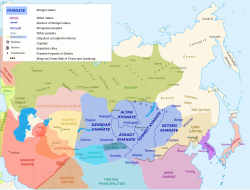
A khanate (/ˈxɑːnt, -ət/ KHAHN-ayt, -⁠ət) or khaganate was a polity ruled by a khan, khagan, khatun, or khanum.[1][2] Khanates were typically nomadic Mongolic and Turkic societies located on the Eurasian Steppe,[3][4][5] and politically equivalent in status to kinship-based chiefdoms and feudal monarchies. Khanates and khaganates were organised tribally, where leaders gained power on the support and loyalty of their warrior subjects,[3] gaining tribute from subordinates as realm funding.[6] In comparison to a khanate, a khaganate, the realm of a khagan, was a large nomadic state maintaining subjugation over numerous smaller khanates.[7] The title of khagan, translating as "Khan of the Khans", roughly corresponds in status to that of an emperor.[4]

Mongol khanates

[edit]
The successor states of the Mongol Empire in 1335: the Ilkhanate, Golden Horde, Yuan dynasty and Chagatai Khanate

Indefinite origin

[edit]
Hunnic Empire of Attila in c. 450 CE

Turkic khanates

[edit]

Early and Late Medieval Turkic khaganates and khanates

[edit]
Khazar Khaganate, 650–850 CE
Cumania, c. 1200 CE
Tamgha of the Bulgar Turkic Dulo clan which ruled the First Bulgarian Empire

Central Asian Turkic khanates

[edit]

Khanates of Azerbaijan

[edit]

Khanates of the Caucasus

[edit]

Other khanates

[edit]

See also

[edit]

References

[edit]
[edit]
Revisions and contributorsEdit on WikipediaRead on Wikipedia
from Grokipedia
A khanate is a political entity or territory governed by a khan, a title denoting supreme leadership among nomadic Mongolic and Turkic tribes of the Eurasian steppes. The term originates from the Mongolian tribal rulers who adopted "khan" as a mark of authority, later extending to Muslim polities in and beyond. Following the death of in 1227, his empire fragmented into major khanates assigned to his sons and grandsons, including the in the northwest, the in , the in Persia, and the in , which functioned as a khanate under Mongol rule. These successor states maintained the Mongol military decimal system and nomadic structures but increasingly integrated local sedentary administrations, languages, and religions, leading to processes like Turkicization in the and Chagatai realms. Khanates played pivotal roles in Eurasian connectivity, enforcing tribute systems that sustained long-distance trade along revived routes and fostering cultural syntheses between steppe warriors and urban civilizations, though internal succession disputes and external pressures often precipitated their decline by the 16th to 18th centuries. Later examples, such as the Kazakh and Crimean khanates, perpetuated khan-centric governance amid interactions with rising powers like Muscovy and the Ottomans, until absorption into modern nation-states.

Definition and Etymology

Origin and Meaning of "Khan"

The title "khan" (also spelled qaγan in reconstructed forms) originates as a term denoting a ruler or lord among the of the , with its earliest attested usage appearing in the context of the around 402 CE, when Shelun adopted it as a marker of independent authority derived from influences. Etymologically, the word is most plausibly of Turkic origin, functioning as a contraction of khaqan (), signifying "prince" or "," though possible connections to proto-Mongolic, Korean, or even ancient Chinese linguistic elements have been proposed without definitive consensus. This title emerged in the linguistic milieu of Central Asian pastoralist societies, where it encapsulated leadership over tribal groups sustained by mobile herding and warfare, predating its widespread adoption by Mongol and later Turkic confederations. In its core meaning, "khan" referred to a supreme tribal chieftain whose authority was validated through martial prowess, alliances forged in , and acclaim from warrior assemblies rather than automatic hereditary succession, reflecting the meritocratic dynamics of nomadism where leaders rose by demonstrating the capacity to unite clans against rivals or sedentary states. This elevation distinguished the khan from lesser chiefs (beys or noyans), positioning him as the apex of a hierarchical order geared toward expansion and survival in harsh environments, as evidenced by its application to rulers who commanded loyalty via redistribution of spoils and protection of migratory routes. Chinese historical records, such as those from the dynasty, transcribed the term phonetically (e.g., as kan or qan) to describe overlords, underscoring its association with autonomous, non-sedentary potentates who extracted without fixed territorial . The term "khan" carried a nuanced distinction from the related title "," which denoted an or overlord of multiple khans, often reserved for the sovereign of a vast encompassing subordinate tribal realms, as in the Rouran and subsequent Turkic empires where khagans claimed universal dominion over allied hordes. In practice, this hierarchy allowed khans to govern semi-autonomous uluses (tribal domains) under a khagan's nominal , a structure that emphasized conquest-driven legitimacy over dynastic purity, though later usages blurred the lines as khans occasionally assumed khagan-like imperial pretensions. This differentiation highlights the title's adaptability to the fluid power structures of nomadic polities, where authority derived from demonstrated efficacy in warfare and coalition-building rather than institutionalized inheritance alone.

Characteristics of Khanate Governance

Khanate governance was characterized by a decentralized system, termed ulus, in which territories were apportioned among the khan's relatives, granting them semi-autonomous authority over assigned regions while maintaining nominal to the . This patrilineal division leveraged ties for administration, with revenue derived primarily from extracted from sedentary subjects and levies mobilized from nomadic tribes, minimizing fixed bureaucracies ill-suited to mobile pastoral economies. Such structures prioritized loyalty through personal bonds over institutional hierarchy, enabling adaptability to the steppe's vast, fluid landscapes. Military organization underpinned governance, with emphasis on cavalry-based mobility and decimal units for rapid deployment, where commanders drew on tribal contingents for campaigns rather than standing armies. Communication relied on the yam relay system, featuring stations spaced 25–40 miles apart that supplied couriers with remounts and provisions, facilitating orders' traversal of thousands of miles in days. This infrastructure, sustained by corvée labor from locals, ensured administrative reach without dense settlement. Internal cohesion was enforced via legal codes like the , a compilation of edicts covering , property rights, and prohibitions against or , with violations punished severely—often by —to deter disloyalty and standardize conduct across diverse groups. Periodic censuses tabulated households, livestock, and artisans for taxation and , as implemented systematically from the mid-13th century, providing empirical data for amid expansion. Khanates exhibited pragmatic , exempting clerics of various faiths from taxes and while permitting open worship, a policy that co-opted subject elites and mitigated revolts by prioritizing utility over doctrinal uniformity. This flexibility, rooted in shamanistic pluralism and conquest's demands, fostered stability among heterogeneous populations, though it yielded to Islamization in later successor states. The system's inherent adaptability—balancing with oversight—causally enabled conquests by allowing localized rule that absorbed administrative expertise from vanquished polities, sustaining momentum without overextension's collapse.

Historical Origins

Pre-Mongol Steppe Precursors

The confederation, formed circa 209 BCE under , exemplified early centralized leadership among nomads, uniting diverse tribes into a tribute-extracting empire that challenged the . The title denoted the supreme ruler, who commanded through military prowess and alliances rather than strict heredity, with succession often contested among elite lineages supported by Chinese annals. This structure relied on horse-mounted archery for rapid strikes, enabling dominance over sedentary polities without permanent settlements or bureaucratic administration. Archaeological evidence from elite kurgans in and southern reveals hierarchical burials with composite bows, iron precursors, and horse sacrifices, underscoring a warrior aristocracy bound by clan ties and pastoral mobility. Genetic analyses of remains indicate multi-ethnic composition, including eastern Eurasian and possible western elements, challenging singular Turkic, Mongolic, or Iranic attributions but confirming adaptive confederative governance. Chinese , such as the Shiji, detail tribute systems where vassal tribes supplied goods and warriors, fostering expansion across the Gobi to the Altai without formalized dynasties. In the 4th–6th centuries CE, the Xianbei and Rouran khaganates built on precedents, organizing proto-Mongolic tribes into expansive leagues via charismatic leaders like Tanshihuai, who coordinated invasions southward. The Rouran, ruling from circa 402–552 CE, first employed as a title for the paramount ruler—translating to "khan of khans"—over subordinate khans of allied clans, replacing the and emphasizing merit-based authority amid constant warfare. These polities' resilience stemmed from technological edges, including recurved bows effective at 300 meters and clan pacts that distributed herds and raids equitably, allowing control of territories from the Ordos to Lake Baikal without hereditary monopolies. Byzantine and Sui Dynasty sources on the westward-migrating Avars (6th–8th centuries) describe similar khagan-led hierarchies, where dual rulers (khagan and tudun) managed nomadic coalitions extracting tribute from Europe, evidenced by grave goods of sabers and cauldrons. Such formations prioritized martial coalitions over bloodlines, prefiguring khanate adaptability through empirical dominance rather than ideological claims.

Emergence in Nomadic Societies

The Eurasian Steppe's expansive, arid grasslands, characterized by short growing seasons and limited , compelled human populations to adopt nomadism as the dominant subsistence strategy from at least the late onward, with herders relying on sheep, , , and especially for mobility and sustenance. This inherently promoted decentralized social structures, as fixed settlements were impractical, and resource scarcity drove seasonal migrations across vast distances, typically 100-500 kilometers annually per . Horse around 3500 BCE further amplified this mobility, enabling nomads to traverse terrains impassable to infantry-based societies and to sustain herds through efficient foraging patterns tied to climatic cycles. Pastoralism's demands intertwined economic survival with perpetual low-level conflict, as for pastures, water, and from sedentary neighbors incentivized raiding economies; nomadic groups could mobilize 10-20% of their male as mounted archers within days, contrasting sharply with the slower of agrarian states. Such conditions precluded enduring bureaucratic hierarchies, which require sedentary taxation and administration, favoring instead transient authority vested in who demonstrated prowess in battle and alliance-building to coordinate multi-tribal raids. This charismatic leadership model arose causally from the steppe's volatility—droughts displacing up to 20-30% of herds in severe years, per paleoclimatic reconstructions—forcing coalitions to pool resources and warriors under a dominant figure to secure dominance over rivals and extract rents from transhumant trade. The consolidation into khanate-like systems marked a pivotal from fluid tribal confederacies, where authority fragmented after a khagan's , to conquest-oriented polities sustained by institutionalized and ; from archaeological sites in the Altai and regions shows fortified encampments emerging around 200-500 CE, correlating with expanded control over segments and the displacement of up to 100,000 individuals in localized conflicts as inferred from burial assemblages and migration patterns in isotopic analyses. These coalitions enabled nomads to monopolize key trade corridors, such as the , channeling commodities like and horses while imposing tariffs that could yield 10-15% of regional exchange value, thereby funding larger retinues and perpetuating the khan's centrality. Origins of the khanate framework remain debated, with linguistic evidence pointing to Proto-Turkic roots for the title qan (ruler), attested in from the 8th century CE and likely predating Mongolian usages, though some reconstructions posit broader Altaic substrates without definitive ethnic attribution. Scholarly consensus privileges inscriptional and toponymic data over speculative Indo-European or Iranian derivations, emphasizing functional adaptation to realia over primordialist claims; for instance, Rouran records from Chinese annals describe analogous hierarchical titles by the 5th century CE, underscoring convergence driven by ecological imperatives rather than singular diffusion. This evidence-based view counters narratives inflating singular ethnic origins, as genetic studies reveal admixed Turkic-Mongolic populations in polities, reflecting repeated fusions via conquest rather than purity.

Khanates of the Mongol Empire

Unification and Structure under Genghis Khan

Temüjin, born around 1162, rose through alliances, betrayals, and military victories against rival clans such as the Merkits and Tatars, culminating in the unification of Mongol tribes by 1206. At a kurultai assembly on the Onon River that year, tribal leaders proclaimed him Genghis Khan, meaning "universal ruler," granting him authority over an estimated 95 tribes and approximately 1 million people across the eastern steppe. This unification ended centuries of inter-tribal warfare, enabling centralized command through meritocratic appointments of noyans (commanders) selected for loyalty and prowess rather than birth, which disrupted traditional kinship-based loyalties and fostered discipline. Genghis Khan restructured the Mongol military into a to maximize mobility and cohesion, dividing forces into arbans of 10 warriors, jaguns of 100, mingghans of 1,000, and tumens of 10,000, with overall armies scaling to 3-4 tumens under trusted generals. This system, drawn from nomadic pastoralist practices but rigidly enforced, allowed rapid reconfiguration for , feigned retreats, and encirclements, compensating for initial numerical inferiority—Genghis commanded perhaps 100,000-130,000 troops at unification against fragmented foes. Logistics emphasized horse-based supply, with each warrior maintaining 3-5 remounts for sustained marches up to 100 kilometers daily, enabling strikes deep into settled territories without fixed supply lines. The , an oral legal code attributed to Genghis and gradually codified during his reign, mandated absolute obedience to the khan, prohibited corruption among officials, enforced to avoid alienating conquered subjects, and prescribed severe punishments like execution for or to instill fear and unity. Drawing from The Secret History of the Mongols—a 13th-century insider account generally reliable for core events when corroborated by Persian and Chinese chronicles—it prioritized causal deterrence over retribution, binding diverse clans through shared enforcement rather than custom. edicts, such as slaying negligent chieftains, ensured meritocratic , while pluralism facilitated integration of engineers and artisans from conquests for siege technology. These innovations proved causal in early expansions, as seen in the 1211 invasion of the Jin dynasty, where Mongol tumens exploited mobility to bypass fortifications, defeating a Jin force of 600,000 at minimal direct engagements through attrition and division. Similarly, the 1219 Khwarezm campaign, triggered by Shah Muhammad II's execution of a Mongol caravan and ambassador in , saw Genghis deploy 100,000-200,000 troops in coordinated columns to shatter a realm twice as populous, leveraging decimal flexibility for parallel sieges and pursuits across 2,500 kilometers. Logistical superiority—sustained by and captured herds—overcame Khwarezm's static defenses, demonstrating how unification and structure enabled conquests reliant on speed and coordination rather than sheer numbers.

The Four Primary Ulus Khanates

The Mongol Empire's vast territories were initially organized into ulus, or principalities, allocated among Genghis Khan's descendants to facilitate and , with each ulus functioning as a semi-autonomous khanate under the overarching authority of the Great Khan. This system, rooted in nomadic traditions of dividing herds and lands among heirs, ensured military obligations to the imperial center while allowing local adaptation, though tensions over succession often led to independence by the mid-13th century. Following Möngke Khan's death in 1259, the empire formalized its division into four primary ulus khanates around the 1260s, each tied to a branch of Genghis Khan's lineage: the (Great Khanate) in under ; the in the western Eurasian steppes under ; the in under Chagatai's successors; and the in Persia and the under Hulagu Khan. These khanates maintained nominal subordination to the Great Khan in the Yuan, who claimed universal sovereignty, but in practice pursued independent policies, with correspondence and occasional military aid underscoring the fragile hierarchy. The Yuan ulus, encompassing , northern , and Korea by 1279, was proclaimed by in 1271 after his 1260 election as Great Khan, integrating Chinese administrative scripts and systems to manage sedentary populations while preserving Mongol military elites. The Golden Horde, established circa 1242 after Batu's conquests from the Volga River to , controlled nomadic Kipchak tribes and Russian principalities through extraction and yam postal relays, adapting steppe mobility to vast grassland domains. The Chagatai Khanate, formalized around 1227 in and the [Tarim Basin](/page/Tarim Basin), relied on caravan trade routes and Islamic scholarly networks under early rulers like Chagatai, enforcing Mongol decimal military units amid Turkic-Persian cultural influences. The Ilkhanate, founded in 1258 following Hulagu's sack of Baghdad, spanned Persia, Iraq, and Anatolia, where Mongol overseers rapidly adopted Persian bureaucratic viziers and tax-farming diwans from Abbasid precedents to administer urban centers and irrigation systems, as documented in contemporary Persian chronicles. This adaptation bridged nomadic oversight with sedentary fiscal mechanisms, enabling revenue from silk roads and agriculture, though initial dual structures—parallel Mongol and Persian staffs—reflected caution toward local elites. Across the khanates, appanage principles prioritized lateral inheritance among brothers before sons, fostering rivalries but sustaining Mongol dominance through shared yassa legal codes and tumen armies.

Successor Khanates in Central Asia and Russia

Golden Horde and Its Fragments

The , founded by in the aftermath of the Mongol conquests of the 1230s and 1240s, established dominion over the eastern European steppes, including the Rus' principalities, through direct military subjugation and an indirect system of governance known as the yarlik system, wherein local princes received patents of authority in exchange for tribute and . Annual tributes from Rus' lands, calculated at approximately 1 silver per household plus furs and military levies, totaled around 10,000 pounds of silver equivalents by the mid-, enforced via periodic censuses and punitive campaigns like those under Öz Beg Khan (r. 1313–1341). This fiscal extraction funded Horde expeditions while fostering administrative delegation to loyal Rus' princes, notably Moscow's Ivan I Kalita (r. 1325–1340), who collected tributes as the khan's chief agent, amassing wealth that enabled Moscow's territorial consolidation amid rivals like . Over time, the Horde integrated Kipchak Turkic populations, who formed the majority of its subjects after the assimilation of nomadic and local Turkic groups, leading to linguistic and cultural Turkicization; by the 1350s, Kipchak had supplanted Mongolian as the elite's primary language, evidenced in administrative decrees and coinage inscriptions shifting from to Arabic-influenced Turkic forms. Moscow's ascent accelerated as the Horde weakened from internal succession disputes and external assaults, such as Timur's 1395 that sacked the capital New Sarai and fragmented authority; Ivan III Vasilyevich (r. 1462–1505) capitalized on this by withholding tributes from 1476 and culminating in the 1480 confrontation on the Ugra River against Akhmat Khan's forces, where mutual standoffs—due to Crimean Tatar diversions and Horde logistical strains—effectively ended Mongol overlordship without battle, marking Moscow's independence. The Horde's cohesion unraveled after 1430s civil wars, dissolving into successor khanates that inherited its territories and Turkic-Mongol elites. The Kazan Khanate, established in 1438 by after his expulsion from the Horde, controlled the middle until its conquest by Ivan IV in 1552 following repeated over tribute defaults and raids. The Astrakhan Khanate emerged around 1466 from Horde remnants on the lower , sustaining trade hubs until Russian forces under Yuri Ivanovich captured it in 1556, securing Volga navigation. The Crimean Khanate, founded in 1441 by with Genoese and Ottoman backing, endured as a raiding power until Russian annexation in 1783, leveraging alliances against . The Siberian Khanate, originating in 1468 under Ibak Khan in , fragmented further and fell to Cossack-led Russian expansion by 1598 under , opening fur-rich territories. Economic foundations underpinned the Horde's resilience amid strife: control of Silk Road segments facilitated east-west trade in silks, spices, and furs, while in like Caffa handled slave exports—primarily Slavic captives from Rus' raids—to , yielding up to 10,000 slaves annually by the and generating revenues exceeding tribute in peak years. This commerce, taxed at 10% tariffs and bolstered by urban slave labor in Sarai's crafts, offset dynastic conflicts like the Tokhtamysh-Timur wars (1380s–1390s), delaying total collapse until fragments eroded central fiscal authority. Russian chronicles, while potentially exaggerating Horde depredations to justify expansion, corroborate tribute scales via surviving yarliks, though archaeological data from Sarai excavations reveal diversified urban economies less reliant on pure nomadism than initial conquests suggested.

Chagatai Khanate and Central Asian Offshoots

The Chagatai Khanate emerged in the 1220s as Genghis Khan assigned Central Asian conquests—gained during campaigns against the Khwarazmian Empire—to his second son, Chagatai, who governed until 1242 from capitals like Almalik. Its core territory included Transoxiana (Mawarannahr), the Ferghana Valley, Semirechye, and eastern reaches into the Ili Valley and Tarim Basin, corresponding to modern Uzbekistan, southern Kazakhstan, and western Xinjiang. This domain persisted as a distinct ulus through the 1370s, balancing nomadic steppe governance with oversight of sedentary oases and cities along the Silk Road. Islamization progressed unevenly, with early conversions among elites like Mubarak Shah, but Tarmashirin Khan's adoption of around 1331 marked a pivotal shift, prompting relocation to urban and enforcing Islamic law, which provoked backlash from nomadic tribes adhering to traditional Mongol customs. This tension between sedentarizing western provinces and pastoral eastern holdings fueled fragmentation by the 1340s: developed stronger Islamic and agrarian institutions under puppet khans controlled by local amirs, while emerged as a nomadic refuge in the east, centered on Almaliq and . Sedentarization thus exacerbated divisions, as urban fiscal demands clashed with steppe mobility, weakening central authority. Timur's campaigns from 1370 to 1405 further dismantled Chagatai structures; originating as a chieftain in , he defeated rival amir Husayn at the 1370 Battle of , installing puppet khans and claiming Chagatai legitimacy to consolidate power over western domains by 1380. His conquests subordinated remaining Chagatai elements, redirecting resources toward expansive raids while interrupting hereditary succession. Post-Timurid fragmentation enabled Uzbek ascendance: Shaybanid leader seized and in 1500, founding the (1500–1920), with offshoots including the Khanate (1511–1920) and Khanate (1709–1876). In Moghulistan's sphere, the crystallized in 1465 when sultans Janibek and Kerei, dissenting from Abulkhair Khan's , migrated to Semirechye (Zhetysu) and proclaimed independence, drawing nomadic tribes into a new confederation that expanded across the until Russian incursions ended it in 1847. These offshoots reflect sedentarization's long-term causality—fostering urban-rural rifts that exploited but could not fully resolve—as chronicled in Zahir al-Din Babur's , where the Timurid prince attributes Uzbek dominance over to inherited divisions and nomadic incursions eroding sedentary Timurid control.

Khanates in Persia and the Near East

Ilkhanate and Persian Successors

The Ilkhanate, established in 1256 by Hulagu Khan, grandson of , encompassed Persia, , and parts of the and following military campaigns that included the destruction of the in 1256 and the sack of in 1258, which ended the . Hulagu's forces massacred an estimated 200,000 to 800,000 inhabitants during the Baghdad siege, devastating the city's intellectual and economic centers. This conquest facilitated the Ilkhans' integration into Persian administrative traditions, blending Mongol military hierarchy with pre-existing Persian bureaucratic elements like the diwan system for taxation and finance, which viziers adapted to maintain fiscal stability. Under Khan, who ascended in 1295 and converted to that same year, the underwent significant Persianate evolution, adopting Islamic law and Persian cultural norms while retaining Mongol nomadic elements. 's reforms centralized administration through Persian viziers, promoting a synthesis of Mongol governance with Iranian fiscal practices, which helped sustain the realm amid the Black Death's devastation in the 1330s. The Ilkhans patronized arts and sciences, exemplified by Rashid al-Din Hamadani's (Compendium of Chronicles), commissioned around 1307, which compiled universal history under state auspices and reflected cross-cultural intellectual exchange. This era saw the production of illustrated manuscripts and architectural projects fusing Persian styles with Mongol motifs, fostering a hybrid elite culture. Following the death of the last effective Ilkhan, Abu Sa'id, in 1335 without heirs, the Ilkhanate fragmented into successor states blending Mongol-Turkic lineages with Persian governance. The Jalayirid Sultanate (1335–1432), ruled by descendants of Jalair tribal leaders, controlled Baghdad and western Persia, maintaining diwan-based administration and Persianate courts until defeated by the Kara Koyunlu. The Kara Koyunlu (Black Sheep Turkmen, 1374–1468), emerging in northwest Persia and Azerbaijan, expanded under Qara Yusuf by 1410, incorporating Ilkhanid fiscal systems and promoting Sunni orthodoxy amid Turkic nomadic traditions. These polities preserved administrative continuity through viziers and land revenue mechanisms, enabling localized stability despite succession crises and plagues, though they increasingly emphasized Turkic elements over pure Mongol heritage. Minor khanates, such as those in southern Persia, echoed this pattern of cultural synthesis, bridging Ilkhanid legacies until Timurid and Safavid consolidations.

Caucasian and Azerbaijani Khanates

The Azerbaijani khanates arose in the 1740s amid the fragmentation of Nader Shah Afshar's empire following his assassination on June 20, 1747, when provincial governors and tribal chieftains seized control, proclaiming themselves khans and establishing roughly 18 semi-independent principalities across the region of modern Azerbaijan. These entities, nominally vassals of Persia but effectively autonomous, functioned as buffer states amid rivalries between Qajar Iran and Russian expansionism, with key examples including the Shirvan Khanate (centered at Shamakhi), Karabakh Khanate (fortified at Shusha), Ganja Khanate, Baku Khanate, Nakhchivan Khanate, and Erivan Khanate. Khanly rule blended Persianate with tribal-military foundations, featuring hereditary succession within Turkic or mixed-ethnic dynasties, often ratified by assemblies of tribal elders (divans), and centered on walled capitals defended by irregular forces of nomadic drawn from clans like the , supplemented by infantry and artillery. In the adjacent , the Khanate exemplified similar structures in southern , emerging post-1747 under local Muslim nobility who governed multi-ethnic clans via fortified citadels controlling the Caspian passes, while incorporating administrative echoes of Mongol-era khan titles from the Ilkhanid period. Russian incursions escalated during the Russo-Persian War of 1804–1813, with forces under Generals Tsitsianov and Gudovich seizing Ganja on January 3, 1804, prompting submissions from Shirvan and conquests of Karabakh, Shakki, Baku, and the Quba-Derbent complex by 1806–1807. The resulting Treaty of Gulistan, concluded October 24, 1813, transferred to Russia the khanates north of the Aras River—including Derbent, Baku, Shirvan, Karabakh, and Ganja—along with eastern Georgia and parts of Dagestan. Qajar reconquest efforts ignited the Russo-Persian War of 1826–1828, ending with the Treaty of Turkmenchay on February 22, 1828, which compelled Persia to cede the southern khanates of Erivan and Nakhchivan, finalizing Russian dominion over all Azerbaijani and associated Caucasian khanates. Annexation involved mixed resistance, as some khans like those of negotiated pacts with against Persian overlords, while others, including in Nakhchivan, fought alongside Qajar troops before capitulating; by the 1820s–1830s, the khanates were reorganized into Russian provinces such as the Caspian Oblast and Georgia-Imeretia Governorate, with deposed rulers frequently pensioned or co-opted into imperial service.

Other Regional Khanates

Turkic Khaganates and Early Precursors

The Göktürk Khaganate, founded in 552 CE by Bumin Qaghan of the Ashina clan after defeating the Rouran Khaganate, marked the emergence of the first extensive Turkic nomadic confederation in Inner Asia. This empire controlled territories from the Altai Mountains to the Black Sea, unifying disparate Turkic tribes under a dual khagan system with eastern and western rulers, reflecting a decentralized structure suited to steppe governance. The khaganate's ideology centered on Tengriism, where the supreme deity Tengri granted legitimacy to rulers, as evidenced in the 8th-century Orkhon inscriptions erected by Bilge Khagan (r. 716–734 CE) and his brother Kül Tigin near the Orkhon River in Mongolia. These runic-script monuments, the oldest known Turkic writings, detail military campaigns, administrative policies, and warnings against over-reliance on sedentary powers like the Tang dynasty, emphasizing nomadic independence and the eternal mandate from the "blue sky" above. Internal strife and pressures from Tang China and Uyghur revolts led to the khaganate's fragmentation by 744 CE, paving the way for successor states. The (744–840 CE), established by the Yağlakar clan after overthrowing the eastern , shifted toward semi-sedentary lifestyles, adopting as a state religion and forging alliances with the Tang against mutual foes. Centered around near the , the Uyghurs controlled and parts of the , facilitating trade along the and introducing urban elements like walled cities, which adapted the khaganate model to include agrarian taxation alongside . Their downfall came in 840 CE from a Kyrgyz invasion, dispersing Uyghur populations southward and influencing later Central Asian polities. Further south, the (c. 940–1212 CE), arising from Karluk Turkic tribes in the and , represented the first Turkic state to adopt en masse under Satuq Bughra Khan around 955 CE. This blended steppe nomadic traditions with sedentary Islamic governance, ruling from cities like and , and promoting Persianate administration while maintaining khan titles for regional rulers. Unlike purely nomadic predecessors, the Karakhanids integrated urban oases and madrasas, fostering the synthesis of Turkic prowess with Islamic , though internal divisions between eastern and western branches weakened it against Seljuk and later Mongol incursions. These entities prefigured Mongol in titular usage and tribal but diverged in religious adaptations and lesser emphasis on universal , prioritizing regional hegemony and over the ' later centralized decimal system and shamanistic-Tengriist framework.

Siberian, Crimean, and Peripheral Khanates

The , also known as the , emerged in the mid-15th century as a fragmented successor to the , controlling territories east of the along the and Rivers, with its capital at Sibir (near modern ). Ruled by the Taibugin and Shaybanid dynasties, it relied on tribute from indigenous Oghuz and Siberian tribes, as well as a economy that exchanged , , and pelts for goods from Central Asian merchants. Interactions with Muscovite were initially limited to border skirmishes and trade, but escalated when Khan Kuchum sought to consolidate power by subjugating local Vogul and groups, prompting Russian intervention. In 1581–1582, a force of approximately 540 under , funded by the Stroganov merchant family, crossed the Urals and defeated Kuchum's forces at the , leading to the khanate's collapse by 1585 despite temporary retreats and reinforcements from Siberian allies. This conquest facilitated Russian absorption of the region through fortified ostrogs and fur (tribute) systems, integrating Siberian elites as vassals while displacing nomadic structures by the early 17th century. The , founded in 1441 by of the —a branch of Chinggisid descendants—controlled the Crimean Peninsula and steppe regions as a nominal successor to the , maintaining autonomy under Ottoman suzerainty formalized after the 1475 conquest of like Caffa. Its economy blended pastoral nomadism, agriculture, and a lucrative slave , with and allied Nogai forces conducting raids into Russian, Polish-Lithuanian, and Ukrainian territories between 1441 and 1774, capturing an estimated 1–2 million slaves sold primarily to Ottoman markets via ports like Caffa. These expeditions, often numbering 10,000–80,000 warriors, targeted undefended villages for captives, exacerbating demographic losses in frontier regions and prompting Russian fortifications like the Belgorod Line. Ottoman vassalage provided military aid, including support against incursions, but waned after the 1774 granted Crimea nominal independence; internal Giray factionalism and Russian influence led to Şahin Giray's deposition in 1782, culminating in Empress Catherine II's unilateral on April 19, 1783, which dissolved the khanate and resettled much of the Tatar nobility, though Giray descendants persisted in Ottoman exile. Peripheral entities like the exemplified khanate-like autonomy on the empire's fringes, forming a loose confederation of Turkic-Mongol tribes (primarily Manghyt) in the Volga-Ural and North Caspian steppes from the as a offshoot, rejecting centralized khanal authority in favor of biy-led tribal decisions. and raids sustained its independence, with alliances shifting between the for joint slave expeditions and Russian principalities for tribute exemptions, as seen in the 1557 treaty with Ivan IV granting autonomy in exchange for military service against . By the , internal divisions fragmented it into Greater, Lesser, and Inner Hordes; the Greater Nogai submitted to Russian overlordship after 1556 defeats, while southern groups aligned with Ottomans or were absorbed by Kalmyk migrations, effectively ending organized autonomy by the early 18th century through gradual sedentarization and incorporation into the Russian Empire's steppe defenses. These marginal khanates' absorptions highlighted causal dynamics of technological disparity—Russian firearms and versus nomadic mobility—and economic incentives like fur and slave trades that drew imperial expansion without full .

Decline and Legacy

Causes of Fragmentation and Fall

The Mongol successor khanates fragmented due to the inheritance system established by , which divided territories among his sons and descendants, fostering rivalries and civil conflicts that eroded central authority. Following the death of Great Khan Möngke in 1259, the erupted between and his brother Ariq Böke from 1260 to 1264, exemplifying how ambiguous succession rules—lacking —precipitated internecine strife among the Toluid lineage, ultimately solidifying the separation of the empire into autonomous khanates. This pattern repeated across khanates, as ulus (appanages) granted to princes incentivized localized power bases over unified imperial governance, with inept or contested khans post-1294 failing to maintain cohesion amid ongoing disputes. Overextension compounded these internal divisions, as the khanates' vast domains—from the Pacific to the Black Sea—strained administrative control and military logistics, rendering sustained defense against rebellions untenable without constant conquests to replenish tribute revenues. The Black Death, originating in Mongol-controlled Central Asia during the 1330s and peaking in the 1340s, inflicted demographic collapse, killing millions across khanate territories and disrupting pastoral economies reliant on mobile herds and human labor, which accelerated fiscal insolvency as tax bases shrank. This plague-induced depopulation weakened military recruitment and elite cohesion, contributing directly to the rapid dissolution of states like the Yuan Dynasty by 1368. Sedentarization further undermined the khanates' nomadic foundations, as ruling elites in Persia, , and intermarried with local populations and adopted urban administrations, diluting the horse-archer warfare tactics that had enabled initial conquests. This shift prioritized agrarian taxation over mobility, eroding the martial discipline of Mongol tumens and exposing khanates to challenges from revitalized sedentary powers, such as Timur's campaigns in the 1370s–1400s that dismantled Chagatai remnants through superior combined-arms forces. Fiscal strains arose from shortfalls when expansion stalled—evident in accounts of declining caravan security and unmet yam (postal) obligations—compelling khans to impose heavier on subjects, which fueled unrest without restoring nomadic vigor. By the 15th–17th centuries, ascendant states like Muscovy and the Qing exploited these vulnerabilities, methodically absorbing peripheral khanates through incremental warfare rather than decisive battles, as fragmented leadership precluded effective alliances.

Long-Term Political and Cultural Impacts

The Mongol khanates facilitated the , a period of relative stability from approximately 1260 to 1360 that enhanced overland trade along the revived Silk Roads by reducing banditry and establishing secure relay stations, thereby increasing the volume of goods exchanged between and . This era also promoted the diffusion of technologies, including weaponry from westward through Mongol campaigns and administrative networks, which influenced military developments in Persia and by the 14th century. Similarly, techniques, advanced under Yuan patronage and transmitted via Uighur intermediaries, contributed to broader manuscript production in the Islamic world. These exchanges were enabled by the khanates' merit-based bureaucracy and , which integrated diverse artisans and scholars without imposing shamanistic beliefs. Politically, the khanates' centralized models, including tax collection and the yam postal system, provided precedents for successor states; (Tamerlane), founding the in 1370, explicitly emulated Chinggis Khan's organizational principles while blending Turkic-Mongol and Persian elements. The , established by in 1526, traced its legitimacy to both Timurid and Chinggisid lineages, adopting similar imperial ideologies of universal rule and military discipline. In Russia, the Golden Horde's overlordship from 1240 to 1480 fostered autocratic governance in Muscovy, where princes like Ivan III adapted Mongol fiscal and diplomatic practices to consolidate power, contributing to the rise of centralized tsardom. Culturally and demographically, Mongol migrations left genetic imprints across , with Y-chromosome C2-M217 showing admixture in Central Asian and European populations dating to 600–1000 years ago, reflecting elite dominance and population displacements. However, these facilitative roles must be weighed against severe costs, including estimated 40 million deaths from conquests between 1206 and 1368, which caused depopulation and agricultural reversion in regions like and , hindering long-term development. Scholarly assessments, such as those by emphasizing Mongol-driven global integration, have been critiqued for underplaying fragmentation and overattributing unity to institutions amid ongoing khanate rivalries. instead highlights the khanates' role in temporarily countering Eurasian fragmentation by enforcing transcontinental networks, though persistent nomadic incursions perpetuated instability until the .

References

Add your contribution
Related Hubs
Contribute something
User Avatar
No comments yet.