
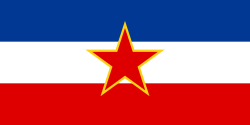
.svg/250px-Flag_of_Yugoslavia_(1946-1992).svg.png)


.svg/2000px-Flag_of_Yugoslavia_(1946-1992).svg.png)
Community hub
0 subscribers8 pages, 0 posts
Recent from talks
All channels
Be the first to start a discussion here.
Be the first to start a discussion here.
Be the first to start a discussion here.
Be the first to start a discussion here.
Contribute something
Welcome to the community hub built to collect knowledge and have discussions related to Yugoslav Americans.
Nothing was collected or created yet.
Yugoslav Americans
View on Wikipediafrom Wikipedia
Key Information

| Part of a series on |
| Yugoslavs |
|---|
 |
| By region |
| Culture |
| History |
| Languages |
| People |
|
| Ethnicities |
Yugoslav Americans are Americans of full or partial Yugoslav ancestry. In the 2021 Community Surveys, there were 210,395 people who indicated Yugoslav or Yugoslav American as their ethnic origin;[1] a steep and steady decrease from previous censuses (233,325 in 2019;[2] 276,360 in 2016[3]) and nearly a 36% decrease from the 2000 Census when there were over 328,000.[4]
The total number of Americans whose origins lie in former Yugoslavia is unknown due to conflicting definitions and identifications; in descending order these were as per 2021 American Community Survey:
| Ethnic group | Number[1] |
|---|---|
 Croatian Americans Croatian Americans |
398,101 |
 Yugoslav Americans Yugoslav Americans |
210,395 |
 Serbian Americans Serbian Americans |
193,844 |
 Slovene Americans Slovene Americans |
162,172 |
 Bosnian Americans Bosnian Americans |
125,793[5] |
 Macedonian Americans Macedonian Americans |
66,070[1] |
 Montenegrin Americans Montenegrin Americans |
Unknown |
 Kosovar Americans[a] Kosovar Americans[a] |
Unknown |
See also
[edit]Notes
[edit]- ^ Kosovar Americans are likely to identify as simply Albanian Americans instead, as the majority of Kosovar Americans are ethnic Albanians.
References
[edit]- ^ a b c d "2021 American Community Survey 1-Year Estimates". American Community Survey 2021. United States Census Bureau. Archived from the original on 8 April 2022. Retrieved 19 November 2022.
- ^ "2019 American Community Survey 1-Year Estimates". American Community Survey 2019. United States Census Bureau. Archived from the original on 8 April 2022. Retrieved 19 November 2022.
- ^ "2016 American Community Survey 1-Year Estimates". Factfinder.census.gov. Archived from the original on 13 February 2020. Retrieved 18 September 2017.
- ^ "2013 American Community Survey 1-Year Estimates". American Community Survey 2013. United States Census Bureau. Archived from the original on 18 January 2019. Retrieved 16 June 2016.
- ^ Karamehic-Oates, Adna (2020). "Borders and Integration: Becoming a Bosnian-American". Washington University Global Studies Law Review.
External links
[edit]- David Wallechinsky; Irving Wallace. "People, Races, Ethnicity in the U.S. Yugoslav Americans Part 1". Trivia-Library.com. David Wallechinsky & Irving Wallace. Retrieved 14 June 2017.
Yugoslav Americans
View on Grokipediafrom Grokipedia
History
Pre-World War I Immigration Waves
The pre-World War I immigration waves from the South Slavic territories that later comprised Yugoslavia consisted mainly of Croats, Slovenes, Serbs, and Bosnians originating from the Austro-Hungarian Empire, with smaller contingents from independent Montenegro and Ottoman Bosnia-Herzegovina. Initial arrivals were isolated, including a few dozen Dalmatian sailors and laborers documented in Louisiana and New York as early as the 1830s and 1840s, but sustained migration emerged in the 1880s amid agrarian crises, phylloxera outbreaks devastating vineyards, land fragmentation, and compulsory military service in the Habsburg army.[7][8] These factors prompted rural peasants, particularly from Croatia-Slavonia, Dalmatia, Styria (Slovenian regions), and Vojvodina, to seek wage labor abroad rather than permanent resettlement.[9] Migration accelerated sharply after 1900, peaking between 1905 and 1913, as steamship lines from Trieste and other Adriatic ports facilitated access; in 1907 alone, over 338,000 emigrants departed from Austria-Hungary for the United States, including tens of thousands of South Slavs.[10] By the 1910 U.S. Census, roughly 230,000 residents traced their origins to these territories, with about 85 percent being males aged 15-44 who entered as unskilled laborers for temporary stints in coal mines, steel mills, and railroads, often under contract labor systems.[1] Croatian emigrants dominated numerically, with 400,000 to 600,000 arrivals estimated from 1880 to 1914, primarily from Dalmatia and Lika, though return migration exceeded 50 percent due to the sojourner intent of accumulating savings for land purchases or dowries back home.[11] Slovenes followed, numbering 30,000 to 40,000 foreign-born by 1910, drawn from Carniola and Styria to Upper Midwest mining districts, while Serbs and Montenegrins totaled around 30,000, often from Herzegovina and the Bay of Kotor, clustering in Pennsylvania and Illinois.[12][13] High repatriation—fueled by seasonal work cycles, chain migration networks via letters and returning villagers, and discriminatory U.S. attitudes toward "new immigrants"—meant net population growth lagged arrivals; federal records show only partial tracking, as many entered via Canadian or Mexican borders to evade literacy tests introduced in 1917.[14] Economic remittances, estimated in millions of crowns annually by Habsburg officials, sustained rural economies but reinforced temporary migration patterns, with women and families rare until post-1914 family reunifications.[15] Pre-war communities remained male-dominated and fragmented by regional loyalties, lacking unified "Yugoslav" identity amid Habsburg-era ethnic divisions.[8]Interwar Period and World War II
Immigration from the Kingdom of Serbs, Croats, and Slovenes (renamed Kingdom of Yugoslavia in 1929) to the United States during the interwar period (1918–1939) was significantly curtailed by the U.S. Immigration Act of 1924, which imposed national origin quotas favoring Northern and Western Europeans and limiting entrants from Southern and Eastern Europe.[1] Despite these restrictions, approximately 70,000 individuals from Yugoslavia arrived between 1920 and 1938, representing a shift toward more educated and skilled workers compared to the predominantly unskilled laborers of pre-World War I waves. Economic instability in the new kingdom, including agrarian crises and political centralization efforts under King Alexander I, prompted continued emigration, though many earlier immigrants initially returned to Yugoslavia post-1918 only to re-emigrate to the U.S. amid unmet promises of land reform and stability.[1] Yugoslav-American communities, concentrated in industrial centers like Pittsburgh, Cleveland, and Chicago, maintained ethnic fraternal organizations such as the Serbian National Defense League and Croatian societies, which often reflected underlying Serb-Croat tensions rather than a unified "Yugoslav" identity promoted by the Belgrade government.[16] These groups focused on mutual aid, cultural preservation, and lobbying for homeland issues, but interethnic rivalries persisted, exacerbated by the 1929 royal dictatorship and assassination of King Alexander in 1934.[17] During World War II, following the Axis invasion of Yugoslavia in April 1941, immigration plummeted, with fewer than 1,000 Yugoslavs entering the U.S. as refugees between 1941 and 1945, primarily limited to politicians, diplomats, and select businessmen due to wartime restrictions and lack of organized rescue efforts.[1] The Yugoslav-American community faced intense federal scrutiny, as the FBI monitored organizations for potential fifth-column activities amid divided loyalties: many Serb-Americans supported the royalist Chetnik forces led by Draža Mihailović, while some Croatian elements sympathized with the Axis puppet Independent State of Croatia under Ante Pavelić, though most Croatian-Americans rejected Ustaše atrocities.[17][16] U.S. policy initially backed the Chetniks but shifted support to communist Partisans under Josip Broz Tito by 1943–1944, heightening suspicions of pro-Axis subversion within ethnic subgroups and leading to surveillance of groups like the United Committee of South Slavic Americans.[18] Thousands of Yugoslav-Americans nonetheless enlisted in the U.S. military, contributing to the Allied effort while navigating community fractures that mirrored Yugoslavia's civil war dynamics.[17]Post-World War II Displaced Persons and Cold War Era
Following the end of World War II in 1945, tens of thousands of individuals from Yugoslavia—primarily ethnic Croats, Slovenes, and Serbs who had opposed Josip Broz Tito's communist partisans—found themselves displaced in camps across Austria, Italy, and Germany, refusing repatriation due to fears of persecution under the new regime. Tito's forces had conducted mass executions and imprisonments of perceived enemies, including those associated with the Independent State of Croatia or Chetnik movements, with estimates of up to 100,000 deaths in events like the Bleiburg repatriations in May 1945. These displaced persons (DPs), numbering around 200,000 Yugoslavs in total across European camps, included soldiers, civilians, intellectuals, and families seeking asylum from communist consolidation.[19][3] The U.S. Displaced Persons Act of June 25, 1948, authorized the admission of up to 200,000 European DPs outside normal quotas, prioritizing those in camps before specific cutoff dates and requiring sponsorship and security screening; amendments in 1950 expanded this to over 400,000 visas by 1952, facilitating the entry of thousands of Yugoslav DPs despite initial restrictions favoring pre-1945 entrants, which disadvantaged some later arrivals. Yugoslav immigrants under this act totaled several thousand annually, peaking for Serbs in 1952 with most classified as non-quota entrants, and included a higher proportion of professionals and educated individuals compared to earlier waves—such as Slovenian political refugees who bolstered community leadership. Croats, in particular, benefited from organizations like the Society for Croatian Migration, which sponsored arrivals to industrial centers like Cleveland, where thousands settled and revived fraternal societies. U.S. screening processes during this period emphasized anti-communist credentials, often favoring hardline nationalists to counter Soviet influence.[20][21][22] During the Cold War era from the early 1950s to the 1980s, Yugoslav immigration to the U.S. remained modest, constrained by annual quotas of around 845 under the Immigration Act of 1924 (later adjusted slightly) and Tito's regime's tight controls on exit visas, despite Yugoslavia's 1948 split from Stalin enabling limited liberalization. The Refugee Relief Act of 1953 admitted an additional 214,000 non-quota refugees globally, including some Yugoslav defectors and dissidents fleeing political repression or economic stagnation, though numbers stayed low—contributing to a cumulative 73,000 Yugoslav immigrants from 1950 to 1989. These arrivals, often intellectuals or skilled workers, reinforced anti-communist networks in the U.S., such as through lobbying for Radio Free Europe broadcasts targeting Yugoslavia, while settling in established communities in Ohio, Illinois, and Pennsylvania to avoid isolation. Unlike bloc countries, Yugoslavia's non-aligned status reduced refugee designations, but periodic escapes, like those after the 1966 liberalization under Tito, added small family reunification flows.[3][23][1]Immigration Following the Yugoslav Breakup (1990s Onward)
The breakup of the Socialist Federal Republic of Yugoslavia beginning in 1991 precipitated a surge in emigration to the United States, driven primarily by armed conflicts, ethnic cleansing, and widespread displacement across the successor states. Slovenia and Croatia declared independence in June 1991, leading to brief but intense fighting in Slovenia's Ten-Day War and prolonged hostilities in Croatia (1991–1995), which displaced over 300,000 people internally and prompted cross-border flight. The ensuing Bosnian War (1992–1995) exacerbated the crisis, involving systematic atrocities such as the Srebrenica massacre in July 1995, where over 8,000 Bosniak men and boys were killed by Bosnian Serb forces, resulting in an estimated 2.2 million displaced persons region-wide. These events created acute humanitarian needs, with many ethnic groups—Bosniaks, Croats, Serbs, and others—fleeing persecution, shelling of civilian areas, and economic collapse under wartime conditions.[24] In response, the United States established a dedicated refugee admissions program for the former Yugoslavia in 1992, prioritizing those referred by the United Nations High Commissioner for Refugees (UNHCR) or identified through U.S. processing centers in the region. By the early 2000s, this program had facilitated the permanent resettlement of approximately 107,000 refugees from the former Yugoslav territories, with admissions peaking during the Bosnian conflict and continuing through family reunification provisions. The majority arrived as asylees or refugees under the 1980 Refugee Act, which caps annual admissions but allows flexibility for emergencies; for instance, Bosnian Muslim (Bosniak) refugees formed a significant portion due to targeted campaigns against non-Serb populations, while Croatian Serbs fled en masse following Croatia's Operation Storm in August 1995, which reclaimed Krajina and displaced around 150,000 Serbs. Serbian emigration also increased amid NATO's 1999 bombing campaign during the Kosovo War (1998–1999), which targeted Yugoslav military assets in response to Kosovo Albanian displacement but contributed to civilian hardships and further outflows of Serbs from Kosovo.[25][26] Beyond refugees, total immigration from the former Yugoslav republics between 1991 and 2002 reached nearly 120,000 individuals across ethnic lines, encompassing not only war-displaced persons but also skilled workers and family-sponsored migrants escaping post-conflict instability and hyperinflation in remaining Yugoslav entities like Serbia and Montenegro. The Kosovo conflict alone prompted temporary protected status (TPS) designations for thousands of Kosovar Albanians in 1999, enabling about 10,000 to enter or adjust status amid the displacement of over 800,000 people. Post-2000 immigration tapered off as ceasefires took hold—the Dayton Accords ended the Bosnian War in December 1995, and UN Resolution 1244 stabilized Kosovo in June 1999—but persisted at lower volumes through employment-based visas and the diversity lottery, particularly from economically strained areas like Serbia, where GDP per capita lagged behind EU averages, prompting outflows of professionals and youth. By the 2010s, annual arrivals from these countries numbered in the low thousands, reflecting stabilized borders but ongoing emigration pressures from corruption, unemployment rates exceeding 20% in some republics, and unresolved ethnic grievances.[27][28] This wave diversified the Yugoslav American population, bolstering communities of Bosniaks in cities like St. Louis and Chicago, where resettlement agencies concentrated arrivals for support networks, and Serbs in areas with pre-existing enclaves such as Cleveland and Pittsburgh. Integration challenges included trauma from wartime experiences, with studies noting higher rates of post-traumatic stress among arrivals compared to earlier cohorts, though U.S. programs provided language training and job placement to facilitate adaptation. Overall, the 1990s influx represented a causal response to state failure and irredentist violence rather than economic pull factors alone, distinguishing it from prior Yugoslav migrations tied to labor or ideology.[26]Demographics and Geographic Distribution
Population Estimates and Census Data
In the 2000 U.S. Census, 328,547 individuals self-reported Yugoslavian ancestry, representing the peak in recorded identification with the pan-ethnic category. This figure declined in subsequent American Community Surveys (ACS), with the 2016-2020 ACS estimating around 190,000 individuals reporting Yugoslavian ancestry, reflecting a shift toward specific ethnic self-identification (e.g., Serbian, Croatian) following Yugoslavia's dissolution in the 1990s.[29] Earlier, the 1990 Census counted 257,986 persons of Yugoslavian origin. These ancestry figures capture single and multiple responses but do not encompass the broader population of ex-Yugoslav descent, estimated in the millions when aggregating ethnic subgroups like Serbs (approximately 190,000 in 2016-2020 ACS) and Croats.[29] Foreign-born data from Yugoslavia provides additional context for earlier waves. The 1930 Census enumerated 211,000 Yugoslav-born residents in the United States, concentrated in industrial states.[30] This number decreased to 161,000 by the 1940 Census, due to aging of the immigrant cohort and restricted immigration amid global conflicts.[30] Post-World War II immigration added approximately 73,000 arrivals from Yugoslavia between 1950 and 1989, primarily displaced persons and economic migrants.[1] After 1991, census birthplace categories shifted to successor states (e.g., Serbia, Croatia), complicating direct comparisons, with foreign-born from these nations totaling under 200,000 combined in recent ACS estimates.| Year | Self-Reported Yugoslavian Ancestry | Source |
|---|---|---|
| 1990 | 257,986 | U.S. Census |
| 2000 | 328,547 | U.S. Census |
| 2016-2020 | ~190,000 | ACS[29] |
Major Settlement Areas and Urban Concentrations
Yugoslav Americans primarily settled in industrial centers of the Midwest and Northeast United States during the late 19th and early 20th centuries, drawn by employment opportunities in steel mills, coal mining, manufacturing, and railroads. These patterns persisted with later waves of post-World War II displaced persons and 1990s refugees from the Yugoslav wars, who often joined existing ethnic networks in urban areas. While self-identified Yugoslav ancestry has declined in census reporting, concentrations reflect the ethnic subgroups—Serbs, Croats, Slovenes, and Bosnians—originating from former Yugoslav territories, with Illinois, Ohio, Pennsylvania, New York, and California hosting the largest populations.[1][31] Chicago, Illinois, stands as one of the foremost hubs, encompassing substantial Serbian, Croatian, and Bosnian communities. The Serbian population in Chicago exceeds 6,800 individuals, while Croats number around 7,200, supported by fraternal halls and religious institutions established since the early 1900s. Bosnians have augmented this base through 1990s resettlement, contributing to a diverse South Slavic presence amid the city's manufacturing legacy.[32][33][34] Cleveland, Ohio, developed as a key Slovene American center, with the Newburgh area hosting the largest such settlement in the U.S. from the early 1900s through the late 1990s, fueled by proximity to steel industries. Croatian and Serbian enclaves also emerged nearby, particularly in east-side neighborhoods like St. Clair and Collinwood, where immigrants arrived via Austria-Hungary provinces before World War I. Ohio's overall Croatian population ranks among the highest nationally.[35][36][31] Pittsburgh, Pennsylvania, attracted Croatian and Serbian laborers to its steel and coal sectors starting in the 1880s, forming enduring communities in areas like the South Side. Pennsylvania maintains one of the densest Croatian American populations by state, with historical ties to mining towns extending the pattern beyond the city core.[37][31] New York City and its metropolitan area host diverse Yugoslav-origin groups, including over 9,000 Croats and 5,000 Serbs, concentrated in boroughs with early 20th-century immigrant influxes. Southern California, particularly Los Angeles, mirrors this with around 2,600 Serbs and 5,300 Croats, bolstered by post-1960s chain migration and entertainment industry ties. St. Louis, Missouri, emerged as a primary Bosnian resettlement site in the 1990s, developing one of the largest such communities outside Europe amid the city's affordable housing and job availability.[33][32][33]Ethnic Composition and Internal Dynamics
Breakdown by Primary Ethnic Groups
Croatian Americans constitute the largest subgroup among those of Yugoslav descent, with recent U.S. Census estimates indicating approximately 399,000 individuals reporting Croatian ancestry.[33] This figure reflects historical immigration patterns from Croatia and adjacent regions within Yugoslavia, particularly during the early 20th century and post-World War II periods. Serbian Americans follow closely, numbering around 190,600 based on aggregated Census data from 2016–2020.[38] These populations often trace roots to economic migrants and political refugees from Serbia proper and Serbian-inhabited areas of Bosnia, Croatia, and Montenegro. Slovenian Americans are estimated at 150,000 to 200,000, though self-reported Census figures tend to undercount due to generational assimilation and intermarriage; official claims hover below 200,000.[13] Their communities stem largely from late 19th- and early 20th-century labor migrations to industrial centers in the Midwest. Bosniak Americans, primarily from Bosnia and Herzegovina, number over 200,000, with concentrations in cities like St. Louis (50,000–70,000) driven by 1990s refugee inflows following the Yugoslav Wars. Smaller groups include Macedonian Americans (approximately 65,000)[39] and Montenegrin Americans (around 40,000), the latter often overlapping with Serbian identifiers due to shared historical and linguistic ties.| Ethnic Group | Estimated U.S. Population | Primary Immigration Periods |
|---|---|---|
| Croatian | 399,000 | 1900s–1920s; post-1945; 1990s |
| Serbian | 190,600 | 1880s–1910s; post-WWII; 1990s |
| Slovenian | 150,000–200,000 | 1890s–1914; post-WWII |
| Bosniak | 200,000+ | 1990s onward (refugee waves) |
| Macedonian | 65,000 | Early 1900s; post-1945 |
| Montenegrin | ~40,000 | Early 1900s; limited post-1990s |
Ethnic Tensions and Pan-Yugoslav Identity
Ethnic tensions among Yugoslav Americans have historically mirrored divisions in the homeland, particularly during periods of conflict, while efforts at pan-Yugoslav unity often emphasized supra-ethnic solidarity against common threats like communism or fragmentation. In the interwar period and World War II, the community fractured along Serb, Croat, Slovene, and other lines, with Serbian Americans largely supporting the royalist Chetniks, Croatian Americans divided between independence advocates and those wary of Ustaše extremism, and smaller groups aligning variably; these splits hindered unified lobbying in the U.S. and raised national security concerns amid fears of Axis sympathies or espionage.[17][41] Reactions to Ustaše-perpetrated massacres against Serbs in the Independent State of Croatia further inflamed diaspora animosities, as ethnic-specific organizations like the Croatian Fraternal Union and Serbian National Defense Council prioritized homeland grievances over collective action.[42] Post-World War II displaced persons and Cold War exiles fostered anti-communist coalitions, such as the American Council for Yugoslav Relief, but ethnic parochialism persisted, with Serbs decrying perceived Croat dominance in Tito's Partisan movement and Croats resenting Serb centralism in the monarchy; these frictions limited the effectiveness of pan-Yugoslav groups like the Federation of Croatian Societies, which sought broader South Slavic unity but often dissolved into recriminations.[16] Pan-Yugoslav identity gained traction among some Tito-era immigrants and their descendants, promoting a civic nationalism transcending ethnic labels through shared non-aligned socialism and cultural symbols, yet it remained marginal compared to entrenched ethnic loyalties evidenced by separate religious institutions (e.g., Serbian Orthodox vs. Croatian Catholic parishes).[43] The 1990s Yugoslav breakup and ensuing wars sharply polarized communities, as Serbian Americans rallied against NATO interventions and Croatian Americans lobbied for U.S. recognition of independent Croatia in 1992, with diaspora remittances and advocacy fueling homeland conflicts along ethnic fault lines; Bosniak, Slovene, and Macedonian groups similarly fragmented support.[44] This era eroded institutional pan-Yugoslavism, though residual sentiments endure in nostalgic associations and self-identification, with 210,395 Americans reporting Yugoslav ancestry in the 2021 U.S. Community Survey, often invoking "Yugoslavism" as a sentimental bond to pre-1991 unity amid otherwise dominant ethnic identities. Causal factors include homeland traumas amplifying kin loyalties, U.S. assimilation pressures favoring ethnic silos for cultural preservation, and the absence of a unifying post-Tito ideology, rendering pan-Yugoslav efforts more aspirational than operational.Cultural Retention and Contributions
Religious Practices and Institutions
Yugoslav Americans have maintained religious practices closely tied to their ethnic subgroups, with Serbian Americans predominantly adhering to Eastern Orthodoxy, Croatian and Slovenian Americans to Roman Catholicism, and Bosnian Muslim Americans to Islam. These faiths serve not only spiritual functions but also as anchors for cultural identity and community cohesion, particularly among first- and second-generation immigrants who established parishes and mosques as early as the late 19th century. Religious observance often includes ethnic-specific liturgies, feast days, and rituals that preserve linguistic and traditional elements from the homeland, such as Serbian slava family patron saint celebrations or Croatian korizma Lenten customs.[45][46] The Serbian Orthodox Church in North and South America, under the jurisdiction of the Serbian Orthodox Church, traces its origins to 1894 with the consecration of St. Sava Church in Jackson, California, recognized as the oldest Serbian Orthodox church in the United States. By the early 20th century, dioceses formed to oversee growing parishes in industrial centers like Cleveland and Chicago, where Serbian immigrants numbered in the thousands; today, the church operates multiple eparchies, including the Eastern American Diocese headquartered in Mars, Pennsylvania, supporting over 200 congregations. These institutions have historically emphasized education and monastic life, with monasteries like St. Sava in Libertyville, Illinois, founded in 1944, functioning as spiritual and cultural hubs.[47][48] Croatian Catholic parishes emerged concurrently, with St. Nicholas Croatian Church in Millvale, Pennsylvania, established in 1894 as the first dedicated Croatian Catholic parish in the U.S., initially serving steelworkers in Pittsburgh. Subsequent foundations include St. Anthony Croatian Catholic Church in Los Angeles (dedicated 1904) and Sacred Heart Croatian Parish in Chicago (1913), which continue to offer Masses in Croatian and host festivals reinforcing communal bonds. Slovenian Catholics similarly founded missions, such as the Slovenian Catholic Mission in Lemont, Illinois, under Franciscan oversight since 1912, and St. Cyril Church in New York (1920s), which integrate religious services with cultural programs like language classes.[46][49][50] Bosnian Muslim communities, largely post-1990s arrivals fleeing the Yugoslav wars, have developed Islamic centers emphasizing Sunni practices adapted to American contexts, including halal observances and Ramadan iftars. Key institutions include the Islamic and Cultural Center Bosniak in Des Moines, Iowa, serving as a mosque and community space since the early 2000s, and similar facilities in St. Louis, home to over 60,000 Bosnians with multiple masjids supporting Arabic and Bosnian prayers. These centers often collaborate with broader Muslim networks while prioritizing Bosniak-specific traditions like mevlud recitations.[51][52]Fraternal Organizations and Community Life
Fraternal organizations among Yugoslav Americans primarily emerged in the late 19th and early 20th centuries as mutual aid societies providing insurance, death benefits, and social support to immigrants facing industrial hazards and isolation. These groups often aligned along ethnic lines—Serbian, Croatian, or Slovene—reflecting underlying regional identities from the Habsburg and Ottoman eras rather than a unified Yugoslav framework, which only solidified post-1918. Early examples included the Slavonic Mutual and Benevolent Society in San Francisco (1857), focused on Dalmatian Croats for accident and burial assistance.[53] By the 1900s, such societies expanded to encompass cultural preservation, hosting dances, lectures, and newspapers to combat assimilation pressures.[5] The Croatian Fraternal Union of America (CFU), established on September 2, 1894, in California before relocating to Pittsburgh, Pennsylvania, grew into the largest such entity, offering life insurance, annuities, and fraternal programs like scholarships and heritage events. With roots in mutual protection against workplace deaths in mining and steel industries, it emphasized Croatian language maintenance and anti-communist advocacy post-World War II.[54] [55] Similarly, the Serbian National Defense Council of America, founded in 1914 by engineer Mihajlo Pupin in Chicago, Illinois, promoted Serbian welfare, cultural education, and geopolitical advocacy, including opposition to Axis occupation during World War II and later Yugoslav communism; it continues to organize conferences and media outreach.[56] [57] Slovene-focused groups, such as the Slovene National Benefit Society (SNPJ), formed in 1904 in Illinois, provided fraternal insurance and social lodges that sponsored festivals, youth camps, and relief drives, including under the Yugoslav Relief Committee during wartime shortages.[58] The American Mutual Life Association, another Slovene entity, similarly supported immigrants through benefits and community halls. In industrial hubs like Chicago and Cleveland, Ohio, early Serbian benevolent societies like St. Sava (1904) facilitated boarder networks and kumstvo (godparent) ties for economic stability.[59] [5] Community life revolved around these organizations' halls and events, fostering intergenerational ties through tamburica music gatherings, Orthodox or Catholic feasts, and economic cooperatives like Chicago's Slavija (1903), which blended socialist and liberal elements for worker aid. Post-1945 displaced persons reinforced anti-Tito networks, with fraternal groups collecting over $1 million in relief by 1948 for non-communist Yugoslavs, though ethnic frictions—exacerbated by wartime atrocities—limited pan-Yugoslav unity, prioritizing subgroup solidarity. Today, these bodies sustain digital archives, scholarships, and advocacy amid declining membership from assimilation.[15] [1]Culinary and Artistic Traditions
Yugoslav Americans maintain culinary traditions rooted in the diverse ethnic cuisines of the former Socialist Federal Republic of Yugoslavia, emphasizing grilled meats, phyllo pastries, and preserved vegetables adapted to American ingredients and availability. Common dishes include ćevapi, small grilled sausages of beef and lamb served with ajvar (roasted red pepper and eggplant relish) and lepinja bread, often prepared at family gatherings and ethnic festivals in communities like those in Chicago and Cleveland. Burek, a flaky pastry filled with cheese, meat, or potatoes, and sarma (cabbage rolls stuffed with spiced rice and meat) reflect Ottoman-influenced Balkan staples, with home cooks in Bosnian-American enclaves continuing practices like making zimnica—canned ajvar and lutenica for winter storage—despite shifts toward commercial products.[60][61][62] These traditions persist through restaurants and markets in urban centers with high Yugoslav diaspora populations, such as Balkan Treat Box in Chicago, which specializes in pljeskavica (spiced meat patties) and burek, drawing on recipes from Serbian and Bosnian immigrants. In Utah's Yugoslav-American communities, where early 20th-century miners settled, families uphold roasting practices for holidays, blending them with American barbecues while sourcing imported spices to replicate paprika-heavy stews like čorba. Such adaptations highlight resilience amid assimilation, with second-generation cooks prioritizing authenticity in private settings over public fusion experiments.[5][61][63] Artistic traditions among Yugoslav Americans center on folk music, dance, and crafts that reinforce ethnic identity, often performed at church halls, fraternal lodges, and annual slavas (patron saint feasts). Kolo circle dances, characterized by energetic hand-holding and footwork variations like seljačko kolo from Serbia or trojka from Montenegro, are taught in groups such as the Southern California Folk Dance Federation, preserving communal rituals from rural Yugoslav villages. Tamburica orchestras, featuring stringed instruments akin to mandolins, accompany epic ballads (gusle-accompanied in Serb traditions) at events, with ensembles in Pittsburgh and Detroit recording albums that echo pre-1990s unity.[64][65] Visual arts include intricate wood carvings and embroidery depicting motifs from Orthodox iconography or Slavic folklore, practiced by immigrants in mining towns and passed via workshops in cultural centers. Smithsonian Folkways recordings from 1951 document these performances, capturing polyphonic singing from Croatian and Slovenian groups that influenced American folk revival scenes without diluting origins. While professional artists like those in New York's Yugoslav diaspora explore abstract modernism, community efforts prioritize folk preservation over avant-garde shifts seen in post-breakup Europe.[66][64]Notable Individuals and Achievements
Pioneers in Industry and Invention
Mario Puratić (1904–1993), a Croatian native from Sumartin on the island of Brač, emigrated from the Kingdom of Yugoslavia to the United States in 1938 and settled in San Pedro, California, where he worked as a fisherman. In 1953, he patented the Puretic Power Block, a mechanical winch that automated the retrieval of purse seine fishing nets by powering a pulley system to haul heavy loads efficiently. This invention reduced the manpower needed for net hauling from 8–10 workers to 1–2 operators, dramatically increasing productivity and safety in commercial tuna fishing, and was adopted globally as standard equipment on purse seiners by the mid-20th century.[67] Anthony Maglica (born 1930), of Croatian descent, was born in New York City but raised in Yugoslavia after his family returned there during the Great Depression; he re-emigrated to the U.S. in the late 1940s following World War II disruptions. Starting as a machinist, he founded Mag Instrument, Inc. in Los Angeles in 1955, initially producing precision components before shifting to consumer goods. Maglica invented the Maglite flashlight in the 1970s, featuring an adjustable beam, durable anodized aluminum construction, and high-intensity incandescent bulb, which earned dozens of patents and became a hallmark of reliability used by police, firefighters, and outdoorsmen. By the 1980s, the company employed over 200 workers and generated annual revenues exceeding $100 million, exemplifying immigrant-driven manufacturing innovation in optics and materials engineering.[68][69] These contributions highlight Yugoslav Americans' roles in practical industrial advancements, often stemming from hands-on experience in labor-intensive sectors like fishing and machining, where self-taught engineering addressed real-world inefficiencies without reliance on large corporate R&D.[70]Military and Public Service Figures
Louis Cukela, born on May 1, 1888, in Split (then part of the Austro-Hungarian Empire and later Yugoslavia's Socialist Republic of Croatia), immigrated to the United States in 1913 and enlisted in the U.S. Army in 1914 before transferring to the Marine Corps. During the Battle of Soissons on July 18, 1918, serving as a sergeant with the 66th Company, 5th Regiment, he advanced alone through heavy enemy fire, captured a machine-gun nest by grenade and bayonet, and took 40 prisoners, earning both the Army and Navy Medals of Honor—one of only 19 individuals to receive dual awards.[71][72] Cukela retired as a major in 1946 and died in 1956.[73] Peter Tomich, born Petar Herceg Tonić on June 3, 1893, in Prozor, Herzegovina (then Austria-Hungary and later part of Yugoslavia's Socialist Republic of Bosnia and Herzegovina), immigrated to the United States around 1913 and naturalized as a citizen in 1917. As chief watertender on USS Utah during the Japanese attack on Pearl Harbor on December 7, 1941, he remained at his post to close watertight doors and prevent further flooding despite the ship's capsizing, actions for which he was posthumously awarded the Medal of Honor in 1942.[74][75] His remains were never identified, and he is commemorated on the Courts of the Missing at the National Memorial Cemetery of the Pacific.[74] Michael J. Novosel Sr., born in 1922 in Pennsylvania to Croatian immigrants from the Lika region (later Yugoslavia's Socialist Republic of Croatia), served in the U.S. Army Air Forces during World War II, the Army during the Korean War, and as a warrant officer helicopter pilot in Vietnam. On October 2, 1969, near Binh Dinh Province, he evacuated 29 wounded soldiers under intense fire across multiple trips, earning the Medal of Honor; he retired in 1970 after 44 years of service, one of the longest in U.S. military history.[76] In public service, Slovenian American Amy Klobuchar, whose paternal grandparents emigrated from Slovenia (part of interwar Yugoslavia), has served as a U.S. Senator from Minnesota since 2007, previously as Hennepin County Attorney from 1998 to 2007, focusing on issues like consumer protection and antitrust enforcement.[77] John Blatnik, of Slovenian descent from immigrants who arrived before World War I, represented Minnesota's 8th congressional district in the U.S. House from 1947 to 1975, advocating for infrastructure projects including the St. Lawrence Seaway. These figures exemplify contributions from Yugoslav ethnic diasporas in U.S. governance and defense, often drawing on pre-1991 regional ties.Entertainment and Cultural Icons
Karl Malden, born Mladen George Sekulovich to Serbian immigrants from modern-day Montenegro, achieved prominence as an actor, earning the Academy Award for Best Supporting Actor for his portrayal of Mitch in A Streetcar Named Desire (1951).[4] His career spanned over five decades, including roles in films like On the Waterfront (1954) and television series such as The Streets of San Francisco (1972–1977), where he played Lieutenant Mike Stone.[4] Rade Šerbedžija, born in Croatia to a Croatian mother and Serbian father, emerged as a versatile character actor in Hollywood after establishing himself in Yugoslav cinema during the 1970s and 1980s.[78] He appeared in over 150 films, including notable American productions such as Eyes Wide Shut (1999), Snatch (2000), and Taken 2 (2012), often portraying complex Eastern European figures reflective of his regional heritage.[78] Goran Višnjić, born in Šibenik, Croatia, in 1972, gained widespread recognition in the United States for his role as Dr. Luka Kovač on the medical drama ER, which he joined in 1999 and continued until 2008, appearing in 164 episodes.[79] His performances extended to films like Practical Magic (1998) and The Peacemaker (1997), blending intensity with vulnerability drawn from his experiences during the Croatian War of Independence.[79] Milla Jovovich, born in Kyiv to a Serbian father and Ukrainian mother, transitioned from modeling to acting, starring in blockbuster franchises such as the Resident Evil series (2002–2016), where she played Alice in five films grossing over $1.2 billion worldwide.[4] Her paternal Yugoslav roots influenced early exposure to regional culture, though her career emphasized action and sci-fi genres.[4] In music, Micky Dolenz, born in 1945 to actor George Dolenz (originally Jure Dolenc from Solkan, Slovenia), served as drummer and lead vocalist for The Monkees, whose debut album topped the Billboard 200 in 1967 and spawned hits like "I'm a Believer," selling over 75 million records globally.[80] His Slovenian ancestry connected him to immigrant narratives of adaptation in American pop culture.[80] Alfred "Weird Al" Yankovic, whose mother Mary Elizabeth Vivalda traced her lineage to Slovenian immigrants, parodied hit songs as a comedian-musician, releasing 14 studio albums since 1983, including the Grammy-winning Poodle Hat (2003).[81] Tracks like "Eat It" (1984), a parody of Michael Jackson's "Beat It," achieved platinum status, exemplifying satirical contributions from Yugoslav-descended artists to mainstream entertainment.[81]Political Engagement and Ideological Shifts
Anti-Communist Stance and Cold War Activism
Yugoslav Americans, largely comprising post-World War II emigrants who escaped communist purges and repression under Josip Broz Tito's regime, maintained a pronounced anti-communist orientation throughout the Cold War. This stance was rooted in direct experiences of partisan violence, mass executions of perceived collaborators—estimated at over 50,000 in immediate postwar reprisals—and the suppression of non-communist political entities, fostering enduring opposition to the Yugoslav government among exiles in the United States.[82] Their activism emphasized highlighting human rights abuses, such as political imprisonments and cultural suppression, to counter Western perceptions of Tito's non-aligned communism as benign.[83] Croatian American communities, predominant among Yugoslav emigrants, established organizations dedicated to regime change, including the Croatian Liberation Movement (Hrvatski Oslobodilački Pokret, HOP), founded in 1956 by figures like Andrija Artuković, which advocated democratic overthrow of communism while rejecting violence in favor of political advocacy.[82] These groups lobbied U.S. policymakers against economic and military aid to Yugoslavia—totaling over $3 billion from 1949 to 1980—arguing it propped up a dictatorship responsible for suppressing Croatian nationalism and executing dissidents. Publications and rallies by fraternal societies, such as elements within the Croatian Fraternal Union, disseminated anti-Tito propaganda, exposing communist infiltration attempts in diaspora networks during and after World War II.[84] Tensions escalated during Tito's 1971 and 1976 U.S. visits, prompting protests in cities like New York and Chicago, where demonstrators decried U.S. hospitality toward a leader accused of sponsoring assassinations of exiles abroad.[85] Serbian American anti-communist efforts paralleled Croatian activism, with ex-Chetnik leaders like Momčilo Đujić, who resettled in California after 1945, organizing monarchist and anti-Tito campaigns from Chicago and Los Angeles bases, advocating restoration of the Karađorđević dynasty and abolition of the communist federation.[86] Đujić's Serb National Defense Committee collaborated with broader émigré networks to publicize purges in Serbia, where communist forces executed thousands of royalist supporters in 1944–1945, fueling demands for U.S. sanctions.[82] High-profile actions included Nikola Kavaja's 1976 hijacking of a TWA flight from New York to Paris, intended as a protest against Tito's state visit and symbolic rejection of U.S. aid to his regime; Kavaja, a Serbian exile pilot, surrendered after grounding the plane, highlighting diaspora grievances over unaddressed postwar atrocities.[87] Both subgroups participated in pan-ethnic initiatives, such as supporting Captive Nations Week proclamations since 1959, which Congress renewed annually to condemn Soviet and satellite oppressions, including Yugoslavia's despite its 1948 Cominform expulsion. Intra-community clashes, investigated by federal grand juries in the 1970s, arose from rival anti-communist factions versus alleged pro-Tito infiltrators, underscoring the intensity of exile politics but also unified opposition to returning Yugoslavia to Soviet orbit or perpetuating one-party rule.[87] This activism influenced U.S. policy debates, as evidenced by congressional hearings critiquing aid to Tito amid reports of émigré persecution, though strategic containment priorities often tempered responsiveness.[83]Diaspora Roles in Yugoslav Dissolution Conflicts
Croatian Americans, organized through community groups and fraternal organizations, raised substantial funds during the Croatian War of Independence (1991–1995) to procure arms for Croatian forces, circumventing the United Nations arms embargo imposed on the former Yugoslavia in September 1991.[88] These efforts included direct financial transfers estimated in the millions of dollars, which supported military logistics and volunteer fighters from the diaspora.[44] Political mobilization extended to lobbying U.S. Congress members on measures like the Nickles Amendment, which sought to withhold U.S. aid to Yugoslavia unless it permitted multiparty elections and democratic transitions, thereby pressuring the federal government and aiding the push for Croatian sovereignty.[89] This advocacy contributed to the U.S. recognition of Croatia's independence on January 15, 1992, following Slovenia's.[90] Serbian Americans, via groups such as émigré networks in the U.S., conducted counter-lobbying to highlight Serb perspectives on territorial integrity and oppose rapid secessions, influencing congressional debates amid the escalating conflicts.[91] Though their community was smaller and less affluent than the Croatian diaspora, they channeled resources to support nationalist causes in Serbia, including media campaigns and limited funding for aligned factions during the Bosnian War (1992–1995).[44] Such activities paralleled broader Balkan diaspora patterns, where ethnic remittances fueled arms smuggling and militia operations, exacerbating ethnic divisions and prolonging hostilities across Slovenia's Ten-Day War (1991), Croatia, and Bosnia.[44][92] Bosnian Muslim (Bosniak) Americans, emerging as a distinct community amid the refugee influx from the Bosnian War, focused on humanitarian aid drives and advocacy for U.S. intervention against Bosnian Serb advances, including calls to lift the arms embargo selectively for Bosniak forces.[93] Their efforts aligned with diaspora-wide patterns of funding kin networks, though on a smaller scale than Croatian initiatives, and included support for international pressure leading to NATO's Operation Deliberate Force in 1995.[44] Overall, these diaspora interventions, while rooted in ethnic solidarity, amplified irredentist claims and contributed to the federal state's collapse by 1992, as external financing bypassed central Yugoslav authority and empowered regional secessionist armies.[44][90]Contemporary Political Views and Assimilation
Yugoslav Americans, comprising primarily descendants of Serbian, Croatian, Slovenian, Bosnian, and other ethnic groups from the former Yugoslavia, exhibit political views shaped by historical anti-communism and lingering attachments to Balkan geopolitics. Serbian Americans, concentrated in states like Illinois, Michigan, and Pennsylvania, have demonstrated a preference for Republican candidates, particularly Donald Trump, due to perceptions that his administration's policies were more favorable to Serbian interests amid Kosovo tensions compared to Democratic interventions in the 1990s. In the 2024 U.S. presidential election, Serbian diaspora communities in swing states were reported to overwhelmingly back Trump, influencing local electoral dynamics alongside Albanian American support for Biden.[94][95] This lean reflects broader skepticism toward U.S. foreign policy seen as biased against Serbs since the 1999 NATO bombing, fostering alignment with isolationist or pro-Serb stances over multilateral interventions.[96] Croatian Americans, with significant populations in New York, Ohio, and California, engage more bipartisanship through lobbying groups like the Croatian American Association, which advocates for U.S.-Croatia ties regardless of administration. The bipartisan Congressional Croatian Caucus, relaunched in 2025, promotes cultural and economic exchanges, underscoring Croatia's NATO and EU integration as priorities.[97][98] Notable examples include Croatian-descended Republican Nick Begich III's 2024 victory in Alaska's House seat, endorsed by Trump, highlighting conservative electoral success within the community.[99] Overall, these groups prioritize homeland stability and anti-extremism, with views often diverging along ethnic lines—Serbs wary of Western interventionism, Croats supportive of it—yet unified in rejecting Yugoslav-era socialism. Assimilation among Yugoslav Americans has progressed rapidly since the mid-20th century waves, marked by high intermarriage rates and socioeconomic mobility that dilute pan-Yugoslav identity in favor of ethnic-specific or generic American affiliations. Third- and fourth-generation descendants frequently intermarry outside Slavic groups, accelerating cultural blending, though exact rates for Yugoslav subsets remain understudied compared to broader European immigrants, who show intermarriage exceeding 50% by the second generation.[100] Retention of fraternal organizations sustains ethnic ties, but political engagement increasingly mirrors U.S. conservative norms—emphasizing family values, entrepreneurship, and limited government—over Balkan nationalism, as evidenced by participation in local Republican machinery without dominant bloc voting.[101] This shift underscores causal factors like economic success in industries from steel to tech, reducing insularity and aligning views with mainstream American individualism rather than collectivist Yugoslav legacies.Assimilation, Challenges, and Current Status
Economic Integration and Socioeconomic Outcomes
Yugoslav Americans, encompassing descendants of immigrants from Serbia, Croatia, Slovenia, and other South Slavic regions of the former Yugoslavia, initially entered the United States primarily as unskilled laborers during the late 19th and early 20th centuries, taking jobs in mining, steel production, and manufacturing in industrial centers like Pennsylvania, Ohio, Illinois, and Wisconsin.[102] These early migrants faced challenges such as low wages and hazardous conditions but demonstrated rapid upward mobility through family networks, vocational skills, and entrepreneurship, transitioning into small businesses, farming, and skilled trades by the mid-20th century. Post-World War II arrivals, often political refugees with higher education levels, further diversified occupations into engineering, medicine, and academia, contributing to stronger economic footholds.[102] By the 1980 census, Americans reporting Serbo-Croatian ancestry exhibited robust labor force participation rates of 95.4% for males and 63.9% for females aged 25-54, with unemployment rates around 4.7-4.9%, lower than comparable white groups.[102] Earnings for this group surpassed those of other whites, with male annual earnings 9% higher, weekly 10% higher, and hourly 13% higher; females showed even stronger relative gains, up to 29% higher weekly earnings. Poverty rates were notably low at 4.6% for those aged 25-64, compared to 7.0% for other whites.[102] Occupational distributions reflected professional advancement, with 23.7% of Serbo-Croatian males in managerial or professional roles and similar proportions for females.[102] Regression analyses from the same census data confirmed a positive earnings premium for Serbo-Croatian ancestry, with coefficients of 0.139-0.140 relative to British-origin whites, adjusted for education, experience, and region, indicating sustained socioeconomic advantages.[102] Subsequent waves, including 1990s refugees fleeing Yugoslav conflicts, encountered initial barriers like language and credential recognition but achieved long-term integration akin to earlier cohorts, bolstered by community support and U.S. economic opportunities. Overall, Yugoslav Americans have attained above-average household incomes and educational attainment, with groups like Serbian and Croatian descendants reporting median family incomes exceeding $100,000 in recent estimates, reflecting causal factors such as emphasis on work ethic, family cohesion, and selective migration of skilled individuals.[103] [104]| Indicator (1980 Census, Serbo-Croatian Ancestry, Ages 25-54) | Males (Relative to Other Whites) | Females (Relative to Other Whites) |
|---|---|---|
| Labor Force Participation | 95.4% | 63.9% |
| Unemployment Rate | 4.7% | 4.9% |
| Annual Earnings Ratio | 1.09 | 1.11 |
| Weekly Earnings Ratio | 1.10 | 1.29 |
| Hourly Earnings Ratio | 1.13 | 1.14 |