Hubbry Logo
LarimarLarimarMain
Open search
Larimar
Community hub
Larimar
logo
8 pages, 0 posts
0 subscribers
Be the first to start a discussion here.
Larimar
Larimar
from Wikipedia
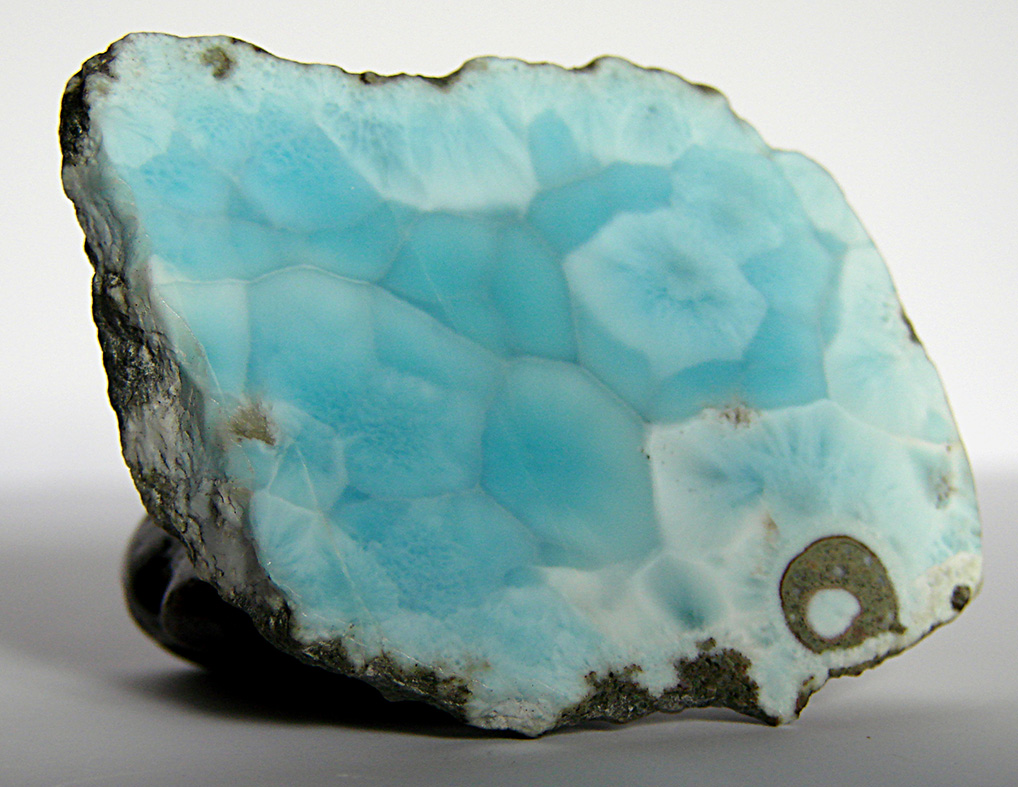
Larimar (Blue Pectolite)
Larimar specimen from Dominican Republic
General
CategoryInosilicate mineral
FormulaNaCa2Si3O8(OH)
Crystal systemTriclinic
Crystal classPinacoidal (1)
(same H-M symbol)
Space groupP1
Unit cella = 7.99 Å, b = 7.03 Å,
c = 7.03 Å; α = 90.51°,
β = 95.21°, γ = 102.53°; Z = 2
Identification
ColorShades of blue, blue-green
Crystal habitTabular to acicular, radiating fibrous, spheroidal, or columnar; massive
TwinningTwin axis [010] with composition plane [100], common
CleavagePerfect on {100} and {001}
FractureUneven
TenacityBrittle; tough when compact
Mohs scale hardness4.5 - 5
LusterSilky, subvitreous
DiaphaneityTranslucent to opaque
Specific gravity2.84 - 2.90
Optical propertiesBiaxial (+)
Refractive indexnα = 1.594 - 1.610 nβ = 1.603 - 1.614 nγ = 1.631 - 1.642
Birefringenceδ = 0.037
2V angleMeasured: 50° to 63°, Calculated: 42° to 60°
Dispersionr > v weak to very strong
References[1][2][3]

Larimar is the tradename for a rare blue variety of the silicate mineral pectolite found only in Dominican Republic, around the city of Barahona.[4] Its coloration varies from bluish white, light-blue, light-green, green-blue, turquoise blue, turquoise green, turquoise blue-green, deep green, dark green, to deep blue, dark blue and purple, violet and indigo and the larimar can come in many varieties and color mixes.[5][6]

History

[edit]

Dominican Republic's Ministry of Mining records show that Father Miguel Domingo Fuertes Loren of the Barahona Parish requested permission on 22 November 1916 to explore and exploit the mine of a certain blue rock that he had discovered. Pectolites were not yet known in Dominican Republic, and the request was rejected.[6][7]

Miguel Méndez and Peace Corps volunteer Norman Rilling rediscovered Larimar in 1974 on a beach at the foot of the Bahoruco Mountain Range, the coastal province of Barahona. Natives believed that the stone came from the sea, and they called the gem Blue Stone. Méndez took his young daughter's name Larissa and the Spanish word for sea (mar) and formed Larimar, to suggest the colors of the Caribbean Sea where it was found. The few stones that they found were alluvial sediment, washed into the sea by the Bahoruco River. An upstream search revealed the in situ outcrops in the range and soon the Los Chupaderos mine was formed.[6][7]

Geology

[edit]
Rough Larimar

Larimar is a type of pectolite or a rock composed largely of pectolite, an acid silicate hydrate of calcium and sodium. Pectolite is found in many locations, but larimar has a unique volcanic blue coloration, which is the result of copper substitution for calcium.[8]

Miocene volcanic rocks, andesites and basalts, erupted within the limestones of the south coast of the island. These rocks contained cavities or vugs which were later filled with a variety of minerals, including the blue pectolite. These pectolite cavity fillings are a secondary occurrence within the volcanic flows, dikes, and plugs. When these rocks erode, the pectolite fillings are carried down the slope to end up in the alluvium and the beach gravels. The Bahoruco River carried the pectolite-bearing sediments to the sea.[6] The tumbling action along the streambed provided the natural polishing to the blue larimar, which makes them stand out in contrast to the dark gravels of the streambed.[7]

Los Chupaderos

[edit]

The most important outcrop of blue pectolite is located at Los Chupaderos in the section of Los Checheses, about 10 km (6.2 mi) southwest of the city of Barahona in the southwestern region of Dominican Republic. It is a single mountainside now perforated with approximately 2,000 vertical shafts, surrounded by rainforest vegetation and deposits of blue-colored mine tailings.[6][7]

Jewelry

[edit]

Larimar jewelry is offered to the public in Dominican Republic, and elsewhere in the Caribbean as a local specialty. Most jewelry produced is set in silver, but sometimes high-grade larimar is also set in gold.

Quality grading is according to coloration and the typical mineral crystal configuration in the stone. Larimar also comes in green and can have red spots, brown strikes, etc., due to the presence of other minerals or oxidation. The more intense the blue color and the contrast in the stone, the higher and rarer is the quality. The blue color is photosensitive and fades with time if exposed to too much light and heat.[7]

Dominican jewelry designers such as Mónica Varela[9] and Joarla Caridad[10] have contributed to the popularization of larimar internationally.

See also

[edit]

References

[edit]
[edit]
Revisions and contributorsEdit on WikipediaRead on Wikipedia
from Grokipedia
Larimar is a rare variety of the , a hydrated sodium calcium silicate with the chemical formula NaCa₂Si₃O₈(OH), found exclusively in the . The gem's distinctive sky- to coloration, often with white marbling, results from trace amounts of substituting for calcium in the crystal structure. It forms in cavities and veins within altered basaltic volcanic rocks of age in the Bahoruco Mountain range near Barahona Province, making it geologically unique to this region. Discovered in 1974 by Dominican geologist Miguel Méndez and volunteer Norman Rilling while exploring a beach at the foot of the Bahoruco Mountains, Larimar was named by Méndez after his daughter Larisa and the Spanish word for , "mar," evoking its oceanic hues. The trade name quickly gained popularity as the stone entered international markets in the late 1970s, primarily as cabochons and beads for jewelry due to its ornamental appeal. Larimar exhibits a Mohs of 4.5 to 5, a specific of 2.74 to 2.88, and a of 1.595 to 1.645, rendering it relatively soft and requiring careful handling to avoid scratching or abrasion. Its color is stable to prolonged light exposure but can fade or alter with above 240°C or , though natural specimens are prized for their untreated vibrancy. occurs in small-scale operations within the Los Chupaderos area, where the stone is extracted from narrow veins, contributing to its status as a of the and a sought-after gem in global trade.

Physical Properties

Composition and Structure

Larimar is a variety of the , which has the NaCa₂Si₃O₈(OH) and is classified as an acid silicate hydrate containing sodium and calcium. This composition reflects its membership in the wollastonite group of inosilicate minerals, where silicon-oxygen tetrahedra form single chains that contribute to its overall framework. Pectolite, and thus larimar, crystallizes in the triclinic system, typically forming dense, fibrous aggregates that exhibit radiating or fan-like patterns due to the interlocking of fine, needle-like . These aggregates arise from the mineral's prismatic chain , where the chains align parallel to the c-axis, resulting in a polycrystalline texture that enhances its cohesion despite the individual ' delicacy. On the Mohs scale, larimar's hardness ranges from 4.5 to 5, underscoring its relative softness compared to harder gemstones like . Its specific gravity is approximately 2.74 to 2.90, varying slightly with inclusions, which places it among lighter . Larimar exhibits perfect cleavage on {100} and {001}, a consequence of its prismatic chain arrangement, which allows easy parting along the fiber length. A distinctive feature of larimar is the presence of trace copper ions (Cu²⁺), which substitute for calcium in the lattice without fundamentally changing the base chemical composition but imparting its characteristic hue. These inclusions occur as microscopic substitutions or associated minerals like , contributing to optical effects while maintaining the mineral's structural integrity.

Appearance and Varieties

Larimar exhibits a distinctive range of shades, from pale sky- to vivid deep , often veined or mottled with contrasting white or gray matrix derived from surrounding or other host rock materials. These colors are the primary reason for its appeal as a , evoking the serene tones of waters. The visual patterns in larimar are equally characteristic, featuring swirling, cloud-like, or marbled inclusions that create fluid, oceanic designs resembling waves, , or ethereal skies. These organic formations arise from the mineral's fibrous growth and intermingling with matrix, enhancing its aesthetic uniqueness in each specimen. Larimar is classified into varieties primarily based on color intensity and inclusion types. larimar features light blue tones accented by white veins, offering a soft, ethereal appearance. Deep Blue represents the rarest and most saturated form, with intense, uniform coloration that commands higher value. In contrast, the Volcán variety incorporates brown inclusions, typically from iron oxides, providing earthy contrast against the blue backdrop. Most larimar is opaque to translucent, though fully transparent pieces are exceedingly uncommon and highly sought after. Its luster ranges from silky to vitreous, attributable to the stone's fine fibrous texture that diffuses light softly. Naturally occurring in nodular or masses, larimar is typically fashioned into smooth cabochons to optimize the display of its colors and patterns, as its relative softness influences cutting techniques for optimal polish.

Geology and Occurrence

Formation Process

Larimar, a variety of the , forms primarily in gas bubbles or cavities within basaltic lava flows generated by volcanic activity. These cavities serve as sites for mineral precipitation during subsequent geological processes. The formation process involves the precipitation of from silica-rich hydrothermal fluids that react with calcium and sodium ions in the surrounding host rock, typically within Cretaceous-era volcanic sequences. These fluids originate from low-temperature hydrothermal alteration, often resulting from the mixing of volcanic waters with , under conditions below 170°C. This alteration occurs in both and basaltic environments, where the fluids migrate through fractures and voids in the rock, leading to the crystallization of fibrous aggregates. During fluid migration, is oxidized and incorporated into the structure, primarily as Cu²⁺ ions, which impart the characteristic blue hues to the mineral. Associated minerals commonly found in the same cavities include , zeolites such as , and occasionally , reflecting the silica- and alkali-rich nature of the precipitating environment. The host rocks date to the period within the broader tectonic setting characterized by volcanic arc activity and plate . The fibrous structure of the contributes to its ability to retain color variations developed during this process.

Primary Locations

Larimar occurs exclusively in the , within the in the southwestern of Barahona. These deposits are tied to the island's , forming in altered basaltic and pyroclastic rocks of the Dumisseau Formation. The primary deposit is situated in the Los Chupaderos area, near the town of Los Cheches, where the majority of known larimar nodules, veinlets, and impregnations are extracted. Other minor sites, such as Filita and Agua Piedra, contribute limited production but remain secondary to Los Chupaderos. Access to these deposits is challenging due to the rugged, roadless terrain of the Sierra de Bahoruco massif, typically requiring travel by foot or mule from nearby settlements like La Ciénaga, approximately 15 km northeast of Barahona city. As the national gemstone of the Dominican Republic, larimar exports are strictly regulated by law, mandating certification through Export Non-Objection Certificates issued by the Ministry of Industry, Commerce and Mipymes to ensure authenticity and compliance. In July 2025, larimar received international Denomination of Origin certification, further protecting its unique status. Despite extensive global geological surveys, no viable occurrences of larimar have been identified outside the Dominican Republic.

History and Discovery

Initial Finding

Although reports suggest the stone was first encountered in by Miguel Domingo Fuertes Loren, it was rediscovered in by Miguel Méndez, a Dominican artisan, and Norman Rilling, a U.S. volunteer, during an expedition in the Bahoruco Mountain Range in the . While hiking near the southern coast, they encountered waterworn fragments of an unusual sky-blue stone along the banks of the Bahoruco River and traced them upstream to their source in the Los Chupaderos area. Méndez coined the name "larimar" by blending "Lari," a for his daughter , with "mar," the Spanish word for sea, to evoke the stone's serene, ocean-like hues. Initial samples collected from Los Chupaderos were analyzed and identified as a rare variety of the in 1977, marking the stone's first public recognition beyond local finds. This distinctive coloration, resulting from trace copper inclusions, set larimar apart from the more common white or colorless forms of found elsewhere. Early efforts faced challenges, including frequent confusion with owing to their shared vivid tones and use in jewelry. By 1979, the Dominican government had conducted geological studies confirming larimar as a semi-precious stone, promoting it as a exclusive to the country. Small-scale commercial sales began in the late 1970s, primarily as rough or simply cut pieces sold to tourists in jewelry shops.

Mining Development

Mining of larimar commenced in the mid-1970s as an informal, small-scale artisanal endeavor in the Barahona province of the , where locals employed basic hand tools like picks and chisels to dig out the stone from exposed surface cavities and alluvial deposits along riverbeds. This rudimentary approach persisted through the , yielding modest quantities amid challenging tropical terrain and limited infrastructure. Government intervention in the 1980s introduced mining concessions to local , aiming to formalize operations, curb unregulated exploitation, and ensure community benefits; by 1985, approximately 100 miners had organized into the first under official recommendation. To bolster awareness and craftsmanship, the Larimar Factory and Museum was established in late 1986 by Ámbar Nacional, serving as an educational hub for the stone's processing and cultural significance. Contemporary extraction incorporates mechanized drilling and pneumatic tools to penetrate narrow veins within altered volcanic host rocks, though the steep, unstable slopes and brittle deposits necessitate predominantly manual labor for and precision. Annual production is estimated at 20,000 to 40,000 kg, constrained by vein scarcity and extraction difficulties. Economically, the sector sustains hundreds of jobs in Barahona, fostering , while processed larimar exports generate millions of USD yearly, with 2024 totals reaching 95,480 pounds (~43,300 kg) and January-June 2025 figures at 177,540 pounds. Sustainability challenges emerged prominently in the as accessible surface deposits dwindled, compelling miners to excavate deeper tunnels—often exceeding 100 meters—heightening risks of collapses, flooding, and worker injuries, as evidenced by fatal accidents prompting temporary mine closures. In response, Law 296-11 of 2011 proclaimed larimar the national stone, emphasizing its cultural patrimony, while a 2016 ministerial resolution prohibited raw exports to promote domestic industry growth and resource conservation. In July 2025, larimar received International Denomination of Origin certification, affirming its exclusive Dominican origin. The stone's exclusive occurrence in the Sierra de Bahoruco further limits global supply, underscoring the need for regulated development.

Uses and Applications

Jewelry Fabrication

Larimar is typically cut into cabochons to best preserve its distinctive swirling patterns and matrix inclusions, as the stone's relatively low Mohs hardness of 4.5 to 5 renders faceting difficult and uncommon due to the risk of chipping and the presence of internal flaws. Water-cooled diamond saws and grinding wheels are employed during shaping to minimize heat damage, with polishing achieved using fine abrasives to enhance the stone's silky luster without altering its natural texture. Setting techniques prioritize protection for the fragile material, favoring settings that encase the stone in a metal rim or to it from impacts, while prong settings are generally avoided to prevent dislodging or cracking. These methods allow larimar to be securely incorporated into finished pieces without compromising its , particularly given its susceptibility to under pressure. Common jewelry designs feature larimar as pendants, rings, earrings, and strands of beads, frequently paired with or gold settings to accentuate the gem's oceanic hues and create versatile, bohemian-style accessories. For instance, or freeform cabochons are often suspended as focal pendants, while smaller beads enable lightweight earrings or necklaces that highlight the stone's marbled variations. Jewelry production occurs predominantly in handcrafted workshops across the , particularly in , where artisans transform the majority of mined material into custom pieces using traditional tools like files, carving bits, and soldering equipment. This localized process supports small-scale operations focused on ethical sourcing and unique designs, with limited large-scale due to the stone's restricted supply. Fabrication challenges arise primarily from larimar's inherent fragility and , which can lead to breakage during cutting or wear; to address this, some pieces undergo stabilization via impregnation, filling micro-cracks and enhancing resistance to daily use without significantly altering appearance. Current market trends emphasize demand for untreated larimar exhibiting vivid sky-blue tones and minimal white veining, prized for their authenticity, with wholesale prices typically ranging from $5 to $20 per carat based on color intensity, pattern quality, and size, though exceptional specimens can command higher values. Exports of larimar products reached record levels in 2025, exceeding 230,000 pounds, reflecting growing international demand.

Alternative Applications

Beyond its traditional role in adornments, larimar serves as a valued collectible in geological and mineralogical displays. Specimens are exhibited in dedicated institutions such as the Larimar Museum in , , where raw and polished pieces highlight the stone's unique formation and rarity for educational purposes. Private collections also feature larimar for its aesthetic and scientific interest, often showcasing variations in color and texture derived from intergrowths. Larimar is crafted into various decorative objects that emphasize its artistic potential. Artisans carve it into sculptures, paperweights, and bookends, utilizing the stone's fibrous structure to create intricate designs suitable for home or office settings. It is also incorporated as inlays in furniture or used in beads, providing subtle accents that evoke the sea's hues without wearable intent. Due to its and specific mineral composition, larimar has limited industrial applications, primarily confined to scientific research on variants. Studies examine its blue coloration, attributed to inclusions and structural features, contributing to broader understandings of zeolite-like minerals in volcanic environments. This rarity restricts any widespread utilitarian use, focusing efforts on preservation rather than extraction for non-gem purposes. In metaphysical practices, larimar is marketed as a healing stone associated with the , purportedly aiding communication, emotional balance, and stress relief, though these claims lack scientific validation. Enthusiasts employ it in or as a to promote serenity, drawing on its calming blue tones. As a popular in the , larimar is sold in raw chunks or tumbled forms to tourists, offering an accessible memento of the country's exclusive gem resource. These pieces are commonly available near sites in Bahoruco , emphasizing the stone's local cultural significance. Conservation initiatives prioritize larimar's preservation for educational and environmental reasons. Some deposits are protected to maintain geological exhibits in museums, while regulations aim to minimize habitat disruption in the Sierra de Bahoruco, ensuring sustainable access to this endemic material. In July 2025, larimar received International Denomination of Origin certification to protect its authenticity and promote responsible practices. Additionally, as of September 2025, efforts to improve include better ventilation and worker to address health risks from toxic gases.

Identification and Care

Authentication Methods

Authenticating larimar, a rare blue variety of , requires a combination of visual, physical, and laboratory tests to distinguish genuine specimens from common imitations like dyed or blue . Under , genuine larimar exhibits a distinctive fibrous or radial texture due to its pectolite composition, whereas fakes such as often appear uniformly smooth or bubbly. Physical tests provide further verification; larimar has a Mohs of 4.5 to 6, meaning it can be scratched by a steel knife but resists scratching from (Mohs 7). Under (UV) light, some varieties of genuine larimar show weak , often appearing greenish-yellow or white, which helps differentiate it from non-reactive fakes. Common counterfeits, such as dyed , display uniform color penetration due to their , lacking the natural, mottled patterns and white inclusions characteristic of larimar. For definitive authentication, origin certification is essential, as larimar occurs exclusively in the Dominican Republic. Reputable sellers provide lab reports from institutions like the Gemological Institute of America (GIA), which confirm the pectolite composition through X-ray diffraction analysis, revealing the mineral's specific crystalline structure. The Dominican Republic's international denomination of origin certification, granted in July 2025, further protects against mislabeled imports, though buyers should seek verified documents over informal stamps. Assessing larimar's value focuses on key quality factors: intense sky-blue color without excessive white matrix, large (as nodules over 100 carats are rare), and appealing wave-like patterns resembling ocean waves. High-quality specimens with vivid color and minimal inclusions can command prices exceeding $200 per carat, while lower-grade pieces range from $1 to $20 per carat.

Maintenance Guidelines

To maintain the beauty and integrity of larimar, a relatively soft with a Mohs of 4.5 to 6, owners should prioritize gentle handling to avoid scratches and structural damage. Daily care involves limiting exposure to heat sources and harsh chemicals, including perfumes, , lotions, and household cleaners, as heat can cause color fading or alteration above 240°C and chemicals can lead to surface deterioration; direct should also be avoided to prevent potential heating and physical damage. For cleaning, gently wash larimar pieces using lukewarm mixed with a mild, phosphate-free soap and a soft-bristled to remove dirt without abrasion. Rinse thoroughly under running and pat dry with a soft, lint-free cloth; avoid ultrasonic cleaners, , or tools, which may fracture the stone due to its fibrous structure. Periodic cleansing every few weeks helps preserve its vibrancy. Proper storage is essential to prevent physical damage; keep larimar jewelry in a soft cloth pouch or fabric-lined box, stored separately from harder gemstones like or that could cause scratches. When repairs are needed, such as re-gluing loose settings, consult a professional jeweler experienced with fragile materials, as larimar's composition makes it prone to breaking under pressure; resizing rings or bands should be avoided to prevent cracking. With consistent adherence to these practices, larimar jewelry can endure for decades, though untreated or lower-quality stones may show signs of over extended periods.

References

Add your contribution
Related Hubs
User Avatar
No comments yet.