Hubbry Logo
VarisciteVarisciteMain
Open search
Variscite
Community hub
Variscite
logo
8 pages, 0 posts
0 subscribers
Be the first to start a discussion here.
Variscite
Variscite
from Wikipedia
Variscite
General
CategoryPhosphate minerals
FormulaAlPO4·2H2O
IMA symbolVar[1]
Strunz classification8.CD.10
Crystal systemOrthorhombic
Crystal classDipyramidal (mmm)
H-M symbol: (2/m 2/m 2/m)
Space groupPbca
Identification
ColorPale to emerald-green (pale green in transmitted light), green, blue green, yellow green, pale shades of brown or yellow, rarely red and colourless to white
Crystal habitEncrustations and reniform masses
Cleavage[010] perfect
FractureConchoidal to splintery
Mohs scale hardness4.5
LusterVitreous to waxy
StreakWhite
DiaphaneityTransparent to translucent
Specific gravity2.57 to 2.61
Optical propertiesBiaxial (−)
Refractive indexnα = 1.563 nβ = 1.588 nγ = 1.594
Birefringenceδ = 0.031
References[2][3][4]

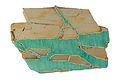
Variscite is a hydrated aluminium phosphate mineral (AlPO4·2H2O). It is a relatively rare phosphate mineral. It is sometimes confused with turquoise; however, variscite is usually greener in color. The green color results from the presence of small amounts of trivalent chromium (Cr3+
).[5]

Geology

[edit]

Variscite is a secondary mineral formed by direct deposition from phosphate-bearing water which has reacted with aluminium-rich rocks in a near-surface environment.[6] It occurs as fine-grained masses in nodules, cavity fillings, and crusts. Variscite often contains white veins of the calcium aluminium phosphate mineral crandallite.

It was first described in 1837 and named for the locality of Variscia, the historical name of the Vogtland, in Germany. At one time, variscite was called Utahlite. At times, materials which may be turquoise or may be variscite have been marketed as "variquoise". Appreciation of the color ranges typically found in variscite have made it a popular gem in recent years.[7]

Variscite from Nevada typically contains black spiderwebbing in the matrix and is often confused with green turquoise. Most of the Nevada variscite recovered in recent decades has come from mines located in Lander County[8] and Esmeralda County, specifically in the Candelaria Hills.

Notable localities are Lucin, Snowville, and Fairfield in Utah, United States. Most recently found in Wyoming as well. It is also found in Germany, Australia, Poland, Spain,[9] Italy (Sardinia), Brazil, and Iran (Yazd).

Jewelry

[edit]

Variscite has been used in Europe to make personal ornaments, especially beads, since Neolithic times. In the tumulus (burial mounds) excavated in the 19th century in Brittany (France)—among them the tomb of Mané er Hroëck in Locmariaquer and the Tumiac mound in Arzon—dating from the Neolithic period, between 4500 and 4000 BCE, many ornamental pieces, beads, and pendants were found. These were made from a green stone that Alexis Damour identified as a hydrated aluminum phosphate containing some iron, which he considered equivalent to the callaïs described by Pliny in his Natural History. Later, variscite was found in Neolithic archaeological sites in Spain as well.[10] During Roman times, variscite was used to imitate emerald crystals employed as pendants, being carved into prisms drilled longitudinally through the center but having eight faces instead of the six typical of emerald crystals. [11] It was not until the 19th century that it was determined that all variscite used in Europe came from three sites in Spain, Gavá (Barcelona), Palazuelo de las Cuevas (Zamora), and Encinasola (Huelva).[12]

Variscite is sometimes used as a semi-precious stone, and is popular for carvings and ornamental use due to its beautiful and intense green color, and is commonly used in silversmithing in place of turquoise. Variscite is more rare and less common than turquoise, but because it is not as commonly available as turquoise or as well known to the general public, raw variscite tends to be less expensive than turquoise.[7][5][13]

[edit]

See also

[edit]

References

[edit]
Revisions and contributorsEdit on WikipediaRead on Wikipedia
from Grokipedia
Variscite is a relatively rare hydrated aluminum with the AlPO₄·2H₂O, characterized by its vibrant green to blue-green coloration often resembling , and it typically occurs as masses or nodules suitable for use as a semiprecious . This secondary forms through the interaction of phosphatic solutions with aluminum-rich rocks under low-temperature, near-surface conditions, resulting in a waxy to vitreous luster and a Mohs of 3.5 to 4.5, making it relatively soft and prone to scratching. The mineral's color variations, ranging from pale mint green to deeper emerald tones or even bluish hues, arise from trace impurities such as , , and iron, with rarer varieties exhibiting red or violet shades due to ferric iron substitution. Variscite has a specific gravity of approximately 2.3 to 2.6, , and is generally translucent to opaque, though thin sections can appear nearly colorless under transmitted light. It belongs to the but rarely forms distinct crystals, instead appearing in massive, , or stalactitic habits, and it is commonly associated with other minerals like , crandallite, and . Variscite was first described in 1837 from the region in , —its type locality, historically known as Variscia, from which the mineral derives its name—and it has since been identified in various global deposits, primarily in sedimentary or altered igneous rocks. Key occurrences include the Fairfield and Lucin districts in , , which supply much of the commercial material; other notable localities are in and (), Queensland (), (), and the Sureanu Mountains (). It forms via processes or low-temperature hydrothermal activity, often in brecciated sandstones, clay sediments influenced by deposits, or phosphate-rich zones. As a gem material, variscite has been valued since times, with artifacts such as beads from over 6,000 years ago found in sites across , including , , and sourced from places like . Today, it is primarily cut into cabochons, beads, and slabs for jewelry, ornamental carvings, and collector specimens, prized for patterns like "spiderweb" inclusions of iron oxides or that enhance its aesthetic appeal. Its value is determined by color intensity, pattern quality, and size, though it remains more affordable than due to abundant supply from deposits, and it requires gentle care to avoid damage from acids or heat.

Chemical and Physical Properties

Composition and Formula

Variscite is a hydrated aluminum with the \ceAlPO42H2O\ce{AlPO4 \cdot 2H2O}. This composition classifies it within the group of minerals, where aluminum serves as the primary cation coordinated with tetrahedra and molecules. The molecular weight of variscite is 157.98 g/mol, calculated from its ideal end-member . Its elemental composition, based on this , includes aluminum at 17.08%, at 19.61%, oxygen at 60.76%, and at 2.55% by weight. Natural specimens may incorporate trace impurities such as iron, , or , which substitute for aluminum or enter interstitial sites within the structure. Variscite is the orthorhombic member of the variscite-metavariscite dimorphous pair, where metavariscite represents the monoclinic polymorph sharing the same chemical formula but differing in atomic arrangement. It also participates in the variscite-strengite series, involving isomorphous substitution of iron for aluminum in related phosphate structures. The dihydrate hydration state of variscite imparts structural stability under near-surface conditions, with dehydration occurring primarily as a function of temperature rather than pressure. Experimental studies indicate stability up to below 113 °C at atmospheric pressure and around 150°C at 4–5 kbar, beyond which it transitions to anhydrous aluminum phosphates like berlinite. This behavior underscores its formation in low-temperature aqueous environments.

Crystal Structure

Variscite crystallizes in the orthorhombic crystal system, belonging to the dipyramidal class with point group symmetry 2/m 2/m 2/m. Its atomic arrangement is defined by the space group Pbca (no. 61), which accommodates the hydrated aluminum phosphate framework through a specific layering of AlO₆ octahedra and PO₄ tetrahedra linked by hydrogen bonds from the water molecules. This structure results in a relatively open lattice that contributes to the mineral's typical massive or cryptocrystalline habits rather than well-formed crystals. The unit cell of variscite is characterized by approximate parameters a ≈ 9.82 , b ≈ 8.56 , c ≈ 9.63 , with a of about 809 ³ and Z = 8 units per cell. These dimensions reflect the orthorhombic symmetry, where the a and c axes are nearly equal, leading to pseudo-tetragonal appearances in some specimens, though the structure is distinctly orthorhombic. Variations in cell parameters occur due to minor substitutions, such as partial replacement of Al by Fe, but the core topology remains consistent across samples. Variscite exhibits imperfect cleavage, good on the {010} plane and poor on {001}, which influences its breakage along these directions in crystalline forms. Its is typically uneven to splintery, though it can appear sub-conchoidal to conchoidal in fine-grained or glassy varieties. Twinning is rare and occurs on the {201} plane, occasionally producing intergrowths that subtly alter . Variscite is dimorphous with metavariscite, the latter adopting a monoclinic ( P2₁/c) with a more distorted lattice due to different hydrogen-bonding arrangements, despite sharing the same AlPO₄·2H₂O. Within the orthorhombic form, two polytypes exist: variscite-1O (Lucin-type) and variscite-2O (Messbach-type), distinguished by their octahedral-tetrahedral layer stacking sequences. The variscite-2O polytype features a doubled b unit-cell parameter compared to variscite-1O, arising from an ordered repetition of layers, and is interpreted as a higher-temperature variant in synthetic studies.

Appearance and Diagnostic Features

Variscite is typically characterized by its coloration, ranging from to emerald green, with occasional or yellow varieties; this hue arises from trace amounts of or impurities. The mineral produces a streak, which aids in its identification. In terms of luster, variscite exhibits a waxy to vitreous sheen in crystalline forms, while massive varieties often appear earthy. It is generally translucent to opaque, with transparency varying based on size and inclusions. The Mohs ranges from 3.5 to 4.5, making it relatively soft and prone to scratching, while its specific gravity falls between 2.5 and 2.6. Optically, variscite displays refractive indices of α = 1.563, β = 1.588, and γ = 1.594, with a of 0.031; it shows no . These properties, combined with its diagnostic white streak and green tones, distinguish variscite in gemological assessments.

Geological Formation and Occurrence

Formation Processes

Variscite primarily forms as a secondary through low-temperature hydrothermal processes, where phosphate-rich fluids interact with and alter aluminum-bearing rocks such as , clays, or aluminosilicates. These fluids deposit variscite in veins or nodules within fractured or porous host rocks, often in fault zones where circulation is facilitated. The process involves the dissolution and reprecipitation of and aluminum, leading to the of variscite under relatively mild geochemical conditions. Phosphorus for variscite formation typically derives from the or hydrothermal breakdown of primary minerals like , while aluminum is sourced from the alteration of aluminous rocks or sediments. This occurs in acidic environments ( <6), often around 2–5, favorable for mobilization and precipitation, and at low temperatures typically below 150°C, including near-surface conditions without high-energy . Microbial activity in some settings, such as soils or caves, can further enhance formation by producing organic acids that lower and mobilize phosphates. Variscite commonly appears in paragenesis with minerals like , , crandallite, and , reflecting shared phosphate-rich depositional environments in altered zones. processes also play a key role, with in oxidized zones of sedimentary or igneous terrains promoting enrichment through leaching and secondary , often concentrating variscite in near-surface deposits.

Major Deposits and Localities

Variscite deposits are primarily associated with phosphate-rich hydrothermal alterations in aluminous rocks, occurring as nodules, veins, or crusts in , , or clay environments. The most significant commercial production has historically come from the , particularly , where small-scale targeted gem-quality nodules in the early to mid-20th century. Today, extraction is largely limited to hobbyist and collector activities due to the mineral's niche demand in the trade. In the United States, the Clay Canyon deposit near Fairfield, , stands as the largest and most renowned locality, situated in the Sunshine Mining District of the . Discovered in 1893, it yielded high-quality variscite nodules from brecciated limestone zones, with notable mining efforts in the 1900s and 1930s–1940s, including operations by the Occidental company (producing around 45,000 carats in 1908) and later by Ed Over at the Little Green Monster Mine. This site contributed substantially to the U.S. supply for jewelry and specimens until the , after which reserves dwindled and activity shifted to recreational digging. Other localities, such as Lucin and Snowville, have produced exceptional green nodules historically, though on a smaller scale. In , variscite occurs sporadically in the Farmville Mining District of Buckingham County, notably at the Willis Mountain Mine, where it forms in association with other phosphates but has seen minimal commercial extraction. Europe hosts several classic variscite occurrences, often tied to historical or prehistoric . In , the Tavistock area of has yielded variscite from old quarries and mines, such as High Down Quarry, where it appears as green crusts in phosphate-rich veins, though production was always small-scale and predates modern records. The Krásno ore district in the , part of the , features notable deposits at Vysoký Kámen, where variscite forms crystalline aggregates in associated with tin-tungsten mineralization; these sites have been studied for their rare assemblages but not extensively mined for variscite alone. Germany's region, the mineral's type locality (originally termed "Variscia"), produced early specimens from small veins in schists, contributing to its initial description in 1837, while Spain's Encinasola district in Province includes the prehistoric Pico Centeno site, where open-trench for variscite nodules dates to around 5200 BC and peaked in the , supporting widespread trade networks. Additional notable deposits exist outside and . In , hosts variscite in nodule form within weathered zones, with small-scale collection for gem purposes ongoing. Brazil's state yields scattered occurrences in pegmatites and altered rocks, primarily for local use, while other sites in the country remain underexplored. Overall, global variscite mining remains non-commercial, focused on high-quality nodules for ornamental applications rather than bulk production.

History and Etymology

Discovery and Naming

Variscite was first described as a distinct species in 1837 by the German mineralogist Johann Friedrich August Breithaupt, who examined specimens collected from the Meßbach Quarry in the region of , . These specimens occurred as crusts on aluminous rocks, marking the type locality for the mineral. Breithaupt's description appeared in the Journal für praktische Chemie, establishing variscite through detailed observation and initial chemical examination. Prior to this formal recognition, Breithaupt had described a similar material as "peganite" in from a locality near St. Riegi, close to in , but the 1837 analysis redefined and renamed it variscite to reflect its unique characteristics. This classification differentiated variscite as a hydrated aluminum , distinct from turquoise-like stones that had previously led to misidentifications. The name "variscite" originates from "Variscia," the ancient Latin designation for the medieval region, chosen by Breithaupt to honor the site of its initial discovery. Early 19th-century specimens were often mistaken for due to their similar green hues and associations, but chemical analyses during this period confirmed variscite's unique composition, resolving the confusion.

Historical and Cultural Uses

Variscite has been utilized in human artifacts since the period in , where it was mined and fashioned into beads, pendants, and amulets for burial purposes. Archaeological evidence from sites in , such as , dating to approximately 7200–6500 years ago (c. 5200–4500 BCE), reveals variscite ornaments including faceted beads, perforated pendants, and complete necklaces interred with high-status individuals, often alongside other like vessels and flint tools. These items were produced through collective mining efforts involving both genders, with the stone traded extensively up to 375 km northward into and , indicating early networks of exchange and variscite's role in signifying social prestige. Similarly, Neolithic burials in , such as at and Pompignan, have yielded variscite bead necklaces and deposits, underscoring its funerary and symbolic importance in prehistoric Atlantic facade cultures. Variscite sourced from Sardinian deposits, such as the Arbus mines, also contributed to these trade networks, appearing in Neolithic artifacts across the Mediterranean. In the , variscite served as a in jewelry and personal ornaments, often valued for its luster resembling . Scientific analysis of artifacts from the Late Bronze Age royal tomb at Qatna in (circa 14th century BCE) confirms variscite's use as raw material for adornments, marking the first documented evidence of its application in Middle Eastern contexts. This site, situated within the Mesopotamian cultural sphere, highlights variscite's prestige in elite burials, where its visual similarity to likely contributed to its selection for high-status items. While direct evidence from Egyptian sites remains limited, the stone's hue in broader ancient traditions evoked themes of growth and vitality, aligning with symbolic associations of minerals for renewal and life force. Variscite's prominence waned in later historical periods but experienced a revival in the 19th and 20th centuries, particularly in artistic and contexts. During the era (late 19th to early 20th century), it appeared in European jewelry designs, such as cabochon-set pendants and rings featuring organic motifs, capitalizing on the movement's emphasis on natural forms and colored stones. In the United States, in Utah's Clay Canyon near Fairfield, active since the early 1900s and intensifying in the 1930s, supplied material for Southwestern Native American crafts, where artisans like the incorporated variscite into silver jewelry as a alternative, reviving traditional and techniques. This period also saw variscite's resurgence in the growing hobby, promoted through publications like Desert Magazine in the 1940s, which encouraged enthusiasts to cut and polish the stone for ornamental use. In cultural traditions, variscite lacks prominent mythological roles but holds significance in modern spiritual practices, particularly for its association with emotional healing and the in contexts, where its green color is linked to compassion and balance. Native American communities in the Southwest have integrated it into contemporary crafts, viewing it as a stone of harmony, though prehistoric use in the region remains undocumented compared to . Overall, variscite's historical trajectory reflects a shift from elite prehistoric and ancient adornments to accessible 20th-century artisanal revival, without the synthetic dyes impacting its niche appeal in natural gemworking.

Applications and Uses

Jewelry and Lapidary Arts

Variscite is most commonly prepared for jewelry through cutting, as its nodular formations lend themselves well to this technique, producing smooth, polished stones that highlight the mineral's attractive green hues and patterns. Lapidaries typically work with nodules ranging up to 10 cm in diameter, slicing and shaping them into ovals, rounds, or freeforms to maximize color uniformity and veining. is rare due to the material's softness and lack of transparency in most specimens, though some chatoyant varieties may occasionally be cut this way to accentuate silky inclusions. Doublets, where variscite is backed with stabilizing materials like or , are also employed to enhance durability for wearable pieces. In design applications, variscite excels in beads, pendants, and inlays, often set in to complement its earthy tones in bohemian or Native American-inspired styles. Beaded necklaces feature graduated strands showcasing the stone's translucency, while pendants and earrings highlight carved motifs like leaves or abstract patterns. Inlays adorn silver cuffs or rings, creating effects with matrix inclusions for a rustic aesthetic. These uses capitalize on variscite's affordability and availability in larger sizes, making it suitable for statement jewelry. Among varieties prized for jewelry, "Utah teal" or Utahlite from the Little Green Monster Mine stands out for its high-quality light to emerald-green color with white veining, ideal for cabochons up to 20 carats or more. However, variscite's can lead to stability issues, such as absorption of oils or dyes, necessitating sealing with colorless stabilizers before setting. Spiderweb patterns, with dark matrix inclusions, add visual appeal but require careful cutting to preserve integrity. Market value for gem-quality variscite typically ranges from $5 to $50 per carat, depending on color saturation, pattern uniformity, and size, with emerald-green specimens commanding higher prices up to $60 per carat. Finished jewelry pieces, such as pendants or rings, retail from $20 to $200, though designer items in silver settings can exceed $700. Factors like rarity of uniform nodules influence pricing, keeping variscite accessible compared to similar gems like . Due to its Mohs hardness of 3.5–4.5, variscite's softness limits it to low-wear applications like pendants or earrings, requiring protective settings to prevent scratches or chipping. Owners should avoid exposure to chemicals, heat, or ultrasonics, as the mineral's hydration can cause cracking or color fading. Routine care involves gentle cleaning with a soft brush, mild detergent, and warm water, followed by thorough drying to mitigate porosity-related damage.

Industrial and Other Applications

Variscite has limited industrial applications due to its relative rarity and low content, but it plays a notable role in scientific and geochemical exploration. In , variscite is examined for its crystallization processes in systems, particularly under low-temperature conditions where it forms as a stable phase from aluminum and interactions. Its characteristics, influenced by crystal imperfections in natural samples, make it a useful model for understanding behavior in sedimentary environments and soils. Researchers also study its dissolution rates compared to amorphous aluminum phosphates, highlighting slower kinetics that inform models of release in acidic soils. As a potential source of aluminum or phosphorus, variscite is uneconomical for extraction, given its trace-level concentrations and the abundance of more viable minerals like for aluminum or for . No large-scale occurs for these purposes, as deposits are typically small and dispersed. In geochemical , variscite acts as an indicator for phosphate-rich deposits, forming secondarily in aluminous rocks altered by phosphatic waters, which signals potential economic resources. Its presence in sediments, such as or profiles, helps trace dynamics and environmental transformations over time. Beyond research, variscite holds appeal for mineral collectors due to its vibrant hues and nodular habits, though it lacks significant international export , with most specimens sourced from localized U.S. deposits.

Identification and Similar Minerals

Testing Methods

Variscite specimens can initially be assessed through , noting their characteristic pale to emerald- color, waxy to vitreous luster, and earthy to fine-grained massive texture, which often appears in nodular or stalactitic forms. This preliminary evaluation helps distinguish potential samples in the field but requires confirmation through physical tests. A simple hardness test involves attempting to scratch the specimen with a coin (Mohs 3), which variscite (Mohs 3.5–4.5) will mark, while it fails to scratch a steel knife blade (Mohs 5.5), indicating its intermediate softness; this destructive test should be performed only on rough or inconspicuous areas. The streak test, conducted by rubbing the specimen on an unglazed plate, produces a mark, and specific gravity can be approximated in the field via water displacement in a graduated , yielding a low value of 2.57–2.61 g/cm³ for crystalline forms or 2.2–2.5 g/cm³ for massive varieties. For laboratory verification, X-ray diffraction (XRD) analysis confirms variscite's by matching patterns, such as key d-spacings from Cu Kα radiation available in standard databases. Under long-wave (UV) light, variscite exhibits weak grass-green , aiding in initial screening. Chemical tests provide definitive identification: fine-grained variscite is slightly soluble in dilute (HCl) without , and adding ammonium reagent to the acidified solution produces a yellow phosphomolybdate precipitate, confirming the PO₄ presence. Fourier transform infrared (FTIR) spectroscopy further verifies the mineral by detecting characteristic absorption bands for OH stretching around 3000–3500 cm⁻¹ and PO₄ symmetric stretching at 1000–1100 cm⁻¹, with a prominent peak near 1030 cm⁻¹ for the P–O mode.

Distinction from Look-Alikes

Variscite is frequently mistaken for other green to blue-green minerals due to overlapping color ranges, but it can be distinguished through differences in hardness, chemical composition, streak, cleavage, luster, and reactivity to acids. Its blue-green hues arise from trace amounts of iron and aluminum in the hydrated phosphate structure, without copper, which imparts color to many mimics. Compared to , variscite is softer, with a Mohs of 3.5–4.5 versus turquoise's 5–6, making it more prone to scratching. Variscite lacks , responsible for turquoise's characteristic tones, and instead derives its from aluminum and iron; its streak is , while turquoise's is pale greenish- to . Both exhibit waxy luster and no prominent cleavage in massive forms, but variscite's lower specific gravity (2.5–2.7) compared to turquoise's (2.6–2.8) aids differentiation. Unlike , a variety of colored blue-green by lead impurities, variscite lacks the perfect cleavage in two directions at nearly 90 degrees typical of feldspars and has a more waxy rather than vitreous luster. Amazonite's reaches 6–6.5, far exceeding variscite's, and its streak is white without the subtle translucency variscite shows in thin sections. Variscite differs from , an amorphous , by being harder (3.5–4.5 versus 2–4) and less porous, with no cleavage observed in its aggregates compared to chrysocolla's earthy to lacking cleavage. Chrysocolla's blue-green color stems from , and it decomposes in , often forming a , but without , while variscite shows only slight in acid. Both have white streaks, but variscite's vitreous to waxy luster contrasts with chrysocolla's often dull appearance. In contrast to , a with deeper green shades from and distinctive banding, variscite lacks such banding and does not effervesce with in dilute acid, as it is a non- . has perfect cleavage on {201} and a light green streak, while variscite's cleavage is good on {010} but poorer on {001}, with a streak; their ranges overlap at 3.5–4.5 for and 3.5–4.5 for variscite, but 's monoclinic system versus variscite's orthorhombic provides crystallographic distinction. Pseudomalachite, a copper phosphate with similar chemistry but lacking variscite's full hydration, shares green hues from but crystallizes in the monoclinic system rather than variscite's orthorhombic. Variscite's aluminum-dominant (AlPO₄·2H₂O) contrasts with pseudomalachite's copper-rich Cu₅(PO₄)₂(OH)₄, resulting in variscite's streak and lower specific gravity (around 2.6) versus pseudomalachite's higher value (3.6–4.34); is comparable at 4–4.5 for both, but variscite's waxy luster and lack of aid identification.

References

Add your contribution
Related Hubs
User Avatar
No comments yet.