



Community hub
Limbu script
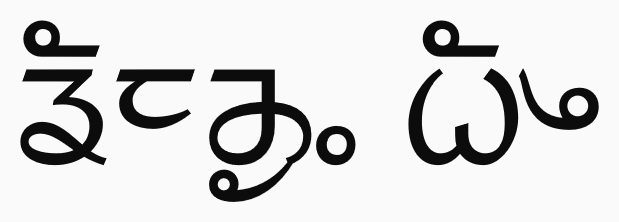
View on Wikipedia| Limbu ᤕᤠᤰᤌᤢᤱ ᤐᤠᤴ | |
|---|---|
 | |
| Script type | |
Period | c. 1740–present |
| Direction | Left-to-right  |
| Region | Nepal and Northeastern India |
| Languages | Limbu |
| Related scripts | |
Parent systems | |
| ISO 15924 | |
| ISO 15924 | Limb (336), Limbu |
| Unicode | |
Unicode alias | Limbu |
| U+1900–U+194F | |

| Brahmic scripts |
|---|
| The Brahmi script and its descendants |
The Limbu script (also Sirijanga script)[1] is used to write the Limbu language. It is a Brahmic type abugida.[2]
History
[edit]The Limbu script was invented in the 18th century by Limbu monk and scholar Te-ongsi Sirijunga Xin Thebe, in order to give the Limbu a distinct medium to commit their oral tradition to writing. He claimed that the script was used in late first millennium and that he had only rediscovered it, but no text from before the 18th century has been discovered. It was likely invented as an act of defiance.[3]
Accounts with Sirijunga
[edit]The Limbu language is one of the few Sino-Tibetan languages of the Central Himalayas to possess their own scripts.[4][5] The Limbu or Sirijunga script was devised during the period of Buddhist expansion in Sikkim in the early 18th century when Limbuwan still constituted part of Sikkimese territory. The Limbu script was probably composed at roughly the same time as the Lepcha script which was created by the third King of Sikkim, Chakdor Namgyal (ca. 1700–1717). The Limbu script is ascribed to the Limbu hero, Te-ongsi Sirijunga Xin Thebe.
Structure
[edit]The Limbu script is an abugida, which means that a basic letter represents both a consonant and an inherent, or default, vowel. In Limbu, the inherent vowel is /ɔ/, as in Bengali–Assamese and Odia scripts. To start a syllable with a vowel, the appropriate vowel diacritic is added to the vowel-carrier ᤀ. A vowel-carrier with no diacritic represents the sound /ɔ/.
ᤁ ko IPA: /kɔ/
|
ᤂ kho IPA: /kʰɔ/
|
ᤃ go IPA: /ɡɔ/
|
ᤄ gho IPA: /ɡʱɔ/
|
ᤅ ngo IPA: /ŋɔ/
|
ᤆ co IPA: /t͡ɕɔ/
|
ᤇ cho IPA: /t͡ɕʰɔ/
|
ᤈ jo IPA: /d͡ʑɔ/
|
ᤉ jho IPA: /d͡ʑʱɔ/
|
ᤊ nyo IPA: /ɲɔ/
|
ᤋ to IPA: /tɔ/
|
ᤌ tho IPA: /tʰɔ/
|
ᤍ do IPA: /dɔ/
|
ᤎ dho IPA: /dʱɔ/
|
ᤏ no IPA: /nɔ/
|
ᤐ po IPA: /pɔ/
|
ᤑ pho IPA: /pʰɔ/
|
ᤒ bo IPA: /bɔ/
|
ᤓ bho IPA: /bʱɔ/
|
ᤔ mo IPA: /mɔ/
|
ᤕ yo IPA: /jɔ/
|
ᤖ ro IPA: /rɔ/
|
ᤗ lo IPA: /lɔ/
|
ᤘ wo IPA: /wɔ/
|
ᤙ sho IPA: /ʃɔ/
|
ᤚ sso IPA: /ʂɔ/
|
ᤛ so IPA: /sɔ/
|
ᤜ ho IPA: /ɦɔ/
|
ᤠ a IPA: /a/
|
ᤡ i IPA: /i/
|
ᤢ u IPA: /u/
|
ᤣ ee IPA: /e/
|
ᤤ ai IPA: /ai/
|
ᤥ oo IPA: /o/
|
ᤦ au IPA: /au/
|
ᤧ e IPA: /ɛ/
|
ᤨ o IPA: /ɔ/
|
z + ᤠ ᤁᤠ IPA: /ka/
|
z + ᤡ ᤁᤡ IPA: /ki/
|
z + ᤢ ᤁᤢ IPA: /ku/
|
z + ᤣ ᤁᤣ IPA: /ke/
|
z + ᤤ ᤁᤤ IPA: /kai/
|
z + ᤥ ᤁᤥ IPA: /ko/
|
z + ᤦ ᤁᤦ IPA: /kau/
|
z + ᤧ ᤁᤧ IPA: /kɛ/
|
z + ᤨ ᤁᤨ IPA: /kɔ/
|
Initial consonant clusters are written with small marks following the main consonant:
ᤩ y IPA: /j/
|
ᤪ r IPA: /r/
|
ᤫ w IPA: /w/
|
ᤁ + ᤩ ᤁᤩ IPA: /kjɔ/
|
ᤁ + ᤪ ᤁᤪ IPA: /krɔ/
|
ᤁ + ᤫ ᤁᤫ IPA: /kwɔ/
|
Final consonants after short vowels are written with another set of marks, except for some final consonants occurring only in loanwords. They follow the marks for consonant clusters, if any.
ᤰ -k IPA: /k/
|
ᤱ -ng IPA: /ŋ/
|
ᤳ -t IPA: /t/
|
ᤴ -n IPA: /n/
|
ᤵ -p IPA: /p/
|
ᤶ -m IPA: /m/
|
ᤷ -r IPA: /r/
|
ᤸ -l IPA: /l/
|
ᤁᤰ IPA: /kɔk/
|
ᤁᤱ IPA: /kɔŋ/
|
ᤁᤳ IPA: /kɔt/
|
ᤁᤴ IPA: /kɔn/
|
ᤁᤵ IPA: /kɔp/
|
ᤁᤶ IPA: /kɔm/
|
ᤁᤷ IPA: /kɔr/
|
ᤁᤸ IPA: /kɔl/
|
Long vowels without a following final consonant are written with a diacritic called kemphreng ⟨᤺⟩, for example, ⟨ᤁ᤺⟩, /kɔː/.
There are two methods for writing long vowels with syllable-final consonants:
- With a kemphreng diacritic and the final consonant, such as ⟨ᤁ᤺ᤰ⟩, /kɔːk/.
- By replacing the final consonant with the corresponding full consonant and adding an underscore-like diacritic mark ⟨᤻⟩. This indicates that the consonant has no following vowel and that the preceding vowel is lengthened, example, ⟨ᤁᤁ᤻⟩, /kɔːk/. The same diacritic may be used to mark final consonants in loanwords that do not have final forms in Limbu, regardless of the length of the vowel.
The first method is widely used in Sikkim; the second method is advocated by certain writers in Nepal.[2]
Glottalization is marked by a sign called mukphreng ⟨᤹ ⟩, for example, ⟨ᤁ᤹ ⟩, /kɔʔ/.
Sample text
[edit]ᤛᤧᤘᤠᤖᤥ᥄ ᤀᤠᤍᤠᤱᤒᤠ ᤜᤠᤍᤠᤱᤔᤠᤛᤣ ᤗᤠᤶᤎᤡᤱᤃᤥ ᤗᤠᤶᤎᤰ ᤕᤠᤰᤌᤢᤱᤐᤠᤴ ᤖᤧ ᤘᤡᤁᤡᤐᤡᤍᤡᤕᤠ ᤀᤥ ॥ ᤛᤧᤘᤠᤖᤥ᥄ ᤀᤠᤍᤠᤏᤠᤒᤠ ᤀᤠᤍᤠᤏᤠᤔ ᤀᤠᤛᤧ ᤗᤠᤶᤎ ᤀᤡᤏᤠᤃ ᤗᤠᤶᤎᤠᤁᤠ ᤕᤠᤰᤌᤢᤱ ᤐᤠᤏᤠ ᤖᤧ ᤘᤡᤁᤡᤐᤧᤍᤤ ᤀ। ᤗᤡᤶᤒᤢ ᤓᤠᤙᤠᤁᤥ ᤘᤡᤁᤡᤐᤡ᤺ᤍᤡᤕᤠᤔᤠ ᤛᤫᤠᤃᤋ ᤇ। ᤗᤡᤶᤒᤢ ᤓᤠᤛᤠᤁᤨ ᤘᤡᤁᤡᤐᤡᤍᤡᤕᤠ ᤀᤜᤡᤗᤧ ᤀᤡᤴᤁᤢᤒᤧᤛᤠᤏᤠ (ᤐᤠᤖᤣᤰᤙᤠᤏ ᤘᤡᤁᤡ) ᤀᤷᤌᤠᤳ ᤁᤨᤁᤨᤔᤠ ᤇᤠ। ᤕᤛᤗᤠᤀᤡ᤺ ᤀᤃᤠᤍᤡ ᤒᤎᤠᤀᤢᤏᤠᤁᤠ ᤗᤠᤃᤡ ᤁᤠᤶᤋᤡᤔᤠ ᥈ ᤛᤠᤕᤠ ᤗᤧᤰ ᤗᤡᤶᤒᤢ ᤓᤠᤙᤠᤔᤠ ᤜᤢᤏᤠ ᤈᤠᤖᤥᤖᤣ ᤇᤠ। ᤋᤩᤛᤁᤠᤖᤏ ᤗᤡᤶᤒᤢ ᤓᤠᤙᤠᤔᤠ ᤗᤧᤂᤠᤜᤠᤖᤢ ᤗᤧᤰᤏᤠ ᤛᤢᤖᤢᤃᤠᤷᤏᤠ ᤛᤠᤒᤤ ᤗᤡᤶᤒᤢᤓᤠᤙᤡ ᤔᤡᤳᤖᤜᤠᤖᤢᤔᤠ ᤜᤠᤷᤍᤡᤰ ᤀᤠᤏᤢᤖᤨᤎ ᤇᤠ।
Obsolete characters
[edit]Three additional letters were used in early versions of the modern script:[2]
- ᤉ /d͡ʑʱɔ/
- ᤊ /ɲɔ/
- ᤚ /ʂɔ/
Two ligatures were used for Nepali consonant conjuncts:[6]
- ᤝ jña (for Devanagari ज्ञ)
- ᤞ tra (for Devanagari त्र)
Nineteenth-century texts used a small anusvara (ᤲ) to mark nasalization. This was used interchangeably with ᤱ /ŋ/.
The sign ᥀ was used for the exclamatory particle ᤗᤥ (/lo/).[2]
Punctuation
[edit]The main punctuation mark used in Limbu is the Devanagari double danda (॥).[2] It has its own exclamation mark (᥄) and question mark (᥅).
Numerals
[edit]0 ᥆
|
1 ᥇
|
2 ᥈
|
3 ᥉
|
4 ᥊
|
5 ᥋
|
6 ᥌
|
7 ᥍
|
8 ᥎
|
9 ᥏
|
Unicode
[edit]Limbu script was added to the Unicode Standard in April, 2003 with the release of version 4.0.
The Unicode block for Limbu is U+1900–U+194F:
| Limbu[1][2] Official Unicode Consortium code chart (PDF) | ||||||||||||||||
| 0 | 1 | 2 | 3 | 4 | 5 | 6 | 7 | 8 | 9 | A | B | C | D | E | F | |
| U+190x | ᤀ | ᤁ | ᤂ | ᤃ | ᤄ | ᤅ | ᤆ | ᤇ | ᤈ | ᤉ | ᤊ | ᤋ | ᤌ | ᤍ | ᤎ | ᤏ |
| U+191x | ᤐ | ᤑ | ᤒ | ᤓ | ᤔ | ᤕ | ᤖ | ᤗ | ᤘ | ᤙ | ᤚ | ᤛ | ᤜ | ᤝ | ᤞ | |
| U+192x | ᤠ | ᤡ | ᤢ | ᤣ | ᤤ | ᤥ | ᤦ | ᤧ | ᤨ | ᤩ | ᤪ | ᤫ | ||||
| U+193x | ᤰ | ᤱ | ᤲ | ᤳ | ᤴ | ᤵ | ᤶ | ᤷ | ᤸ | ᤹ | ᤺ | ᤻ | ||||
| U+194x | ᥀ | ᥄ | ᥅ | ᥆ | ᥇ | ᥈ | ᥉ | ᥊ | ᥋ | ᥌ | ᥍ | ᥎ | ᥏ | |||
| Notes | ||||||||||||||||
References
[edit]- ^ "Script Description". ScriptSource. Retrieved 29 June 2025.
- ^ a b c d e Michailovsky, Boyd; Everson, Michael (5 February 2002). "L2/02-055: Revised proposal to encode the Limbu script in the UCS" (PDF). Retrieved 1 September 2017.
- ^ Gaenszle, Martin (23 July 2021). "The Limbu Script and the Production of Religious Books in Nepal". Philological Encounters. 6 (1–2): 43–69. doi:10.1163/24519197-bja10014. ISSN 2451-9197. Retrieved 5 September 2024.
- ^ Sprigg, R. K. (1959). "Limbu books in the Kiranti Script". Akten des vierundzwanzigsten Internationalen Orientalisten-Kongresses München 28. Deutsche Morgenländische Gesellschaft, in Kommission bei Franz Steiner Verlag. pp. 590–592. Retrieved 6 May 2024.
- ^ Sprigg, R. K. (1998). Original and sophisticated features of the Lepcha and Limbu scripts. SOAS University of London. pp. 1–18. Retrieved 6 May 2024.
- ^ Pandey, Anshuman (14 January 2011). "L2/11-008: Proposal to Encode the Letters GYAN and TRA for Limbu in the UCS" (PDF). Retrieved 1 September 2017.
Limbu script
View on GrokipediaHistory
Invention and Early Accounts
The Limbu script, also known as the Sirijanga script, was invented in the early 18th century by the Limbu monk and scholar Te-ongsi Sirijunga Xin Thebe, during a period of Buddhist expansion in the Kingdom of Sikkim under the Namgyal dynasty.[5][3] Born around 1704 in the Yangwarok district of Limbuwan, Sirijunga is credited with creating the script to transcribe and preserve the Limbu oral traditions, particularly the Mundhum, a corpus of mythological, historical, and spiritual narratives central to Limbu identity and religion.[5] This effort occurred amid tensions between indigenous Kirati practices and the dominant Tibetan-influenced Buddhism promoted by Sikkim's rulers, with Sirijunga reportedly teaching the script and Mundhum texts to his disciples despite prohibitions.[3][5] Traditional accounts portray Sirijunga as a cultural hero and reincarnation of an earlier legendary king, who received divine inspiration for the script from the goddess Nisammang at Mount Phoktanglungma, enabling him to revive or innovate a writing system for the Limbu language.[5] As a scholar affiliated with a Sikkim monastery, he composed and copied religious manuscripts in the new script, focusing on ethical, moral, and ritual texts that resisted assimilation into Buddhist orthodoxy.[3] His work is seen as an act of cultural resistance against Sikkim's royal authority, which viewed the script as a threat to political control; Sirijunga was ultimately executed by Tibetan lamas in 1741 near Martam in western Sikkim.[5][3] The script's development paralleled the creation of the Lepcha script in the same Himalayan region, both emerging as indigenous responses to cultural pressures from Tibetan Buddhism.[6] It drew influences from Brahmic scripts, transmitted indirectly through the Tibetan script, particularly in its abugida structure, syllabary order, and vowel notation systems.[6] Early evidence of the script's form appears in 19th-century manuscripts collected by British resident Brian Houghton Hodgson in the 1840s, including alphabet books and Mundhum excerpts from Sikkim, preserved in the British Library's Hodgson Collection.[7][3] These documents demonstrate the script's initial use in religious and cultural contexts, though its dissemination remained limited due to ongoing suppression.[7]Modern Revival and Standardization
The modern revival of the Limbu script began in 1925 with the establishment of the Yakthunghang Chumlung Sabha in Kalimpong, India, an organization dedicated to promoting Limbu language, culture, and script through initiatives like the Jambok Memorial School.[3] This effort built on the foundational myth of Sirijunga's 18th-century invention of the script while adapting it for contemporary use.[3] Early 20th-century scholars such as Iman Singh Chemjong (1904–1975) and Phalgunanda Lingden (1885–1949) played pivotal roles in propagating the script, producing initial publications and fostering literacy among Limbu communities in India and Nepal.[3] Significant standardization occurred in the 1960s and 1970s through revisions by B.B. Subba, who adapted Iman Singh Chemjong's version of the script for printed materials by simplifying certain characters and removing obsolete ones, such as those for jña and tra, to suit modern Limbu orthography.[8][3] Subba's reforms, implemented via textbooks published in Sikkim starting in the late 1970s, became the basis for the script's widespread adoption and later Unicode encoding.[8] Limbu scholars and organizations, including the Yakthunghang Chumlung Sabha and the Nepal Academy, continued these efforts by supporting literacy programs and publishing religious texts, notably Atmananda Lingden's multi-volume Kirat Samjik Mundhum in 1998, which documented Limbu oral traditions in the standardized script.[3] Post-1950s initiatives in India and Nepal advanced script recognition in education and media. In Sikkim, India, Limbu-medium textbooks were introduced in schools from the 1960s, with the language later recognized as an additional official medium for cultural preservation in 1981.[9] In Nepal, following the 1990 democratic movement, the script gained traction in primary education and local media, culminating in recommendations for official status in Koshi Province by the Language Commission and declarations in rural municipalities like Mangsebung in 2018.[3][10] In August 2025, the Koshi Province Assembly registered and passed a bill recognizing Limbu as an official language alongside Maithili, effective for provincial administrative use as of November 2025.[11] Additionally, in August 2025, Maiwakhola Rural Municipality in Ilam declared Limbu as an official working language in government offices.[12] Challenges persisted, particularly limited printing resources until the 1990s, when censorship and lack of standardized fonts restricted production to rudimentary methods like cyclostyle machines and woodblocks.[3] Recent revival initiatives, accelerated by the script's inclusion in Unicode 4.0 in 2003, have focused on digital education, enabling font development (e.g., via the Noto project since 2012) and online literacy resources for over 4,000 students in Nepal.[13][14] This digital standardization has facilitated broader access to Limbu texts, including Mundhum excerpts, in educational apps and websites by 2025.[3]Script Structure
Consonants and Vowels
The Limbu script functions as an abugida, where its basic consonant letters inherently include the vowel /ɔ/, representing syllable-initial sounds in the Limbu language. Modern standardized forms feature 28 basic consonant letters, each denoting a consonant followed by this default vowel, reflecting the script's adaptation of Brahmic traditions to Limbu phonology, which includes aspirated stops such as /kh/ and /th/, as well as fricatives like /s/ and /h/.[15][16] For instance, the letter ᤁ represents /kɔ/, while ᤂ denotes /khɔ/, and ᤐ indicates /pɔ/. These letters are derived from earlier Kirati scripts and arranged without a strict canonical order, prioritizing phonetic representation over traditional varṇamālā sequencing.[17] The vowel system comprises seven phonemic vowels—/i/, /e/, /ɛ/, /a/, /ɔ/, /o/, /u/—with the inherent /ɔ/ serving as the default for consonants, and the others expressed through nine combining diacritics attached above, below, or to the side of the base consonant. Vowel length is distinguished on most vowels (except /e/ and /o/) using an additional mark called kemphreng placed over the consonant or vowel carrier. Representative diacritics include ᤡ for /i/ (as in ᤁᤡ /ki/), ᤢ for /u/ (as in ᤁᤢ /ku/), and ᤠ for /a/ (as in ᤁᤠ /ka/). Independent vowel forms at the syllable onset employ a dedicated vowel-carrier letter ᤀ, which can be modified by the same diacritics, such as ᤀᤡ for standalone /i/. This system accommodates the Limbu language's vowel inventory without length contrast on all positions, ensuring concise syllable encoding.[16][17][15] Additional examples of consonants highlight the script's coverage of Limbu sounds: ᤋ for /tɔ/, ᤌ for /thɔ/, ᤙ for /ʃɔ/, and ᤛ for /hɔ/, demonstrating the inclusion of voiceless aspirates and sibilants typical in Tibeto-Burman phonologies. These letters, when unmodified, always carry the inherent /ɔ/, which can be suppressed using the sa-i ᤻ to form pure consonants without the inherent vowel, such as in clusters or finals.[17][16]Diacritics, Clusters, and Syllable Formation
The Limbu script employs a set of diacritics to modify consonants and vowels, including nine vowel signs that attach to consonant bases to indicate variations from the inherent vowel /ɔ/, and nine syllable-final marks that denote coda consonants without an accompanying vowel.[17] These final marks, such as ᤰ for /ŋ/, are rendered as small combining forms positioned below or to the side of the preceding consonant, allowing for closed syllables.[17][16] Consonant clusters in Limbu orthography are formed using subjoined medial consonants for syllable-initial combinations and final marks for codas, with the script supporting three primary subjoined forms: ᤩ for the semivowel /j/ (subjoined ya), ᤫ for /w/ (subjoined wa), and another for /r/ (subjoined ra), which attach below the initial consonant to create onsets like /kja/ or /tra/.[17][16] For more complex clusters or gemination, the orthography uses a syllable-final mark followed by a full-sized onset consonant in the next position, rather than stacked conjuncts, as in ᤔᤢᤰᤁᤢ for /pikkha/ where ᤰ indicates the geminated /k/.[17] This approach avoids traditional ligatures in modern usage, simplifying rendering while preserving phonological distinctions.[17] Syllable formation in Limbu follows a core CV(C) structure, where a syllable consists of an optional initial consonant cluster, the inherent vowel /ɔ/ (which can be modified or suppressed by diacritics like ᤻ for vowel killer), and an optional coda indicated by a final mark.[17][16] Long vowels in closed syllables (with finals) are indicated through two methods: an explicit vowel lengthening mark like the kemphreng ᤺ (a double dot) placed above the syllable-final consonant, or by doubling the diacritic on the final, as in practices from Nepal where a full-sized final consonant pairs with the sa-i ᤻ below to extend the preceding vowel.[17][16] In open syllables, the kemphreng alone prolongs the vowel, though its use is not always mandatory in contemporary texts.[16] Early forms of the script incorporated ligatures for specific clusters borrowed from Nepali, such as ᤝ for /ɟɲa/ (jña, equivalent to Devanagari ज्ञ) and ᤞ for /tra/ (equivalent to Devanagari त्र), which were introduced in revisions by Īmāna Siṃha Cemajoṅ in the 1960s and 1970s.[8] These ligatures functioned as precomposed units for conjuncts but were later deemed obsolete by reformers like B. B. Subba, with modern Limbu simplifying such clusters through sequential final marks and subjoined medials instead, aligning the script more closely with native phonological needs.[8][17]Orthographic Elements
Punctuation
The Limbu script primarily employs the Devanagari double danda (॥) as its main punctuation mark for indicating sentence or verse endings, a convention adapted from broader Indic writing traditions to suit the script's syllabic structure.[17] This vertical double bar serves to delimit major pauses, much like a period in Latin scripts, and is especially prevalent in traditional and religious compositions where rhythmic or poetic flow is emphasized.[16] In contrast to Western punctuation, Limbu texts generally lack a standard comma or single period; instead, shorter pauses rely on spacing or the full stop (.) functioning as a comma equivalent, promoting a fluid reading experience aligned with the language's oral heritage.[17] Modern Limbu orthography introduces two unique script-specific marks to enhance expressiveness: the Limbu exclamation mark (᥄) for emphatic statements and the Limbu question mark (᥅) for interrogatives, both encoded within the Limbu Unicode block and recommended for contemporary fonts.[18] These innovations, though not ubiquitous in older manuscripts, appear in recent publications to bridge traditional forms with modern needs, such as in educational materials or literature.[16] An obsolete anusvara diacritic for nasalization, occasionally surfaces in historical texts but is discouraged in standardized modern usage.[18] In religious Mundhum texts, which form the core of Limbu oral and written mythology, the double danda (॥) dominates for marking verse conclusions and ritual segments, as seen in works like Tongsing tokma mundhum (1995–1996), where it underscores the sacred cadence without additional delimiters.[16] Secular writing, such as poetry in Sumhalung (1997–1998), incorporates these alongside the newer ᥄ and ᥅ for emotional or inquisitive tones, though reliance on spacing persists for minor breaks, reflecting a blend of conservatism and adaptation in everyday Limbu expression.[16] For instance, a Mundhum excerpt might end a stanza with ॥ to signify completion, while a modern narrative could punctuate surprise with ᥄ to heighten drama.[17]Numerals
The Limbu script employs a distinct set of ten decimal digits, ranging from 0 (᥆) to 9 (᥏), which are encoded in Unicode at code points U+1946 to U+194F.[19] These digits feature unique glyph forms derived from the script's abugida structure, setting them apart visually from Devanagari numerals (such as ०-९) and other Brahmic systems through rounded, angular shapes that align with Limbu consonant aesthetics.[17] The following table illustrates the standard forms:| Value | Digit | Unicode |
|---|---|---|
| 0 | ᥆ | U+1946 |
| 1 | ᥇ | U+1947 |
| 2 | ᥈ | U+1948 |
| 3 | ᥉ | U+1949 |
| 4 | ᥊ | U+194A |
| 5 | ᥋ | U+194B |
| 6 | ᥌ | U+194C |
| 7 | ᥍ | U+194D |
| 8 | ᥎ | U+194E |
| 9 | ᥏ | U+194F |