


Community hub
Recent from talks
Contribute something
Nothing was collected or created yet.
Shan alphabet
View on Wikipedia| Shan script လိၵ်ႈတႆး | |
|---|---|
 | |
| Script type | |
Period | c. 1407 CE—present |
| Direction | Left-to-right  |
| Languages | Shan language |
| Related scripts | |
Parent systems | |
Child systems | Lik-Tai |
| Unicode | |
| |
| Brahmic scripts |
|---|
| The Brahmi script and its descendants |

The Shan script is a Brahmic abugida, used for writing the Shan language, which was derived from the Burmese script.[2] Due to its recent reforms, the Shan alphabet is more phonetic than other Burmese-derived scripts.[3]
History
[edit] | This Section needs additional citations for verification. (September 2024) |
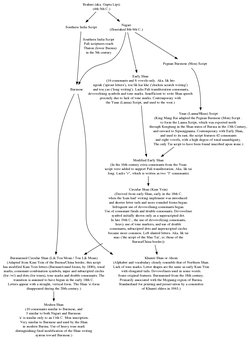
Around the 15th or 16th centuries, the Mon–Burmese script was borrowed and adapted to write a Tai language of northern Burma. This adaptation eventually resulted in the Shan alphabet, as well as the Tai Le script, Ahom script and Khamti script.[4] This group of scripts has been called the "Lik Tai" scripts or "Lik" scripts, and are used by various Tai peoples in northeastern India, northern Myanmar, southwestern Yunnan, and northwestern Laos.[5]According to the scholar Warthon, evidence suggests that the ancestral Lik-Tai script was borrowed from the Mon–Burmese script in the fifteenth century, most probably in the polity of Mong Mao.[6] However, it is believed that the Ahom people had already adopted their script before migrating to the Brahmaputra Valley in the 13th century.[7] Furthermore, the scholar Daniels describes a Lik Tai script featured on a 1407 Ming dynasty scroll, which shows greater similarity to the Ahom script than to the Lik Tho Ngok (Tai Le) script.[8]
Until the 1960s, Shan alphabet utilised vowel symbols and tone marks used in the Burmese script, which did not sufficiently distinguish all the phonemic distinctions in Shan.[3] The alphabet was reformed to incorporate vowel signs, and additional tone markers to represent the high-falling creaky (ႉ), high-level (း), low (ႇ), and mid-level, mid-falling tones (ႈ) and the addition of the Thai visarga (ႊ) to represent the sixth tone used in northern Shan dialects.[3]
Characteristics
[edit]The Shan alphabet is characterised by the circular letter forms of the Mon-Burmese script. It is an abugida, all letters having an inherent vowel /a/. Vowels are represented in the form of diacritics placed around the consonants. It is written left to right [2]
Vowels
[edit]The representation of the vowels depends partly on whether the syllable has a final consonant. They are typically arranged in the manner below to show the logical relationships between the medial and the final forms and between the individual vowels and the vowel clusters they help form.
| Medial | ◌ a unmarked
|
ၢ aa IPA: ɑː
|
ိ i IPA: i
|
ဵ e IPA: e
|
ႅ ae IPA: æ
|
ု u IPA: u
|
ူ o IPA: o
|
ွ aw/o IPA: ɔ
|
ို eu IPA: ɯ
|
ိူ oe IPA: ə
|
ႂ wa IPA: ʷ
|
|---|---|---|---|---|---|---|---|---|---|---|---|
| Final | ႃ aa IPA: ɑː
|
ီ ii IPA: iː
|
ေ e IPA: e
|
ႄ ae IPA: æ
|
ူ uu IPA: uː
|
ူဝ် o IPA: o
|
ေႃ aw/o IPA: ɔ
|
ိုဝ် eu IPA: ɯ
|
ိူဝ် oe IPA: ə
|
||
ႆ ai IPA: ai
|
ၢႆ aai IPA: aːi
|
ုၺ် ui IPA: ui
|
ူၺ် ohi/uai IPA: oi
|
ွႆ oi/oy IPA: ɔi
|
ိုၺ် uei/uey IPA: ɨi
|
ိူၺ် oei/oey IPA: əi
|
|||||
ဝ် aw IPA: au
|
ၢဝ် aaw IPA: aːu
|
ိဝ် iu IPA: iu
|
ဵဝ် eo IPA: eu
|
ႅဝ် aeo IPA: æu
|
ႂ် aɨ IPA: aɯ
|
Consonants
[edit]The Shan alphabet is much less complex than those of related Tai-Kadai languages like Thai. Having been reformed recently, Shan lacks many of the historical spelling remnants in Thai and Burmese. Compared to the Thai alphabet, it lacks the notions of high-class, mid-class and low-class consonants, distinctions which help the Thai script to number 44 consonants. Shan has only 19 consonants.
The number of consonants in a textbook may vary: there are 19 universally accepted Shan consonants (ၵ ၶ င ၸ သ ၺ တ ထ ၼ ပ ၽ ၾ မ ယ ရ လ ဝ ႁ ဢ) and five more which represent sounds not found in Shan, g, z, b, d and th [θ]. These five (ၷ ၹ ၿ ၻ ႀ) are quite rare. The consonant ရ occurs only in loanwords, as the consonant has otherwise merged ႁ in Shan.[3] In addition, most editors include a dummy consonant (ဢ) used in words with a vowel onset. A textbook may therefore present 18-24 consonants.
Like other Brahmi scripts, Shan consonants are typically arranged in rows based on place of articulation with columns based on aspiration and voicing ( Used to spell loan words and Pali):
ၵ ka IPA: ka
|
ၶ kha IPA: kʰa
|
ၷ gǎ IPA: ɡa
|
ꧠ gǎ IPA: ɡa
|
င nga IPA: ŋa
|
ၸ tsa IPA: t͡ɕa
|
ႀ xǎ IPA: θa
|
ၹ
|
ꧢ
|
ၺ nya IPA: ɲa
|
ꩦ ṭa IPA: ta
|
ꩧ ṭha IPA: tʰa
|
ꩨ ḍa IPA: da
|
ꩩ dha IPA: da
|
ꧣ ṇa IPA: na
|
တ ta IPA: ta
|
ထ tha IPA: tʰa
|
ၻ dǎ IPA: da
|
ꩪ dǎ IPA: da
|
ၼ na IPA: na
|
ပ pa IPA: pa
|
ၽ / ၾ pha / fa IPA: pʰa / fa
|
ၿ bǎ IPA: ba
|
ꧤ
|
မ ma IPA: ma
|
ယ ya IPA: ja
|
ရ ra IPA: ra
|
လ la IPA: la
|
ဝ wa IPA: wa
|
သ xǎ IPA: /θa/
|
ႁ ha IPA: ha
|
ꩮ la IPA: la
|
ဢ a IPA: ʔa
|
မ် IPA: m
|
ၼ် IPA: n
|
င် IPA: ŋ
|
ပ် IPA: p
|
တ် IPA: t
|
ၵ် IPA: k
|
ျ IPA: ja
|
ြ IPA: ra
|
Tones
[edit]The tones are indicated by tone markers at the end of the syllable. Shan tonal markers are mostly unambiguous and phonetic. In the absence of any marker, the default is the rising tone.
1 ◌ rising
|
2 ႇ low
|
3 ႈ mid-falling
|
4 း high
|
5 ႉ high-falling
and creaky |
6 ႊ emphatic
or middle |
While the reformed script originally used only four diacritic tone markers, equivalent to the five tones spoken in the southern dialect, the Lashio-based Shan Literature and Culture Association now, for a number of words, promotes the use of the 'yak khuen' (Shan: ယၵ်းၶိုၼ်ႈ) to denote the sixth tone as pronounced in the north.
Numerals
[edit]There are differences between the numerals used by the Shan script in China and Myanmar. The numerals used by Shan in China are similar to the numbers in Tham script and Tai Le script in China and the numbers in Burmese, while the Shan numerals in Myanmar form their own system, similar to the Burmese Tai Le numerals.
| Burmese Shan and Tai Le |
0 ႐
|
1 ႑
|
2 ႒
|
3 ႓
|
4 ႔
|
5 ႕
|
6 ႖
|
7 ႗
|
8 ႘
|
9 ႙
|
|---|---|---|---|---|---|---|---|---|---|---|
| Chinese Shan and Tai Le |
᧐
|
᧑
|
ᥨ
|
၃
|
၄
|
၅
|
᧖
|
၇
|
᧘
|
᧙
|
Punctuation
[edit]There are three main punctuation marks in Shan script with an addition mark for letter reduplication, typically as shorthand.
၊ comma
|
။ full stop
|
႟ exclamation
|
ꧦ letter
reduplication |
Syllables
[edit]Below are charts with syllables showcasing how of Shan script vowels and consonants are combined.
ၵ + ◌◌ ၵ kǎ IPA: /ʔa˨˦/
|
ၵ + ◌ႃ ၵႃ kǎa IPA: /ʔaː˨˦/
|
ၵ + ◌ိ ၵိ kǐ IPA: /ʔi˨˦/
|
ၵ + ◌ီ ၵီ kǐi IPA: /ʔiː˨˦/
|
ၵ + ◌ေ ၵေ kǎe IPA: /ʔeː˨˦/
|
ၵ + ◌ႄ ၵႄ kě IPA: /ʔɛː˨˦/
|
ၵ + ◌ု ၵု kǔ IPA: /ʔu˨˦/
|
ၵ + ◌ ူ ၵူ kǔu IPA: /ʔuː˨˦/
|
ၵ + ◌ူဝ် ၵူဝ် kǒ IPA: /ʔoː˨˦/
|
ၵ + ◌ေႃ ၵေႃ kǎu IPA: /ʔɔː˨˦/
|
ၵ + ◌ိုဝ် ၵိုဝ် kǔe IPA: /ʔɯː˨˦/
|
ၵ + ◌ိူဝ် ၵိူဝ် kǒe IPA: /ʔɤː˨˦/
|
ၵ + ႆ ၵႆ kǎi IPA: /ʔaj˨˦/
|
ၵ + ၢႆ ၵၢႆ kǎai IPA: /ʔaːj˨˦/
|
ၵ + ွႆ ၵွႆ kǎui IPA: /ʔɔj˨˦/
|
ၵ + ုၺ် ၵုၺ် kǔi IPA: /ʔuj˨˦/
|
ၵ + ူၺ် ၵူၺ် kǒi IPA: /ʔoj˨˦/
|
ၵ + ိုၺ် ၵိုၺ် kǔei IPA: /ʔɯj˨˦/
|
ၵ + ိူၺ် ၵိူၺ် kǒei IPA: /ʔɤj˨˦/
|
ၵ + ဝ် ၵဝ် kǎo IPA: /ʔaw˨˦/
|
ၵ + ၢဝ် ၵၢဝ် kǎao IPA: /ʔaːw˨˦/
|
ၵ + ိဝ် ၵိဝ် kǐo IPA: /ʔiw˨˦/
|
ၵ + ဵဝ် ၵဵဝ် kǎei IPA: /ʔew˨˦/
|
ၵ + ႅဝ် ၵႅဝ် kěo IPA: /ʔɛw˨˦/
|
ၵ + ႂ် ၵႂ် ʼǎue IPA: /ʔaɰ˨˦/
|
ပႃ pǎa IPA: /paː˨˦/
|
ပႃႇ pàa IPA: /paː˩/
|
ပႃႈ pāa IPA: /paː˧˧˨/
|
ပႃး páa IPA: /paː˥/
|
ပႃႉ pâ̰a IPA: /paː˦˨ˀ/
|
ပႃႊ [pa᷈a] Error: {{Transliteration}}: transliteration text not Latin script (pos 3: ᷈) (help) IPA: /paː˧˦˧/
|
Unicode
[edit]The Shan script has been encoded as a part of the Myanmar block with the release version of Unicode 3.0.
| Myanmar[1] Official Unicode Consortium code chart (PDF) | ||||||||||||||||
| 0 | 1 | 2 | 3 | 4 | 5 | 6 | 7 | 8 | 9 | A | B | C | D | E | F | |
| U+100x | က | ခ | ဂ | ဃ | င | စ | ဆ | ဇ | ဈ | ဉ | ည | ဋ | ဌ | ဍ | ဎ | ဏ |
| U+101x | တ | ထ | ဒ | ဓ | န | ပ | ဖ | ဗ | ဘ | မ | ယ | ရ | လ | ဝ | သ | ဟ |
| U+102x | ဠ | အ | ဢ | ဣ | ဤ | ဥ | ဦ | ဧ | ဨ | ဩ | ဪ | ါ | ာ | ိ | ီ | ု |
| U+103x | ူ | ေ | ဲ | ဳ | ဴ | ဵ | ံ | ့ | း | ္ | ် | ျ | ြ | ွ | ှ | ဿ |
| U+104x | ၀ | ၁ | ၂ | ၃ | ၄ | ၅ | ၆ | ၇ | ၈ | ၉ | ၊ | ။ | ၌ | ၍ | ၎ | ၏ |
| U+105x | ၐ | ၑ | ၒ | ၓ | ၔ | ၕ | ၖ | ၗ | ၘ | ၙ | ၚ | ၛ | ၜ | ၝ | ၞ | ၟ |
| U+106x | ၠ | ၡ | ၢ | ၣ | ၤ | ၥ | ၦ | ၧ | ၨ | ၩ | ၪ | ၫ | ၬ | ၭ | ၮ | ၯ |
| U+107x | ၰ | ၱ | ၲ | ၳ | ၴ | ၵ | ၶ | ၷ | ၸ | ၹ | ၺ | ၻ | ၼ | ၽ | ၾ | ၿ |
| U+108x | ႀ | ႁ | ႂ | ႃ | ႄ | ႅ | ႆ | ႇ | ႈ | ႉ | ႊ | ႋ | ႌ | ႍ | ႎ | ႏ |
| U+109x | ႐ | ႑ | ႒ | ႓ | ႔ | ႕ | ႖ | ႗ | ႘ | ႙ | ႚ | ႛ | ႜ | ႝ | ႞ | ႟ |
Notes
| ||||||||||||||||
Gallery
[edit]-
 A sign written in Shan along with other languages in Chiang Mai, Thailand
 -
 A sign written in Shan in Chiang Mai, Thailand


References
[edit]- ^ Diringer, David (1948). Alphabet a key to the history of mankind. p. 411.
- ^ a b Ager, Simon. "Shan alphabet, pronunciation and language". Omniglot. Retrieved 28 December 2018.
- ^ a b c d Jenny, Mathias (2021-08-23), Sidwell, Paul; Jenny, Mathias (eds.), "36 Writing systems of MSEA", The Languages and Linguistics of Mainland Southeast Asia: A comprehensive guide, De Gruyter Mouton, pp. 879–906, doi:10.1515/9783110558142-036, ISBN 978-3-11-055814-2, retrieved 2024-12-06
- ^ Ferlus, Michel (Jun 1999). "Les dialectes et les écritures des Tai (Thai) du Nghệ An (Vietnam)". Treizièmes Journées de Linguistique d'Asie Orientale. Paris, France.
- ^ "Shan | History, Culture & Language | Britannica". www.britannica.com. 2024-07-14. Retrieved 2024-09-07.
- ^ Wharton, David (2017). Language, Orthography and Buddhist Manuscript Culture of the Tai Nuea: An Apocryphal Jātaka Text in Mueang Sing, Laos (PhD thesis). Universität Passau. p. 518. urn:nbn:de:bvb:739-opus4-5236.
- ^ Terwiel, B. J., & Wichasin, R. (eds.), (1992). Tai Ahoms and the stars: three ritual texts to ward off danger. Ithaca, NY: Southeast Asia Program.
- ^ Daniels, Christian (2012). "Script without Buddhism: Burmese Influence on the Tay (Shan) Script of Mäng2 Maaw2 as Seen in a Chinese Scroll Painting of 1407". International Journal of Asian Studies. 9 (2): 170–171. doi:10.1017/S1479591412000010. S2CID 143348310.
Shan alphabet
View on GrokipediaHistory and Origins
Development from Ancestral Scripts
The Shan alphabet, known as lik tai or lik shan, originated as a Brahmic abugida derived from the Mon-Burmese script family during the 15th to 16th centuries, adapting elements from the Burmese script to suit the phonology of the Tai Shan language spoken in northern Myanmar and adjacent regions.[5] This derivation reflects broader Southeast Asian patterns of script borrowing, where the Mon script—itself evolved from Pallava Grantha influences in southern India—served as the foundational model for Burmese writing by the 11th century, before Shan adaptations emerged amid cultural exchanges in the Shan States.[5] The earliest documented evidence of the Shan script appears in a 1407 Ming dynasty scroll painting depicting tribute bearers from the Tay (Shan) polity of Mäng² Maaw², where inscriptions in an early form of the script exhibit strong Burmese influences, including shared consonant shapes and structural features.[5] This artifact, predating other known Shan texts by over a century, substantiates the script's development prior to the 15th century through prestige borrowing from Burman elite culture during the Pagan and early Ava periods, without initial ties to Theravada Buddhism—a distinctive trait in the region's script histories.[5] Subsequent influences from Pali and Sanskrit entered via Buddhist textual traditions in the Shan States, where the script was employed to transcribe religious manuscripts, enriching its orthographic conventions while maintaining its core abugida structure.[6] By the 16th century, the script saw widespread initial adoption for recording the Shan language across Burma (present-day Myanmar) and neighboring areas, including northern Thailand and southwestern China, facilitating administrative, literary, and vernacular uses.[5] A primary distinction from the parent Burmese script lies in its more pronounced rounded letter forms, which were stylized to better accommodate Shan phonological patterns, such as tonal distinctions and vowel harmonies, while retaining the circular aesthetics suited to palm-leaf inscription.[5] These adaptations, evident in early manuscripts, marked the script's evolution into a distinct system tailored for Shan expression, diverging from Burmese's sharper angularities in certain glyphs.[5]Reforms and Standardization
Significant reforms to the Shan script began in the 1940s, with further efforts in the 1950s and 1960s by the Myanmar government and Shan scholars to enhance its phonetic accuracy by introducing diacritics for tones and vowels to address limitations in the original system derived from Burmese. In 1940, Sao Hsai Muong and a Shan literary committee created a new version of the script by adding tone marks and new characters.[7] These changes included the addition of dedicated symbols to represent Shan-specific phonemes absent in Burmese, such as the velar nasal /ŋ/ (encoded as Myanmar Letter Shan Na, ၼ) and the palatal nasal /ɲ/ (encoded as Myanmar Letter Shan Nya, ၺ). The reforms also emphasized consistent vowel representation and tone marking to reduce ambiguities in pronunciation.[8][9][10] The reforms built on 1952 initiatives by the Shan Cultural Committee, which promoted Shan literacy through textbooks and readers.[8][11] Regional variations complicated full implementation, with older, less standardized forms persisting in Thailand—where the script retained more circular, pre-reform shapes influenced by local Tai traditions—and in China, where Dai (Shan-related) communities adopted a simplified New Tai Lue script under 1950s government directives, diverging from Myanmar's model before partial convergence through cross-border exchanges. By 1969, the Shan State Affairs Council appointed a 16-member commission in Taunggyi to further unify the script, compiling a handbook based on ancient manuscripts and synchronizing it with Burmese grammar for school curricula.[8][12][13] These reforms boosted Shan literacy rates in controlled areas through vernacular education and publications like the "tiger heads" readers, fostering cultural preservation amid nationalist movements. However, ongoing political instability in Shan State, including insurgencies and government suppression from the 1960s onward, resulted in incomplete adoption, with many rural communities relying on oral traditions or hybrid forms.[14][15][16]Core Script Components
Consonants
The Shan alphabet, an abugida derived from the Burmese script, employs 18 core consonants for native vocabulary, each carrying an inherent vowel sound /a/ that can be modified or suppressed in clusters. These consonants represent a range of plosives, fricatives, nasals, approximants, and affricates, with voiceless unaspirated and aspirated distinctions but no voiced plosives in standard Shan phonology.[1] In addition to the core set, five rare consonants—primarily loanwords or obsolescent forms inherited from Burmese—handle non-native sounds such as voiced stops and fricatives; these include ၿ (/b/), ၻ (/d/), ၷ (/ɡ/), ႀ (/θ/), and ၹ (/z/). Usage of these extended letters is limited to Pali, Sanskrit, or Burmese borrowings, and they are increasingly obsolescent in modern Shan writing.[1] Consonant clusters occur syllable-initially, typically involving a prescript medial (e.g., ျ for -j-, ြ for -r-, or ႂ for -w-) followed by the main consonant, or finals marked without vowel. Unlike some related scripts, Shan does not use true subjoined (stacked) forms; instead, the visible asat diacritic ် (U+103A) suppresses the inherent /a/ on non-initial consonants in clusters, as in ၵ် (/k/) for a bare /k/ sound. This killer mark remains orthographically apparent, aiding readability.[1] The following table lists the core and extended consonants, with Unicode representations, International Phonetic Alphabet (IPA) transcriptions, standard romanizations, and representative word examples (including glosses for context).| Character | Unicode | IPA | Romanization | Example Word | Meaning |
|---|---|---|---|---|---|
| ပ | U+1015 | /p/ | p | ပၢင် | to be able |
| ၽ | U+107D | /pʰ/ | ph | ၽၵ်း | cauliflower |
| တ | U+1010 | /t/ | t | တွင် | banana leaf |
| ထ | U+1011 | /tʰ/ | th | ထွင် | to grow |
| ၵ | U+1075 | /k/ | k | ၵူၼ်း | person |
| ၶ | U+1076 | /kʰ/ | kh | ၶဝ် | sky |
| ၸ | U+1078 | /t͡ɕ/ | c | ၸႂ် | to know |
| ၾ | U+107E | /f/ | f | ၾူၼ် | to blow |
| သ | U+101E | /s/ | s | သုၼ်ႇ | sun |
| ႁ | U+1081 | /h/ | h | ႁိၼ် | stone |
| မ | U+1019 | /m/ | m | မႃး | mother |
| ၼ | U+107C | /n/ | n | ၼၼ်ႉ | face |
| ၺ | U+107A | /ɲ/ | ny | ၺၢၼ်ႇ | to count |
| င | U+1004 | /ŋ/ | ng | ငဝ်ႈ | to go |
| ဝ | U+101D | /w/ | w | ဝူၼ် | doctor |
| ရ | U+101B | /r/ | r | ရႃ | heart |
| လ | U+101C | /l/ | l | လႅဝ်း | world |
| ယ | U+101A | /j/ | y | ယမ် | not |
| ၿ | U+107F | /b/ | b | (rare, e.g., in loanwords) | - |
| ၻ | U+107B | /d/ | d | (rare, e.g., in loanwords) | - |
| ၷ | U+1077 | /ɡ/ | g | (rare, e.g., in loanwords) | - |
| ႀ | U+1080 | /θ/ | th' | (rare, e.g., in loanwords) | - |
| ၹ | U+1079 | /z/ | z | (rare, e.g., in loanwords) | - |
Vowels
The Shan script, an abugida derived from the Burmese writing system, assigns an inherent vowel /a/ to each consonant unless suppressed by the virama (asat) mark ် (U+103A).[1] This default /a/ represents a short central vowel, typically realized as [ə] or in open syllables, and forms the basis for syllable pronunciation when no other vowel sign is present.[1] To denote other vowels, Shan employs approximately 12 dedicated diacritic vowel signs, which attach to the base consonant in positions before, after, above, or below, along with composite forms created from additional diacritics and consonants, resulting in 18 total vowel representations covering monophthongs and diphthongs.[1] These dependent vowel signs modify the inherent /a/, producing phonetic values such as /i/ (ိ, U+102D), /iː/ (ီ, U+102E), /u/ (ု, U+102F), /uː/ (ူ, U+1030), /eː/ (ေ, U+1031), and /ɛː/ (ႄ, U+1084).[1] Independent vowel forms, used for words beginning with a vowel, are constructed by combining the Shan letter A (ဢ, U+1022, /ɑː/) with these diacritics, such as ဢူ (/uː/, U+1022 U+1030).[1] Shan distinguishes vowel length phonemically, with short vowels like /a/ contrasting against long /aː/ (marked by ၢ, U+1062), and similar pairs for front and back vowels; length is often predictable in syllables, being long in open syllables and short in closed ones.[1] Diphthongs are represented by dedicated signs or composites, including /aj/ (ႆ, U+1086), /aːj/ (ဢႆ, U+1062 U+1086), /au̯/ (ဝ်, U+101D U+103A), and /aːu̯/ (ဢဝ်, U+1062 U+101D U+103A), typically gliding to /j/ or /w/.[1] Regional variations exist in vowel rendering: Myanmar Shan adheres closely to the standard Myanmar script extensions with angular diacritics, while Thai Shan often features more rounded glyph forms for the same signs, though phonetic realizations remain largely consistent; in contrast, the Khamti Shan variant (used in parts of Myanmar and India) introduces unique diacritics like ႂ် (U+1082) for /aɯ/ and additional diphthongs such as /aːi/ (ဢေ, U+1062 U+1035).[1][3]| Vowel Sign | IPA | Example with Base Consonant ၵ (/k/) | Transliteration |
|---|---|---|---|
| (unmarked) | /a/ | ၵ | ka |
| ၢ | /aː/ | ၢၵ | kaa |
| ိ | /i/ | ၵိ | ki |
| ီ | /iː/ | ၵီ | kii |
| ု | /u/ | ၵု | ku |
| ူ | /uː/ | ၵူ | kuu |
| ေ | /eː/ | ၵေ | ke |
| ႄ | /ɛː/ | ၵႄ | kɛɛ |
| ႆ | /aj/ | ၵႆ | kaj |
| ဝ် | /au̯/ | ၵဝ် | kau |
| ိဝ် | /iw̯/ | ၵိဝ် | kiw |
| ဢေ | /aːi/ (Khamti variant) | ဢေၵ | kaai k |
Tone Marks
The Shan language is a tonal language belonging to the Kra-Dai family, characterized by five principal tones—high (˥), mid (˧˨), low (˩), rising (˦), and falling/creaky (˦˨ˀ)—with a sixth emphatic tone (˧˦˧) used primarily in northern dialects or for stress.[1][17] These tones are essential for distinguishing meaning, as even slight variations in pitch can alter words entirely. The tonal inventory applies mainly to unchecked syllables (those ending in vowels or nasals), while checked syllables (ending in stops) have a reduced set of four tones.[1] Prior to the 1960s orthographic reforms, the Shan script, derived from the Burmese abugida, relied on ambiguous vowel and tone indicators borrowed from Burmese, making it challenging to represent the language's tones accurately and leading to reading difficulties.[1] The reforms, aimed at standardization and clarity, introduced distinct diacritic tone marks based partly on Roman punctuation symbols, positioned to the right of the syllable (after consonants and vowels) to explicitly denote the five main tones.[1][18] This innovation was crucial for resolving minimal pairs, such as unmarked naa¹ (rising tone, "thick") versus naa² with low tone mark ("very") or naa⁴ with high tone mark ("paddy field").[1] Another example includes the creaky tone in na⁵ ("aunt/uncle"), highlighting how tone marks prevent homophone confusion.[1] Shan also features tone sandhi rules, whereby tones may shift in compounds or polysyllabic words to achieve phonological harmony, as observed across dialects through targeted phonetic studies.[19]| Tone | IPA Contour | Diacritic Mark | Unicode | Example (Shan Script) | Romanization | Meaning | Notes |
|---|---|---|---|---|---|---|---|
| Rising (1st, unmarked) | ˦ (or ˦˦ in some analyses) | None | N/A | ၼႃ | naa¹ | thick | Default for open syllables without mark; audio approximates a smooth rise from mid to high pitch.[1] |
| Low (2nd) | ˩ | ႇ | U+1087 | ၼႃႇ | naa² | very | Low falling or level low; positioned after vowel. Audio: steady low pitch.[1] |
| Mid (3rd) | ˧˨ | ႈ | U+1088 | ၼႃႈ | naa³ | (contextual) | Slight dip from mid; less common in isolation. Audio: near-neutral with minor fall.[1] |
| High (4th) | ˥ | း (visarga) | U+1038 | ၼႃး | naa⁴ | paddy field | High level or rising-high; shared with Burmese. Audio: sustained high pitch.[1] |
| Falling/Creaky (5th) | ˦˨ˀ | ႉ | U+1089 | ၼႃႉ | naa⁵ | aunt/uncle | Starts mid-high, falls with glottal creak. Audio: breathy, interrupted fall for emphasis.[1] |
| Emphatic (6th, northern) | ˧˦˧ | ႊ | U+108A | (e.g., emphatic variants) | N/A | emphasis on base tone | Used for stress; not always marked separately. Audio: exaggerated rise-fall.[1] |
Orthographic Conventions
Numerals
The Shan alphabet utilizes ten basic digits, derived from the Brahmic family of scripts, to represent the numerals zero through nine in a positional decimal system akin to that of related Southeast Asian writing systems. These digits are integral to the script's orthography and are pronounced with specific terms in the Shan language, such as /suːn/ for zero (႐) and /nʊŋ/ for one (႑), reflecting phonetic adaptations in regional usage. The full set includes forms for 2 (႒, /sɔŋ/), 3 (႓, /sɑːm/), 4 (႔, /siː/), 5 (႕, /hɑː/), 6 (႖, /hɔk/), 7 (႗, /tɕɛt/), 8 (႘, /pɛt/), and 9 (႙, /kɔː/).[20] In Myanmar, traditional Shan numerals (႐–፼) are distinct from but stylistically related to standard Burmese digits (၀–၉), with angular, stacked shapes typical of the script's evolution from Mon-Burmese influences; both are used in modern texts, particularly in digital contexts for broader compatibility. In contrast, Dehong Shan (also known as Tai Nüa) employs the Tai Le script, featuring more rounded variants influenced by proximity to Chinese writing traditions and adaptations from the Tai Tham (Lanna) script; examples include ᧐ for zero and ᧑ for one. These differences arise from historical script reforms and cross-border linguistic exchanges. In modern Shan writing, both the specific Shan digits and standard Myanmar digits are employed, particularly in digital contexts for Unicode compatibility. Shan numerals serve practical functions in dates (e.g., marking Buddhist calendar years), quantities (such as in trade or agriculture), and traditional counting, where they integrate into syllabic structures for numerical compounds like ႑၀ (ten, /sʰip/). While modern usage follows positional notation, older Shan texts often apply additive principles, combining individual digit values or words without fixed place values to denote larger numbers, preserving pre-reform conventions.[20] The following table compares the basic Shan numerals to their Arabic and Burmese equivalents, noting that Shan and Burmese forms are encoded separately in Unicode but may exhibit minor stylistic variations in traditional handwriting; standard Myanmar digits are also used in some modern Shan contexts:| Value | Arabic | Shan | Burmese |
|---|---|---|---|
| 0 | 0 | ႐ | ၀ |
| 1 | 1 | ႑ | ၁ |
| 2 | 2 | ႒ | ၂ |
| 3 | 3 | ႓ | ၃ |
| 4 | 4 | ႔ | ၄ |
| 5 | 5 | ႕ | ၅ |
| 6 | 6 | ႖ | ၆ |
| 7 | 7 | ႗ | ၇ |
| 8 | 8 | ႘ | ၈ |
| 9 | 9 | ႙ | ၉ |
Punctuation
The Shan script utilizes punctuation marks inherited from the Burmese script, which itself draws from ancient Indic traditions such as those in Pali and Sanskrit manuscripts. These marks facilitate sentence structure and phrasing in written Shan, emphasizing clarity in a syllabic orthography.[1] Key standard punctuation includes the comma (၊, U+104A MYANMAR SIGN LITTLE SECTION), used to separate phrases within a sentence; the full stop (။, U+104B MYANMAR SIGN SECTION), marking the end of a declarative sentence; and the question mark (၌, U+104C MYANMAR SYMBOL QUESTION MARK), indicating interrogative sentences. The danida (၍, U+104D MYANMAR SYMBOL DANIDA) serves as a connector between clauses, often in conjunctions, and also denotes breaks in poetic or rhythmic texts. Unlike Western systems, the Shan script does not employ marks like semicolons or colons, instead depending on spaces to delineate phrases and larger units of thought.[1] The following table summarizes principal punctuation marks, their Unicode designations, primary functions, and illustrative examples in simple Shan phrases (with approximate Romanization for clarity):| Mark | Unicode | Function | Example Phrase | Approximate Romanization and Translation |
|---|---|---|---|---|
| ၊ | U+104A | Separates phrases | မၢၼ်း၊ လိၵ်ႈမၢၼ်း။ | Mān, lik hō mān. (Mother, [she] is mother.) |
| ။ | U+104B | Ends sentences | လိၵ်ႈၼမၼ်။ | Lik hō nam. ([She] drinks water.) |
| ၌ | U+104C | Indicates questions | လိၵ်ႈၼမၼ်လိၵ်၌ | Lik hō nam lik? ([Does she] drink water?) |
| ၍ | U+104D | Connects clauses or poetic breaks | လိၵ်ႈ။ မၢၼ်း၍ လိၵ်ႈ။ | Lik hō. Mān yā lik hō. ([She] goes. Mother and [she] goes.) |