Hubbry Logo
search
logo
1990684

Mewari language

logo
Community Hub0 Subscribers
Read side by side
from Wikipedia

Mewari
मेवाड़ी
Native toIndia
RegionMewar
EthnicityRajasthanis
Native speakers
4.21 million (2011 census)[1]
Devanagari
Language codes
ISO 639-3mtr
Glottologmewa1249
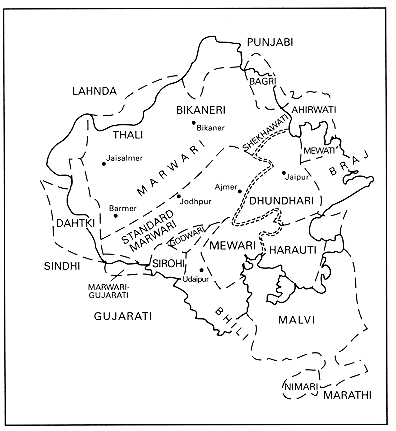
Rajasthani language and geographical distribution of its dialects

Mewari is an Indo-Aryan language of the Rajasthani languages group.[2] It is spoken by about five million speakers in Rajsamand, Bhilwara, Udaipur, Chittorgarh and Pratapgarh districts of Rajasthan state and Mandsaur, Neemuch districts of Madhya Pradesh state of India.

There are 31 consonants, 10 vowels and 2 diphthongs in Mewari. Intonation is prominent. Dental fricative is replaced by glottal stop at initial and medial positions. Inflection and derivation are the forms of word formation. There are two numbers—singular and plural, two genders—masculine and feminine, and three cases—simple, oblique, and vocative. Case marking is partly inflectional and partly postpositional. Concord is of nominative type in the imperfective aspect but ergative in the perfective aspect.[3] Nouns are declined according to their endings. Pronouns are inflected for number, person, and gender. Third person is distinguished not only in gender but also in remote-proximal level. There are three tenses—present, past, and future; and four moods. Adjective are of two types—marked or unmarked. Three participles are there—present, past, and perfect.[4] It has SOV word order.Mewari is a prominent language in Mewar region of Rajasthan.

See also

[edit]

References

[edit]
[edit]
Revisions and contributorsEdit on WikipediaRead on Wikipedia
from Grokipedia
Mewari is a Western Indo-Aryan language in the Rajasthani group, specifically the Mewari subgroup of Marwari, spoken primarily by approximately 4.2 million people (2011 census) in the Mewar region of southeastern Rajasthan, India.[1][2] It serves as a vital medium of communication in districts such as Udaipur, Rajsamand, Chittorgarh, and Bhilwara, with smaller communities in neighboring areas like Pratapgarh in Rajasthan and Mandsaur and Neemuch in Madhya Pradesh.[3][4] The language exhibits significant dialectal variation, including prominent varieties such as Gorawati, Khairari, and Sarwari, which show lexical similarities ranging from 82% to 93% among themselves but lower intelligibility with more distant Rajasthani speech forms like Marwari (around 70-80% lexical similarity).[2][5] Written in the Devanagari script, Mewari has a rich oral tradition and contributes to Rajasthani literature, though it faces sociolinguistic pressures from Hindi, with many speakers bilingual and using Hindi in formal education and media.[4] Studies indicate moderate to high vitality in rural heartland areas, but potential endangerment in urbanizing zones due to language shift among younger generations.[6] Mewari's phonological and grammatical features align closely with other Rajasthani languages, featuring implosive consonants, retroflex sounds, and a subject-object-verb word order typical of Indo-Aryan tongues.[2] It plays a key role in preserving cultural identity in the historic Mewar kingdom's territories, influencing local folklore, poetry, and festivals, while scholarly surveys highlight the need for standardization and literacy programs to support its development amid regional multilingualism.[5][7]

Classification and history

Linguistic classification

Mewari is a Western Indo-Aryan language belonging to the Indo-Aryan branch of the Indo-European language family.[8] It is classified within the Rajasthani subgroup, specifically as an eastern variety of the Marwari macrolanguage, which encompasses several mutually intelligible speech forms spoken primarily in western India.[8] The language has the ISO 639-3 code mtr and Glottolog identifier mewa1249, reflecting its recognition as a distinct entity while acknowledging its close ties to neighboring varieties.[2] In the taxonomic framework established by historical linguists, Mewari is positioned under the broader Rajasthani languages, which form a dialect continuum in the Central Zone of Indo-Aryan.[9] George A. Grierson, in his comprehensive Linguistic Survey of India (1907–1928), categorized Mewari as one of the five major Western Rajasthani dialects, alongside Marwari, Dhundhari, Jaipuri (a form of Dhundhari), and Harauti, emphasizing its phonological and morphological divergences from eastern Indo-Aryan languages like Hindi.[10] This classification highlights Mewari's retention of archaic Indo-Aryan traits, such as implosive consonants and specific vowel shifts, which differentiate it from standard Hindi's more standardized phonology and from Gujarati's distinct aspirate series and lexical borrowings.[9] Linguistic criteria for Mewari's placement include postpositional case marking that preserves oblique forms more conservatively than in Hindi, and lexical overlap of approximately 73-81% with Marwari, supporting high mutual intelligibility within the Rajasthani group but reduced comprehension with Gujarati (around 60%).[3] A sociolinguistic survey by SIL International further substantiates this by reporting 81-97% lexical similarity among Mewari varieties themselves, with 90% comprehension rates in intelligibility testing, underscoring debates on whether Mewari constitutes a separate language or a dialect of the Marwari continuum— a status resolved in ISO standards by its individual coding despite the macrolanguage affiliation.[9] Relative to other Rajasthani dialects like Dhundhari, Mewari exhibits greater eastern influences in its vowel harmony and verb conjugation patterns, contributing to partial mutual intelligibility (70-85%) but clear subregional distinctions.[3]

Historical origins and development

Mewari, a prominent dialect of the Western Rajasthani language group, originated from the Apabhramsa stage of Middle Indo-Aryan languages, particularly the Gurjar or Shauraseni Apabhramsa varieties prevalent in northwestern India between the 10th and 12th centuries. Linguist L.P. Tessitori, in his seminal analysis, traced the development of Old Western Rajasthani—the direct precursor to Mewari and related dialects like Marwari—from these Apabhramsa forms, noting phonological and grammatical continuities such as the retention of intervocalic stops and case endings. This evolutionary path positioned Mewari within the broader Indo-Aryan continuum, distinguishing it from eastern Hindi varieties through its western phonetic and lexical features. George A. Grierson further corroborated this lineage in his Linguistic Survey of India, classifying Mewari as emerging from the medieval Maru-Gurjar speech forms around the same period. During the medieval era, Mewari's development was shaped by the patronage of Rajput courts in the Mewar region, where it functioned as a vernacular for royal chronicles, poetry, and administrative records, fostering a degree of standardization amid oral traditions. The Dingal poetic style, often composed in early forms of Western Rajasthani including Mewari elements, reflected this courtly influence, as seen in bardic narratives glorifying Mewar rulers. This period marked Mewari's transition from a primarily spoken dialect to a literary medium, influenced by regional power structures that preserved its distinct identity separate from neighboring Gujarati.[11] The language underwent significant lexical enrichment during the Mughal era (16th–18th centuries), incorporating Persian and Arabic terms related to governance, military, and culture through interactions with imperial administration, while retaining its core Indo-Aryan structure. In the colonial period, a Sanskrit revival movement, promoted by British scholars and Indian reformers, prompted efforts to refine Mewari literature by drawing on classical Sanskrit vocabulary, countering earlier foreign influences. Earliest surviving written records in Mewari appear in late 19th-century inscriptions and translations, such as Maharaja Chatur Singh's Mewari rendition of the Bhagavad Gita, highlighting its emerging literary role.[11] In the 19th and 20th centuries, Mewari contributed to broader Rajasthani literary movements, with poets like those in the Dingal-Pingal tradition advocating for regional linguistic recognition against emerging Hindi standardization. Figures such as Meghraj Mukul composed works like Sainani in Mewari, blending folk elements with historical themes. Post-independence in 1947, the emphasis on Hindi as India's official language accelerated shifts away from Mewari in education and media, though it persisted in oral and cultural expressions within Mewar communities.[11]

Geographic distribution and speakers

Regions of use

Mewari is primarily spoken in the Mewar region of southern Rajasthan, India, covering the districts of Rajsamand, Bhilwara, Udaipur, Chittorgarh, and Pratapgarh.[4][12] This area, historically known as Mewar, forms the linguistic heartland of the language, where it serves as a key medium of daily communication among local communities.[4] The language extends beyond Rajasthan into adjacent districts of Mandsaur and Neemuch in Madhya Pradesh, reflecting shared cultural and geographic ties across state borders.[4][12] Mewari predominates in rural settings, particularly in the hilly and lake-dotted terrains of Mewar, with about 95% of speakers living in rural areas as of 1991 according to sociolinguistic surveys.[3] Urban usage is more limited but notable in Udaipur, the region's principal city, where Mewari functions as a major local language alongside Hindi.[13] Labor migration has led to Mewari-speaking communities in urban centers across India, though the language remains strongest in its core rural domains. Dialectal variations exist within these regions, including Khairari, Gorawati, and Sarwari, which reflect subtle differences in phonology and vocabulary tied to local sub-areas.[4][14]

Speaker population and demographics

According to the 2011 Census of India (latest available data, as the 2021 census has been delayed), Mewari has 4,212,262 native speakers, predominantly in Rajasthan where 4,166,666 individuals reported it as their mother tongue.[1] Of these, males account for 2,154,528 and females for 2,012,138 in the state, reflecting a near-even gender distribution among reported speakers.[1] Mewari functions primarily as a first language (L1) within its ethnic community, especially in rural settings, with all members thought to acquire it natively.[15] Second-language (L2) use is limited, though bilingualism with Hindi is prevalent, driven by educational and administrative needs; self-reported proficiency in Hindi is high, but testing reveals lower actual competence among uneducated speakers. This bilingualism correlates with factors like education level, where higher literacy (rising from 33% in 1991 to 38% in 2001) favors Hindi proficiency.[16] The language maintains stable vitality as an indigenous variety, with vigorous intergenerational transmission and primary use in home (93% of speakers) and cultural contexts (85%), based on 2002 survey data.[3] However, demographic trends show potential erosion, as 62% of speakers prefer Hindi as the initial language for children, particularly in urban areas where younger individuals shift toward Hindi for socioeconomic mobility.[16] Census data for Mewari faces challenges from underreporting, as many Rajasthani varieties, including Mewari, are often grouped under the "Hindi" category due to official classifications, potentially understating distinct speaker counts.[17]

Phonology

Consonants

Mewari possesses 31 consonant phonemes, typical of Western Indo-Aryan languages, including series of voiceless and voiced stops with aspirated counterparts at multiple places of articulation, retroflex consonants, and a small inventory of fricatives and approximants.[18] The stops are articulated at bilabial, dental, retroflex, and velar places, while postalveolar affricates provide additional contrasts in manner. Nasals occur at bilabial, dental, and retroflex positions, fricatives at alveolar (/s/) and glottal (/h/), and other sonorants include flaps (/ɾ/, /ɽ/), lateral approximants (/l/, /ɭ/), a palatal approximant (/j/), and a labiodental approximant (/ʋ/).[19] Key articulatory features include aspiration, realized as breathy voice in post-aspiration for obstruents, and retroflexion, involving apical or subapical articulation with tongue tip curled back. Voiced stops exhibit mild implosive qualities, particularly in bilabials. Allophonic variations are observed across the inventory: /b/ and /bʱ/ may surface as [ʋ] in certain lexical items (e.g., /baɾ/ realized as [ʋaɾ] 'outside'); /t͡ʃ/ and /t͡ʃʰ/ alternate with [s] in specific environments (e.g., /ɾət͡ʃko/ ~ [ɾəsko] 'fodder'); /s/ becomes [ʃ] before /j/ (e.g., /kəsjan/ [kəʃjan] 'how many'); and /h/ varies between [h] word-initially and [ɦ] elsewhere. Although not phonemic in native Mewari words, the dental fricative /θ/ from Hindi loans is regularly replaced by a glottal stop /ʔ/ in initial and medial positions (e.g., Hindi th in 'thanda' 'cold' becomes /ʔənɖo/).[19][18] Phonotactics restrict consonant clusters, with the maximal syllable structure permitting up to two consonants in onsets or codas but prohibiting combinations like CCVCC. Gemination is frequent intervocalically, especially following short vowels in inflectional morphology (e.g., /d͡ʒəbbo/ 'kurta'). A notable constraint is retroflex harmony, whereby dental and retroflex stops do not co-occur within the same root.[19] The following table presents the consonant inventory organized by place and manner of articulation, with representative examples in IPA and English gloss where available:
Manner / PlaceBilabialDentalAlveolarPostalveolarRetroflexVelarGlottal
Voiceless stopp (/paʈ/ 'millstone')ʈk
Voiced stopb (/baʈ/ 'weighing stone')ɖɡ
Aspirated voiceless stoppʰ (/pʰaʈ/ 'blast')t̪ʰʈʰ
Aspirated voiced stopbʱ (/bʱaʈ/ 'caste')d̪ʱɖʱɡʱ
Voiceless affricatet͡ʃ
Voiced affricated͡ʒ
Aspirated voiceless affricatet͡ʃʰ
Aspirated voiced affricated͡ʒʱ
Nasalmnɳ
Fricativesh
Lateral approximantlɭ
Approximantj
Flap/Trillɾɽ
Labiodental approximantʋ
[19]

Vowels and diphthongs

Mewari possesses a vowel inventory of eight oral phonemes, consisting of five long tense (peripheral) vowels /i, e, a, o, u/ and three short lax (non-peripheral) vowels /ɪ, ə, ʊ/. These vowels occupy front (/i, e, ɪ/), central (/ə/), and back (/u, o, ʊ, a/) positions in the vowel space. Length distinctions are phonemic and often correlate with tenseness, where long vowels are more peripheral in articulation compared to their short counterparts. For instance, /piɾ/ 'love' contrasts with /pɪɾ/ 'fill', illustrating how vowel quality and length can distinguish meaning.[19] Nasalization is phonemic in Mewari, with nasal counterparts existing for all oral vowels, including /ĩ, ẽ, ɪ̃, ə̃, ũ, õ, ʊ̃, ã/. Nasalized vowels contrast meaningfully with oral ones, independent of adjacent nasal consonants; for example, /het̪/ 'love' differs from /hẽt̪/ 'honey', and /t͡ʃʰik/ 'scream' from /t͡ʃʰĩk/ 'sneeze'. This feature aligns with broader patterns in Indo-Aryan languages, where nasalization serves a distinctive role. While some analyses count nasalized forms separately, contributing to a total of up to 10 vowels in descriptive inventories, the core oral set remains eight phonemes with nasal variants.[19][18] Mewari exhibits two phonemic diphthongs, /ai/ and /au/, which function as complex nuclei and appear in both native and borrowed lexicon. These diphthongs are rising in nature and can contrast with monophthongs; for example, /ai/ occurs in forms like "pair" meaning 'foot', where it maintains phonemic status without reduction to a simple vowel. Diphthongs do not participate in nasalization to the same extent as monophthongs, though contextual variation may occur.[18] Intonation plays a prominent role in Mewari prosody, with stress being non-contrastive but influencing rhythm and phrasing. In isolated words, primary stress typically falls on the final syllable, shifting to penultimate or earlier positions in connected speech for emphasis or fluency. Question intonation features rising-falling contours, where pitch rises on the penultimate syllable and falls on the final one, distinguishing interrogatives from declaratives. This pattern aids in syntactic disambiguation, such as marking yes-no questions. Vowel harmony is observed in limited contexts, particularly front-back alternations in certain suffixes, where the vowel quality assimilates to the stem's final vowel to maintain euphony; for instance, suffixes may alternate between /e/ and /o/ forms based on the preceding back or front vowel.[18][19] Length distinctions further underscore semantic contrasts, as seen in minimal pairs like /kal/ 'yesterday' versus /kaːl/ 'tomorrow', where prolonged /aː/ signals a shift in temporal reference. Similarly, the long nasalized /aː/ appears in kinship terms such as "mā̃" 'mother', highlighting the interplay of length, nasalization, and lexical meaning. These features contribute to Mewari's rhythmic flow, with breathy voicing sometimes affecting vowels following /h/, particularly among older speakers.[19]

Grammar

Nominal system

The nominal system in Mewari features two grammatical genders—masculine and feminine—and two numbers—singular and plural. Nouns are typically assigned gender based on semantic natural gender for animates or lexical patterns for inanimates, with masculine singular forms often ending in -o (e.g., ləṛkə 'boy') and feminine singular in -i (e.g., ləṛki 'girl'). Plural marking varies by gender: masculine plurals commonly take -o or -ā (e.g., ləṛkā 'boys'), while feminine plurals use -ī or -yā̃ (e.g., ləṛkiyā̃ 'girls'). These inflections are influenced by the stem's final vowel or consonant, reflecting typical Indo-Aryan patterns in Rajasthani dialects.[18] Case marking in Mewari distinguishes three main cases: direct (used for nominative and accusative functions), oblique (for most oblique relations like genitive, locative, and instrumental), and vocative (for direct address). The direct case is generally unmarked, while the oblique is formed through stem changes, such as vowel alternation or suffix addition (e.g., ləṛkə 'boy' direct sg. masc. becomes ləṛkā 'of the boy' oblique sg. masc.). Vocative forms often resemble direct but may shorten or add particles for emphasis (e.g., ləṛkə! 'O boy!'). Postpositions follow the oblique form to specify relations, including -ko for dative (e.g., ləṛkā-ko 'to the boy'), -rə for locative (e.g., gər-rə 'in the house'), and -to for ablative (e.g., gər-to 'from the house'). This hybrid system combines inflectional morphology with postpositional marking, common in western Indo-Aryan languages.[18] Personal pronouns in Mewari inflect for person, number, gender (in third person), and case. First person singular is hũ 'I' (direct), with oblique form mũ- (e.g., mũ-ko 'to me'); second person singular is tu 'you' (direct), oblique tũ- (e.g., tũ-ko 'to you'). Third person pronouns distinguish proximity: e 'this one' (near demonstrative, masc. sg. direct), oh 'that one' (far), and ah 'which one' (interrogative), all agreeing in gender and number (e.g., e-i 'this one' fem. sg.). Demonstratives like e function similarly to pronouns and inflect for case (e.g., e-ko 'to this one'). Pronouns show suppletive forms in oblique, such as first plural amər- 'our' from direct amə 'we'.[18] Adjectives in Mewari agree with the noun in gender, number, and case, following the noun's inflectional paradigm. For instance, the adjective vaḍō 'big' appears as vaḍō (masc. sg. direct), vaḍi (fem. sg. direct), vaḍe (masc./fem. pl. direct), and takes oblique forms like vaḍyā (masc. sg. oblique) or vaḍiyā (fem. sg. oblique). Adjectives precede the noun and may stem-change for agreement (e.g., nəvō gəṛə 'new house' masc. sg.). This agreement system ensures concord within the noun phrase, linking modifiers tightly to the head noun. Definiteness is conveyed contextually rather than morphologically.[18]

Verbal system and syntax

The verbal system in Mewari is characteristic of Western Indo-Aryan languages, featuring finite verbs formed by combining a root with tense-aspect markers and person-number-gender agreement suffixes. Verb roots are typically monosyllabic or disyllabic, followed by a stem-forming element (such as -a- or -i-) that conditions the addition of tense-aspect affixes; for instance, the 1st person singular imperfective suffix often appears as -yo in present contexts. Agreement on the verb matches the subject in gender and number for imperfective and future tenses but defaults to neuter masculine singular in perfective transitive constructions.[20] Mewari distinguishes three main tenses—present, past, and future—each intersecting with aspectual categories of imperfective (ongoing or habitual) and perfective (completed). The present tense is formed with the auxiliary ho- 'to be' plus the present participle in -ta-, yielding imperfective meanings, as in the 1st person singular huN khātā hoN 'I eat' (literally 'I am eating'). The past tense uses perfective markers like -o- for masculine singular, resulting in forms such as mene khāyo 'I ate', where the agent is marked with the postposition -ne.[20] Future tense employs the suffix -ibo- or -ega on the root, combined with agreement, to indicate intention or prediction.[20] The language encodes four moods through distinct inflectional paradigms: indicative for factual statements, imperative for commands (e.g., bare root for 2nd singular like khā 'eat!'), subjunctive with -u- endings for hypothetical or desiderative situations, and optative using the future participle for wishes or permissions. Participles play a key role in non-finite constructions, including three types: present in -ta- (e.g., khātā 'eating'), past in -a- or -yo- (e.g., khāyo 'eaten/having eaten'), and future in -ibo- (e.g., khāibā 'to eat/will eat'). These forms relativize clauses or form compound verbs with auxiliaries. Alignment in Mewari exhibits an aspect-based split: nominative-accusative in imperfective and future tenses, where subjects and intransitive subjects receive no case marking, but ergative-absolutive in perfective transitive clauses, with agents marked by -ne and patients unmarked unless animate (requiring differential object marking with -ko).[20] This ergative pattern, inherited from Middle Indo-Aryan developments, applies strictly to perfective past verbs, ensuring the transitive subject aligns with intransitive objects in lacking case.[20] Basic syntax follows a head-final SOV order, with postpositions governing noun phrases (e.g., ghar mẽ 'in the house'). Adjectives and adverbs precede the nouns or verbs they modify, and subordinate clauses typically occur before main clauses. Questions are formed by SOV inversion with rising intonation or the interrogative particle ki at the end, as in tu khāyo ki? 'Did you eat?'. Negation employs the preverbal particle nə- or nahi, applying across moods and tenses without altering alignment.

Writing system and orthography

Use of Devanagari script

The Mewari language, a member of the Indo-Aryan family spoken primarily in Rajasthan, India, employs the Devanagari script as its primary writing system, a choice shared with Hindi, Marathi, and other regional languages. This abugida script is written from left to right, with each consonant inherently carrying the vowel sound /ə/ unless modified by diacritic marks known as matras or suppressed by the virama (halant).[4][21] The adoption of Devanagari for Mewari aligns with broader trends in northern Indian vernaculars, facilitating literary expression while drawing on the script's established use for classical languages.[22] Historically, Devanagari's use in Mewari emerged prominently in the 19th century for literary works, building on earlier traditions influenced by Sanskrit and Prakrit, from which Indo-Aryan languages like Mewari derive. Examples include 19th-century texts such as "Bhagvā ndās," rendered in a variant of Devanagari that incorporated regional forms like the Rajasthani SA letter for specific phonemes, reflecting adaptations in Mewar royal and courtly documentation. Prior to widespread standardization in the early 20th century, influenced by printing presses and the promotion of Hindi, Mewari writings often retained pre-modern Devanagari features, such as distinct sibilant representations, used until around 1900–1920.[23][23] This evolution underscores Devanagari's flexibility in accommodating Rajasthani dialects, including Mewari, while transitioning toward a more uniform Hindi-aligned orthography.[23] The core character set of Devanagari for Mewari comprises 47 primary aksharas: 14 vowels (svaras) and 33 consonants (vyanjanas), supplemented by matras for denoting vowels other than the inherent /ə/. These elements allow for the representation of Mewari's phonological inventory, though mappings for dialectal variations rely on standard letters like ह (/h/) or contextual adaptations.[21][19] One key challenge in using Devanagari for Mewari is the lack of full standardization for language-specific sounds, stemming from the script's primary calibration for Sanskrit and Hindi and requiring ad hoc solutions for Rajasthani phonemes.[19][23] Digitally, Devanagari has been supported in Unicode since version 1.0 in 1991, enabling consistent encoding for Mewari texts via the Devanagari block (U+0900–U+097F), though specialized characters like the Rajasthani SA (proposed U+11B0A) await broader implementation to better serve regional needs.[23] Recent studies as of 2025 emphasize the need for standardization to support literacy material development.[19]

Orthographic features and conventions

Mewari orthography follows Devanagari conventions for vowel representation, where dependent vowel signs, or matras, are attached to preceding consonants to indicate non-inherent vowels. For instance, the short high front vowel /ɪ/ is marked by the matra ि, as in किळ (kiḷ, "bud"), while the long counterpart /iː/ uses ी, as in की (kī, "which"). The inherent schwa /ə/ is implied in any consonant lacking a matra or explicit vowel sign, and the virama (halant, ्) suppresses this inherent vowel to form consonant clusters, such as in प्रत्येक (pratyek, "each").[21] Consonant spelling adheres to standard Devanagari forms, distinguishing places of articulation and aspiration. Retroflex consonants are denoted with a subscript dot, exemplified by ट for the voiceless retroflex stop /ʈ/ in टाक (ṭāk, "pound") and ड for the voiced /ɖ/ in डाकू (ḍākū, "robber"). Aspirated consonants feature a superscript horizontal stroke resembling "h," such as ख for the aspirated voiceless velar stop /kʰ/ in खायो (khāyo, "ate").[21] Special orthographic conventions address unique phonological traits. Nasalization of vowels is indicated by the chandrabindu (ँ) diacritic above the vowel or matra, as in माँ (mā̃, "mother").[18][21] Historically, Mewari and other Rajasthani varieties employed a distinct Devanagari letter, Rajasthani SA (visually similar to a dotted स), to represent the schwa /ə/ in word-final or preconsonantal positions, as seen in 19th-century examples like भगवाांनदा (bhagvā̃ndā, a form related to "gift"). Modern standardization, influenced by Hindi norms post-1947, has largely replaced this with स, though it persists in some handwritten or royal documents.[23] Efforts to standardize Mewari orthography gained momentum after the 1950s, with linguists proposing consistent sound-to-script mappings to distinguish it from Hindi. Lakhan Gusain's 2013 grammatical description outlines rules for phoneme representation, including guidelines for diphthongs and suprasegmentals, to promote uniformity in educational and literary contexts.[24] Representative examples include the self-referential term मेवाड़ी (Mevāṛī) for "Mewari language." Hindi-influenced writing often introduces errors, such as overusing explicit अ for /ə/ where the inherent vowel suffices or substituting standard Hindi matras for Mewari-specific intonations.[4]

Lexicon and vocabulary

Word formation processes

Mewari employs a range of morphological processes to form words, predominantly through suffixation for both inflection and derivation, alongside compounding and reduplication for lexical expansion and emphasis. These strategies reflect the agglutinative tendencies common in Western Indo-Aryan languages, enabling the marking of grammatical relations and the derivation of new meanings from existing roots.[25][26] Inflection in Mewari relies heavily on suffixation to indicate tense, case, and number. For tense, verbs take suffixes such as -ā for simple past masculine singular (e.g., ayā 'he came', gyā 'he went') and -syu for future (e.g., mar^syu 'I shall strike'). Case marking uses postpositional suffixes, including -re or -rd for genitive (e.g., daria-re 'of the sea', haukare 'of the merchant') and -e for locative (e.g., ghare 'in the house'). Number is expressed through suffixes like -a or -d for plural nouns (e.g., chhokre 'boys' from chhokro 'boy').[26] Derivation involves suffixes to create nouns from verbs or indicate agency, with examples including -dib for agentive nouns (e.g., mdraṇ-dib 'a striker' from mdr- 'to strike'). Causative forms are derived using suffixes like -ā or -r (e.g., hamjāryā 'he remonstrated'). While prefixes such as a- for negation occur in broader Rajasthani patterns, specific Mewari derivations emphasize suffixal addition for semantic modification.[25][26] Compounding is productive, particularly in verb phrases via conjunctive participles combined with auxiliary verbs (e.g., parb-gayb 'he went away' from parb- 'to go away' and gayb 'gone') and noun-postposition structures (e.g., ghar-mai 'in the house'). Noun-noun compounds follow similar patterns to express relational concepts, though verb-verb combinations are less common.[26] Reduplication serves to convey emphasis, plurality, or intensification, often applied to nouns or adjectives (e.g., chhokrd chhokrd 'boys [emphatic or distributive]'). This process is also used in expressive or onomatopoeic forms, aligning with New Indo-Aryan conventions.[26][25] Among productive processes, diminutives and affectives are formed with suffixes like -do for a contemptuous or small connotation (e.g., halu-do 'the little children', minak-do 'little fish') and -rb for endearing or diminutive nuance (e.g., badb-rb 'little elder son'). These suffixes attach to base forms to express size, affection, or attitude.[26]

Influences and borrowings

The Mewari language, as a dialect of Rajasthani, derives much of its core vocabulary from Sanskrit through inherited tadbhava forms, which form the foundation of everyday nouns and concepts, such as mānus for "man," dhan for "wealth," ghora for "horse," and sonau for "gold."[27] This Sanskrit influence is evident in both tatsama borrowings, like labh for "profit," and preserved phonological features, such as intervocalic -m- in words like gam from Old Indo-Aryan grama meaning "village."[25][27] Modern vocabulary in Mewari incorporates significant loans from Hindi and Urdu, particularly for contemporary and administrative terms, including dost for "friend" and chha for "is," reflecting ongoing standardization and contact with northern Indian languages.[25][27] Persian and Arabic influences, mediated through Mughal-era Hindustani, appear in terms related to governance and commerce, such as fayda for "profit," matlab for "meaning," and rupiya for "rupee."[25][27] Regional contacts contribute additional borrowings, with Gujarati impacting border areas through trade and syntax-related lexicon, as seen in forms like ane for "and" and chhe for "I am."[27] Tribal languages like Bhili introduce rural terms, including khaṛu for "hut" and imthe for "behind," especially in southern dialects near Sirohi.[27] Borrowings in Mewari often undergo phonological adaptation to fit native patterns, such as the loss of aspiration in loans (e.g., padnd from Hindi padhna "to read") or substitution of foreign sounds, where Persian/Arabic /f/ becomes /ph/ and /z/ becomes /j/ in words like phayda for "benefit."[25][27][28] Urban speech frequently features code-mixing with Hindi and English-derived terms via Hindi, such as skūl for "school," highlighting dynamic bilingualism in contemporary contexts.[25]

Literature and cultural role

Literary tradition

The literary tradition of Mewari, a dialect of Rajasthani spoken primarily in the Mewar region, has roots in the medieval period (1500–1850 AD), with increased prominence in the 19th century through heroic epics and folk tales patronized by the courts of Udaipur and Chittorgarh, reflecting the valor and historical narratives of Rajput rulers. These works drew from broader Rajasthani oral traditions, transmitted by bards, with folk tales emphasizing themes of sacrifice and devotion, rooted in Mewar's martial heritage during the declining princely era.[11] In the early 20th century, Mewari literature saw significant advancements through translations and original poetry that bridged religious philosophy with local expression. Maharaja Chatur Singh (1880–1929), a saint-poet from the Mewar court, rendered the Bhagavad Gita and Patanjali's Yogasutra into Mewari, making these Sanskrit classics accessible to vernacular readers and infusing them with regional idioms. Meghraj Mukul contributed the renowned poem Sainani, a narrative on female bravery and sacrifice inspired by historical events in Mewar, which exemplifies religious and historical storytelling in poetic form. These works marked a transition from oral folk traditions to formalized written literature, preserving Mewari's narrative depth amid colonial influences.[29] Key genres in Mewari literary tradition include vāt (ballads), which narrate heroic deeds in rhythmic verse, and doha (couplets), concise two-line forms extolling bravery and moral lessons, such as those in Dhola Maru ra Doha. These genres reflect influences from the broader Rajasthani literary movement for cultural and political awakening.[11] Many manuscripts from the Mewar dynasty, including poetic collections and court chronicles, are preserved in Udaipur's archives, such as the Maharana Mewar Special Library, which safeguards rare texts alongside tamrapatras and historical documents. This repository ensures the continuity of the oral-to-written transition, with efforts focused on digitization and scholarly access to protect these artifacts from deterioration.[30]

Modern usage in media and culture

In the post-independence era, Mewari has seen continued use in modern prose and poetry within the broader Rajasthani literary tradition, with authors contributing novels and short stories that draw on folk narratives and regional themes.[11] Influential figures like Vijaydan Detha, though primarily associated with the Marwari dialect, have inspired Mewari writers through their adaptation of oral folklore into written forms, fostering a revival of dialect-specific storytelling in the 20th and 21st centuries.[31] Works such as poems by Meghraj Mukul, including Sainani, exemplify this shift toward contemporary expression in Mewari, blending traditional motifs with modern social commentary.[11] Mewari maintains a presence in media through radio and television broadcasts, as well as digital platforms. All India Radio airs a weekly program in Mewari, while Doordarshan broadcasts occasional content featuring the dialect, helping to sustain its visibility among rural audiences in Rajasthan.[3] In the 2020s, YouTube channels dedicated to Rajasthani dialects, such as those producing educational videos on Mewari pronunciation and vocabulary, have proliferated, with content like dialect lessons and folk song recitations garnering thousands of views since 2020.[32] Folk songs in Mewari, often shared via these platforms, preserve oral traditions amid growing online accessibility. Culturally, Mewari plays a key role in festivals and performing arts in the Mewar region, particularly around Udaipur. During Teej celebrations, women perform songs and dances in Mewari, incorporating themes of monsoon and marital bliss, which reinforce community bonds through linguistic heritage.[33] In local cinema and theater, Rajasthani films and Udaipur-based productions frequently employ Mewari dialogue to depict regional stories, as seen in the dialect's integration into the burgeoning Rajasthani film industry since the late 20th century.[34] Preservation initiatives have gained momentum through digital tools and educational programs. The Mewari-Hindi-English Dictionary app, launched in 2021 by Nirmaan Society, facilitates language learning with multilingual translations, aiming to document and teach the dialect to younger users.[35] Online dictionaries and resources from organizations like the Rajasthani Bhasha Academy further support this, alongside summer schools and virtual courses introduced in 2023 that include Mewari modules for dialect immersion.[31] Despite these efforts, Mewari faces challenges from Hindi's dominance in formal education and urban media, where schools prioritize Hindi, leading to declining fluency among youth.[36] Social media has emerged as a revitalization tool, with user-generated content in Mewari on platforms like Instagram and YouTube countering this shift by promoting casual usage among the diaspora and younger generations.[31] In the 2020s, digital content in Mewari has expanded alongside broader pushes for Rajasthani recognition, including ongoing advocacy as of 2025 for official state language status in Rajasthan to bolster dialect preservation. These developments, coupled with community radio and online academies, signal growing momentum for Mewari's cultural endurance.[37][38]

References

User Avatar
No comments yet.