


Community hub
Recent from talks
Contribute something
Nothing was collected or created yet.
Moroccan Arabic
View on Wikipedia | This article may need to be rewritten to comply with Wikipedia's quality standards. (June 2017) |
| Moroccan Arabic | |
|---|---|
| Darija | |
| العربية المغربية الدارجة | |
| Pronunciation | [ddɛɾiʒə] |
| Native to | Morocco |
| Ethnicity | Moroccan Arabs, also used as a second language by other ethnic groups in Morocco |
| Speakers | L1: 31 million (2020)[1] L2: 9.6 million (2020)[1] Total: 40 million (2020)[1] |
| Dialects | |
| Arabic alphabet | |
| Language codes | |
| ISO 639-3 | ary – Moroccan Arabic |
| Glottolog | moro1292 |
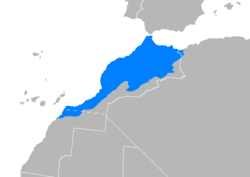
 Map of Moroccan Arabic[2] | |

Moroccan Arabic (Arabic: العربية المغربية الدارجة, romanized: al-ʻArabiyyah al-Maghribiyyah ad-Dārija[3] lit. 'Moroccan vernacular Arabic'), also known as Darija (الدارجة or الداريجة[3]), is the dialectal, vernacular form or forms of Arabic spoken in Morocco.[4][5] It is part of the Maghrebi Arabic dialect continuum and as such is mutually intelligible to some extent with Algerian Arabic and to a lesser extent with Tunisian Arabic. It is spoken by 91.9% of the population of Morocco, with 80.6% of Moroccans considering it their native language.[6]
While Modern Standard Arabic is used to varying degrees in formal situations such as religious sermons, books, newspapers, government communications, news broadcasts and political talk shows, Moroccan Arabic is the predominant spoken language of the country and has a strong presence in Moroccan television entertainment, cinema and commercial advertising. Moroccan Arabic has many regional dialects and accents as well, with its mainstream dialect being the one used in metropolitan cities, such as Casablanca, Rabat, Meknes and Fez. Therefore, the metropolitan dialects dominate the media and eclipse most of the other regional accents.
Dialects
[edit]Moroccan Arabic was formed by two dialects of Arabic belonging to two genetically different groups: pre-Hilalian and Hilalian dialects.[7][8][9]
There is a growing consensus that modern Moroccan Arabic is undergoing a process of koineization.[10] This koine emerged in the past fifty years due to urbanization, increased mobility and the influence of radio and television and is based of the Bedouin dialects of the Atlantic coast.[11] This new dialect is the one that is socially dominant and is used in popular singing, in theatre and cinema, in radio and TV announcements and most notably in publicity marketing. In the literature, this dialect has been named Average Moroccan Arabic, General Moroccan Arabic and Mainstream Moroccan Arabic but Moroccans only refer to it as Darija.[12]
The growth of Mainstream Moroccan Arabic has affected the speaker count of several local dialects, especially Hilalian dialects
Pre-Hilalian dialects
[edit]
Pre-Hilalian dialects are a result of early Arabization phases of the Maghreb, from the 7th to the 12th centuries, concerning the main urban settlements, the harbors, the religious centres (zaouias) as well as the main trade routes. The dialects are generally classified in three types: (old) urban, "village" and "mountain" sedentary and Jewish dialects.[8][13] In Morocco, several pre-Hilalian dialects are spoken:
- Urban dialects: Old dialects of Fes, Casablanca, Rabat, Salé, Taza, Tétouan, Wezzan, Chefchaouen, Tangier, Asilah, Larache, Ksar el-Kebir, Meknes and Marrakesh.[14][9][15]
- Jebli dialects: Dialects of northwestern Morocco, spoken by the Jebala people.[9][16]
- Sedentary ("village") dialects of Zerhoun and Sefrou and their neighboring tribes (Zerahna tribe for Zerhoun; Kechtala, Behalil and Yazgha tribes for Sefrou), remnants of pre-Hilalian dialects that were more widely spoken before the 12th century.
- Judeo-Moroccan, nearly extinct, formerly spoken by Moroccan Jews.[17]
The pre-Hilalian dialects are descended from Arabic dialects brought to the region by Qurashi families, such as the Idrissids and the Umayyads, as well as dialects brought by Arabs and Amazighs from al-Andalus. When al-Andalus fell, many of its Muslim inhabitants migrated back to North Africa, particularly to cities along the Mediterranean coast.
Hilalian dialects
[edit]Hilalian dialects (Bedouin dialects) were introduced following the migration of Arab nomadic tribes to Morocco in the 11th century, particularly the Banu Hilal, which the Hilalian dialects are named after.[18][13]
The Hilalian dialects spoken in Morocco belong to the Maqil subgroup,[13] a family that includes three main dialectal areas:
- 'Aroubi Arabic (Western Moroccan Arabic): spoken in the western plains of Morocco by Doukkala, Abda, Tadla, Chaouia, Gharb, and Zaers, and in the area north of Fes by Hyayna, Cheraga, Awlad Jama', etc.
- Eastern Moroccan Arabic: spoken in Oujda, the Oriental region[19])
- New urban dialects: predominantly Hilalian urban dialects, resulting from the migration movements from the countryside to cities in 20th century.[15]
- Hassaniya Arabic: spoken in southern Morocco, Western Sahara and Mauritania.[20] Among the dialects, Hassaniya is often considered as distinct from Moroccan Arabic.
The Hilalian dialects are descended from Arabic dialects brought to the region by Hilalian tribes, such as the Athbaj and Riyah. Although the Hilalians did interact and intermarry with the local Amazigh populations, it occurred to a much lesser extent compared to the Qurashi families. Since the Hilalians came to the region in large numbers, alongside their women and children, unlike the Qurashis, who were typically descended from a single Qurashi male who had migrated to the region alone.
Phonology
[edit] |
Vowels
[edit]| Short | Long | ||||
|---|---|---|---|---|---|
| Front | Central | Back | Front | Back | |
| Close | ə | u | iː | uː | |
| Mid | |||||
| Open | aː | ||||
One of the most notable features of Moroccan Arabic is the collapse of short vowels. Initially, short /a/ and /i/ were merged into a phoneme /ə/ (however, some speakers maintain a difference between /a/ and /ə/ when adjacent to pharyngeal /ʕ/ and /ħ/). This phoneme (/ə/) was then deleted entirely in most positions; for the most part, it is maintained only in the position /...CəC#/ or /...CəCC#/ (where C represents any consonant and # indicates a word boundary), i.e. when appearing as the last vowel of a word. When /ə/ is not deleted, it is pronounced as a very short vowel, tending towards [ɑ] in the vicinity of emphatic consonants, [a] in the vicinity of pharyngeal /ʕ/ and /ħ/ (for speakers who have merged /a/ and /ə/ in this environment), and [ə] elsewhere. Original short /u/ usually merges with /ə/ except in the vicinity of a labial or velar consonant. In positions where /ə/ was deleted, /u/ was also deleted, and is maintained only as labialization of the adjacent labial or velar consonant; where /ə/ is maintained, /u/ surfaces as [ʊ]. This deletion of short vowels can result in long strings of consonants (a feature shared with Amazigh and certainly derived from it). These clusters are never simplified; instead, consonants occurring between other consonants tend to syllabify, according to a sonorance hierarchy. Similarly, and unlike most other Arabic dialects, doubled consonants are never simplified to a single consonant, even when at the end of a word or preceding another consonant.
Some dialects are more conservative in their treatment of short vowels. For example, some dialects allow /u/ in more positions. Dialects of the Sahara, and eastern dialects near the border of Algeria, preserve a distinction between /a/ and /i/ and allow /a/ to appear at the beginning of a word, e.g. /aqsˤarˤ/ "shorter" (standard /qsˤərˤ/), /atˤlaʕ/ "go up!" (standard /tˤlaʕ/ or /tˤləʕ/), /asˤħaːb/ "friends" (standard /sˤħab/).
Long /aː/, /iː/ and /uː/ are maintained as semi-long vowels, which are substituted for both short and long vowels in most borrowings from Modern Standard Arabic (MSA). Long /aː/, /iː/ and /uː/ also have many more allophones than in most other dialects; in particular, /aː/, /iː/, /uː/ appear as [ɑ], [e], [o] in the vicinity of emphatic consonants and [q], [χ], [ʁ], [r], but [æ], [i], [u] elsewhere. (Most other Arabic dialects only have a similar variation for the phoneme /aː/.) In some dialects, such as that of Marrakech, front-rounded and other allophones also exist. Allophones in vowels usually do not exist in loanwords.
Emphatic spreading (i.e. the extent to which emphatic consonants affect nearby vowels) occurs much less than in Egyptian Arabic. Emphasis spreads fairly rigorously towards the beginning of a word and into prefixes, but much less so towards the end of a word. Emphasis spreads consistently from a consonant to a directly following vowel, and less strongly when separated by an intervening consonant, but generally does not spread rightwards past a full vowel. For example, /bidˤ-at/ [bedɑt͡s] "eggs" (/i/ and /a/ both affected), /tˤʃaʃ-at/ [tʃɑʃæt͡s] "sparks" (rightmost /a/ not affected), /dˤrˤʒ-at/ [drˤʒæt͡s] "stairs" (/a/ usually not affected), /dˤrb-at-u/ [drˤbat͡su] "she hit him" (with [a] variable but tending to be in between [ɑ] and [æ]; no effect on /u/), /tˤalib/ [tɑlib] "student" (/a/ affected but not /i/). Contrast, for example, Egyptian Arabic, where emphasis tends to spread forward and backward to both ends of a word, even through several syllables.
Emphasis is audible mostly through its effects on neighboring vowels or syllabic consonants, and through the differing pronunciation of /t/ [t͡s] and /tˤ/ [t]. Actual pharyngealization of "emphatic" consonants is weak and may be absent entirely. In contrast with some dialects, vowels adjacent to emphatic consonants are pure; there is no diphthong-like transition between emphatic consonants and adjacent front vowels.
Consonants
[edit]| Labial | Dental-Alveolar | Palatal | Velar | Uvular | Pharyngeal | Glottal | ||||
|---|---|---|---|---|---|---|---|---|---|---|
| plain | emphatic | plain | emphatic | |||||||
| Nasal | m | mˤ | n | |||||||
| Plosive | voiceless | (p) | t | tˤ | k | q | ʔ | |||
| voiced | b | bˤ | d | dˤ | ɡ | |||||
| Fricative | voiceless | f | (fˤ) | s | sˤ | ʃ | χ | ħ | h | |
| voiced | (v) | z | zˤ | ʒ | ʁ | ʕ | ||||
| Tap | ɾ | ɾˤ | ||||||||
| Trill | r | rˤ | ||||||||
| Approximant | l | lˤ | j | w | ||||||
Phonetic notes:
- Non-emphatic /t/ In normal circumstances, is pronounced with noticeable affrication, almost like [t͡s] (still distinguished from a sequence of /t/ + /s/), and hence is easily distinguishable from emphatic /tˤ/ which can be pronounced as [t]. However, in some recent loanwords from European languages, a non-affricated, non-emphatic [t] appears, distinguished from emphatic /tˤ/ primarily by its lack of effect on adjacent vowels (see above; an alternative analysis is possible).
- /mˤʷ, bˤʷ, fˤʷ/ are very distinct consonants that only occur geminated, and almost always come at the beginning of a word. They function completely differently from other emphatic consonants: They are pronounced with heavy pharyngealization, affect adjacent short/unstable vowels but not full vowels, and are pronounced with a noticeable diphthongal off-glide between one of these consonants and a following front vowel. Most of their occurrences can be analyzed as underlying sequences of /mw/, /fw/, /bw/ (which appear frequently in diminutives, for example). However, a few lexical items appear to have independent occurrences of these phonemes, e.g. /mˤmˤʷ-/ "mother" (with attached possessive, e.g. /mˤmˤʷək/ "your mother").
- /p/ and /v/ occur mostly in recent borrowings from European languages, and may be assimilated to /b/ or /f/ in some speakers.
- Unlike in most other Arabic dialects (but, again, similar to Amazigh), non-emphatic /r/ and emphatic /rˤ/ are two entirely separate phonemes, almost never contrasting in related forms of a word.
- /lˤ/ is rare in native words; in nearly all cases of native words with vowels indicating the presence of a nearby emphatic consonant, there is a nearby triggering /tˤ/, /dˤ/, /sˤ/, /zˤ/ or /rˤ/. Many recent European borrowings appear to require (lˤ) or some other unusual emphatic consonant in order to account for the proper vowel allophones; but an alternative analysis is possible for these words where the vowel allophones are considered to be (marginal) phonemes on their own.
- Original /q/ splits lexically into /q/ and /ɡ/ in many dialects (such as in Casablanca) but /q/ is preserved all the time in most big cities such as Rabat, Fes, Marrakech, etc. and all of northern Morocco (Tangier, Tetouan, Chefchaouen, etc.); for all words, both alternatives exist.
- Original /dʒ/ normally appears as /ʒ/, but as /ɡ/ (sometimes /d/) if a sibilant, lateral or rhotic consonant appears later in the same stem: /ɡləs/ "he sat" (MSA /dʒalas/), /ɡzzar/ "butcher" (MSA /dʒazzaːr/), /duz/ "go past" (MSA /dʒuːz/) like in western Algerian dialects.
- Original /s/ is converted to /ʃ/ if /ʃ/ occurs elsewhere in the same stem, and /z/ is similarly converted to /ʒ/ as a result of a following /ʒ/: /ʃəmʃ/ "sun" vs. MSA /ʃams/, /ʒuʒ/ "two" vs. MSA /zawdʒ/ "pair", /ʒaʒ/ "glass" vs. MSA /zudʒaːdʒ/, etc. This does not apply to recent borrowings from MSA (e.g. /mzaʒ/ "disposition"), nor as a result of the negative suffix /ʃ/ or /ʃi/.
- The gemination of the flap /ɾ/ results in a trill /r/.
Writing
[edit]
Through most of its history, Moroccan vernacular Arabic has usually not been written.[22]: 59 Due to the diglossic nature of the Arabic language, most literate Muslims in Morocco would write in Standard Arabic, even if they spoke Darija as a first language.[22]: 59 However, since Standard Arabic was typically taught in Islamic religious contexts, Moroccan Jews usually would not learn Standard Arabic and would write instead in Darija, or more specifically a variety known as Judeo-Moroccan Arabic, using Hebrew script.[22]: 59 A risala on Semitic languages written in Maghrebi Judeo-Arabic by Judah ibn Quraish to the Jews of Fes dates back to the ninth-century.[22]: 59
Al-Kafif az-Zarhuni's epic 14th century zajal Mala'bat al-Kafif az-Zarhuni, about Abu al-Hasan Ali ibn Othman al-Marini's campaign on Hafsid Ifriqiya, is considered the first literary work in Darija.[23][24]
Most books and magazines are in Modern Standard Arabic; Qur'an books are written and read in Classical Arabic, and there is no universally standard written system for Darija. There is also a loosely standardized Latin system used for writing Moroccan Arabic in electronic media, such as texting and chat, often based on sound-letter correspondences from French, English or Spanish ('sh' or 'ch' for English 'sh', 'u' or 'ou' for English 'oo', etc.) and using numbers to represent sounds not found in French or English (2-3-7-9 used for ق-ح-ع-ء, respectively.).
In the last few years, there have been some publications in Moroccan Darija, such as Hicham Nostik's Notes of a Moroccan Infidel, as well as basic science books by Moroccan physics professor Farouk El Merrakchi.[25] Newspapers in Moroccan Arabic also exist, such as Souq Al Akhbar, Al Usbuu Ad-Daahik,[26] the regional newspaper Al Amal (formerly published by Latifa Akherbach), and Khbar Bladna (news of our country), which was published by Tangier-based American painter Elena Prentice between 2002 and 2006.[27]
The latter also published books written in Moroccan Arabic, mostly novels and stories, written by authors such as Kenza El Ghali and Youssef Amine Alami.[27]
Vocabulary
[edit]Substrates
[edit]Moroccan Arabic is characterized by a strong Berber, as well as Latin (African Romance), substratum.[28]
Following the Arab conquest, Berber languages remained widely spoken. During their Arabisation, some Berber tribes became bilingual for generations before abandoning their language for Arabic; however, they kept a substantial Berber stratum that increases from the east to the west of the Maghreb, making Moroccan Arabic dialects the ones most influenced by Berber. Arabian tribes that inhabited the plains of Morocco also adopted Amazigh loanwords, though much less compared to the pre-Hilalian dialects spoken by city-dwellers and Amazighs. For the most part, the Hilalian Dialects of the western plains remained mostly unaffected until the beginning of urbanization after the French colonization period.
More recently, the influx of Andalusi people and Spanish-speaking–Moriscos (between the 15th and the 17th centuries) influenced urban dialects with Spanish substrate (and loanwords).
Vocabulary and loanwords
[edit]The vocabulary of Moroccan Arabic is mostly Semitic and derived from Classical Arabic.[29] It also contains some Berber, French and Spanish loanwords.
There are noticeable lexical differences between Moroccan Arabic and most other Arabic languages. Some words are essentially unique to Moroccan Arabic: daba "now". Many others, however, are characteristic of Maghrebi Arabic as a whole including both innovations and unusual retentions of Classical vocabulary that disappeared elsewhere, such as hbeṭ' "go down" from Classical habaṭ. Others are shared with Algerian Arabic such as hḍeṛ "talk", from Classical hadhar "babble", and temma "there", from Classical thamma.
There are a number of Moroccan Arabic dictionaries in existence:
- A Dictionary of Moroccan Arabic: Moroccan-English, ed. Richard S. Harrell & Harvey Sobelman. Washington, DC: Georgetown University Press, 1963 (reprinted 2004.)
- Mu`jam al-fuṣḥā fil-`āmmiyyah al-maghribiyyah معجم الفصحى في العامية المغربية, Muhammad Hulwi, Rabat: al-Madaris 1988.
- Dictionnaire Colin d'arabe dialectal marocain (Rabat, éditions Al Manahil, ministère des Affaires Culturelles), by a Frenchman named Georges Séraphin Colin, who devoted nearly all his life to it from 1921 to 1977. The dictionary contains 60,000 entries and was published in 1993, after Colin's death.
Examples of words inherited from Classical Arabic
[edit] | This section possibly contains original research. The vast majority of 'example words' below lack citations. (June 2023) |
- kəlb: dog (orig. kalb كلب)
- qəṭ: cat (orig. qiṭṭ قط)
- qərd: monkey (orig. qird قرد)
- bħar: sea (orig. baħr بحر)
- šəmš: sun (orig. šams شمس)
- bab: door (orig. bab باب)
- ħiṭ: wall (orig. ħā'iṭ حائط)
- bagra/baqra: cow (orig. baqarah بقرة)
- koul: eat (orig. akala أكل)
- fikra: idea (orig. fikrah فكرة)
- ħub: love (orig. ħubb حب)
- dhab: gold (orig. dhahab ذهب)
- ħdid: metal (orig. ħadid حديد)
- ržəl: foot (orig. rijl رجل)
- ras: head (orig. ra's رأس)
- wžəh: face (orig. wažh وجه)
- bit: room (orig. bayt بيت)
- xiṭ: wire (orig. khayṭ خيط)
- bənti: my daughter (orig. ibnati ابنتي)
- wəldi: my son (orig. waladi ولدي)
- rajəl: man (orig. rajul رجل)
- mra: woman (orig. imra'ah امرأة)
- colors=red/green/blue/yellow: ħmər/xdər/zrəq/ṣfər (orig. aħmar/axdar/azraq/aṣfar أحمر/أخضر/أزرق/أصفر)
- šħal: how much (orig. ayyu šayʾ ḥāl أَيُّ شَيْء حَال)[citation needed]
- ʕlāš: why (orig. ʿalā ʾayyi šayʾ, عَلَى أَيِّ شَيْء)[citation needed]
- fīn: where (orig. ʿfī ʾaynaʾ فِي أَيْنَ)
- ʢṭīni: give me (orig. aʢṭinī أعطني)
Examples of words inherited from Tamazight
[edit]- Muš: cat (orig. Amouch), pronounced [muʃ]
- Xizzu: carrots [xizzu]
- Tekšita: typical Moroccan dress
- Lalla: lady, madam
- Mesus: tasteless
- Tburiš: goosebumps
- Fazeg: wet
- Zezon: deaf
- Henna: grandmother (jebli and northern urban dialects) / "jeda" :southern dialect
- Dšar or tšar: zone, region [tʃɑɾ]
- Neggafa: wedding facilitator (orig. tamneggaft) [nɪɡɡafa][30]
- Mezlot: poor
- Sebniya: veil (jebli and northern urban dialects)
- žaada: carrots (jebli and northern urban dialects)
- sarred: synonym of send (jebli and northern urban dialects)
- šlaɣem: mustache
- Awriz: heel (jebli and northern urban dialects)
- Sifet: send
- Sarut: key
- Baxuš: insect
- Kermos: figs
- Zgel: miss, overlook
- Tabrori: hail
- Fakron: turtle
- Tammara: hardship, worries
- Bra: letter
- Deġya: hurry
- Dmir: hard work
Examples of loanwords from French
[edit]- forshita/forsheta: fourchette (fork), pronounced [foɾʃitˤɑ]
- tonobil/tomobil: automobile (car) [tˤonobil]
- telfaza: télévision (television) [tlfazɑ]
- radio: radio [ɾɑdˤjo], rādio is common across most varieties of Arabic
- bartma: appartement (apartment) [bɑɾtˤmɑ]
- rompa: rondpoint (roundabout) [ɾambwa]
- tobis: autobus (bus) [tˤobis]
- kamera: caméra (camera) [kɑmeɾɑ]
- portable: portable (cell phone) [poɾtˤɑbl]
- tilifūn: téléphone (telephone) [tilifuːn]
- brika: briquet (lighter) [bɾike]
- parisiana: a French baguette, more common is komera, from spanish
- disk: song
- tran: train (train) [træːn]
- serbita: serviette (napkin) [srbitɑ]
- tabla : table (table) [tɑblɑ]
- ordinatūr/pc: ordinateur / pc
- boulis: police
Examples of loanwords from Spanish
[edit]Some loans might have come through Andalusi Arabic brought by Moriscos when they were expelled from Spain following the Christian Reconquest or, alternatively, they date from the time of the Spanish protectorate in Morocco.
- rwida: rueda (wheel), pronounced [ɾwedˤɑ]
- kuzina: cocina (kitchen) [kuzinɑ]
- simana: semana (week) [simɑnɑ], may be borrowed from the french word for week (semaine)
- manta: manta (blanket) [mɑntˤɑ]
- rial: real (five centimes; the term has also been borrowed into many other Arabic dialects) [ɾjæl]
- fundo: fondo (bottom of the sea or the swimming pool) [fundˤo]
- karrossa: carrosa (carriage) [kɑrosɑ]
- kama (in the north only): cama (bed) [kɑmˤɑ]
- blassa: plaza (place) [blɑsɑ]
- komir: comer (but Moroccans use the expression to name the Parisian bread) [komeɾ]
- elmaryo: El armario (the cupboard) [elmɑɾjo]
- karratera: carretera (road) [karateɾa]
Examples of regional differences
[edit]- Now: "daba" in the majority of regions, but "druk" or "druka" is also used in some regions in the centre and south and "drwek" or "durk" in the east.
- When?: "fuqāš" in most regions,"fuyāx" in the Northwest (Tangier-Tetouan) but "imta" in the Atlantic region and "weqtāš" in Rabat region.
- What?: "ašnu", "šnu" or "āš" in most regions, but "šenni", "šennu" in the north, "šnu", "š" in Fes, and "wašta", "wasmu", "wāš" in the far east.
Some useful sentences
[edit]Note: All sentences are written according to the transcription used in Richard Harrell, A Short Reference Grammar of Moroccan Arabic (Examples with their pronunciation).:[31]
- a i u = full vowels = normally [æ i u], but [ɑ e o] in the vicinity of an emphatic consonant or q ("vicinity" generally means not separated by a full vowel)
- e = /ə/
- q = /q/
- x ġ = /x ɣ/
- y = /j/
- t = [tˢ]
- š ž = /ʃ ʒ/
- ḥ ʿ = /ħ ʕ/
- ḍ ḷ ṛ ṣ ṭ ẓ = emphatic consonants = /dˤ lˤ rˤ sˤ tˤ zˤ/ (ṭ is not affricated, unlike t)
| English | Western Moroccan Arabic | Northern (Jebli, Tanjawi and Tetouani) Moroccan Arabic | Eastern (Oujda) Moroccan Arabic | Western Moroccan Arabic
(Transliterated) |
Northern (Jebli, Tetouani) Moroccan Arabic
(Transliterated) |
Eastern (Oujda) Moroccan Arabic
(Transliterated) |
|---|---|---|---|---|---|---|
| How are you? | لا باس؟ | كيف نتينا؟/لا باس؟ بخير؟ | راك شباب؟ /لا باس؟/ راك غايَ؟ | la bas? | la bas? / bi-xayr?/ kif ntina? / amandra? | la bas? / rak ġaya / rak šbab? |
| Can you help me? | يمكن لك تعاونني؟ | تقدر تعاونني؟/ واخا تعاونني؟ | يمكن لك تعاونني؟ | yemken-lek tʿaweni? | teqder dʿaweni? waxa dʿaweni? | yemken-lek tʿaweni? |
| Do you speak English? | واش كَتهدر بالانّڭليزية؟/ واش كتدوي بالانّڭليزية؟ | واش كَتهدر بالانّڭليزية؟/كتهدر الانّڭليزية؟ | واش تهدر الانّڭليزية؟ | waš ka-tehder lengliziya / waš ka-tedwi be-l-lengliziya? | waš ka-tehder be-l-lengliziya? / ka-tehder lengliziya? | waš tehder lengliziya? |
| Excuse me | سمح ليَ | سمح لي | سمح لِيَ | smaḥ-liya | smaḥ-li | smaḥ-liya |
| Good luck | الله يعاون/الله يسهل | allah y'awn / allah ysahel | ||||
| Good morning | صباح الخير/صباح النور | ṣbaḥ l-xir / ṣbaḥ n-nur | ||||
| Good night | تصبح على خير | الله يمسيك بخير | تصبح على خير | teṣbaḥ ʿla xir | lay ymsik be-xer | teṣbaḥ ʿla xir |
| Goodbye | بالسلامة / تهلا | بالسلامة | بالسلامة | be-slama / tḥălla | be-slama | be-slama |
| Happy new year | سنة سعيدة | sana saʿida | ||||
| Hello | السلام عليكم/اهلاً | السلام عليكم/اهلاً | السلام عليكم | s-salam ʿalikum / as-salamu ʿalaykum (Classical) / ʔahlan | as-salamu ʿalaykum (Classical) / ʔahlan | s-salam ʿlikum |
| How are you doing? | لا باس؟ | la bas (ʿlik)? | ||||
| How are you? | كي داير؟/كي دايرة؟ | كيف نتين؟/كيف نتينا؟ | كي راك؟ | ki dayer ? (masculine) / ki dayra ? (feminine) | kif ntin? (Jebli) / kif ntina [ki tina] ? (Northern urban) | ki rak? |
| Is everything okay? | كل شي مزيان؟ | كل شي مزيان؟ /كل شي هو هداك؟؟ | كل شي مليح؟ | kul-ši mezyan ? | kul-ši mezyan ? / kul-ši huwa hadak ? | kul-ši mliḥ? / kul-ši zin? |
| Nice to meet you | متشرفين | metšaṛṛfin [mət.ʃɑrˤrˤ.fen] | ||||
| No thanks | لا شكراً | la šukran | ||||
| Please | الله يخليك/عفاك | الله يعزك / الله يخليك / عفاك | الله يعزك / الله يخليك | ḷḷa yxallik / ʿafak | ḷḷa yxallik / ḷḷa yʿizek / ʿafak | ḷḷa yxallik / ḷḷa yʿizek |
| Take care | تهلا فراسك | تهلا | تهلا فراسك | tḥălla f-ṛaṣek | tḥălla | tḥălla f-ṛaṣek |
| Thank you very much | شكراً بزاف | šukran bezzaf | ||||
| What do you do? | فاش خدام/شنو كتدير؟ | faš xddam? / chno katdir | škatʿăddel? / šenni xaddam? (masculine) / šenni xaddama? (feminine) / š-ka-dexdem? / šini ka-teʿmel/tʿadal f-hyatak? | faš texdem? (masculine) / faš txedmi ? (feminine) | ||
| What's your name? | شنو اسمك؟ / شنو سميتك؟ | ašnu smiytek? / šu smiytek | šenni ʔesmek? /šenno ʔesmek? / kif-aš msemy nta/ntinah? | wašta smiytek? | ||
| Where are you from? | منين نتا؟ | mnin nta? (masculine) / mnin nti? (feminine) | mnayn ntina? | min ntaya? (masculine) / min ntiya? (feminine) | ||
| Where are you going? | فين غادي؟ | fin ġhadi? | fayn machi? (masculine) / fayn mašya? (feminine) | f-rak temchi? / f-rak rayaḥ | ||
| You are welcome | بلا جميل/مرحبا/دّنيا هانية/ماشي مشكل / العفو | bla žmil/merḥba/ddenya hania/maši muškil/l'afo | bla žmil/merḥba/ddunya hania/maši muškil/l'afo | bla žmil/merḥba/ddenya hania/maši muškil/l'afo | ||
Further useful phrases
[edit]| English[32] | Moroccan Arabic | Latin Transliteration |
|---|---|---|
| Yes. | .ايه | eyeh. |
| Yes please. | .وخا شكراً | wakha shoukran. |
| No. | .لا | la. |
| Thank you. | .شكراً | shoukran. |
| I'd like a coffee please. | .واحد القهوة عفاك | wahed lqahoua afak. |
| What time is it? | شحال فالساعة؟ | ch-hal fssa-a? |
| Can you repeat that please? | وخا تعاود عافاك؟ | wakha t-awoud afak? |
| Please speak more slowly. | .هضر بشويا عافاك | hder bshwiya afak. |
| I don't understand. | .ما فهمتش | ma fhamtch. |
| Sorry. | .سمح لي | smeh li. |
| Where are the toilets? | فين الطواليط؟ | fin toilettes? |
| How much does this cost? | بشحال هادا؟ | bch-hal hada? |
| Welcome! | !تفضّل | tfdel! |
| Good evening. | .مسا الخير | msa lkheir. |
Grammar
[edit]Verbs
[edit]Introduction
[edit]The regular Moroccan Arabic verb conjugates with a series of prefixes and suffixes. The stem of the conjugated verb may change a bit, depending on the conjugation:
The stem of the Moroccan Arabic verb for "to write" is kteb.
Past tense
[edit]The past tense of kteb (write) is as follows:
I wrote: kteb-t
You wrote: kteb-ti (some regions tend to differentiate between masculine and feminine, the masculine form is kteb-t, the feminine kteb-ti)
He/it wrote: kteb (can also be an order to write; kteb er-rissala: Write the letter)
She/it wrote: ketb-et / ketb-at""
We wrote: kteb-na
You (plural) wrote: kteb-tu / kteb-tiu
They wrote: ketb-u
The stem kteb turns into ketb before a vowel suffix because of the process of inversion described above.
Present tense
[edit]The present tense of kteb is as follows:
I am writing: ka-ne-kteb
You are (masculine) writing: ka-te-kteb
You are (feminine) writing: ka-t-ketb-i
He's/it is writing: ka-ye-kteb
She is/it is writing: ka-te-kteb
We are writing: ka-n-ketb-u
You (plural) are writing: ka-t-ketb-u
They are writing: ka-y-ketb-u
The stem kteb turns into ketb before a vowel suffix because of the process of inversion described above. Between the prefix ka-n-, ka-t-, ka-y- and the stem kteb, an e appears but not between the prefix and the transformed stem ketb because of the same restriction that produces inversion.
In the north, "you are writing" is always ka-de-kteb regardless of who is addressed. This is also the case of de in de-kteb as northerners prefer to use de and southerners prefer te. However, there is an exception, which is the northern dialectof Tangier, where they use te instead of de .
Instead of the prefix ka, some speakers prefer the use of ta (ta-ne-kteb "I am writing"). The coexistence of these two prefixes is from historic differences. In general, ka is more used in the north and ta in the south, some other prefixes like la, a, qa are less used. In some regions like in the east (Oujda), most speakers use no preverb (ne-kteb, te-kteb, y-kteb, etc.).
Other tenses
[edit]To form the future tense, the prefix ka-/ta- is removed and replaced with the prefix ġa-, ġad- or ġadi instead (e.g. ġa-ne-kteb "I will write", ġad-ketb-u (north) or ġadi t-ketb-u "You (plural) will write") It is worth noting that in northern Morocco, such as Tangier and Tetouan, they use "ha" instead of ""gha/ġa"" most of the time, and also "ʕa" (عا) to a lesser extent. Also "aa" can be used as an abbreviation for "Gha/Ġa" in the general Moroccan dialect in rapid speech especially.
For the subjunctive and infinitive, the ka- is removed (bġit ne-kteb "I want to write", bġit te-kteb "I want 'you to write").
The imperative is conjugated with the suffixes of the present tense but without any prefixes or preverbs:
kteb Write! (masculine singular)
ketb-i Write! (feminine singular)
ketb-u Write! (plural)
Negation
[edit]One characteristic of Moroccan Arabic syntax, which it shares with other North African varieties as well as some southern Levantine dialect areas, is in the two-part negative verbal circumfix /ma-...-ʃi/. (In many regions, including Marrakech, the final /i/ vowel is not pronounced so it becomes /ma-...-ʃ/.)[33]
- Past: /kteb/ "he wrote" /ma-kteb-ʃi/ "he did not write"
- Present: /ka-j-kteb/ "he writes" /ma-ka-j-kteb-ʃi/ "he does not write"
/ma-/ comes from the Classical Arabic negator /ma/. /-ʃi/ is a development of Classical /ʃajʔ/ "thing". The development of a circumfix is similar to the French circumfix ne ... pas in which ne comes from Latin non "not" and pas comes from Latin passus "step". (Originally, pas would have been used specifically with motion verbs, as in "I did not walk a step". It was generalised to other verbs.)
The negative circumfix surrounds the entire verbal composite, including direct and indirect object pronouns:
- /ma-kteb-hom-li-ʃi/ "he did not write them to me"
- /ma-ka-j-kteb-hom-li-ʃi/ "he does not write them to me"
- /ma-ɣadi-j-kteb-hom-li-ʃi/ "he will not write them to me"
- /waʃ ma-kteb-hom-li-ʃi/ "did he not write them to me?"
- /waʃ ma-ka-j-kteb-hom-li-ʃi/ "does he not write them to me?"
- /waʃ ma-ɣadi-j-kteb-hom-li-ʃi/ "will he not write them to me?"
Future and interrogative sentences use the same /ma-...-ʃi/ circumfix (unlike, for example, in Egyptian Arabic). Also, unlike in Egyptian Arabic, there are no phonological changes to the verbal cluster as a result of adding the circumfix. In Egyptian Arabic, adding the circumfix can trigger stress shifting, vowel lengthening and shortening, elision when /ma-/ comes into contact with a vowel, addition or deletion of a short vowel, etc. However, they do not occur in Moroccan Arabic (MA):
- There is no phonological stress in MA.
- There is no distinction between long and short vowels in MA.
- There are no restrictions on complex consonant clusters in MA and hence no need to insert vowels to break up such clusters.
- There are no verbal clusters that begin with a vowel. The short vowels in the beginning of Forms IIa(V), and such, have already been deleted. MA has first-person singular non-past /ne-/ in place of Egyptian /a-/.
Negative pronouns such as walu "nothing", ḥta ḥaja "nothing" and ḥta waḥed "nobody" can be added to the sentence without ši as a suffix:
- ma-ġa-ne-kteb walu "I will not write anything"
- ma-te-kteb ḥta ḥaja "Do not write anything"
- ḥta waḥed ma-ġa-ye-kteb "Nobody will write"
- wellah ma-ne-kteb or wellah ma-ġa-ne-kteb "I swear to God I will not write"
Note that wellah ma-ne-kteb could be a response to a command to write kteb while wellah ma-ġa-ne-kteb could be an answer to a question like waš ġa-te-kteb? "Are you going to write?"
In the north, "'you are writing" is always ka-de-kteb regardless of who is addressed. It is also the case of de in de-kteb, as northerners prefer to use de (Tangier is an exception) and southerners prefer te.
Instead of the prefix ka, some speakers prefer the use of ta (ta-ne-kteb "I am writing"). The co-existence of these two prefixes is from historical differences. In general ka is more used in the north and ta in the south. In some regions like the east (Oujda), most speakers use no preverb:
- ka ma-ġadi-ši-te-kteb?!
In detail
[edit]Verbs in Moroccan Arabic are based on a consonantal root composed of three or four consonants. The set of consonants communicates the basic meaning of a verb. Changes to the vowels between the consonants, along with prefixes and/or suffixes, specify grammatical functions such as tense, person and number in addition to changes in the meaning of the verb that embody grammatical concepts such as causative, intensive, passive or reflexive.
Each particular lexical verb is specified by two stems, one used for the past tense and one used for non-past tenses, along with subjunctive and imperative moods. To the former stem, suffixes are added to mark the verb for person, number and gender. To the latter stem, a combination of prefixes and suffixes are added. (Very approximately, the prefixes specify the person and the suffixes indicate number and gender.) The third person masculine singular past tense form serves as the "dictionary form" used to identify a verb like the infinitive in English. (Arabic has no infinitive.) For example, the verb meaning "write" is often specified as kteb, which actually means "he wrote". In the paradigms below, a verb will be specified as kteb/ykteb (kteb means "he wrote" and ykteb means "he writes"), indicating the past stem (kteb-) and the non-past stem (also -kteb-, obtained by removing the prefix y-).
The verb classes in Moroccan Arabic are formed along two axes. The first or derivational axis (described as "form I", "form II", etc.) is used to specify grammatical concepts such as causative, intensive, passive or reflexive and mostly involves varying the consonants of a stem form. For example, from the root K-T-B "write" are derived form I kteb/ykteb "write", form II ketteb/yketteb "cause to write", form III kateb/ykateb "correspond with (someone)" etc. The second or weakness axis (described as "strong", "weak", "hollow", "doubled" or "assimilated") is determined by the specific consonants making up the root, especially whether a particular consonant is a "w" or " y", and mostly involves varying the nature and location of the vowels of a stem form. For example, so-called weak verbs have one of those two letters as the last root consonant, which is reflected in the stem as a final vowel instead of a final consonant (ṛma/yṛmi "throw" from Ṛ-M-Y). Meanwhile, hollow verbs are usually caused by one of those two letters as the middle root consonant, and the stems of such verbs have a full vowel (/a/, /i/ or /u/) before the final consonant, often along with only two consonants (žab/yžib "bring" from Ž-Y-B).
It is important to distinguish between strong, weak, etc. stems and strong, weak, etc. roots. For example, X-W-F is a hollow root, but the corresponding form II stem xuwwef/yxuwwef "frighten" is a strong stem:
- Weak roots are those that have a w or a y as the last consonant. Weak stems are those that have a vowel as the last segment of the stem. For the most part, there is a one-to-one correspondence between weak roots and weak stems. However, form IX verbs with a weak root will show up the same way as other root types (with doubled stems in most other dialects but with hollow stems in Moroccan Arabic).
- Hollow roots are triliteral roots that have a w or a y as the last consonant. Hollow stems are those that end with /-VC/ in which V is a long vowel (most other dialects) or full vowel in Moroccan Arabic (/a/, /i/ or /u/). Only triliteral hollow roots form hollow stems and only in forms I, IV, VII, VIII and X. In other cases, a strong stem generally results. In Moroccan Arabic, all form IX verbs yield hollow stems regardless of root shape: sman "be fat" from S-M-N.
- Doubled roots are roots that have the final two consonants identical. Doubled stems end with a geminate consonant. Only Forms I, IV, VII, VIII, and X yield a doubled stem from a doubled root. Other forms yield a strong stem. In addition, in most dialects (but not Moroccan), all stems in Form IX are doubled: Egyptian Arabic iḥmáṛṛ/yiḥmáṛṛ "be red, blush" from Ḥ-M-R.
- Assimilated roots are those where the first consonant is a w or a y. Assimilated stems begin with a vowel. Only Form I (and Form IV?) yields assimilated stems and only in the non-past. There are none In Moroccan Arabic.
- Strong roots and stems are those that fall under none of the other categories described above. It is common for a strong stem to correspond with a non-strong root but the reverse is rare.
Table of verb forms
[edit]In this section, all verb classes and their corresponding stems are listed, excluding the small number of irregular verbs described above. Verb roots are indicated schematically using capital letters to stand for consonants in the root:
- F = first consonant of root
- M = middle consonant of three-consonant root
- S = second consonant of four-consonant root
- T = third consonant of four-consonant root
- L = last consonant of root
Hence, the root F-M-L stands for all three-consonant roots, and F-S-T-L stands for all four-consonant roots. (Traditional Arabic grammar uses F-ʕ-L and F-ʕ-L-L, respectively, but the system used here appears in a number of grammars of spoken Arabic dialects and is probably less confusing for English speakers since the forms are easier to pronounce than those involving /ʕ/.)
The following table lists the prefixes and suffixes to be added to mark tense, person, number, gender and the stem form to which they are added. The forms involving a vowel-initial suffix and corresponding stem PAv or NPv are highlighted in silver. The forms involving a consonant-initial suffix and corresponding stem PAc are highlighted in gold. The forms involving no suffix and corresponding stem PA0 or NP0 are not highlighted.
| Tense/Mood | Past | Non-Past | |||
|---|---|---|---|---|---|
| Person | Singular | Plural | Singular | Plural | |
| 1st | PAc-t | PAc-na | n(e)-NP0 | n(e)-NP0-u/w | |
| 2nd | masculine | PAc-ti | PAc-tiw | t(e)-NP0 | t(e)-NPv-u/w |
| feminine | t(e)-NPv-i/y | ||||
| 3rd | masculine | PA0 | PAv-u/w | y-NP0 | y-NPv-u/w |
| feminine | PAv-et | t(e)-NP0 | |||
The following table lists the verb classes along with the form of the past and non-past stems, active and passive participles, and verbal noun, in addition to an example verb for each class.
Notes:
- Italicized forms are those that follow automatically from the regular rules of deletion of /e/.
- In the past tense, there can be up to three stems:
- When only one form appears, this same form is used for all three stems.
- When three forms appear, these represent first-singular, third-singular and third-plural, which indicate the PAc, PA0 and PAv stems, respectively.
- When two forms appear, separated by a comma, these represent first-singular and third-singular, which indicate the PAc and PA0 stems. When two forms appear, separated by a semicolon, these represent third-singular and third-plural, which indicate the PA0 and PAv stems. In both cases, the missing stem is the same as the third-singular (PA0) stem.
- Not all forms have a separate verb class for hollow or doubled roots. In such cases, the table below has the notation "(use strong form)", and roots of that shape appear as strong verbs in the corresponding form; e.g. Form II strong verb dˤáyyaʕ/yidˤáyyaʕ "waste, lose" related to Form I hollow verb dˤaʕ/yidˤiʕ "be lost", both from root Dˤ-Y-ʕ.
| Form | Strong | Weak | Hollow | Doubled | ||||||||
|---|---|---|---|---|---|---|---|---|---|---|---|---|
| Past | Non-Past | Example | Past | Non-Past | Example | Past | Non-Past | Example | Past | Non-Past | Example | |
| I | FMeL; FeMLu | yFMeL, yFeMLu | kteb/ykteb "write", ʃrˤeb/yʃrˤeb "drink" | FMit, FMa | yFMi | rˤma/yrˤmi "throw", ʃra/yʃri "buy" | FeLt, FaL | yFiL | baʕ/ybiʕ "sell", ʒab/yʒib "bring" | FeMMit, FeMM | yFeMM | ʃedd/yʃedd "close", medd/ymedd "hand over" |
| yFMoL, yFeMLu | dxel/ydxol "enter", sken/yskon "reside" | yFMa | nsa/ynsa "forget" | yFuL | ʃaf/yʃuf "see", daz/yduz "pass" | FoMMit, FoMM | yFoMM | koħħ/ykoħħ "cough" | ||||
| yFMu | ħba/yħbu "crawl" | yFaL | xaf/yxaf "sleep", ban/yban "seem" | |||||||||
| FoLt, FaL | yFuL | qal/yqul "say", kan/ykun "be" (the only examples) | ||||||||||
| II | FeMMeL; FeMMLu | yFeMMeL, yFeMMLu | beddel/ybeddel "change" | FeMMit, FeMMa | yFeMMi | werra/ywerri "show" | (same as strong) | |||||
| FuwweL; FuwwLu | yFuwweL, yFuwwLu | xuwwef/yxuwwef "frighten" | Fuwwit, Fuwwa | yFuwwi | luwwa/yluwwi "twist" | |||||||
| FiyyeL; FiyyLu | yFiyyeL, yFiyyLu | biyyen/ybiyyen "indicate" | Fiyyit, Fiyya | yFiyyi | qiyya/yqiyyi "make vomit" | |||||||
| III | FaMeL; FaMLu | yFaMeL, yFaMLu | sˤaferˤ/ysˤaferˤ "travel" | FaMit, FaMa | yFaMi | qadˤa/yqadˤi "finish (trans.)", sawa/ysawi "make level" | (same as strong) | FaMeMt/FaMMit, FaM(e)M, FaMMu | yFaM(e)M, yFaMMu | sˤaf(e)f/ysˤaf(e)f "line up (trans.)" | ||
| Ia(VIIt) | tteFMeL; ttFeMLu | ytteFMeL, yttFeMLu | ttekteb/yttekteb "be written" | tteFMit, tteFMa | ytteFMa | tterˤma/ytterˤma "be thrown", ttensa/yttensa "be forgotten" | ttFaLit/ttFeLt/ttFaLt, ttFaL | yttFaL | ttbaʕ/yttbaʕ "be sold" | ttFeMMit, ttFeMM | yttFeMM | ttʃedd/yttʃedd "be closed" |
| ytteFMoL, yttFeMLu | ddxel/yddxol "be entered" | yttFoMM | ttfekk/yttfokk "get loose" | |||||||||
| IIa(V) | tFeMMeL; tFeMMLu | ytFeMMeL, ytFeMMLu | tbeddel/ytbeddel "change (intrans.)" | tFeMMit, tFeMMa | ytFeMMa | twerra/ytwerra "be shown" | (same as strong) | |||||
| tFuwweL; tFuwwLu | ytFuwweL, ytFuwwLu | txuwwef/ytxuwwef "be frightened" | tFuwwit, tFuwwa | ytFuwwa | tluwwa/ytluwwa "twist (intrans.)" | |||||||
| tFiyyeL; tFiyyLu | ytFiyyeL, ytFiyyLu | tbiyyen/ytbiyyen "be indicated" | tFiyyit, tFiyya | ytFiyya | tqiyya/ytqiyya "be made to vomit" | |||||||
| IIIa(VI) | tFaMeL; tFaMLu | ytFaMeL, ytFaMLu | tʕawen/ytʕawen "cooperate" | tFaMit, tFaMa | ytFaMa | tqadˤa/ytqadˤa "finish (intrans.)", tħama/ytħama "join forces" | (same as strong) | tFaMeMt/tFaMMit, tFaM(e)M, tFaMMu | ytFaM(e)M, ytFaMMu | tsˤaf(e)f/ytsˤaf(e)f "get in line", twad(e)d/ytwad(e)d "give gifts to one another" | ||
| VIII | FtaMeL; FtaMLu | yFtaMeL, yFtaMLu | ħtarˤem/ħtarˤem "respect", xtarˤeʕ/xtarˤeʕ "invent" | FtaMit, FtaMa | yFtaMi | ??? | FtaLit/FteLt/FtaLt, FtaL | yFtaL | xtarˤ/yxtarˤ "choose", ħtaʒ/yħtaʒ "need" | FteMMit, FteMM | yFteMM | htemm/yhtemm "be interested (in)" |
| IX | FMaLit/FMeLt/FMaLt, FMaL | yFMaL | ħmarˤ/yħmarˤ "be red, blush", sman/ysman "be(come) fat" | (same as strong) | ||||||||
| X | steFMeL; steFMLu | ysteFMeL, ysteFMLu | steɣrˤeb/ysteɣrˤeb "be surprised" | steFMit, steFMa | ysteFMi | stedʕa/ystedʕi "invite" | (same as strong) | stFeMMit, stFeMM | ystFeMM | stɣell/ystɣell "exploit" | ||
| ysteFMa | stehza/ystehza "ridicule", stăʕfa/ystăʕfa "resign" | |||||||||||
| Iq | FeSTeL; FeSTLu | yFeSTeL, yFeSTLu | tˤerˤʒem/ytˤerˤʒem "translate", melmel/ymelmel "move (trans.)", hernen/yhernen "speak nasally" | FeSTit, FeSTa | yFeSTi | seqsˤa/yseqsˤi "ask" | (same as strong) | |||||
| FiTeL; FiTLu | yFiTeL, yFiTLu | sˤifetˤ/ysˤifetˤ "send", ritel/yritel "pillage" | FiTit, FiTa | yFiTi | tira/ytiri "shoot" | |||||||
| FuTeL; FuTLu | yFuTeL, yFuTLu | suger/ysuger "insure", suret/ysuret "lock" | FuTit, FuTa | yFuTi | rula/yruli "roll (trans.)" | |||||||
| FiSTeL; FiSTLu | yFiSTeL, yFiSTLu | birˤʒez??? "cause to act bourgeois???", biznes??? "cause to deal in drugs" | F...Tit, F...Ta | yF...Ti | blˤana, yblˤani "scheme, plan", fanta/yfanti "dodge, fake", pidˤala/ypidˤali "pedal" | |||||||
| Iqa(IIq) | tFeSTeL; tFeSTLu | ytFeSTeL, ytFeSTLu | tˤtˤerˤʒem/ytˤtˤerˤʒem "be translated", tmelmel/ytmelmel "move (intrans.)" | tFeSTit, tFeSTa | ytFeSTa | tseqsˤa/ytseqsˤa "be asked" | (same as strong) | |||||
| tFiTeL; tFiTLu | ytFiTeL, ytFiTLu | tsˤifetˤ/ytsˤifetˤ "be sent", tritel/ytritel "be pillaged" | tFiTit, tFiTa | ytFiTa | ttira/yttiri "be shot" | |||||||
| tFuTeL; tFuTLu | ytFuTeL, ytFuTLu | tsuger/ytsuger "be insured", tsuret/ytsuret "be locked" | tFuTit, tFuTa | ytFuTa | trula/ytruli "roll (intrans.)" | |||||||
| tFiSTeL; tFiSTLu | ytFiSTeL, ytFiSTLu | tbirˤʒez "act bourgeois", tbiznes "deal in drugs" | tF...Tit, tF...Ta | ytF...Ta | tblˤana/ytblˤana "be planned", tfanta/ytfanta "be dodged", tpidˤala/ytpidˤala "be pedaled" | |||||||
Sample Paradigms of Strong Verbs
[edit]Regular verb, form I, fʕel/yfʕel
[edit]Example: kteb/ykteb "write"
| Tense/Mood | Past | Present Subjunctive | Present Indicative | Future | Imperative | ||||||
|---|---|---|---|---|---|---|---|---|---|---|---|
| Person | Singular | Plural | Singular | Plural | Singular | Plural | Singular | Plural | Singular | Plural | |
| 1st | kteb-t | kteb-na | ne-kteb | n-ketb-u | ka-ne-kteb | ka-n-ketb-u | ɣa-ne-kteb | ɣa-n-ketb-u | |||
| 2nd | masculine | kteb-ti | kteb-tiw | te-kteb | t-ketb-u | ka-te-kteb | ka-t-ketb-u | ɣa-te-kteb | ɣa-t-ketb-u | kteb | ketb-u |
| feminine | t-ketb-i | ka-t-ketb-i | ɣa-t-ketb-i | ketb-i | |||||||
| 3rd | masculine | kteb | ketb-u | y-kteb | y-ketb-u | ka-y-kteb | ka-y-ketb-u | ɣa-y-kteb | ɣa-y-ketb-u | ||
| feminine | ketb-et | te-kteb | ka-te-kteb | ɣa-te-kteb | |||||||
Some comments:
- Boldface, here and elsewhere in paradigms, indicate unexpected deviations from some previously established pattern.
- The present indicative is formed from the subjunctive by the addition of /ka-/. Similarly, the future is formed from the subjunctive by the addition of /ɣa-/.
- The imperative is also formed from the second-person subjunctive, this by the removal of any prefix /t-/, /te-/, or /d-/.
- The stem /kteb/ changes to /ketb-/ before a vowel.
- Prefixes /ne-/ and /te-/ keep the vowel before two consonants but drop it before one consonant; hence singular /ne-kteb/ changes to plural /n-ketb-u/.
Example: kteb/ykteb "write": non-finite forms
| Number/Gender | Active Participle | Passive Participle | Verbal Noun |
|---|---|---|---|
| Masc. Sg. | kateb | mektub | ketaba |
| Fem. Sg. | katb-a | mektub-a | |
| Pl. | katb-in | mektub-in |
Regular verb, form I, fʕel/yfʕel, assimilation-triggering consonant
[edit]Example: dker/ydker "mention"
| Tense/Mood | Past | Present Subjunctive | Present Indicative | Future | Imperative | ||||||
|---|---|---|---|---|---|---|---|---|---|---|---|
| Person | Singular | Plural | Singular | Plural | Singular | Plural | Singular | Plural | Singular | Plural | |
| 1st | dker-t | dker-na | n-dker | n-dekr-u | ka-n-dker | ka-n-dekr-u | ɣa-n-dker | ɣa-n-dekr-u | |||
| 2nd | masculine | dker-ti | dker-tiw | d-dker | d-dekr-u | ka-d-dker | ka-d-dekr-u | ɣa-d-dker | ɣa-d-dekr-u | dker | dekr-u |
| feminine | d-dekr-i | ka-d-dekr-i | ɣa-d-dekr-i | dekr-i | |||||||
| 3rd | masculine | dker | dekr-u | y-dker | y-dekr-u | ka-y-dker | ka-y-dekr-u | ɣa-y-dker | ɣa-y-dekr-u | ||
| feminine | dekr-et | d-dker | ka-d-dker | ɣa-d-dker | |||||||
This paradigm differs from kteb/ykteb in the following ways:
- /ne-/ is always reduced to /n-/.
- /te-/ is always reduced to /t-/, and then all /t-/ are assimilated to /d-/.
Reduction and assimilation occur as follows:
- Before a coronal stop /t/, /tˤ/, /d/ or /dˤ/, /ne-/ and /te-/ are always reduced to /n-/ and /t-/.
- Before a coronal fricative /s/, /sˤ/, /z/, /zˤ/, /ʃ/ or /ʒ/, /ne-/ and /te-/ are optionally reduced to /n-/ and /t-/. The reduction usually happens in normal and fast speech but not in slow speech.
- Before a voiced coronal /d/, /dˤ/, /z/, /zˤ/, or /ʒ/, /t-/ is assimilated to /d-/.
Examples:
- Required reduction /n-them/ "I accuse", /t-them/ "you accuse".
- Optional reduction /n-skon/ or /ne-skon/ "I reside", /te-skon/ or /t-skon/ "you reside".
- Optional reduction/assimilation /te-ʒberˤ/ or /d-ʒberˤ/ "you find".
Regular verb, form I, fʕel/yfʕol
[edit]Example: xrˤeʒ/yxrˤoʒ "go out"
| Tense/Mood | Past | Present Subjunctive | Present Indicative | Future | Imperative | ||||||
|---|---|---|---|---|---|---|---|---|---|---|---|
| Person | Singular | Plural | Singular | Plural | Singular | Plural | Singular | Plural | Singular | Plural | |
| 1st | xrˤeʒ-t | xrˤeʒ-na | ne-xrˤoʒ | n-xerˤʒ-u | ka-ne-xrˤoʒ | ka-n-xerˤʒ-u | ɣa-ne-xrˤoʒ | ɣa-n-xerˤʒ-u | |||
| 2nd | masculine | xrˤeʒ-ti | xrˤeʒ-tiw | te-xrˤoʒ | t-xerˤʒ-u | ka-te-xrˤoʒ | ka-t-xerˤʒ-u | ɣa-te-xrˤoʒ | ɣa-t-xerˤʒ-u | xrˤoʒ | xerˤʒ-u |
| feminine | t-xerˤʒ-i | ka-t-xerˤʒ-i | ɣa-t-xerˤʒ-i | xerˤʒ-i | |||||||
| 3rd | masculine | xrˤeʒ | xerˤʒ-u | y-xrˤoʒ | y-xerˤʒ-u | ka-y-xrˤoʒ | ka-y-xerˤʒ-u | ɣa-y-xrˤoʒ | ɣa-y-xerˤʒ-u | ||
| feminine | xerˤʒ-et | te-xrˤoʒ | ka-te-xrˤoʒ | ɣa-te-xrˤoʒ | |||||||
Regular verb, form II, feʕʕel/yfeʕʕel
[edit]Example: beddel/ybeddel "change"
| Tense/Mood | Past | Present Subjunctive | Present Indicative | Future | Imperative | ||||||
|---|---|---|---|---|---|---|---|---|---|---|---|
| Person | Singular | Plural | Singular | Plural | Singular | Plural | Singular | Plural | Singular | Plural | |
| 1st | beddel-t | beddel-na | n-beddel | n-beddl-u | ka-n-beddel | ka-n-beddl-u | ɣa-n-beddel | ɣa-n-beddl-u | |||
| 2nd | masculine | beddel-ti | beddel-tiw | t-beddel | t-beddl-u | ka-t-beddel | ka-t-beddl-u | ɣa-t-beddel | ɣa-t-beddl-u | beddel | beddl-u |
| feminine | t-beddl-i | ka-t-beddl-i | ɣa-t-beddl-i | beddl-i | |||||||
| 3rd | masculine | beddel | beddl-u | y-beddel | y-beddl-u | ka-y-beddel | ka-y-beddl-u | ɣa-y-beddel | ɣa-y-beddl-u | ||
| feminine | beddl-et | t-beddel | ka-t-beddel | ɣa-t-beddel | |||||||
Boldfaced forms indicate the primary differences from the corresponding forms of kteb, which apply to many classes of verbs in addition to form II strong:
- The prefixes /t-/, /n-/ always appear without any stem vowel. This behavior is seen in all classes where the stem begins with a single consonant (which includes most classes).
- The /e/ in the final vowel of the stem is elided when a vowel-initial suffix is added. This behavior is seen in all classes where the stem ends in /-VCeC/ or/-VCCeC/ (where /V/ stands for any vowel and /C/ for any consonant). In addition to form II strong, this includes form III strong, form III Due to the regular operation of the stress rules, the stress in the past tense forms beddel-et and beddel-u differs from dexl-et and dexl-u.
Regular verb, form III, faʕel/yfaʕel
[edit]Example: sˤaferˤ/ysˤaferˤ "travel"
| Tense/Mood | Past | Present Subjunctive | Present Indicative | Future | Imperative | ||||||
|---|---|---|---|---|---|---|---|---|---|---|---|
| Person | Singular | Plural | Singular | Plural | Singular | Plural | Singular | Plural | Singular | Plural | |
| 1st | sˤaferˤ-t | sˤaferˤ-na | n-sˤaferˤ | n-sˤafrˤ-u | ka-n-sˤaferˤ | ka-n-sˤafrˤ-u | ɣa-n-sˤaferˤ | ɣa-n-sˤafrˤ-u | |||
| 2nd | masculine | sˤaferˤ-t | sˤaferˤ-tiw | t-sˤaferˤ | t-sˤafrˤ-u | ka-t-sˤaferˤ | ka-t-sˤafrˤ-u | ɣa-t-sˤaferˤ | ɣa-t-sˤafrˤ-u | sˤaferˤ | sˤafrˤ-u |
| feminine | t-sˤafrˤ-i | ka-t-sˤafrˤ-i | ɣa-t-sˤafrˤ-i | sˤafrˤ-i | |||||||
| 3rd | masculine | sˤaferˤ | sˤafrˤ-u | y-sˤaferˤ | y-sˤafrˤ-u | ka-y-sˤaferˤ | ka-y-sˤafrˤ-u | ɣa-y-sˤaferˤ | ɣa-y-sˤafrˤ-u | ||
| feminine | sˤafrˤ-et | t-sˤaferˤ | ka-t-sˤaferˤ | ɣa-t-sˤaferˤ | |||||||
The primary differences from the corresponding forms of beddel (shown in boldface) are:
- The long vowel /a/ becomes /a/ when unstressed.
- The /i/ in the stem /safir/ is elided when a suffix beginning with a vowel follows.
Regular verb, form Ia, ttefʕel/yttefʕel
[edit]Example: ttexleʕ/yttexleʕ "get scared"
| Tense/Mood | Past | Present Subjunctive | Present Indicative | Future | Imperative | ||||||
|---|---|---|---|---|---|---|---|---|---|---|---|
| Person | Singular | Plural | Singular | Plural | Singular | Plural | Singular | Plural | Singular | Plural | |
| 1st | ttexleʕ-t | ttexleʕ-na | n-ttexleʕ | n-ttxelʕ-u | ka-n-ttexleʕ | ka-n-ttxelʕ-u | ɣa-n-ttexleʕ | ɣa-n-ttxelʕ-u | |||
| 2nd | masculine | ttexleʕ-ti | ttexleʕ-tiw | (te-)ttexleʕ | (te-)ttxelʕ-u | ka-(te-)ttexleʕ | ka-(te-)ttxelʕ-u | ɣa-(te-)ttexleʕ | ɣa-(te-)ttxelʕ-u | ttexleʕ | ttxelʕ-u |
| feminine | (te-)ttxelʕ-i | ka-(te-)ttxelʕ-i | ɣa-(te-)ttxelʕ-i | ttxelʕ-i | |||||||
| 3rd | masculine | ttexleʕ | ttxelʕ-u | y-ttexleʕ | y-ttxelʕ-u | ka-y-ttexleʕ | ka-y-ttxelʕ-u | ɣa-y-ttexleʕ | ɣa-y-ttxelʕ-u | ||
| feminine | ttxelʕ-et | (te-)ttexleʕ | ka-(te-)ttexleʕ | ɣa-(te-)ttexleʕ | |||||||
Sample Paradigms of Weak Verbs
[edit]Weak verbs have a W or Y as the last root consonant.
Weak, form I, fʕa/yfʕa
[edit]Example: nsa/ynsa "forget"
| Tense/Mood | Past | Present Subjunctive | Present Indicative | Future | Imperative | ||||||
|---|---|---|---|---|---|---|---|---|---|---|---|
| Person | Singular | Plural | Singular | Plural | Singular | Plural | Singular | Plural | Singular | Plural | |
| 1st | nsi-t | nsi-na | ne-nsa | ne-nsa-w | ka-ne-nsa | ka-ne-nsa-w | ɣa-ne-nsa | ɣa-ne-nsa-w | |||
| 2nd | masculine | nsi-ti | nsi-tiw | te-nsa | te-nsa-w | ka-te-nsa | ka-te-nsa-w | ɣa-te-nsa | ɣa-te-nsa-w | nsa | nsa-w |
| feminine | te-nsa-y | ka-te-nsa-y | ɣa-te-nsa-y | nsa-y | |||||||
| 3rd | masculine | nsa | nsa-w | y-nsa | y-nsa-w | ka-y-nsa | ka-y-nsa-w | ɣa-y-nsa | ɣa-y-nsa-w | ||
| feminine | nsa-t | te-nsa | ka-te-nsa | ɣa-te-nsa | |||||||
The primary differences from the corresponding forms of kteb (shown in ) are:
- There is no movement of the sort occurring in kteb vs. ketb-.
- Instead, in the past, there are two stems: nsi- in the first and second persons and nsa- in the third person. In the non-past, there is a single stem nsa.
- Because the stems end in a vowel, normally vocalic suffixes assume consonantal form:
- Plural -u becomes -w.
- Feminine singular non-past -i becomes -y.
- Feminine singular third-person past -et becomes -t.
Weak verb, form I, fʕa/yfʕi
[edit]Example: rˤma/yrˤmi "throw"
| Tense/Mood | Past | Present Subjunctive | Present Indicative | Future | Imperative | ||||||
|---|---|---|---|---|---|---|---|---|---|---|---|
| Person | Singular | Plural | Singular | Plural | Singular | Plural | Singular | Plural | Singular | Plural | |
| 1st | rˤmi-t | rˤmi-na | ne-rˤmi | ne-rˤmi-w | ka-ne-rˤmi | ka-ne-rˤmi-w | ɣa-ne-rˤmi | ɣa-ne-rˤmi-w | |||
| 2nd | masculine | rˤmi-ti | rˤmi-tiw | te-rˤmi | te-rˤmi-w | ka-te-rˤmi | ka-te-rˤmi-w | ɣa-te-rˤmi | ɣa-te-rˤmi-w | rˤmi | rˤmi-w |
| feminine | |||||||||||
| 3rd | masculine | rˤma | rˤma-w | y-rˤmi | y-rˤmi-w | ka-y-rˤmi | ka-y-rˤmi-w | ɣa-y-rˤmi | ɣa-y-rˤmi-w | ||
| feminine | rˤma-t | te-rˤmi | ka-te-rˤmi | ɣa-te-rˤmi | |||||||
This verb type is quite similar to the weak verb type nsa/ynsa. The primary differences are:
- The non-past stem has /i/ instead of /a/. The occurrence of one vowel or the other varies from stem to stem in an unpredictable fashion.
- -iy in the feminine singular non-past is simplified to -i, resulting in homonymy between masculine and feminine singular.
Verbs other than form I behave as follows in the non-past:
- Form X has either /a/ or /i/.
- Mediopassive verb forms—i.e. Ia(VIIt), IIa(V), IIIa(VI) and Iqa(IIq) – have /a/.
- Other forms—i.e. II, III and Iq—have /i/.
Examples:
- Form II: wedda/yweddi "fulfill"; qewwa/yqewwi "strengthen"
- Form III: qadˤa/yqadˤi "finish"; dawa/ydawi "treat, cure"
- Form Ia(VIIt): ttensa/yttensa "be forgotten"
- Form IIa(V): tqewwa/ytqewwa "become strong"
- Form IIIa(VI): tqadˤa/ytqadˤa "end (intrans.)"
- Form VIII: (no examples?)
- Form IX: (behaves as a strong verb)
- Form X: stedʕa/ystedʕi "invite"; but stehza/ystehza "ridicule", steħla/ysteħla "enjoy", steħya/ysteħya "become embarrassed", stăʕfa/ystăʕfa "resign"
- Form Iq: (need example)
- Form Iqa(IIq): (need example)
Sample Paradigms of Hollow Verbs
[edit]Hollow verbs have a W or Y as the middle root consonant. Note that for some forms (e.g. form II and form III), hollow verbs are conjugated as strong verbs (e.g. form II ʕeyyen/yʕeyyen "appoint" from ʕ-Y-N, form III ʒaweb/yʒaweb "answer" from ʒ-W-B).
Hollow verb, form I, fal/yfil
[edit]Example: baʕ/ybiʕ "sell"
| Tense/Mood | Past | Present Subjunctive | Present Indicative | Future | Imperative | ||||||
|---|---|---|---|---|---|---|---|---|---|---|---|
| Person | Singular | Plural | Singular | Plural | Singular | Plural | Singular | Plural | Singular | Plural | |
| 1st | beʕ-t | beʕ-na | n-biʕ | n-biʕ-u | ka-n-biʕ | ka-n-biʕ-u | ɣa-n-biʕ | ɣa-n-biʕ-u | |||
| 2nd | masculine | beʕ-ti | beʕ-tiw | t-biʕ | t-biʕ-u | ka-t-biʕ | ka-t-biʕ-u | ɣa-t-biʕ | ɣa-t-biʕ-u | biʕ | biʕ-u |
| feminine | t-biʕ-i | ka-t-biʕ-i | ɣa-t-biʕ-i | biʕ-i | |||||||
| 3rd | masculine | baʕ | baʕ-u | y-biʕ | y-biʕ-u | ka-y-biʕ | ka-y-biʕ-u | ɣa-y-biʕ | ɣa-y-biʕ-u | ||
| feminine | baʕ-et | t-biʕ | ka-t-biʕ | ɣa-t-biʕ | |||||||
This verb works much like beddel/ybeddel "teach". Like all verbs whose stem begins with a single consonant, the prefixes differ in the following way from those of regular and weak form I verbs:
- The prefixes /t-/, /j-/, /ni-/ have elision of /i/ following /ka-/ or /ɣa-/.
- The imperative prefix /i-/ is missing.
In addition, the past tense has two stems: beʕ- before consonant-initial suffixes (first and second person) and baʕ- elsewhere (third person).
Hollow verb, form I, fal/yful
[edit]Example: ʃaf/yʃuf "see"
| Tense/Mood | Past | Present Subjunctive | Present Indicative | Future | Imperative | ||||||
|---|---|---|---|---|---|---|---|---|---|---|---|
| Person | Singular | Plural | Singular | Plural | Singular | Plural | Singular | Plural | Singular | Plural | |
| 1st | ʃef-t | ʃef-na | n-ʃuf | n-ʃuf-u | ka-n-ʃuf | ka-n-ʃuf-u | ɣa-n-ʃuf | ɣa-n-ʃuf-u | |||
| 2nd | masculine | ʃef-ti | ʃef-tiw | t-ʃuf | t-ʃuf-u | ka-t-ʃuf | ka-t-ʃuf-u | ɣa-t-ʃuf | ɣa-t-ʃuf-u | ʃuf | ʃuf-u |
| feminine | t-ʃuf-i | ka-t-ʃuf-i | ɣa-t-ʃuf-i | ʃuf-i | |||||||
| 3rd | masculine | ʃaf | ʃaf-u | y-ʃuf | y-ʃuf-u | ka-y-ʃuf | ka-y-ʃuf-u | ɣa-y-ʃuf | ɣa-y-ʃuf-u | ||
| feminine | ʃaf-et | t-ʃuf | ka-t-ʃuf | ɣa-t-ʃuf | |||||||
This verb class is identical to verbs such as baʕ/ybiʕ except in having stem vowel /u/ in place of /i/.
Sample Paradigms of Doubled Verbs
[edit]Doubled verbs have the same consonant as middle and last root consonant, e.g. ɣabb/yiħebb "love" from Ħ-B-B.
Doubled verb, form I, feʕʕ/yfeʕʕ
[edit]Example: ħebb/yħebb "love"
| Tense/Mood | Past | Present Subjunctive | Present Indicative | Future | Imperative | ||||||
|---|---|---|---|---|---|---|---|---|---|---|---|
| Person | Singular | Plural | Singular | Plural | Singular | Plural | Singular | Plural | Singular | Plural | |
| 1st | ħebbi-t | ħebbi-na | n-ħebb | n-ħebb-u | ka-n-ħebb | ka-n-ħebb-u | ɣa-n-ħebb | ɣa-n-ħebb-u | |||
| 2nd | masculine | ħebbi-ti | ħebbi-tiw | t-ħebb | t-ħebb-u | ka-t-ħebb | ka-t-ħebb-u | ɣa-t-ħebb | ɣa-t-ħebb-u | ħebb | ħebb-u |
| feminine | t-ħebb-i | ka-t-ħebb-i | ɣa-t-ħebb-i | ħebb-i | |||||||
| 3rd | masculine | ħebb | ħebb-u | y-ħebb | y-ħebb-u | ka-y-ħebb | ka-y-ħebb-u | ɣa-y-ħebb | ɣa-y-ħebb-u | ||
| feminine | ħebb-et | t-ħebb | ka-t-ħebb | ɣa-t-ħebb | |||||||
This verb works much like baʕ/ybiʕ "sell". Like that class, it has two stems in the past, which are ħebbi- before consonant-initial suffixes (first and second person) and ħebb- elsewhere (third person). Note that /i-/ was borrowed from the weak verbs; the Classical Arabic equivalent form would be *ħabáb-, e.g. *ħabáb-t.
Some verbs have /o/ in the stem: koħħ/ykoħħ "cough".
As for the other forms:
- Form II, V doubled verbs are strong: ɣedded/yɣedded "limit, fix (appointment)"
- Form III, VI doubled verbs optionally behave either as strong verbs or similar to ħebb/yħebb: sˤafef/ysˤafef or sˤaff/ysˤaff "line up (trans.)"
- Form VIIt doubled verbs behave like ħebb/yħebb: ttʕedd/yttʕedd
- Form VIII doubled verbs behave like ħebb/yħebb: htemm/yhtemm "be interested (in)"
- Form IX doubled verbs probably don't exist, and would be strong if they did exist.
- Form X verbs behave like ħebb/yħebb: stɣell/ystɣell "exploit".
Sample Paradigms of Doubly Weak Verbs
[edit]"Doubly weak" verbs have more than one "weakness", typically a W or Y as both the second and third consonants. In Moroccan Arabic such verbs generally behave as normal weak verbs (e.g. ħya/yħya "live" from Ħ-Y-Y, quwwa/yquwwi "strengthen" from Q-W-Y, dawa/ydawi "treat, cure" from D-W-Y). This is not always the case in standard Arabic (cf. walā/yalī "follow" from W-L-Y).
Paradigms of Irregular Verbs
[edit]The irregular verbs are as follows:
- dda/yddi "give" (inflects like a normal weak verb; active participle dday or meddi, passive participle meddi)
- ʒa/yʒi "come" (inflects like a normal weak verb, except imperative aʒi (sg.), aʒiw (pl.); active participle maʒi or ʒay)
- kla/yakol (or kal/yakol) "eat" and xda/yaxod (or xad/yaxod) "take" (see paradigm below; active participle wakel, waxed; passive participle muwkul, muwxud):
| Tense/Mood | Past | Present Subjunctive | Present Indicative | Future | Imperative | ||||||
|---|---|---|---|---|---|---|---|---|---|---|---|
| Person | Singular | Plural | Singular | Plural | Singular | Plural | Singular | Plural | Singular | Plural | |
| 1st | kli-t | kli-na | na-kol | na-kl-u | ka-na-kol | ka-na-kl-u | ɣa-na-kol | ɣa-na-kl-u | |||
| 2nd | masculine | kli-ti | kli-tiw | ta-kol | ta-kl-u | ka-ta-kol | ka-ta-kl-u | ɣa-ta-kol | ɣa-ta-kl-u | kul | kul-u |
| feminine | ta-kl-i | ka-ta-kl-i | ɣa-ta-kl-i | kul-i | |||||||
| 3rd | masculine | kla | kla-w | ya-kol | ya-kl-u | ka-ya-kol | ka-ya-kl-u | ɣa-ya-kol | ɣa-ya-kl-u | ||
| feminine | kla-t | ta-kol | ka-ta-kol | ɣa-ta-kol | |||||||
Social features
[edit]Evolution
[edit]In general, Moroccan Arabic is one of the least conservative of all Arabic languages. Now, Moroccan Arabic continues to integrate new French words, even English ones due to its influence as the modern lingua franca, mainly technological and modern words. However, in recent years, constant exposure to Modern Standard Arabic on television and in print media and a certain desire among many Moroccans for a revitalization of an Arab identity has inspired many Moroccans to integrate words from Modern Standard Arabic, replacing their French, Spanish or otherwise non-Arabic counterparts, or even speaking in Modern Standard Arabic[dubious – discuss] while keeping the Moroccan accent to sound less formal.[34]
Though rarely written, Moroccan Arabic is currently undergoing an unexpected and pragmatic revival. It is now the preferred language in Moroccan chat rooms or for sending SMS, using Arabic Chat Alphabet composed of Latin letters supplemented with the numbers 2, 3, 5, 7 and 9 for coding specific Arabic sounds, as is the case with other Arabic speakers.
The language continues to evolve quickly as can be noted by consulting the Colin dictionary. Many words and idiomatic expressions recorded between 1921 and 1977 are now obsolete.
Code-switching
[edit]Some Moroccan Arabic speakers, in the parts of the country formerly ruled by France, practice code-switching with French. In parts of northern Morocco, such as in Tetouan and Tangier, it is common for code-switching to occur between Moroccan Arabic, Modern Standard Arabic, and Spanish, as Spain had previously controlled part of the region and continues to possess the territories of Ceuta and Melilla in North Africa bordering only Morocco. On the other hand, some Arab nationalist Moroccans generally attempt to avoid French and Spanish in their speech; consequently, their speech tends to resemble old Andalusian Arabic.
Literature
[edit]Although most Moroccan literature has traditionally been written in the classical Standard Arabic, the first record of a work of literature composed in Moroccan Arabic was Al-Kafif az-Zarhuni's al-Mala'ba, written in the Marinid period.[35]
There exists some poetry written in Moroccan Arabic like the Malhun. In the troubled and autocratic Morocco of the 1970s, Years of Lead, the Nass El Ghiwane band wrote lyrics in Moroccan Arabic that were very appealing to the youth even in other Maghreb countries.
Another interesting movement is the development of an original rap music scene, which explores new and innovative usages of the language.
Zajal, or improvised poetry, is mostly written in Moroccan Darija, and there have been at least dozens of Moroccan Darija poetry collections and anthologies published by Moroccan poets, such as Ahmed Lemsyeh[36] and Driss Amghar Mesnaoui. The later additionally wrote a novel trilogy in Moroccan Darija, a unique creation in this language, with the titles تاعروروت "Ta'arurut", عكاز الريح (the Wind's Crutch), and سعد البلدة (The Town's Luck).[37]
Scientific production
[edit]The first known scientific productions written in Moroccan Arabic were released on the Web in early 2010 by Moroccan teacher and physicist Farouk Taki El Merrakchi, three average-sized books dealing with physics and mathematics.[38]
Newspapers
[edit]There have been at least three newspapers in Moroccan Arabic; their aim was to bring information to people with a low level of education, or those simply interested in promoting the use of Moroccan Darija. From September 2006 to October 2010, Telquel Magazine had a Moroccan Arabic edition Nichane. From 2002 to 2006 there was also a free weekly newspaper that was entirely written in "standard" Moroccan Arabic: Khbar Bladna ('News of Our Country'). In Salé, the regional newspaper Al Amal, directed by Latifa Akherbach, started in 2005.[39]
The Moroccan online newspaper Goud or "ݣود" has much of its content written in Moroccan Arabic rather than Modern Standard Arabic. Its name "Goud" and its slogan "dima nishan" (ديما نيشان) are Moroccan Arabic expressions that mean almost the same thing "straightforward".[40]
See also
[edit]References
[edit]- ^ a b c Moroccan Arabic at Ethnologue (28th ed., 2025)

- ^ Ennaji, Moha (1998). Arabic Varieties in North Africa. Centre for Advanced Studies of African Soc. p. 6. ISBN 978-1-919799-12-4.
- ^ a b Manbahī, Muḥammad al-Madlāwī; منبهي، محمد المدلاوي. (2019). al-ʻArabīyah al-Dārijah : imlāʼīyah wa-naḥw العربية الدارجة : إملائية ونحو (1st ed.). Zākūrah. ISBN 978-9920-38-197-0. OCLC 1226918654.
{{cite book}}: CS1 maint: location missing publisher (link) - ^ Abdel-Massih, Ernest Tawfik (1973). An Introduction to Moroccan Arabic. Center for Near Eastern and North African Studies, University of Michigan. ISBN 9780932098078.
- ^ Yabiladi.com. "Darija, a lingua franca influenced by both Arabic Tamazight and". en.yabiladi.com. Retrieved 4 June 2020.
- ^ Gauthier, Christophe. "كلمة افتتاحية للسيد المندوب السامي للتخطيط بمناسبة الندوة الصحفية الخاصة بتقديم معطيات الإحصاء العام للسكان والسكنى 2024". Site institutionnel du Haut-Commissariat au Plan du Royaume du Maroc (in French). Retrieved 23 December 2024.
- ^ A. Bernard & P. Moussard, « Arabophones et Amazighophones au Maroc », Annales de Géographie, no.183 (1924), pp.267-282.
- ^ a b D. Caubet, Questionnaire de dialectologie du Maghreb Archived 2013-11-12 at the Wayback Machine, in: EDNA vol.5 (2000-2001), pp.73-92
- ^ a b c S. Levy, Repères pour une histoire linguistique du Maroc, in: EDNA no.1 (1996), pp.127-137
- ^ Turner, Mike (18 February 2019). "Moroccan Arabic". In Huehnergard, John; Pat-El, Na’ama (eds.). The Semitic Languages. Routledge. p. 459. ISBN 978-0-429-65538-8.
- ^ Boumans, Louis; de Ruiter, Jan Jaap (13 May 2013). "Moroccan Arabic in the European diaspora". In Rouchdy, Aleya (ed.). Language Contact and Language Conflict in Arabic. Routledge. p. 262. ISBN 978-1-136-12218-7.
- ^ Dahbi, Mohammed (28 July 2023). "Language Choice, Literacy, and Education Quality in Morocco". In Joshi, R. Malatesha; McBride, Catherine A.; Kaani, Bestern; Elbeheri, Gad (eds.). Handbook of Literacy in Africa. Springer Nature. p. 170. ISBN 978-3-031-26250-0.
- ^ a b c K. Versteegh, Dialects of Arabic: Maghreb Dialects Archived 2015-07-15 at the Wayback Machine, teachmideast.org
- ^ The dialects of Ouezzane, Chefchaouen, Asilah, Larache, Ksar el-Kebir and Tangiers are influenced by the neighbouring mountain dialects. The dialects of Marrakech and Meknes are influenced by Bedouin dialects. The old urban dialect formerly spoken in Azemmour is extinct.
- ^ a b L. Messaoudi, Variations linguistiques: images urbaines et sociales, in: Cahiers de Sociolinguistique, no.6 (2001), pp.87-98
- ^ A. Zouggari & J. Vignet-Zunz, Jbala: Histoire et société, dans Sciences Humaines, (1991) (ISBN 2-222-04574-6)
- ^ "Glottolog 4.6 - Judeo-Moroccan Arabic". glottolog.org. Retrieved 27 September 2022.
- ^ François Decret, Les invasions hilaliennes en Ifrîqiya
- ^ J. Grand'Henry, Les parlers arabes de la région du Mzāb, Brill, 1976, pp.4-5
- ^ M. El Himer, Zones linguistiques du Maroc arabophone: contacts et effets à Salé Archived 2015-04-13 at the Wayback Machine, in: Between the Atlantic and Indian Oceans, Studies on Contemporary Arabic, 7th AIDA Conference, 2006, held in Vienna
- ^ Caubet (2007), p. 3
- ^ a b c d Gottreich, Emily (2020). Jewish Morocco. I.B. Tauris. doi:10.5040/9781838603601. ISBN 978-1-78076-849-6. S2CID 213996367.
- ^ "الخطاب السياسي لدة العامة في مغرب العصر المريني - ملعبة الكفيف الزرهوني نموذجا" (PDF). هيسبريس تمودا العدد XLIX، 2014، ص 13-32. Archived from the original (PDF) on 5 December 2019.
- ^ "الملعبة، أقدم نص بالدارجة المغربية". Archived from the original on 27 June 2018.
- ^ "Farouk El Merrakchi Taki, professeur de physique en France, s'est lancé dans la rédaction de manuels scientifiques en darija" (in French). 26 November 2013. Retrieved 8 April 2021.
- ^ Moha Ennaji (20 January 2005). Multilingualism, Cultural Identity, and Education in Morocco. Springer Science & Business Media (published 5 December 2005). p. 2019. ISBN 9780387239804.
- ^ a b Valentina Ferrara (2017). "À propos de la darija" (in French).
- ^ Martin Haspelmath; Uri Tadmor (22 December 2009). Loanwords in the World's Languages: A Comparative Handbook. Walter de Gruyter. p. 195. ISBN 978-3-11-021844-2.
- ^ Elimam, Abdou (2009). Du Punique au Maghribi : Trajectoires d'une langue sémito-méditerranéenne (PDF). Synergies Tunisie.
- ^ Chafik, Mohamed (1999). الدارجة المغربية مجال توارد بين الأمازيغية والعربية [Moroccan Darija: a space of exchange between Amazigh and Arabic] (PDF) (in Arabic and Moroccan Arabic). Moroccan Royal Academy. p. 170.
- ^ Morocco-guide.com. "Helpful Moroccan Phrases with pronunciation - Moroccan Arabic".
- ^ "Learn Moroccan Arabic with uTalk". utalk.com. Retrieved 9 April 2024.
- ^ Boujenab, Abderrahmane (2011). Moroccan Arabic. Peace Corps Morocco. p. 52.
- ^ Kamusella, Tomasz (December 2017). "The Arabic Language: A Latin of Modernity?" (PDF). Journal of Nationalism, Memory & Language Politics. 11 (2): 117–145. doi:10.1515/jnmlp-2017-0006. Retrieved 11 March 2024.
- ^ "الملعبة، أقدم نص بالدارجة المغربية". 27 May 2018. Archived from the original on 27 June 2018. Retrieved 2 March 2020.
- ^ "Publications by Ahmed Lemsyeh" (in Moroccan Arabic and Arabic). Retrieved 25 September 2021.
- ^ "رواية جديدة للمغربي إدريس أمغار المسناوي" [A new novel by Moroccan (writer) Driss Amghar Mesnaoui]. 24 August 2014. Retrieved 11 July 2022.
- ^ "Une première: Un Marocain rédige des manuels scientifiques en…". Medias24.com. 26 November 2013.
- ^ "Actualité : La "darija" ou correctement la langue marocaine sort ses griffes". lavieeco.com (in French). 9 June 2006.
- ^ "كود". Goud.

Bibliography
[edit]- Ernest T. Abdel Massih. Introduction to Moroccan Arabic. Washington: Univ. of Michigan, 1982.
- Jordi Aguadé. ‘Notes on the Arabic Dialect of Casablanca’, in: AIDA, 5th Conference Proceedings. Universidad de Cadiz, 2003, pp. 301–8.
- Jordi Aguadé. ‘Morocco (dialectological survey)’, in Encyclopedia of Arabic Language and Linguistics, vol. 3, Brill, 2007, pp. 287–97.
- Bichr Andjar & Abdennabi Benchehda. Moroccan Arabic Phrasebook, Lonely Planet, 1999.
- Louis Brunot. Introduction à l'arabe marocain. Paris: Maisonneuve, 1950.
- Dominique Caubet. L'arabe marocain. Publ. Peeters, 1993.
- Dominique Caubet. ‘Moroccan Arabic’, in Encyclopedia of Arabic Language and Linguistics, vol. 3, Brill, 2007, pp. 274–287
- Olivier Durand. L'arabo del Marocco: elementi di dialetto standard e mediano. Rome: Università degli Studi La Sapienza, 2004.
- Richard S. Harrel. A short reference grammar of Moroccan Arabic. Washington, D.C.: Georgetown Univ. Press, 1962.
- Richard S. Harrel. A Dictionary of Moroccan Arabic. Washington, D.C.: Georgetown Univ. Press, 1966.
- Jeffrey Heath. Ablaut and Ambiguity: Phonology of a Moroccan Arabic Dialect. Albany: State Univ. of New York Press, 1987.
- Angela Daiana Langone. ‘Khbar Bladna, une expérience journalistique en arabe dialectal marocain’, in Estudios de dialectologia norteafricana y andalusi, no. 7, 2003, pp. 143–151.
- Angela Daiana Langone. ‘Jeux linguistiques et nouveau style dans la masrahiyya en-Neqsha, Le déclic, écrite en dialecte marocain par Tayyeb Saddiqi’, in Actes d'AIDA 6. Tunis, 2006, pp. 243–261.
- Francisco Moscoso García. Esbozo gramatical del árabe marroquí. Cuenca: Universidad de Castilla-La Mancha, 2004.
- Abderrahim Youssi. ‘La triglossie dans la typologie linguistique’, in La Linguistique, no. 19, 1983, pp. 71–83.
- Abderrahim Youssi. Grammaire et lexique de l'arabe marocain moderne. Casablanca: Wallada, 1992.
- Annamaria Ventura & Olivier Durand. Grammatica di arabo marocchino: Lingua dārija. Milan: Hoepli, 2022.
External links
[edit]


Arabic language | |||||||||||||||||||||||||||||||||||||
|---|---|---|---|---|---|---|---|---|---|---|---|---|---|---|---|---|---|---|---|---|---|---|---|---|---|---|---|---|---|---|---|---|---|---|---|---|---|
| Overviews | |||||||||||||||||||||||||||||||||||||
| Scripts | |||||||||||||||||||||||||||||||||||||
| Letters | |||||||||||||||||||||||||||||||||||||
| Varieties |
| ||||||||||||||||||||||||||||||||||||
| Academic | |||||||||||||||||||||||||||||||||||||
| Linguistics | |||||||||||||||||||||||||||||||||||||
| Calligraphy · Script | |||||||||||||||||||||||||||||||||||||
| Technical |
| ||||||||||||||||||||||||||||||||||||
| Other | |||||||||||||||||||||||||||||||||||||
| |||||||||||||||||||||||||||||||||||||

| International | |
|---|---|
| Other | |

Moroccan Arabic
View on GrokipediaClassification and Origins
Historical Development
Moroccan Arabic, also known as Darija, originated during the Arab conquests of North Africa in the 7th and 8th centuries CE, when Arab-led troops, likely Arabized Berbers from the central Maghreb speaking a contact variety of Arabic, settled in northern Moroccan cities such as Tangier, Salé, and Volubilis.[5] These early settlers blended Bedouin and urban Arabic varieties with local substrates, including a significant Late Latin influence from the Roman period, characterized by phonemic stress and vowel systems, alongside minor Punic remnants and the dominant Berber languages spoken by indigenous populations.[6] This fusion laid the foundation for a home-grown Arabic dialect in the region, particularly in the emerging urban centers like Fes, founded in 789 CE and bolstered by immigration from Andalusia and the central Maghreb by 817 CE.[5][7] The Muslim conquests further shaped Moroccan Arabic through subsequent waves of migration, most notably the arrival of the Banu Hilal and Banu Sulaym Bedouin tribes in the 11th century, encouraged by the Fatimid caliphs as a means to destabilize rival Zirid rule in Ifriqiya. This Hilalian invasion, occurring primarily between 1050 and 1100 CE, introduced nomadic Arabic features that overlaid pre-existing dialects, leading to greater diversification, especially in rural and southern areas where Ḥassāniyya variants emerged.[5] The migrations disrupted social structures and accelerated Arabicization, with the tribes spreading westward into Morocco, influencing lexicon, phonology, and syntax in a process that partially Bedouinized urban and pre-Hilalian varieties.[6] Later waves included Andalusian Arabic speakers fleeing the Reconquista from the late 15th to 17th centuries, who reinforced urban dialects in northern cities like Fes, Tetouan, and Rabat with eastern Andalusian features, including lexicon and phonetic traits.[6] Key historical phases in Moroccan Arabic's development include the early medieval period (8th–10th centuries), marked by initial fusion in Roman-Berber contexts; the Hilalian migrations (11th–12th centuries), which introduced eastern Arabic elements and spurred dialectal splits; and stabilization under dynasties like the Almohads (12th–13th centuries), who promoted Arabic as an administrative and cultural medium while integrating Berber elites.[5] The Almohad era, in particular, saw the consolidation of Arabic in governance and scholarship, fostering a more unified vernacular amid ongoing Berber-Arabic bilingualism. Early attestations of Moroccan Arabic appear in 10th- to 12th-century texts, including administrative documents and poetry that reveal vernacular traits. For instance, zajal poetry by al-Zajjāli exhibits phonetic shifts like /h/-dropping in pronouns.[8] These sources, though often in a mixed Classical-vernacular style, provide the earliest direct evidence of the dialect's evolution prior to the modern period.[9]Relation to Other Maghrebi Varieties
Moroccan Arabic is classified as part of the Maghrebi Arabic subgroup within Western Arabic dialects, forming a distinct continuum from the Nile to the Atlantic that sets it apart from Eastern Arabic varieties like Egyptian or Levantine Arabic, which exhibit different phonological and morphological developments.[10][11] This subgroup, encompassing Algerian, Tunisian, and Libyan varieties, shares key innovations with Moroccan Arabic, including complex circumfixal negation structures such as ma...sh (e.g., ma katktubsh 'I don't write') and substantial lexical borrowing from Berber languages, reflecting a common substrate from pre-Arabic North African linguistic layers.[10][12] Despite these commonalities, Moroccan Arabic diverges notably through its intensified Berber substrate, arising from prolonged bilingualism and higher Berber population density in Morocco, which contributes more pervasive phonological shifts and vocabulary items compared to Algerian or Tunisian Arabic.[13] It also features greater weakening or loss of pharyngeals (e.g., /ħ/ and /ʕ/ often reduced to glides or elided), unlike the relatively preserved realizations in Tunisian varieties, and incorporates a higher density of French loanwords (e.g., tramway for streetcar), stemming from Morocco's extended period of French protectorate influence relative to its eastern neighbors.[10][11] Mutual intelligibility within the Maghrebi group is generally significant, with Moroccan Arabic showing high comprehension with Algerian varieties due to geographic proximity and shared features, moderate levels with Tunisian Arabic aided by media exposure but hindered by vowel and consonant differences, and lower rates with Libyan Arabic, where Hilalian Bedouin migrations have introduced more conservative, eastern-like traits.[14] Furthermore, Moroccan Arabic exerts influence on Saharan Arabic varieties, particularly Hassaniya Arabic in southern Morocco and Mauritania, through lexical exchanges and phonological adaptations in border regions, blending urban pre-Hilalian elements with nomadic Bedouin substrates.[15]Dialectal Variation
Pre-Hilalian Dialects
Pre-Hilalian dialects of Moroccan Arabic represent the earliest stratum of Arabic spoken in the region, originating from the Arab conquests of the 7th and 8th centuries CE and associated with sedentary populations before the influx of nomadic Hilalian tribes in the 11th century.[16] These dialects developed in urban centers and northern mountainous areas, reflecting a conservative evolution influenced by local Berber substrates rather than later Bedouin innovations.[17] They are primarily distributed in northern Morocco, including the Jbala region, the Rif periphery, and pre-Saharan oases such as Tafilalt and Draa, as well as traditional cities like Tangier, Tetouan, Fez, Meknes, Rabat-Salé, and Marrakesh.[16][18] Key phonological markers of these dialects include the retention of the classical Arabic /q/ as /q/ or /ʔ/, contrasting with the /g/ reflex typical in later varieties, as seen in forms like qālu realized as qālu or ʾālu ('they said').[16] Intervocalic /t/ to /d/ shifts occur but are less widespread or emphatic compared to those in post-Hilalian dialects, preserving more stable consonant patterns overall.[17] Additionally, some northern examples exhibit secondary interdentals due to Berber contact, and unconditioned imāla (fronting of /a/ to /e/) is common, alongside merged interdentals with dentals.[16][17] Lexically, Pre-Hilalian dialects maintain a higher proportion of unaltered Classical Arabic vocabulary, with early integrations from pre-Islamic Berber substrates, such as sārūt for 'key' or mǝftāḥ for 'needle' in certain urban forms.[16] This retention underscores their prestige in historical urban contexts, where pure Arabic terms outnumbered later nomadic borrowings.[18] Berber influences appear in substrate loans related to local agriculture and daily life, but without the extensive overlay seen in migrant-influenced areas. Prominent examples include the Fessi dialect of Fez, known for its conservative grammar and pronunciation of /q/ as /ʔ/, such as ʾbīḥ ('bad'), and the Jdid dialect of Rabat-Salé, which features urban prestige forms like gender-neutral second-person pronouns (ntīn).[16][18] These dialects, often spoken by Jewish communities in cities like Tetouan and Tangier, preserve features like plurals ending in /ot/ and exhibit lisping shifts (š > s), highlighting their role as repositories of pre-migration Arabic.[18] In contrast to Hilalian overlays, they embody a more stable, sedentary linguistic heritage.[17]Hilalian Dialects
The Hilalian dialects of Moroccan Arabic trace their origins to the 11th-century migrations of the Banu Hilal and Banu Sulaym Bedouin tribes from the Arabian Peninsula, who traversed Egypt and Ifriqiya (modern Tunisia) before settling in the Maghreb. These nomadic groups, displaced by the Fatimid Caliphate, introduced a distinctly Bedouin variety of Arabic that intermingled with existing sedentary dialects, profoundly shaping rural speech patterns in Morocco. Subsequent migrations, including the Ma'qil tribes during the Saadian era in the 16th and 17th centuries, further embedded these traits in southern regions.[15][1] These dialects are geographically concentrated in Morocco's central plains, such as Doukkala and Chaouia, and extend to southern areas including the Sous valley, the fringes of the Anti-Atlas mountains, and rural hinterlands. They dominate in agrarian and pastoral zones like the plains surrounding Marrakech and the oases of Tafilalet, where Bedouin influences remain strong due to historical nomadic settlements. Unlike more conservative urban varieties, Hilalian speech prevails in these expansive, less densely populated areas.[15][20] Phonologically, Hilalian dialects are marked by the reflex of Classical Arabic /q/ as /g/, as in qalb ('heart') pronounced as galb, a hallmark of Bedouin Arabic that distinguishes them from pre-migration varieties. They also demonstrate accelerated loss of case endings and vowel harmony tendencies, often reducing diphthongs such as /ăw/ to /ū/ and /ăy/ to /ī/, though some retention occurs in oasis settings like Tafilalet. These shifts contribute to a more streamlined sound system adapted to rapid, nomadic communication.[15][1] In terms of grammar, Hilalian varieties exhibit simplified verb conjugations, including the feminine third-person perfect suffix -āt, which streamlines agreement patterns. There is also greater use of participles as nominal forms, reflecting a trend toward analytic constructions influenced by the tribes' spoken heritage. These features enhance flexibility in rural contexts, prioritizing efficiency over classical complexity.[15][1] Representative examples appear in the Marrakech plains dialects, which incorporate elevated Bedouin lexical items related to herding and desert life, such as terms for camel husbandry absent in urban speech. Similarly, Tafilalet oasis varieties blend typical Hilalian phonology with local adaptations, showcasing higher retention of Bedouin vocabulary in daily expressions.[15]Urban and Rural Distinctions
Moroccan Arabic exhibits notable distinctions between urban and rural varieties, shaped by historical settlement patterns, migration, and social dynamics. Urban dialects, often referred to as mdini (city dweller's speech), are typically associated with prestige and refinement, while rural dialects, known as ʕrobi (rural or Bedouin-influenced speech), reflect greater regional diversity and substrate influences. These differences manifest in phonology, prosody, lexicon, and code-switching practices, with urban forms showing tendencies toward leveling and convergence.[21] Urban varieties, prevalent in cities like Casablanca, Tangier, and Fez, feature smoother intonation and non-trilled realizations of /r/ as [ɹ], contributing to a perceived urbane quality. In Casablanca's Casawi dialect, French code-mixing is widespread, with intra-sentential switches such as "kopjit l-kōr ta ʢ longli" (I copied the English course), integrating French verbs into Arabic morphology via suffixes like -t. This bilingualism, rooted in colonial legacies and education, is more pronounced in northern cities like Tangier, where French nouns like "café" are embedded in Arabic structures, reflecting socioeconomic aspirations. Media exposure, including television, promotes standardization of these urban features, fostering a pan-urban koiné.[20][22][4] In contrast, rural dialects display harsher intonation and stronger substrate effects from indigenous languages. In the Atlas Mountains and Souss regions, Berber (Amazigh) influences are evident in morphology and lexicon, such as agentive participles following patterns like fəʕʕal, carried over by Berber-speaking communities into Arabic varieties. The Soussi dialect of southern rural areas incorporates Berber prosodic rhythms, marked by distinct stress and juncture patterns that differ from urban smoothness. Plains regions preserve conservative Hilalian traits, including the realization of /q/ as (e.g., gaːl for "said") and verbal suffixes like -āt for third-person feminine perfect (e.g., šǝṛbāt "she drank"). Saharan border areas exhibit high variability, retaining distinctions between /a/ and /i/ vowels and allowing initial /a/ in words, influenced by Hassaniya Arabic transitions.[23][20][15] Socioeconomic factors underscore these distinctions, with urban dialects serving as markers of education, social mobility, and elite status, often linked to French proficiency among higher classes in cities. Rural varieties, conversely, are tied to agricultural lifestyles and traditional communities, where working-class speakers maintain localized forms without significant foreign admixture. Urban migration from rural areas reinforces this divide, as newcomers adopt prestige features to signal integration.[21][4] Despite these contrasts, modern trends indicate increasing homogenization. Rural-to-urban migration drives dialect leveling, as seen in the adoption of central urban features like over in cities such as Temara near Rabat. Television and media further accelerate convergence by disseminating urban norms and stigmatizing rural accents through stereotypes, though remote rural areas persist in isolation, preserving variability. For instance, the Casawi dialect's fluid prosody contrasts with the Soussi's Berber-inflected rhythm, yet both are blending in migrant-heavy urban settings.[24][21]Phonology
Consonants
Moroccan Arabic possesses a consonant inventory consisting of 28 phonemes, comprising stops, fricatives, nasals, liquids, and glides, organized by place and manner of articulation. This system largely mirrors that of Classical Arabic but incorporates dialect-specific realizations influenced by historical developments and substrate languages. The consonants are divided into plain and emphatic (pharyngealized) pairs for coronals, with emphatics marked by a lowered F1 and raised F2 in adjacent vowels due to pharyngeal constriction.[25] The following table presents the consonant phonemes in International Phonetic Alphabet (IPA) notation, grouped by place of articulation, with manner indicated and representative examples from Moroccan Arabic words (transliterated for clarity):| Place/Manner | Bilabial | Labiodental | Dental/Alveolar Plain | Dental/Alveolar Emphatic | Postalveolar | Palatal | Velar | Uvular | Pharyngeal | Glottal |
|---|---|---|---|---|---|---|---|---|---|---|
| Stops | b | t, d | ṭ (tˤ), ḍ (dˤ) | k, g | ʔ | |||||
| Fricatives | f | s, z | ṣ (sˤ), ẓ (zˤ) | ʃ, ʒ | x, ɣ | ħ, ʕ | h | |||
| Nasals | m | n | ||||||||
| Liquids | l, r | lˤ (marginal), rˤ | ||||||||
| Glides | w |
Vowels
Moroccan Arabic exhibits a simplified vowel system in comparison to Classical Arabic, which had three short and three long vowels with phonemic length distinctions. In Moroccan Arabic, the inventory is generally analyzed as comprising three full vowels /i/, /a/, /u/ and an epenthetic central schwa /ə/. Length distinctions are minimal and often non-phonemic, with vowels tending to be short except in stressed positions where they may realize as slightly longer. Mid vowels /e/ and /o/ appear as allophones, particularly from monophthongization of Classical diphthongs /aj/ and /aw/, or in emphatic contexts.[33][34][35] Vowel quality shows notable variations influenced by surrounding consonants and prosodic context. The low vowel /a/ often fronts to [æ] in proximity to emphatic (pharyngealized) consonants, as in sæmək [sæmək] 'fish', where the emphatic /sˤ/ conditions the shift. Additionally, a central schwa /ə/ appears frequently in unstressed syllables as an epenthetic vowel to resolve consonant clusters, exhibiting allophonic realizations ranging from [ə] to , [ɪ], or even depending on adjacent sounds; for example, in ktəb [ktəb] 'he wrote', the schwa breaks the onset cluster. In some analyses, this schwa is not counted as a full phoneme but as a non-contrastive element derived from vowel reduction.[36][35][33] Diphthongs are rare in contemporary Moroccan Arabic, with the Classical Arabic sequences /aj/ and /aw/ typically monophthongized to the mid vowels /e/ and /o/, respectively, particularly in urban varieties. For instance, the word for 'day', derived from Classical yawm, surfaces as yom [joːm] in dialects like those of Casablanca and Rabat. This monophthongization contributes to the vowel realizations and is more consistent in central and southern dialects, while northern rural varieties may retain diphthongal traces.[33][37] Stress in Moroccan Arabic is lexical and quantity-sensitive, typically falling on the penultimate or final syllable, forming trochaic feet, as evidenced in Casablanca varieties where heavy syllables (closed or long) attract stress. Rural dialects show Berber-influenced prosody, with more even stress distribution and less reliance on weight. Vowel harmony effects, such as pharyngeal spreading to adjacent vowels in compounds, can alter realizations, as in bayt sˤaħb 'friend's house' where the emphatic influences nearby /a/ quality. Examples include ktab [ktæb] 'book', illustrating fronting without emphasis, and ḥubb [ħʊb] 'love' with a reduced high back vowel.[38][34][32]Orthography
Arabic Script Usage
Moroccan Arabic, also known as Darija, is traditionally written using the Maghrebi variant of the Arabic script, a right-to-left cursive style derived from early Kufic forms and widely employed in North African manuscripts since the 11th century. This script accommodates the dialect's phonology through the standard 28 letters of the Arabic alphabet, supplemented by additional characters to represent sounds absent in Classical Arabic, such as /g/ (often rendered as ݣ or ڭ), /č/ (چ), /p/ (پ), and /v/ (ڤ). These modifications, drawn from extended Arabic Unicode ranges, facilitate the transcription of loanwords and dialectal features, though their adoption varies across writers and regions.[39][40] Historically, the Arabic script has been integral to Moroccan Arabic since medieval times, appearing in religious texts, legal documents, and folk literature. A prominent example is Malhun poetry, a genre of sung vernacular verses that originated in the 15th century[41] and continues as a key element of Morocco's intangible cultural heritage, blending dialectical Arabic with musical performance. Manuscripts of Malhun, often composed in urban centers like Fez and Meknes, preserve oral traditions in this script, highlighting its role in bridging spoken and written forms despite the dialect's primarily oral nature.[42][39] Adaptations in the script include the optional application of vowel diacritics (harakat), which mark short vowels and are rarely used in practice, resulting in frequent ambiguity since the script is inherently consonantal. Writers may employ a schwa (ə) marker for the dialect's central vowel, while long vowels (a, i, u) are indicated more consistently. Regional stylistic variants, such as the flowing ligatures and even line thickness produced by a pointed pen in Maghrebi cursive, extend to numerals, where traditional ghubari forms (distinct from Eastern Arabic numerals) persist in some eastern Moroccan and Algerian contexts, though European numerals have largely supplanted them since the 19th century.[43][40][39] Phonetic mismatches pose significant challenges, as the script was designed for Classical Arabic phonemes and lacks native symbols for several Moroccan Arabic sounds, including /p/ and /v/, which occur mainly in loanwords from European languages. These are commonly resolved through substitutions like ب for /p/ and ف for /v/, or by incorporating the additional letters noted above; however, without standardization, such adaptations lead to inconsistent spellings and heterography in written productions. This variability is evident in modern uses like media and literature, where the absence of fixed norms amplifies reading difficulties.[39][43] For illustration, consider the proverb ماديرش يدك في غيران باش مايعضوكش الحنوشة (Mā dīrsh yādk fī gīrān bāsh mā yaʿḍūksh l-ḥnūša), which translates to "Don't put your hand in burrows lest the snake bite you," advising caution to avoid unnecessary risks. Here, the script omits most vowels, relying on context for interpretation, while dialectal consonants like /č/ in الحنوشة (l-ḥnūša, "snake") are adapted from standard forms.[44]Latin and Other Scripts
Moroccan Arabic, or Darija, is frequently written using a Latin-based system known as Arabizi, an informal orthography that employs Latin letters and numerals to approximate its phonemes. This system emerged prominently in the late 20th century with the advent of digital communication, allowing speakers to transcribe the dialect on keyboards designed for Latin scripts without requiring Arabic input tools.[45] Arabizi is particularly prevalent in social media, text messaging, and online forums among younger Moroccans and the diaspora, where it facilitates quick expression of colloquial speech.[46] The adoption of Latin script for Darija traces its roots to the French Protectorate period (1912–1956), during which French became the dominant language of administration, education, and elite communication, fostering widespread familiarity with the Latin alphabet among the population.[47] This colonial legacy influenced informal writing practices, blending French phonetic conventions with Arabic sounds, such as using "ch" to represent the /ʃ/ sound (as in "chbik" for "how are you?") and "g" for the voiced velar stop /g/ (as in "gualu" for "they said").[48] Other common mappings include "kh" for /x/ (as in "khobz" for "bread") and numerals like "3" for the pharyngeal /ʕ/ (as in "3ndi" for "I have"), "7" for /ħ/ (as in "7bib" for "love"), and "9" for /ɡ/ or /q/ in some variants. These conventions, often called Franco-Arabic or Dakira in Moroccan contexts, prioritize phonetic ease over consistency, leading to variations across users.[45] Despite its popularity, Arabizi remains non-standardized, with spelling inconsistencies arising from regional dialects and personal preferences, such as "labas" or "lbass" for "how are you?" (compared to Arabic script: لاباس). Efforts to standardize Latin romanization for Darija have been proposed since the 2010s, including academic initiatives to create unified phonetic systems for educational and digital use, but these lack official endorsement and widespread adoption due to debates over the dialect's status relative to Standard Arabic.[49] For instance, the phrase "I have time" might appear as "3ndi wqt" in Arabizi (عندي وقت in Arabic script), illustrating how the Latin form can obscure vowel elisions and emphatic consonants inherent to spoken Darija, potentially creating ambiguities in formal transcription.[49] Beyond Latin, other scripts occasionally appear in contexts blending Moroccan Arabic with Berber elements, particularly the Tifinagh alphabet for representing shared lexical items from the Berber substrate. Tifinagh, an ancient abjad revived as Neo-Tifinagh, is primarily used for Tamazight (standardized Berber), but it surfaces in hybrid expressions within Darija-influenced Berber communities, such as transcribing loanwords like "asif" (sorry) in digital tools or signage.[50] Neo-Tifinagh gained traction in digital applications following its inclusion in Unicode in 2003 and official promotion by Morocco's Royal Institute of Amazigh Culture (IRCAM) for Berber revitalization, enabling occasional integration with Darija in multicultural online spaces.[50] However, such uses remain marginal, limited to cultural or activist contexts rather than everyday Darija writing.[50]Grammar
Nominal System
Moroccan Arabic nouns, adjectives, and pronouns form a nominal system that inherits much from Classical Arabic while incorporating dialectal simplifications and innovations. Nouns are inflected for gender and number, with definiteness marked prefixally and possession expressed through analytic constructions. Adjectives agree morphologically with the nouns they modify, and pronouns appear in both independent and clitic forms. Derivational processes allow for the formation of feminine and diminutive nouns, often using suffixation or templatic patterns.[51]Gender and Number
Nouns in Moroccan Arabic are distinguished by two genders: masculine (unmarked or default) and feminine, typically marked by the suffix -a for non-participial nouns or -ta for participles and certain agent nouns. For example, ustāD "male teacher" becomes ustāDa "female teacher," and mʕalləm "male teacher" becomes mʕallm-a "female teacher."[51] Adjectives also inflect for gender, adding -a in the feminine, as in mzYan "good" (masculine) versus mzYan-a "good" (feminine).[51] Number marking includes singular (unmarked), plural, and a rare dual. Plurals are formed via sound patterns or broken (internal) modifications similar to Classical Arabic. Sound masculine plurals often end in -in, as in muslim-in "Muslims" from muslim "Muslim," while sound feminine plurals use -āt, as in bnat "girls" from bnt "girl." Broken plurals involve vowel changes or infixes, such as ktub "books" from ktāb "book" or wlad "boys/children" from wld "boy/child."[52] The dual is uncommon and formed by adding -ayn to singular nouns, as in yūmayn "two days" from yōm "day," or using the numeral juj "two" in analytic constructions.[51] Adjectives agree in number with nouns, using plural forms like zwīn "beautiful" (masculine plural) or zwīn-āt "beautiful" (feminine plural).[51]Definiteness and Possession
Definiteness is indicated by the prefix l- (a reduced form of Classical al-), which assimilates to sun letters, as in l-ktāb "the book" or sh-shms "the sun." There is no indefinite article; indefiniteness is unmarked.[51] Possession is primarily expressed through the analytic idāfa construct using dyāl "of" followed by a possessor, as in ktāb dyāl l-wld "the boy's book" or l-ktāb dyāl-i "my book." This replaces the Classical synthetic idāfa in most cases, though synthetic forms like ktāb l-wld occasionally appear in formal speech.[53] For kinship terms, possessive clitics may attach directly, as in xū-hā "her brother," even in indefinite contexts for some speakers.[53]Pronouns
Pronouns are divided into independent forms, used as subjects or in isolation, and clitics, which attach to verbs, prepositions, or nouns as objects or possessives. Dual forms are rare and generally avoided in favor of plural pronouns. Independent pronouns include:| Person/Gender/Number | Form | Gloss |
|---|---|---|
| 1st singular | ana | I |
| 2nd masculine singular | nta | you (m. sg.) |
| 2nd feminine singular | nti | you (f. sg.) |
| 3rd masculine singular | huwa | he |
| 3rd feminine singular | hiya | she |
| 1st plural | ḥna | we |
| 2nd plural | ntūma | you (pl.) |
| 3rd plural | huma | they |
Adjectives
Adjectives follow the nouns they modify and agree in gender, number, and definiteness. For instance, bnt zwīn-a "beautiful girl" (feminine singular indefinite) or l-bnt l-ḥlwa "the pretty girl" (definite).[51] Comparatives are formed analytically with the adjective plus mn "than," as in akbər mn "bigger than," or using akθar "more" before the adjective, as in akθar jmil "more beautiful." Superlatives employ the definite article with the comparative form, such as l-akbər "the biggest." Some speakers use -sh for emphasis in comparatives, as in kbər-sh "bigger (indeed)."[51]Derivation
Feminine derivation typically involves suffixing -a to masculine bases, as in msləm "Muslim" to mslm-a "Muslim woman," or -ta for participles like katb "writer (m.)" to katb-a "writer (f.)."[51] Diminutives are formed via templatic patterns, often reduplicating consonants with high vowels, such as slilim "little ladder" from səllum "ladder" or bririd "little teapot" from bərrad "teapot," or suffixing -uʃa in affectionate or regional variants, as in bnt-uʃa "little girl." These forms convey smallness or endearment and may interact with plural morphology by prioritizing external suffixes over broken patterns.[52]Verbal System
The verbal system of Moroccan Arabic is based on a root-and-pattern morphology, where verbs are derived from primarily triconsonantal consonantal roots that convey core semantic meaning, such as ktb for "write" or kl for "eat". Patterns involving vowels, prefixes, infixes, and suffixes are applied to these roots to indicate tense, aspect, person, number, and gender, resulting in a templatic structure typical of Semitic languages but simplified in this dialect compared to Classical Arabic.[55][56] Moroccan Arabic distinguishes two main tenses: the perfect (past), which denotes completed actions and uses suffixation on the root, and the aorist or non-past (imperfective), which covers habitual, ongoing, or future actions through prefixation. For example, the perfect form of ktb is ktəb ("he wrote"), while the aorist is yktəb ("he writes"). There is no dedicated future tense; instead, futuricity is expressed by prefixing d- (from ḍay) to the aorist or using the auxiliary ġadi ("going to") followed by the aorist, as in d-yktəb or ġadi yktəb ("he will write").[55][57][56] Aspectual nuances are marked by prefixes: the progressive or continuous aspect uses ka- (or ta- in some regions) before the aorist, yielding forms like ka-yktəb ("he is writing"). The perfect inherently carries perfective aspect for completed events, but can combine with ka- for recent past continuity. Negation applies to both tenses via the discontinuous particle ma...-sh, surrounding the verb, as in ma ktəb-sh ("he didn't write") or ma ka-yktəb-sh ("he isn't writing").[55][57][56] Derived verb forms (I through V) expand the basic meaning of the root through specific patterns, often indicating causativity, reflexivity, or reciprocity. Form I is the simple active (faʕal pattern, e.g., ktəb "he wrote" from ktb). Form II intensifies or causativizes by geminating the second root consonant (faʕʕal, e.g., kəttəb "he made [someone] write"). Form III suggests interaction or reciprocity (fāʕal, e.g., kātəb "he corresponded" from ktb). Form IV introduces causativity with an initial ʔa- prefix (ʔafʕal, e.g., ʔaktəb "he dictated"). Form V adds reflexivity via tafaʕʕal (e.g., tkattəb "he subscribed" from ktb). These forms conjugate similarly to the basic pattern but adapt to the morphological template.[55][56] Irregular verbs deviate due to weak (vowel-like) radicals or initial glottal stops. Defective verbs, ending in a weak consonant like y or w (e.g., rḥ "go," perfect raḥ), shorten or elide in certain forms, such as ruḥt ("I went"). Hamzated verbs, starting with a glottal stop (e.g., ʔkl variants of "eat"), assimilate the hamza in conjugation, often merging with prefixes. These irregularities affect about 10-15% of verbs but follow predictable sound changes.[55][57] The following table illustrates the full paradigm for the regular sound verb kl ("to eat") in the perfect (past) and aorist (non-past), excluding progressive and future for brevity; gender is distinguished in 2nd/3rd persons singular.| Person | Perfect (Past) | Aorist (Non-Past) |
|---|---|---|
| 1st Singular | klit | nkul |
| 2nd Singular Masc. | kliti | tkul |
| 2nd Singular Fem. | kliti | tkuli |
| 3rd Singular Masc. | kla | ykul |
| 3rd Singular Fem. | klat | tkul |
| 1st Plural | klina | nkul-u |
| 2nd Plural | klito | tkul-u |
| 3rd Plural | klaw | ykul-u |
Syntax and Sentence Structure
Moroccan Arabic exhibits a predominantly subject-verb-object (SVO) word order in declarative sentences, which serves as the unmarked structure in everyday speech and narratives.[59] This contrasts with the verb-subject-object (VSO) order more typical of Modern Standard Arabic, though VSO remains available in Moroccan Arabic for pragmatic purposes such as focusing new information or emphasizing the verb.[60] For instance, the sentence l-wlad qra-w d-dərs ("The boys read the lesson") follows SVO, while qra-w l-wlad d-dərs shifts to VSO to highlight the action of reading.[60] Word order flexibility is constrained by discourse context, with SVO preferred in pro-drop constructions where the subject pronoun is omitted due to rich verbal morphology.[53] Verbal agreement in Moroccan Arabic is robust, with the verb obligatorily concording with the subject in person, gender, and number across both SVO and VSO orders.[59] Unlike in Modern Standard Arabic, where partial agreement may occur in VSO contexts, Moroccan Arabic requires full phi-feature agreement, as in qra-t l-ktab ("I read the book," feminine speaker) versus qra l-ktab ("He read the book").[60] Pronominal clitics attach directly to verbs to indicate objects or indirect arguments, integrating agreement into the verbal complex; for example, ʃuft-u ("I saw him/them") combines the verb ʃuft ("I saw") with the masculine plural clitic -u.[53] Yes/no questions in Moroccan Arabic are typically formed by prefixing the interrogative particle waʃ to the declarative sentence, without inverting subject and verb, and often relying on rising intonation for confirmation.[61] An example is waʃ qrit-i l-juma? ("Did you study today?"), where waʃ occupies the specifier of CP.[61] Wh-questions involve fronting the wh-phrase to the left periphery, typically to [Spec, CP], with obligatory movement for elements like ʃkun ("who") or ʃnu ("what").[62] Thus, ʃnu qrit-i l-barḥ? ("What did you read yesterday?") places the wh-word initially, followed by the SVO-like structure.[62] Negation in Moroccan Arabic employs a discontinuous circumfix ma...sh that envelops the verb in simple declarative sentences, as in ma kla ʃ ("He did not eat").[63] This bipartite marker can extend to verbless copular clauses, yielding ma-ʃ farḥan ("He is not happy"), and supports multiple negation for emphasis, though n-words like ḥatta waḥəd ("nobody") are licensed only by ma without sh.[63] In some regional varieties, such as in Oujda, innovations like ma...bu emerge under Berber influence for existential negation, e.g., ma ʃra-w bu l-awli ("They did not buy a sheep").[64] Complex clauses in Moroccan Arabic are subordinated using the complementizer ʔilli ("that"), which introduces content clauses without altering basic word order, as in ʔənsa ʔilli ħməd ja ("I know that Ahmed came").[65] Relative clauses also rely on ʔilli as a neutral relativizer, preceding the gapped or resumptive structure, for example, el-weld ʔilli rbaḥ ("The boy who won").[65] In simpler cases, resumptive pronouns are avoided in subject relatives but may appear in object positions for clarity, distinguishing Moroccan Arabic from Standard Arabic's more rigid pronoun requirements.[66] These syntactic features illustrate the interplay between fixed order and pragmatic flexibility in Moroccan Arabic. Consider the declarative ħməd kla t-təffāḥa ("Ahmed ate the apple," SVO) shifting to VSO in focus: kla ħməd t-təffāḥa ("Ate Ahmed the apple").[60] A negated wh-question might be ʃkun ma ʃuf-t-ʃ? ("Who didn't you see?"), combining fronting, agreement (-t- for first-person feminine), and circumfix negation.[63] Relative embedding appears in el-bənt ʔilli ʃuft-ha ("The girl whom I saw her"), using a resumptive for the object gap.[65]Lexicon
Arabic Core and Berber Substrate
The lexicon of Moroccan Arabic is fundamentally rooted in Classical Arabic, which provides the majority of its vocabulary, particularly for everyday, religious, and formal concepts. This core layer reflects the historical process of Arabization in the Maghreb beginning in the 7th century CE, where Arabic settlers and converts adapted Classical forms to local speech patterns. Representative examples include bayt 'house', directly from Classical Arabic bayt, and ktab 'book', from Classical kitāb, which retain their semantic and structural integrity in religious and educational contexts.[23][48] A significant Berber substrate influences the lexicon, contributing words especially in domains like agriculture, topography, kinship, and natural phenomena, due to the indigenous presence of Berber speakers during early Arabization. These loanwords often enter through bilingualism, with Berber speakers shifting to Arabic while carrying over native terms. Examples include sarut 'key', derived from Berber tasarut, and ifkər 'turtle', from Berber ifkər. This substrate distinguishes Moroccan Arabic from eastern varieties, enriching its vocabulary with terms absent or altered in Classical Arabic.[67][23] Historically, Berber loans in Moroccan Arabic layer across periods: pre-Hilalian influences from the initial 7th–9th century Arab conquests incorporated substrate elements during rapid language shifts among Berber populations in urban centers like Volubilis and Salé; post-Hilalian migrations (11th–13th centuries) by Bedouin tribes reinforced Arabic dominance but preserved earlier Berber integrations, while ongoing rural bilingualism continues to introduce or revitalize terms. Pre-Hilalian layers are evident in archaic features of northern and Judeo-Moroccan dialects, contrasting with the more Arabic-heavy southern varieties.[13][48] Berber words integrate into Moroccan Arabic via phonological adaptation (e.g., vowel reduction to match Arabic syllable structure) and morphological Arabization, such as prefixing m- for agentives (borrowed from Berber patterns) or using the fəʕʕal form for habitual states, originally extended under substrate influence. Density of Berber-derived terms is higher in rural and Atlas dialects, where bilingualism persists, compared to urban koinés. Possessive constructions like dyal-u 'his' also reflect Berber substrate in syntax-adjacent lexicon. Additionally, limited retentions from pre-Arabic substrates include Latin-derived qbṭal 'elbow' (from cubitalis).[13][23][48]| Category | Moroccan Arabic Term | Meaning | Etymology/Source Language |
|---|---|---|---|
| Arabic Core | bayt | house | Classical Arabic bayt[23] |
| Arabic Core | ktab | book | Classical Arabic kitāb[23] |
| Arabic Core | səmāʔ | sky | Classical Arabic samāʾ[23] |
| Arabic Core | ʔard | earth/land | Classical Arabic ʔarḍ[23] |
| Arabic Core | nār | fire | Classical Arabic nār[23] |
| Berber Substrate | sarut | key | Berber tasarut (Riffian/Tamazight)[67] |
| Berber Substrate | ifkər | turtle | Berber ifkər (Tashlhiyt)[67] |
| Berber Substrate | zərmumiya | gecko | Berber tazərmuməyt (Tashlhiyt)[67] |
| Berber Substrate | məzluṭ | poor | Amazigh zləṭ 'to be poor'[13] |
| Berber Substrate | məḥḍər | student in Quranic school | Amazigh ḥḍər 'learn'[13] |
| Berber Substrate | məkʃuf | ill-fated | Amazigh kʃəf 'fade out'[13] |
| Berber Substrate | mhawʃ | tranced | Amazigh hawʃ 'play'[13] |
| Berber Substrate | məʒdam | leprous | Amazigh ʒdam 'leprosy'[13] |
| Berber Substrate | amʒʒuʕ | ravenous | Amazigh ʒuʕ 'hunger'[13] |
| Berber Substrate | anbraṣ | person with vitiligo | Amazigh bərṣ 'vitiligo'[13] |
European and Other Loanwords
Moroccan Arabic, or Darija, incorporates a substantial number of loanwords from European languages, primarily French and Spanish, reflecting Morocco's colonial history and ongoing cultural exchanges. French borrowings dominate due to the French Protectorate from 1912 to 1956, during which French served as the language of administration, education, and technology, leading to widespread adoption in urban and modern contexts. Spanish loanwords are concentrated in northern Morocco, stemming from Spanish control of coastal enclaves like Ceuta and Melilla from the 15th to the 20th century, influencing trade and daily life in border regions. These loans constitute approximately 2–3% of Darija's vocabulary for French and 2–3% for Spanish, though their presence is more pronounced in specialized domains like administration and transportation.[68][69][70][71] French loanwords often pertain to administrative, technological, and everyday modern items, with phonetic adaptations to align with Darija's phonological system. For instance, French /ʃ/ (as in "ch") is directly borrowed as /ʃ/, while back vowels like /ɔ/ or /o/ trigger emphatic (pharyngealized) consonants in Darija, such as in moquette ('carpet') adapted as [mu kiT] with emphatic /T/. Nasal vowels are denasalized, and ill-formed segments like /p/ or /v/ are frequently retained in urban speech. Examples include tramway ('tram') as [tram wɛj], ordinateur ('computer') as [ur du na tœr], boîte ('tin can') as [bwaT], and châle ('shawl') as [ʃan]. These adaptations occur in over 93% of cases, ensuring compatibility with Darija's syllable structure and emphatic harmony.[69][72] Spanish loanwords, more prevalent in northern dialects due to historical presidios, typically involve household, trade, and basic items, adapted with similar phonological adjustments like vowel harmony and occasional emphatic insertion. Common examples are rueda ('wheel') as rwida [r we dɑ], cocina ('kitchen') as kuzina [ku zi na], semana ('week') as simana [si ma na], manta ('blanket') as manta, plaza ('place') as blasa, and factura ('bill') as factura. Unlike French, Spanish loans show less retention of non-native consonants, with /b/ for /v/ (e.g., lavadora 'washing machine' as labadora), reflecting closer phonetic proximity.[73][74] Loanwords from other European languages are less common but notable in specific historical contexts. Italian borrowings arise from Mediterranean maritime trade, such as camicia ('shirt') adapted as qmiija (from Spanish influence via Latin camisia), often in coastal urban areas. Turkish influences from the Ottoman era (16th-19th centuries) are rare, limited to administrative or military terms like kofta ('meatball') from kofte or chawush ('sergeant') from çavuş, integrated sparingly due to indirect contact. English loans are modern and growing, particularly in globalized youth culture and media as of 2025, including football as futbøl and internet as internet, typically adapted with minimal changes in pronunciation.[75][76][77] These loanwords integrate into Darija through code-switching, especially in bilingual urban settings, where French or Spanish terms are embedded in Arabic sentences for precision or prestige. Gender assignment follows Darija patterns: masculine by default for most loans, but feminine if ending in -a (e.g., simana 'week' as feminine) or based on semantic class. Rural usage favors fewer loans, relying more on native terms, while urban speakers employ them extensively in professional and technical discourse.[68][72][69]| Original Word (Language) | Darija Adaptation | Meaning | Context/Notes |
|---|---|---|---|
| tramway (French) | tramway [tram wɛj] | tram | Urban transport, common in cities like Casablanca.[69] |
| ordinateur (French) | ordinateur [ur du na tœr] | computer | Technology/education, widespread post-independence.[69] |
| moquette (French) | [mu kiT] | carpet | Household, emphatic /T/ for back vowel.[72] |
| boîte (French) | [bwaT] | tin can | Everyday items, denasalized vowel.[72] |
| châle (French) | [ʃan] | shawl | Clothing, /ʃ/ for /ʃ/.[72] |
| rueda (Spanish) | rwida [r we dɑ] | wheel | Northern vehicles/tools, emphatic /d/. |
| cocina (Spanish) | kuzina [ku zi na] | kitchen | Household, northern dialects. |
| semana (Spanish) | simana [si ma na] | week | Time, feminine gender. |
| manta (Spanish) | manta | blanket | Bedding, direct borrowing. |
| plaza (Spanish) | blasa | place | Northern locations, /b/ for /pl/.[78] |
| camicia (Italian) | qmiija | shirt | Coastal trade, urban fashion.[75] |
| kofte (Turkish) | كفتة [kəfta] | meatball | Culinary, Ottoman legacy, rare.[76] |
| çavuş (Turkish) | شاوش [ʃawuʃ] | sergeant | Military, historical/administrative.[76] |
| football (English) | futbøl | football (soccer) | Sports/media, modern youth usage as of 2025.[77] |
| internet (English) | internet | internet | Technology, global influence, urban.[79] |
Regional Lexical Variations
Moroccan Arabic exhibits notable lexical variations across its regions, shaped by historical migrations, Berber substrate influences, and colonial contacts with European languages. These differences are most evident in everyday vocabulary, where synonyms or loanwords reflect local substrates and superstrates. In the northern regions, such as the Rif and Jbala areas, Berber languages exert a strong influence due to the high density of Berber speakers, leading to the integration of Berber terms into the Arabic lexicon. For instance, the word for "bread" is often "aghrum" in Berber-heavy speech, coexisting with the more widespread Arabic "xubz".[80] This Berber substrate is particularly pronounced in rural northern communities, where bilingualism fosters such borrowings.[23] In central urban areas like Fez and Marrakech, the vocabulary aligns more closely with pre-Hilalian Arabic cores but incorporates French loanwords from the colonial period (1912–1956), alongside lingering Spanish influences from trade routes. An example is "matisha" for "tomato," adapted from Spanish "tomate," which is common in markets and daily use across central and northern zones but less so in isolated Berber areas.[81] Spanish loanwords are especially prevalent in the north, such as "pukadio" for "sandwich" (from "bocadillo") and "panaderia" for "bakery," reflecting the Spanish Protectorate's impact on Tangier and Tetouan.[74] These urban centers show a blend that facilitates mutual intelligibility while preserving local flavor. Southern regions, including the Sous valley and Sahara, feature a Hilalian Arabic base fused with Tashelhit and other Berber varieties, resulting in Berber-derived terms for flora, fauna, and daily items. The word for "goat" remains "meʕza" in Arabic forms but may incorporate Berber "tigzawt" in mixed rural speech.[82] Berber loans like "khizu" for "carrots" are more embedded here than in the north, due to Tashelhit's dominance.[82] Overall, urbanization and media exposure promote lexical convergence toward a national koine, reducing stark differences, particularly in younger speakers in cities like Casablanca.[21] Region-specific idioms further highlight these variations, often drawing on local environments or histories. In the north, expressions like "rāso ʕla l-ḥajar" ("his head on the stone"), meaning extreme stubbornness, evoke rugged terrain, while southern equivalents might use pastoral metaphors such as "qəlbu zəyy təgəzurt" ("his heart like a dry well") for emotional hardness, reflecting arid landscapes.[21] The following table illustrates lexical synonyms for select common words across regions, based on documented variations (transliterations approximate; Arabic script varies regionally):| English | Northern (Rif/Jbala) | Central (Fez/Marrakech) | Southern (Sous/Sahara) |
|---|---|---|---|
| Bread | aghrum (Berber loan) | xubz | xubz |
| Tomato | matisha (Sp. loan) | matisha | matisha |
| Sandwich | pukadio (Sp. loan) | sandwič (Fr. loan) | sandwič |
| Bakery | panaderia (Sp. loan) | boulangerie (Fr. loan) | maḥbza |
| Pen | poligrafo (Sp. loan) | stylo (Fr. loan) | qalam |
| Team | lkipo (Sp. loan) | équipe (Fr. loan) | tim (koine) |
| Office | lfisina (Sp. loan) | bureau (Fr. loan) | maktab |
| Carrots | khizu (Berber loan) | karota (Fr. loan) | khizu |
| Heart | lb | lb | lb |
| Sponge | sfinj (local var.) | éponge (Fr. loan) | esponj |
Expressions of Gratitude and Respect
In Moroccan Arabic, common expressions for gratitude and honor reflect cultural norms of politeness and are frequently used in everyday social interactions, often drawing from Classical Arabic roots adapted to local usage. Expressions of thanks:- شكرا (shukran) - thank you
- شكرا بزاف (shukran bzzaf) - thank you very much
- متشكر (mtshaker) - I am grateful
- بارك الله فيك (barakallah fik) - may God bless you (used as thanks or response)
- الله يجازيك بالخير (allah yjazik bilkhir) - may God reward you with good
- تشرفنا (tsharrafna) - we are honored
- نشرفو بيك (nshrefu bik) - we are honored by you
- تشرفنا بمعرفتك (tsharrafna bma3riftk) - we are honored to know you
- الشرف لينا (ash-sharaf lina) - the honor is ours
- متشرّفين (mtsharfin) - we are honored
Sociolinguistic Aspects
Diglossia and Code-Switching
Moroccan Arabic, or Darija, exists in a classic diglossic relationship with Modern Standard Arabic (MSA), where MSA functions as the high variety (H) used in formal domains such as education, official media, religious ceremonies, and written literature, while Darija serves as the low variety (L) for everyday informal communication at home, in markets, and among friends.[83][84] This bifurcation, first systematically described by Ferguson in his seminal 1959 work on Arabic diglossia, creates linguistic challenges in Morocco, as MSA is not a native spoken language for most citizens and requires acquisition through schooling, leading to disparities in formal proficiency.[84] The situation is further complicated by Morocco's multilingualism, resulting in what some scholars term "dual diglossia" or even triglossia, incorporating Berber languages (Tamazight varieties like Tashelhit, Tamazight, and Tarifit).[83] In this framework, standardized Tamazight acts as a high variety for official Berber contexts, such as limited educational programs introduced after its 2011 co-official recognition, while local Berber dialects remain low varieties for rural daily interactions.[83] Domains of use reinforce these hierarchies: MSA and standardized Tamazight appear in government documents and select classrooms (reaching about 40% of schools for Tamazight as of 2025), whereas Darija and Berber dialects dominate private spheres, with occasional "Middle Arabic" bridging forms emerging in semi-formal settings like mosque sermons.[83][84][85] Code-switching, the fluid alternation between languages within or across sentences, is a pervasive practice in Morocco, particularly among urban bilinguals integrating French (a colonial legacy) and Berber elements into Darija matrices.[86][87] With French, switches often occur intra-sententially for technical or modern topics, such as in academic discussions where speakers might say "première année, f l-ʿām l-ʾuwwl" (first year, in the first year) or adapt verbs like "yivalidaw" (they validate) from French "valider," especially among educated youth in fields like sciences.[86] Triggers include topic shifts to specialized vocabulary, emphasis through repetition (e.g., "kulliyyat, la fac" for university), and social solidarity in peer groups, with studies showing higher rates among females and French-exposed students—up to 52% Arabicized French verbs in recorded speech.[86][88] In rural or mixed Berber-Arabic communities, such as the Guerrouans, Darija acts as the dominant matrix with embedded Tamazight for cultural expression or family ties, as in switches during informal storytelling to evoke solidarity, though French insertions appear in economic contexts like tourism.[87] This linguistic fluidity serves as a marker of social identity and adaptation in Morocco's diverse society, enabling speakers to navigate class, education, and ethnicity while signaling modernity (via French) or tradition (via Berber or MSA).[88][87] However, frequent code-switching, observed in over 70% of numerals and phonemes in urban student interactions, raises concerns for language vitality, particularly marginalizing Berber dialects among youth and perpetuating diglossic inequalities despite widespread prevalence in daily discourse.[86][87]Media, Literature, and Standardization
Moroccan Arabic, known as Darija, has a rich tradition in oral literature, particularly through the halqa, a public storytelling circle where performers recount epic tales, folklore, and moral lessons in public squares like Jemaa el-Fna in Marrakech. This form of oral performance, dating back centuries, serves as a communal entertainment and cultural preservation mechanism, often blending humor, poetry, and social commentary delivered entirely in Darija.[89] Written literature in Darija emerged later, with the earliest known work being al-Mala'ba by Al-Kafif az-Zarhuni in the 14th century, a poetic text composed in the vernacular to address everyday life and satire. In the modern era, Darija literature has gained traction through poetry and prose, including zajal, a form of improvised verse performed in cafes and festivals, as seen in the works of contemporary poets like Larbi Aqraou and Driss Mesnaoui, who explore themes of identity and migration. Chaabi music further elevates Darija as poetic expression; groups like Nas al-Ghiwane, active since the 1970s, use lyrical songs in the dialect to critique social issues and politics, influencing a generation of listeners with their raw, accessible language.[90][91] Darija's presence in media dates to the early 20th century, with radio broadcasting beginning under French colonial administration in 1924, initially in French and Arabic, but incorporating local dialects for broader reach by the post-independence period. The state-run Radiodiffusion Marocaine, established in 1956, increasingly featured Darija in programs to engage rural audiences, evolving into multilingual content by the 1970s. Television followed suit, with the launch of the national channel RTM in 1962 using a mix of Modern Standard Arabic and Darija in entertainment and news segments; the private 2M channel, starting in 1989, has amplified this by broadcasting popular series, talk shows, and ads predominantly in the dialect.[92][93] Print media in Darija has been more sporadic but influential, exemplified by the weekly magazine Nichane (2006–2010), which published investigative journalism, interviews, and opinion pieces entirely in the dialect using a modified Arabic script and sparking debates on vernacular expression. Post-2010, online platforms and supplements in newspapers like Al Massae have incorporated Darija elements, with digital editions garnering millions of monthly readers, though full Darija newspapers remain limited due to regulatory preferences for Standard Arabic.[94] Scientific production in Darija is emerging, driven by the need for accessible knowledge dissemination; since the 2010s, theses and academic papers on topics like linguistics and social sciences have appeared in the dialect, particularly in university repositories, to bridge the gap between formal education and everyday communication. For instance, dissertations exploring code-switching and dialectal identity often include Darija annotations and abstracts. Efforts to develop terminology include initiatives by the Ministry of National Education to create glossaries for technical fields, though these remain ad hoc without a dedicated institute like IRCAM for Amazigh.[95] Standardization of Darija remains contentious, with ongoing debates over orthography centering on whether to adapt the Arabic script—preserving cultural ties but complicating vowel representation—or adopt Latin-based Arabizi for digital ease and phonetic accuracy, as seen in social media and youth literature. Proponents of Arabic script argue it maintains linguistic continuity, while Latin advocates highlight inclusivity for Berber and French influences, though no consensus has emerged. In the 2020s, pushes for official recognition have intensified, including a 2025 government decree (2.21.448) on language engineering in education, amid advocacy from educators for mother-tongue instruction to improve literacy rates, which hover around 75% nationally as of 2024.[96][97][98][99]Contemporary Usage and Evolution
Moroccan Arabic, also known as Darija, serves as the primary vernacular for approximately 92% of Morocco's population, equating to around 35 million native speakers within the country, given Morocco's estimated population of 38.4 million in 2025.[2][100] This widespread usage underscores its role as the dominant everyday language, with UNESCO classifying it as stable and not endangered, reflecting its robust vitality among speakers. Beyond Morocco, the language has a significant diaspora presence, with over 5 million Moroccan emigrants in Europe—primarily in France (around 900,000) and Spain (over 1 million, including naturalized citizens)—contributing to its global footprint.[101][102][103] Large-scale labor migration to Western Europe beginning in the post-1960s era has facilitated the spread of Moroccan Arabic, giving rise to Euro-Maghrebi varieties that blend Darija with elements of French, Spanish, Dutch, and other host languages through frequent code-switching.[104] These diaspora forms maintain core Moroccan Arabic structures while adapting to multicultural contexts, as seen in communities in France and Belgium where second- and third-generation speakers use hybrid expressions in daily communication and media.[105] In the digital realm, the language's evolution has accelerated since the 2010s, with social media platforms promoting its transcription in Latin-based Arabizi script—employing numbers for unique Arabic sounds like 3 for ʿayn and 7 for ḥāʾ—to facilitate informal writing among youth.[106] This practice, alongside the integration of emojis to convey Darija-specific nuances, has spurred innovations such as English loanwords and slang mixes, particularly in urban online spaces where terms like "chbik" (what's up?) appear alongside English abbreviations.[107] However, contemporary challenges threaten dialectal diversity, as rapid urbanization—driven by economic shifts—promotes the emergence of homogenized urban koines, such as the Casablancan variety, which dilute traditional rural features like specific phonological traits and lexicon.[108] In southern regions, climate-induced migration due to droughts and desertification is displacing Saharan communities, impacting Hassaniya Arabic by mixing it with northern dialects among migrants resettling in urban centers.[109] Recent developments include ongoing advocacy for incorporating Darija into formal education, with pilots and textbook integrations in primary schools dating back to 2018 and renewed discussions in 2023 emphasizing its use for early literacy to bridge diglossia gaps.[110] Additionally, AI advancements have introduced transcription tools tailored for Moroccan Arabic since around 2022, enhancing accessibility for digital content creation despite the absence of full support in major platforms like Google Translate.[111]References
- https://www.[mdpi](/page/MDPI).com/2226-471X/6/4/163
- https://en.wiktionary.org/wiki/%D9%82%D9%85%D9%8A%D8%AC%D8%A9
- https://en.wiktionary.org/wiki/Category:Moroccan_Arabic_terms_derived_from_Ottoman_Turkish
- https://en.wiktionary.org/wiki/Category:Moroccan_Arabic_terms_derived_from_Berber_languages