


Community hub
Recent from talks
Contribute something
Nothing was collected or created yet.
Port Orange, Florida
View on Wikipedia
Port Orange is a city in Volusia County, Florida, United States. The city is part of the Deltona–Daytona Beach–Ormond Beach metropolitan area. Port Orange is a principal city in the Fun Coast region of the state of Florida. As of the 2020 census, the city had a population of 62,596.
Key Information


Port Orange was settled by John Milton Hawks, who brought freed African Americans to work at his sawmill after the U.S. Civil War. Esther Hawks established an integrated school in the area. The colony struggled soon after its creation and most colonists left. The area that became known as Freemanville is a legacy of the settlers who stayed in the area.[4]
Geography
[edit]The approximate coordinates for the City of Port Orange is located at 29°7′8″N 81°0′10″W / 29.11889°N 81.00278°W (29.118970, –81.002906).[5]
According to the United States Census Bureau, the city has a total area of 28.7 square miles (74.3 km2), of which 26.6 square miles (69.0 km2) is land and 2.0 square miles (5.3 km2) (7.09%) is water.[6]
Climate
[edit]The climate in this area is characterized by hot, humid summers and generally mild winters. According to the Köppen climate classification, the City of Port Orange has a humid subtropical climate zone (Cfa).
| Climate data for Port Orange | |||||||||||||
|---|---|---|---|---|---|---|---|---|---|---|---|---|---|
| Month | Jan | Feb | Mar | Apr | May | Jun | Jul | Aug | Sep | Oct | Nov | Dec | Year |
| Mean daily maximum °C (°F) | 20.6 (69.1) |
22.4 (72.3) |
24.5 (76.1) |
26.9 (80.4) |
29.5 (85.1) |
31.2 (88.2) |
31.8 (89.2) |
31.9 (89.4) |
30.4 (86.7) |
28.0 (82.4) |
24.4 (75.9) |
22.1 (71.8) |
27.0 (80.6) |
| Daily mean °C (°F) | 15.6 (60.1) |
17.4 (63.3) |
19.5 (67.1) |
22.0 (71.6) |
24.9 (76.8) |
26.8 (80.2) |
27.5 (81.5) |
27.7 (81.9) |
26.6 (79.9) |
23.9 (75.0) |
20.0 (68.0) |
17.5 (63.5) |
22.5 (72.4) |
| Mean daily minimum °C (°F) | 10.8 (51.4) |
12.7 (54.9) |
14.7 (58.5) |
17.5 (63.5) |
20.8 (69.4) |
23.5 (74.3) |
24.4 (75.9) |
24.7 (76.5) |
23.7 (74.7) |
20.4 (68.7) |
16.1 (61.0) |
13.3 (55.9) |
18.6 (65.4) |
| Average precipitation mm (inches) | 19.1 (0.75) |
24.9 (0.98) |
26.0 (1.02) |
26.6 (1.05) |
40.7 (1.60) |
74.3 (2.93) |
100.3 (3.95) |
99.3 (3.91) |
85.0 (3.35) |
30.7 (1.21) |
20.5 (0.81) |
23.9 (0.94) |
571.3 (22.5) |
| Source: Weather.Directory[7] | |||||||||||||
Demographics
[edit]| Census | Pop. | Note | %± |
|---|---|---|---|
| 1920 | 380 | — | |
| 1930 | 678 | 78.4% | |
| 1940 | 662 | −2.4% | |
| 1950 | 1,201 | 81.4% | |
| 1960 | 1,801 | 50.0% | |
| 1970 | 3,781 | 109.9% | |
| 1980 | 18,756 | 396.1% | |
| 1990 | 35,317 | 88.3% | |
| 2000 | 45,823 | 29.7% | |
| 2010 | 56,048 | 22.3% | |
| 2020 | 62,596 | 11.7% | |
| U.S. Decennial Census[8] | |||
| Race | Pop 2010[9] | Pop 2020[10] | % 2010 | % 2020 |
|---|---|---|---|---|
| White (NH) | 49,392 | 50,709 | 88.12% | 81.01% |
| Black or African American (NH) | 1,790 | 2,412 | 3.19% | 3.85% |
| Native American or Alaska Native (NH) | 147 | 152 | 0.26% | 0.24% |
| Asian (NH) | 1,250 | 1,991 | 2.23% | 3.18% |
| Pacific Islander or Native Hawaiian (NH) | 21 | 40 | 0.04% | 0.06% |
| Some other race (NH) | 88 | 266 | 0.16% | 0.42% |
| Two or more races/Multiracial (NH) | 825 | 2,472 | 1.47% | 3.95% |
| Hispanic or Latino (any race) | 2,535 | 4,554 | 4.52% | 7.28% |
| Total | 56,048 | 62,596 |
As of the 2020 United States census, there were 62,596 people, 26,547 households, and 16,244 families residing in the city.[11]
As of the 2010 United States census, there were 56,048 people, 23,447 households, and 14,977 families residing in the city.[12]
Economy
[edit]One of the larger businesses in Port Orange is Thompson Pump and Manufacturing. The city has started courting high-tech companies as well, prompting the simulation training defense contractor, Raydon Corporation, to move its headquarters and all operations there in 2010.
Education
[edit]Public primary and secondary education is handled by Volusia County Schools. Port Orange schools are A-rated by the state, and one of the high schools, Spruce Creek High School, has made the list of one of the top 100 high schools in the nation for several years in a row,[13] as well as offering students the International Baccalaureate program.
Elementary schools
[edit]- Horizon Elementary School
- Spruce Creek Elementary School
- Sugar Mill Elementary School
- Cypress Creek Elementary School
- Sweetwater Elementary School
- Port Orange Elementary School
- South Daytona Elementary School
Middle schools
[edit]- Creekside Middle School
- Silver Sands Middle School
- Campbell Middle School
- David C. Hinson Sr. Middle School
- Deland Middle School
- Deltona Middle School
- Galaxy Middle School
- Heritage Middle School
- Holly Hill Middle School
- New Smyrna Beach Middle School
- Ormond Beach Middle School
- River Springs Middle School
- Southwestern Middle School
- T. Dewitt Taylor Middle-High
High schools
[edit]- Spruce Creek High School
- Atlantic High School
- Deland High School
- Deltona High School
- Mainland High School
- New Smyrna Beach High School
- Pine Ridge High School
- Seabreeze High School
- University High School
- T. Dewitt Taylor Middle-High
Colleges and universities
[edit]Port Orange is the home of the Florida campus of Palmer College of Chiropractic. The campus in Port Orange was founded in 2002 by James E. Hether, D. C.
Culture
[edit]Government
[edit]
The City of Port Orange operates under a council–manager government.[16] The mayor is independently elected citywide in non-partisan elections every four years.[16] The city council consists of four members, representing specific districts, elected to four-year terms in non-partisan elections.[16]

Elected officials
[edit]| Name | District | Term ends | Citations | |
|---|---|---|---|---|

|
Scott Stiltner | Mayor | December 2028 | [16] |

|
Jonathan Foley | District 1 | December 2026 | [16] |

|
Tracy Grubbs | District 2 & Vice Mayor | December 2026 | [16] |

|
Shawn Goepfert | District 3 | December 2028 | [16] |

|
Lance Green | District 4 | December 2026 | [16] |
Notable people
[edit]- Vince Carter, NBA player
- Adam Cianciarulo, professional Motocross racer
- Charles Dougherty (Florida politician)
- Marci Gonzalez, ABC news reporter WABC-TV New York City
- Danielle Harris, actress
- Ryan Lochte, Olympic gold medalist
- Bobby Kennedy, NASCAR driver
- Mark Martin, NASCAR driver
- Dan Pardus, NASCAR driver
- Mike Skinner, NASCAR driver
Transportation
[edit]Airports
[edit]- The Daytona Beach International Airport is the nearest major airport.
- New Smyrna Beach Municipal Airport is the closest airport to Port Orange.
- Spruce Creek Airport is a private community airport.
Major Roads
[edit] I-95 (SR 9 / Interstate 95) is the main north–south interstate highway along the east coast of the state. The sole interchange for Port Orange is at Exit 256, also known as Florida State Road 421 (see below).
 US 1 (SR 5 / Ridgewood Avenue) is the main local road through Port Orange, running north–south. It served as the main north–south highway in the state and the eastern half of the county until I-95 was built. The route enters the city from the south at Spruce Creek Park near New Smyrna Beach and leaves at the border with South Daytona.
 SR A1A (Port Orange Causeway / South Atlantic Avenue)
 SR 5A (Nova Road)
 SR 421 (Taylor Road / Dunlawton Avenue)
 SR 441 (South Peninsula Drive)


Railroad
[edit]The main railroad line through Port Orange is the Florida East Coast Railway. Port Orange contained a separate passenger and freight station along Dunlawton Avenue which were merged together, in 1924. Passenger service ended in Port Orange in 1932, though it continued as a flag stop until the long strike of 1963. Freight service ended in 1964 when railroads shifted freight operations more within yards rather than freight stations.
Freight service continues to operate along the Florida East Coast Railway, but makes no stops within Port Orange.
Public transportation
[edit]Port Orange is served by several bus routes operated by VOTRAN.[17] The #4 & #17 offer Sunday and night service.[18][19]
References
[edit]- ^ "2020 U.S. Gazetteer Files". United States Census Bureau. Retrieved October 31, 2021.
- ^ "U.S. Census website". United States Census Bureau. Retrieved January 31, 2008.
- ^ "US Board on Geographic Names". United States Geological Survey. October 25, 2007. Retrieved January 31, 2008.
- ^ "History City of Port Orange". Archived from the original on April 2, 2013. Retrieved May 9, 2013.
- ^ "US Gazetteer files: 2010, 2000, and 1990". United States Census Bureau. February 12, 2011. Retrieved April 23, 2011.
- ^ "Geographic Identifiers: 2010 Demographic Profile Data (G001): Port Orange city, Florida". United States Census Bureau. Retrieved February 16, 2012.
- ^ "Port Orange Weather & Climate Guide". Weather.Directory. Retrieved April 20, 2025.
- ^ "Census of Population and Housing". Census.gov. Retrieved June 4, 2015.
- ^ "P2 HISPANIC OR LATINO, AND NOT HISPANIC OR LATINO BY RACE - 2010: DEC Redistricting Data (PL 94-171) - Port Orange city, Florida". United States Census Bureau.
- ^ "P2 HISPANIC OR LATINO, AND NOT HISPANIC OR LATINO BY RACE - 2020: DEC Redistricting Data (PL 94-171) - Port Orange city, Florida". United States Census Bureau.
- ^ "S1101 HOUSEHOLDS AND FAMILIES - 2020: Port Orange city, Florida". United States Census Bureau.
- ^ "S1101 HOUSEHOLDS AND FAMILIES - 2010: Port Orange city, Florida". United States Census Bureau.
- ^ "Magazine taps Spruce Creek as one of nation's best schools". Daytona Beach News-Journal Online. Retrieved February 27, 2021.
- ^ Fuller, Austin (April 19, 2018). "Port Orange jazz festival marks return to stage for Marjory Stoneman Douglas students". News-Journal. Retrieved March 29, 2023.
- ^ "Lakeside Jazz". Lakeside Jazz Festival. Retrieved March 29, 2023.
- ^ a b c d e f g h "City Council". port-orange.org. Retrieved October 4, 2025.
- ^ "Daytona Beach route map". Archived from the original on December 3, 2013. Retrieved November 25, 2013.
- ^ "Daytona Beach holiday service schedule". Archived from the original on December 3, 2013. Retrieved November 25, 2013.
- ^ "Southeast Volusia night and Sunday bus service schedule". Archived from the original on October 31, 2013. Retrieved November 25, 2013.
External links
[edit]

Municipalities and communities of Volusia County, Florida, United States | ||
|---|---|---|
| Cities | 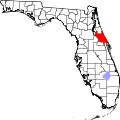 | |
| Towns | ||
| CDPs | ||
| Unincorporated communities | ||
| Ghost town | ||
| Footnotes | ‡This populated place also has portions in an adjacent county or counties | |
| International | |
|---|---|
| National | |
| Geographic | |
| Other | |

Port Orange, Florida
View on GrokipediaHistory
Founding and Early Settlement
The area now known as Port Orange experienced initial European agricultural settlement during the Spanish colonial period, with Patrick Dean receiving a 995-acre land grant from the Spanish Crown in 1804 for what became Dunlawton Plantation.[1] [6] This plantation focused on indigo and sugarcane production, relying on enslaved African labor, and included a sugar mill constructed in the early 1800s that was destroyed twice during the Second Seminole War, including in 1836.[1] [6] [7] The plantation operated intermittently until the Civil War era but did not develop into a permanent town, leaving the region sparsely populated amid ongoing conflicts and territorial changes after Florida's U.S. statehood in 1845.[1] [6] The founding of Port Orange as a distinct community occurred in 1866, when Dr. John Milton Hawks, an abolitionist and former Union Army surgeon, partnered with other Union officers to establish the Florida Land and Lumber Company.[1] [6] Hawks recruited approximately 500 freed African Americans, many from South Carolina and some Union veterans, to settle along the Halifax River north of Spruce Creek and work in lumber milling operations.[1] [6] This marked the second major wave of settlement in the area, shifting focus from agriculture to timber extraction amid post-war economic opportunities in Florida's coastal regions.[1] [6] In February 1867, the settlers relocated the community inland to its approximate current location to access better timber resources and avoid coastal vulnerabilities.[1] [6] Hawks named the site Orange Port, reflecting its proximity to citrus groves and port potential, but the name was changed to Port Orange in April 1867 after discovering a conflicting usage elsewhere.[1] [6] Early infrastructure included basic milling facilities and housing, though the venture struggled due to inadequate planning, harsh conditions, and market fluctuations, reducing the population to just nine families by 1869.[1] [6] This initial phase laid the groundwork for the community's lumber-based economy, despite high attrition rates among settlers.[1]Post-Civil War Era and Freedmen's Community
Following the American Civil War, Dr. John Milton Hawks, a Union Army surgeon and abolitionist from North Carolina, acquired approximately 1,800 acres of land along the Halifax River in what is now Port Orange, Volusia County, to establish a cooperative settlement for freed Black laborers.[1] In late 1865, Hawks transported around 500 freed slaves—many from South Carolina plantations, including some who had served in Union forces—to the site via schooners, intending for them to operate a sawmill and turpentine still under the Florida Land and Lumber Company, which he incorporated in 1866.[8] [9] An additional 1,000 freedmen arrived shortly thereafter, forming the core of what became known as Freemanville, Volusia County's first organized African-American community.[10] The settlers cleared land for farming rice, corn, and cotton while processing lumber from local pine forests, with Hawks providing initial supplies and tools on credit against future production.[1] Esther Hawks, his wife, founded an integrated school in 1867, one of the earliest in Florida to educate both Black and white children, emphasizing practical skills alongside basic literacy.[8] The community initially thrived with communal governance, a church, and self-sustaining agriculture, but sandy soils, frequent freezes, and inadequate drainage led to repeated crop failures, exacerbating food shortages and debt.[9] [10] By 1868, the company's financial collapse—stemming from overextended credit, low lumber demand, and Hawks' legal disputes with investors—forced many residents to disperse, seeking work in nearby Daytona or northern states; the site devolved into a "ghost settlement" with only remnants of cabins and a cemetery enduring.[1] [8] Despite its brevity, Freemanville exemplified early Reconstruction-era efforts to foster Black economic independence through land ownership and industry, though undermined by environmental constraints and insufficient capital, as documented in period land deeds and Hawks' correspondence.[9] A state historical marker erected in 2003 at the site commemorates the settlement's role in local founding.[10]20th Century Expansion
Port Orange experienced gradual expansion in the early 20th century following its incorporation as a town on May 7, 1913, which formalized governance and supported modest settlement growth amid ongoing agricultural activities like citrus cultivation and lumber processing.[11] The community reincorporated as a city in 1926, enabling further administrative development and attracting additional farmers and entrepreneurs to the Halifax River waterfront area.[11] This period saw population increases from 380 residents in 1920 to 678 by 1930, driven by local industries including boat building and oystering, though growth remained constrained by the Great Depression and limited infrastructure.[1] Post-World War II prosperity catalyzed accelerated expansion, with the population rising to 1,201 in 1950 and reaching 1,801 by 1960 as returning veterans and northern migrants sought affordable housing near Daytona Beach's emerging tourism economy.[1] Suburbanization intensified in the mid-century, transitioning the economy from rural farming and ranching toward residential subdivisions, supported by proximity to Interstate 95 and the influx of retirees drawn to Florida's coastal climate.[12] By the late 20th century, infrastructure improvements, including the expansion of Dunlawton Avenue to connect with I-95 in the 1970s, spurred commercial and residential development, expanding the city's footprint to 29 square miles and boosting population to approximately 41,000 by 1990.[12] This era marked a shift to modern gated communities and retail centers, reflecting broader regional growth in Volusia County while preserving elements of its historical Freemanville community through institutions like the 1911 Mount Moriah Baptist Church.[1] Overall, 20th-century expansion transformed Port Orange from a small agrarian outpost into a burgeoning suburb, with population multiplying over 100-fold from early census figures amid economic diversification and highway access.[1]Incorporation and Modern Development
Port Orange was incorporated as a town on November 25, 1913, following legislative approval to establish local governance amid early 20th-century agricultural and lumber interests.[11] The settlement's transition to city status occurred in 1926, when the Florida Legislature granted formal city incorporation, enabling expanded municipal services and reflecting modest population growth to around 380 residents by that period.[13] [1] This shift supported infrastructure improvements, including rail connections along Dunlawton Avenue established in the 1920s for passenger and freight transport. Incorporation facilitated regulatory oversight of fishing, oystering, and citrus operations, which dominated the local economy prior to the Great Depression's impact. Post-World War II economic prosperity catalyzed significant expansion, with the construction of the Port Orange Causeway Bridge in 1951 improving access to barrier islands and fostering residential and commercial development.[14] Proximity to Daytona Beach's tourism and racing industries drove population influx, transforming the area from rural outposts to suburban communities; by 1970, the city covered expanded territory with emerging gated neighborhoods replacing former ranchlands and farms.[1] The economy diversified into boatbuilding, manufacturing, and retail, supported by federal highway expansions like Interstate 95 in the late 1950s, which enhanced connectivity and logistics.[1] From 2000 to 2024, Port Orange's population surged by 45.2%, reaching 66,556 residents, fueled by inbound migration to Volusia County and annexation of adjacent lands, increasing the city's area to 29 square miles.[15] [1] Modern growth emphasizes mixed-use projects in the Port Orange Town Center, designated for redevelopment under community plans prioritizing commercial hubs and housing; incentives like Opportunity Zone tax deferrals have attracted investments in healthcare, aerospace, and tourism-related facilities.[16] [17] Between 2022 and 2023 alone, the population grew 1.54% to 63,818, with median household income rising to $68,000 amid steady job creation in retail and manufacturing sectors.[18] Current initiatives include active site plans for worship centers, residential phases, and infrastructure upgrades, reflecting controlled expansion amid regional forecasts for additional housing and commercial builds through 2025.[19] [20]Geography and Environment
Location and Topography
Port Orange occupies a position in southeastern Volusia County, Florida, along the western bank of the Halifax River, an estuary of the Atlantic Intracoastal Waterway, approximately 5 miles (8 km) south of Daytona Beach and 60 miles (97 km) northeast of Orlando. The city spans a land area of about 28.6 square miles (74 km²), with its central coordinates at approximately 29°07′N 81°00′W. This placement situates Port Orange within the broader Deltona–Daytona Beach–Ormond Beach metropolitan statistical area, facilitating access to coastal resources while remaining on the mainland.[21] The topography of Port Orange features low-lying coastal plains typical of Florida's Atlantic seaboard, with elevations ranging from sea level to a maximum of around 26 feet (8 meters) above mean sea level, averaging approximately 7 feet (2 meters). Sandy, well-drained soils predominate, interspersed with wetlands concentrated along waterways like the Halifax River and Spruce Creek. Underlying limestone formations contribute to karst topography, manifesting in subtle sinkholes, springs, and shallow lakes formed by dissolution processes over geological time.[22][23][24] These characteristics reflect the region's formation during the Pleistocene epoch, where marine transgressions and regressions shaped flat, permeable terrains vulnerable to erosion and subsidence. The absence of significant relief—lacking hills or ridges—defines a landscape suited to urban expansion but prone to flooding from tidal influences and stormwater.[23][25]Natural Features and Ecology
Port Orange occupies a low-lying portion of Florida's Atlantic coastal plain, with elevations generally ranging from sea level to approximately 20 feet above mean sea level, shaped by glacial outwash sands and marine deposits that form the basis of its sandy soils.[24] The city's eastern boundary is defined by the Halifax River, a tidal estuary connected to the Atlantic Ocean via the Intracoastal Waterway, which supports dynamic intertidal zones influenced by daily tidal fluctuations.[24] To the south, Spruce Creek, a blackwater stream originating from inland wetlands, meanders through the area, contributing freshwater inflows that mix with saline waters and foster estuarine habitats.[26] Other significant water features include Fozzard Creek, Rose Bay, and Strickland Bay along the southeastern limits, where wetlands are concentrated and serve as buffers against stormwater runoff and habitat corridors.[24] Ecologically, the region features hydric hammocks dominated by native hardwood species such as live oaks (Quercus virginiana) and laurel oaks (Quercus laurifolia), interspersed with pine flatwoods and freshwater marshes that transition into brackish systems near the riverine boundaries.[24] These habitats support diverse flora adapted to periodic flooding and fire regimes, including saw palmetto (Serenoa repens) and cabbage palm ([Sabal palmetto](/page/Sabal palmetto)), with conservation policies emphasizing the retention of at least 75% native shade trees in developed areas to maintain ecological integrity.[27] Wildlife includes wading birds like white ibis (Eudocimus albus) and brown pelicans (Pelecanus occidentalis), which nest in colonies numbering up to 400 pairs in nearby critical areas, alongside manatees (Trichechus manatus) in the warmer months utilizing the river's seagrass beds for foraging.[28] Key conservation lands, such as the 2,513-acre Doris Leeper Spruce Creek Preserve, protect over three miles of trails and boardwalks traversing upland forests, marshes, and creek frontage, providing observation points for monitoring biodiversity and mitigating urban encroachment.[29] Spruce Creek Park offers access to marsh ecosystems via canoe launches and towers overlooking tidal flats, underscoring efforts to preserve blackwater stream integrity amid surrounding development pressures.[30] These areas collectively function as refugia for species vulnerable to habitat fragmentation, with city policies promoting Florida-friendly landscaping to enhance native plant resilience against invasive species and sea-level rise.[31]Climate
Seasonal Patterns and Averages
Port Orange exhibits a humid subtropical climate (Köppen Cfa) with pronounced seasonal variations in temperature and precipitation, influenced by its coastal location along Florida's Atlantic seaboard. Winters are mild and relatively dry, while summers are hot, humid, and wet, driven by convective thunderstorms and the onset of the Atlantic hurricane season. Spring and fall serve as transition periods with moderate conditions. These patterns align closely with data from the adjacent Daytona Beach International Airport station, which serves as a representative proxy due to the lack of a dedicated long-term station in Port Orange.[32] Average monthly temperature and precipitation normals (1991-2020) for the area are as follows:| Month | Avg. High (°F) | Avg. Low (°F) | Avg. Precip. (in) |
|---|---|---|---|
| January | 69.0 | 48.5 | 2.6 |
| February | 71.7 | 51.1 | 2.7 |
| March | 75.5 | 54.8 | 3.3 |
| April | 80.2 | 60.1 | 2.4 |
| May | 84.6 | 66.5 | 3.4 |
| June | 88.2 | 72.0 | 6.2 |
| July | 90.1 | 73.8 | 5.3 |
| August | 89.8 | 74.2 | 6.5 |
| September | 87.2 | 72.8 | 6.9 |
| October | 82.6 | 67.2 | 4.3 |
| November | 76.3 | 56.2 | 2.5 |
| December | 71.3 | 50.9 | 2.7 |
Weather Hazards and Risks
Port Orange experiences elevated risks from tropical cyclones, particularly hurricanes, due to its coastal location in Volusia County along Florida's Atlantic seaboard. The area has recorded 84 hurricanes since 1930, with Hurricane Frances in 2004 ranking as the most significant by scale of impact.[35] More recent events include Hurricane Matthew in October 2016, which generated high winds, storm surge, and coastal erosion across Volusia County, resulting in approximately $586 million in damages to infrastructure and properties in the county.[36] Hurricane Irma followed in September 2017, affecting Volusia County with sustained high winds and heavy rainfall that damaged over 4,800 homes, businesses, and government facilities.[37] Flooding constitutes a persistent hazard, exacerbated by hurricanes, tropical storms, and localized heavy rainfall from thunderstorms prevalent during the June-to-November hurricane season and Florida's convective summer patterns. Currently, 41.9% of properties in Port Orange face flood risk, projected to increase to 44.9% within 30 years due to intensified precipitation and potential storm surge.[38] The city's floodplain mapping, aligned with FEMA standards, identifies zones vulnerable to riverine and coastal flooding, with recent alerts highlighting risks along waterways like the St. Johns River.[39][40] Severe thunderstorms and associated phenomena, including high winds, lightning strikes, and occasional tornadoes, add to the annual threat profile. Port Orange carries an extreme wind risk factor from hurricanes, tornadoes, and severe storms, with 209 recorded wind events, the most intense linked to Hurricane David in 1979.[41] Local emergency resources emphasize preparation for these convective events, which frequently produce gusts exceeding 50 knots and flash flooding.[42]Demographics
Population Growth and Trends
The population of Port Orange has grown steadily since the late 20th century, driven primarily by domestic migration to Florida's coastal regions. The U.S. Census Bureau recorded 56,048 residents in the 2010 decennial census, increasing to 62,596 by 2020, a rise of 11.6% over the decade.[43] [44] This growth outpaced the national average of 7.4% for the same period, reflecting attractions such as proximity to beaches, moderate climate, and economic opportunities in the Daytona Beach metropolitan area.[43] Post-2020 estimates indicate continued expansion, with the Florida Legislature's Office of Economic and Demographic Research reporting 65,670 residents as of April 1, 2024, equating to roughly 1.2% annual growth since the 2020 census.[45] Net domestic migration has been the dominant factor, consistent with statewide patterns where Florida gained over 1 million residents from other U.S. states between 2020 and 2023 due to factors including lower taxes and housing affordability relative to northern states.[46] Local trends show annual increases of 1.0-1.6% in recent years, though slightly moderated by natural increase (births minus deaths) amid an aging demographic.[43] [47]| Year | Population | Percent Change from Prior Decade/Census |
|---|---|---|
| 2010 | 56,048 | - |
| 2020 | 62,596 | +11.6% |
| 2024 | 65,670 | +5.0% (from 2020) |
Socioeconomic Profile
Port Orange maintains a middle-class socioeconomic standing, with a median household income of $68,955 in 2023, somewhat below the national median but aligned with regional patterns in Volusia County.[18][47] The per capita income stands at $45,329, while average household income reaches $78,709, indicating variability in earnings distribution.[47][48] The poverty rate was 11.6% in 2023, reflecting a modest decline from prior years and lower than broader Florida averages.[18] Unemployment remains low at 3.1% as of June 2024, supported by proximity to tourism and manufacturing hubs in the Daytona Beach area.[49] Homeownership is prevalent, with approximately 73% of occupied housing units owner-occupied in 2023 estimates, and average home values at $365,318.[48] Educational attainment among the population aged 25 and older exceeds metro-area benchmarks, with high school graduation or higher rates surpassing the Deltona-Daytona Beach-Ormond Beach area's 93.1%.[50] This profile underscores a stable, working-to-middle-class base, bolstered by local service, retail, and professional sectors rather than heavy industry concentration.[18]| Key Socioeconomic Indicators | Value | Reference Year |
|---|---|---|
| Median Household Income | $68,955 | 2023[18] |
| Per Capita Income | $45,329 | Recent estimate[47] |
| Poverty Rate | 11.6% | 2023[18] |
| Unemployment Rate | 3.1% | June 2024[49] |
| Owner-Occupied Housing Rate | ~73% | 2023[48] |
Racial, Ethnic, and Age Composition
As of the 2022 American Community Survey 5-year estimates, Port Orange's population of 63,796 was composed primarily of non-Hispanic Whites at 84.1%, followed by non-Hispanic Blacks or African Americans at 3.76%, non-Hispanic Asians at 2.57%, and non-Hispanic individuals reporting two or more races at 3.09%. Hispanics or Latinos of any race accounted for 5.31%, with the largest subgroup being White Hispanics. Other racial categories, including non-Hispanic American Indians or Alaska Natives (0.37%) and Native Hawaiians or Pacific Islanders (0.07%), represented minimal shares. These figures reflect a predominantly European-descended population with limited diversity compared to national averages, where non-Hispanic Whites constitute about 58% of the U.S. total.[18][47] The age distribution indicates an older demographic profile, with a median age of 46.2 years—higher than the U.S. median of 38.9 years. Approximately 14.3% of residents were under 15 years old, 18.1% were aged 15 to 29, 52.6% were between 30 and 64, and 15.0% were 65 or older. This skew toward middle-aged and senior residents aligns with broader trends in Florida's coastal retirement communities, where in-migration of older adults contributes to elevated median ages and a lower proportion of youth relative to the national figure of about 22% under 18.[51][18]| Age Group | Percentage of Population |
|---|---|
| Under 15 | 14.3% |
| 15–29 | 18.1% |
| 30–64 | 52.6% |
| 65+ | 15.0% |
Government and Politics
City Governance Structure
The City of Port Orange operates under a council-manager form of government, which has been in place since 1971.[52] This structure separates legislative policy-making from administrative execution, with an elected mayor and four-member city council providing oversight and direction, while a professional city manager handles operational responsibilities.[52] [53] The mayor is elected at-large by city residents in non-partisan elections, serving as the presiding officer of the council and representing the city in ceremonial capacities.[53] City council members are elected from four specific geographic districts, ensuring localized representation.[53] All elected officials serve four-year staggered terms, with elections occurring in even-numbered years such that approximately half the seats are contested biennially; term limits restrict service to no more than two consecutive terms, defined as holding office for more than 738 days.[53] [54] [55] The city council holds legislative authority, including enacting ordinances, approving annual budgets, setting tax rates, and appointing the city manager.[53] The city manager, appointed by and reporting to the council, acts as the chief executive officer, overseeing daily operations, implementing policies, managing departments, and preparing budget recommendations.[52] This arrangement promotes professional administration insulated from partisan influences, aligning with standard practices in council-manager systems.[52]Political Leanings and Representation
Port Orange demonstrates Republican-leaning political tendencies, aligning with patterns observed in Volusia County. Voter registration data for Volusia County as of September 30, 2025, indicates Republicans form the plurality, comprising approximately 45% of active voters, compared to 23% Democrats and 30% no party affiliation, trends that extend to suburban areas like Port Orange.[56] Local analyses map Port Orange as predominantly red, with higher concentrations of Republican voters relative to Democratic ones.[57] In presidential elections, Volusia County supported Republican candidates decisively. Donald Trump garnered 60.24% of the county's vote in the November 5, 2024, general election, compared to 38.53% for Kamala Harris, contributing to Florida's overall Republican margin. This follows Trump's 2020 county win of approximately 55%, amid statewide Republican dominance, underscoring Port Orange's conservative voter base amid Florida's shift rightward since 2020.[58] The city's government operates under a council-manager system with nonpartisan elections for mayor and four council seats, two elected at-large and two by district. Scott Stiltner was elected mayor on August 20, 2024, securing 69% of the vote against Derek LaMontagne, assuming office in December 2024.[59] Recent council additions include Shawn Goepfert (District 3) and Lance Green (District 4), elected in the same primary, alongside incumbents.[59] While parties are not formally listed, prior mayor Don Burnette identified as Republican, and local figures like county councilman Jake Johansson from Port Orange affiliate with the GOP, reflecting the area's representational conservatism.[60][61] Federally, Port Orange falls within Florida's 6th congressional district, represented by Republican Randy Fine since January 2025, and state Senate District 8, held by Republicans. These alignments reinforce the locality's empirical support for conservative policies on taxation, development, and limited government intervention.Recent Policy Debates
In 2024 and 2025, Port Orange city council debates have prominently featured tensions between accommodating population growth and preserving infrastructure capacity, particularly in stormwater management and flood mitigation. A town hall on September 25, 2025, drew hundreds of residents voicing frustrations over recurrent flooding, highlighting perceived delays in actionable remedies despite ongoing infrastructure strains from development.[62] On August 19, 2025, the council unanimously approved acquiring and demolishing three flood-prone homes under FEMA's Hazard Mitigation Grant Program to enhance resilience in vulnerable areas.[63] Later, in October 2025, the city obtained over $21 million in grants for comprehensive stormwater system upgrades, addressing drainage deficiencies exacerbated by recent hurricanes.[64] Stormwater utility fees have been a focal point of contention, with council discussions emphasizing funding shortfalls for maintenance and expansion. A 2023 rate study recommended phased increases to cover projected expenditures, leading to an initial hike from $0 to $15 per dwelling unit approved in September 2023; further adjustments were debated in 2024 and 2025 public hearings to support tree preservation initiatives and drainage improvements without overburdening residents.[65] [66] [67] Development-related zoning changes have elicited public opposition, as seen in the planning commission's September 2025 approval of rezoning for the Vintage project, despite resident concerns over water resource depletion and ecological effects in a region already facing capacity limits.[68] Updates to the Port Orange Comprehensive Plan (2022-2045), discussed in council meetings like May 21, 2024, have balanced economic expansion with environmental safeguards, amid broader growth pressures.[69] Florida Senate Bill 180, signed into law in March 2025, has indirectly shaped local debates by barring municipalities from enacting stricter land-use or zoning rules until October 2027, ostensibly to expedite post-disaster recovery but limiting tools for proactive flood and growth management in coastal Volusia County.[70] Volusia representatives noted in July 2025 that the measure protects rebuilding efforts after storms like Hurricane Milton, though it has prompted discussions on eroded home-rule authority and heightened developer leverage in areas like Port Orange.[71] [72]Economy
Major Industries and Employers
The economy of Port Orange centers on service-oriented sectors, with health care and social assistance as the largest employer of residents, supporting 4,520 jobs in 2023.[18] Retail trade follows closely, employing around 3,400 individuals, while accommodations and food services account for approximately 2,900 positions, reflecting the city's proximity to coastal tourism areas like Daytona Beach.[73] Educational services and construction also contribute significantly, with about 2,600 and 2,300 jobs respectively, the latter driven by ongoing residential and commercial development in Volusia County.[73] Manufacturing, though smaller, includes specialized marine production, benefiting from the region's boating industry. Among private employers, Brunswick Corporation's Boston Whaler division operates a major facility in Port Orange, employing 841 people in boat manufacturing as of recent county data.[74] Retail giants such as Walmart and Publix maintain stores in the city, drawing from the broader Volusia workforce where Walmart employs 3,504 county-wide and Publix 4,106.[74] Health care providers like AdventHealth support local operations, including an emergency room in Port Orange, though specific local headcounts are integrated into the system's 7,923 county employees.[74][75] Public sector roles are led by the City of Port Orange with 493 employees in administration and services.[74] Smaller but notable firms include manufacturing and sign production companies like Thompson Pump and Don Bell Signs, the latter with around 75 workers.[73]Growth Metrics and Challenges
Port Orange's economy has shown steady expansion, supported by population growth that reached 63,818 residents in 2023, a 1.54% increase from 62,849 in 2022, which correlates with rising demand for local services and housing.[18] Median household income advanced from $65,026 in 2022, reflecting gains in key sectors such as healthcare, retail, education, construction, and food services, where the job market expanded by 2% in recent years.[18] [73] Labor force participation remains strong, with average employment holding at 32,789 in the second quarter of 2024 and 32,687 in the third quarter, underpinned by the city's proximity to Interstate 95 and business incentives like Opportunity Zones that defer capital gains taxes to spur investment and job creation.[76] [77] [17] Unemployment metrics indicate resilience, averaging around 3.1% in Q2 2024 and 3.47% in Q3 2024, though rates have ticked up to 4.5% more recently, exceeding the prior year's 3.7% but aligning with long-term local averages.[77] [78] Projections for sector-specific job growth, particularly in healthcare and construction, suggest potential increases of up to 43% over the next decade, driven by Florida's broader economic momentum and Volusia County's $21.9 billion GDP in 2023.[78] [73] [79] Challenges persist amid this growth, including regional labor shortages that hinder business expansion, as employers in Volusia County continue to face difficulties retaining and attracting workers despite employment gains.[80] Rising unemployment trends, potentially reaching 4.3% statewide by 2026, compound issues like workforce saturation in entry-level sectors, where job seekers report competitive pressures even as private sector growth outpaces national averages at 1.3%.[78] [81] [82] The city's reliance on cyclical industries exposes it to vulnerabilities such as construction slowdowns from hurricane recovery or insurance cost escalations, though targeted incentives aim to mitigate these by fostering long-term commercial development.[17]Education
Public School System
The public schools serving Port Orange operate under the Volusia County Schools district, which encompasses the city and administers education for approximately 62,742 students across 90 schools as of the 2023-24 school year, making it the 14th largest district in Florida.[83] [84] The district maintains a student-teacher ratio of 17:1, with 50% minority enrollment and 40.3% of students classified as economically disadvantaged.[84] Enrollment in Volusia County has remained stagnant or slightly declined in recent years, with administrative costs rising amid efforts to improve outcomes.[85] In the 2024-25 school year, Volusia County Schools received its first overall "A" district grade from the Florida Department of Education since 2008-09, reflecting a 13 percentage point increase in schools earning A or B ratings to 75%.[86] This improvement follows a "B" grade in 2023-24 and incorporates metrics such as student achievement, progress, and acceleration under Florida's accountability system.[87] Schools in Port Orange contribute to these gains, with elementary institutions like Sweetwater Elementary ranking in the top 5% statewide (112th of 2,258) and earning high marks for test proficiency in math and reading.[88] Similarly, Spruce Creek High School, serving Port Orange students, ranks among the top public high schools in the district with strong college readiness indicators.[89] Port Orange-area schools include several high-performing elementaries such as Cypress Creek Elementary (state rank 364th) and Port Orange Elementary, alongside middle schools like Silver Sands and Cypress Creek Middle, which feed into high schools including Atlantic High (which earned its first "A" rating in 2025) and Spruce Creek High.[88] [90] Overall, public schools in Port Orange average a 7/10 rating, placing them in the top 50% of Florida districts, with 32% minority enrollment lower than the statewide average.[91] The district emphasizes programs like Advanced Placement courses and career-technical education, though challenges persist in addressing enrollment trends and resource allocation amid Florida's emphasis on accountability-driven reforms.[92]Elementary Schools
Public elementary education in Port Orange is provided by the Volusia County Schools district, with five schools serving grades pre-kindergarten through 5: Cypress Creek Elementary School, Horizon Elementary School, Port Orange Elementary School, Spruce Creek Elementary School, and Sweetwater Elementary School.[93][88] These institutions emphasize general education, exceptional student education, and gifted programs, with enrollment reflecting the area's growing population.[94]| School Name | Enrollment (2023-2024) | Student-Teacher Ratio | Math Proficiency (%) | Reading Proficiency (%) | State Ranking (2024) |
|---|---|---|---|---|---|
| Cypress Creek Elementary | 797 | 15:1 | 75 | 75 | Top 20% |
| Horizon Elementary | 749 | 14:1 | 62 | 60 | Top 26% (4-star) |
| Port Orange Elementary | 380 | 16:1 | 62 | 57 | Top 25% (4-star) |
| Sweetwater Elementary | 662 | 15:1 | 84 | 79 | Top 10% (5-star) |
| Spruce Creek Elementary | Not specified in recent district reports | Not specified | Not specified | Not specified | Ranked in district listings |