Hubbry Logo
search
logo
2061362

Pre-Adamite

logo
Community Hub0 Subscribers
Read side by side
from Wikipedia

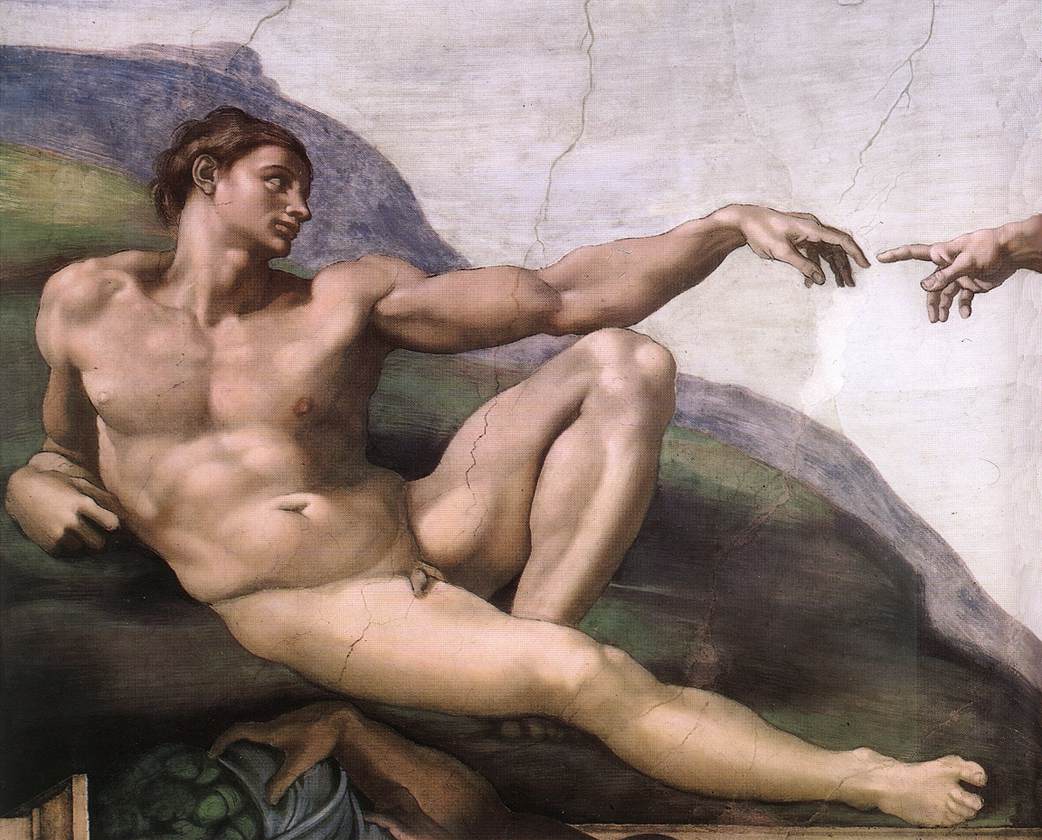
Creation of Adam in the Sistine Chapel

The pre-Adamite hypothesis or pre-Adamism is the theological belief that humans (or intelligent yet non-human creatures) existed before the biblical character Adam. Pre-Adamism is therefore distinct from the conventional Abrahamic belief that Adam was the first human. "Pre-Adamite" is used as a term, both for those humans (or human-like animals) believed to exist before Adam, and for believers or proponents of this hypothesis.

Early development

[edit]

The first known debate about human antiquity took place in 170 AD between a Christian, Theophilus of Antioch, and an Egyptian pagan, Apollonius the Egyptian (probably Apollonius Dyscolus), who argued that the world was 153,075 years old.[1]: 26 

An early challenge to biblical Adamism came from the Roman Emperor Julian the Apostate, who, upon his rejection of Christianity and his return to paganism, accepted the idea that many pairs of original people had been created, a belief termed co-Adamism or multiple Adamism.[2]: 6  [1]: 27-28,125 

Augustine of Hippo's The City of God contains two chapters indicating a debate between Christians and pagans over human origins: Book XII, chapter 10 is titled Of the falseness of the history that the world hath continued many thousand years and the title of book XVIII, chapter 40 is The Egyptians' abominable lyings, to claim their wisdom the age of 100,000 years. These titles tend to indicate that Augustine saw pagan ideas concerning both the history of the world and the chronology of the human race as incompatible with the Genesis creation narrative. Augustine's explanation aligned with most rabbis, and with the church fathers, who generally dismissed views on the antiquity of the world as "myths and fables", whereas Jewish and Christian claims were based on "revealed truth".[1]: 27 

Augustine did take a critical view of the young earth narrative in some aspects, arguing that everything in the universe had been created simultaneously by God, and not seven literal days. He was primarily concerned with arguing against the idea of humanity having existed eternally rather than a Bible-based chronology of human history.[3]

900–1700

[edit]

In early Islam, a common belief held that mankind is actually the successor of other intelligent creatures such as jinn and hinn. Medieval Muslim traditions referred to the jinn as pre-Adamites,[4]: 39  depicted as human-like in various ways. Although the notion of jinn as pre-Adamites was generally accepted, the idea that other humans lived before the known Adam was controversial. From the mid-ninth century onward the idea appeared that God created several Adams, each of whom presides over an era lasting around 50,000 years. This concept was regarded as heretical, but was widely accepted by Ismailis and some Sufis.[5]: 230–232 

A book titled Nabatean Agriculture, written or translated by Ibn Wahshiyya in 904, collated texts about the activities and beliefs of Arabic groups such as the Nabataeans, in defense of Babylonian culture against Islam. The book discussed the ideas that people lived before Adam, that he had parents, and that he came from India.[1]: 28  It proposed that Adam was the father of an agricultural civilization, rather than the father of the entire human race.[2]: 7 

The Jewish poet Yehuda Halevi wrote his Kitab al Khazari between 1130 and 1140, which featured a discussion wherein the King of the Khazars questioned three theologians (a Jewish rabbi, a Christian, and a Muslim) which was the true religion, and raised the challenge that people in India said they had buildings and antiquities which were millions of years old. The rabbi responded that his faith was unshaken, as the Indians lacked "a fixed form of religion, or a book concerning which a multitude of people held the same opinion, and in which no historical discrepancy could be found." The rabbi dismissed Indians as dissolute, unreliable people, whose claims could be ignored. Later in the book, Halevi rejected the Nabatean claims as these people did not know of the revelation in Scripture, and he dismissed Greek theories of an eternal world. In his conclusion, Halevi maintained that Adam was the first human in this world but left open other possibilities: "If, after all, a believer in the Law finds himself compelled to admit an eternal matter and the existence of many worlds prior to this one, this would not impair his belief that this world was created at a certain epoch, and that Adam and Noah were the first human beings."[1]: 27–28 

The claims in Nabatean Agriculture were also disputed by Maimonides (1135–1204) in The Guide for the Perplexed. He attributed the concepts to the Sabians and said they were just legends and mythology which deviated from monotheism though drawing on Jewish sources, but in refuting the speculations, he circulated an outline of the ideas among other scholars:[2]: 7–8  "They deem Adam to have been an individual born of male and female like any other human individuals, but they glorify him and say that he was a prophet, the envoy of the moon, who called people to worship the moon. and there are compilations of his on how to cultivate the soil." He noted the claim that Adam came from India, and went on to Babylon.[1]: 29–30 

The presence of a belief in the existence of men before Adam among the Familists, a religious community in Friesland, was noted by John Rogers in 1578.[6]: 51 

In 1591, Giordano Bruno argued that, because no one could imagine that the Jews and the Ethiopians had the same ancestry, God must have either created separate Adams or that Africans were the descendants of pre-Adamic races.[7]: 25–26 

The 17th-century French millenarian Isaac La Peyrère is usually credited with formulating the pre-Adamite theory because of his influence on subsequent thinkers and movements. In his Prae-Adamitae, published in Latin in 1655, La Peyrère argued that Paul's words in Romans 5:12–14 should be interpreted to mean that "if Adam sinned in a morally meaningful sense there must have been an Adamic law according to which he sinned. If law began with Adam, there must have been a lawless world before Adam, containing people."[6]: 53  Thus, according to La Peyrère, there must have been two creations; first the creation of the Gentiles and then the creation of Adam, who was the father of the Hebrews.[8]: 152  The existence of pre-Adamites, La Peyrère argued, explained Cain's taking of a wife and the building of a city after Abel's murder in the Book of Genesis.[1]: 43 

In Politica Hermetica, Laszlo Toth wrote that "racial theory has as its official birthdate 24 April 1684," when François Bernier distinguished four or five races in an article titled A new division of the Earth, according to the different species or races of men who inhabit it published in the Journal des sçavans. Because of widespread theological opposition to the pre-Adamite theories of his friend La Peyrère, Bernier published his paper anonymously.[9]: 52–53 [10]

Age of Enlightenment

[edit]

During the Age of Enlightenment, pre-Adamism was adopted widely as a challenge to the biblical account of human origins.[citation needed] In the 19th century, the idea was welcomed by advocates of white superiority. A number of racist interpretive frameworks involving the early chapters of Genesis arose from pre-Adamism. Some pre-Adamite theorists held the view that Cain left his family for an inferior tribe described variously as "nonwhite Mongols" or that Cain took a wife from one of the inferior pre-Adamic peoples.[8]: 154 

1800–present

[edit]

Racist pre-Adamism

[edit]

In 19th-century Europe, pre-Adamism was attractive to those who were intent on demonstrating the inferiority of non-Western peoples, and in the United States, it appealed to those who were attuned to racial theories but found it unattractive to contemplate a common history with non-whites.

Scientists such as Charles Caldwell, Josiah C. Nott and Samuel G. Morton rejected the view that non-whites were the descendants of Adam. Morton combined pre-Adamism with cranial measurements. As Michael Barkun explains:

In such an intellectual atmosphere, pre-Adamism appeared in two different but not wholly incompatible forms. Religious writers continued to be attracted to the theory both because it appeared to solve certain exegetical problems (where did Cain's wife come from?) and exalted the spiritual status of Adam's descendants. Those of a scientific bent found it equally attractive but for different reasons, connected with a desire to formulate theories of racial difference that retained a place for Adam while accepting evidence that many cultures were far older than the few thousand years that humanity had existed, according to the biblical chronology. The two varieties differed primarily in the evidence they used, the one relying principally on scriptural texts and the latter on what passed at the time for physical anthropology.[8]: 153 

In 1860, Isabella Duncan wrote Pre-Adamite Man, Or, The Story of Our Old Planet and Its Inhabitants, Told by Scripture & Science, a mixture of geology and scriptural interpretation. The book was popular among a number of geologists because it mixed biblical events with science. She suggested that the pre-Adamites are today's angels.[2]: 90  Since they were without sin, for sin did not enter the world until Adam disobeyed God, there was no reason for them not to have been at least raptured into heaven, anticipating what would again occur with the second coming of Jesus Christ. Duncan also believed that some angels had sinned and fallen from Heaven, which caused them to become demons. Duncan believed that such an upheaval would leave geological scars on the earth. The concept of ice ages, pioneered by Louis Agassiz, seemed to provide evidence of such events, drawing the line between the pre-Adamic era and the modern one, which she posited began about 6,000 years ago.[11]: 142–144 

In 1867, Buckner H. Payne, writing under the pen name Ariel, published a pamphlet titled The Negro: What is His Ethnological Status? He insisted that all of the sons of Noah had been white. According to his hypothesis, if the Flood had been universal, the only survivors of it should have been white, so why were non-white people living on Earth? To answer this question, Payne suggested that the "Negro" is a pre-Adamic human of the field (specifically, a higher order which was preserved on Noah's Ark. According to Payne, the Pre-Adamites were a separate species without immortal souls.[12]: 149 

The Irish lawyer Dominick McCausland, a Biblical literalist and anti-Darwinian polemicist, maintained the theory in order to uphold the Mosaic timescale. He believed that the Chinese were descended from Cain and he also believed that the "Caucasian race" would eventually exterminate all other races. He also believed that only the "Caucasian" descendants of Adam were capable of creating civilization, and he tried to explain away the existence of the numerous non-"Caucasian" civilizations by attributing all of them to a vanished "Caucasian race", the Hamites.[13]

In 1875, A. Lester Hoyle wrote a book, The Pre-Adamite, or who tempted Eve? In his book, he claimed that there had been five distinct creations of races, but only the fifth race, the white race, of which Adam was the father, had been made in God's own image and likeness.[12]: 150  Hoyle further suggested that Cain was the "mongrel offspring" of Eve's being seduced by "an enticing Mongolian" with whom she had repeated trysts, thus laying the foundation for the white supremacist bio-theology that miscegenation was "an abomination".[2]: 197 

In an unusual blend of contemporary evolutionary thinking and pre-Adamism, the Vanderbilt University theistic evolutionist and geologist Alexander Winchell argued in his 1878 tract, Adamites and Preadamites, for the pre-Adamic origins of the human race, on the basis that the Negroes were too racially inferior to have been descended from the Biblical Adam. Winchell also believed that the laws of evolution operated according to the will of God.[14]: 50 

In 1891, William Campbell, under the pen name "Caucasian", wrote in Anthropology for the People: A Refutation of the Theory of the Adamic Origin of All Races that the non-white peoples were not the descendants of Adam and were therefore "not brothers in any proper sense of the term, but inferior creations" and he also wrote that polygenism was the "only theory reconcilable with scripture." Like Payne before him, Campbell viewed the Great Flood as a consequence of intermarriage between the white (Adamic) and the nonwhite (pre-Adamic) peoples "the only union we can think of that is reasonable and sufficient to account for the corruption of the world and the consequent judgement."[15]: 43 

In 1900, Charles Carroll wrote the first of his two books on pre-Adamism, The Negro a Beast; or, In the Image of God, in which he sought to revive the ideas which had previously been presented by Buckner H. Payne, describing the Negro as a literal ape rather than a human.[16] In a second book which was published in 1902, The Tempter of Eve, he put forth the idea that the serpent was actually a black female, and he also theorized that miscegenation was the greatest of all sins.[17]: 277  Carroll claimed that the pre-Adamite races, such as blacks, did not have souls. He believed that race mixing was an insult to God because it spoiled His racial plan of creation, and he also believed that the mixing of races had led to the errors of atheism and evolution.[12]: 150 

The Scottish millennialist George Dickison wrote The Mosaic Account of Creation, As Unfolded in Genesis, Verified by Science in 1902. The book mixed science with a scientifically enhanced reading of Genesis and it also listed geological discoveries which showed that men existed before Adam had been created and proved that Earth was much older than the 6000-year-old span of the Adamic race. Dickison welcomed scientific discoveries from fossil evidence and the palaontological record and used them as evidence of pre-Adamism.[12]: 165–166 

The idea that "lower races" are mentioned in the Bible (in contrast to Aryans) was posited in the 1905 book Theozoology: or The Science of the Sodomite Apelings and the Divine Electron by Jörg Lanz von Liebenfels, an Ariosophist and a volkisch writer who influenced Nazism.[18]: x 

The doctrine which is known as British Israelism, which developed in England in the 19th century, also included a pre-Adamic worldview but Pre-Adamism was a minority position. The model viewed pre-Adamites as a race of inferior bestial creatures which was not descended from Adam, because according to it, Adam was the first white man and consequently, he was the first son of God. In the narrative, Satan seduces Eve, and the resulting offspring is a hybrid creature, Cain. Later, Cain flees to East Turkestan to establish a colony of followers who are intent on realizing the Devil's plan for domination of the earth. A further elaboration of this myth involved the identification of the Jews with the Canaanites, the putative descendants of Cain, but the eponymous ancestor of the Canaanites is not Cain, but Canaan. It followed that if the tribes of Judah were supposed to have intermarried with Cain's descendants, the Jews were both the offspring of Satan and the descendants of sundry nonwhite pre-Adamic races.[8]: 150–172 

In the United States, philo-Semitic British Israelism developed into the antisemitic Christian Identity movement and the serpent seed doctrine. Identity preacher Conrad Gaard wrote that the serpent was a "beast of the field" who was the father of Cain, and since Cain married a pre-Adamite, his descendants were a "mongrel, hybrid race".[8]: 177–178 

Non-racist pre-Adamism

[edit]

The occultist Paschal Beverly Randolph published Pre-Adamite Man: Demonstrating The Existence of the Human Race Upon the Earth 100,000 Thousand Years Ago! under the name Griffin Lee in 1863. The book took a primarily scientific view of pre-Adamism, relying on evidence from linguistics, anthropology, archaeology, paleontology, and ancient history. Being a polygenist, Randolph argued that the color of races, particularly black, was not the result of climate and was proof of separate, pre-Adamite origins.[2]: 110-111 

Pre-Adamite theories have also been held by a number of mainstream Christians such as the Congregational evangelist R. A. Torrey (1856–1928), who believed in the Gap Theory. Torrey believed it was possible to accept both evolution and biblical infallibility, with the pre-Adamite as the bridge between religion and science.[2]: 202 

Gleason Archer Jr. was a believer in pre-Adamism. In his 1985 book A Survey of Old Testament Introduction he wrote,[19]: 204 

To revert to the problem of the Pithecanthropus, the Swanscombe man, the Neanderthal and all the rest (possibly even the Cro-magnon man, who is apparently to be classed as Homo sapiens, but whose remains seem to date back at least to 20,000 B.C.) it seems best to regard these races as all prior to Adam's time, and not involved in the Adamic covenant. We must leave the question open, in view of the cultural remains, whether these pre-Adamic creatures had souls (or, to use the trichotomic terminology, spirits).

Archer asserted that only Adam and his descendants were infused with the breath of God and a spiritual nature corresponding to God himself, and that all mankind subsequent to Adam's time must have been literally descended from him. Regarding the concept of pre-Adamic races (such as the Cro-Magnon man), he says: "They may have been exterminated by God for unknown reasons prior to the creation of the original parent of the present human race."[19]: 205 [20]

More recently, such ideas have been promoted by Kathryn Kuhlman and Derek Prince among Pentecostals, John Stott among Anglicans, Old Earth creationist Hugh Ross,[21] and computational biologist S. Joshua Swamidass.[22]

See also

[edit]

References

[edit]

Further reading

[edit]
Revisions and contributorsEdit on WikipediaRead on Wikipedia
from Grokipedia
Pre-Adamism is a theological hypothesis asserting the existence of human or human-like beings on Earth prior to the biblical Adam and Eve, as recounted in Genesis.[1] Originating in the 17th century, the theory primarily aimed to reconcile scriptural accounts with evidence of ancient human populations or diverse gentile nations mentioned in the Bible, such as Cain's wife and city in Genesis 4.[1] French scholar Isaac La Peyrère formalized the idea in his 1655 treatise Prae-Adamitae, interpreting Romans 5:12-14 to imply pre-Adamic peoples who lived without Mosaic law, with Adam as progenitor specifically of the Hebrews.[2] La Peyrère's framework positioned pre-Adamites as non-covenant races outside the Jewish lineage, influencing later polygenist views that treated human races as separately created lines rather than descendants of a single pair.[3] The hypothesis persisted into the 19th century, adopted by figures like naturalist Louis Agassiz to explain fixed racial differences through multiple origins, thereby challenging monogenism while evading direct conflict with Genesis by localizing Adam's creation.[4] Proponents often invoked it to address geological strata suggesting antiquity beyond a literal six-day creation or Ussher chronology, positing catastrophic destructions between pre-Adamic eras and Eden.[1] Controversies arose from its implications, including the introduction of human death prior to the Fall—contradicting Romans 5:12's link between sin, death, and Adam—and its exploitation to rationalize racial hierarchies and slavery by deeming non-Adamites as soulless or inferior.[1][4] Initially condemned as heresy for diluting biblical authority and genealogies (e.g., Luke 3:38 naming Adam as son of God), pre-Adamism waned with Darwinian evolution but echoes in some theistic models accommodating fossils via localized Adamic events.[5] Critics from young-earth perspectives argue it undermines scriptural clarity on human origins, while empirical fossil records—showing hominid remains predating any feasible Eden date—expose tensions between literalism and geological data, though the theory itself prioritizes interpretive flexibility over uniform causality in origins.[1]

Definition and Core Concepts

Theological and Biblical Basis

The theological and biblical basis for the pre-Adamite hypothesis rests on interpretive claims that certain scriptural passages imply the existence of human populations prior to Adam, whom proponents view not as the first human but as the progenitor of a specific lineage, often identified with the Hebrews or a covenantal line. Isaac La Peyrère, in his 1655 treatise Prae-Adamitae, advanced this view by citing Romans 5:12-14, interpreting the reference to death reigning "from Adam to Moses" over those who sinned without the law as evidence of pre-existing peoples who died naturally, unbound by Adamic transgression.[2] This reading posits that sin and death through Adam affected only his descendants, allowing for earlier humans outside this federal headship, though mainstream exegesis rejects this as contradicting the passage's emphasis on Adam as the origin of universal sin.[6] Proponents further distinguish the creation of "man" (Hebrew adam, collective) in Genesis 1:26-27 from the formation of Adam as an individual in Genesis 2:7, arguing the former describes a generic humanity while the latter introduces a particular figure destined for divine election.[7] Genesis 4:13-17, detailing Cain's fear of being killed by others, his wife from the land of Nod, and the building of a city, is invoked to suggest established populations predating Abel's murder, necessitating external inhabitants beyond Adam's immediate family.[7] These interpretations aim to resolve apparent tensions, such as the origin of Cain's wife, without altering a literal reading of Adam's creation, yet critics contend they impose external assumptions, as the text genealogically traces all humanity from Adam in Genesis 5:1-5 and 1 Chronicles 1:1.[6] Theologically, pre-Adamites are often framed as lacking the imago Dei in its full redemptive sense or as subject to natural death sans original sin, preserving Romans 5:12's assertion that "death passed upon all men, for that all have sinned" within Adam's line while accommodating notions of prior mortality.[7] Early formulations, including La Peyrère's, tied this to Jewish particularism, with Adam as the first Israelite amid Gentile precursors, influencing later racial polygenism but diverging from patristic consensus that Adam inaugurated humanity universally, as affirmed in 1 Corinthians 15:45 ("the first man Adam").[2] Such views have been deemed heretical by Catholic authorities for undermining monogenism and original sin's universality.[7]

Key Variants and Distinctions from Adamic Lineage

The pre-Adamite hypothesis features variants that differentiate pre-Adamite populations from the Adamic lineage, which biblical theology identifies as the covenantal progeny of Adam endowed with God's image (Genesis 1:26-27) and bearing the consequences of original sin (Romans 5:12).[7] In Isaac de La Peyrère's 1655 formulation, pre-Adamites represent a primordial human stock created prior to Adam, serving as ancestors of Gentile nations worldwide, while Adam's descendants form the exclusively Jewish line from which the Messiah emerges.[8] This variant reconciles Genesis by interpreting chapter 1's creation mandate as applying to pre-Adamites populating the earth, with chapter 2 detailing a localized Adamic creation in Eden; distinctions include pre-Adamites' absence from Adam's federal headship over sin and death, yet their eligibility for redemption through Christ, as La Peyrère argued against supersessionism.[8] Nineteenth-century iterations often linked pre-Adamism to polygenism, positing Adam as progenitor of the Caucasian race alone, with Africans, Asians, and Native Americans tracing to distinct pre-Adamite origins—either a unified stock or multiple independent creations.[7] These theories emphasized biological and moral distinctions, portraying pre-Adamites as inherently inferior, potentially soulless, or untainted by Adamic sin, thereby rationalizing racial subjugation and slavery by exempting non-Adamic peoples from universal human solidarity in Romans 5.[1] For instance, proponents contended that pre-Adamites lacked the Imago Dei fully realized in Adam, explaining observed cranial and cultural variances without monogenist diffusion from a single pair.[7] A further variant, advanced in some theological reconciliations with geology, depicts pre-Adamites as beast-like or animalistic humans predating a global cataclysm—termed "Lucifer's Flood" by certain interpreters—between Satan's fall and Adam's era, after which only Adamic survivors repopulated.[1] Here, distinctions hinge on spiritual ontology: pre-Adamites possess physical form akin to humans but forfeit eternal souls or divine likeness, perishing entirely without lineage continuity, unlike the Adamic line's propagation of redemptive history through Noah.[1] Such models, critiqued for eisegesis, aimed to harmonize fossil evidence of archaic humans with scriptural timelines by denying pre-Adamites' equivalence to biblically normative humanity.[7]

Historical Development

Ancient and Early Christian Debates

In ancient times, debates over human origins emerged as pagan intellectuals challenged Jewish and Christian assertions of Adam as the first human, drawing on mythological chronologies that posited extensive antiquity for civilizations like Egypt. Egyptian priest Manetho, writing in the 3rd century BCE, compiled king lists extending back tens of thousands of years, implying human existence predating biblical timelines.[9] These claims were used to undermine Abrahamic monotheism, suggesting multiple cycles of human creation or destruction incompatible with Genesis. Early Christians countered by prioritizing scriptural chronology, calculating the world's age at approximately 5,000–6,000 years from creation to their era, as derived from genealogies in Genesis and corroborated by prophetic timelines.[10] A pivotal early confrontation occurred around 170 CE between Christian apologist Theophilus of Antioch and the Egyptian pagan Apollonius, marking the first recorded debate on human antiquity. Apollonius invoked Egyptian annals to argue for a world age of 153,075 years, entailing pre-Adamic populations and contradicting the Genesis account of a recent creation.[2] Theophilus refuted this in his To Autolycus, insisting Adam was the primordial man formed from dust, with no prior humans, as human sin and death entered through him alone (Romans 5:12). He dismissed pagan records as fabricated or exaggerated, lacking verifiable empirical chains of custody, and emphasized God's singular creative act in Genesis 1–2 over speculative mythologies.[10] This exchange highlighted a core Christian commitment to monogenism—descent from one ancestral pair—against polygenist-like pagan notions.[11] Allegorical interpreters among early Christians, such as Origen of Alexandria (c. 185–254 CE), engaged Genesis through philosophical lenses influenced by Platonism but stopped short of endorsing pre-Adamites. Origen distinguished the "image of God" in Genesis 1:26–27 as an incorporeal, rational creation of souls preceding the physical molding of Adam in Genesis 2, yet he affirmed Adam as the first corporeal human and progenitor of the fleshly race.[12] He rejected literal pre-physical humans populating earth before Adam, viewing such ideas as incompatible with the unity of the human fall and redemption through Christ. Similarly, Jewish-Hellenistic thinker Philo of Alexandria (c. 20 BCE–50 CE) allegorized Adam as the mind or intellect, with Eve as sense-perception, but maintained a singular origin for humanity without positing earthly predecessors.[13] By the 4th century, Roman Emperor Julian the Apostate (r. 361–363 CE), upon renouncing Christianity for Neoplatonism, revived pagan critiques in Against the Galileans, advocating multiple human creations akin to co-Adamism—pairs of humans generated successively rather than from a single progenitor. Julian argued this reconciled diverse ethnic origins and ancient traditions with observed human variation, portraying biblical Adamism as a narrow Jewish invention.[6] Christian responses, including those from later fathers like Augustine (354–430 CE), reinforced monogenism by interpreting Cain's wife as a sibling or close kin from Adam's progeny (Genesis 5:4), avoiding any implication of external populations. Augustine critiqued pagan chronologies as inconsistent and myth-laden, upholding Adam's primacy to preserve doctrines of original sin and universal atonement.[14] These debates underscored early Christianity's causal realism: human unity under Adam explained empirical realities like shared mortality and moral accountability, without reliance on unverified ancient annals prone to inflation for cultural prestige.[15]

Medieval and Renaissance Speculations

In medieval Islamic theology, scholars interpreted Quranic verses to indicate that jinn, created from smokeless fire, preceded Adam on Earth by thousands of years, inhabiting the planet and causing corruption that prompted divine intervention through angels.[16] These beings were viewed as a distinct race with free will, capable of mischief akin to later human sin, but not equivalent to humanity, as they lacked the covenantal role assigned to Adam's descendants.[17] Medieval commentators like those cited in tafsir traditions emphasized jinn as pre-Adamic inhabitants, sometimes numbering their existence at 2,000 years before Adam, after which humans were introduced to steward the Earth.[18] Christian medieval speculations on pre-Adamite humans remained sparse and largely orthodox, adhering to patristic views of Adam as the progenitor of all mankind without explicit allowance for prior human races, though some esoteric Jewish midrashim alluded to shattered pre-Adamic worlds in kabbalistic frameworks without direct human populations.[1] Renaissance humanism revived classical historiography, prompting Italian thinkers to grapple with pagan chronologies—such as those in Diodorus Siculus depicting ancient peoples with timelines exceeding biblical genealogies—leading to tentative pre-Adamite hypotheses to harmonize Scripture with evidence of remote civilizations.[19] Scholars like those analyzed by Richard H. Popkin explored these ideas amid broader skepticism toward Mosaic chronology, positing non-Adamic origins for non-Semitic peoples to explain ethnographic diversity and antiquity claims without undermining Genesis, though such views bordered on heresy and lacked widespread endorsement.[20] These speculations prefigured later polygenist formulations by integrating revived ancient texts with theological accommodation, emphasizing causal discrepancies between empirical historical records and literalist exegesis.[21]

17th-Century Formulations

In 1655, French theologian and scholar Isaac La Peyrère published Prae-Adamitae, presenting one of the earliest systematic formulations of the pre-Adamite hypothesis.[22] La Peyrère argued that biblical texts, particularly Romans 5:12–14, implied the existence of humans prior to Adam, as Gentiles are described as sinning "not like the transgression of Adam" before the Mosaic law.[1] He posited that God created multiple original human pairs across different regions, with Adam forming a distinct lineage intended as progenitors of the Israelites, while pre-Adamites accounted for non-Jewish peoples such as Canaanites and Gentiles encountered in Genesis narratives.[22] This polygenist framework reconciled scriptural accounts with reports of diverse human populations, interpreting the Noachian flood as a localized event rather than universal.[1] La Peyrère's theory drew from millenarian eschatology and his Huguenot background, though he served as secretary to the Catholic Prince de Condé and later engaged with Jewish scholars like Menasseh ben Israel.[23] He suggested pre-Adamites inhabited areas outside Eden, populating continents like the Americas independently, thus explaining indigenous peoples without requiring post-diluvian dispersion from Noah's family alone.[2] The work, initially circulated in Latin manuscript before formal printing in Amsterdam, provoked immediate ecclesiastical opposition for challenging monogenism and Mosaic authorship of the Pentateuch.[24] Despite its controversy, La Peyrère's ideas influenced select 17th-century thinkers, including English natural philosopher Francis Lodwick, who adopted pre-Adamism to address human origins amid emerging reports of global diversity.[25] However, public acceptance remained limited; the Catholic Church compelled La Peyrère to recant before Pope Alexander VII in 1656, affirming Adam as the first man, though private discussions persisted among intellectuals grappling with biblical literalism and exploratory accounts.[26] These formulations marked a shift toward accommodating empirical observations of human variation within a theological schema, foreshadowing later polygenist developments, yet they faced rebuttals for undermining original sin's universality tied to Adamic descent.[22]

Enlightenment and 19th-Century Expansions

During the Enlightenment, pre-Adamite ideas gained limited but notable traction among some intellectuals seeking to reconcile biblical narratives with emerging evidence of ancient civilizations and geological antiquity. Voltaire, in works such as his Philosophical Dictionary, invoked pre-Adamism to challenge monogenism, positing that non-European peoples, including Chinese and Indians, descended from separate pre-Adamic creations predating the biblical timeline by millennia, thereby explaining their advanced societies without contradicting Genesis as a localized Adamic event.[27] Similarly, Johann Wolfgang von Goethe speculated on independent human origins across continents, aligning polygenetic views with observations of global diversity, though such ideas often carried implicit hierarchies excluding certain groups like Jews from Adamic descent.[27] These arguments drew on reports of Hindu chronologies extending over 7 million years and Buffon's estimates of an Earth at least 500,000 years old, framing pre-Adamites as a means to extend human history beyond Ussher's 4004 BCE chronology without fully abandoning scriptural authority.[27] Opposition persisted from monogenists like Johann Friedrich Blumenbach, who favored environmental explanations for racial variation to uphold human unity from Adam, but pre-Adamism's appeal grew as a heterodox tool for critiquing literalist interpretations amid deistic skepticism.[27] In the 19th century, pre-Adamite hypotheses expanded significantly, often integrated with geological discoveries and fossil evidence to accommodate deep human antiquity while preserving theological monotheism. British geologist William Buckland, in early writings around 1820, tentatively proposed pre-Adamic humans to account for antediluvian remains and extinctions, viewing them as non-souled or separate creations destroyed before Adam's era, though he later aligned more with glacial theories over flood geology.[28] Swiss-American naturalist Louis Agassiz, a leading polygenist, advanced pre-Adamism from the 1840s onward to argue for multiple divine creations of human "stocks" or races—positing Adam as progenitor of Caucasians and Jews—reconciled with Genesis via pre-Adamic epochs separated by ice ages, which he pioneered in 1837.[29] [4] American proponents further elaborated racial dimensions; Georgia geologist Matthew Fleming Stephenson, in the 1830s, theorized pre-Adamic humans populating Earth long before Genesis, drawing on stratigraphic data to posit successive creations.[30] By 1878, University of Michigan professor Alexander Winchell's Preadamites systematically demonstrated pre-Adamic men's existence through cranial metrics, linguistic affinities, and dispersion patterns, claiming non-white races (e.g., blacks, Mongolians) arose from earlier, inferior creations—potentially bestial or soulless—distinct from Adamic whites, thus rejecting monogenism and Hamitic curses in favor of polygenetic biblical exegesis.[31] [32] These expansions, echoed by ethnologists like Josiah Nott and Samuel Morton, often substantiated claims of fixed racial hierarchies, with pre-Adamites portrayed as uncivilized precursors justifying social separations, though critics like monogenist James Cowles Prichard countered with diffusionist models emphasizing environmental adaptation over separate origins.[31] [1]

Interpretations in Anthropology and Polygenism

In the 19th century, the discovery of ancient human remains and artifacts in geological strata prompted some pre-Adamite advocates to interpret these findings as evidence of non-Adamic human populations existing long before the biblical Adam, estimated around 4000 BCE by contemporary chronologies. This adaptation addressed the tension between scriptural timelines and paleontological data indicating human activity predating the supposed Noachian Flood, such as tools and skeletal remains from European caves dated to tens of thousands of years prior via emerging stratigraphic methods.[29] Proponents contended that these pre-Adamites underwent separate creation events, allowing for their extinction or marginalization without implying death entered the world through Adam's transgression, a core doctrinal claim.[1] Notable among such interpretations was the work of Georgia geologist Matthew Fleming Stephenson (died 1866), who explicitly linked pre-Adamite humans to geological evidence of antiquity, proposing multiple human creations to account for fossilized remains and landforms inconsistent with a recent Adamic origin. Stephenson's theory posited pre-Adamites as responsible for certain megafaunal extinctions and ancient earthworks, drawing on field observations of stratified deposits containing human-associated artifacts.[30] Similarly, the 1856 unearthing of Neanderthal fossils in Germany's Neander Valley—described as robust skulls with pronounced brow ridges and dated contextually to the Pleistocene—led isolated speculations that they exemplified a pre-Adamic lineage, distinct from Adam's descendants and capable of pre-dating the Edenic covenant.[8] These views, however, relied on preliminary anatomical assessments lacking genetic corroboration, which later analyses in the 20th century revealed Neanderthals interbred with early modern humans around 50,000–60,000 years ago.[33] The pre-Adamite linkage to fossils extended to broader human origins debates, influencing polygenist anthropologists who viewed cranial variations in fossils and living populations as markers of plural origins rather than descent from a single Adamic pair. For instance, 19th-century examinations of remains like the Engis fossil (uncovered 1829 in Belgium, with juvenile Neanderthal-like traits) were occasionally framed as pre-Adamic to explain apparent morphological diversity without invoking evolution or extended post-Adamic divergence.[34] This approach prioritized theological reconciliation over uniform empirical mechanisms, positing causal separation between pre-Adamite extinctions—evidenced by trauma and pathology in fossils—and the sinless state presumed for Adam's immediate progeny. Yet, comprehensive fossil inventories, including over 300 Neanderthal individuals showing disease and injury patterns akin to modern humans, undermined claims of isolated pre-Adamic viability by demonstrating continuity in human vulnerability across time.[3]

Polygenist Theories and Racial Differentiation

Polygenist theories, which posited multiple independent origins for human races rather than descent from a single pair, intersected with pre-Adamite hypotheses in the 17th and 19th centuries to account for observed racial variations while preserving a literal reading of Adam as the progenitor of specific lineages, typically Semitic or Caucasian peoples.[35] Early formulations, such as Isaac La Peyrère's 1655 Prae-Adamitae, suggested pre-Adamite humans existed to explain the presence of non-Jewish peoples mentioned in Genesis, implying polygenetic creation events prior to Adam; La Peyrère argued these pre-Adamites populated regions like the Americas, with racial distinctions arising from separate divine acts rather than diffusion from Adam's descendants.[36] This framework allowed proponents to reconcile biblical texts with emerging ethnographic data on human diversity, attributing fixed racial traits—such as skin color, cranial morphology, and cultural capacities—to immutable origins rather than environmental adaptation or degeneration.[37] In the 19th century, American polygenists like Samuel George Morton, Josiah C. Nott, and George R. Gliddon advanced these ideas through craniometric studies, claiming measurable differences in skull capacities (e.g., Morton's data showing averages of 87 cubic inches for Negroes versus 96 for Caucasians) evidenced separate species creations, with non-white races predating Adam to explain their supposed intellectual and moral inferiority.[38] Their 1854 collaborative work Types of Mankind integrated pre-Adamite speculation, positing that races like Africans and Native Americans arose from pre-Adamic creations, unaffected by the Noachian flood or Adamic covenant, thus justifying racial hierarchies as divinely ordained rather than post-diluvial divergences.[36] These theories drew on geological findings of human antiquity, such as European fossils, to argue for staggered creations over vast timescales, with Adam's line representing a later, elevated intervention confined to the Middle East.[39] Alexander Winchell's 1880 Preadamites exemplified this synthesis, proposing six successive human creations based on paleontological evidence; he identified pre-Adamites as ancestors of "colored" races, dispersed globally before Adam's 4004 BCE creation (per Ussher chronology), with racial affinities traced through migrations evidenced by artifacts like Neanderthal remains and Egyptian hieroglyphs depicting distinct peoples.[32] Winchell emphasized progressive dispersion and intermixture risks, warning that Adamic-Pre-Adamite unions produced "degenerates" like Cain's lineage, reinforcing notions of racial permanence and superiority for Adamites, whom he linked to Aryan and Semitic stocks via linguistic and biblical genealogy.[31] Such views, while framed as empirical via fossil correlations (e.g., tertiary-era tools), prioritized causal separation of races to uphold scriptural exceptionalism for Adam's descendants amid challenges from uniformitarian geology.[40] These polygenist-pre-Adamite models differentiated races by origin epochs and divine intents: pre-Adamites as earlier, earth-bound creations with innate limitations (e.g., lower cranial indices correlating to purported cognitive deficits), versus Adamites as federally headship bearers under God's image, enabling civilization and redemption narratives.[38] Proponents like Louis Agassiz endorsed this to counter monogenist diffusionism, citing embryological and zoogeographic barriers as evidence against racial unity, though their data often derived from biased samples favoring hierarchical outcomes.[36] By 1900, such theories waned against genetic monogenism but persisted in fringe apologetics, illustrating how pre-Adamism accommodated racial realism through plural creations.[37]

Theological and Scientific Reconciliations

Integration with Geological Antiquity

The pre-Adamite hypothesis gained traction among some 19th-century theologians and naturalists as a means to harmonize the Genesis narrative with emerging geological evidence for an ancient Earth, including stratified rock layers and fossils indicative of vast timescales predating biblical chronology. Proponents argued that human or humanoid populations could have existed during these deep geological epochs, separate from Adam's lineage, thereby attributing fossil remains—such as those of Neanderthals or other archaic forms—to pre-Adamite beings rather than descendants of the biblical first couple. This framework preserved the theological primacy of Adam as the progenitor of the covenant line while accommodating uniformitarian principles advanced by geologists like Charles Lyell, who in 1830-1833 outlined Earth's history extending millions of years through gradual processes.[30] A key formulation integrated pre-Adamism with the "gap theory," positing an indeterminate interval between Genesis 1:1 ("In the beginning God created the heaven and the earth") and 1:2 ("And the earth was without form, and void"), during which a primordial world—including pre-Adamite humans—arose, flourished, and was catastrophically destroyed, leaving the geological column's fossils as remnants. This view, popularized in the early 19th century amid discoveries of Ice Age megafauna and human artifacts in ancient strata, allowed interpreters to relegate evidence of pre-Fall death, disease, and violence in the fossil record to this antecedent era, avoiding conflict with Romans 5:12's assertion that death entered through Adam. Georgia geologist Matthew Fleming Stephenson exemplified this synthesis in the 1850s, drawing on stratigraphic data to propose pre-Adamite civilizations embedded in geological antiquity, distinct from the Adamic recreation.[41][30] Such integrations faced scrutiny for lacking direct biblical warrant and for implying sin and mortality prior to Adam, as human fossils often exhibit trauma, pathology, and cultural artifacts suggestive of societal complexity across Pleistocene layers dated paleontologically to over 100,000 years before conventional biblical timelines. Nonetheless, figures like Harvard's Louis Agassiz in the mid-19th century explored concordist models incorporating pre-Adamic humans to align polygenist anthropology with glacial geology and fossil distributions. By the late 1800s, as radiometric dating precursors reinforced deep time, pre-Adamite appeals waned among mainstream geologists but persisted in theological circles seeking empirical-theological détente.[8][42]

Responses to Evolutionary Biology

In the wake of Charles Darwin's On the Origin of Species (1859), which proposed natural selection as the mechanism for biological diversity over vast geological timescales, proponents of pre-Adamism adapted the hypothesis to accommodate evidence of human fossils predating traditional biblical chronologies.[1] These adaptations posited that pre-Adamite populations—potentially arising through evolutionary processes—could explain archaeological and paleontological findings of early hominins, such as Neanderthals or other archaic forms dated to tens or hundreds of thousands of years ago, without requiring Adam to be the first biological human.[4] By confining theological significance, including the imago Dei and original sin, to Adam's specially created line, this framework sought to insulate core Genesis doctrines from evolutionary challenges, treating pre-Adamites as soulless or non-covenantal beings whose deaths did not contradict Romans 5:12's assertion that sin entered through one man.[3] A key figure in this reconciliation was American geologist Alexander Winchell, whose 1880 book Preadamites; or, A Demonstration of the Existence of Men Before Adam blended theistic evolution with pre-Adamite speculation.[32] Winchell argued that multiple waves of pre-Adamite humans dispersed globally via evolutionary development or separate creations, populating regions like Africa and Asia long before Adam's localized formation around 6000 BCE in a Mesopotamian Eden.[43] He drew on geological strata and fossil evidence to support antiquity claims, suggesting interbreeding or replacement between pre-Adamites and Adamites, while maintaining Adam as the federal head for moral accountability and Semitic racial origins.[4] This model allowed acceptance of Darwinian mechanisms for pre-Adamite diversification—such as adaptation over millennia—without extending them to Adam's ensoulment, thereby preserving divine intervention in human spiritual origins.[3] Such responses, however, often intertwined with polygenist racial theories, positing non-Adamic lineages as inherently inferior to justify social hierarchies, a linkage that persisted into the late 19th century amid debates over human unity.[44] Theologically, they addressed evolution's implication of pre-Fall death by exempting pre-Adamites from Adamic curse, but critics contended this fragmented humanity's genealogical and soteriological oneness, as evidenced by Acts 17:26's claim of all nations descending "from one man."[1] Empirical genetics later undermined strict separation, revealing mitochondrial Eve and Y-chromosomal Adam as recent common ancestors circa 100,000–200,000 years ago, challenging models reliant on isolated pre-Adamite branches.[45] Despite these issues, pre-Adamism offered a bridge for progressive creationists wary of full Darwinism, influencing later hybrid views until sidelined by stricter monogenist interpretations.[46]

Criticisms and Rebuttals

Biblical Literalism and Doctrinal Challenges

Proponents of biblical literalism maintain that Genesis chapters 1 and 2 describe the creation of Adam as the first human being, formed directly from the dust of the ground and animated by God's breath, with no indication of prior human populations.[47] This interpretation aligns with New Testament affirmations, such as 1 Corinthians 15:45, which designates Adam as "the first man," and Acts 17:26, stating that God "made from one man every nation of mankind." Pre-Adamite theories, by positing human-like beings prior to Adam, directly contravene this literal framework, requiring interpretive insertions into the text that literalists reject as eisegesis rather than exegesis.[6][8] A core doctrinal challenge arises from the federal headship of Adam, central to the doctrine of original sin as articulated in Romans 5:12: "Therefore, just as sin came into the world through one man, and death through sin, and so death spread to all men because all sinned." Literalists argue that this passage establishes Adam's transgression as the entry point for sin and physical death into human experience, imputing guilt and corruption to all his descendants.[6] Pre-Adamism undermines this by implying pre-existing human mortality and potential sinfulness, which would mean death occurred independently of Adam's act, contradicting the causal sequence of sin preceding death and rendering the "one man" mechanism superfluous.[8] Evangelical critiques emphasize that such a view fragments humanity's unified origin in Adam, weakening the parallel typology of Christ as the "last Adam" who reverses the effects of the first (1 Corinthians 15:21–22, 45–49).[47] Theological responses from mainstream evangelical and creationist perspectives often classify strict Pre-Adamism as incompatible with orthodox Christianity, viewing it as a concession to secular timelines that dilutes scriptural authority. For instance, it raises unresolved questions about the spiritual status of pre-Adamites—whether they bore God's image (Genesis 1:26–27), possessed immortal souls, or experienced redemption—none of which find explicit biblical warrant.[48] Critics contend that accommodating pre-Adamites necessitates speculative distinctions, such as non-covenantal humans or soulless hominids, which strain literal hermeneutics and echo historical heresies like those refuted in early church councils affirming monogenism.[8] While some reconcile Pre-Adamism with doctrine by limiting Adam's role to a federal or representative head of post-Fall humanity, literalists rebut this as an ad hoc harmonization that prioritizes external evidence over the plain reading of Scripture.[6]

Empirical and Causal Flaws

Modern genomic analyses, including whole-genome sequencing and mitochondrial DNA studies, reveal that all living humans trace their ancestry to a single population that emerged in Africa around 200,000 years ago, with genetic diversity arising from subsequent migrations, bottlenecks, and admixture with archaic groups like Neanderthals and Denisovans at low levels (typically 1-4% in non-African populations).[49][50] This monophyletic pattern, evidenced by shared haplotypes and a nucleotide diversity of approximately 0.1%, undermines pre-Adamite claims of separate, independently created human groups predating a singular Adamic creation, as such polygenist scenarios would necessitate detectable ancient genetic discontinuities or isolated lineages persisting without fusion into the modern gene pool—discontinuities absent in data from projects like the 1000 Genomes Project.[50] Causally, pre-Adamism posits multiple origins to account for fossil antiquity and racial variation, yet this multiplicity lacks parsimony: observed human unity in core genetic markers (e.g., ABO blood groups, HLA alleles) and physiological traits is more efficiently explained by divergence from a common source via natural selection and drift than by discrete divine acts, which introduce ad hoc interventions without predictive power for linkage disequilibrium patterns or Fst values between populations (typically <0.15, indicating shallow divergence).[49] Polygenist variants, historically tied to pre-Adamism, further falter empirically, as craniometric and serological data from the 20th century onward refuted fixed racial essences, showing clinal variation rather than discrete clusters aligning with supposed pre-Adamite "races."[39] Archaeological and paleontological records exacerbate these issues: sites like Blombos Cave (South Africa, ~100,000 years ago) yield symbolic artifacts and ochre processing attributable to anatomically modern humans, exhibiting behavioral modernity continuous with later cultures, not a abrupt post-Adamite "upgrade" from inferior pre-Adamite forebears.[1] If pre-Adamites existed as fully human yet non-Adamic entities, their extinction without leaving unmixed descendant lines contradicts the effective population size estimates (Ne ~10,000-20,000) derived from coalescent models, which show no signal of large-scale replacement or parallel human radiations.[51] Thus, pre-Adamism fails to causally integrate empirical timelines, overcomplicating human history without resolving discrepancies between genetic bottlenecks and hypothetical prior civilizations.

Historical Misuses and Ethical Consequences

In the 19th century, the pre-Adamite hypothesis was appropriated by American polygenists, such as Samuel George Morton and Josiah C. Nott, to underpin arguments for separate racial origins, positing that non-Caucasian peoples descended from pre-Adamite lines distinct from the biblical Adam, thereby lacking full spiritual equality with whites.[52] This framework, detailed in works like Nott and George Gliddon’s Types of Mankind (1854), claimed empirical support from cranial measurements and ethnographic data to assert inherent racial hierarchies, with pre-Adamites depicted as inferior or animal-like in capacity.[53] Such interpretations diverged from Isaac La Peyrère’s 1655 original, which aimed at theological reconciliation rather than racial differentiation, but were extended by figures like Buckner H. Payne in The Negro: What Is His Ethnological Status? (1867) to argue that Africans, as pre-Adamites, were under a divine curse akin to Cain’s, unfit for citizenship or salvation on par with Adamites.[54] These misuses provided pseudoscientific rationale for chattel slavery in the antebellum United States, framing it as compatible with Scripture by exempting pre-Adamites from the universal sin narrative tied to Adam’s fall, thus alleviating moral qualms among pro-slavery theologians.[1] Polygenist advocates, including Louis Agassiz, integrated pre-Adamism with geological evidence to oppose monogenism, which implied racial unity and undermined segregationist policies; this culminated in defenses during the 1850s debates over the Fugitive Slave Act and Dred Scott decision, where racial polygeny was invoked to deny shared humanity.[55] Post-Civil War, residual pre-Adamite ideas persisted in justifying Jim Crow laws and anti-miscegenation statutes, as seen in Alexander Winchell’s Adamites and Preadamites (1880), which ranked races by supposed proximity to Adamic purity despite empirical challenges from emerging genetics.[40] Ethically, these applications fostered systemic dehumanization, contributing to violence and disenfranchisement by embedding racial essentialism in legal and social norms; for instance, pre-Adamite polygeny informed Confederate ideologies that treated enslaved persons as property outside redemptive history, exacerbating atrocities documented in slave narratives and post-emancipation records.[56] While proponents claimed fidelity to biblical literalism against evolutionary monism, the hypothesis’s flexibility enabled selective interpretation that prioritized observed racial differences over causal genetic unity later confirmed by 20th-century anthropology, yielding long-term consequences like delayed civil rights advancements and entrenched supremacist ideologies.[35] Critics, including monogenist abolitionists like Frederick Douglass, rebutted these as distortions serving economic interests over empirical or scriptural integrity, highlighting how theological speculation was weaponized absent rigorous falsification.[54]

Modern and Contemporary Variants

Genealogical Adam Models

The Genealogical Adam hypothesis, advanced by computational biologist S. Joshua Swamidass in his 2019 book The Genealogical Adam and Eve: The Surprising Science of Universal Ancestry, proposes that a historical Adam and Eve, created de novo (without biological parents) approximately 6,000 years ago in the Middle East, could serve as universal genealogical ancestors of all living humans today, while accommodating established evolutionary timelines for human origins.[57][58] This model distinguishes between genealogical ancestry—tracing pedigree lines backward through family trees—and genetic ancestry, which involves actual DNA inheritance; due to pedigree collapse in exponentially expanding ancestral trees, a single couple could become common ancestors to the global population within a few thousand years via intermarriage with pre-existing human groups outside Eden, without requiring a genetic bottleneck incompatible with genomic evidence of larger effective population sizes (around 10,000 individuals) during that era.[59][60] Swamidass employs population genetics simulations to demonstrate this feasibility, arguing that by 1 CE, interbreeding dynamics could ensure every person descends from Adam and Eve genealogically, even if their direct genetic contributions dilute over generations.[61] In this framework, humans evolved from earlier hominins over hundreds of thousands of years, populating regions beyond the Garden of Eden prior to Adam's creation; these "pre-Adamite" populations, imaged in God's likeness through evolutionary processes, later integrated with Adam's descendants, fulfilling biblical genealogical universality (e.g., via Luke 3:38) without contradicting fossil records or mitochondrial/Y-chromosomal "Eves" and "Adams" dated to 100,000–200,000 years ago.[62][63] Swamidass positions the hypothesis as a testable scientific neutral ground, open to young-earth creationists, evolutionary theists, and skeptics, emphasizing that it neither proves nor disproves theological claims like original sin but removes purported scientific barriers to a literal reading of Genesis 2–3.[64] Critics, including some evangelical scholars, contend the model underemphasizes genetic inheritance for sin's transmission and relies on speculative interbreeding rates, though Swamidass counters with mathematical models showing coalescence times as short as 150 generations for universal ancestry under moderate migration.[59] Philosopher William Lane Craig offers a related but distinct Genealogical Adam model in his 2021 book In Quest of the Historical Adam: A Biblical and Scientific Exploration, situating Adam and Eve within Homo heidelbergensis around 500,000–750,000 years ago in Africa, as specially ensouled representatives specially created or selected by God from an evolving hominin population.[65][66] Craig's approach integrates paleoanthropological evidence, such as H. heidelbergensis fossils exhibiting transitional traits to modern Homo sapiens, positing Adam as the federal head introducing moral agency and fallibility, with subsequent out-of-Africa migrations blending his lineage into broader humanity; this allows pre-Adamite-like archaic populations but rejects Swamidass's recent de novo creation, arguing instead for concordance with genetic data on archaic admixture (e.g., Neanderthal interbreeding).[67][68] Both models revive pre-Adamite elements by permitting human existence prior to a specially significant Adamic pair, aiming to harmonize Genesis with empirical data from genetics and anthropology; Swamidass's recent timeline emphasizes biblical chronology, while Craig's archaic placement prioritizes fossil timelines, yet each leverages genealogical convergence to affirm theological universality without sole genetic origination.[69][70] These proposals, debated in forums like BioLogos and Reasonable Faith, underscore ongoing efforts to test ancestral claims against coalescent theory, where backward lineage tracing reveals that by 3,000–6,000 years ago, a small group's descendants could permeate global pedigrees under realistic demographic assumptions.[71]

Fringe and Esoteric Applications

In Theosophical doctrine, as articulated by Helena Petrovna Blavatsky in The Secret Doctrine (1888), the pre-Adamite hypothesis forms part of a broader evolutionary schema involving seven "root races" of humanity, with the first four races preceding the fifth, termed the Adamic or Aryan race. These earlier races are depicted as progressively materializing from ethereal, non-physical forms: the first root race, emerging over 1.5 billion years ago, consisted of astral, mindless entities lacking self-consciousness; the second developed rudimentary physicality but remained egg-born and androgynous; the third, Lemurian race, achieved denser corporeality around 18 million years ago, inhabiting a Pacific continent and exhibiting hermaphroditic traits before separating into sexes; and the fourth, Atlantean race, spanned from approximately 850,000 years ago and was characterized by psychic powers and megalithic civilizations that declined due to moral degeneration. Blavatsky positioned Adam as a symbolic progenitor of the fifth root race, interpreting biblical narratives as allegories for this transition, thereby reconciling ancient scriptures with purported occult records of cyclic human evolution.[72][73][74] This Theosophical framework influenced subsequent esoteric traditions, including Anthroposophy under Rudolf Steiner, who from 1900 onward elaborated on root races as stages of spiritual incarnation, with pre-Adamite phases involving lunar and earthly evolutions where early humans lacked individualized ego until the Adamic infusion around 30,000 BCE. Steiner described pre-Adamite beings as group-souled entities tied to elemental forces, evolving toward higher consciousness through cosmic influences, though he critiqued Blavatsky's timelines as overly speculative. Such interpretations prioritize hidden "Akashic" records over empirical geology, positing pre-Adamite remnants in subterranean realms or as atavistic traits in modern populations. In ufological and ancient astronaut theories, pre-Adamites appear as extraterrestrial or hyper-advanced progenitors, as explored in the Ancient Aliens television series (2009–present), which draws from occult pre-Adamism to claim that elongated-skulled artifacts and global myths represent a pre-flood elite race engineering Homo sapiens via genetic intervention around 200,000 years ago. Proponents like Erich von Däniken in Chariots of the Gods? (1968) echo this by suggesting biblical "Nephilim" as hybrid pre-Adamite aliens, though these assertions rely on selective iconographic evidence without genetic or archaeological corroboration. Critics note the occult lineage traces to less racially charged 19th-century esotericism but still diverges from verifiable anthropology, conflating myth with unproven extraterrestrial causality.[75]

References

User Avatar
No comments yet.