Hubbry Logo
RPKRPKMain
Open search
RPK
Community hub
RPK
logo
8 pages, 0 posts
0 subscribers
Be the first to start a discussion here.
RPK
RPK
from Wikipedia

The RPK (Russian: Ручной пулемёт Калашникова/РПК, romanizedRuchnoy Pulemyot Kalashnikova/RPK, lit.'Kalashnikov's hand-held machine gun/RPK'), sometimes inaccurately termed the RPK-47, is a Soviet 7.62×39mm light machine gun that was developed by Mikhail Kalashnikov in the early 1960s, in parallel with the AKM assault rifle. It was created to standardize the small arms inventory of the Soviet Army, where it replaced the 7.62×39mm RPD machine gun. The RPK continues to be used by the military of the post-Soviet states and several African and Asian nations. The RPK is also manufactured in Bulgaria, Hungary, Romania, and Serbia.

Key Information

Design details

[edit]

Operating mechanism

[edit]

The RPK functions identically to the AK-47. It also uses the same 7.62×39mm ammunition. It has a similar design layout to the Kalashnikov series of rifles, with modifications to increase the RPK's effective range and accuracy, enhance its sustained fire capability, and strengthen the receiver.[5]

Features

[edit]

The RPK features a thicker and longer barrel than the AKM. This allows for it to be fired for longer without permanent loss in accuracy due to the barrel heating up. The chrome-lined barrel is permanently fixed to the receiver and cannot be replaced in the field. It is fitted with a new front sight base, and the gas block lacks both a bayonet lug and an under-barrel cleaning rod guide. The barrel also features a folding bipod mounted near the muzzle, and a front sight base with a lug that limits the bipod's rotation around the axis of the barrel. The barrel has a threaded muzzle, enabling the use of muzzle devices such as flash hiders, compensators, and blank-firing adapters. When a muzzle device is not being used, the threads on the muzzle can be covered by a thread protector. The barrel is pinned to the receiver in a modified trunnion, reinforced by ribbing, and is slightly wider than the trunnion used on the standard AKM type rifles. Symmetrical bulges on both sides of the front trunnion ensure a proper fit inside the receiver.

The U-shaped receiver is stamped from a smooth 1.5 mm (0.06 in) sheet of steel compared to the 1.0 mm (0.04 in) sheet metal receiver used on the standard AKM rifles. It uses a modified AKM recoil spring assembly that consists of a rear spring guide rod from the AK and a new forward flat guide rod and coil spring. It features a thick laminated wood foregrip and a fixed laminated wood "club-foot" buttstock similar to the stock used on the RPD, which is designed to allow the user to fire from the prone position more comfortably.[6] It uses a standard AKM pistol grip and can also use standard AKM detachable box magazines, but it is most commonly used with a 40-round box magazine or a 75-round drum magazine. Interchangeability of parts between the RPK and AKM are moderate.

Sights

[edit]

The weapon's rear sight leaf is elevation adjustable, and graduated for ranges of 100 to 1,000 meters in 100 m increments. The rear sight leaf also features a windage adjustment knob unique to the RPK series of rifles.

Accessories

[edit]

Supplied with the RPK are: spare magazines, a cleaning rod, cleaning kit (stored in a hollowed compartment in the buttstock), a sling, oil bottle, and magazine pouches (a single-pocket pouch for a drum magazine or a 4-pocket pouch for box magazines).

Variants

[edit]

RPK

[edit]

The RPK light machine gun chambered in 7.62×39mm cartridge, is essentially a Russian equivalent to a squad automatic weapon. It was adopted by the former Soviet Union, and was issued mainly to motorized units. It was later adopted by several military agencies around the world.[7]

RPKS

[edit]

The RPKS ("S" — Skladnoy (Russian: складной) means "folding" [stock]) is a variant of the RPK with a side-folding wooden stock was intended primarily for the paratroopers. Changes to the design of the RPKS are limited only to the shoulder stock mounting, at the rear of the receiver. It uses a trunnion riveted to both receiver walls that has a socket and tang, allowing the stock to hinge on a pivot pin. The trunnion has a cut-out on the right side which is designed to engage the stock catch and lock it in place when folded. The wooden stock is mounted in a pivoting hull, which contains a catch that secures the buttstock in the extended position. The rear sling loop was moved from the left side of the stock body to the right side of the stock frame.

RPK-74

[edit]
A comparison view of the AK-74 (top) and RPK-74 (bottom)

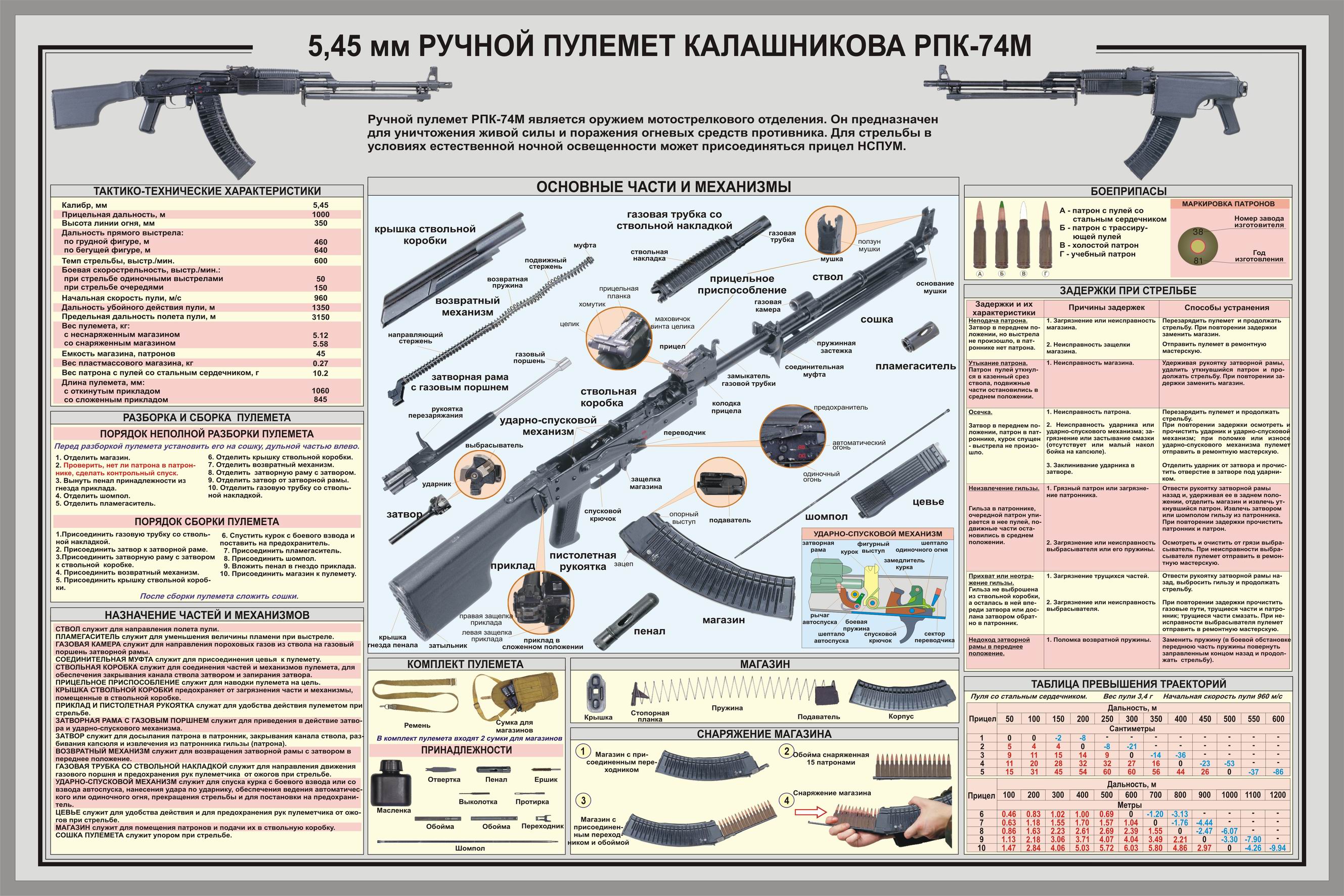
The RPK-74 (Russian: РПК-74) was introduced in 1974 together with the AK-74 assault rifle and chambered for the new 5.45×39mm intermediate cartridge.[8] It was derived from the AK-74 rifle, with modifications that mirror those made to the AKM to create the RPK.

The RPK-74 also uses a longer and heavier chrome-plated barrel, which has a new gas block with a gas channel at a 90° angle to the bore axis, and a ring for the cleaning rod. It is also equipped with a folding bipod and a different front sight tower. The muzzle is threaded for a flash suppressor or blank-firing device.

The rear stock trunnion was strengthened and the magazine well was reinforced with steel inserts.

Additionally, the RPK-74 has a modified return mechanism compared to the AK-74, which uses a new type of metal spring guide rod and recoil spring. The rear sight assembly, forward handguard and receiver dust cover were all retained from the RPK.

The RPK-74 feeds from a 45-round steel or polymer box magazine, interchangeable with magazines from the AK-74,[8] and is designed to be charged from stripper clips. Drum magazines similar to those used on the previous RPK models were tested during its development phase, but were discontinued in favor of the 45-round box magazine. However, recently the production of a 97-round drum has started. This drum was designed to be used with the AK-107 but can also be used in any 5.45×39mm weapon with compatible magazines, such as the RPK-74 and RPK-74M. They were also testing with experimental conventional drums, a prototype 100-round belt fed drum magazine was also created. It attaches into the regular magazine well, but the cartridges are stored on a 100-round belt inside a box. A feed system removes them from the belt and puts them in a position where they can be loaded through the regular magazine well. This system is actuated by a lever from the magazine that clips around the charging handle. It is unknown if this ever went into service.

Standard equipment includes: eight magazines, six stripper clips (15 rounds per clip), a speedloader guide, cleaning rod, cleaning kit, sling, oil bottle and two magazine pouches.[8] Some variants do not come with the cleaning kit option.

It is in widespread use by member states of the former Soviet Union, as well as Bulgaria.[8]

RPKS-74

[edit]

The RPKS-74 is the paratrooper variant of the RPK-74, equipped with a wooden folding stock from the RPKS.

RPK-74M

[edit]
RPK-74M with its bipod deployed

The RPK-74M (Russian: РПК 74М, romanizedRPK 74M; Russian: модернизированный, romanizedModernizirovannij, lit.'Modernised') is an updated variant of the RPK-74 developed during the mid-'90s. In line with the AK-74M assault rifle variant, the RPK-74M lower handguard, gas tube cover, pistol grip, and new synthetic stock are made from a black, glass-filled polyamide. The stock is shaped like the RPK-74 fixed stock, but also side-folds like the RPKS-74. The stock additionally has an easier to use release mechanism, replacing the bullet press release from the RPKS and RPKS-74. Each RPK-74M is fitted standard with a side-rail bracket for mounting optics. It also includes most of the 74M economic changes, such as the dimpled on barrel hardware, omission of lightening cuts from the front sight block and piston and stamped gas tube release lever. Updated magazines were produced by Molot with horizontal ribs going up the sides of the magazines.

RPK-201

[edit]

An export variant chambered in 5.56×45mm NATO was introduced, designated as the RPK-201.

RPK-203

[edit]

A modernised export variant of the RPK was developed, designated as the RPK-203. It uses the same polymer construction as the RPK-74M.

RPKN and RPK-74N

[edit]

The RPK family of light machine guns are also available in a night fighting configuration. These variants are designated as the RPKN, RPKSN, RPK-74N, and RPKS-74N.

They have a side rail mounting on the left side of the receiver that accepts a NSP-3, NSPU, or NSPUM night vision sight.[9]

Models designated RPKN-1, RPKSN-1, RPK-74N and RPKS-74N can mount the multi-model night vision scope NSPU-3 (1PN51)[10] while RPKN2, RPKSN2, RPK-74N2 and RPKS-74N2 can mount the multi-model night vision scope NSPUM (1PN58).[11]

RPK-16

[edit]
RPK-16 with a 95-round drum magazine and sound suppressor

The RPK-16 light machine gun (the number 16 indicates the year 2016, when the development first started) is Kalashnikov's response to the "Tokar-2" program, where it competed against Degtyaryov's submission. In 2018, the Ministry of Defence of the Russian Federation have signed a contract concerning the procurement of the RPK-16, and is expected to take over the role of the RPK-74 in the Russian Armed Forces.[12]

The RPK-16 is chambered in 5.45×39mm which features the traditional Kalashnikov gas-operated long-stroke piston system, and shares several novel technical and ergonomic features derived from the AK-12 program. Such as a Picatinny rail on the top of the receiver for mounting various optical sights and on the bottom of the handguard to mount the Picatinny rail mounted detachable bipod instead of the fixed bipod of the RPK-74, an ergonomic pistol grip and a folding buttstock, and two main barrel lengths; a 550 mm (21.7 in) long barrel (when it is applied or configured for the light machine gun role) and a 370 mm (14.6 in) short barrel (when it is applied or configured for the assault rifle role).[13] Its design enables it to have an interchangeable barrels that can easily be removed, and the ability to quickly attach a detachable suppressor. It has a combat weight of 6 kg (13.23 lb), a full-length of 1,076 mm (42.4 in), a cyclic rate of fire of 700 rounds per minute, an accuracy range of 800 m (870 yd). It primarily uses a 95-round drum magazine and is backwards compatible with box magazines from the AK-74, AK-12 and RPK-74.[14]

After receiving feedback on the performance of the weapon, the Kalashnikov Concern has begun development on the RPL-20 (20 indicating 2020) belt-fed light machine gun also chambered in 5.45×39mm and with a very similar rate of fire. Kalashnikov Concern has so far created at least one functional prototype.[15][16] If adopted, the gun will become the first light machine gun to be used by Russian forces since the RPD that isn't magazine-fed or of the standard Kalashnikov pattern.

Foreign production

[edit]

Bulgaria

[edit]

The RPK is produced by Arsenal as the LMG in three different calibers, 7.62×39mm, 5.45×39mm and 5.56×45mm NATO.

The Arsenal LMGs are equipped with milled receivers. Their folding stock variants are known as the LMG-F.[17][18][19][20]

East Germany

[edit]

The RPK was produced locally in East Germany as the LMGK (German: Leichtes Maschinengewehr Kalashnikov, lit.'Light Machine Gun Kalashnikov').[21][22]

Iraq

[edit]

The RPK is manufactured locally in Iraq as Al Quds.[23]

North Korea

[edit]

The RPK is manufactured locally in North Korea as the Type 64.[17]

Romania

[edit]

The RPK is manufactured locally in Romania by Fabrica de Arme Cugir SA as the Puşcă Mitralieră model 1964 (lit.'Model 1964 light machine gun').[24]

Later, a 5.45mm RPK-74 version based on the PA md. 86, the Mitralieră md. 1993 (lit.'Model 1993 light machine gun'), was also developed.[25]

Serbia

[edit]

Users

[edit]
A map with RPK users in blue
Iraqi soldiers training with the Romanian Model-1964 (RPK).
Soldier of National Guard of Ukraine with the RPK.
Ukrainian JMTG-U soldier firing the RPK.

Non-state users

[edit]

Former users

[edit]

See also

[edit]

References

[edit]

Bibliography

[edit]
[edit]
Revisions and contributorsEdit on WikipediaRead on Wikipedia
from Grokipedia
The RPK (Russian: Ручной пулемёт Калашникова; Ruchnoy Pulemyot Kalashnikova, meaning "Kalashnikov's handheld ") is a Soviet chambered in , developed by in the late 1950s as a to complement the rifle family. It features a long-stroke gas-operated mechanism, a heavier barrel for sustained fire, and compatibility with standard AK magazines augmented by optional 75-round drums, emphasizing logistical simplicity and reliability in adverse conditions. Adopted by the in 1961, the RPK replaced the belt-fed RPD in squads, entering mass production and service by 1964. Weighing approximately 4.8 kg empty with a 590 mm barrel, the RPK delivers effective range up to 600 meters via , achieving cyclic rates of 600 rounds per minute while prioritizing durability over precision. Variants include the RPKS with a side-folding stock for paratroopers and the later RPK-74 adapted for the cartridge alongside the AK-74. Widely exported and employed in conflicts from to ongoing regional wars, the design's proliferation stems from its ease of manufacture, maintenance, and combat-proven robustness, though critics note limitations in prolonged compared to belt-fed alternatives due to magazine constraints.

Development

Origins in Soviet Doctrine

Soviet in the post-World War II era emphasized aggressive relying on fire and maneuver at the squad level, informed by experiences in Korea and the need for enhanced small-unit firepower with intermediate cartridges. This approach required a lightweight automatic weapon capable of sustained using the same ammunition as standard rifles, to simplify logistics and training while replacing belt-fed predecessors like the RPD , which proved cumbersome in rapid advances. The RPD's reliance on disintegrating links and heavier construction conflicted with the doctrinal push for mobility in formations. To meet these tactical imperatives, Mikhail Kalashnikov's team initiated development of the RPK in the late 1950s, aligning it closely with the concurrent rifle modernization for parts commonality and production efficiency. Adopted by the on December 24, 1961, the RPK featured a reinforced receiver, extended heavy barrel for improved cooling during fire, and an integral bipod, enabling one per rifle to deliver bursts at 600 rounds per minute. This design directly supported squad organization into a fire group—centered on the RPK gunner and assistant carrying 320 rounds—and a maneuver group, facilitating offensive operations where pinned enemies during flanking movements. The RPK's magazine-fed system, using 40-round box magazines or 75-round drums interoperable with AK-series rifles, further embodied Soviet priorities of reliability under harsh conditions and minimal specialized maintenance, contrasting with Western belt-fed squad automatics. By standardizing on the AK platform, the weapon reduced logistical footprints in large-scale mechanized warfare, aligning with doctrines of massed assaults under covering fire to achieve deep operational penetration. Entering service in , the RPK exemplified the USSR's commitment to rugged, scalable that amplified combat effectiveness without introducing doctrinal complexities.

Design and Testing

The RPK (Ruchnoy Pulemyot Kalashnikova) was designed as a squad automatic weapon to provide suppressive fire while maximizing parts commonality with the AKM assault rifle, utilizing the same 7.62×39mm intermediate cartridge. Its operating mechanism employs a long-stroke gas piston system with a rotating bolt, identical to the AK series, ensuring reliability in adverse conditions through a simple, robust construction that avoids locked-breech complexity. The receiver is fabricated from 1.5 mm thick stamped sheet steel, extended 20 mm longer than the AKM's for improved rigidity under sustained fire, with reinforced trunnions and a heavier top cover to mitigate distortion from barrel heat. Key adaptations for the role include a chrome-lined barrel measuring 590 mm in length—significantly longer and thicker-walled than the AKM's 415 mm barrel—to enhance , accuracy, and sustained endurance without rapid overheating. A fixed bipod mounts under the barrel near the muzzle, with pivoting legs that extend for adjustment and a spring-steel clip for collapsed storage, enabling prone firing stability. The weapon weighs approximately 4.8 kg empty, measures 1,070 mm overall, and achieves a cyclic rate of 600 rounds per minute, balancing controllability with firepower. Feeding occurs via detachable box magazines compatible with AK-pattern 30-round units, supplemented by 40-round boxes or 75-round drums for extended bursts, prioritizing logistical simplicity over belt-feed systems like the predecessor RPD. Development began in the late at the Izhmash factory under Mikhail Kalashnikov's team, parallel to modernization, to address the need for a magazine-fed derivative that could replace the heavier, belt-fed RPD while sharing 70-80% components with standard infantry rifles. Prototypes underwent comparative state trials against rival designs from other Soviet engineers, evaluating factors such as reliability, heat resistance, and troop handling during extended firing sequences. The Kalashnikov entry demonstrated superior durability and ease of maintenance in these evaluations, leading to its selection for production. Official adoption occurred on April 8, 1959, alongside the , following successful completion of factory and field tests that confirmed its performance in mud, sand, and extreme temperatures—hallmarks of Kalashnikov designs validated in prior AK trials. Initial troop issuance began in 1961, with full service entry by 1964, after additional operational validation ensured squad-level integration without specialized training beyond AK familiarity. No major redesigns were required post-adoption, reflecting the trials' effectiveness in identifying and resolving early issues like receiver warping under prolonged fire.

Adoption and Production

The RPK was accepted into service with the in 1961, following its development in parallel with the to provide squad-level automatic fire support using the existing cartridge logistics. It replaced the earlier in motorized units, emphasizing simplicity, reliability, and commonality with standard to streamline and maintenance. The weapon entered operational use by 1964 and appeared publicly during the 1966 parade, marking its integration into frontline forces. Serial production commenced at the (VPO-215) in June 1960, after an experimental batch of 305 units was manufactured in December 1959 for testing. Domestic output continued through 1978, when it was largely supplanted by the RPK-74 variant, though the design's stamped receiver and shared components with the enabled high-volume manufacturing with minimal retooling. Exact production figures remain classified, but the RPK's role in Soviet doctrine supported widespread issuance, with one typically allocated per motorized rifle . Licensed production and exports expanded the RPK's footprint to allies and pro-Soviet states in and , including manufacturing in , , , , and . These variants maintained core specifications while adapting to local industrial capacities, sustaining availability post-Cold War through surplus stocks and continued use in post-Soviet militaries. Adoption persisted in conflicts involving recipient nations, underscoring the weapon's endurance despite the shift to smaller-caliber systems elsewhere.

Design Principles

Operating Mechanism

The RPK employs a gas-operated, long-stroke system derived from the Kalashnikov design, functioning identically to that of the . Gas is tapped from the barrel through a port located approximately 11 inches from the muzzle, directing high-pressure propellant gases rearward into a short-stroke above the barrel, which drives a heavy attached directly to the bolt carrier. This long-stroke action—where the and bolt carrier recoil together over the full distance—provides reliable cycling under adverse conditions, including fouling and extreme temperatures, with a cyclic rate of approximately 600 rounds per minute. Firing occurs from a closed-bolt position, enhancing accuracy for semi-automatic shots by allowing the bolt to lock forward before ignition, though the defaults to full-automatic fire upon trigger pull unless modified. Upon chambering a round, the locks into the receiver extension via two lugs, sealing the chamber; trigger release releases the to strike the , igniting the primer and propelling the bullet down the barrel. The ensuing gas impulse unlocks the bolt via cam interaction during the carrier's rearward travel, extracting and ejecting the spent cartridge case through a right-side while compressing the spring assembly. The forward stroke, powered by the recoil spring, strips a new cartridge from the and chambers it, with the bolt rotating to lock once fully seated; a prevents unintended double-fires by holding the until the trigger is released. This mechanism's simplicity, with fewer than 10 in the fire control group, contributes to the RPK's durability, tested to function after submersion in or without immediate disassembly. Unlike quick-change barrel designs in Western light guns, the RPK's fixed, chrome-lined barrel relies on controlled burst fire to manage heat, limiting sustained automatic rates to avoid risks beyond 200-300 rounds.

Construction and Materials

The RPK receiver is formed from a U-shaped stamping of 1.5 mm thick sheet, providing greater rigidity than the 1.0 mm sheet used in the rifle through additional welds and reinforcements along the sides and top cover. This heavier construction, weighing approximately 4.8 kg unloaded, accommodates the extended spring assembly that protrudes into the buttstock for improved cycle reliability during prolonged automatic fire. The barrel consists of chrome-lined steel, measuring 590 mm in length with a heavier profile and fixed mounting to a reinforced via pinning, preventing field replacement but enhancing stability and heat resistance for rates of up to 600 rounds per minute. It features integral cooling fins and a muzzle device compatible with the AK-series flash hider or compensator, designed to mitigate overheating during sustained bursts. Furniture components, including the fixed wooden , , and handguards, are primarily constructed from laminated wood treated for environmental resistance, with metal reinforcements at stress points like the sling swivel mounts and bipod attachment. Later production variants incorporated or elements for reduced weight and improved , though early models retained all-wood configurations to match logistics.

Ergonomics and Controls

The RPK incorporates the identical control configuration as the rifle series, prioritizing simplicity and reliability in adverse conditions. The primary control is a combined and selector mounted on the right side of the receiver, operable by the shooter's right thumb without releasing the . This features three distinct positions: upward for , which secures both the trigger mechanism and bolt carrier to prevent accidental discharge; a central position enabling semi-automatic ; and downward for fully automatic operation at approximately 600 rounds per minute. The oversized design accommodates gloved hands and operation in extreme cold or with nuclear, biological, or chemical protective gear, reflecting Soviet doctrinal emphasis on functionality over refined . The charging handle, located on the right side above the receiver, is non-reciprocating, remaining stationary during firing to allow consistent grip retention while manually cycling . Magazine insertion and release follow the standard Kalashnikov , with a paddle-style release button behind the magazine well, compatible with 30-round AK magazines or 40- and 75-round drum variants for sustained fire. No dedicated or last-round bolt hold-open is present, aligning with the system's gas-operated reliability that minimizes user intervention. Ergonomically, the RPK retains the AK's wooden fixed buttstock, , and handguards, providing a familiar interface for Soviet infantrymen trained on Kalashnikov rifles. The reinforced receiver and extended heavy barrel, measuring 590 mm compared to the AK's 415 mm, increase overall weight to about 4.8 kg unloaded, shifting the center of balance forward to enhance stability during bipod-supported automatic fire but complicating offhand or hip firing for extended periods. This configuration supports prone or supported positions effectively, as intended for roles, though the lack of adjustable stock or modern grips limits adaptability for varied body types or prolonged carry. The integral carrying handle facilitates transport, mitigating some handling drawbacks inherent to its profile.

Features and Accessories

Sighting Systems

The RPK employs open similar to those on the , consisting of a semi-shrouded front post sight protected by an ear and a rear sight leaf graduated in 100-meter increments from 100 to 1,000 meters. The rear sight features a U-notch and includes a adjustment knob, a refinement unique to the RPK for improved accuracy in sustained fire roles compared to the standard AK series. Zeroing is typically conducted at 100 meters using a control target, aligning point of aim with point of impact, which accounts for the cartridge's trajectory peaking around 200 meters for battlesight zero settings. The sights prioritize ruggedness and rapid in , with the tangent leaf allowing adjustments via a sliding mechanism locked by a spring-loaded . Variants such as the RPKN incorporate a side-mounted rail on the receiver for attaching passive devices like the NSPU, enabling low-light operation without altering the primary . The RPK-74 series retains comparable but adds compatibility with early Soviet optics like the 1P29 2.8× scope via side mounts, though standard issue remained for most users. Modernized models, including the RPK-74M and RPK-16, feature enhanced rails—such as dovetail or Picatinny—for a broader range of daytime and night optics, reflecting doctrinal shifts toward modular sighting in post-Soviet forces.

Bipods and Mounting

The RPK features a fixed folding bipod mounted directly to the barrel near the muzzle, positioned behind the front sight base to provide forward stability during prone firing. This design allows the bipod to pivot freely around the barrel's axis, enabling limited traverse adjustment without detaching the weapon from a firing position. The bipod legs, constructed from stamped steel, fold parallel beneath the barrel for transport and storage, secured by a clip that maintains their closed position. The legs incorporate extendable sections for height adjustment, accommodating uneven terrain or user preference in prone posture, though Soviet-era models prioritize simplicity over extensive adjustability found in some export variants like Romanian productions. When stowed, the bipod feet include notches that pinch and retain the cleaning rod against the , integrating accessory storage into the assembly. Attachment to the barrel occurs via a dedicated collar or , typically pinned or riveted during manufacturing, ensuring rigidity under while avoiding interference with the gas system or handguards. This integral mounting distinguishes the RPK from rifles like the , which lack such provisions, and contrasts with general-purpose machine guns like the PKM where bipods attach to the gas tube rather than the barrel. In the RPK-74 series, the bipod design remains fundamentally similar but adapted for the lighter barrel profile, retaining the forward mounting point for compatibility with squad tactics emphasizing . Modernized variants, such as the RPK-16, introduce modular rails allowing replacement with Picatinny-compatible bipods for enhanced adjustability or quick-detach features, though traditional fixed bipods persist in many production models for reliability in adverse conditions. The bipod's primary role supports sustained automatic fire rates of 600 rounds per minute, reducing muzzle climb and improving accuracy to effective ranges of 400-600 meters when deployed.

Ammunition and Feeding

The RPK is chambered for the Soviet M43 , an intermediate-power round designed for balanced range, penetration, and controllability in assault rifles and light machine guns. This features a -cased, rimless cartridge with a lead core bullet typically weighing 7.9–8.1 grams, propelled to a of approximately 715–745 m/s from the RPK's 590 mm barrel. The cartridge's design emphasizes reliability in adverse conditions, with lacquered cases to resist and ensure smooth extraction. The weapon employs a detachable magazine feeding system identical in principle to that of the and rifles, where cartridges are fed from the magazine into the chamber via a reciprocating bolt carrier that strips rounds from the feed lips. Standard magazines are 40-round curved box types optimized for the 7.62×39mm's tapered case geometry to prevent binding, though the RPK is backward-compatible with 30-round magazines for logistical commonality. For sustained fire, a 75-round —similar to those used in earlier Soviet submachine guns but adapted for the —can be fitted, increasing capacity without altering the receiver's feed mechanism. Magazines insert into a reinforced well below the receiver, locking via a or release, with the design prioritizing quick reloads under combat stress. Unlike belt-fed contemporaries such as the RPD, the RPK's magazine-fed approach sacrifices ultimate capacity for simplicity, lighter weight per round carried, and easier individual handling, aligning with Soviet squad tactics emphasizing rifleman-like maneuverability for the automatic rifleman. Empty magazines are ejected by depressing a paddle-style release near the magazine well, allowing rapid swaps; the system's robustness minimizes stoppages from magazine-induced malfunctions, even with partially deformed or dirt-contaminated followers. Drum magazines, while heavier (approximately 3–4 kg loaded), provide non-stop firing bursts up to 10–15 seconds at the weapon's 600 rounds per minute cyclic rate before requiring replacement.

Variants

Original 7.62×39mm Models

The original RPK models, chambered for the , were developed by Mikhail Kalashnikov's design bureau in the late to provide squad-level automatic while maintaining logistical compatibility with AK-series rifles. Accepted into service in 1961, these weapons replaced the belt-fed RPD , emphasizing simplicity, reliability, and shared ammunition. Production occurred primarily at the , with the design incorporating a heavier stamped receiver (1.5 mm thick versus 1 mm on the ) and a chrome-lined barrel for enhanced durability under prolonged fire. The base RPK model featured a fixed wooden buttstock, an overall length of 1,040 mm, a 590 mm barrel, and an unloaded weight of 4.8 kg, enabling effective up to 600 meters while using 40-round box magazines or 75-round drums compatible with AK rifles. Its gas-operated, long-stroke piston mechanism, derived from the AK, ensured operation in adverse conditions, though the fixed stock limited compactness for non-infantry roles. The RPKS variant addressed this by substituting the fixed stock with a side-folding metal buttstock, reducing folded length to approximately 760 mm for improved portability in airborne, vehicular, or confined-space applications, without altering core ballistics or weight significantly. Both models included a bipod under the barrel for prone firing stability and provisions for mounting, reflecting Soviet emphasis on versatile support rather than specialized heavy suppression. These configurations entered widespread production and deployment by , arming motorized rifle squads with one RPK per nine-man unit.

5.45×39mm RPK-74 Series

The RPK-74 light machine gun, chambered for the 5.45×39mm intermediate cartridge, was developed in the Soviet Union during the mid-1970s by the Kalashnikov Design Bureau to serve as a squad automatic weapon complementing the newly adopted AK-74 assault rifle. Introduced and adopted by the Soviet Army in 1974, it retained the core gas-operated, long-stroke piston mechanism of its 7.62×39mm predecessor while incorporating design adaptations for the smaller-caliber ammunition, including a longer chrome-lined barrel measuring 590 mm to enhance sustained fire capability without excessive overheating. The weapon weighs approximately 4.7 kg unloaded, lighter than the original RPK due to the reduced recoil and cartridge dimensions, and features a fixed wooden buttstock, integral bipod, and 45-round drum or 40-round box magazines for increased firepower in infantry squads. A folding-stock variant, the RPKS-74, was produced concurrently for airborne and special forces units, featuring a side-folding metal buttstock to improve portability while maintaining the same barrel and feeding system. Production occurred primarily at Izhmash (now ) facilities, with the design emphasizing reliability in adverse conditions through reinforced components like a heavier bolt carrier and modified gas system to handle the higher-velocity round at a cyclic rate of around 600 rounds per minute. In the late , the RPK-74 underwent modernization as the RPK-74M, incorporating furniture similar to the AK-74M, including a side-folding buttstock with an improved release mechanism, lightweight black handguards, and a mounting rail on the left side of the receiver for or night-vision devices. The RPK-74M retains the 590 mm barrel but adds a threaded muzzle for suppressors or compensators, weighs about 4.9 kg, and achieves a cyclic rate of 650 rounds per minute, enhancing versatility for modern infantry tactics while preserving backward compatibility with existing 5.45×39mm magazines and drums. This upgrade addressed ergonomic shortcomings of earlier models, such as stock stability and accessory integration, without altering the fundamental operating principles.

Modern and Specialized Variants

The RPK-74M, introduced in the , represents a modernization of the RPK-74 series with black furniture replacing heavier components, a side-folding stock for improved portability, and a side rail on the receiver for mounting optical sights. This variant maintains the chambering and enhances ergonomics while preserving compatibility with existing magazines and drums, weighing approximately 5.1 kg unloaded. The RPK-16, developed by the and presented in 2016, emerged as a response to Russian requirements for a lighter, more versatile to succeed the RPK-74 series. Chambered in , it features an interchangeable barrel system with options of 415 mm for compact use or 580 mm for sustained fire, enabling quick changes without tools to manage heat during prolonged engagements. Weighing 4.5 kg with the short barrel, it supports 30-, 45-, and 95-round magazines, achieves a cyclic rate of 700-800 rounds per minute, and incorporates elements from the platform, including improved ergonomics and Picatinny rails for accessories. Despite initial adoption following a competitive tender where it outperformed rival s, the RPK-16 saw limited fielding and was reportedly phased out by 2020 in favor of broader AK-12 family integration, reflecting ongoing evaluations of its quick-change barrel and in Russian doctrine. Export-oriented specialized variants, such as the RPKM in with polymer components akin to the RPK-74M, have been produced for international markets but retain core RPK principles without significant operational deviations in Russian service.

Performance Characteristics

Reliability and Durability

The RPK exhibits exceptional reliability derived from the Kalashnikov system's long-stroke gas piston operation, loose tolerances, and over-gassed mechanism, which enable it to cycle reliably even when fouled with dirt, sand, or moisture. This design insensitivity to environmental stressors or ammunition quality—such as lacquered steel-cased rounds—allows minimal maintenance requirements, with the weapon capable of functioning after exposure to submersion, mud immersion, or mechanical abuse like being run over by vehicles. In combat testing during the Soviet-Afghan War (1979–1989), both the original RPK and RPK-74 variants maintained high operational uptime in dusty, high-altitude conditions, outperforming predecessors like the belt-fed RPD in ease of use and jam resistance. Durability is bolstered by structural reinforcements, including a strengthened rear , magazine well, and stamped receiver with spot welds, which distribute stresses from sustained automatic fire more effectively than standard AK rifles. The chrome-lined bore and chamber resist from residues and extend against , while the heavier 590 mm barrel (versus 415 mm on the ) improves heat dissipation during bursts, reducing throat erosion compared to lighter barrels. Soviet production standards projected barrel life at approximately 10,000–15,000 rounds before significant accuracy degradation for 7.62×39mm models, with the RPK's robust construction allowing overall weapon longevity exceeding that of precision-oriented Western counterparts under field abuse. However, without a quick-change barrel, prolonged full-auto firing beyond short bursts risks overheating and temporary , necessitating pauses for cooling in extended engagements—a limitation relative to general-purpose machine guns like the PKM. The bipod, machined from solid steel with stamped legs, further contributes to stability and endurance during prone fire without failure.

Accuracy and Effective Range

The RPK's accuracy benefits from its longer 590 mm barrel compared to the AK-47's 415 mm, which provides higher muzzle velocity of approximately 745 m/s for 7.62×39mm ammunition, resulting in a flatter trajectory and reduced drop at distance. The heavier barrel profile minimizes harmonic vibrations during sustained fire, while the bipod and reinforced receiver improve stability, yielding tighter groups than standard AK rifles—typically 4-6 minute-of-angle (MOA) with military ball ammunition under controlled conditions. However, the design prioritizes durability over precision, with inherent limitations from the cartridge's ballistics and lack of free-floating barrel, making it unsuitable for designated marksman roles beyond squad suppression. Effective range for point targets with the original 7.62×39mm RPK is around 400-600 meters when fired from a prone bipod position, allowing engagement of chest-sized targets with reasonable hit probability using graduated to 1,000 meters. Area suppression extends to 800 meters, where the weapon's volume of fire compensates for dispersion. In the RPK-74 series chambered in , the higher of 960 m/s extends effectiveness to 460 meters for stationary chest targets and 640 meters for moving figures, benefiting from the cartridge's superior and reduced recoil for controlled bursts. Optical attachments on modernized variants like the RPK-74M further enhance practical accuracy to 500 meters or more in tactical scenarios. These ranges reflect Soviet doctrinal emphasis on suppression rather than pinpoint hits, with real-world performance varying by quality and environmental factors.

Rate of Fire and Heat Management

The RPK maintains a cyclic rate of fire of 600 rounds per minute, identical to that of the base and rifles, facilitated by its long-stroke gas piston mechanism that prioritizes reliability over higher velocity. This rate supports effective burst firing in squad-level engagements but limits the weapon's role to short-to-medium durations of automatic fire, as Soviet doctrine emphasized controlled 3-5 round bursts to conserve and manage . Later variants like the RPK-74 retain a similar 600 rounds per minute rate, while the RPK-16 increases it to 700 rounds per minute for enhanced suppressive capability. Heat management in the RPK relies on a thicker, longer barrel—approximately 590 mm compared to 415 mm in the —which provides greater material mass for absorbing and dissipating thermal buildup during sustained fire. This design allows for roughly twice the sustained firing duration of a standard AK before accuracy degrades due to barrel warping or risks, though practical limits remain around 100-150 rounds in mode before pauses are required. The reinforced or wooden handguards further aid in handling heat exposure, but the absence of a quick-change barrel—unlike belt-fed machine guns such as the PK—constrains prolonged engagements, often necessitating doctrinal shifts to burst fire or crew rotations in combat. In field tests and operational use, overheating manifests as increased malfunctions after 200-300 rounds without cooling, underscoring the RPK's optimization for light, mobile support rather than heavy suppression.

Tactical Role and Evaluation

Squad Support Doctrine

In Soviet and military doctrine, the RPK served as the primary , intended to deliver sustained to enable the maneuver of rifle-armed members during assaults or defensive engagements. Developed in the early 1960s by , it replaced the belt-fed RPD to standardize ammunition and logistics with the rifle, using magazines shared across the for rapid resupply without specialized belts. One RPK was typically allocated per motorized rifle of approximately 9-10 personnel, including a dedicated gunner and assistant to manage barrel changes and ammunition. The doctrine emphasized the RPK's role in achieving fire superiority through volume rather than precision, with the gunner positioning to lay down bursts of 600 rounds per minute to pin enemy positions, allowing riflemen to close distances or outflank under covering . This approach aligned with broader Soviet tactics of massed advances supported by artillery and armor, where the squad's organic firepower from the RPK complemented platoon-level general-purpose machine guns like the PKM for deeper engagements. Unlike Western belt-fed squad weapons such as the M60, the RPK prioritized mobility and simplicity, facilitating "fire on the move" in fluid, high-intensity scenarios without requiring a separate bearer team. Subsequent adoption of the RPK-74 in the late preserved this doctrinal function, adapting to lighter ammunition for reduced recoil and improved controllability during extended bursts, while maintaining magazine compatibility with rifles. In practice, the RPK's bipod and reinforced receiver enabled effective prone or supported firing up to 400 meters, though tactical manuals stressed short bursts to manage overheating, reflecting a realist assessment of its design's thermal limitations over prolonged use. This integration fostered squad-level autonomy in decentralized operations, particularly in motorized units dismounted from BMP infantry fighting vehicles.

Advantages in Asymmetric Warfare

The RPK's robust construction and loose-tolerance gas piston system enable reliable operation in environments with high levels of dust, sand, and minimal maintenance, conditions common in asymmetric conflicts like those in Iraq and Afghanistan where insurgents face logistical constraints. This durability stems from shared Kalashnikov design principles, allowing the weapon to continue firing after exposure to contaminants that would impair more precise Western equivalents such as the M249 SAW. Logistical compatibility with standard AK-series rifles provides a key edge for non-state actors, as the RPK utilizes the same or cartridges, magazines, and many internal parts, simplifying supply chains reliant on surplus or captured Soviet-era stockpiles. In , anti-coalition insurgents standardized the RPK alongside AK variants for small-unit , enabling quick resupply without dedicated belts or links required by belt-fed systems. This interchangeability supports operations by groups with limited technical expertise, as gunners can transition from rifle to roles with minimal additional training. The weapon's magazine-fed design, often employing 40- or 75-round , delivers sustained suitable for ambushes and defensive positions in guerrilla tactics, while its weight of approximately 4.8 kg (unloaded) permits maneuverability for mobile fighters evading superior conventional forces. Unlike heavier general-purpose machine guns, the RPK's portability facilitates hit-and-run engagements, as demonstrated by its use in urban insurgencies where rapid repositioning is critical. However, its fixed drum capacity limits prolonged fire compared to linked systems, though this is mitigated in short, high-intensity bursts typical of asymmetric scenarios.

Limitations and Criticisms

The RPK's fixed barrel lacks a quick-change mechanism, restricting its suitability for sustained automatic fire and causing rapid overheating during extended bursts, which can lead to and damage to the barrel . This limitation stems from the weapon's lighter barrel construction compared to general-purpose machine guns like the PKM, which feature interchangeable barrels to mitigate heat buildup. Soviet emphasized short bursts over prolonged suppression, but the design has drawn criticism for falling short in scenarios requiring continuous fire, with the closed-bolt operation exacerbating risks once the chamber heats excessively. The magazine-fed ammunition system, relying on 40-round box magazines or optional 75-round drums, limits onboard capacity and demands frequent reloads, hindering roles relative to belt-fed predecessors like the RPD or contemporaries such as the M249 SAW. The 75-round drum, though increasing potential carry, proves bulky, heavy, and prone to reliability issues, with scant evidence of widespread Soviet adoption. This feeding mechanism reduces overall combat load efficiency, as squads must transport multiple magazines versus compact belts, amplifying logistical burdens in prolonged engagements. Accuracy performance aligns closely with the base AKM platform, offering no marked enhancement from the reinforced receiver or extended barrel, with typical dispersions limiting effective precision beyond 300-400 meters due to loose tolerances and barrel harmonics under full-auto fire. The weapon's weight, exceeding 4.8 kg unloaded for the original model, further compromises mobility for dismounted infantry, particularly in dynamic maneuvers where lighter assault rifles suffice for similar burst roles. Critics, including small-arms analysts, have characterized the RPK as an upscaled rather than a dedicated , ill-equipped for the full spectrum of machine-gun demands due to inadequate controllability in sustained full-auto and overall robustness deficits compared to belt-fed designs. Replacement of the belt-fed RPD with the RPK has been debated as a regression in fire sustainment, prioritizing logistical compatibility with AK magazines over endurance. In modern evaluations, these traits render the RPK less adaptable to high-intensity conflicts demanding modular enhancements or extended suppression, though its simplicity aids in austere environments.

Operators

Current National Armies

The RPK and its derivatives, particularly the RPK-74 chambered in , continue to serve as squad automatic weapons in the armed forces of several , where they provide support due to their compatibility with standard and proven reliability in diverse environments. In , the RPK-74M remains a standard within motorized rifle units, featuring modernized components such as polymer furniture and improved sights for enhanced and accuracy, with ongoing and fielding as of . The weapon supports Russian emphasizing sustained fire from dismounted , often paired with PK-series general-purpose guns at the level. Belarusian armed forces employ both the original RPK in for territorial defense forces and the RPK-74 for regular units, with local upgrades including reinforced receivers and optical mounts conducted as recently as 2019 to extend service life. These variants equip companies, where their shared with AK-series rifles facilitate maintenance in Belarus's post-Soviet inventory. Ukraine's ground forces retain the RPK-74 for roles amid ongoing conflicts, valuing its robustness in urban and despite partial transitions to Western systems; documented use includes modified configurations with night sights as of 2023. The weapon's prevalence stems from vast stockpiles inherited from Soviet times, enabling rapid mobilization without full reliance on foreign aid. Kazakhstan's military inventory includes the RPK and RPK-74, integrated into squads for , with markings and surplus documentation confirming active stock as of recent assessments. This aligns with Central Asian states' preference for cost-effective, domestically maintainable Soviet-era equipment.

Former and Discontinued Use

The original RPK chambered in served as the standard in the from 1961 until the late 1970s, when it was phased out in favor of the RPK-74 to align with the broader adoption of the smaller-caliber cartridge across . This transition reflected doctrinal shifts toward lighter, higher-velocity for improved controllability in sustained fire, though the 7.62mm RPK remained in limited reserve and export roles. In the , the RPK-74 and its variants were progressively withdrawn from frontline infantry units during the late 2000s and early 2010s, supplanted by belt-fed general-purpose machine guns such as the PKM and PKP Pecheneg for enhanced sustained fire capability and capacity in squad support roles. This change prioritized weapons with disintegrating belts over magazine-fed designs to better support modern tactics emphasizing suppression over mobility. East Germany's (NVA) integrated the RPK-74 into its forces during the 1980s, producing a localized variant designated LMG-K-74, but following reunification in , all Warsaw Pact-standard equipment including the RPK series was systematically decommissioned by the as part of standardization and disposal of obsolete stockpiles. Surplus NVA RPKs were either destroyed, sold to third parties, or retained in minimal training capacities before full obsolescence.

Non-State Actors

The RPK and its variants have been extensively utilized by non-state armed groups in conflicts characterized by the proliferation of surplus Soviet and weaponry, providing these actors with reliable squad-level capabilities. In , insurgents, including those affiliated with (the precursor to ), employed the RPK during the post-2003 insurgency against coalition forces. U.S. captured multiple RPKs alongside other AK-pattern weapons from insurgent positions in the city of Hit on June 29, 2005, underscoring its role in sustaining automatic fire with ammunition. During urban engagements in , insurgents fired RPKs from defensive positions, inflicting casualties on advancing U.S. squads before being neutralized. The (ISIS) integrated RPK light machine guns into its forces in and , leveraging captured stockpiles for offensive and defensive operations. Reports document ISIS fighters using these weapons alongside other small arms in territorial control efforts from 2014 onward. In caches raided by coalition forces, RPKs were frequently recovered alongside RPGs and AK variants, indicating their tactical value in and fortified positions. Pro-Russian separatist militias in the region of , such as those operating under the (DPR), have fielded modernized RPK-74M variants supplied via external channels. Photographic evidence from October 2016 shows DPR militants armed with these upgraded guns, featuring components and improved for enhanced sustained fire in . Chechen separatist and militant groups, including foreign fighters in and anti-Russian battalions in , have also adopted RPK-74 models for their compatibility with regional ammunition supplies and ease of maintenance in austere environments. These weapons support guerrilla operations by enabling small units to deliver volume of fire comparable to heavier machine guns without logistical complexity.

Combat History

Cold War Era Conflicts

The RPK , adopted by the in 1961, played a squad support role in multiple proxy conflicts, providing sustained automatic fire with ammunition while sharing logistics with AK-series rifles. Its reinforced receiver and bipod enabled effective suppression in diverse environments, from jungles to mountains, though it was often supplemented by general-purpose machine guns like the PK for heavier fire. Soviet doctrine emphasized its use in motorized rifle squads, typically assigning one per nine-man unit for mobile firepower. During the (1955–1975), the RPK was supplied to North Vietnamese Army (NVA) and forces, entering service in the mid-1960s to bolster firepower against U.S. and South Vietnamese troops. NVA units employed it for base-of-fire positions in ambushes and assaults, valuing its reliability in humid conditions despite limited magazine capacity of 40 or 75 rounds. later produced a licensed copy, the TUL-1, to sustain local manufacturing amid wartime shortages, with production continuing into the 1970s for roles. In the (1975–2002), particularly its early phases aligned with proxy dynamics, the RPK equipped Cuban Military Mission troops and People's Armed Forces for the Liberation of (FAPLA) against U.S.- and South Africa-backed rebels. Cuban infantry squads integrated the RPK for close-quarters bush combat, pairing it with rifles and launchers in operations like the 1975–1976 campaign and subsequent offensives. Soviet aid shipments ensured ample ammunition, though logistical strains in remote areas sometimes limited its deployment compared to belt-fed alternatives. The (1979–1989) marked a major operational test for both the original RPK and its successor, the RPK-74, introduced in 1974. Soviet 40th Army motorized rifle units used the RPK for valley patrols and convoy escorts, achieving effective ranges up to 600 meters with , but facing challenges from Mujahideen that exploited its non-quick-change barrel. Captured RPKs became common among Afghan insurgents, who adapted them for mountain ambushes due to shared ammunition with AK-47s; by the mid-1980s, Mujahideen forces reportedly fielded thousands of Soviet-origin squad automatics, including RPK variants. Reliability in dust and cold was comparable to the AK platform, with field reports noting fewer stoppages than earlier RPD models.

Post-Soviet Wars

In the First and Second Chechen Wars (1994–1996 and 1999–2009), Russian federal forces employed the RPK-74 as a , leveraging its compatibility with AK-74 rifles for sustained in urban and mountainous terrain. However, troops reported inadequate penetration of rounds against reinforced positions and barriers, prompting demands to revert to heavier calibers like the original RPK for better stopping power in close-quarters combat. Chechen separatists, often armed with captured Soviet-era weapons, also utilized RPK variants scavenged from battlefields, contributing to the weapon's proliferation among irregular fighters. During the (1988–1994), Armenian defense forces integrated the RPKS-74, a folding-stock variant, into squads for along contested frontlines, drawing from inherited Soviet arsenals amid ethnic clashes with Azerbaijani forces. The weapon's reliability in rugged Caucasian terrain supported defensive operations, though ammunition logistics strained prolonged engagements as both sides depleted pre-dissolution stockpiles. In the Georgian-Abkhazian War (1992–1993), Georgian government troops relied on RPK and RPK-74 series machine guns as standard light support arms, listed among 7.62mm assets deployed against Abkhaz separatists and allied militias. Abkhaz forces, bolstered by captured Georgian equipment and Russian-supplied Soviet surplus, similarly fielded RPKs, enabling mobile fireteams in the that displaced over 200,000 civilians and resulted in approximately 8,000–10,000 military deaths. These engagements highlighted the RPK's endurance in low-intensity, resource-constrained warfare typical of post-Soviet state fragmentation, where upgraded Western alternatives were scarce.

21st Century Engagements

In the (2003–2011), anti-coalition insurgents commonly employed the 7.62×39mm as a standard , often alongside RPD and RPDM variants, to provide squad-level during ambushes and urban engagements against U.S. and Iraqi forces. These weapons were sourced from captured Iraqi military stocks or smuggled caches, leveraging the RPK's reliability in dusty environments for sustained bursts against armored patrols. During the (2011–present), the RPK saw widespread use among Syrian government forces, opposition rebels, and jihadist groups, capitalizing on the proliferation of Soviet-era armaments in the region. Syrian Arab Army units integrated RPKs into squads for defensive positions in and , while fighters adapted them for hit-and-run tactics in rural . The weapon's simplicity facilitated maintenance amid logistical disruptions, though its limited effective range compared to Western machine guns constrained its role in open battles. In the , particularly following the 2022 full-scale invasion, Russian and forces initially deployed RPK and RPK-74 light machine guns in infantry assaults on positions, providing volume of fire during advances near Severodonetsk. Ukrainian forces captured numerous RPKs from advancing columns, noting their absence from prior national inventories, which highlighted reliance on legacy Soviet designs early in the conflict. By mid-2022, however, RPK usage declined among Russian troops in favor of newer systems, reflecting doctrinal shifts toward lighter, more modular automatics.

References

Add your contribution
Related Hubs
User Avatar
No comments yet.