Hubbry Logo
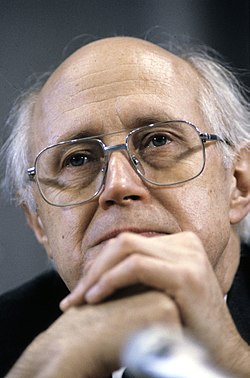
Mstislav RostropovichMstislav RostropovichMain
Open search
Mstislav Rostropovich
Community hub
Mstislav Rostropovich
logo
8 pages, 0 posts
0 subscribers
Be the first to start a discussion here.
Mstislav Rostropovich
from Wikipedia

Mstislav Leopoldovich Rostropovich[a] (27 March 1927 – 27 April 2007) was a Russian cellist and conductor. In addition to his interpretations and technique, he was well known for both inspiring and commissioning new works, which enlarged the cello repertoire more than any cellist before or since. He inspired and premiered over 100 pieces,[1] forming long-standing friendships and artistic partnerships with composers including Dmitri Shostakovich, Sergei Prokofiev, Nikolai Myaskovsky, Henri Dutilleux, Witold Lutosławski, Olivier Messiaen, Luciano Berio, Krzysztof Penderecki, Alfred Schnittke, Norbert Moret, Andreas Makris, Leonard Bernstein, Aram Khachaturian, and Benjamin Britten.

Key Information

Rostropovich was internationally recognized as a staunch advocate of human rights, and was awarded the 1974 Award of the International League of Human Rights. He was married to the soprano Galina Vishnevskaya and had two daughters, Olga and Elena Rostropovich. He received numerous accolades, including a Polar Music Prize.

Early years

[edit]
House in Baku, where Rostropovich was born

Mstislav Rostropovich was born in Baku, Azerbaijan SSR, to parents who had moved from Orenburg in Russia: Leopold Vitoldovich Rostropovich [ru], a renowned cellist and former student of Pablo Casals,[2] and Sofiya Nikolaevna Fedotova-Rostropovich, a talented pianist. Leopold (1892–1942) was born in Voronezh to Witold Rostropowicz [ru], a composer of Polish noble descent with distant Belarusian roots, and Matilda Rostropovich (née Pule) of German and Huguenot descent. The Polish part of his family bore the Bogoria coat of arms, which was located at the family palace in Skotniki.[3]

Mstislav's mother, Sofiya Fedotova, of Russian descent,[4] was the daughter of musicians and herself a conservatory-trained pianist.[5] Her elder sister, Nadezhda, married cellist Semyon Kozolupov, who was thus Rostropovich's uncle by marriage.[6]

Rostropovich grew up in Baku and spent his youth there. During World War II his family moved back to Orenburg and then, in 1943, to Moscow.[7]

At age four, Rostropovich began studying piano with his mother. He began learning the cello at age eight from his father. In 1943, at age 16, he entered the Moscow Conservatory, where he studied cello with his uncle Semyon Kozolupov, piano with Nikolai Kuvshinnikov, and composition with Vissarion Shebalin. His teachers also included Dmitri Shostakovich. In 1945, he came to prominence as a cellist when he won the gold medal in the Soviet Union's first ever competition for young musicians.[2] He graduated from the Conservatory in 1948 and became professor of cello there in 1956.[citation needed]

First concerts

[edit]
Mstislav Rostropovich, 18 September 1959

Rostropovich gave his first cello concert in 1942. He won first prize at the International Music Awards of Prague and Budapest in 1947, 1949 and 1950. In 1950, at age 23, he was awarded what was then considered the highest distinction in the Soviet Union, the Stalin Prize.[8] At that time, Rostropovich was already well known in his country and, while actively pursuing his solo career, taught at the Leningrad Conservatory and the Moscow Conservatory. In 1955, he married Galina Vishnevskaya, a leading soprano at the Bolshoi Theatre.[9]

Rostropovich had working relationships with Soviet composers of the era. He was the dedicatee of the Cello Sonata no.2, Op. 81, by Nikolai Myaskovsky who premiered it with the 21-year old Rostropovich in 1949. Inspired by the performance, Sergei Prokofiev wrote his own Cello Sonata, Op. 119, for Rostropovich, who gave the first performance in 1950 with Sviatoslav Richter. Prokofiev also dedicated his Symphony-Concerto to him; this was premiered in 1952. Rostropovich and Dmitry Kabalevsky completed Prokofiev's Cello Concertino after the composer's death. Shostakovich wrote both his first and second cello concertos for Rostropovich, who also gave their first performances.[10]

Rostropovich went on several tours in Western Europe and met several composers, including Benjamin Britten, who dedicated his Cello Sonata, three Solo Suites, and his Cello Symphony to Rostropovich. Rostropovich gave their first performances, and the two had a special affinity; Rostropovich's family described him as "always smiling" when discussing "Ben", and on his deathbed he was said to have expressed no fear, as he and Britten would, he believed, be reunited in Heaven.[11]

Britten was also renowned as a pianist, and together they recorded, among other works, Schubert's Sonata for Arpeggione and Piano in A minor. His daughter claimed that this recording moved her father to tears of joy even on his deathbed.[12]

Rostropovich also had artistic partnerships with Henri Dutilleux (Tout un monde lointain... for cello and orchestra, Trois strophes sur le nom de Sacher for solo cello),[13] Witold Lutosławski (Cello Concerto, Sacher-Variation for solo cello),[14] Krzysztof Penderecki (cello concerto n°2, Largo for cello and orchestra, Per Slava for solo cello, sextet for piano, clarinet, horn, violin, viola, and cello),[15] Luciano Berio (Ritorno degli snovidenia for cello and thirty instruments, Les mots sont allés... for solo cello),[16] and Olivier Messiaen (Concert à quatre for piano, cello, oboe, flute, and orchestra).[17][circular reference][18]

Rostropovich took private lessons in conducting with Leo Ginzburg,[19] and first conducted in public in Gorky in November 1962, performing the four entr'actes from Lady Macbeth of the Mtsensk District and Shostakovich's orchestration of Mussorgsky's Songs and Dances of Death with Vishnevskaya singing.[20]

In 1967, at the invitation of the Bolshoi Theatre's director Mikhail Chulaki, he conducted Tchaikovsky's opera Eugene Onegin at the Bolshoi.[21]

August 1968 proms

[edit]

Rostropovich played at The Proms on the night of 21 August 1968. He played with the USSR State Symphony Orchestra; it was the orchestra's debut performance at the Proms. The programme featured Czech composer Antonín Dvořák's Cello Concerto in B minor and took place on the same day that the Warsaw Pact invaded Czechoslovakia to end Alexander Dubček's Prague Spring.[22] After the performance, which had been preceded by heckling and demonstrations, the orchestra and soloist were cheered by the Proms audience.[23] Rostropovich stood and held aloft the conductor's score of the Dvořák as a gesture of solidarity for the composer's homeland and the city of Prague.[24]

Exile

[edit]
Rostropovich playing the Duport Stradivarius at the White House in 1978

Rostropovich fought for art without borders, freedom of speech, and democratic values, resulting in harassment from the Soviet regime. An early example was in 1948, when he was a student at the Moscow Conservatory. In response to the 10 February 1948 decree on "formalist" composers, his teacher Dmitri Shostakovich was dismissed from his professorships in Leningrad and Moscow; the 21-year-old Rostropovich quit the conservatory in protest.[25] Rostropovich also smuggled to the West the manuscript of Shostakovich's Symphony No. 13, which set verses by Yevgeny Yevtushenko; the subject of its first movement was the Babi Yar massacre.[26]

In 1970, Rostropovich sheltered Aleksandr Solzhenitsyn, who otherwise would have had nowhere to go, in his own home. His friendship with Solzhenitsyn and support for dissidents led to official disgrace in the early 1970s. As a result, Rostropovich was restricted from foreign touring,[27] as was his wife, Galina Vishnevskaya, and his appearances performing in Moscow were curtailed, as increasingly were his appearances in such major cities as Leningrad and Kiev.[28]

Rostropovich left the Soviet Union in 1974 with his wife and children and settled in the United States. He was banned from touring his homeland with foreign orchestras, and, in 1977, the Soviet leadership instructed musicians from the Soviet bloc not to take part in an international competition he had organised.[29] In 1978, Rostropovich was deprived of his Soviet citizenship because of his public opposition to the Soviet Union's restriction of cultural freedom. He did not return to the Soviet Union until 1990.[8]

Further career

[edit]
Mstislav Rostropovich, chief conductor of U.S. National Symphony Orchestra, greets the audience in Bolshoi Hall of the Tchaikovsky Conservatory in Moscow, 13 February 1990

On 17 December 1988, Rostropovich gave a special concert at Barbican Hall in London, after postponing a trip to India for the 1988 Armenian earthquake relief program. The event was part of an effort called Musicians for Armenia, which was expected to raise more than $450,000 from donations worldwide, including gifts from musicians, concert proceeds, and film and recording rights. Prince Charles and the Princess of Wales attended the concert in the sold-out 2,026-seat hall.[30]

On 7 February 1989, a cello concert was organized by the Armenian Relief Society and the Volunteers Technical Assistance (VTA) for the victims of the earthquake. At the concert, Rostropovich played his favorite cello repertoire, including Dvořák's Cello Concerto in B minor; Haydn's cello concerti in C and D; Prokofiev's Symphony-Concerto; and Shostakovich's two cello concerti. The evening raised awareness and helped hundreds of earthquake victims put food on their tables. The concert was held at the Kennedy Center, and over 2,300 were in attendance.[31]

From 1977 to 1994, Rostropovich was music director and conductor of the National Symphony Orchestra in Washington, D.C., while still performing with famous musicians such as Martha Argerich, Sviatoslav Richter, and Vladimir Horowitz.[32] He was also the director and founder of the Mstislav Rostropovich Baku International Festival and a regular performer at the Aldeburgh Festival.[33]

His impromptu performance during the fall of the Berlin Wall as events unfolded was reported throughout the world.[34] His Soviet citizenship was restored in 1990. When, in August 1991, news footage was broadcast of tanks in the streets of Moscow, Rostropovich responded with a characteristically brave, impetuous, and patriotic gesture: he bought a plane ticket to Japan on a flight that stopped at Moscow, talked his way out of the airport and went to join Boris Yeltsin in the hope that his fame might make some difference to the chance of tanks moving in.[35] Rostropovich supported Yeltsin during the 1993 constitutional crisis and conducted the U.S. National Symphony Orchestra in Red Square at the height of the crackdown.[36]

In 1993, he was instrumental in the foundation of the Kronberg Academy and was a patron until his death. He commissioned Rodion Shchedrin to compose the opera Lolita and conducted its premiere in 1994 at the Royal Swedish Opera. Rostropovich received many international awards, including the French Legion of Honor and honorary doctorates from many universities. He was an activist, fighting for freedom of expression in art and politics. An ambassador for the UNESCO, he supported many educational and cultural projects.[37] Rostropovich performed several times in Madrid and was a close friend of Queen Sofía of Spain.

With his wife, Galina Vishnevskaya, he founded the Rostropovich-Vishnevskaya Foundation, a publicly supported nonprofit 501(c)(3) organization based in Washington, D.C., in 1991 to improve the health and future of children in the former Soviet Union. The Rostropovich Home Museum opened on 4 March 2002, in Baku.[38] The couple visited Azerbaijan occasionally. Rostropovich also presented cello master classes at the Azerbaijan State Conservatory. Together they formed a valuable art collection. In September 2007, when it was slated to be sold at auction by Sotheby's in London and dispersed, Russian billionaire Alisher Usmanov stepped forward and negotiated the purchase of all 450 lots to keep the collection intact and bring it to Russia as a memorial to Rostropovich. Christie's reported that the buyer paid a "substantially higher" sum than the £20 million pre-sale estimate[39]

In 2006, he was featured in Alexander Sokurov's documentary Elegy of a life: Rostropovich, Vishnevskaya.[40]

Later life

[edit]
Rostropovich with BACH.Bow in 1999

Rostropovich's health declined in 2006, with the Chicago Tribune reporting rumours of unspecified surgery in Geneva and later treatment for an aggravated ulcer. Russian President Vladimir Putin visited Rostropovich to discuss details of a celebration the Kremlin was planning for 27 March 2007, Rostropovich's 80th birthday. Rostropovich attended the celebration but was reportedly in frail health.

Though Rostropovich's last home was in Paris, he maintained residences in Moscow, Saint Petersburg, London, Lausanne, and Jordanville, New York. He was admitted to a Paris hospital at the end of January 2007, but then decided to fly to Moscow, where he had been receiving care.[41] On 6 February 2007 Rostropovich was admitted to a hospital in Moscow. "He is just feeling unwell", Natalya Dolezhale, Rostropovich's secretary in Moscow, said.[42] Asked if there was serious cause for concern about his health, she said: "No, right now there is no cause whatsoever." She refused to specify the nature of his illness. The Kremlin said that Putin had visited him in the hospital, which prompted speculation that he was in serious condition. Dolezhale said the visit was to discuss arrangements for marking Rostropovich's 80th birthday. On 27 March 2007, Putin issued a statement praising Rostropovich.[43]

With Vladimir Putin on 27 March 2007

On 7 April 2007, Rostropovich reentered the Blokhin Russian Cancer Research Centre, where he was treated for intestinal cancer. He died on 27 April, aged 80.[34][44][45] On 28 April, Rostropovich's body lay in an open casket at the Moscow Conservatory,[46] and was then moved to the Church of Christ the Saviour. Thousands of mourners, including Putin, bade farewell. Spain's Queen Sofia, French first lady Bernadette Chirac and President Ilham Aliyev of Azerbaijan, where Rostropovich was born, as well as Naina Yeltsina, Yeltsin's widow, were among those who attended the funeral on 29 April. Rostropovich was buried in Novodevichy Cemetery.[47]

Stature

[edit]
Memorial at Kronberg

Rostropovich was a huge influence on the younger generation of cellists. Many have openly acknowledged their debt to his example. In the Daily Telegraph, Julian Lloyd Webber called him "probably the greatest cellist of all time".[48]

Rostropovich either commissioned or was the recipient of compositions by many composers including Dmitri Shostakovich, Sergei Prokofiev, Nikolai Miaskovsky, Benjamin Britten, Henri Dutilleux, Olivier Messiaen, André Jolivet, Witold Lutosławski, Luciano Berio, Krzysztof Penderecki, Leonard Bernstein, Alfred Schnittke, Aram Khachaturian, Astor Piazzolla, Andreas Makris, Sofia Gubaidulina, Arthur Bliss, Colin Matthews and Lopes Graça. His commissions of new works enlarged the cello repertoire more than any previous cellist: he gave the premiere of 117 compositions.[1]

Rostropovich is also well known for his interpretations of standard repertoire works, including Dvořák's Cello Concerto in B minor.

Between 1997 and 2001, he was intimately involved in the development and testing of the BACH.Bow,[49] a curved bow designed by the cellist Michael Bach. In 2001 he invited Bach to present his BACH.Bow to Paris (7th Concours de violoncelle Rostropovitch).[50] In 2011, the city of Moscow announced plans to erect a statue of Rostropovich in a central square;[51] the statue was unveiled in 2012.[52]

He was also a notably generous spirit. Seiji Ozawa relates an anecdote: on hearing of the death of the baby daughter of his friend the sumo wrestler Chiyonofuji, Rostropovich flew unannounced to Tokyo, took a 1+12-hour cab ride to Chiyonofuji's house and played his Bach sarabande outside, as his gesture of sympathy—then got back in the taxi and returned to the airport to fly back to Europe.

Rostropovich is included in the Russian-American Chamber of Fame of Congress of Russian Americans, which is dedicated to Russian immigrants who made outstanding contributions to American science or culture.[53]

Awards and recognition

[edit]

Rostropovich received about 50 awards during his life, including:

Russian Federation and USSR

[edit]

Other governmental awards

[edit]

Honorary citizenships

[edit]

Honorary degrees

[edit]

Competitive awards

[edit]

Other awards

[edit]

See also

[edit]

Notes

[edit]

References

[edit]

Sources

[edit]

Further reading

[edit]
[edit]
Revisions and contributorsEdit on WikipediaRead on Wikipedia
from Grokipedia
Mstislav Leopoldovich Rostropovich (27 March 1927 – 27 April 2007) was a Soviet-born Russian and conductor, celebrated for his profound interpretations of the standard cello repertoire and premieres of contemporary works dedicated to him by composers such as and . Born in , SSR, to musician parents, Rostropovich demonstrated prodigious talent from childhood, studying under his father and later at the , where he graduated with top honors and began performing internationally in the 1940s. His career in the included principal roles at the Bolshoi Theatre and extensive recordings, but mounting tensions with authorities over artistic freedom culminated in 1974 when, after sheltering dissident author and publicly criticizing censorship in an open letter to , he and his wife, soprano , were stripped of Soviet citizenship and forced into . In the West, Rostropovich rebuilt his career, serving as music director of the in , from 1977 to 1994, during which he elevated the ensemble's profile through rigorous standards and innovative programming. His advocacy extended beyond music; he championed , performed at the in 1989 symbolizing the fall of communism, and received numerous accolades including the and Russia's Order of Merit for the Fatherland. Citizenship was restored in 1990, allowing his return to , where he continued conducting until health declined, dying in from .

Early Life and Education

Family Background and Childhood

Mstislav Rostropovich was born on March 27, 1927, in , SSR, , into a family of professional musicians. His father, Leopold Vitodovich Rostropovich, was a cellist who had studied with , and his mother, Sofiya Fedotova, was a responsible for his early . The family's musical heritage provided an immersive environment, with both parents actively shaping his initial exposure to instruments despite the challenges of life in the Soviet periphery. At age four, Rostropovich commenced lessons under his mother's guidance, followed shortly thereafter by instruction from his father, revealing pronounced musical aptitude in both domains. The family relocated to in 1931, enabling greater access to musical resources amid the Soviet cultural landscape. By age eight, he delivered his debut recital in the city, underscoring his precocity before formal institutional training. This early phase, marked by parental tutelage and familial dedication, laid the foundation for his technical prowess, though wartime displacements later disrupted stability.

Formal Musical Training

Rostropovich commenced his formal musical studies at the Central Music School in between 1939 and 1941, where his primary instruction in came from his , Leopold Rostropovich, a professional cellist. This preparatory phase built on the foundational and training he had received from his parents since early childhood, amid the disruptions of , which prompted multiple family relocations. In 1943, at age 16, he enrolled at the , pursuing a rigorous curriculum that encompassed , , composition, and conducting. His cello professor was Semyon Kozolupov, a noted pedagogue and his father's brother-in-law; piano studies were under Nikolai Kuvshinnikov; and composition lessons were guided by , a prominent Soviet symphonist. Rostropovich demonstrated prodigious aptitude by compressing the standard five-year cello program into approximately two years while maintaining excellence across disciplines. He graduated from the Conservatory in 1948 with diplomas in cello performance and composition, having already begun performing publicly and attracting attention from composers like and , who later dedicated works to him during this formative period. This multifaceted training under the Soviet system's centralized institutions equipped him with technical mastery and interpretive depth, though it occurred within a politically constrained environment that emphasized state-approved repertoire.

Career in the Soviet Union

Early Performances and Competitions

Rostropovich made his first public appearance as a cello soloist at the age of 13 in , performing Camille Saint-Saëns's Cello Concerto No. 1. This early debut showcased his precocious talent, honed under his father's tutelage and amid the family's wartime circumstances. By his late teens, he had begun performing more extensively within the , building a reputation through recitals and orchestral engagements that highlighted his technical virtuosity and interpretive depth. His breakthrough came in 1945, at age 18, when he won the gold medal at the Soviet Union's inaugural All-Union Competition for Young Musicians in —the first such national event since —with Dmitry Shostakovich serving as jury president. This victory, achieved on a loaned Guadagnini , propelled him to immediate prominence among Soviet musicians and led to increased performance opportunities, including concerts with leading ensembles. The competition's emphasis on technical precision and musicality aligned with Rostropovich's strengths, marking the start of a string of successes that affirmed his status as a leading cellist. Building on this domestic acclaim, Rostropovich achieved international recognition through victories in abroad competitions. He secured first prize at the International Cello Competition in in 1950, part of the festival, which exposed him to Western European audiences and standards. Additional wins in and other events in the late further solidified his early career trajectory, enabling broader tours and collaborations within the constrained Soviet cultural framework. These achievements, rooted in rigorous preparation at the , distinguished him from peers by demonstrating exceptional command of the instrument's expressive range.

Collaborations with Soviet Composers

Rostropovich formed close artistic partnerships with leading Soviet composers, including , , and , for whom he premiered numerous cello works that expanded the instrument's repertoire during the mid-20th century. These collaborations often involved direct input from Rostropovich on technical feasibility and idiomatic writing, reflecting his dual role as performer and advisor amid the constraints of Soviet musical life. In 1949, at age 21, Rostropovich gave the premiere of Myaskovsky's No. 2, the first major work composed specifically for him, marking the beginning of his influence on Soviet cello composition. Prokofiev, attending one of Rostropovich's recitals in 1948, subsequently dedicated the in C major, Op. 119, to him; Rostropovich premiered it in 1950 alongside pianist . Prokofiev revised his earlier Concerto No. 2, Op. 58 (1938), into the Symphony-Concerto for and , Op. 125, incorporating Rostropovich's suggestions for playability; the revised version received its premiere on February 18, 1952, in , with Rostropovich as soloist and Richter conducting. Shostakovich, having taught Rostropovich composition at the , composed his No. 1, Op. 107, explicitly for him in 1959; Rostropovich memorized the score in four days and premiered it on October 4, 1959, in Leningrad with the Leningrad Philharmonic Orchestra under Mravinsky. Shostakovich followed with the No. 2, Op. 126, also dedicated to Rostropovich, who gave its world premiere in 1966. These works, premiered under Rostropovich's advocacy, integrated the cello's expressive range with Shostakovich's sardonic and introspective style, enduring as staples of the concerto literature.

Rise to Prominence

Rostropovich achieved early recognition in 1945 at age 18 by winning the gold medal in the Soviet Union's inaugural All-Union for Young Performers, marking his emergence as a cellist. This victory propelled him into prominent concert circuits within the USSR, where he performed extensively as a soloist. He graduated from the in 1948 after studying there from 1943 under Semyon Kozolupov, with additional composition lessons from and . Following graduation, Rostropovich secured victories in international competitions, including first prizes in in the late 1940s and the Prague International Cello Competition in 1950, further solidifying his reputation as the USSR's leading cellist. At age 23, he received the Stalin Prize, the Soviet state's highest artistic honor at the time, affirming his status as a regime-endorsed rising star. In the early 1950s, Rostropovich's collaborations with Soviet composers elevated his prominence; Prokofiev revised and dedicated his Symphony-Concerto for and (Op. 125) to him, with Rostropovich premiering the work on February 18, 1952, in . These partnerships, alongside extensive domestic tours and recordings, positioned him as a central figure in Soviet musical life, though his interpretive depth often emphasized works challenging official aesthetics. By 1953, he joined the faculty as a teacher, advancing to professor in 1956, where he influenced generations of cellists while maintaining a demanding performance schedule.

International Recognition Pre-Exile

Global Tours and Recordings

Rostropovich's international tours began with competition victories in , including first prize at the International Cello Competition in in 1950. His first performance in followed in 1951 at , marking the start of broader global engagements permitted by Soviet authorities. These early appearances showcased his virtuosic technique and interpretive depth, drawing acclaim from audiences and critics beyond the . By 1956, Rostropovich expanded to major Western capitals, debuting in in March and making his U.S. premiere at New York City's on April 4, where he performed to enthusiastic reviews praising his commanding presence and emotional intensity. Subsequent tours through the 1950s and 1960s included repeated visits to the , , and continental Europe, as well as performances in and other Asian venues, solidifying his status as a preeminent cellist despite periodic Soviet restrictions on travel. These engagements often featured standard repertoire like the Dvořák Cello Concerto alongside Russian works, enhancing his global reputation. Parallel to his tours, Rostropovich produced extensive recordings primarily for the Soviet label Melodiya, capturing live and studio performances from to 1974 that later circulated internationally. Notable among these were interpretations of concertos by Prokofiev and Shostakovich, including premieres dedicated to him, such as Shostakovich's Concerto No. 1 (), which highlighted his advocacy for contemporary Soviet composers. These recordings, often with USSR state orchestras, demonstrated his technical precision and expressive range, contributing significantly to his pre-exile international recognition through exports and broadcasts.

Key Concerts and Collaborations

Rostropovich achieved significant international acclaim through his debut on April 4, 1956, at in , where he performed a program featuring works by Bach, Haydn, and Soviet composers, earning praise for his technical virtuosity and interpretive depth. This performance marked the beginning of his extensive Western tours, including subsequent appearances in major European venues that highlighted his role as a bridge between Soviet and global musical traditions. A pivotal collaboration was with Dmitri Shostakovich, for whom Rostropovich premiered the Cello Concerto No. 1, Op. 107, on October 4, 1959, in Leningrad with the Leningrad Philharmonic Orchestra under Yevgeny Mravinsky. He followed this with the premiere of Shostakovich's Cello Concerto No. 2, Op. 126, on September 25, 1966, in Moscow with the USSR State Symphony Orchestra conducted by Evgeny Svetlanov, coinciding with the composer's 60th birthday; the concerto's Western premiere occurred in London that October, again with Rostropovich as soloist. These events underscored Rostropovich's status as the dedicatee and foremost interpreter of Shostakovich's cello works, blending technical demands with emotional intensity reflective of the composer's personal struggles. His partnership with produced several landmark works and performances, beginning with the premiere of Britten's in C major, Op. 65, at the on June 14, 1961, with Britten accompanying on piano. Britten dedicated his for and , Op. 68, to Rostropovich, who gave the world premiere on March 12, 1964, in with the Moscow Philharmonic under , followed by the UK premiere at the on June 23, 1964, with the English Chamber Orchestra conducted by Britten. These collaborations at Aldeburgh, a festival emphasizing , showcased Rostropovich's advocacy for new compositions and his ability to navigate stylistic contrasts between Russian and British idioms.

Political Stances and Exile

Defense of Artistic Freedom

In the late 1960s, Mstislav Rostropovich publicly defended the right of artists to create and express without state interference, most notably by sheltering dissident writer at his outside starting in 1969, following Solzhenitsyn's expulsion from the Soviet Writers' Union for his uncensored literary works. This act of hospitality, which Rostropovich described as a tied to the spiritual necessity of creative freedom, exposed him to official scrutiny amid a broader Soviet campaign against Solzhenitsyn's writings, which critiqued the regime's historical atrocities. On October 31, 1970, Rostropovich escalated his advocacy by authoring an open letter addressed to the editors of Pravda, Izvestiya, Literaturnaya Gazeta, and Sovetskaya Kultura, protesting the official persecution of Solzhenitsyn and defending his 1970 Nobel Prize in Literature as recognition of authentic artistic merit rather than ideological conformity. In the letter, he affirmed that Solzhenitsyn resided part-time at his home and rebuked the state's demand that artists subordinate personal truth to partisan service, arguing that such coercion stifled genuine creativity and echoed Stalin-era suppressions. The Soviet press refused to publish the letter, but its circulation amplified Rostropovich's stance against censorship, positioning him as a rare high-profile figure in Soviet arts willing to risk professional isolation for expressive liberty. Rostropovich's interventions stemmed from a principled rejection of bureaucratic oversight on , informed by his own experiences navigating post-Stalin cultural restrictions, though he maintained that his primary was preserving the of artistic output over . These efforts, while not overturning systemic controls, highlighted tensions between personal conscience and state authority in Soviet cultural life, contributing to Rostropovich's eventual professional marginalization within the USSR.

Support for Dissidents and Regime Conflict

Rostropovich provided shelter to the dissident writer Aleksandr Solzhenitsyn at his dacha outside Moscow starting in May 1970, after Solzhenitsyn faced intensified harassment from Soviet authorities following the publication of works critical of the regime and his Nobel Prize award in October of that year. Solzhenitsyn resided there for nearly four years, until his forced deportation to the West in February 1974, during which time Rostropovich and his wife, Galina Vishnevskaya, offered practical and moral support amid official condemnation of the author as a traitor. This act of defiance stemmed from Rostropovich's broader commitment to artistic and intellectual freedom, viewing the regime's suppression of Solzhenitsyn as an assault on truthful expression rather than mere political agitation. In March 1970, prior to Solzhenitsyn's relocation, Rostropovich penned an open letter to Soviet Premier Aleksei Kosygin protesting the government's persecution of the writer, emphasizing that such actions contradicted the principles of humanism and creativity central to Russian culture. The letter, published abroad after domestic censorship, accused authorities of fostering an environment where independent thought was criminalized, a stance that escalated Rostropovich's rift with the Communist Party leadership. He had earlier voiced similar concerns, including criticism of the 1968 Warsaw Pact invasion of Czechoslovakia, which suppressed reforms in a allied socialist state, positioning him as a vocal advocate for artists resisting ideological conformity. These actions provoked severe repercussions from the Soviet regime, which by 1971 had suspended Rostropovich's foreign concert tours for at least six months, citing alleged violations of travel regulations but effectively punishing his public dissidence. Domestic performances dwindled, teaching positions at the were revoked, and state media portrayed him as an ingrate undermining socialist achievements, reflecting the regime's pattern of isolating nonconformists to deter broader intellectual resistance. By mid-1974, with professional opportunities exhausted, Rostropovich, Vishnevskaya, and their daughters departed the USSR on June 16, initially for what was intended as a temporary , but the regime's refusal to allow return marked the onset of his effective exile. The conflict culminated in March 1978, when the Presidium of the Supreme Soviet stripped Rostropovich and Vishnevskaya of their citizenship via decree, accusing them of "anti-patriotic activities" and "defiling" Soviet reality through alleged fabrications about the country's cultural life—charges that masked retaliation for their unyielding defense of dissidents against state . This measure, unprecedented for a figure of Rostropovich's stature, underscored the regime's prioritization of ideological control over artistic excellence, as his international acclaim amplified the embarrassment of tolerating such internal critique.

Departure and Loss of Citizenship

Following his public criticisms of Soviet censorship, including a 1970 defense of Aleksandr Solzhenitsyn's right to artistic expression, Rostropovich provided shelter to the writer and his family at his outside from the summer of 1973 until Solzhenitsyn's forced expulsion in February 1974. This act of defiance against the regime's suppression of dissidents led to immediate professional retaliation: Rostropovich's concerts were systematically canceled, his recordings were withdrawn from circulation, and he was effectively blacklisted from state-sponsored performances within the USSR by early 1974. Amid this isolation, U.S. Senator Edward Kennedy intervened on behalf of Rostropovich and his wife, soprano , prompting Soviet authorities to issue two-year exit visas in April 1974 for foreign engagements. The couple departed in May 1974 with their two daughters, initially planning a temporary absence for concerts in and the , but upon visa expiration they were denied permission to return, rendering their departure a exile. On March 15, 1978, as the visas lapsed, the Soviet formally revoked their citizenship via decree, accusing them of "anti-patriotic activities" and "actions smearing the Soviet state" through continued advocacy for cultural freedoms abroad. This measure, justified by the regime as punishment for defying ideological controls, severed their legal ties to the USSR until restoration in 1990.

Career in the West

Guest Conducting and Teaching

Following his departure from the in 1974, Rostropovich established himself as a sought-after guest conductor with leading Western orchestras, leveraging his reputation as a cellist to secure podium opportunities. His American conducting debut occurred on March 5, 1975, with the in , where his interpretations of works by Tchaikovsky and Prokofiev earned acclaim and directly contributed to his subsequent appointment as the ensemble's music director. He regularly appeared as guest conductor with the , , , and , often programming Russian repertoire that highlighted his interpretive depth. These engagements extended across and the , with Rostropovich conducting over 30 works in an eight-concert series with the London Symphony Orchestra as early as 1967—though intensified post-exile—and later leading the in April 2005 in programs featuring Shostakovich symphonies. In 2003, he conducted the world premiere of Deborah Drattell's opera at the Opera, demonstrating his versatility in contemporary scores. His guest appearances emphasized collaborative energy, drawing on his cellistic insight to refine orchestral phrasing and dynamics. In teaching, Rostropovich shifted from his pre-exile professorship at the to informal yet influential masterclasses and mentorships in the West, prioritizing emotional authenticity over rote technique. At a public masterclass at the on November 5, 1975, he worked intensively with students on pieces like the Dvořák , offering hands-on corrections in and while infusing lessons with dramatic flair and demands for rapid preparation, such as memorizing Bach suites in a week. Western cellists like and Ralph Kirshbaum attributed breakthroughs in left-hand flexibility, sustained phrasing, and bow control to his guidance, describing his method as a "torrent" that awakened interpretive generosity. He conducted similar sessions at the Kronberg Academy, analyzing concertos with young talents to emphasize musical narrative over mechanical precision. These activities, often tied to festivals or competitions he later supported, such as the International Rostropovich Cello Competition starting in 1981, cultivated a legacy of technical rigor fused with profound .

Leadership of the National Symphony Orchestra

Rostropovich was appointed music director of the (NSO) in , in 1977, succeeding Antal Dorati. He held the position for 17 seasons, until 1994. During this period, he elevated the orchestra's international profile by attracting top talent, programming new and American works, and achieving sold-out performances. Under Rostropovich's leadership, the NSO premiered over 70 new compositions, including Leonard 's Slava! A Political on , 1977, marking his debut as . The also gave world premieres of works such as Richard Wernick's in 1991 and announced four new commissions in the 1990 season. Rostropovich emphasized , commissioning pieces that expanded the orchestral repertoire. A highlight was the NSO's tour to the , Rostropovich's first return after 16 years of exile, culminating in the orchestra's inaugural performance in Moscow's . This event symbolized cultural reconciliation amid . The tour included acclaimed renditions, such as Tchaikovsky's Symphony No. 6. Following his tenure, Rostropovich remained involved as an honorary conductor, sustaining a close relationship with the NSO. His era transformed the orchestra into a prominent ensemble known for bold programming and technical excellence.

Return to Russia and Final Years

Post-Coup Involvement

Following the failure of the August 1991 coup attempt against , Mstislav Rostropovich remained actively engaged in supporting , the president of the , whose resistance at the had been pivotal to the plot's collapse. Having arrived in mid-coup on August 20, 1991, from to stand alongside Yeltsin and parliamentary defenders—including briefly holding a at the barricades—Rostropovich used his platform post-coup to reinforce democratic transitions. He publicly endorsed Yeltsin's leadership amid the ensuing , which accelerated the Soviet Union's dissolution by December 1991, viewing it as an opportunity to end communist after his own 1974 exile for harboring dissidents like . Rostropovich's post-coup involvement extended to the , where Yeltsin faced opposition from the and a parliamentary standoff escalated into armed conflict in October. On October 4, 1993, amid the shelling of the to dislodge anti-Yeltsin forces, Rostropovich conducted the U.S. —which he led since 1977—in an open-air concert on , symbolically backing Yeltsin's dissolution of the legislature and push for a new . This performance, attended by thousands, underscored his alignment with Yeltsin's reforms despite the violence, which resulted in over 140 deaths and the adoption of a via in December 1993. Throughout the 1990s, Rostropovich's political engagement in Russia waned in favor of , though he maintained ties with Yeltsin, who had reinstated his Soviet in January 1990. He critiqued emerging oligarchic influences but avoided direct partisanship, focusing instead on performances that promoted artistic openness in the post-communist era.

Cultural and Philanthropic Efforts

Following his return to Russia after the , Rostropovich co-founded the Rostropovich-Vishnevskaya Foundation in on December 13, 1991, with his wife, Galina , to address the dire state of children's in and other former Soviet republics amid and inadequate medical infrastructure. The foundation, a non-political and non-partisan entity, prioritized vaccination programs against diseases like and , which had resurged due to disrupted Soviet-era systems; by the mid-1990s, it had facilitated over 20 million vaccinations and expanded to safe initiatives in schools and orphanages, partnering with governments and organizations like . These efforts, sustained after Rostropovich's death through ongoing public-private collaborations, have reached millions of children, emphasizing sustainable improvements without reliance on short-term aid. In cultural spheres, Rostropovich leveraged his status as a , appointed in recognition of his advocacy for , to promote arts education globally, including participation in the 1999 UNESCO-backed International Appeal for Arts Education and at , which aimed to integrate creative disciplines into curricula to foster youth development amid post-communist transitions. Returning frequently to from 1991 onward, he supported initiatives for young musicians, including masterclasses and concerts to nurture talent, reflecting his lifelong commitment to pedagogical traditions from his professorship; in his final decade, he increasingly directed philanthropic resources toward Russian foundations identifying and promoting emerging classical artists through performances and scholarships. These activities underscored his view, expressed in interviews, that cultural preservation required active investment in education to counteract the Soviet legacy's disruptions, prioritizing empirical support for verifiable talent over ideological constraints.

Health Decline and Death

Rostropovich's health began to decline in 2006, initially stemming from an aggravated that progressed rapidly. He was admitted to a hospital in at the end of January 2007 but chose to travel to for further care. There, he received treatment for intestinal cancer beginning in February 2007. Despite temporary improvements following his February hospitalization for an unspecified illness, Rostropovich's condition worsened over the ensuing months. He died on April 27, 2007, at the age of 80 in a cancer hospital. Although his press secretary declined to specify the cause, multiple reports confirmed intestinal cancer as the terminal illness.

Personal Life

Marriage and Family

Rostropovich married Theatre on May 15, 1955, after a lasting only four days, during which neither had heard the other perform professionally. The marriage, which endured until Rostropovich's death in 2007, produced frequent collaborations between the spouses, with Rostropovich accompanying Vishnevskaya on or in recitals. The couple had two daughters: Olga, born in 1956, and Elena, born on June 22, 1958. Olga initially trained as a cellist under her father's influence but later shifted focus to and painting, while Elena pursued a career as a . The family relocated with Rostropovich during his 1974 departure from the , settling initially in the United States, where the daughters continued their education and professional development.

Friendships and Personal Relationships

Rostropovich maintained close personal and professional ties with several prominent composers, notably , with whom he developed a beginning in 1943 during Rostropovich's student years at the . Shostakovich dedicated both of his concertos (Op. 107 in 1959 and Op. 126 in 1966) to Rostropovich, who premiered them and maintained a deep bond marked by mutual artistic influence and shared experiences under Soviet censorship. This relationship extended to frequent collaborations, including performances of Shostakovich's Cello Sonata Op. 40, and Rostropovich's role in bridging Shostakovich with Western figures like . Similarly, Rostropovich enjoyed a longstanding friendship with , for whom he advocated revisions to the Symphony-Concerto for and before the composer's death in 1953; Rostropovich premiered the revised version on October 18, 1952, in . Despite tensions between Prokofiev and Shostakovich, Rostropovich preserved amicable relations with both, a rarity noted in accounts of their interactions. He also collaborated extensively with pianist , a close friend, in recitals and performances throughout the Soviet era and beyond. After emigrating to the West in 1974, Rostropovich formed a profound bond with British composer , whom he met in April 1960 following a performance of Shostakovich's First , arranged through Shostakovich's introduction. Britten, viewing Rostropovich almost as a younger brother despite being 14 years older, composed major works for him, including the Cello Sonata Op. 65 (1961), Symphony for Cello and Orchestra Op. 68 (1963), three Suites for Solo Cello (1964–1971), and Tema "Sacher" (1976, premiered May 2, 1976, in ). Their partnership involved shared interests in music, automobiles, and cuisine, culminating in recordings and performances that highlighted Rostropovich's interpretive depth. Rostropovich's support for writer exemplified his willingness to risk personal security for dissident allies; from 1970, following Solzhenitsyn's expulsion from the Soviet Writers' Union, Rostropovich and his wife sheltered the author and his family at their near for nearly four years, providing a stable environment for writing . In a public dated November 1970, Rostropovich defended Solzhenitsyn against official harassment, stating that the writer resided partly at his home and decrying the suppression of , which precipitated Rostropovich's own professional blacklisting and eventual . Solzhenitsyn later described Rostropovich as a steadfast friend whose actions embodied amid Soviet oppression.

Musical Contributions

Technique as a Cellist

Rostropovich employed a distinctive physical approach to the , holding the instrument with long arms in a draped position and utilizing a specially modified bent endpin on his primary instrument, the 1711 , to position it nearly horizontally against his chest. This setup enhanced left-hand mobility and optimized weight distribution, allowing greater power in his bow arm while maintaining stability during demanding passages. His large hands and intense practice regimen, including up to ten hours daily on challenging études that built prominent thumb calluses, supported fluid shifts and extensive reach across registers. In left-hand technique, Rostropovich's hand glided effortlessly over the , employing the flat pads of his fingers to generate an intense, wide that contributed to his signature expressive depth. His was agile and forceful, capable of producing a huge, orchestral-scale tone that transcended conventional , drawing inspiration from Romantic symphonic textures rather than limiting itself to chamber-like intimacy. This approach enabled him to master and premiere technically demanding works, such as Shostakovich's cello concertos in 1959 and 1966, through rigorous preparation that prioritized precision under pressure. Rostropovich's overall style evolved toward greater rhythmic freedom and emotional intensity with maturity, viewing technique as a servant to musical vision rather than an end in itself; he once declared to composer , "Write without thinking about the . I am the !" This philosophy, combined with his phenomenal command, expanded the instrument's technical boundaries, making virtuoso pieces like Prokofiev's Symphony-Concerto staples of the and influencing subsequent generations by demonstrating the 's capacity for symphonic power and interpretive nuance.

Approach as a Conductor

Rostropovich's style featured distinctive physical gestures rooted in his cellistic background, with his feet planted approximately the width of a apart, body hunched forward over the , and arms flung in unconventional yet effective motions to elicit responses from the ensemble. His left hand often clutched at the sections to draw out expressive string tones, while emphatic fist-shaking directed percussionists during climactic passages, as observed in performances of Dvořák's Symphony No. 9 (""). This approach conveyed intense emotional engagement, prioritizing visceral communication over conventional precision. Interpretively, Rostropovich embodied extreme , pushing dynamic and tempo contrasts to their extremes with fire-breathing passion and throbbing, propulsive rhythms that built to grand orchestral climaxes. He excelled in heroic, thunderous works like Dvořák's , where the responded with heroic vigor, but faced for overwrought, ragged executions in more classical repertoire such as Mozart's Symphony No. 25, where the reading veered into sweaty perfervidity lacking structural persuasion. His enthusiasm extended to promoting contemporary and Russian composers, including premieres of works by friends like Prokofiev and Shostakovich, reflecting a generous spirit and personal connection to the music's emotional core. As music director of the from 1977 to 1994, Rostropovich fostered a charismatic leadership style built on trust and inspiration, occasionally setting aside the baton to allow sections like the low brass in Tchaikovsky's Symphony to perform unconducted, underscoring his faith in the ensemble's . This tenure emphasized Russian symphonic repertoire alongside American new music, elevating the orchestra's profile through innovative programming, high-profile recordings, and , though European reviews occasionally noted inconsistencies in precision amid his open-hearted interpretations. His dedication to , far from a mere diversion from cello performance, demonstrated a commitment to mastering as a means of profound musical and human interaction.

Dedications and Premieres

Rostropovich received dedications from over a dozen prominent 20th-century composers, who composed works tailored to his technical prowess and expressive range. Key examples include Dmitri Shostakovich's Cello Concerto No. 1, Op. 107 (1959) and Cello Concerto No. 2, Op. 126 (1966); Sergei Prokofiev's Symphony-Concerto for and , Op. 125 (1951, revised from an earlier concerto); Benjamin Britten's for and , Op. 68 (1963), Sonata in C major, Op. 65 (1961), and Suites Nos. 1–3 for Solo , Opp. 72, 80, and 87 (1965, 1967, 1971); Witold Lutosławski's (1970); Dutilleux's Tout un monde lointain... (1970); Krzysztof Penderecki's Second (1982); Aram Khachaturian's Concerto-Rhapsody for and (1962); and Alfred Schnittke's Second (1989) and several sonatas and solos. Other dedicatees encompassed Karen Khachaturian, , Boris Tchaikovsky, and , with works spanning sonatas, suites, and concertos that expanded the 's repertoire. He premiered nearly all these dedicated pieces, often commissioning revisions or expansions to suit his vision. Shostakovich's First Cello Concerto received its world premiere on October 4, 1959, in Leningrad with Rostropovich as soloist and the Leningrad Philharmonic under Mravinsky; the Second Cello Concerto followed on September 25, 1966, in during Shostakovich's 60th-birthday concert, with the Moscow Philharmonic under Evgeny Svetlanov. Prokofiev's Symphony-Concerto debuted on February 18, 1952, in , where Rostropovich's performance prompted the 's final revisions before his death. Britten's Cello Symphony premiered on March 12, 1964, at the with the Moscow Philharmonic conducted by the composer, while the Third Suite awaited its 1974 premiere due to Rostropovich's public criticism of Soviet policies. These events, among over 135 premieres, underscored his role in advocating amid political tensions. Rostropovich also spearheaded commissions, notably for Paul Sacher's 70th birthday on May 2, 1976, in , yielding solo variations from (Le mots sont allés...), Britten (Theme "SACHER"), Dutilleux (Trois strophes sur le nom de Sacher), Lutosławski (Sacher Variations), Cristóbal Halffter, and others—nine pieces in total that he premiered collectively. As conductor from 1973 onward with the , he led 87 world premieres, including Leonard Bernstein's Slava! A Political —a fanfare honoring Rostropovich—on October 11, 1977, in . His advocacy extended to , such as Rodion Shchedrin's in 1994 at the Royal Swedish Opera.

Legacy and Influence

Impact on Music Education and Performance

Rostropovich served as a professor of cello at the from 1956, where he taught generations of Soviet musicians until his departure from the in 1974, emphasizing technical precision and emotional depth in performance. His pedagogical approach prioritized individual sound development over imitation, often conducting lessons without demonstrating on his own instrument to encourage students to discover their unique interpretive voices. Notable students included cellist Karine Georgian, who studied under him for seven years at the starting in the 1960s, crediting his guidance for shaping her career through rigorous focus on phrasing and expression. Similarly, regarded Rostropovich as a pivotal influence during his studies, highlighting the master's ability to instill resilience and artistic independence amid political pressures. Beyond formal conservatory roles, Rostropovich conducted masterclasses worldwide, such as those at the in 1976, where he demonstrated interpretive nuances in works like Dvořák's , inspiring young performers to prioritize musical over mere . These sessions, often attended by emerging talents including , underscored his commitment to fostering connections between technical mastery and emotional authenticity, as recounted in participant accounts of his interactive teaching style. His influence extended to elevating the cello's prominence in orchestral and solo repertoires; by commissioning and premiering over 100 new works, he expanded performance possibilities, compelling subsequent generations to engage with and thereby broadening educational curricula in conservatories. In performance standards, Rostropovich's recordings and live interpretations redefined cello technique, emphasizing and bow control that influenced pedagogical methods globally; for instance, his advocacy for expanded positions and resonant tone production became staples in advanced training programs. As of the from 1977 to 1994, he implemented rehearsal practices that stressed ensemble precision and expressive flexibility, training musicians to adapt to diverse stylistic demands and raising overall orchestral performance levels, as evidenced by the ensemble's increased repertoire diversity during his tenure. This legacy persists in the emphasis on humanistic interpretation in modern cello education, where his example counters overly mechanistic approaches by integrating into technical execution.

Role in Human Rights and Anti-Communism

Rostropovich provided shelter to the dissident writer Aleksandr Solzhenitsyn at his dacha outside Moscow starting in 1970, after Solzhenitsyn was expelled from the Soviet Writers' Union and faced official persecution for his critiques of the regime. Solzhenitsyn resided there for nearly four years, enabling him to work under protected conditions amid threats of arrest or worse. This act of defiance drew retaliation from Soviet authorities, who increasingly restricted Rostropovich's performances abroad and domestic opportunities, culminating in his effective exile after departing the USSR in 1974 with his family despite government refusals to grant exit permission. On March 15, 1978, Rostropovich and his wife, soprano , were stripped of their Soviet citizenship by a decree signed by as chairman of the Presidium of the Supreme Soviet. The official rationale accused them of "provocative actions and defamatory statements" that fueled "anti-Soviet insinuations" abroad, including concerts whose proceeds allegedly aided anti-Soviet groups. Rostropovich publicly rejected these charges as fabrications, vowing to remain in exile until the granted full artistic and expressive freedoms, a stance that amplified his role as a vocal critic of the regime's suppression of intellectuals and artists. During the fall of the on November 9, 1989, Rostropovich traveled to the site and performed Bach's cello suites amid the rubble, symbolizing cultural resistance to communist oppression as East Germans dismantled the barrier erected by the East German regime. In August 1991, amid the hardline communist coup attempt against , Rostropovich flew to Moscow without a visa, positioning himself in solidarity with and democratic reformers outside the Russian , where he played his cello in public support of the resistance that ultimately defeated the putsch. These actions underscored his commitment to opposing totalitarian control, leveraging his international prominence to highlight the human costs of Soviet policies on freedom of expression.

Posthumous Recognition and Debates

Following Mstislav Rostropovich's death on April 27, 2007, several tributes honored his musical and humanitarian legacy. In October 2007, a bronze bust was unveiled in , commemorating his tenure as artistic adviser to the Kronberg Academy since 1997. A prominent monument in , depicting Rostropovich holding his cello, was unveiled on March 29, 2012, at the intersection of Bryusov Pereulok and Yeliseyevsky Pereulok near his former residence. Crafted in bronze and granite by sculptor Alexander Rukavishnikov with architect Igor Voznesensky, the statue marked his 85th birthday; Russian Prime Minister attended, describing Rostropovich as a "man of great soul" whose life exemplified . In December 2016, authorities named the adjacent square after Rostropovich, further embedding his name in the city's landscape. The Rostropovich-Vishnevskaya Foundation, co-founded by Rostropovich and his wife , has sustained his commitment to and for children post-2007. Posthumous assessments of Rostropovich's legacy emphasize his technical innovations and advocacy against Soviet repression, with minimal controversy; however, some cultural commentators have noted tensions in Russian state endorsements, given his 1974 exile for sheltering dissident , juxtaposed against his later 1990s return and honors under post-Soviet leadership.

Awards and Honors

Soviet and Russian Awards

Rostropovich received several prestigious awards from the Soviet state during his early career, reflecting his rapid rise as a virtuoso cellist despite the regime's later suppression of his artistic freedoms. In 1951 and 1953, he was awarded the Stalin Prize, the highest Soviet honor for artistic achievement at the time, recognizing his exceptional performances and contributions to cello repertoire. He also received the , another top Soviet accolade for cultural excellence, underscoring his status as a leading figure in Soviet music before his public criticisms of the regime led to professional isolation. In 1966, he was named , the Soviet Union's supreme title for performers, affirming his national prominence amid growing tensions with authorities over his support for dissident writers like . Following the and his return to , Rostropovich was honored by the post-communist Russian government. In February 2007, President awarded him the Order of Merit for the Fatherland, First Degree, the highest class of this , citing his lifelong contributions to Russian culture and international prestige despite his earlier exile. This recognition came shortly before his death in April 2007, marking a reconciliation with his homeland after decades of estrangement.

International and Governmental Honors

Rostropovich received several high-level governmental honors from Western countries, reflecting recognition of his musical achievements and advocacy against Soviet oppression. In 1987, U.S. President Ronald Reagan presented him with the Presidential Medal of Freedom, the nation's highest civilian award, during a White House ceremony on June 23, citing his heroism in the human spirit. That same year, Queen Elizabeth II conferred upon him an honorary Knight Commander of the Order of the British Empire (KBE) for services to music. In , where Rostropovich resided in exile, he was appointed Officer of the Légion d'honneur in 1982 and later promoted to Commander, acknowledging his contributions to culture. He also received the in 1992 from the , a prestigious lifetime achievement award presented by the President at the . Other international governmental recognitions included the Prince of Award for Concord in 1997, shared with , awarded by the Spanish foundation under royal patronage for promoting understanding and . These honors underscored his global stature beyond Soviet boundaries, with awards from over 30 countries documented in biographical accounts.

Artistic and Competitive Prizes

Rostropovich garnered early acclaim through competitive victories that established his prowess as a cellist. At age 18, in 1945, he secured first prize () in the Soviet Union's inaugural for Young Musicians in , competing against entrants in , , , , and voice disciplines. This triumph marked the start of a streak of international successes, including first prize at the International and first prize at the International (also known as the Hans Wihan Competition) in 1950, where he performed Dvořák's . His artistic excellence later manifested in prestigious recording and performance awards. Rostropovich won five across categories such as Best Classical Performance and Best Instrumental Soloist Performance with Orchestra, with his first victory in 1970 for a classical album; he received 27 nominations overall. Select wins included the 1984 Grammy for Best Performance and a 2004 award for Britten's and Walton's , conducted by him with the London Symphony Orchestra. His also earned the Grand Prix du Disque for outstanding recordings. Other notable artistic recognitions included the 1976 Ernst von Siemens Music Prize for lifetime achievement in music and the 1995 Polar Music Prize, awarded for his unique contributions as a cellist and conductor that advanced musical interpretation and repertoire. These prizes underscored his technical mastery, interpretive depth, and influence on 20th-century cello literature, independent of governmental accolades.

References

Add your contribution
Related Hubs
User Avatar
No comments yet.